
A complete issue · 16 pages · 1902
Judge — November 1, 1902
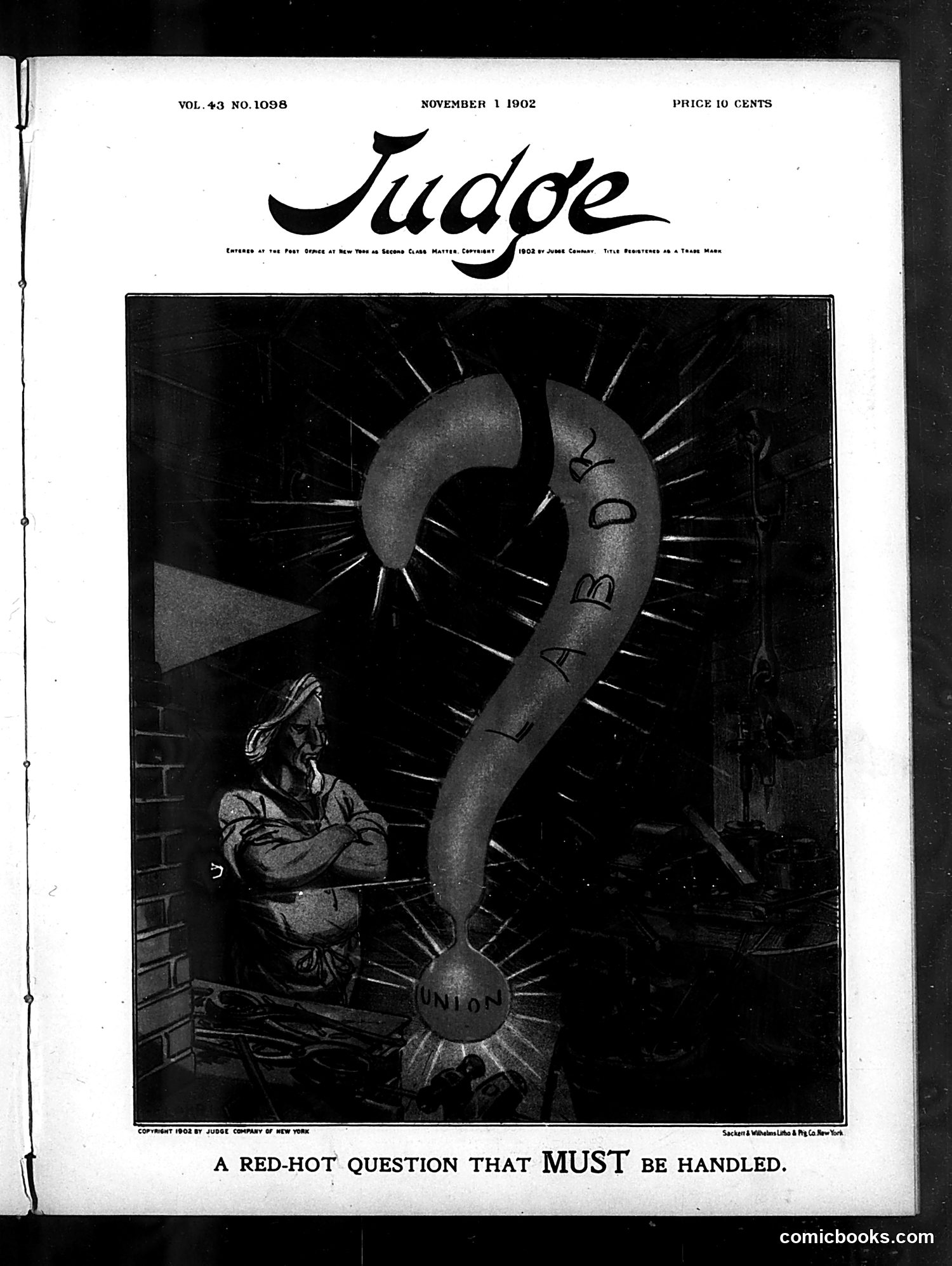
This cover depicts a large question mark labeled "LABOR" looming over a working man. The word "UNION" appears at the base. The caption reads "A RED-HOT QUESTION THAT MUST BE HANDLED." **The Satire:** The cartoon addresses labor unionization as an urgent, mysterious problem confronting American society in the early 1900s. The imposing question mark suggests uncertainty about how to approach or resolve labor issues. The worker's small size relative to the massive question mark emphasizes labor's perceived threat or complexity to the establishment. This reflects the Progressive Era's significant labor unrest, including major strikes and growing union organizing. The imagery suggests Judge's conservative perspective viewing unions and labor activism as confusing, dangerous forces requiring immediate governmental or industrial "handling."
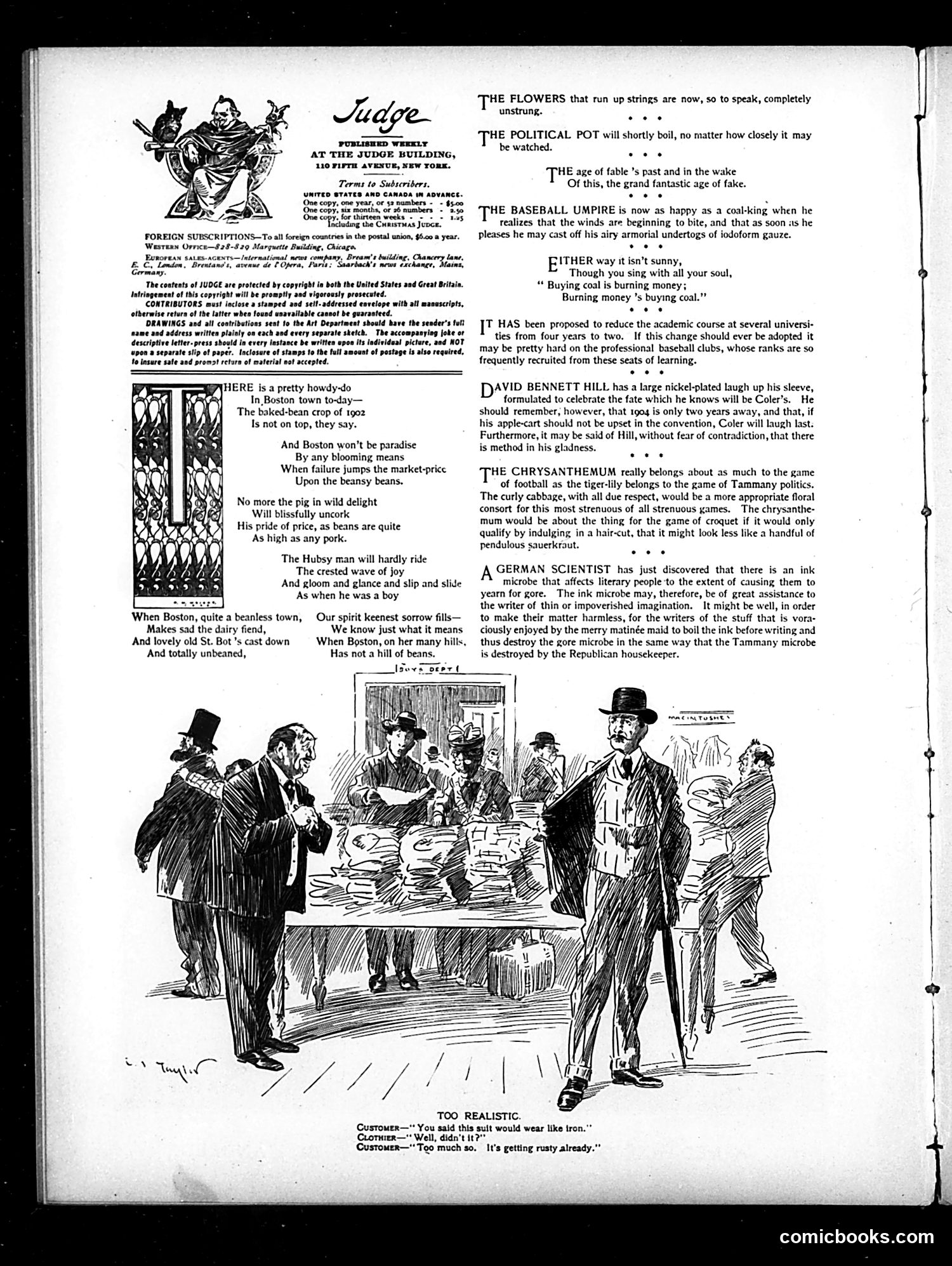
The main cartoon, titled "Too Realistic," depicts a clothing shop scene. A customer complains that a suit claimed to be "iron" is getting rusty already. The clothier responds "Well, didn't it?" — the joke being that iron inevitably rusts, so the suit's poor quality literally matches its advertised material. The surrounding editorial content includes commentary on Boston politics, baseball umpires, academic course reductions at universities, a David Bennett Hill political celebration, chrysanthemums, and a German scientist's discovery about ink microbes affecting literary output. These appear to be typical Judge magazine satirical pieces from the late 19th or early 20th century, mixing political observation, social commentary, and wordplay humor for educated readers. The specific political references and figures remain unclear without additional historical context.
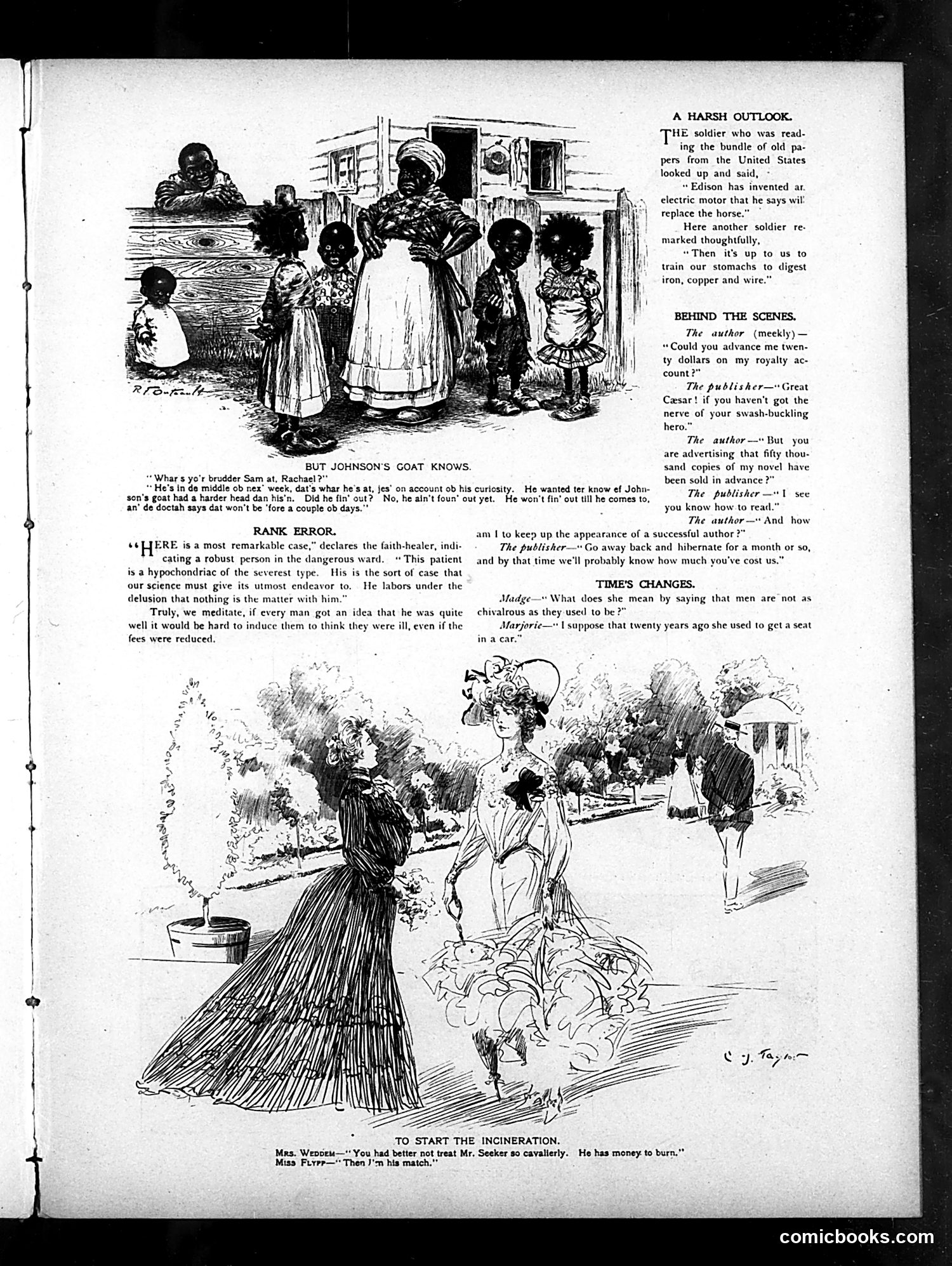
**Top Cartoon ("But Johnson's Goat Knows"):** This appears to be a humorous domestic scene involving a character named Johnson and his goat. The joke seems to rely on the goat's supposed superior judgment compared to humans—a common satirical device for mocking someone's intelligence or decision-making. **Middle Section ("Rank Error"):** A medical anecdote mocking hypochondriacs—people who imagine diseases. The satire critiques those obsessed with minor ailments while ignoring actual problems, using the example of replacing teeth rather than addressing deeper health issues. **Bottom Cartoon ("To Start the Incineration"):** A social satire about wealthy women and courtship. The dialogue suggests commentary on marriage prospects and financial motivations among the upper classes during this era. The overall page uses humor to critique social pretension and questionable judgment.
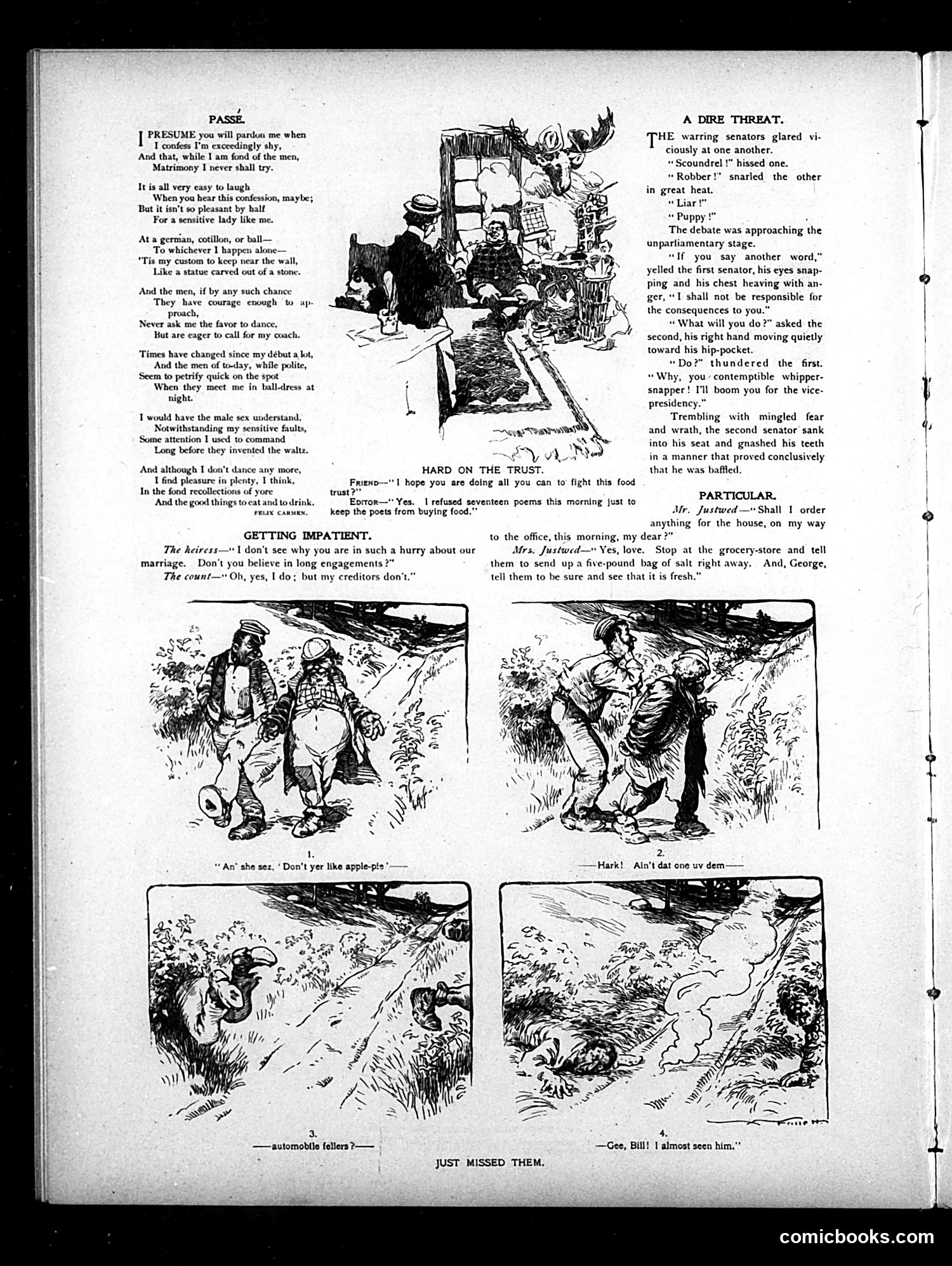
This page contains several distinct satirical pieces from *Judge* magazine: **"Passé"** and **"A Dire Threat"** are poems mocking outdated social conventions and senatorial decorum, respectively—the latter depicting senators quarreling over parliamentary procedure. **"Getting Impatient"** is a brief dialogue joke about marriage engagements. **"Hard on the Trust"** features a humorous exchange about feeding poets, likely satirizing either artistic patronage or food scarcity during an economic crisis. **"Just Missed Them"** is a four-panel comic strip showing two men chasing what appears to be an automobile or some vehicle through countryside, with dialogue suggesting they've "just missed" catching it. The humor derives from the physical comedy and the era's relationship with emerging automotive technology. The illustrations use period pen-and-ink style typical of early 20th-century American humor magazines.
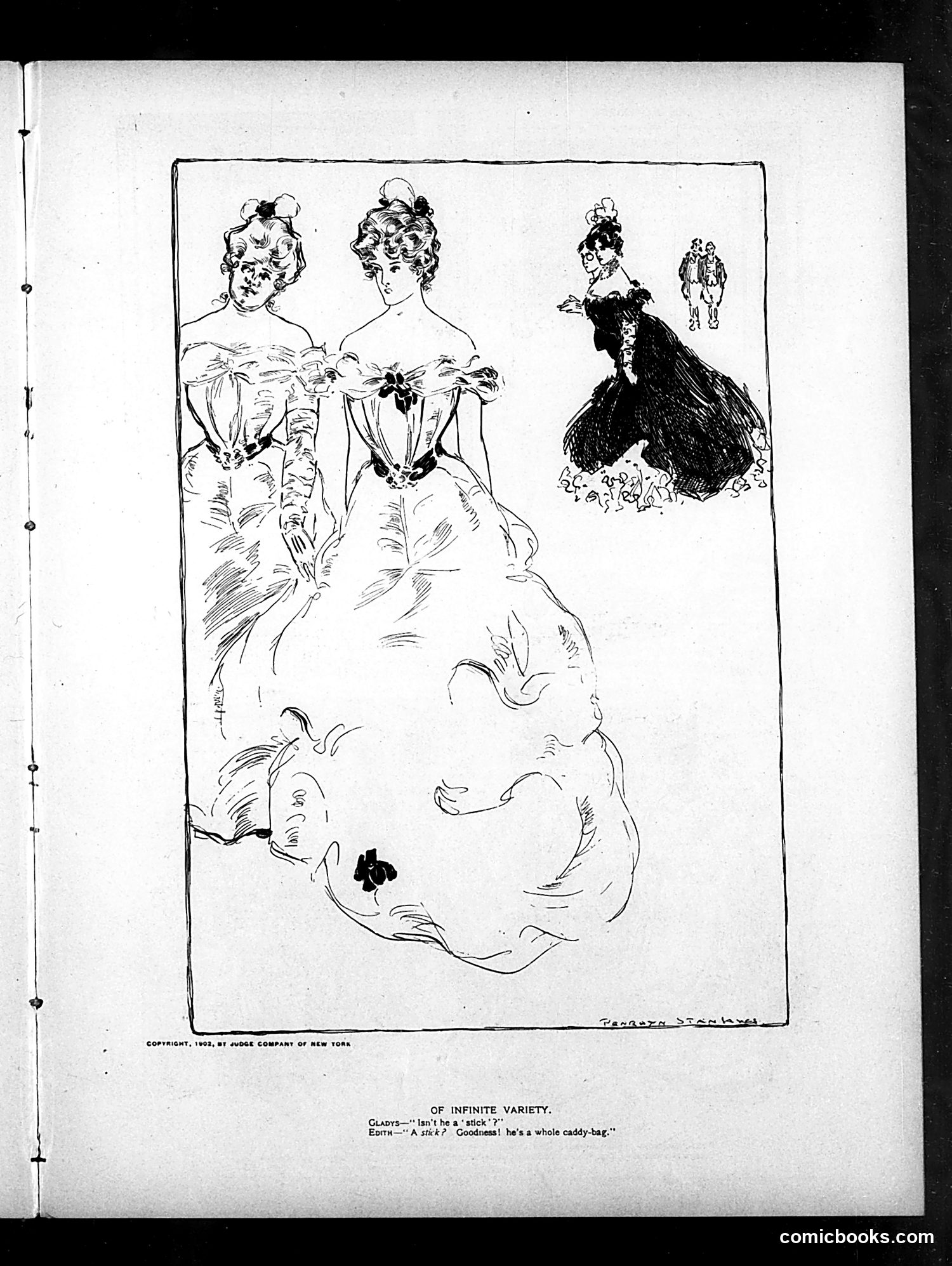
This 1902 Judge cartoon satirizes women's fashion through a conversation between two female figures (Gladys and Edna). The main illustration shows two elegantly dressed women in elaborate gowns with full skirts, alongside a smaller figure of a woman in a black dress. The joke plays on the term "stick"—slang for a thin, fashionable man. Edna corrects Gladys, saying the man isn't just "a stick" but "a whole caddy-bag," suggesting he's as thin and compartmentalized as a golf bag. This appears to mock the exaggerated silhouettes and corseted figures fashionable in the Edwardian era, where extreme thinness in the torso contrasted sharply with voluminous skirts. The satire critiques both male and female body ideals of the period.
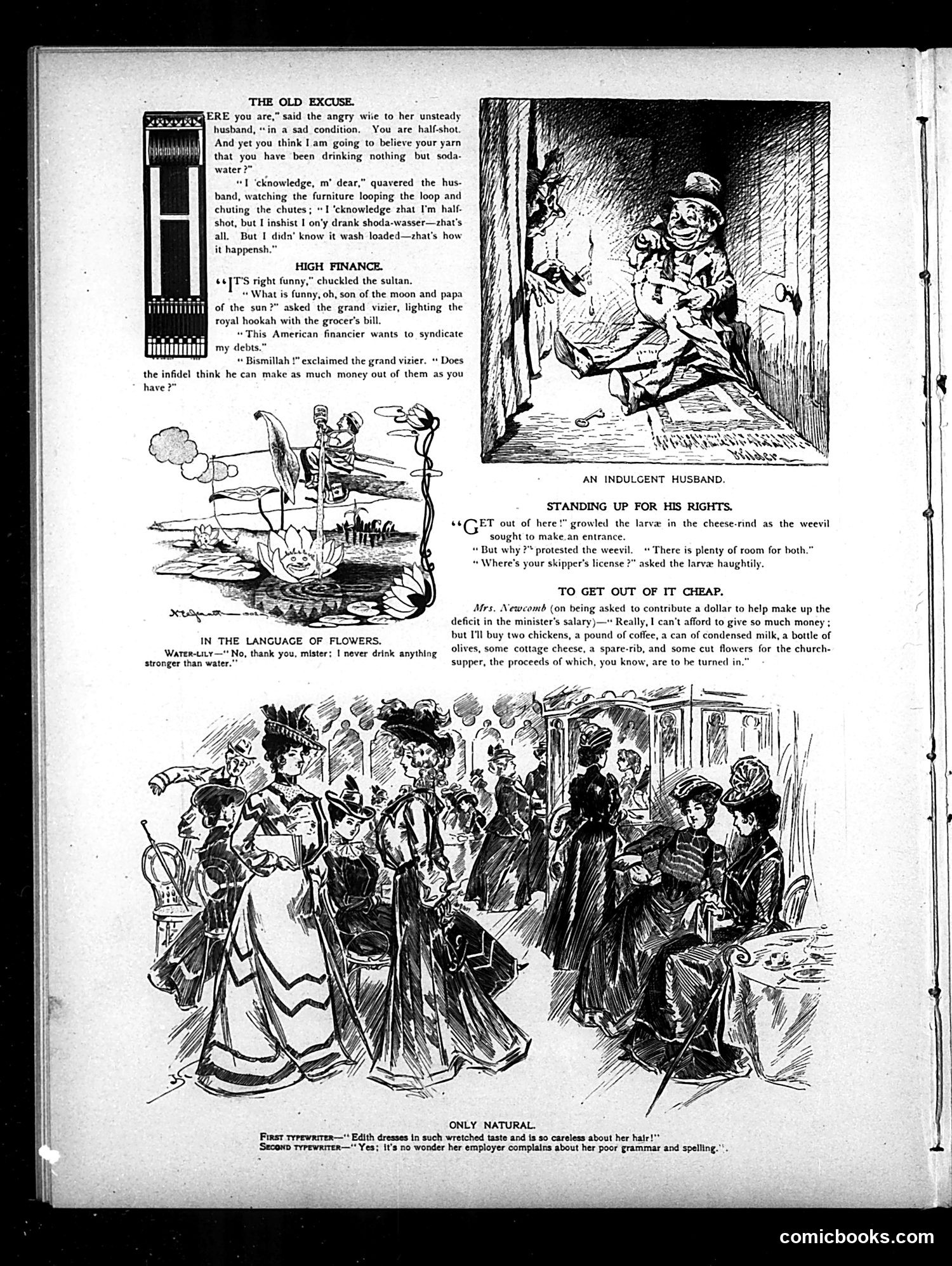
This page contains six separate satirical sketches mocking social hypocrisy and absurdity: **"The Old Excuse"**: A drunk husband claims he only drank soda water that was somehow "loaded"—a transparent lie his angry wife doesn't believe. The satire targets men who make feeble excuses for intoxication. **"High Finance"**: A sultan amuses himself that an American financier wants to "syndicate" his debts—implying the financier thinks he can profit from the sultan's financial troubles as much as the sultan has. It mocks American financial schemes and orientalist stereotypes. **"An Indulgent Husband"**: Shows a henpecked husband in domestic turmoil, illustrating marital discord. **"Standing Up for His Rights"**: A weevil and larva dispute territorial claims in a cheese-rind—absurdist humor using insects to mock petty arguments. **"To Get Out of It Cheap"**: Mrs. Newcomb avoids donating money to her minister's salary shortfall by instead buying groceries, claiming proceeds will be "turned in"—transparent self-serving charity. **"Only Natural"**: Two typists note that poor grammar and spelling naturally follow from poor taste and appearance—circular logic satirizing workplace judgments.
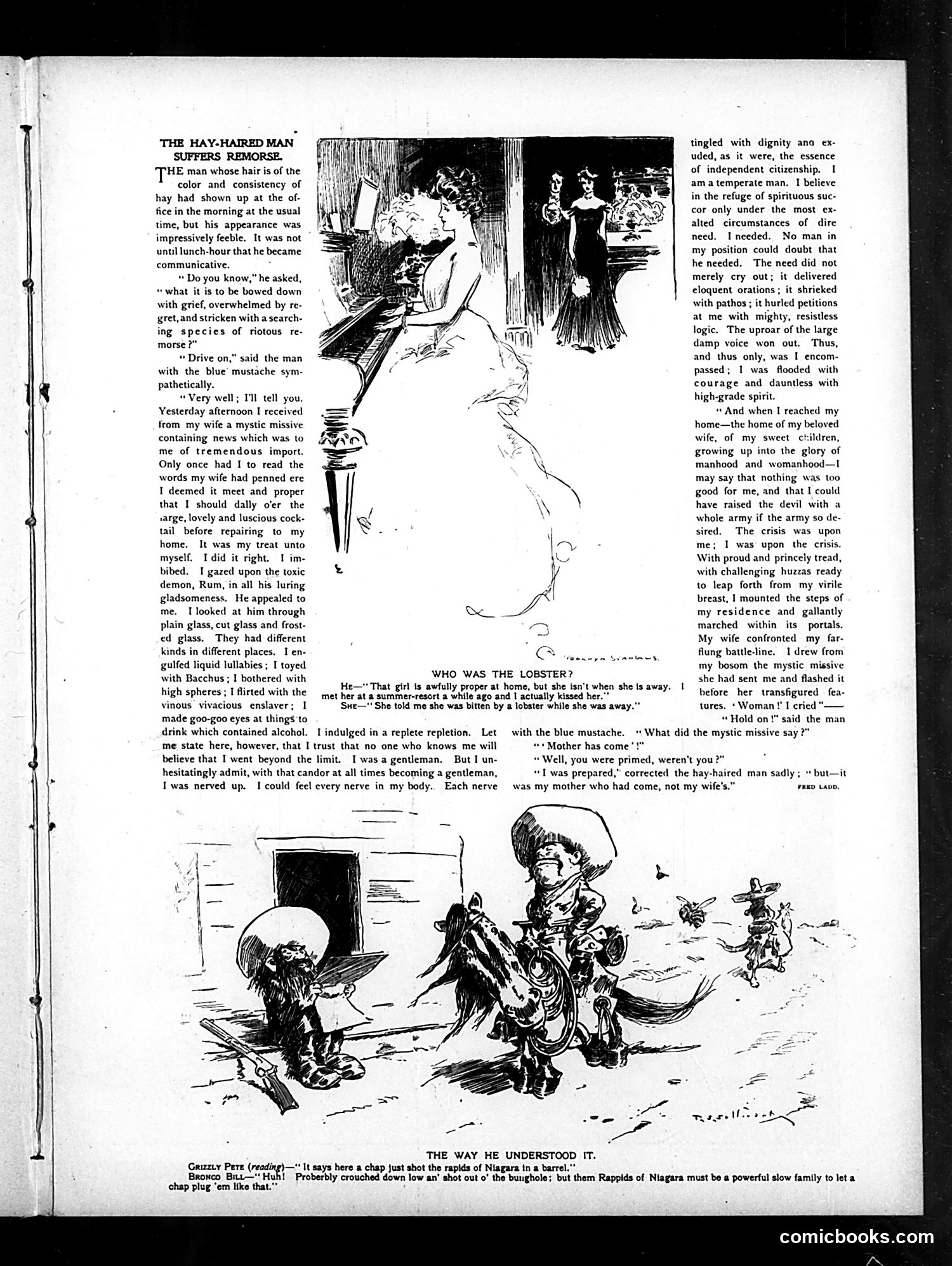
This page satirizes male excess and marital anxiety. The main story depicts a hay-colored-haired man who received urgent news from his wife, then got drunk at a bar before heading home—a classic comedic setup. His elaborate, flowery language about drinking alcohol mocks overwrought Victorian masculinity and the pretense of "gentlemanly" restraint while clearly indulging excessively. The punchline reveals his drunken courage was wasted: his *mother* arrived home instead of his wife, making his elaborate emotional preparation and inebriation absurdly unnecessary. The sidebar joke ("Who Was the Lobster?") plays on a woman's excuse—claiming a lobster bite explains a kiss received at a summer resort, when she'd actually been kissed by a man. The bottom cartoon appears to reference a misunderstood news story about Niagara Rapids, though context is unclear. The satire targets male drinking culture and domestic anxiety in early 20th-century America.
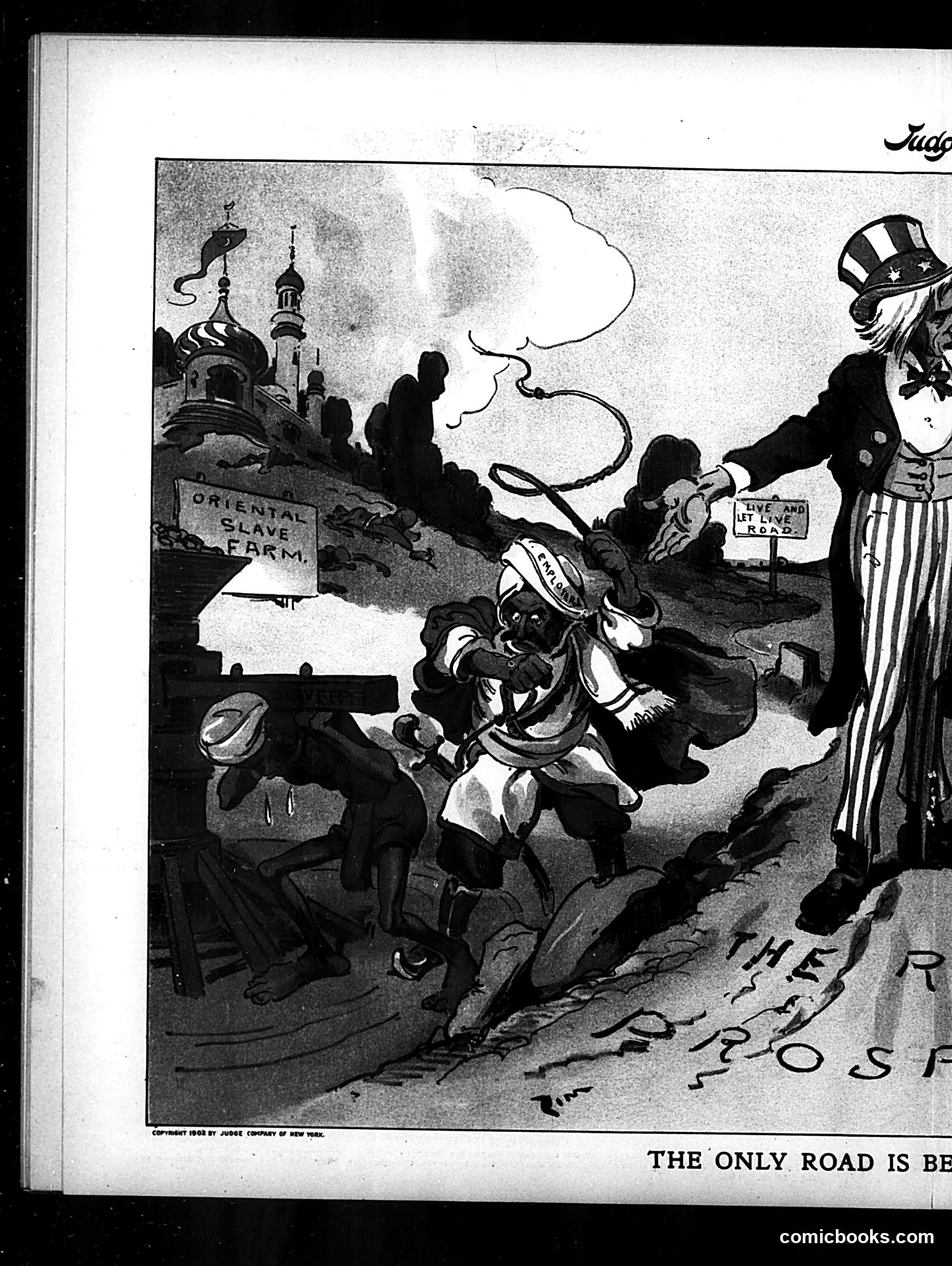
This 1902 *Judge* cartoon depicts Uncle Sam (right, in striped pants and top hat) directing traffic on a road labeled "Oriental Trade Farm." A figure appearing to represent an Asian person or stereotype is being redirected, while silhouettes of what seem to be other figures or nations appear in the background near a building with Oriental architecture. The incomplete caption "THE ONLY ROAD IS BE[...]" suggests the cartoon comments on American foreign policy regarding trade with Asia and the Orient during the early 1900s. The "Live and Let Live Road" sign visible suggests competing philosophies about international commerce. The exact political reference remains unclear without the complete caption, but it likely addresses debates over American expansion into Asian markets or colonial interests during the post-Spanish American War era.
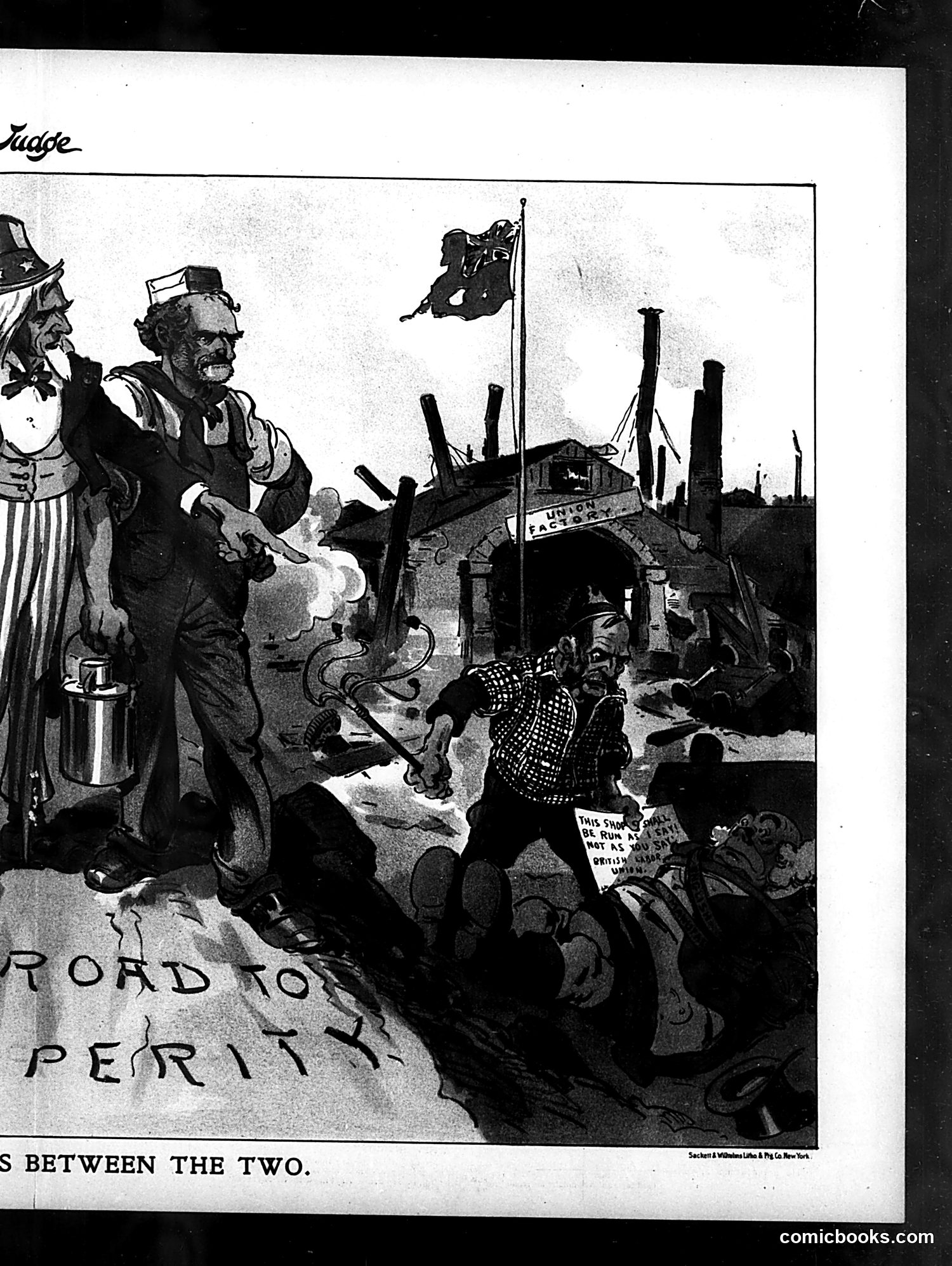
This political cartoon depicts a conflict between labor and capital during the industrial era. The caricatured figures on the left appear to represent wealthy industrialists or business interests, while those on the ground represent workers or the poor. The setting shows an industrial facility with smokestacks and a "Union" flagged building, suggesting labor-management tensions. The text "ROAD TO PERITI[Y]" (likely "ROAD TO PERDITION") on the ground indicates the cartoonist's warning about destructive conflict. The phrase "BETWEEN THE TWO" suggests the cartoon critiques how ongoing disputes between labor and industry threaten social stability. The overall message appears to warn that escalating class conflict benefits neither side, leading both toward ruin.
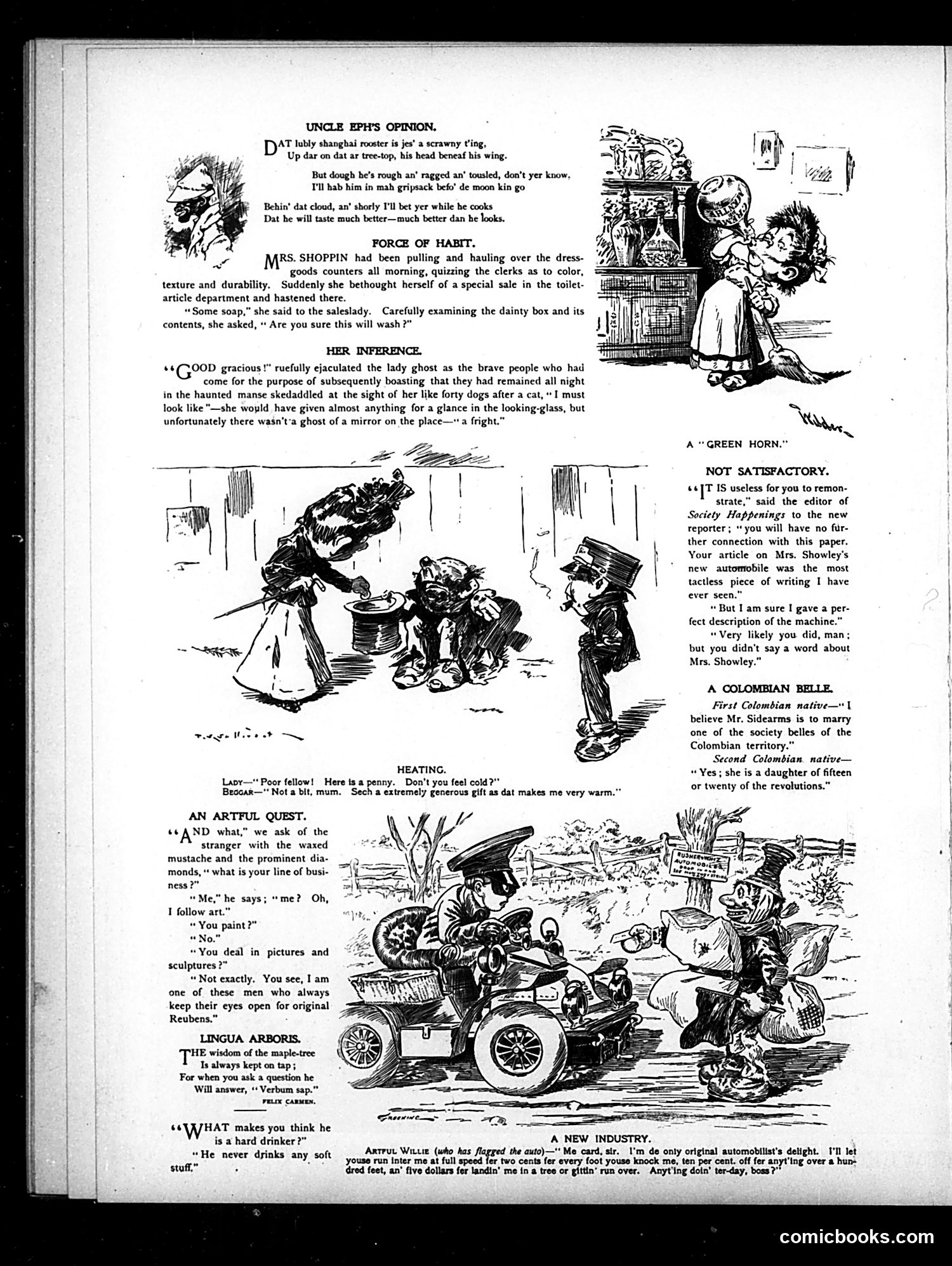
This page from the satirical magazine *Judge* contains several unrelated humorous sketches typical of early 20th-century American humor: **"Uncle Eph's Opinion"** features a dialect-speaking Black character discussing eating a rooster—reflecting the racist caricatures common to the era's "comic" representation of African Americans. **"Force of Habit"** jokes about a woman customer at a dress-goods counter asking a soap saleslady "Are you sure this will wash?"—implying the woman is so obsessed with scrutinizing merchandise that she applies her fastidious shopping habits everywhere. **"Her Inference"** is a ghost-story joke: a female ghost laments she has no mirror to see why people fled from her, ironically suggesting she must look like "a fright." **"Not Satisfactory"** satirizes newspaper reporting—a society editor criticizes a reporter's detailed description of Mrs. Showley's automobile for failing to mention Mrs. Showley herself. **"A Colombian Belle"** makes a dark political joke about Colombia's frequent revolutions by quipping the bride is "a daughter of fifteen or twenty of the revolutions." The remaining sketches are brief wordplay jokes. The content reflects period attitudes and editorial priorities.
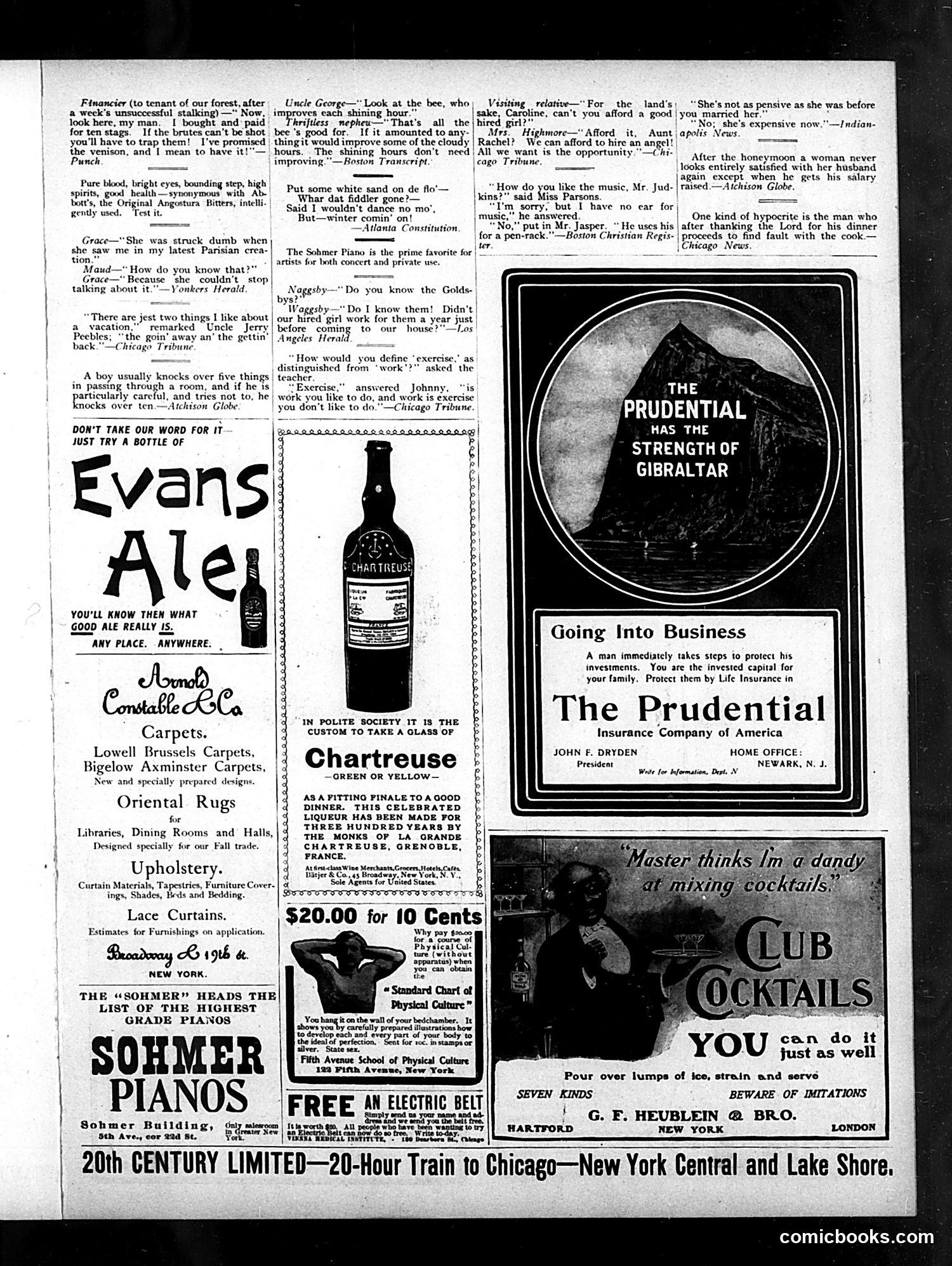
This is primarily an **advertising page** from Judge magazine, with several small comic vignettes scattered between ads. The visible cartoons are brief, genteel humor typical of the era: 1. **"Financier to tenant"**: A wealthy man complains to a hunting guide that he paid for stags but can't shoot them—he needs the venison promised to guests. The joke mocks urban financiers' expectation that money solves everything, even nature. 2. **Various short jokes** about relationships (wives seeming less pensive after marriage), children's clumsiness, and social observations about vacation and exercise—safe, family-magazine material. The page is dominated by period **advertisements**: Evans Ale, Arnold Constable carpets, Sohmer pianos, Prudential Insurance, Chartreuse liqueur, and Club Cocktails. These ads reflect turn-of-the-century upper-middle-class consumer culture. No specific political figures or events are referenced. The humor is domestic and social rather than satirical.
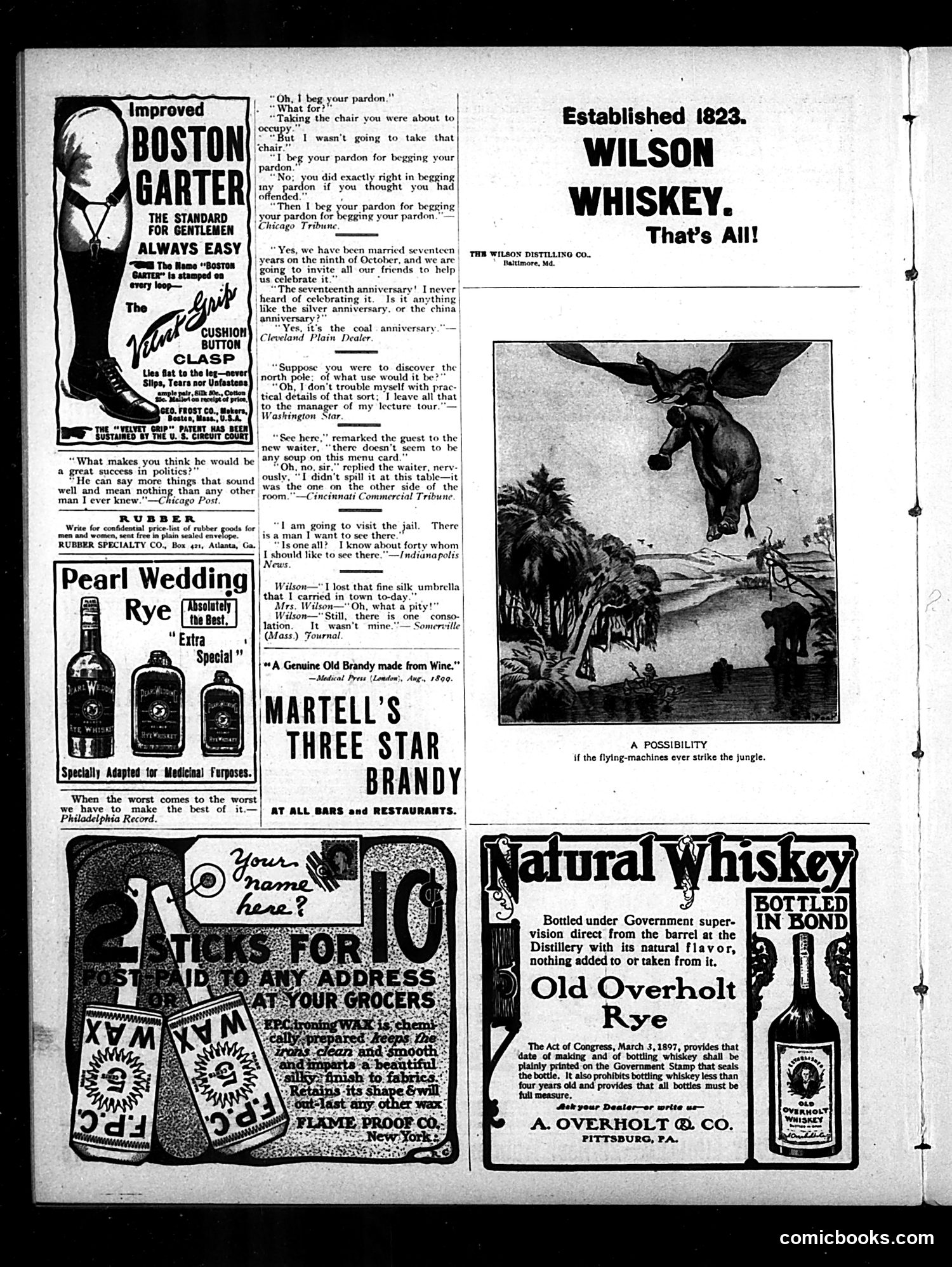
This page from Judge (a major American satirical magazine) is primarily **advertising, with scattered brief comic anecdotes** rather than a unified political cartoon. The small humor pieces mock social awkwardness and absurdity: - A dialogue about excessive apologizing ("I beg your pardon for begging your pardon") - Confusion over anniversaries (celebrating a "coal anniversary") - A waiter denying he spilled soup at the table, claiming it was "the other side of the room" - A man losing an umbrella he didn't own anyway These represent typical Judge humor: gentle mockery of everyday social situations and human foolishness. The page is dominated by **period advertisements** for alcohol (Wilson Whiskey, Pearl Wedding Rye, Martell's Brandy, Old Overholt Rye), the Boston Garter, rubber goods, and other products—reflecting Judge's business model of selling ad space to support publication. There are **no identifiable political figures or references** on this particular page.
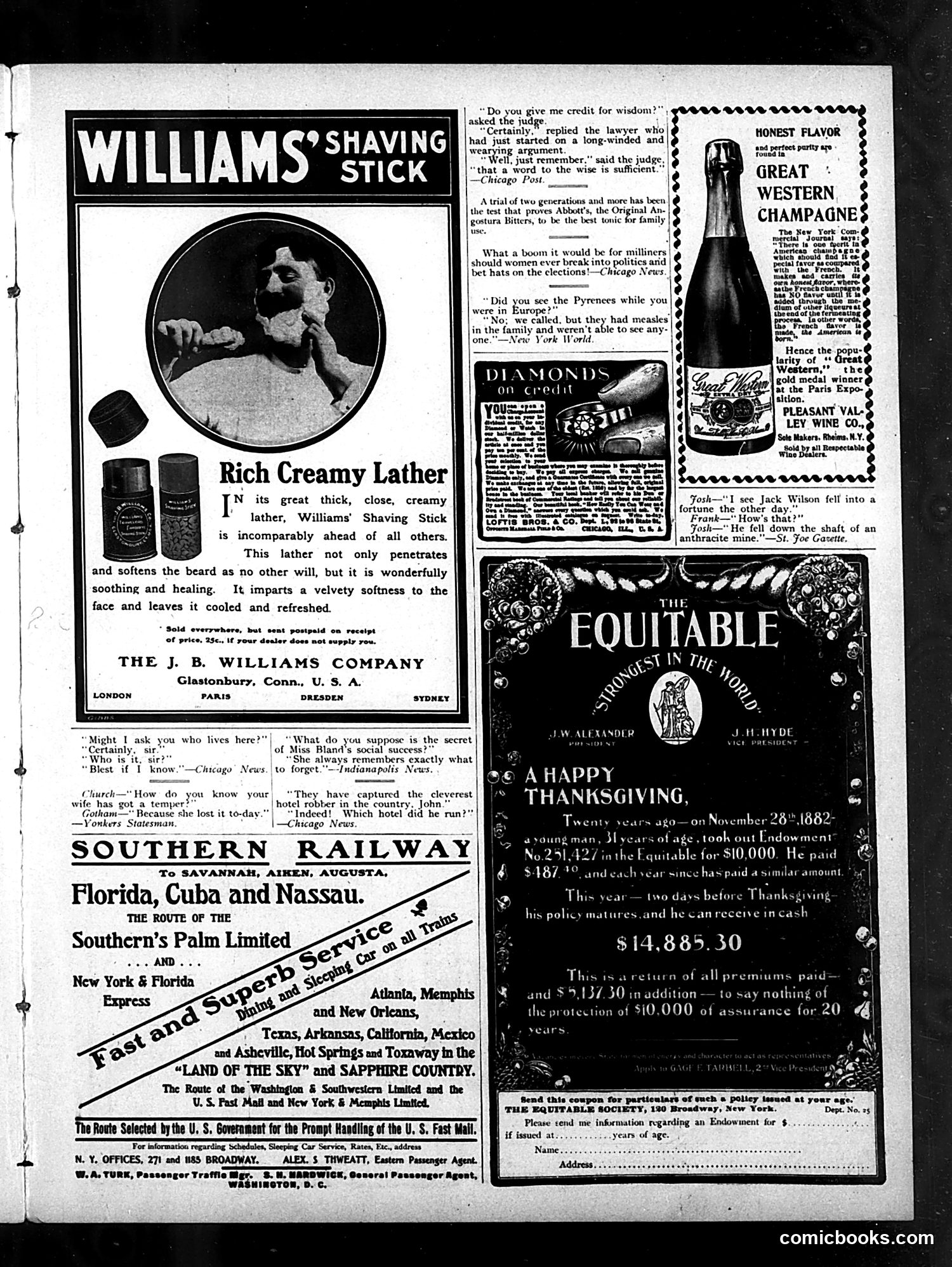
This page is primarily **advertisements and filler content** rather than political satire. The main advertisements include Williams' Shaving Stick, Great Western Champagne, Southern Railway, and The Equitable insurance company. The few jokes scattered throughout are generic humor unrelated to politics or current events—they involve wordplay about marriages, hotel robberies, and social etiquette. The "Diamonds on Credit" ad contains a mild joke about a mining accident. The Equitable insurance advertisement features a Thanksgiving narrative about a policyholder from 1882 receiving returns on his investment, but this is commercial content celebrating the company's products rather than satire. **There are no identifiable political cartoons, caricatures of public figures, or topical satire on this page.** It appears to be a typical early 20th-century magazine page mixing advertisements with light, non-controversial humor.
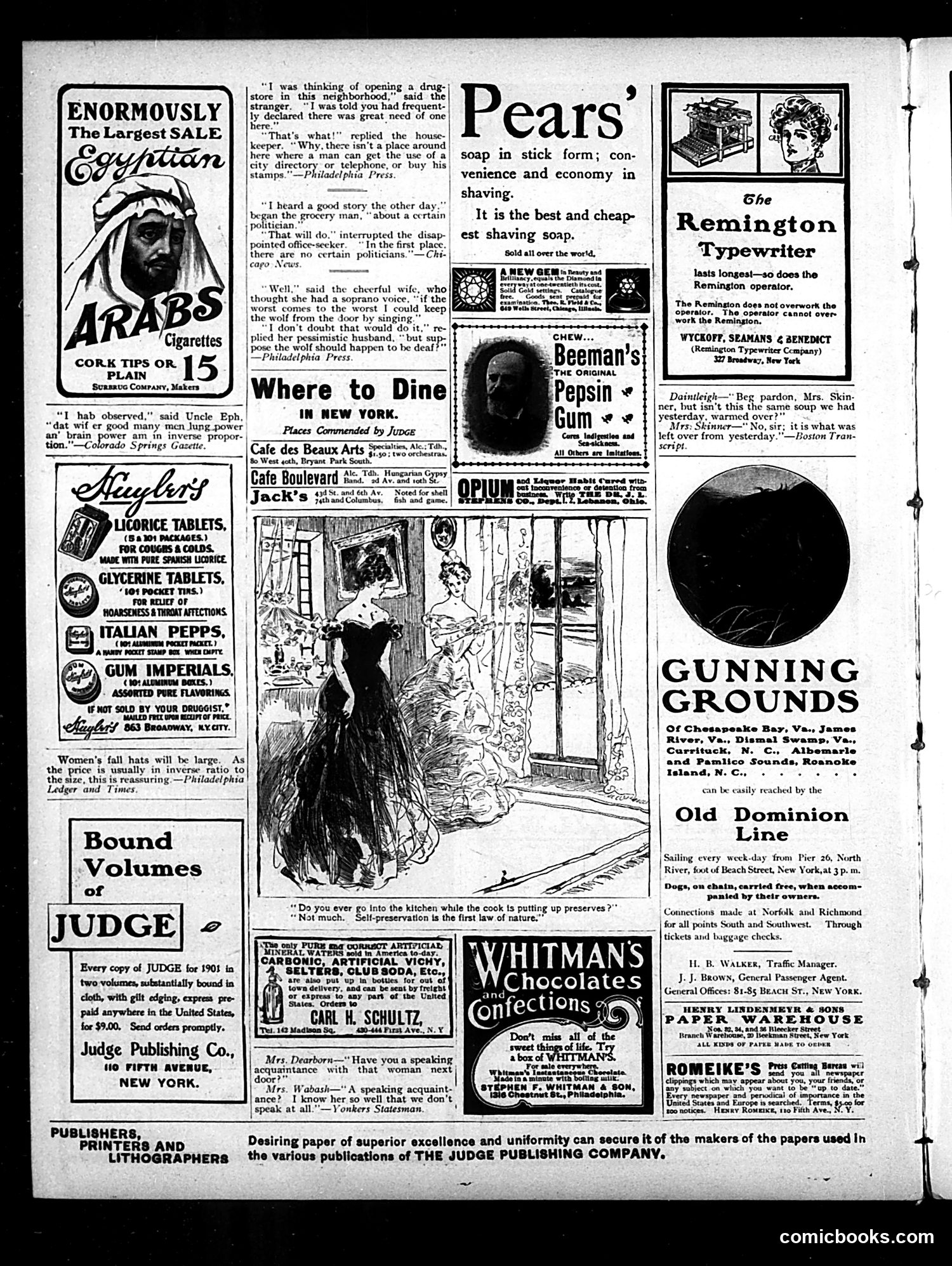
This page collects short jokes and advertisements reflecting early 20th-century American life. The humor targets recognizable social types: **Key jokes visible:** - A drugstore owner jokes that the neighborhood lacks basic services (city directory access, phone use, stamp sales)—satirizing urban neglect - A politician is dismissed as not "certain" (unreliable/dishonest)—typical political cynicism - A wife threatens to sing to keep "the wolf from the door" (pay rent through her own labor)—mocking her spouse's pessimism about her talents - A Black character (Uncle Eph) observes that men with lung power lack brain power—a crude racial stereotype common to the era **Advertisements** dominate: Pears' soap, typewriters, chocolates, restaurants, steamship lines, and paper suppliers—aimed at middle-class readers. The humor relies on class assumptions, gender stereotypes, and ethnic caricature typical of Judge's satirical approach. The page is primarily commercial rather than politically focused.
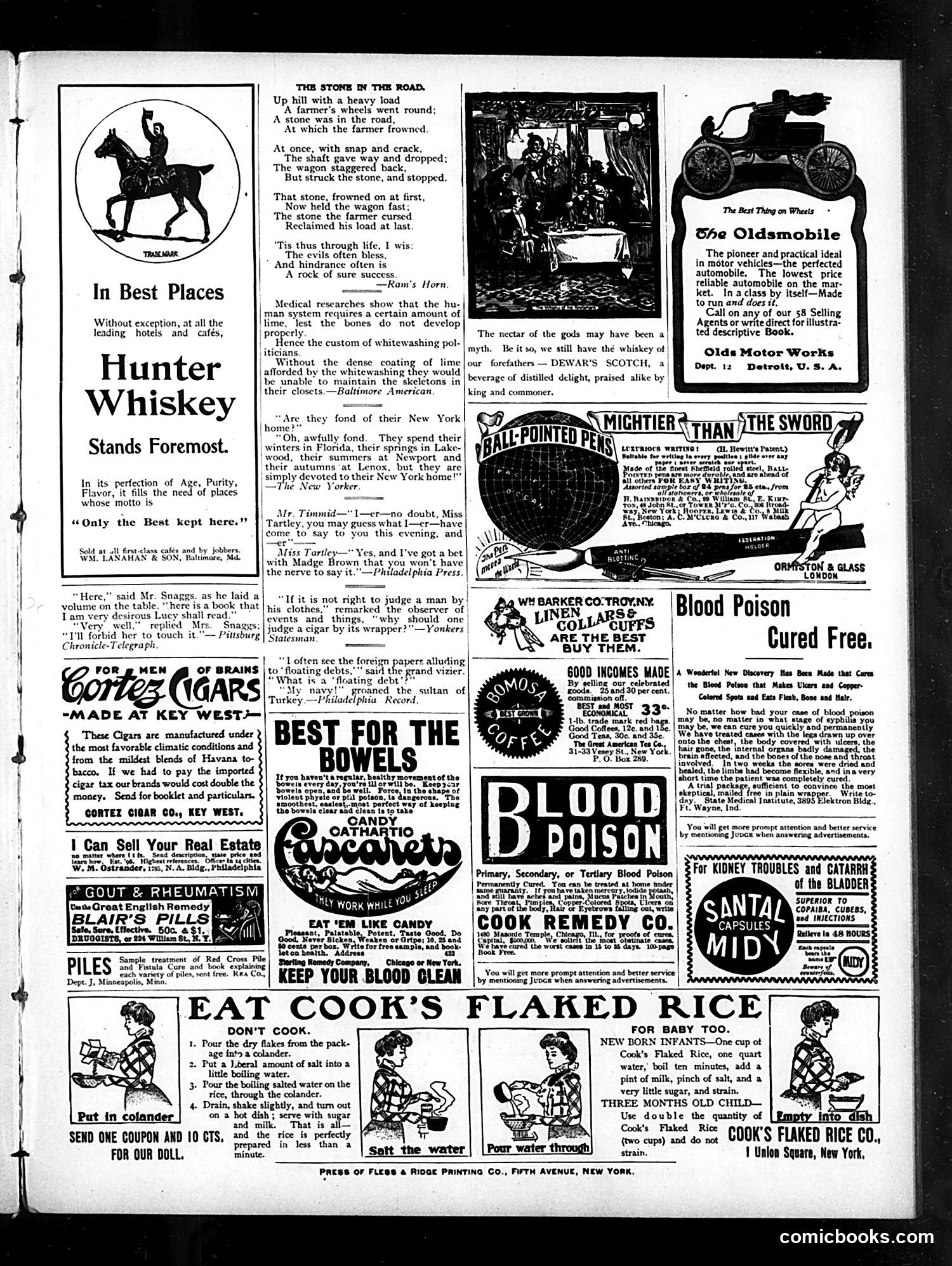
This page is primarily **advertising content** from an early 1900s American satirical magazine, with minimal cartoon satire. The main elements are commercial advertisements for products including Hunter Whiskey, Oldsmobile automobiles, Cortez cigars, and patent medicines ("Blood Poison Cured Free," "Cook's Flaked Rice"). The small narrative and humorous pieces scattered throughout are light social observations rather than political satire—such as a joke about a couple who claim to love their New York home but spend the entire year elsewhere, or observations about judging character by clothing versus cigars by wrappers. **One notable piece** is "The Stone in the Road," a moralistic poem about a farmer whose wagon wheel breaks hitting a stone, but the same stone then prevents the wagon from rolling away—suggesting that life's obstacles can become blessings. The page reflects **late-19th/early-20th century consumer culture** and patent medicine marketing, which often made dubious health claims alongside mainstream advertisements for automobiles and whiskey.
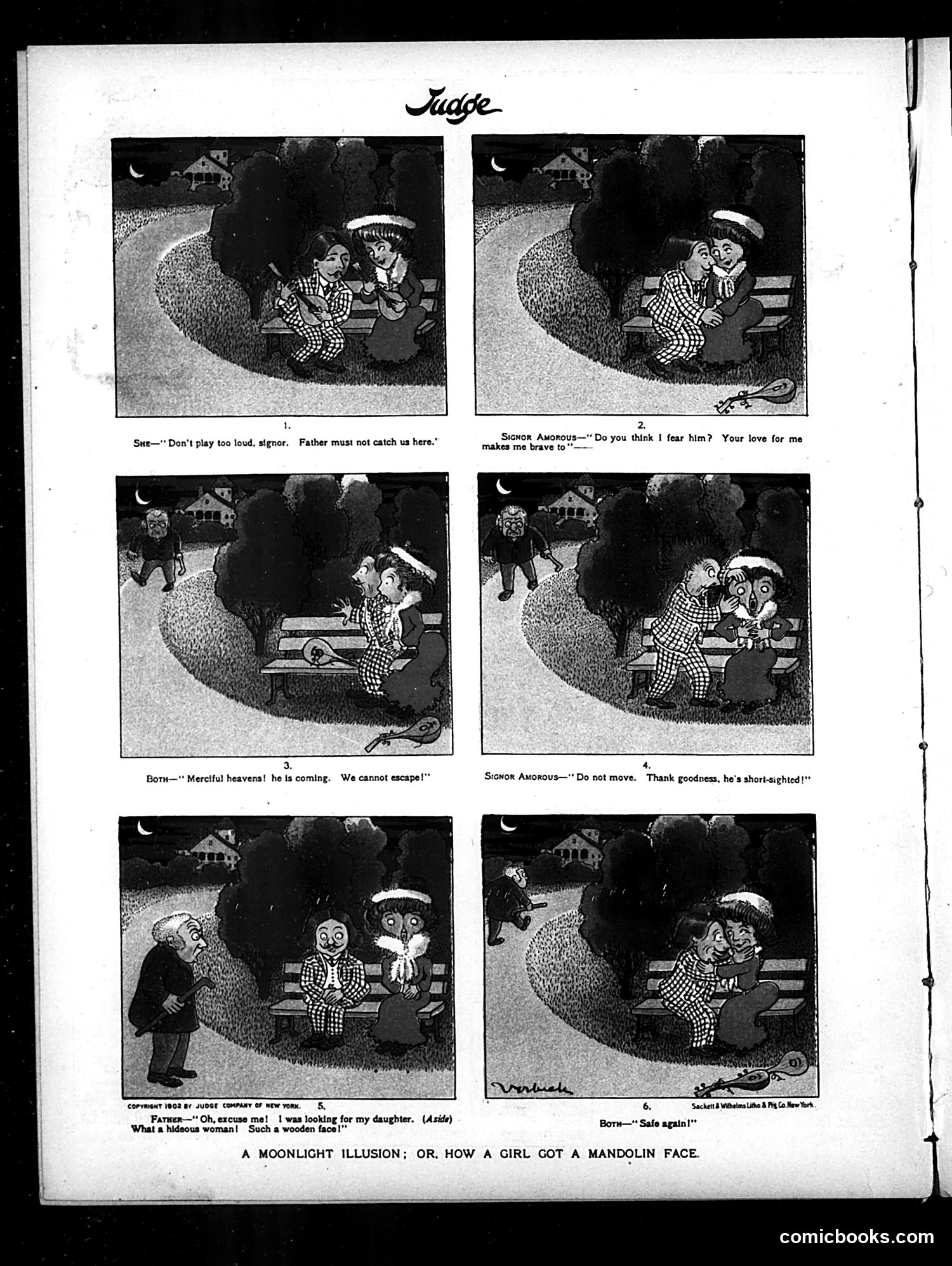
This six-panel comic from Judge (1902) depicts a courtship scandal. A young couple—Sue and a suitor playing mandolin—embrace on a park bench at night while her father searches for her. When the father approaches, the couple freezes. The father, unable to see clearly ("short-sighted"), mistakes the girl's face in the moonlight for the mandolin's rounded shape, thinking he's found his daughter but is confused by her grotesque appearance ("wooden face"). The joke turns on visual confusion and the era's social anxiety about unchaperoned courting. The "mandolin face" refers to the instrument's round body obscuring the girl's features. The satire mocks both paternal surveillance of daughters and the absurdity of moonlit misidentification—a common comedic device in early 20th-century humor about romance and parental authority.