
A complete issue · 16 pages · 1902
Judge — September 13, 1902
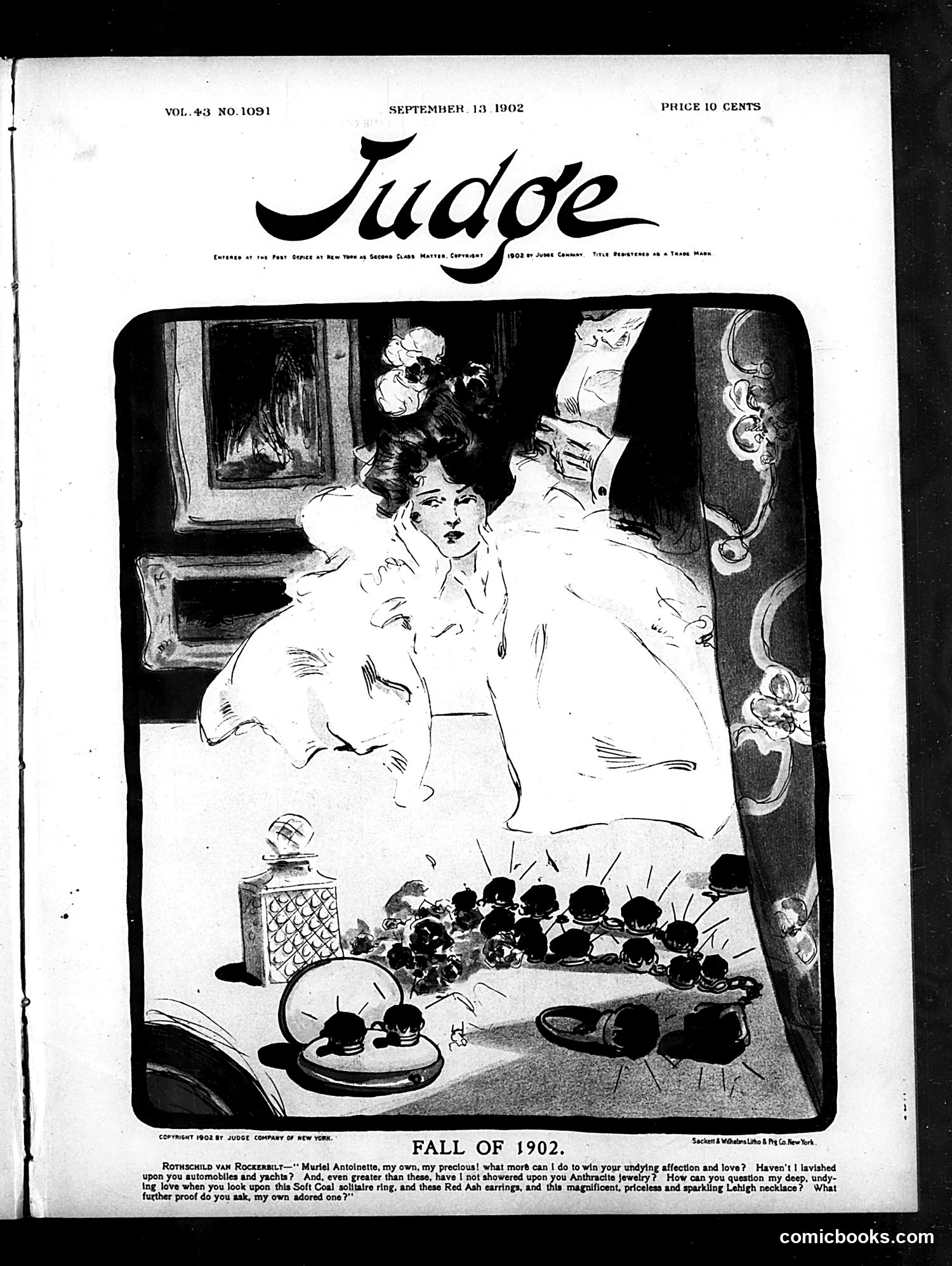
This cartoon satirizes **Rothschild van Rockefeller**, apparently a fictional wealthy character representing American robber barons. The scene depicts an elegant woman in bed surrounded by luxury items—jewelry, perfume bottles, and costly accessories—while contemplating her romantic entanglements. The accompanying text mocks the character's pretensions, questioning whether his wealth genuinely demonstrates love or merely indulgence. It sarcastically references "Soft Coal stock," "Anthracite jewelry," "Red Ash earrings," and a "Leigh necklace"—likely alluding to actual business interests and scandals of wealthy industrialists during the Gilded Age. The joke critiques both wealthy men's use of material gifts to substitute for genuine affection and the superficiality of high society.
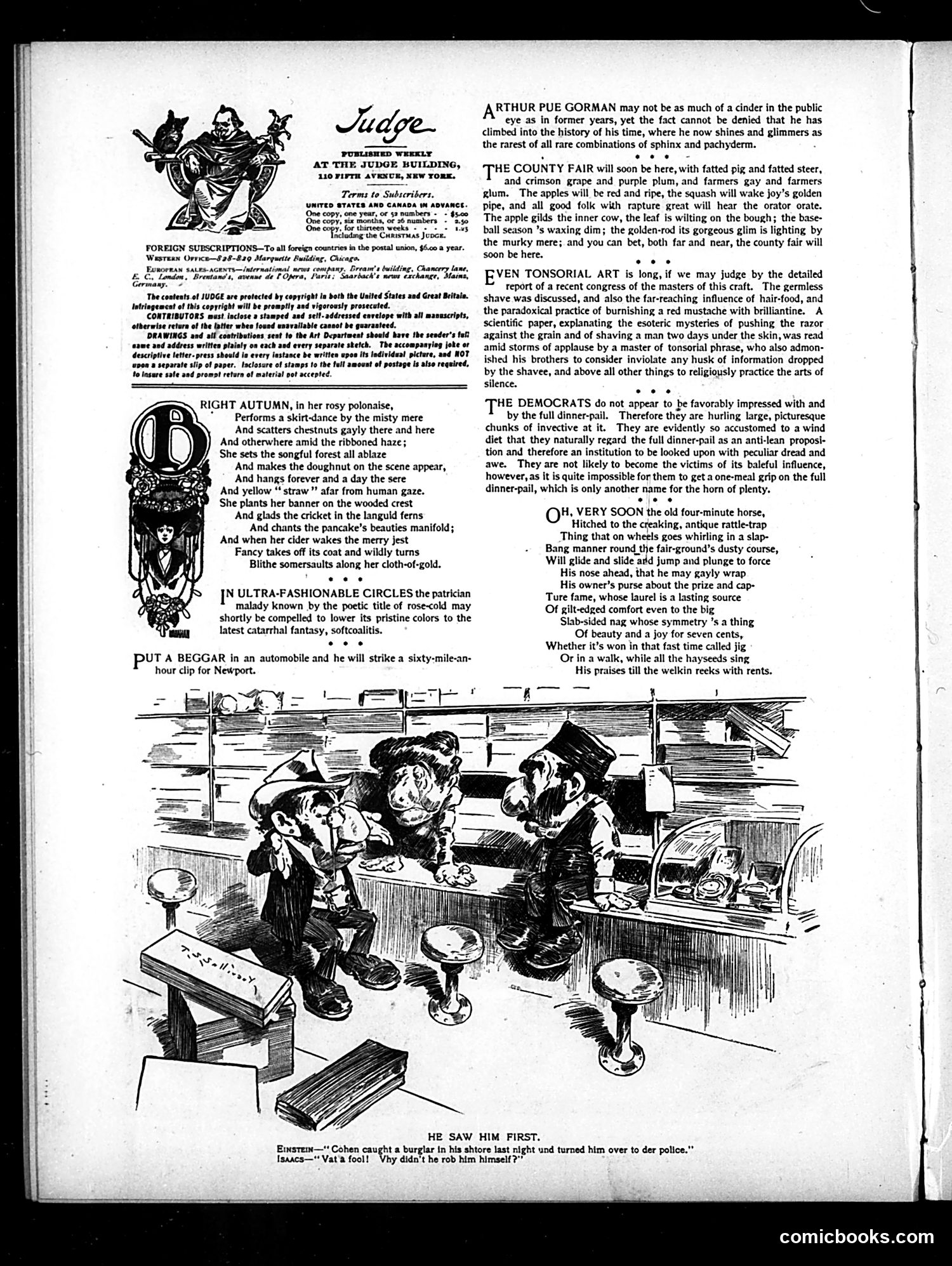
This page contains several distinct sections: **Top Editorial**: Brief commentary on Arthur Pue Gorman (a Democratic politician), county fairs, and tonsorial art (barbering practices). **Main Cartoon "He Saw Him First"**: Depicts what appears to be police or law enforcement figures discovering a burglar. The caption suggests Einstein caught a burglar and turned him over to police, with Isaac making a joke about the criminal robbing himself. This is a visual pun playing on names/circumstances. **Poetry Section "Right Autumn"**: A romantic poem about autumn scenery—unrelated to satire. **"Oh, Very Soon"**: Another poem describing a horse and carriage, likely satirizing some contemporary transportation trend. The page mixes light humor, poetry, and social commentary typical of Judge magazine's format. Without specific historical context, the exact political targets remain unclear, though the tone is characteristically irreverent.
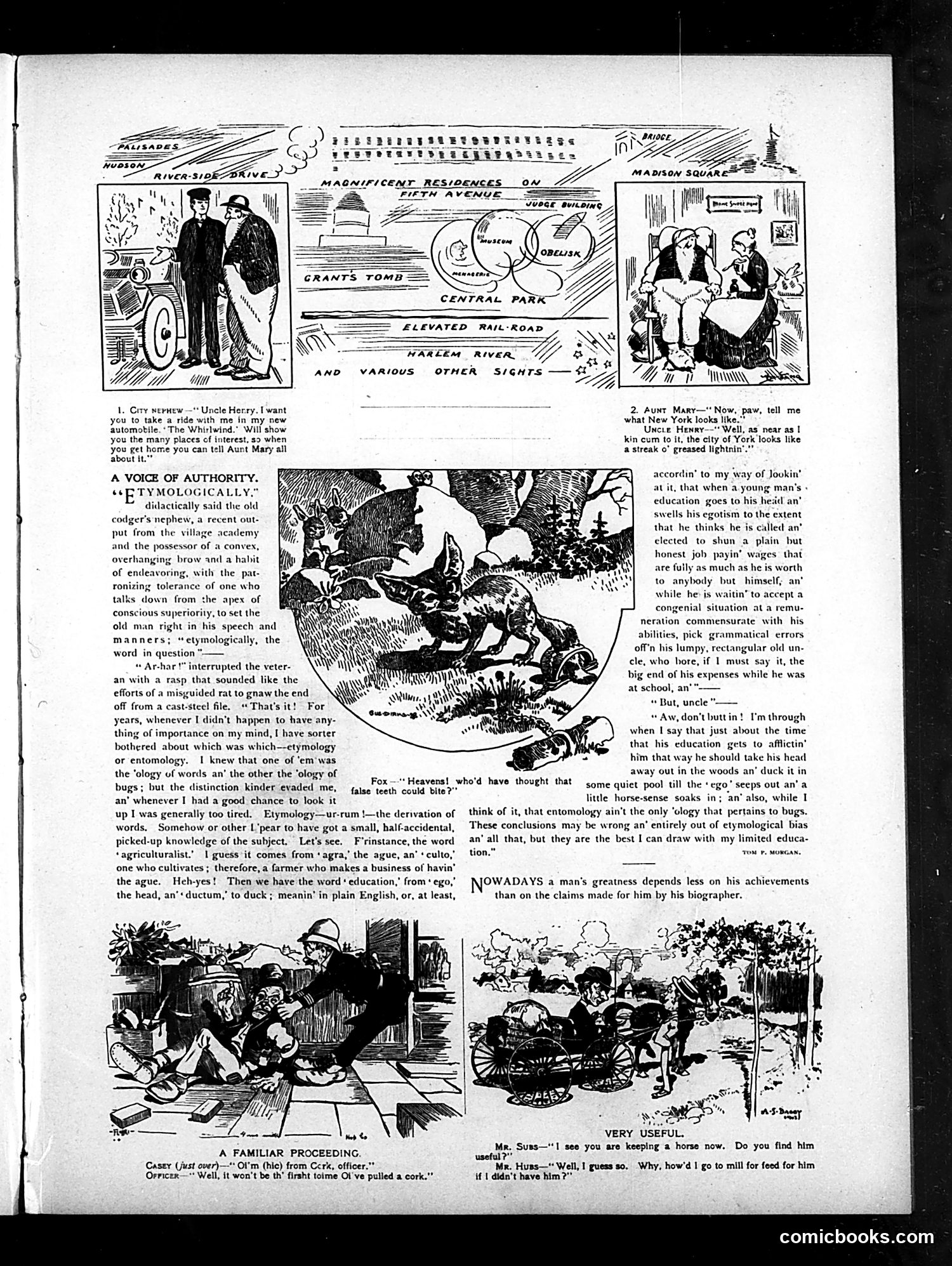
This page contains three distinct items: **Top section**: A comic strip showing Uncle Henry taking Aunt Mary on a tour of New York City landmarks (Grant's Tomb, Central Park, Fifth Avenue residences, the elevated railway, Harlem River). **Middle section**: "A Voice of Authority" — a satirical piece mocking pedantic uncle figures who use obscure vocabulary and correct others' grammar. The text ridicules such men as self-important bores who misuse etymology and inflict tedious "education" on family members. **Bottom cartoons**: "A Familiar Proceeding" and "Very Useful" — domestic humor scenes involving a cork-pulling incident and a man buying a horse for mill feed. The satire targets pretentious, garrulous relatives who weaponize education as social dominance—a common Judge target for early-20th-century American readers familiar with such family archetypes.
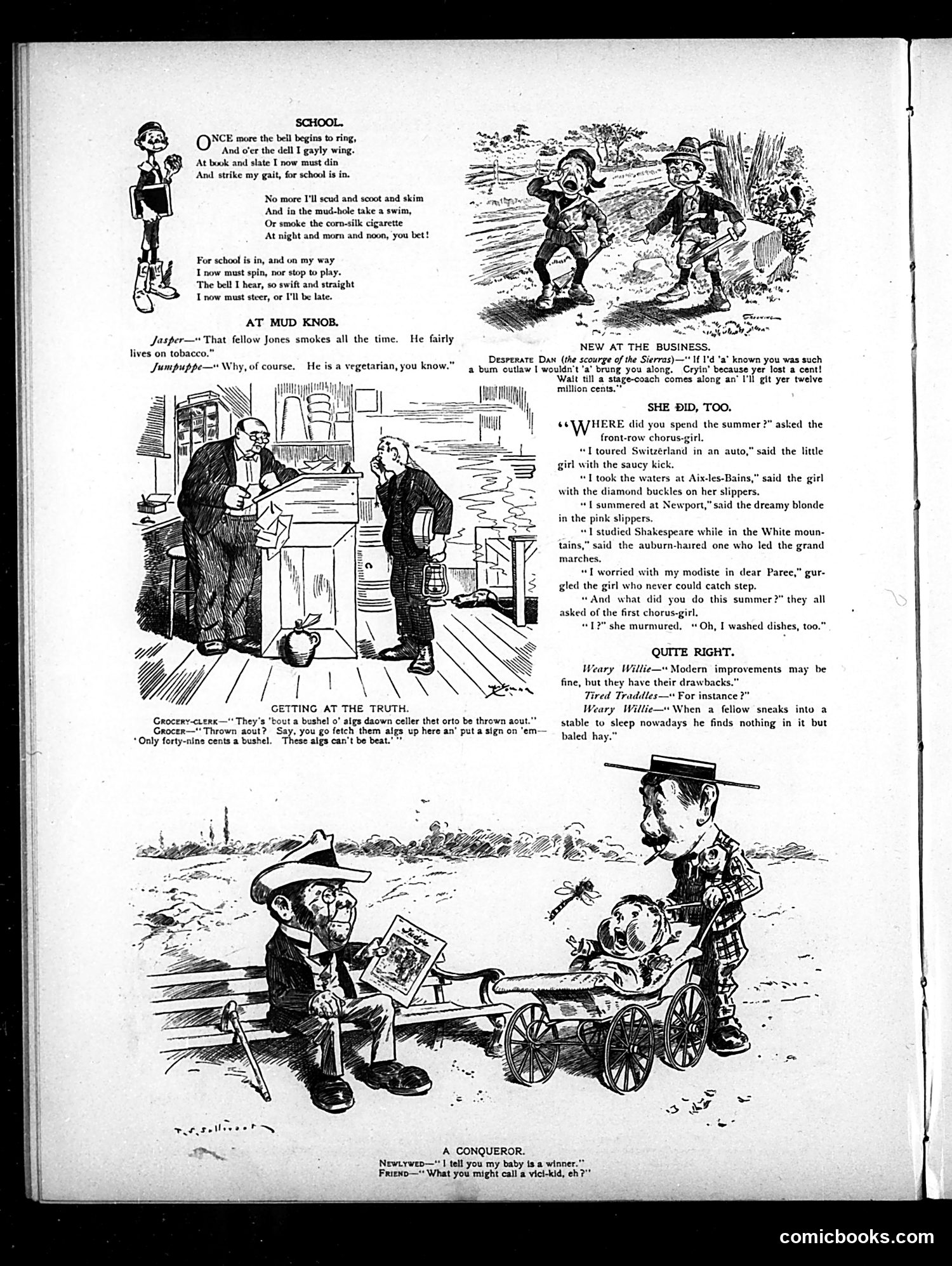
This page contains several humorous sketches and dialogues typical of early 20th-century American humor: **"School"** opens with a poem about truancy and mischief. **"At Mud Knob"** presents a conversation where one character defends a heavy smoker as "vegetarian," a joke about unconventional excuses. **"She Did, Too"** satirizes wealthy women's summer tourism, with a chorus girl listing fashionable destinations (Switzerland, Newport, the White Mountains) before revealing she simply "washed dishes." **"Getting at the Truth"** depicts a grocer and clerk discussing billing disputes. **"Quite Right"** contains brief witticisms about modern life's disappointments. **"A Conqueror"** shows a street vendor claiming his baby is a "winner" while peddling toys—likely mocking commercialized childhood or boastful parenting. The humor targets class pretensions, materialism, and everyday absurdities familiar to Judge's middle-class readership.
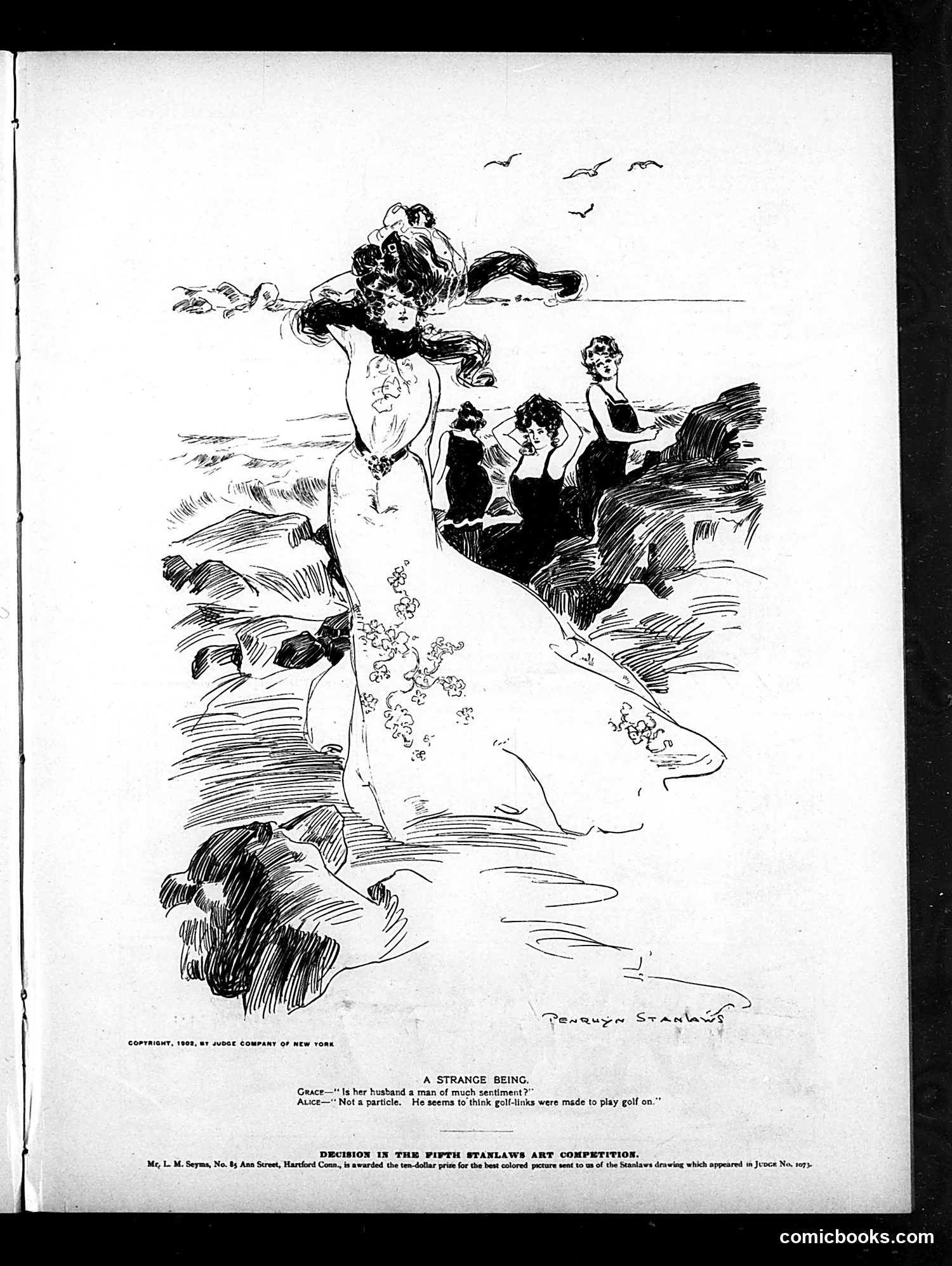
This is a society cartoon satirizing a husband's devotion to golf. The joke hinges on calling him a "strange being" because he views golf-links purely as places to play golf—implying that a sentimental man would romanticize them differently, perhaps as settings for leisure, courtship, or aesthetic appreciation. The cartoon mocks the emerging golf craze among affluent Americans in the early 1900s, portraying the obsessed golfer as emotionally stunted and literally missing the point of leisure. His wife finds it peculiar that he can't see golf as anything but the sport itself—a critique of single-minded dedication to a recreational pursuit. The page also includes a notice about an art competition won by L.M. Seyms, indicating this was part of Judge's regular reader engagement activities. Artist credit goes to Penrhyn Stanlaws.
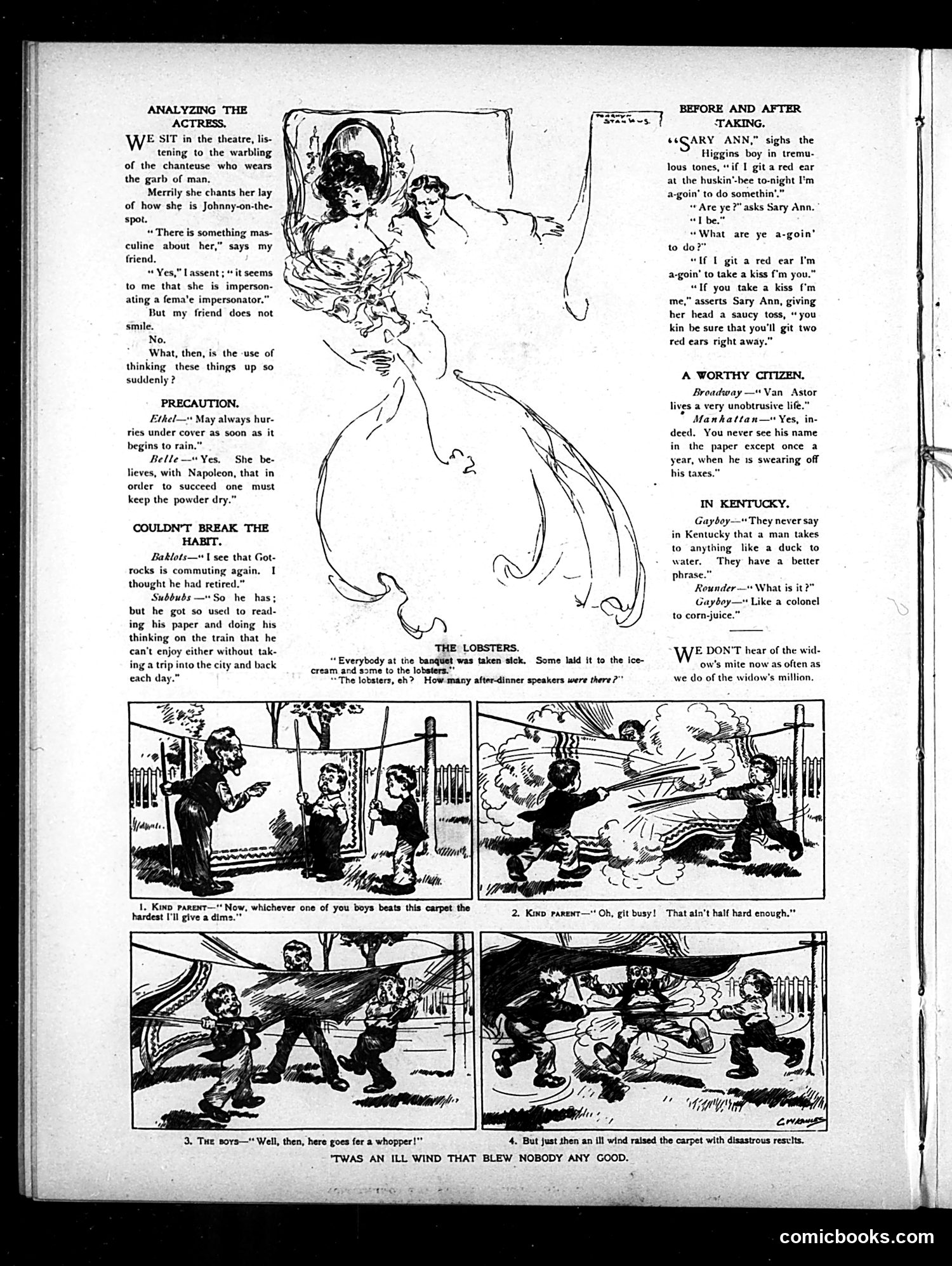
This Judge magazine page contains several brief satirical jokes typical of early 20th-century American humor: **"Analyzing the Actress"** mocks a female performer dressed as a man—likely referencing the vaudeville tradition of cross-dressing acts. The joke's humor derives from the absurdist observation that she's a "female impersonator impersonating a female impersonator." **"Precaution"** and **"Couldn't Break the Habit"** are mild domestic jokes about keeping powder dry during rain and a commuter unable to stop his newspaper-reading routine. **"Before and Taking"** depicts rural courtship banter about red ears resulting from kissing—folk belief humor. **"A Worthy Citizen"** satirizes wealthy New Yorkers (Van Astor reference) for only appearing in newspapers when evading taxes. **"In Kentucky"** stereotypes the region as heavy with alcohol ("corn-juice"). **The Lobsters comic strip** shows children playing with a carpet blown about by wind—simple slapstick with the moral that chaos benefits someone. These represent typical Judge content: society satire, ethnic/regional stereotypes, and children's mischief humor.
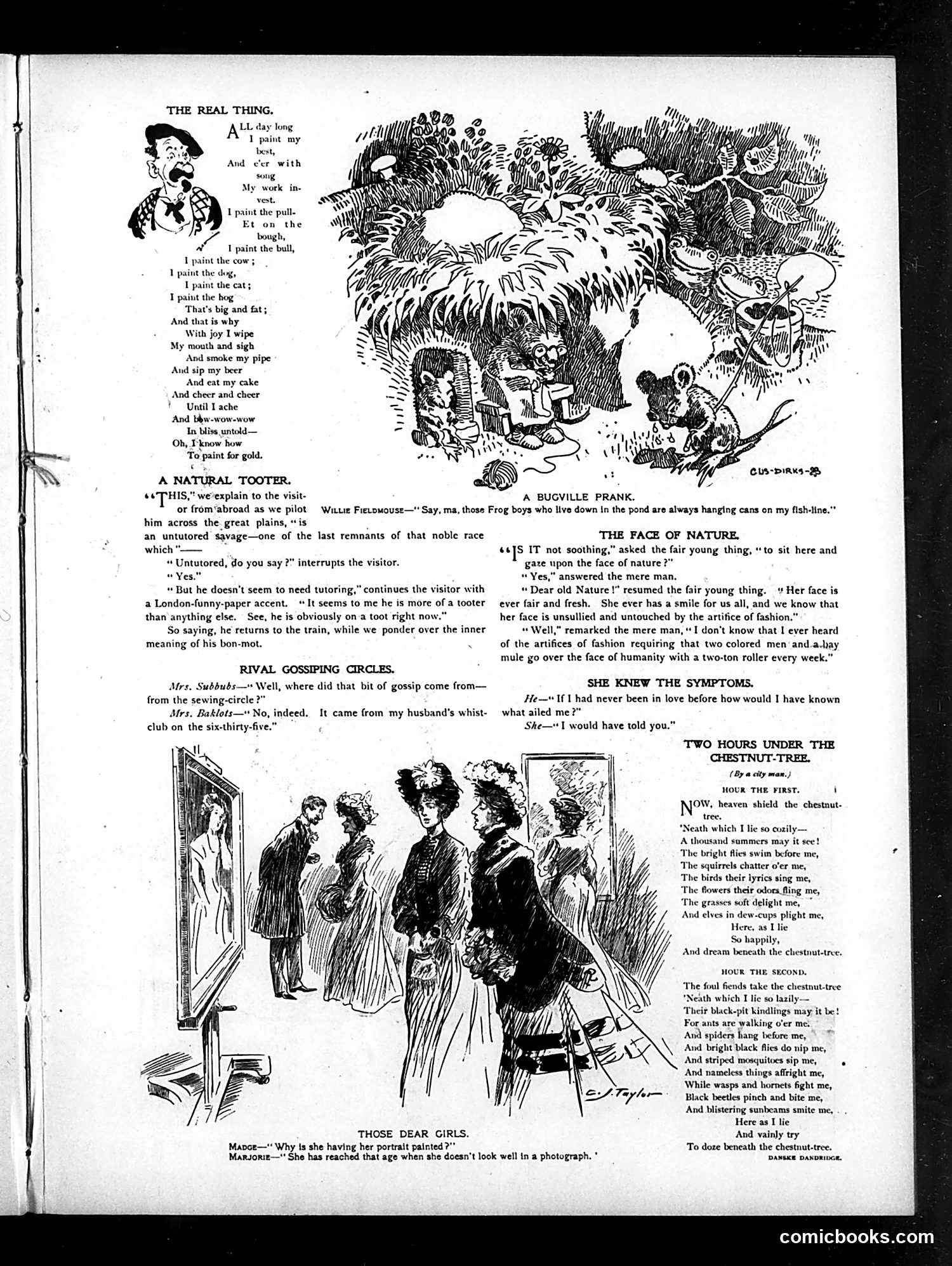
This page contains several satirical pieces typical of early 20th-century American humor: **"The Real Thing"** depicts a painter boasting he "paints for gold"—mocking artists who claim noble artistic motives while actually pursuing profit. **"A Natural Tooter"** satirizes romantic notions of Native Americans as "noble savages." A visitor deflates the pretense by noting the depicted man is simply drunk ("on a toot"), revealing the hypocrisy of such idealizing descriptions. **"Rival Gossiping Circles"** humorously suggests gossip spreads equally through women's sewing circles and men's card games—poking fun at both genders' social habits. **"Two Hours Under the Chestnut-Tree"** contrasts romantic poetry with reality: a city man's idealized meditation on nature (Hour One) becomes an insect-tormented nightmare (Hour Two), mocking sentimental nature writing. The remaining pieces are light observational humor about portraits, love, and pranks—typical Judge fare with no specific political reference.
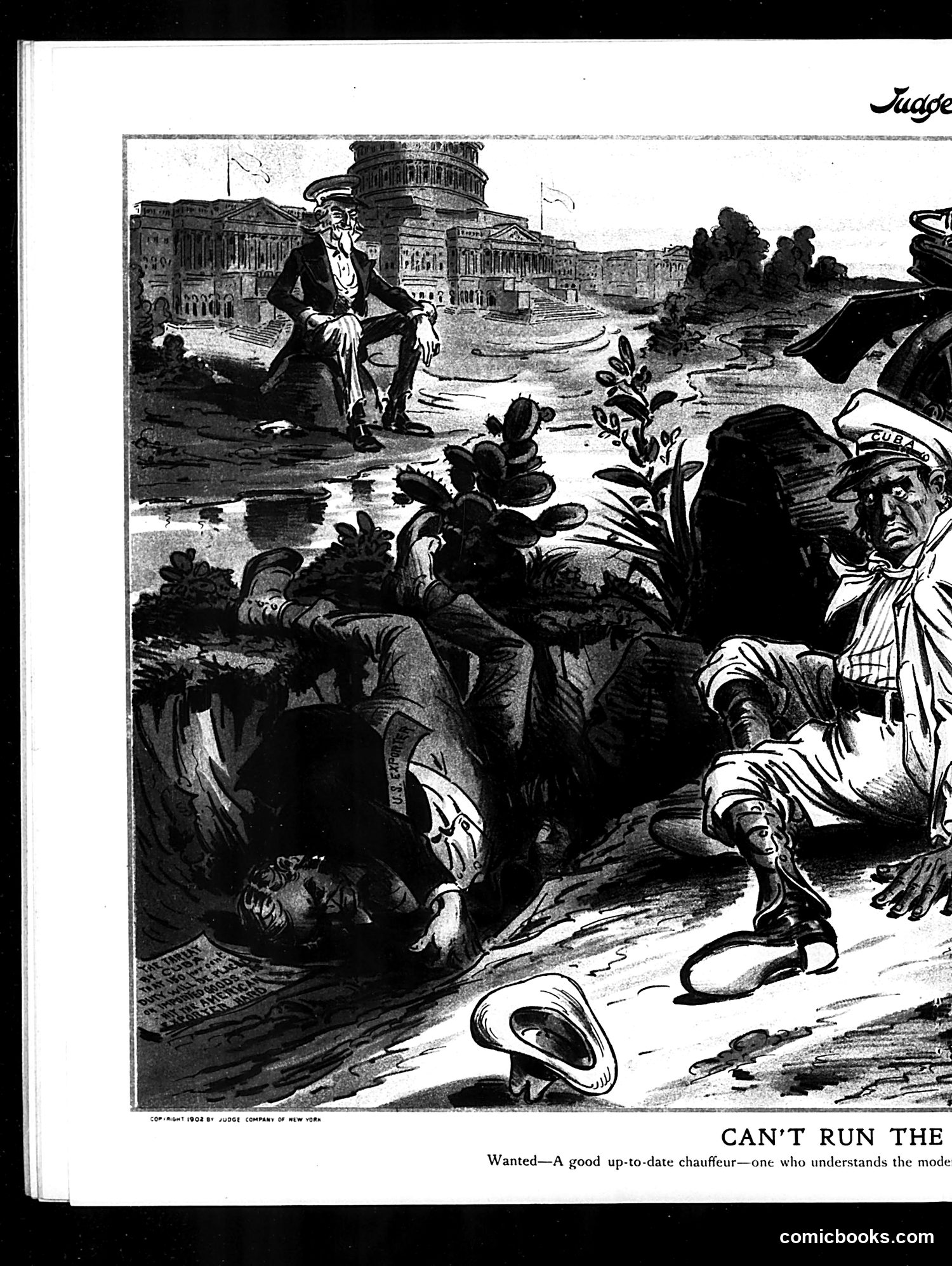
This Judge magazine cartoon satirizes the chaos of early automobile culture in Washington, D.C. The scene depicts a well-dressed gentleman (likely representing a government official or politician) sitting calmly amid vehicular disorder—overturned cars, scattered hats, and disheveled people sprawled about near the Capitol building. The "Wanted" advertisement requests "a good up-to-date chauffeur" who "understands the mode[rn]" (text cuts off). The satire mocks both the incompetence of early drivers and the broader difficulty of managing this new transportation technology in the nation's capital. The contrast between the composed gentleman and the surrounding chaos emphasizes how dangerous and unpredictable automobiles were in this era, making the job of chauffeur absurdly difficult—perhaps impossible to fill competently.
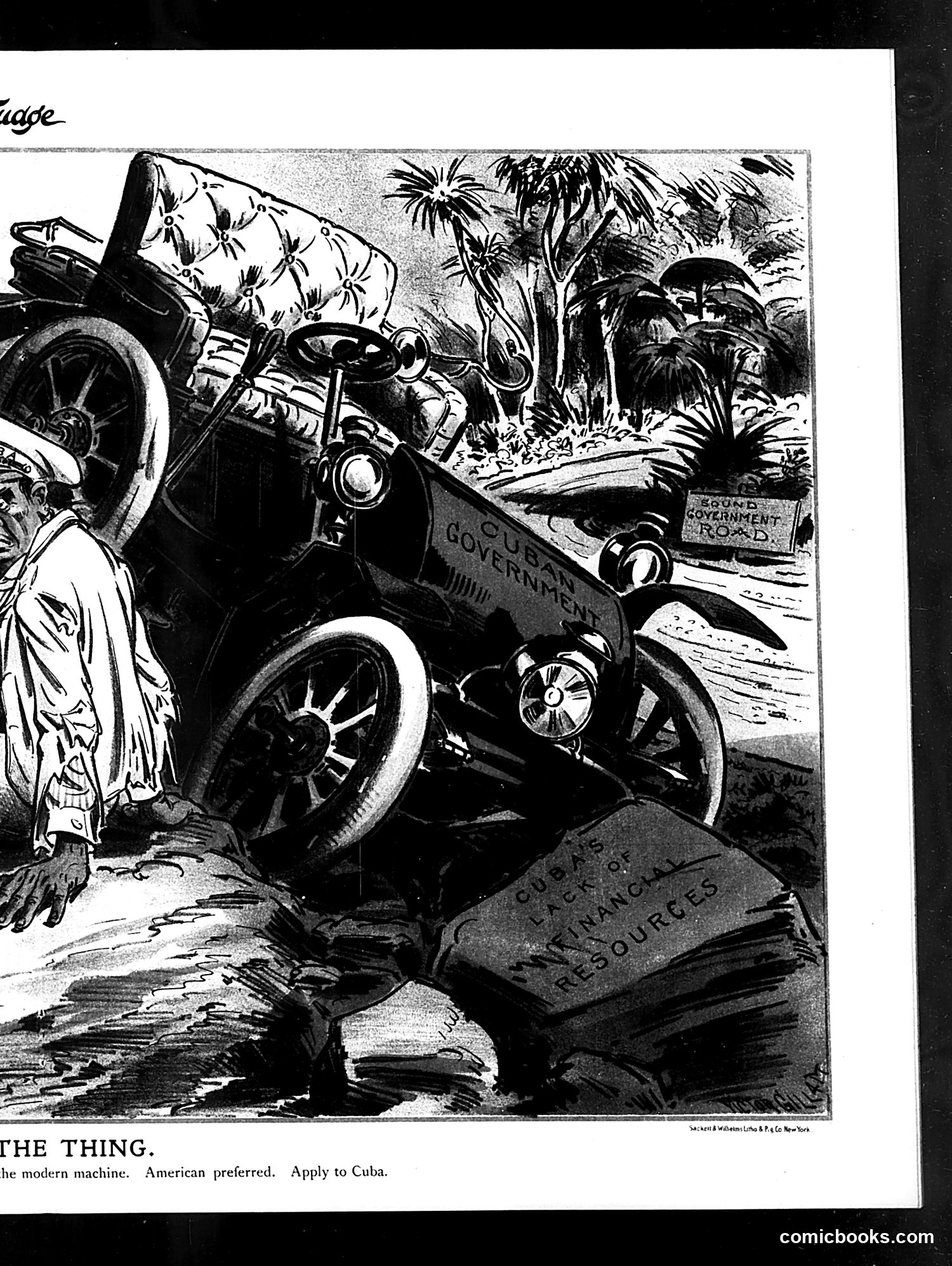
This cartoon, titled "THE THING," satirizes American intervention in Cuba. The central figure appears to be Uncle Sam (identifiable by his distinctive clothing on the left) presenting a modern automobile labeled "GOVERNMENT" to Cuba, depicted as a tropical landscape with palm trees. The satire critiques U.S. imperial ambitions: America is offering its "modern machine"—its system of government—to Cuba, with the caption's dry humor ("American preferred") suggesting this is being imposed rather than genuinely chosen. The visible book labeled "RESOURCES" implies economic exploitation underlies this supposedly benevolent export. This reflects late 19th or early 20th-century American expansionism, when the U.S. actively intervened in Cuban affairs following the Spanish-American War.
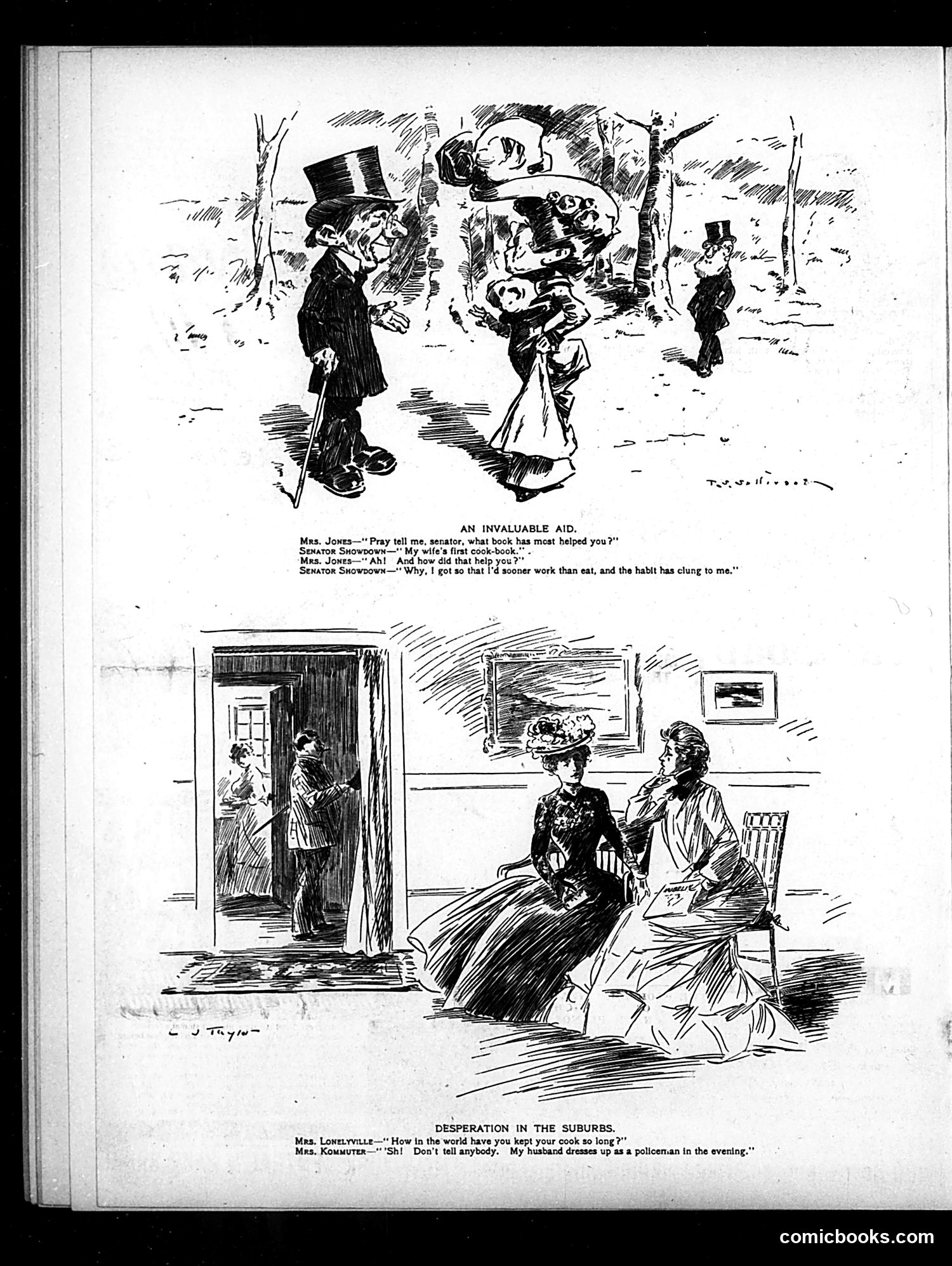
**Top cartoon ("An Invaluable Aid"):** A senator credits his wife's cookbook with his work ethic. The joke mocks both the senator's vanity (claiming hard work as a virtue) and implicitly criticizes his wife's cooking—it was so bad he'd "sooner work than eat," and this habit persisted. The satire targets self-aggrandizing politicians. **Bottom cartoon ("Desperation in the Suburbs"):** A suburban woman reveals her secret for keeping a cook: her husband works as a policeman in the evening, presumably intimidating the cook into staying. The humor reflects early-20th-century servant-keeping anxieties among the middle class and satirizes how suburban wives managed household help through indirect coercion rather than fair wages or conditions. Both cartoons mock domestic life and social pretension.
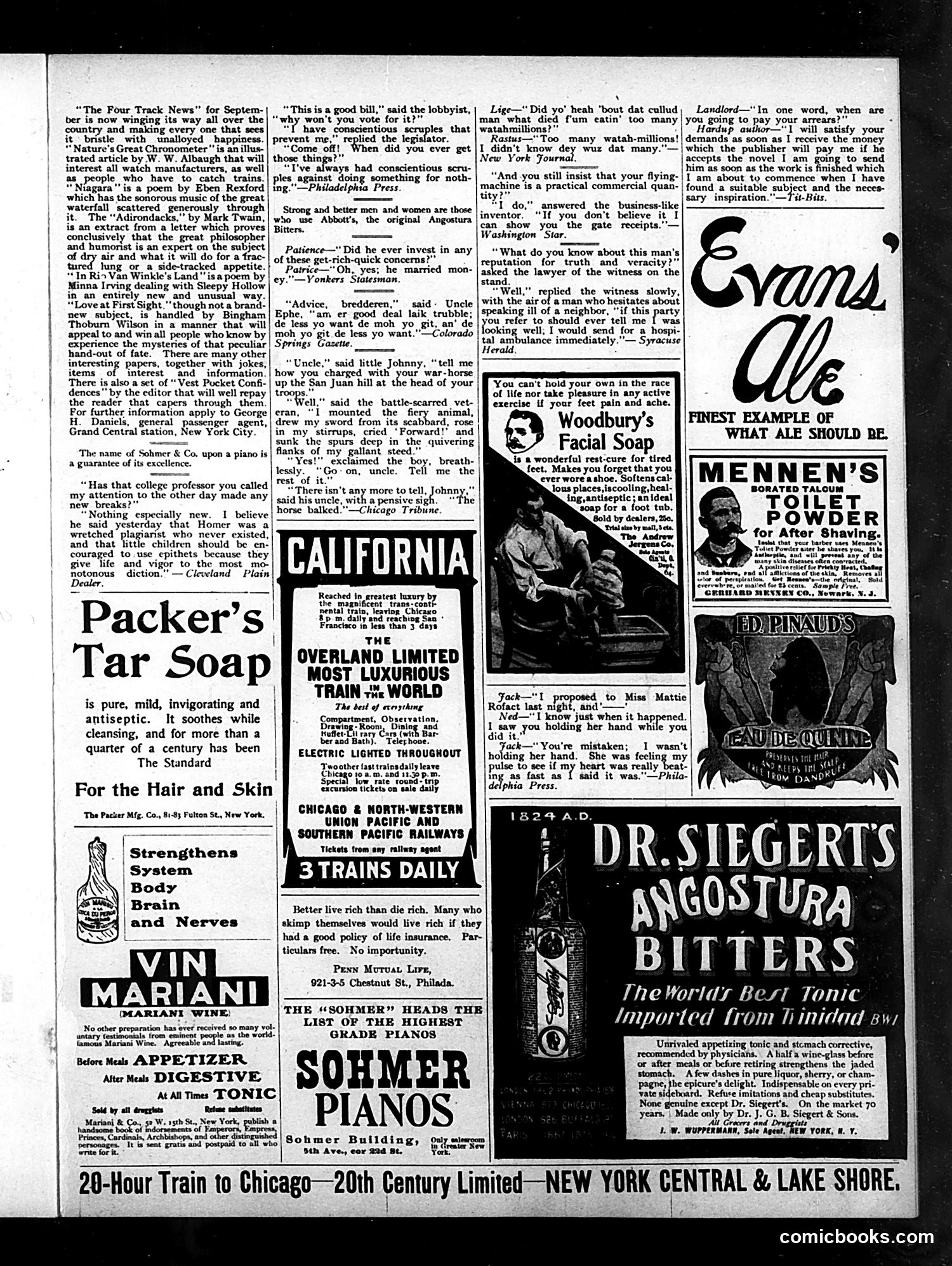
This page is primarily **advertisements and filler content** typical of early 1900s magazines. The main satirical elements are brief jokes scattered throughout: **Key satirical content:** 1. **The lobbyist joke**: A legislator refuses to vote for a bill due to "conscientious scruples," then admits he only has scruples about doing things "for nothing"—mocking political corruption and bribery as commonplace. 2. **The marriage joke**: A man invests in "get-rich-quick schemes" by marrying money—satirizing both financial schemes and marriages of convenience among the wealthy. 3. **The war story**: Uncle Ephe describes charging up San Juan Hill heroically, then admits the horse simply "balked"—deflating military heroism with comic anticlimax. **Context**: These jokes reflect early 1900s American cynicism about politicians, wealth-seeking, and romanticized military narratives. The page otherwise consists of train advertisements, patent medicines, and product promotions typical of the era's commercial publishing model.
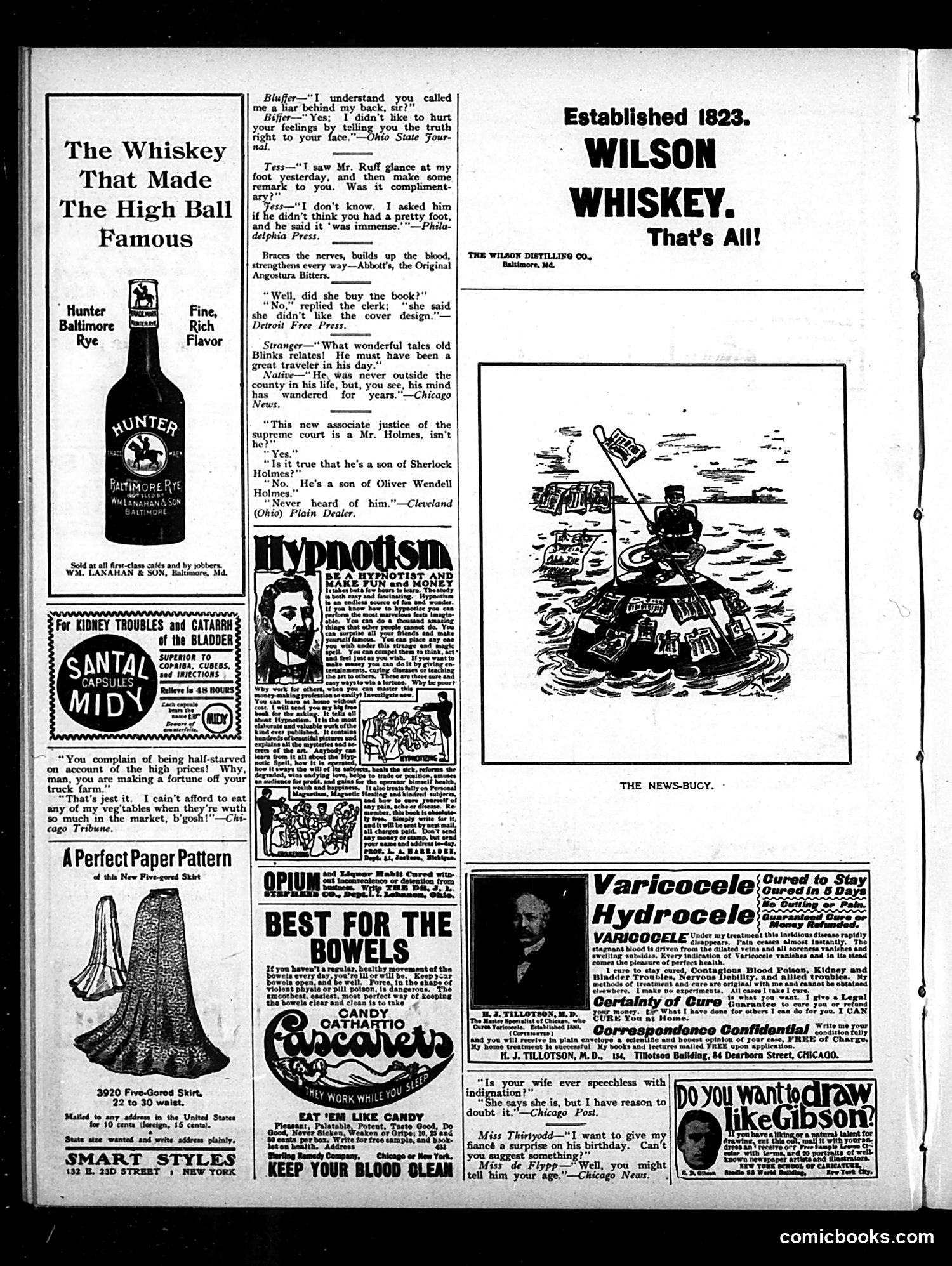
This page is primarily **advertising**, not political satire. It contains multiple patent medicine and product ads typical of early 20th-century magazines, interspersed with brief comic vignettes. The **cartoon** ("THE NEWS-BUCY") depicts a figure drowning in papers/documents—likely satirizing bureaucratic overload or information overwhelm, though the specific reference is unclear without more context. The **text jokes** are simple wordplay: a farmer can't afford to eat his own vegetables because prices are too high; someone compliments a woman's foot as "immense" (size-related humor); a woman won't buy a book due to its cover design. The **advertisements** promote whiskey, patent medicines for kidney/bladder issues and blood ailments, drawing lessons, and clothing patterns—all marketed with exaggerated health claims typical of the era before FDA regulations. The overall page reflects **pre-regulation America**, where dubious medical claims and high inflation (the farmer joke) were common social concerns. The satire is mild and domestic rather than political.
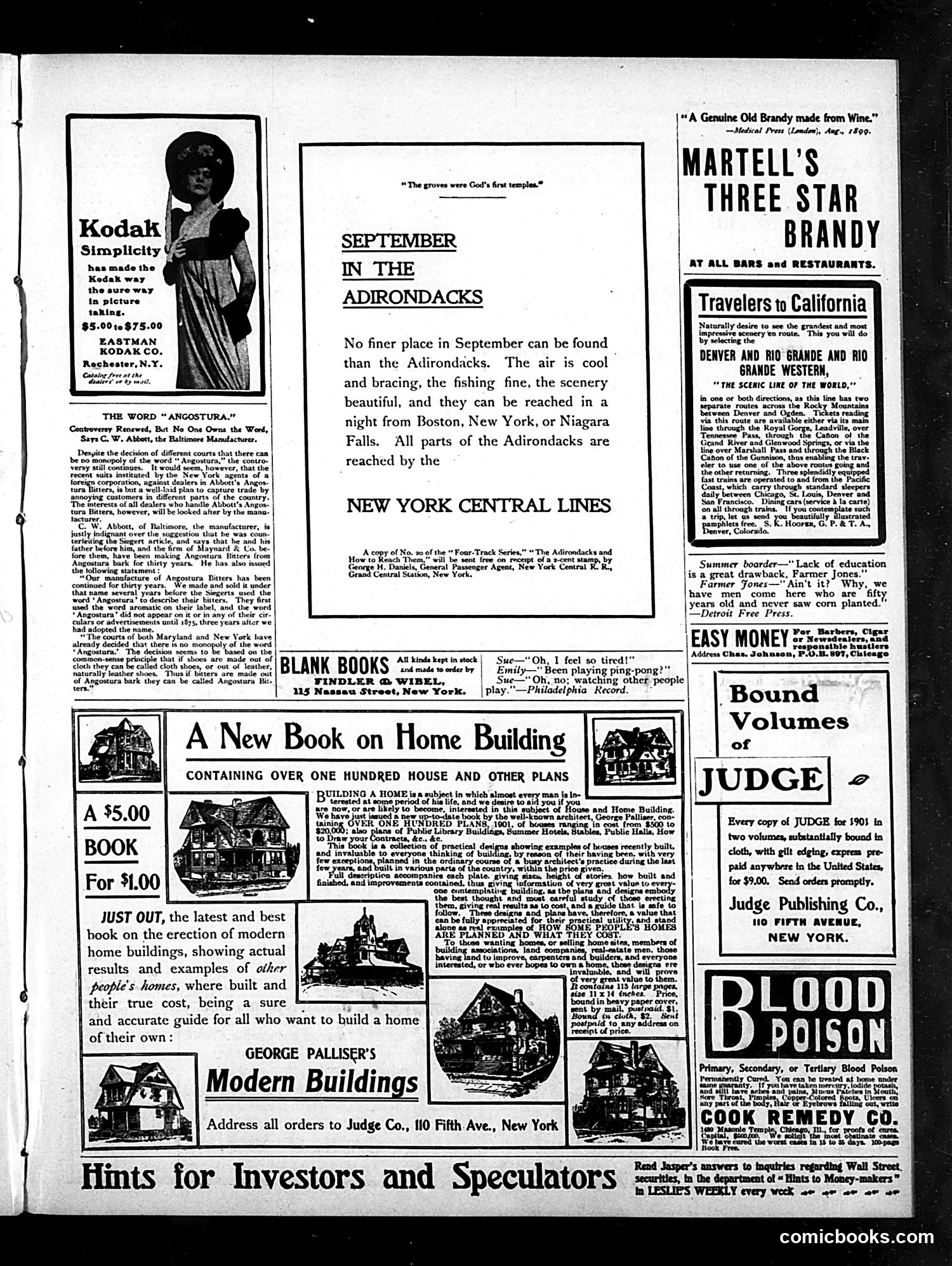
This page is primarily **advertising and filler content** rather than political satire or editorial cartoons. The main elements include: - **Kodak advertisement** (top left): Standard camera marketing - **Angostura Bitters legal dispute** (center): A trademark controversy where manufacturer C.W. Abbott defends his right to use "Angostura" for his bitters, arguing his family has made the product for 30+ years before competitors used the name - **Travel advertisements**: New York Central Lines promoting Adirondacks tourism; Denver and Rio Grande railroad advertising scenic routes - **Book advertisements**: Home building guides and Judge Publishing Company books - **Small humorous items**: Brief jokes (farmer/boarder dialogue, ping-pong quip) typical of Judge's filler content **No significant political cartoons or satire appear on this page.** It represents the commercial-heavy back pages common in period magazines, mixing legitimate editorial content with paid advertisements and light humor.
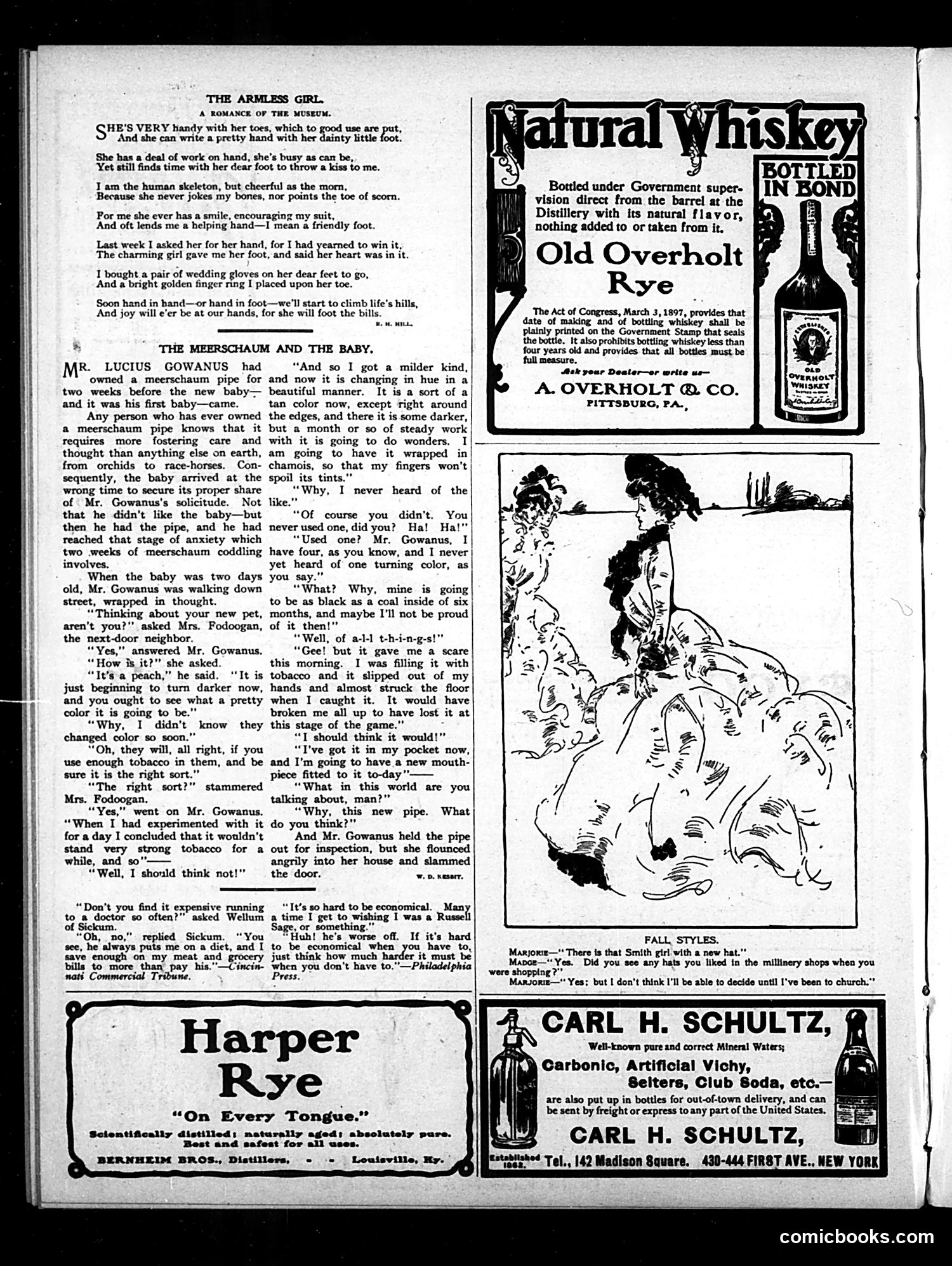
This page contains two humorous stories typical of early 20th-century American humor magazines: **"The Armless Girl"** is a poem-romance about a museum performer (an armless woman) and a skeleton exhibit who court using feet/toes instead of hands—playing on the physical limitations for comedic effect and double entendres ("handy," "hand," "foot the bills"). **"The Meerschaum and the Baby"** satirizes a new father, Mr. Gowanus, who neglects his newborn infant while obsessively caring for a meerschaum (ornamental smoking) pipe. He discusses the pipe's "development" and color-changing properties as if describing a baby, confusing his neighbor who owns similar pipes. The satire mocks excessive materialism and misplaced priorities—valuing a luxury item over family. The page also contains period whiskey and mineral water advertisements. These stories reflect contemporary humor conventions: physical comedy, puns, and satire of middle-class pretension and domestic life.
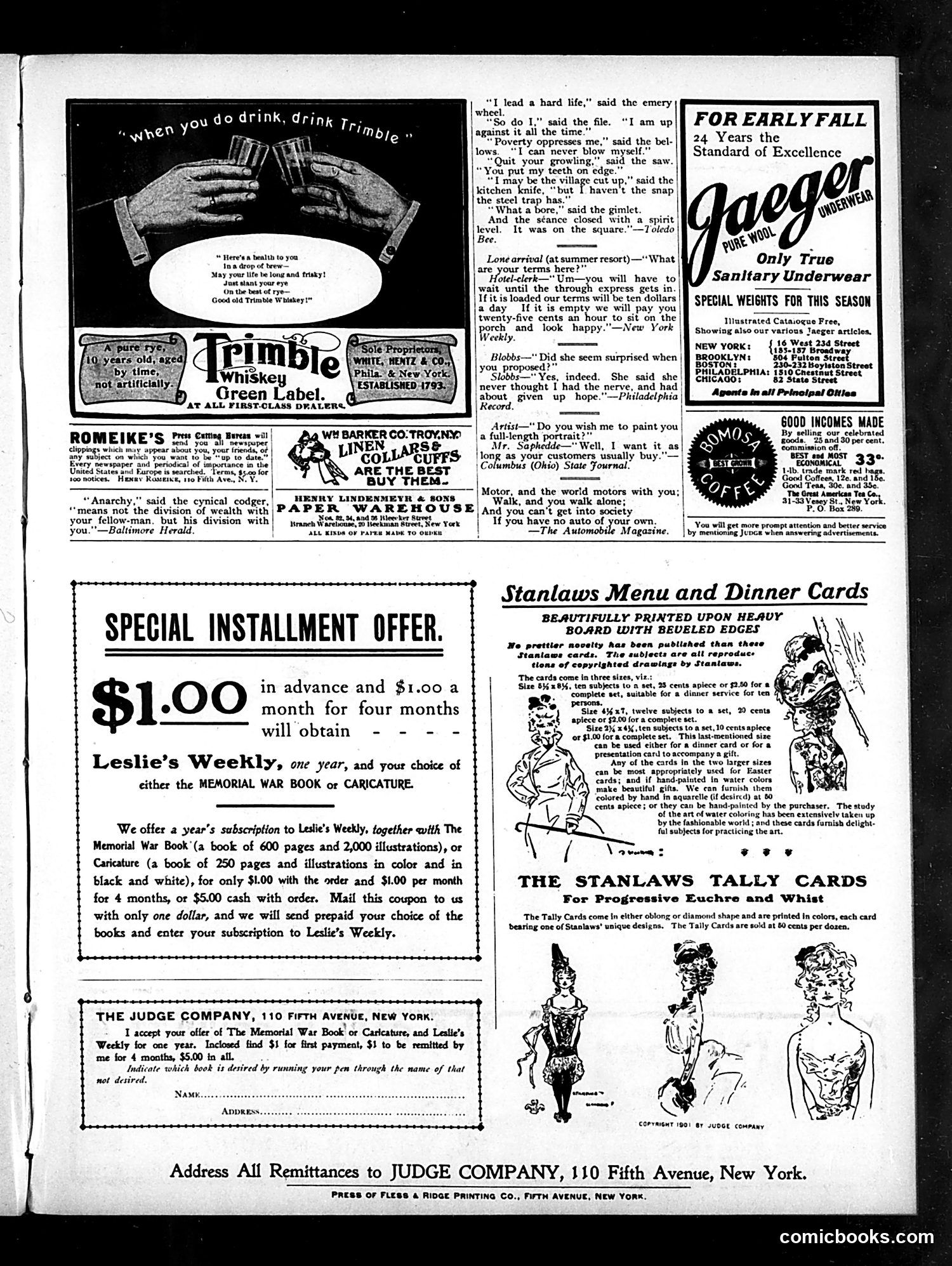
This page is primarily **advertising and subscription offers**, not political satire. However, it contains several humorous dialogues that reflect early 20th-century social attitudes: **The cartoons/jokes:** - A dialogue between personified tools (emery wheel, file, gimlet, spirit level) complaining about hard work—a anthropomorphic joke common to the era - Exchanges about summer resorts, marriage proposals, and portrait painting that mock working-class pretensions and social climbing - A cynical quote about "anarchy" being wealth redistribution rather than lawlessness **Social context:** These jokes reflect contemporary anxieties about class mobility, leisure culture, and changing social norms. The repeated references to automobiles and summer resorts suggest emerging consumer culture and leisure among the middle classes. **Mostly commercial:** The page is dominated by subscription offers for *Leslie's Weekly*, book advertisements, and product promotions (whiskey, underwear, coffee), with decorative Stanlaws illustration cards advertised below. This was typical Judge magazine content—mixing satire with revenue-generating ads.
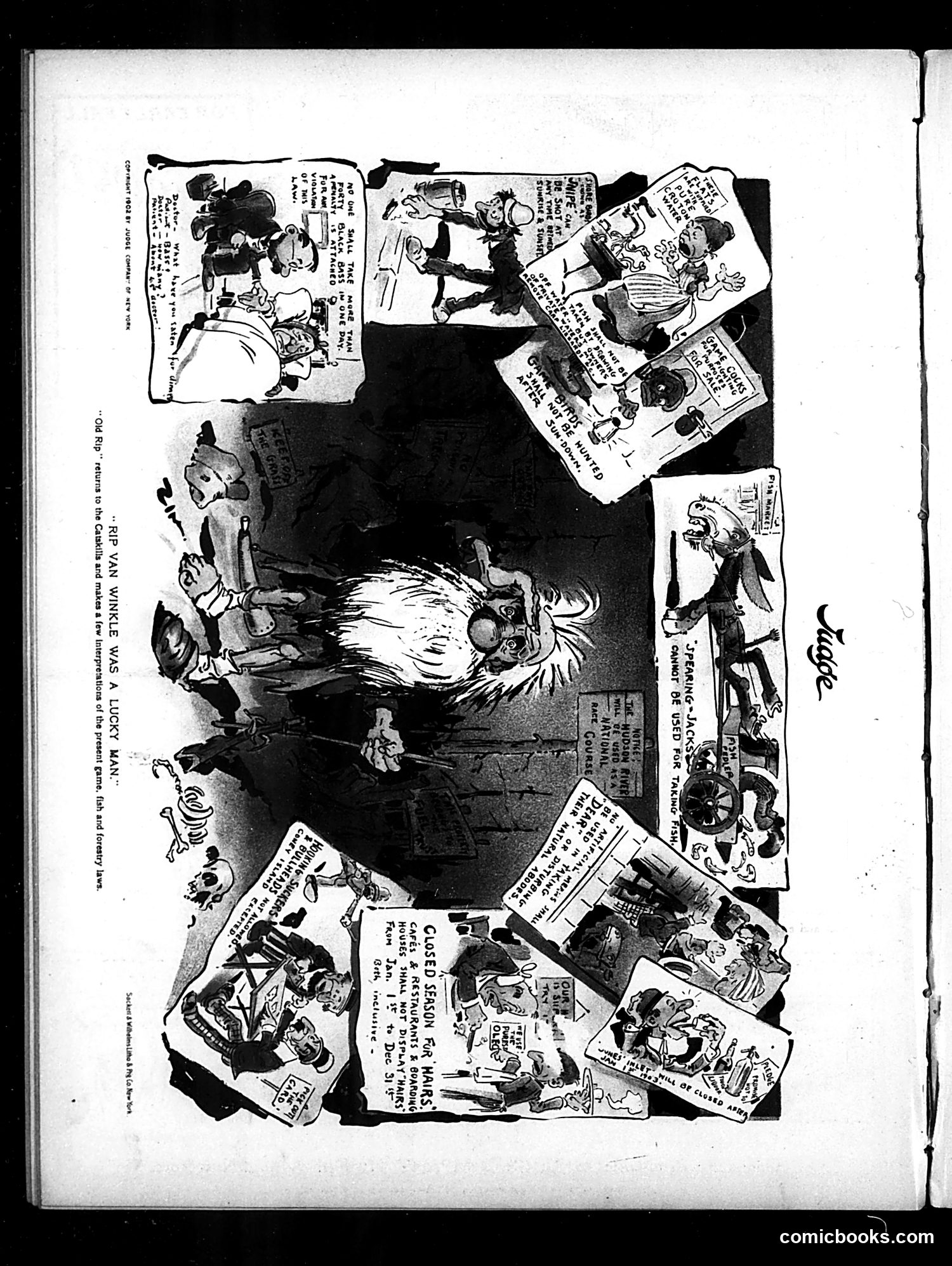
This page satirizes New York State's newly enacted game and fishing regulations through the conceit of Washington Irving's "Rip Van Winkle"—a man who slept for decades and awoke to a changed world. The central figure appears to be "Old Rip" encountering bewildering modern conservation laws. The surrounding comic panels mock specific regulations: a "closed season for hairs" in restaurants (likely addressing unsanitary food practices), restrictions on black bass catches (40-fish daily limit), and other forestry/game laws. The satire suggests these regulations are absurdly bureaucratic and overly restrictive—treating citizens like Rip, confused and regulated beyond comprehension. The title "Rip Van Winkle Was a Lucky Man" implies he's fortunate to have slept through an era of increasing governmental interference in everyday activities. This reflects turn-of-the-century anxiety about expanding state regulation of commerce and leisure.