
Judge, 1902-09-13 · page 6 of 16
Judge — September 13, 1902 — page 6: what you’re looking at
What you’re looking at
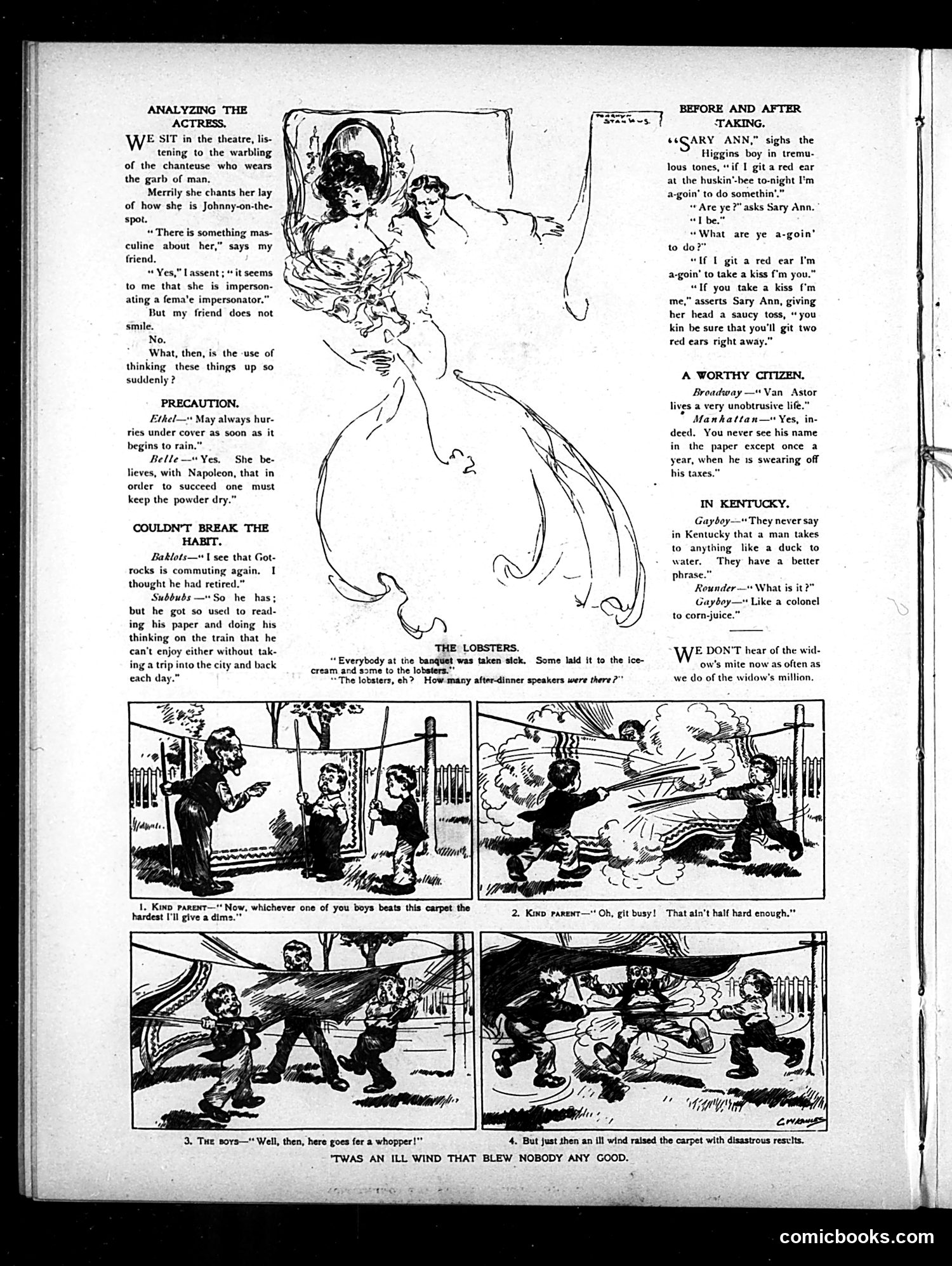
This Judge magazine page contains several brief satirical jokes typical of early 20th-century American humor: **"Analyzing the Actress"** mocks a female performer dressed as a man—likely referencing the vaudeville tradition of cross-dressing acts. The joke's humor derives from the absurdist observation that she's a "female impersonator impersonating a female impersonator." **"Precaution"** and **"Couldn't Break the Habit"** are mild domestic jokes about keeping powder dry during rain and a commuter unable to stop his newspaper-reading routine. **"Before and Taking"** depicts rural courtship banter about red ears resulting from kissing—folk belief humor. **"A Worthy Citizen"** satirizes wealthy New Yorkers (Van Astor reference) for only appearing in newspapers when evading taxes. **"In Kentucky"** stereotypes the region as heavy with alcohol ("corn-juice"). **The Lobsters comic strip** shows children playing with a carpet blown about by wind—simple slapstick with the moral that chaos benefits someone. These represent typical Judge content: society satire, ethnic/regional stereotypes, and children's mischief humor.
📄 Transcribed text from this page (OCR, searchable)
Machine-transcribed from the original scan — historical spelling and the odd misread are preserved.
ACTRESS. WE SIT in the theatre, lis tening to the warbling of the chanteuse who wears the garb of man. Merrily she chants her lay of how she is Johnny-on-the- spot. “There is something mas- culine about her,” says my friend. + Yes," Lassent ; “it seems to me that she is imperson- ating a fema’e impersonator.” friend does not What, then, is the -use of thinking these things up so suddenly ? PRECAUTION. Ethel—* May always hur- ries under cover as soon as it begins to rain,” Belle—“Yes, She be- lieves, with Napoleon, that in order to succeed one must keep the powder dry.” COULDN'T BREAK THE HABIT. Baklots—| see that Got- rocks is commuting again. I thought he had retired.” Subbubs—"So he has; but he got so used to read- ing his paper and doing his thinking on the train that he BEFORE AND AFTER «TAKING. S6GARY ANN,” sighs the Higgins boy in tremu- if 1 git a red ear "bee to-night I'm a-goin’ to do somethin’.” “Are ye?” asks Sary Ann. “1 be.” “What are ye a-goin’ to do?” “If L git a red ear I'm to take a kiss f'm you.” If you take a kiss f'm me,” asserts Sary Ann, giving her head a saucy toss, “you kin be sure that you'll git two red ears right away.” A WORTHY CITIZEN. Broadway —"Van Astor lives a very unobtrusive life.” * Manhattan— Yes, in- deed. You never see his name in the paper except once a year, when he is swearing off his taxes.” IN KENTUCKY. Gayboy—""They never say in Kentucky that a man takes to anything like a duck to water, They have a better phrase.” Rounder—“ What is it?” Gayboy— Like a colonel to corn-juice.” can't enjoy either without tak- THE LOBSTERS. E DON'T hear of the wid- ing a trip into the city and back aug oo ee es ee ow’s mite now as often as , | “The lobsters, eh? How many after-dinner speakers were there?” we do of the widow's million. eee ee ear cares tucharer be) of Yeu Beye beats) tie. estes 2. Kino rarewt—" Oh, git busy! That ain't half hard enough.” | 3. Tue soys—'* Well, then, here goes fer a whopper!"” 4. But just shen an ill wind raised the carpet with disastrous resvits. | ‘TWAS AN ILL WIND THAT BLEW NOBODY ANY GOOD. comicbooks.com