
A complete issue · 16 pages · 1902
Judge — July 26, 1902
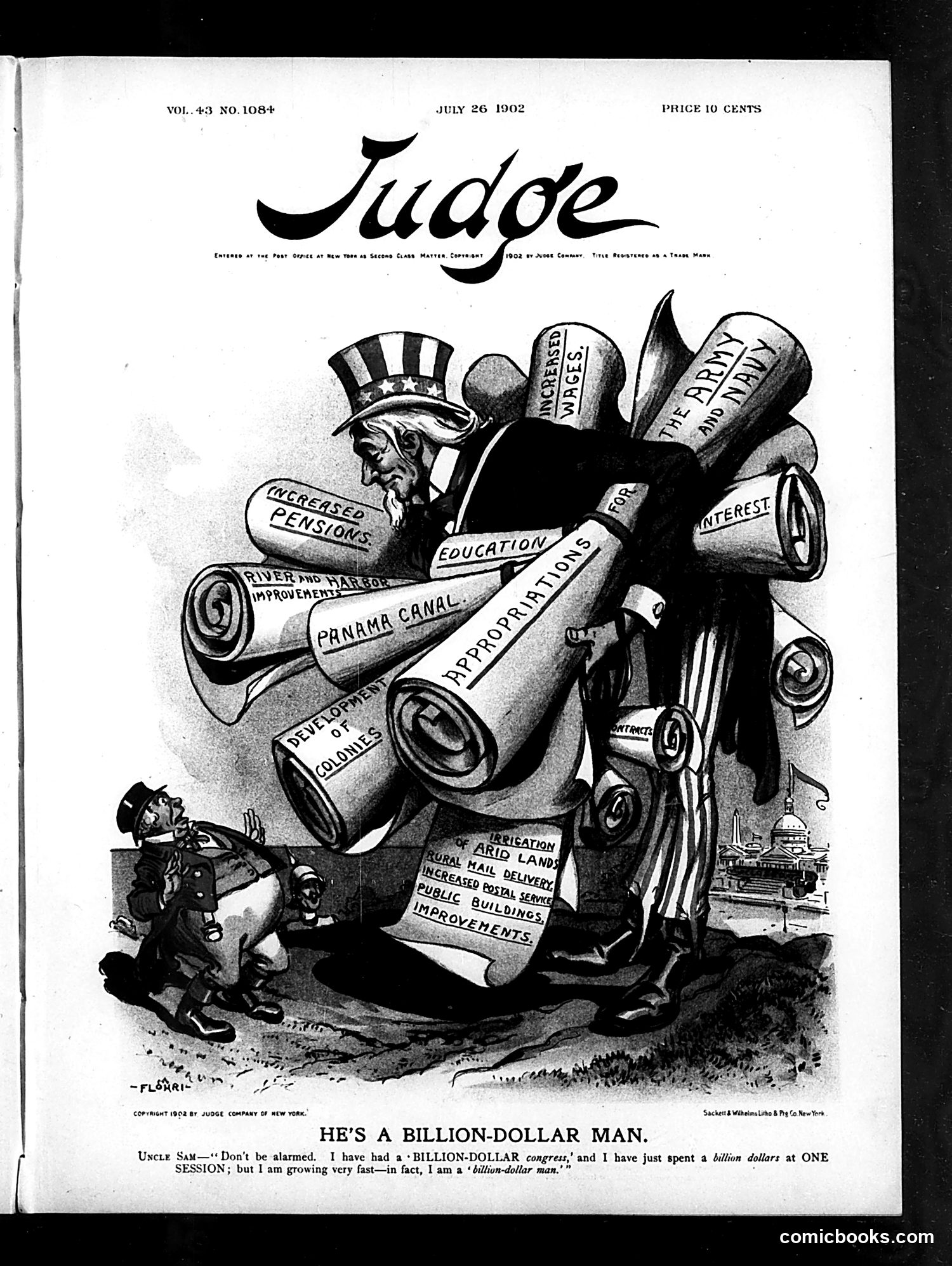
This political cartoon satirizes Uncle Sam's massive spending on infrastructure and social programs. Uncle Sam, wearing his characteristic top hat, carries enormous scrolls labeled "Panama Canal," "River and Harbor Improvements," "Education," "Development of Colonies," "Appropriations," and other public works. A tiny figure (appearing to represent a political opponent or fiscal conservative) cowers beneath this towering load, alarmed at the spending. The caption's joke—that Uncle Sam claims to be a "billion-dollar man" after a single congressional session spending "a billion dollars"—mocks the rapid accumulation of federal expenditures. This reflects early-1900s political debate over expansionism, infrastructure investment, and government spending following the Spanish-American War.
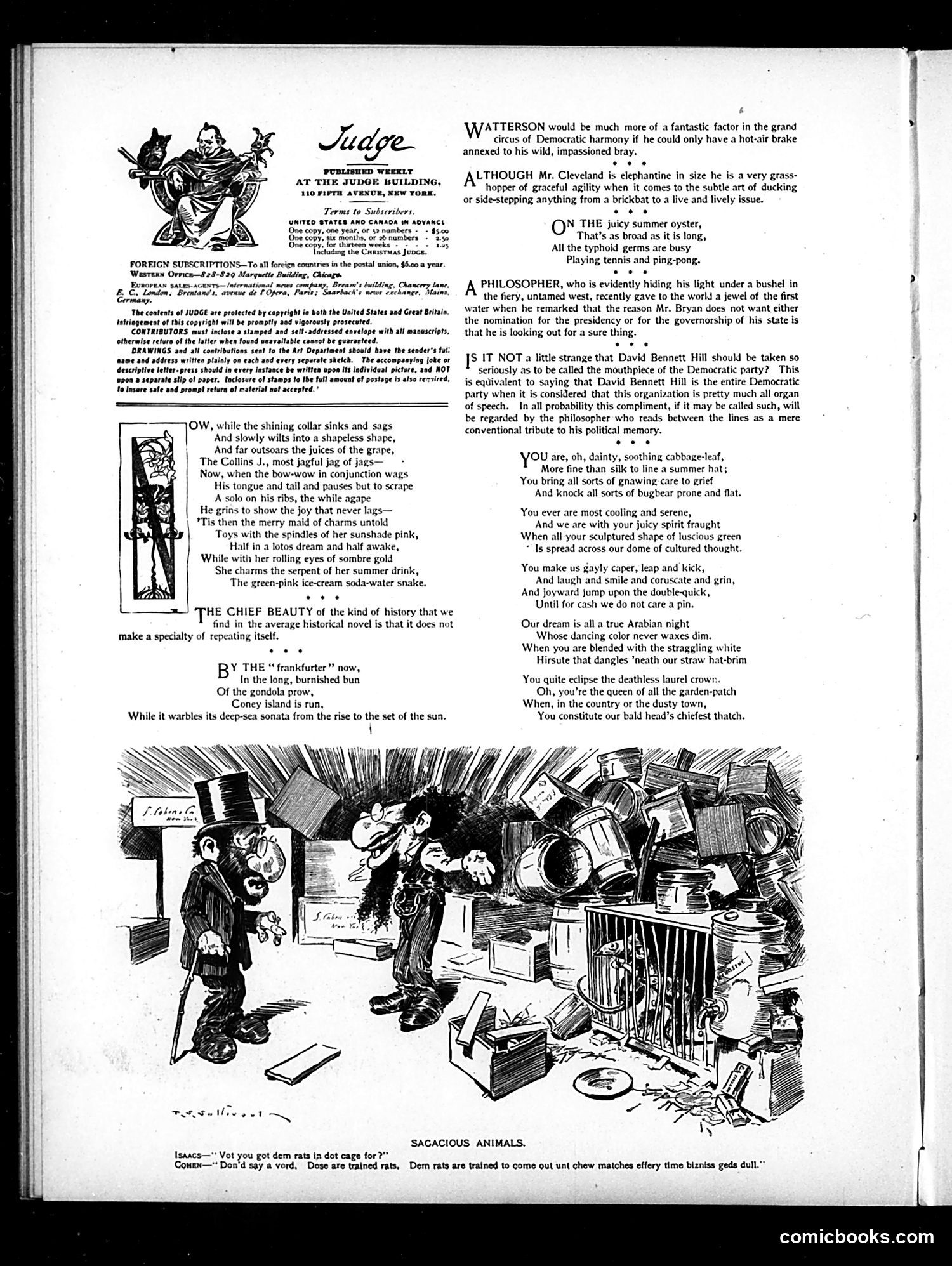
This page contains political commentary and satirical verse rather than traditional cartoons. The text critiques several figures: **Watterson** is mocked for lacking a "hot-air brake" on his "wild, impassioned bray," suggesting he's an uncontrolled speaker. **Cleveland** is praised for graceful agility, implying political dexterity. **David Bennett Hill** is questioned as a Democratic party spokesperson, with the philosopher suggesting this is absurd—equivalent to calling him the party's "mouthpiece." The lengthy poem appears to address a woman, possibly a political figure or allegorical representation, using garden and summer imagery. The bottom cartoon titled "SAGACIOUS ANIMALS" depicts two men in what appears to be a cluttered office or printing space, with a dialogue about rats and cages—likely political commentary about containment or control, though the specific reference remains unclear without additional context.
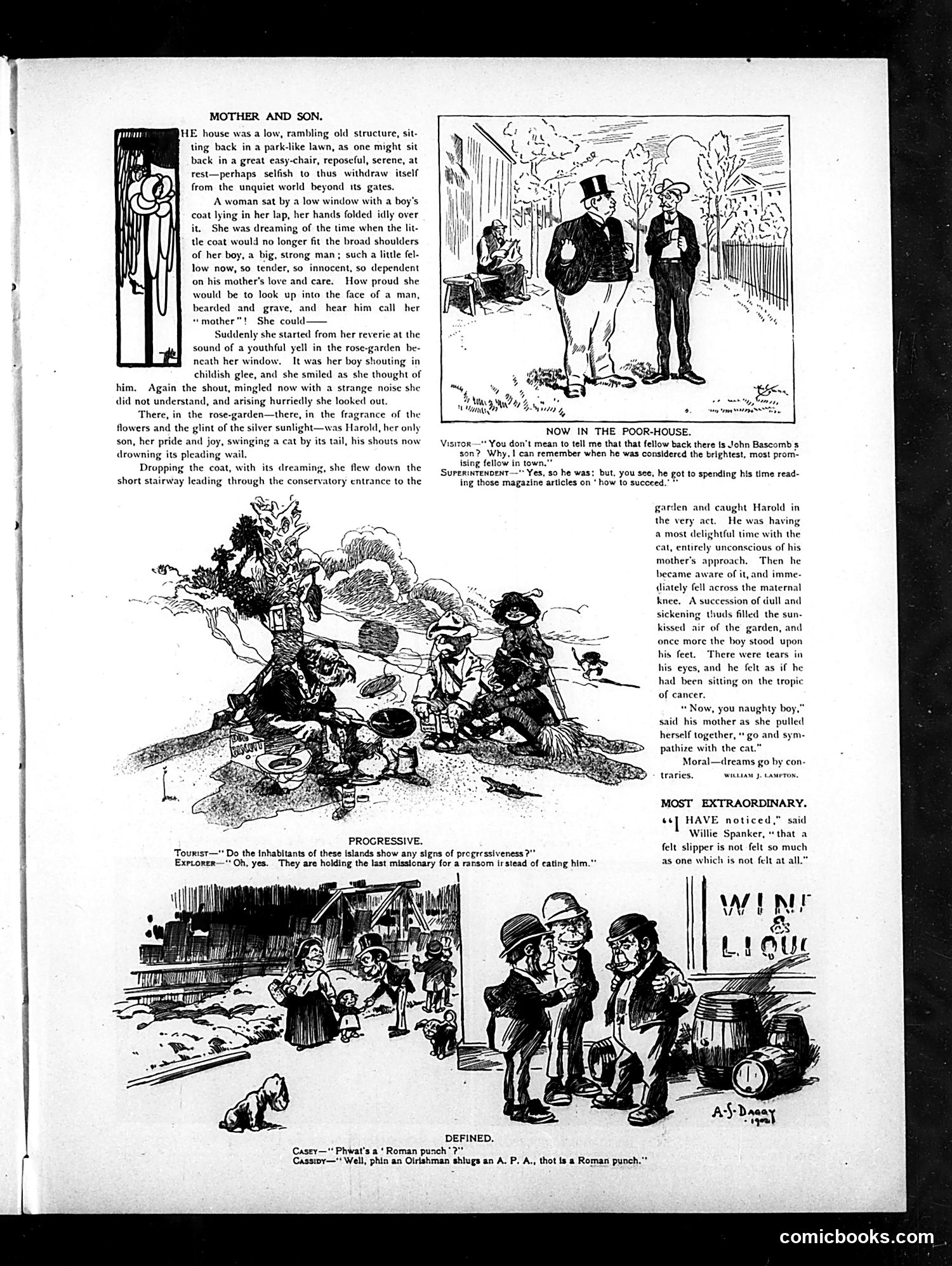
This page contains four separate cartoons and comic sketches with minimal political content. The main narrative, "Mother and Son," depicts a sentimental scene of a woman watching her son in a park-like setting, reflecting on his future achievements. The labeled cartoons—"Now in the Poor-House," "Progressive," "Most Extraordinary," and "Defined"—appear to be humorous social observations rather than topical satire. They mock everyday character types and situations: a poor-house visitor's recollections, tourist assumptions about island inhabitants, observations about felt slippers versus ore felt, and a debate over Roman punch definitions. The humor relies on wordplay, visual gags, and gentle social commentary rather than political critique. No specific political figures or events appear identifiable from the text or illustrations.
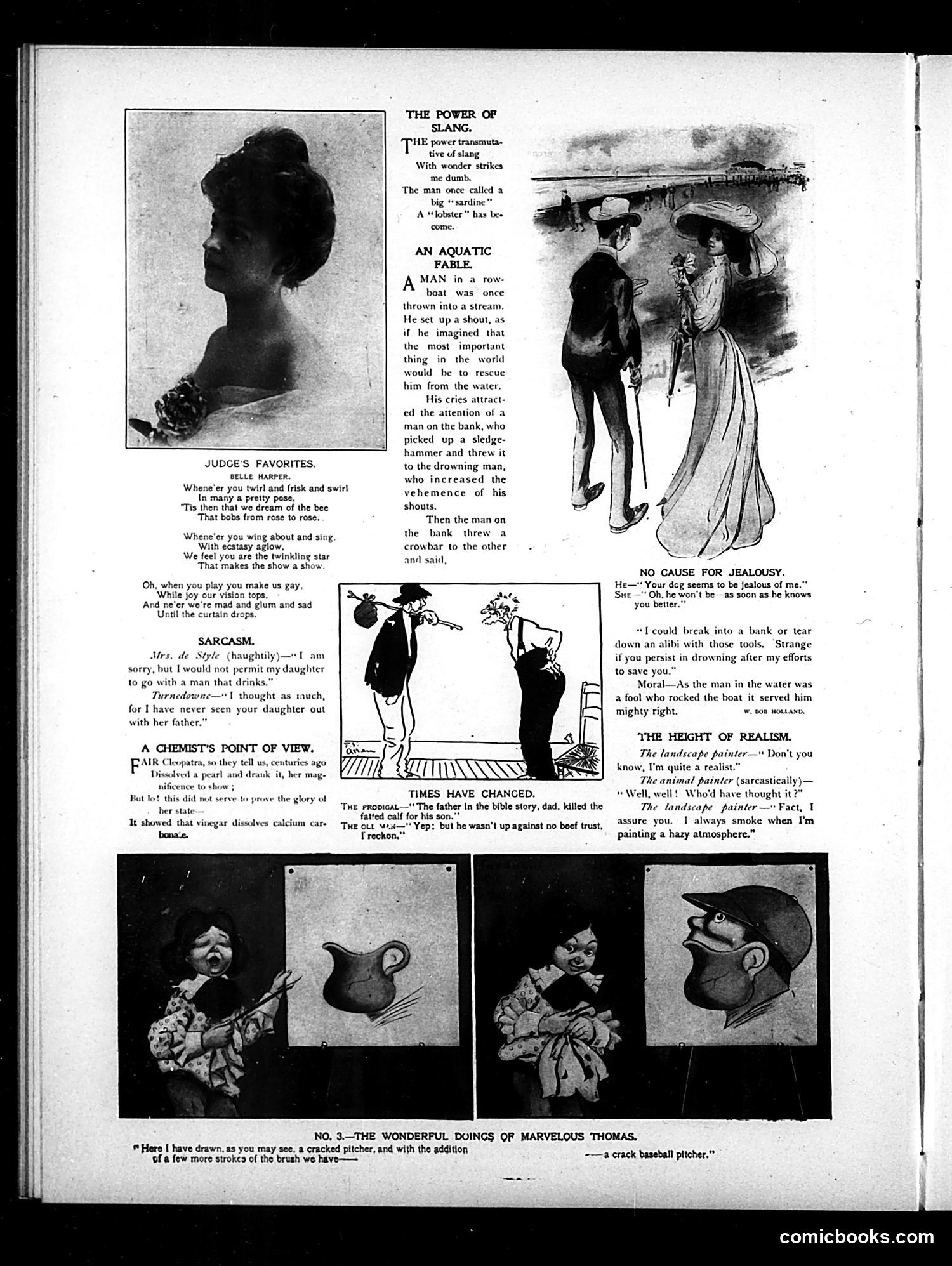
This page contains several humor pieces typical of early 20th-century satirical journalism: **"The Power of Slang"** and **"An Aquatic Fable"** are brief humorous stories about language's effects and foolish behavior, respectively. **"Judge's Favorites"** presents witty verse on social topics—romance, drinking, and marriage appear to be recurring themes. **"A Chemist's Point of View"** makes a pun about vinegar dissolving calcium carbonate. The illustrated cartoons show genteel social situations: a drowning rescue scene and romantic/domestic scenarios. The bottom panels labeled **"No. 3—The Wonderful Doings of Marvelous Thomas"** appear to be a comic strip featuring character transformations or comparisons (a cracked pitcher becoming a baseball pitcher). The humor relies on wordplay, social observation, and slapstick rather than political commentary.
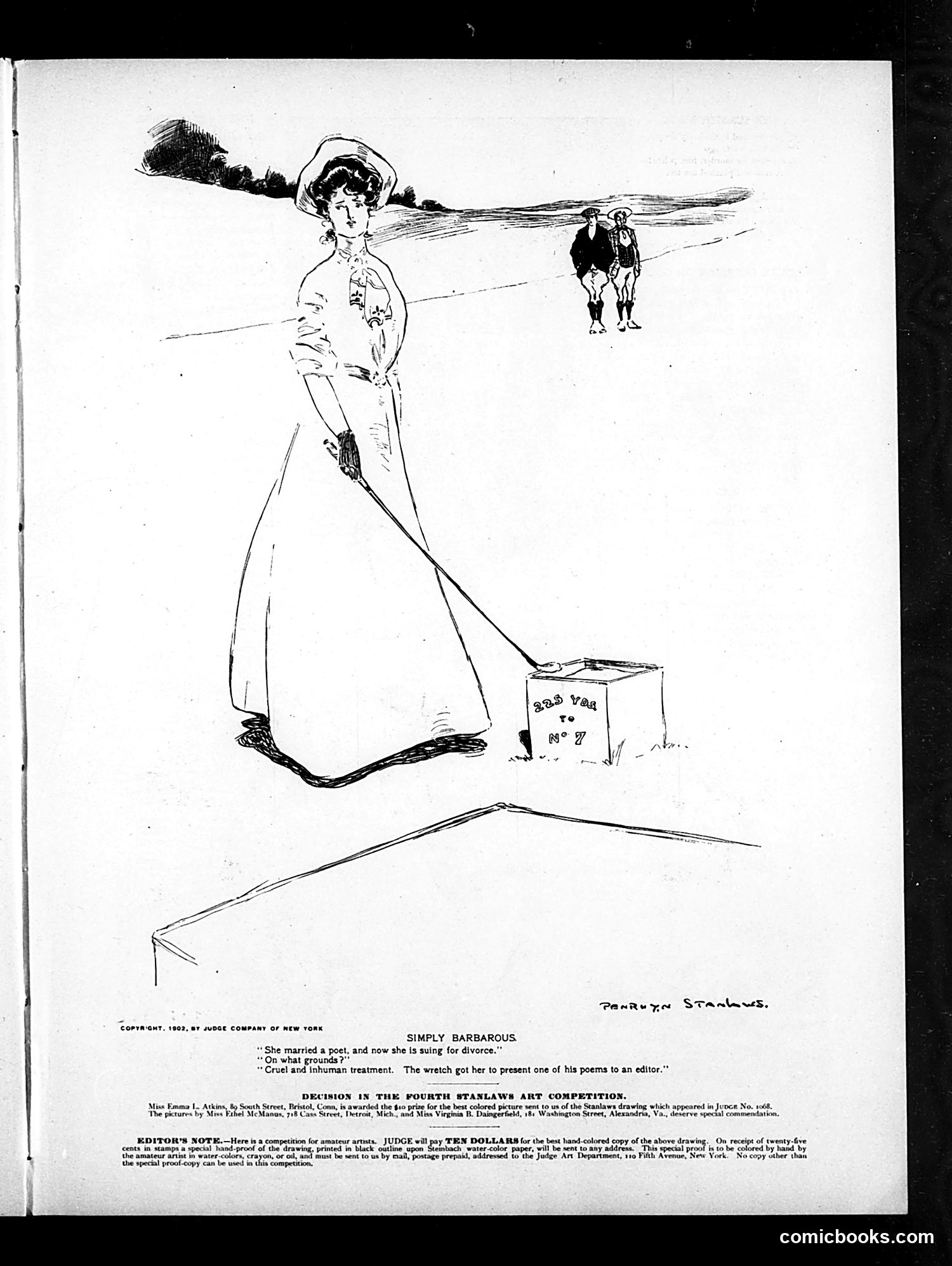
This page contains a brief satirical joke about marriage and poetry. The cartoon depicts a woman in Edwardian dress standing near a surveyor's marker, with two men visible in the background. The humor targets struggling poets: a woman sues her poet husband for divorce on grounds of "cruel and inhuman treatment"—specifically, that he forced her to submit one of his poems to an editor. The joke implies that exposure to bad poetry constitutes abuse, satirizing both the pretensions of amateur poets and the suffering inflicted on those close to them. The page also announces Judge's art competition, offering ten dollars for the best hand-colored reproduction of the drawing by amateur artists. This was a common early-20th-century promotional device. The artist is credited as "Penrhyn Stanlaws," a known Judge contributor of that era.
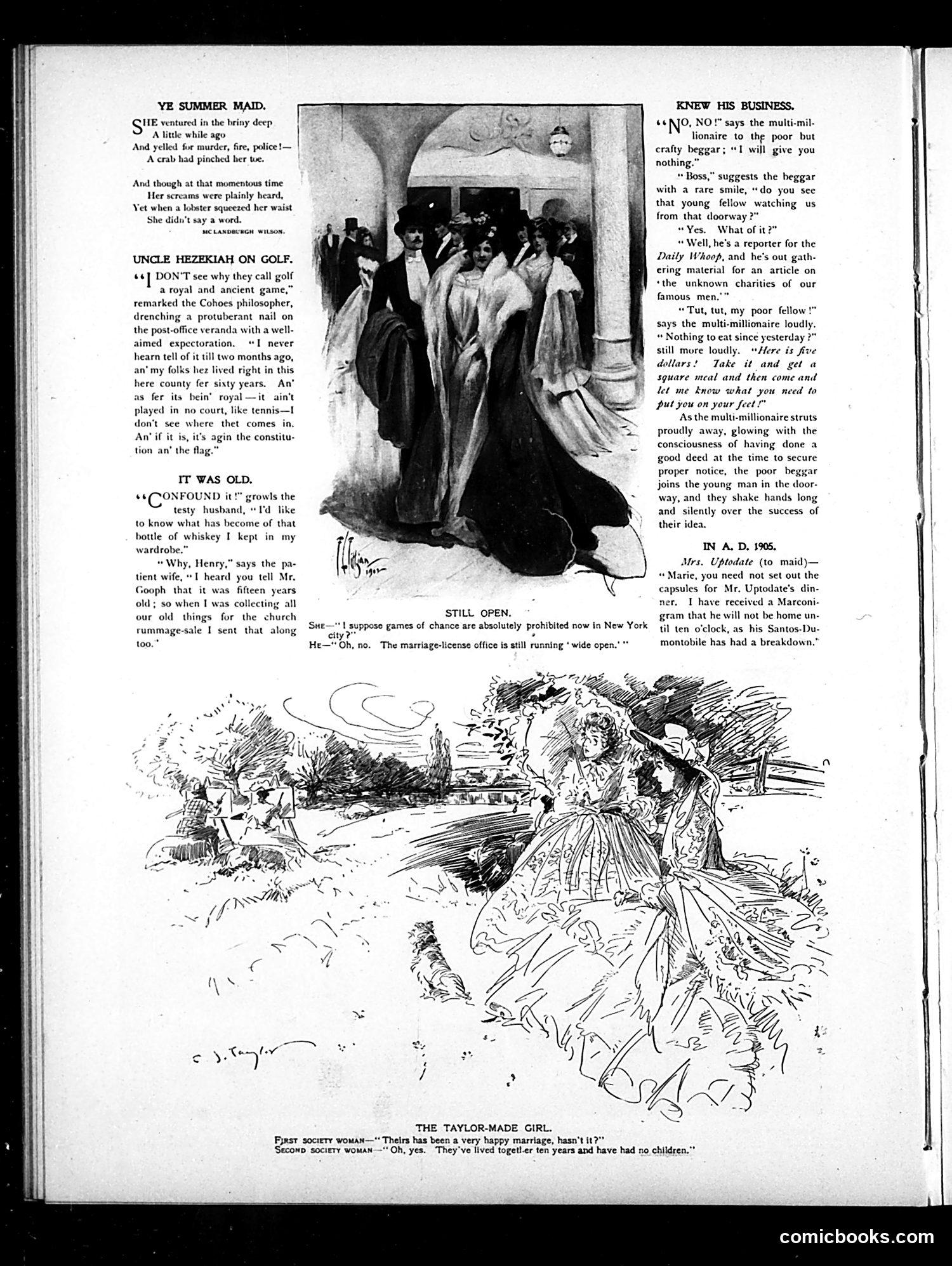
This page contains several satirical pieces targeting early-1900s American society: **"Ye Summer Maid"** mocks women's selective modesty—a woman screams over a crab pinching her toe but silently tolerates a lobster's embrace, suggesting hypocrisy about propriety. **"Uncle Hezekiah on Golf"** features a rural philosopher dismissing golf as neither ancient nor royal, satirizing the upper-class adoption of this imported sport as pretentious. **"Still Open"** jokes darkly about New York's marriage-license office remaining operational despite prohibition on "games of chance"—equating marriage to gambling. **"Knew His Business"** exposes philanthropic fraud: a beggar deliberately performs poverty before a reporter to manipulate a millionaire into public charity, revealing how wealthy men perform generosity for press coverage rather than genuine compassion. **"The Taylor-Made Girl"** (bottom) implies a society woman's decade-long marriage succeeded *because* they had no children—a sharp critique of contemporary attitudes toward marriage and motherhood among the wealthy.
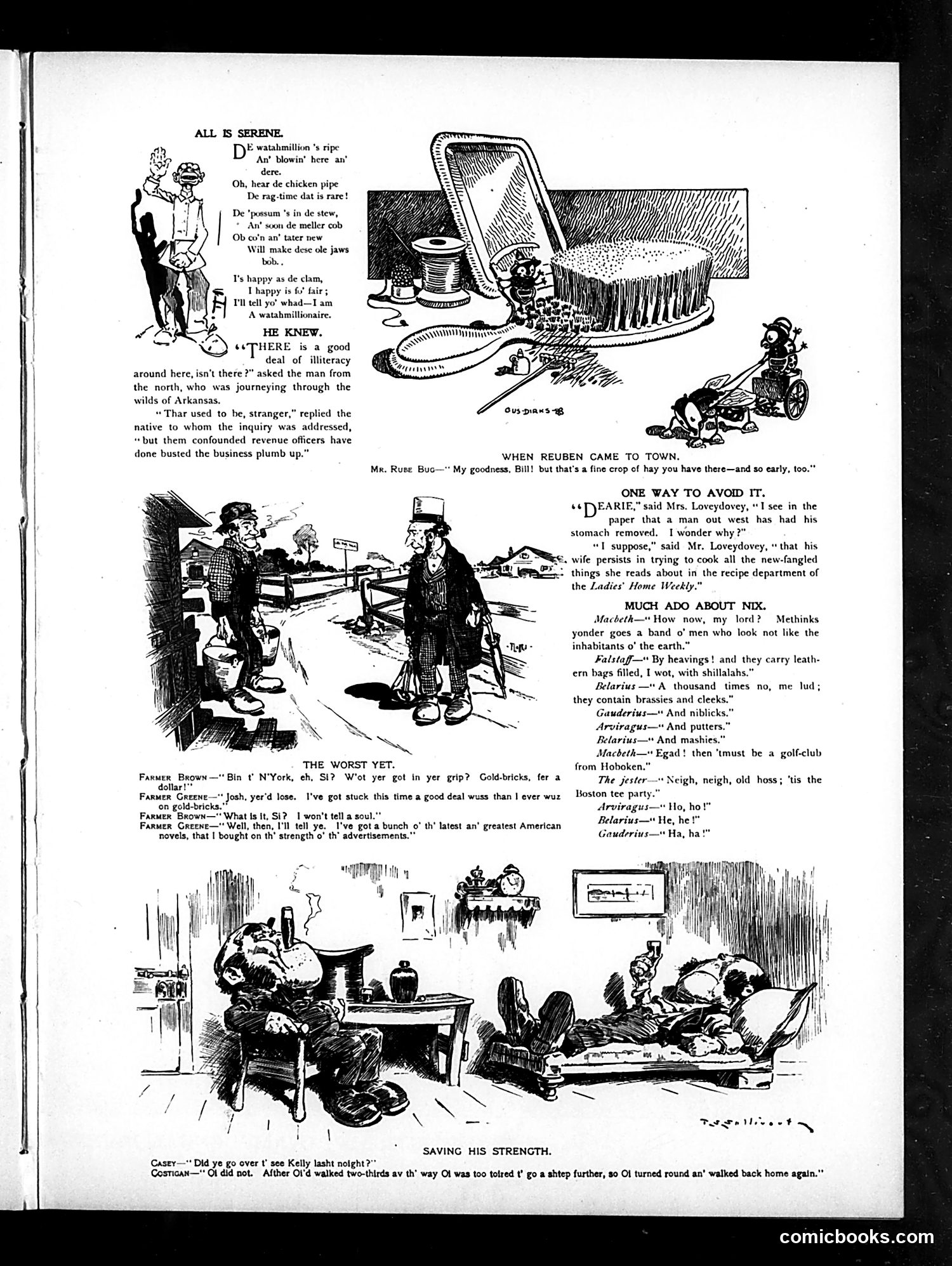
This page contains multiple satirical pieces typical of early 20th-century American humor: **"All is Serene"** mocks rural Southern dialect and contentment, using exaggerated Black vernacular to portray a poor sharecropper as happily oblivious—a common racist trope of the era. **"He Knew"** jokes about Arkansas backwardness and tax evasion, with a local claiming revenue officers destroyed the region's "illiteracy business"—likely referencing moonshining or fraud schemes. **"The Worst Yet"** depicts farmers duped by mail-order novels advertised in publications, satirizing gullible rural consumers. **"Much Ado About Nix"** parodies Shakespeare by having classical characters mistake golfers' equipment for weapons, joking that golf clubs must be from "Hoboken" (a working-class area) or referencing the "Boston tee party"—a pun on the Boston Tea Party. **"One Way to Avoid It"** humorously suggests wives' cooking from *Ladies' Home Weekly* recipes is so terrible it might justify stomach removal. The overall tone targets rural ignorance, immigrant stereotypes, and contemporary consumer culture.
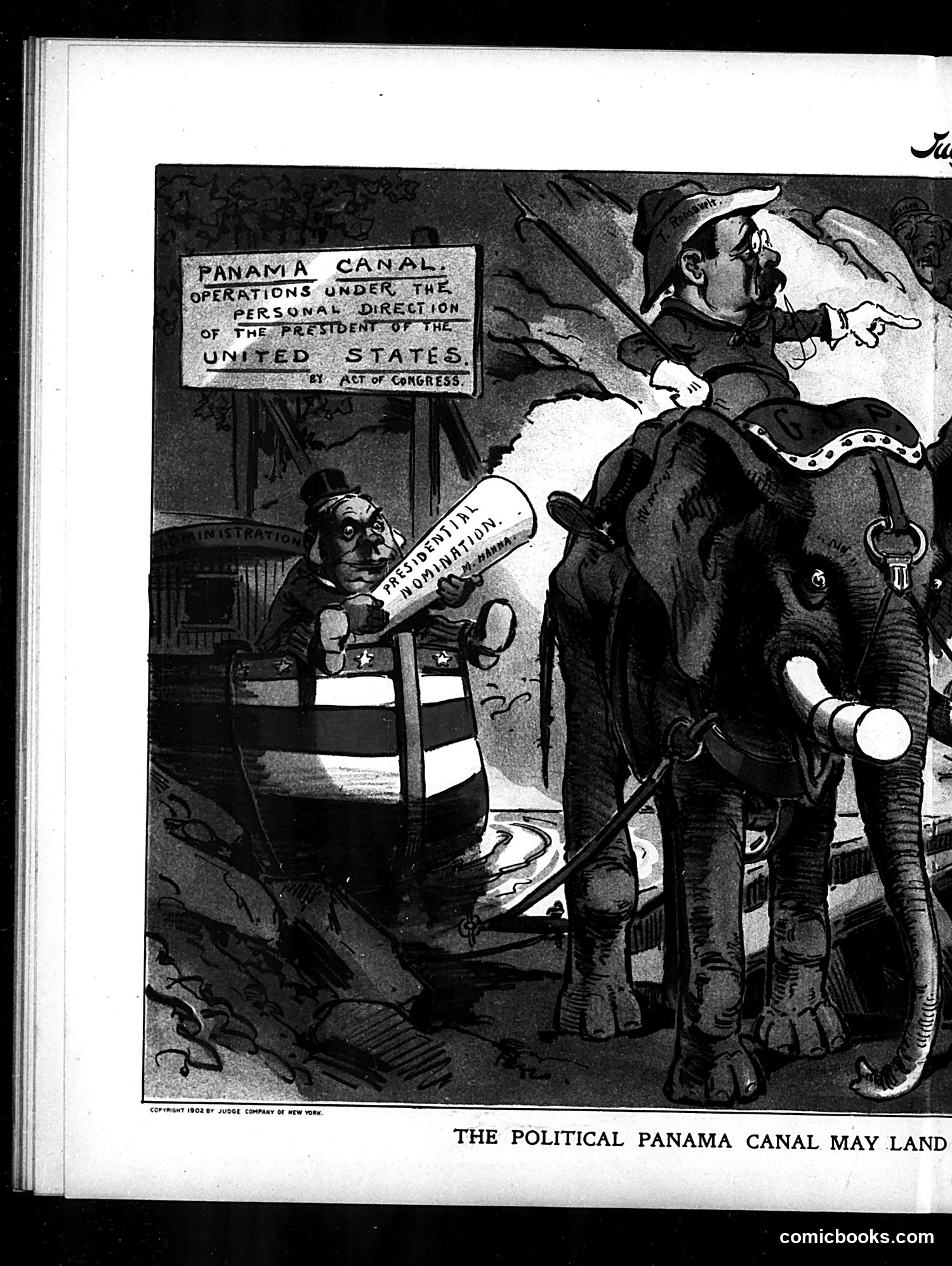
This Judge magazine cartoon satirizes the Panama Canal as a political issue. The image shows a figure seated at a desk labeled "PANAMA CANAL: OPERATIONS UNDER THE PERSONAL DIRECTION OF THE PRESIDENT OF THE UNITED STATES BY ACT OF CONGRESS." The seated figure (likely representing a U.S. President, though specific identity is unclear) holds a document marked "PRESIDENTIAL NOMINATION." To the right stands an elephant—the Republican Party symbol—dressed elaborately, suggesting the canal project had become entangled in partisan politics. The caption "THE POLITICAL PANAMA CANAL MAY LAND" suggests the cartoon warns that the canal, ostensibly a national infrastructure project, risked becoming compromised by political maneuvering and presidential ambition rather than serving public interest. The satire critiques using major national undertakings for political gain.
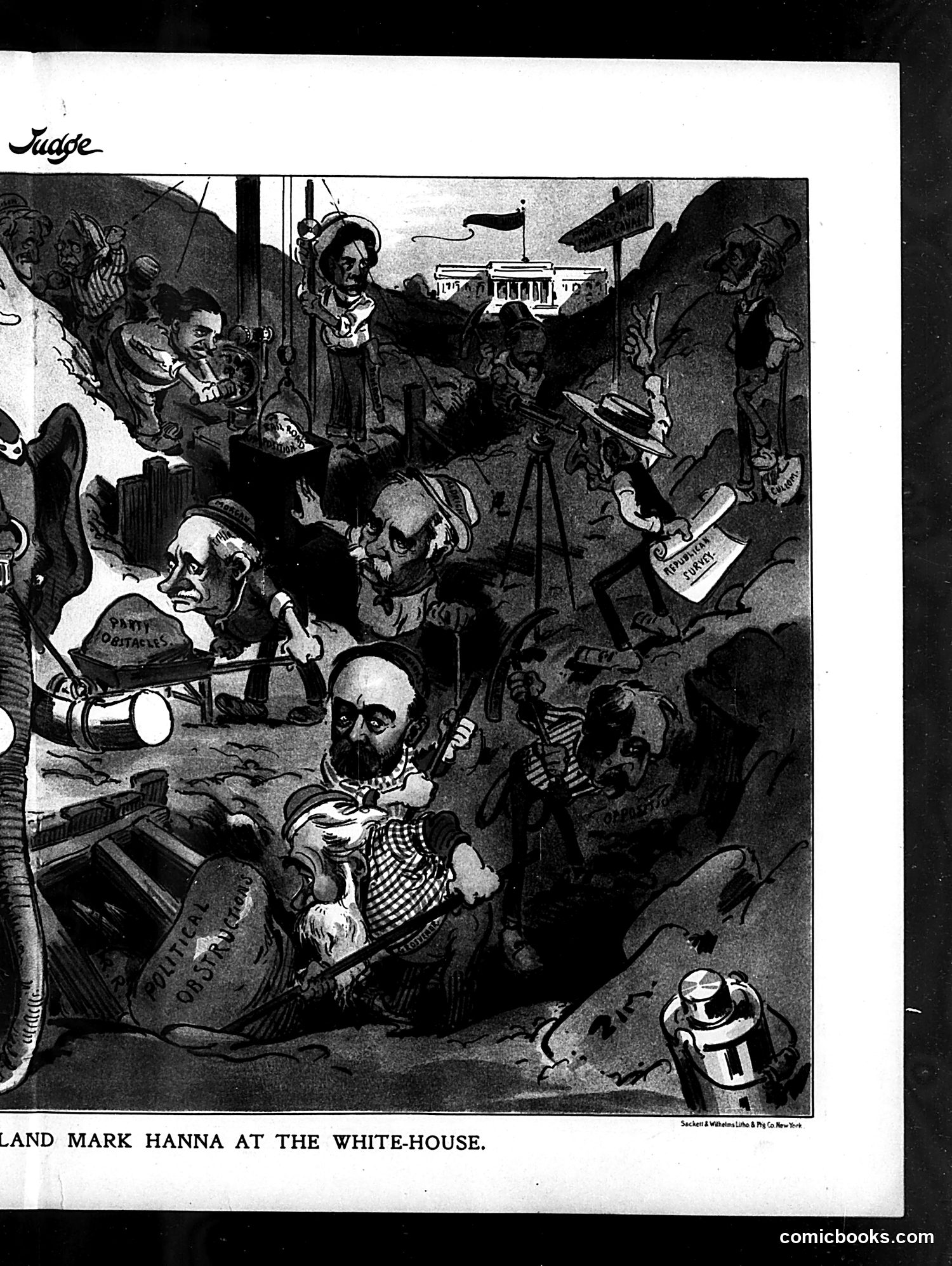
This Judge magazine cartoon satirizes Mark Hanna, the prominent Republican political operative and businessman of the Gilded Age era. The image depicts Hanna surrounded by caricatured political figures and wealthy industrialists at the White House, suggesting his outsized influence over American politics and government policy. The satire critiques what the cartoonist views as corrupt collusion between wealthy business interests and political power—the implication being that Hanna effectively controlled political decision-making through financial leverage and backroom dealings rather than democratic processes. The crowded, chaotic composition emphasizes the sordid nature of this alleged influence-peddling at the nation's highest level. This reflects broader Progressive Era concerns about the corrupting influence of big business on American democracy.
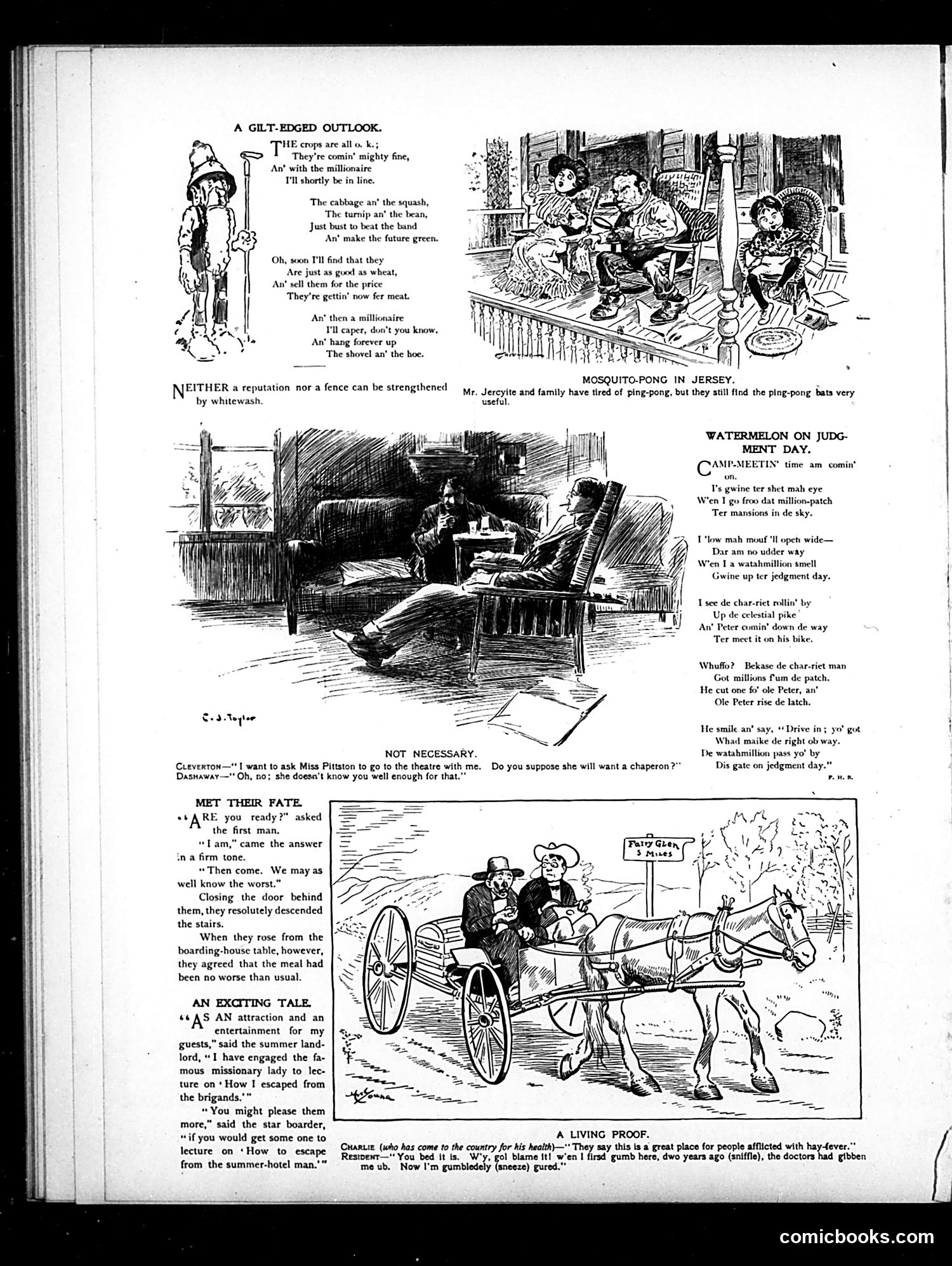
This page contains several satirical pieces typical of early 20th-century American humor: **"A Gilt-Edged Outlook"** mocks a farmer who believes growing vegetables will make him a millionaire—satirizing unrealistic economic fantasies and get-rich-quick thinking. **"Mosquito-Pong in Jersey"** jokes that mosquitoes are so prevalent in New Jersey that residents use ping-pong paddles to swat them instead of playing the game. **"Watermelon on Judgment Day"** uses dialect humor (common but problematic for modern readers) depicting an African American imagining heaven, where watermelon abundance determines social status even in the afterlife—reflecting both period stereotypes and class commentary. **"Not Necessary"** is a brief joke about a man not needing a chaperone to take a woman to theater because she doesn't know him well enough to care about propriety. **"Met Their Fate"** and **"An Exciting Tale"** are boarding-house jokes about terrible meals and hay fever, reflecting common period anxieties about boarding establishments. The humor relies on exaggeration, class anxiety, and stereotypes typical of Judge magazine's satirical approach.
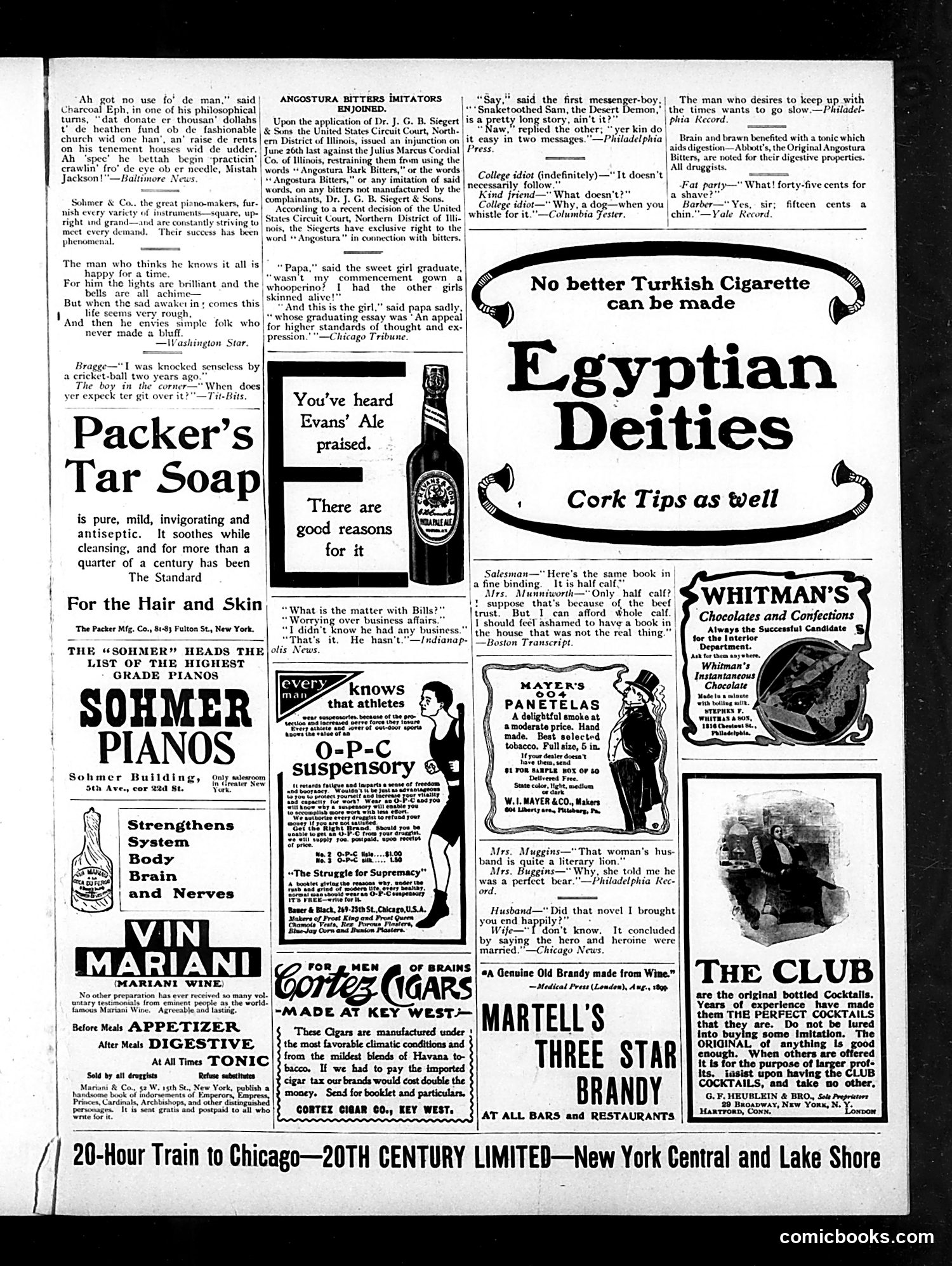
This page from *Judge* magazine is primarily **advertising**, not political satire. It features product advertisements (Packer's Tar Soap, Sohmer Pianos, Egyptian Deities cigarettes, Whitman's Chocolates, Martell's Brandy) interspersed with brief humor columns and jokes. The satirical content includes: - **Racial dialect humor** (opening piece with "Charcoal Eph"): Reflects the period's crude racial stereotyping common in early 20th-century American humor. - **Social commentary**: Brief quips about hypocrisy (wealthy donors raising rents), pretentious graduates, and matrimonial discord—typical light satire of the era. - **Legal notice**: An Angostura Bitters trademark injunction—genuine business news presented as content. The page reflects *Judge's* formula: mixing commercial advertising with accessible comedy for middle-class readers. Nothing here requires identifying specific political figures; the satire targets universal human follies rather than current events.
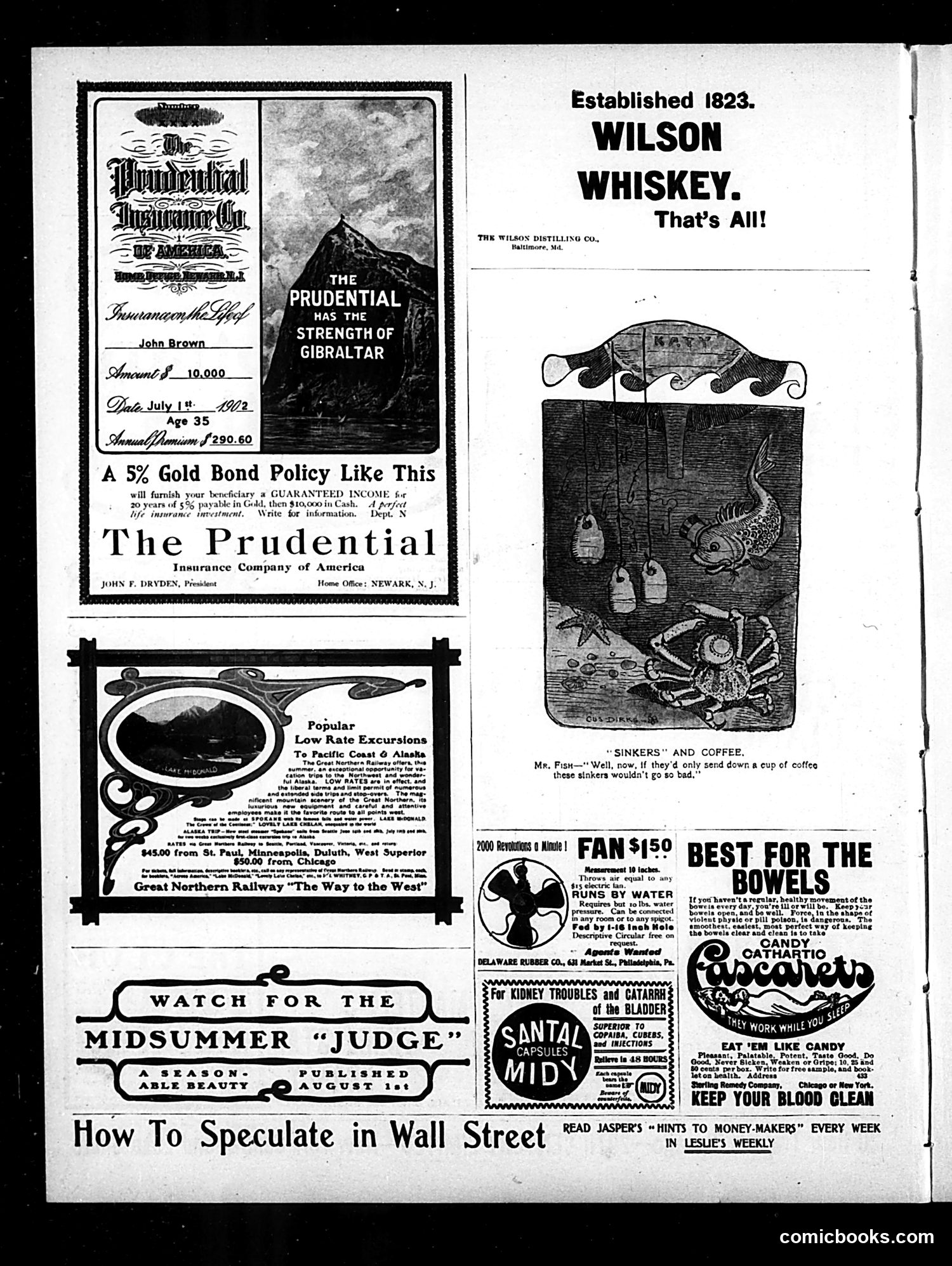
This page is primarily **advertising**, not editorial satire. It contains multiple product advertisements from circa 1912, reflecting turn-of-the-century American consumer culture. Notable ads include: - **Prudential Insurance**: A life insurance policy pitched as a "guaranteed income" investment, with sample policy details for a 35-year-old named John Brown. - **Wilson Whiskey**: A straightforward liquor advertisement emphasizing simplicity. - **Great Northern Railway**: Promoting discounted excursion fares to the Pacific Coast and Alaska. - **Cathartic/medicinal ads** (Santal Midi, Delaware Rubber Co., Cascarah): These reflect the era's widespread marketing of laxatives and dubious health remedies—products aggressively promoted to address digestive complaints. - **A fish/ocean cartoon** captioned "Sinkers and Coffee," a mild visual joke about submarine life. The page demonstrates how Judge monetized content through advertising while revealing period attitudes toward health (heavy reliance on purgatives) and financial security (insurance as investment).
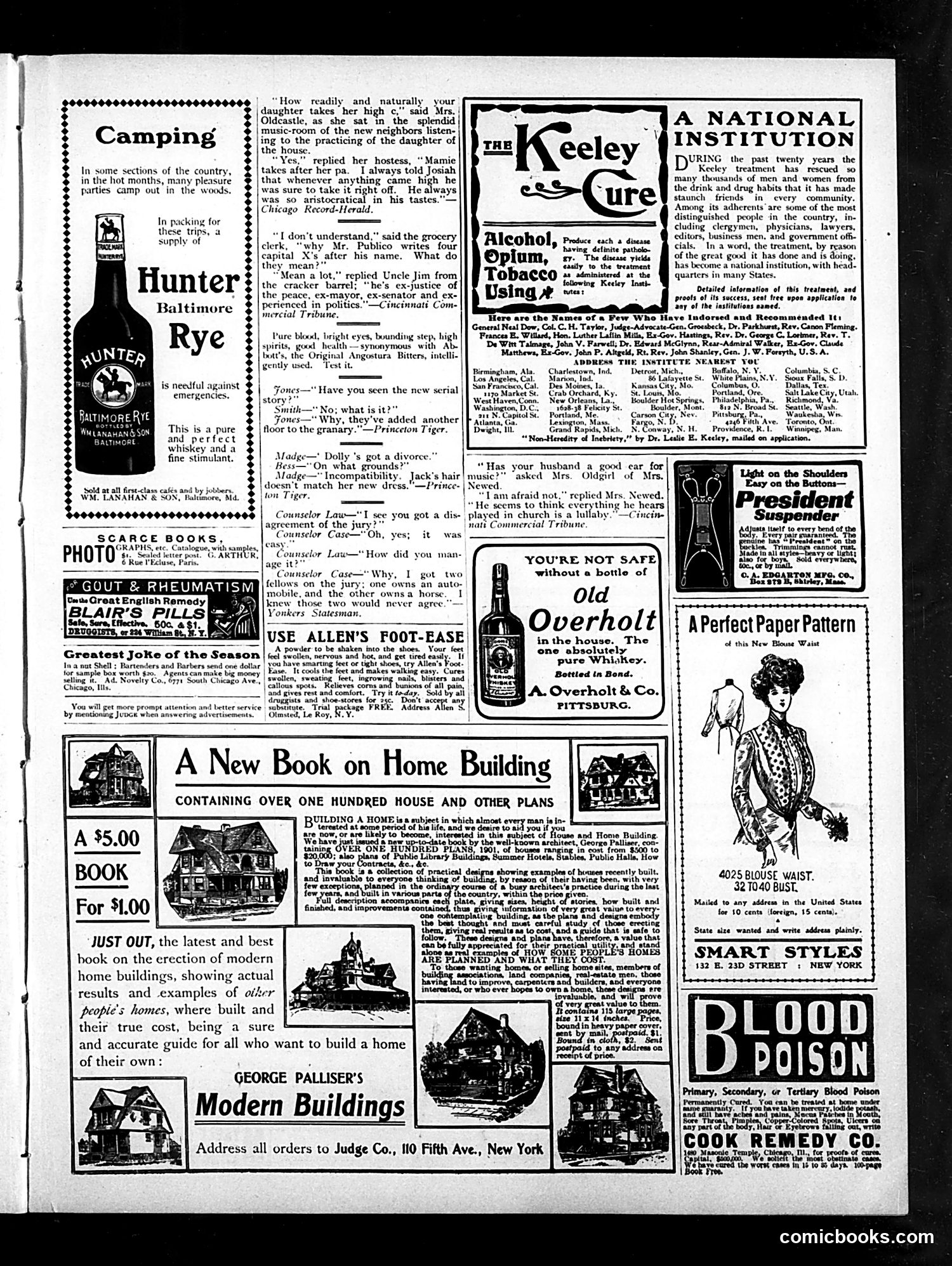
This page primarily contains **social humor and advertisements** rather than political cartoons. The satirical content consists of brief, genteel jokes typical of early 20th-century humor magazines: **The Jokes:** Several short comedic exchanges mock social pretension and marital incompatibility—like the opening joke about a neighbor whose daughter "takes after her pa" in adopting high-class affectations, and quips about divorce and musical taste. **The Advertisements** dominate the page and reveal period concerns: - **The Keeley Cure**: A treatment for alcoholism and drug addiction, endorsed by prominent figures (judges, generals, clergy). This reflects the temperance movement's influence. - **Hunter Rye whiskey**: Ironically placed near the Keeley ad - **President Suspenders**, Abbott's Bitters, and a home-building book **Historical Context:** This reflects Progressive Era anxieties about substance abuse, social mobility, and "proper" behavior. The ads suggest these were genuine concerns for the magazine's educated, middle-class readership rather than satirical targets.
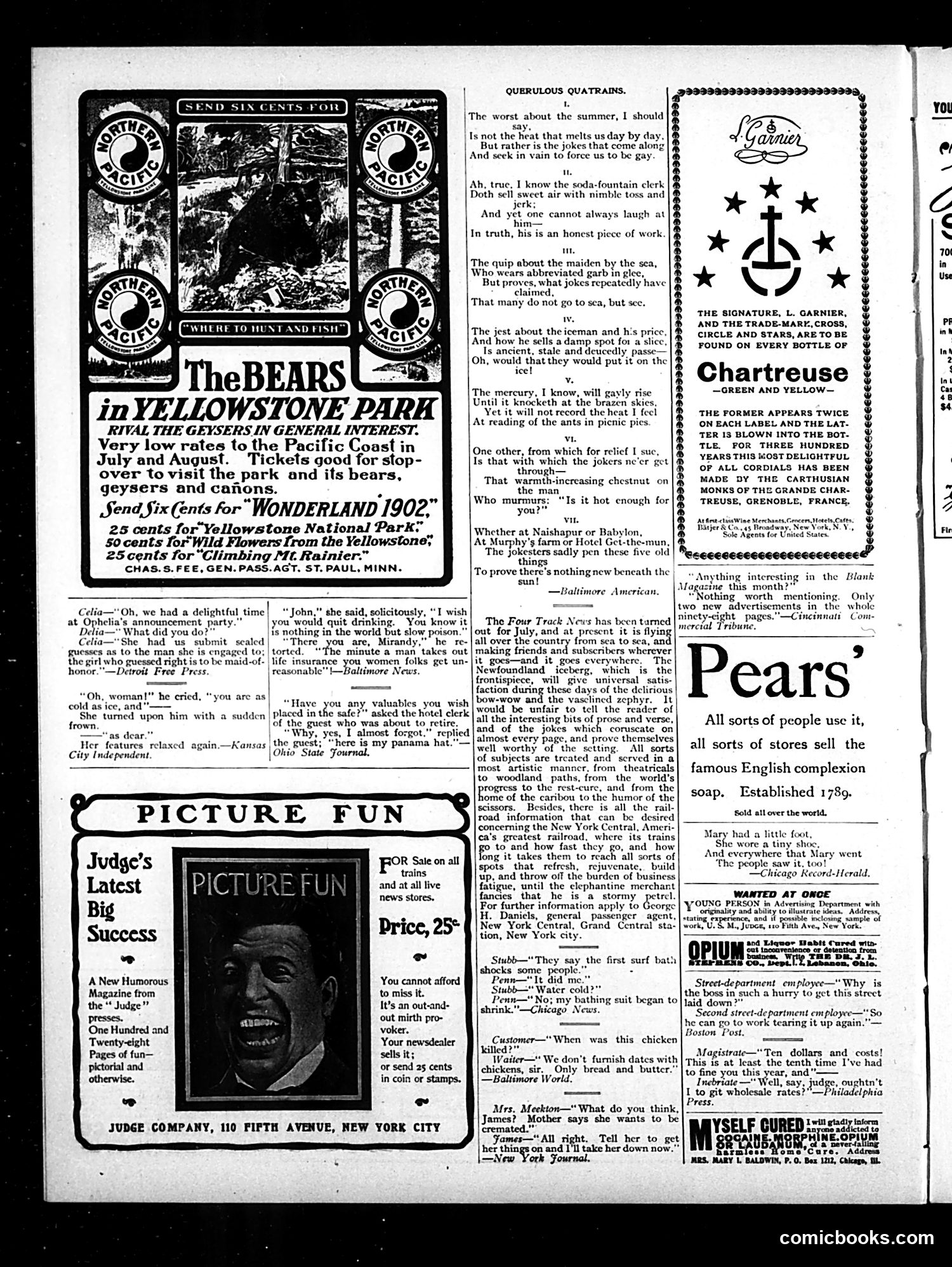
This page contains primarily **advertising and light humor** rather than political satire. The main elements include: **"The Bears in Yellowstone Park"** advertisement promoting Northern Pacific Railway's discounted summer travel packages to Yellowstone, emphasizing the park's geysers and bears as tourist attractions. **"Querulous Quatrains"** is a humorous poetry section lamenting tired summer jokes—specifically mocking repetitive "hot weather" humor (the iceman jokes, "Is it hot enough for you?" chestnuts, ants-at-picnics gags). The poet expresses frustration that comedians recycle the same worn material annually. **Scattered short anecdotes** include mild domestic humor (a wife nagging her husband about drinking, a guest joking about his panama hat as a "valuable"). **"Picture Fun"** advertises Judge Company's new humorous magazine. The page reflects early-1900s popular humor: gentle domestic comedy, complaints about clichéd jokes, and travel promotion. There's no identifiable political cartooning or significant social commentary—it's primarily entertainment and commercial content.
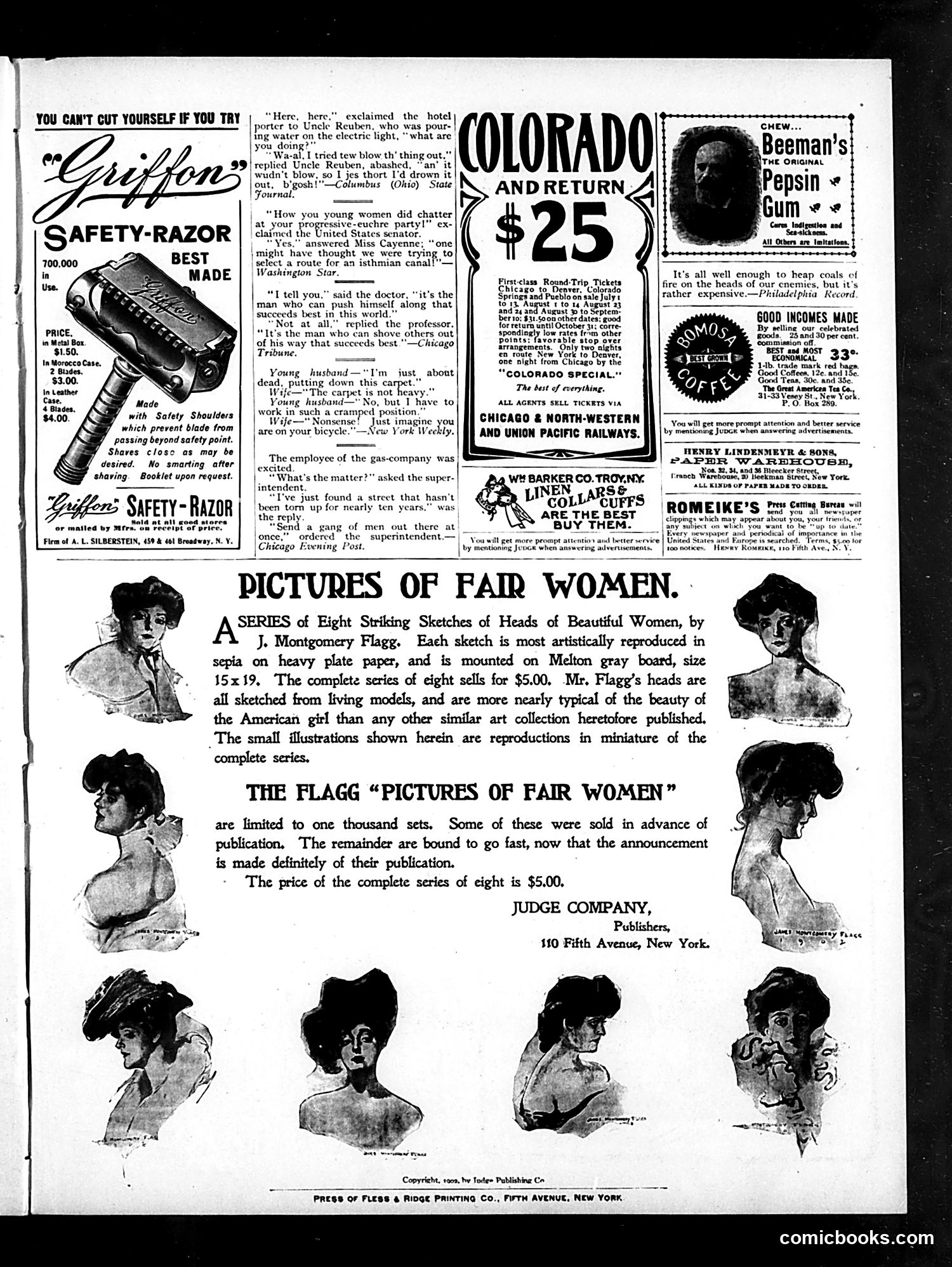
This is primarily an **advertising page** with some comic anecdotes rather than political cartoons. The page contains **short humorous stories** satirizing American life: a porter nearly drowns a rat with water instead of poison; a senator's wife deflects criticism of progressive cuisine; a professor cynically claims success requires pushing others aside; a husband complains about laying carpet; and a superintendent discovers a street hasn't been torn up for repairs (implying constant infrastructure disruption). The main content is **product advertisements**, including Griffon Safety Razors, Beeman's Pepsin Gum, and a Colorado train excursion ($25 round trip). The centerpiece advertises **J. Montgomery Flagg's "Pictures of Fair Women"**—eight artistic sketches of female heads, limited to 1,000 sets at $5.00. Eight portrait sketches are displayed showing different women's profiles and angles. The humor is gentle, domestic satire reflecting early 20th-century American anxieties about infrastructure, progress, and gender. No specific political figures are identifiable.
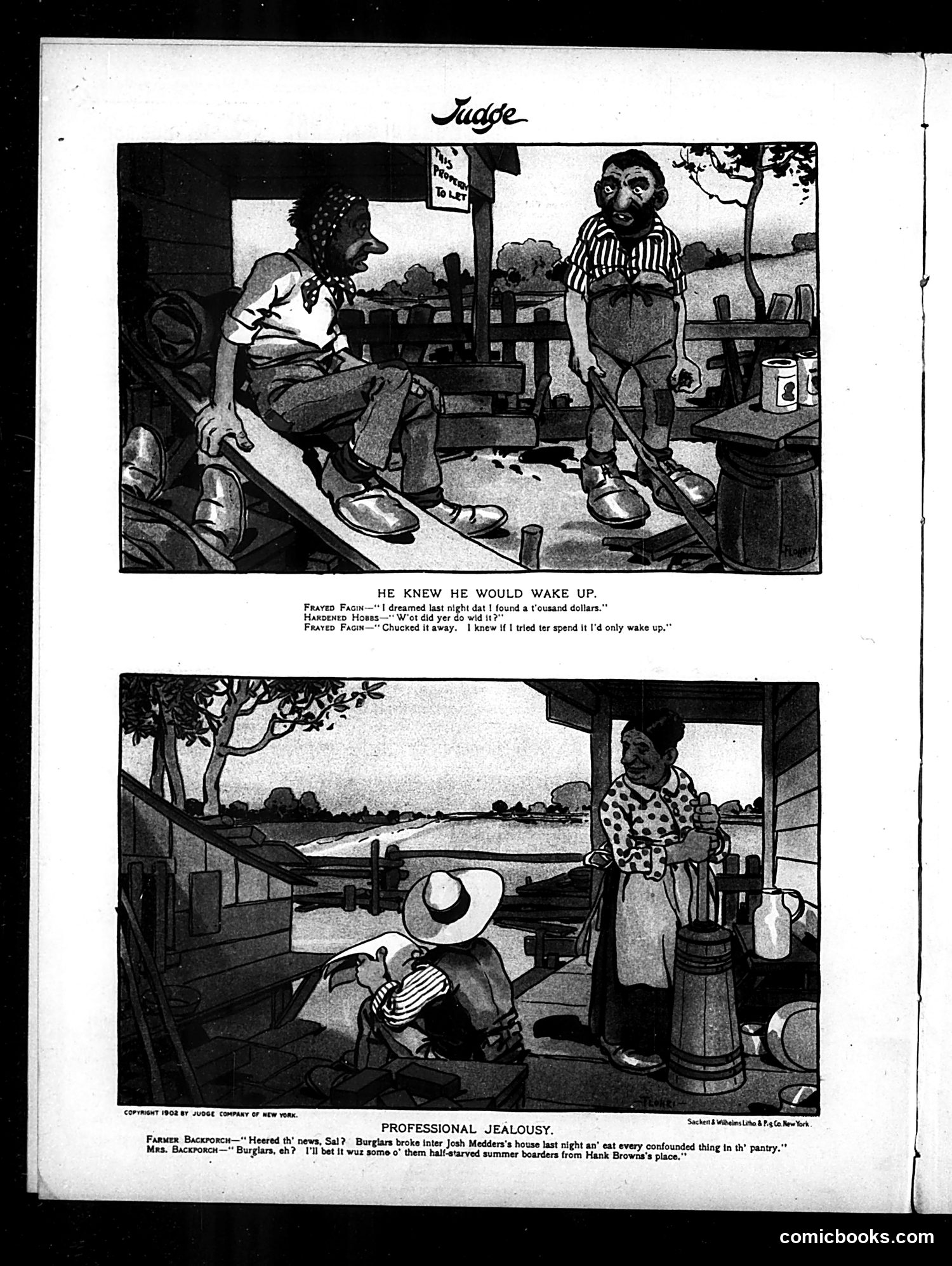
**Top panel: "He Knew He Would Wake Up"** depicts two working-class men in dialect-heavy conversation. One recounts dreaming of finding a thousand dollars but throwing it away, reasoning that spending it would cause him to wake. The joke targets the desperation of poor laborers whose dreams of wealth are so implausible they assume any fortune must be illusory. **Bottom panel: "Professional Jealousy"** shows rural/working-class characters (indicated by heavy dialect spelling) discussing a burglary. Mrs. Backporch suspects the thieves were actually starving summer boarders from a neighbor's property—implying they're so poor and hungry they'd steal food. The "professional jealousy" likely refers to competition between poor communities over limited resources and suspicion of outsiders. Both cartoons use exaggerated dialect and caricature to mock working-class poverty and rural communities, typical of Judge's satirical approach to social class.