
Judge, 1902-07-26 · page 7 of 16
Judge — July 26, 1902 — page 7: what you’re looking at
What you’re looking at
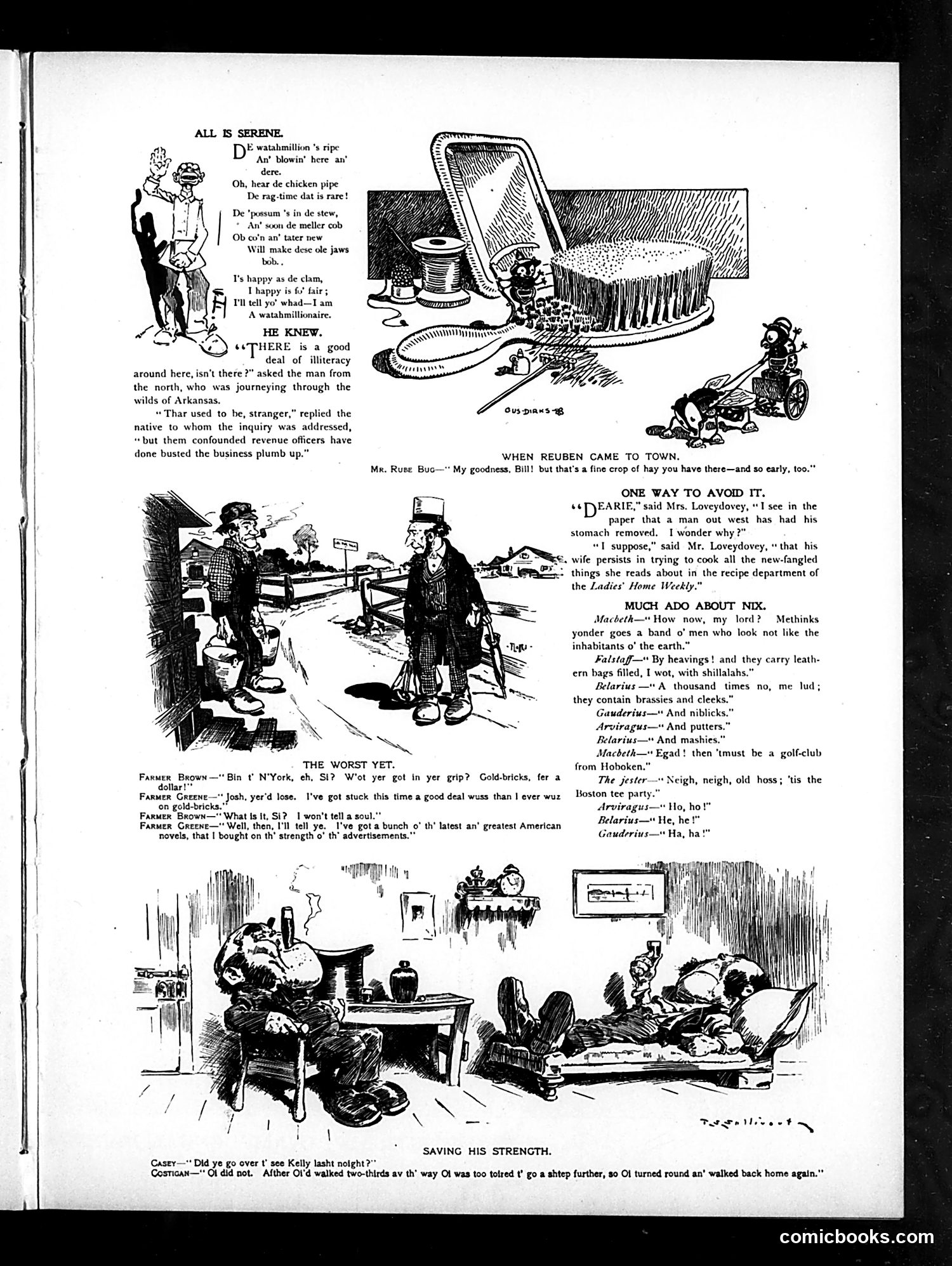
This page contains multiple satirical pieces typical of early 20th-century American humor: **"All is Serene"** mocks rural Southern dialect and contentment, using exaggerated Black vernacular to portray a poor sharecropper as happily oblivious—a common racist trope of the era. **"He Knew"** jokes about Arkansas backwardness and tax evasion, with a local claiming revenue officers destroyed the region's "illiteracy business"—likely referencing moonshining or fraud schemes. **"The Worst Yet"** depicts farmers duped by mail-order novels advertised in publications, satirizing gullible rural consumers. **"Much Ado About Nix"** parodies Shakespeare by having classical characters mistake golfers' equipment for weapons, joking that golf clubs must be from "Hoboken" (a working-class area) or referencing the "Boston tee party"—a pun on the Boston Tea Party. **"One Way to Avoid It"** humorously suggests wives' cooking from *Ladies' Home Weekly* recipes is so terrible it might justify stomach removal. The overall tone targets rural ignorance, immigrant stereotypes, and contemporary consumer culture.
📄 Transcribed text from this page (OCR, searchable)
Machine-transcribed from the original scan — historical spelling and the odd misread are preserved.
ee ALL IS SERENE. D* watahmillion ‘s ripe ‘An’ blowin’ here an’ dere. Oh, hear de chicken pipe De rag-time dat is rare! | De ‘possum 's in de stew, ‘ * An’ soon de meller cob Ob co'n an’ tater new Will make dese ole jaws bob. . T’s happy as de clam, i T happy is fu" fair ; ¥ T'll tell yo’ whad—I am t A watahmillionaire. Y E> HE KNEW. | XD MO THERE is a good deal of illiteracy around here, isn't there ?” asked the man from | the north, who was journeying through the wilds of Arkansas, “Thar used to be, stranger,” replied the native to whom the inquiry was addressed, | “but them confounded revenue officers have | done busted the business plumb up.” | ¢ i} ‘THE WORST YET. dollar!"* Farmer Greene—" Josh, yer'd lose. on gold-bricl Faruer Brown— Farwer Greene: ‘What is It, Si? I won't tell a soul.”” Well, then, I'll tell ye. fl Nh Casty—"' Did ye go over t’ see Kelly lasht noight?” Mr. Ruse Buc—* My goodness, Bill! but that's a fine crop of hay you have there—and so early, too." Faruer Brown —"'Bin t' N'York, eh, Si? W'ot yer got in yer grip? Gold-bricks, fer a I've got stuck this time a good deal wuss than | ever wuz I've gota bunch o' th’ latest an’ greatest American novels, that | bought on th’ strength o° th’ advertisements."* Costican—" Ol did not. Afther Ot'd walked two-thirds av th’ way O1 was too tolred t" go a shtep further, so O1 turned round an’ walked back home again.”” Ous-piaKs-B WHEN REUBEN CAME TO TOWN. ONE WAY TO AVOID IT. “4 P)EARIE,” said Mrs. Loveydovey, “I see in the paper that a man out west has had his stomach removed. I wonder why ?" “1 suppose,” said Mr. Loveydovey, «that his wife persists in trying to cook all the new-fangled things she reads about in the recipe department of the Ladies’ Home Weekly.” MUCH ADO ABOUT NIX. Macbeth—" How now, my lord? Methinks yonder goes a band o' men who look not like the inhabitants o' the earth.” Falstag—" By heavings! and they carry leath- ern bags filled, I wot, with shillalahs.” Belarius —" A thousand times no, me lud; they contain brassies and cleeks.” Gauderius—* And niblicks." Arviragus—* And putters. Belarius—* And mashies.” Macbeth— Egad ! then ‘tmust be a golf-club from Hoboken. The jester —“ Neigh, neigh, old hoss; ‘tis the Boston tee party.” Arviragus—* Ho, ho!” Belarius—* He, he ! Gaudrrius— Ha, ha!" Ta seileveet N SAVING HIS STRENGTH. comicbooks.com