
A complete issue · 16 pages · 1901
Judge — December 7, 1901
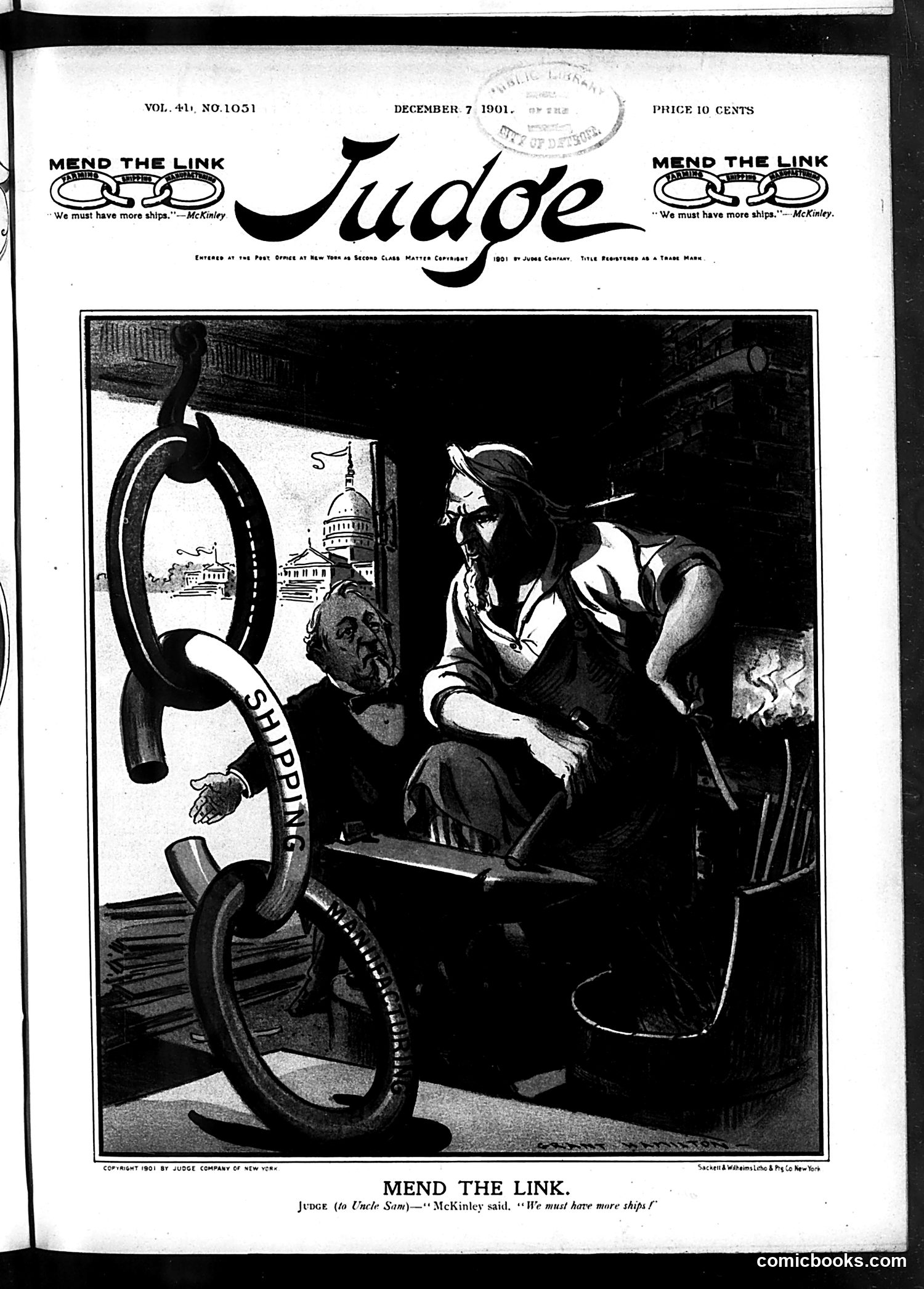
This December 1901 *Judge* cartoon satirizes President Theodore Roosevelt's foreign policy, specifically his naval ambitions. The figure labeled "SHIPPING" represents American merchant marine interests, depicted as a skeletal victim being strangled by a chain. The cartoon critiques McKinley's (the previous administration's) shipping policy through Roosevelt's perspective. The chain labeled "SHIPPING" symbolizes how inadequate naval support has weakened American commercial power. The Capitol building visible through the porthole suggests Congress is responsible for this failure. Roosevelt's famous saying "We must have more ships!" appears as the caption, endorsing naval expansion as essential to American prosperity. The skeleton imagery emphasizes that without improved shipping infrastructure and naval protection, American commerce faces death. The satire advocates for Roosevelt's interventionist maritime policy.
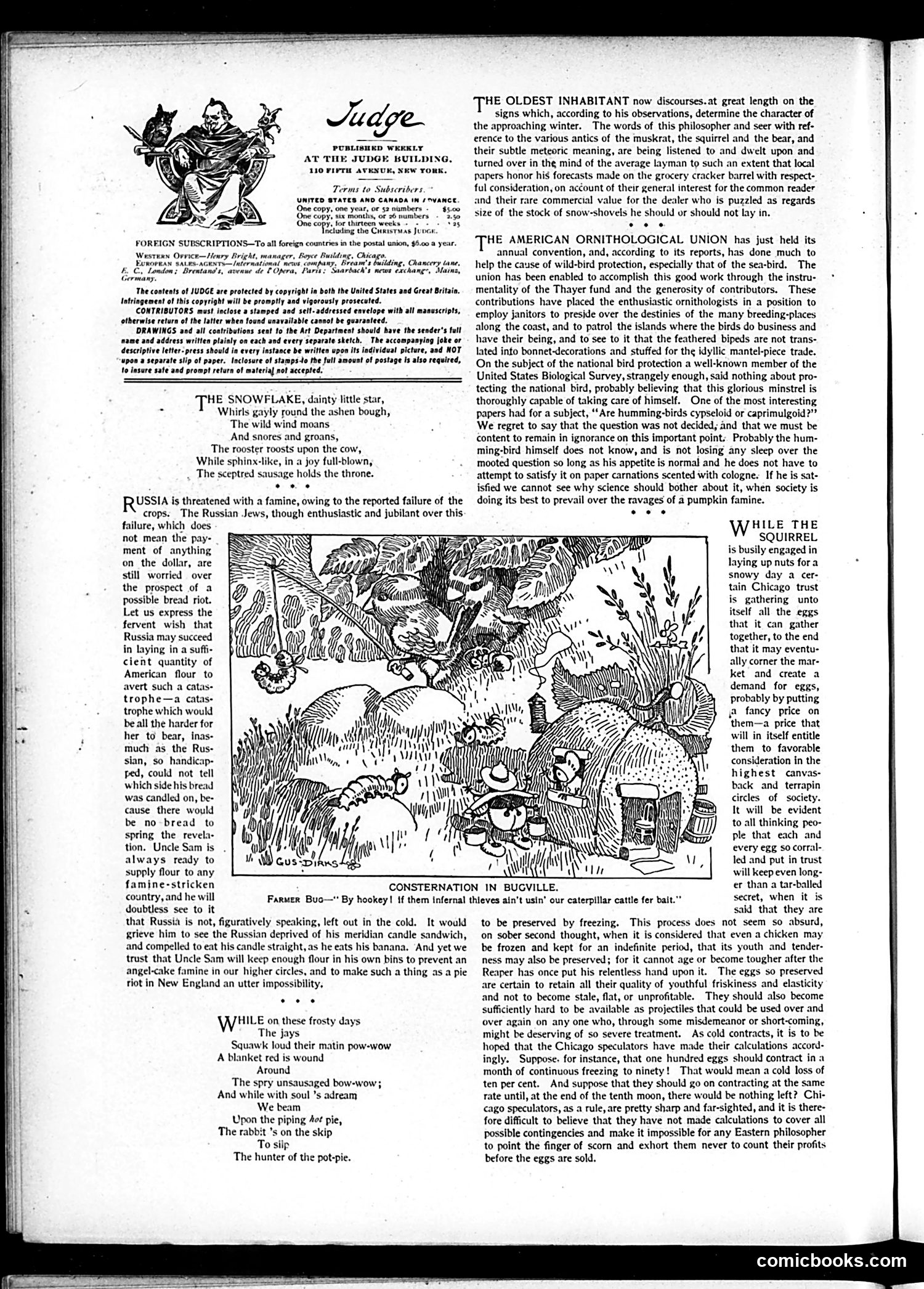
The main cartoon, titled "Consternation in Bugville," depicts squirrels and other small animals with gathered food stores. The caption quotes "Farmer Bug: 'By hookey! If them infernal thieves ain't usin' our caterpillar cattle for bait.'" This appears to be **anthropomorphic satire about food storage and economic concerns**. The squirrels represent humans preparing for winter (financial hardship), while their anxiety about "thieves" stealing resources suggests **anxieties about theft, loss of investments, or economic instability**—likely referencing contemporary concerns about speculation or market manipulation. The accompanying text discusses egg preservation and Chicago speculators' calculations about frozen eggs, suggesting the cartoon satirizes **commodity speculation and artificial scarcity schemes** used to manipulate prices. The humor lies in applying such economic schemes to animals' simple survival instincts.
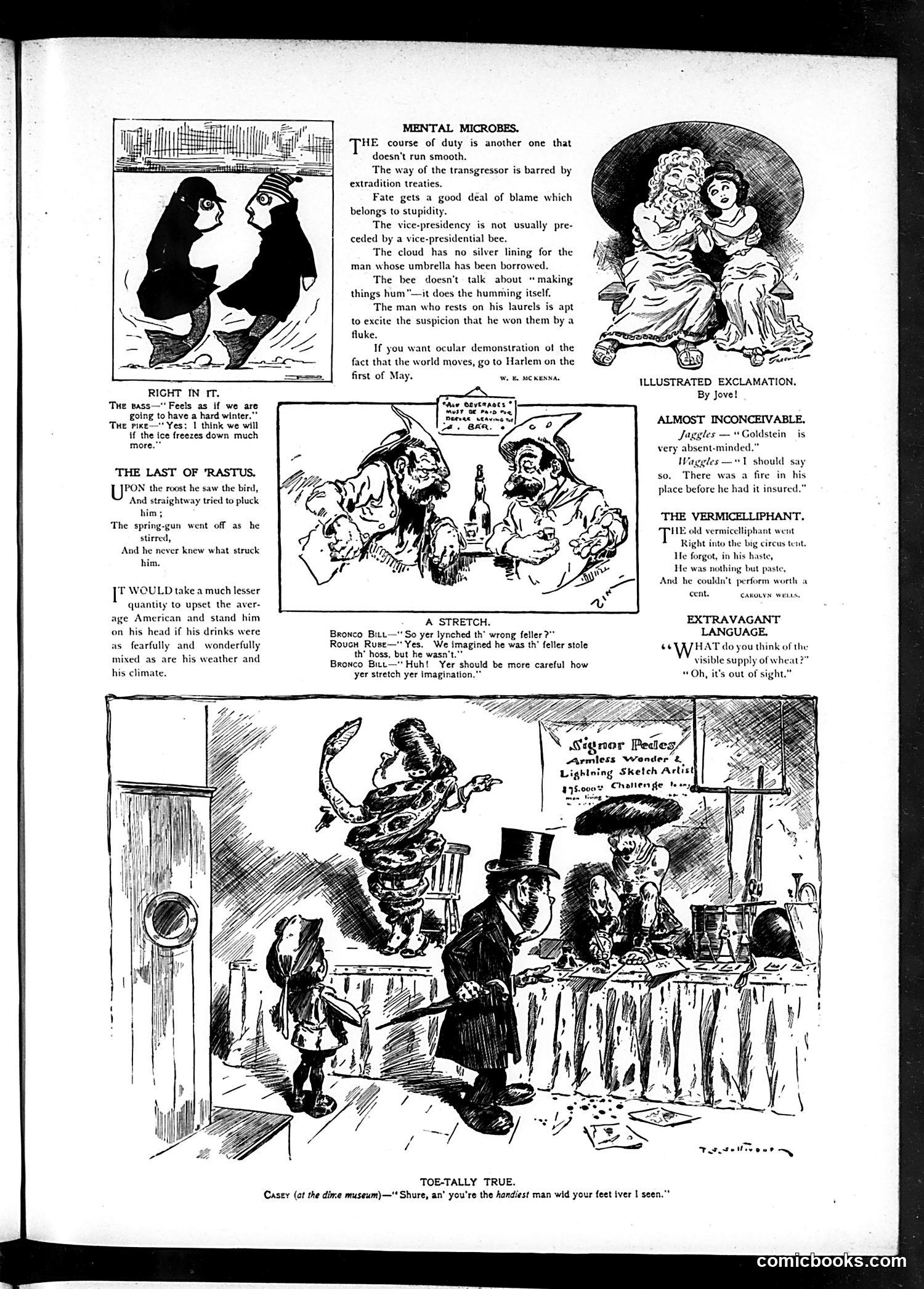
This page contains several unrelated satirical pieces typical of Judge magazine's format: **"Mental Microbes"** appears to mock philosophical or intellectual pretension through dialogue between two figures. **"Right in It"** and **"The Last of Rastus"** are brief humorous snippets, though their specific targets are unclear from the limited text. **"A Stretch"** depicts two men (Bronco Bill and Rocky) arguing about exaggeration—a simple joke about tall tales. **"Toe-Tally True"** shows a circus scene where Casey (at the dime museum) is called "the handiest man you feet ever seen"—a pun on "feet" suggesting a contortionist or acrobat. The remaining items are short quips and illustrations without clear historical references. The page primarily offers light humor and wordplay rather than direct political satire.
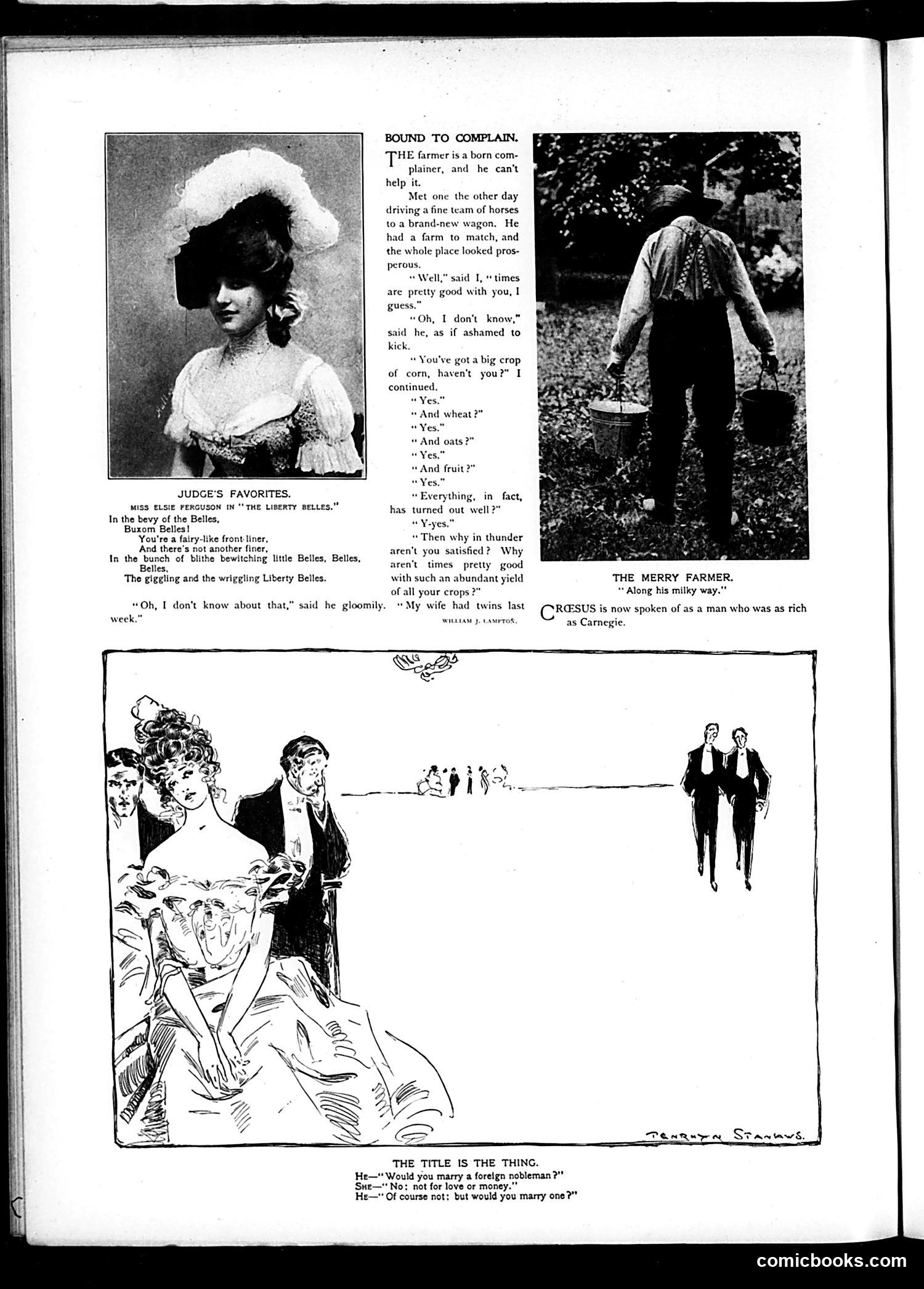
**"Judge's Favorites"** features Miss Elsie Ferguson from "The Liberty Belles," a theatrical production. The accompanying verse is light social commentary about her appearance and charm. **"Bound to Complain"** depicts a farmer grumbling despite abundant harvests—corn, wheat, oats, and fruit all thriving. His wife bore twins, yet he still complains about thunder and weather. The satire mocks chronic complainers: people blessed with prosperity who focus obsessively on minor grievances rather than appreciating abundance. **"The Title Is the Thing"** shows a woman prioritizing a suitor's social status over character, asking whether he's a gentleman or wealthy rather than whether he'd be loving or true. This satirizes materialistic marriage values of the era. The cartoons reflect early 20th-century social attitudes regarding class consciousness, gender expectations, and character.
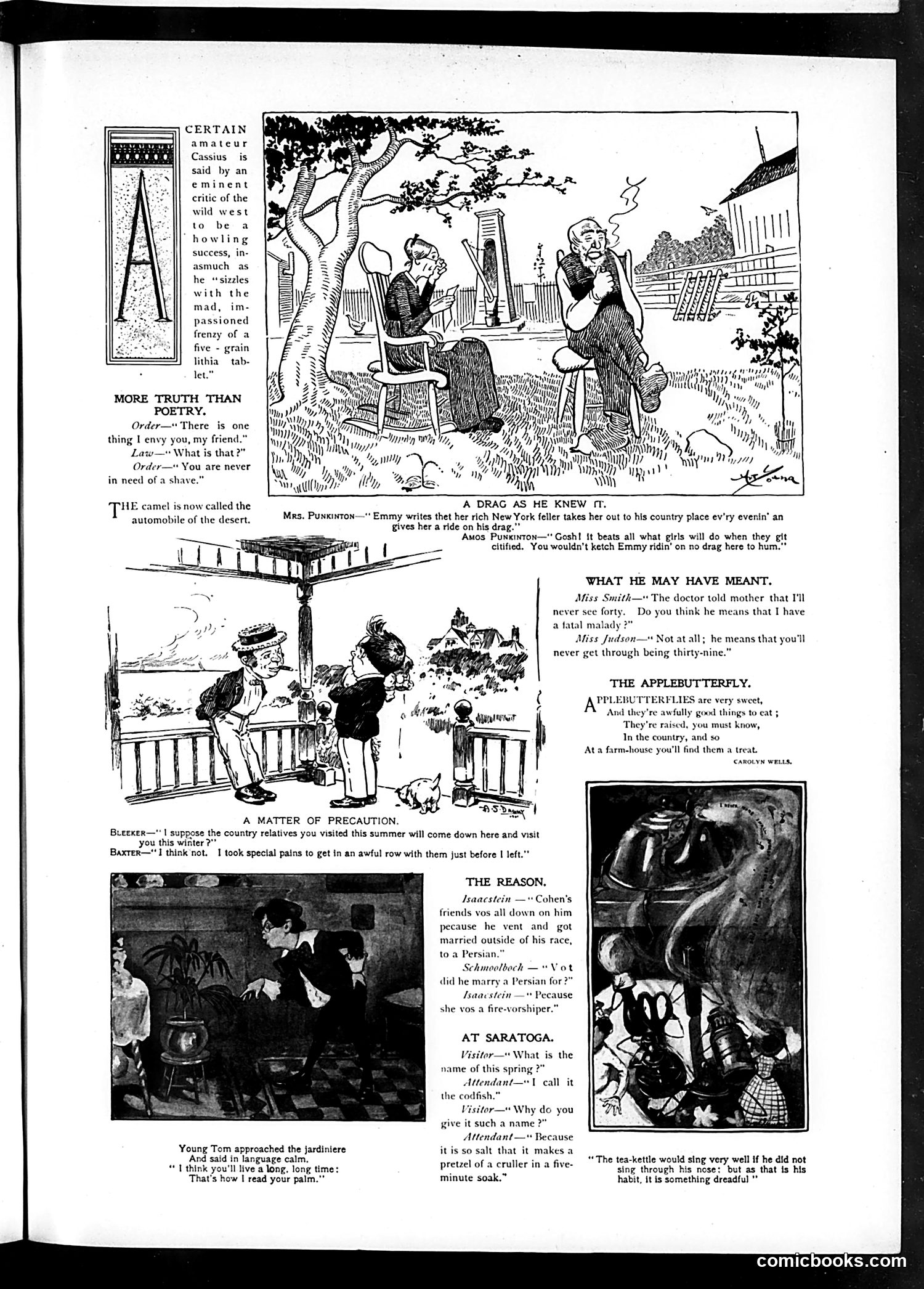
This page contains several brief comedic sketches typical of early 20th-century American humor magazines: **"More Truth Than Poetry"** satirizes a man who never needs to shave—likely mocking either laziness or chronic facial hair problems treated as a quirk. **"A Drag As He Knew It"** plays on class differences: a rural father (Amos Puxnton) is scandalized that his daughter Emmy now accepts carriage rides from a wealthy New York suitor, viewing it as improper city behavior she'd never do "back home." **"The Applebutterfly"** is whimsical nonsense verse by Carolyn Wells, apparently a playful fictional food item. **Remaining sketches** include ethnic humor ("The Reason," featuring Jewish characters Cohen, Schmoolboch, and Isaacstein discussing intermarriage) and observational jokes about precautions, medical misunderstandings, and spa culture at Saratoga. The page reflects period attitudes toward immigration, rural-urban cultural gaps, and gender propriety, presented as lighthearted satire for Judge's educated urban readership.
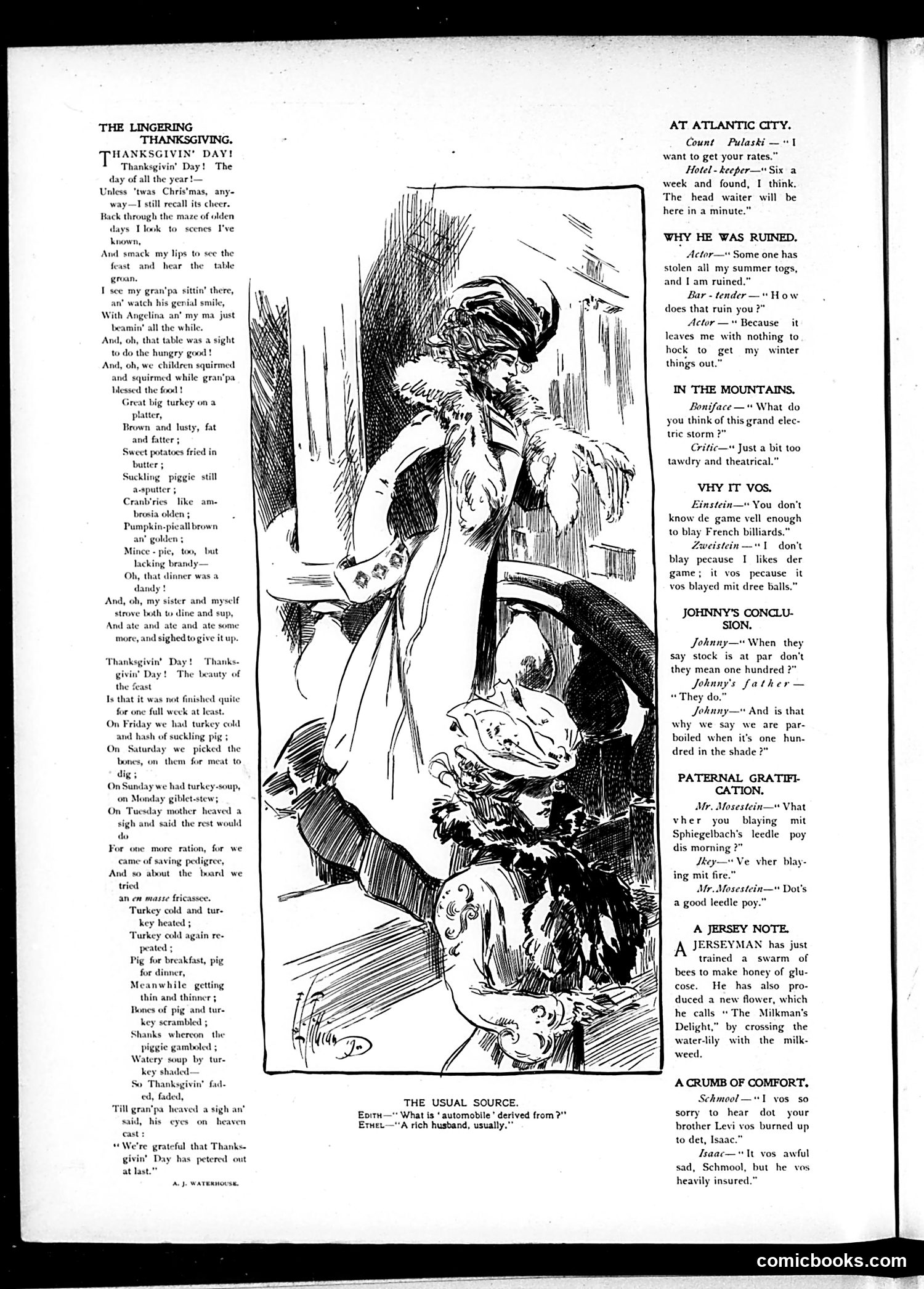
This page from *Judge* magazine contains several short humorous pieces typical of early 20th-century American satire. **"The Lingering Thanksgiving"** (main poem with illustration) nostalgically describes a bountiful childhood Thanksgiving feast, then humorously shows how the family stretched the meal for an entire week—turkey cold, turkey soup, pig scraps, bones for broth—until the grandfather finally exclaims relief that Thanksgiving "has petered out at last." The joke satirizes both sentimental nostalgia and working-class food waste-prevention practices. The remaining items are brief jokes targeting contemporary stereotypes: **"Automobile"** jokes about wealthy husbands funding wives' cars; **Atlantic City** references resort pricing; **Einstein and "Zweistein"** use Yiddish-inflected speech patterns (common ethnic humor of the era) about billiards; **Jersey Note** mocks New Jersey agricultural innovation claims; and the final items use Jewish names with exaggerated accents to joke about life insurance and financial pragmatism—reflecting period attitudes toward immigrant communities.
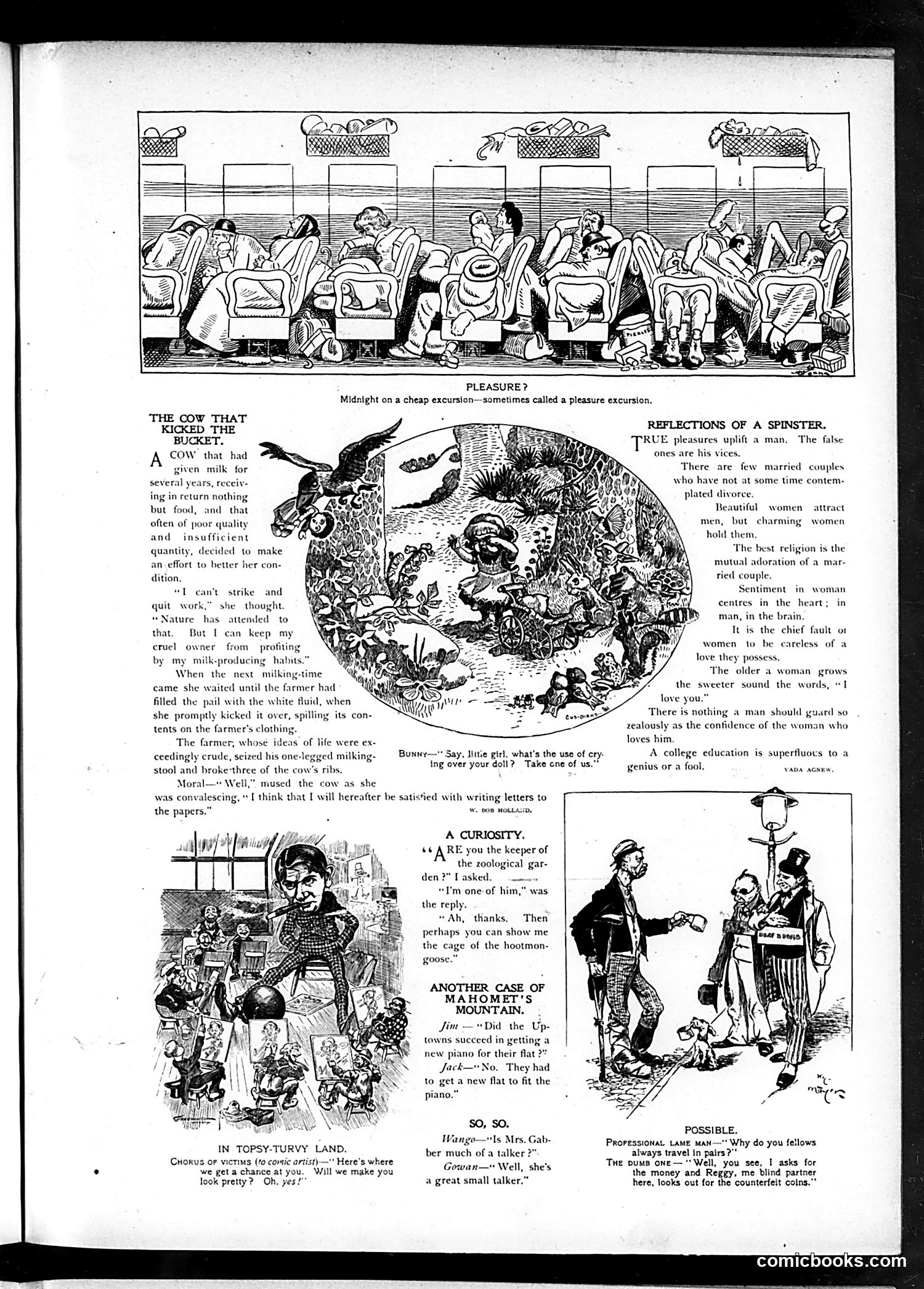
This page contains multiple satirical pieces reflecting turn-of-the-century social commentary: **"Pleasure?"** depicts a cheap excursion (budget outing), showing crowded, uncomfortable conditions—satirizing working-class attempts at recreation. **"The Cow That Kicked the Bucket"** is an animal fable criticizing labor exploitation: a mistreated dairy cow deliberately spills milk to deprive her owner of profit, only to be brutally beaten. The moral condemns both worker desperation and employer cruelty. **"Reflections of a Spinster"** offers cynical observations about marriage and women, reflecting period anxieties about divorce and female independence. The remaining pieces are brief humorous anecdotes: a child's confusion about dolls, a furniture/apartment paradox, wordplay about zoo animals, and—most pointedly—"Professional Lame Man," which darkly jokes about con artists exploiting disability to commit counterfeiting fraud. This last item satirizes urban crime and dishonesty among the poor. The overall tone blends social criticism with sometimes harsh humor about class, labor, and urban life.
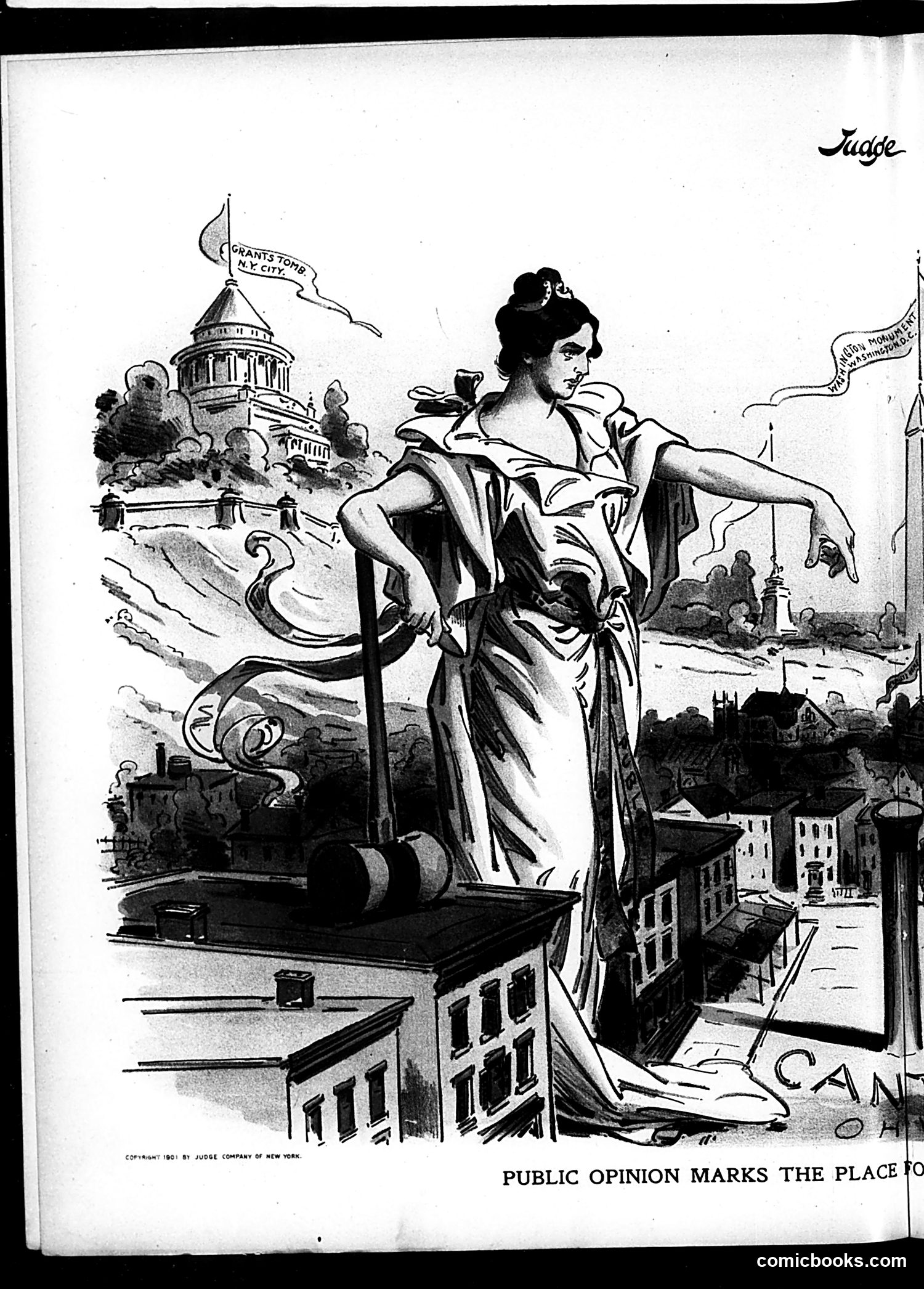
This Judge magazine cartoon depicts a classical female figure (likely representing "Public Opinion" or "Justice") standing prominently over a cityscape. She holds a staff or scepter and gestures authoritatively across an urban landscape featuring prominent buildings including what appears to be a domed government structure (possibly a capitol or city hall). The caption reads "PUBLIC OPINION MARKS THE PLACE FOR..." though the text is cut off. The satire appears to comment on public opinion's power to designate or judge the proper location for something—likely a civic institution or monument. The classical allegorical female figure emphasizes the "timeless" authority of popular will in democratic governance. Without the complete caption, the specific target remains unclear, though the cartoon likely critiques contemporary debates about public works, urban development, or institutional placement in early-20th-century American cities.
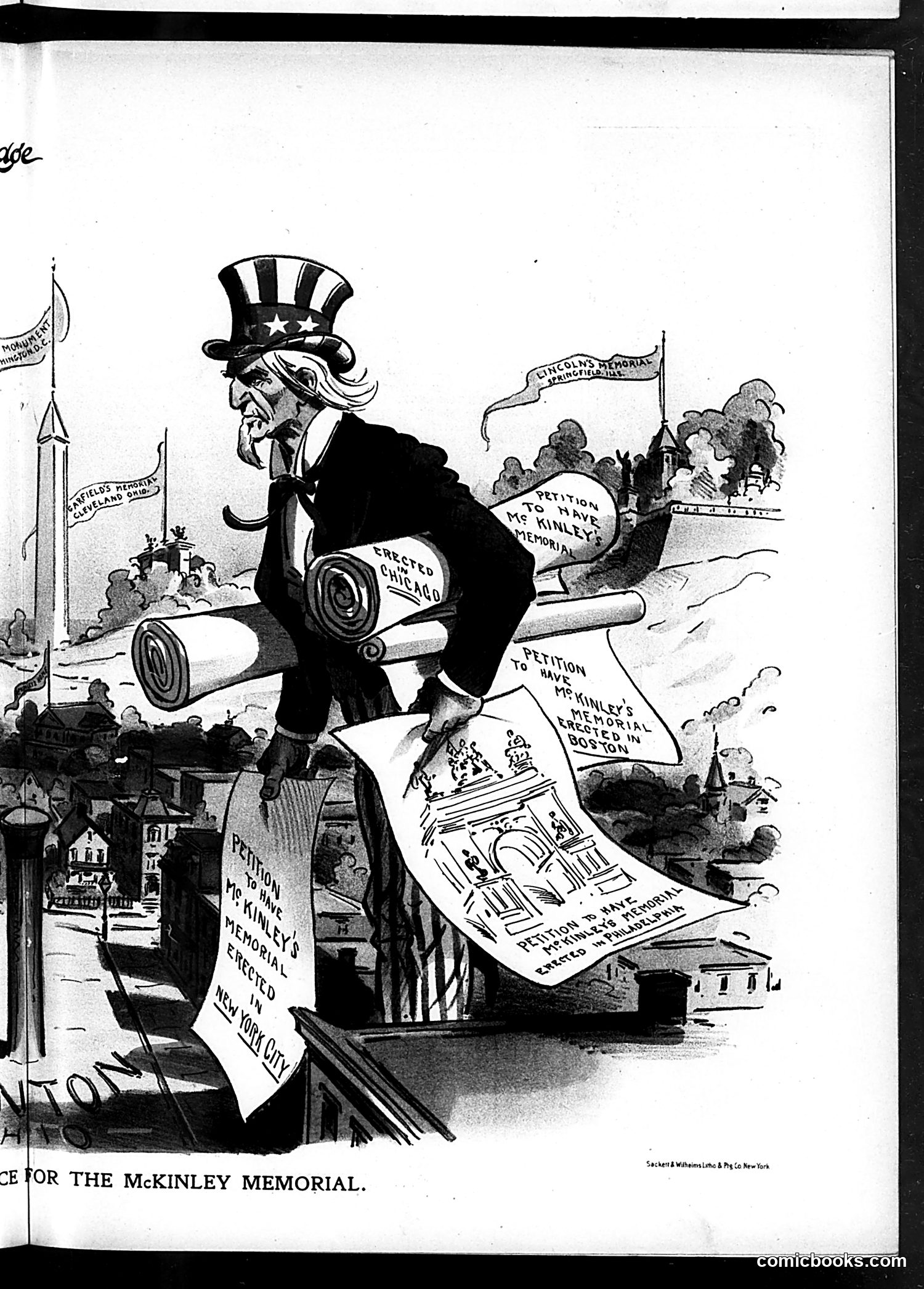
This political cartoon satirizes fundraising efforts for a memorial to President William McKinley (assassinated 1901). Uncle Sam, identifiable by his starred top hat, is depicted as a carnival barker or pitchman, literally "selling" the memorial project. Multiple petition documents surround him—labeled as petitions from various cities (New York City, Boston, and Chicago are visible)—suggesting competing or redundant memorial campaigns. The satirical point appears to critique the proliferation of memorial schemes and perhaps the aggressive or undignified manner in which funds were being solicited from the public. The carnival-like presentation mocks how memorial fundraising had become commercialized, treating a solemn patriotic duty as a promotional spectacle rather than a genuine civic endeavor.
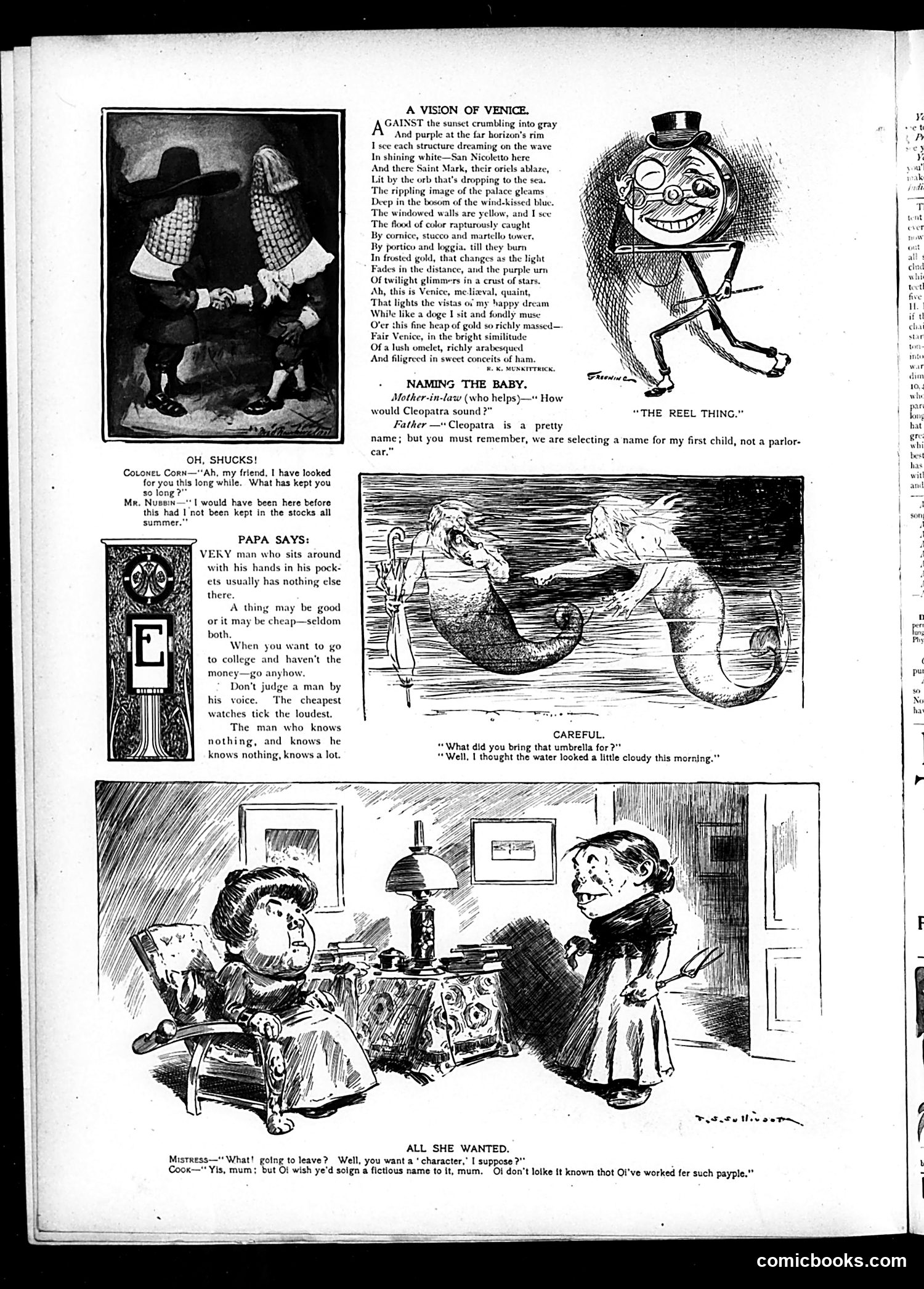
This page contains several unrelated satirical pieces typical of early 20th-century Judge magazine: **"A Vision of Venice"** is a humorous poem mocking flowery, pretentious travel writing. It begins with romantic descriptions of Venice, then deflates them by comparing the sunset's reflection to "a lush omelet, richly arabesqued / And filigreed in sweet conceits of ham"—crude humor undercutting aesthetic pretension. **"Naming the Baby"** jokes about nouveau riche parental pretension: a father rejects "Cleopatra" as too theatrical for his child, revealing class-conscious anxiety about appearing ostentatious. **"Papa Says"** offers cynical aphorisms about human nature and money. **"All She Wanted"** satirizes servant employment: a departing cook asks her employer for a false reference letter, unwilling to admit working for people she considers beneath her social standing—commentary on class hierarchies and employment practices of the era. The cartoons use exaggeration and crude humor to mock social climbing, pretension, and class anxiety among various social groups.
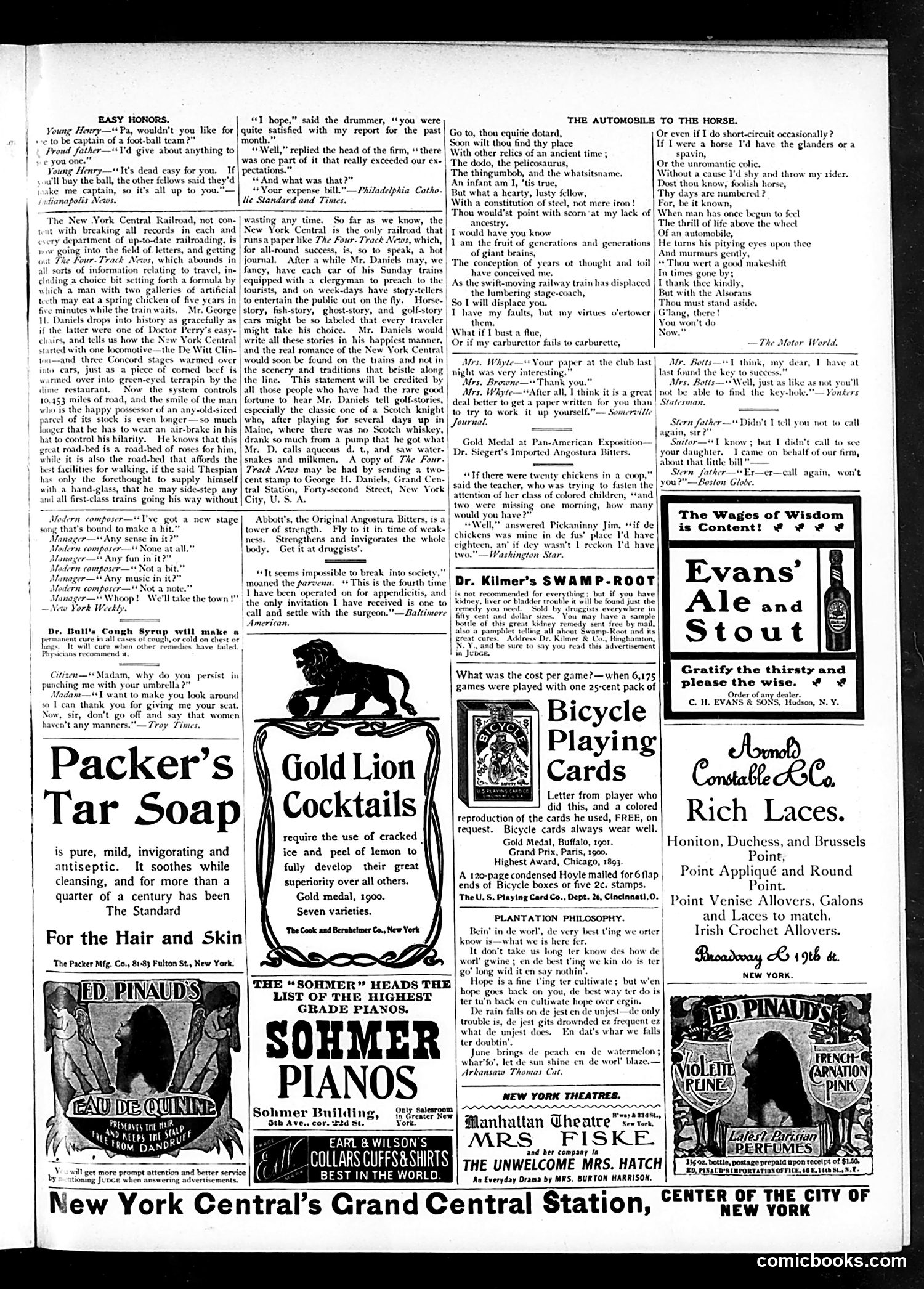
This page primarily consists of **advertisements and light humor pieces** rather than political satire. The main cartoon, "Easy Honors," depicts a father-son exchange where a boy asks his father to buy him a football team captaincy by purchasing equipment—a joke about parental indulgence and the commercialization of childhood achievement. "The Automobile to the Horse" is a mock-dramatic dialogue where a newfangled automobile mocks an old horse as obsolete, representing the early-20th-century anxiety about technological displacement. The horse responds defensively, claiming superior virtue and long service—satirizing resistance to modern progress. A third piece celebrates the **New York Central Railroad's *Four-Track News*** publication, praising its innovative approach to passenger entertainment with on-board storytellers and themed observation cars. The remainder is **period advertising**: Packer's Tar Soap, Gold Lion Cocktails, Sohmer Pianos, Evans' Ale and Stout, and various other commercial products typical of the era. The page reflects **turn-of-the-century American optimism about technology** alongside nostalgic humor about displaced traditions.
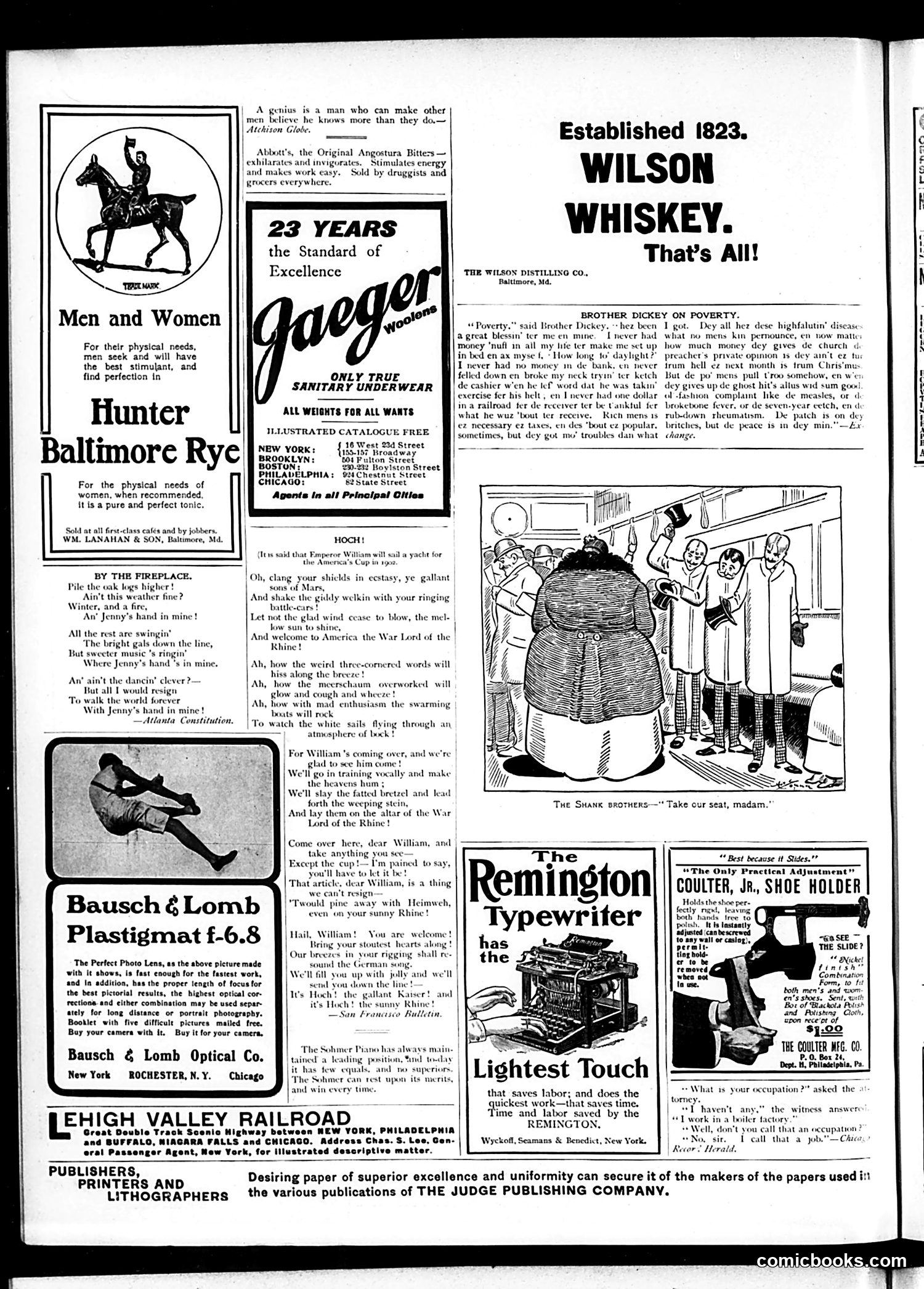
This page is primarily **advertising**, not satirical editorial content. The main items are commercial ads for Wilson Whiskey, Hunter Baltimore Rye, Gaeger Underwear, Bausch & Lomb camera lenses, Remington typewriters, and a Lehigh Valley Railroad notice. The one notable satirical piece is "BROTHER DICKEY ON POVERTY," a dialect story mocking rural/working-class attitudes toward wealth and hardship. The narrator argues poverty has been a "blessing" because it prevented him from becoming corrupted by money—a satirical jab at romanticized poverty rhetoric and the hypocrisy of the wealthy. There's also a poem "HOCH!" celebrating the arrival of someone (likely Kaiser Wilhelm), written in jingoistic, mocking verse that appears to satirize American enthusiasm for foreign dignitaries. The page reflects **early 1900s advertising culture** more than substantive satire. Judge magazine at this period mixed commercial content with occasional political humor.
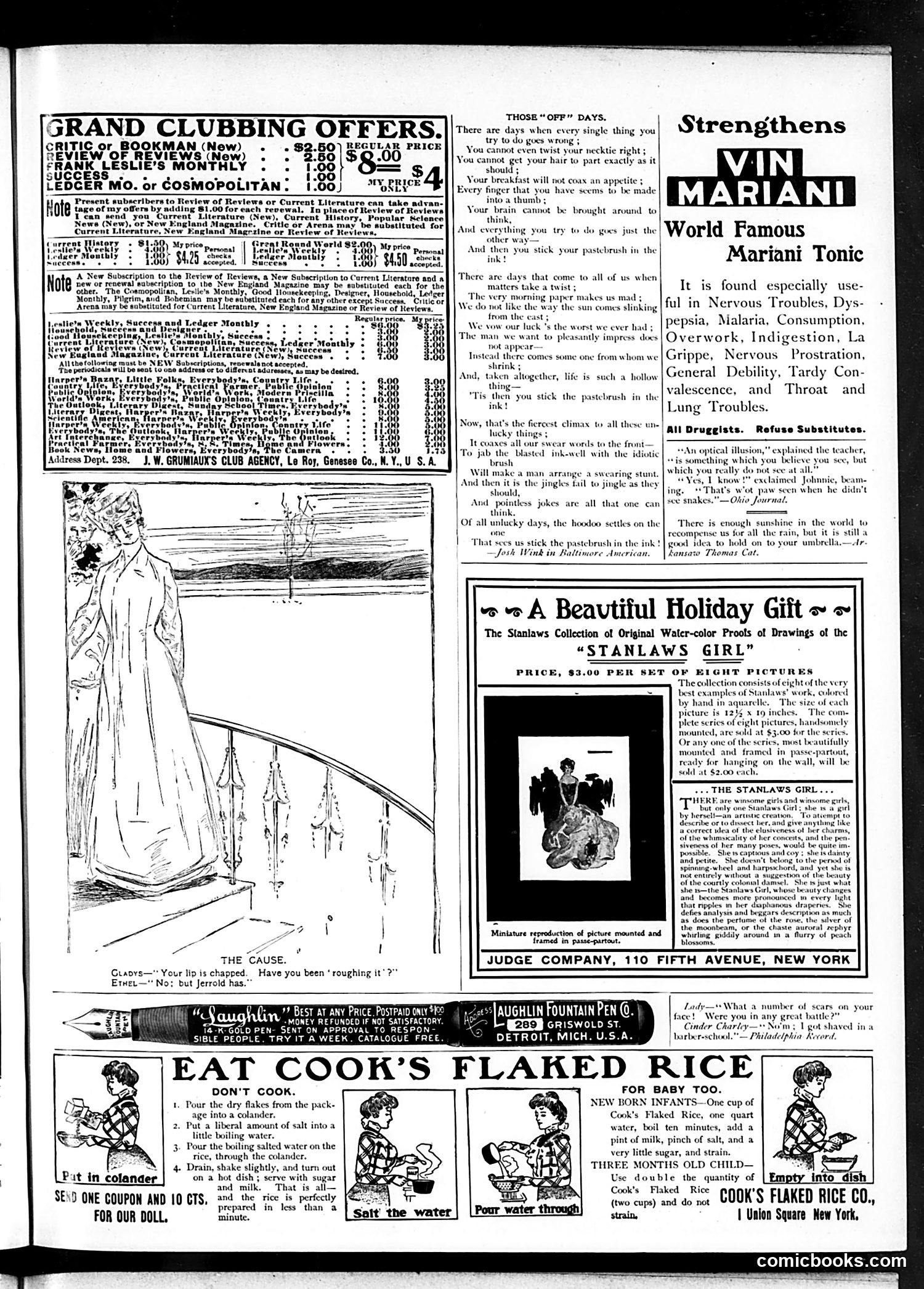
This page from Judge magazine (American satirical publication) contains primarily **advertising and light humor** rather than political satire. The main cartoon, titled **"The Cause,"** depicts a frustrated woman who has gotten her hair mussed up ("roughed it"). It's a gentle domestic joke about the trials of everyday life—specifically, the indignity of disheveled appearance. The accompanying poem **"Those 'Off' Days"** humorously catalogs a series of mundane frustrations (twisted neckties, bad hair, lost appetite, social snubs) that culminate in the recurring punchline: sticking one's pastebrush in the ink. This represents the final, absurd indignity when everything goes wrong. The satire is **mild and relatable** rather than political—it mocks the universal human experience of "one of those days" and the mounting irritation of small failures. For modern readers, the dated reference to "pastebrushes" and ink requires explanation, but the emotional truth remains: trivial annoyances compounding into frustration. The page is otherwise dominated by **subscription offers and patent medicine advertisements** (Vin Mariani Tonic, Cook's Flaked Rice), typical of period magazine content.
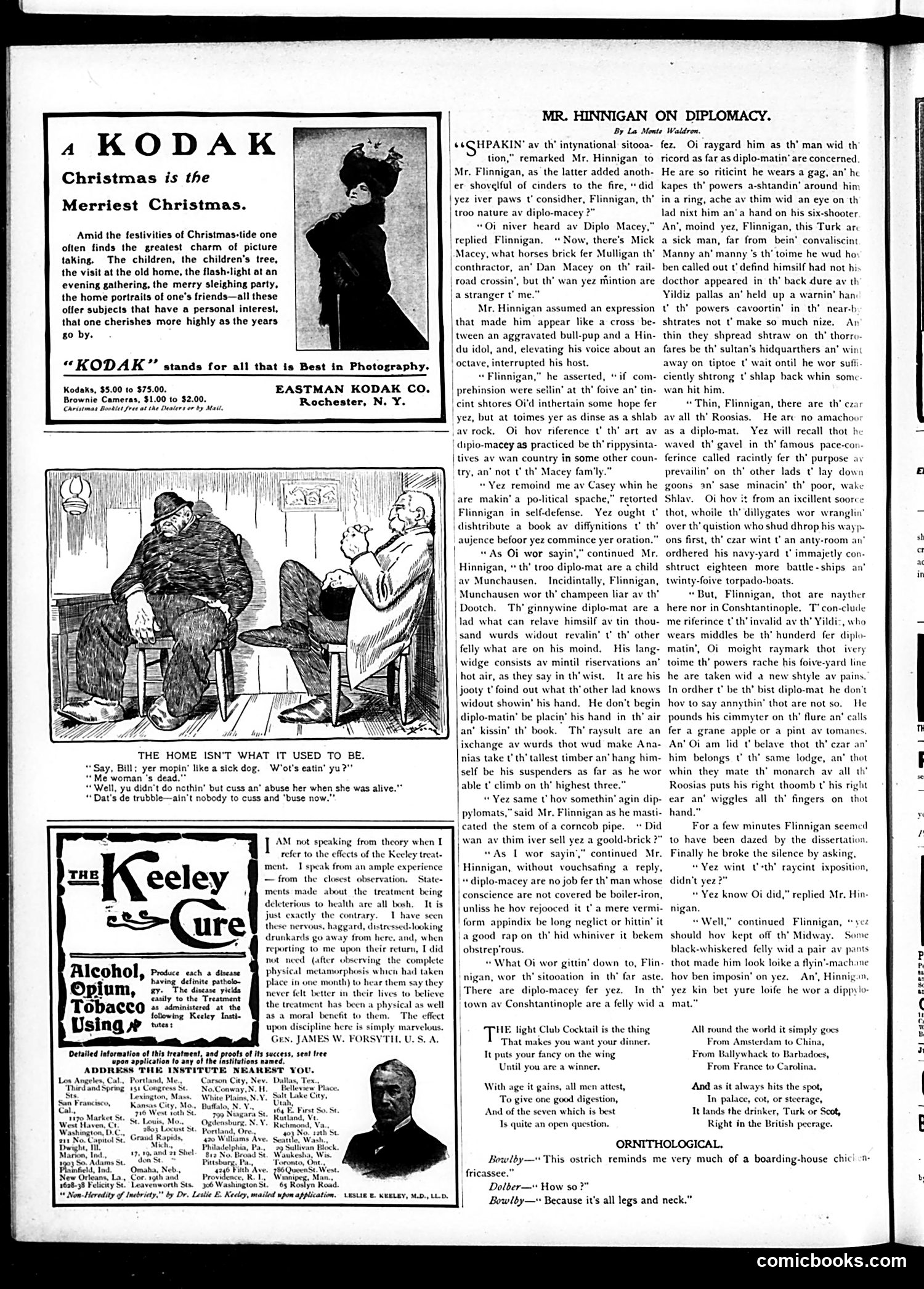
This page contains three distinct elements: **1. Kodak Advertisement (top):** A Christmas-themed ad promoting cameras and "Brownie" cameras as ideal for capturing family moments. No satire here—straightforward holiday marketing. **2. "The Home Isn't What It Used To Be" (middle cartoon):** A working-class dialogue joke. A man mourns his deceased wife, revealing he misses having someone to curse and abuse. The humor (dark by modern standards) relies on the irony that he abused her while living but now regrets losing even that outlet. It's cynical social commentary on domestic relationships. **3. "Mr. Hinnigan on Diplomacy" (right column):** An ethnic-dialect comedy piece featuring Irish-American characters "Hinnigan" and "Flinnigan" (note the phonetic spelling reflecting stereotypical Irish brogue). Hinnigan attempts explaining international diplomacy to the slower Flinnigan, who hilariously confuses "diplomacy" with actual people named "Macey." The satire mocks both poor understanding of foreign policy and ethnic stereotypes prevalent in 1910s American humor. **Keeley Institute advertisement** (lower left) promotes addiction treatment—not satirical content.
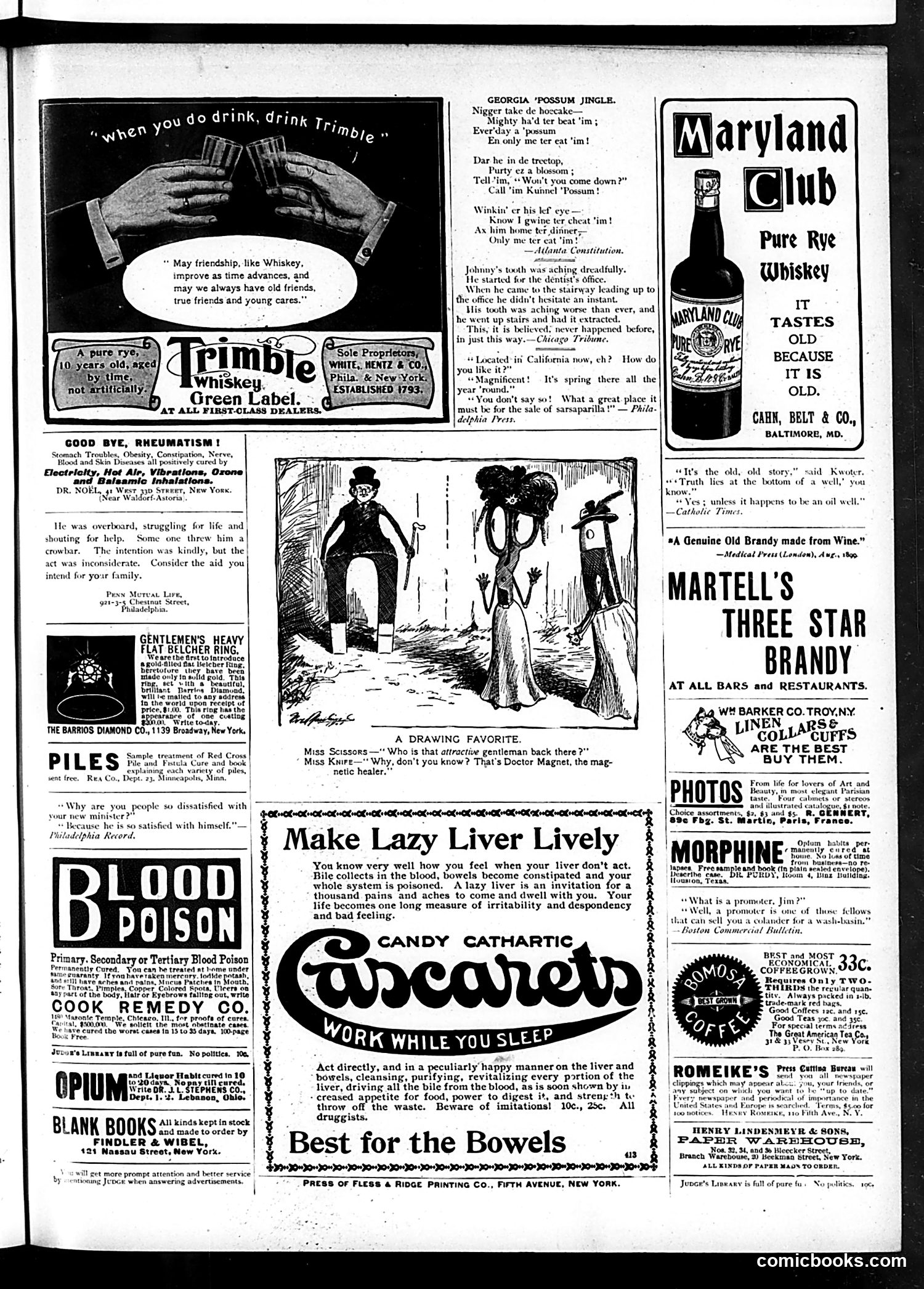
This is primarily an **advertising page** from Judge magazine, with minimal editorial content. The page showcases various patent medicines and commercial products typical of early 20th-century American print media. ## Notable Content: **"Georgia 'Possum Jingle"** uses racist dialect humor (common to the era) to advertise whiskey—a standard advertising trope of the period. **The main cartoon** ("A Drawing Favorite") depicts a woman asking about an "attractive gentleman" who is "Doctor Magnet, the magnetic healer"—satirizing quack medical practitioners who were prevalent and popular in this era. The visual pun plays on the name. **Dominant advertisements** include dubious remedies: "Blood Poison" treatments, "Candy Cathartic" laxatives, "Morphine" products, and electrical/vibrational cure-alls. These reflect the pre-FDA regulation era when patent medicines made extravagant health claims without scientific basis. The page reveals how Judge mixed entertainment with advertising for products that modern readers would recognize as fraudulent or dangerous. The overall tone reflects period attitudes toward medicine, race, and consumer gullibility.
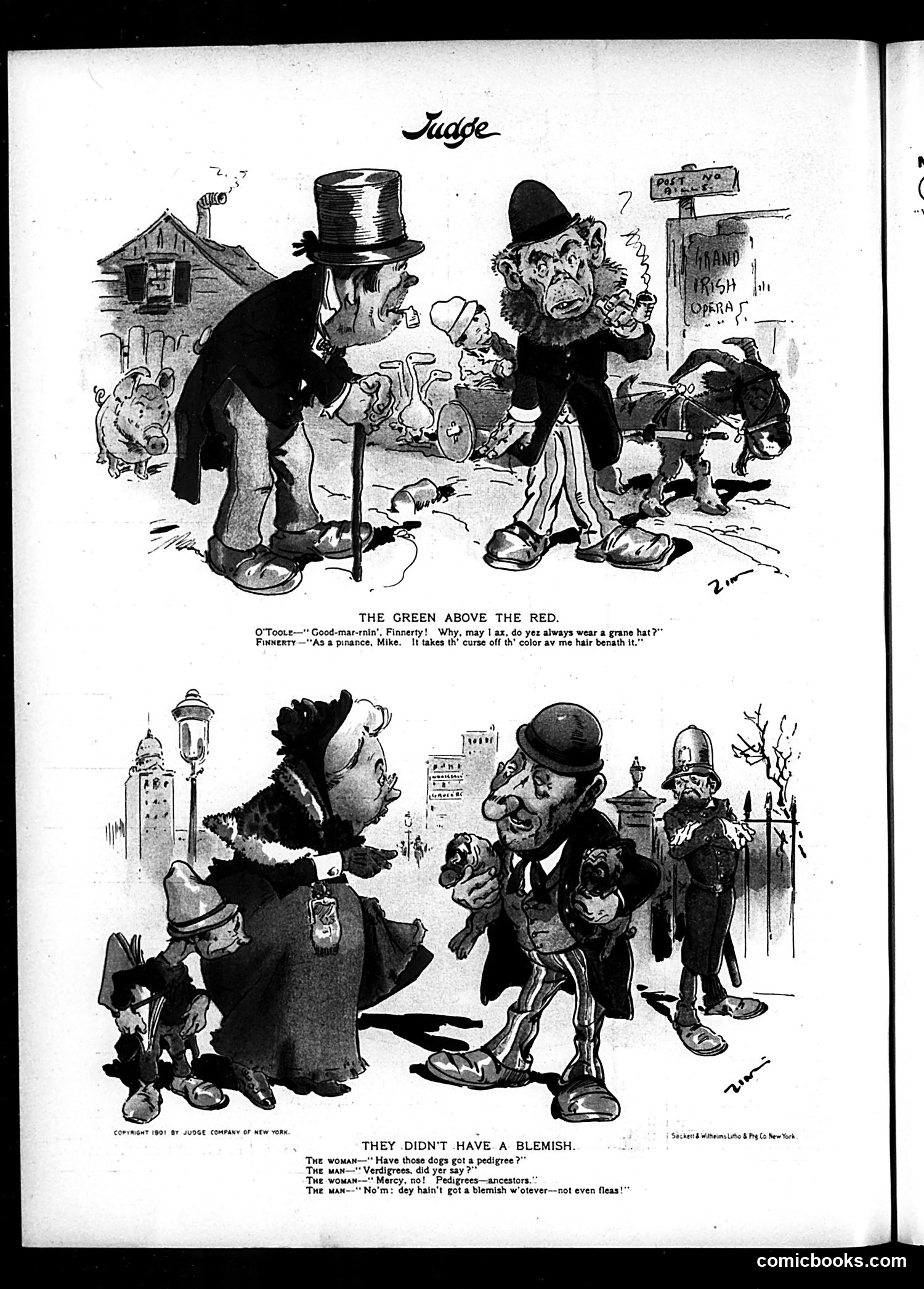
**Top Cartoon: "The Green Above the Red"** Two Irish-stereotyped characters discuss hat-wearing. One wears a green hat to cover red hair beneath—"as a penance." This plays on Irish identity stereotypes: green representing Ireland, red hair as an Irish trait. The humor relies on ethnic caricature common to early 1900s American satire. **Bottom Cartoon: "They Didn't Have a Blemish"** A woman asks a man about dogs' pedigrees (ancestry/breeding lines). The man mishears as "verdigris" (copper corrosion), then misunderstands "pedigree" as meaning "ancestors without flaws." His response—the dogs have no blemishes, not even fleas—conflates physical imperfections with parasites, missing the point about breeding quality entirely. The joke mocks working-class ignorance of proper breeding terminology. Both cartoons employ period stereotypes and linguistic humor typical of Judge's satirical approach.