
A complete issue · 16 pages · 1901
Judge — November 16, 1901
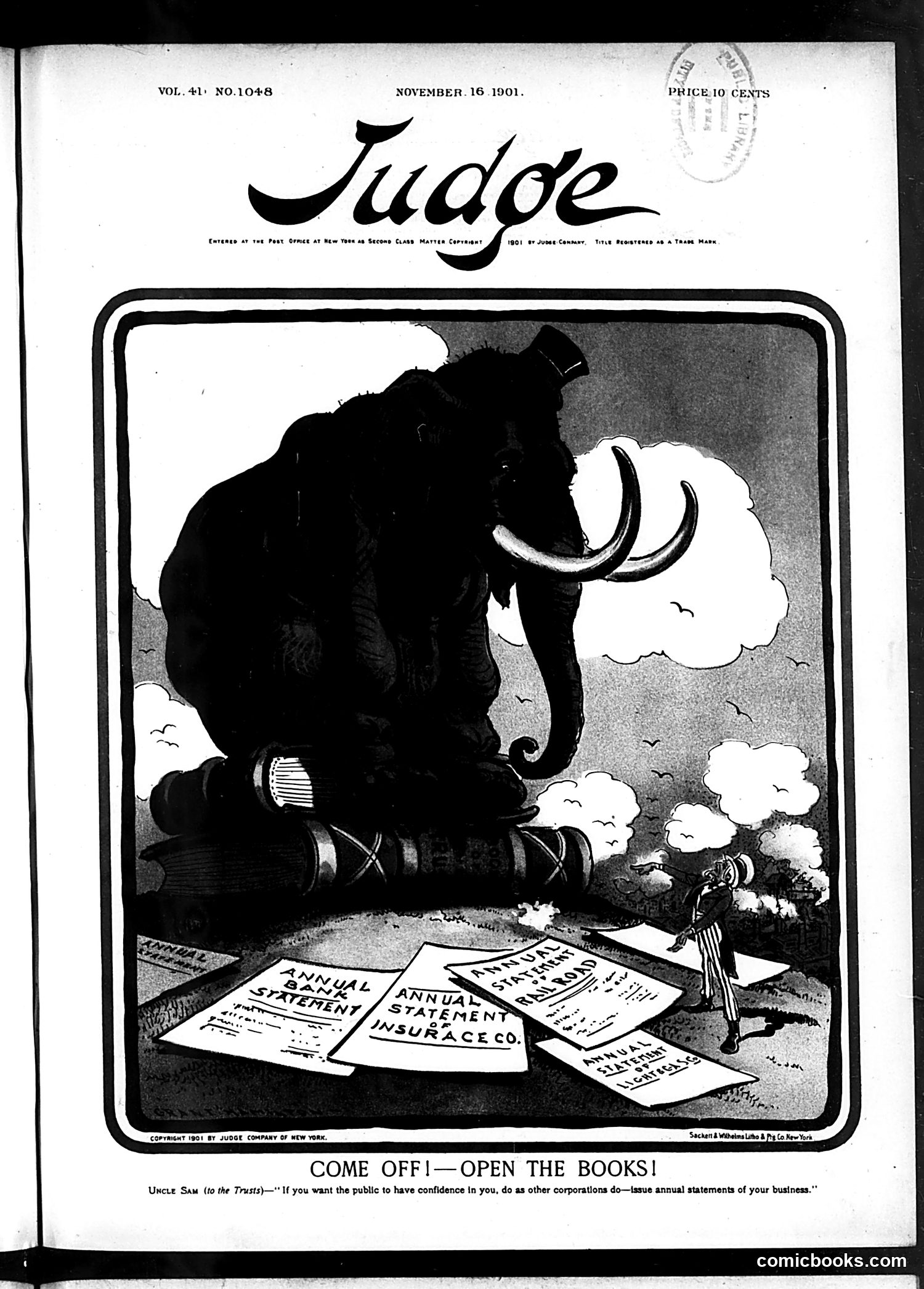
This political cartoon satirizes corporate financial secrecy. The image shows an elephant—likely representing major corporations or trusts—sitting atop scattered "Annual Statement" documents from an insurance company. Uncle Sam (identified in the caption) urges the elephant to "Come off!—Open the Books!" The satire targets corporations' reluctance to disclose financial information to the public. Uncle Sam's statement—"If you want the public to have confidence in you, do as other corporations do—issue annual statements of your business"—employs ironic pressure, suggesting that transparency and public trust require honest financial disclosure. This reflects early 1900s progressive-era concerns about corporate accountability and the emerging demand for business regulation and transparency.
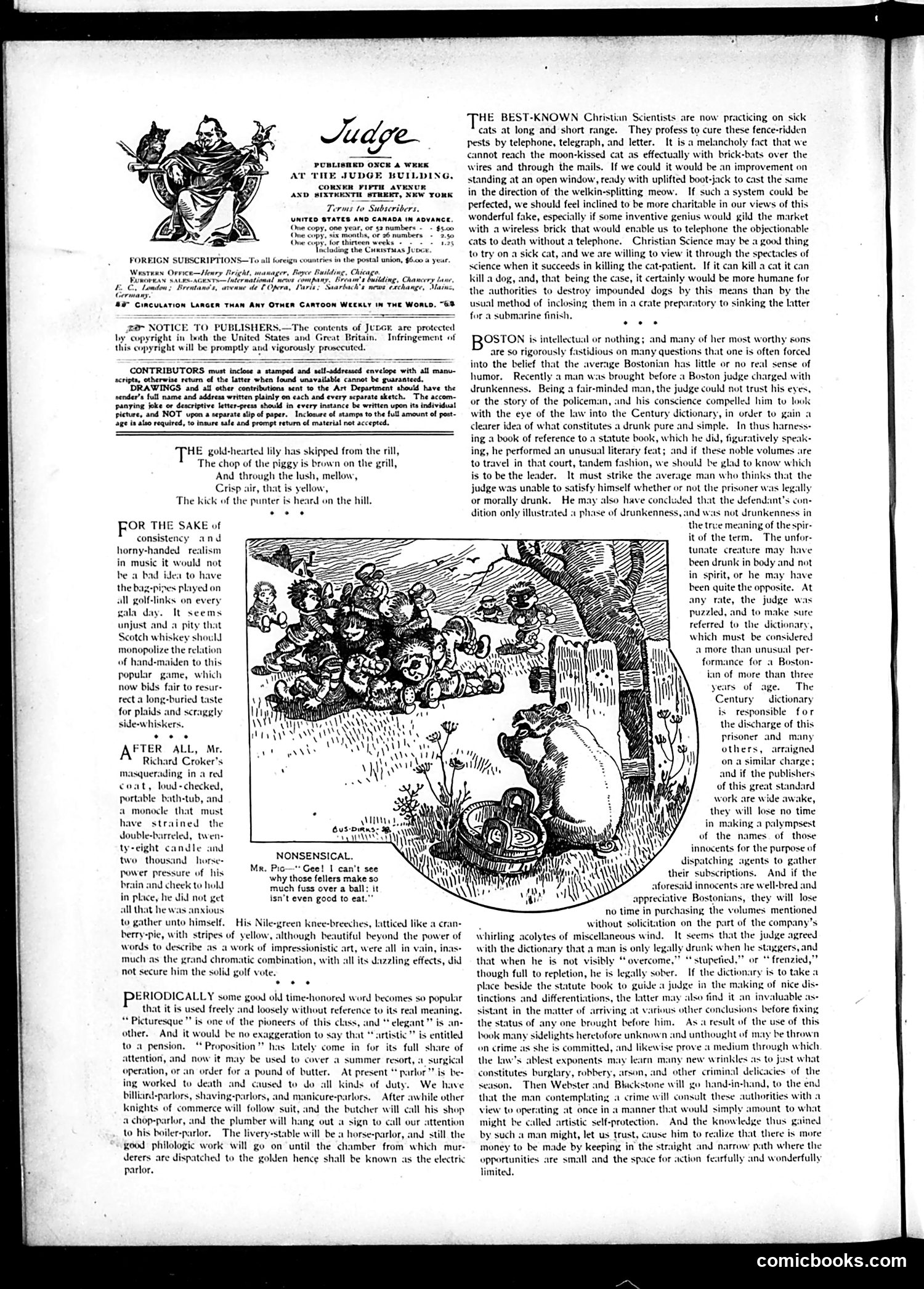
This cartoon satirizes the absurdity of prohibitionist arguments. The illustration shows a chaotic scene of people in various states of intoxication or debauchery around what appears to be alcohol consumption. The accompanying text critiques how prohibition advocates use loose, exaggerated language. It mocks terms like "pussy-footer" and "parker" (derogatory slang for temperance supporters) as examples of how both sides employ meaningless insults rather than reasoned debate. The piece argues that anti-alcohol advocates make inflammatory claims without substance—comparing their rhetoric to nonsensical jargon. Judge magazine, being satirical and anti-prohibition, uses this cartoon to ridicule the moral panic and hyperbolic claims made by temperance crusaders during the Prohibition era.
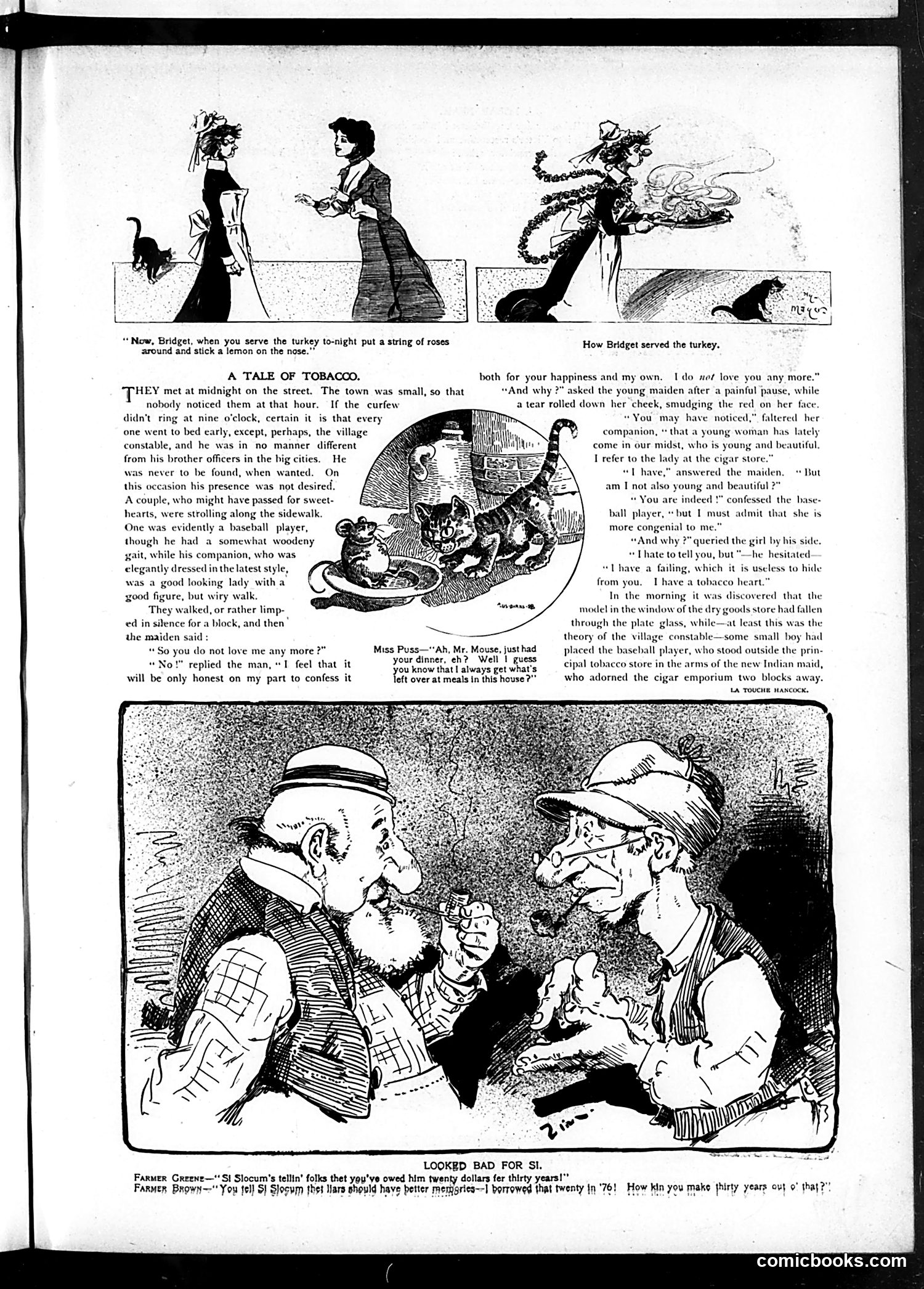
This page contains two distinct satirical pieces: **Top Comic Strip:** "How Bridget Served the Turkey" depicts a domestic servant (Bridget, a common Irish character stereotype in period humor) decorating a turkey with increasingly elaborate garnishes—roses, feathers, and ornate presentations. The joke appears to mock working-class attempts at pretentious presentation or immigrant unfamiliarity with "proper" serving customs. **Bottom Section:** "A Tale of Tobacco" is a romantic story about a young man and woman's relationship, interrupted by revelations about tobacco. The narrative suggests class or status conflict, with the man's devotion to cigars disrupting romance—reflecting era-specific anxieties about smoking's social propriety and its perceived threat to courtship and family values. Both pieces target working-class characters and immigrant stereotypes common to Judge's satirical approach.
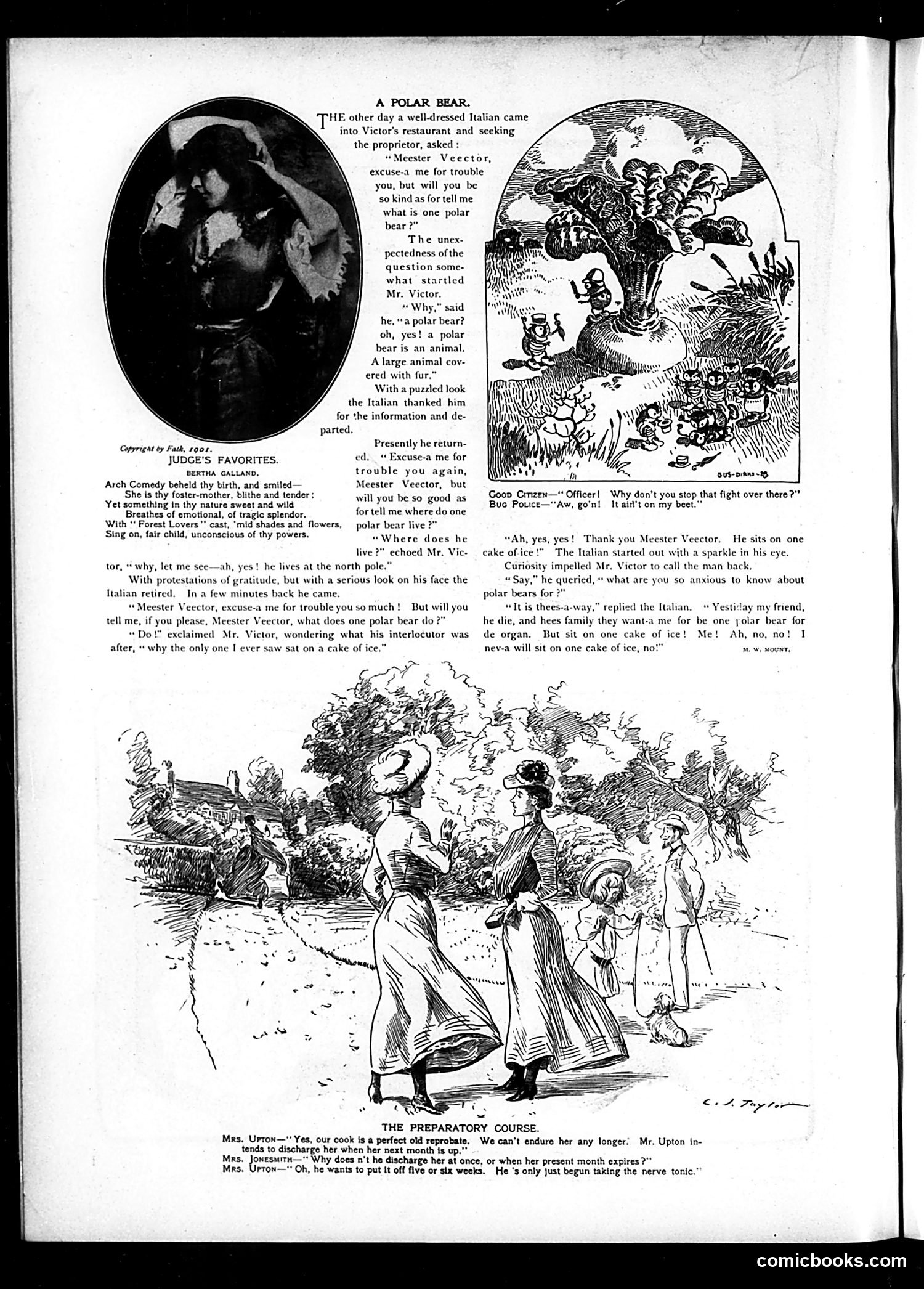
This page contains a humorous anecdote about a well-dressed Italian visiting Victor's restaurant. When asked what a "polar bear" is, the proprietor explains it's "an animal, white and covered with fur." The Italian then asks where polar bears live, leading to Victor's reply: "at the north pole." The joke concludes with the Italian's punchline about polar bears sitting on "one cake of ice"—a play on words mocking Victor's earlier claim that he serves only "one cake of ice" at his establishment. The accompanying illustrations depict the conversation and unrelated domestic scenes below. This appears to be gentle ethnic humor typical of early-20th-century American magazines, using a supposed Italian accent or naïveté for comedic effect.
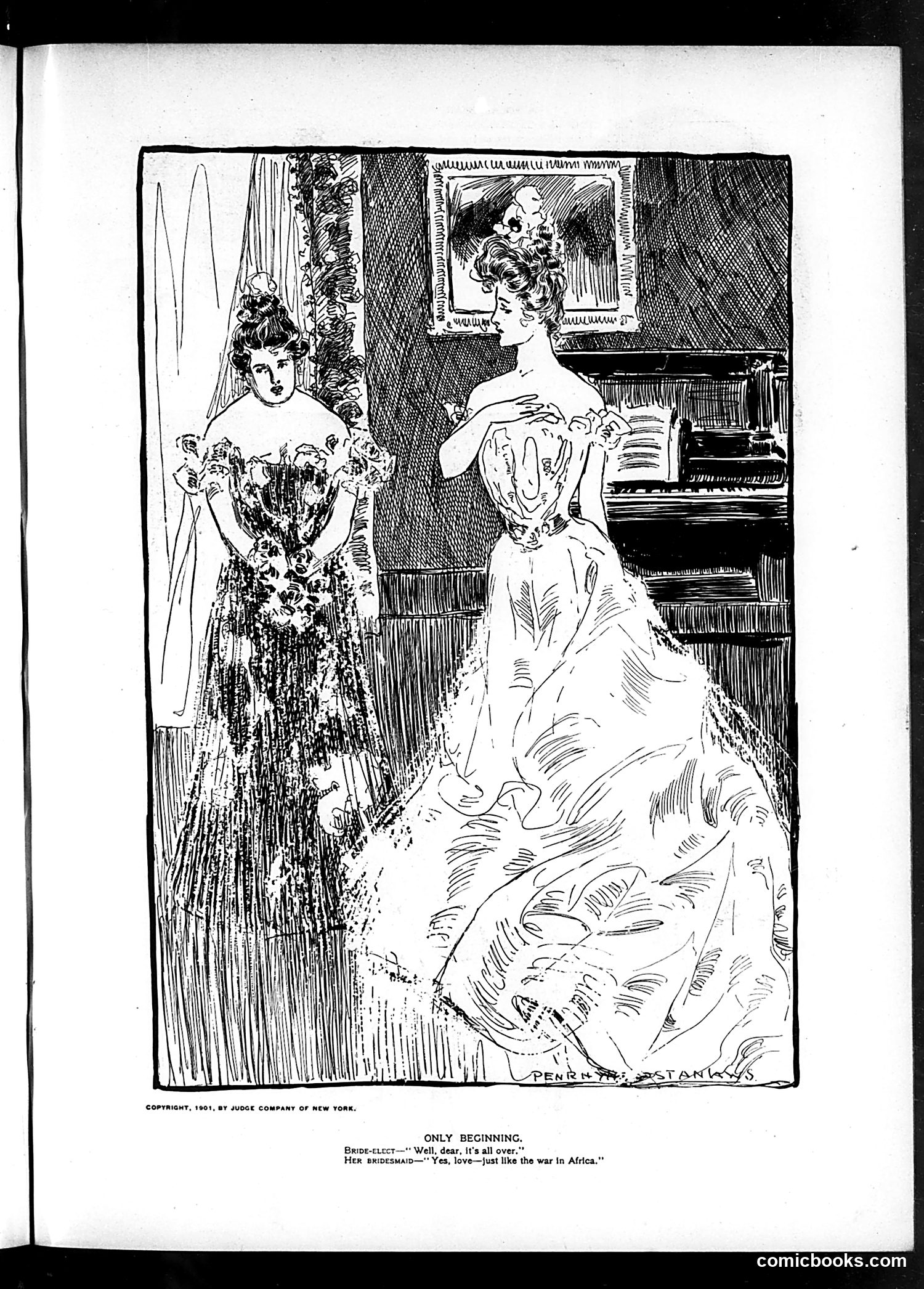
This 1901 cartoon from *Judge* satirizes a newlywed couple by comparing their marriage to the Boer War in South Africa. The bride-elect says "it's all over" after the wedding, while her bridesmaid responds that marriage is "just like the war in Africa"—implying it's just the beginning of a long, difficult conflict rather than a conclusion. The joke reflects contemporary anxieties about marriage as a prolonged struggle. The reference to the Boer War (1899-1902) was timely and well-known to readers, as it was an ongoing, grueling British military campaign. By equating matrimony with this brutal conflict, the cartoon humorously suggests that marriage involves protracted hardship and conflict ahead, rather than the happy ending a bride might expect.
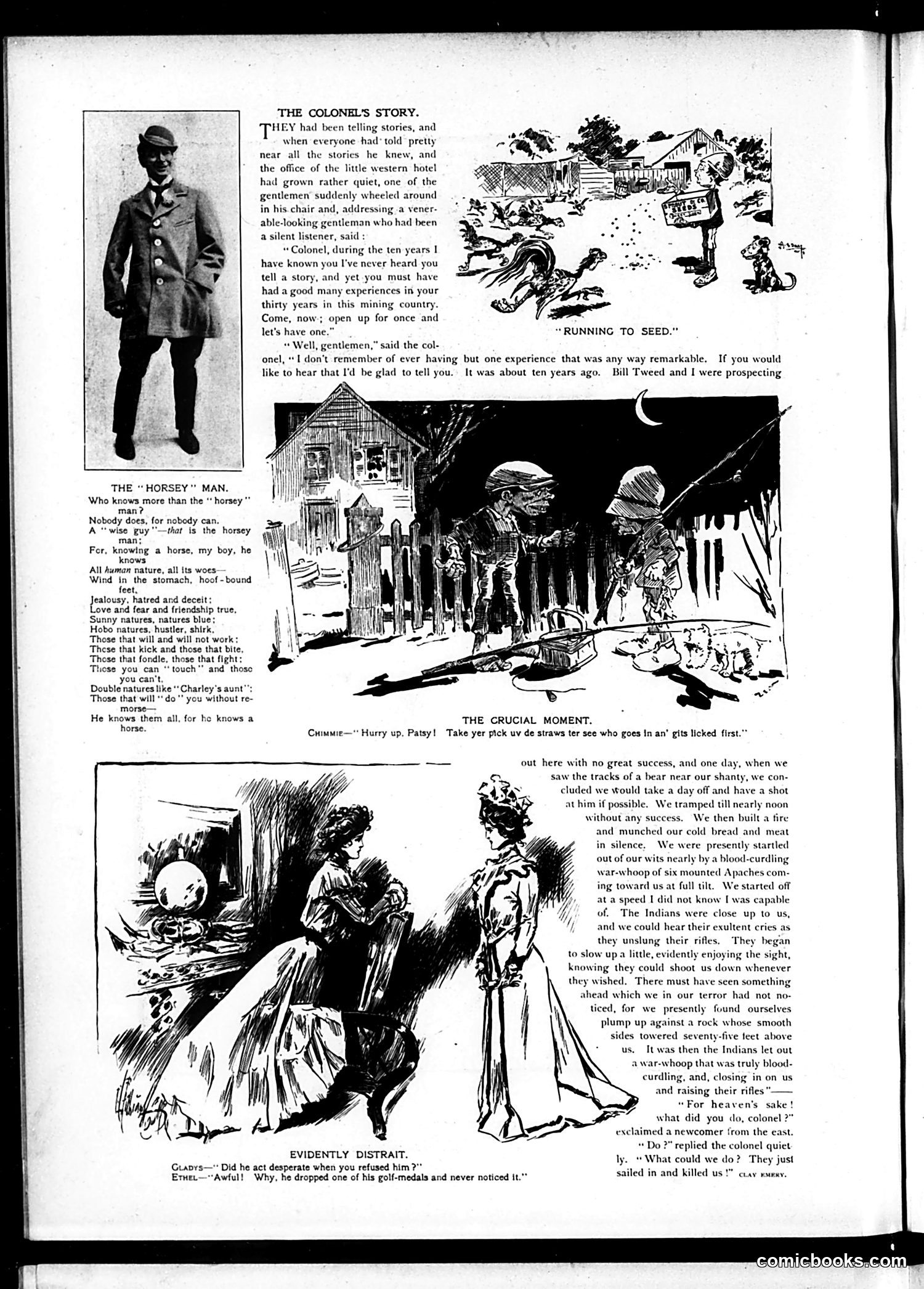
This page presents a Western tall tale framed as salon storytelling. The Colonel, a taciturn prospector (photograph upper left), finally agrees to share a remarkable experience from his mining days. His narrative describes a harrowing Apache attack while prospecting with Bill Tweed: trapped against a cliff face with six mounted warriors closing in, certain death imminent—then abruptly ends: "They just sailed in and killed us!" The joke is the anticlimax. After building dramatic tension, the Colonel reveals his story has no resolution or escape—just death. This subverts the expected Western adventure narrative where the hero survives through wit or courage. The page's other content—"The Horsey Man" (satirizing know-it-alls who think horse knowledge equals understanding human nature) and comic vignettes—are unrelated filler typical of Judge's satirical magazine format. The overall effect mocks both frontier mythology and pompous storytelling conventions.
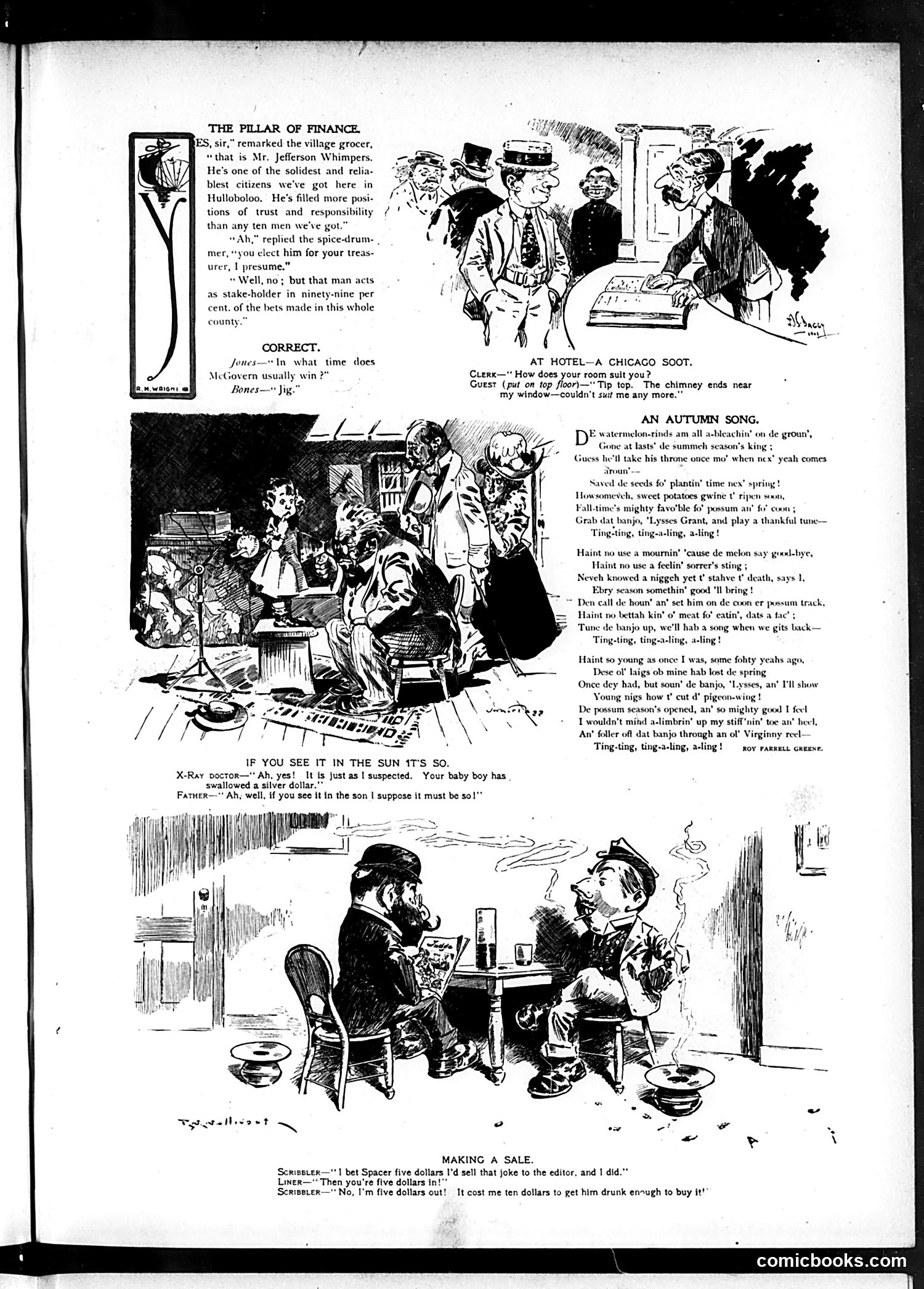
This page contains multiple satirical pieces typical of late 19th-century American humor: **"The Pillar of Finance"** mocks a respected community figure—Jefferson Whimpers—whose reliability derives not from legitimate business acumen but from serving as a "stake-holder" in local gambling bets. The satire critiques how society elevates men of questionable virtue. **"An Autumn Song"** is a dialect piece using exaggerated African American vernacular, celebrating autumn harvest and possum hunting. While offensive to modern readers, it reflects the era's minstrelsy tradition. **"If You See It in the Sun"** is a simple joke about an X-ray doctor diagnosing a swallowed silver dollar—playing on the newspaper "The Sun" and the visual pun of seeing something "in the son" (sun). **"Making a Sale"** satirizes magazine editors' drinking habits, suggesting the editor only bought a joke manuscript while intoxicated, costing the writer more than he earned. The overall tone is light satirical humor targeting financial impropriety, ethnic stereotyping, and publishing industry practices.
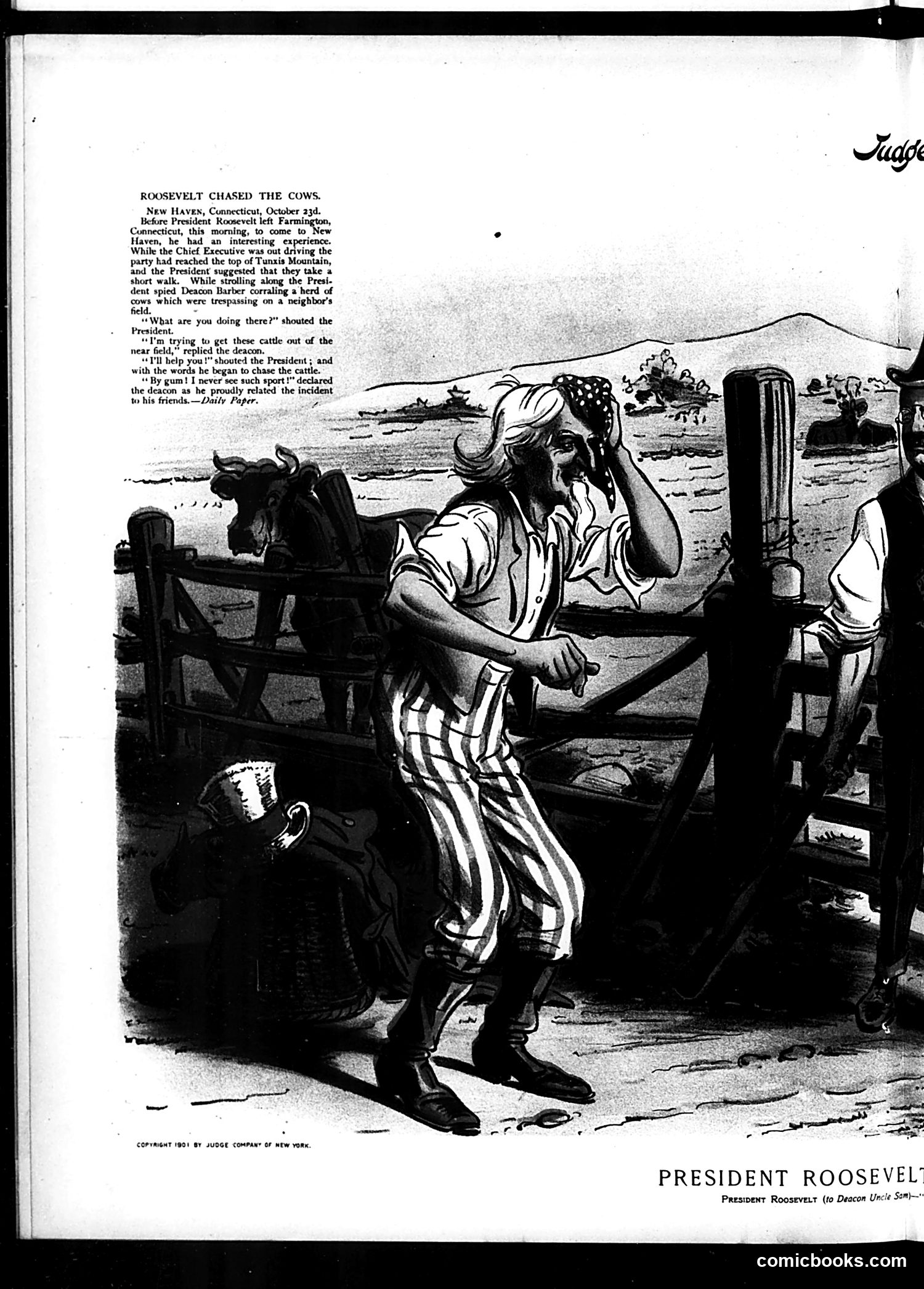
This Judge magazine cartoon satirizes President Theodore Roosevelt's energetic, hands-on personality. The text describes Roosevelt stopping during a Connecticut visit in October 1901 to *actively help* chase stray cattle off a neighbor's field—rather than simply observing or directing others. The satire targets Roosevelt's famous vigor and impulsiveness. The deacon's amazed reaction ("I never see such sport!") mocks how the President would personally involve himself in any activity rather than maintain presidential dignity. Roosevelt was known for his outdoorsy enthusiasm and tendency to jump into action, which satirists portrayed as undignified or excessive for the office. The illustration shows Roosevelt energetically engaged with the cattle and farmer, emphasizing his unconventional behavior. For modern readers: this jokes about his "rough rider" persona and constant activity, suggesting a president too eager to participate in everyday tasks rather than delegate or remain aloof.
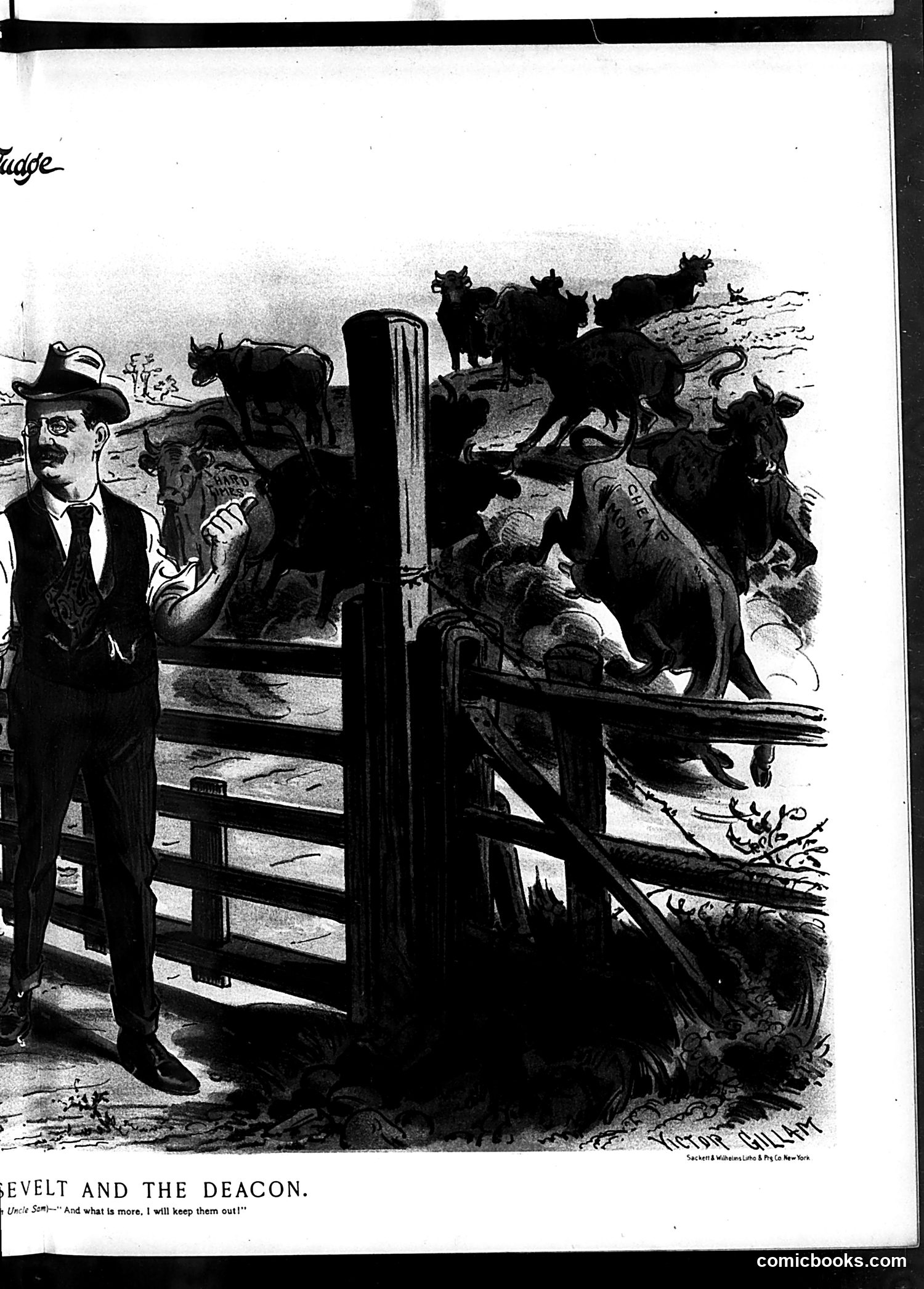
This Judge magazine cartoon satirizes Theodore Roosevelt's immigration policies. The figure on the left (labeled "Uncle Sam" in the caption) represents Roosevelt's stern determination to restrict immigration. The gate serves as a literal barrier, while the cattle and various figures on the other side represent immigrants or unwanted groups seeking entry. Roosevelt's quote—"And what is more, I will keep them out!"—reflects his restrictive stance on immigration during his presidency (1901-1909). The "Deacon" reference likely alludes to Roosevelt's moralistic, often sanctimonious public persona. The cartoon mocks Roosevelt's hardline position by depicting him as an unyielding gatekeeper, using the pastoral imagery of livestock to suggest the dehumanizing nature of such policies. Judge magazine typically favored Republican politics but occasionally criticized excessive positions.
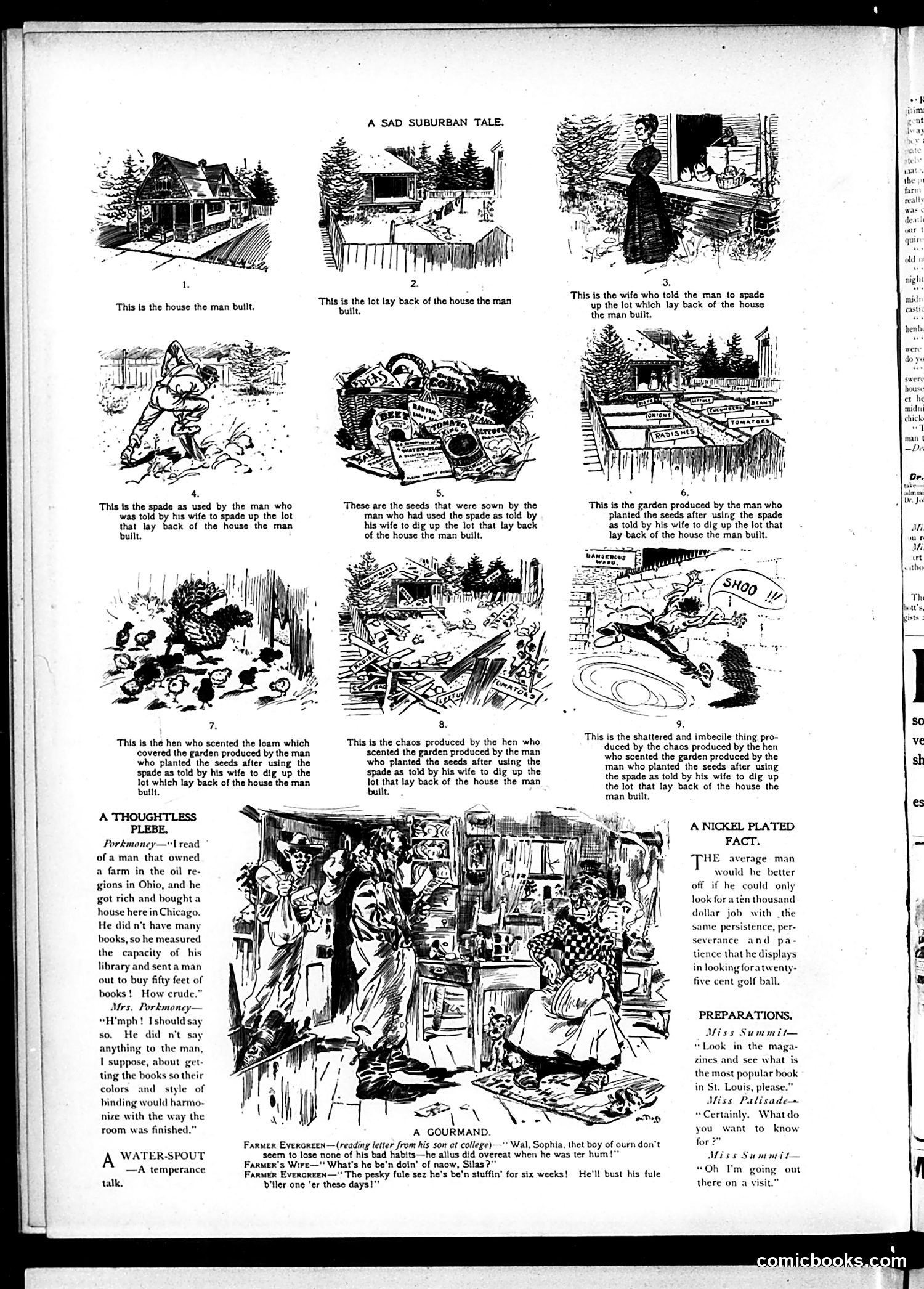
This nine-panel comic uses cumulative, circular logic to satirize suburban domesticity and the chaos of modern homeownership. A man is ordered by his wife to dig up their backyard lot. He plants seeds there, which grow into a garden. A hen smells the loam, destroys the garden while scratching, and this destruction becomes "chaos" and "imbecile" ruin—all traced back to the wife's initial command. The satire targets the absurdity of domestic authority and unintended consequences: a simple spousal directive cascades into complete disorder through no one's direct fault. It mocks both the henpecked husband and the assumption that following orders guarantees reasonable outcomes. The other brief sketches on the page—about an oil-rich farmer measuring library capacity by linear footage, and a college boy overeating—share similar themes: the newly wealthy and their ridiculous social pretensions; generational foolishness.
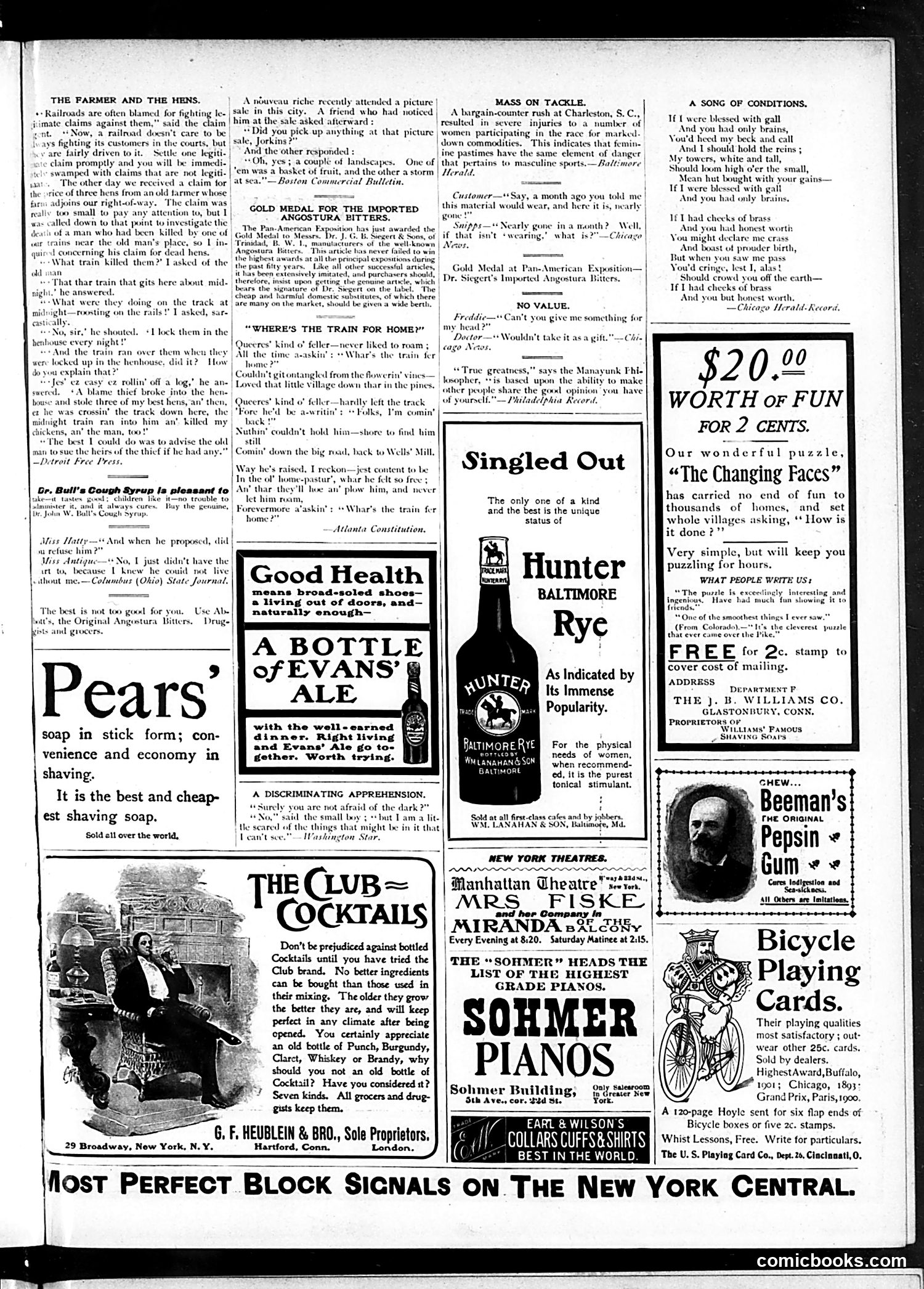
This page is primarily **advertising and filler content** from Judge magazine, not a coherent political cartoon. The main elements are: **"The Farmer and the Hens"** (top left): A rural anecdote about a farmer whose hens are killed by a train. The joke relies on rural dialect humor and the farmer's comically stubborn insistence on locking hens in the henhouse at night—missing the point that the train kills them regardless. This reflects early 1900s urban-vs-rural stereotyping common in American humor. **"Where's the Train for Home?"** (center): Another rural dialect piece about a homesick villager repeatedly asking about trains, playing on rustic simplicity as comedic material. **Remaining content**: Primarily **advertisements** for products like Evans' Ale, Pears' soap, Heublein cocktails, Sohmer pianos, and Hunter Baltimore Rye whiskey—typical of Judge's revenue model. The small anecdotes scattered throughout are generic jokes without significant political content. The page contains **no major political satire** or identifiable public figures—it's essentially a advertising-heavy magazine page using mild rural humor for filler.
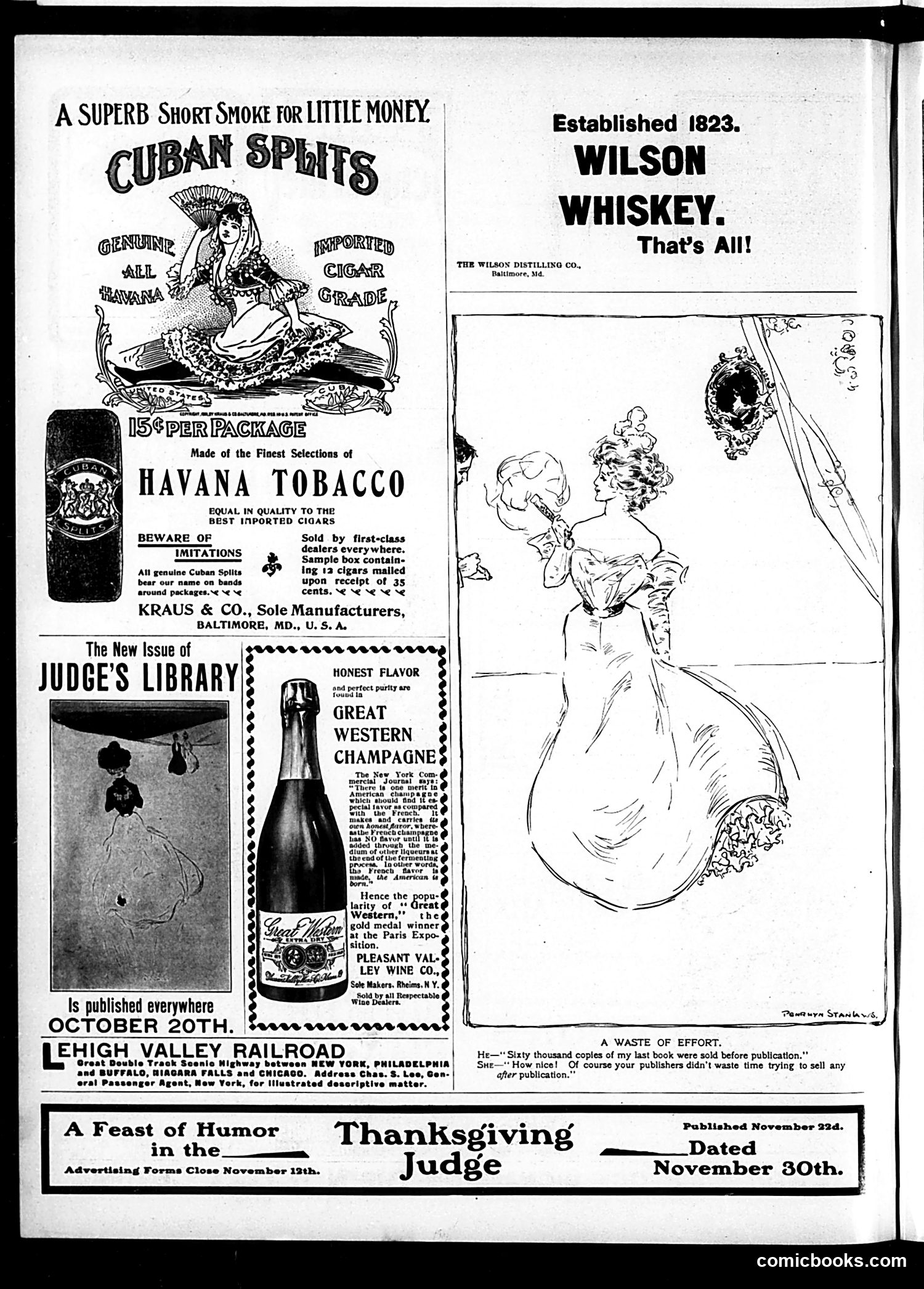
This page is primarily **advertising**, not political satire. It features commercial ads for products popular in the early 1900s: Cuban Split cigars (15¢ per package), Wilson Whiskey (established 1823), Great Western Champagne, and railroad service. The only cartoon appears to be a small sketch in the upper right showing a woman in flowing dress—likely illustrating the champagne ad with an aesthetic, decorative figure typical of Belle Époque advertising. The small text snippet at bottom right contains a meta-joke about publishing: someone complains their "last book were sold before publication," and another responds sarcastically that of course the publisher didn't waste effort selling it afterward—a jab at poor marketing or distribution practices. The page announces Judge's "Thanksgiving" issue with "A Feast of Humor," indicating this is primarily a vehicle for holiday-themed advertisements rather than substantive satirical content.
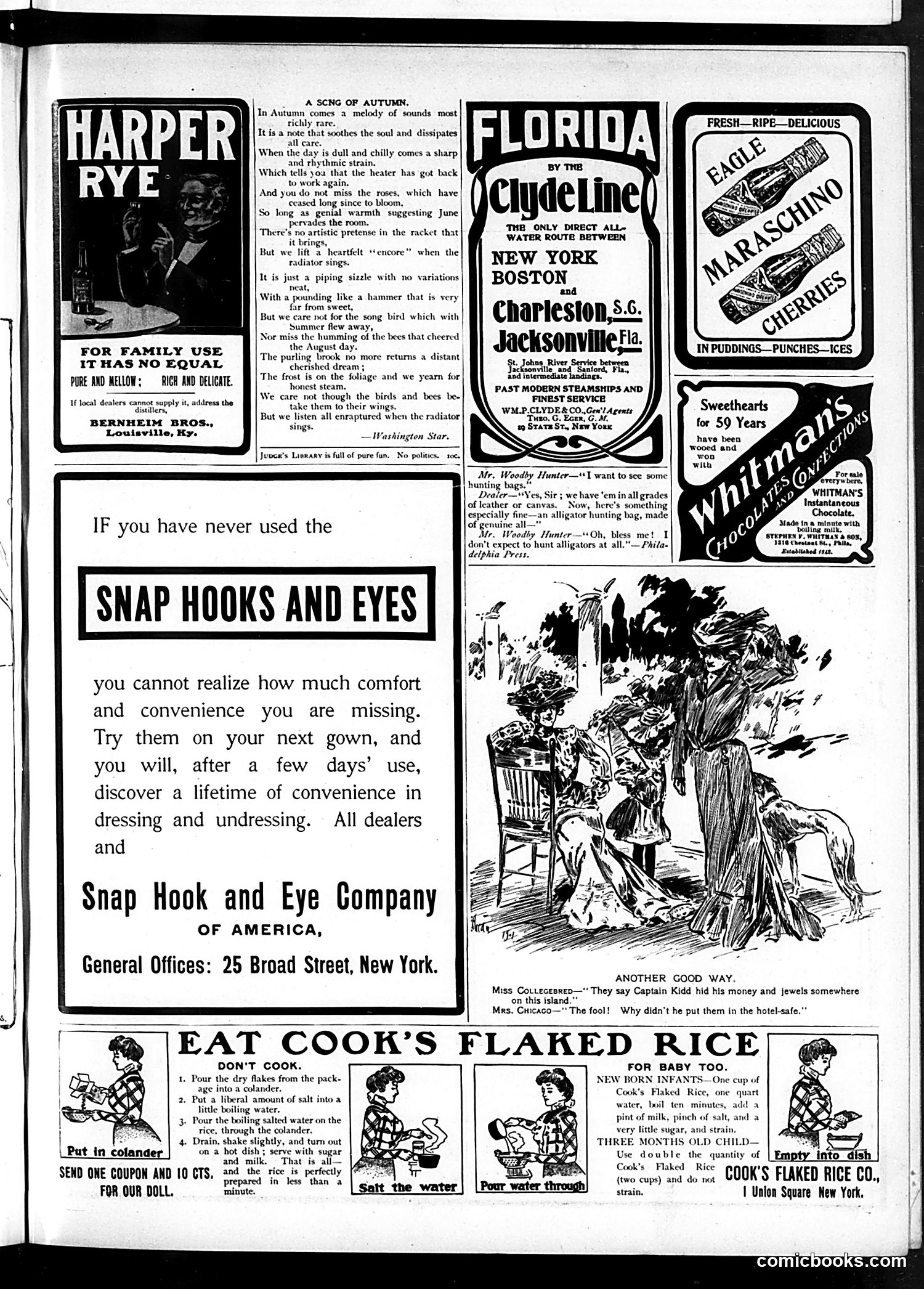
This page is primarily **advertising with one cartoon joke**. The main cartoon (bottom center) satirizes wealthy tourists' naiveté. A woman mentions that Captain Kidd allegedly buried treasure on an island, and her companion incredulously responds: "The fool! Why didn't he put them in the hotel-safe?" The humor lies in the anachronism—applying modern, mundane safety practices to a historical pirate, and the implication that even legendary criminals should know better than to hide valuables the old-fashioned way. It's gentle satire of early 20th-century American tourists' faith in modern conveniences and hotels. The remainder consists of period product advertisements: Harper Rye whiskey, steamship lines, snap hooks and eyes (clothing fasteners), Whitman's chocolate, and Cook's Flaked Rice. A poem about heating radiators occupies the upper left—celebrating modern indoor heating with humorous resignation that autumn means abandoning nature's pleasures for artificial warmth.
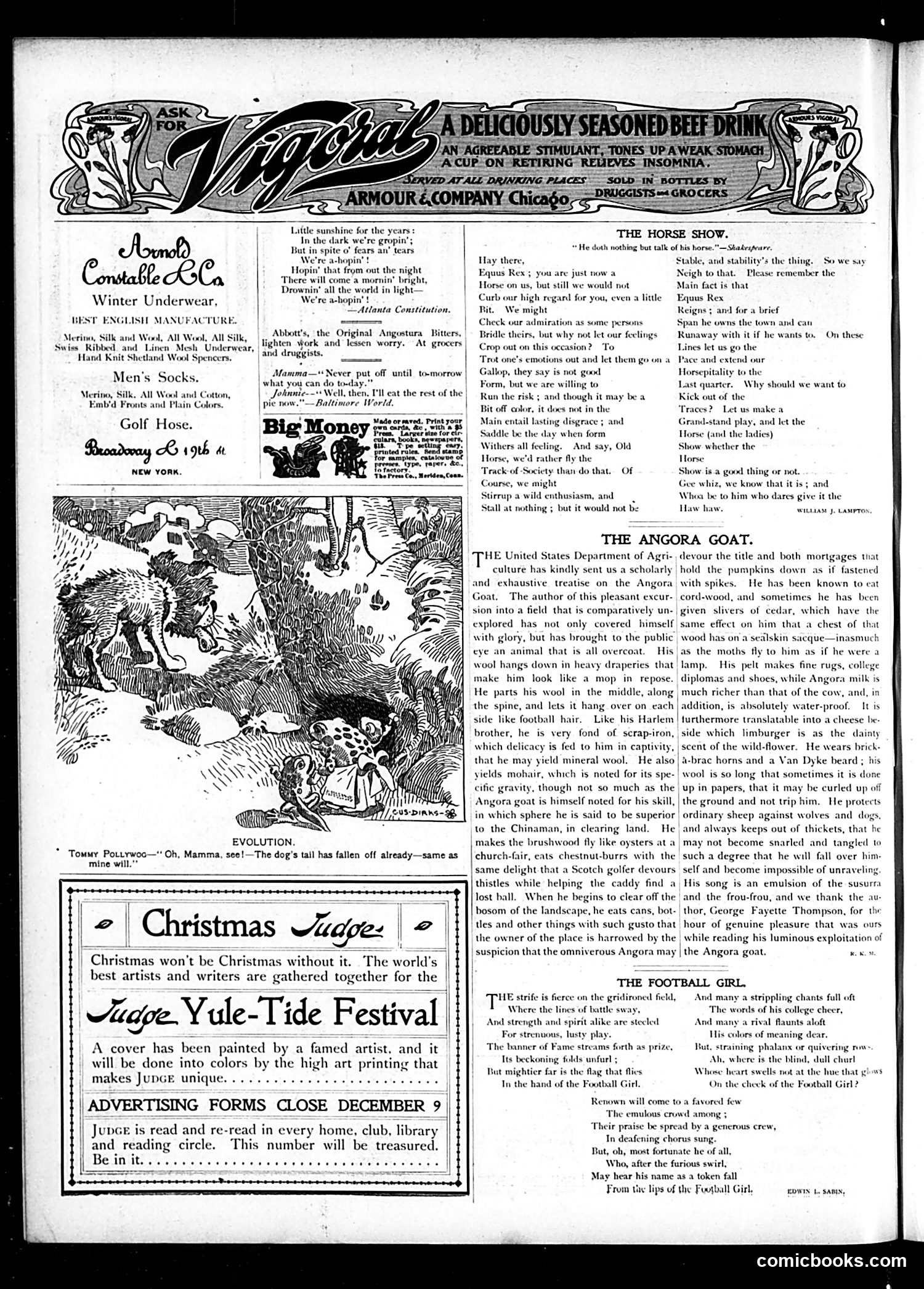
This page contains primarily **advertisements and light humor pieces** rather than political satire. The main content includes: **"The Horse Show"** — A punny piece celebrating high society's annual horse exhibition, using equestrian wordplay ("Neigh," "Bridle," "Crop," "Gallop") to mock the pretentious emotion people invest in showing horses. It's gentle social satire on class affectation. **"The Angora Goat"** — A humorous, deadpan description of the Angora goat's wool-covered appearance, comparing it to a "mop" and "football hair," while satirizing the animal's indiscriminate appetite for scrap metal and debris. **"Evolution"** — A brief joke about a child's dog losing its tail, with the boy predicting his own hair loss—likely a bald-man joke. The page also promotes an upcoming **"Judge Yule-Tide Festival"** Christmas issue with a cover by a "famed artist." Overall, this is a **society humor and advertising page** with no significant political content—typical of Judge's lighter material between more pointed satirical pieces.
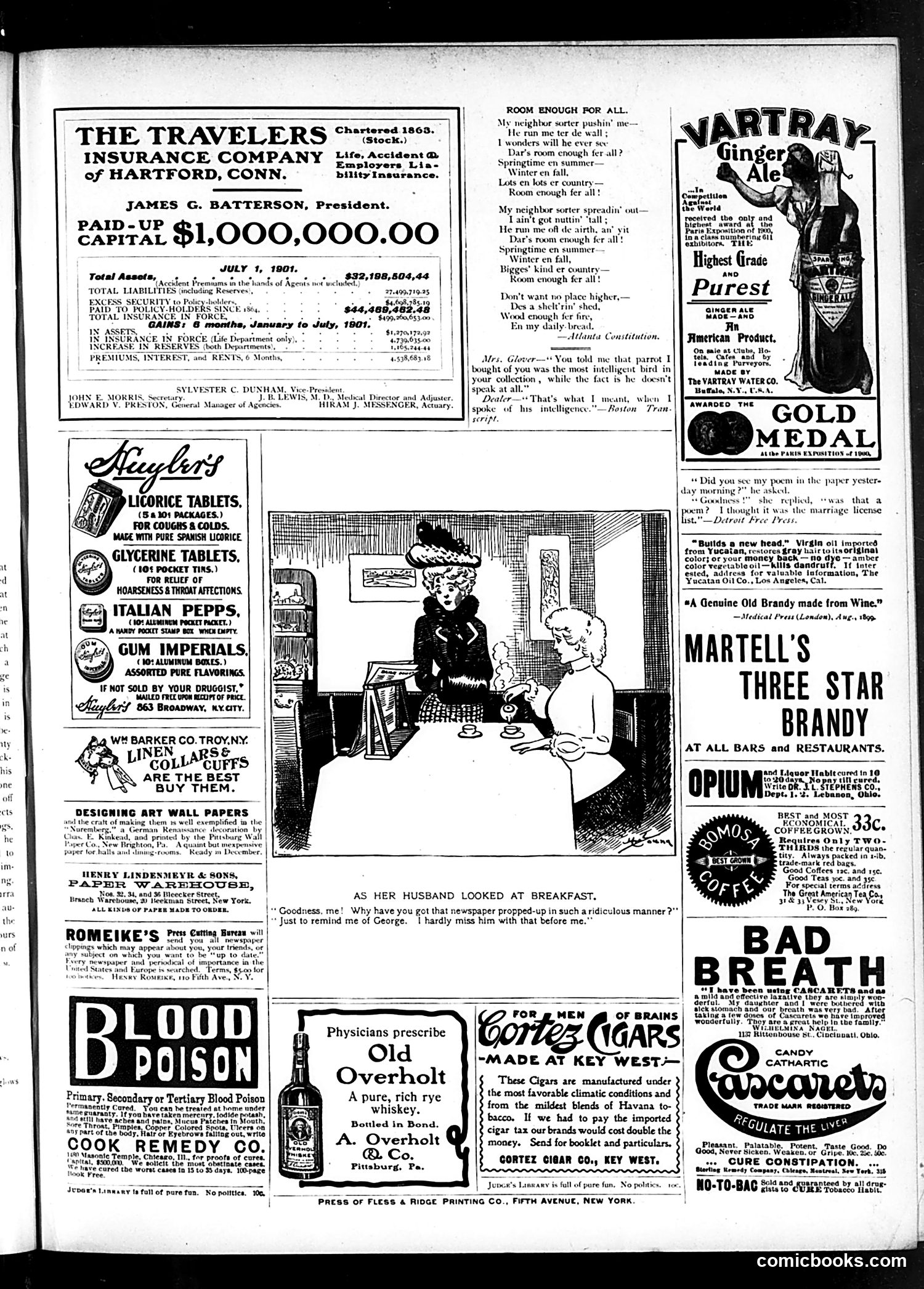
This page is primarily **advertisements and filler content** from Judge magazine (circa 1901). The main cartoon depicts a domestic scene where a husband reads a newspaper at breakfast while his wife sits opposite, clearly neglected. The caption reveals the joke: she props the newspaper up so she can see her husband's face through it—a visual gag about marital disconnection and the husband's newspaper-absorbed inattention. The page contains numerous period product ads (licorice tablets, cigars, brandy, patent medicines) typical of early 1900s magazines. One notable ad promotes "Old Overholt" whiskey and "Blood Poison" remedies—reflecting an era when alcohol and dubious medicinal claims were openly advertised. The poem "Room Enough for All" (Atlanta Constitution) uses rural dialect to discuss land availability and neighborly relations, likely reflecting turn-of-century agrarian concerns. Overall, this page captures advertising practices and domestic humor conventions of Teddy Roosevelt-era America.
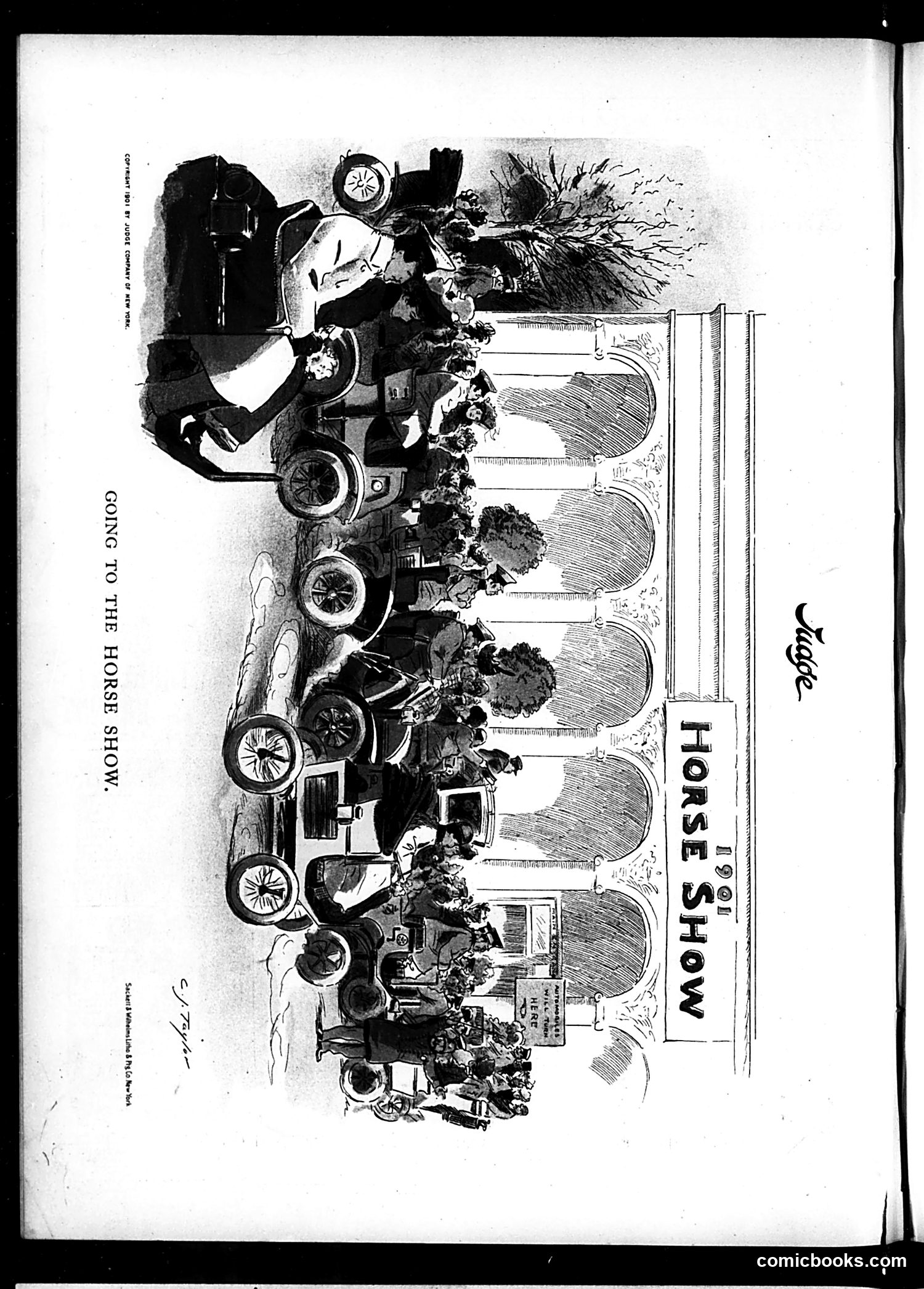
This page presents a satirical illustration of a horse show, with the title "Horse Show" prominently displayed. The image depicts multiple horse-drawn carriages and well-dressed figures arranged vertically, likely satirizing the pretensions and social hierarchies of wealthy Americans participating in exclusive horse shows. The satire appears to mock the ostentatious display of wealth, fashionable dress, and status-seeking behavior among the upper classes who attended such events. By presenting the spectacle in exaggerated fashion—stacking the scenes vertically—the cartoonist emphasizes the repetitive, absurd nature of aristocratic social rituals. The OCR text is too degraded to read clearly, but the visual joke relies on Judge's typical approach: ridiculing American elites and their leisure pursuits as vain and pretentious.