
Judge, 1901-11-16 · page 3 of 16
Judge — November 16, 1901 — page 3: what you’re looking at
What you’re looking at
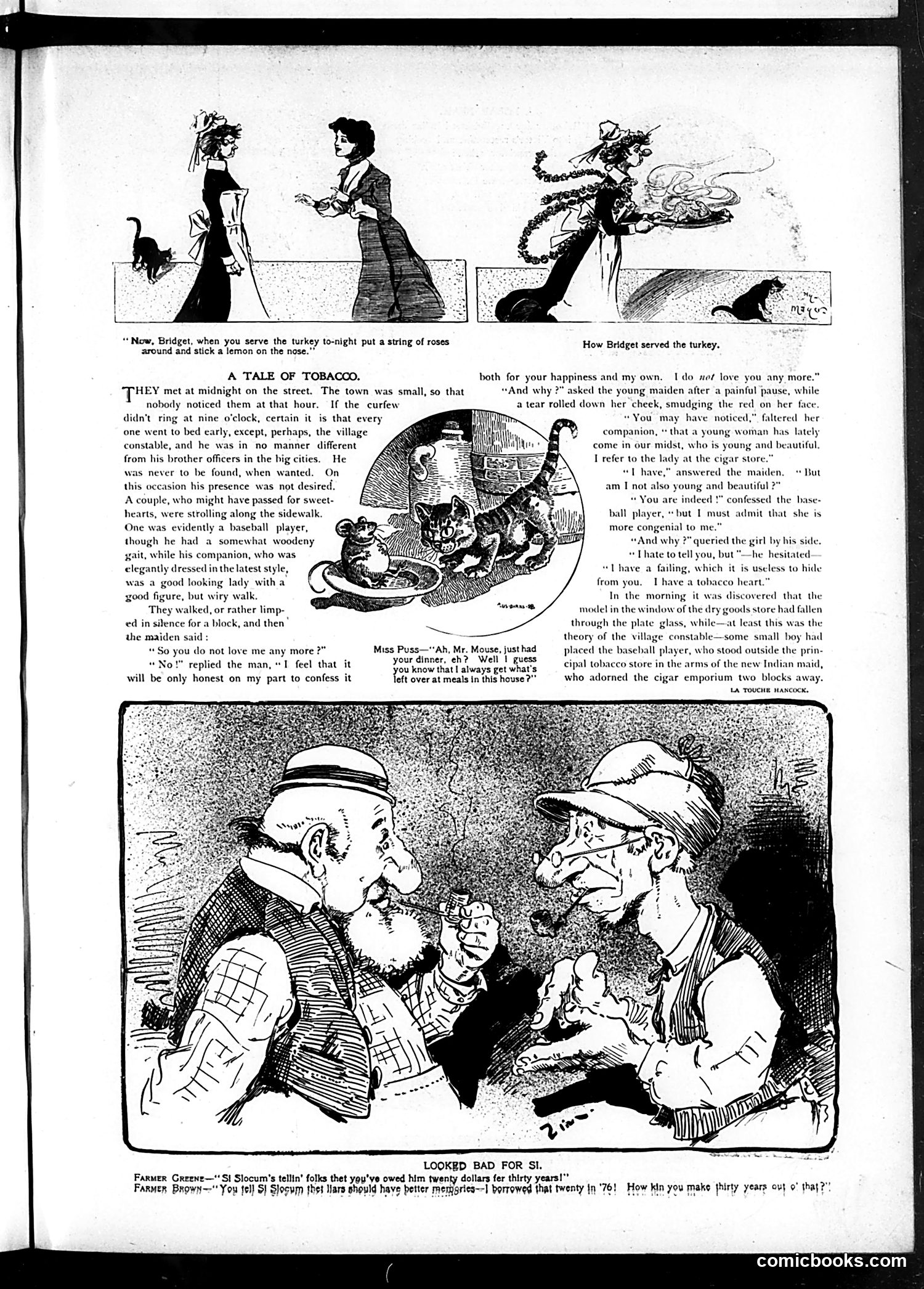
This page contains two distinct satirical pieces: **Top Comic Strip:** "How Bridget Served the Turkey" depicts a domestic servant (Bridget, a common Irish character stereotype in period humor) decorating a turkey with increasingly elaborate garnishes—roses, feathers, and ornate presentations. The joke appears to mock working-class attempts at pretentious presentation or immigrant unfamiliarity with "proper" serving customs. **Bottom Section:** "A Tale of Tobacco" is a romantic story about a young man and woman's relationship, interrupted by revelations about tobacco. The narrative suggests class or status conflict, with the man's devotion to cigars disrupting romance—reflecting era-specific anxieties about smoking's social propriety and its perceived threat to courtship and family values. Both pieces target working-class characters and immigrant stereotypes common to Judge's satirical approach.
📄 Transcribed text from this page (OCR, searchable)
Machine-transcribed from the original scan — historical spelling and the odd misread are preserved.
“Now, Bridget, when you serve the turkey to-night put a string of roses How Bridget served the turkey. around and stick a lemon on the nose.”” A TALE OF TOBACCO. HEY met at midnight on the street. The town was small, so that nobody noticed them at that hour. If the curfew didn’t ring at nine o'clock, certain it is that every one went to bed early, except, perhaps, the village constable, and he was in no manner different from his brother officers in the hig cities. He was never to be found, when wanted. On this occasion his presence was not desired, A couple, who might have passed for sweet- hearts, were strolling along the sidewalk. One was evidently a baseball player, both for your happiness and my own. Ido nef love you any more.” “And why 2” asked the young maiden after a painful pause, while a tear rolled down her cheek, smudging the red on her face. “You may have noticed,” faltered her companion, * that a young woman has lately come in our midst, who is young and beautiful. I refer to the lady at the cigar store.” “T have,” answered the maiden, “But am I not also young and beautiful ?" “ You are indeed ! confessed the base- ball player, “but I must admit that she is more congenial to me.” “And why ?” queried the girl by his side. * Thate to tell you, but "—he hesitated. though he had a somewhat woodeny gait, while his companion, who was elegantly dressed in the latest style, was a good looking lady with a good figure, but wiry walk. They walked, or rather limp- ed in silence for a block, and then" the maiden said : “Lhave a failing, which it is useless to hide from you. I have a tobacco heart.” In the morning it was discovered that the model in the window of the dry goods store had fallen through the plate glass, while—at least this was the theory of the village constable—some small boy had “So you do not love me any more ?" Miss Puss—“Ah, Mr. Mouse, just had placed the baseball player, who stood outside the prin- iN events = i your dinner, eh? Well | guess es epaiain homens chike Hescliiny “No! replied the man, “I feel that it ou knowthatl always get what's cipal tobacco store in the arms of the new Indian maid, will be only honest on my part to confess it left over at meals in this house?” who adorned the cigar emporium two blocks away. LA TOUCHE HANCOCK. LOOKED BAD FOR SI. Faruer Greene—S! Slocum’s tellin’ folks thet you've owed him twenty dollars fer thirty years!" Farmer Browy—"' You fell S} Slocum thet liars should have better memgries—I borrowed that twenty {n '76! How kin you make fhirty years out o° thay?", comicbooks.com