
A complete issue · 16 pages · 1901
Judge — November 9, 1901
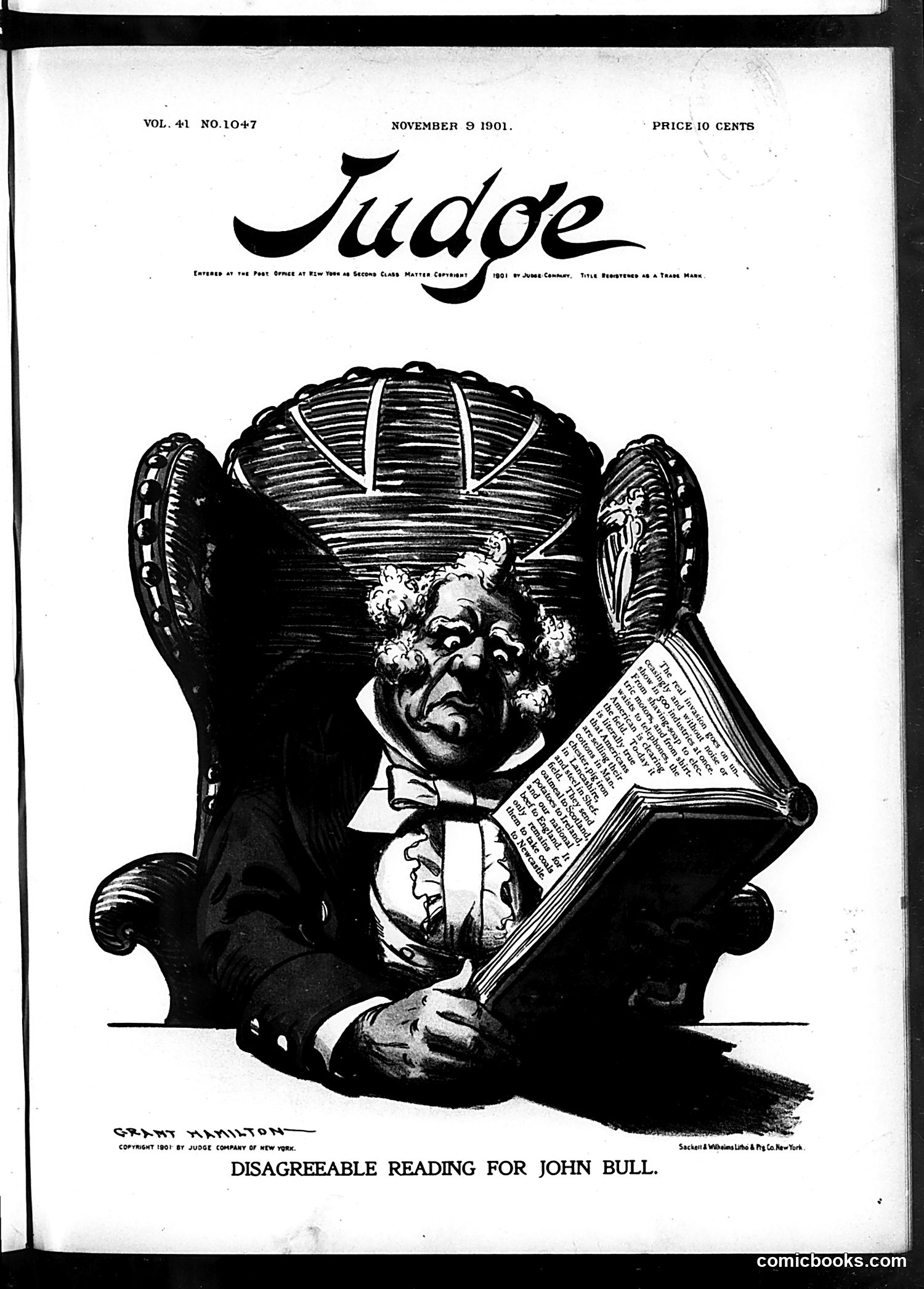
This 1901 *Judge* magazine cover satirizes British imperial policy through the figure of "John Bull" (the personification of Britain). The cartoon depicts Bull as a grotesque character in formal dress, seated in an ornate chair, holding an open book with an expression of distress or displeasure. The satire likely references contemporary British military or political difficulties—possibly the ongoing Second Boer War (1899-1902), which was unpopular and costly for Britain. The "disagreeable reading" suggests unfavorable news or criticism of British imperial actions that disturbs the traditionally confident British establishment. The exaggerated facial features and uncomfortable posture emphasize how unpleasant these circumstances have become for British interests.
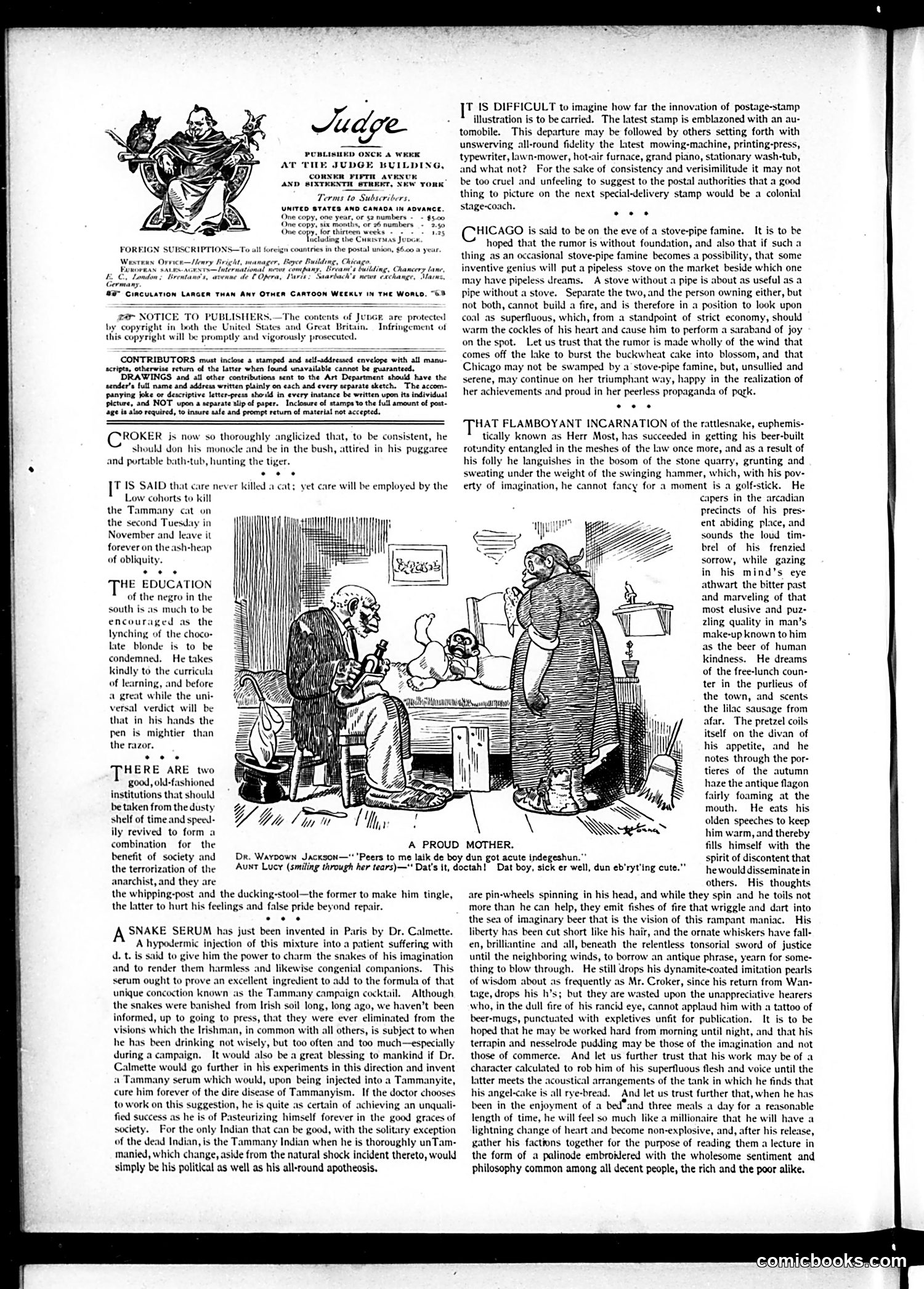
This page contains multiple satirical commentary pieces rather than a single cartoon. The main illustrated piece, titled "A Proud Mother," depicts a working-class domestic scene with a woman and child. The caption suggests social commentary on parenting and child-rearing in tenement conditions. The text articles address various topics: postage-stamp innovations, Chicago's stove-pipe famine concerns, a rattlesnake character ("Herr Most"), and snake serum experiments in Paris. These pieces employ sardonic humor about contemporary social issues—poverty, technological change, and scientific developments. The overall tone targets both the working poor and intellectual pretensions of the era, though specific political figures or events referenced are unclear from this excerpt alone without additional historical context.
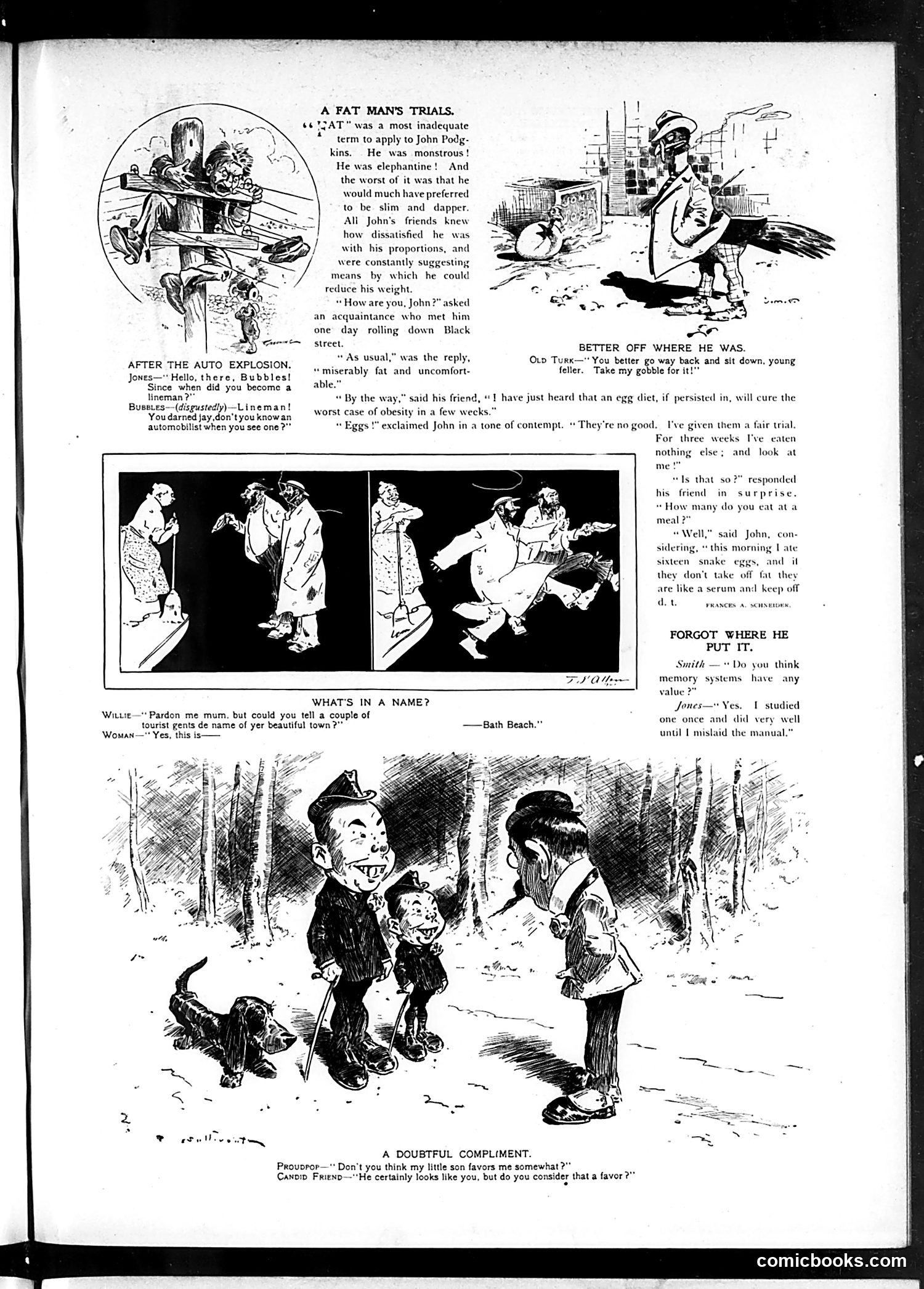
This page satirizes the struggles of an overweight man named John Podge, who is repeatedly advised to lose weight. The cartoon mocks his resistance to diet advice—friends suggest egg diets and other remedies, but John dismisses them. One friend notes John ate "sixteen snake eggs" without result, leading John to complain that eggs "don't take off fat" and function "like a serum." The humor targets both obesity itself and the era's obsession with weight-loss fads and amateur medical advice. Other cartoons on the page ("What's in a Name?", "A Doubtful Compliment") offer unrelated humor about naming conventions and social awkwardness. The overall tone is light satirical commentary on vanity and bodily concerns rather than serious social critique.
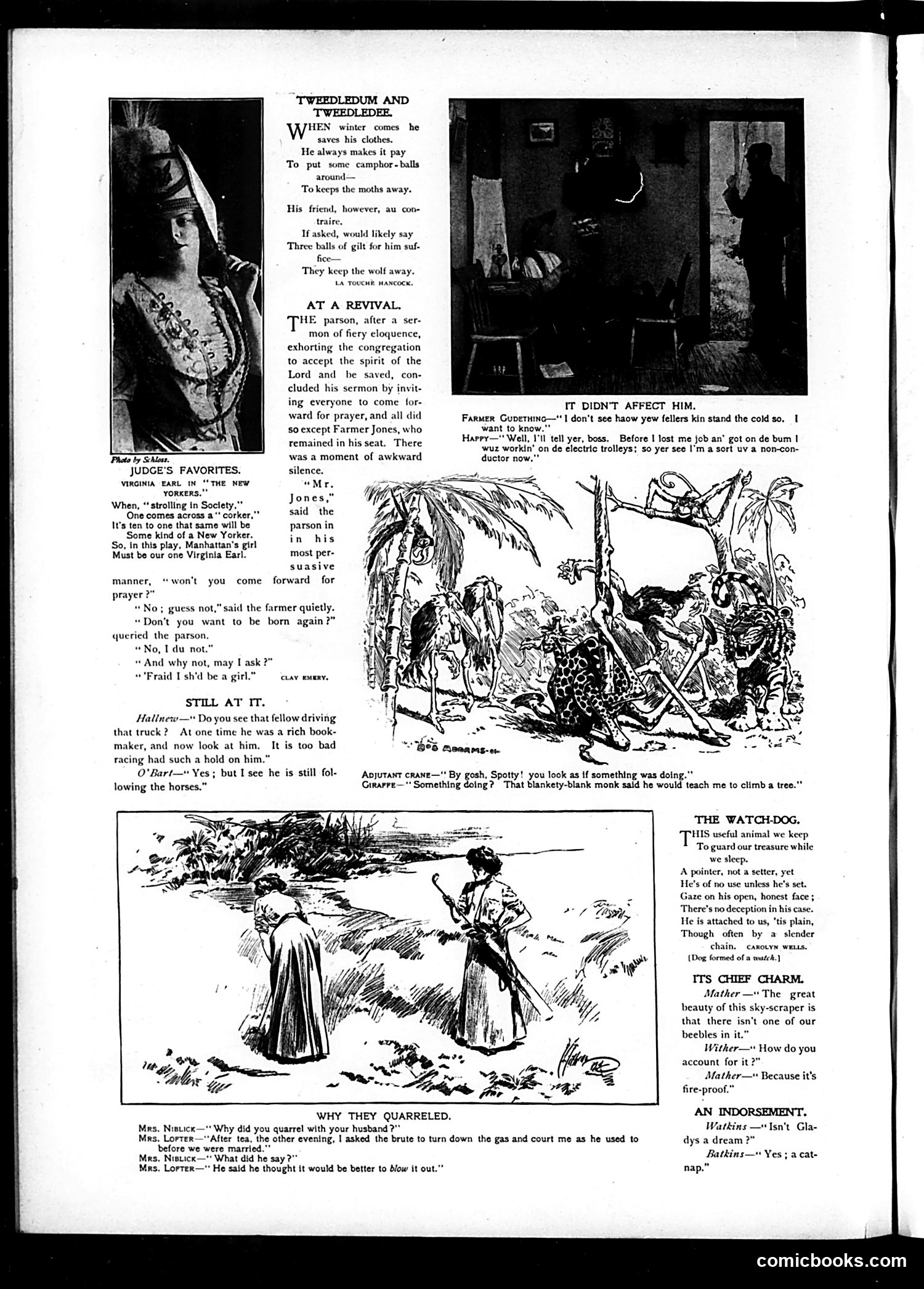
This page contains several satirical pieces and illustrations typical of early 20th-century Judge magazine: **"Tweedledum and Tweedledee"** mocks two indistinguishable political or social figures who behave identically, suggesting their differences are meaningless. **"A Revival"** depicts a rural preacher whose sermon on salvation fails to convert a stubborn farmer—satirizing both religious fervor and rural skepticism. **"Still at It"** jokes about a former wealthy bookmaker now reduced to driving a truck, suggesting social decline or the unpredictability of fortune. The illustrated jokes throughout—including "Why They Quarreled," "The Watch-Dog," and "An Endorsement"—use everyday domestic or rural scenarios for humor. The page primarily offers light social satire rather than pointed political commentary, focusing on character types and human foibles rather than specific contemporary events.
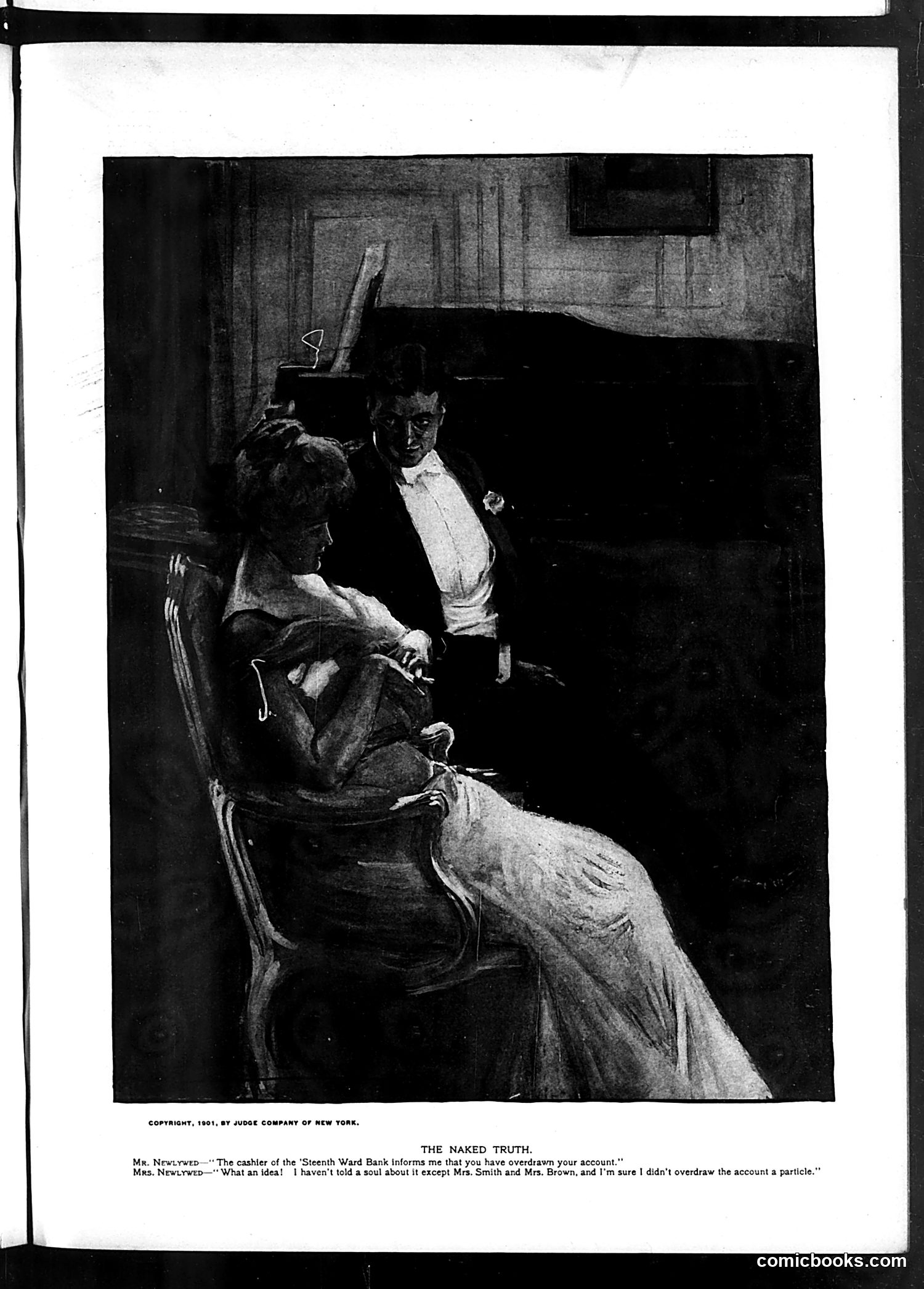
This 1901 Judge cartoon satirizes the naiveté of wealthy married women regarding financial matters. Mr. Newlywed informs his wife she's overdrawn their bank account. Her response—that she hasn't told anyone except two friends and denies overdrawing—reveals the satire's point: she's either lying or genuinely ignorant of her spending habits, yet confident in her innocence. The humor targets both women's purported financial irresponsibility and their casual gossip ("Mrs. Smith and Mrs. Brown"), suggesting her claim of secrecy is contradicted by her own admission. The title "The Naked Truth" implies exposing hidden realities—in this case, marital financial discord and female extravagance, common themes in Gilded Age satire about the "New Woman" and changing domestic dynamics.
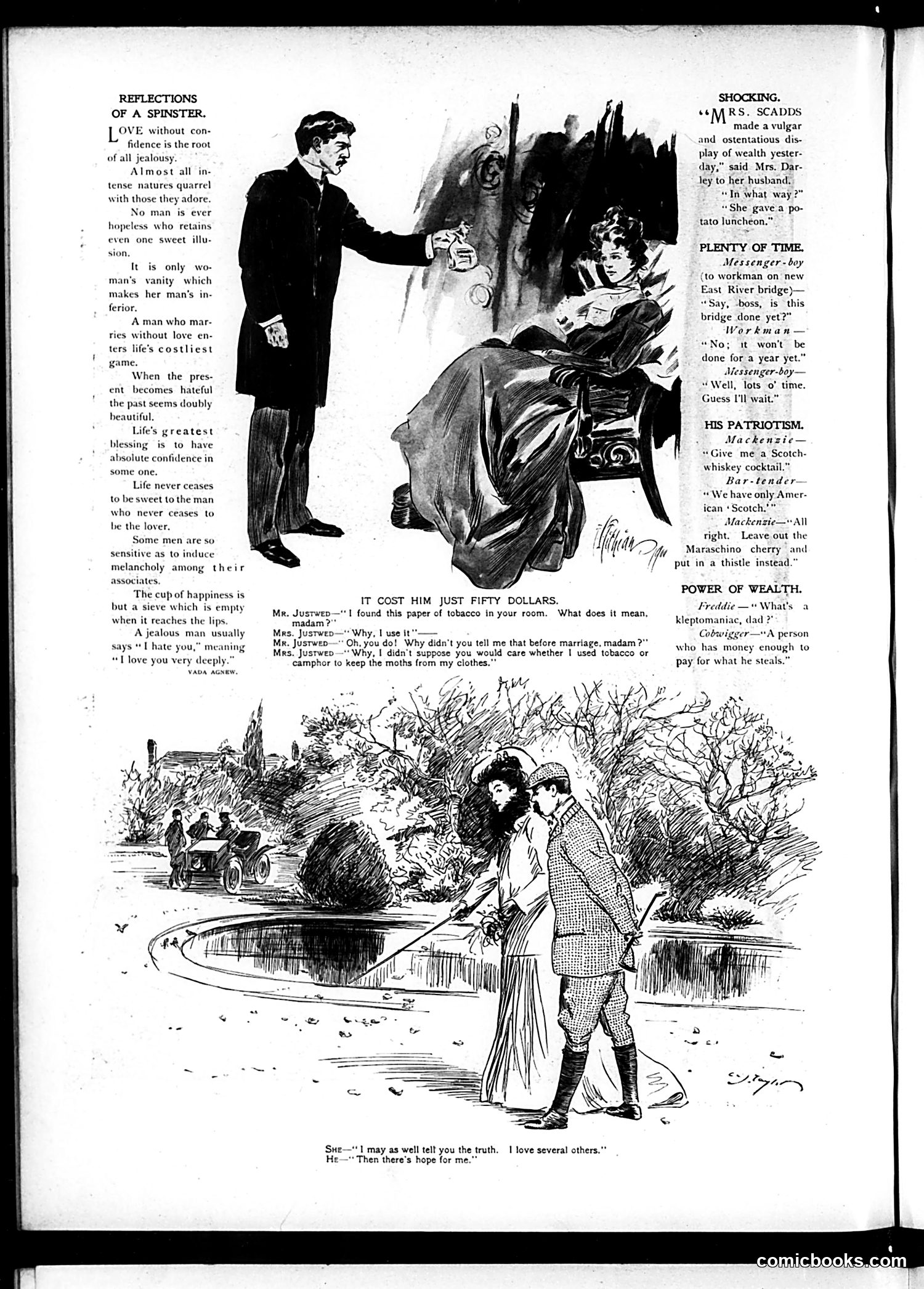
This page contains several short satirical pieces typical of early 20th-century American humor magazines. **"Reflections of a Spinster"** offers philosophical observations on love and marriage from a woman's perspective—likely satirizing both romantic idealism and female independence. **"It Cost Him Just Fifty Dollars"** jokes about marital deception: a husband discovers tobacco in his wife's room, assumes infidelity, but she claims she uses it for moth prevention. The humor lies in the absurd excuse and the fifty-dollar cost (possibly a divorce settlement reference). **The remaining vignettes** are brief comedy sketches: "Mrs. Scadds" mocking ostentatious wealth displays through a cheap "potato luncheon"; a messenger boy's patience with bridge construction delays; "Mackenzie" making a patriotic (though stereotypical) Scottish whisky joke; and "Power of Wealth" suggesting wealthy kleptomaniacs simply buy their way out of theft consequences. The illustrations show domestic scenes and romantic encounters typical of Judge's comedic approach to class, gender, and social pretension.
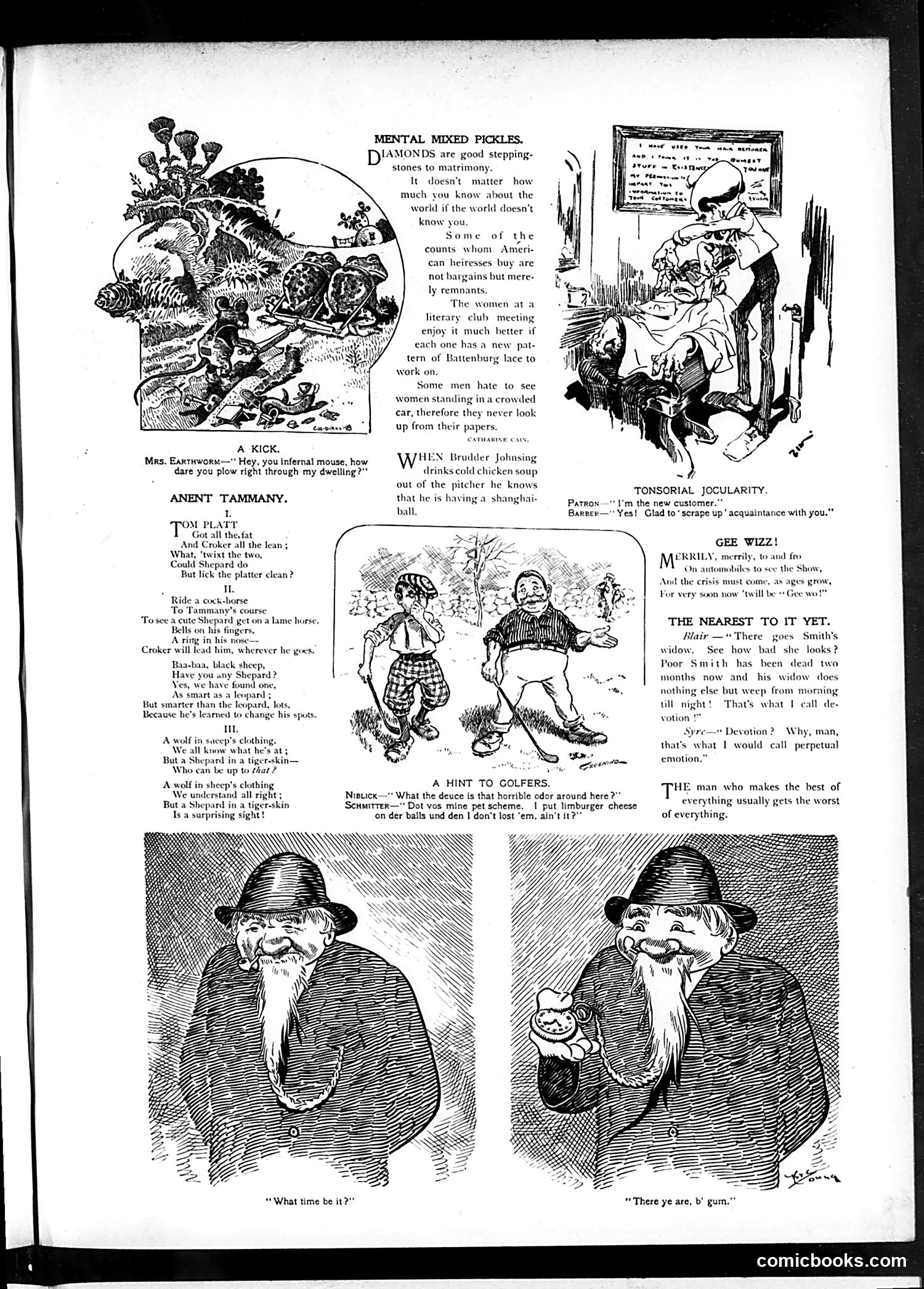
This page collects brief satirical quips and visual jokes typical of Judge's format. Key content includes: **"Anent Tammany"** section: Political verses mocking Tammany Hall (New York's Democratic machine) and its figures. References "Tom Platt" (Republican boss), "Croker" (Richard Croker, Tammany leader), and "Shepard" (appears to be a political figure), satirizing their corruption and opportunism through nursery-rhyme parodies about "changing spots" and wolves in sheep's clothing. **Other satirical items**: - "Mental Mixed Pickles"—random observations about diamonds, heiresses, and social pretension - "Tonsorial Jocularity"—a barber joke - Bottom illustrations: Two caricatured elderly men, possibly ethnic stereotypes common to period humor The page primarily targets **political corruption** (Tammany Hall's notorious graft) and **social hypocrisy** among the wealthy. Without clearer identification of "Shepard," precise political context remains partially unclear, but the anti-Tammany sentiment is unmistakable.
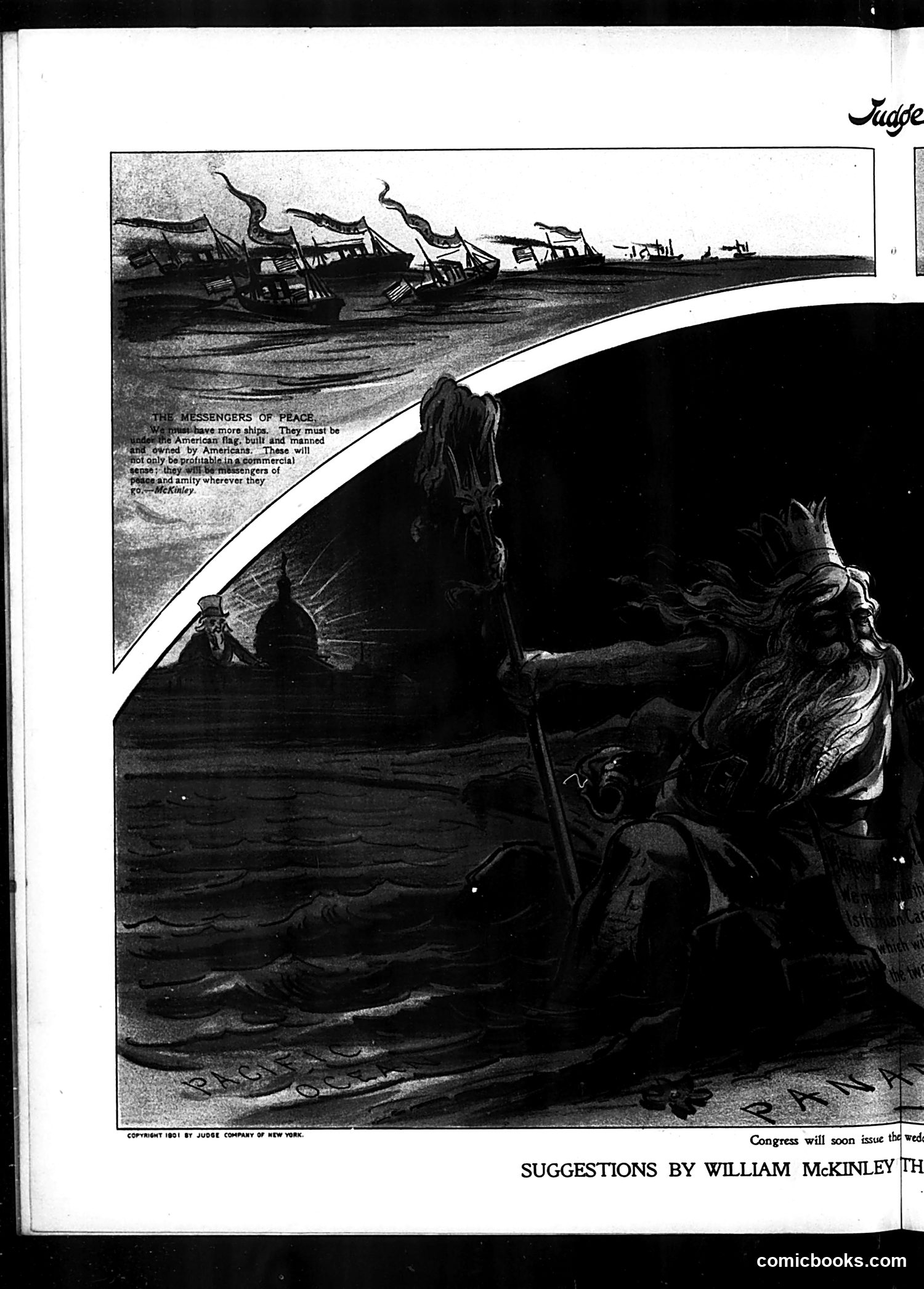
This 1901 Judge cartoon presents William McKinley's "Suggestions" regarding American naval expansion. The image shows an allegorical figure (likely representing Peace or America) gazing upon a fleet of ships with distinctive Asian-style curved roofs, suggesting foreign or captured vessels. The visible text emphasizes that America needs more ships—specifically American-built and American-owned vessels that will serve commercial and military purposes, bringing "peace and amity wherever they go." This reflects McKinley's imperialist foreign policy during the Spanish-American War era and its aftermath, when the U.S. was expanding its naval power and overseas territories. The cartoon satirizes McKinley's aggressive expansion strategy by framing military buildup as a path to international "peace"—a contradiction the satirist highlights through the juxtaposition of warships and the peace-figure's contemplation.
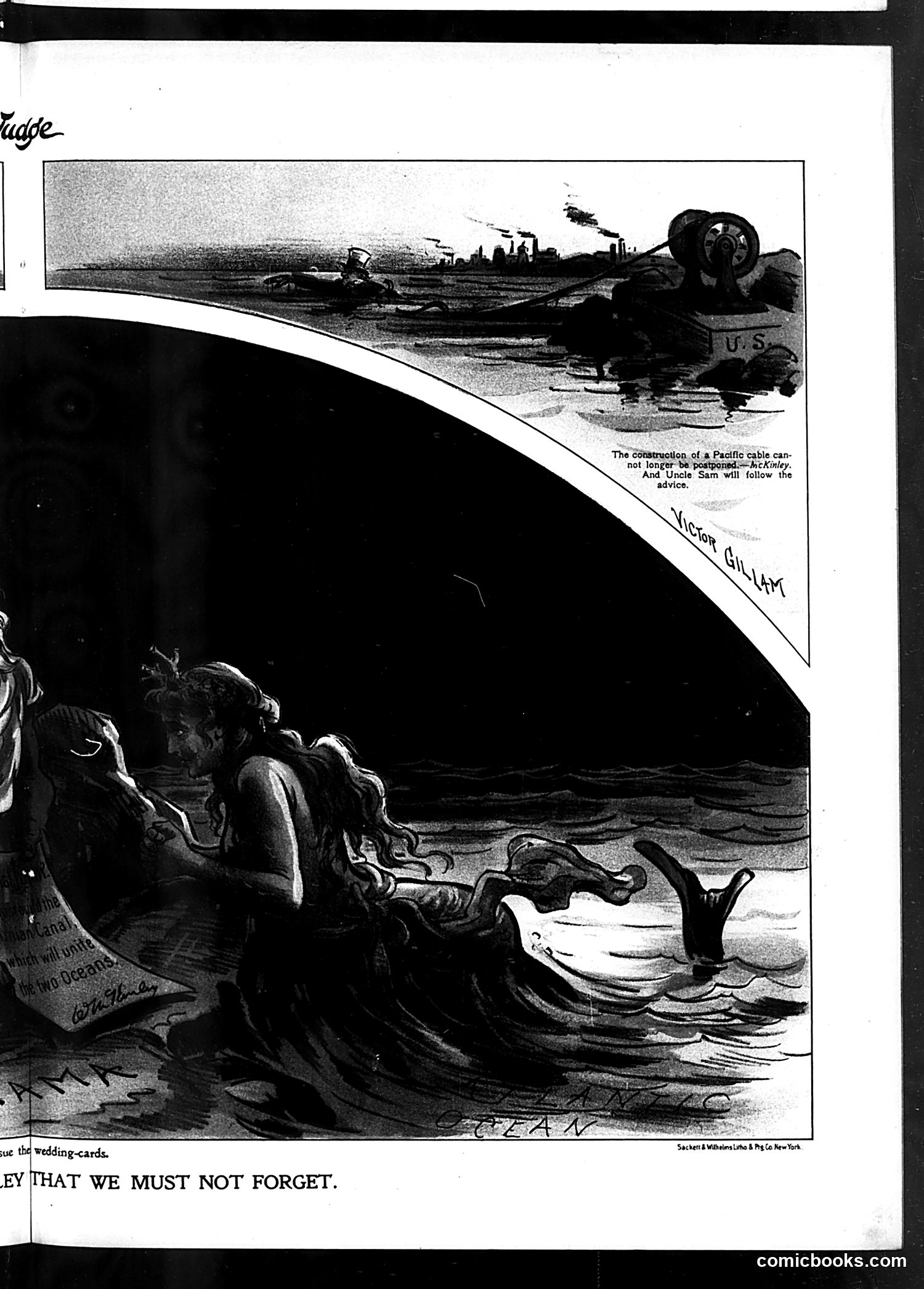
This is a Gilded Age political cartoon titled "A Debt That We Must Not Forget," signed by Victor Gillam. It depicts a tragic scene: figures (likely representing American sailors or victims) lie dead on a beach labeled "OCEAN," while in the background, a U.S. naval vessel is visible. The cartoon references President McKinley's statement about delaying Pacific cable construction. The satire suggests that postponing the cable—presumably needed for military communication and coordination—has resulted in tragic loss of life at sea. The corpses represent the human cost of political inaction or negligence. The "debt we must not forget" refers to the moral obligation to learn from such losses and act decisively on infrastructure that could prevent future tragedies. This reflects Progressive Era arguments that modern technology and government action could save lives.
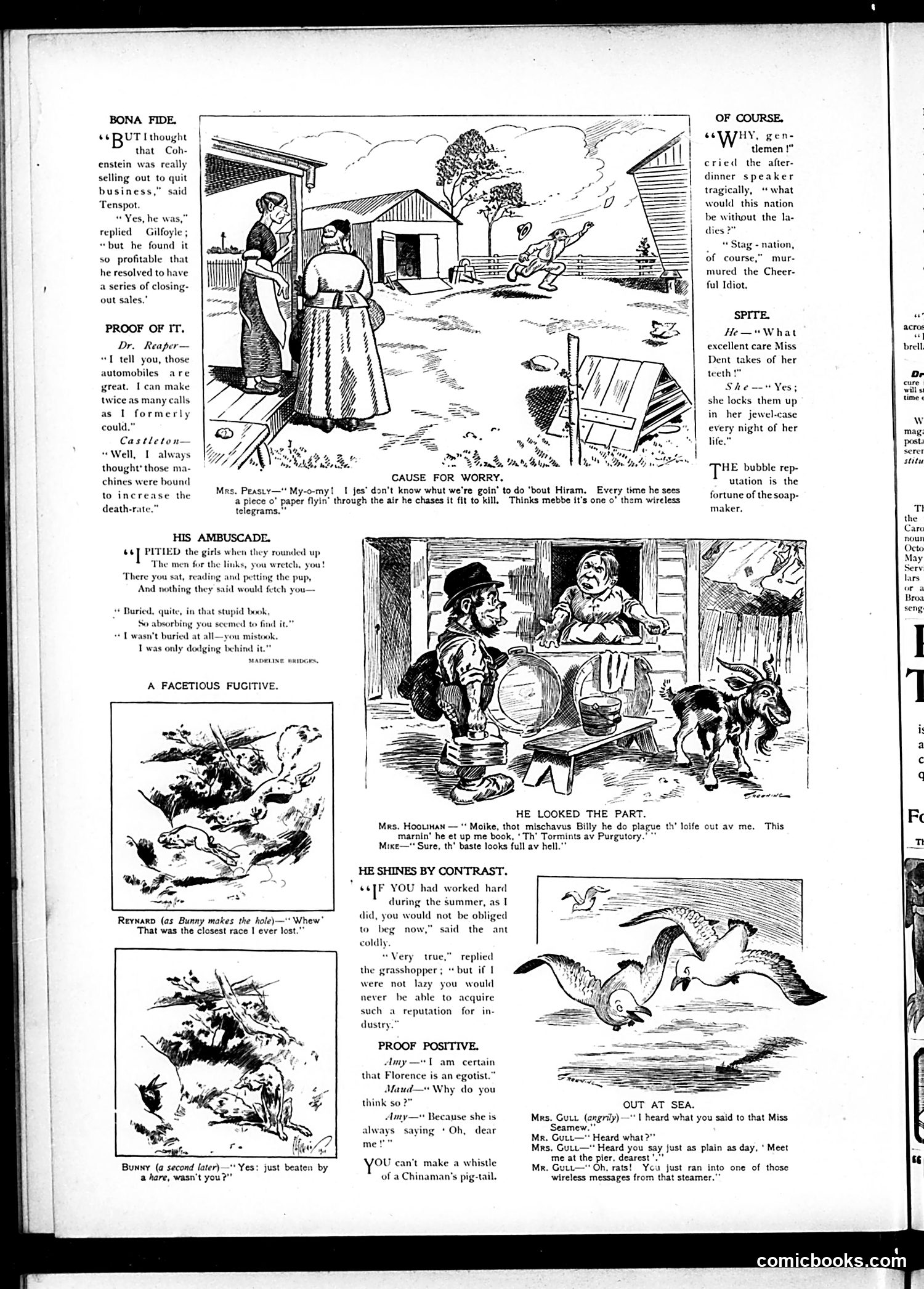
This page contains several unrelated satirical vignettes typical of early 20th-century humor magazines: **Top section** mocks business practices: a man named Cohenstein claims to be liquidating his business but instead profits so much from "closing-out sales" that he continues the scheme indefinitely—satirizing fraudulent retail practices. **"His Ambuscade"** presents a domestic squabble where a man claims he wasn't reading during golf season but "dodging behind" his wife's complaints—poking fun at marital conflict and male avoidance tactics. **Animal fables** ("A Facetious Fugitive," "He Shines by Contrast") retell Aesop-style stories with contemporary commentary on laziness and industriousness. **Remaining vignettes** target common subjects: dental vanity, mistaken identity in romance ("Proof Positive"), and marital misunderstandings ("Out at Sea," where a wife misinterprets her husband's flirtation as a wireless ship message). The humor relies on wordplay, domestic situations, and gentle mockery of middle-class behavior rather than political content.
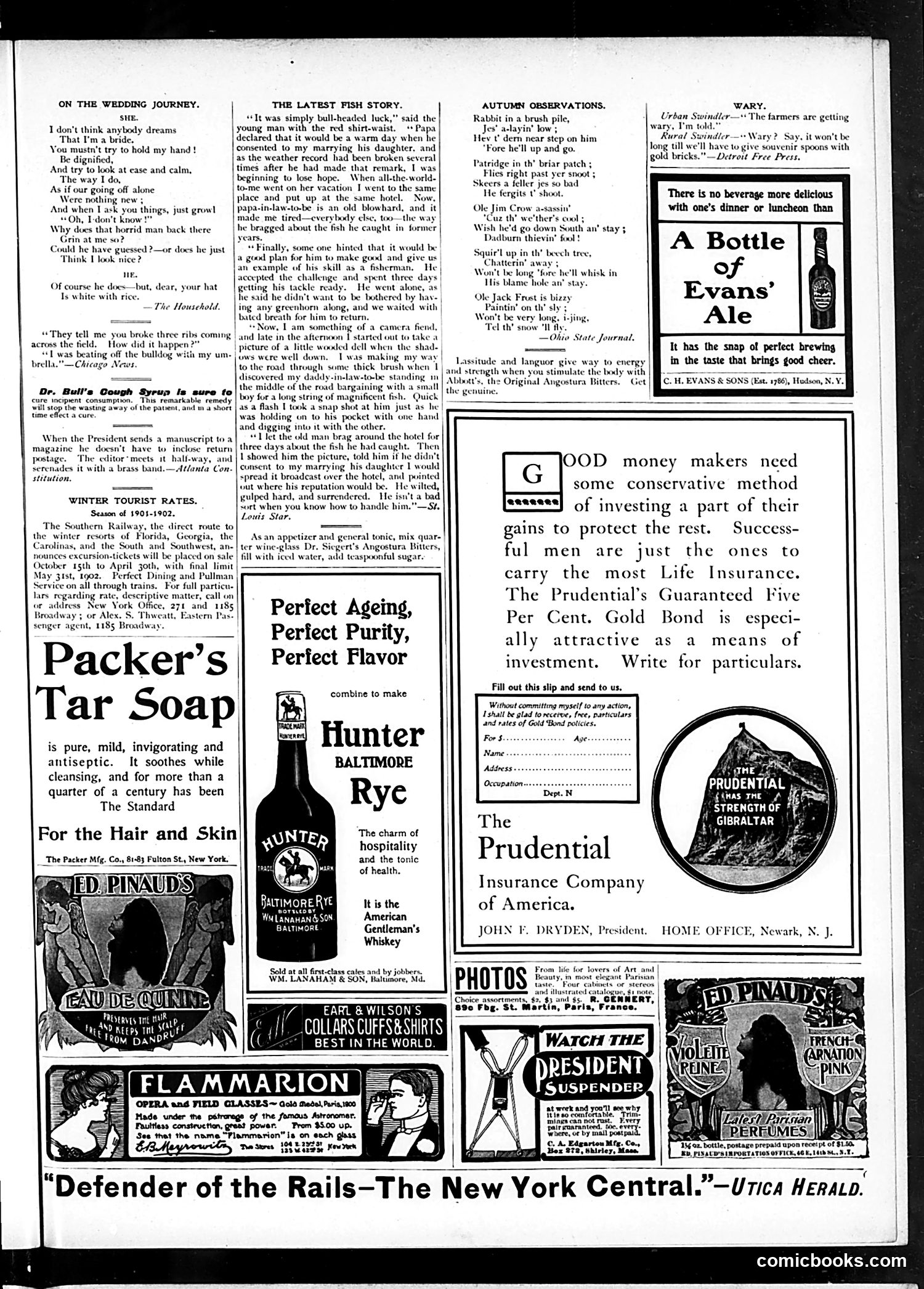
This page is primarily **advertising and light humor**, lacking a cohesive political cartoon. The visible content includes: **"On the Wedding Journey"** — A domestic humor piece where a newlywed bride worries about propriety while traveling, wanting to appear dignified rather than romantically attached. This reflects early-1900s social conventions about public decorum. **"The Latest Fish Story"** — A lengthy anecdote about a suitor impressing his prospective father-in-law by catching a fish, then being photographed in an undignified moment struggling with it. The joke hinges on the gap between boasting and reality. **"Autumn Observations"** — Brief rural dialect observations (rabbit, partridge, flies) with no clear satirical target. The remainder consists of **advertisements** for Packer's Tar Soap, Hunter Baltimore Rye whiskey, The Prudential Insurance Company, and other commercial products — typical of Judge's revenue model. No prominent political figures or events are caricatured on this page. The humor is domestic and commercial rather than satirical.
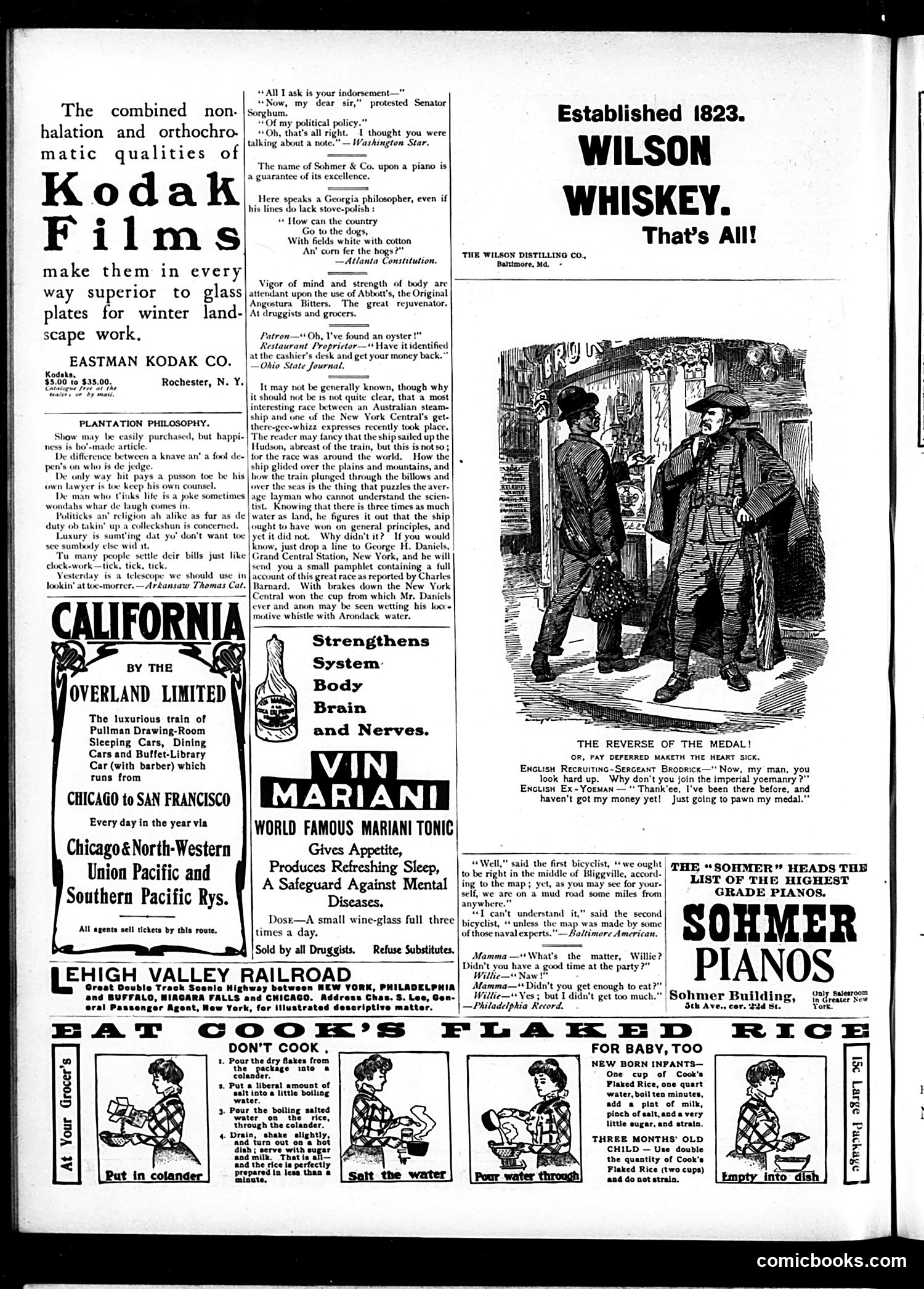
This page is primarily **advertising**, with one notable political cartoon titled "The Reverse of the Medal!" **The Main Cartoon:** The cartoon depicts a conversation between an English Recruiting Sergeant (Broprick) and an Ex-Yeoman soldier. The sergeant encourages the poor man to join the Imperial Yeomanry, but the ex-soldier refuses, claiming he previously served and "haven't got my money yet!" He's now pawning his medal out of desperation. **The Satire:** This critiques the British military's failure to adequately compensate soldiers. The "reverse of the medal" suggests that military service—supposedly honorable—actually leaves veterans impoverished and unpaid. The joke's bitter irony: the medal itself becomes worthless, requiring pawn rather than pride. **Historical Context:** This likely references late 19th-century concerns about veteran welfare in Britain, where soldiers received inadequate compensation and struggled financially after service. **Rest of Page:** Mostly period advertisements for Kodak film, Mariani Tonic, Wilson Whiskey, Sohmer Pianos, and railroad services, with minor comic snippets about philosophy and domestic situations.
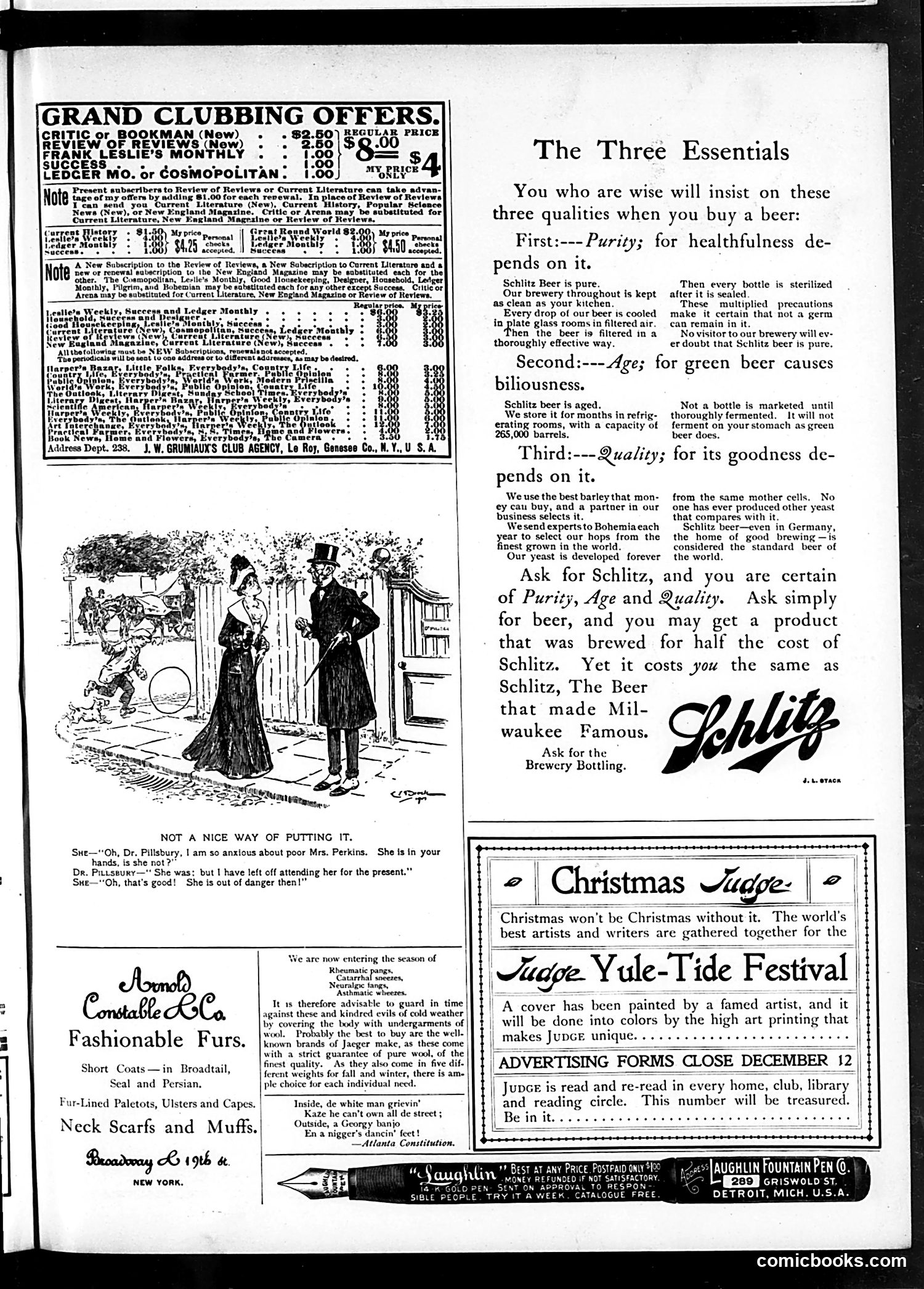
This page contains primarily **advertising content** rather than political cartoons. The main feature is a Schlitz beer advertisement emphasizing "The Three Essentials"—purity, age, and quality—using claims about sterile bottling and refrigeration that would appeal to early 20th-century consumers concerned about contaminated food and drink. The small cartoon titled "Not a Nice Way of Putting It" is a domestic humor joke: A woman (Sue) expresses anxiety about her friend Mrs. Perkins to Dr. Pillsbury, who replies he's stopped attending her. Sue cheerfully interprets this as good news because the patient must be out of danger—missing the darker implication that the doctor abandoned a difficult or terminal case. The humor relies on Sue's naive misunderstanding. The page also includes advertisements for fur coats and a Judge magazine Christmas issue promotion. The content reflects early 1900s consumer culture and genteel domestic humor conventions.
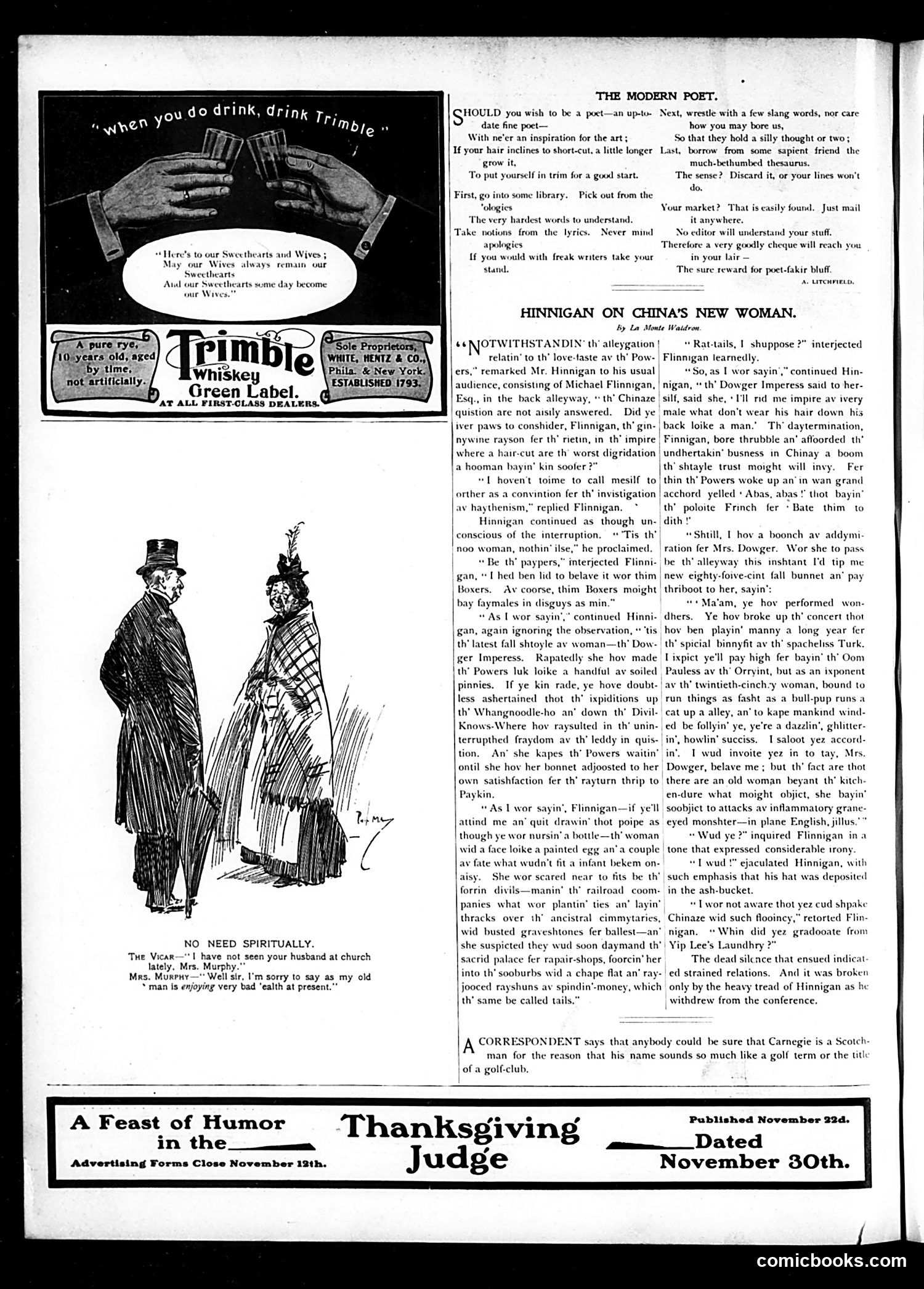
**"The Modern Poet"** satirizes early 20th-century avant-garde poetry. It mocks "modern" poets who deliberately obscure meaning by: using difficult vocabulary from dictionaries, incorporating nonsensical slang, stealing ideas from thesauruses, and discarding coherent sense entirely. The joke is that incomprehensible work still finds publishers and pays well—rewarding "poet-fakir bluff" over genuine craft. This reflects anxiety about modernism's rejection of traditional poetic standards. **"Hinnigan on China's New Woman"** is a dialect humor piece (featuring Irish-American character speech patterns) about the Chinese Dowager Empress and the Boxer Rebellion. Hinnigan tells Flinnigan that the Empress—the "new woman"—has intimidated Western powers through her strength and independence, keeping them waiting while she manages affairs. The satire portrays her as formidable and shrewd, outwitting foreign intervention through sheer force of personality and political acumen.
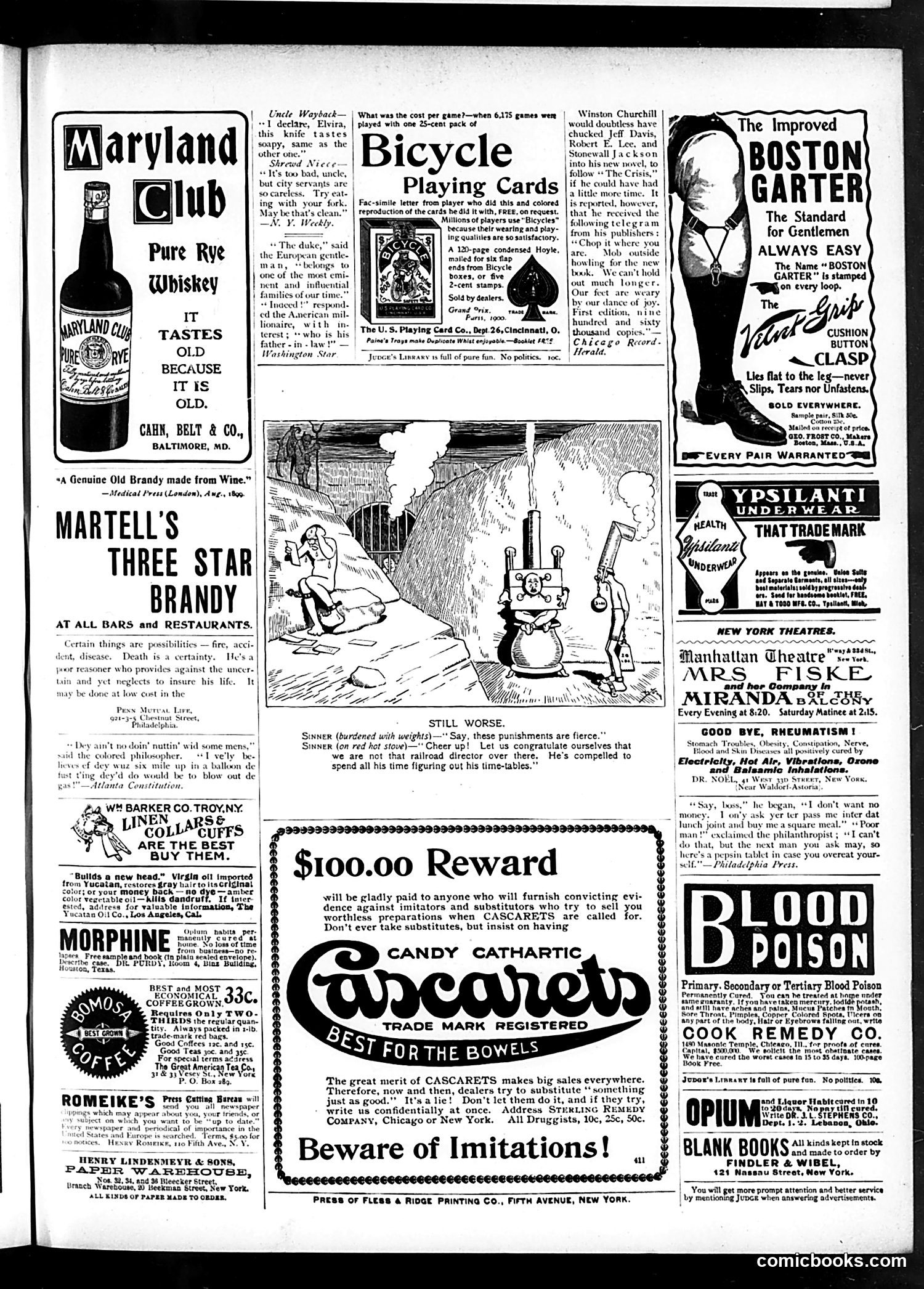
This page is primarily **advertising**, dominated by a large Cascarets laxative ad. The main cartoon, titled "Still Worse," depicts two sinners in punishment—one weighted down, one on a hot stove—comparing their fates unfavorably to a railroad director's punishment of "figuring out his time-tables." The joke targets **railroad corruption and inefficiency** during the Progressive Era, when railroad executives faced public criticism for mismanagement and fraud. The cartoon implies that forcing a railroad director to actually work through legitimate schedules is worse punishment than literal damnation—satirizing both their incompetence and the era's popular contempt for railroad monopolies. A secondary joke involves Uncle Wayback complaining his knife tastes "soapy," with his niece sarcastically suggesting he use a fork instead—a simple domestic humor non sequitur common to period magazines.
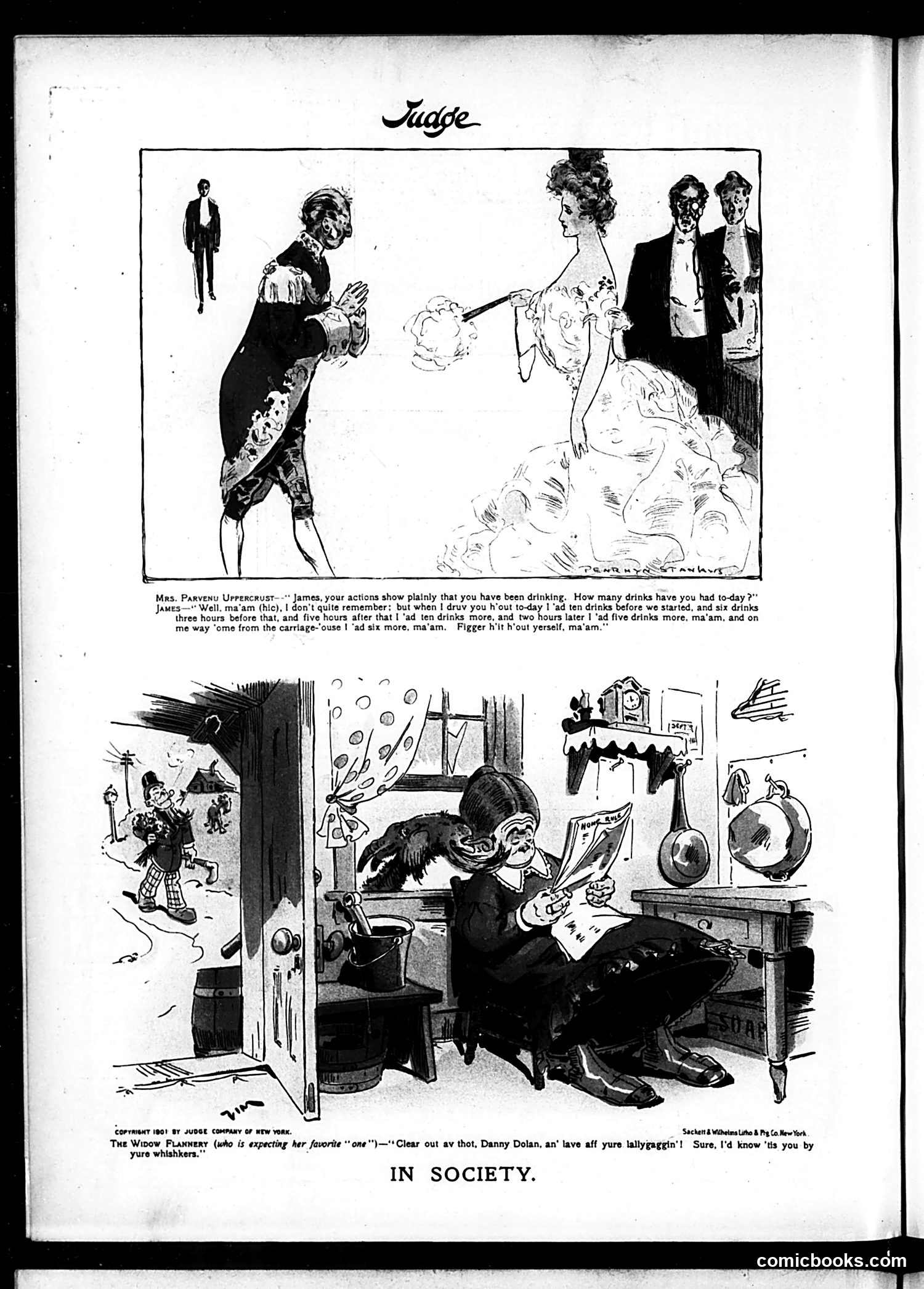
This 1901 page contains two satirical cartoons mocking social pretension and Irish servants. **Top cartoon**: A wealthy woman ("Mrs. Parvenu Urrercrust"—the name itself mocking nouveau riche) confronts her drunk coachman James about his drinking. James responds with absurd precision, listing an impossible number of drinks consumed throughout the day while driving her. The satire targets both his brazen dishonesty and her obliviousness to the obvious danger he posed while operating her carriage. **Bottom cartoon**: "The Widow Flannery" scolds her suitor Danny Dolan, identifying him by his distinctive whiskers despite his attempts at flirtation ("lallygaggin'"). Both cartoons employ exaggerated Irish dialect and stereotypes common to the era, while satirizing servants' behavior and lower-class social dynamics. The "In Society" heading suggests ironic commentary on social pretense.