
Judge, 1901-11-09 · page 4 of 16
Judge — November 9, 1901 — page 4: what you’re looking at
What you’re looking at
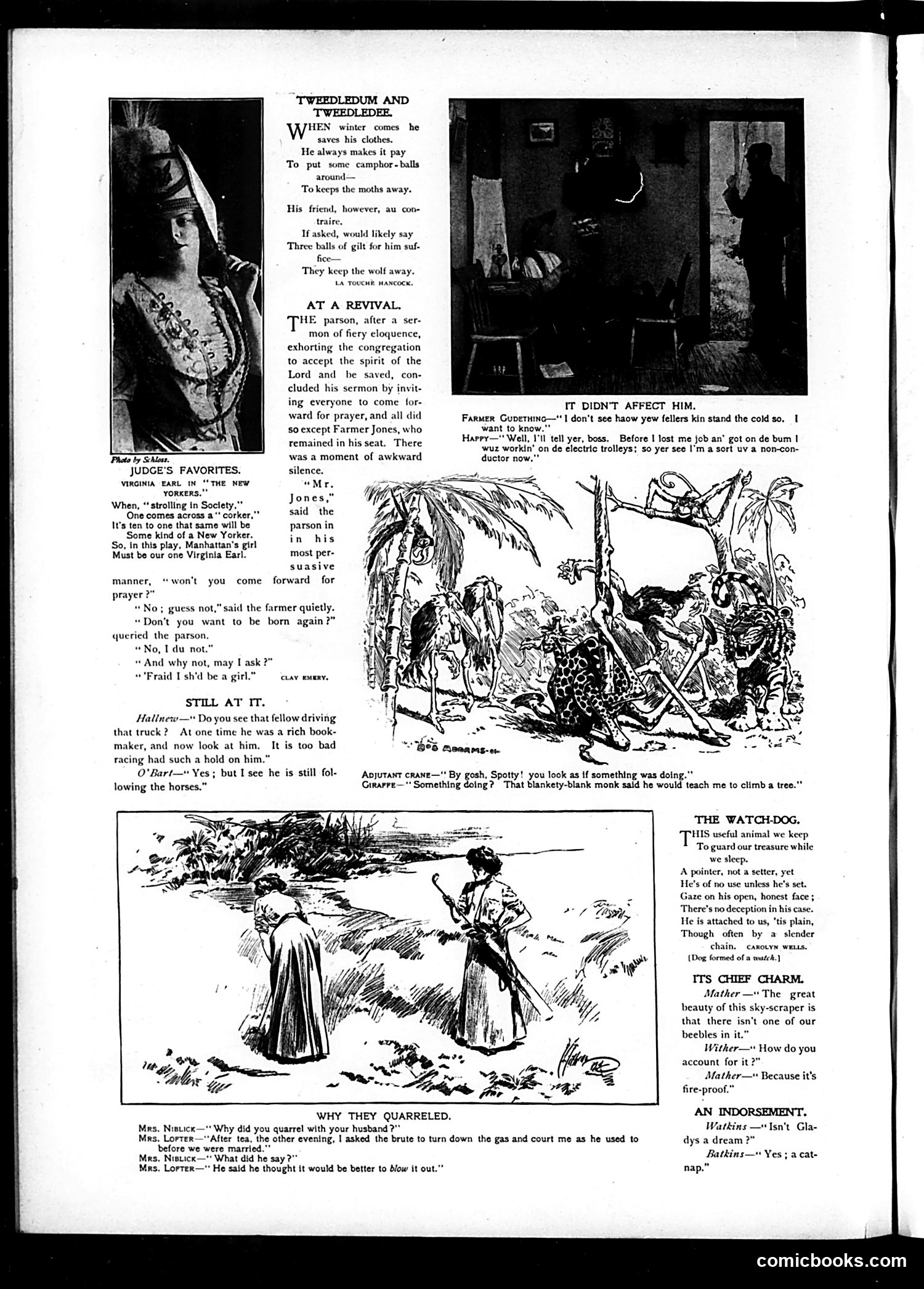
This page contains several satirical pieces and illustrations typical of early 20th-century Judge magazine: **"Tweedledum and Tweedledee"** mocks two indistinguishable political or social figures who behave identically, suggesting their differences are meaningless. **"A Revival"** depicts a rural preacher whose sermon on salvation fails to convert a stubborn farmer—satirizing both religious fervor and rural skepticism. **"Still at It"** jokes about a former wealthy bookmaker now reduced to driving a truck, suggesting social decline or the unpredictability of fortune. The illustrated jokes throughout—including "Why They Quarreled," "The Watch-Dog," and "An Endorsement"—use everyday domestic or rural scenarios for humor. The page primarily offers light social satire rather than pointed political commentary, focusing on character types and human foibles rather than specific contemporary events.
📄 Transcribed text from this page (OCR, searchable)
Machine-transcribed from the original scan — historical spelling and the odd misread are preserved.
'HEN winter comes he saves his clothes. He always makes it pay To put some camphor- balls around— To keeps the moths away. His friend, however, au con- traire, If asked, would likely say Three balls of gilt for him suf- fice— They keep the wolf away. LA TOUCHE: HANCOCK. parson, after a ser- mon of fiery eloquence, exhorting the congregation to accept the spirit of the Lord and be saved, con- cluded his sermon by invit- ing everyone to come for- IT DIDN'T AFFECT HIM. ward for prayer, and all did Farmer Gupetiinc—'I don’t see haow yew fellers kin stand the cold so, 1 so except Farmer Jones, who want to know." : inaiaed in bib aeaucot here Harry—" Well, I'll tell yer, boss. Before | lost me job an’ got on de bum | wuz workin’ on de electric trolleys; so yer see I'm a sort uy a non-con- Fa iy Silas was a moment of awkward ductor now." JUDGE'S FAVORITES. silence. VIRGINIA EARL IN “THE NEW Mr YORKERS.”” ones When, “strolling In Soctety,” J ia th One comes across a‘* corker,"” said the I's ten to one that same will be parson in Some kind of a New Yorker. So, In this play, Manhattan's girl Must be our one Virginia Earl. most per- suasive in his manner, “won't you come forward for prayer?” “No; guess not,” said the farmer quietly. “Don't you want to be born again 2” queried the parson. “No, I du not.” “And why not, may [ask 2” «'Fraid I sh'd be a girl.” CLAY EMERY, STILL AT IT. Hallnew—* Do you see that fellow driving that truck? At one time he was a rich book- maker, and now look at him. It is too bad racing had such a hold on him.” O'Bart—« Yes; but I see he is still fol- Apjutant crane—" By gest. Spotty! you look as if something was doing.” lowing the horses.” Girarre—“ Something doing? That blankety-blank monk said he would teach me to climb a tree.” BES menams-o THE WATCH-DOG. THIS useful animal we keep To guard our treasure while we sleep. A pointer, not a setter, yet He's of no use unless he's set. Gaze on his open, honest face ; ‘There’s no deception in his cas He is attached to us, ‘tis plain, Though often by a slender chain. carotrw weiss. (Dog formed of a watch.) ITS CHIEF CHARM. Mather —The great beauty of this sky-scraper is that there isn’t one of our beebles in it. Wither—« How do you account for it Mather—« Because it's fire-proof.” WHY THEY QUARRELED. AN INDORSEMENT. Mrs. Niptick—‘* Why did you quarrel with your husband ?”” Watkins —Isn't Gla- Mrs. Lorter—"‘After tea, the other evening, | asked the brute to turn down the gas and court me as he used to dys a dream ?” before we were married.” js.icx—" What did he say?” Palkia os Nes a cate Mrs. Lorrer—* He said he thought it would be better to d/ow it out.” nap. comicbooks.com