
A complete issue · 16 pages · 1901
Judge — October 5, 1901
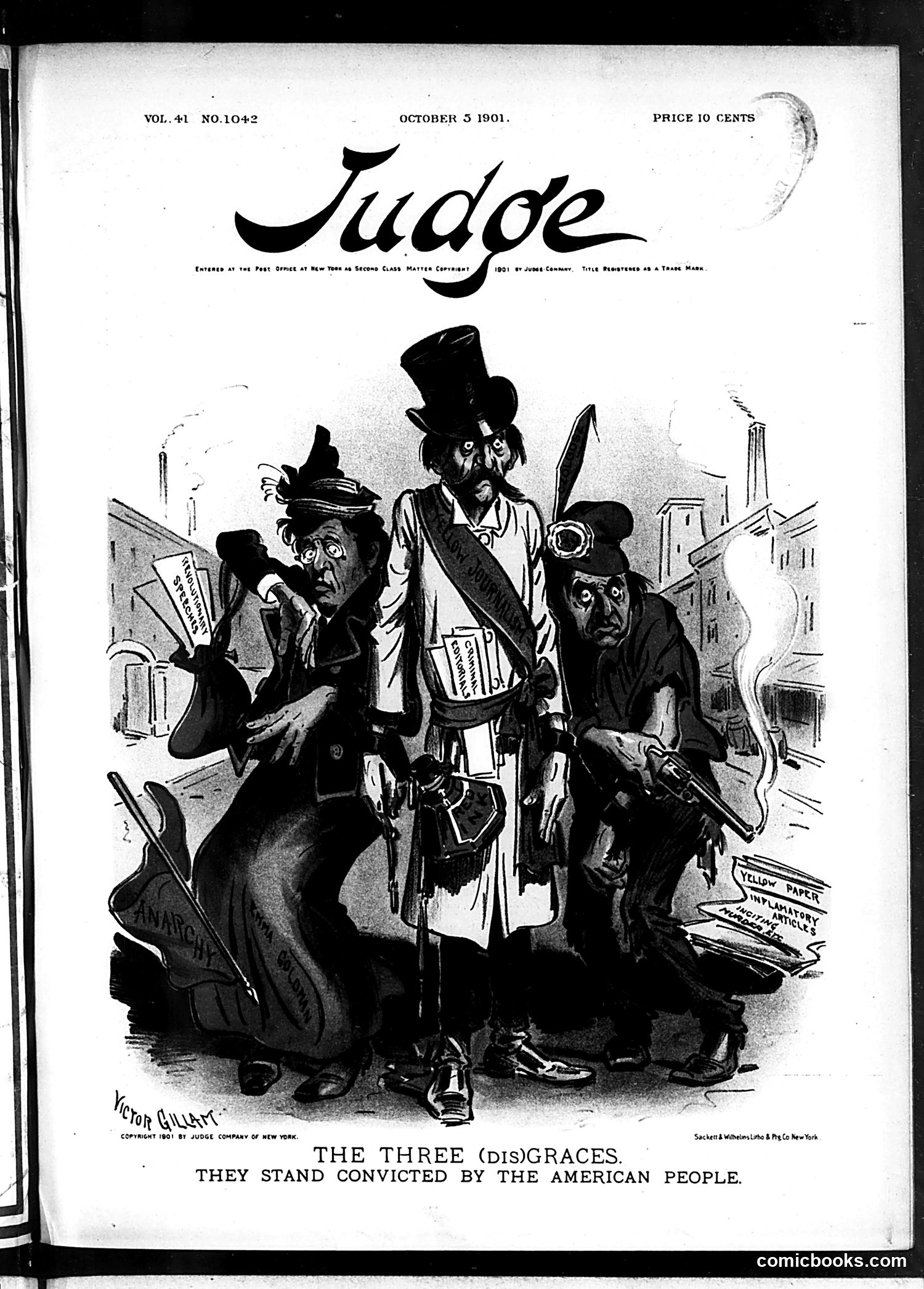
This October 5, 1901 *Judge* cartoon by Victor Gillam depicts three caricatured figures presented as "disgrace[s]" convicted by the American people. The figures wear top hats and appear to represent political or public figures of the era, though their specific identities are unclear from the image alone. They carry documents labeled with text that is difficult to read in this reproduction. The satire suggests these three individuals have been publicly condemned for wrongdoing or misconduct. The urban setting with industrial smokestacks in the background emphasizes their connection to American public affairs. Without clearer identification of the figures or knowledge of specific 1901 scandals, the precise targets of Gillam's criticism remain uncertain, though the message clearly conveys public disapproval of their conduct.
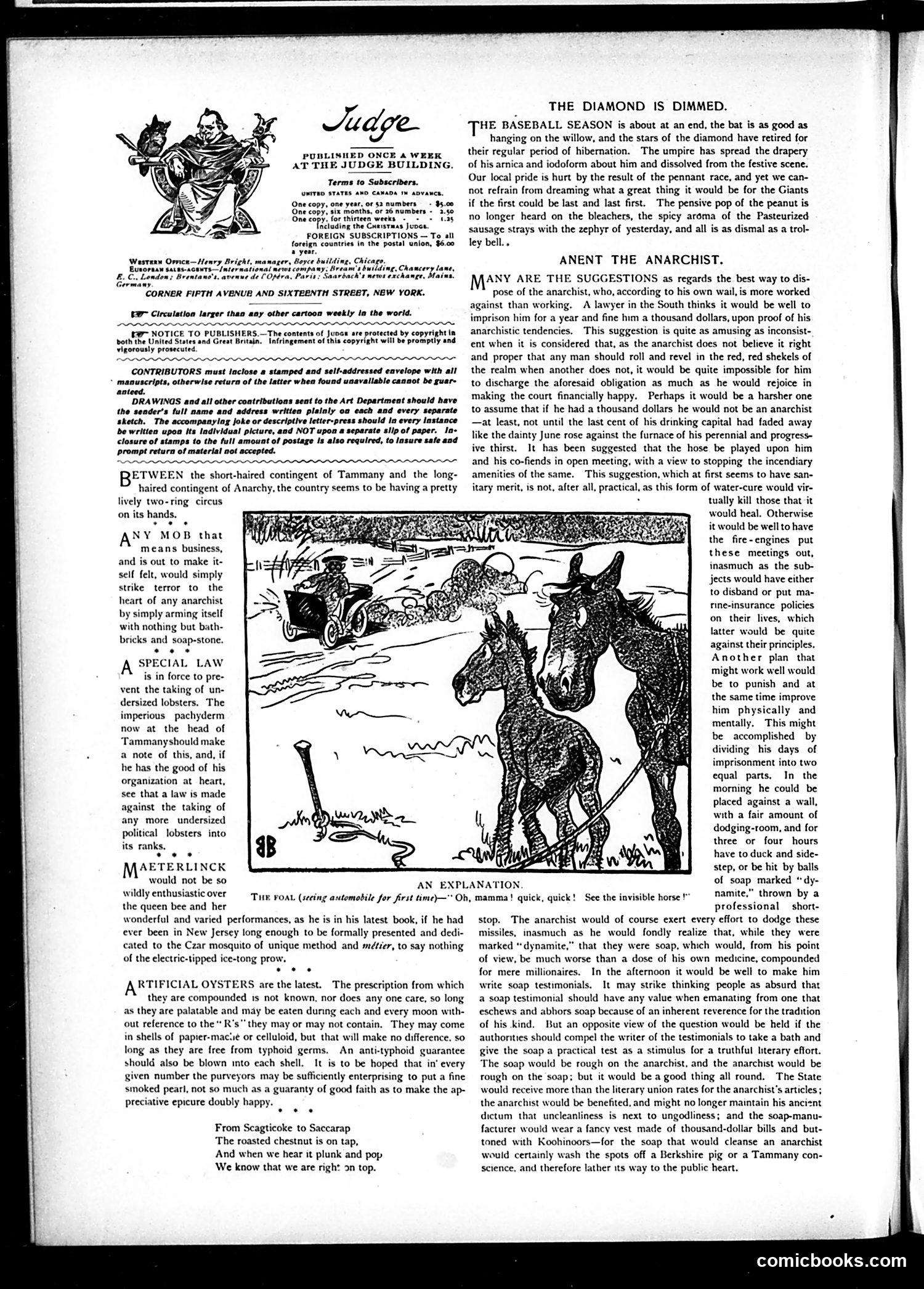
The main cartoon depicts an automobile collision with a horse, illustrating the tension between new motorized transportation and traditional horse-drawn conveyances—a common satirical theme during the automobile's early adoption period. The accompanying text titled "ANENT THE ANARCHIST" discusses proposals to punish anarchists through imprisonment and fines, offering satirical counterarguments. The author absurdly suggests alternative punishments: forcing anarchists to attend fire-department meetings, subjecting them to soap testimonials, or having them wear fancy vests. The satire mocks both anarchist ideology and the government's earnest but ineffectual response to radical threats. The piece reflects early 20th-century American anxiety about anarchism while lampooning overly-literal or bureaucratic governmental solutions to political extremism.
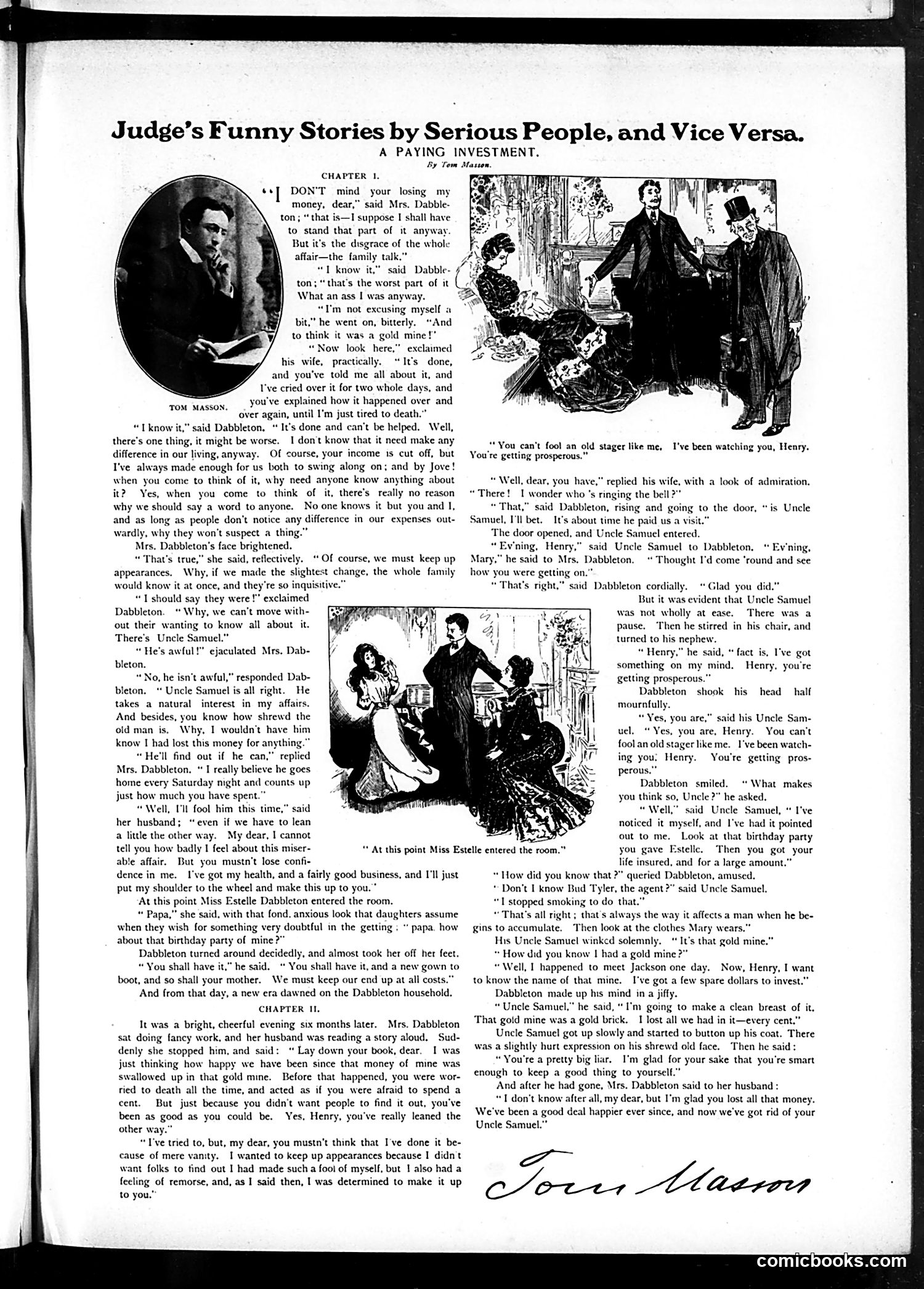
This page contains a serialized story titled "A Paying Investment" by Tom Mason, featuring two illustrations. The narrative depicts a domestic comedy about the Dabbleton family discussing financial matters and social propriety. The story concerns Mr. Dabbleton's loss of money and subsequent efforts to conceal it from his wife and maintain appearances. Uncle Samuel visits and discovers the deception. The humor derives from period-typical marital dynamics—the husband's embarrassment, the wife's concern about "family talk," and Uncle Samuel's pragmatic advice about keeping up appearances while being sensible with money. The illustrations show Victorian-era domestic scenes with multiple figures in conversation. This appears to be straightforward domestic humor rather than political satire, typical of Judge's lighter content alongside its more pointed social commentary.
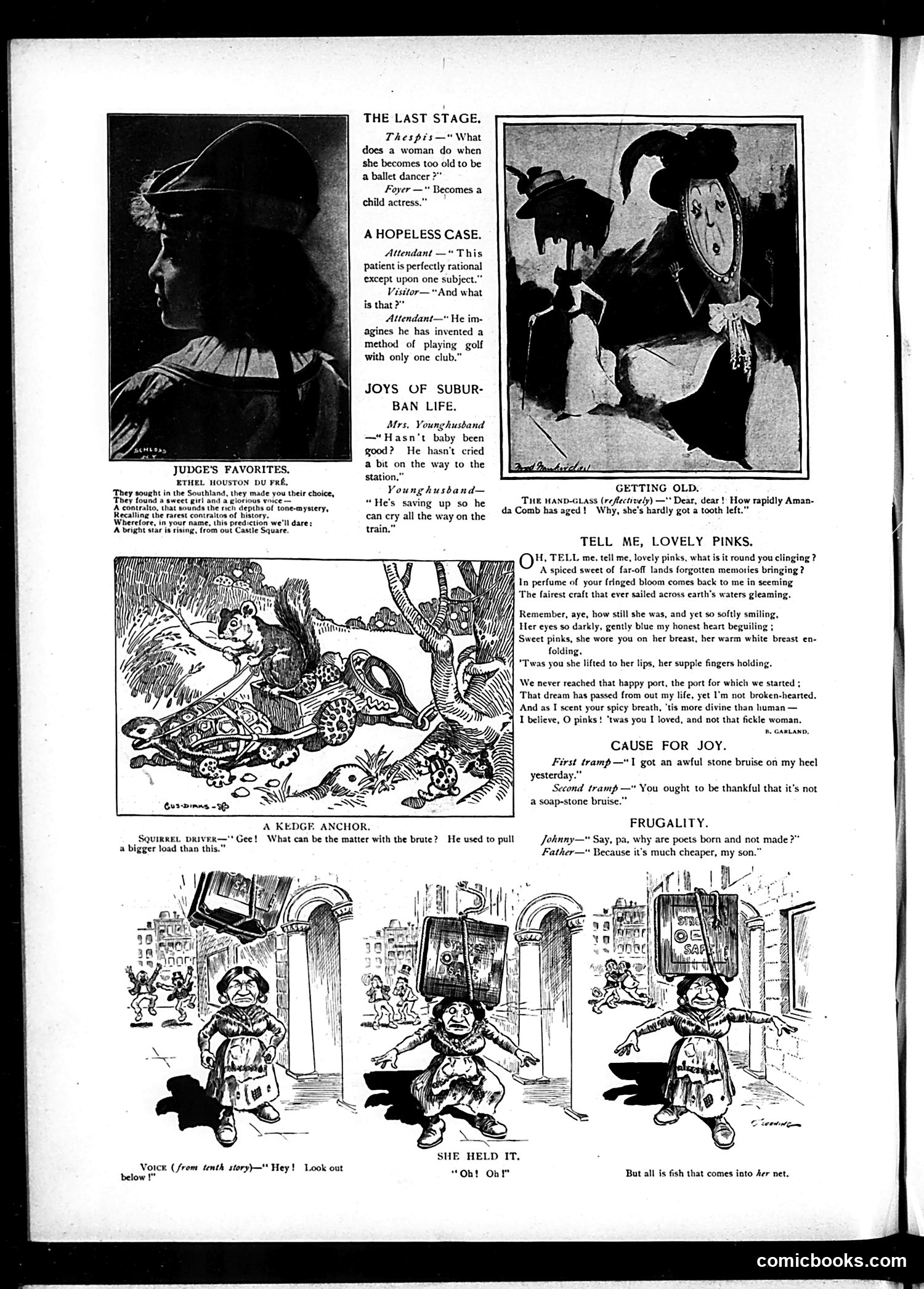
This page contains several unrelated satirical pieces typical of Judge's format: **"The Last Stage"** mocks aging performers, specifically ballet dancers forced into lesser theatrical roles. **"A Hopeless Case"** presents a patient obsessed with inventing golf variations—satire on eccentric hobbyists. **"Judge's Favorites"** credits Ethel Houston du Pré with witty observations about society. **"Tell Me, Lovely Pinks"** is sentimental poetry about forgotten flowers and lost love—likely satirizing Victorian sentimentality. **"A Kedge Anchor"** jokes about a square-driver (golfer) whose physical strength exceeds his skill. **"Frugality"** features a dialogue where a father explains poets are cheap to produce. **"She Held It"** shows a woman with a falling object—the caption suggests misfortune befalling her. These are typical Judge humor pieces: social commentary, observational comedy, and light mockery of middle-class life.
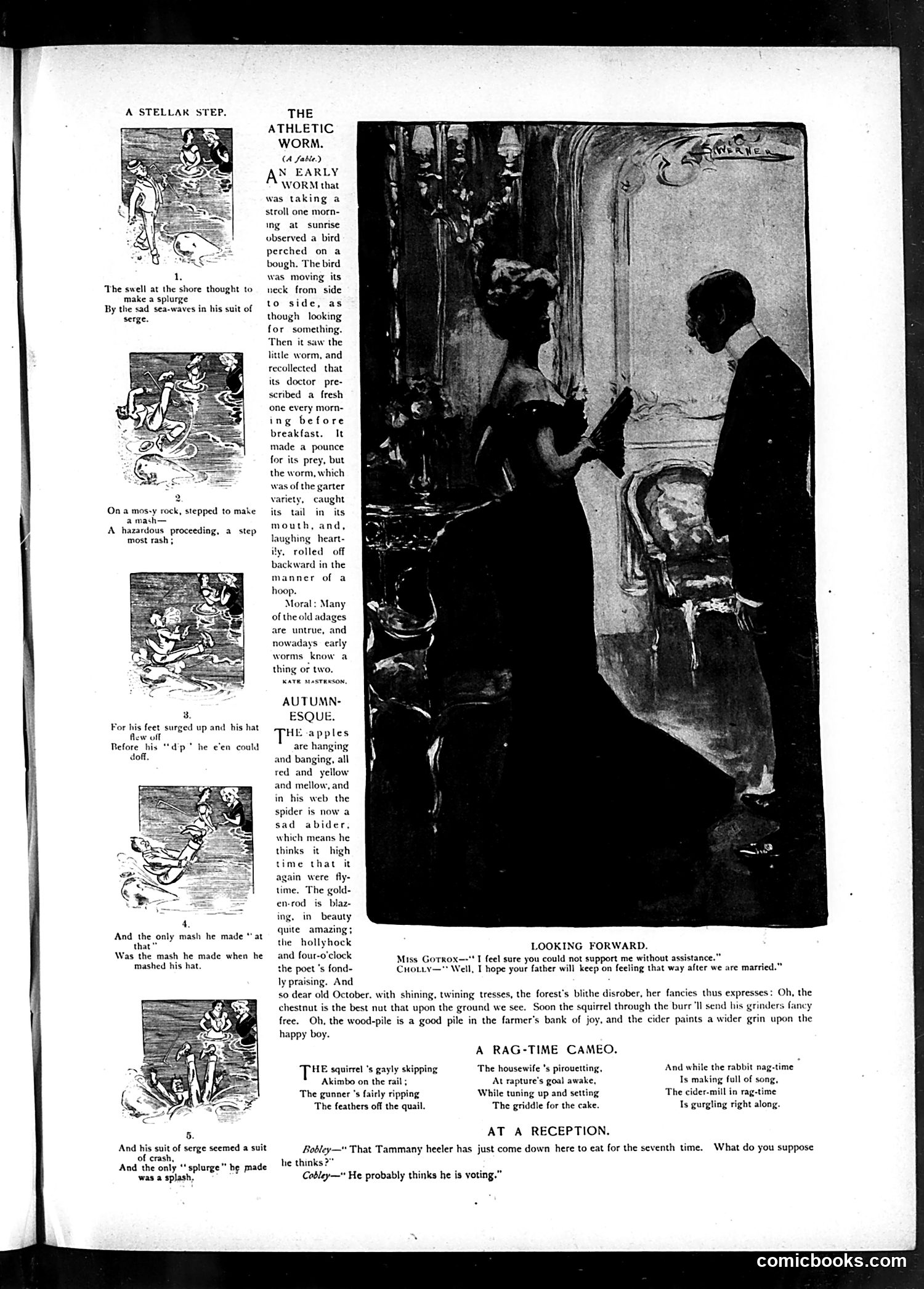
This page contains several short humorous pieces typical of Judge's satirical style: **"The Athletic Worm"** is a fable mocking outdated conventional wisdom. A bird hunts a worm, but the worm—described as a "garter variety"—escapes by catching its tail in its mouth and rolling away like a hoop, suggesting old advice ("the old adages are untrue") doesn't always apply. **The fashion/social humor** includes a seaside scene poking fun at pretentious dressing and a courtship exchange where a woman manipulates her fiancé's financial dependence, satirizing matrimonial negotiations. **"At a Reception"** contains political satire: a Tammany Hall operative (a notoriously corrupt New York political machine) repeatedly attends receptions for free meals. The joke is dark—the character likely thinks eating at public events equals voting, mocking both the corruption of machine politics and the intelligence of its participants. The remaining pieces are light seasonal and domestic humor about autumn, rag-time music, and everyday activities—characteristic filler content of the era.
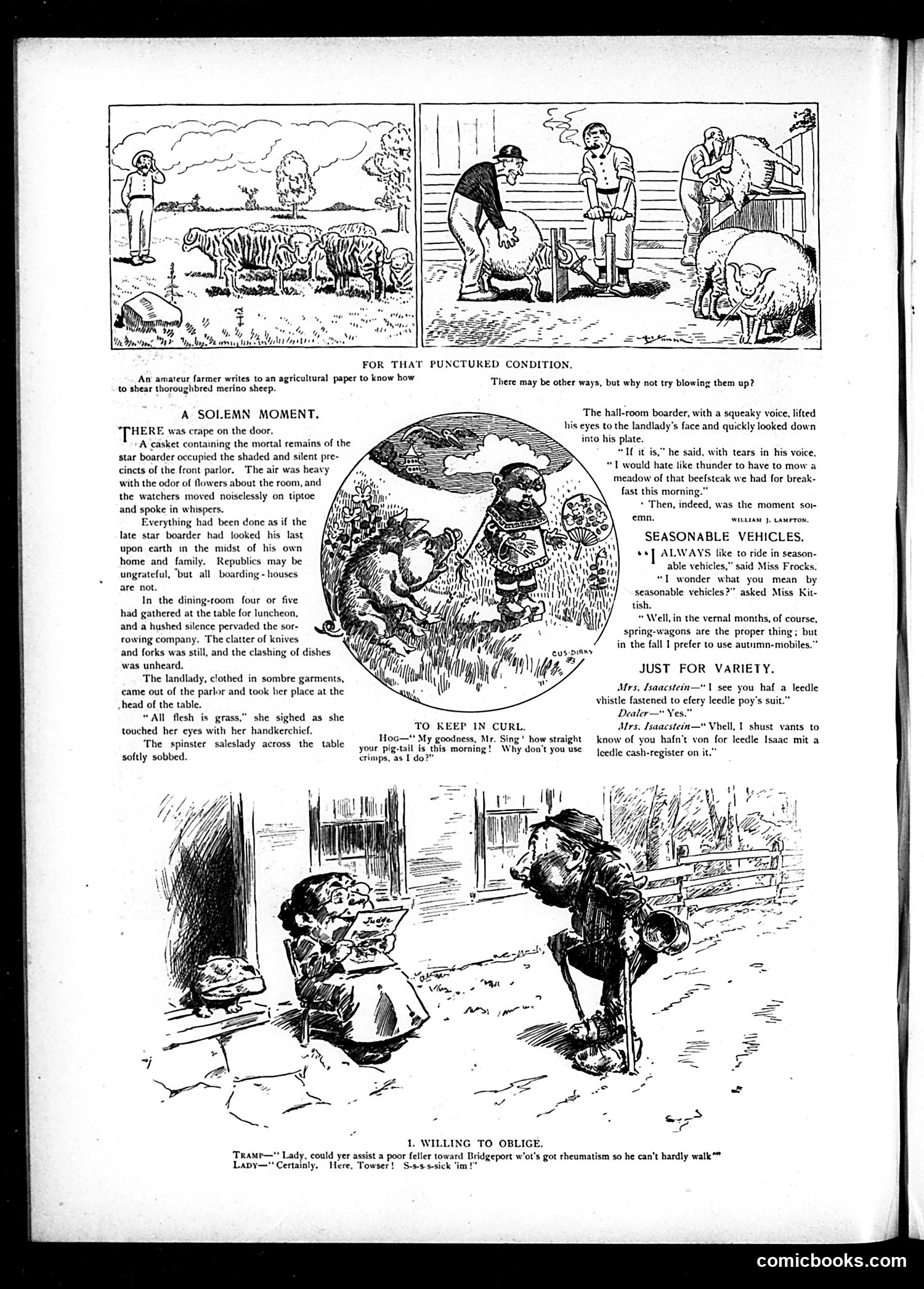
This page contains several unrelated satirical pieces typical of Judge's format: **Top cartoon:** "For That Punctured Condition" mocks an amateur farmer asking an agricultural journal how to shear merino sheep, suggesting he simply "blow them up"—physical comedy based on the farmer's incompetence. **"A Solemn Moment":** Dark humor about a boarding house where the residents mourn a deceased "star boarder" with exaggerated solemnity. The joke culminates when a hall-room boarder makes a crude joke about the tough beefsteak served at breakfast, undercutting the false reverence. This satirizes both boarding-house culture and performative grief. **Remaining items:** Brief quips including wordplay on "seasonable vehicles" (spring-wagons versus "autumn-mobiles"), a stereotypical Jewish immigrant character (Mrs. Isaacstein) joking about wanting a cash register on her son's whistle, and a final cartoon about a tramp asking a lady to help him reach Bridgeport—she siccs her dog on him instead. The page represents Judge's mix of visual gags, ethnic stereotypes, and social observation common to turn-of-the-century American humor magazines.
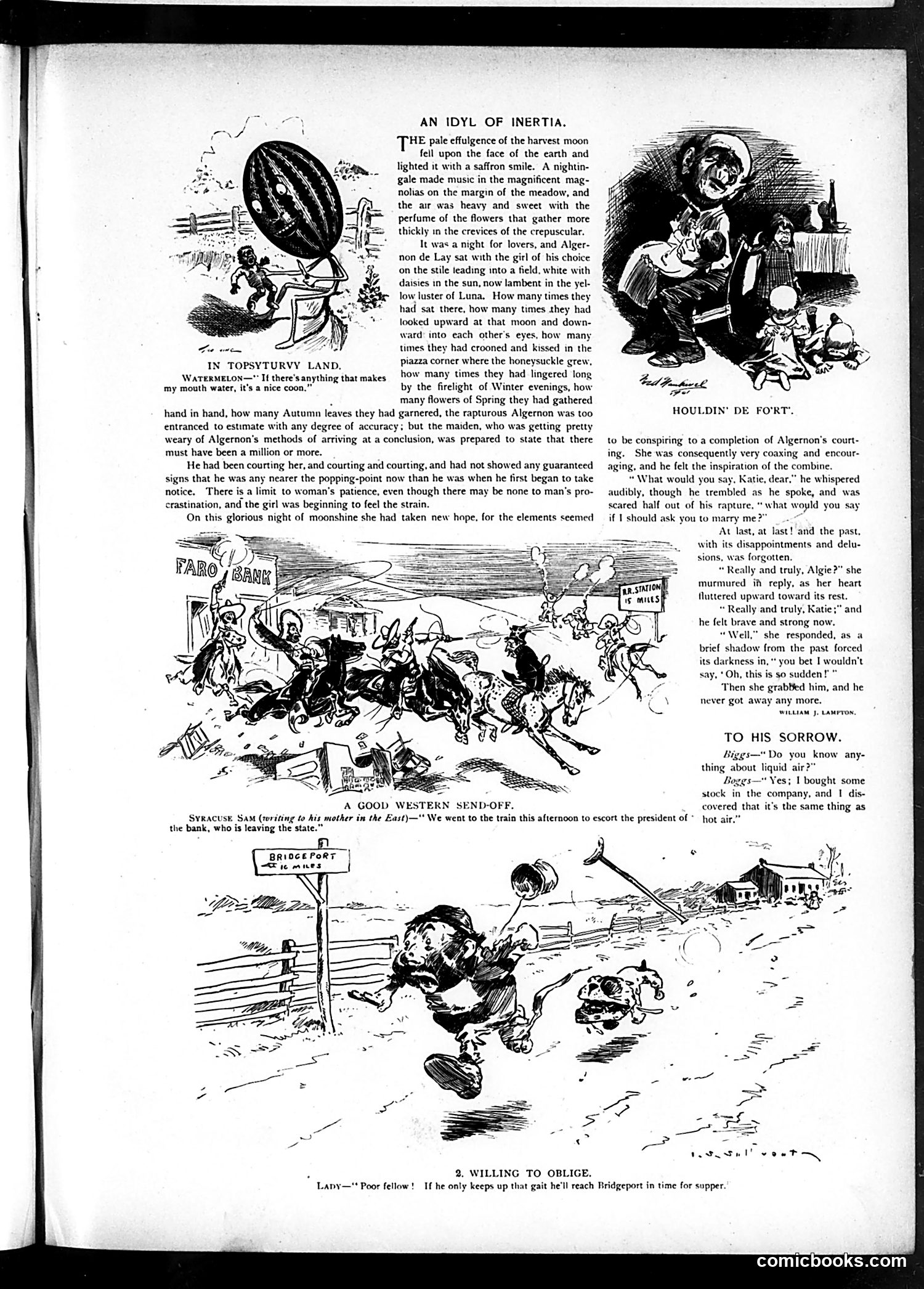
This page contains three distinct satirical pieces: **"An Idyl of Inertia"** mocks a prolonged courtship. Algernon has courted Katie for years with endless romantic gestures but never proposed until finally asking her to marry him. The satire targets male procrastination and indecision in relationships—Katie's exasperation after years of delay is the joke's point. **"In Topsyturvy Land"** appears to be a racial caricature typical of period Judge content, mocking dialect speech. This reflects the magazine's unfortunately common racist humor of the era. **"A Good Western Send-Off"** and **"Willing to Oblige"** are brief visual gags about a man running toward Bridgeport—likely poking fun at either a specific public figure or simply absurd situations. The page primarily showcases Judge's formula: romantic/social satire mixed with visual humor and period racial stereotyping. The main substantive satire critiques male romantic hesitation and the strain it places on women's patience.
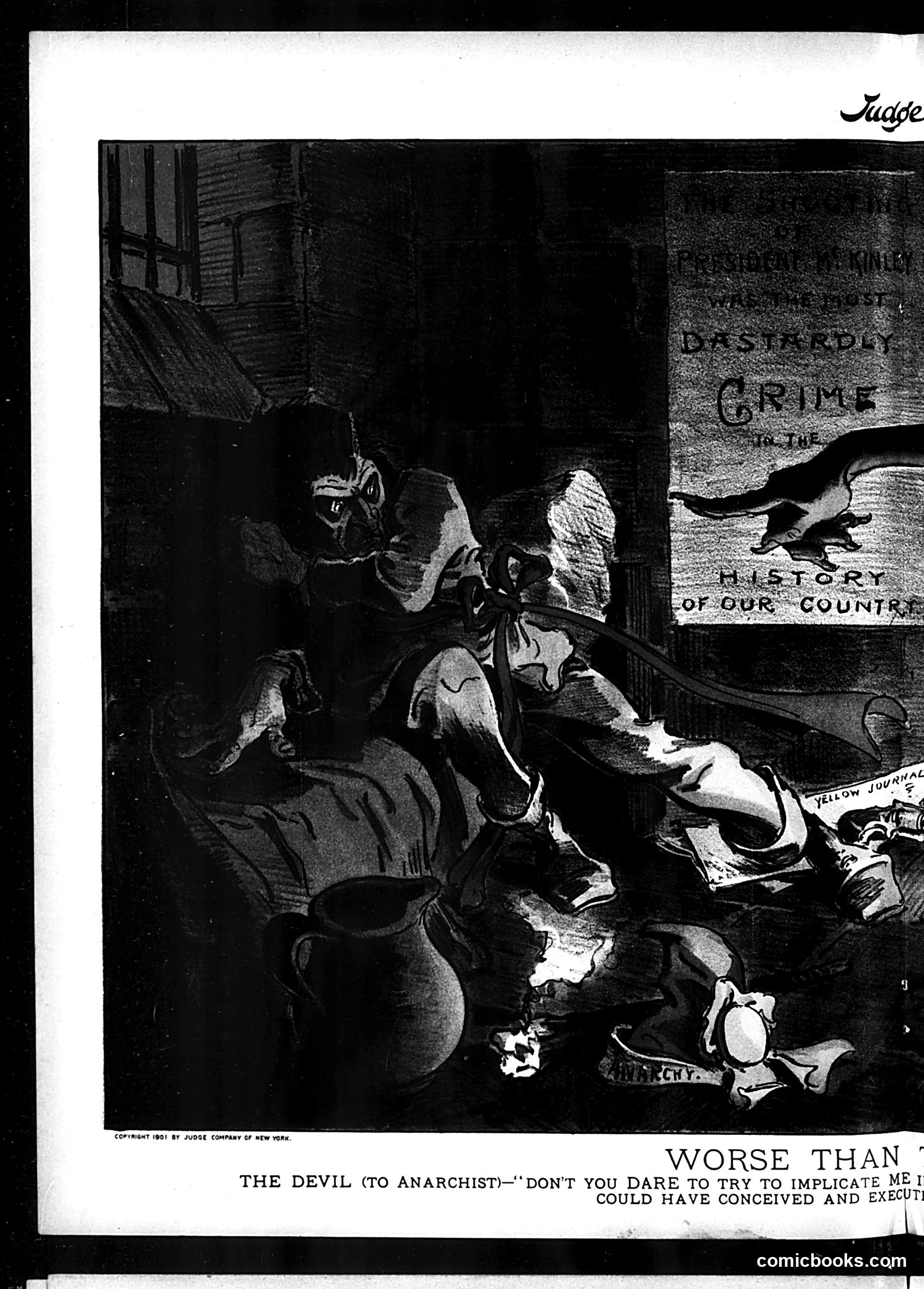
This is a political cartoon from Judge magazine (copyright 1901) satirizing anarchists. The image shows a devil figure confronting an anarchist, with the devil declaring he's "worse than" the anarchist and warning: "Don't you dare try to implicate me!" The cartoon's point appears to be that anarchists—who engaged in violent acts and assassinations around the turn of the 20th century—are so morally depraved that even the devil himself wants to distance himself from them. The scattered objects (books, newspapers) suggest anarchist propaganda and violent planning. This reflects early 1900s American anxiety about anarchism as a violent political movement, particularly following the 1901 assassination of President McKinley by an anarchist. The satire inverts traditional morality: even evil personified rejects association with anarchists as beyond the pale.
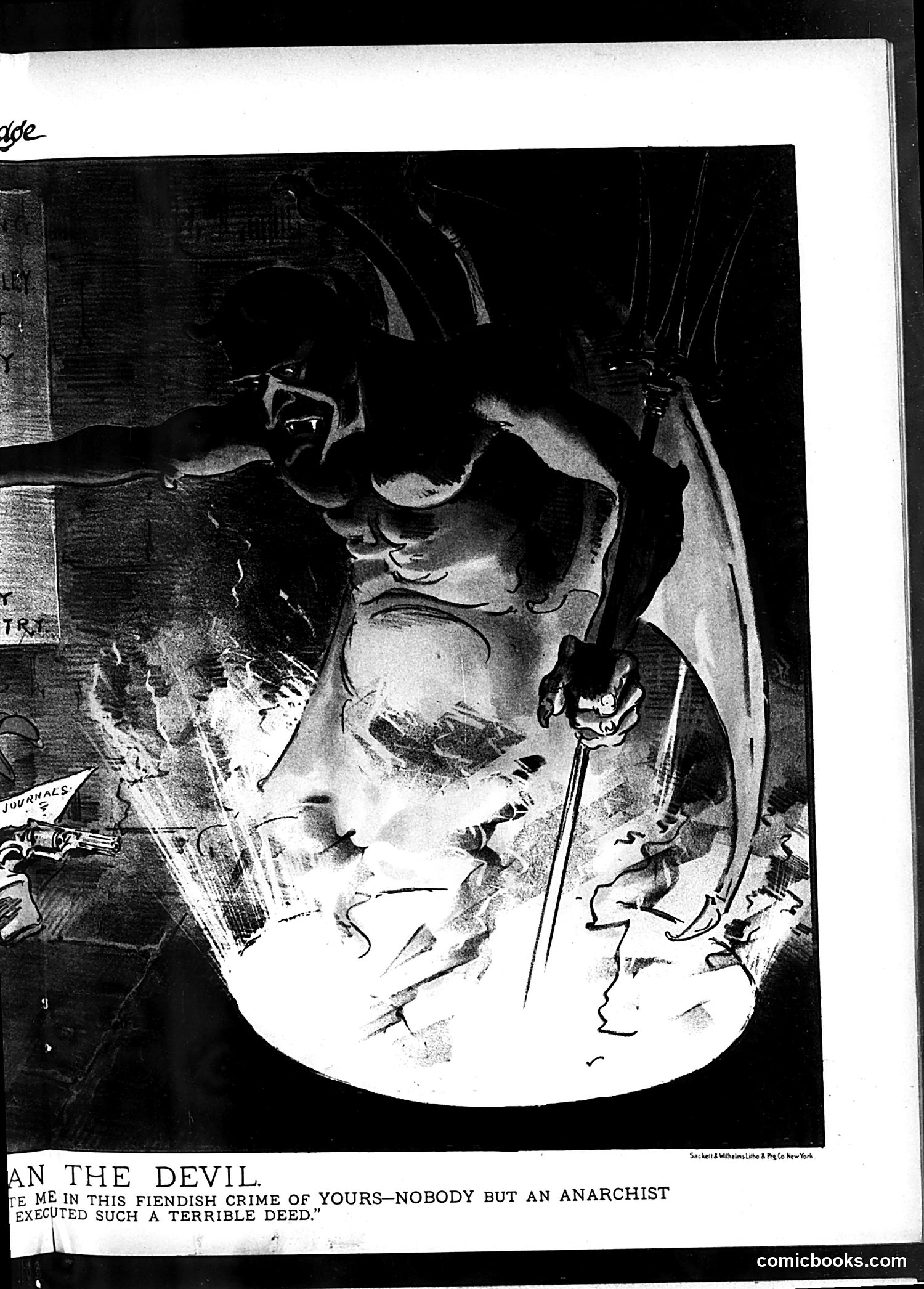
This appears to be a political cartoon from Judge magazine depicting a dialogue between the Devil and another figure. The caption presents the Devil accusing someone of committing "this fiendish crime" and declaring that "nobody but an anarchist executed such a terrible deed." The cartoon likely reflects early 20th-century American anxieties about anarchism as a political threat. During this period, anarchists were blamed for various violent acts and assassinations, making them frequent targets of satirical vilification in publications like Judge. The specific "crime" referenced is unclear from the visible text, but the cartoon's point appears to be a rhetorical condemnation: by having the Devil himself identify the perpetrator as anarchist, the cartoonist emphasizes anarchism's association with evil and violence in contemporary political discourse.
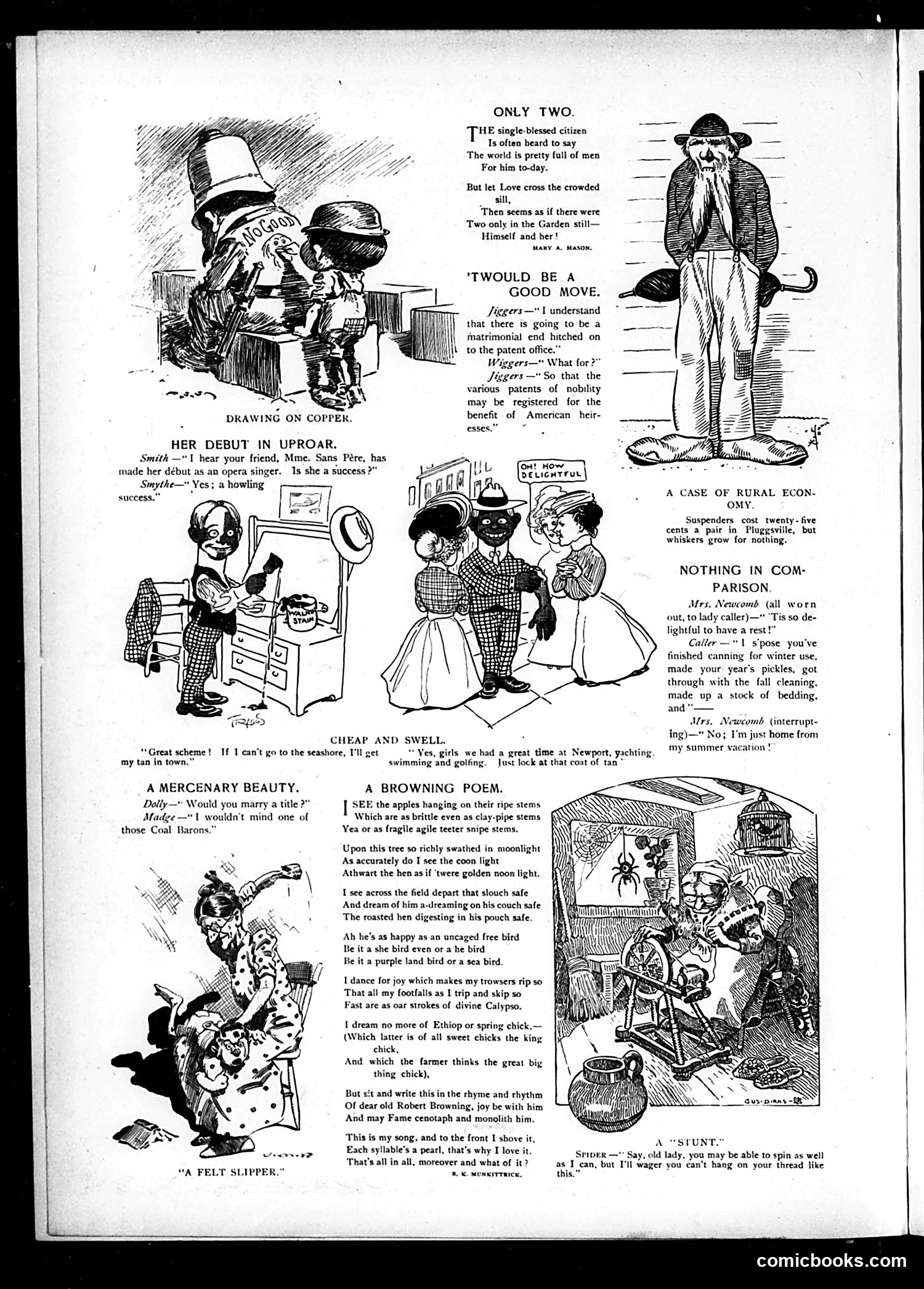
This page contains several satirical pieces targeting late-19th/early-20th-century American society: **"Only Two"** is a sentimental poem about romantic love narrowing one's worldview. **"'Twould Be a Good Move"** satirizes American heiresses marrying foreign nobility for titles. The joke suggests registering "patents of nobility" at the patent office—mocking the transactional nature of these marriages and American fascination with European aristocratic credentials. **"A Mercenary Beauty"** directly targets the same phenomenon: a woman willing to marry a coal baron solely for his title, treating marriage as a financial transaction. **"A Browning Poem"** parodies the obscure, overwrought style of poet Robert Browning, with absurd imagery and forced rhymes—contemporary literary satire poking fun at Browning's notoriously difficult work. The remaining pieces are light domestic humor about rural economy, vacation vanity, and household tasks—typical Judge fare mocking middle-class life and gender roles of the era.
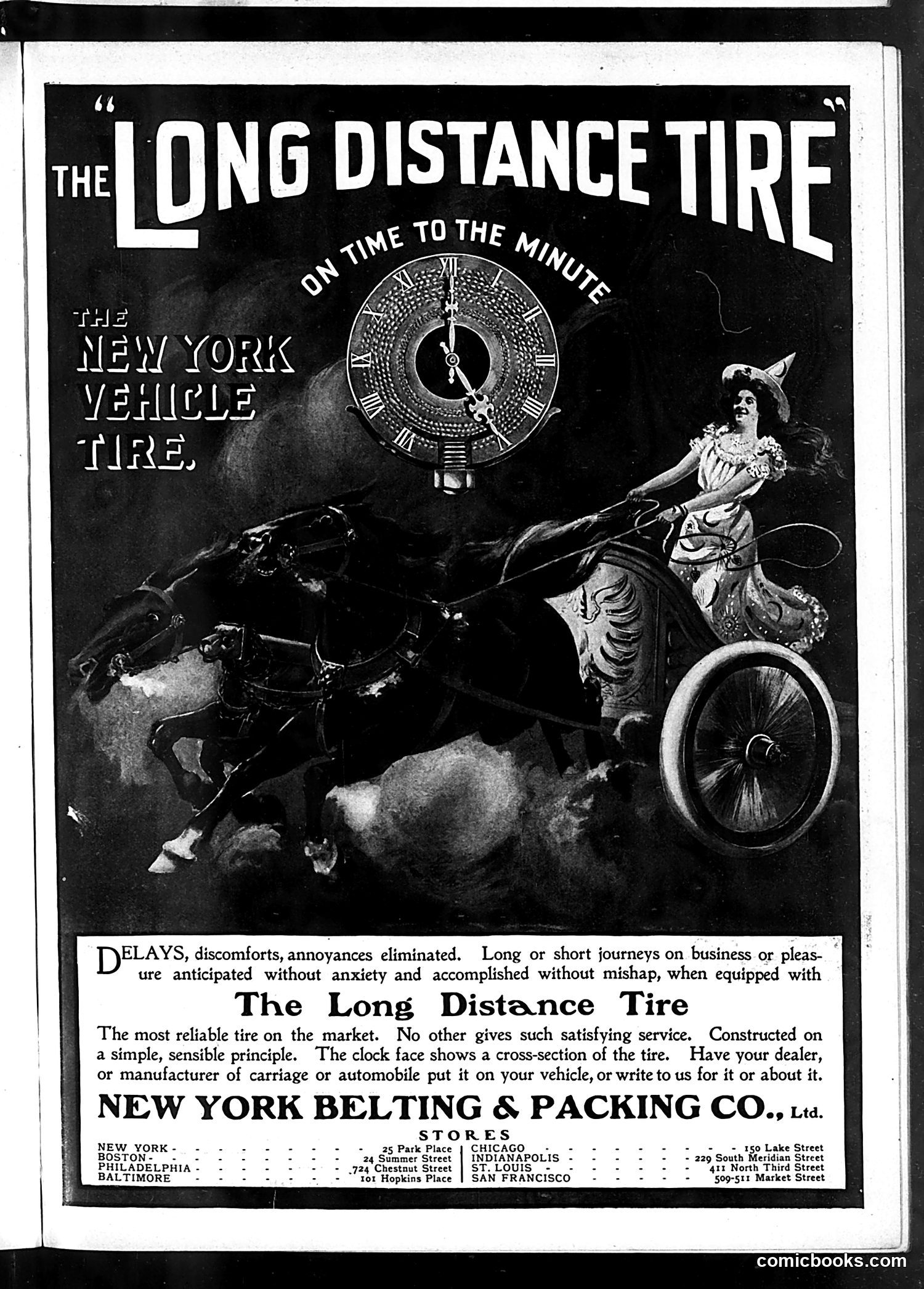
This is primarily **an advertisement**, not political satire. It's a tire company ad from the early automotive era (likely early 1900s based on the horse-drawn carriage imagery). The visual shows a classical female figure (likely representing "Progress" or "Time," referencing the clock above her) driving a chariot pulled by horses, symbolizing reliability and forward momentum. The clock face integrated into the tire's cross-section is the product's key selling point—suggesting the tire's durability and precision engineering. The copy emphasizes that "Long Distance Tires" eliminate travel anxieties by being dependable for both business and pleasure trips. This was a genuine concern in the early automotive age when tire failures were common. The ad lists multiple store locations nationwide, indicating the New York Belting & Packing Co. was a substantial manufacturer. The classical iconography was standard advertising rhetoric of the era, conflating industrial products with timeless ideals of progress and reliability.
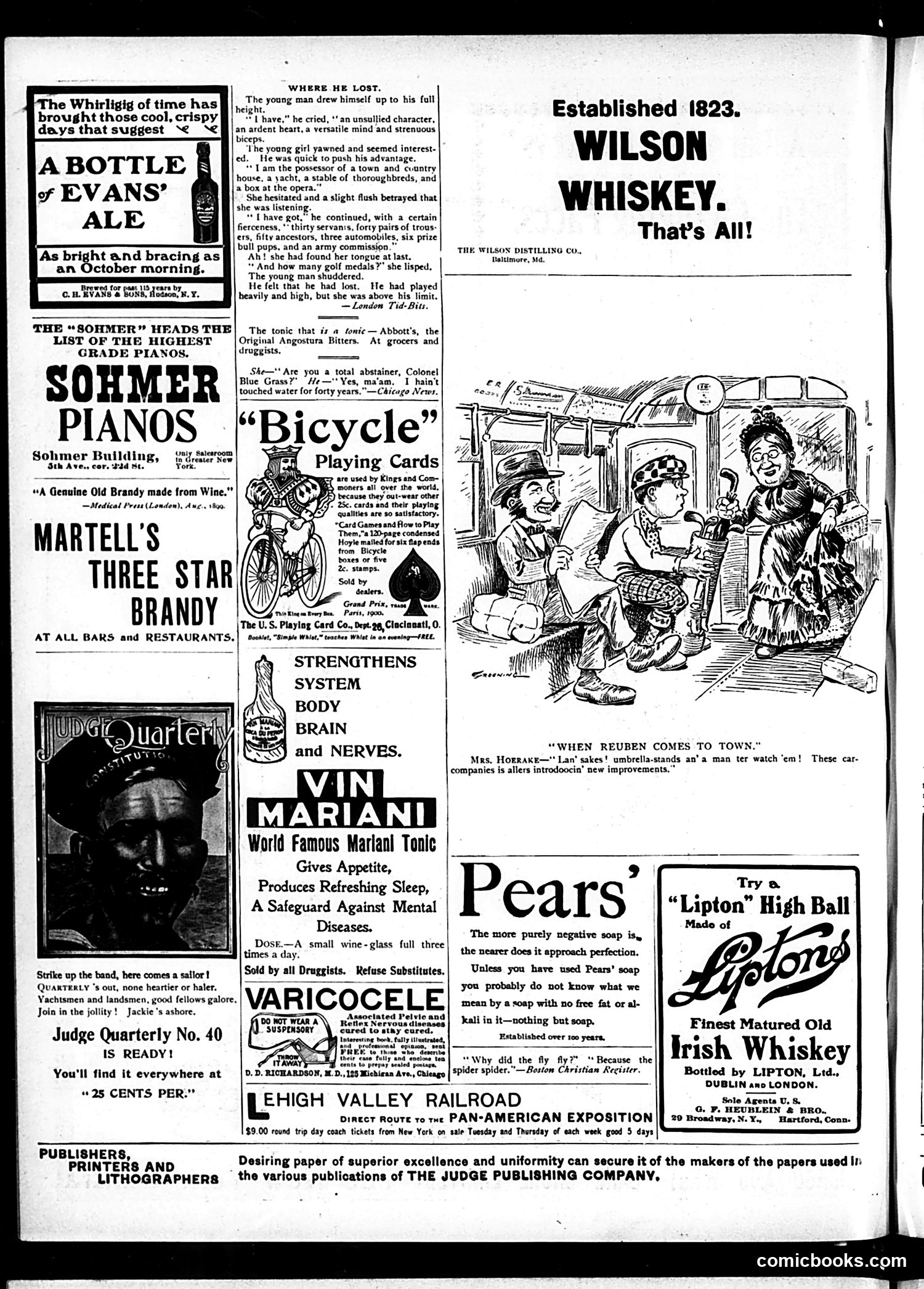
This page is primarily **advertising**, not editorial satire. However, it contains two notable comic items: **"Where He Lost"** (top): A joke about a young man who impresses a woman by listing his wealth—houses, yachts, thoroughbreds, automobiles, servants, ancestors, and military commission. She remains unimpressed until he admits he lacks "golf medals," at which point he realizes she's beyond his reach. The satire targets the idle wealthy class's obsession with golf as the ultimate status symbol—suggesting that in this milieu, athletic achievement matters more than traditional wealth or accomplishment. **"When Reuben Comes to Town"** (center-right): A rural character named Reuben causes such commotion that streetcar companies must install umbrella-stands and hire men to watch them. This mocks both rural "hick" stereotypes and the rapid urbanization/modernization of cities, portraying country visitors as disruptive forces requiring special infrastructure. The rest of the page comprises period advertisements for whiskey, brandy, pianos, playing cards, and patent medicines—typical of Judge's revenue model.
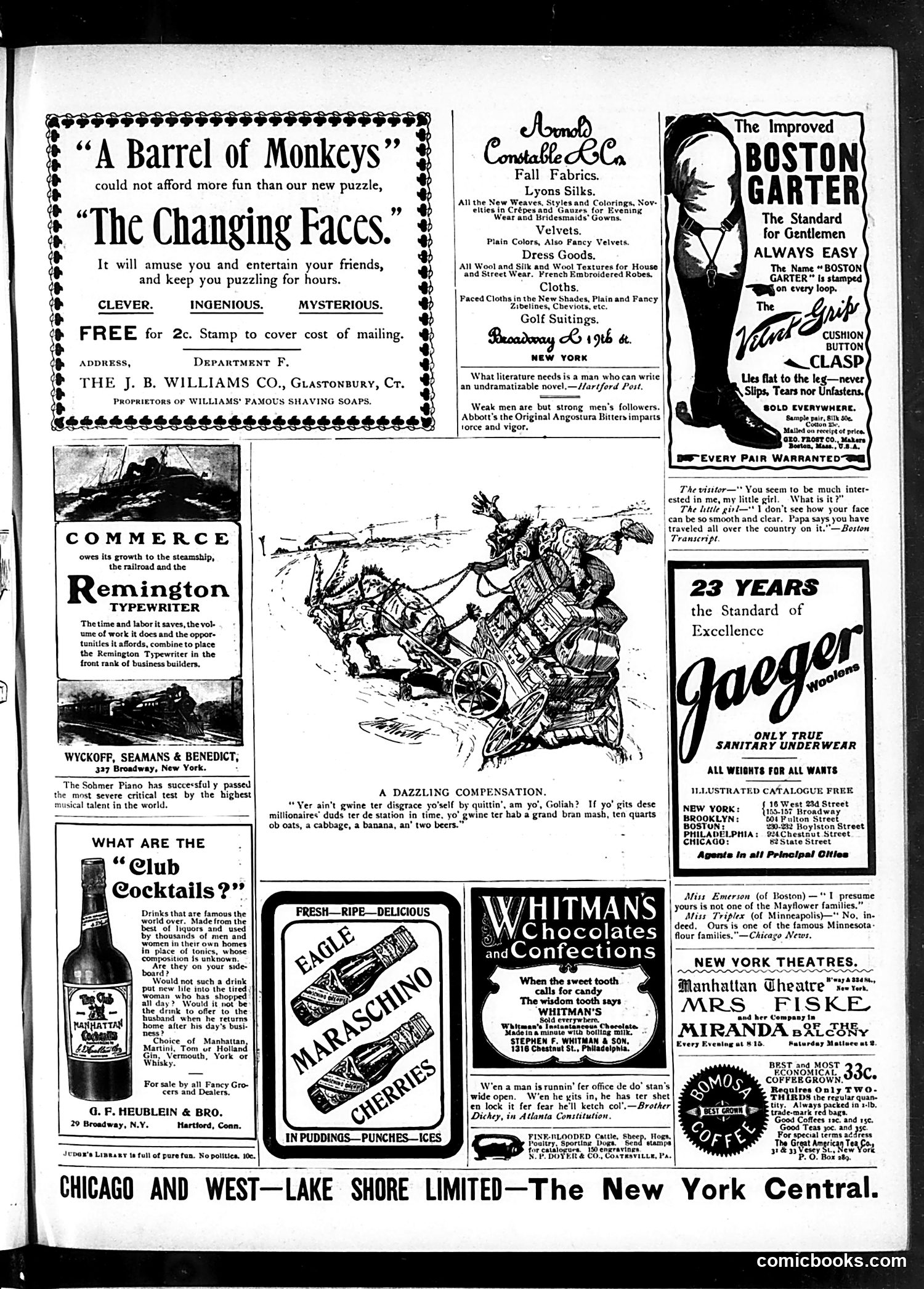
This is primarily an **advertising page** from Judge magazine, not a satirical commentary. The main content consists of vintage advertisements for products like typewriters, chocolates, garters, and underwear. However, there are a few **humorous anecdotes** embedded: 1. **"A Dazzling Compensation"**: A dialect joke about a Black man named Goliah being promised grand food if he helps millionaires at the train station—reflecting the era's racist humor. 2. **Two society jokes** about Boston and Minneapolis families competing over social prestige, and a child's innocent observation about an adult's smooth face from traveling. 3. **A political quip** about politicians keeping office doors open while campaigning but closing them once elected—mild commentary on political hypocrisy. These jokes reflect early 20th-century American attitudes: casual racism, class consciousness, and cynicism about politics. The ads dominate, making this primarily a commercial rather than editorial page.
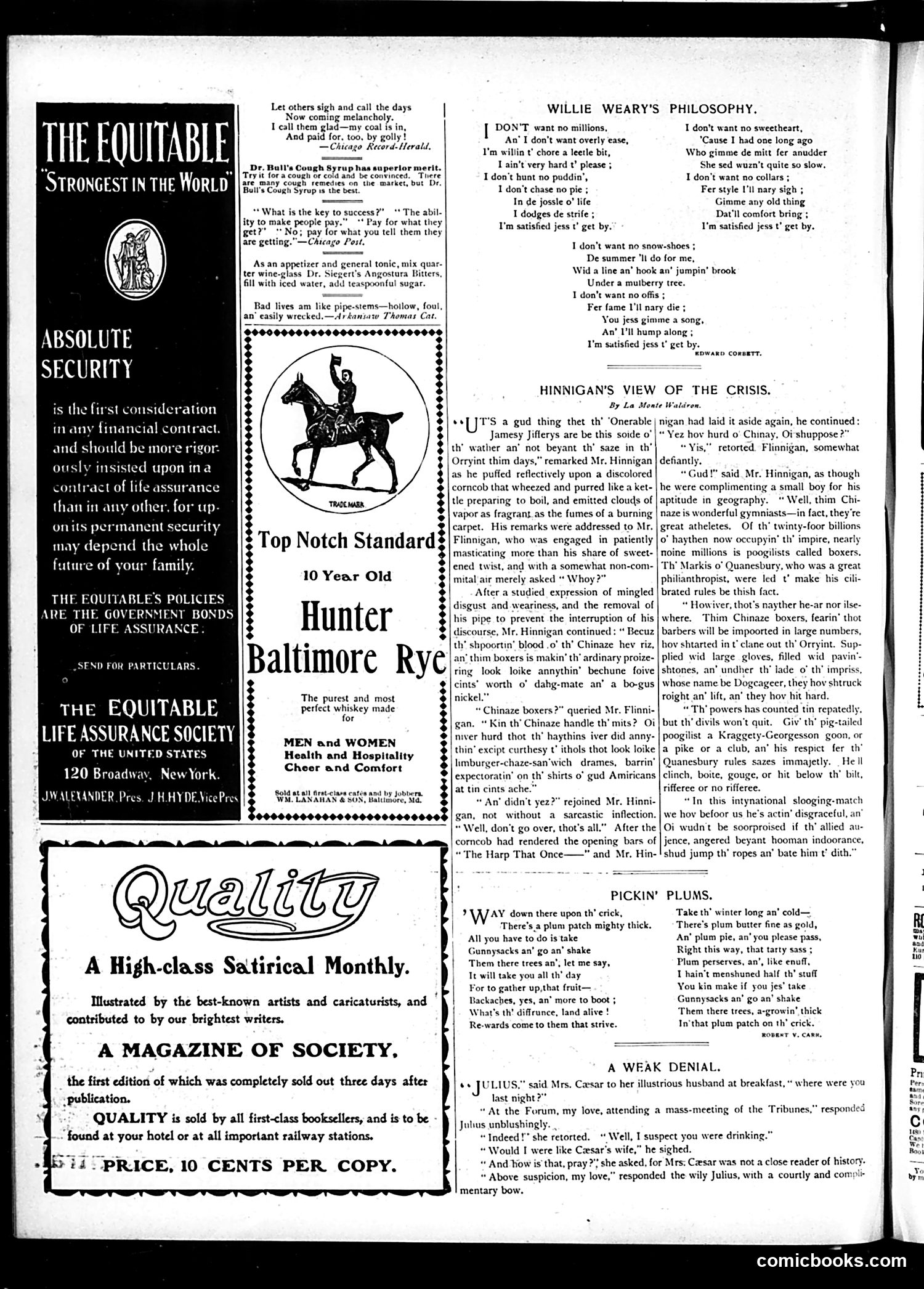
This page is primarily **advertising and filler content** rather than political cartooning. However, it includes two notable satirical pieces: **"Willie Weary's Philosophy"** presents working-class resignation to poverty—a character content to "dodge de strife" and "get by" with minimal expectations. This likely satirizes either laboring-class fatalism or critiques societal indifference to workers' hardship. **"Hinnigan's View of the Crisis"** features Irish-accented dialogue discussing Chinese boxers, likely referencing the **Boxer Rebellion** (1900) or its aftermath. Hinnigan expresses relief that Chinese fighters are "on this side" of the ocean rather than in the Orient, suggesting contemporary anxiety about Eastern conflict and immigration. The heavy dialect and casual racism reflect period attitudes. The page is otherwise dominated by **life insurance and whiskey advertisements**—typical of Judge's business model. The cartoon of a mounted soldier (labeled "Trooper") appears decorative rather than satirically pointed.
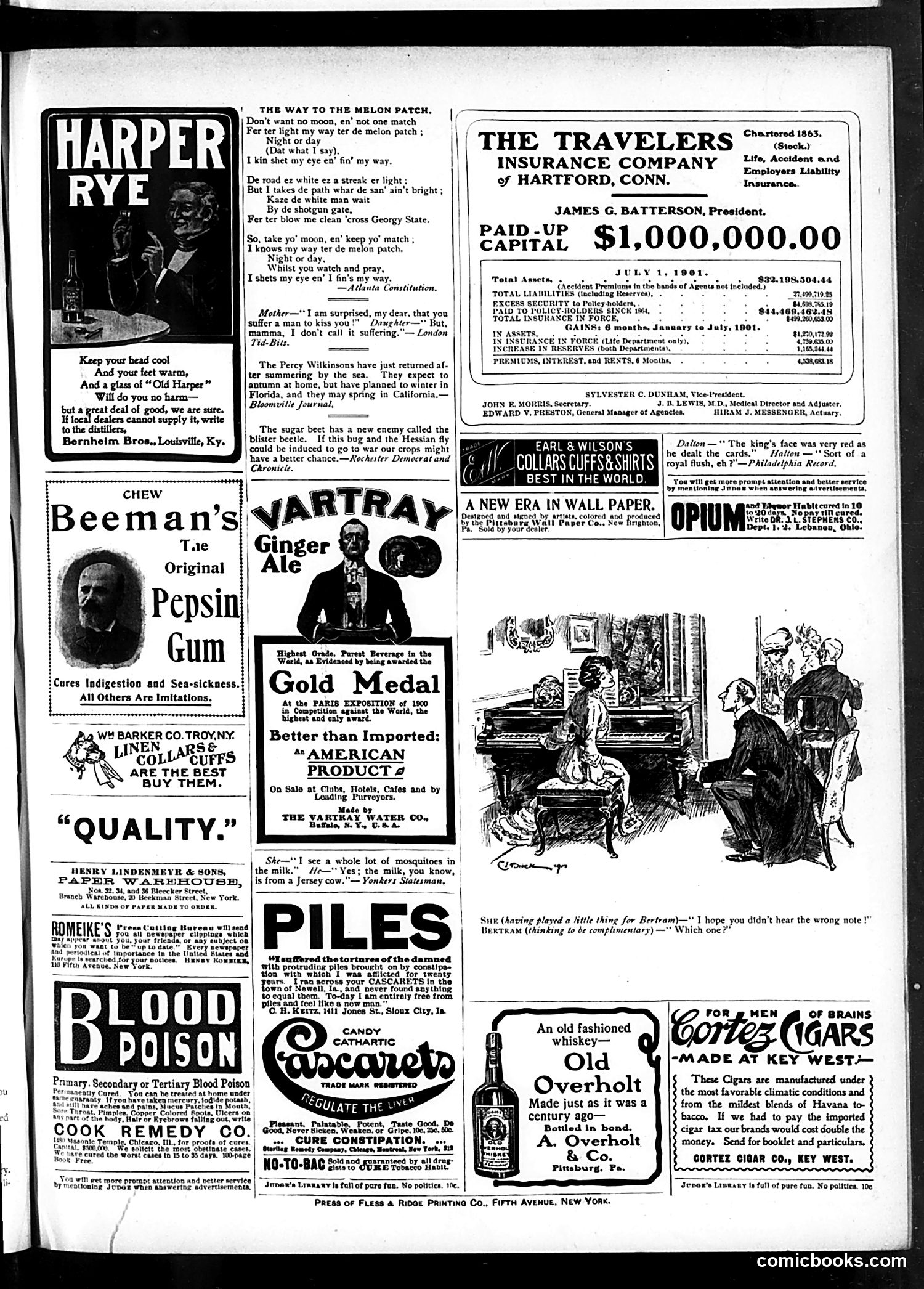
This page is primarily **advertising**, with one significant satirical cartoon at the top titled "The Way to the Melon Patch." ## The Main Cartoon The poem depicts an African American man planning to steal watermelons at night, navigating by starlight to avoid detection by white sentries ("the white man wait / By the shotgun gate"). The racist caricature and dialect perpetuate harmful stereotypes portraying Black people as watermelon thieves—a deeply dehumanizing trope used to justify violence and discrimination. The "satire" appears directed at the subject himself rather than at racism; Judge presents this as humor for white readers rather than social criticism. This reflects the magazine's casual racism typical of early 1900s American publications. ## Remaining Content The page features advertisements for patent medicines (Pepsin Gum, blood poison cures), liquor, cigars, and insurance. A small dialogue joke about milk from a Jersey cow appears near the bottom. These ads were standard Judge content, offering little substantive commentary.
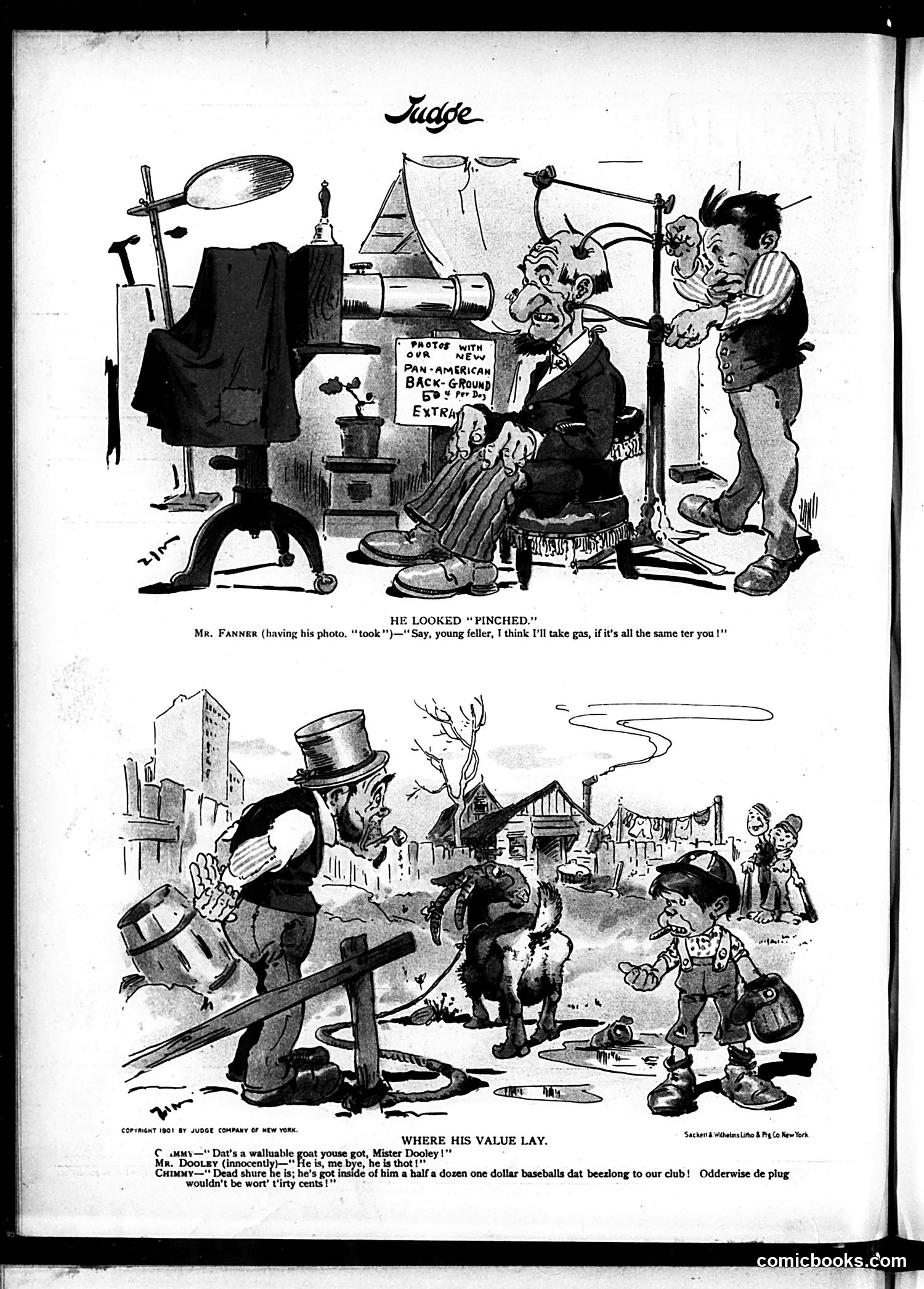
**Top cartoon ("He Looked Pinched"):** A photographer is about to take Mr. Fanner's portrait in a studio setting. Fanner, looking uncomfortable, jokes that he'd prefer laughing gas (anesthesia used in dentistry) to endure the photo session. The satire mocks the unpleasant experience of early portrait photography—the stiff poses, long exposures, and discomfort involved. **Bottom cartoon ("Where His Value Lay"):** Two characters (appearing to be Irish immigrants, suggested by dialect) discuss a goat. One reveals the goat's actual "value" isn't the animal itself but the baseballs hidden inside it—apparently stolen property belonging to their baseball club. The joke satirizes petty theft and the irony that the goat is only worth thirty cents without its contraband contents. The Irish dialect and setting suggest satire about immigrant communities and urban crime.