
A complete issue · 16 pages · 1901
Judge — August 24, 1901
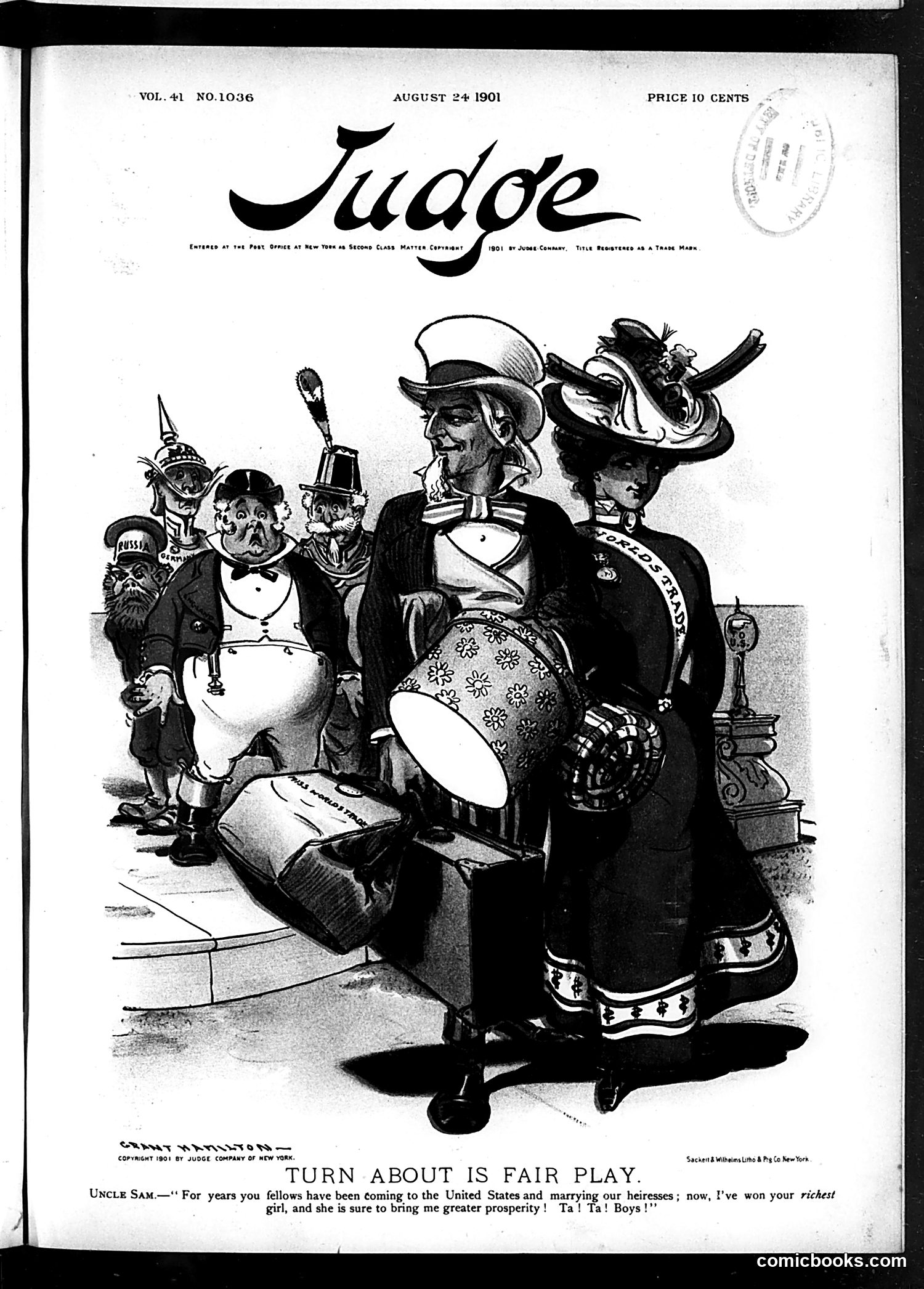
This cartoon satirizes American imperialism and wealth extraction. Uncle Sam—the bearded figure in the center—boasts that European suitors have long pursued American heiresses for their money. Now, he claims, he's reversed the tables by winning a European heiress himself, expecting her to bring "greater prosperity" to America. The caricatured European figures (likely representing various nations, suggested by the Prussian military costume visible) appear as scheming suitors. The satire suggests American anxieties about foreign gold-diggers while simultaneously mocking Uncle Sam's own imperial ambitions—the notion that marrying European wealth represents American conquest parallels actual American expansion abroad during this 1901 period.
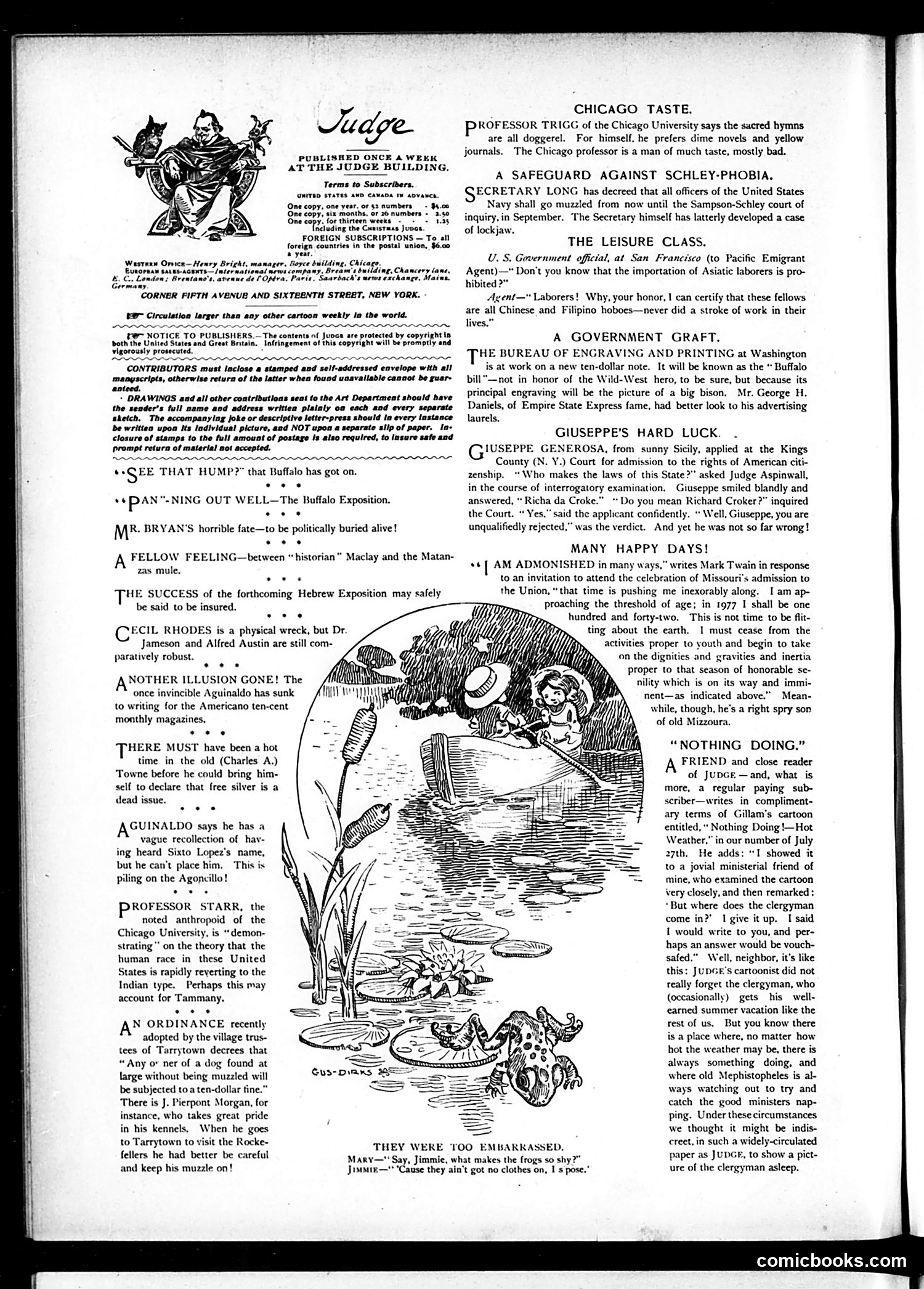
The main cartoon depicts frogs in a pond, illustrating the caption "They Croak All Week — Say, Jimmie, what makes the frogs so shy? / Jimmie — 'Cause they ain't got no clothes on, I s'pose.'" This is a simple visual pun playing on the double meaning of "croak" (frog sounds versus complaining) and suggesting the frogs' shyness relates to their lack of clothing. It's gentle humor rather than political satire. The surrounding text includes brief satirical "Judge" commentary on various topics: religious exposition, government currency design, and immigration. One piece mocks a government official's misunderstanding of citizenship law. The humor is topical but relatively lighthearted, typical of Judge magazine's mixed approach to social commentary and wordplay.
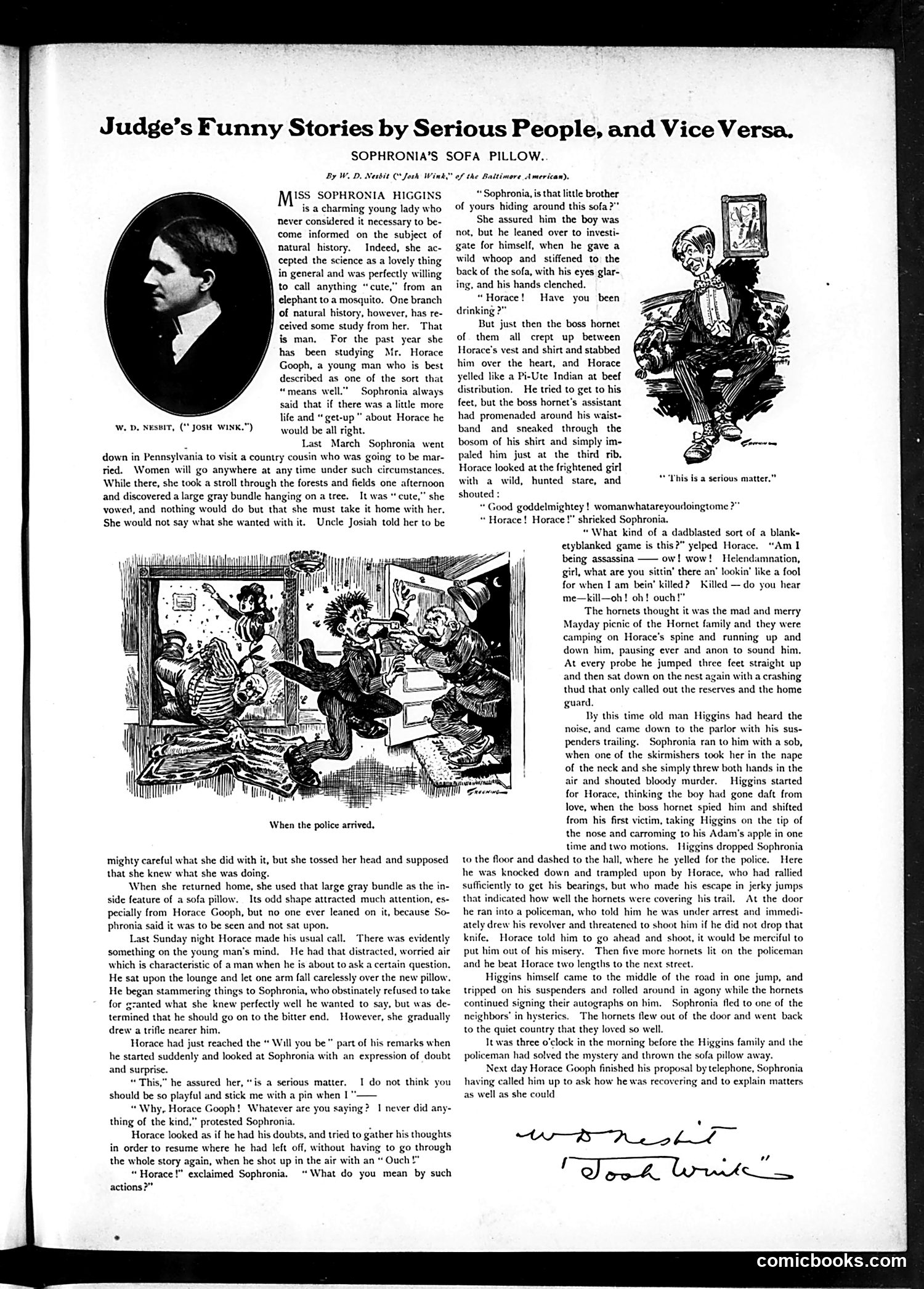
This humorous story by W.D. Nesbit satirizes a sheltered young woman named Sophronia Higgins who considers herself well-educated in natural history. When visiting the countryside, she encounters a young man named Horace Gooph and impulsively takes him on a romantic outing. The joke centers on Sophronia's naive misidentification: she mistakes the sounds and behavior of horses for something sinister, leading to comic chaos. Horace and the horses create havoc—jumping on Sophronia, causing general mayhem—which she interprets as dangerous criminal activity. The satire mocks upper-class pretension and incomplete education: Sophronia's book-learning hasn't equipped her to recognize actual animals. The story's humor derives from her "serious" interpretation of absurd rural mishaps.
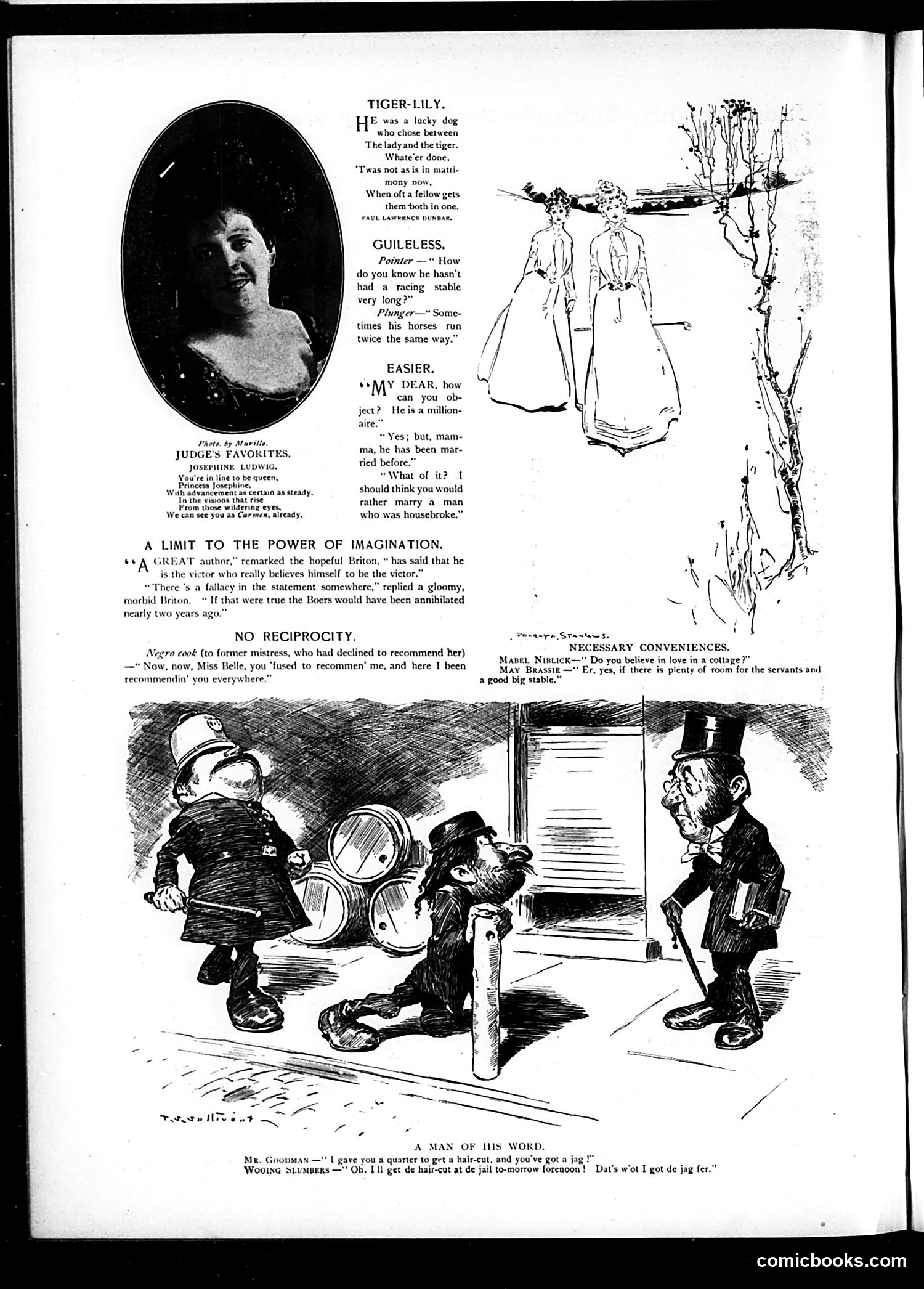
This page contains several brief satirical items and jokes typical of Judge's format: **"Tiger-Lily"** and **"Guiltless"** are short humor pieces about romantic/marital situations—common Judge content about courtship and marriage. **"A Limit to the Power of Imagination"** mocks an unnamed "hopeful Briton" who believed he could become a victor through imagination alone, only to be reminded that facts contradict such delusion. This appears to satirize optimistic British attitudes, likely toward a specific (now-unclear) political or military matter. **"No Reciprocity"** jokes about a former mistress's refusal to recommend someone she previously promoted. **"Necessary Conveniences"** is a brief domestic joke about servant quarters. The bottom cartoon depicts two mustachioed men exchanging barrels, with dialogue about a quarter given for a haircut and subsequent jail time—a joke about petty crime or misunderstanding. The specific historical references are unclear without additional context.
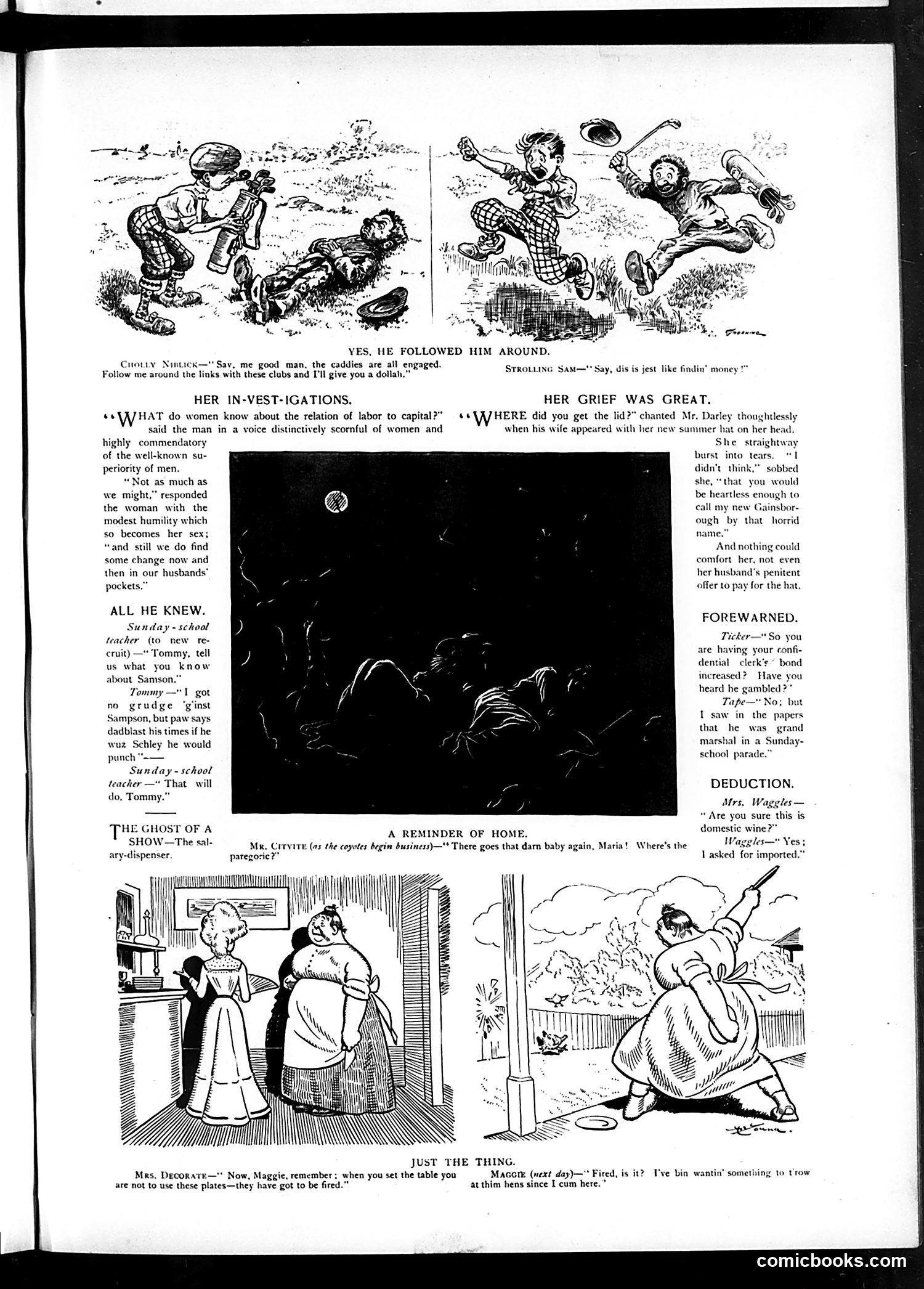
This page contains six unrelated comic sketches typical of Judge's satirical humor, targeting gender roles, class dynamics, and domestic life around the early 1900s. **"Her In-Vest-igations"** mocks women's supposed ignorance of economics by having a woman smugly reveal she understands labor and capital through finding loose change in her husband's pockets—implying wives are only interested in petty theft from their spouses. **"Her Grief Was Great"** jokes about vanity: a husband insults his wife's expensive new hat by calling it by an unflattering name (likely referencing a painting style), causing her emotional devastation. **"All He Knew"** satirizes both Sunday-school education and possibly the Spanish-American War figure Admiral Schley, with a child conflating biblical strength with naval violence. The remaining sketches use similar domestic humor: wives deceiving husbands about wine, servants misunderstanding instructions, and workers finding unexpected uses for broken items. The overall tone reflects period attitudes toward women's intelligence and class hierarchies.
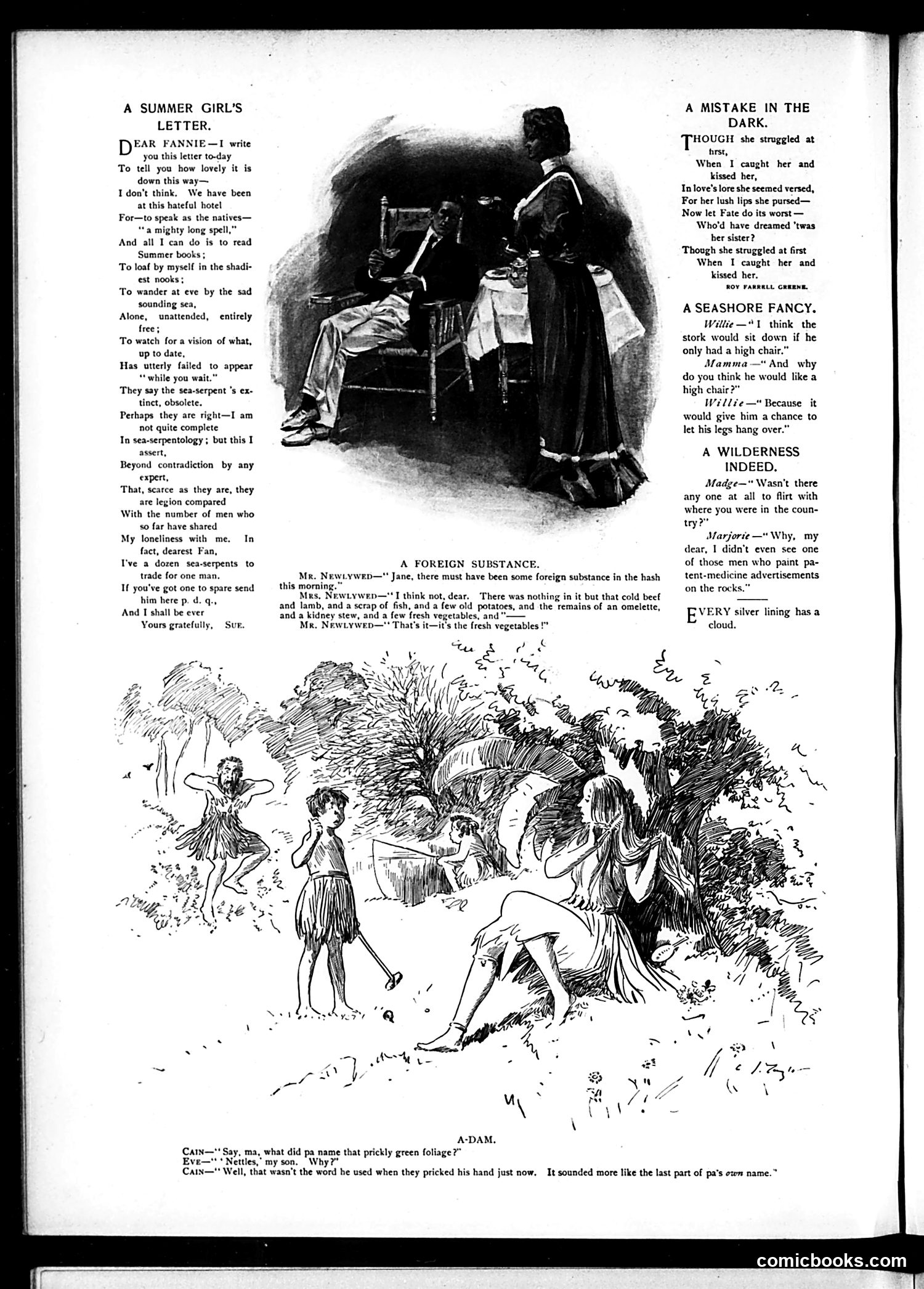
This page contains several short humorous pieces typical of early 20th-century American satire: **"A Summer Girl's Letter"** satirizes the romantic disappointments of a young woman vacationing at a seaside hotel. She complains of boredom and the absence of eligible men—she'd trade "a dozen sea-serpents for one man." The joke targets the gap between summer resort fantasies and dull reality. **"A Foreign Substance"** plays on a newlywed wife's cooking. When Mr. Newlywed complains of something odd in the hash, she lists increasingly questionable ingredients (old potatoes, kidney stew). His conclusion that "fresh vegetables" are the problem mocks both her cooking and his desperation to be polite. **"A-DAM"** makes a pun: a child asks his father what he calls "prickly green foliage," and when told "nettles," observes the father used different language when pricked—implying a stronger curse word. **"A Mistake in the Dark"** describes a man who kissed a woman in darkness, only to discover he'd kissed her sister instead—playing on mistaken-identity comedy. The remaining pieces are brief observational humor about children and disappointment.
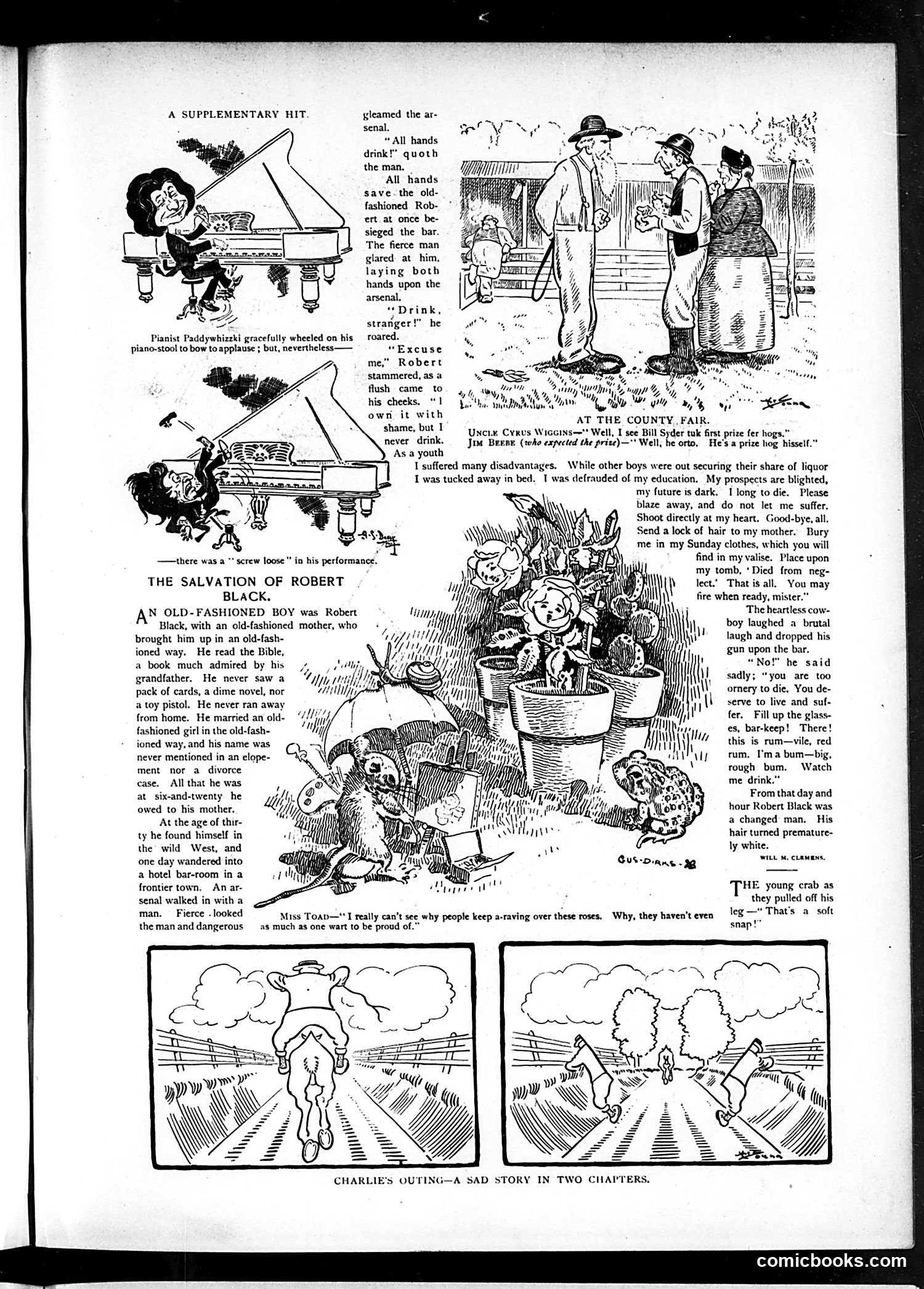
This page contains multiple satirical pieces typical of late 19th-century Judge magazine: **"Supplementary Hit"** mocks pianist Paddy Whizzski, a caricatured ethnic figure whose performance has a "screw loose"—a pun on both mechanical failure and mental instability. **"The Salvation of Robert Black"** satirizes temperance advocates. Robert, raised by an old-fashioned, pious mother and never drinking, represents the temperance ideal. When confronted by a drunken gunman in a frontier bar demanding he drink, Robert's pathetic speech about his ruined youth backfires: instead of shooting him, the gunman is so disgusted by Robert's weakness that he forces liquor upon him. Robert then becomes a drunkard. The joke: temperance produces such pathetic, contemptible men that even outlaws reject them, and paradoxically, Robert only becomes a "man" through drinking. **Additional sketches** include county-fair humor and a crab joke. The satire targets 1880s-90s temperance movements, suggesting their moral framework produces inadequate men unfit for real life.
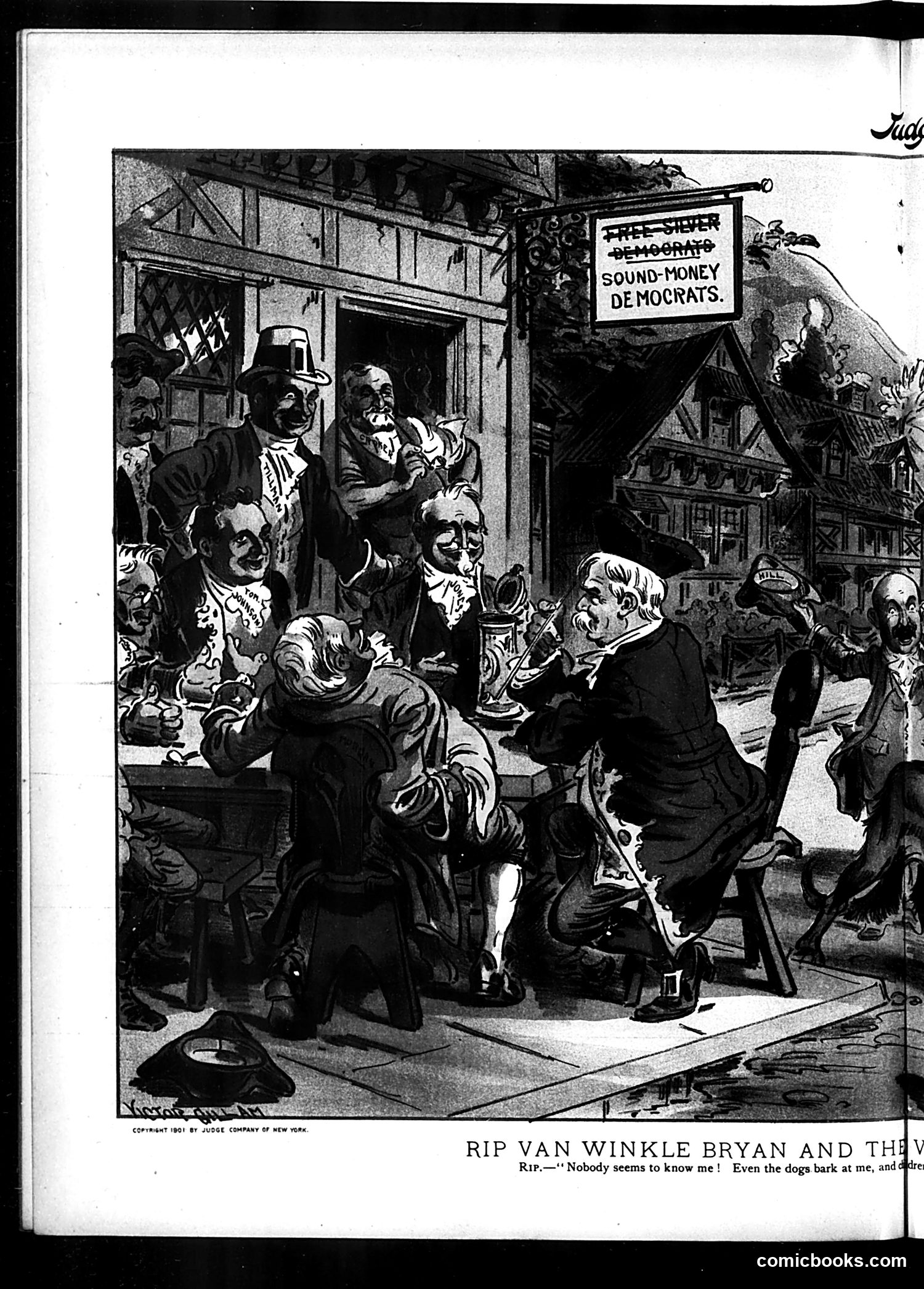
This is political satire mocking William Jennings Bryan, the three-time Democratic presidential candidate. The cartoon references Washington Irving's "Rip Van Winkle"—the man who slept for years and awoke as an outsider in his own world. The joke: Bryan is depicted as Rip Van Winkle, suggesting he's become irrelevant and forgotten, even by common people ("the dogs bark at me"). The storefront sign advertising "Sound-Money Democrats" indicates this cartoon supports the gold standard (conservative economics), opposing Bryan's famous advocacy for "free silver" currency. The exaggerated caricatured faces reflect Judge magazine's characteristic style. This likely dates from the early 1900s when Bryan's political influence was waning after repeated electoral defeats, making him a figure of ridicule to establishment publications favoring traditional monetary policy.
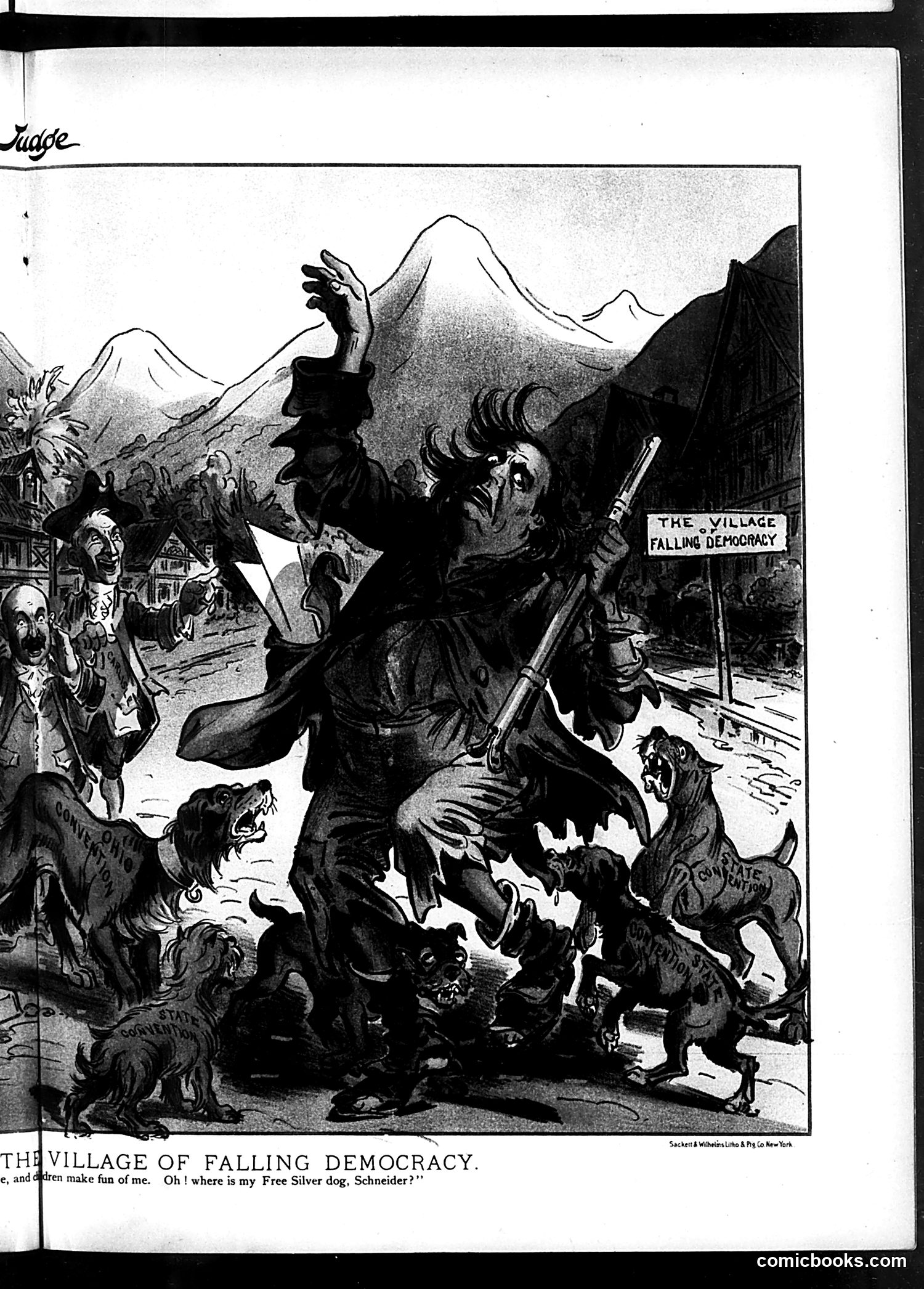
This political cartoon depicts a chaotic scene where a central figure (appearing distressed, with raised arms) stands amid a pack of snarling dogs labeled with what appear to be political forces or parties attacking democratic institutions. The mountains in the background suggest a pastoral "village" setting now under siege. The dialogue references "Free Silver" and "Schneider," likely alluding to 1890s American political debates—Free Silver was a major populist/Democratic issue of that era. The cartoon satirizes how democracy is being undermined by competing political forces (represented as vicious dogs) tearing apart civic order. The figure's despair suggests the cartoonist viewed contemporary politics as destructive to democratic governance itself.
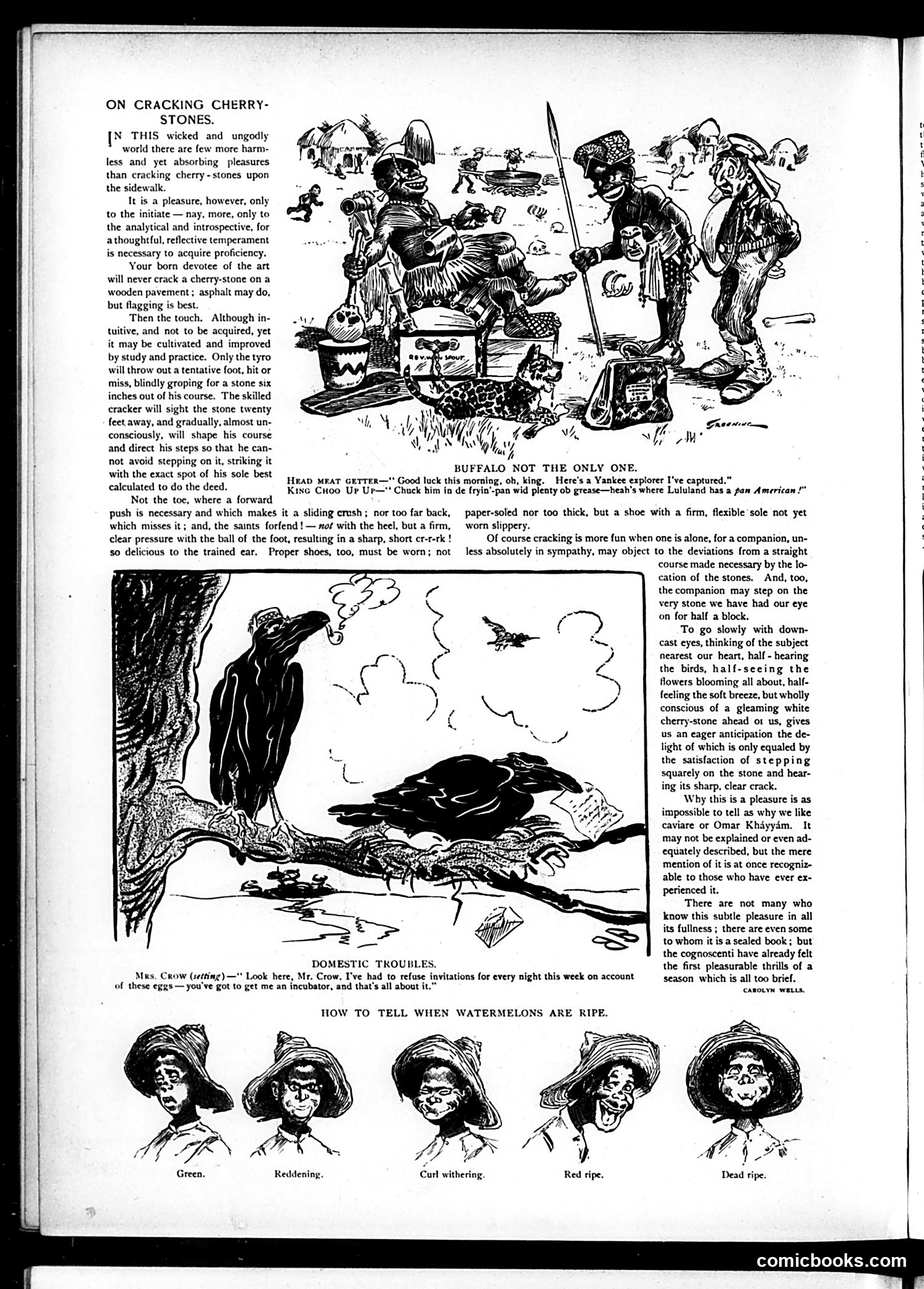
This Judge magazine page contains three distinct pieces: **"On Cracking Cherry-Stones"** is a humorous essay by Carolyn Wells celebrating an apparently trivial childhood pleasure—deliberately stepping on cherry pits to crack them. The piece satirizes overwrought literary analysis by treating this mundane act with absurdly serious, philosophical language, mocking the tendency to romanticize simple experiences. **"Buffalo Not the Only One"** features a racist cartoon depicting a African or Pacific Islander king planning to cook a captured "Yankee explorer." The joke plays on cannibalism stereotypes while also suggesting Americans themselves are violent ("Lululand has a fan American"), conflating colonizers with the colonized—a darkly ironic commentary on American imperialism, though expressed through deeply offensive racial caricature. **"Domestic Troubles"** and the watermelon ripeness guide are animal comics: Mrs. Crow demands an incubator for her eggs, and a visual guide mocks racial stereotypes about African Americans and watermelons. The page reflects Judge's typical early-20th-century mix of gentle satire and crude racial humor—attitudes now recognized as offensive.
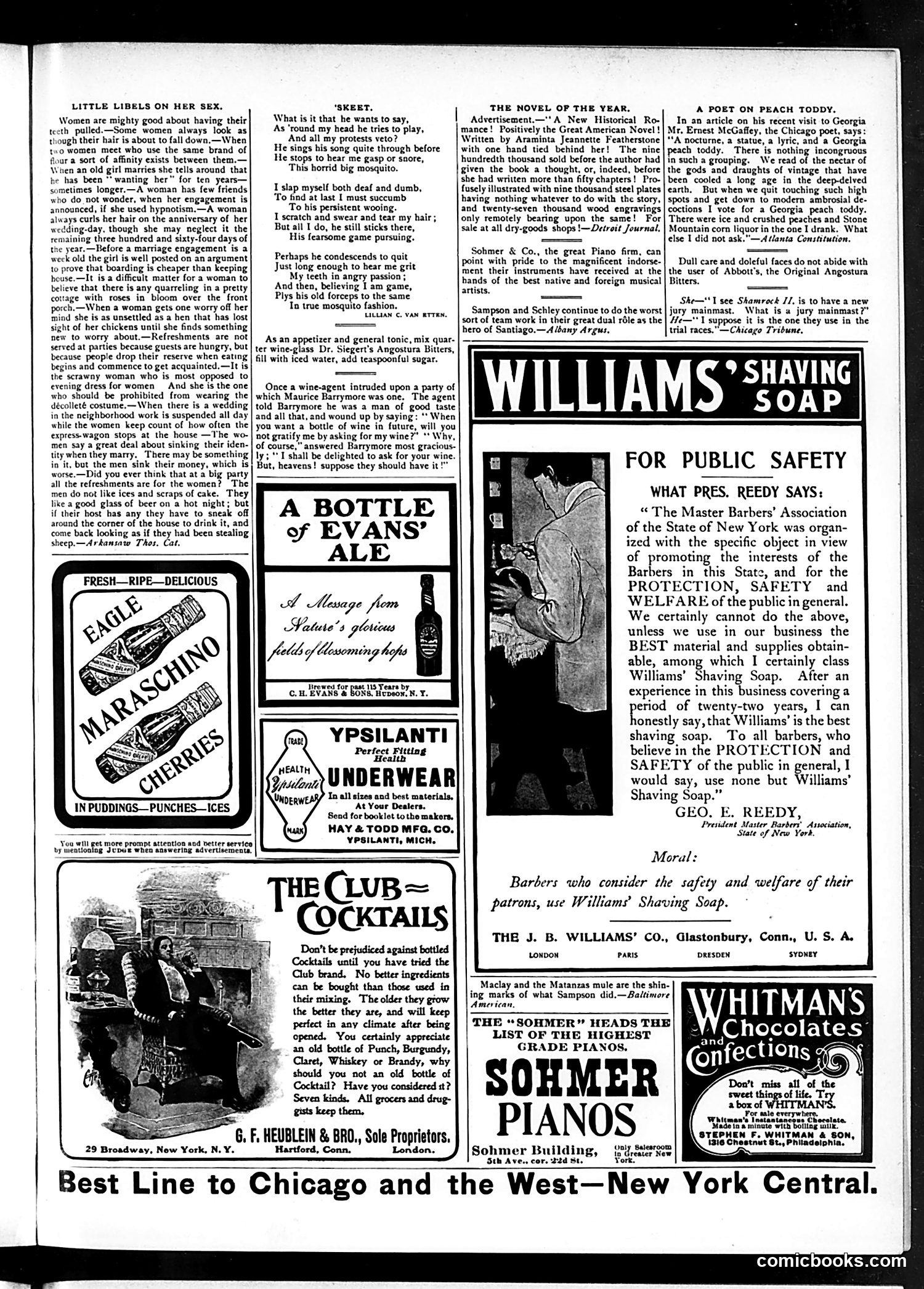
This page from *Judge* magazine is primarily **advertising and satirical commentary**, not political cartoons. The main content includes: **"Little Libels on Her Sex"** — A column of misogynistic quips stereotyping women's behavior (vanity, frivolousness, mercenary marriage attitudes). This reflects early 20th-century attitudes treating women as comedic targets. **"Skeet"** — A humorous poem about a mosquito pestering the narrator, using the insect as a metaphor for an unwelcome suitor who won't take hints. **The Barrymore anecdote** — A joke about a wine salesman's persistence, echoing the mosquito theme of unwanted intrusiveness. **Advertisements dominate the page**, hawking beverages (Eagle Maraschino, Evans' Ale), shaving soap, pianos, and chocolates—representing consumer culture of the era. The Williams' Shaving Soap ad includes an endorsement from the Master Barbers' Association president, emphasizing "safety" and "protection"—possibly referencing safety razors as new technology. This is primarily a **commercial publication**, not a political commentary page.
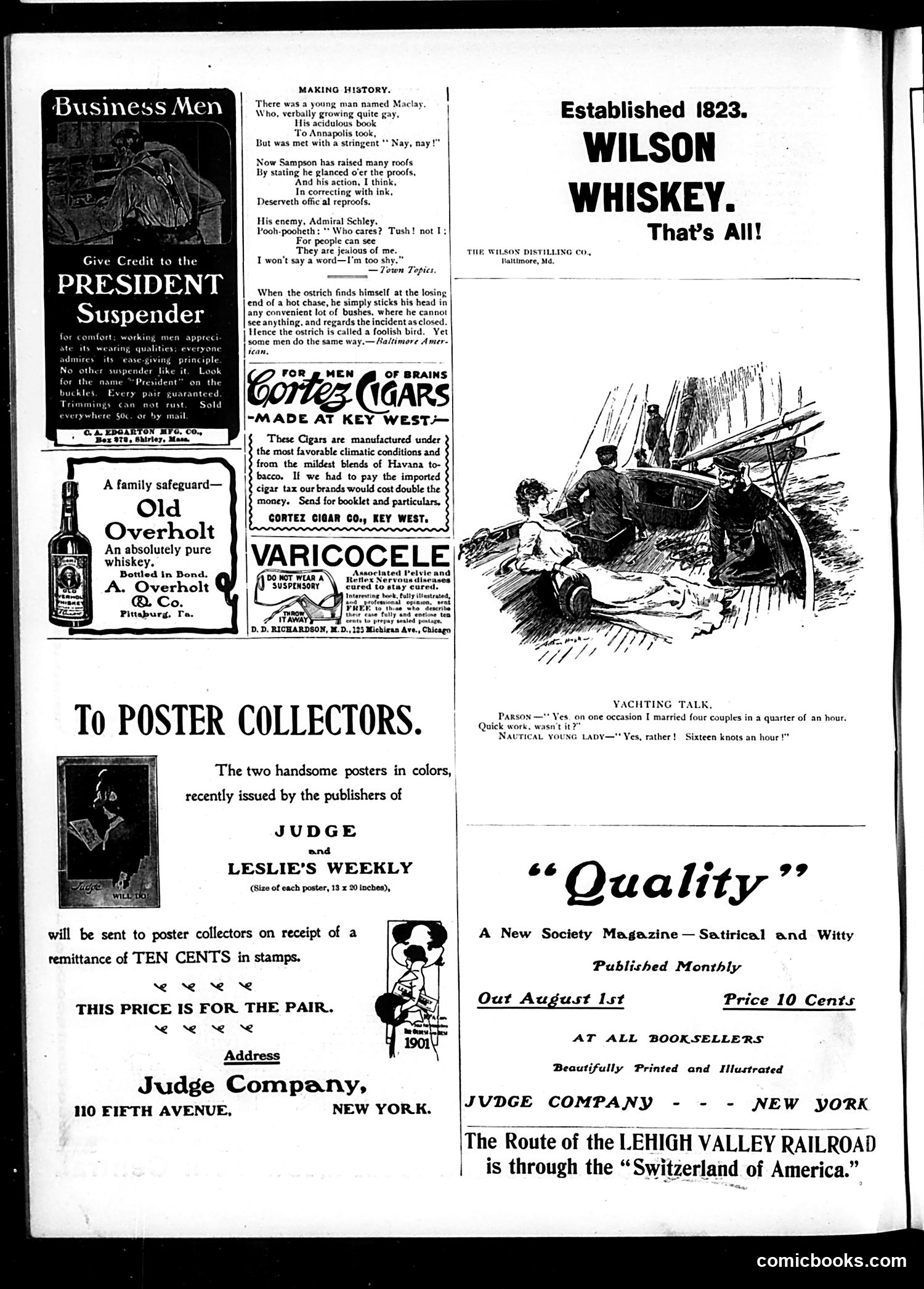
This page primarily contains **advertising and a brief political cartoon** about an early-1900s naval controversy. The main cartoon, "Making History," satirizes tensions between Admiral William T. Sampson and Admiral Winfield Scott Schley over credit for naval victories (likely the Spanish-American War). The cartoon mocks their dispute: Sampson is depicted correcting proofs of an account of his actions, while Schley dismisses the controversy as beneath him, claiming people can see he's being slandered—yet he insists he won't comment, appearing hypocritically evasive. The satire compares their behavior to an ostrich burying its head in sand while pretending nothing happened. The remainder of the page is **vintage advertisements** for whiskey, cigars, and other products typical of the era. A brief "Yachting Talk" joke plays on nautical terminology (knots = speed).
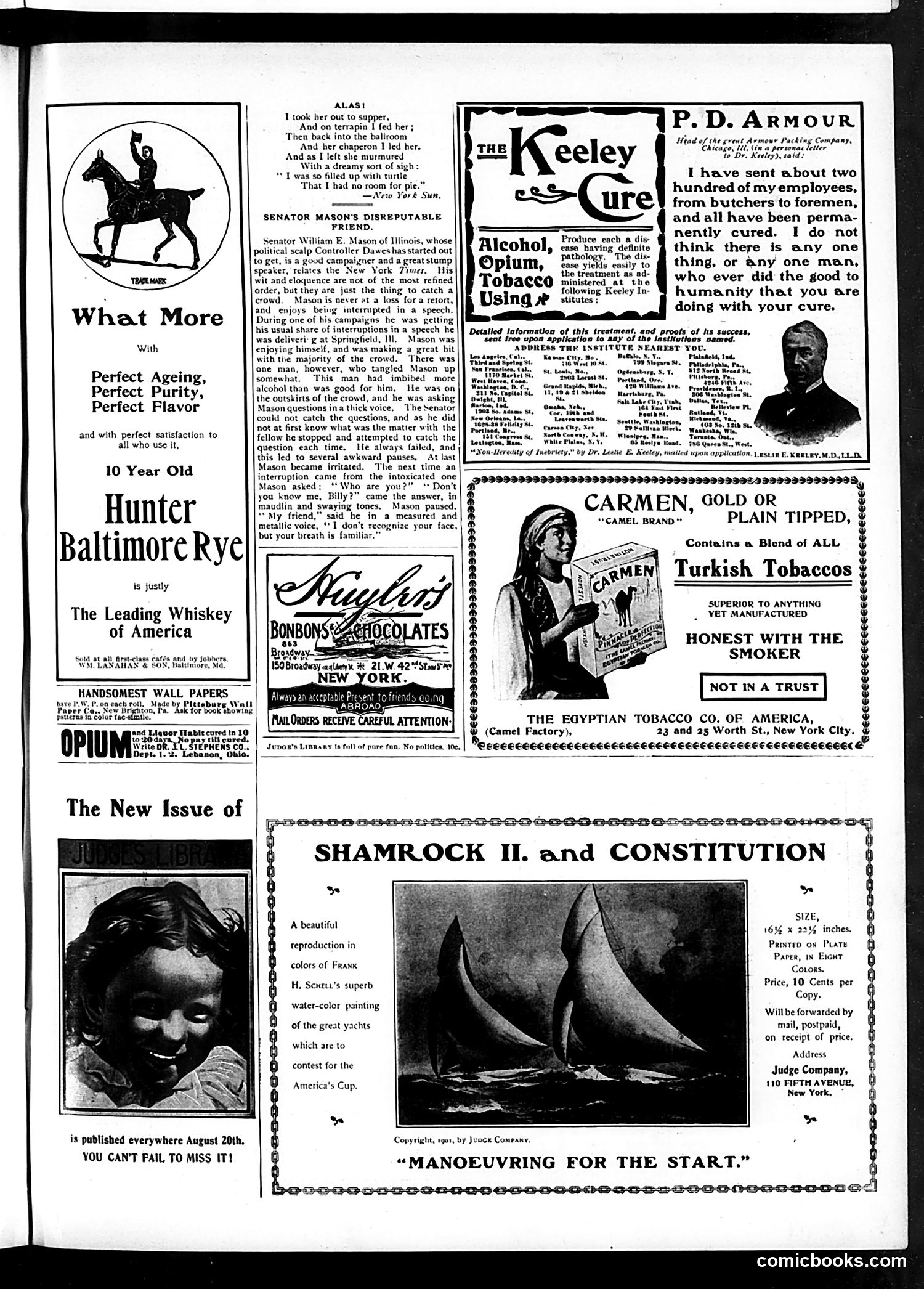
This page is primarily **advertisements** interspersed with light satirical humor. The main content includes: **"Alas!" anecdote**: A humorous quip from the *New York Sun* about a man taking a date to dinner—she ate so much terrapin (turtle), she had "no room for pie." This is genteel romantic humor typical of the era. **Senator Mason anecdote**: A story about Illinois Senator William E. Mason, whose political rival Controller Dawes sought his "scalp" (political defeat). The joke: when a drunk heckler interrupts Mason's speech, Mason retorts, "I don't recognize your face, but your breath is familiar"—a classic insult about drunkenness. **Advertisements**: Hunter Baltimore Rye whiskey, Keeley Cure (alcohol/addiction treatment), Carmen cigarettes (claiming independence from trusts), and wall papers dominate the page. The page reflects early 1900s concerns: political rivalries, alcoholism as both product and social problem, and corporate trust-busting sentiment (Carmen's "NOT IN A TRUST" claim).
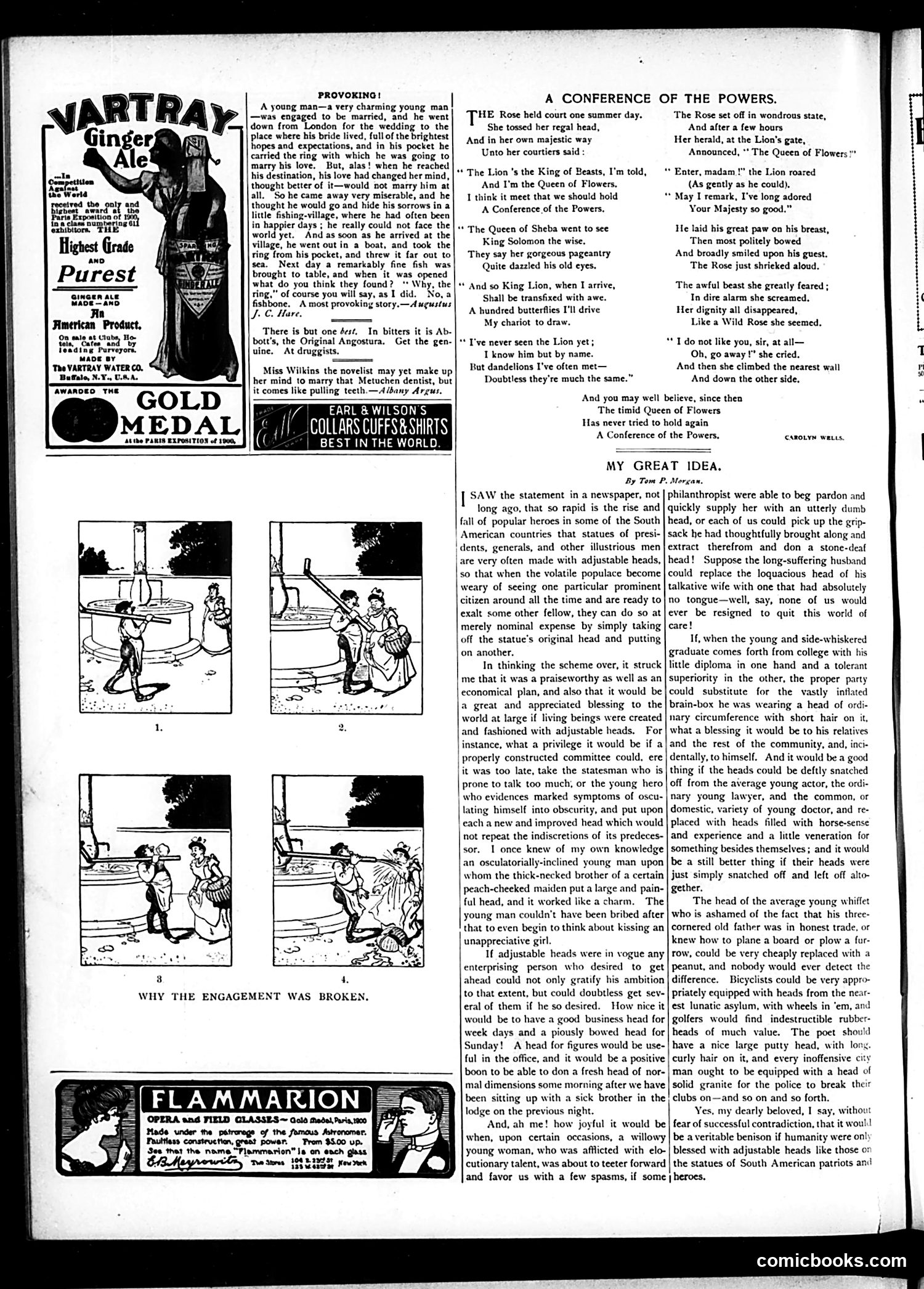
This page contains several distinct pieces: **"Provoking!"** (top left): A humorous anecdote about a jilted English gentleman who throws his engagement ring into the sea, only to have it disappear—a story meant to illustrate life's frustrations. **"A Conference of the Powers"** (center/right): An allegorical poem by Carolyn Watts where the Rose (representing feminine vanity/beauty) hosts a summit with the Lion (King of Beasts). The Rose arrives with elaborate pageantry expecting to impress the Lion, but panics upon meeting him and flees—satirizing pretension meeting reality. The moral: her grand ambitions collapse when confronted with actual power. **"My Great Idea"** (bottom right): Tom P. Morgan proposes replacing the heads on South American statues of fallen politicians/generals rather than melting them down—a satirical commentary on political instability and the rapid rise-and-fall of leaders in those regions. The page is primarily literary/satirical content with period advertisements (Vartray Ginger Ale, Earl & Wilson collars, Flammarion glassware).
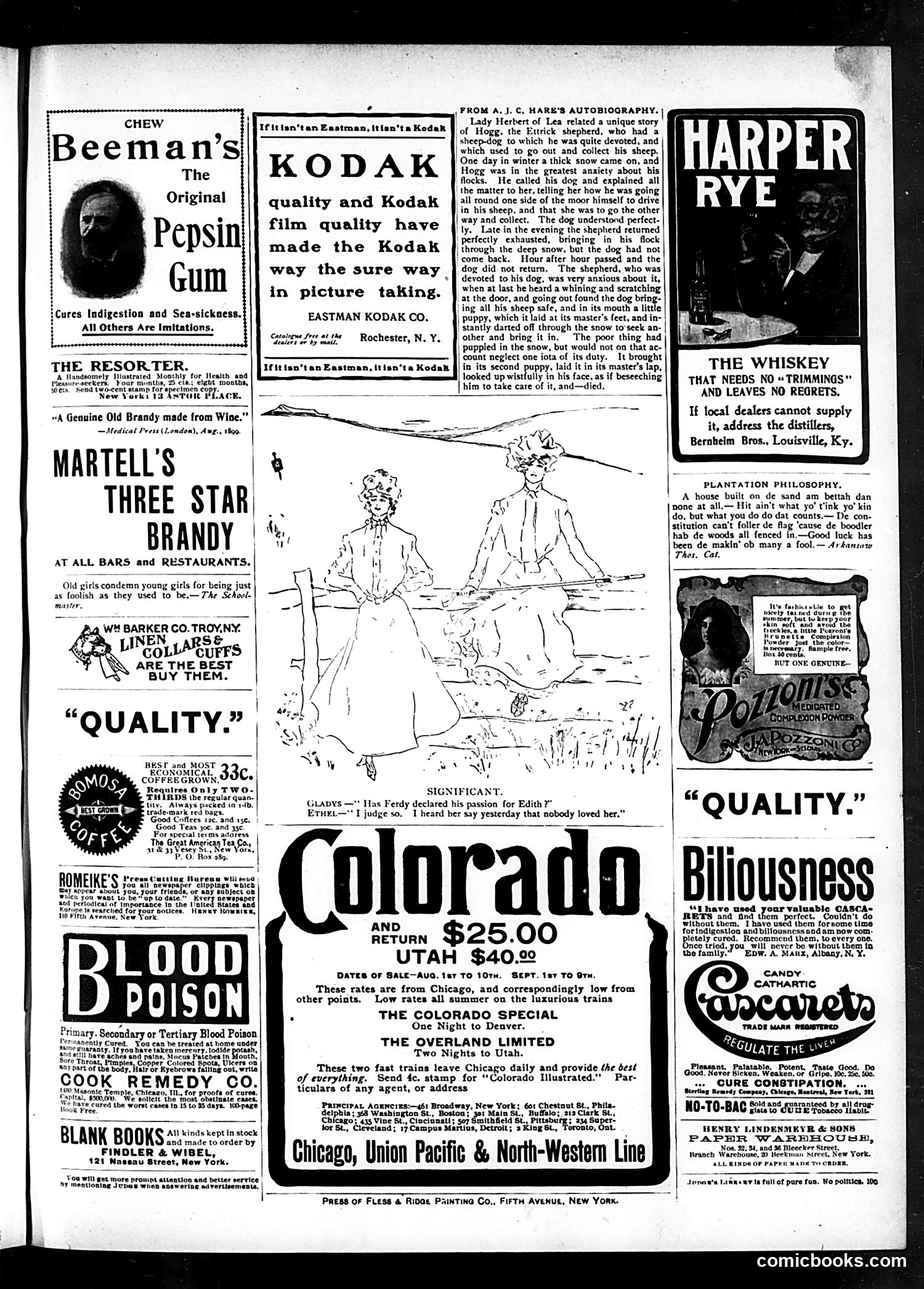
This page is primarily **advertisements and filler content** with one small cartoon. The single cartoon labeled "SIGNIFICANT" depicts two women discussing a third named Edith. Gladys asks if "Ferdy" (Ferdinand) has declared his passion for Edith, and Ethel responds that she assumes so because she heard Edith say "nobody loved her" yesterday. The joke satirizes **women's romantic disappointments**—the humor comes from Edith's apparent unrequited feelings despite Ferdy's supposed interest, suggesting miscommunication or unreciprocated affection in courtship. The page is otherwise filled with period advertisements: Beeman's chewing gum, Kodak cameras, Martell's brandy, blood poison treatments, and Colorado tourism. A brief excerpt from J.C. Hare's autobiography about a loyal shepherd's dog appears as filler content. The page lacks significant political satire—it's typical late-19th-century magazine space-filler combining commercial ads with light social commentary on romance and manners.
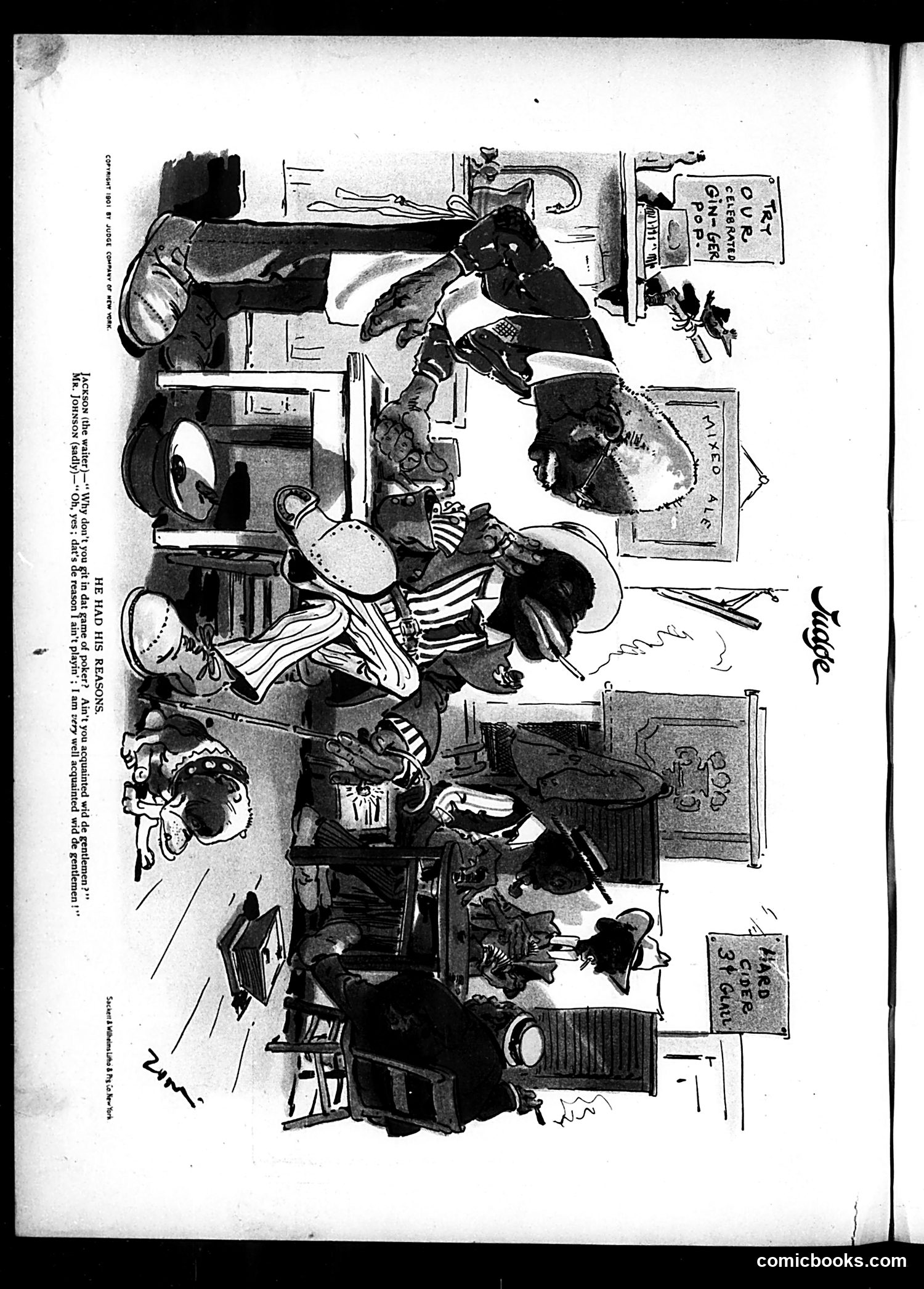
This is a single-panel joke cartoon from 1901 depicting two Black men: Jackson, a waiter, and R. Johnson, who is declining to join a poker game with gentlemen in the background. The humor relies on a racial stereotype common to the era: the implication that Black men are naturally inclined toward gambling and card games. Johnson's refusal—stated as "I am very well acquainted with de gentlemen"—suggests he knows these particular men are cheaters or untrustworthy at cards, making it foolish to play with them. The dialect spelling ("git," "dat," "wid," "de") reflects how Judge magazine typically rendered Black speech for comedic effect, though this was considered standard practice in American humor of the period. The joke's appeal to contemporary readers likely lay in the understated punchline rather than overtly racist content, though the caricature presentation and stereotypical framing would be deeply offensive today.