
A complete issue · 16 pages · 1901
Judge — August 10, 1901
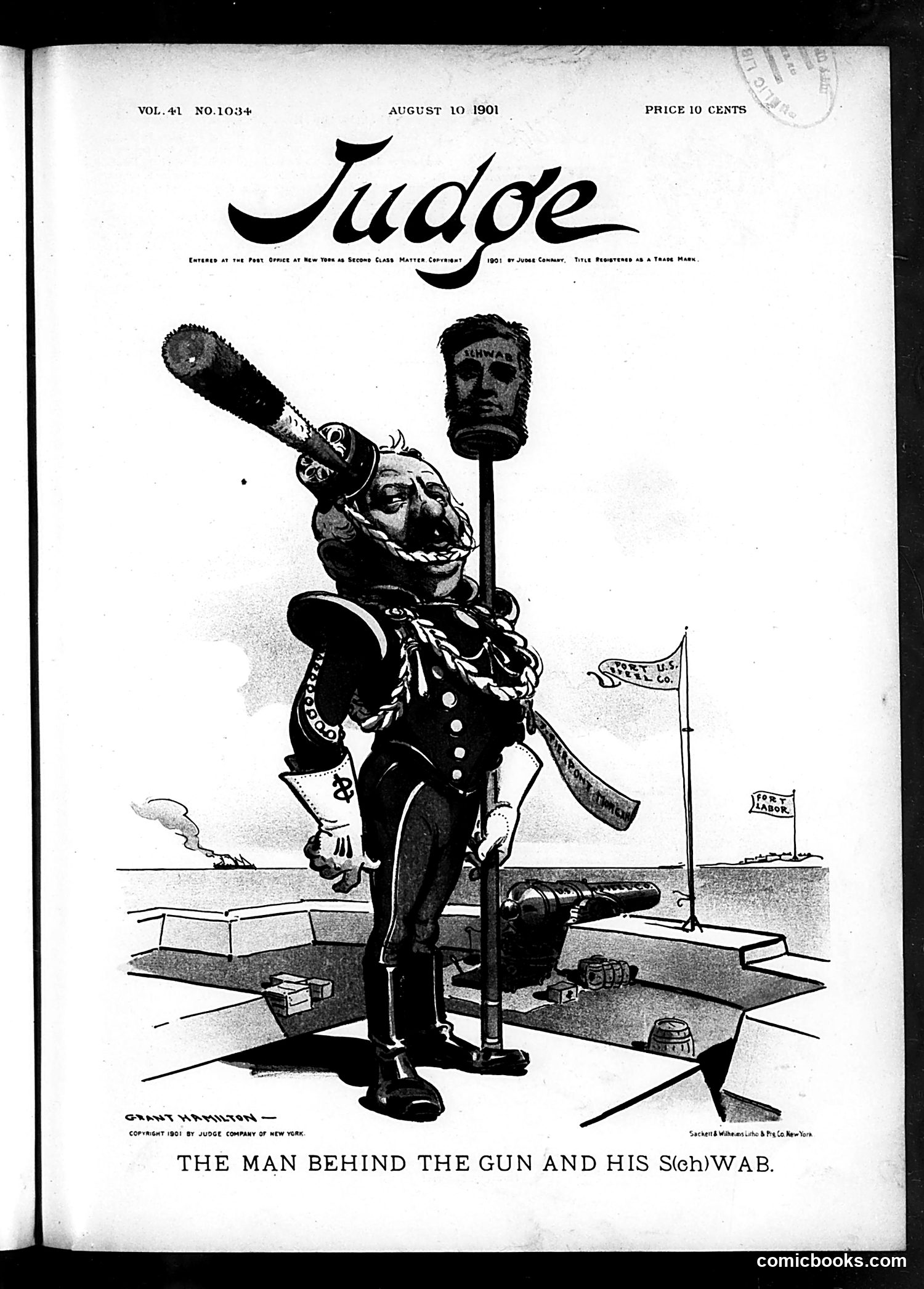
This Judge magazine cover from August 10, 1901 depicts a caricatured military figure with exaggerated facial features holding a large gun and a head on a pike. The title's wordplay on "SCHWAB" (likely referring to steel magnate Charles M. Schwab) suggests satirical criticism of American imperialism or militarism during the early 20th century. The military regalia, fort setting with flags, and weapons imagery indicate commentary on American expansionism, possibly related to the Philippine-American War (1899-1902) or contemporary military-industrial influence. The grotesque caricature and violent imagery—the severed head—appear to critique the brutality or moral compromises associated with imperial military adventures and those profiting from them.
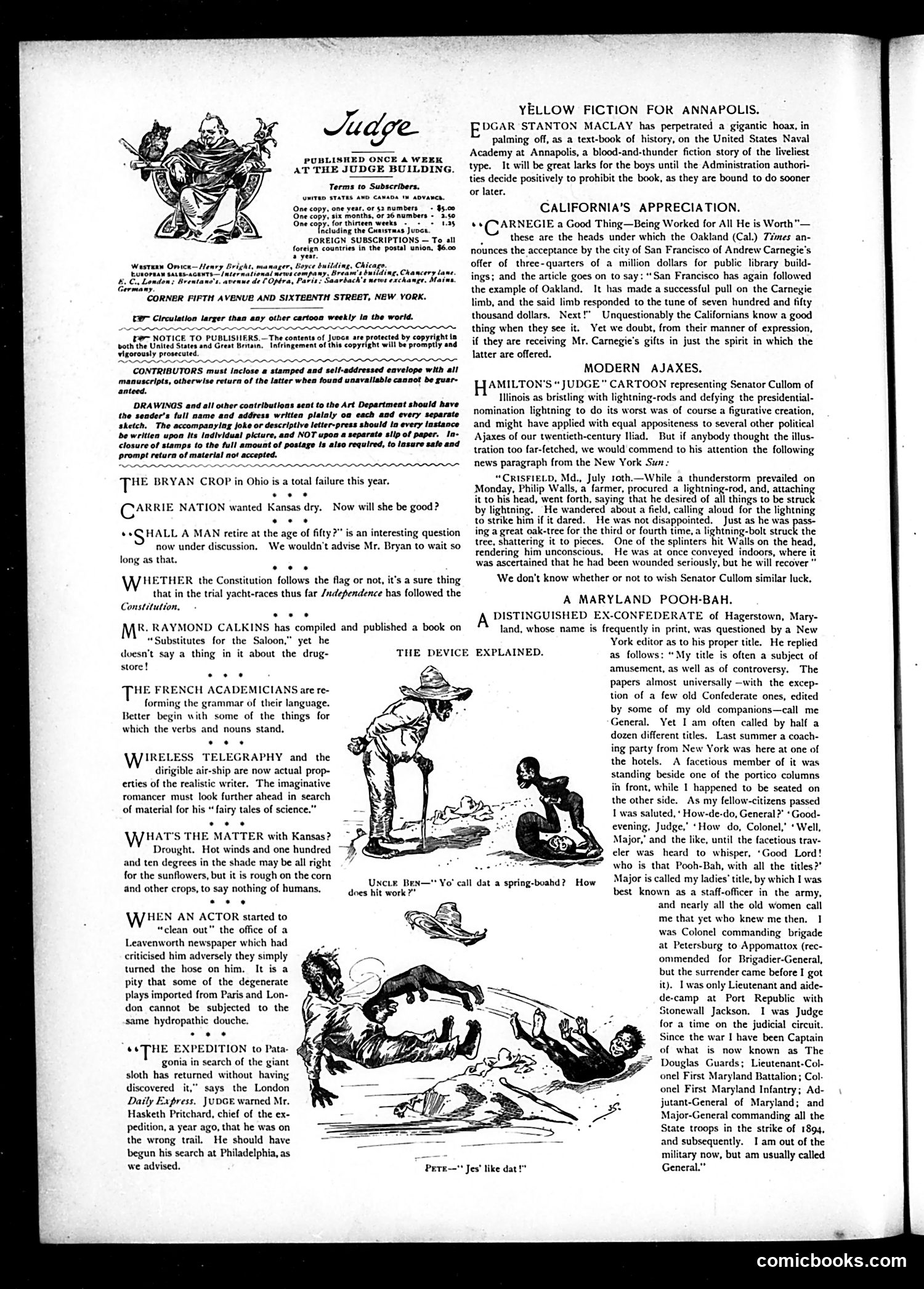
The page contains several satirical short pieces rather than a single cartoon. The main illustrated content shows what appears to be period caricatures of figures in various comedic situations—possibly depicting political or social commentary typical of Judge's style. The text pieces address contemporary issues: Bryan's failed crop in Ohio, Kansas's drought conditions, and comments on yacht races and Independence Day. One section titled "Modern Ajaxes" critiques Senator Cullon's speeches about presidential lightning rods (likely political criticism). Another piece satirizes French academicians reforming grammar. Without clearer identification of the illustrated figures or more specific dating context visible in the image, the exact political targets remain unclear, though the content suggests typical late-19th or early-20th century American political satire.
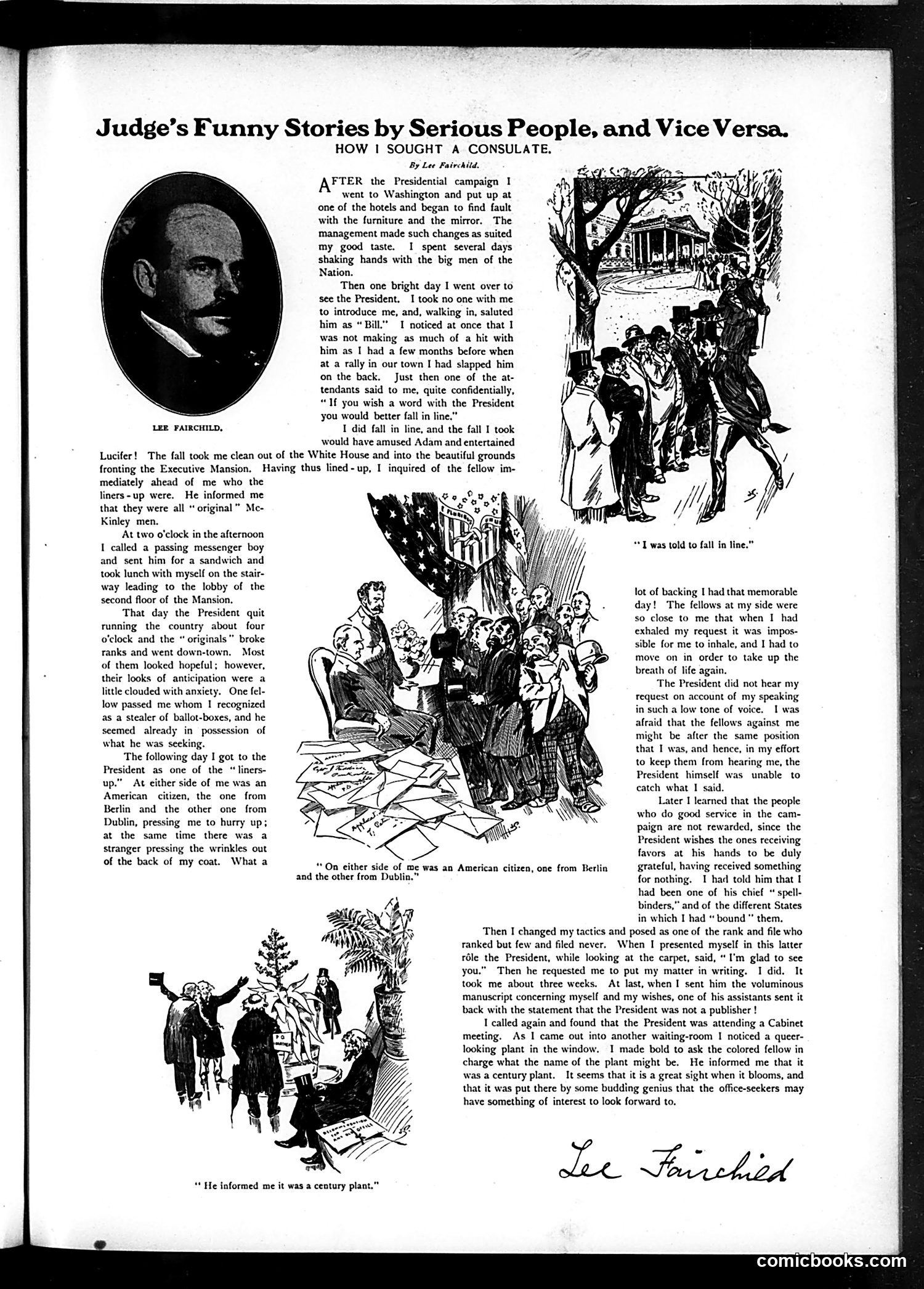
This is Lee Fairchild's humorous account of pursuing a diplomatic position after a presidential campaign. The satire mocks patronage culture—the practice of rewarding political supporters with government posts regardless of qualifications. Fairchild describes repeatedly approaching the President seeking a consulate appointment, only to be rebuffed or ignored. The cartoons illustrate his escalating desperation: being told to "fall in line," attempting to catch the President's attention, and awkwardly positioning himself during official business. The humor derives from the absurdity of his persistence and the President's transparent avoidance. The final twist—discovering the President wasn't even a publisher—satirizes how political favor-seeking proves fruitless, and how those seeking patronage often misunderstand the President's actual interests or abilities to help them.
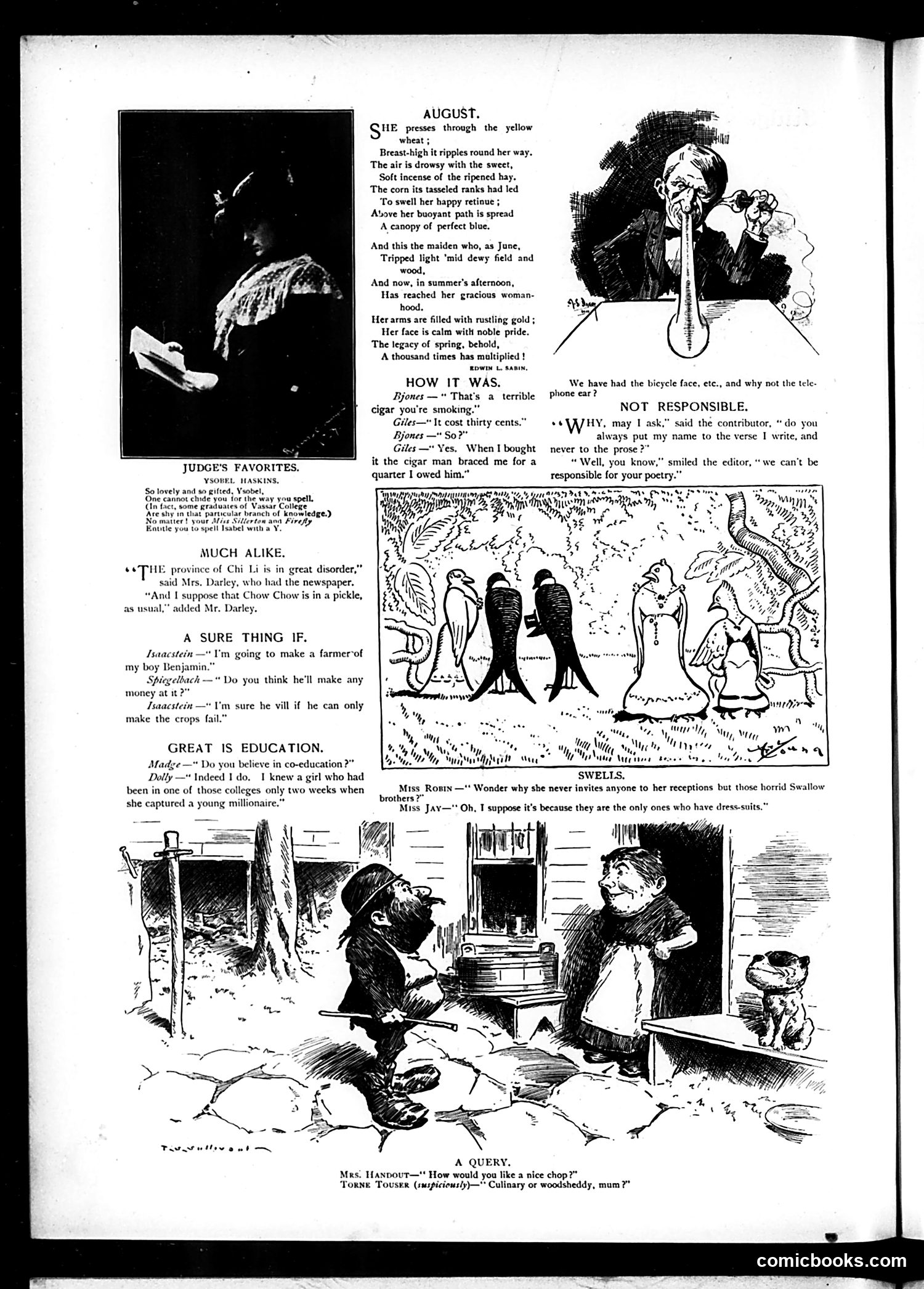
This page contains several brief satirical pieces and illustrations typical of Judge's humor: **"Judge's Favorites"** presents a poem about Yorel Haskins, likely a contemporary public figure. **"How It Was"** satirizes expensive cigars—a dialogue where someone bought a cigar for a quarter but was later charged thirty cents, mocking inflation or merchant dishonesty. **"Not Responsible"** jokes about editorial disclaimers for submitted poetry, suggesting contributors frequently submit poor work the magazine won't endorse. **"A Query"** (bottom) depicts two working-class figures discussing food options, with one asking about "nice chop" versus "woodchokey, mum?"—apparently mocking lower-class dialect and limited dining choices. The page reflects Judge's focus on class-based humor, economic satire, and contemporary consumer frustrations rather than political commentary.
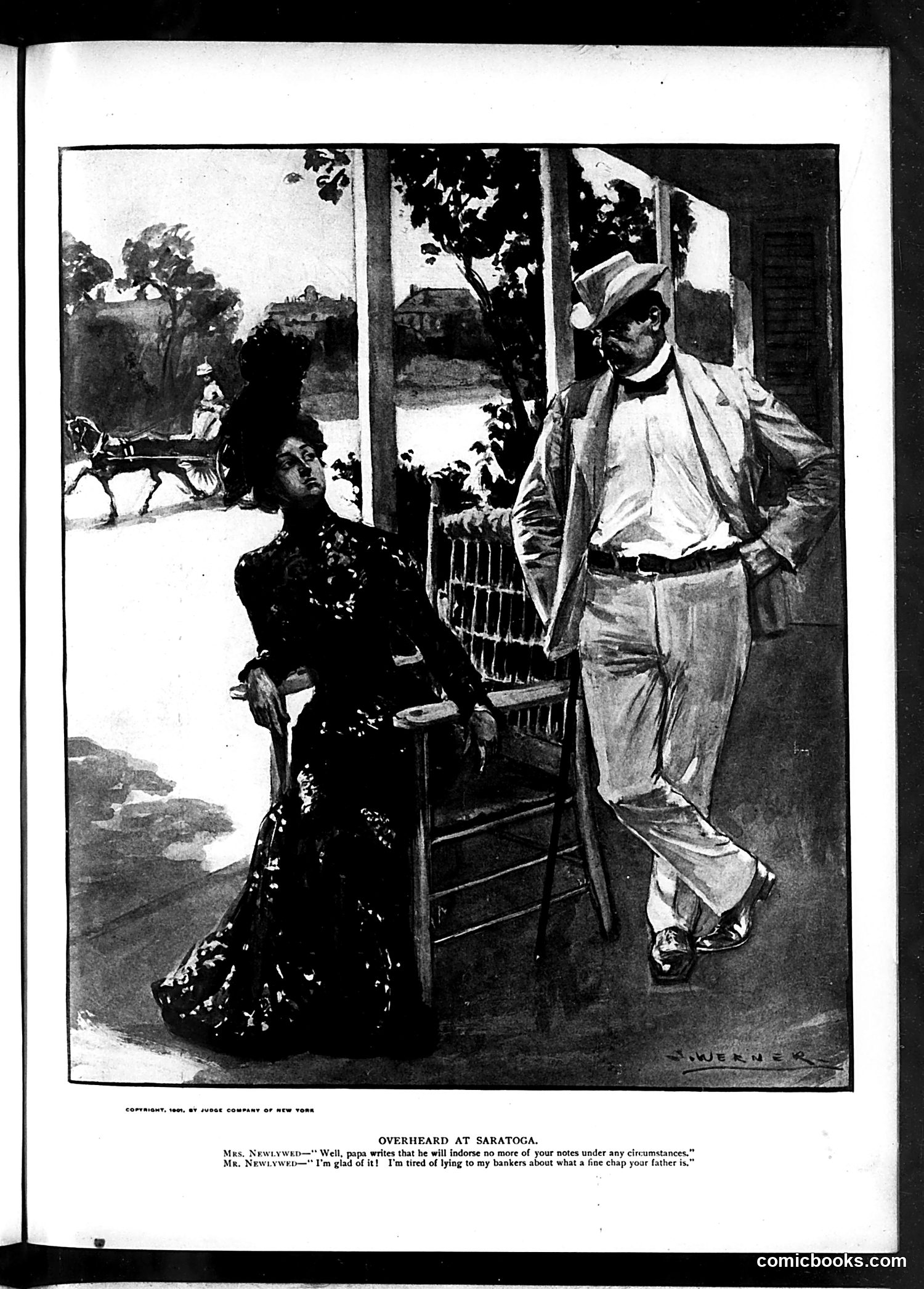
This cartoon satirizes financial irresponsibility among the wealthy at Saratoga Springs, a fashionable resort. A woman in an elegant black dress informs a man that her father will no longer co-sign his promissory notes. The man responds with relief, admitting he's exhausted from fabricating lies to his bankers about her father's character to justify the endorsements. The satire targets: (1) young men living beyond their means through borrowed money; (2) the practice of using wealthy fathers-in-law as financial guarantors; (3) the deception required to maintain appearances of creditworthiness among the banking class. It mocks both the frivolous spending habits of the leisure class and the hollow social pretenses that enabled their financial schemes during the Gilded Age.
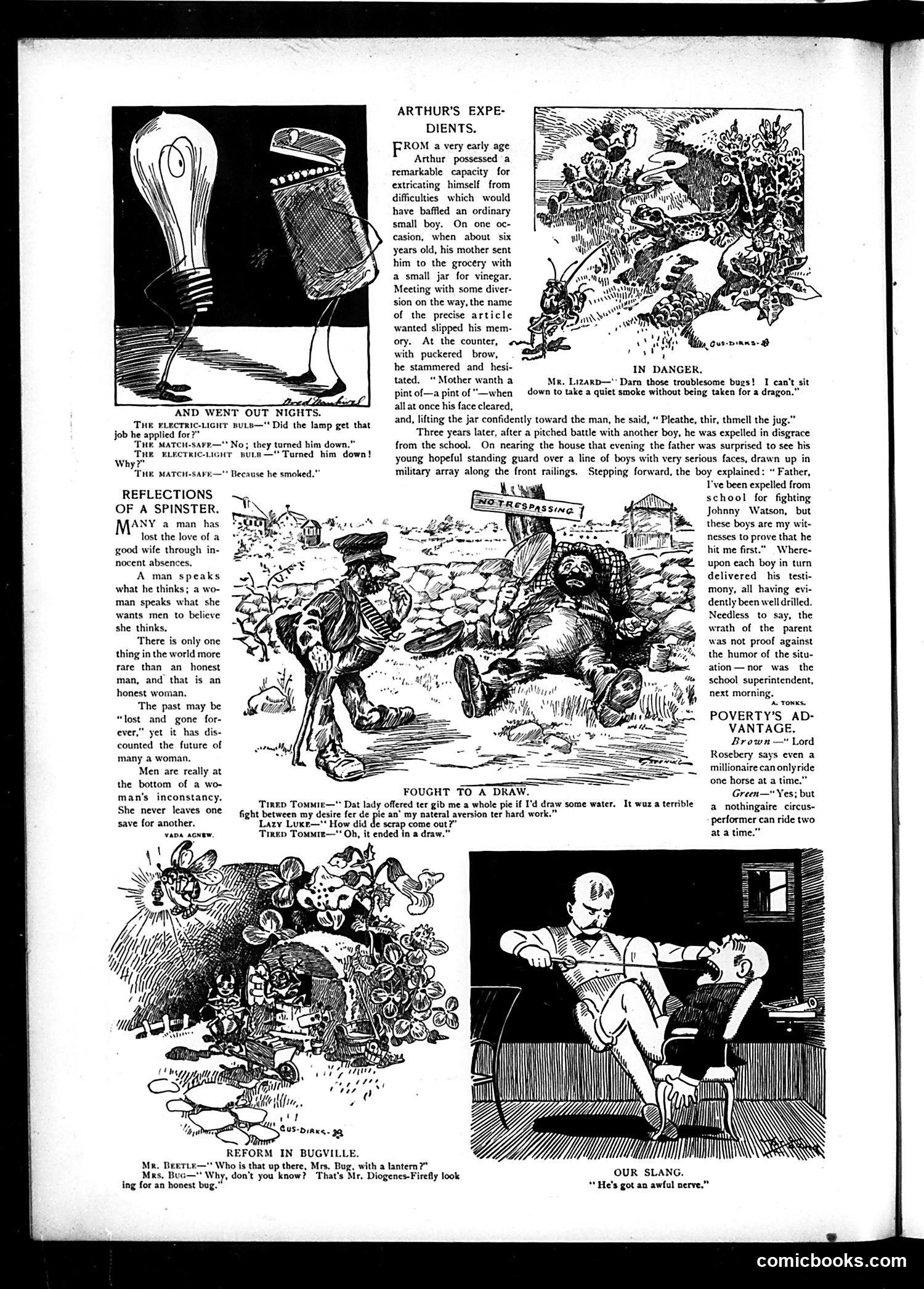
This page contains multiple short satirical pieces typical of Judge magazine's humor: **"Arthur's Expedients"** tells anecdotes about a clever boy who escapes difficulties through quick thinking—first by smelling a jar to identify vinegar, later by assembling witnesses to prove he didn't start a schoolyard fight. The satire celebrates childhood resourcefulness. **"Reflections of a Spinster"** offers misogynistic observations contrasting male honesty with female deception, reflecting Victorian-era gender stereotypes common to the era. **Other cartoons** include: - "In Danger": A lizard mistaken for a dragon - "Fought to a Draw": Street urchins debating work versus pie - "Reform in Bugville": A firefly (Diogenes reference) searching for an honest bug—satirizing civic corruption - "Our Slang": Brief quip about nerve/audacity The page reflects Judge's typical mix of sentimental stories, domestic humor, and social commentary aimed at middle-class readers, with illustrations accompanying each piece.
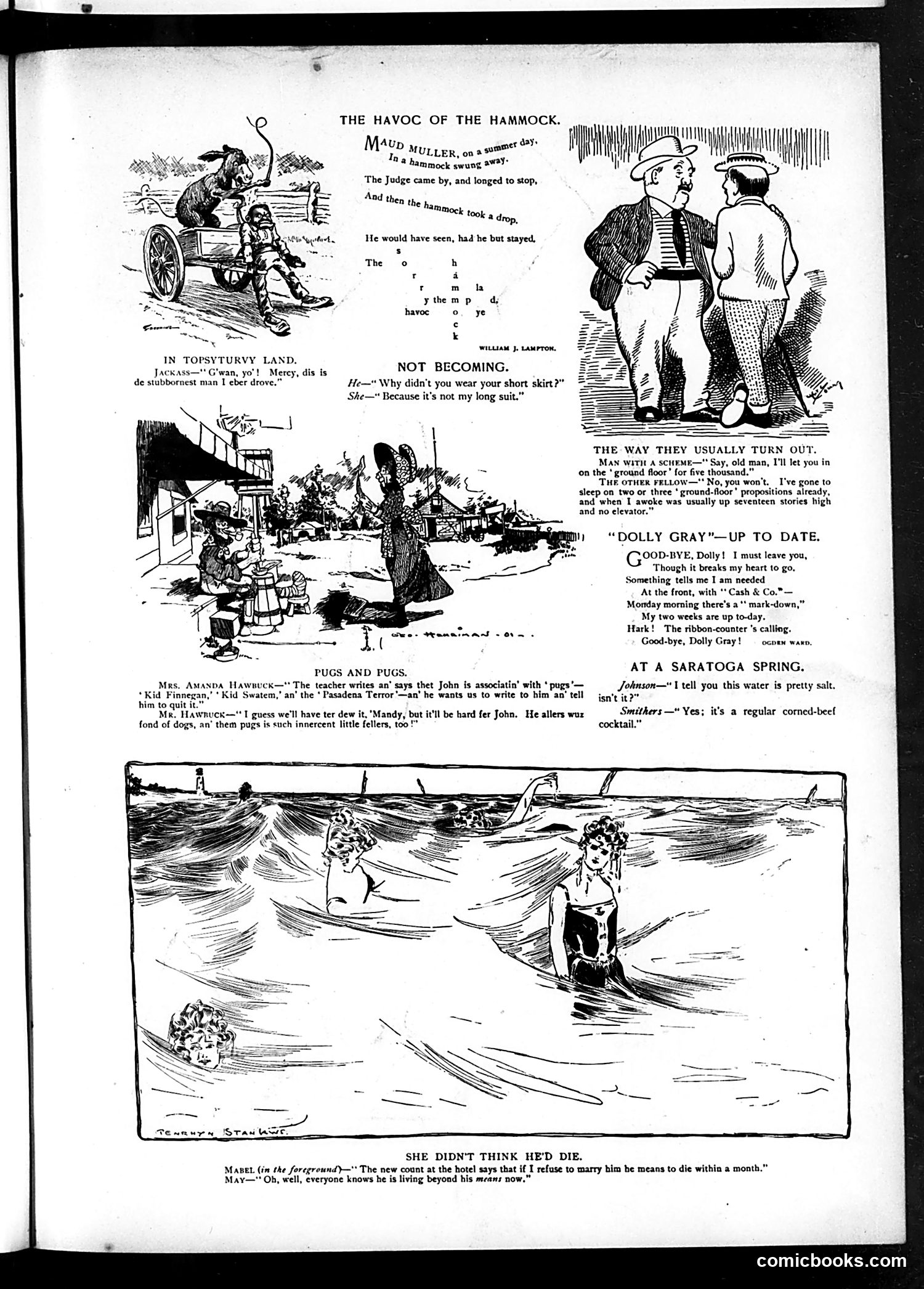
This page contains several unrelated humorous sketches typical of early 20th-century American satire: **"The Havoc of the Hammock"** mocks the leisure culture of the wealthy—a judge gets trapped by a hammock swing, missing the spectacle. **"Not Becoming"** makes a crude pun about clothing and marital discord. **"The Way They Usually Turn Out"** satirizes con artists pitching investment schemes ("ground floor" opportunities) to gullible marks, who discover they've been defrauded multiple times. **"Dolly Gray—Up to Date"** parodies the sentimental Civil War-era song by replacing patriotic duty with a clerk's retail obligations at a department store (Cash & Co.), mocking commercialized romance. **"At a Saratoga Spring"** contains wordplay about mineral water tasting like corned beef broth—a joke about the famous spa's therapeutic waters. **"She Didn't Think He'd Die"** uses dark humor: a woman dismisses a suitor's suicide threat because he's already living beyond his financial means (thus presumably already "dying" economically). The overall tone reflects Judge's satirical approach to contemporary American social pretensions and commercial culture.
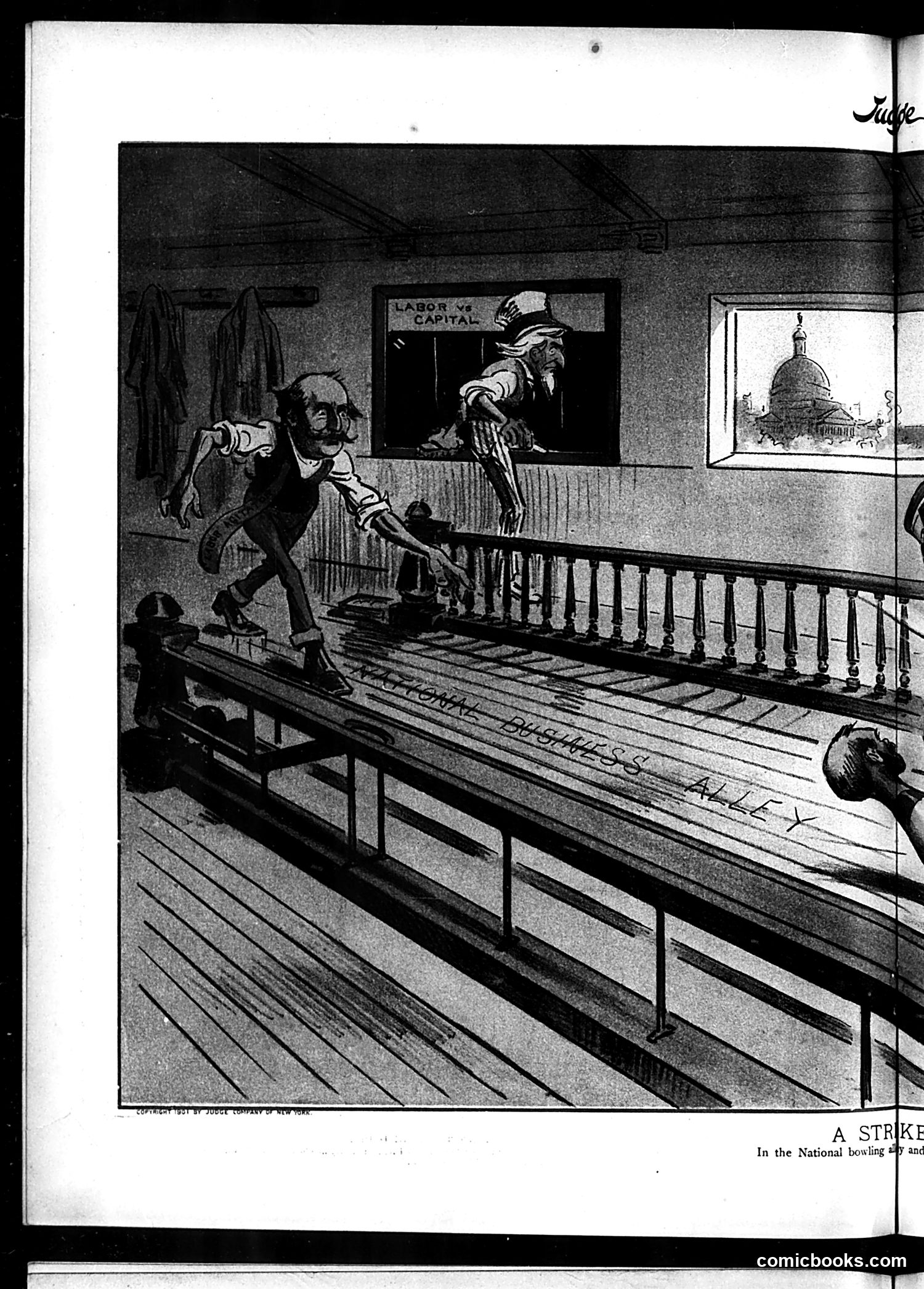
This cartoon depicts a bowling alley scene titled "A Strike In the National boxing [ring and...]" The image uses bowling as a metaphor for labor conflict. A figure on the left (appearing to represent a worker or labor organizer) bowls toward pins labeled "DASHES ALL" while an authority figure (possibly representing capital or government) watches from above. The "Labor vs. Capital" sign visible in the background confirms this addresses labor-management conflict. The cartoon's pun equates a successful bowling strike with labor strikes—the working figure's action represents organized labor's attempt to knock down the opposition. The Capitol building visible on the right wall suggests federal/governmental dimensions to this labor dispute, likely referencing early 20th-century American labor struggles when Judge published political satire addressing union activism and workers' rights movements.
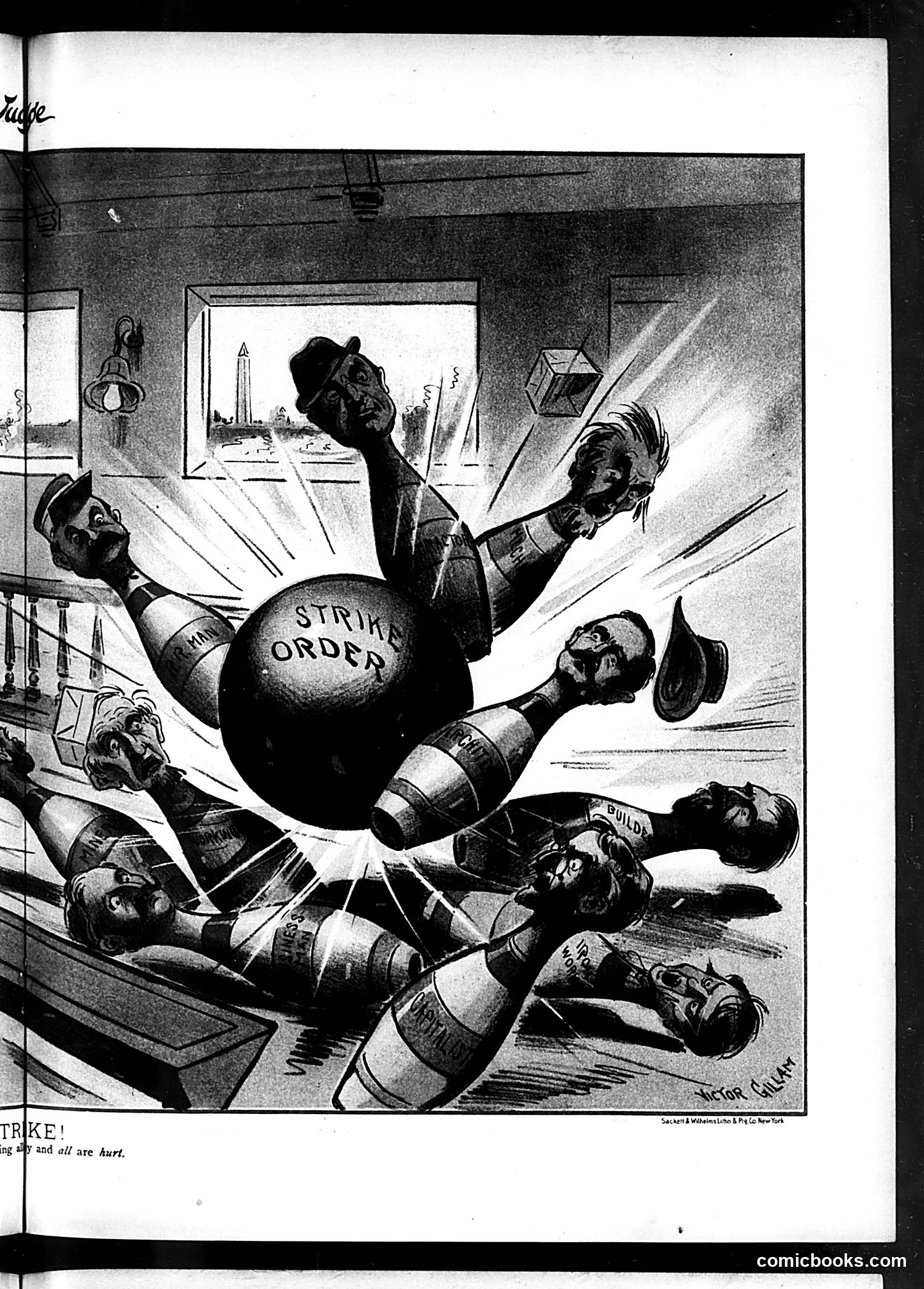
This Vic cartoon depicts a massive bomb labeled "STRIKE ORDER" exploding in an industrial setting (visible factory/smokestacks through the window). Multiple workers are shown being violently thrown by the blast. The satire critiques the consequences of strike orders during what appears to be an industrial labor dispute. The cartoon argues that strike action harms the workers themselves—depicted literally as casualties of the "explosion"—rather than achieving their goals. The visual metaphor equates the strike order to a destructive bomb, suggesting the satirist viewed labor strikes as self-destructive for working people. This reflects anti-labor sentiment common in Judge magazine, which typically sided with business interests over unions and workers' organizing efforts.
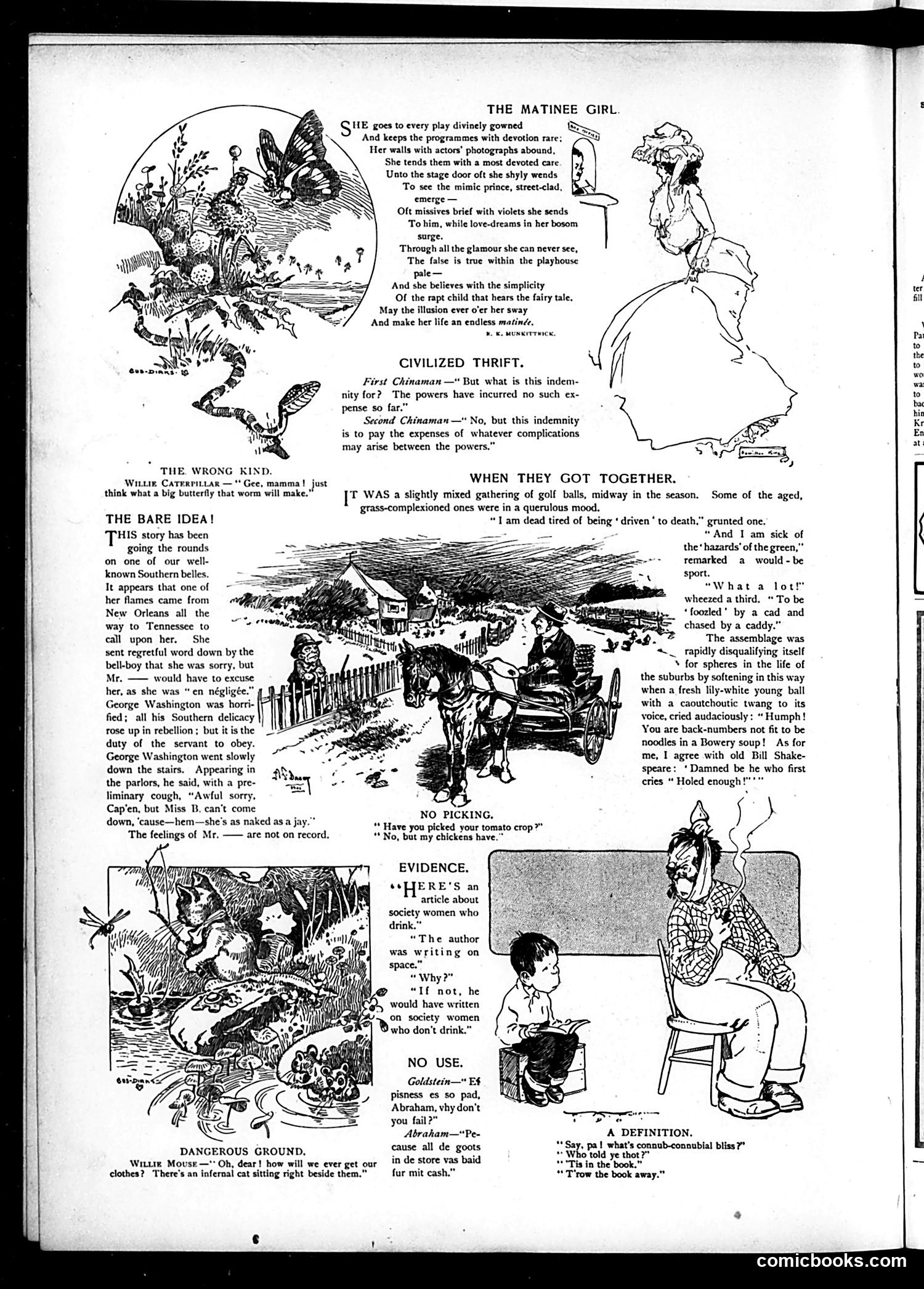
This page contains multiple satirical pieces typical of early 20th-century American humor: **"The Matinee Girl"** mocks young women obsessed with theater—attending every show, collecting actors' photographs, and sending love notes to performers. The satire targets their inability to distinguish theatrical illusion from reality, treating stage romance as genuine. **"Civilized Thrift"** appears to reference Chinese indemnities (likely from the Boxer Rebellion era), satirizing how Western powers justify financial reparations by claiming payment for future potential complications rather than actual expenses incurred. **"When They Got Together"** personifies golf balls as aging, complaining characters, satirizing both the sport and social pretension through their snobbish dismissal of newer, cheaper balls. **Other shorts** include ethnic humor (Yiddish-accented characters named Goldstein and Abraham), a joke about chickens eating tomatoes, and wordplay about society women drinking. The page reflects period attitudes: casual ethnic stereotyping, class-based humor, and satirical commentary on women's behavior and consumerism. The artwork uses caricature and cartoon illustration typical of Judge's satirical style.
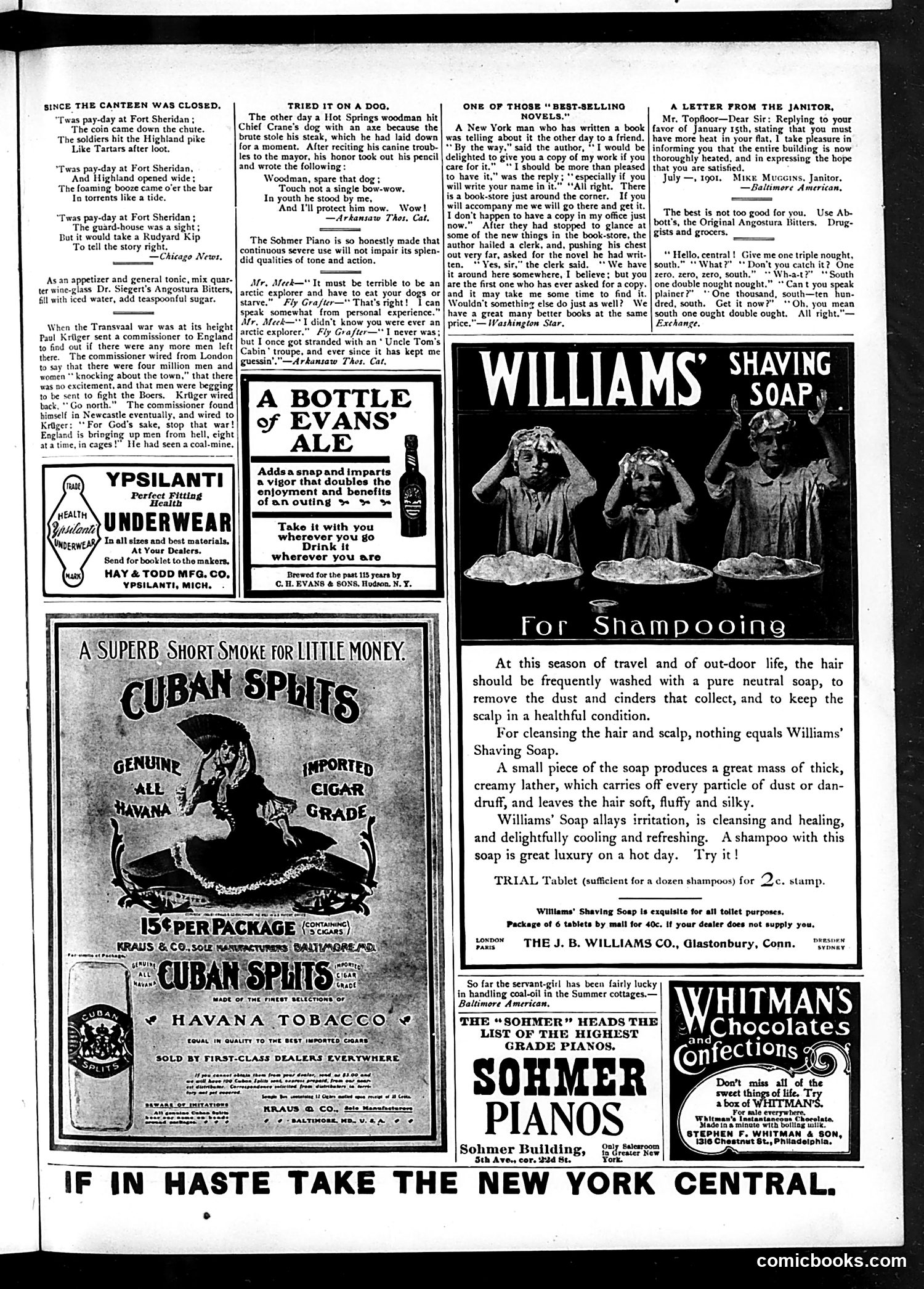
This is primarily an **advertising page** from Judge magazine with several short humorous anecdotes interspersed. The satirical content includes: **"Since the Canteen Was Closed"**: A poem lamenting that closing the military canteen at Fort Sheridan led soldiers to drink at nearby bars instead—suggesting the prohibition-style measure backfired, producing worse drunkenness and disorder. **The Kruger Anecdote**: A joke about the Boer War (1899-1902), mocking English industrial capacity by claiming a coal mine's workers resembled hellish creatures being extracted "eight at a time, in cages." **"One of Those Best-Selling Novels"**: Satire on vanity publishing—an author eagerly offers his book to someone, only to have a bookseller reveal he's never heard of it and suggest other titles are better. **"Hello, Central"**: A brief telephone operator joke playing on unclear speech about numbered addresses. The page otherwise consists entirely of **period advertisements** for Evans' Ale, Cuban Splits cigars, Williams' Shaving Soap, Sohmer Pianos, Whitman's Chocolates, and other products, reflecting Judge's commercial sponsorship model.
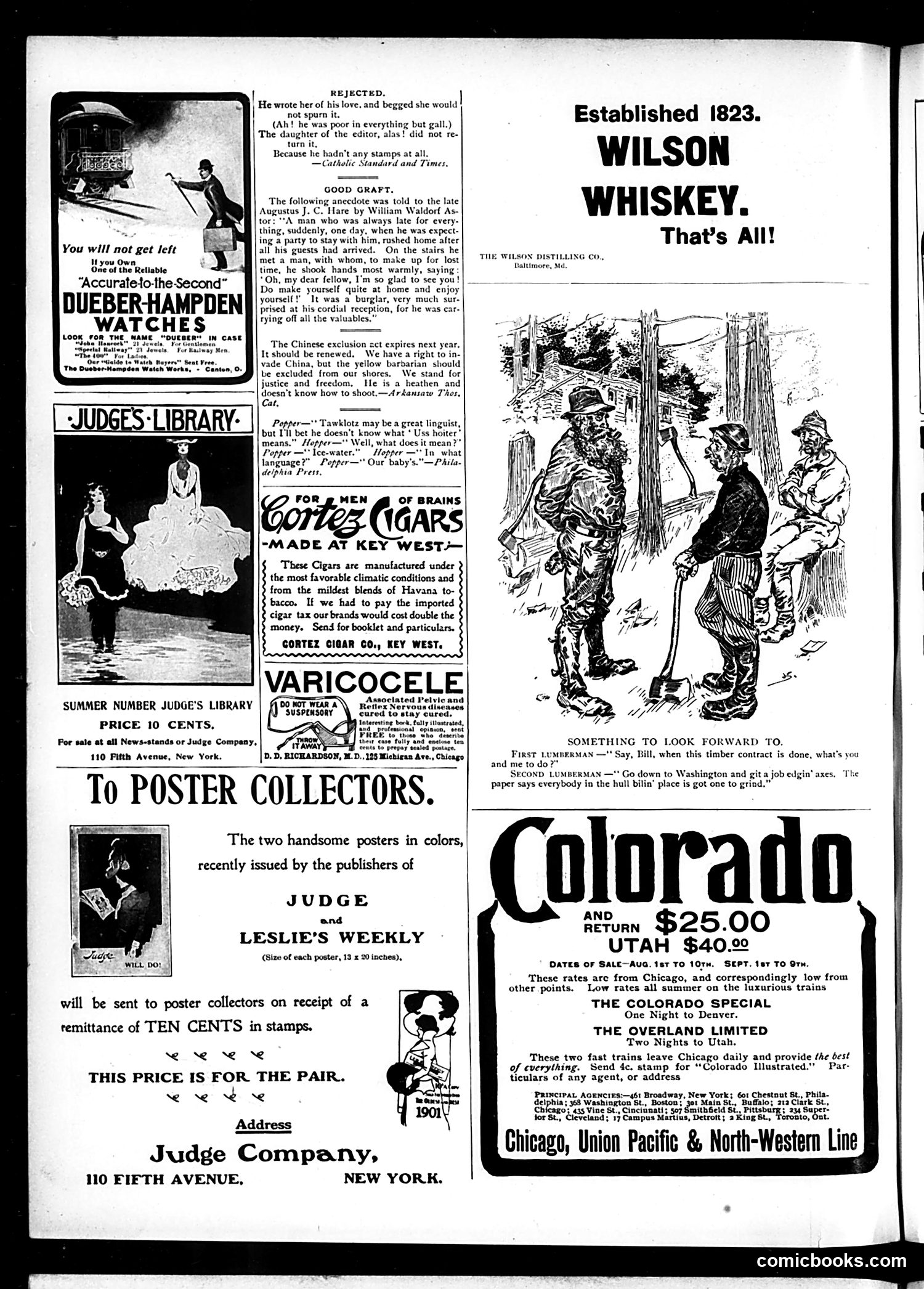
This page contains multiple satirical items and advertisements typical of early 1900s Judge magazine: **"Rejected" cartoon**: A brief joke about a young man's love letter being returned—not because the recipient rejected him, but because he lacked postage stamps. It's wordplay on romantic rejection versus postal failure. **"Good Graft" anecdote**: A humorous story about a chronically late host who, rushing home, warmly welcomes a burglar by mistake, treating him as a guest while the thief steals valuables. The satire critiques thoughtless hospitality. **Political commentary**: Brief editorial snippets address the Chinese Exclusion Act's expiration, advocating its renewal with xenophobic language typical of the era. **Main cartoon "Something to Look Forward To"**: Two lumberjacks discuss future employment—one mentions getting a "job edgin' axes" in Washington. The joke satirizes government corruption: "everybody in the hull bilin' place is got one to grind" (a political axe to grind), suggesting Washington is filled with self-interested politicians and job-seekers rather than public servants. The page is primarily advertisements interspersed with humor columns reflecting early 1900s attitudes.
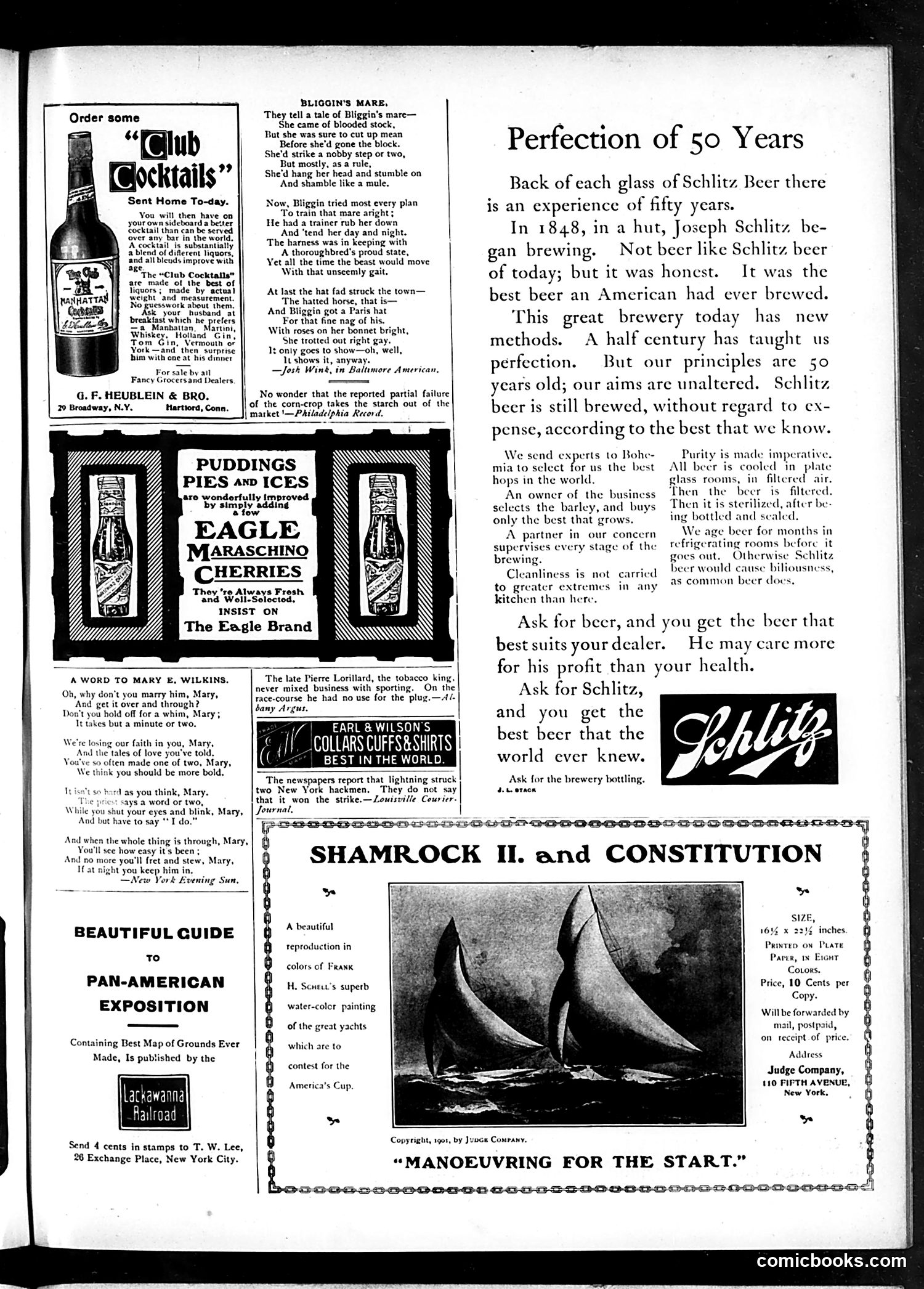
This page is primarily **advertising**, not political satire. It contains several commercial promotions typical of early 1900s magazines: **Main Advertisement**: Schlitz Beer dominates the right side, emphasizing 50 years of brewing tradition since 1848. The copy appeals to quality-consciousness and purity standards—reflecting contemporary anxieties about food/beverage safety. **Other Ads**: Club Cocktails (home delivery service), Eagle Maraschino Cherries, and Earl & Wilson dress shirts appear on the left. **Actual Content**: - A poem, "Bliggin's Mare," about a poorly-behaved horse transformed by wearing a fancy Paris hat—a light joke about superficial improvement through fashion. - Several brief comic quips about contemporary topics (corn crops, lightning strikes, tobacco). - A courtship advice piece titled "A Word to Mary E. Wilkins" (likely addressing the known author). **Historical Context**: The page reflects a commercial magazine ecosystem where advertising subsidized editorial content, and brief humorous items filled space between ads.
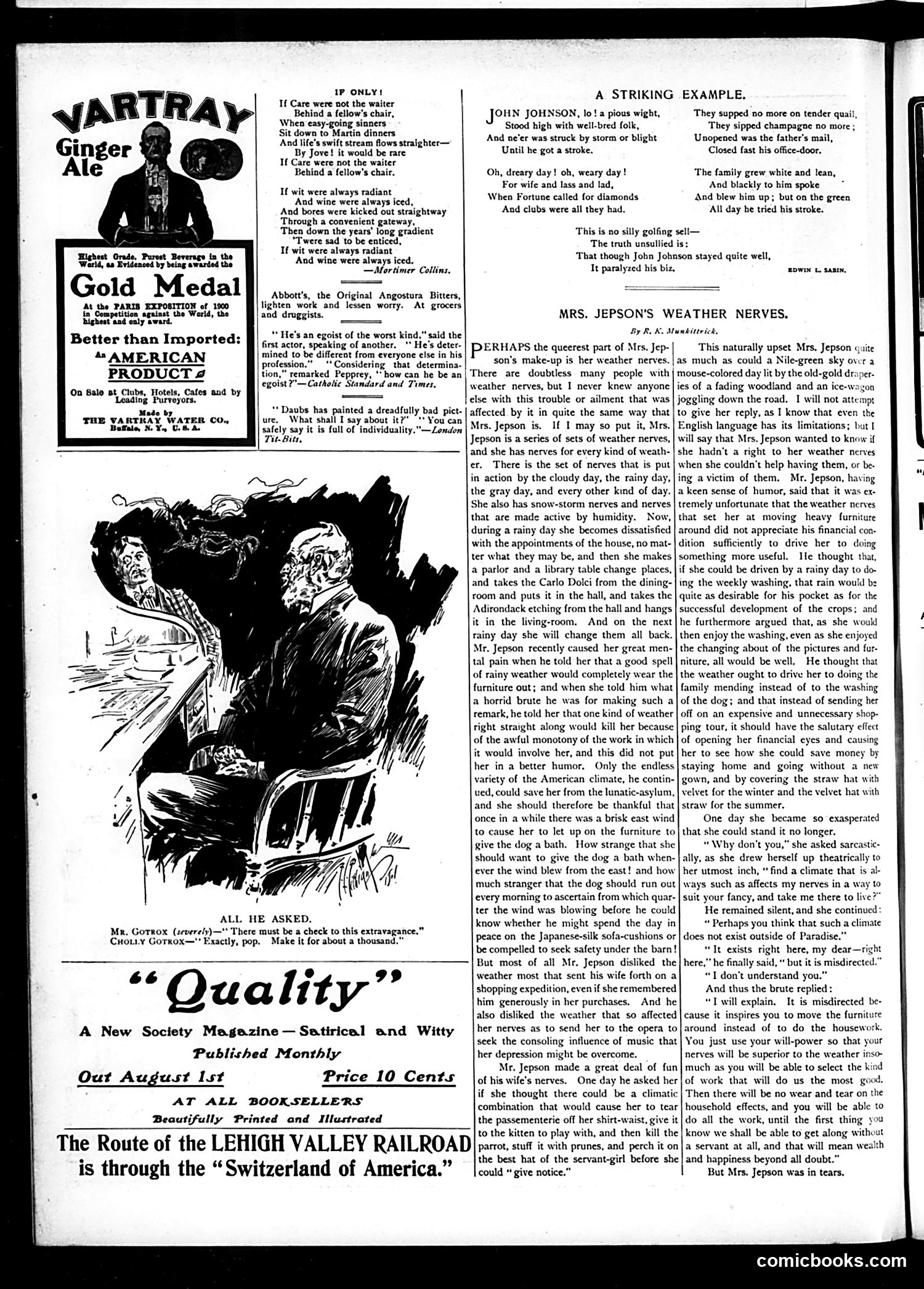
This page contains several distinct elements: **ADVERTISEMENTS**: The Vartray Ginger Ale ad prominently features a man in a chair, advertising an "American product" that won a gold medal at the 1900 Paris Exposition—nationalist marketing common in the era. **POETRY & HUMOR PIECES**: Several short satirical items, including: - A poem about "Care" as a waiter, emphasizing life's hardships - Actor anecdotes mocking egotism and pretension - A joke about a bad painting being "full of individuality" **"ALL HE ASKED" CARTOON**: Shows a father and son discussing finances. The son asks his father to write a check "for about a thousand" to control the daughter's extravagance—satirizing wealthy families' casual overspending and generational attitudes toward money. **"A STRIKING EXAMPLE" & "MRS. JEPSON'S WEATHER NERVES"**: Humorous stories about social/personal absurdities—one about a man whose golf obsession persists despite financial ruin, the other mocking a woman's irrational sensitivity to weather affecting her home decoration habits. The page reflects early 1900s satirical humor targeting middle/upper-class vanities and neuroses.
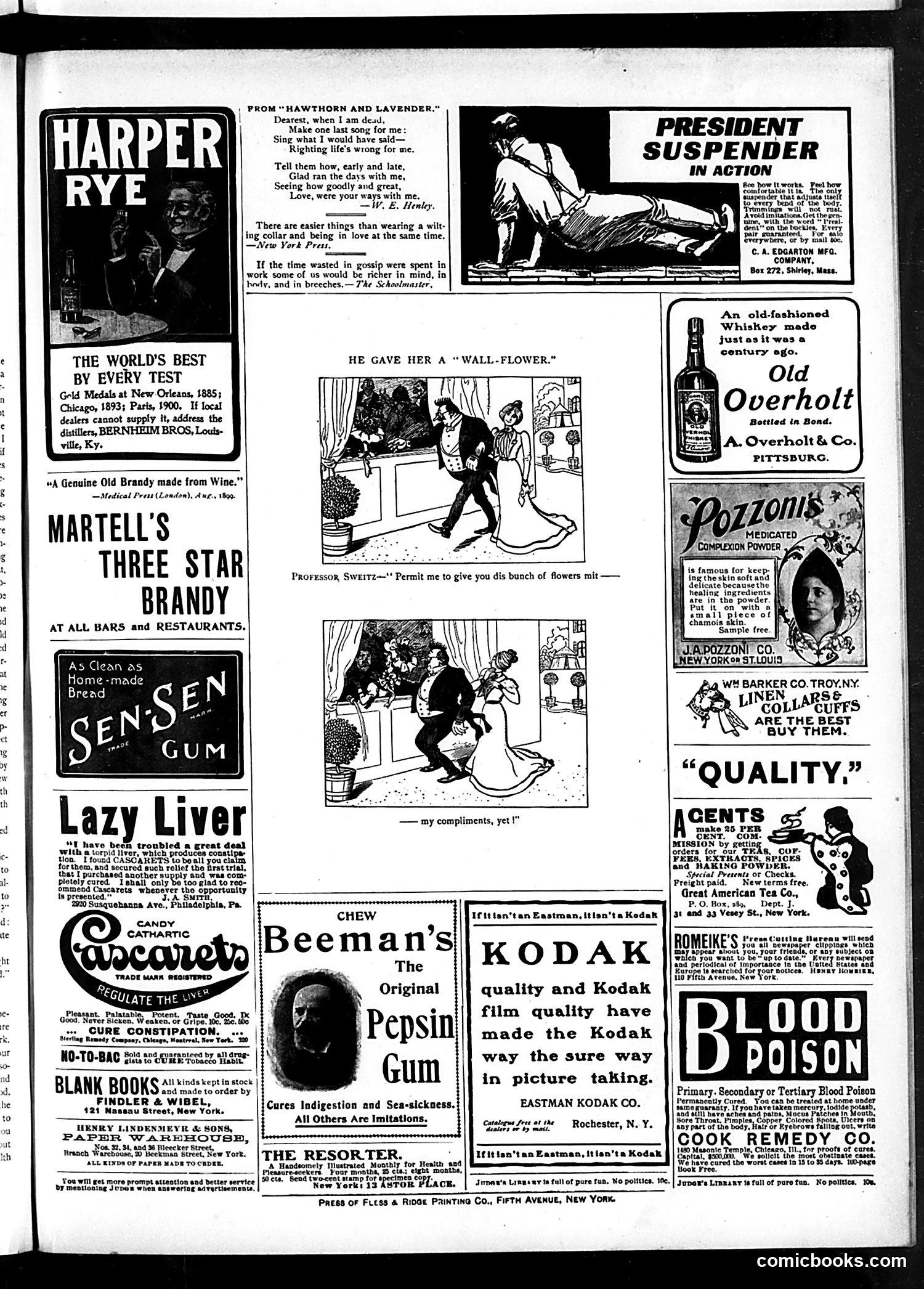
This page is primarily **advertising**, typical of early 1900s magazines. The main cartoon—"He Gave Her a 'Wall-Flower'"—depicts a social humiliation: a man presenting flowers to a woman at a dance while others watch, with her responding sarcastically ("my compliments, yet!"). The joke relies on the period custom where being a "wall-flower" meant being left without a dance partner; giving flowers as mockery compounds the insult. The page's other content consists of patent medicine ads (remedies for liver problems, blood poison, indigestion) and luxury goods (whiskey, brandy, Kodak cameras, gum). These ads are historically significant for showing what was marketable then—many products would later be regulated or banned as fraudulent. The poetry excerpts at top provide sentimental filler typical of Judge's mixed editorial-advertising format. The overall page reflects Edwardian social anxieties about courtship etiquette and contemporary medical quackery.
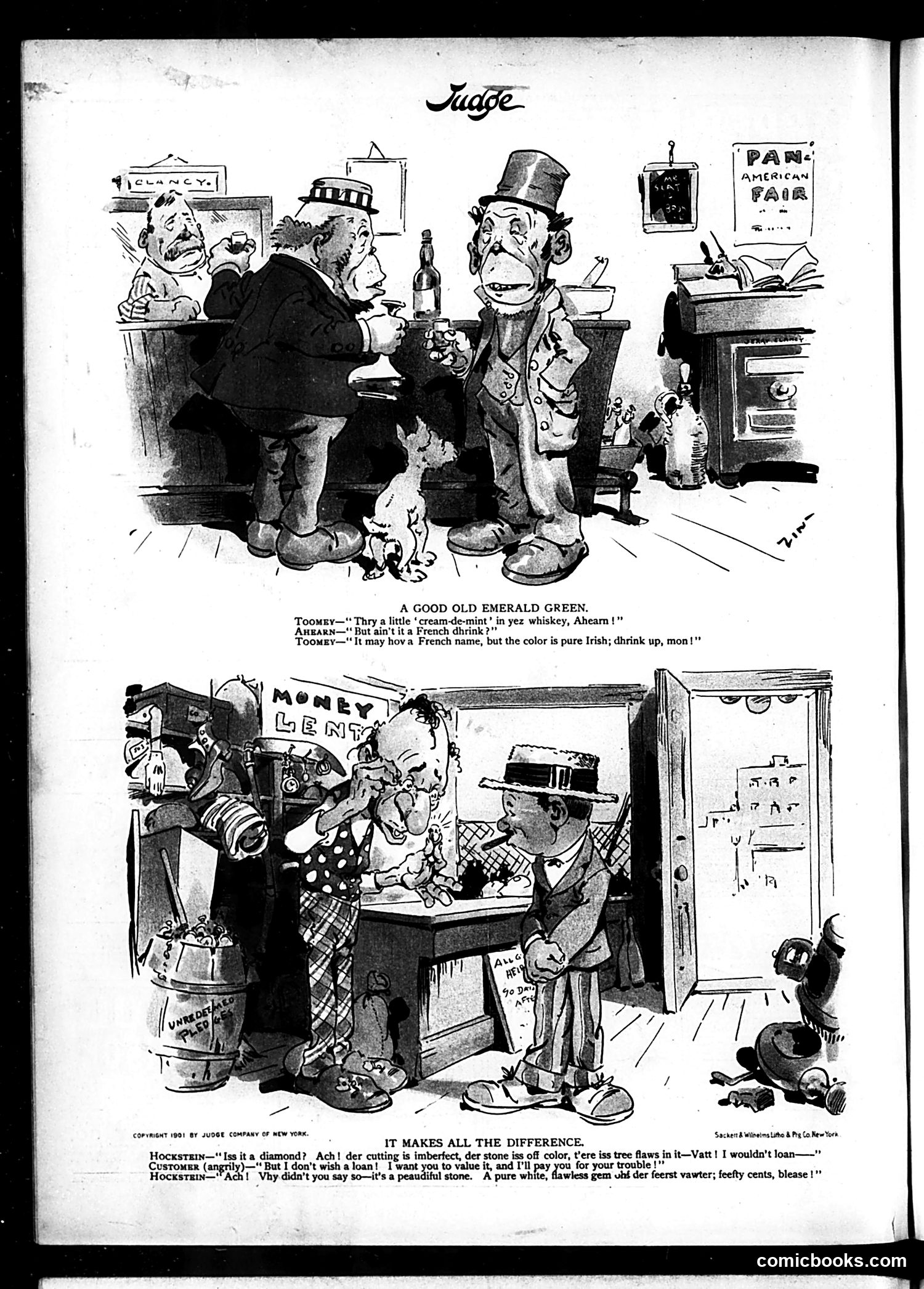
**Top cartoon: "A Good Old Emerald Green"** Two Irish-accented characters (Toomey and Ahearn) discuss adding crème de menthe to whiskey. The joke plays on ethnic stereotypes: Ahearn objects that it's a "French drink," but Toomey argues the green color makes it "pure Irish." This satirizes Irish-American identity and drinking culture, suggesting they'll adopt anything if it appears Irish enough. **Bottom cartoon: "It Makes All the Difference"** A Jewish pawnbroker (Hockstein, identified by Yiddish accent and stereotypical features) harshly criticizes a diamond's quality when asked to appraise it for a loan. When the customer insists he wants *valuation* (not a loan), Hockstein suddenly praises it as "peaudiful"—revealing his dishonesty. The satire targets Jewish moneylenders' reputation for deception and exploiting customers. Both cartoons rely on ethnic caricature and stereotype humor typical of early 1900s Judge magazine.