
A complete issue · 16 pages · 1901
Judge — July 13, 1901
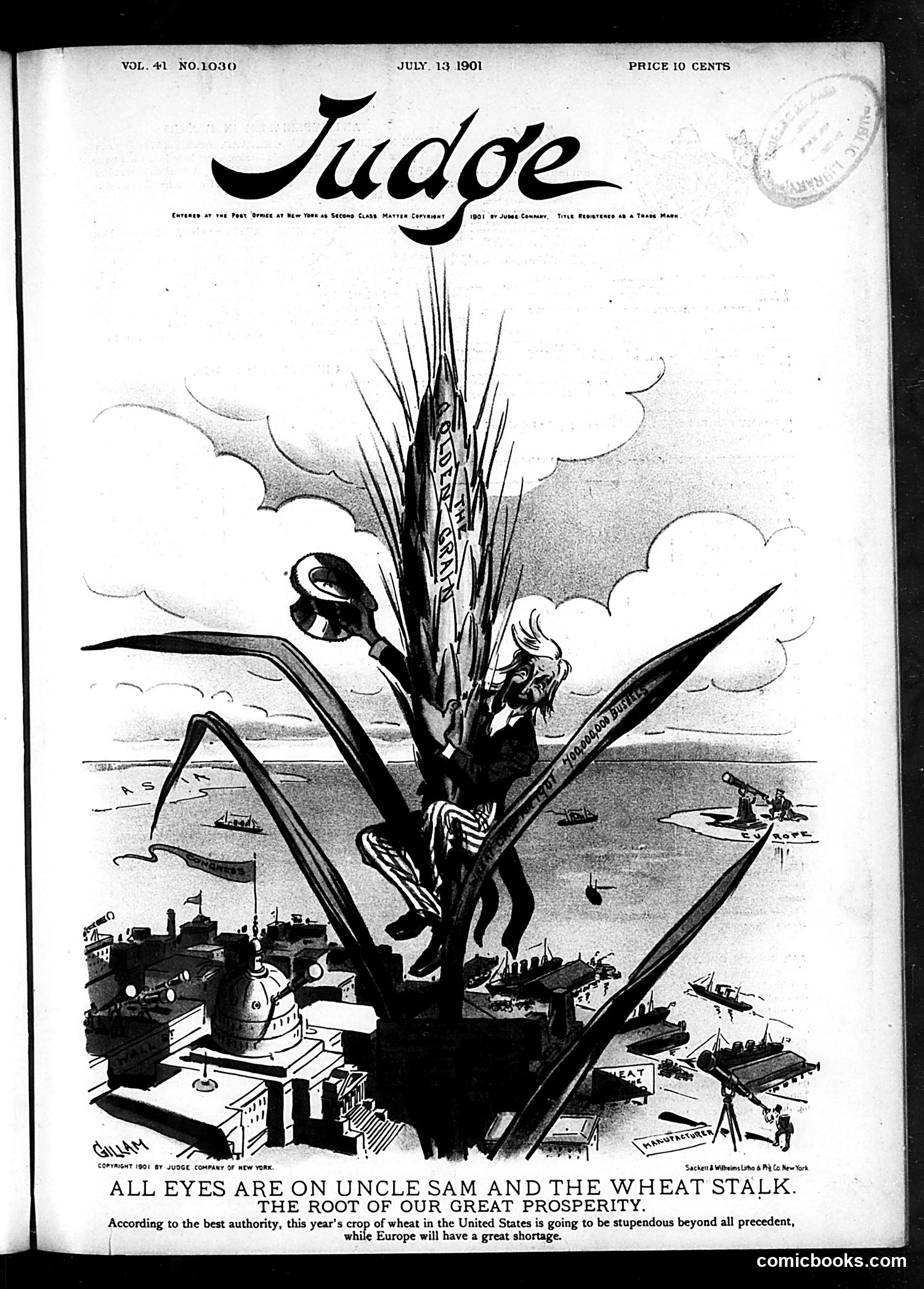
This satirical cover depicts **Uncle Sam** (personified as America) riding atop a giant wheat stalk, celebrating the nation's exceptional grain harvest. The image shows industrial prosperity below—factories, ships, and commerce—representing America's economic strength. The satire's point: while Europe faces wheat shortages, the United States enjoys agricultural abundance, positioning America as economically superior and prosperous. The exaggerated scale of the wheat stalk and Uncle Sam's triumphant pose emphasize American agricultural dominance and national pride. The caption states this year's U.S. wheat crop "is going to be stupendous beyond all precedent, while Europe will have a great shortage"—highlighting America's competitive advantage during a period of global agricultural instability.
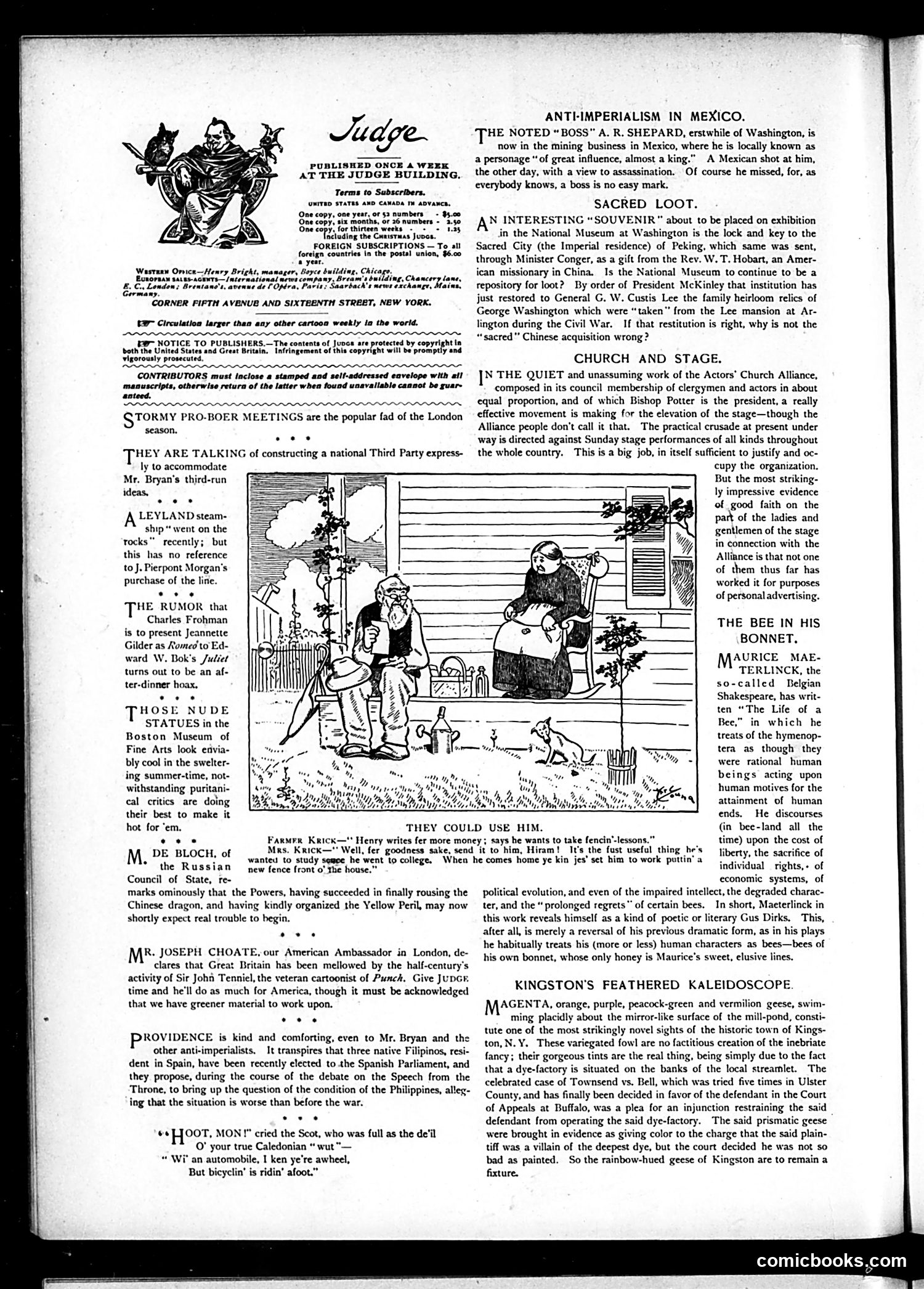
This cartoon satirizes **M. de Hirsch of the Council of State**, a Belgian politician mentioned in the text. The joke appears to involve a domestic scene where a wife complains to her husband about household management, suggesting "for goodness' sake, send it to him, Hiram!" The satire implies that de Hirsch—despite his political prominence—would be useful for mundane domestic tasks, reducing an important statesman to a figure of ridicule. This is typical of Judge's approach: deflating pompous political figures by imagining them in embarrassingly ordinary situations. The cartoon reflects early 20th-century American attitudes toward European politicians, treating them as subjects of mockery rather than serious statesmen.
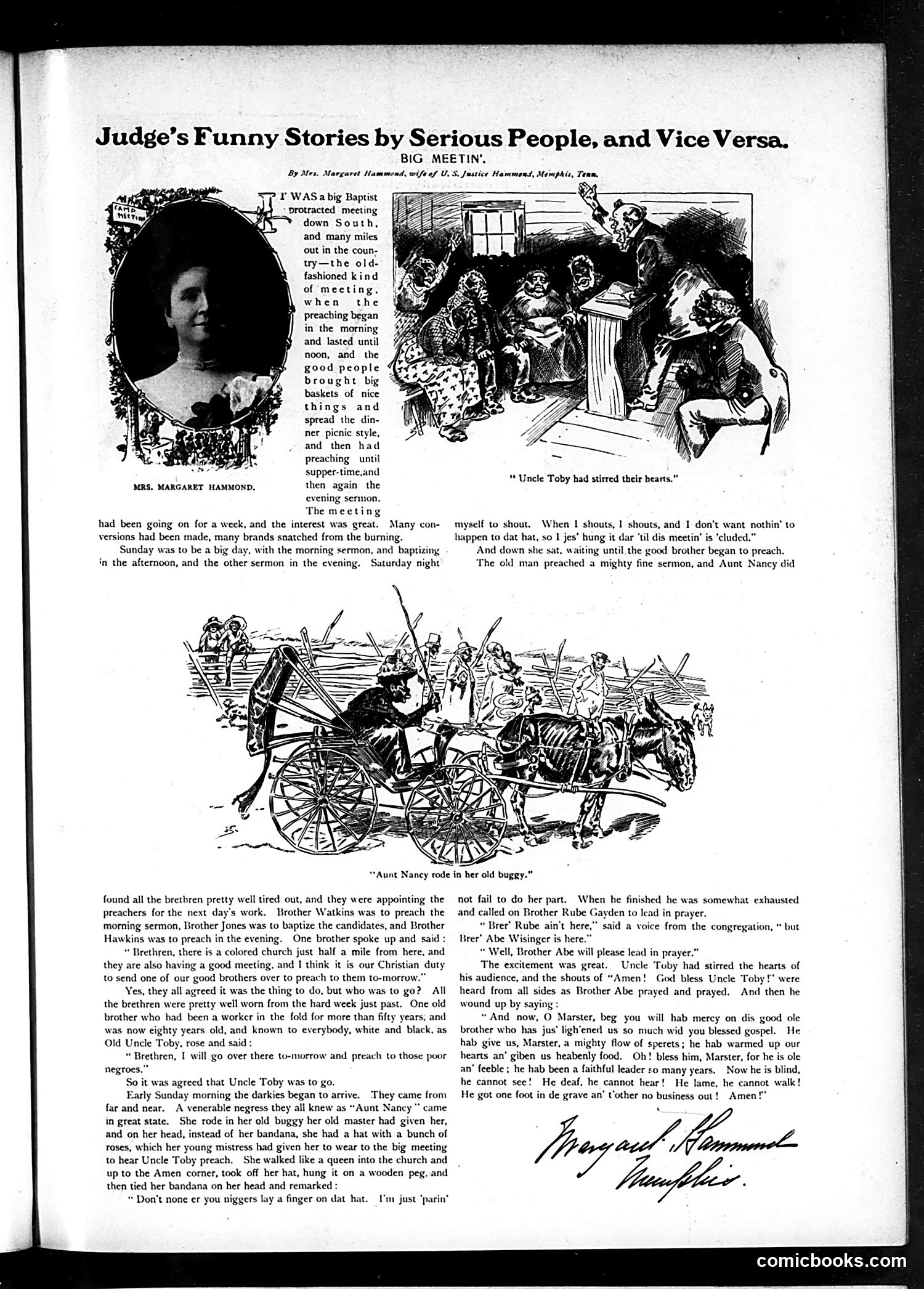
This page presents a humorous anecdote by Mrs. Margaret Hammon about a week-long Baptist revival meeting in the South. The satire targets rural religious practices and camp-meeting culture. The joke centers on Uncle Toby, an elderly Black man, who disrupts the proceedings by shouting during sermons. When told to be quiet, he explains his hat will fall off if he shouts—so he's been "hanging it dar" outside. Aunt Nancy arrives in an old buggy laden with attendees, creating a chaotic scene. The humor mocks the emotional exuberance of revival meetings and stereotypes rural Southern religious practice as loud and unrefined. The narrative voice treats the participants' earnest faith as absurd, a common satirical approach in early-20th-century Judge magazine content targeting religious enthusiasm among working-class and rural communities.
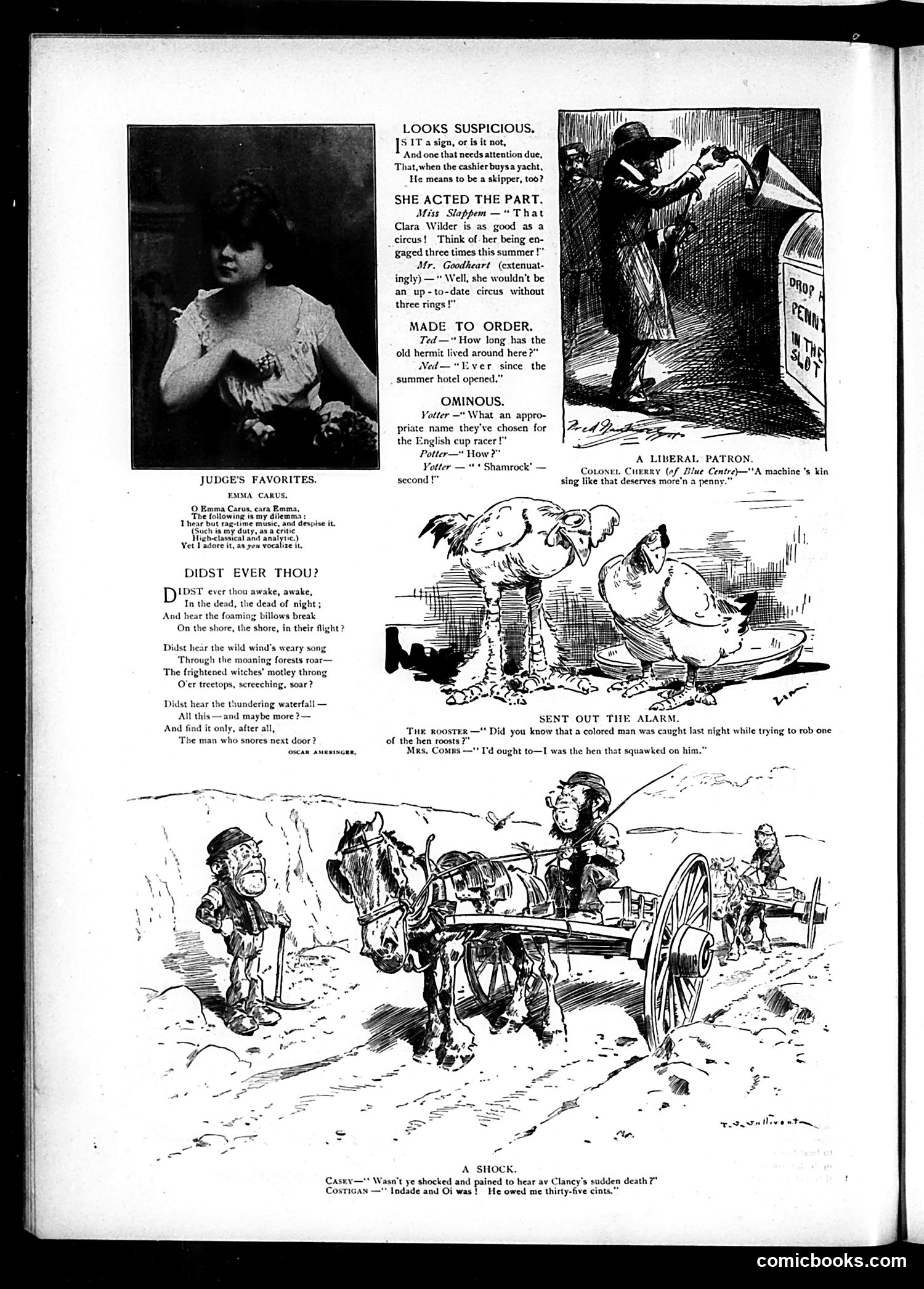
This Judge magazine page contains humorous sketches and literary pieces rather than political cartoons. The top features "Judge's Favorites" - a photograph of actress Emma Carus with theatrical commentary. Several sections present comedic dialogues and verse, including "Didst Ever Thou?" (poetic satire) and "Sent Out the Alarm" (a joke about a rooster catching a colored man attempting theft). The bottom cartoon "A Shock" depicts rural characters reacting to someone's sudden death, with dialogue suggesting surprise at the deceased's age. The overall tone reflects early-20th-century Judge magazine humor: theatrical gossip, rustic comedy, and dialect-based jokes typical of the era's entertainment-focused satirical publications. Without specific historical context, the exact references remain unclear.
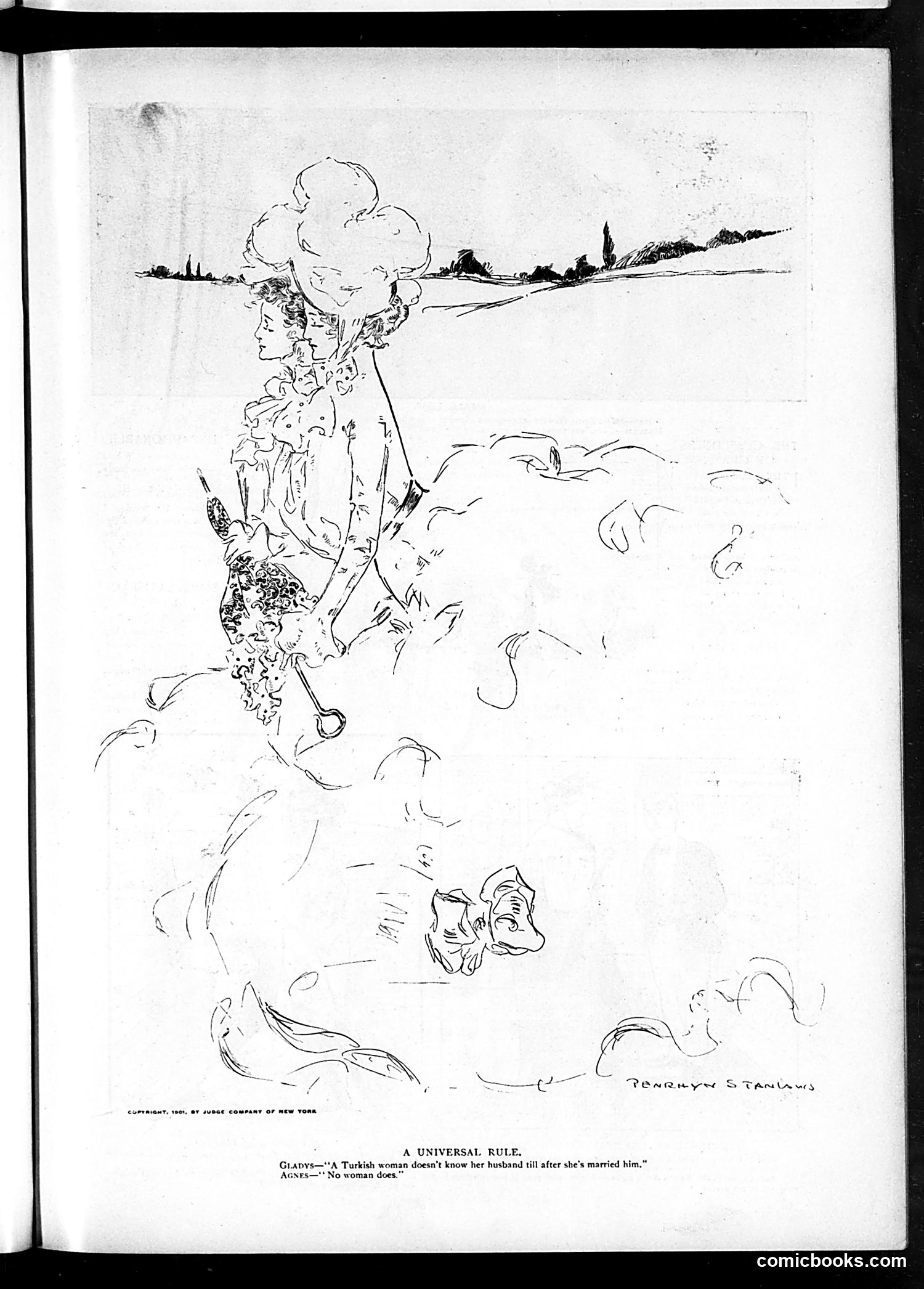
This cartoon satirizes marriage and gender relations through a conversation between two women, Gladys and Agnes. Gladys makes an observation about Turkish women not knowing their husbands until after marriage—likely referencing arranged marriages or cultural practices unfamiliar to American readers. Agnes's response—"No woman does"—extends the joke to universal application, suggesting that *all* women, regardless of culture, discover their husbands' true nature only after matrimony. The elaborate illustration shows a fashionably dressed woman with an exaggerated coiffure overlooking a romantic landscape, visualizing the naive expectations versus reality of marriage. The satire targets both romantic illusions and the disconnect between courtship and married life—a recurring theme in early 20th-century American humor about marriage.
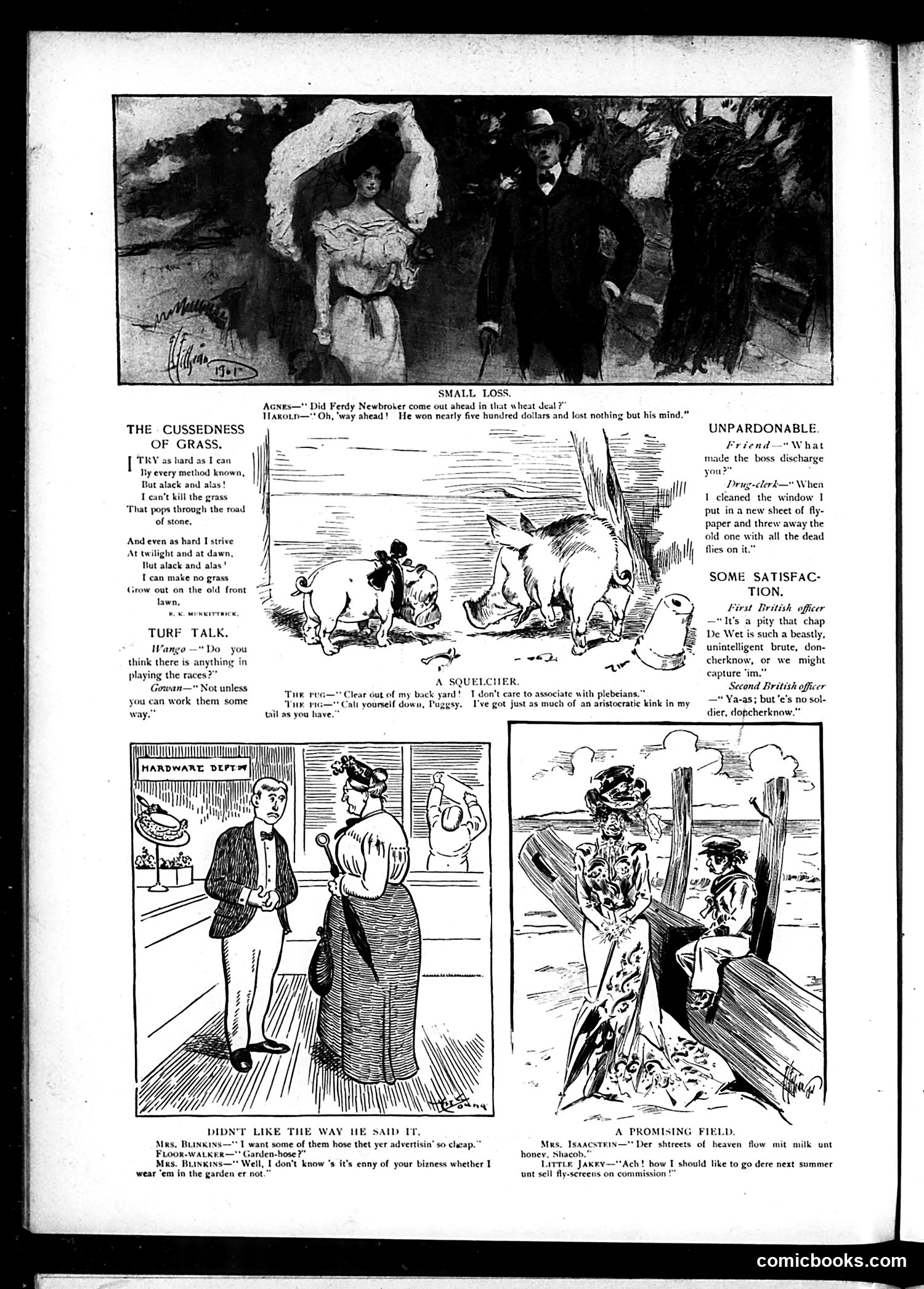
This page from *Judge* magazine contains multiple unrelated satirical sketches typical of early 20th-century American humor: **"Small Loss"** (top): Appears to reference a wheat speculation deal where someone profited financially but lost mental stability—satirizing financial recklessness. **"A Squelcher"**: Two pigs debate social class, mocking aristocratic pretension among working animals—a class-consciousness joke. **"Turf Talk"**: Brief quips about horse racing ("playing the races") and garden maintenance, offering social commentary on leisure activities. **Hardware Department scene**: A shopkeeper interaction about garden hoses, with gendered humor about domestic maintenance. **De Wet reference**: References the Boer War (unclear exact context without dating), discussing a military adversary's unintelligence—wartime satire. **Mrs. Isaacstein**: Ethnic humor (Yiddish dialect) about heavenly prosperity and selling fly-screens—exploiting stereotypes common in period humor. The page mixes class satire, ethnic caricature, and domestic comedy typical of *Judge*'s satirical style.
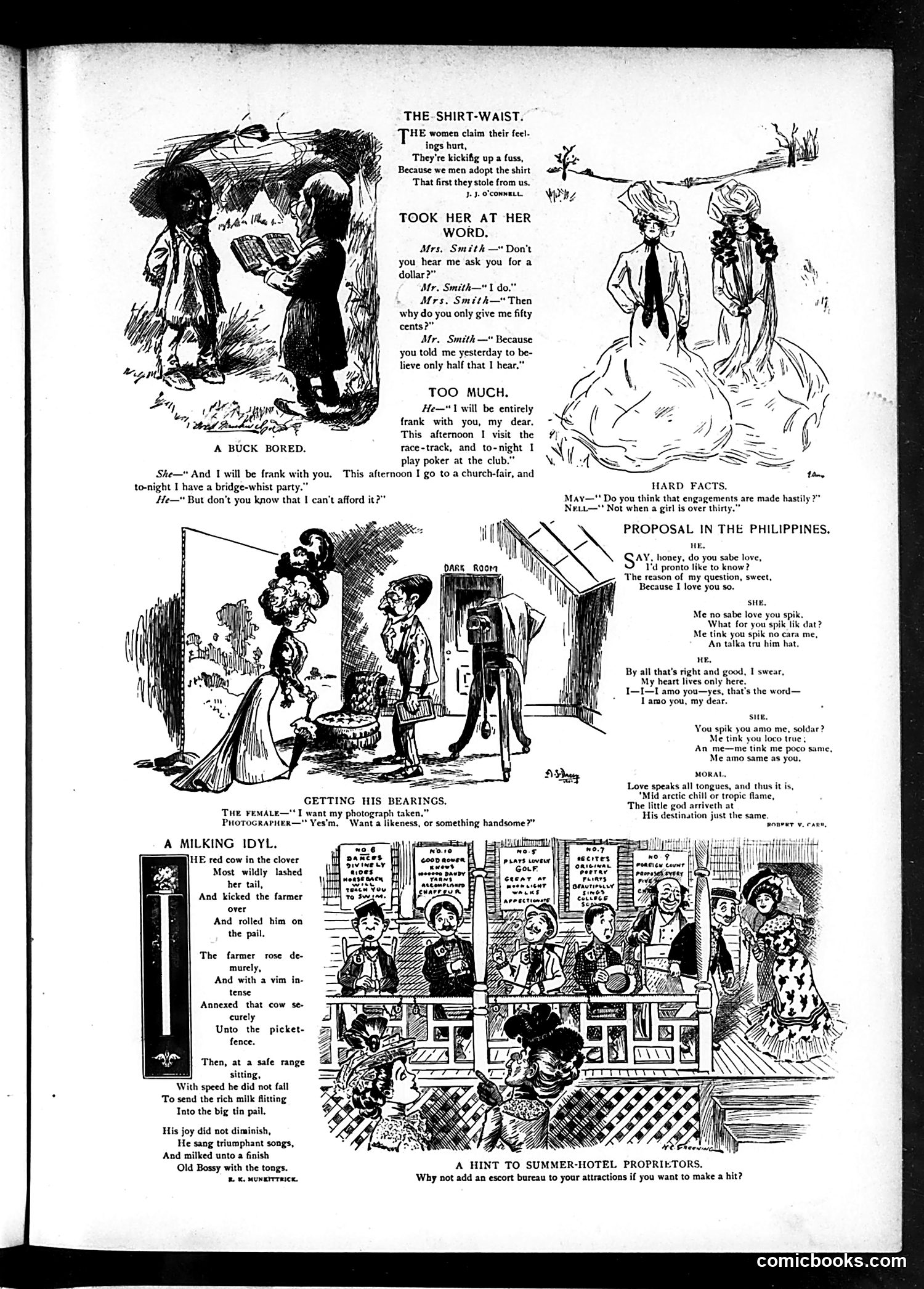
This early 20th-century satirical page uses humor to mock contemporary gender relations and social pretensions: **"The Shirt-Waist"** jokes that men adopted women's fashionable shirt-waists, reversing the usual accusation that women steal men's fashions. **"Took Her at Her Word"** depicts marital financial tension—a husband gives his wife fifty cents instead of a dollar, claiming he only believes "half" of what she says after she told him yesterday to do so. **"Hard Facts"** and **"Too Much"** present cynical marriage scenarios where husbands prioritize leisure (gambling, racing) over domestic obligations. **"Proposal in the Philippines"** uses broken English to satirize romantic encounters between American soldiers and Filipino women, reflecting post-1898 American colonial presence there. **"A Milking Idyl"** humorously depicts a farmer kicked by a cow, then milking her with tongs—inverting pastoral poetry's romanticized rural imagery. **"A Hint to Summer-Hotel Proprietors"** suggests hotels add "escort bureaus"—mocking the matrimonial desperation of women "over thirty" needing assistance finding husbands. The page reflects period anxieties about gender roles, courtship, and American imperial expansion.
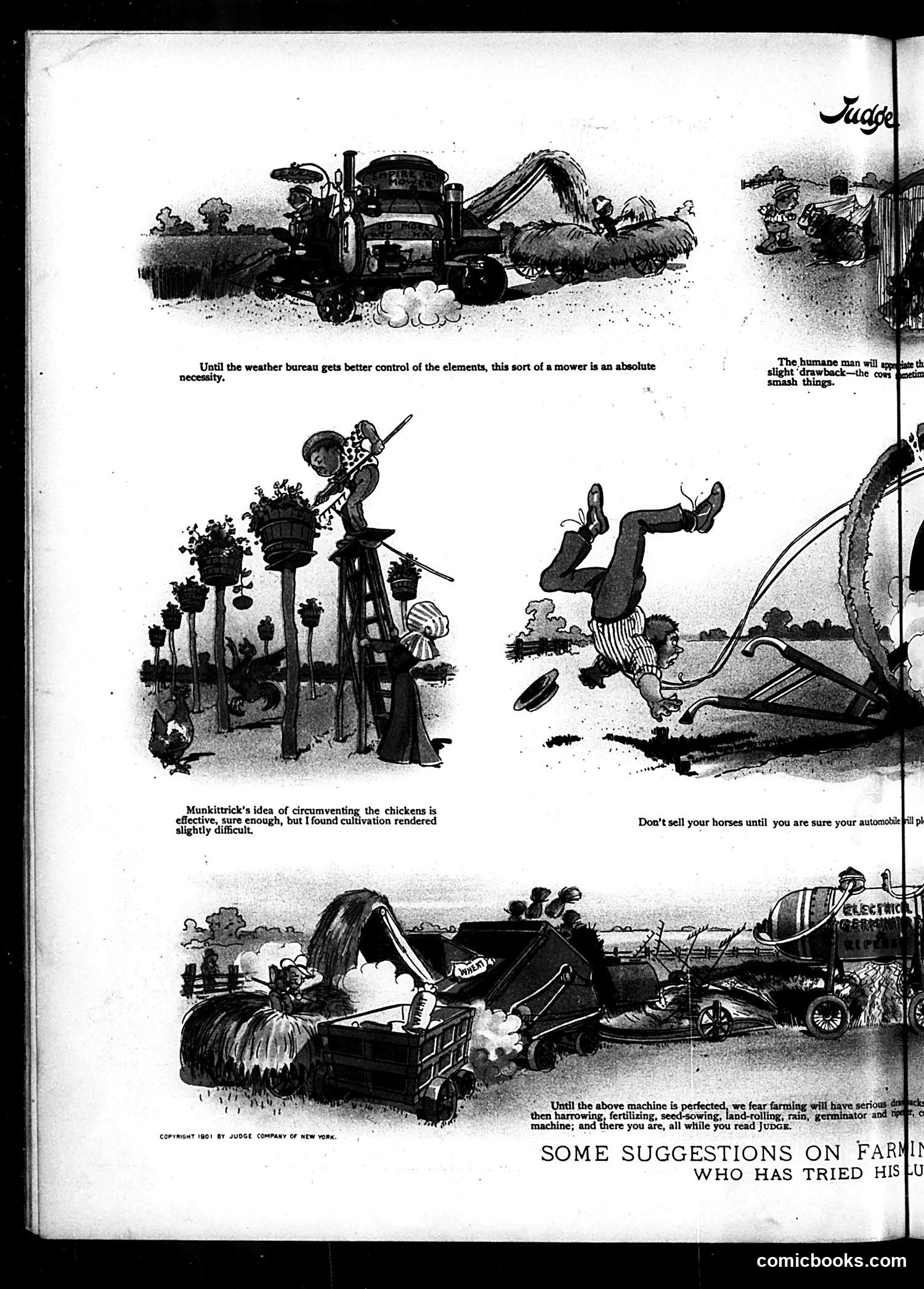
This page satirizes early agricultural mechanization and farming automation. The cartoons mock the impracticality of overly complex farm machinery solutions. The top illustration shows an elaborate mechanical mower, captioned about weather control necessitating such devices. Below, "Munkittrick's idea" depicts absurdly tall stilts or platforms for circumventing chickens in fields—technically effective but rendering cultivation "slightly difficult," the caption notes with dry humor. The remaining panels show increasingly ridiculous contraptions: a person entangled in farm equipment, and a massive automated harvesting machine with multiple implements working simultaneously. The satire targets wealthy farmers or inventors seeking technological shortcuts rather than practical farming methods. The final caption suggests these fantastical machines will someday handle all farm work while readers enjoy Judge magazine—mocking both the unrealistic optimism about mechanization and advertisements for such impractical devices. The humor lies in the gap between promotional promises and absurd reality.
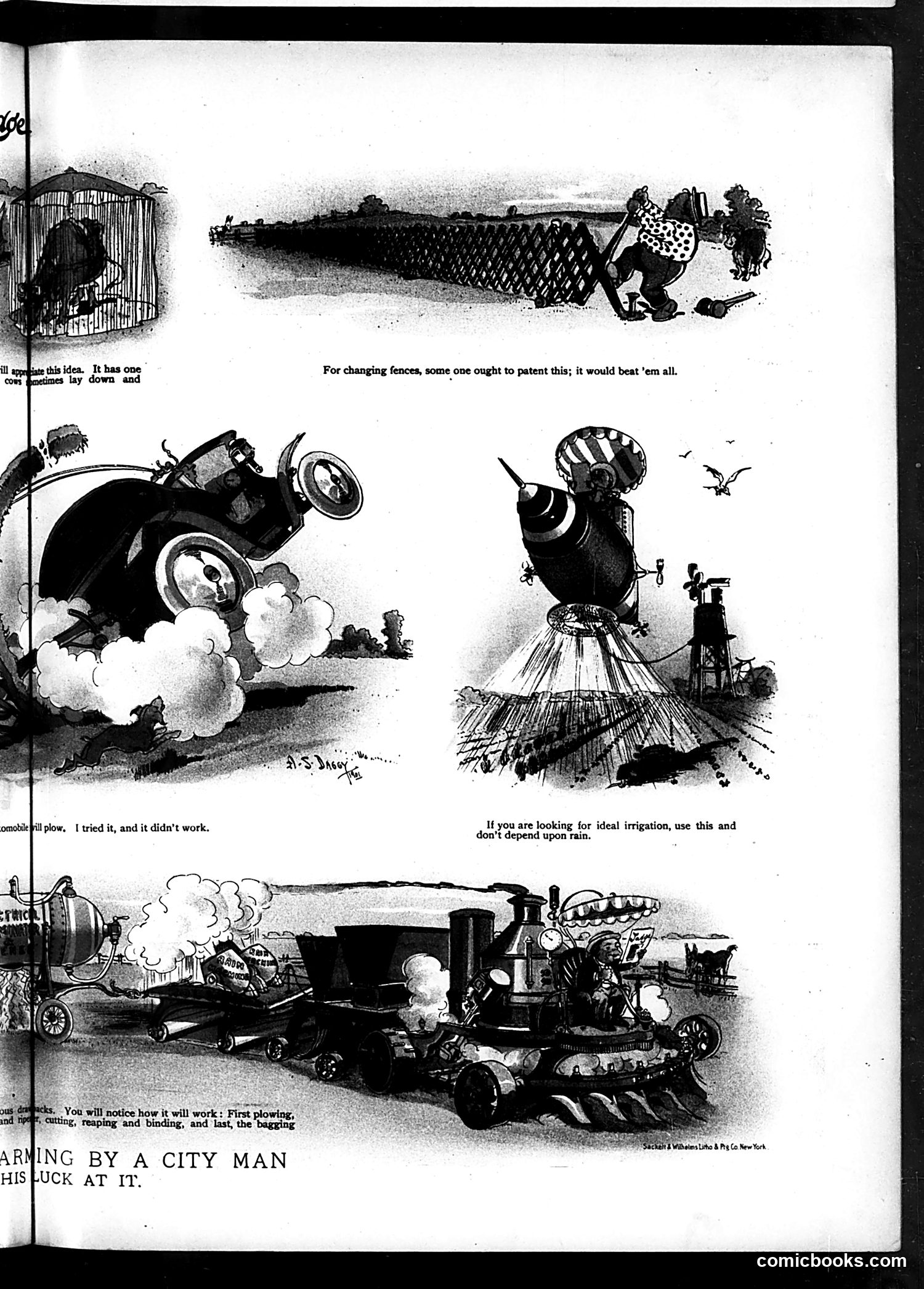
This satirical cartoon mocks urban newcomers attempting agriculture. Each panel depicts failed or absurd farming contraptions invented by someone unfamiliar with traditional methods: 1. **Top**: An elaborate expandable fence device—impractical and overcomplicated 2. **Middle left**: A car-powered plow that explodes 3. **Middle right**: An irrigation balloon/airship—comically inefficient 4. **Bottom**: A steam-powered harvesting machine combining plowing, cutting, reaping, and binding in one elaborate (and presumably malfunctioning) apparatus The humor targets the "city man" who believes mechanical ingenuity can replace agricultural knowledge and proven methods. Each failed invention suggests he's wasting resources on unnecessary complexity. This reflects early 20th-century tensions between urbanization and rural tradition, ridiculing the assumption that outsiders could simply mechanize farming without understanding its realities. The caption's resignation ("I tried it, and it didn't work") reinforces the joke's central message: book learning and gadgetry cannot substitute for experience.
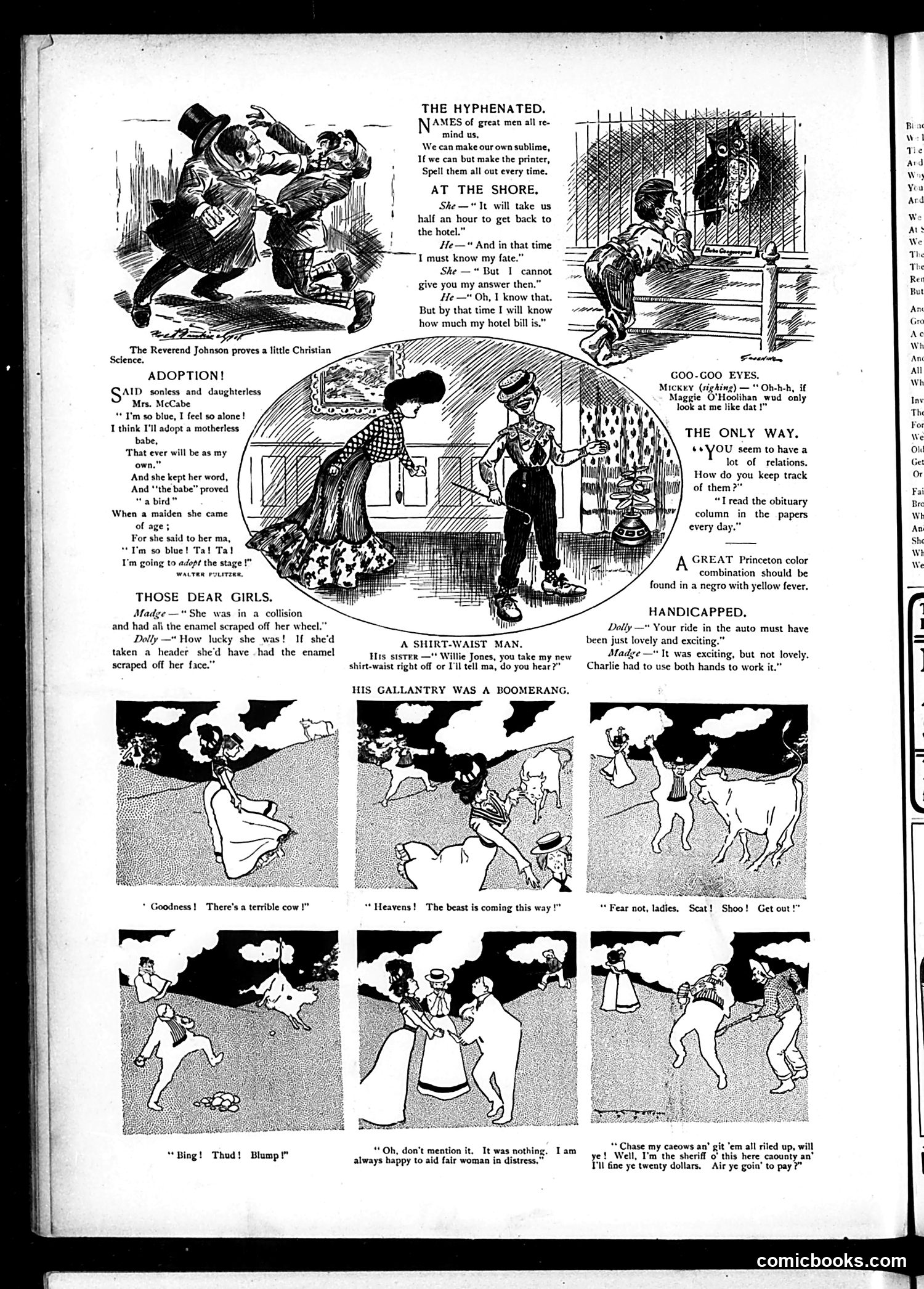
This page contains multiple short humorous pieces typical of early 20th-century satirical magazines: **"The Hyphenated"** mocks the difficulty of spelling hyphenated names—a complaint about immigrants and their "un-American" surnames. **"Adoption"** and **"Those Dear Girls"** are domestic comedies about women and vanity: one woman adopts a child who later wants to become an actress; another girl jokes that a woman in a car crash lost her facial enamel rather than wheel enamel. **"At the Shore"** plays on a man's anxiety about proposing marriage versus calculating his hotel bill. **"Shirt-Waist Man"** depicts a boy's interaction with his sister over borrowed clothing. **"His Gallantry Was a Boomerang"** shows a comic sequence where a man helps women escape a cow; the final panel reveals he's the sheriff demanding payment for the disruption. The remaining items are brief quips about Princeton colors, relations tracking via obituaries, and automobile riding—all employing the period's casual racism and gender stereotypes typical of Judge's humor.
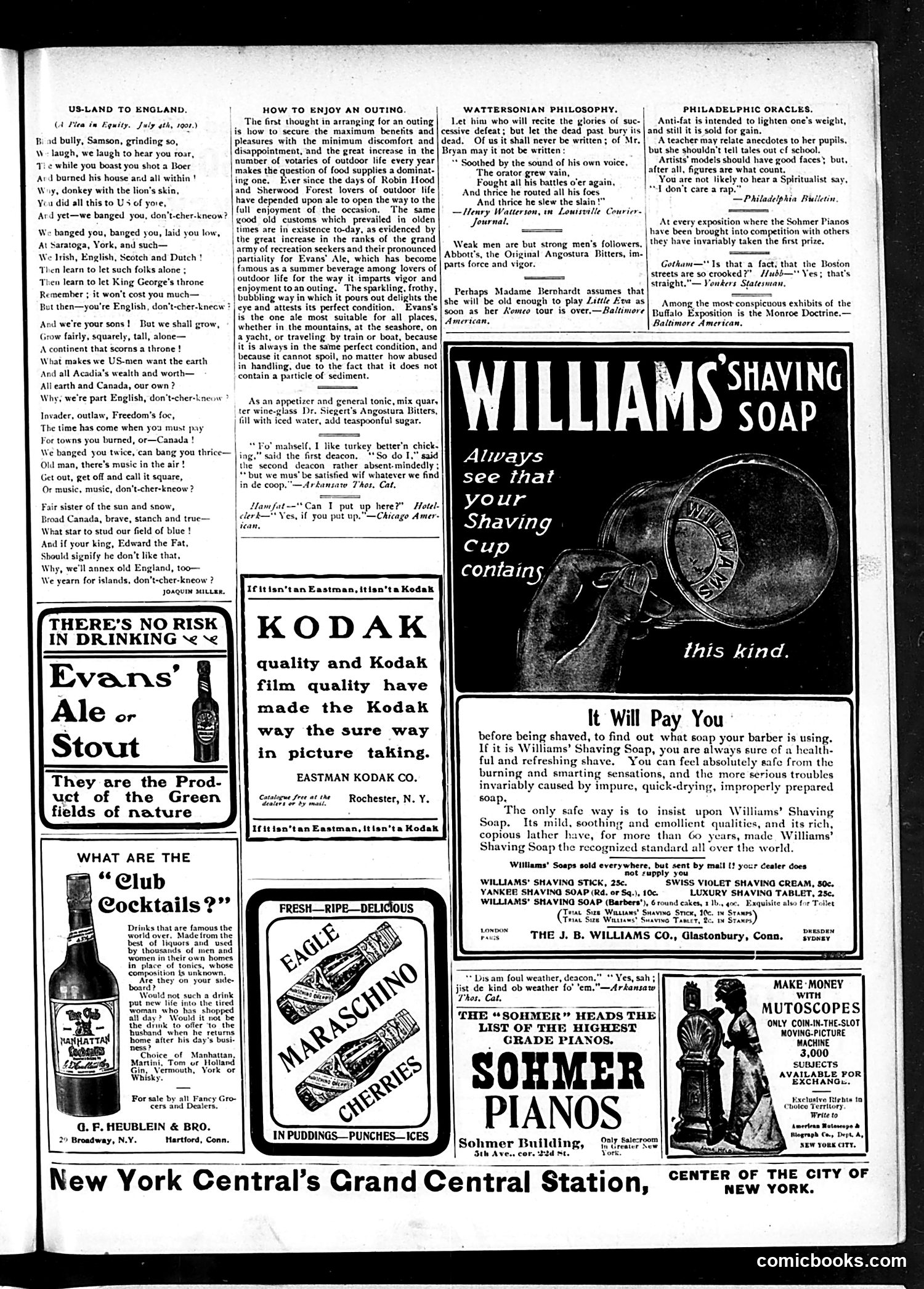
This page is primarily **advertising with one substantial poem**. The main content is "US-Land to England," a patriotic verse by Joaquin Miller (byline visible) addressing Britain. **The Poem's Message:** The poem uses repetitive, colloquial language ("don't-cher-know") to taunt Britain, referencing American Revolutionary War victories (Saratoga, York) and threatening further conflict if Britain doesn't respect American independence and territorial claims (specifically Canada). It positions the US as a growing nation descended from but now superior to Britain, mixing swagger with nationalist sentiment. **Historical Context:** Published around 1901, this reflects post-Spanish American War American expansionism and confidence. The references to "King George" and Britain "burning" American towns invoke Revolutionary-era grievances, while the threats toward Canada and Britain reflect contemporary tensions and American territorial ambitions. **The Advertisements:** The remaining page space contains period product ads (Evans' Ale, Kodak, Williams' Shaving Soap, Sohmer Pianos, mutoscopes) typical of Judge's revenue model.
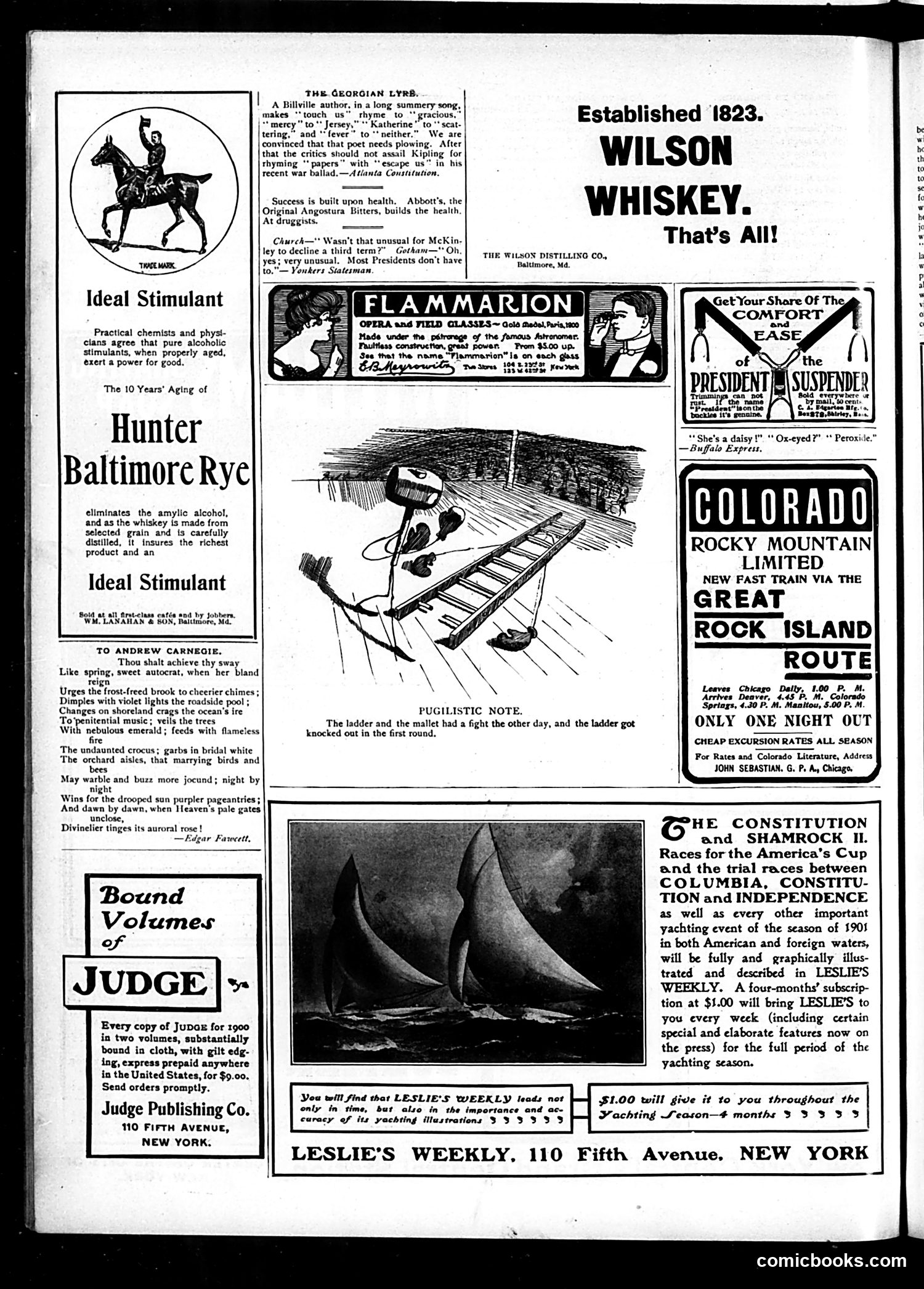
This page is primarily **advertising** with minimal editorial content. The main items are: **Text Humor**: Brief satirical commentary pieces mock a Georgian poet's poor rhyming (contrasting with Kipling's work) and McKinley's declining a third presidential term—suggesting most presidents wouldn't voluntarily step down. **Central Cartoon**: A simple sketch shows a ladder and mallet in a boxing match, with the caption "The ladder and the mallet had a fight the other day, and the ladder got knocked out in the first round"—a pun on "mallet" defeating "ladder" in a physical confrontation. **Advertisements**: The page is dominated by ads for alcohol (Wilson Whiskey, Hunter Baltimore Rye, Abbott's Bitters)—notably marketed as health tonics, reflecting early-1900s practices when alcohol was promoted for medicinal purposes. Other ads promote trains and Judge's bound volumes. The page lacks political cartooning; it's essentially a period advertising layout with minor comedic interludes.
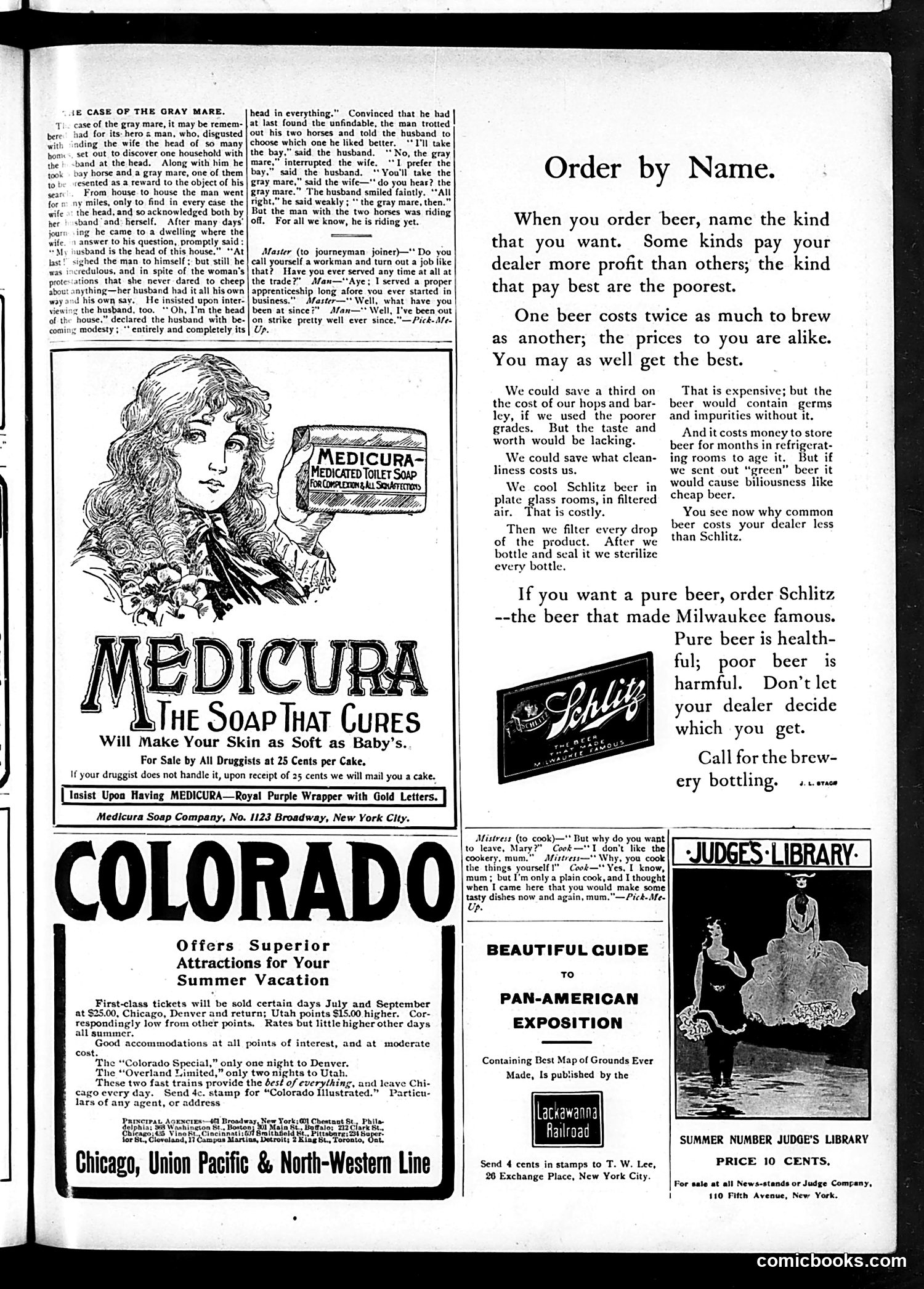
This page contains **primarily advertisements** rather than editorial cartoons. The main satirical content is minimal. The one **actual cartoon** depicts "The Case of the Gray Mare"—a traditional folk tale about a man seeking a household where the husband truly leads. The joke: he finally finds one, only to discover the wife overrules the husband's choice of horse anyway, proving no such household exists. It's a timeless joke about domestic power dynamics, suggesting wives ultimately control their households despite men's claims of authority. The page is otherwise dominated by **commercial advertisements**: Medicura soap (25 cents), Schlitz beer (emphasizing quality ingredients and purity), Colorado vacation travel via the Chicago, Union Pacific & North-Western railroad, and a Pan-American Exposition guide. The Schlitz ad notably argues consumers should "order by name" rather than let dealers choose—an indirect pitch against cheaper competitors, though all beers cost customers the same price.
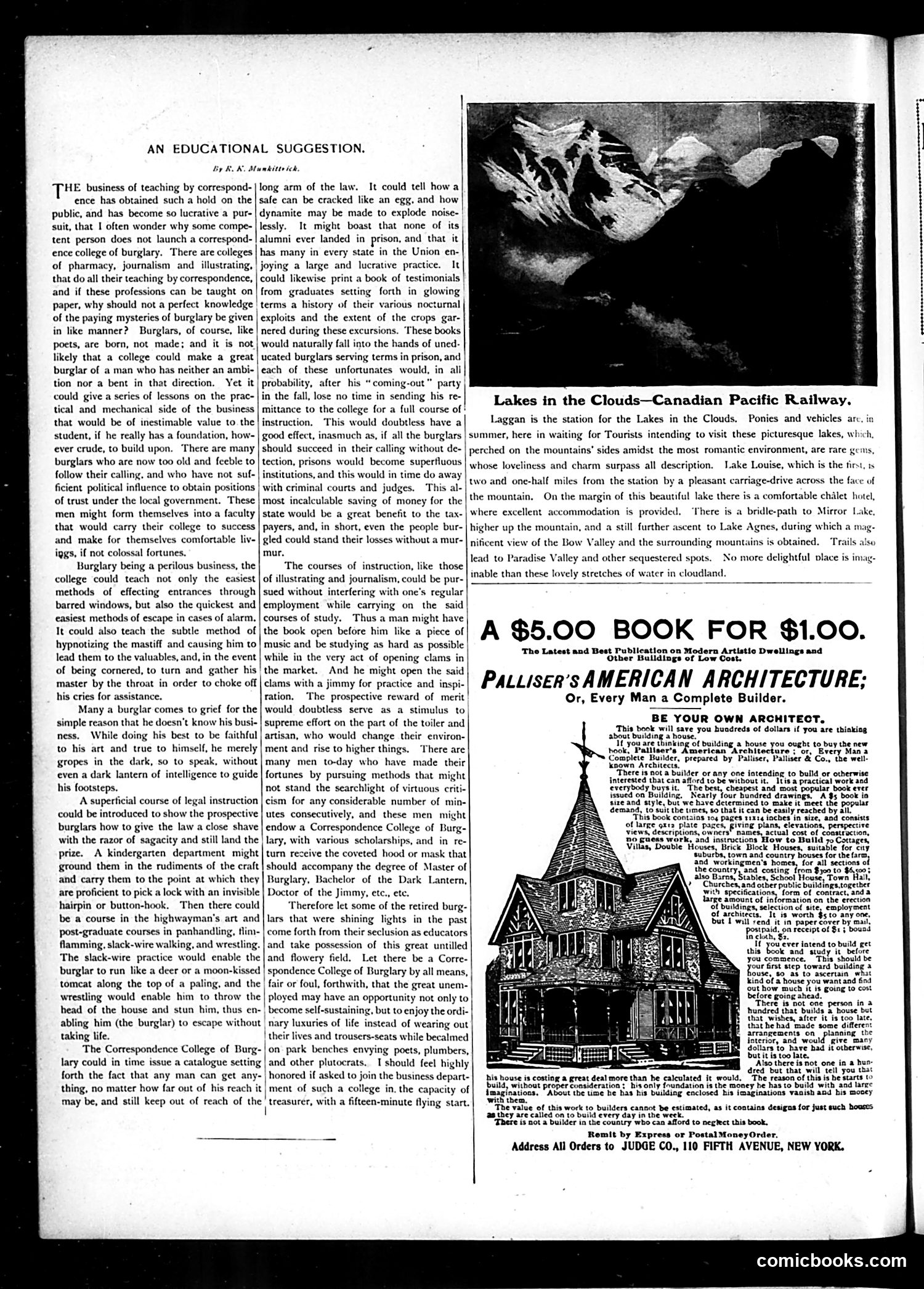
This is a satirical essay by K.K. Munkittrick proposing an absurd idea: a correspondence college teaching **burglary as a profession**. The humor works by treating crime with deadpan seriousness, suggesting burglarry deserves formal education like legitimate professions (pharmacy, journalism). The satire targets two things: 1. **The correspondence school boom** of the era—Judge's readers would recognize these as a common, often-dubious educational trend offering mail-order courses in various skills. 2. **Social hypocrisy**—Munkittrick ironically notes that if burglary is truly a "calling" (like poetry), shouldn't it receive institutional support? Aging, unemployed burglars with insufficient "political influence" could become faculty. The essay playfully details a curriculum including "slack-wire practice" and hypnotizing guard dogs, mocking both the grandiosity of correspondence schools and suggesting that criminal enterprise operates with the same systematic ambition as legitimate business. The page also contains an advertisement for Palliser's *American Architecture* book—unrelated satirical content typical of Judge's mixed format.
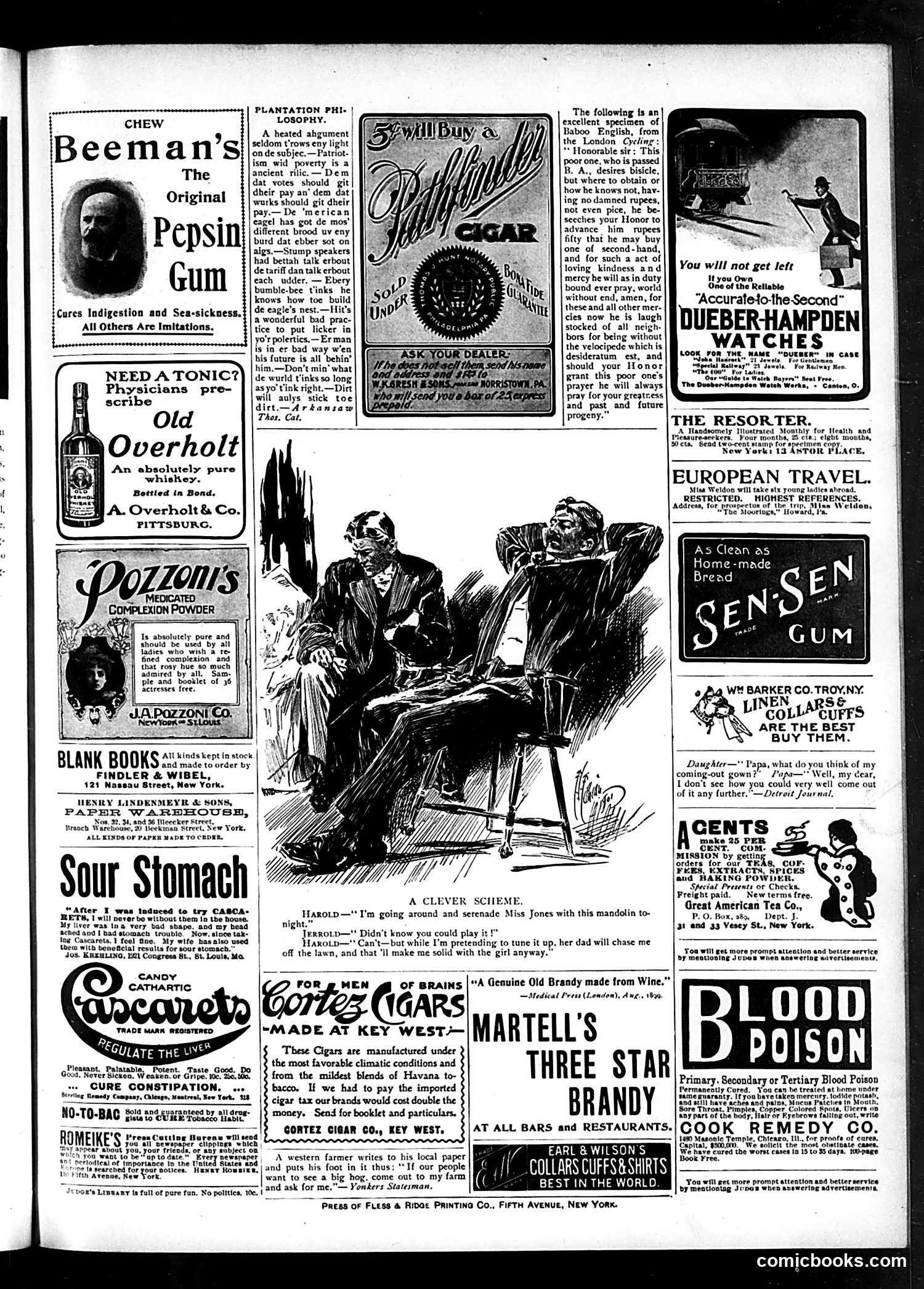
This page is primarily **advertising**, typical of early 20th-century magazines. The central cartoon, titled "A Clever Scheme," depicts two young men discussing how one will serenade a woman (Miss Jones) with a mandolin while pretending to tune it—banking on her father chasing him off the lawn, which will paradoxically endear him to the girl. It's a lighthearted joke about courtship and parental disapproval. The "Plantation Philosophy" section offers folksy wisdom in exaggerated dialect, likely reflecting period stereotypes and attempts at humor through vernacular speech. The page is dominated by patent medicines and tonics (Beeman's Pepsin Gum, Old Overholt whiskey, Cascarets laxatives, Martell's brandy) typical of the era before FDA regulations. These advertisements reveal the unregulated health-product market of the time. The only other notable content is a brief excerpt mocking Indian English ("Baboo English"), reflecting contemporary attitudes toward colonial subjects.
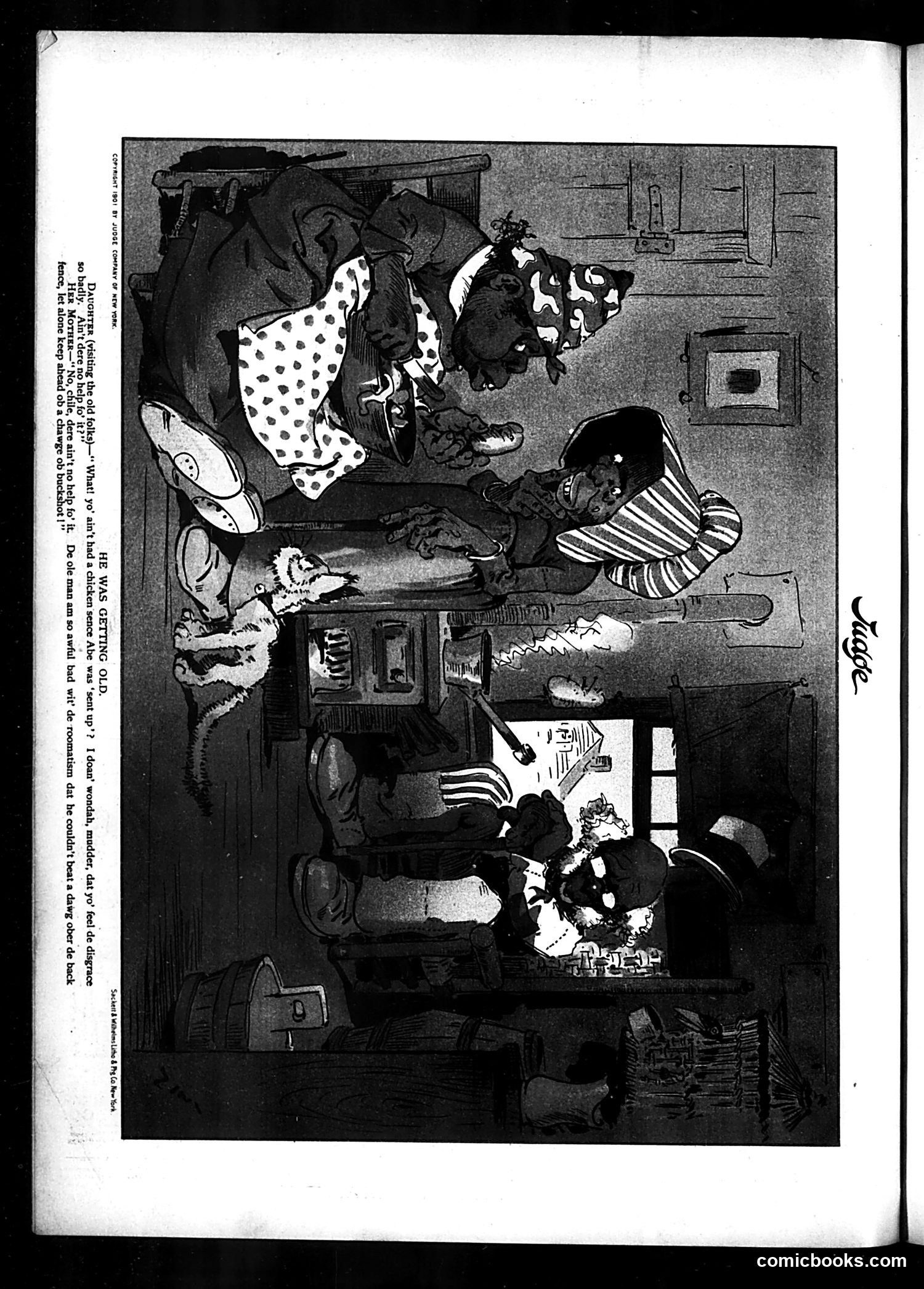
This appears to be a late 19th-century satirical cartoon using racist dialect and caricature—a regrettable but common style in Judge magazine of that era. The scene depicts a domestic conversation between a mother and daughter, rendered in exaggerated African American vernacular. The dialogue references "Abe" being "sent up" (imprisoned), with the mother explaining the family disgrace by noting the father is too physically incapacitated by rheumatism to maintain discipline or "keep ahead" of trouble. The satire targets working-class or impoverished Black families, mocking both parental authority and physical infirmity. The joke relies on stereotypes and dialect humor typical of Judge's entertainment approach. The specific "Abe" reference remains unclear without additional context—it may reference a specific criminal case or simply a generic name used for comedic effect. The lithographer credit appears at bottom.