
A complete issue · 16 pages · 1901
Judge — June 15, 1901
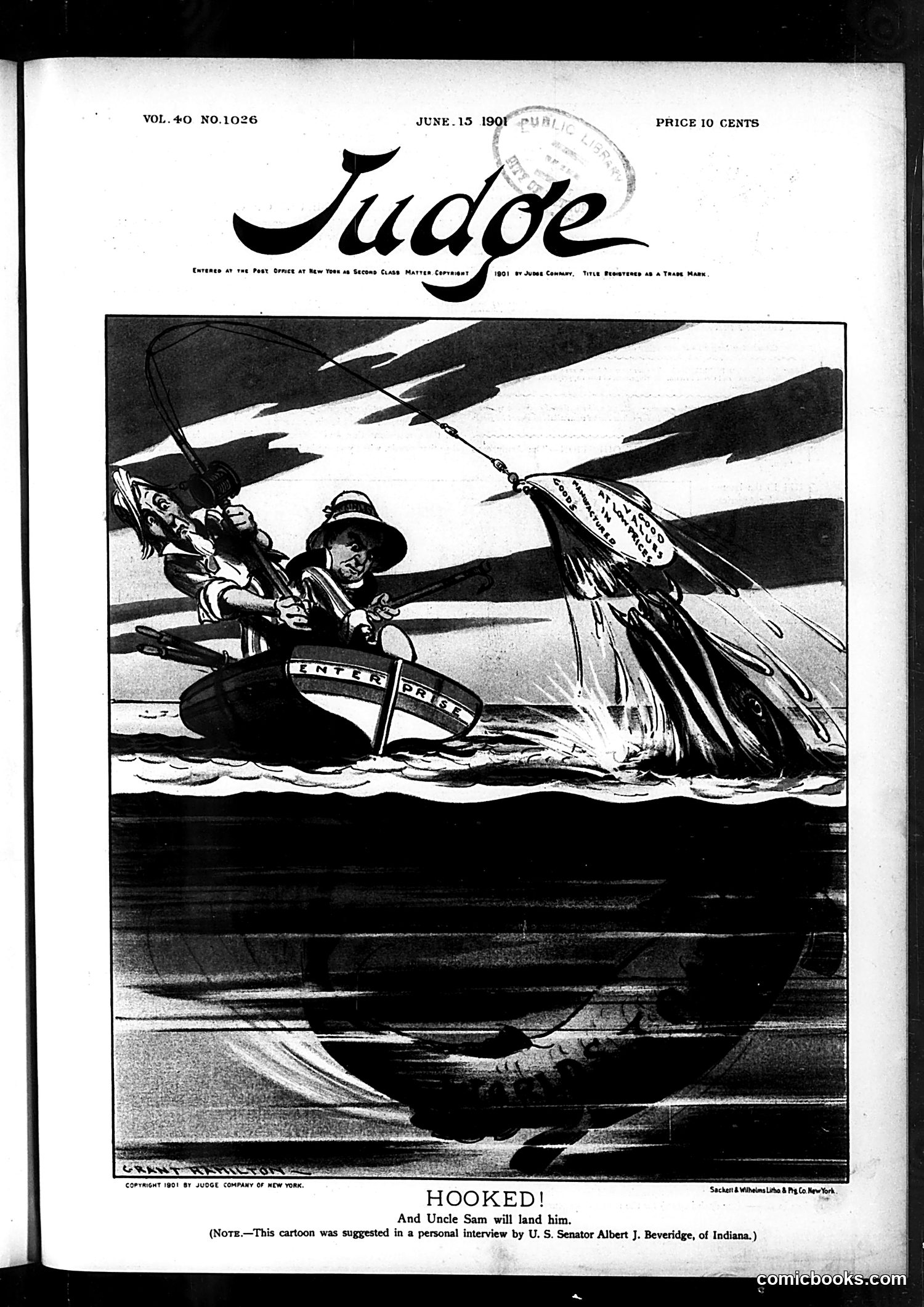
This political cartoon satirizes Uncle Sam's anticipated acquisition of the Philippines. The image shows Uncle Sam in a small boat being "hooked" by a large fish labeled "INTER OCEAN" (likely referencing the *Chicago Inter Ocean* newspaper or expansionist media). The caption states "And Uncle Sam will land him," suggesting the U.S. will inevitably gain control of the Philippines—depicted as the struggling fish on the line. A note attributes the cartoon's concept to U.S. Senator Albert J. Beveridge of Indiana, a prominent imperialist advocate. The satire critiques American expansionism and media influence in promoting imperial ambitions in the Pacific, presenting the Philippines acquisition as an inescapable trap or entanglement rather than a triumph.
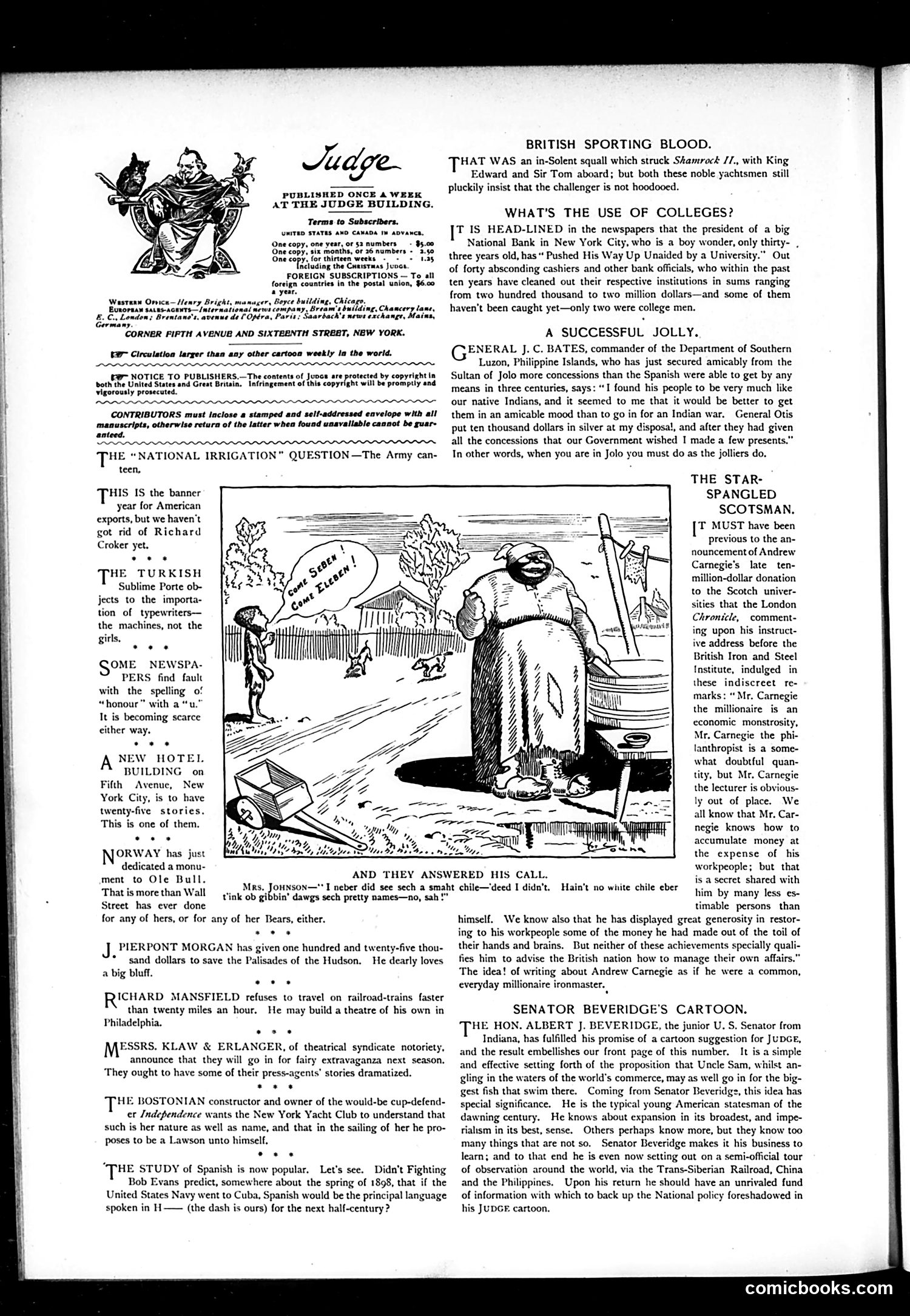
This cartoon satirizes Andrew Carnegie's philanthropic claims. The central figure—a large, rotund man labeled "Carnegie"—sits contentedly while small figures around him work. The caption references Mrs. Johnson saying "I asked did she such a small chile—dead I didn't. Hair's no white chile cher" and notes Carnegie has made money "at the expense of his workpeople." The satire's point: Carnegie publicly positions himself as generous to the working class, but the cartoon suggests his wealth accumulated through exploiting laborers. The text accompanying it explicitly critiques his claiming moral authority on economic matters while the text notes he's "out of place" offering advice to nations—his philanthropy is presented as guilt-driven rather than genuinely altruistic.
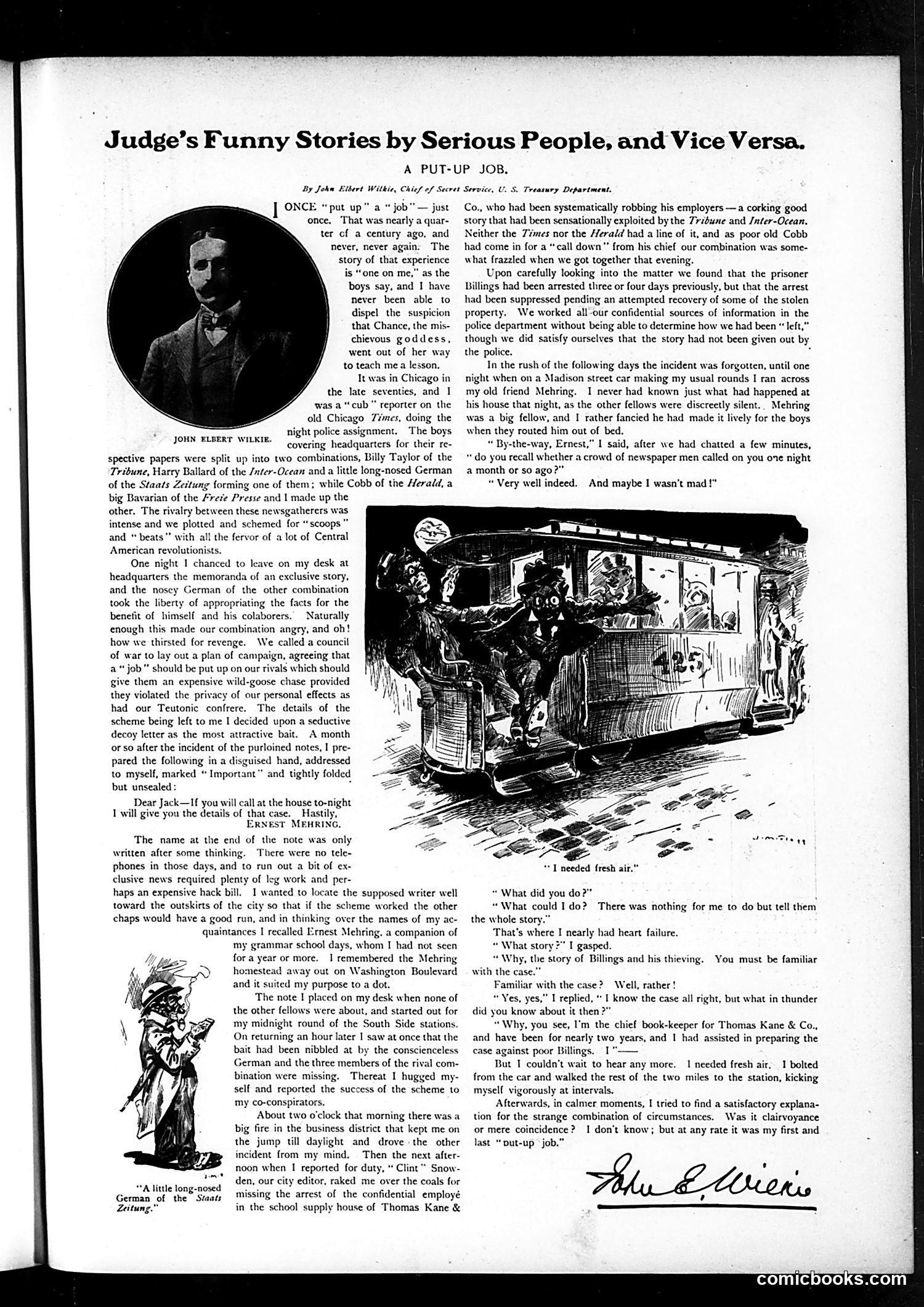
This page features a humorous essay by John Elbert Wilkie, Chief of the Secret Service, titled "A Put-Up Job." The text recounts an anecdote about newspaper rivalry in Chicago during the late 1800s, when Wilkie worked as a reporter. The main cartoon depicts a street scene with what appears to be a streetcar or trolley, with a figure exclaiming "I needed fresh air." This illustrates Wilkie's story about competing reporters from rival papers (the *Tribune* and *Herald*) who devised an elaborate scheme to trap each other by fabricating a crime story about employee theft. The cartoon humorously captures the moment when one reporter, realizing he'd been duped into publicizing false information, needed to escape the situation. The satire mocks journalistic deception and competitive ruthlessness among newspapers of that era.
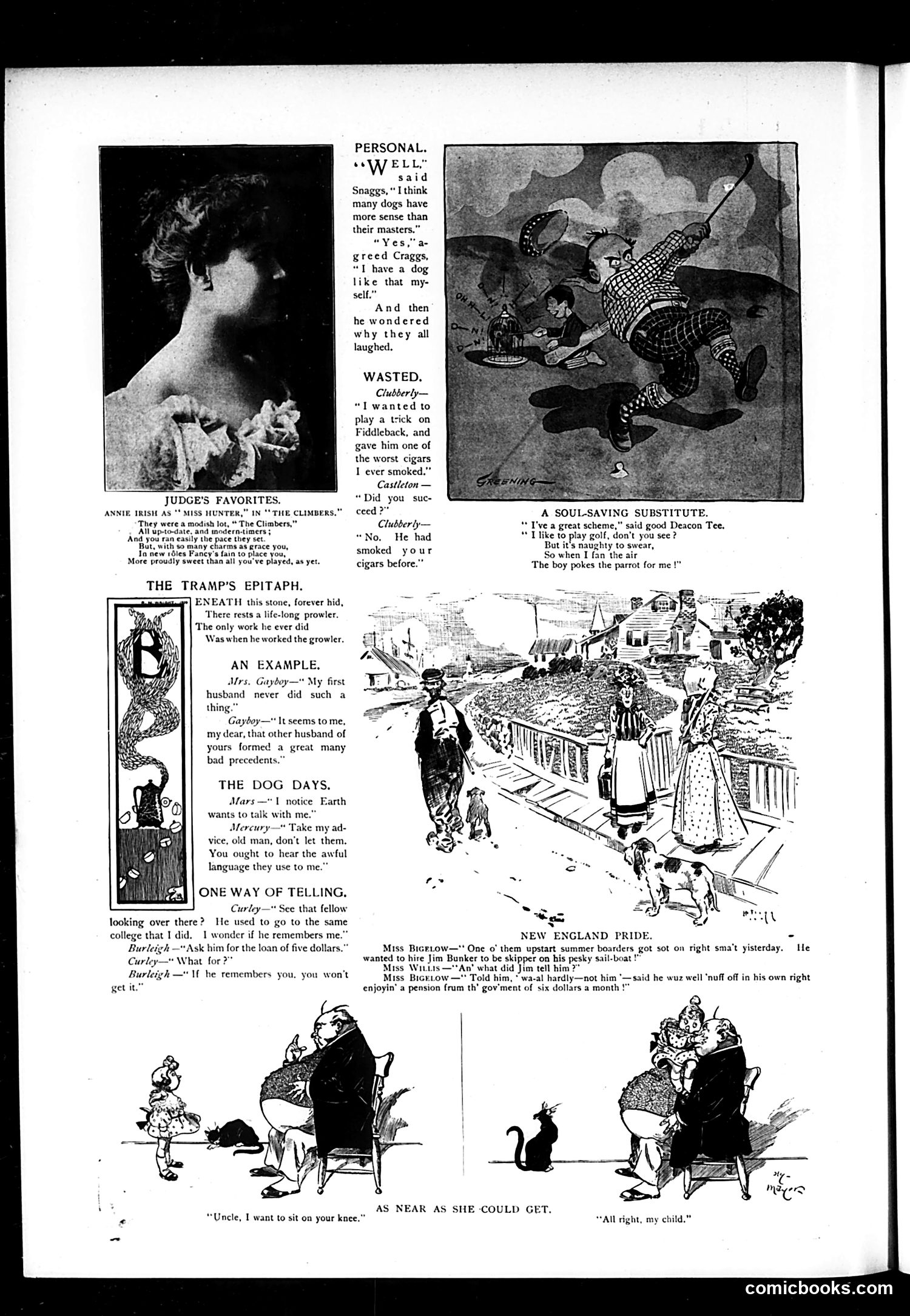
This page contains mostly humor columns and light satirical sketches rather than political cartoons. The content includes: **"Personal Well"** - A witty exchange where Smaggs notes dogs have more sense than masters, prompting laughter about human foolishness. **"Wasted"** - A anecdote about someone attempting to trick Fiddleback, illustrating themes of attempted deception. **"New England Pride"** - A narrative about hiring Jim Bunker as a boat skipper, with dialogue suggesting regional character types and social pretension. **Illustrated sketches** show domestic scenes: an uncle with a child, and a man with a rat, emphasizing humor through visual comedy and physical situations rather than political commentary. The overall page targets human vanity and social absurdities through gentle, character-based humor typical of early 20th-century American magazine satire.
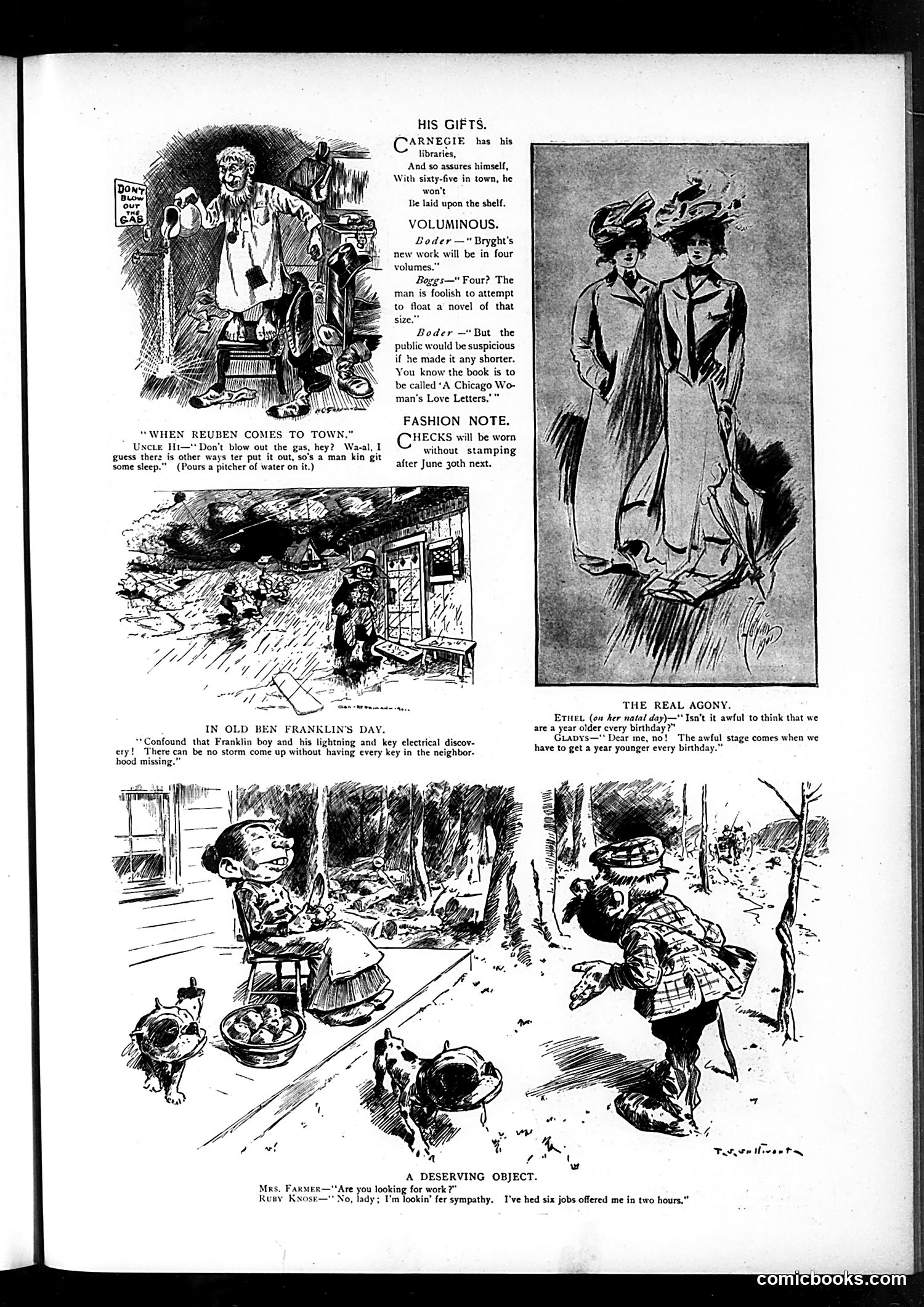
This page contains several brief satirical jokes typical of early 20th-century American humor: **"His Gifts"** mocks Andrew Carnegie's philanthropy—specifically his library donations—suggesting he's building them to ensure his own legacy and remembrance rather than pure altruism. **"Voluminous"** jokes about unnecessarily lengthy novels, likely referencing a contemporary work called "A Chicago Woman's Love Letters." **"When Reuben Comes to Town"** appears to be a domestic humor piece about rural folk using unconventional methods. **"In Old Ben Franklin's Day"** satirizes how modern electrical technology (lightning rods, keys) has created new problems—neighborhood theft of metal items during storms. **"Fashion Note"** references a women's fashion trend regarding checked fabrics. **"The Real Agony"** presents a birthday joke about aging—the woman's complaint about getting older annually. **"A Deserving Object"** shows dark humor about unemployment: a man claims to prefer sympathy-seeking over actually accepting the six job offers he's received. The page mixes social commentary with period-specific domestic and fashion humor.
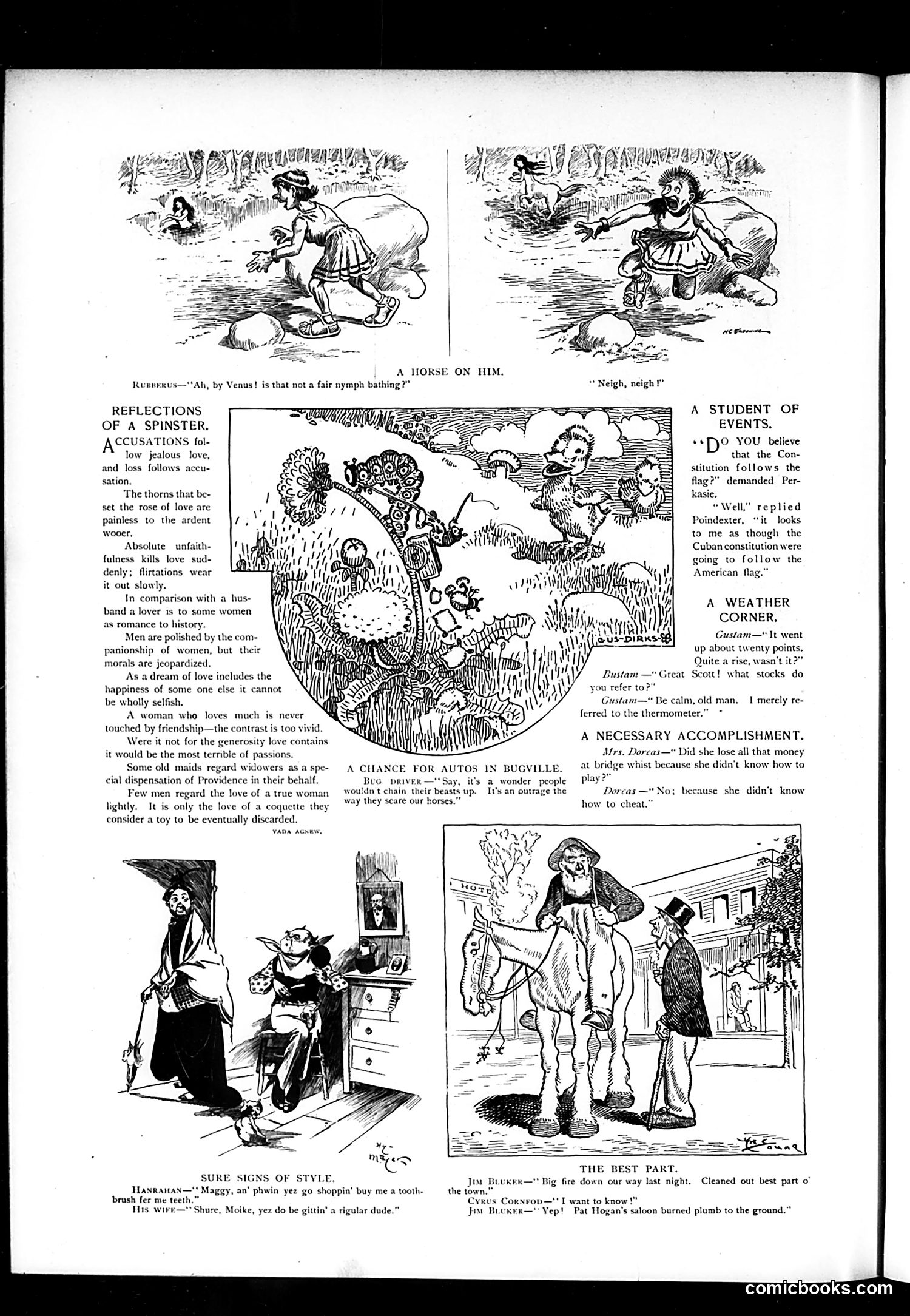
This page contains multiple satirical humor pieces typical of early Judge magazine: **Top cartoons ("A Horse on Him"):** A classical reference joke where a man mistakes a woman bathing for a "fair nymph," with the punchline involving wordplay about "nymphing" (bathing). **"Reflections of a Spinster":** A philosophical column mocking unmarried women's romantic observations, including cynical commentary on love, marriage, and male behavior—reflecting contemporary attitudes about women's roles. **"A Student of Events":** A joke about the Philippine-American War era, where the "Constitution follows the flag" was a real political debate about whether U.S. constitutional protections applied to occupied territories. **Minor humor pieces:** Include a "Weather Corner" pun, a piece about bridge cheating (reflecting upper-class social concerns), and ethnic dialect humor featuring Irish characters ("Hanrahan," "Moike")—common in period satire but reflecting now-outdated stereotyping. **"Chance for Autos in Bugville":** Rural versus urban transportation humor, referencing the emerging automobile culture displacing horses.
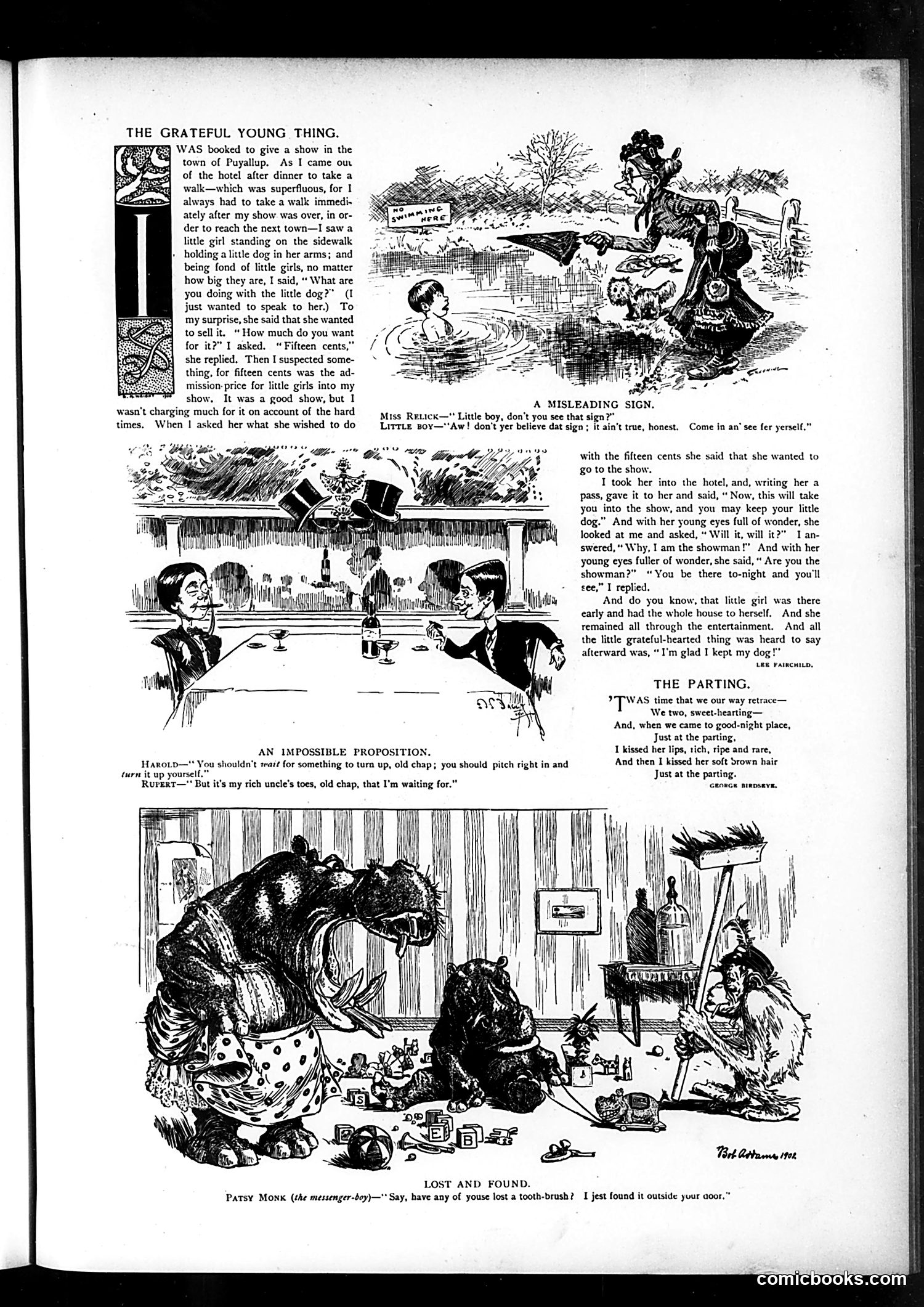
This page contains three distinct humorous pieces: **"The Grateful Young Thing"** presents a sentimental anecdote: a showman encounters a girl selling her dog for fifteen cents—coincidentally the admission price to his show. He buys both dog and girl a pass. She attends alone and is moved by the performance, later saying she's glad she kept her dog. The satire gently mocks sentimentality and the presumed emotional simplicity of children. **"An Impossible Proposition"** is a brief joke about two men, Harold and Rupert, debating work ethic. Rupert refuses to "pitch in" because he's waiting for his rich uncle's inheritance—specifically his "toes" (likely a pun or absurdist humor now unclear). **"Lost and Found"** features Patsy Monk, a messenger boy, offering someone a tooth-brush he found outside their door, with comedic Irish dialect spelling. **"The Parting"** is romantic verse about kissing at farewell. The illustrations throughout depict genteel, upper-class scenarios typical of early 20th-century American humor magazines.
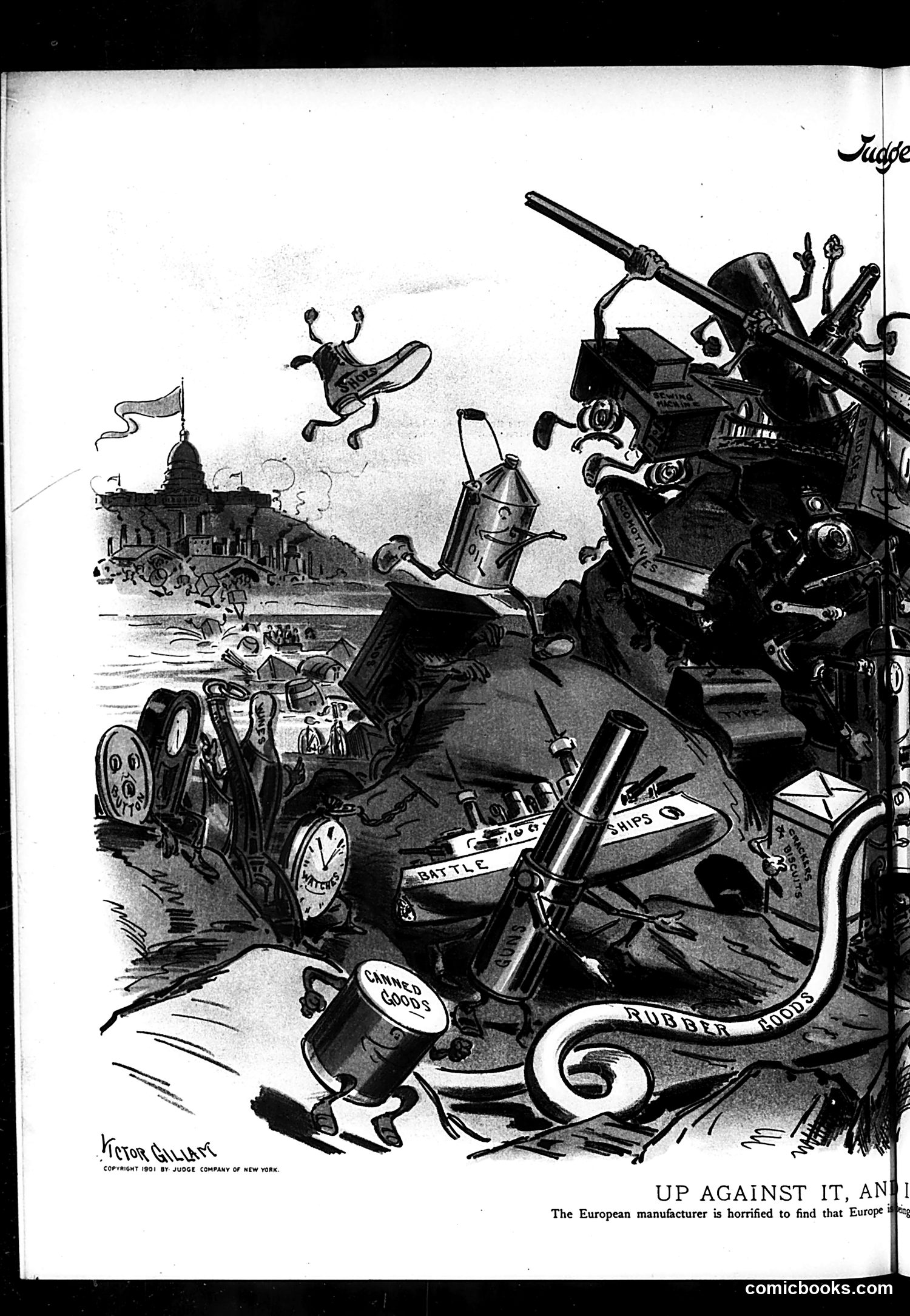
This 1901 Judge cartoon by Keron Gillam depicts American industrial might overwhelming European competition. The Capitol building on the left represents the U.S. government, while the right side shows a massive pile of industrial machinery, weapons, and manufactured goods labeled "BATTLE SHIPS," "RUBBER GOODS," and "CANNED GOODS"—symbolizing American industrial capacity. Small anthropomorphic figures representing European manufacturers are shown fleeing or being crushed by this American industrial avalanche. The title "UP AGAINST IT, AN!" suggests European manufacturers are helpless against American economic dominance. This reflects early 1900s American confidence in its manufacturing superiority and growing economic power relative to established European industrial nations. The cartoon celebrates American industrial and military advancement during the post-Spanish-American War period.
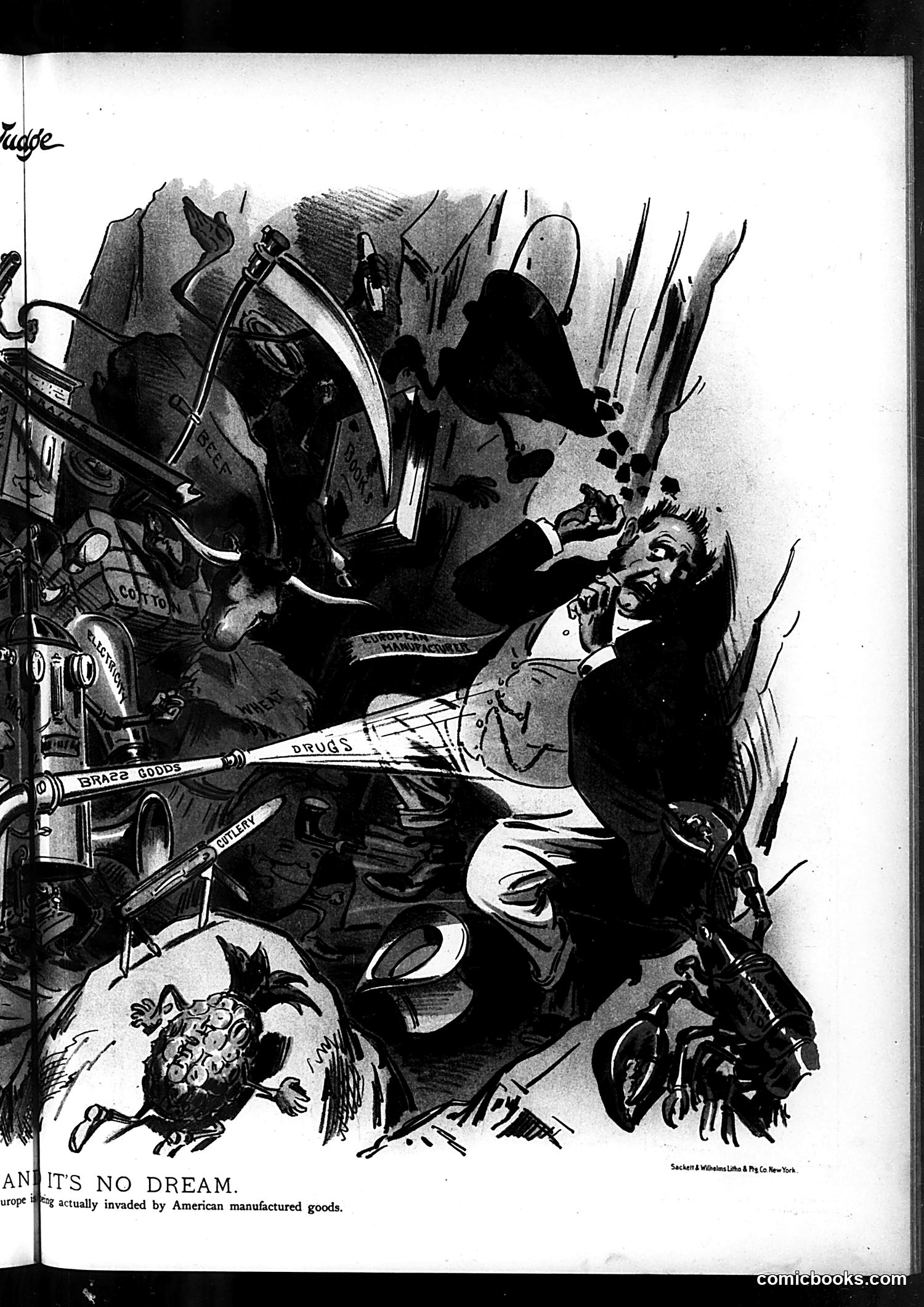
This political cartoon satirizes European concerns about American commercial dominance. The central figure (appearing to be a European personification, possibly France or Europe generally) lies sleeping or dreaming, surrounded by American consumer goods labeled "BRACES," "DRUGS," and what appear to be other manufactured products. Various items like shoes and other goods are scattered around. The caption "IT'S NO DREAM" with the subtitle about Europe "being actually invaded by American manufactured goods" suggests the cartoon is commenting on—likely with some pride—American economic expansion into European markets in the early 20th century. Rather than military invasion, the "invasion" is commercial: American-made consumer products flooding European markets and displacing local manufacturers. This reflects anxieties about American industrial competition and cultural influence during a period of rising U.S. economic power.
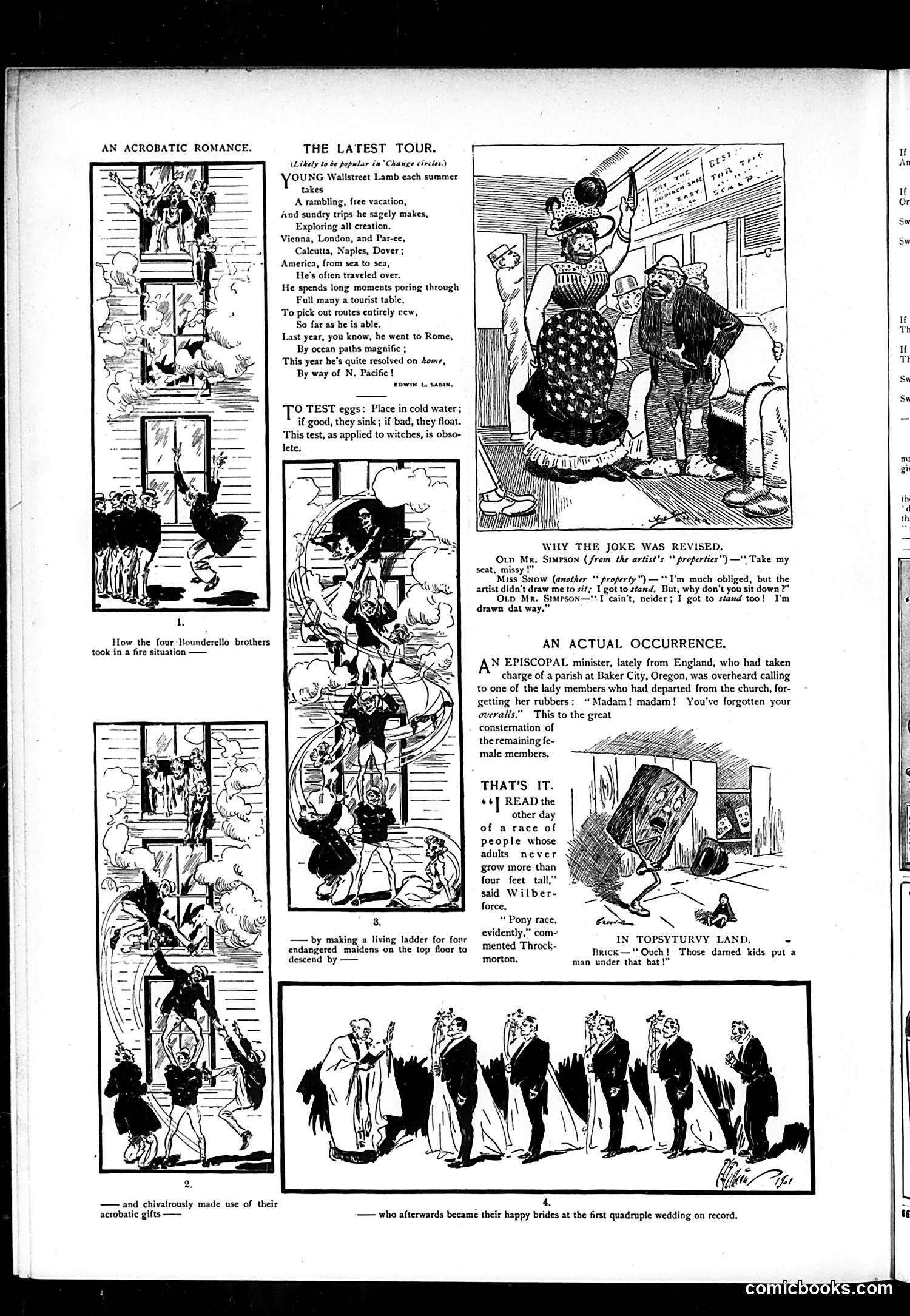
This page satirizes **Wall Street speculation and financial recklessness** during the Gilded Age. The main cartoon, "An Acrobatic Romance," depicts four wealthy young stockbrokers ("Wallstreet Lambs") performing increasingly dangerous acrobatic stunts to rescue women from a fire. The joke is two-fold: it mocks both their reckless bravado and the idea that such dangerous showing-off wins them wives ("their happy brides at the first quadruple wedding"). The supporting content includes: - **"The Latest Tour"**: A poem mocking how wealthy speculators constantly travel abroad to escape financial consequences, taking circuitous routes - **Miscellaneous jokes**: Including references to witch-testing, an Episcopal minister misusing "overalls" for "rubbers," and a "pony race" of short people The overall message targets **wealthy financiers' cavalier attitudes toward risk**—both in markets and personal behavior—suggesting their dangerous theatrics and globe-trotting are symptoms of an unstable, frivolous financial class.
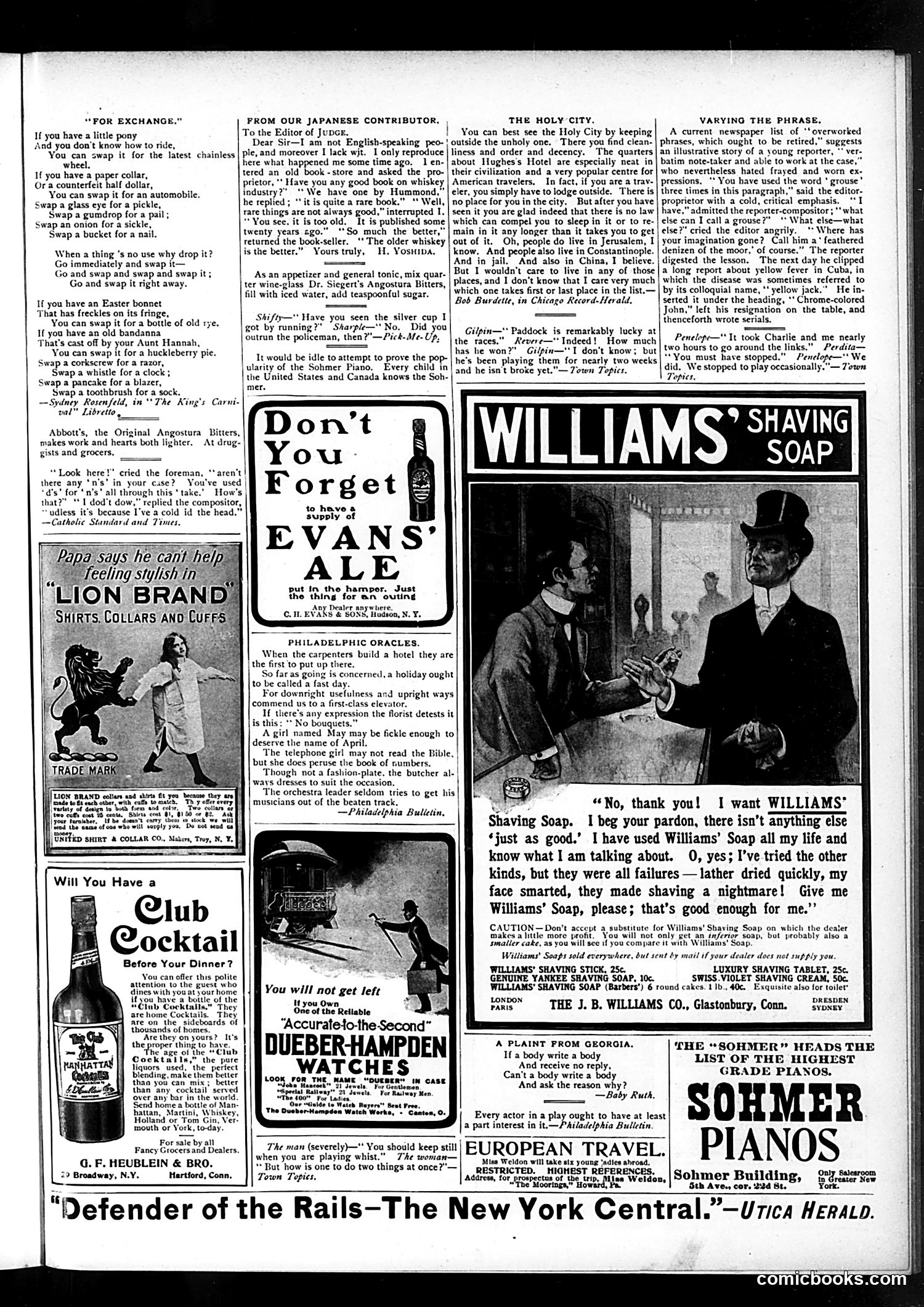
This page is primarily **advertisements and light humor pieces**, not political cartoons. The content includes: **Humorous items:** - A poem "For Exchange" about swapping worthless items—satirizing the era's casual bartering culture - Short jokes about linguistic mistakes, occupational quirks ("Philadelphia Oracles"), and social absurdities - A Japanese contributor's anecdote about old whiskey, poking gentle fun at aging and value judgments **Advertisements:** The page is dominated by ads for consumer products: Evans' Ale, Williams' Shaving Soap, Lion Brand shirts, Sohmer Pianos, Dueber-Hampden watches, and "Club Cocktails" (pre-Prohibition liquor). **Context for modern readers:** The humor reflects early 1900s concerns: the novelty of automobiles, telephones, and elevators; gender stereotypes (telephone operators, fashion); and working-class occupations. The ads suggest affluent readership—fancy cocktails, pianos, and quality goods were luxury items. This appears to be a typical Judge issue: satire mixed with advertising revenue.
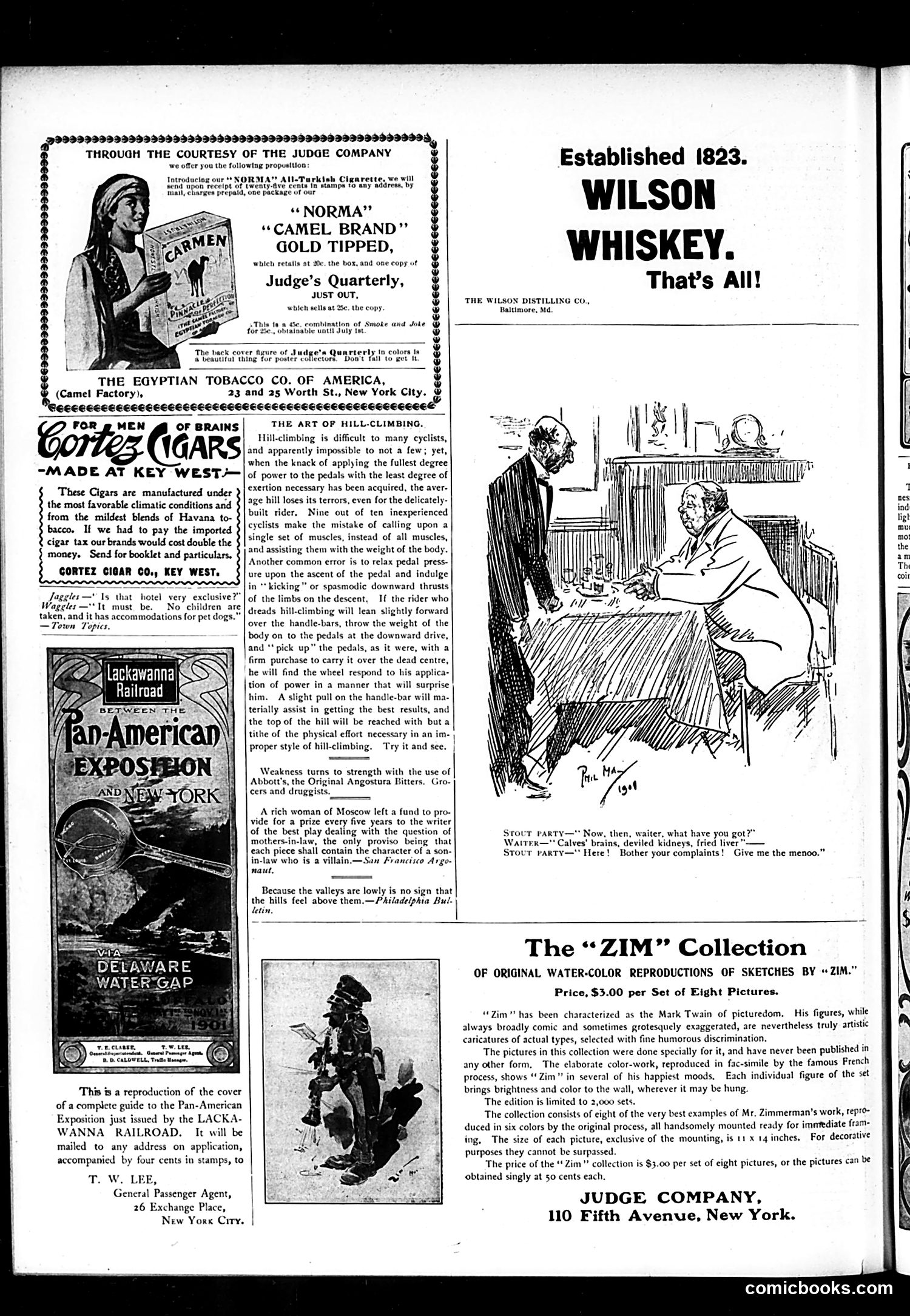
This page is primarily **advertisements and filler content** rather than political satire. The main elements include: **Advertisements:** - Wilson Whiskey (Baltimore distillery) - Egyptian Tobacco Company's "Camel Brand" cigarettes - Cortez Cigars (Key West) - Abbott's Bitters - Lackawanna Railroad guide - "Zim" Collection water-color reproductions **Cartoon Content:** A small cartoon depicts a stout gentleman at a restaurant demanding the menu, dismissing the waiter's offerings (calves' brains, kidneys, fried liver) with complaint. **Article:** "The Art of Hill-Climbing" provides practical cycling advice for navigating inclines—a timely topic when bicycles were popular transportation. **Notable Context:** The cigarette ad's mention of "imported cigar tax" references early-20th-century tariff debates. The "Zim" artist is compared to Mark Twain, suggesting he was a recognized satirist of the era. Overall, this appears to be a standard magazine issue blending modest humor with commercial content.
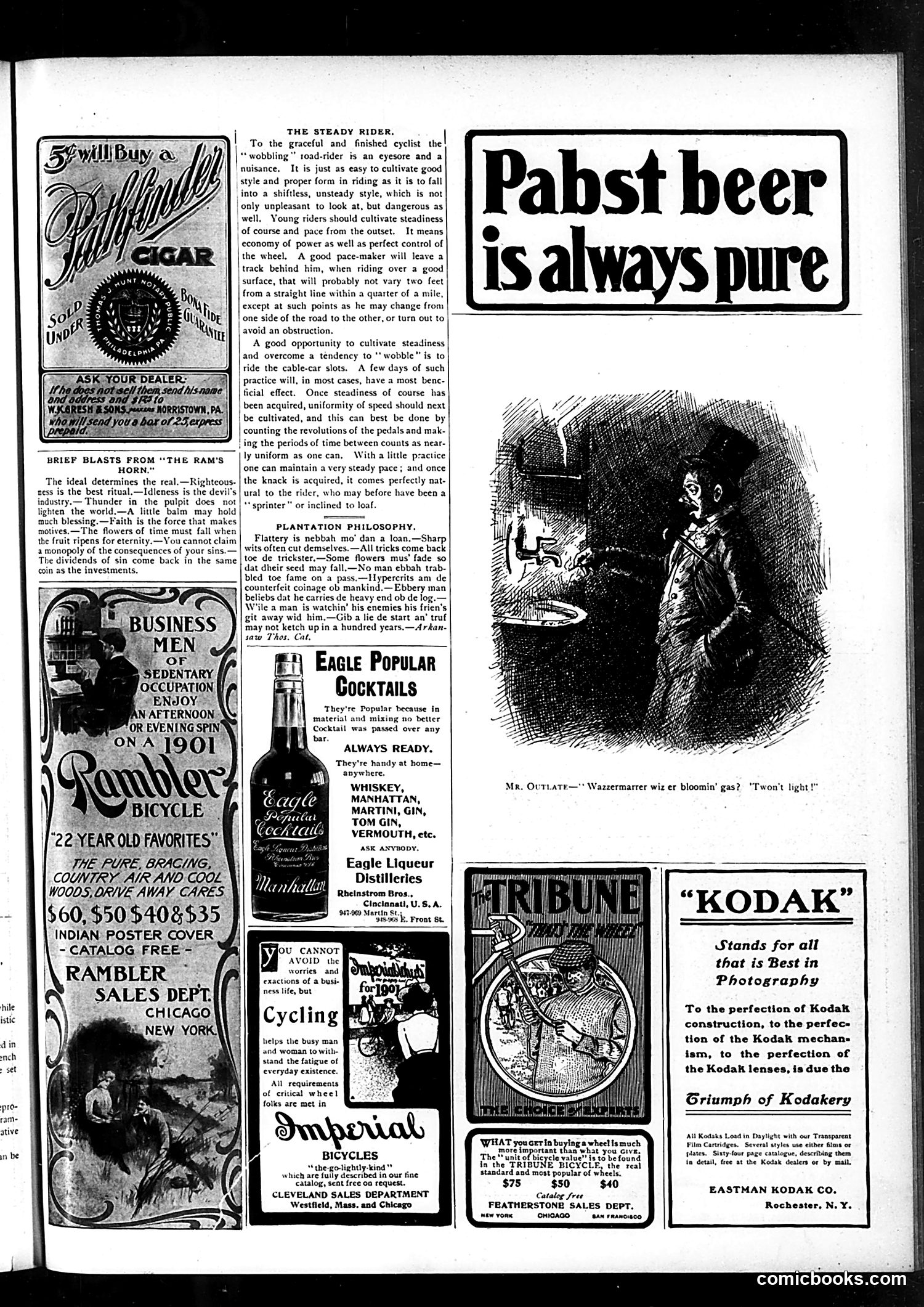
This page is primarily **advertising with one cartoon**. The main illustrated content is a single cartoon captioned "Mr. Outlate—'Wazzermarrer wiz er bloomin' gas? 'Twon't light!'" depicting two figures examining what appears to be a gas lamp that won't ignite. The humor appears to be a simple domestic mishap joke rather than political satire. The rest of the page consists entirely of period advertisements (Pabst beer, Rambler bicycles, Eagle cocktails, cycling equipment, Kodak cameras) and editorial content including "The Steady Rider" (cycling advice), "Brief Blasts from 'The Ram's Horn'" (moral aphorisms), and "Plantation Philosophy" (dialect-based folk sayings). There is **no significant political or social satire** on this particular page—it functions primarily as an advertising vehicle with light humor and practical editorial content typical of early 1900s magazines.
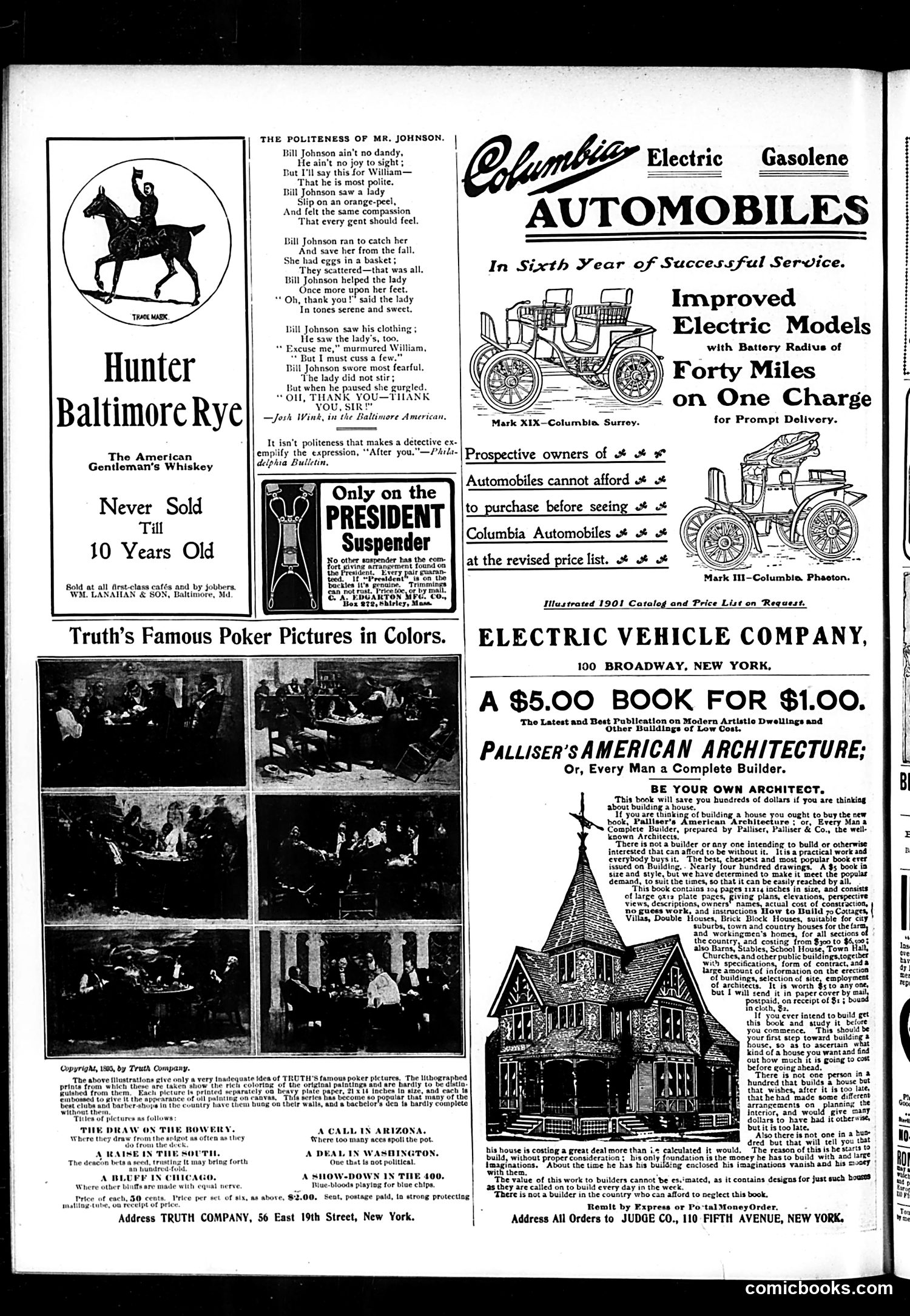
This page is primarily **advertisements and light verse**, not political satire. The main content is a humorous poem titled "The Politeness of Mr. Johnson" about a working-class man (Bill Johnson) who courteously helps a lady slip on an orange peel, then apologizes profusely for swearing at the mess—while she, oddly, thanks him for cursing. It's a gentle joke playing on social conventions: Johnson's crude language is presented as oddly polite by the lady's standards, inverting expectations about what constitutes "politeness." The page includes period advertisements for Hunter Baltimore Rye whiskey, Columbia electric automobiles (emphasizing a 40-mile battery range), Truth's poker paintings, and Palliser's American Architecture book. A small sidebar joke contrasts "politeness" with detectives' use of "After you"—implying detectives aren't actually polite. **The satire is minimal and social rather than political**, mocking genteel pretense about manners rather than addressing contemporary events or figures.
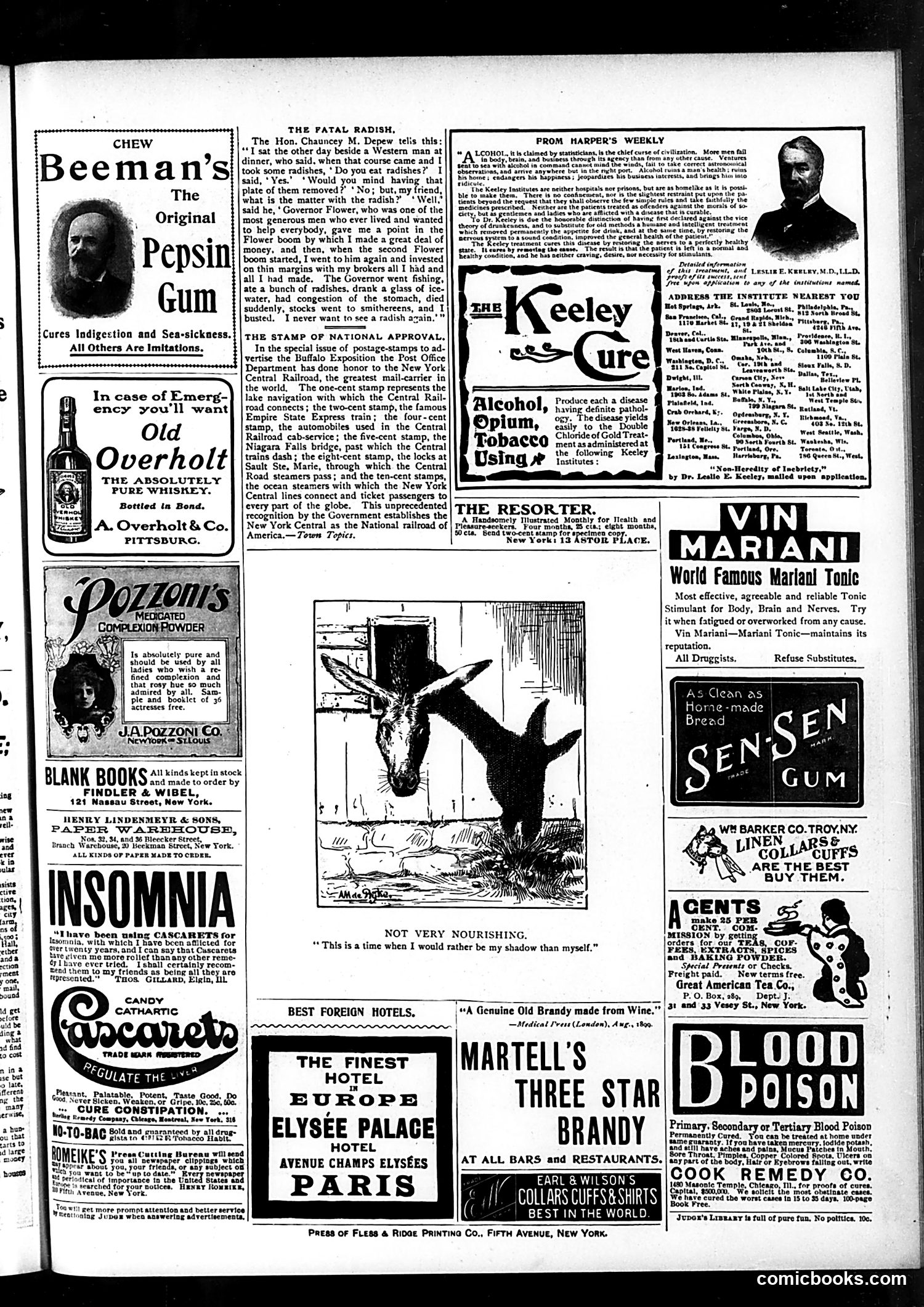
This page's main cartoon illustrates a humorous anecdote attributed to Chauncey M. Depew (a prominent Gilded Age politician and railroad executive). The story concerns a Western businessman who lost his fortune through speculative investment in Governor Flower's political ventures. When Flower died unexpectedly after eating radishes and drinking ice water—causing fatal stomach congestion—the market collapsed, wiping out the investor. The punchline: the man now refuses to eat radishes, blaming them for his financial ruin. The satire targets the volatility of 1890s speculation and the casual relationship between political patronage and risky investments. The "fatal radish" is a darkly comic metaphor for how seemingly trivial circumstances—or bad luck—could destroy fortunes in this era's unregulated markets. The remainder of the page is vintage advertising for patent medicines, tonics, and other products typical of the period.
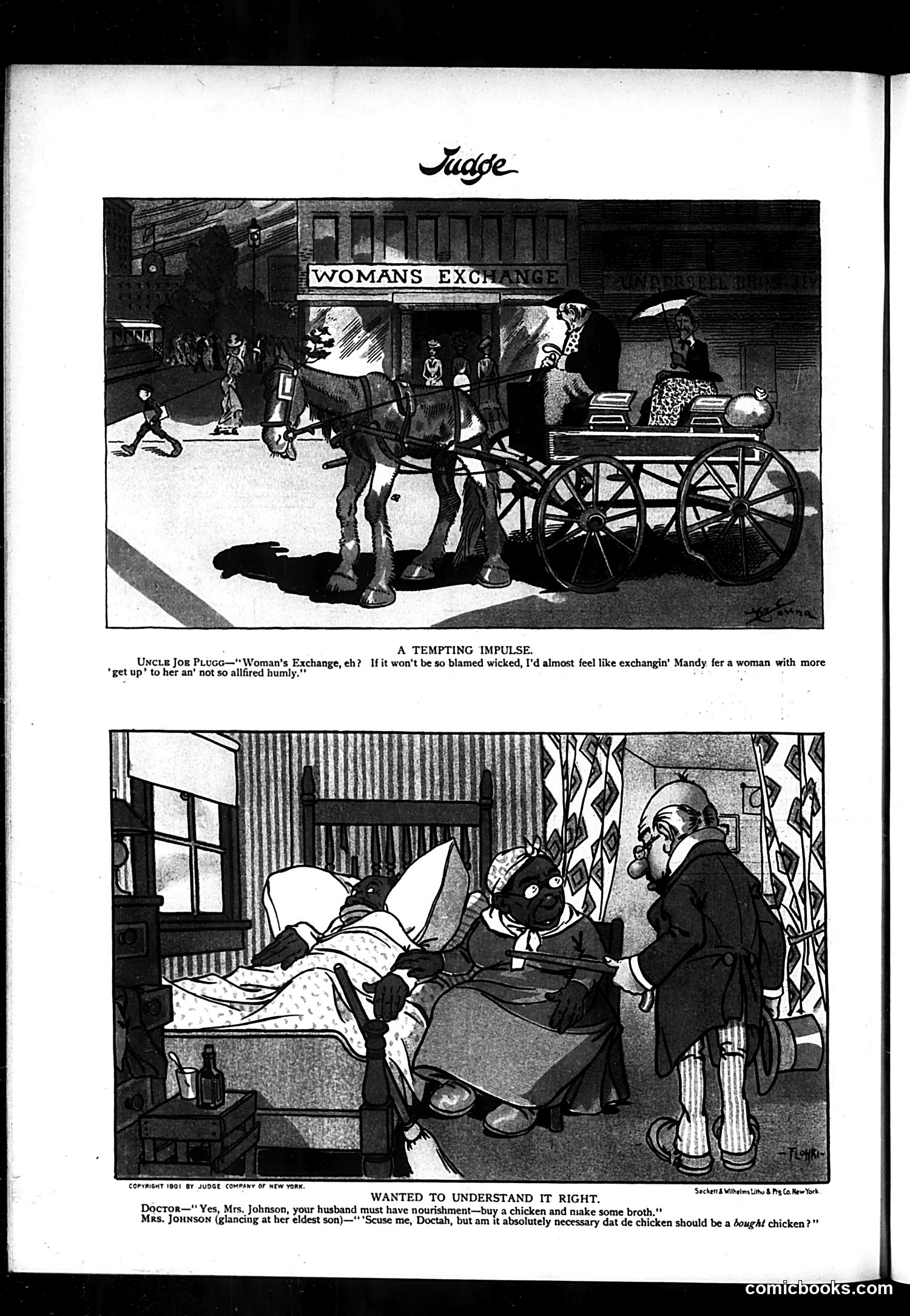
This page contains two separate satirical cartoons targeting working-class domestic life and gender relations circa early 1900s. **Top cartoon ("A Tempting Impulse"):** Uncle Joe Plugg eyes a "Woman's Exchange" storefront, joking he'd like to trade his wife Mandy for one with more "get up" (energy/ambition) and less "allfired humly" (humble/dowdy appearance). The satire mocks men's fleeting marital discontent and the notion of women as interchangeable commodities. **Bottom cartoon ("Wanted to Understand It Right"):** A doctor prescribes a chicken for a sick husband's nourishment. Mrs. Johnson—glancing at her eldest son—asks if it *must* be a purchased chicken, implying she could steal one instead. The joke satirizes poverty and working-class mothers' desperation, their willingness to commit petty theft to afford medicine. Both cartoons use ethnic/dialect humor (rendered speech patterns) typical of Judge's era, depicting working-class characters as comical and morally flexible.