
Judge, 1901-06-15 · page 3 of 16
Judge — June 15, 1901 — page 3: what you’re looking at
What you’re looking at
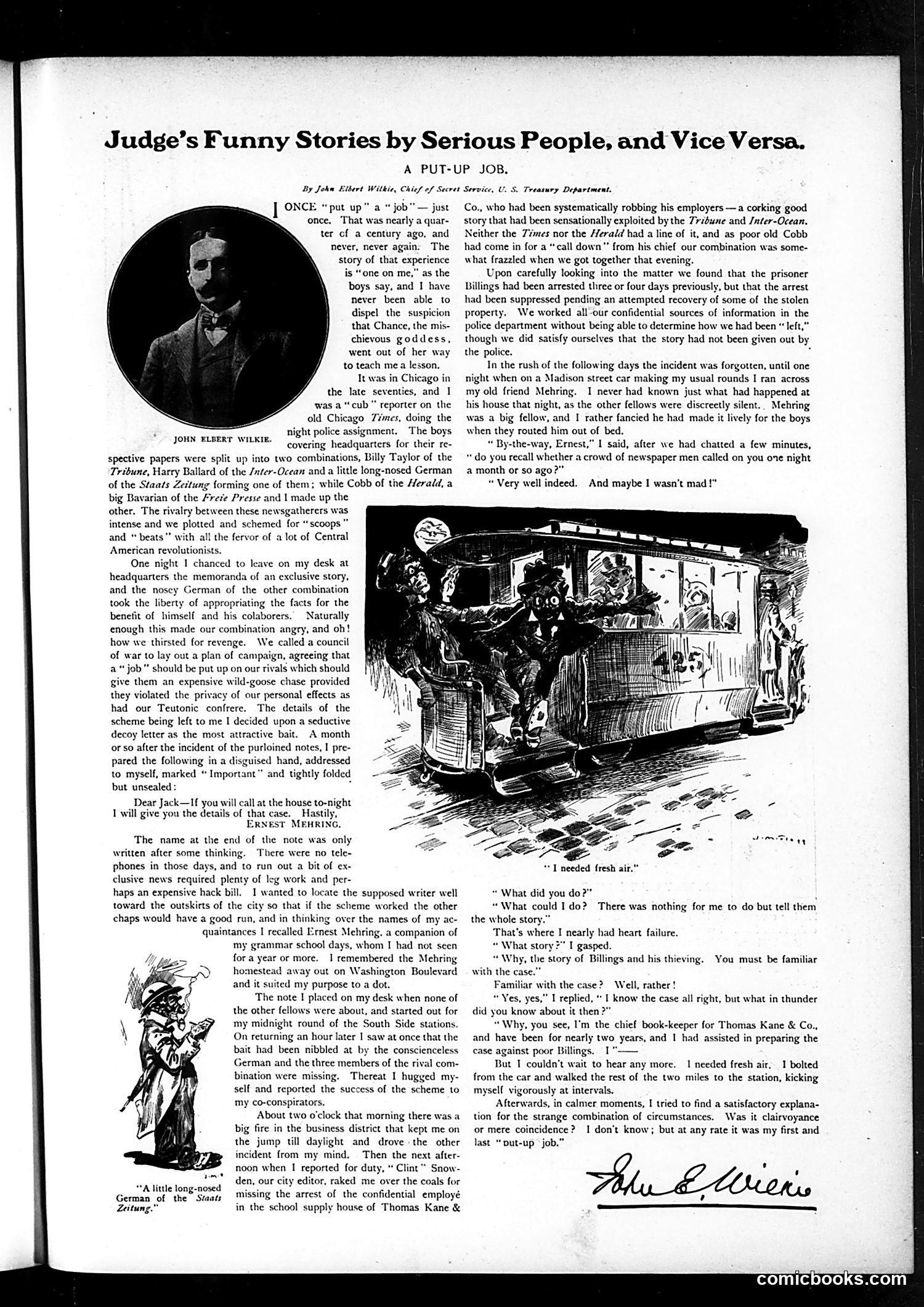
This page features a humorous essay by John Elbert Wilkie, Chief of the Secret Service, titled "A Put-Up Job." The text recounts an anecdote about newspaper rivalry in Chicago during the late 1800s, when Wilkie worked as a reporter. The main cartoon depicts a street scene with what appears to be a streetcar or trolley, with a figure exclaiming "I needed fresh air." This illustrates Wilkie's story about competing reporters from rival papers (the *Tribune* and *Herald*) who devised an elaborate scheme to trap each other by fabricating a crime story about employee theft. The cartoon humorously captures the moment when one reporter, realizing he'd been duped into publicizing false information, needed to escape the situation. The satire mocks journalistic deception and competitive ruthlessness among newspapers of that era.
📄 Transcribed text from this page (OCR, searchable)
Machine-transcribed from the original scan — historical spelling and the odd misread are preserved.
J ONCE “put up” a * job” — just once, ‘That was nearly a quar- ter of a century ago, and never, never again. The story of that experience is “one on me,” as the boys say, and I have never been able to dispel the suspicion that Chance, the mis- chievous goddess, went out of her way to teach mea lesson. It was in Chicago in the late seventies, and 1 was a“‘cub” reporter on the old Chicago Times, doing the night police assignment. The boys covering headquarters for their re- spective papers were split up into two combinations, Billy Taylor of the Tribune, Harry Ballard of the /nter-Ocean and a little long-nosed German of the Staats Zettung forming one of them; while Cobb of the Herald, a big Bavarian of the Frese Presse and I made up the other. The rivalry between these newsgatherers was intense and we plotted and schemed for “scoops " and “ beats” with all the fervor of a lot of Central American revolutionists. One night I chanced to leave on my desk at headquarters the memoranda of an exclusive story, and the nosey German of the other combination took the liberty of appropriating the facts for the benefit of himself and his colaborers. Naturally enough this made our combination angry, and oh! how we thirsted for revenge. We called a council of war to lay out a plan of campaign, agreeing that job” should be put up on our rivals which should give them an expensive wild-goose chase provided they violated the privacy of our personal effects as had our Teutonic confrere. The details of the scheme being left to me I decided upon a seductive decoy letter as the most attractive bait. A month or so after the incident of the purloined notes, I pre- pared the following in a disguised hand, addressed to myself, marked “Important” and tightly folded but unsealed: : JOHN ELBERT WILKIE. Dear Jack—If you will call at the house to-night I will give you the details of that case. Hastily, ERNEST MEHRING, The name at the end of the note was only written after some thinking. There were no tele- phones in those days, and to run out a bit of ex- clusive news required plenty of leg work and per- haps an expensive hack bill. 1 wanted to locate the supposed writer well toward the outskirts of the city so that if the scheme worked the other chaps would have a good run, and in thinking over the names of my ac- quaintances I recalled Ernest Mehring, a companion of my grammar school days, whom I had not seen for a year or more. I remembered the Mehring homestead away out on Washington Boulevard and it suited my purpose to a dot. The note I placed on my desk when none of the other fellows were about, and started out for my midnight round of the South Side stations. On returning an hour later I saw at once that the bait had been nibbled at by the conscienceless German and the three members of the rival com- bination were missing. Thereat I hugged my- self and reported the success of the scheme to my co-conspirators. About two o'clock that morning there was a big fire in the business district that kept me on the jump till daylight and drove «the other incident from my mind. Then the next after- noon when I reported for duty, “Clint Snow- den, our city editor, raked me over the coals for missing the arrest of the confidential employé in the school supply house of Thomas Kane & “A little long-nosed German of the Staats Zeitung.” Judge’s Funny Stories by Serious People, and Vice Versa. A PUT-UP JOB. By John Elbert Wilkie, Chief of Secret Service, U.S. Treasury Department. Co., who had been systematically robbing his employers — a corking good story that had been sensationally exploited by the Tribune and Inter-Ocean. Neither the 77mes nor the Herald had a line of it, and as poor old Cobb had come in for a “call down” from his chief our combination was some- what frazzled when we got together that evening. Upon carefully looking into the matter we found that the prisoner Billings had been arrested three or four days previously, but that the arrest had been suppressed pending an attempted recovery of some of the stolen property. We worked all-our confidential sources of information in the police department without being able to determine how we had been “left,” though we did satisfy ourselves that the story had not been given out by the police. i In the rush of the following days the incident was forgotten, until one night when on a Madison street car making my usual rounds I ran across my old friend Mehring. I never had known just what had happened at his house that night, as the other fellows were discreetly silent... Mehring was a big fellow, and I rather fancied he had made it lively for the boys when they routed him out of bed. “ By-the-way, Ernest,” I said, after we had chatted a few minutes, * do you recall whether a crowd of newspaper men called on you one night a month or so ago?” “Very well indeed. And maybe I wasn’t mad!" ** | needed fresh air.” * What did you do?” | “What could Ido? There was nothing for me to do but tell them the whole story.” That's where I nearly had heart failure. * What story?" I gasped. “Why, the story of Billings and his thieving. with the case. Familiar with the case? Well, rathe! “Yes, yes,” I replied, I know the case all right, but what in thunder did you know about it then ?” “Why, you see, I'm the chief book-keeper for Thomas Kane & Co., and have been for nearly two years, and I had assisted in preparing the case against poor Billings, 1" But I couldn't wait to hear any more. I needed fresh air, 1 bolted from the car and walked the rest of the two miles to the station, kicking myself vigorously at intervals. Afterwards, in calmer moments, I tried to find a satisfactory explana- tion for the strange combination of circumstances. or mere coincidence ? last “‘put-up job.” You must be familiar Was it clairvoyance I don't know ; but at any rate it was my first and comicbooks.com