
Judge, 1901-06-15 · page 2 of 16
Judge — June 15, 1901 — page 2: what you’re looking at
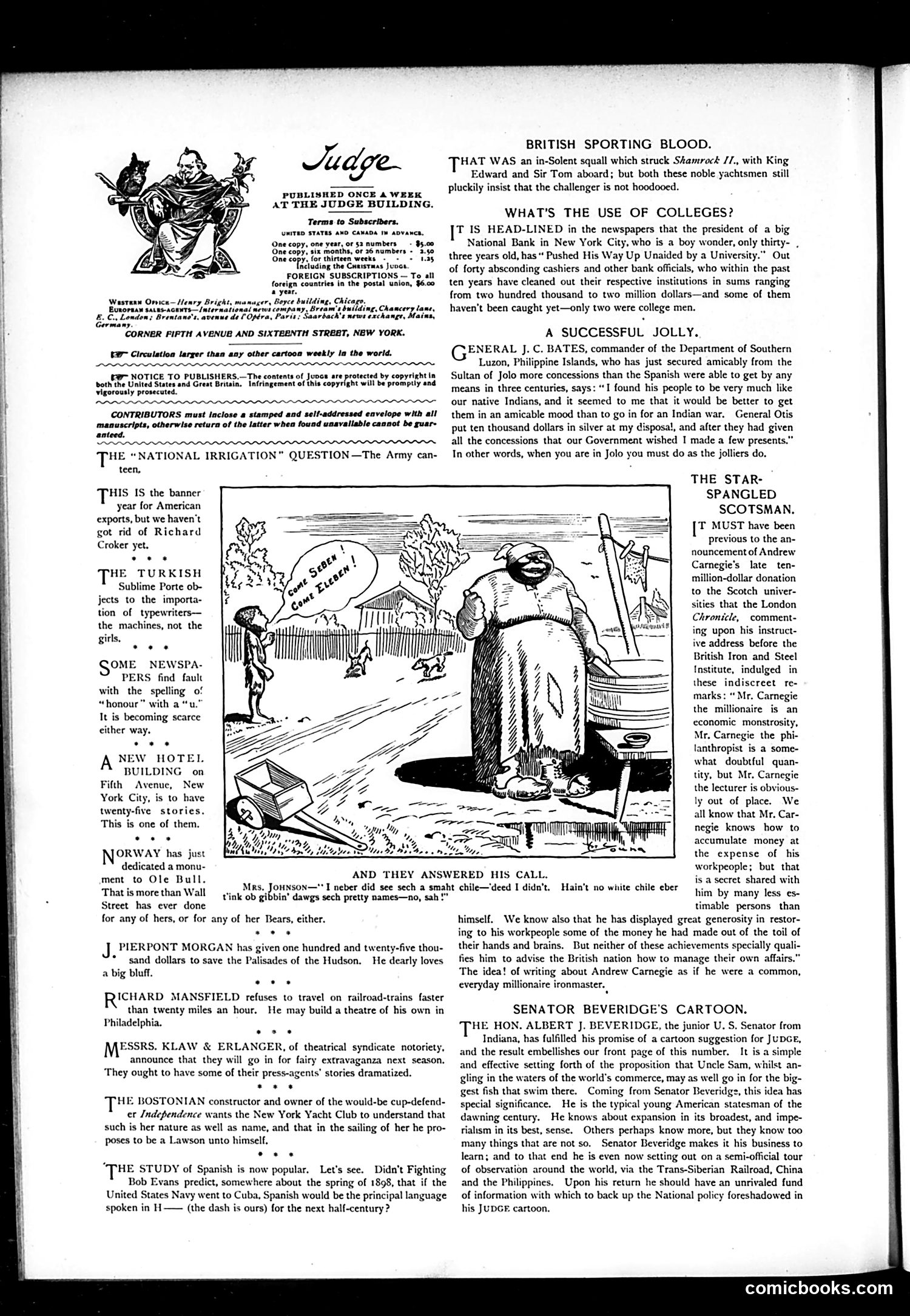
What you’re looking at
This cartoon satirizes Andrew Carnegie's philanthropic claims. The central figure—a large, rotund man labeled "Carnegie"—sits contentedly while small figures around him work. The caption references Mrs. Johnson saying "I asked did she such a small chile—dead I didn't. Hair's no white chile cher" and notes Carnegie has made money "at the expense of his workpeople." The satire's point: Carnegie publicly positions himself as generous to the working class, but the cartoon suggests his wealth accumulated through exploiting laborers. The text accompanying it explicitly critiques his claiming moral authority on economic matters while the text notes he's "out of place" offering advice to nations—his philanthropy is presented as guilt-driven rather than genuinely altruistic.
📄 Transcribed text from this page (OCR, searchable)
Machine-transcribed from the original scan — historical spelling and the odd misread are preserved.
Adge- PUBLISHED ONCE 4 WEEK AT THE JUDGE BUILDING. Terms to Subscribers. UNITED STATES AMD CAMADA 1 ADVANCE. ‘One copy, one year, or sz numbers - $5.00 One copy, six months, or 26 numbers - 3.50 ‘One copy, for thirteen weeks - = = 1.35 Including the Cusistmas Jvoce. FOREIGN SUBSCRIPTIONS — To all foreign countries in the postal union, $6.00 a year. Henry Bright, manager, Boyce bi jiomal mews cor no's, avenue del Opera, Wastane Orvic Bunoraan satas- dom: Bri ing, Chicago. Bream’s building, Chancery lane, ‘Saarbach's mews exchange, Mains, IRNER FIFTH AVENUE AND SIXTEENTH STREET, NEW YORK. (7 Circulation larger than any other cartoon weekly Ia the world. (- NOTICE TO PUBLISHERS.—The contents of Joven are protected by copyright in United States and Great Britain. Infringement of this copyright will be promptly and sly prosecuted. bot! vig CONTRIBUTORS must inclose a stamped and self-addressed envelope with all manuscripts, otherwise retura of the latter whea found unavallable cannot be guar anteed. THE “NATIONAL IRRIGATION” QUESTION—The Army can- teen, HIS IS the banner year for American exports, but we haven't got rid of Richard BRITISH SPORTING BLOOD. THAT WAS an in-Solent squall which struck Shamrock //., with King Edward and Sir Tom aboard; but both these noble yachtsmen still pluckily insist that the challenger is not hoodooed. WHAT'S THE USE OF COLLEGES? [It IS HEAD-LINED in the newspapers that the president of a big National Bank in New York City, who is a boy wonder, only thirty- , three years old, has“ Pushed His Way Up Unaided by a University.” Out of forty absconding cashiers and other bank officials, who within the past ten years have cleaned out their respective institutions in sums ranging from two hundred thousand to two million dollars—and some of them haven't been caught yet—only two were college men. A SUCCESSFUL JOLLY. GENERAL J. C. BATES, commander of the Department of Southern Luzon, Philippine Islands, who has just secured amicably from the Sultan of Jolo more concessions than the Spanish were able to get by any means in three centuries, says: “I found his people to be very much like our native Indians, and it seemed to me that it would be better to get them in an amicable mood than to go in for an Indian war. General Otis put ten thousand dollars in silver at my disposal, and after they had given all the concessions that our Government wished I made a few presents.” In other words, when you are in Jolo you must do as the jolliers do. THE STAR- SPANGLED SCOTSMAN. T MUST have been Croker yet. cee HE TURKISH Sublime Porte ob- jects to the importa- tion of typewriters— the machines, not the girls, . OME NEWSPA- PERS find fault with the spelling of “honour” with a “u.” It is becoming scarce either way. A NEW HOTEL BUILDING on Fifth Avenue, New York City, is to have twenty-five stories. This is one of them. Norway has just dedicated a monu- ment to Ole Bull. That is more than Wall Street has ever done for any of hers, or for any of her Bears, either. J PIERPONT MORGAN has given one hundred and twenty-five thou- sand dollars to save the Palisades of the Hudson. He dearly loves a big bluff. D ay Upyin gy te Mrs. tink ob gil dawgs sech pretty names—no, sah !” ICHARD MANSFIELD refuses to travel on railroad-trains faster than twenty miles an hour. He may build a theatre of his own in Philadelphia. MESSRS. KLAW & ERLANGER, of theatrical syndicate notoriety, announce that they will go in for fairy extravaganza next season. ‘They ought to have some of their press-agents’ stories dramatized. THE BOSTONIAN constructor and owner of the would-be cup-defend- er Independence wants the New York Yacht Club to understand that such is her nature as well as name, and that in the sailing of her he pro- poses to be a Lawson unto himself. eee “THE STUDY of Spanish is now popular. Let's see. Didn't Fighting Bob Evans predict, somewhere about the spring of 1898, that if the United States Navy went to Cuba, Spanish would be the principal language spoken in H—— (the dash is ours) for the next half-century? \ panei Lyn Ore ge a - —_ oe) ins 2, Dbl itn, aE —— eer AND THEY ANSWERED HIS CALL. 5 vit OUNSON—""I neber did see sech a smaht chile—'deed Ididn't. Hain't no white chile eber /*.° Secret shared with previous to the an- nouncementof Andrew Carnegie’s late ten- million-dollar donation to the Scotch univer- sities that the London Chronicle, comment- ing upon his instruct- ive address before the British Iron and Steel Institute, indulged in these indiscreet re- marks: “ Mr. Carnegie the millionaire is an economic monstrosity, Mr. Carnegie the phi- lanthropist is a some- what doubtful quan- tity, but Mr. Carnegie : the lecturer is obvious- a. ly out of place. We a all know that Mr. Car- negie knows how to accumulate money at the expense of his workpeople; but that SS SSS him by many less es timable persons than himself. We know also that he has displayed great generosity in restor- ing to his workpeople some of the money he had made out of the toil of their hands and brains. But neither of these achievements specially quali- fies him to advise the British nation how to manage their own affairs.” The idea! of writing about Andrew Carnegie as if he were a common, everyday millionaire ironmaster., SENATOR BEVERIDGE’S CARTOON. THE HON. ALBERT J. BEVERIDGE, the junior U. S, Senator from Indiana, has fulfilled his promise of a cartoon suggestion for JUDGE, and the result embellishes our front page of this number. It is a simple and effective setting forth of the proposition that Uncle Sam, whilst an- gling in the waters of the world’s commerce, may as well go in for the big- gest fish that swim there. Coming from Senator Beveridge, this idea has special significance. He is the typical young American statesman of the dawning century. He knows about expansion in its broadest, and impe- riahsm in its best, sense. Others perhaps know more, but they know too many things that are not so. Senator Beveridge makes it his business to learn; and to that end he is even now setting out on a semi-official tour of observation around the world, via the Trans-Siberian Railroad, China and the Philippines. Upon his return he should have an unrivaled fund of information with which to back up the National policy foreshadowed in his JUDGE. cartoon. comicbooks.com