
Judge, 1901-06-15 · page 7 of 16
Judge — June 15, 1901 — page 7: what you’re looking at
What you’re looking at
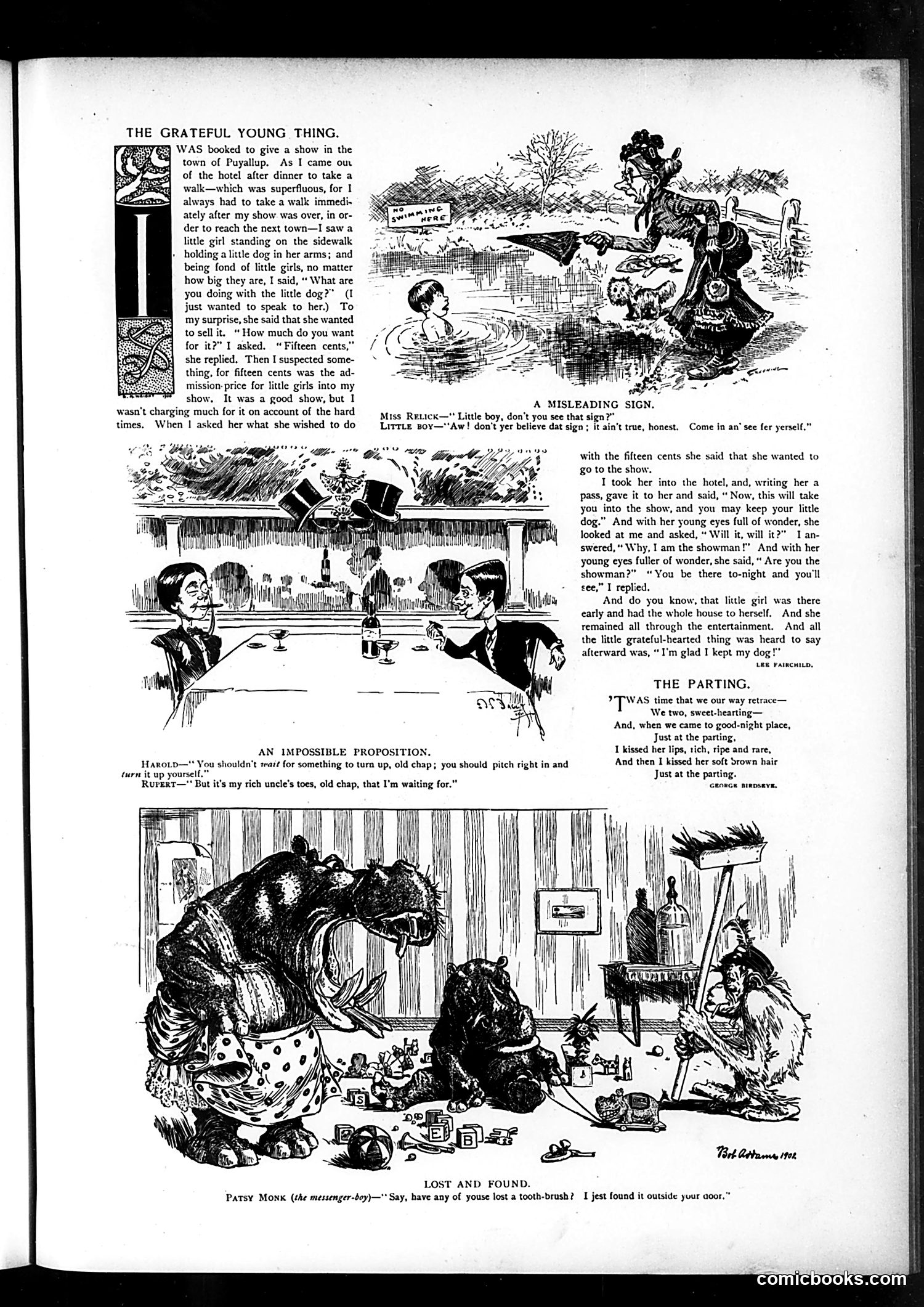
This page contains three distinct humorous pieces: **"The Grateful Young Thing"** presents a sentimental anecdote: a showman encounters a girl selling her dog for fifteen cents—coincidentally the admission price to his show. He buys both dog and girl a pass. She attends alone and is moved by the performance, later saying she's glad she kept her dog. The satire gently mocks sentimentality and the presumed emotional simplicity of children. **"An Impossible Proposition"** is a brief joke about two men, Harold and Rupert, debating work ethic. Rupert refuses to "pitch in" because he's waiting for his rich uncle's inheritance—specifically his "toes" (likely a pun or absurdist humor now unclear). **"Lost and Found"** features Patsy Monk, a messenger boy, offering someone a tooth-brush he found outside their door, with comedic Irish dialect spelling. **"The Parting"** is romantic verse about kissing at farewell. The illustrations throughout depict genteel, upper-class scenarios typical of early 20th-century American humor magazines.
📄 Transcribed text from this page (OCR, searchable)
Machine-transcribed from the original scan — historical spelling and the odd misread are preserved.
THE GRATEFUL YOUNG THING. ny Ge] WAS booked to give a show in the a town of Puyallup. As I came om of the hotel after dinner to take a walk—which was superfluous, for I always had to take a walk immedi. ately after my show. was over, in or- der to reach the next town—I saw a little girl standing on the sidewalk | holding a little dog in her arms; and being fond of little girls, no matter how big they are, I said, “ What are you doing with the little dog?” (I just wanted to speak to her.) To my surprise, she said that she wanted to sell it. How much do you want for it?” I asked. “Fifteen cents,” she replied. Then I suspected some- thing, for fifteen cents was the ad- mission: price for little girls into my ee _ show, Tt was a good show, but 1 i MisLERDING SIGN: wasn't charging much for it on account of the hard : ‘ s RELICK—"' Little boy, don't you see that sign?” times. When I asked her what she wished to do ‘Aw! don’t yer believe dat sign ; it ain't true, honest, Come in an’ see fer yerself.” phy, wed with the fifteen cents she said that she wanted to Ui go to the show, EN A I took her into the hotel, and, writing her a on fii, pass, gave it to her and said, “ Now, this will take you into the show, and you may keep your little dog.” And with her young eyes full of wonder, she looked at me and asked, “ Will it, will it?” I an- swered, Why, I am the showman!" And with her young eyes fuller of wonder, she said,“ Are you the showman?” “You be there to-night and you'll see,” I replied. And do you know, that litle girl was there early and had the whole house to herself. And she remained all through the entertainment. And all the little grateful-hearted thing was heard to say afterward was, “I'm glad I kept my dog!" Lae vatRcuita, THE PARTING. IT WAS time that we our way retrace— We two, sweet-hearting— And, when we came to good-night place, Just at the parting, AN IMPOSSIBLE PROPOSITION. I kissed her lips, rich, ripe and rare, Haroip—"* You shouldn't rait for something to turn up, old chap; you should pitch right in and And then I kissed her soft drown hair turn it up yourself. Just at the parting. Rurert—" But it’s my rich uncle's toes, old chap, that I'm waiting for.” CRONGH SIRDSEVE, LOST AND FOUND. Patsy Monx (the messenger-boy)—"* Say, have any of youse lost a tooth-brush? I jest found it outside your aoor.”