
A complete issue · 16 pages · 1901
Judge — January 26, 1901
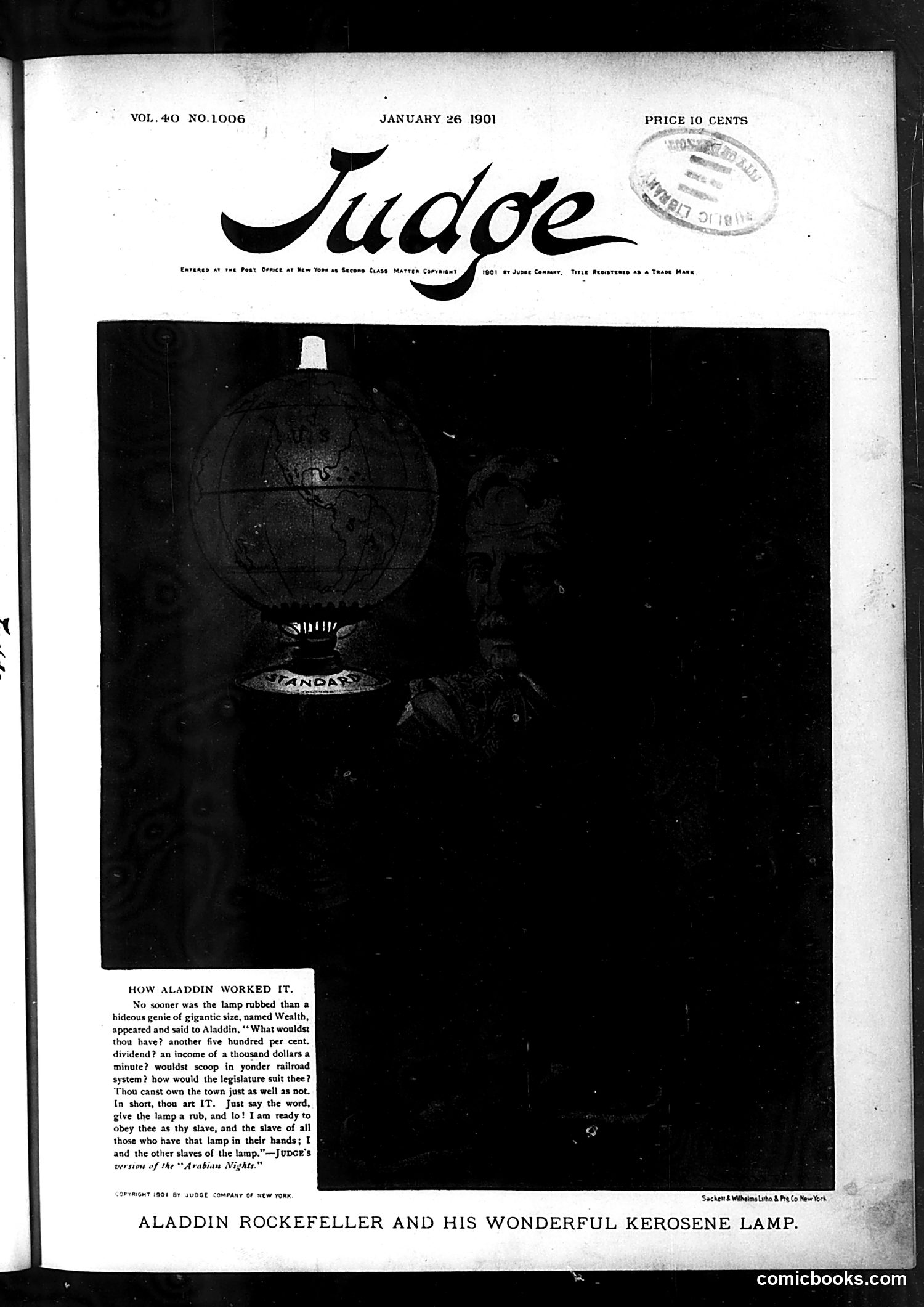
This is the cover of Judge magazine from January 26, 1901. The central image depicts a figure (identified in the caption as "Aladdin") holding an enormous illuminated kerosene lamp, with another figure visible in shadow beside him. The accompanying text references a "genie of gigantic size, named Wealth" who grants wishes—a clear reference to the Aladdin legend. The satire appears to target **John D. Rockefeller and Standard Oil**, likely the world's dominant kerosene producer. By portraying oil wealth as a magical lamp controlled by a genie named "Wealth," Judge mocks Rockefeller's enormous industrial power and suggests his financial dominance grants wishes like a fairy tale—a pointed commentary on monopolistic corporate power and wealth concentration in the Gilded Age.
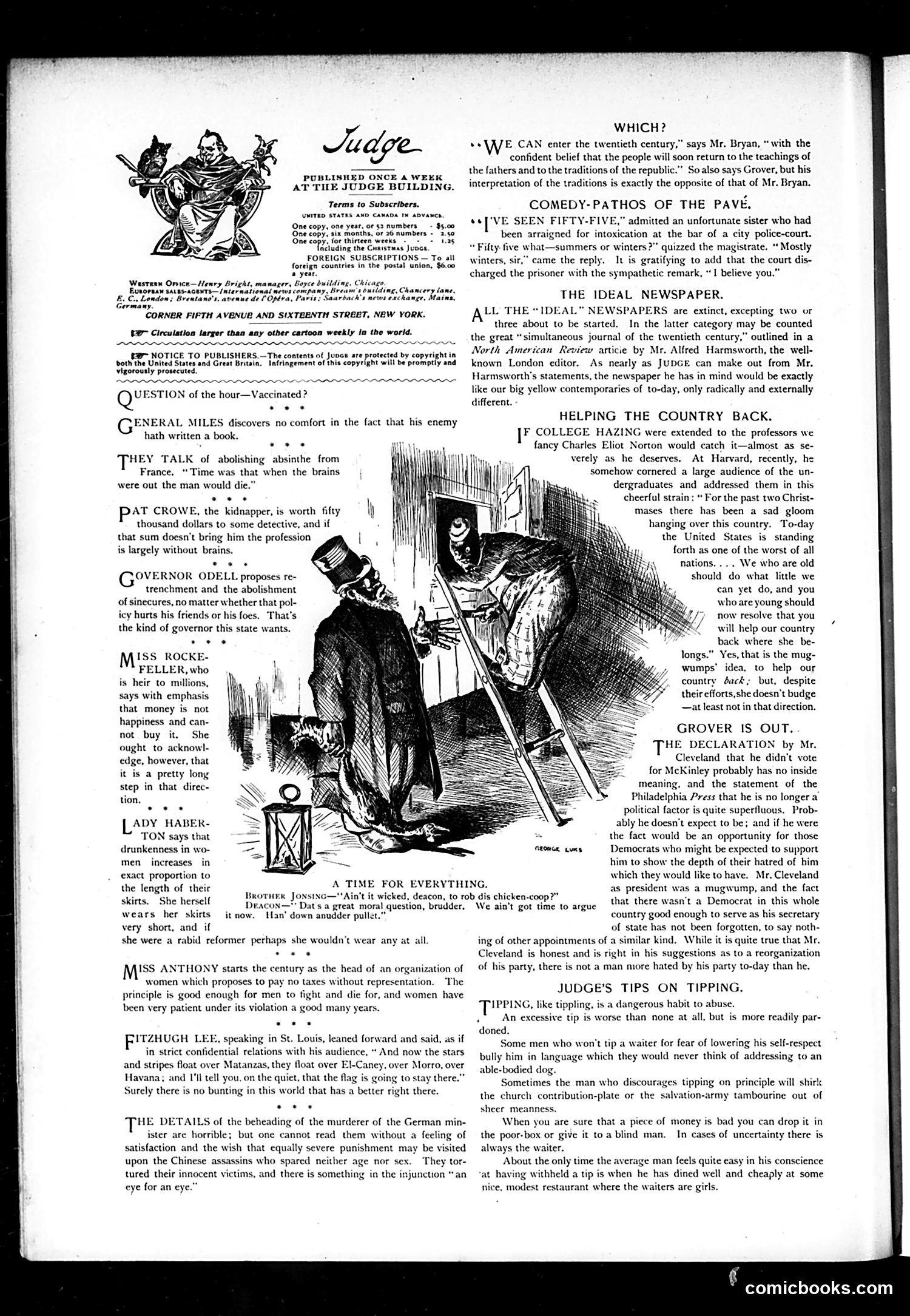
The main cartoon, titled "A Time for Everything," depicts Death as a skeletal figure playing a violin while standing over a prone body. The surrounding satirical text items mock various public figures and political positions of the era. The cartoon appears to criticize American political leadership, particularly referencing President Cleveland's policies and military matters (mentions of "General Miles," foreign relations, and "German minister"). One section titled "Grover is Out" discusses Cleveland's political prospects. The overall theme suggests Death/mortality as an ironic commentary on governance failures—implying political leadership is bringing harm to the nation. The satirical items critique specific figures' positions on taxes, women's suffrage, tipping customs, and military conduct. Without definitive dates visible, the exact historical moment remains unclear, though Cleveland's presidency and contemporary political debates are central.
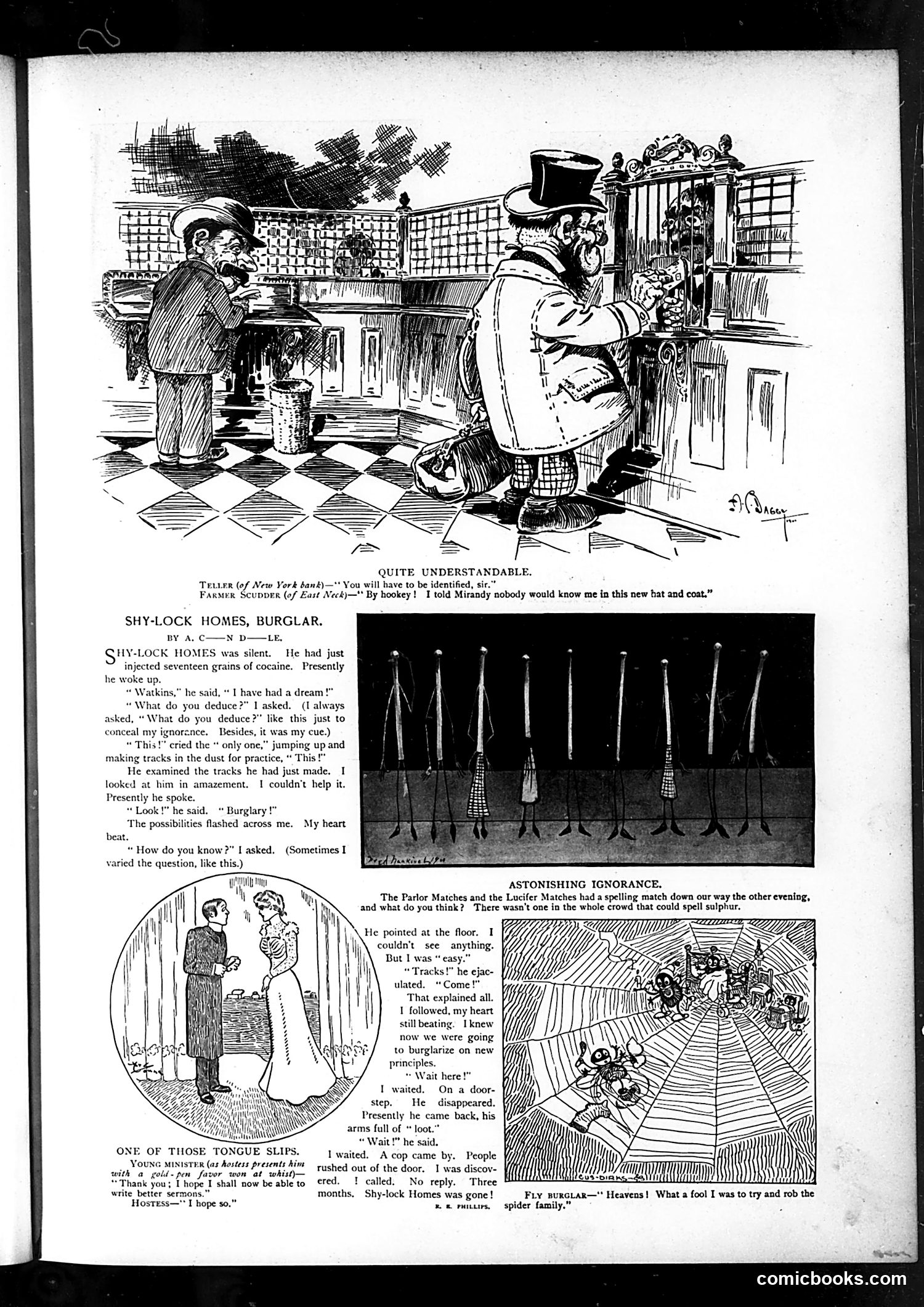
This page contains three unrelated humorous pieces typical of Judge magazine's satirical format: **Top cartoon ("Quite Understandable")**: Two men discuss identifying someone—one mentions a farmer from East Side who "told Miranda nobody would know me in this new hat and coat," suggesting the humor involves disguise or mistaken identity as a social commentary. **"Shy-lock Homes, Burglar"**: A parody detective story about a burglar named Shy-lock Holmes (punning on Sherlock Holmes). The narrator describes being recruited for a burglary, examining tracks, then being abandoned with stolen goods—satirizing both detective fiction conventions and criminal incompetence. **"Astonishing Ignorance"** and **"Fly Burglar"**: Brief comedic vignettes about matches, spiders, and burglary misadventures. The page primarily offers light entertainment rather than political satire, focusing on wordplay, fictional parody, and slapstick scenarios.
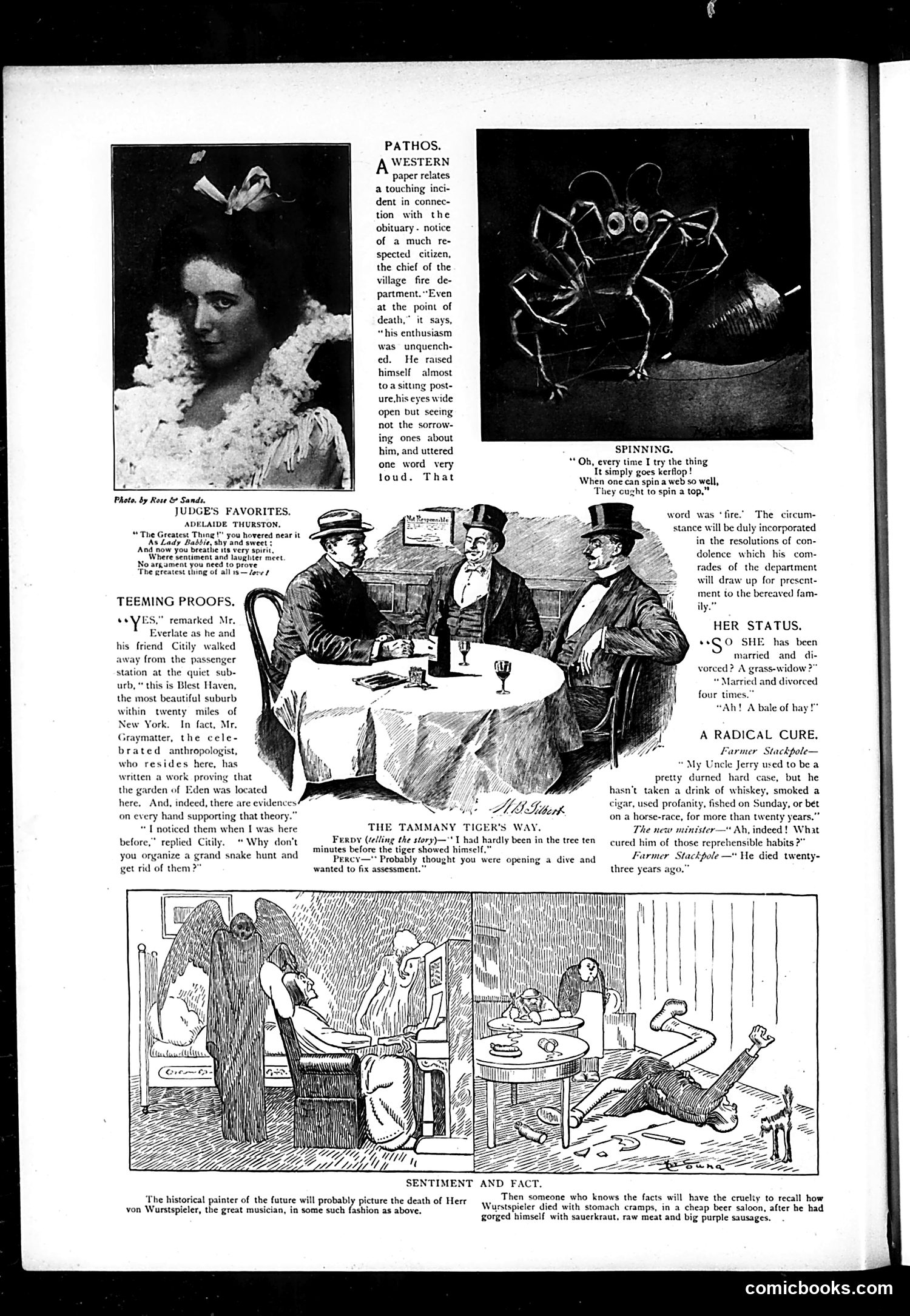
This page contains several unrelated satirical pieces typical of Judge's format: **"Pathos"** mocks a newspaper's emotional obituary of a fire chief, suggesting excessive sentimentality over a "much respected citizen." **"Judge's Favorites"** appears to be a lighthearted anecdote about a walk through a town called "Blest Haven," celebrating rural tranquility—likely satirizing urban readers' romanticization of country life. **"Teeming Proofs"** makes a joke about organizing a "grand-snake hunt," with the punchline suggesting bureaucratic absurdity. **"Sentiment and Fact"** (bottom cartoon) contrasts romantic artistic depictions of death with crude reality, referencing the death of a musician (Wurstspieler) who died from overeating cheap sausages and beer—satirizing the gap between sentimental art and harsh truth. The page primarily uses humor to critique sentimentality, bureaucracy, and false romanticism.
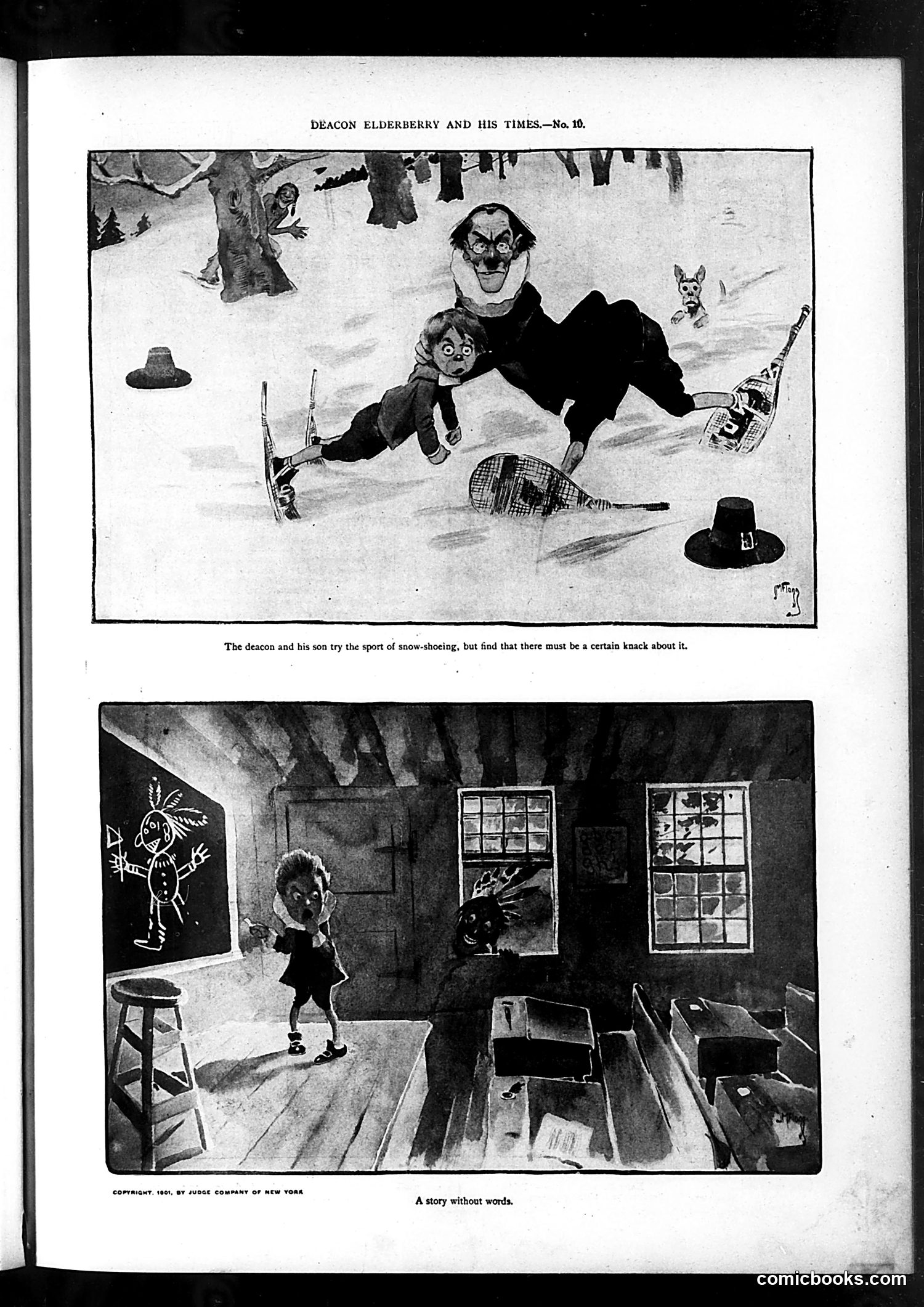
This page shows two sequential cartoons from "Deacon Elderberry and His Times," a recurring Judge comic strip. The top panel depicts a father (Deacon Elderberry) and son attempting snowshoeing in winter. Both figures are comically failing—tangled with their equipment, skis askew, and clearly lacking proper technique. Their exaggerated expressions convey frustration and mishap. The bottom panel, labeled "A story without words," shows an indoor scene, likely depicting consequences or a related domestic moment, though details are harder to discern in this reproduction. The humor rests on the physical comedy of incompetence at a winter sport and the implication that snowshoeing requires skill ("a certain knack") that these characters lack. The strip appears to be gentle, family-friendly satire of everyday middle-class leisure activities and the gap between ambition and ability.
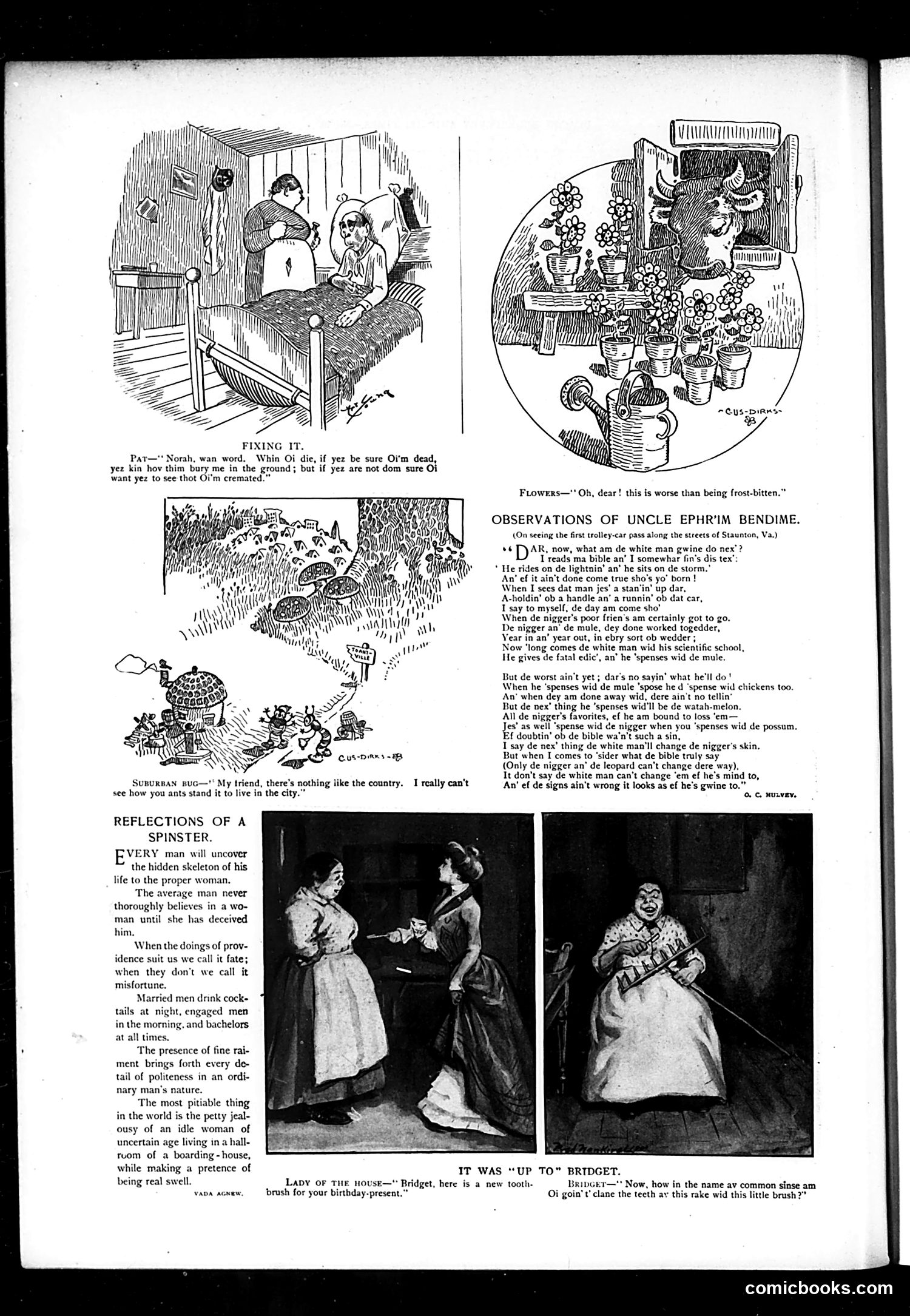
This Judge magazine page contains several satirical pieces reflecting late-19th/early-20th-century American attitudes: **"Fixing It"** (top left): An Irish immigrant ("Pat") discusses cremation preferences in dialect humor typical of the era's ethnic comedy. **"Observations of Uncle Ephr'im Bendime"** (center-right): A deeply problematic piece using racist dialect to express an elderly Black man's fears about technological progress (trolley cars replacing mules). The satire targets anxieties about industrialization displacing traditional labor, but relies entirely on offensive stereotypes and dialect caricature. **"Reflections of a Spinster"** (lower left): Social commentary on women's behavior and marriage, presented as sardonic observations about gender relations. **"It Was 'Up to' Bridget"** (bottom): Another Irish servant stereotype—humor based on an immigrant domestic worker's supposed confusion about modern appliances. The page exemplifies Judge's approach: satirizing social change, class differences, and ethnic groups through caricature and exaggerated dialect. While addressing real contemporary issues (industrialization, immigration, gender roles), it relied on racist and xenophobic humor that modern audiences find offensive rather than amusing.
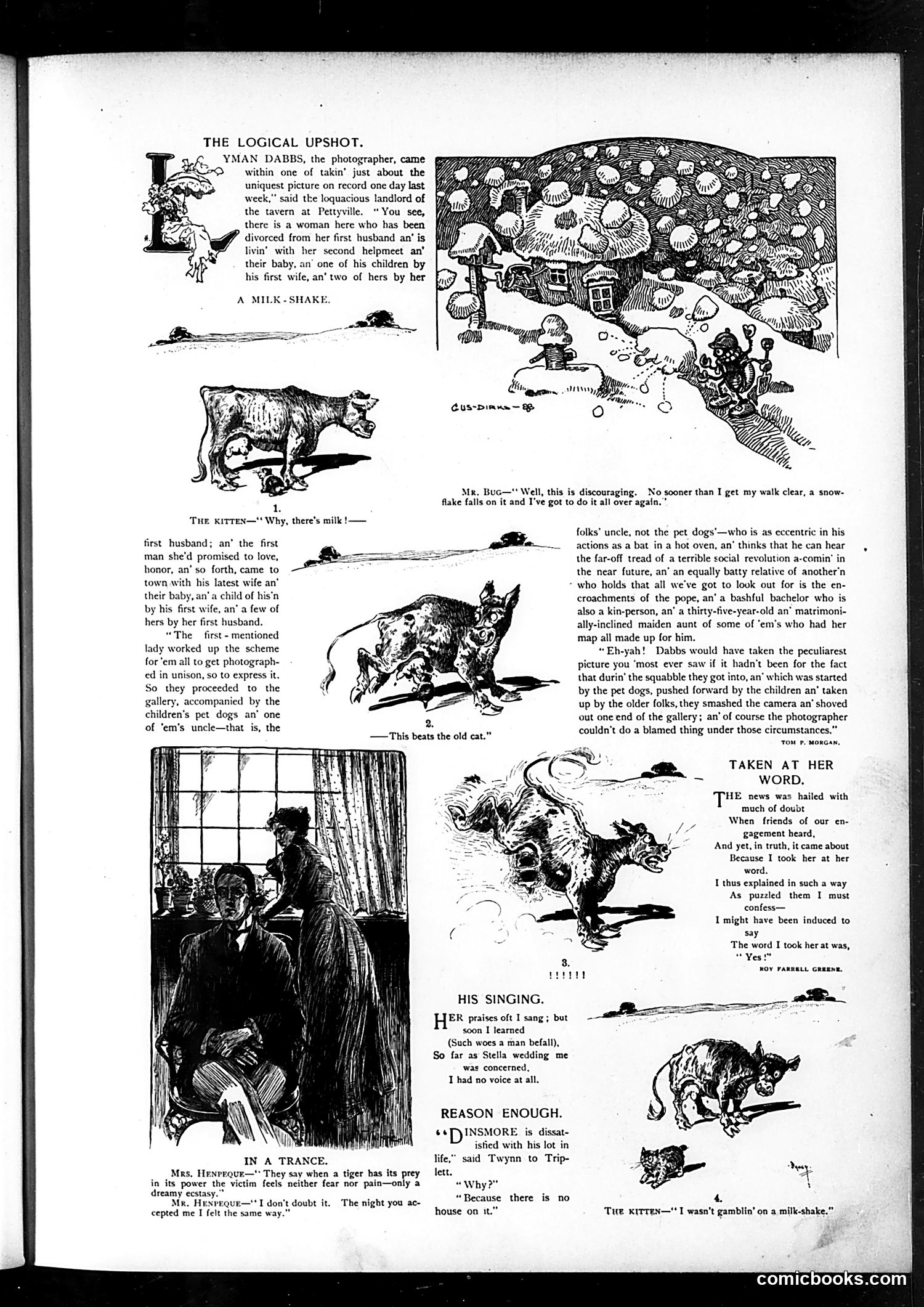
This page contains several unrelated humorous sketches typical of Judge's satirical format. **Main Story**: "The Logical Upshot" satirizes the complexity of modern blended families. A photographer attempts to capture a group portrait of a woman, her two ex-husbands, their current spouses, and their various children from different marriages—a deliberately tangled domestic arrangement meant to illustrate the messy realities of contemporary divorce and remarriage. The joke's punchline: the chaotic family members fight so badly during the photo session that they destroy the camera, making the picture impossible. The satire critiques both the absurdity of such complicated modern family structures and the futility of attempting to impose order on them. **Other sketches** on the page include brief, unrelated jokes about mesmerism, a bachelor's singing voice, and a man frustrated by snow—typical of Judge's miscellaneous humor format. The overall tone suggests early-to-mid 20th century concerns about changing marriage and family structures.
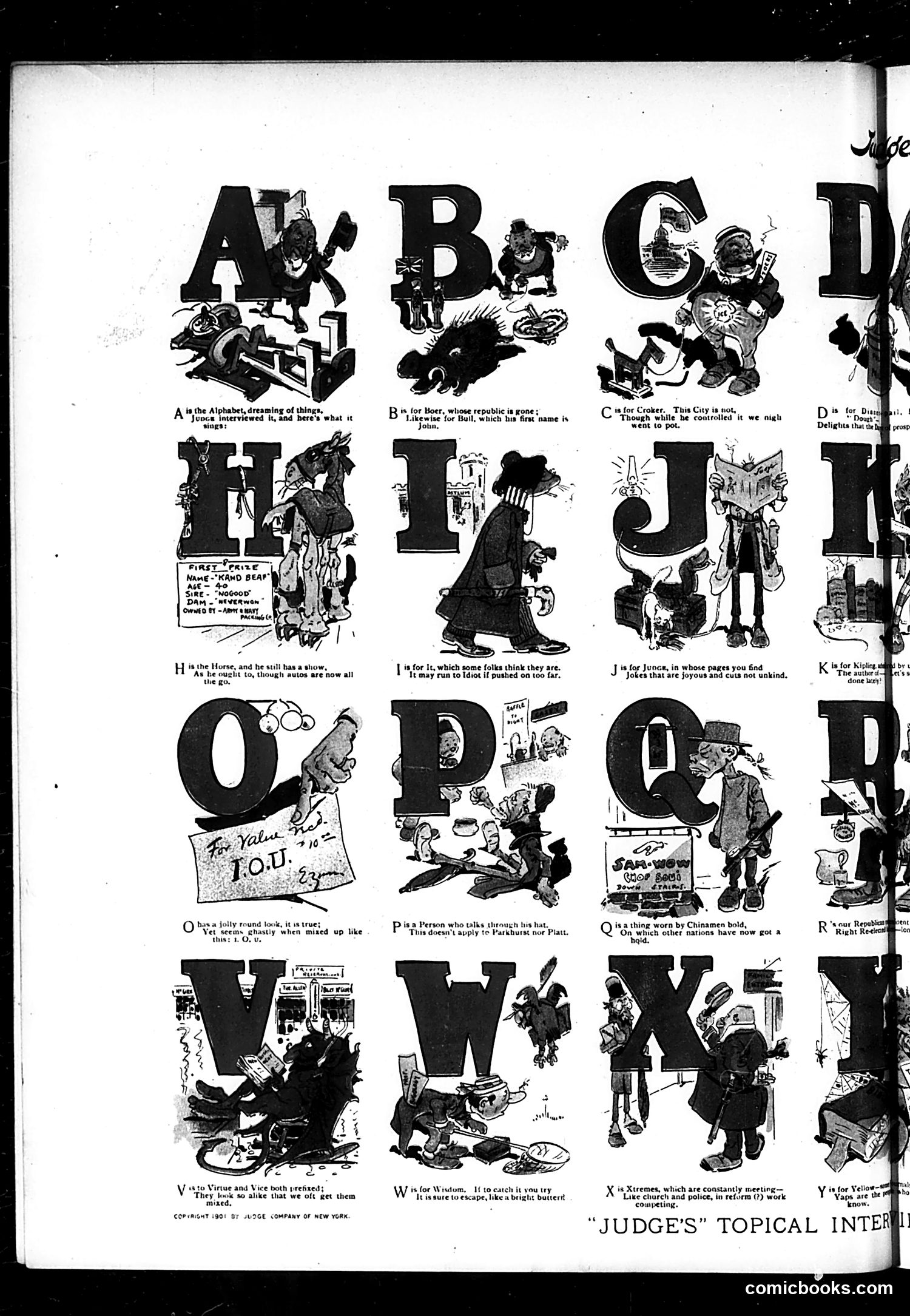
This is an alphabetical satirical primer using large letters paired with topical illustrations and verse commentary. Each entry mocks contemporary figures and issues: **Key targets include:** - **Croker**: Richard Croker, New York political boss, blamed for city corruption - **Parkhurst and Platt**: Reform figure and Republican politician, both criticized for hypocrisy - **The Boer War**: Referenced as a concluded conflict ("republic is gone") - **Chinese exclusion**: The "queue" (pigtail) worn by Chinese immigrants, now imitated by other nations—a satirical jab at cultural appropriation or mockery - **Social contrasts**: "Virtue and Vice" look alike; "Wisdom" is elusive; "It" (idiocy) lurks in common speech The general tone mixes political corruption critiques with social observation. It's Judge magazine's typical format: biting commentary on American politics, immigrant issues, and urban vice disguised as lighthearted alphabet humor for readers familiar with 1901's newsmakers.
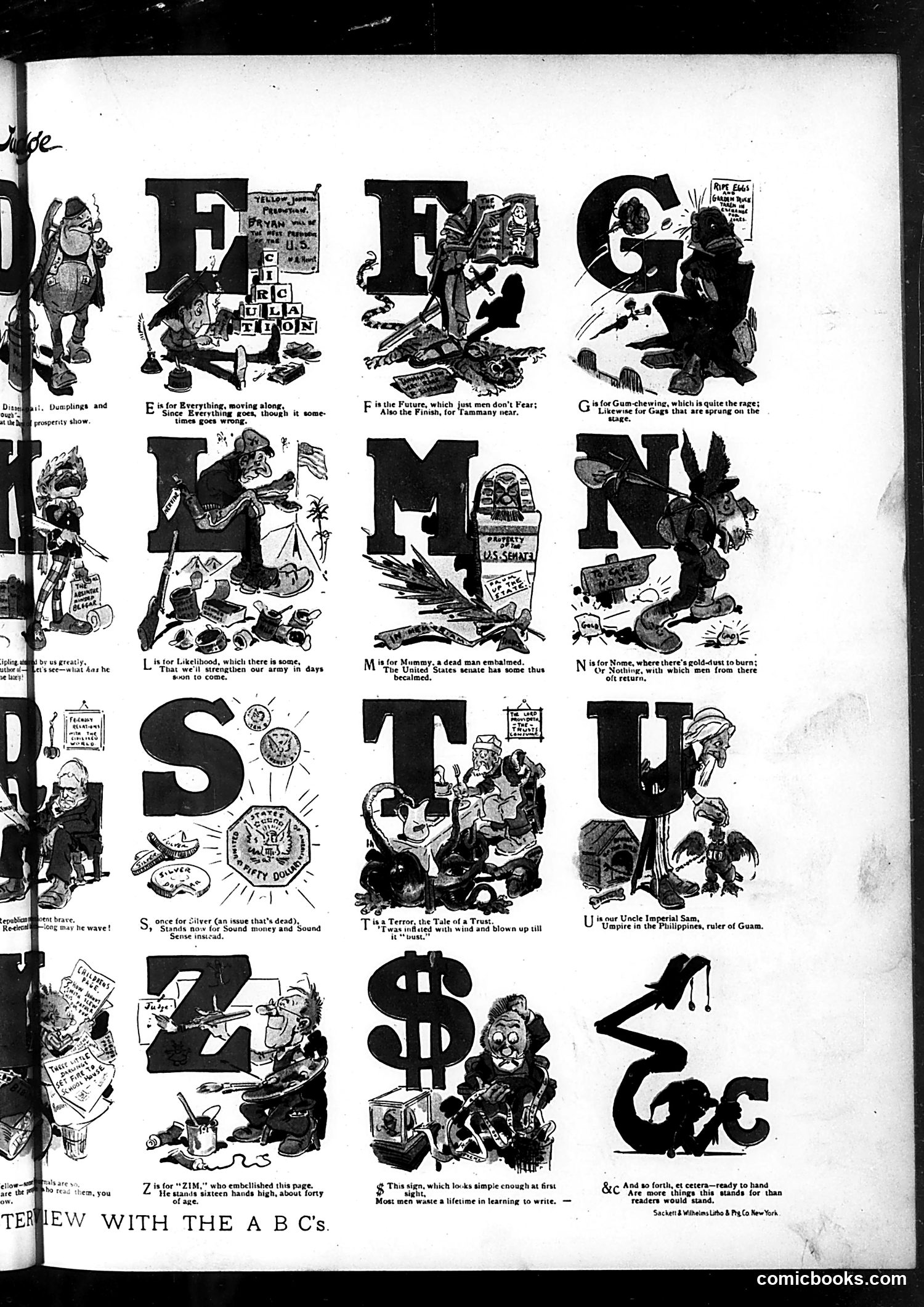
This is an alphabetical satire on American politics and society, likely from the early 1900s. Each letter features caricatured figures and contemporary references: **Political targets** include Tammany Hall (the corrupt New York Democratic machine), the U.S. Senate, and "Uncle Sam" in the Philippines—referencing American imperialism. **Social commentary** mocks: - Economic obsessions ("Silver," "Sound Money") - Military expansion and preparedness - Gum-chewing as a vulgar fad - Gold rushes (Nome, Alaska) - Senate corruption ("a dead man embalmed") The cartoonist "ZIM" drew elaborate letter-forms incorporating small figures and scenes. The final couplet jokes that the dollar sign ($) and ampersand (&) represent more meanings than readers could tolerate—suggesting capitalism and commerce underlie everything. It's political humor targeting American institutions, materialism, and fashionable vices through visual wordplay.
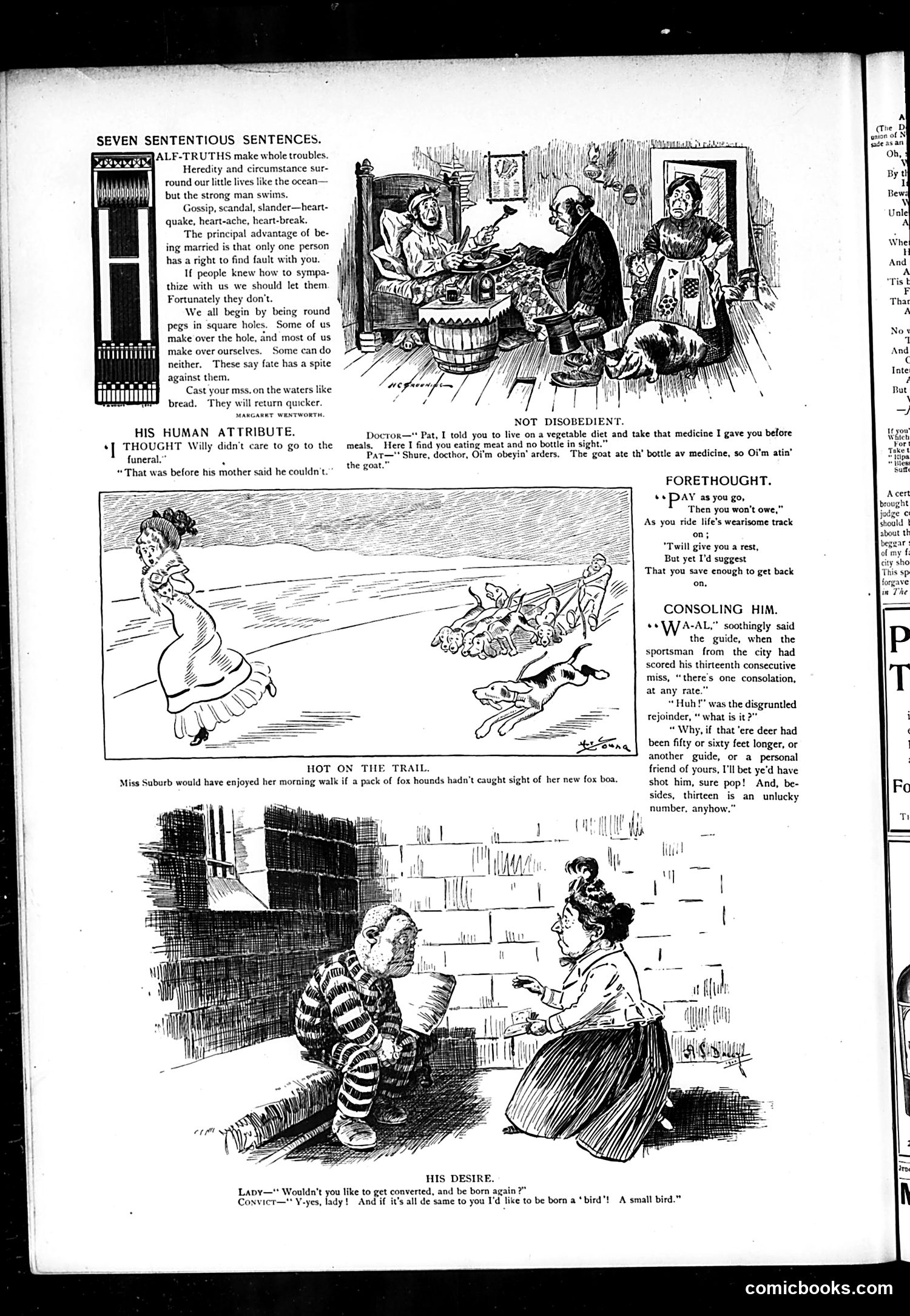
This page contains seven separate humorous sketches typical of late 19th/early 20th-century American satire: **"Seven Sententious Sentences"** presents cynical aphorisms about life, marriage, and social behavior—mocking self-help platitudes. **"Not Disobedient"** jokes about an Irish laborer (Pat, identified by dialect) who follows doctor's orders literally: the goat ate his medicine bottle, so he eats the goat instead. The humor relies on working-class immigrant stereotypes. **"Hot on the Trail"** depicts a wealthy woman whose fashionable fox fur boa is mistaken for a real fox by hunting dogs—satire of upper-class vanity and the disconnect between natural and artificial. **"His Desire"** features a convict (in striped uniform) who, when offered religious conversion, expresses desire to be "born a bird"—dark humor about prison life and escape fantasy. The remaining sketches use similar formats: mild social observation with exaggerated illustrations. The overall tone reflects Judge's satirical approach to class differences, immigrant stereotypes, and urban/rural contrasts common to Gilded Age American humor.
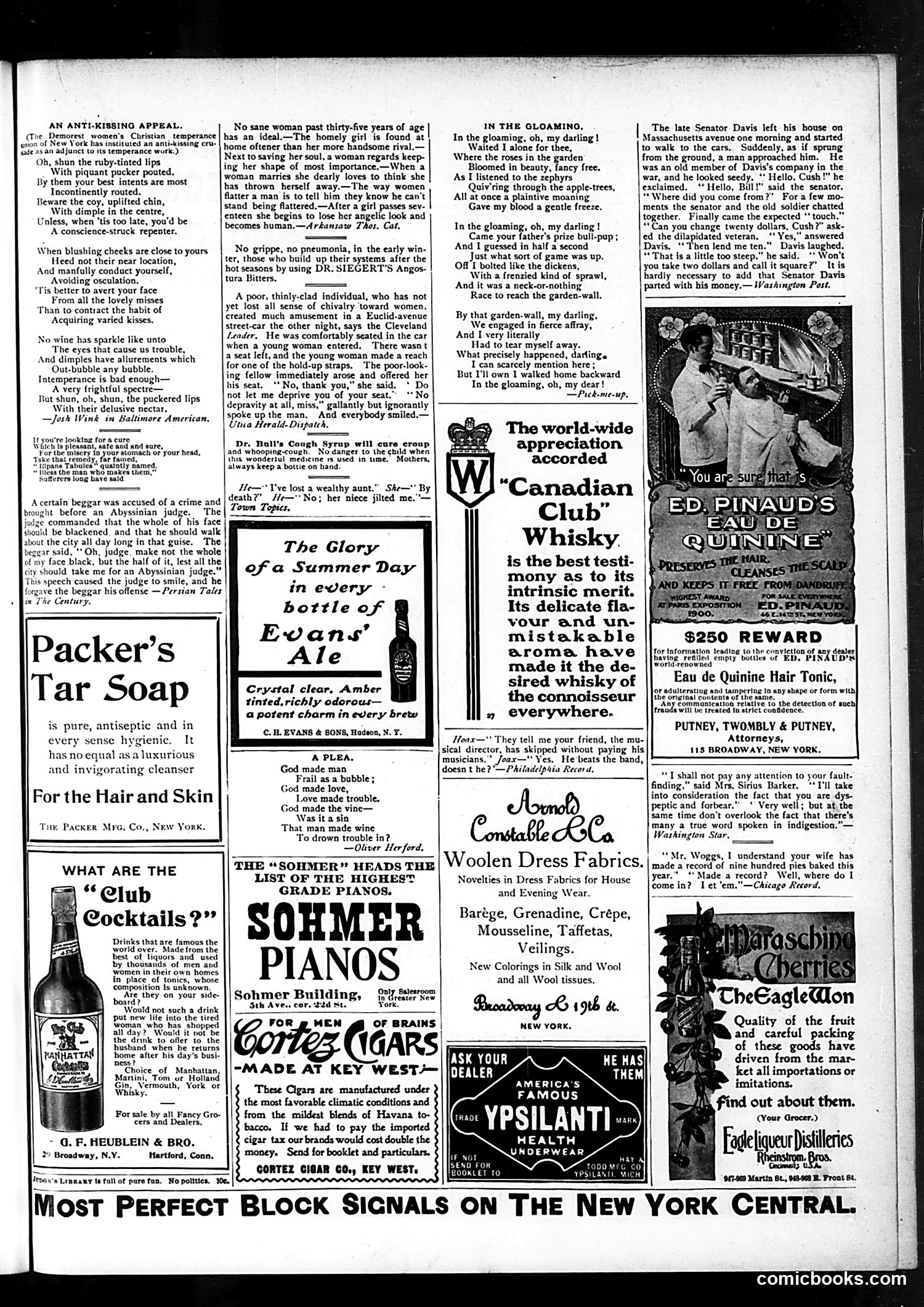
This page is primarily **advertising with some light satirical verses**, rather than political cartoons. The main satirical content includes: 1. **"An Anti-Kissing Appeal"** — A humorous poem mocking the Women's Christian Temperance Union's (WCTU) anti-kissing campaign in New York. The satire ridicules the WCTU's moral crusade by treating kissing with the same gravity as alcohol consumption, suggesting the prohibition movement has become absurdly overreaching. 2. **Aphorisms about women** — Brief sardonic observations ("a homely girl is found at home oftener than her more handsome rival") reflect period attitudes about women's appearance and marriage. 3. **The streetcar anecdote** — A humorous story about a poor man offering his seat to a woman, then awkwardly denying she'd deprive him, plays on class distinctions and gentility. The page is dominated by product advertisements (tar soap, pianos, whisky, cigars), typical of Judge's revenue model. The satire targets the era's reform movements and gender dynamics without deep political engagement.
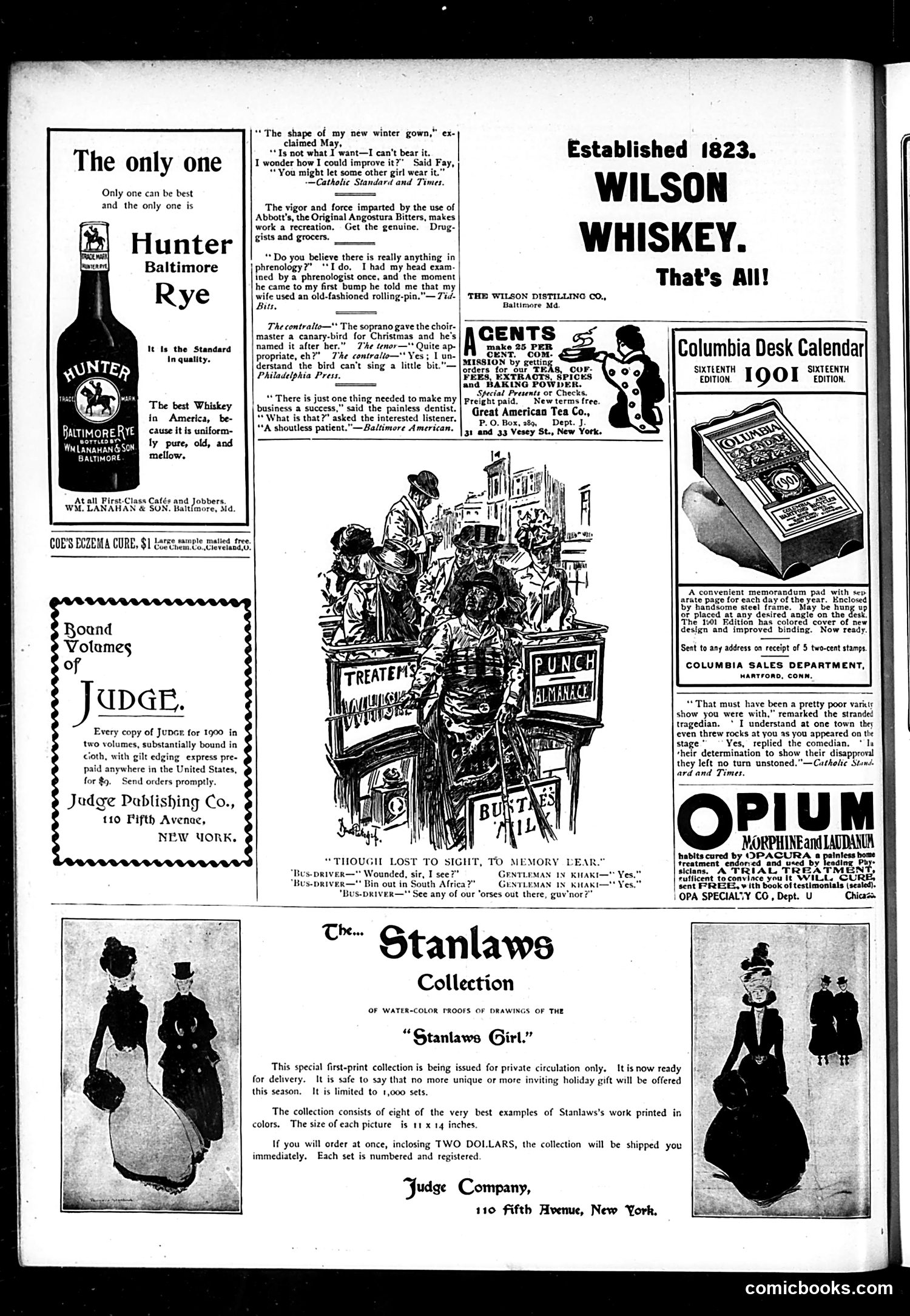
This page is primarily **advertising and miscellaneous content** rather than a unified satirical cartoon or political commentary. The main visual element is a sketch labeled "Though Lost to Sight, to Memory Dear" depicting what appears to be a **Boer War scene**—a wounded soldier being helped by others. The accompanying dialogue references a bus driver and soldiers "out in South Africa," clearly referencing the Second Boer War (1899-1902), a topical concern for American readers at this time. The page contains numerous **product advertisements** (whiskey, bitters, dental services, tea company) and humor snippets (brief jokes about phrenology, dentistry, soprano singers). The **Stanlaws Collection** advertisement at bottom promotes water-color artwork prints of "Stanlaws Girl" illustrations for private circulation—a holiday gift offering. Overall, this represents a typical Judge magazine page: a mix of topical humor, war-related references timely to 1901, and commercial advertising woven throughout.
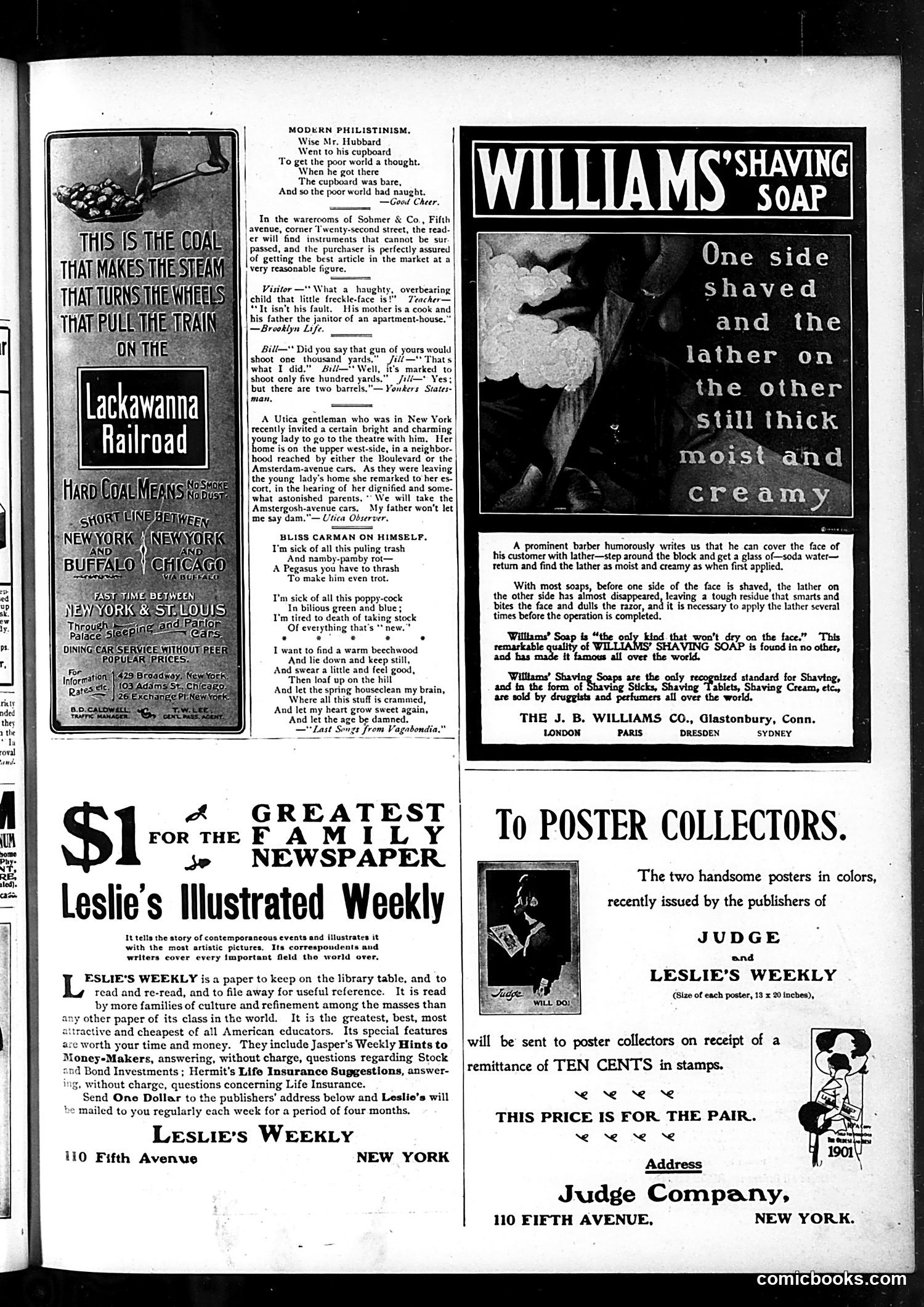
This page is primarily **advertising and promotional content** rather than political commentary. The main elements are: **"Modern Philistinism" section:** Brief satirical commentary on American culture, including humorous anecdotes (a child's rudeness blamed on parents' working-class jobs; an exaggerated gun claim). The title suggests mild criticism of materialism or cultural decline, but lacks specific political targets. **Williams' Shaving Soap ad:** The dominant feature—an extended advertisement showcasing the soap's superior lather-retention through testimonials and product claims. **Leslie's Illustrated Weekly promotion:** Advertising the magazine as educational and culturally refined for "families of culture." **Poster offer:** Judge magazine promotes colored posters of itself and Leslie's Weekly for ten cents. The page reflects **early 20th-century magazine culture**: heavy advertising mixed with light humor, targeting middle-class readers. There are no identifiable political figures or events, and no sharp satirical edge—it's mostly commercial content typical of the era's periodicals.
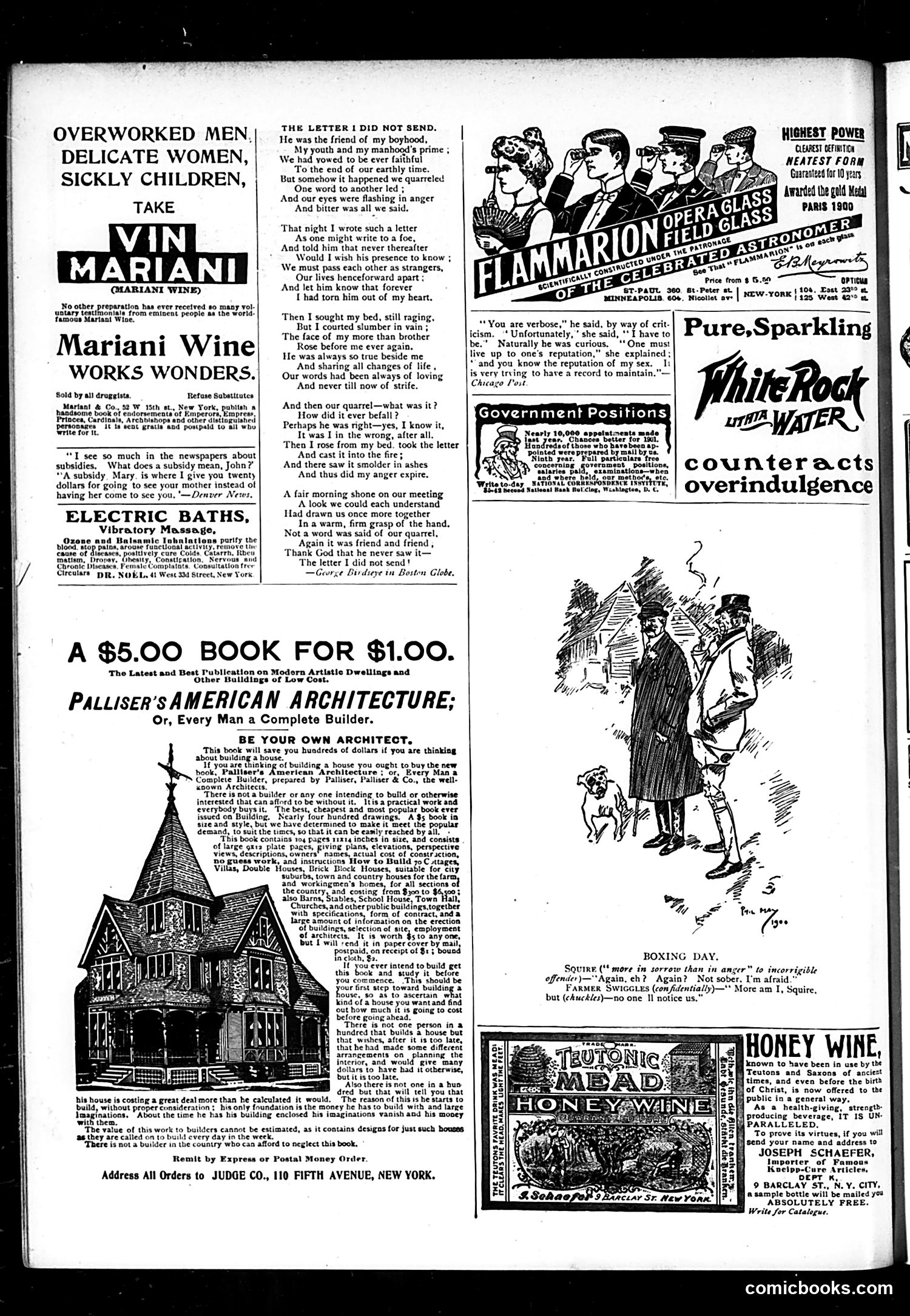
This is primarily an **advertising page** from Judge magazine, with one notable literary content piece. The main editorial content is a sentimental poem titled "The Letter I Did Not Send," published in the Boston Globe. It tells of two longtime friends who quarrel bitterly. The narrator writes an angry letter severing the friendship but, unable to sleep, reflects that *he* was actually at fault. He burns the unsent letter, and they reconcile the next morning without words. The satire here is subtle—it's likely mocking the overwrought sentimentality and melodrama typical of popular newspaper poetry of the era. The page is otherwise filled with period advertisements: Mariani Wine (a popular patent medicine), Electric Baths treatments, an architectural instruction book, Flammarion opera glasses, White Rock sparkling water, Tutonic Mead, and Honey Wine. No political figures or cartoons are visible on this particular page.
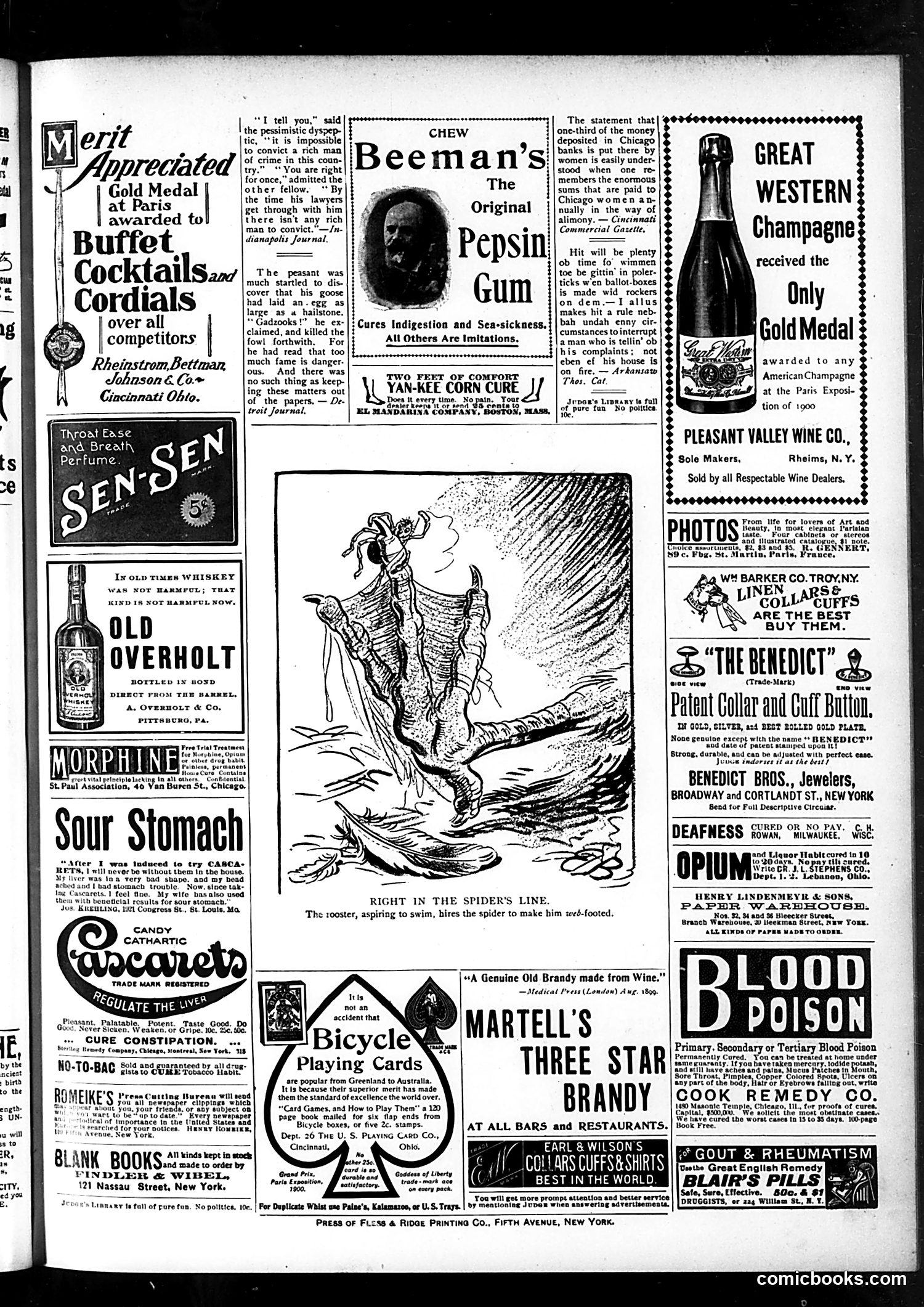
This is primarily an **advertising page** from Judge magazine, with one small satirical cartoon titled "Right in the Spider's Line" (center). **The Main Cartoon:** A rooster hires a spider to make him "web-footed" so he can swim—a humorous absurdity mocking misguided schemes. The joke plays on the rooster's foolish ambition to become something he's not. **The Text Cartoons** (left column) are brief satirical quips: - One mocks wealthy criminals escaping conviction through expensive lawyers - Another jokes about women winning political power through ballot boxes (a contemporary women's suffrage reference) **The Advertisements** dominate the page, hawking period remedies (Beeman's Pepsin Gum, morphine products, "Blood Poison" cures) and luxury goods (champagne, brandy, playing cards)—many for conditions or substances we'd now recognize as dangerous or dubious. The page reflects early 1900s attitudes: skepticism toward wealth and law, emerging women's political participation, and unregulated patent medicine marketing.
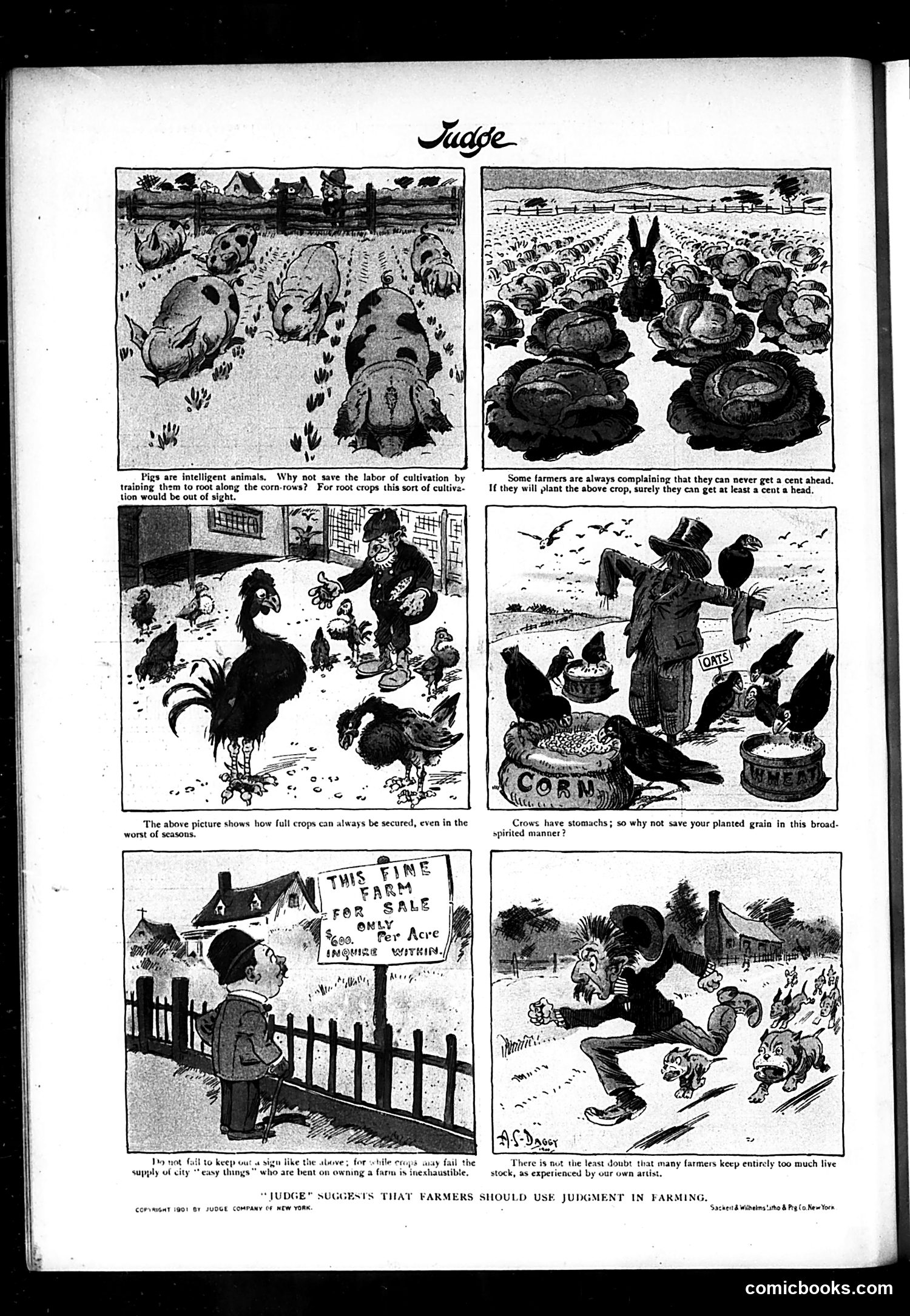
This satirical page mocks farmers' poor agricultural judgment through absurdist scenarios. Each panel presents ridiculous farming "solutions": 1. **Top panels**: Using pigs to till cornrows and rabbits to harvest crops—suggesting farmers waste labor on inefficient methods. 2. **Middle panel**: Feeding grain to crows instead of saving it—satirizing farmers who don't protect their crops from wildlife. 3. **Bottom panels**: A farm "for sale" sign and a farmer surrounded by excess livestock, illustrating the broader problem: farmers keep too many animals and make economically unsound decisions. The subtitle—"Judge Suggests That Farmers Should Use Judgment in Farming"—frames the satire as practical advice. The cartoonist criticizes rural inefficiency and poor resource management, implying farmers' poverty stems from foolish choices rather than circumstance. This reflects Progressive-era urban attitudes toward rural Americans as backward or incompetent.