
Judge, 1901-01-26 · page 2 of 16
Judge — January 26, 1901 — page 2: what you’re looking at
What you’re looking at
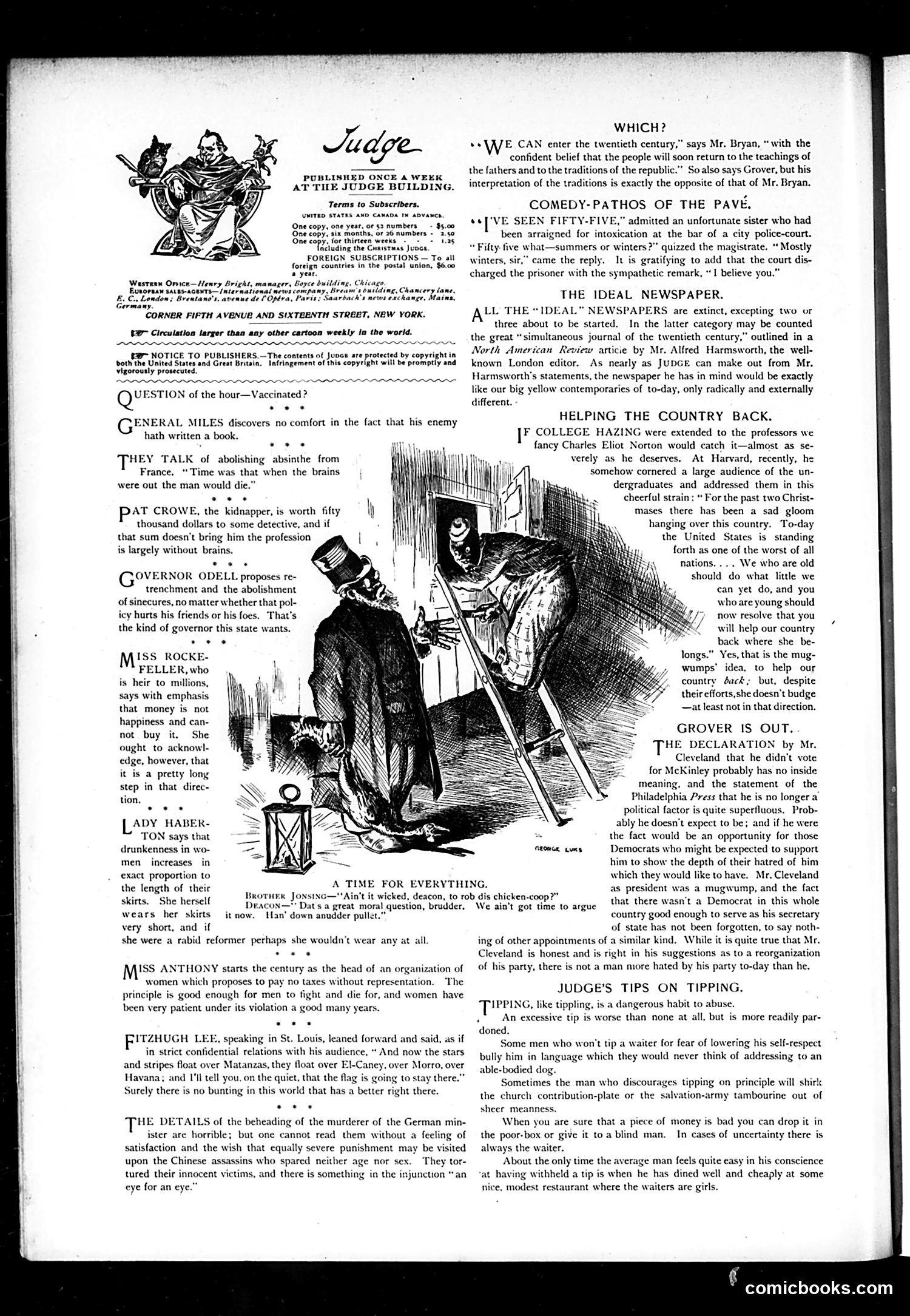
The main cartoon, titled "A Time for Everything," depicts Death as a skeletal figure playing a violin while standing over a prone body. The surrounding satirical text items mock various public figures and political positions of the era. The cartoon appears to criticize American political leadership, particularly referencing President Cleveland's policies and military matters (mentions of "General Miles," foreign relations, and "German minister"). One section titled "Grover is Out" discusses Cleveland's political prospects. The overall theme suggests Death/mortality as an ironic commentary on governance failures—implying political leadership is bringing harm to the nation. The satirical items critique specific figures' positions on taxes, women's suffrage, tipping customs, and military conduct. Without definitive dates visible, the exact historical moment remains unclear, though Cleveland's presidency and contemporary political debates are central.
📄 Transcribed text from this page (OCR, searchable)
Machine-transcribed from the original scan — historical spelling and the odd misread are preserved.
FE: AT THE JUDGE BUILDING. Terms to Subscribers. UNITED STATES AND CANADA IN ADVAWCA. One copy, one year, or $2 numbers ‘One copy, six months, or 26 numbers ‘One copy, for thirteen weeks - = facluding the Cneistwas Juocs. FOREIGN SUBSCRIPTIONS — To all foreign countries in the postal union, $6.00 ayer. Westaan Orrice—Henry Bright, manager, Boyce building. Chicage, Eunoraan satns-acuns—/ntermational mews company, Brewm 4 building, Chancery lane, avenue del Opera nexchange, Maina, CORNER FIFTH AVENUE AND SIXTEENTH STREET, NEW YORK. (2 Circulation larger than any other cartoon weekly ia the world. f9- NOTICE TO PUBLISHERS. —The contents of Juocs both the United St vigorously prosecuted. re protected by copyright in nd Great Britain. Infringement of this copyright will be promptly and UESTION of the hour—Vaccinated ? ENERAL MILES discovers no comfort in the fact that his enemy hath written a book. THEY TALK of abolishing absinthe from France, “Time was that when the brains were out the man would die.” cee AT CROWE, the kidnapper, is worth fifty thousand dollars to some detective, and if that sum doesn’t bring him the profession is largely without brains. GOVERNOR ODELL proposes re- trenchment and the abolishment of sinecures, no matter whether that pol- icy hurts his friends or his foes. ‘That's the kind of governor this state wants. MISS ROcKE- FELLER, who is heir to millions, says with emphasis that money is not happiness and can- not buy it, She ought to acknowl. edge, however, that it is a pretty long step in that direc- tion. LADY HaBER- TON says that drunkenness in wo- men_ increases in exact proportion to the length of their skirts. She herself wears her skirts very short, and if she were a rabid reformer perhaps she wouldn't wear any at all Dracon—" Dat s a great moral question, brudder. it now. Han’ down anudder pullet.” MISS ANTHONY starts the century as the head of an organization of women which proposes to pay no taxes without representation. The principle is good enough for men to fight and die for, and women have been very patient under its violation a good many years. FITZHUGH LEE, speaking in St. Louis, leaned forward and said, as if in strict confidential relations with his audience, “And now the stars and stripes float over Matanzas, they float over El-Caney, over Morro, over Havana; and I'll tell you. on the quiet, that the flag is going to stay there.”” Surely there is no bunting in this world that has a better right there. THE DETAILS of the beheading of the murderer of the German min- ister are horrible; but one cannot read them without a feeling of satisfaction and the wish that equally severe punishment may be upon the Chinese assassins who spared neither age nor se tured their innocent victims, and there is something in th eye for an eye.” A TIME FOR EVERYTHING, Brotiek JoNsinc—"‘Ain't it wicked, deacon, to rob dis chicken-coop?” WHICH? *s\VE CAN enter the twentieth century,” says Mr. Bryan, confident belief that the people will soon return to the teachings of the fathers and to the traditions of the republ So also says Grover, but his interpretation of the traditions is exactly the opposite of that of Mr. Bryan. COMEDY-PATHOS OF THE PAVE, FIFTY-FIVE,” admitted an unfortunate sister who had been arraigned for intoxication at the bar of a city police-court. —summers or winters?” quizzed the magistrate. “ Mostly winters, sir,” came the reply. It is gratifying to add that the court dis- charged the prisoner with the sympathetic remark, “I believe you.” THE IDEAL NEWSPAPER. ALL THE “IDEAL” NEWSPAPERS are extinct, excepting two or three about to be started. In the latter category may be counted the great “simultaneous journal of the twentieth century,” outlined in a North American Review aricie by Mr. Alfred Harmsworth, the well- known London editor. As nearly as JUDGE can make out from Mr. Harmsworth’s statements, the newspaper he has in mind would be exactly like our big yellow contemporaries of to-day, only radically and externally different. HELPING THE COUNTRY BACK. COLLEGE HAZING were extended to the professors we fancy Charles Eliot Norton would catch it—almost as se- verely as he deserves. At Harvard, recently, he somehow cornered a large audience of the un- dergraduates and addressed them in this cheerful strain : For the past two Christ- mases there has been a sad gloom hanging over this country. To-day the United States is standing forth as one of the worst of all nations. ... We who are old should do what little we can yet do, and you who are young should now resolve that you will help our country back where she be- longs.” Yes, that is the mug- wumps’ idea, to help our country back; but, despite 4 their efforts,she doesn’t budge SSL Sat least not in that direction. —— = GROVER IS OUT. <S THE DECLARATION by Mr, Cleveland that he didn’t vote for McKinley probably has no inside meaning, and the statement of the Philadelphia Press that he is no longer a political factor is quite superfluous. Prob- ably he doesn’t expect to be; and if he were the fact would be an opportunity for those Democrats who might be expected to support him to show the depth of their hatred of him which they would like to have. Mr. Cleveland as president was a mugwump, and the fact that there wasn't a Democrat in this whole country good enough to serve as his secretary of state has not been forgotten, to say noth- ing of other appointments of a similar kind. While it is quite true that Mr. Cleveland is honest and is right in his suggestions as to a reorganization of his party, there is not a man more hated by his party to-day than he. JUDGE'S TIPS ON TIPPING, TIPPING, like tippling, is a dangerous habit to abuse. . "An excessive tip is worse than none at all, but is more readily par- doned. Some men who won't tip a waiter for fear of lowering his self-respect bully him in language which they would never think of address able-bodied dog. Sometimes the man who discourages tipping on principle will shirk the church contribution-plate or the salvation-army tambourine out of sheer meanness. When you are sure that a piece of money is bad you can drop it in the poor-box or give it toa blind man, In cases of uncertainty there is always the waiter. About the only time the average man feels quite easy in his conscience ‘at having withheld a tip is when he has dined well and cheaply at some nice, modest restaurant where the waiters are girls. IF We ain't got time to argue « . ~ comicbooks.com