
A complete issue · 20 pages · 1900
Judge — July 14, 1900
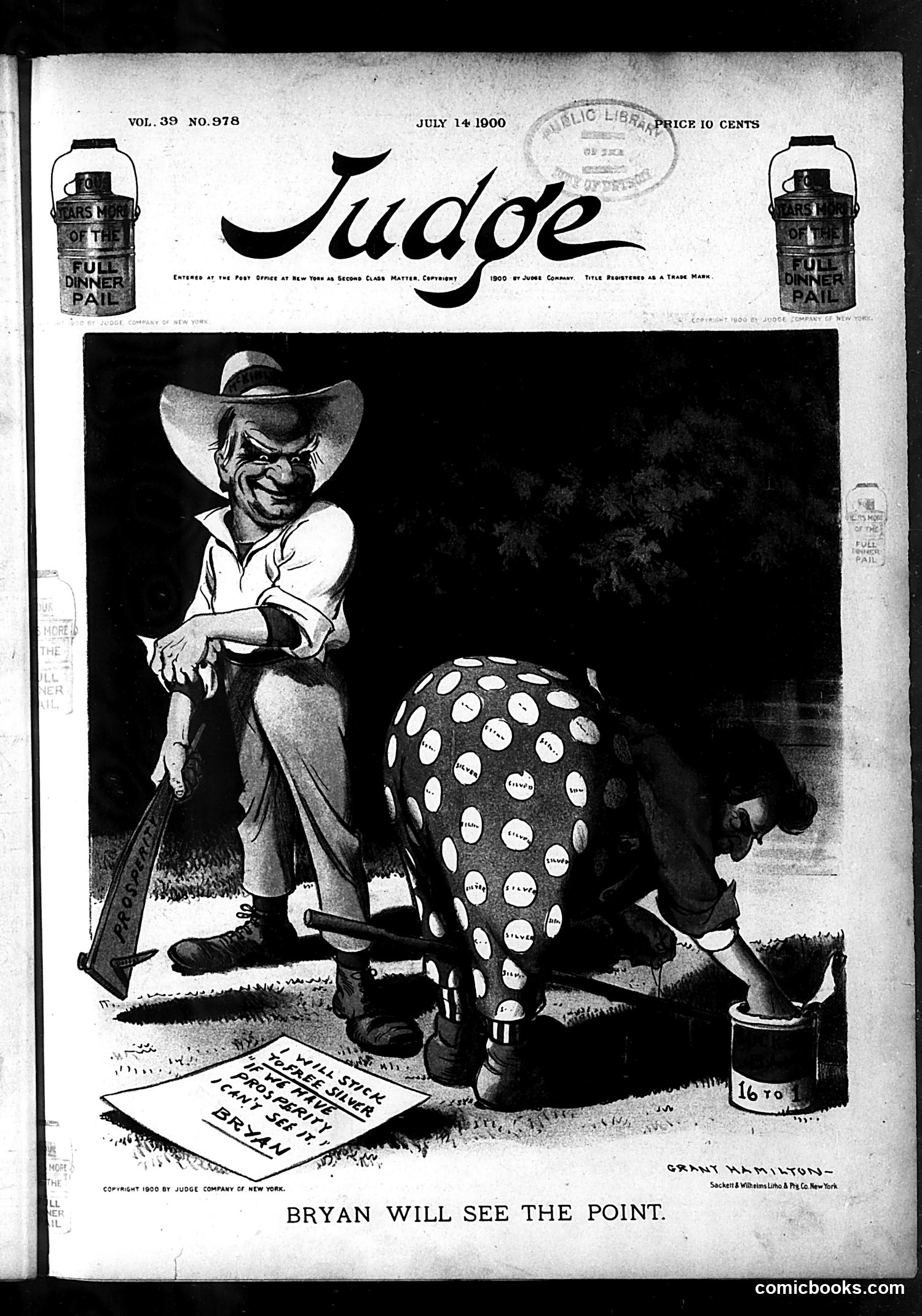
This is a July 14, 1900 *Judge* magazine cartoon satirizing William Jennings Bryan, the Democratic presidential candidate. The image shows a cowboy figure (representing Bryan) about to be struck by a large spiked ball labeled with what appears to be political/economic criticisms. The cartoon mocks Bryan's political positions through violent imagery—he's positioned as someone who will "see the point" (understand the message) only through harsh force or defeat. The exaggerated cowboy caricature and threatening spiked weapon suggest the cartoonist viewed Bryan's platform as dangerously misguided, requiring forceful correction. This reflects *Judge*'s Republican editorial stance during the 1900 election, when McKinley faced Bryan's second presidential campaign.
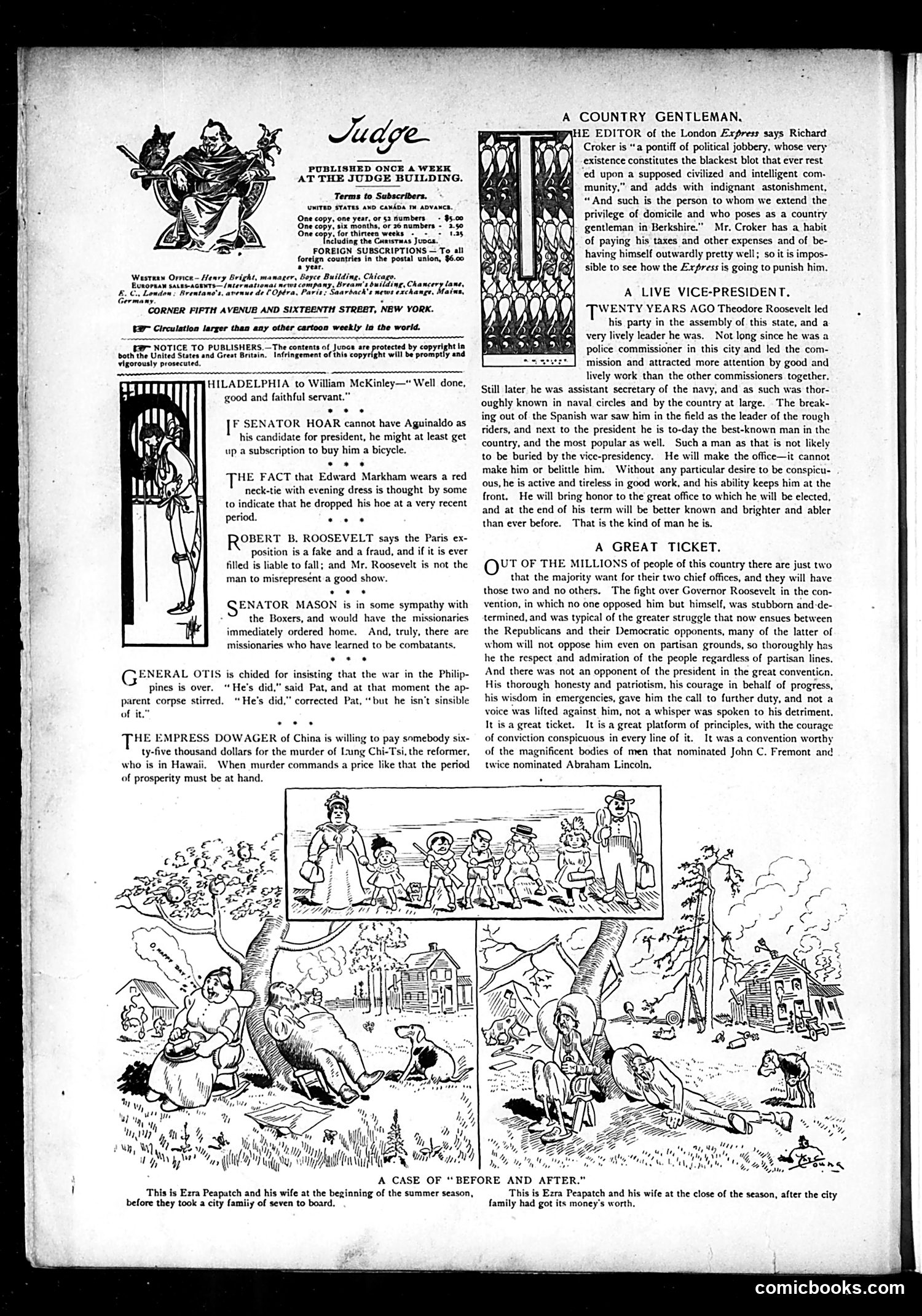
This page contains **political commentary and social satire** from an early 20th-century American magazine. **"A Country Gentleman"** attacks Richard Croker, a Tammany Hall political boss, as corrupt and parasitic on honest citizens. **"A Live Vice-President"** praises an unnamed vice-president (likely James Sherman, serving under Theodore Roosevelt around this period) as energetic and competent—a "live" contrast to typically inactive vice-presidents. **"A Great Ticket"** celebrates Roosevelt's convention nomination, depicting widespread public support and comparing him to Lincoln and Fremont as great Republican figures. The bottom comic, **"A Case of Before and After,"** uses the Peascash family to satirize working-class financial desperation—showing how poor families resort to exploitative city trips, leaving them worse off. The overall tone blends partisan Republican celebration with class-based social criticism.
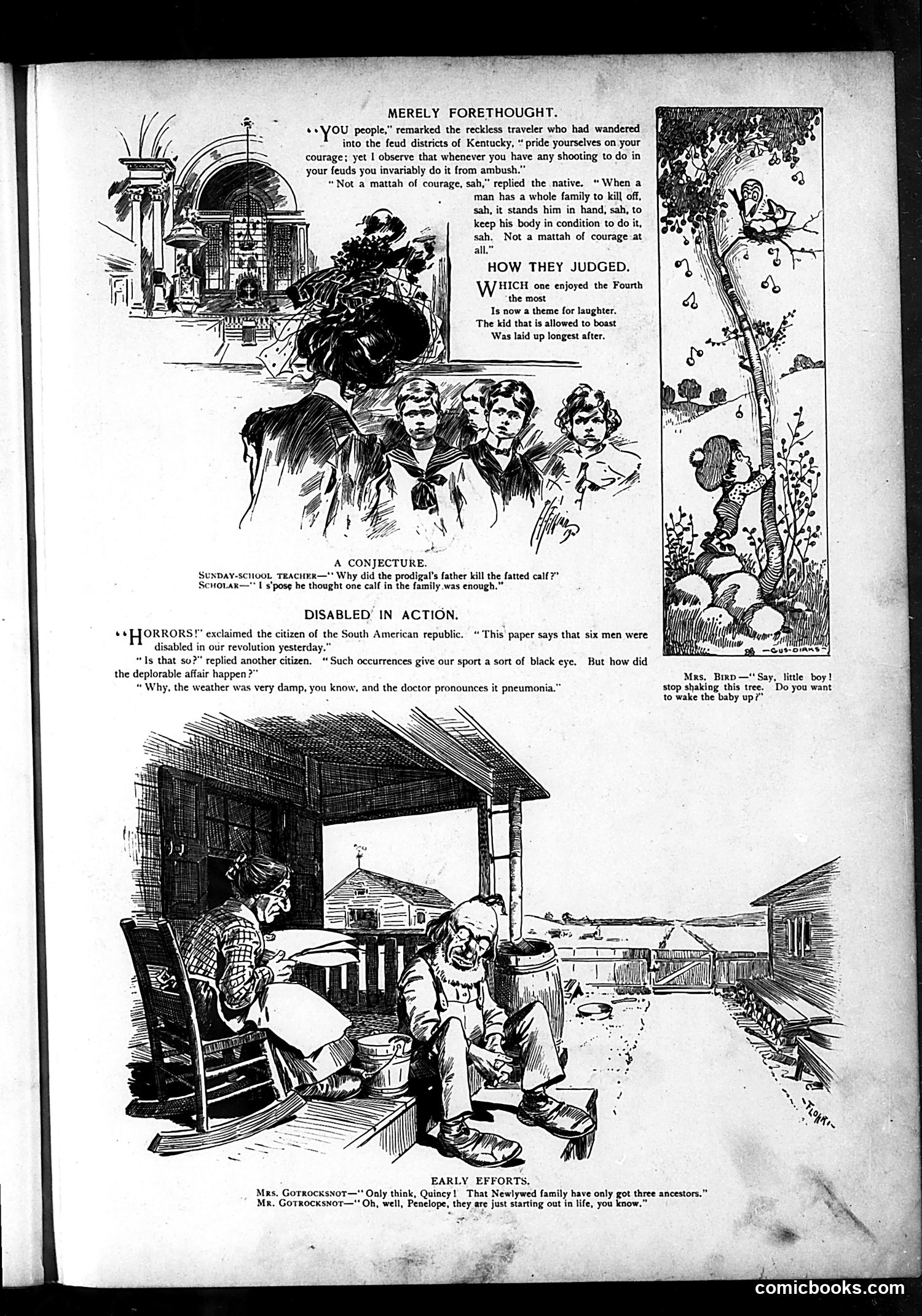
This page contains several satirical vignettes typical of Judge magazine's humor: **"Merely Forethought"** mocks frontier violence, depicting a Kentucky traveler advising caution about ambushes—a commentary on lawlessness in rural American districts. **"How They Judged"** jokes about Fourth of July celebrations, suggesting children who boast most get punished worst. **"A Conjecture"** presents a Sunday-school dialogue poking fun at theological reasoning. **"Disabled in Action"** satirizes newspaper reports of Revolutionary War casualties, with characters debating whether pneumonia counts as a wartime disability. **"Early Efforts"** depicts rustic characters discussing family ancestry, mocking pretensions to social standing among working-class Americans. The page exemplifies Judge's satirical approach to American social customs, regional stereotypes, and contemporary absurdities through sequential comic vignettes with accompanying illustrations.
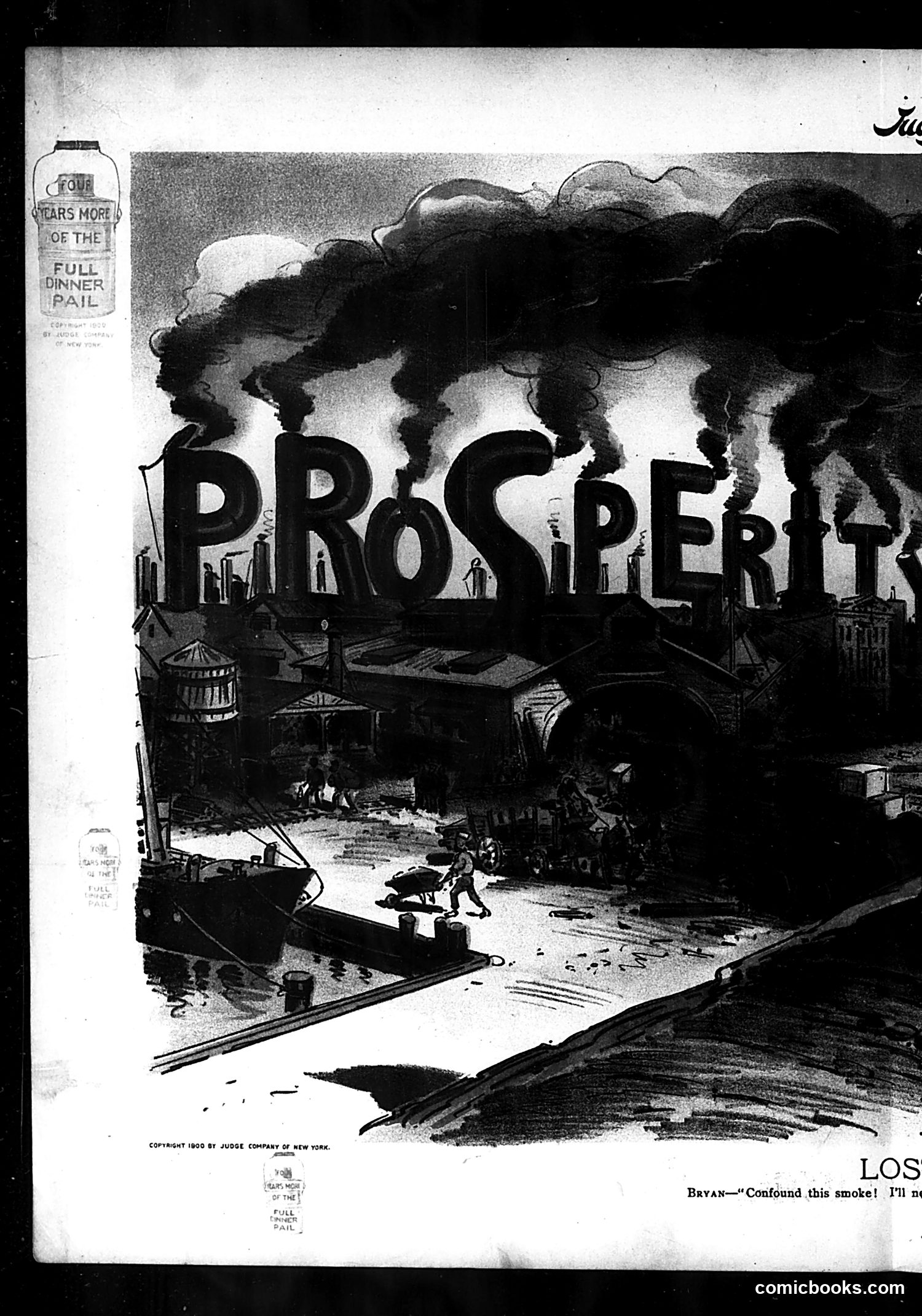
This Judge magazine cartoon satirizes industrial prosperity, likely from the early 1900s. The large letters spelling "PROSPERITY" dominate a factory scene with massive smokestacks belching dark smoke. The cartoon appears critical of claims of national economic well-being—the irony is evident: factories pollute heavily while workers labor below in harsh conditions. The bottom caption references "Bryan" and mentions "Confound this smoke!" This likely references William Jennings Bryan, a populist presidential candidate who opposed big business interests. The satire suggests that while industrialists and politicians tout "prosperity," the reality for ordinary people involves smoke, pollution, and difficult working conditions. The cartoon questions whether industrial growth truly benefits everyone equally.
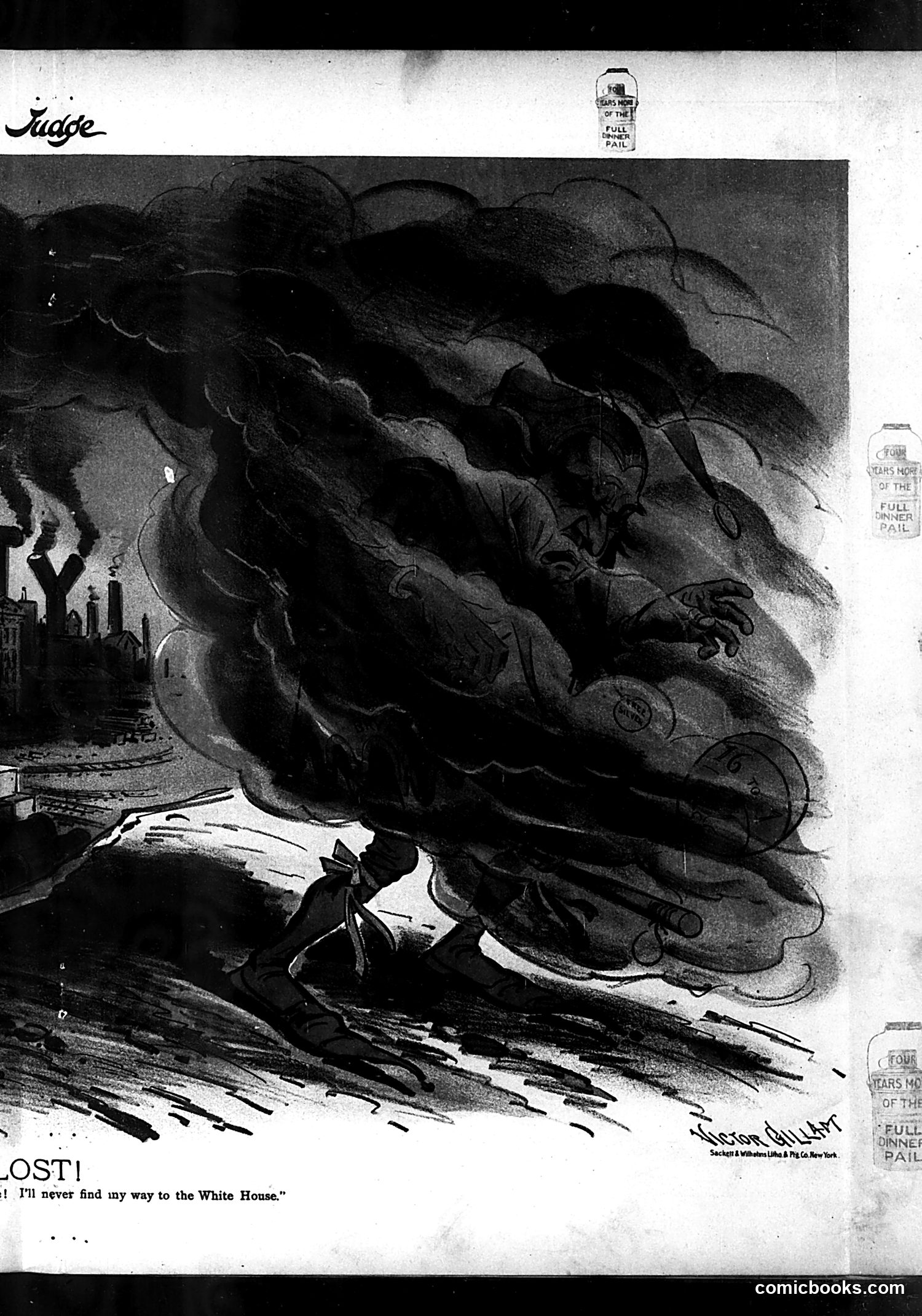
This is a satirical cartoon from *Judge* magazine depicting a figure lost in darkness and chaos, saying "I'll never find my way to the White House." The swirling, demonic forms surrounding the lost traveler suggest corruption, confusion, or moral chaos obscuring the path to political power. The cartoon likely comments on a specific political figure's failed ambitions or troubled path to the presidency—though without a clear caption identifying the figure, the exact subject remains unclear. The imagery suggests the artist viewed the candidate's route as morally compromised or hopelessly confused. The cartoon's stark black-and-white expressionistic style emphasizes the darkness and disorientation of the political landscape being satirized.
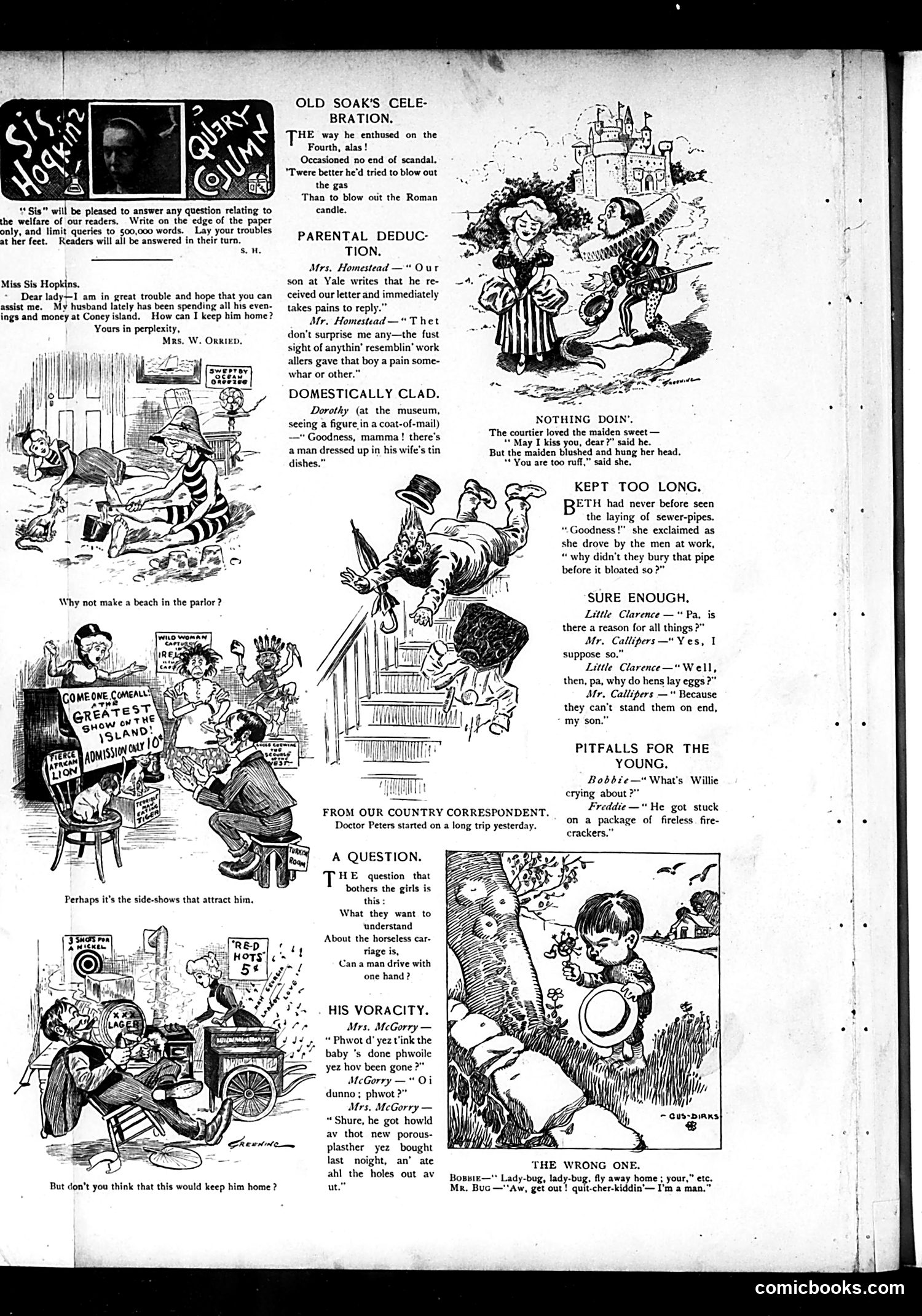
This page from Judge (an early 20th-century satirical weekly) contains multiple unrelated humor pieces typical of the era: **"Old Soak's Celebration"** mocks a drunk man's Fourth of July excess—he nearly caused a fire trying to blow out a gas lamp instead of a candle, creating scandal. **"Parental Deduction"** jokes that a Yale student's prompt letter-writing proves he's lazy; his mother notes he never worked hard at anything. **"Domestically Clad"** presents a child's innocent misunderstanding: seeing a suit of armor, she assumes a man is wearing his wife's tin dishes. Other vignettes satirize: motorcar etiquette (can men drive one-handed?), Irish immigrant speech patterns (Mrs. McGorry's baby ate holes from a porous plaster), and children's mishaps with fireworks. The humor relies on wordplay, social observation, and gentle mockery of domestic life, class pretension, and immigrant communities—typical Judge magazine fare for educated American readers of that period.
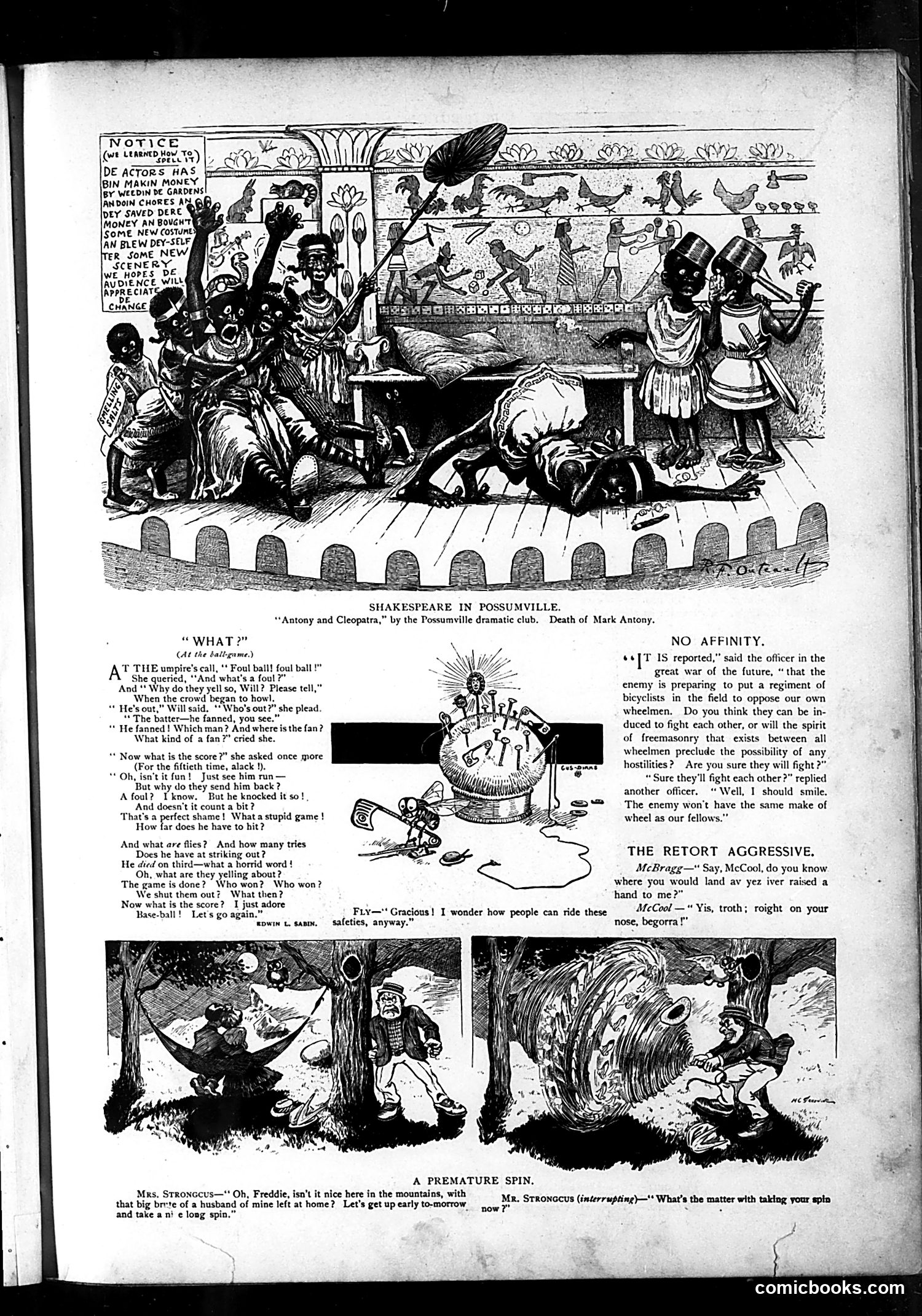
This page contains multiple satirical pieces typical of Judge magazine's humor: **Top:** "Shakespeare in Possumville" mocks amateur theatrical productions by a Black dramatic club performing "Antony and Cleopatra." The notice announces actors have saved money for new costumes and scenery—satirizing their earnest but humble efforts. **"What?" (center-left):** A woman at a baseball game repeatedly asks her companion to explain basic rules (foul balls, fanning, flies, scoring). The joke targets women's supposed ignorance of sports, a common era stereotype, with her endless questions presented as absurdly pedantic. **"No Affinity" (right):** Officers discuss whether enemy bicycle troops will fight each other. The punchline—that different wheel brands prevent solidarity—is mild satire on both military concerns and cyclists' tribal loyalties. **"Premature Spin" (bottom):** A wife enjoys mountain freedom from her husband; his interruption suggests marital discord. The humor relies on domestic tension and female independence themes. These pieces reflect early 1900s American magazine humor: ethnic caricature, gender stereotypes, and genteel social observation rather than sharp political commentary.
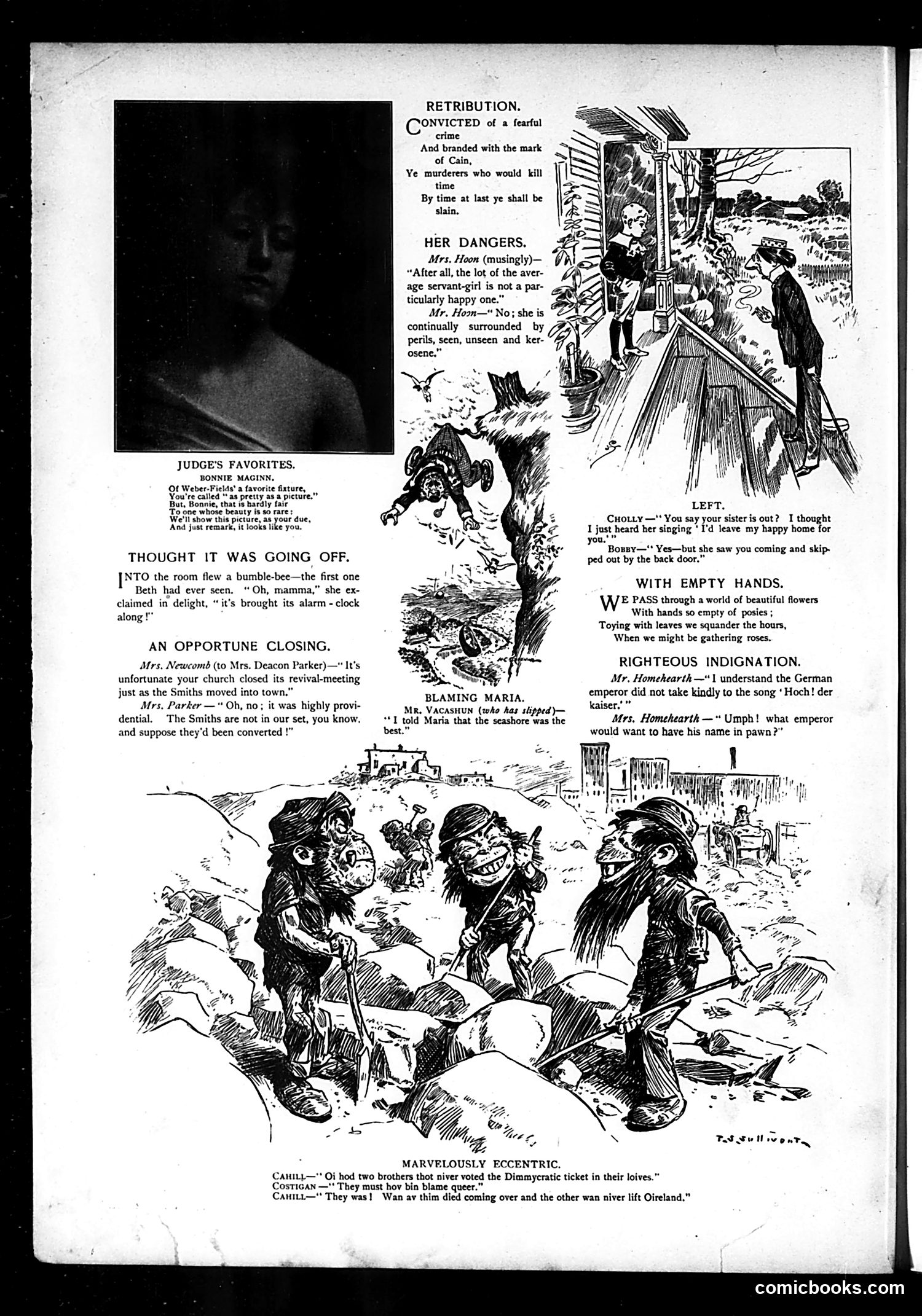
This page from *Judge* magazine contains several short humorous pieces and illustrations typical of early 20th-century American satirical humor. **"Judge's Favorites"** showcases Bonnie Maginn, apparently a popular actress or performer of the era. **"Thought It Was Going Off"** is a gentle joke about a child mishearing a bumblebee's buzzing as an alarm clock. **"An Opportune Closing"** satirizes class snobbery: a church conveniently ends its revival meeting to avoid converting the newly-arrived Smith family, deemed socially undesirable. **"Retribution"** uses biblical imagery (Cain's mark) to warn against "killing time"—wasting one's life. **"Her Dangers"** humorously lists the various perils surrounding a servant-girl's employment. **"Marvelously Eccentric"** (bottom illustration) appears to depict Irish immigrants, using exaggerated dialect ("Dimmycratic," "Oireland") and stereotypical caricature—common in period American humor, reflecting anti-Irish prejudice. The page reflects *Judge's* mix of genteel domestic comedy and ethnic stereotyping typical of Gilded Age satire.
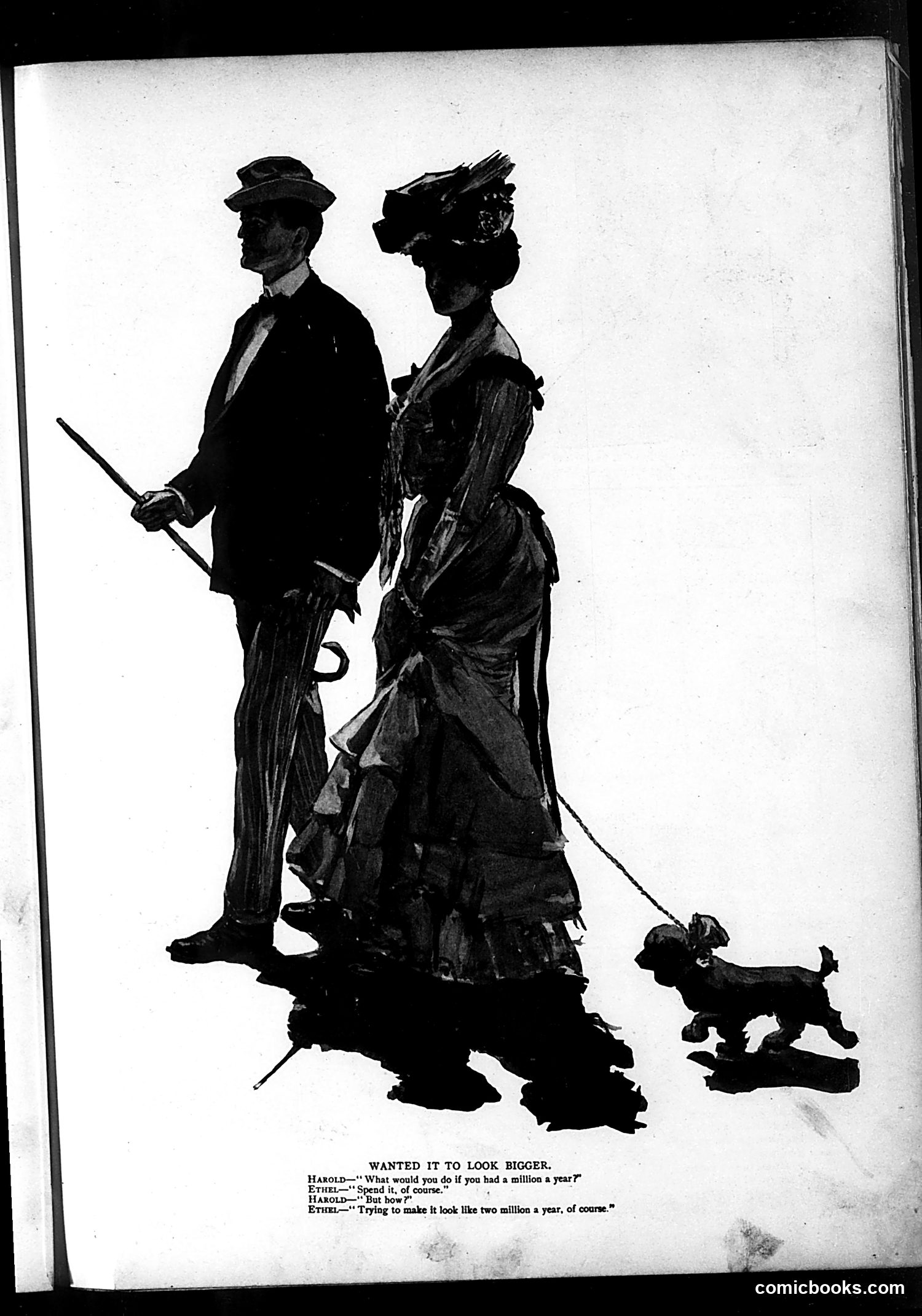
This satirical cartoon depicts a wealthy couple (Harold and Ethel) with their small dog, mocking upper-class conspicuous consumption. The joke centers on social pretense: when asked how she'd spend a million dollars annually, Ethel reveals she'd use it to *appear* to have two million—essentially spending money solely on ostentatious display rather than genuine wealth accumulation or useful purposes. The cartoon satirizes the Gilded Age obsession with visible luxury and status symbols. The couple's formal attire, the small decorative dog, and their affected poses all reinforce the critique: wealthy individuals prioritize appearances and social climbing over substance. This reflects broader Progressive-era concerns about excessive materialism and the nouveau riche's emphasis on flaunting wealth rather than using it productively.
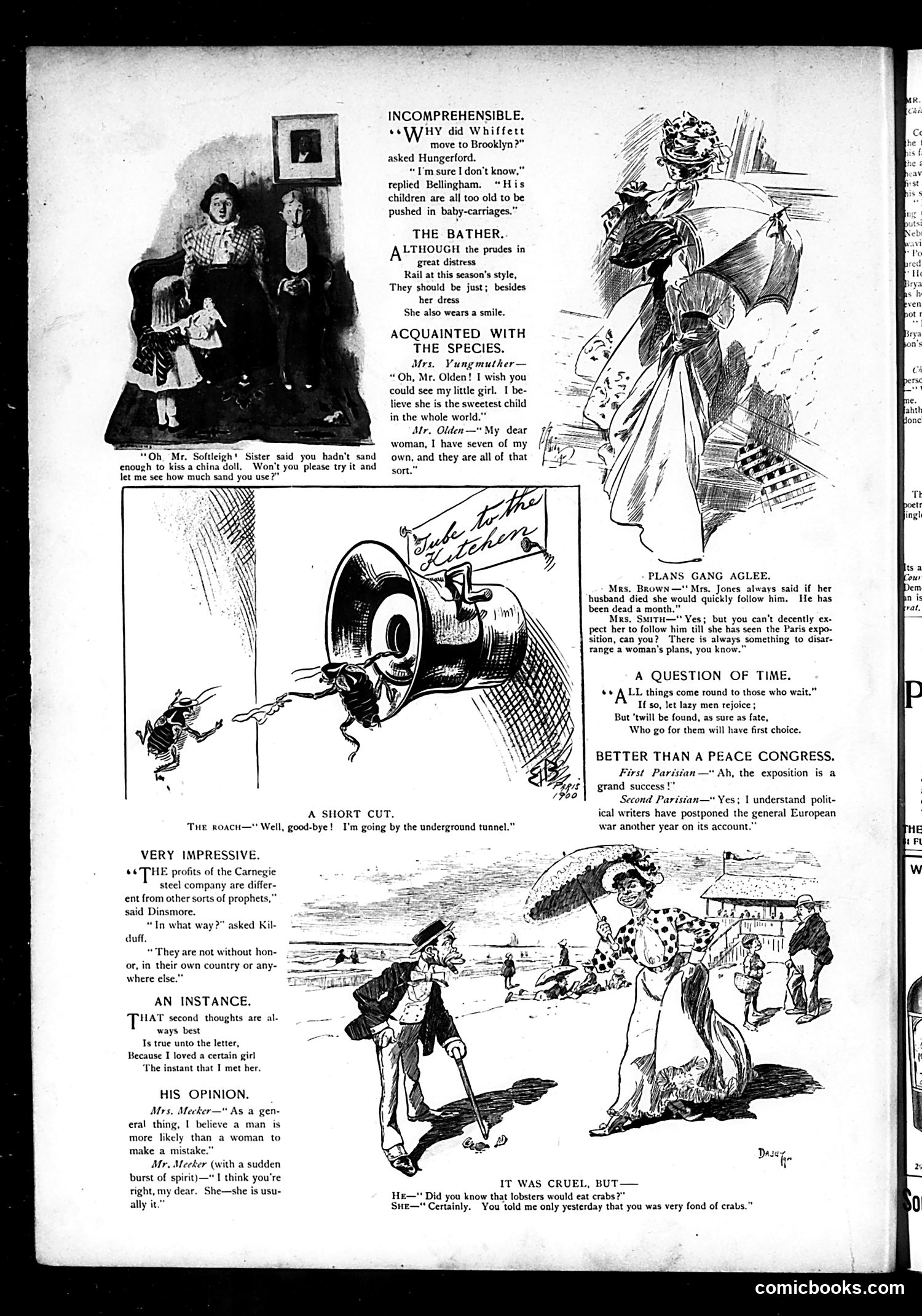
This page contains multiple short humorous vignettes typical of early 20th-century satirical magazines. **Key satirical pieces:** - **"Incomprehensible"**: Jokes about Brooklyn relocation and outdated parenting (baby carriages for old children) - **"The Bather"**: Social commentary on women's swimwear fashion—ladies complain about style constraints yet manage to smile anyway - **"Acquainted with the Species"**: Mrs. Youngmother boasts her child is sweetest; Mr. Olden deflates her with news of his seven identical children - **"Plans Gang Aglee"**: Widow Mrs. Jones promised to follow her dead husband but delays to attend the Paris Exposition—satirizing women's materialism over marital devotion - **"Better Than a Peace Congress"**: The Paris Exposition's success allegedly postpones European war—mocking international politics - **Miscellaneous jokes**: Include puns (Carnegie "prophets" vs. profits), observations on male vs. female mistakes, and marital sparring The humor relies on contemporary references (Paris Exposition), gender stereotypes, and wordplay typical of Judge's satirical voice.
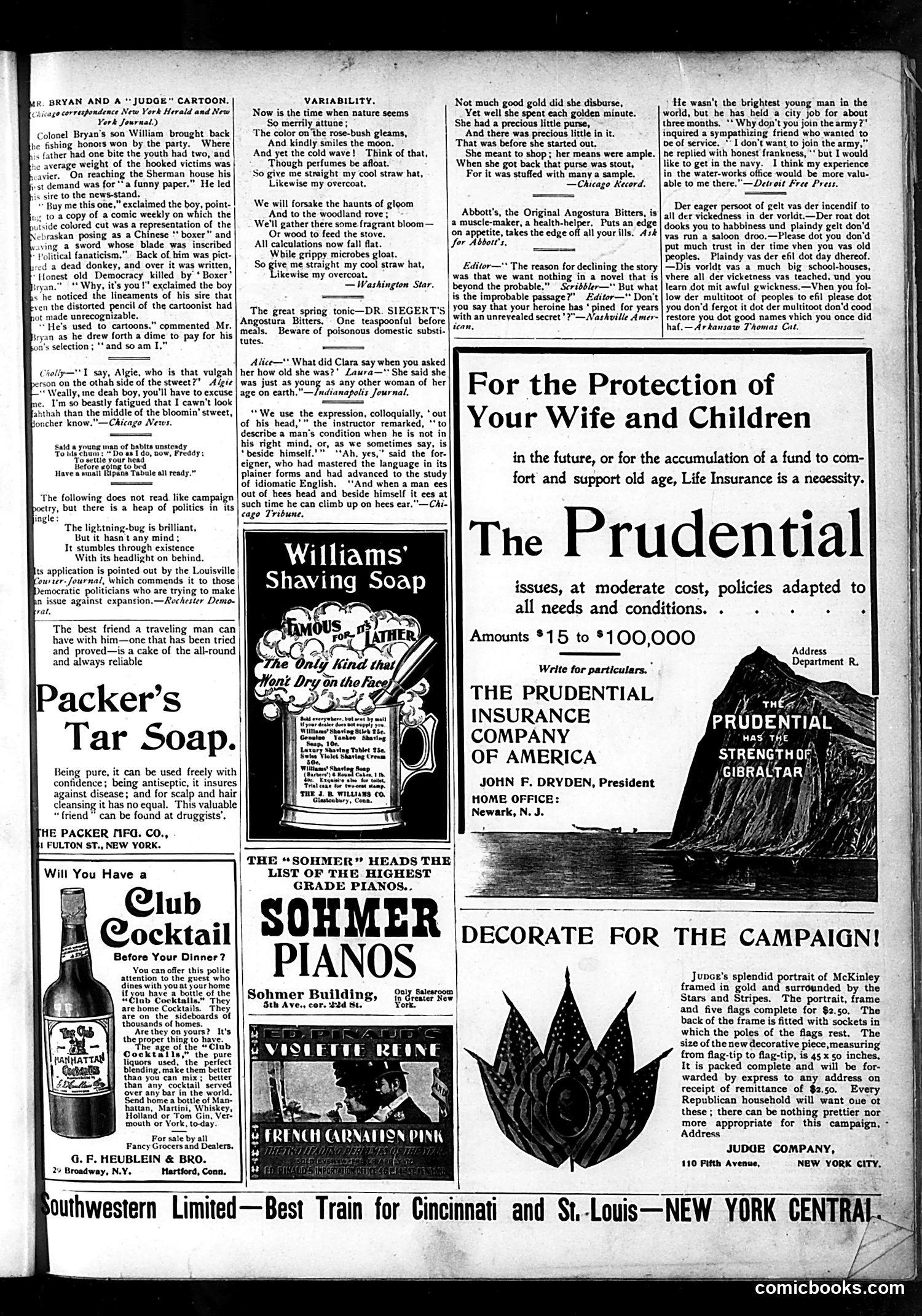
This anecdote concerns William Jennings Bryan, the three-time presidential candidate and prominent Democrat. The story recounts how Bryan's young son brought back fishing trophies superior to his father's catch, then asked for a funny paper at a newsstand. The boy pointed to a Judge magazine cartoon depicting Bryan as a Chinese "Boxer" (reference to the Boxer Rebellion, 1900) wielding a sword labeled "Political fanaticism," with a dead donkey labeled "Honest old Democracy" behind him. The joke turns on the boy recognizing his father in the unflattering caricature—the distorted features were still identifiable. Bryan's wry response ("He's used to cartoons") suggests he was a frequent target of satirical criticism, particularly regarding his radical politics and association with populism (the "dead Democracy" image). The anecdote gently mocks both Bryan's notoriety as a cartoon subject and his philosophical acceptance of political satire.
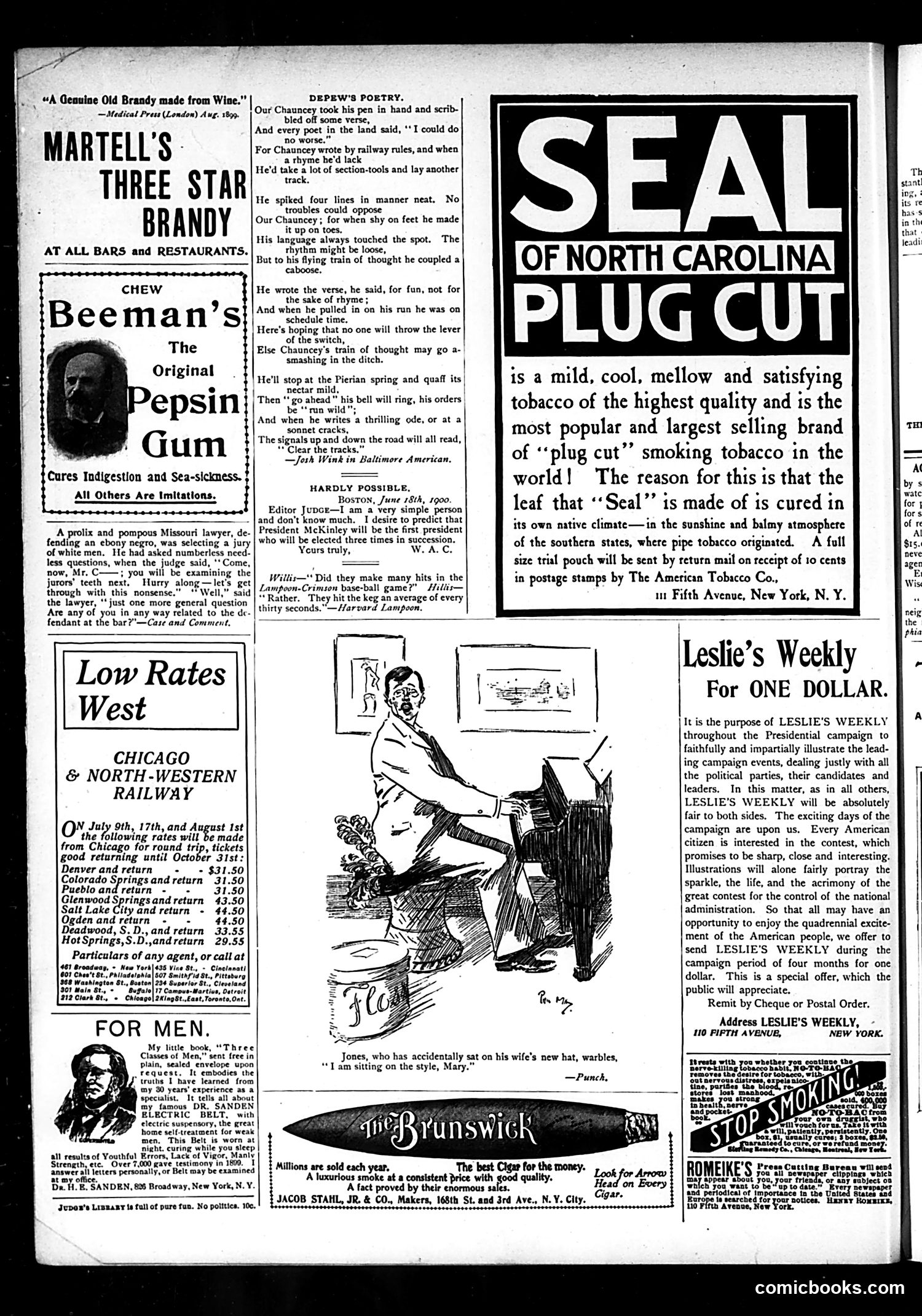
This page contains mostly **advertisements and humor pieces**, not a unified political cartoon. The main satirical content is **"Depew's Poetry,"** a mock-heroic verse about **Chauncey Depew**, a prominent railroad executive and politician. The joke equates Depew's poetic abilities with railroad engineering—he "writes by railway rules," substitutes toes for feet when rhymes fail, and "couples a caboose" to his "flying train of thought." The satire mocks Depew's pretensions to literary skill while playing on his identity as a railroad man. The repeated railroad metaphors suggest his verse is mechanical and poorly constructed. A secondary joke predicts President McKinley will be the first three-term president—historically significant since this violates the two-term tradition not yet legally binding in 1900. The page is otherwise filled with product advertisements (brandy, tobacco, patent medicines, rail tickets) typical of Judge magazine's revenue model.
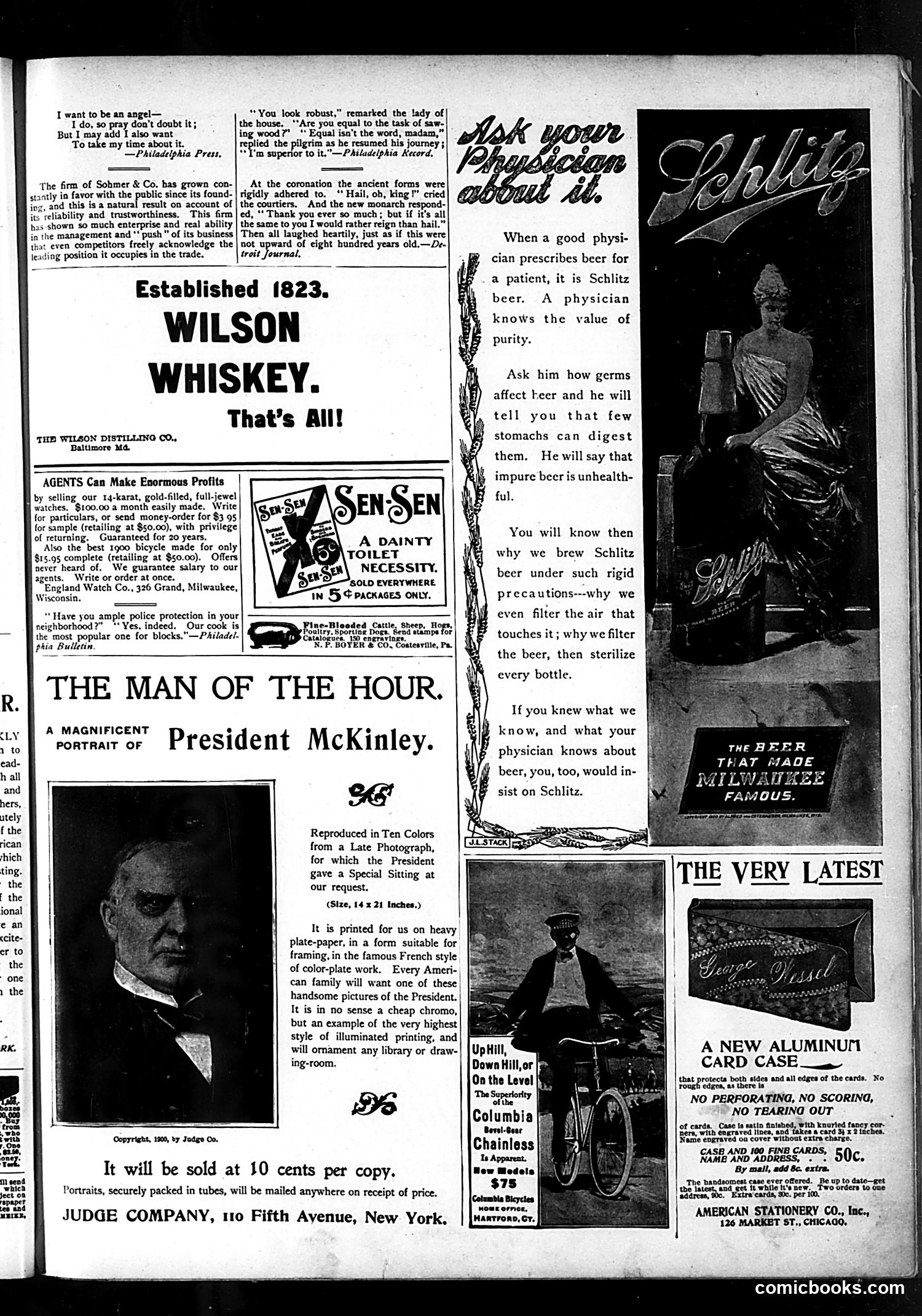
This page is primarily **advertising and promotional content** rather than political satire. The main feature is a portrait of President **William McKinley**, labeled "The Man of the Hour," available as a ten-color reproduction print for framing—reflecting McKinley's popularity during his presidency (1897-1901), likely around the Spanish-American War period when his approval was high. The page includes several brief humorous anecdotes unrelated to McKinley, plus various product advertisements (Wilson Whiskey, watches, bicycles, Schlitz beer, card cases). The **Schlitz beer advertisement** includes physician-endorsed messaging about purity and germ-free brewing—reflecting early 20th-century anxieties about hygiene and contamination. The humor snippets appear designed as filler content typical of Judge's satirical format, though none constitute sustained political commentary on this particular page.
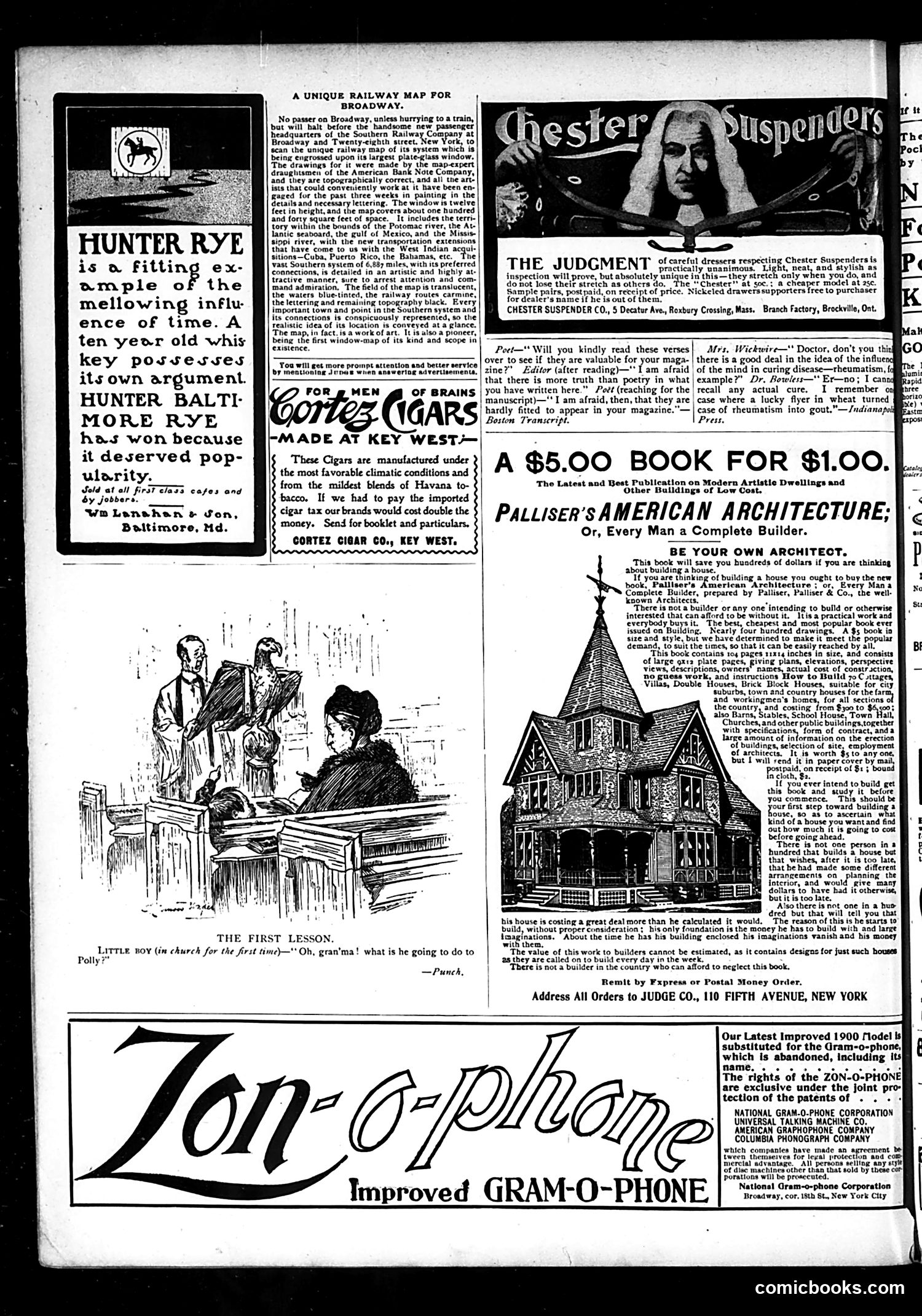
This is primarily an **advertisement-heavy page** from Judge magazine, typical of early 20th-century publications. The main content includes ads for Hunter Rye whiskey, cigars, Chester Suspenders, and Palliser's American Architecture book. The few cartoons present are minor humor pieces: 1. **"The First Lesson"** (bottom left): A church scene where a boy asks what he'll do in church, a gentle joke about childhood innocence. 2. **Small editorial cartoons** (middle): Brief comic exchanges between a poet/editor and a doctor, using dialogue-based humor about poetry submissions and medical remedies. The page reflects **consumer culture and product advertising** rather than political satire. References to the Southern Railway's Broadway window display and the architecture book suggest this targets middle-class readers interested in commerce, building, and self-improvement—not political commentary. The ads emphasize quality goods and practical knowledge for the era.
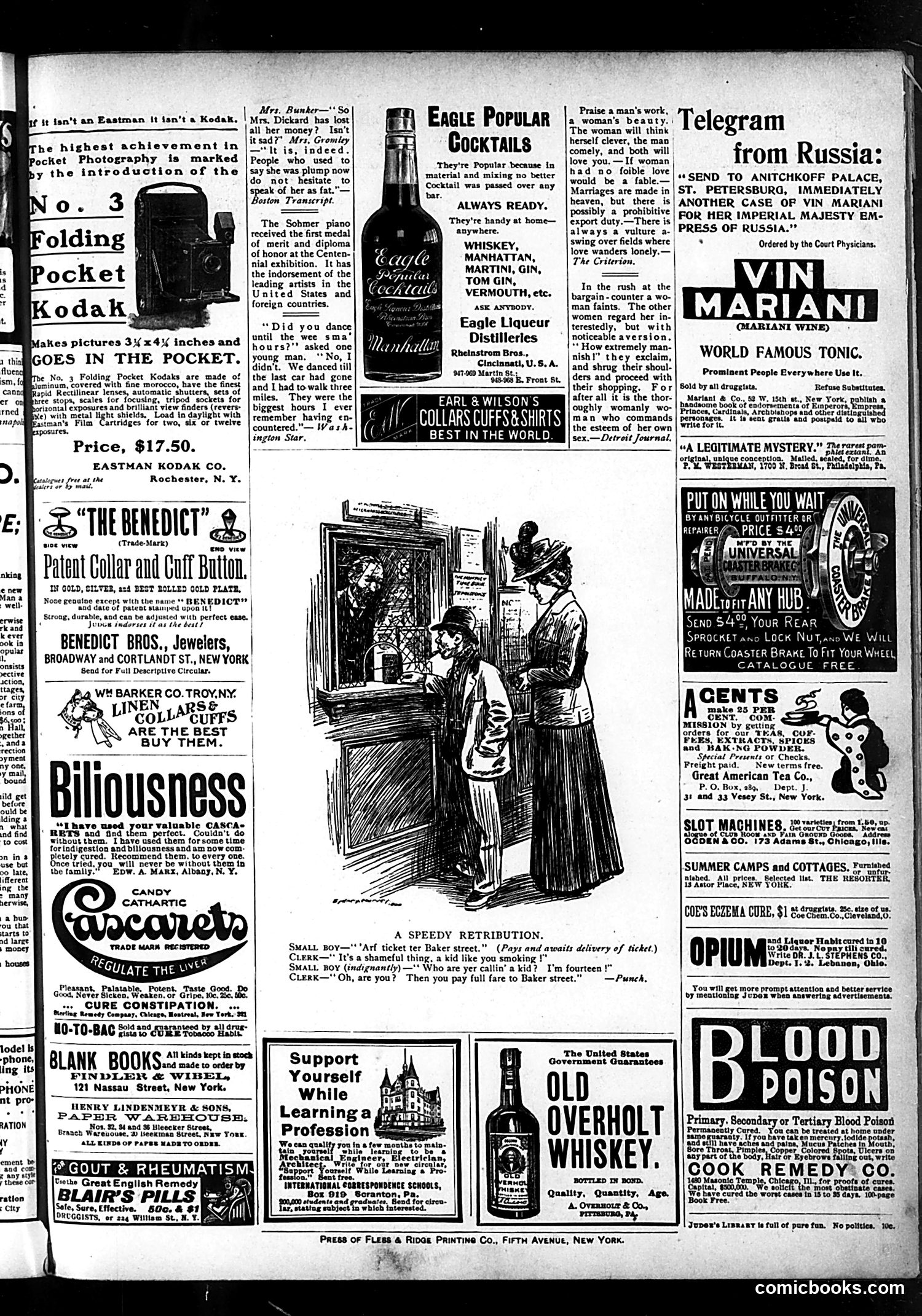
This page is primarily **advertising**, with one small cartoon titled "A SPEEDY RETRIBUTION" showing a street interaction between a boy and a clerk, illustrating the caption's joke about a "baker street" pun (likely a play on words now lost to modern readers). The main editorial content is a brief joke about **class and gossip**: when a wealthy woman (Mrs. Dickard) loses her money, her acquaintances shift from calling her "plump" to calling her "fat"—revealing that flattery depends entirely on social status, not truthfulness. Notable is a **telegram claiming the Russian Empress ordered Vin Mariani tonic**, a wine-based patent medicine prominently advertised on the page. This appears designed to boost the product's prestige through royal endorsement. The page is otherwise dominated by period advertisements: cameras, whiskey, collar buttons, cocktail mixes, and various patent remedies (Cascarets, Cacarets digestive aids). These ads reveal early 20th-century consumer culture and the ubiquitous promotion of dubious "medicinal" products.
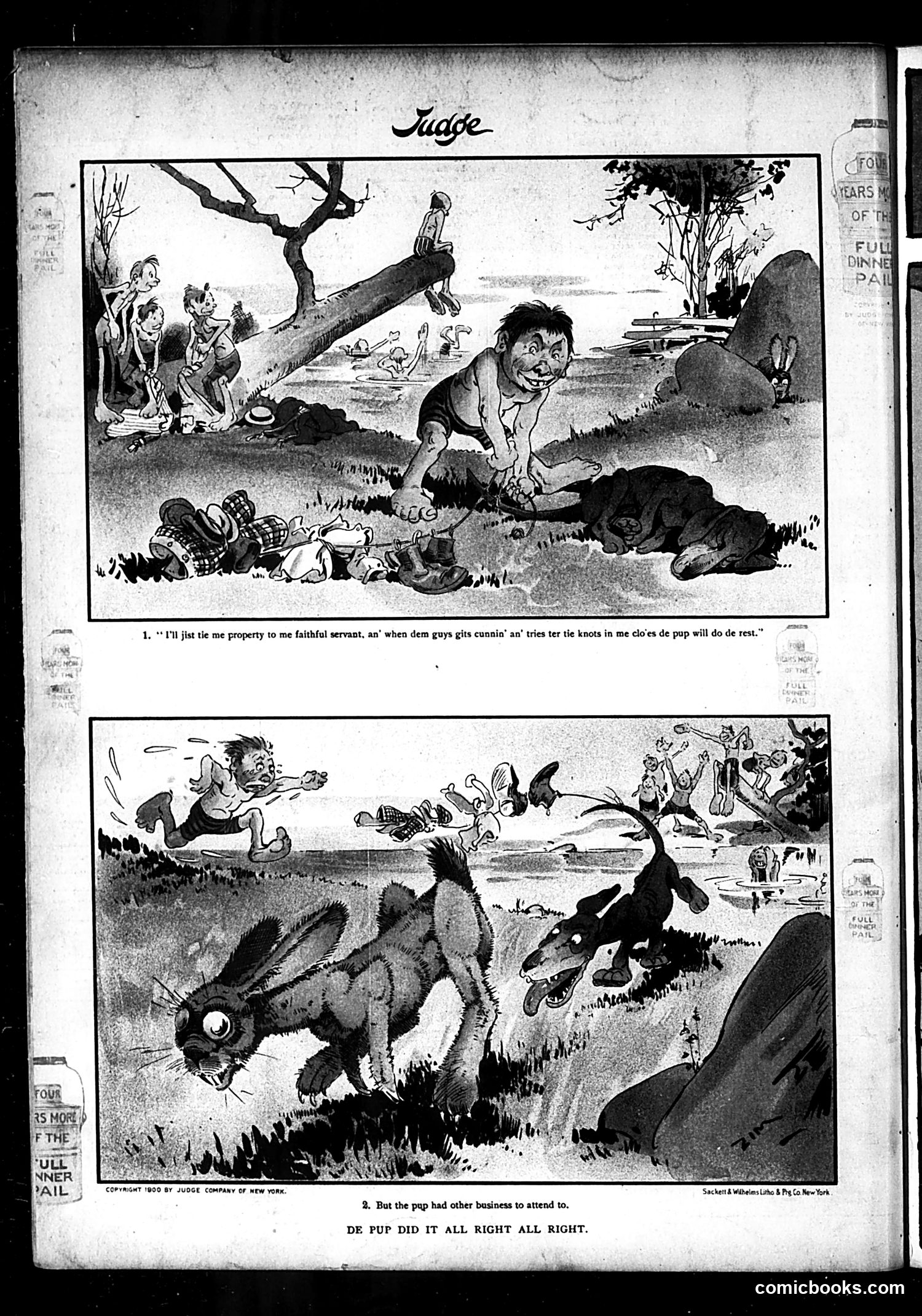
This two-panel comic from Judge magazine tells a slapstick story about a dog causing chaos at a riverside picnic. In panel one, a man crouches amid scattered belongings, claiming "I'll jist let me property to me faithful servant, an' when dem guys gits cunning an' tries ter tie knots in de clos de pup will do de rest." Panel two shows the punchline: the dog has indeed caused mayhem, scattering picnickers and destroying their setup while chasing rabbits. The humor relies on ethnic dialect ("jist," "dem," "de") typical of early 20th-century American comedy stereotyping. The joke is straightforward slapstick—the man's plan backfires spectacularly when the dog creates complete pandemonium instead of the intended mild disruption. No clear political satire is evident.
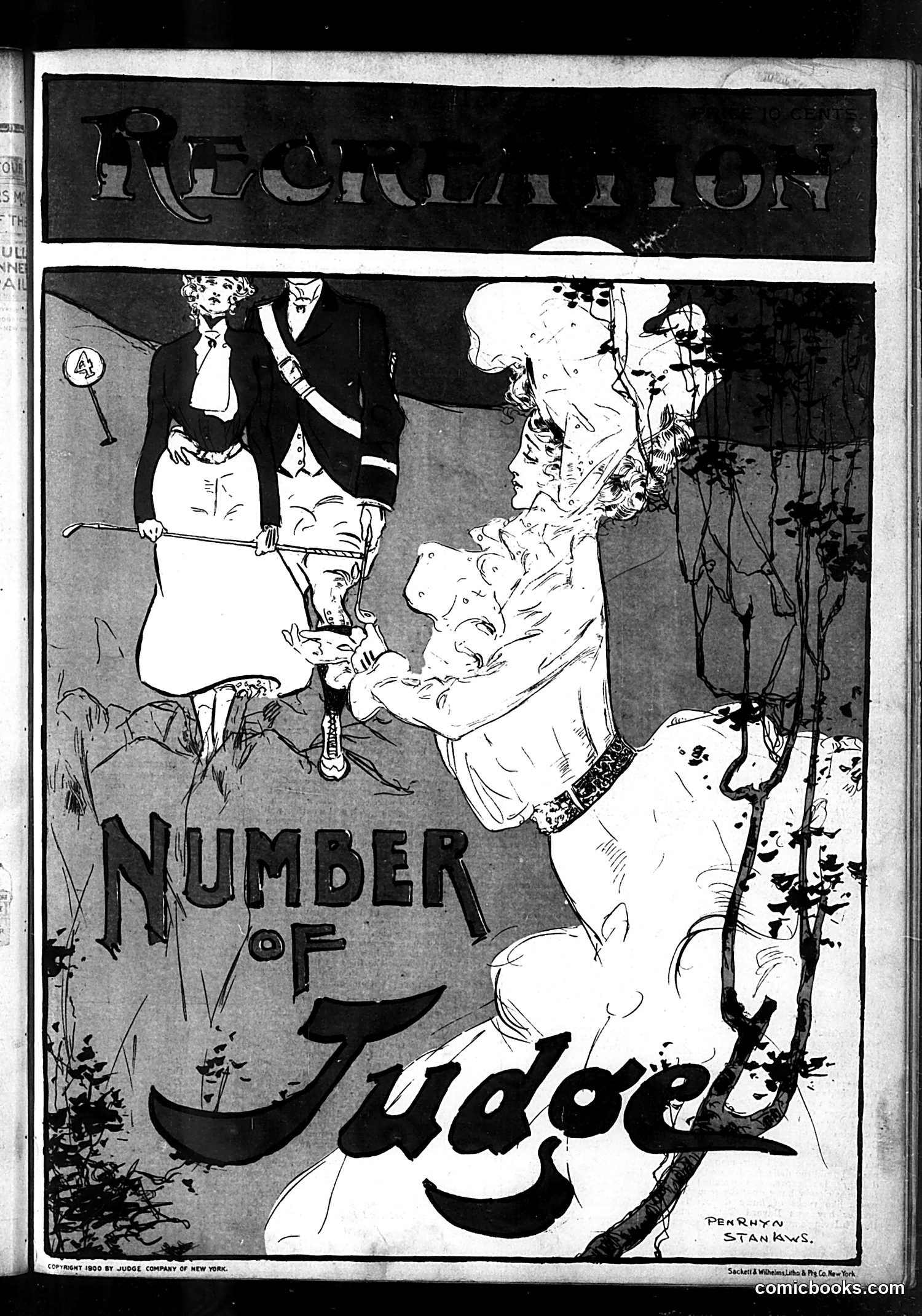
This 1900 Judge magazine cover by Penrhyn Stanlaws satirizes judicial corruption or election manipulation. The central figure appears to be a rotund judge or political boss character in formal dress, depicted in an exaggerated, unflattering caricature style typical of the era. The title "Number of Judges" suggests commentary on either the proliferation of corrupt judges or political manipulation of the judiciary. The well-dressed figures on the left (appearing to represent politicians or wealthy interests) seem to control or influence the central figure, likely critiquing how money and power corrupted the judicial system. The satirical tone targets Gilded Age concerns about institutional corruption and the influence of wealthy elites over supposedly impartial legal institutions.
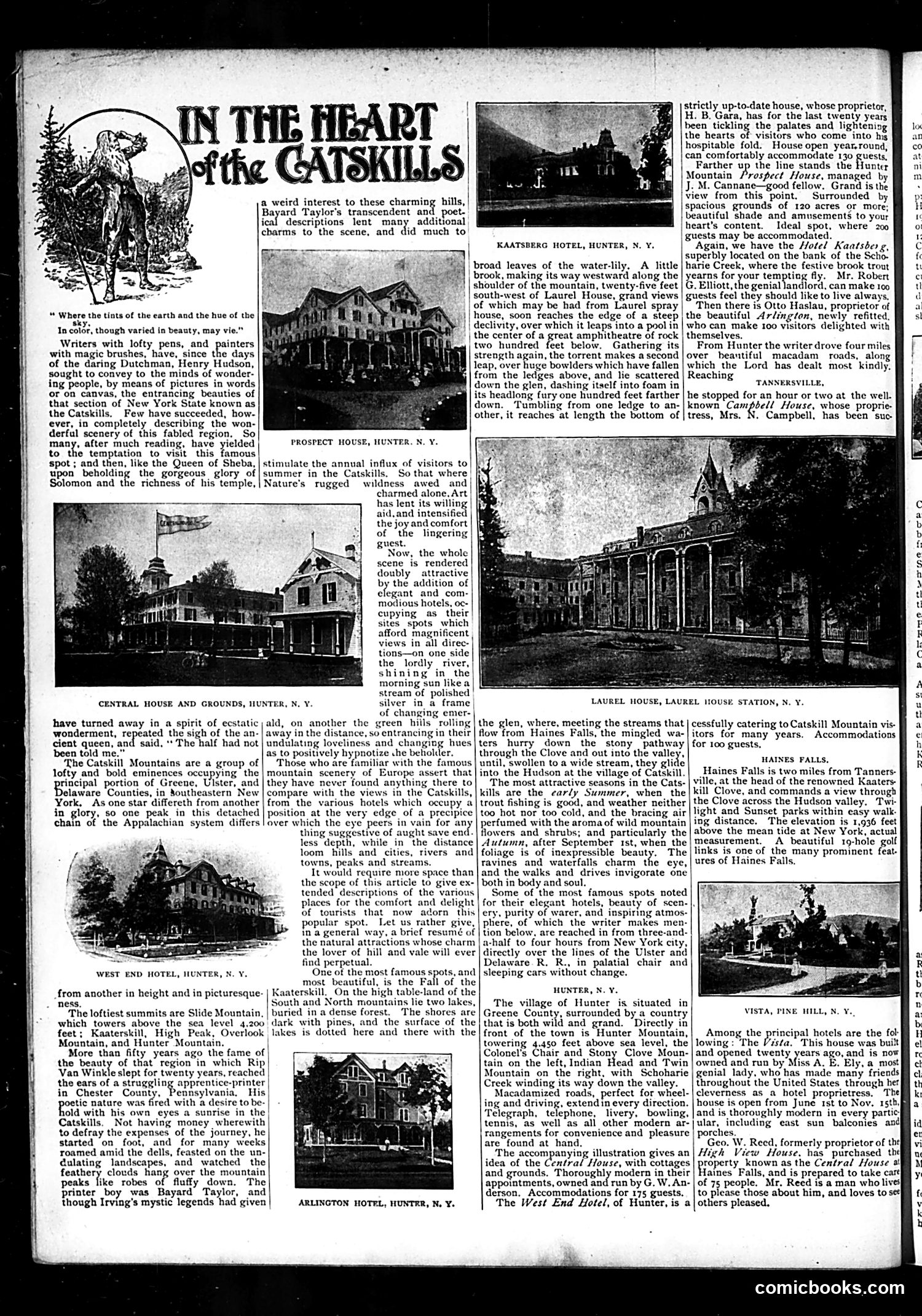
This is **not a political cartoon** but rather a promotional travel article for the Catskill Mountains region of New York State. The page features photographs and descriptions of hotels (Kaatsberg, Prospect House, Central House, West End Hotel, etc.) designed to attract summer visitors. The article references **Rip Van Winkle** and the region's literary fame, crediting writers like Henry Hudson, Washington Irving, and **Bayard Taylor** with popularizing the area's natural beauty. It compares the Catskills favorably to famous European mountain scenery. This appears to be **advertising content** dressed as editorial, typical of Judge magazine's era—using lofty language about nature's beauty to encourage wealthy readers to visit these upscale mountain hotels. The "satire" element, if any, is gentle mockery of tourist enthusiasm rather than political commentary.
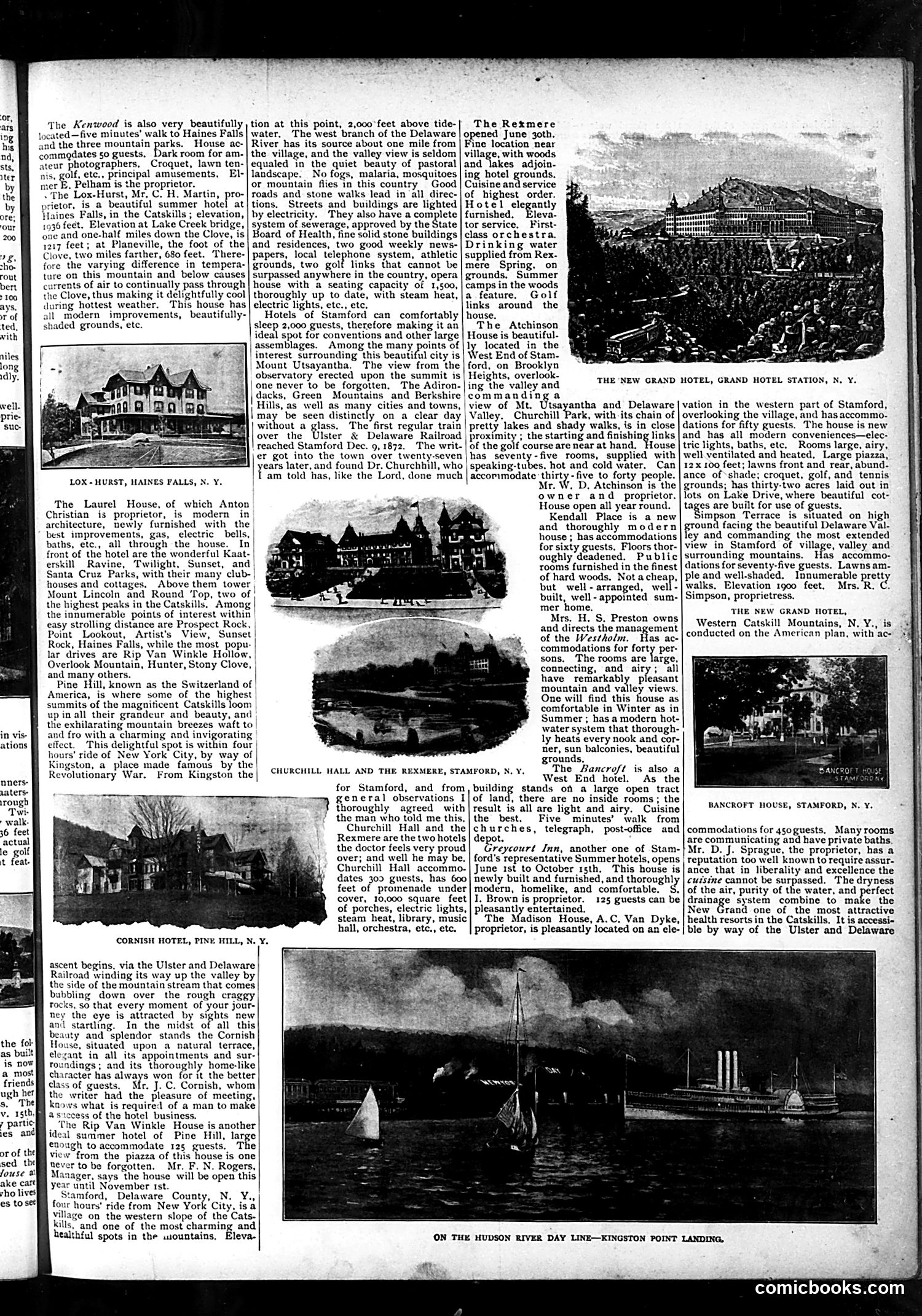
This page is **not primarily a political cartoon or satire**. It is a **travel and hotel advertisement section** from Judge magazine, likely from the late 19th century. The page features **promotional write-ups and photographs of Catskill Mountain resort hotels** in New York (Stamford, Haines Falls, Pine Hill area), including the Lox-Hurst, Cornish Hotel, Rexmere, Grand Hotel, Bancroft House, and others. Each entry describes amenities: accommodations capacity, modern conveniences (electric lights, baths, golf links, orchestras), scenic views, accessibility, and proprietors' names. A photograph shows "Kingston Point Landing" on the Hudson River. This represents **late-Victorian leisure tourism marketing**—mountain resorts catering to affluent urbanites seeking summer escape with modern comforts. There is **no political satire or cartoon content visible** on this page; it functions as straightforward commercial advertising disguised within Judge's editorial format.
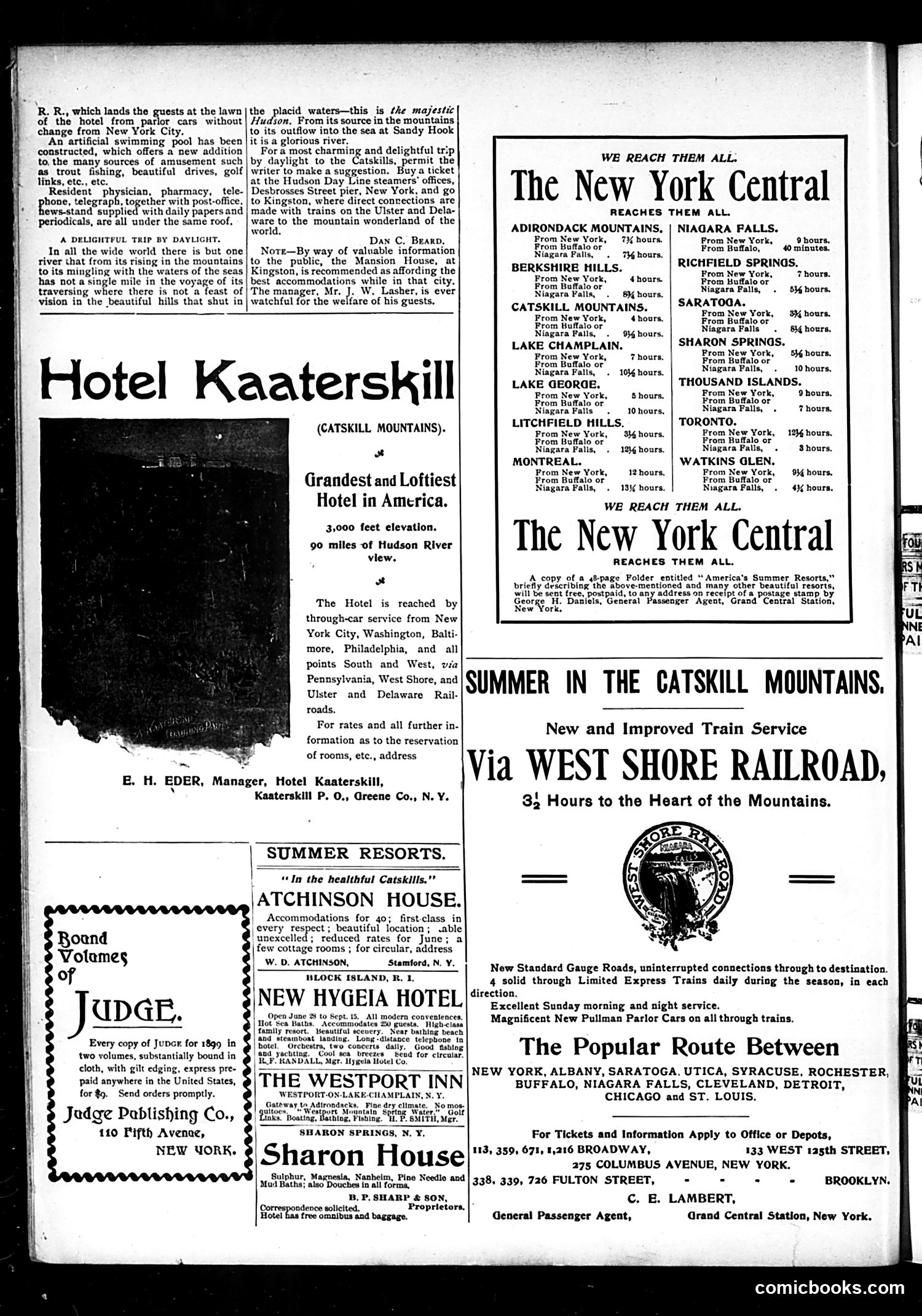
This page is primarily **advertising content** rather than political satire or editorial cartooning. It showcases summer resort destinations and transportation services available in 1899 America. The central visual element features the **Hotel Kaaterskill** in the Catskill Mountains—advertised as "Grandest and Loftiest Hotel in America" at 3,000 feet elevation with 90-mile Hudson River views. The page emphasizes the hotel's accessibility via through-car service from major cities (New York, Washington, Baltimore, Philadelphia). Multiple resort advertisements fill the page: Atchinson House, New Hygeia Hotel, Westport Inn, and Sharon House, each promoting specific amenities—therapeutic waters, mountain air, fishing, golf. The dominant commercial message celebrates the **New York Central Railroad**, which "REACHES THEM ALL," listing travel times to various destinations (Adirondacks, Berkshire Hills, Catskills, Lake George). This reflects the Gilded Age leisure industry: wealthy Americans could now easily access upscale mountain and spa resorts via railroad networks. The advertising density shows how thoroughly commercial interests dominated period magazine pages.