
A complete issue · 16 pages · 1900
Judge — January 20, 1900
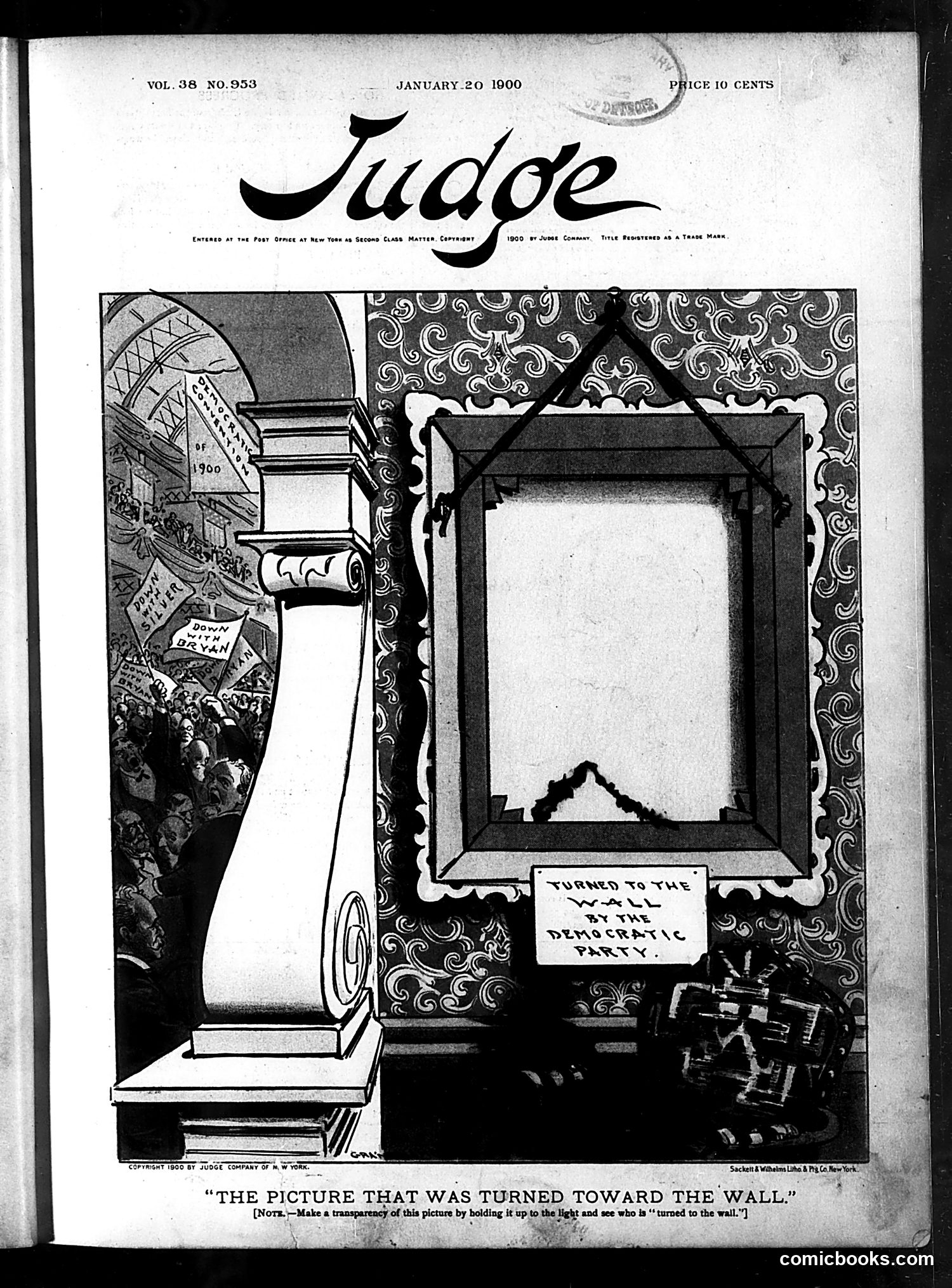
This political cartoon satirizes the Democratic Party's response to the 1900 presidential election. The image shows a framed portrait that has been "turned to the wall"—a historical gesture of rejection or disgrace. The left panel depicts a dramatic scene with crowds and banners reading "DOWN WITH [text]," suggesting political turmoil. The right panel shows an ornate frame now facing the wall, labeled "TURNED TO THE WALL BY DEMOCRATIC PARTY." The satire suggests Democrats are deliberately hiding or rejecting something—likely their previous political platform or candidate—in shame or strategic retreat. This appears to reference internal Democratic Party conflict or unpopular policies heading into the 1900 election cycle. The "turned to the wall" metaphor indicates abandonment of previous positions.
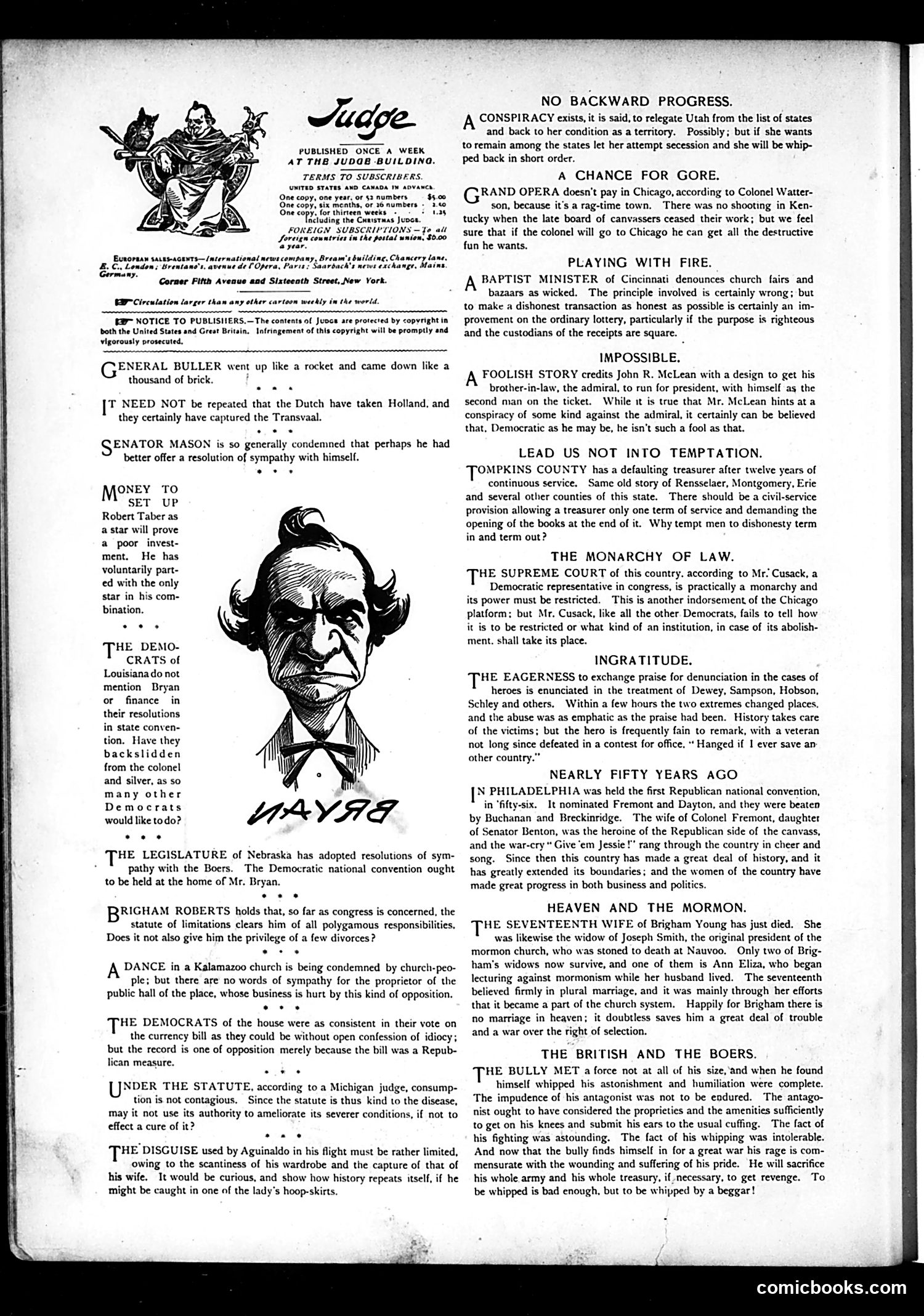
The page contains political commentary rather than cartoons. The central illustration shows a caricatured figure with exaggerated features—appearing to be a political opponent of the Republican/Judge perspective. **Key sections:** - "NO BACKWARD PROGRESS" criticizes Utah's potential statehood, suggesting Democrats want to reverse progress - "THE MONARCHY OF LAW" attacks Democratic congressman Cusack's views on presidential power, framing Democrats as monarchists - "HEAVEN AND THE MORMON" mocks Brigham Young's polygamy and the Mormon church - "THE BRITISH AND THE BOERS" discusses conflict in South Africa The satire targets Democrats on multiple fronts: territorial policy, executive power, and cultural/religious issues. The caricature likely represents a Democratic political figure, though specific identification isn't clear from the image alone. This reflects late-19th-century partisan Republican journalism.
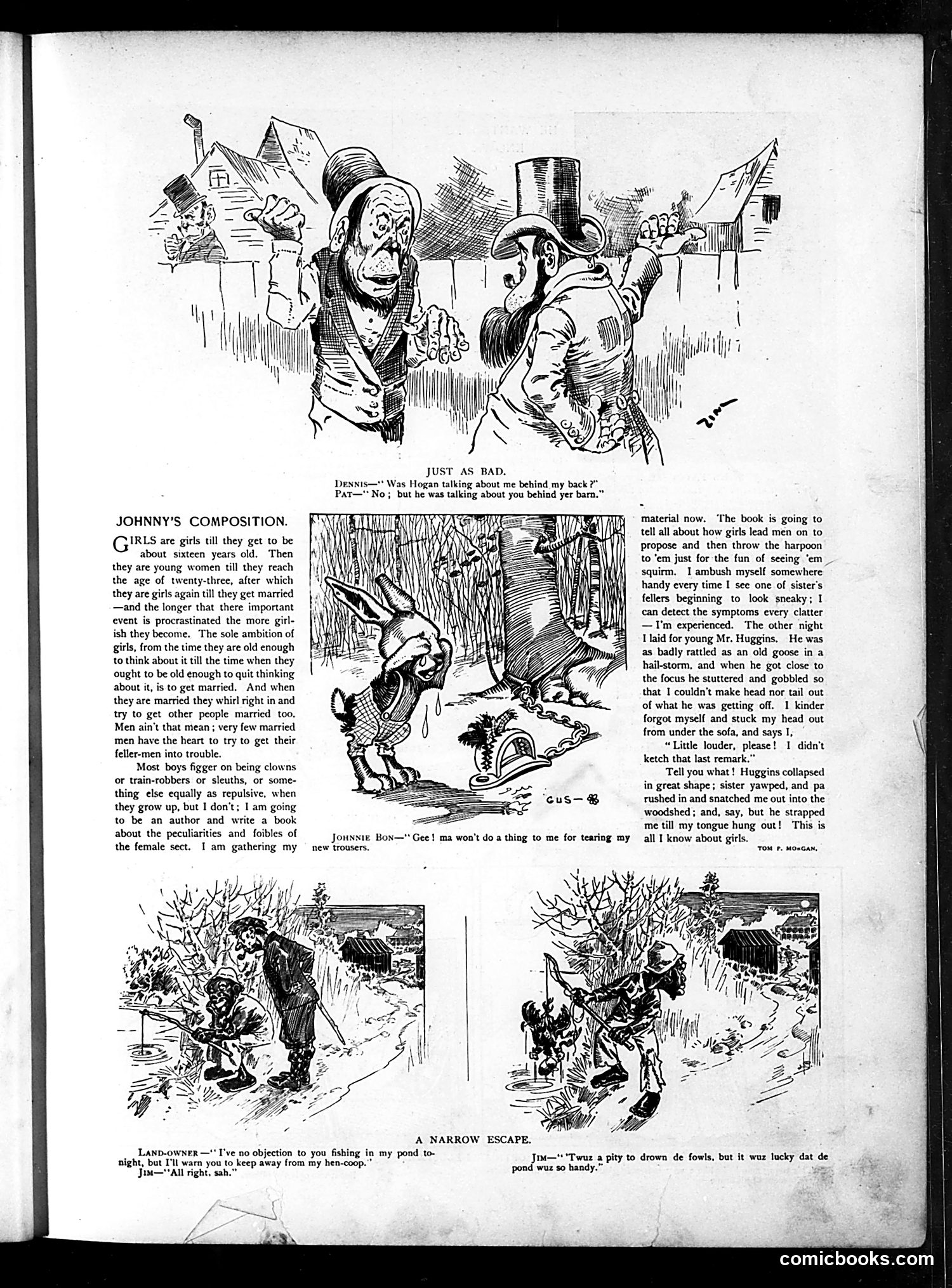
This page contains three distinct pieces: **"Just As Bad"** (top): A cartoon showing two men in confrontation, with the caption implying they're accusing each other of betrayal. The satirical point appears to be about hypocrisy—both parties are guilty of the same offense, making their moral outrage equally baseless. **"Johnny's Composition"** (center): A humorous article by Tom P. Morgan about a young girl writing a school composition criticizing boys and their immature behavior. The accompanying sketch shows a boy being beaten. It's light social satire on gender relations and childhood. **"A Narrow Escape"** (bottom): Two panels showing someone fishing in a pond while a landowner objects. The humor relies on dialect humor and a pun about nearly drowning in the pond. The page emphasizes domestic social humor rather than political commentary.
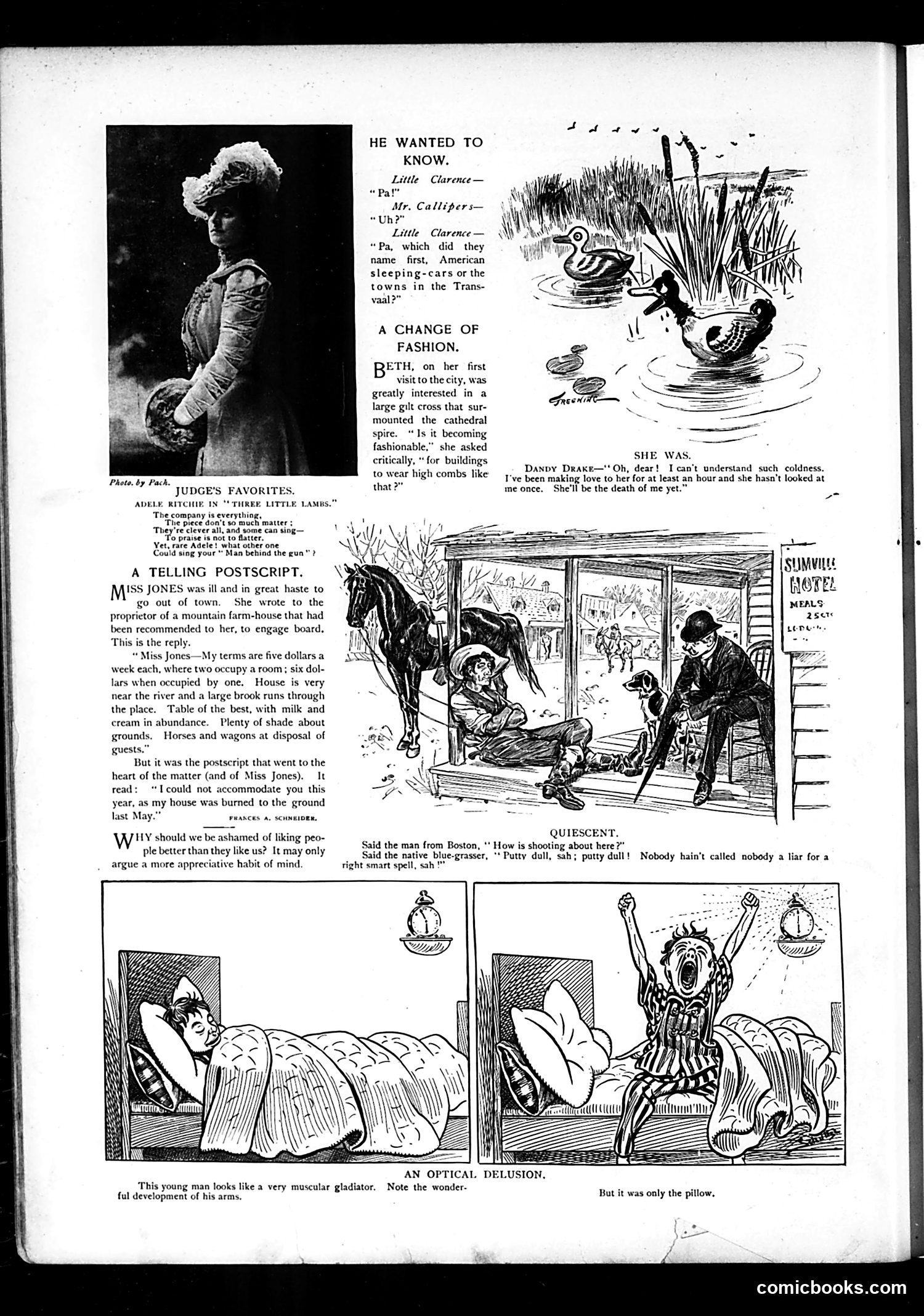
This page contains several unrelated satirical pieces typical of early 20th-century Judge magazine: **"He Wanted to Know"** mocks a character's question about whether American sleeping cars or towns were named first in the Transvaal—appearing to ridicule someone's ignorance about geography or colonial matters. **"A Change of Fashion"** jokes about architectural trends, with a woman asking whether gilt crosses on cathedral spires are becoming fashionable for buildings. **"A Telling Postscript"** presents a humorous farm letter where a woman describes her property's amenities but notes her house burned down last May—the dark joke being this crucial detail comes as an afterthought. **"An Optical Delusion"** uses two panels showing a person in bed seeing a muscular gladiator, then revealing it's actually just a pillow—a visual pun on misperception. The page mixes social commentary with lighthearted domestic humor typical of the era's satirical publications.
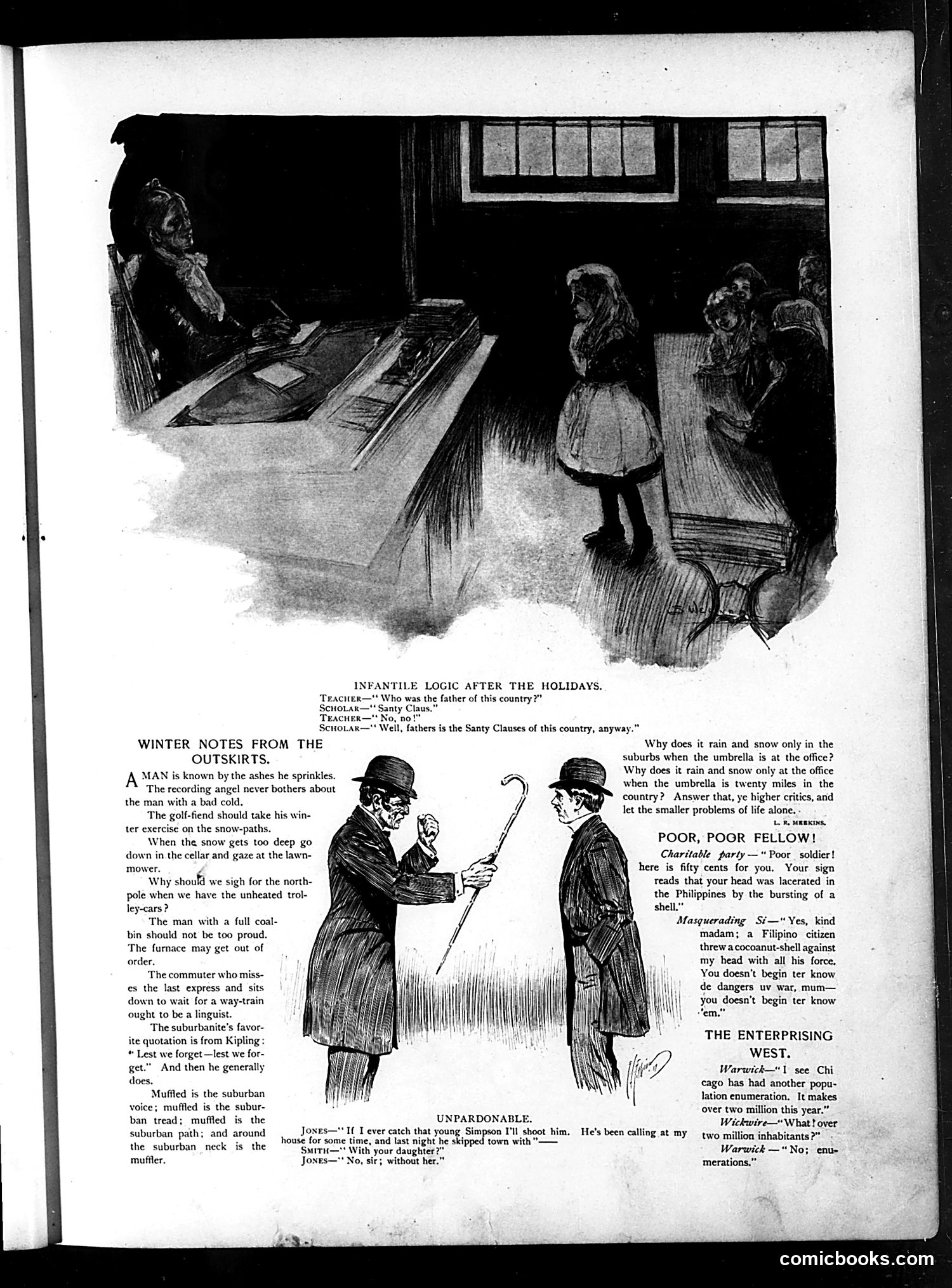
This page from *Judge* magazine contains three separate humorous pieces: **"Infantile Logic After the Holidays"** (top): A teacher asks a student who was the father of America. The student answers "Santa Claus," then revises to say "fathers is the Santy Clauses of this country, anyway"—a joke about how children conflate Santa with paternal authority figures. **"Winter Notes from the Outskirts"** (left): A series of brief, sardonic observations about suburban winter life—complaining about unheated trolleys, coal bins, and the inconvenient placement of umbrellas relative to rain. **"Poor, Poor Fellow!"** (right): A beggar claims his head injury came from a Filipino coconut shell in the Philippines (likely referencing the Philippine-American War, circa 1899-1902), but his exaggerated dialect and dramatic suffering suggest he's a con artist exploiting charitable sympathy. The bottom section contains brief witticisms about commuters, suburbanites, and a joke about Chicago's inflated population counts (a jab at the city's dubious census figures).
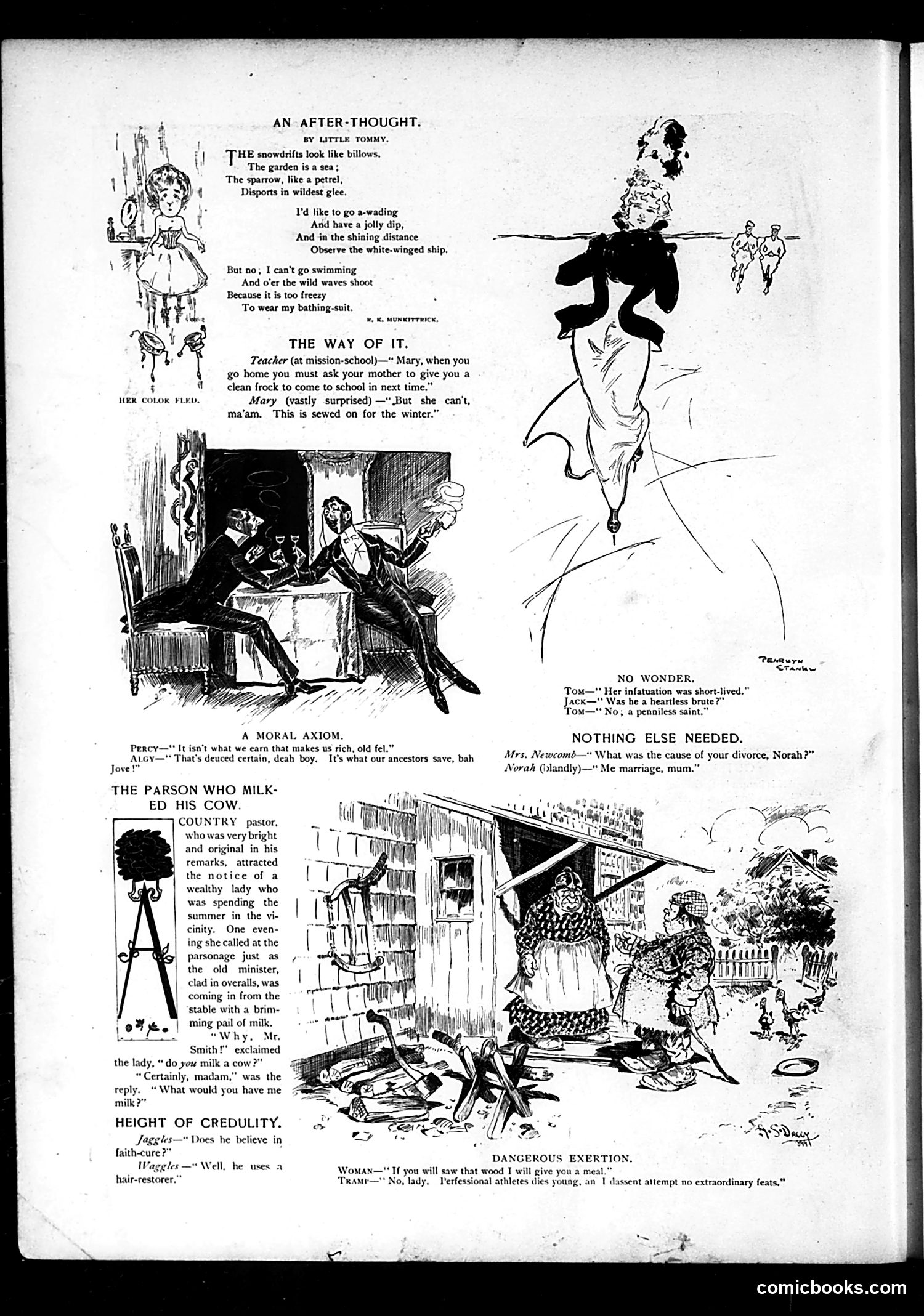
This page contains multiple short satirical pieces typical of early 20th-century American humor: **"An After-Thought"** mocks a child's seasonal disappointment—wanting to swim in winter, unable to wear a bathing suit in freezing weather. Gentle, relatable humor. **"The Way of It"** satirizes poverty: a schoolteacher asks a poor girl to wear clean clothes; the girl reveals her dress is permanently sewn on for winter. The joke highlights class disparities and the indignity of poverty. **"A Moral Axiom"** mocks wealthy assumptions about inherited privilege—that inherited money matters more than earning it. **"The Parson Who Milked His Cow"** satirizes pretension: a wealthy woman is shocked to find a clergyman doing manual labor, revealing class-based assumptions about clergy status. **"Nothing Else Needed"** is dark humor: a woman claims her marriage caused her divorce—implying marriage itself is the problem. The page reflects Edwardian-era satire targeting class consciousness, gender roles, and social hypocrisy through domestic and comedic scenarios.
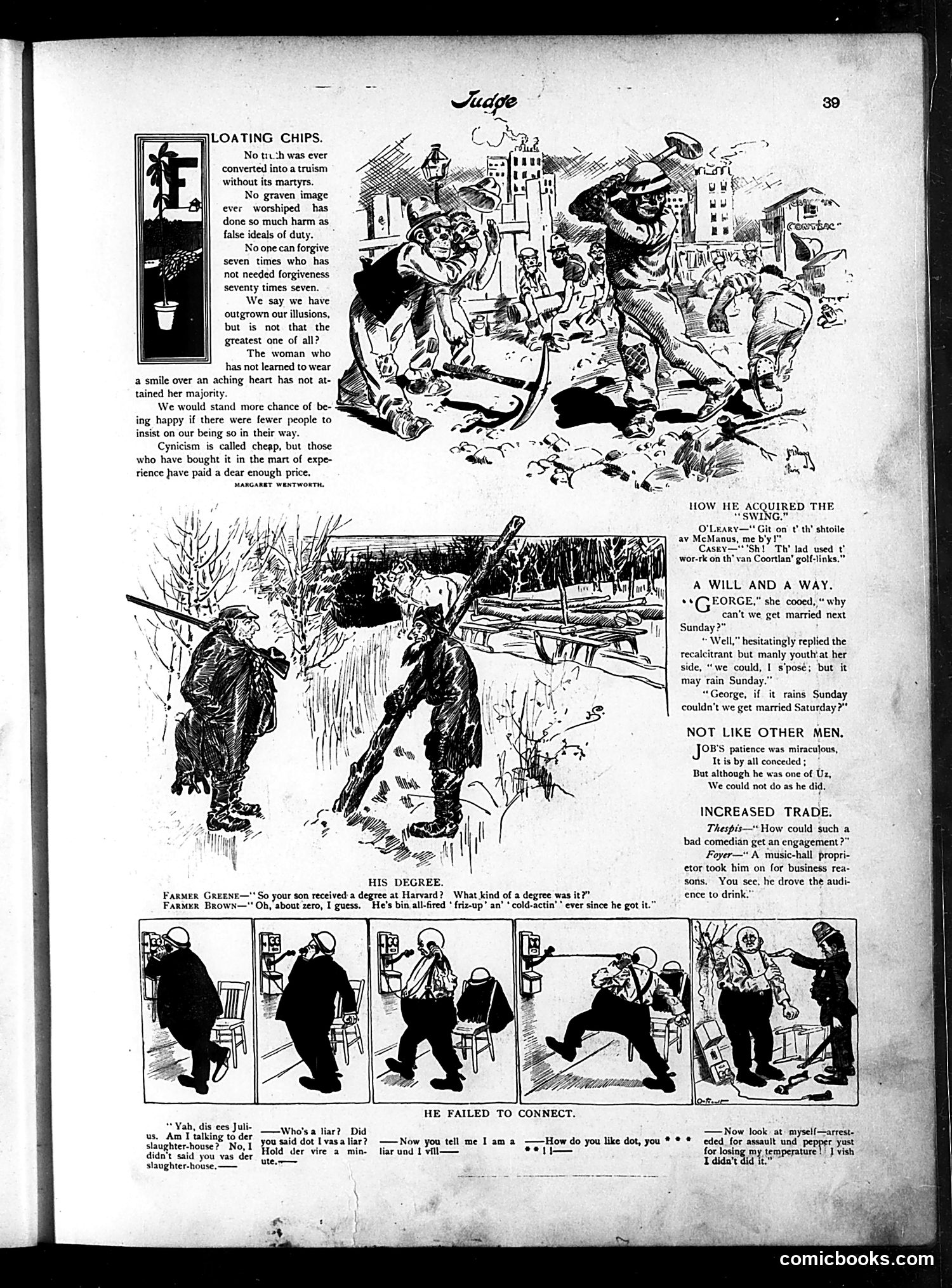
This page contains several brief satirical pieces typical of Judge's humor circa early 1900s. **"Floating Chips"** is a column of philosophical aphorisms by Margaret Wentworth about human nature and idealism—not political commentary. The cartoon vignettes mock Irish immigrants (indicated by "O'Leary" and phonetic dialect) and working-class figures. **"How He Acquired the Swing"** jokes about an Irishman bragging that his coworker previously worked for wealthy Van Courtlandt family. **"His Degree"** satirizes Harvard education as producing snobby, emotionally cold graduates—a common critique of elite institutions. **"He Failed to Connect"** depicts a comedic confrontation with heavy ethnic dialect humor, showing two men arguing about who's the liar, with physical comedy. The other pieces ("A Will and a Way," "Not Like Other Men," "Increased Trade") are brief gags without specific political content. Overall, this reflects Judge's reliance on ethnic stereotypes and class-based humor typical of the era.
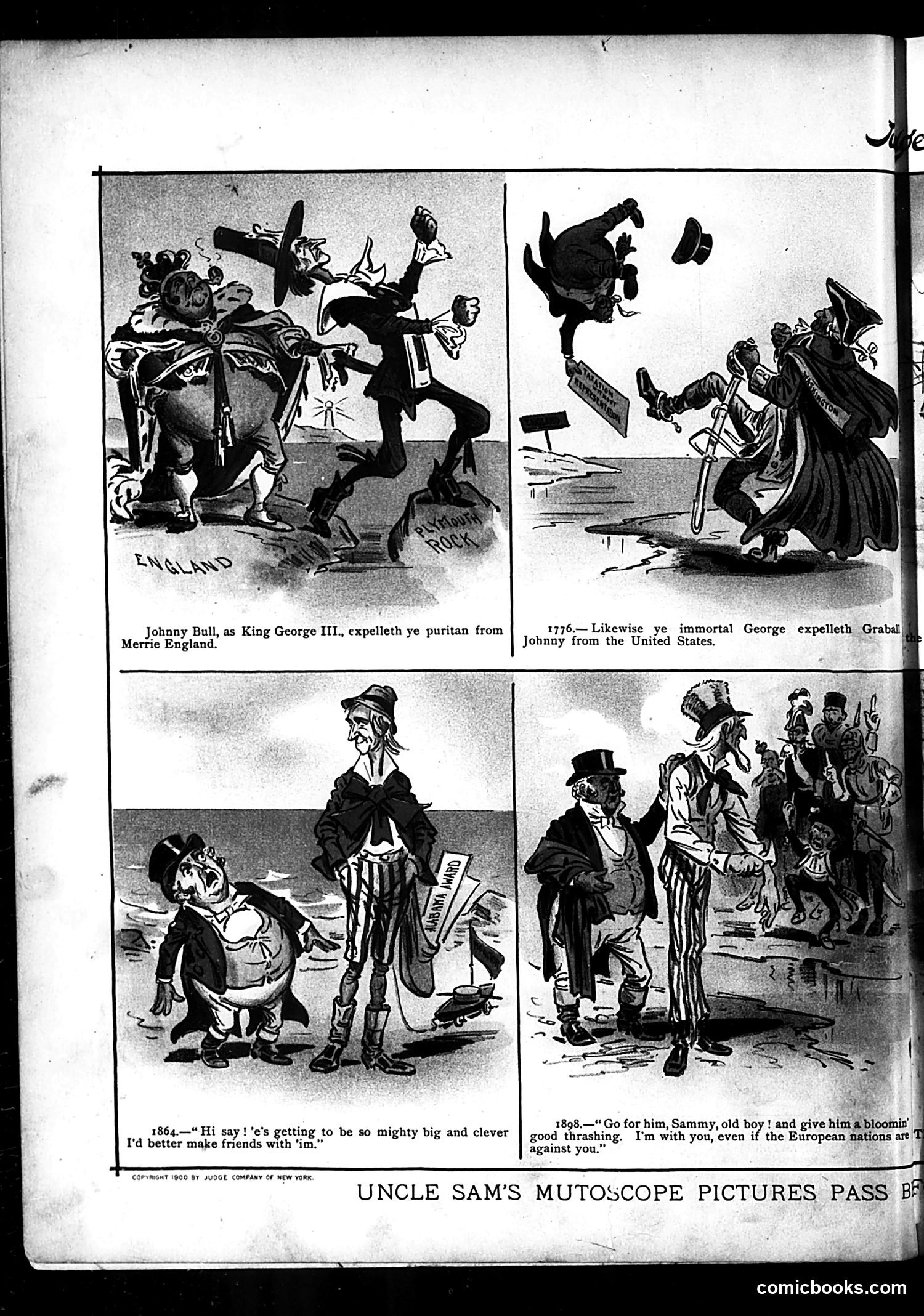
This four-panel cartoon uses historical parallels to comment on American expansion and conflict around 1900. **The panels depict:** 1. **King George III expelling the Puritan** (Revolutionary War reference) 2. **George Washington expelling "Johnny" (Britain) from America** (1776) 3. **1864**: Uncle Sam warns someone becoming "mighty big and clever"—likely referring to a rival power threatening American dominance 4. **1898**: Uncle Sam ("Sammy") encourages action against a figure, with European nations opposing ("even if the European nations are against you") **The satire:** The cartoon draws a parallel between America's founding struggle against British imperial control and America's current imperial ambitions. It suggests Uncle Sam is now doing what King George did—aggressively expanding—but frames this as justified because America is the "good guy." The 1898 date references the Spanish-American War, suggesting America should pursue imperial interests regardless of European opposition. The joke is ironic: America criticizes the tyranny it once fought, yet mimics it.
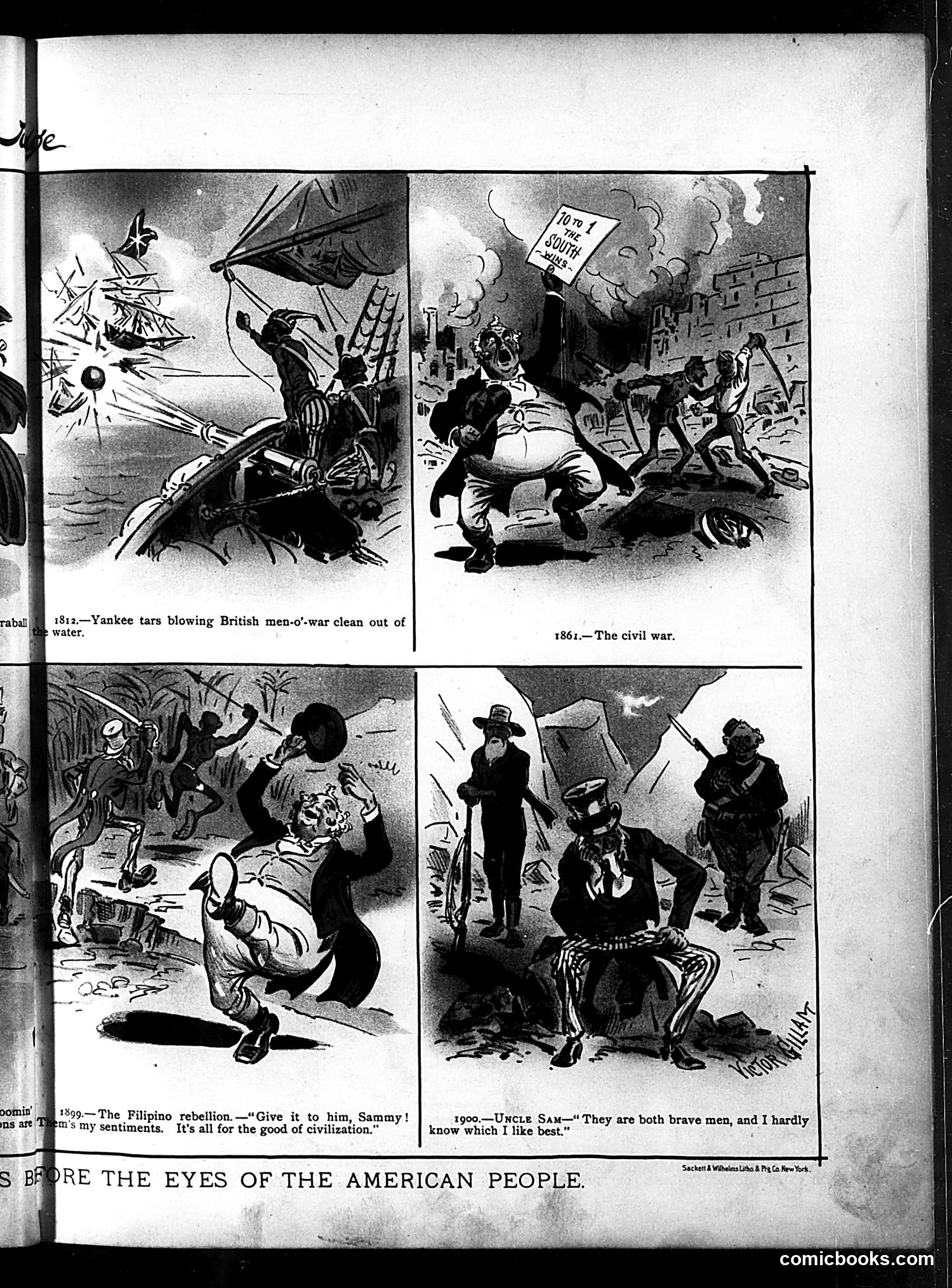
This four-panel cartoon traces American military conflicts across a century, comparing them through Uncle Sam's perspective. **Panel 1 (1812)**: American sailors ("Yankee tars") defeat British warships—a celebrated moment of American naval prowess. **Panel 2 (1861)**: The Civil War devastates an American city, presenting internal conflict as destructive chaos. **Panels 3-4 (1899-1900)**: The Filipino Rebellion and subsequent conflict. A figure (likely representing American expansionism or "Sammy") fights Filipino rebels while claiming it's "for civilization." Uncle Sam then expresses difficulty choosing between two "brave" opponents—suggesting moral ambiguity about American imperialism in the Philippines. **The satire's point**: This appears to critique American military expansion in the Philippines (a contemporary 1899-1900 issue), contrasting earlier "justified" wars with questionable imperial intervention. The cartoon implies that fighting for "civilization" rings hollow when Americans kill fellow independence fighters. The title suggests these conflicts should be examined critically by the public.
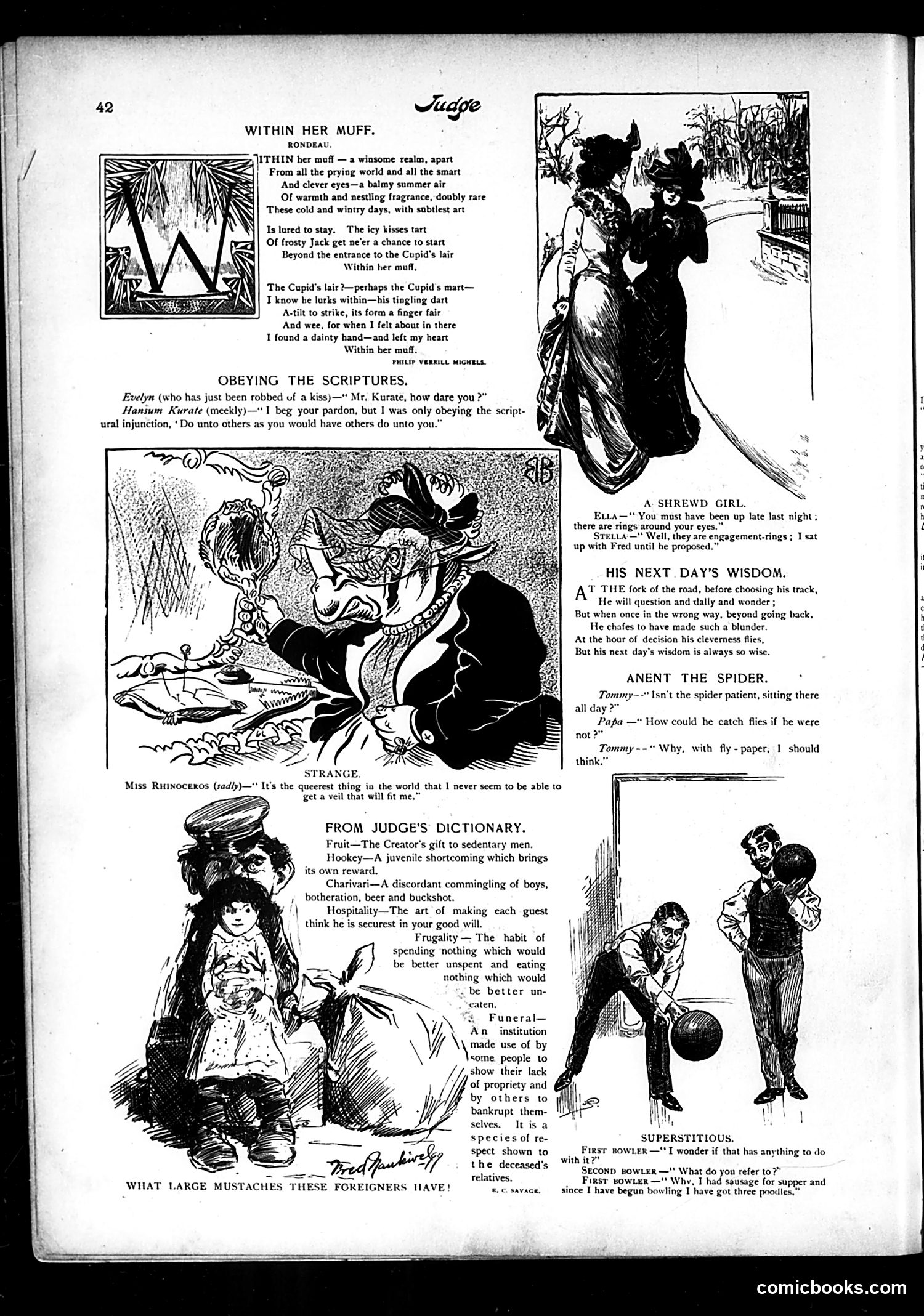
This page from *Judge* contains several satirical pieces typical of American humor magazines: **"Within Her Muff"** is a romantic rondeau poem playing on double entendre—"muff" referring both to a woman's hand-warming garment and flirtation. **"Obeying the Scriptures"** mocks a young man ("Hansum Kurate") who steals a kiss, then justifies it by quoting scripture about treating others as you'd want treated. The satire targets both his audacity and the absurd misapplication of religious doctrine. **"From Judge's Dictionary"** offers humorous definitions of social concepts—Frugality, Hospitality, Funerals—poking fun at human behavior and hypocrisy. **"A Shrewd Girl"** jokes about a woman claiming engagement rings (dark circles) around her eyes from staying up late with her boyfriend. **Minor pieces** include observations about foreign mustaches, a father-son dialogue about spiders and flypaper, and bowling superstitions. The page reflects early 20th-century middle-class American humor: risqué but not explicit, socially observant, and focused on courtship, propriety, and everyday absurdities.
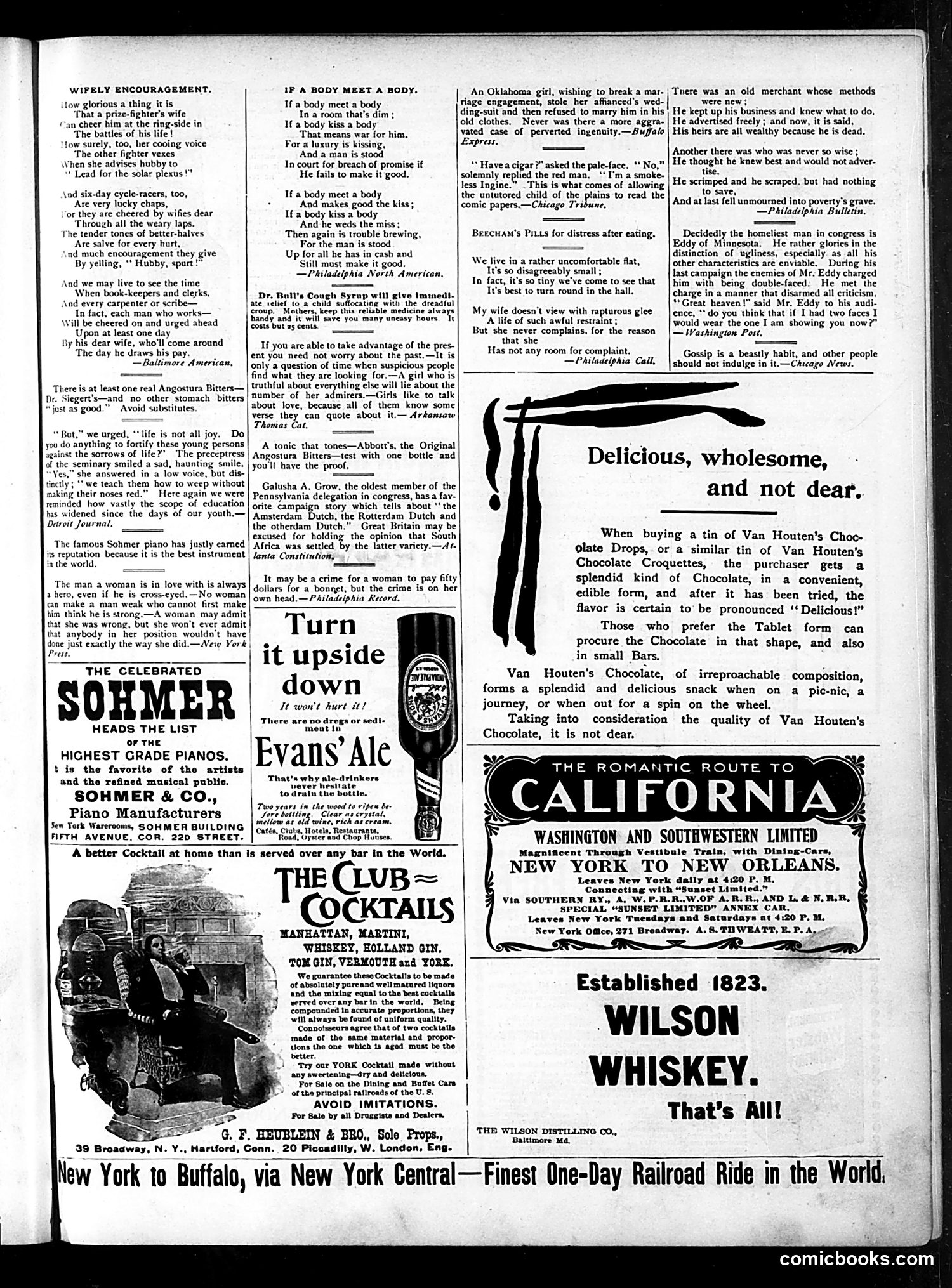
This page from Judge magazine is **primarily advertisements and short humorous observations**, not political cartoons with identifiable figures. The main satirical pieces are brief social commentaries: 1. **"Wifely Encouragement"** mocks the idea that wives cheering husbands during prizefights or six-day bicycle races (popular spectacles then) somehow helps. The joke extends to imagining wives celebrating husbands on payday—satirizing both marital dynamics and working-class life. 2. **"If a Body Meet a Body"** is a risqué piece about kissing leading to legal consequences: either "breach of promise" suits (a real legal action for broken engagement promises) or alimony obligations after marriage. 3. The page includes various aphorisms about women's behavior—their dishonesty about admirers, their spending habits, their emotional nature—reflecting period gender stereotypes presented as humor. The rest comprises **product advertisements** (Sohmer pianos, Dr. Bull's cough syrup, Wilson whiskey, Evans Ale) and railroad/travel promotions typical of era publications.
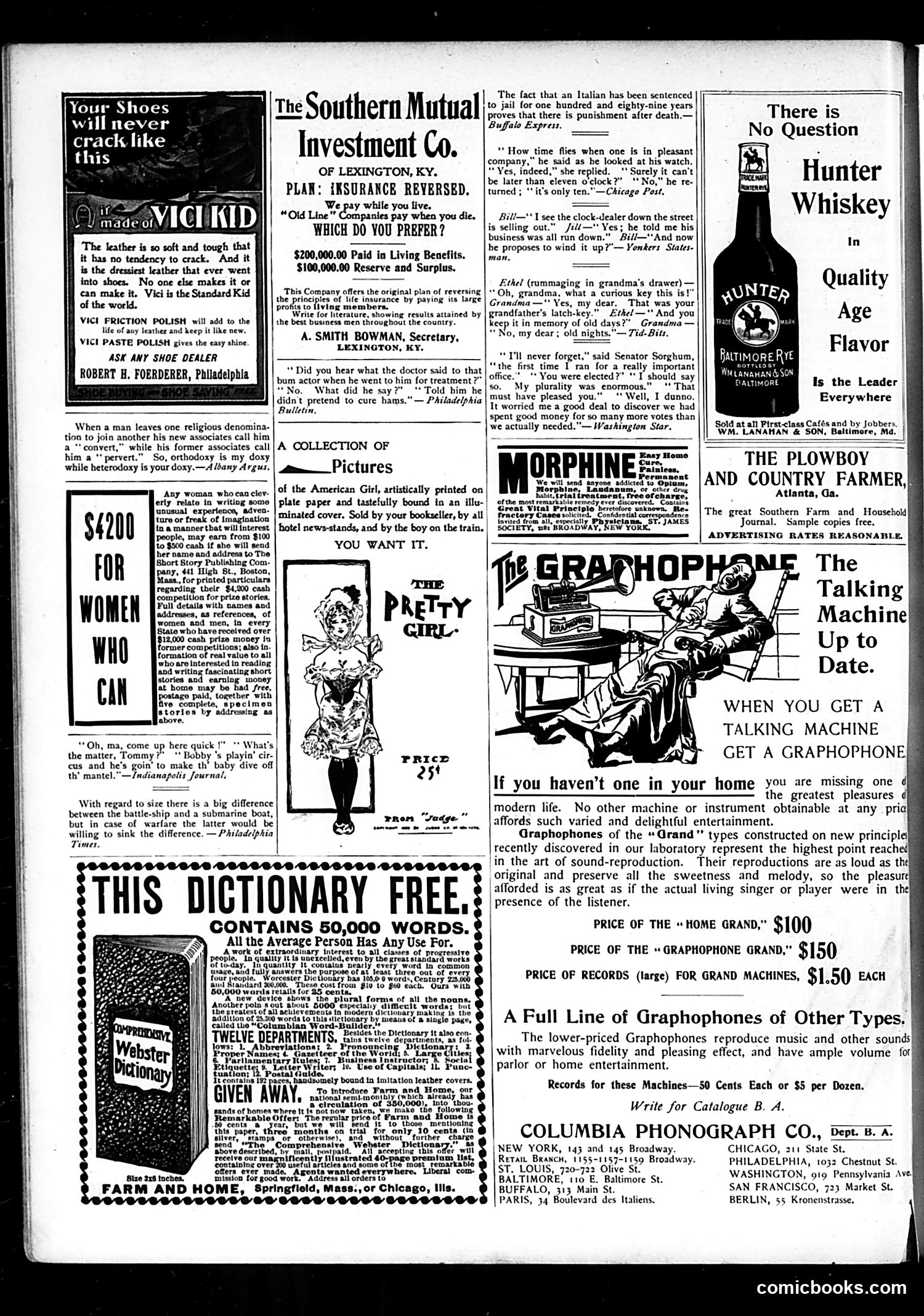
This is primarily an **advertising page** from Judge magazine, with limited satirical content. The main satirical items are brief jokes: 1. **The "convert/pervert" joke** contrasts religious terminology—when someone switches denominations, their old group calls them a "pervert" while the new group calls them a "convert," illustrating how perspective shapes language. 2. **The doctor and actor joke** uses wordplay: a doctor tells an actor he "doesn't pretend to cure hams"—a pun on "ham" (bad acting) versus actual medical treatment. 3. **The children's mishap quip** depicts a mother stopping her son from dangerous play-acting (a baby diving off a mantle during a mock circus). The page is dominated by **product advertisements**: Vici Kid shoes, Southern Mutual Investment Company insurance, The Pretty Girl picture collection, and a free dictionary offer. These ads reflect early 1900s consumer marketing. The page also advertises **Graphophone records and machines** (early phonograph technology), highlighting entertainment technology of the era. The overall content is typical Judge fare: light humor mixed with period-appropriate commercial promotions.
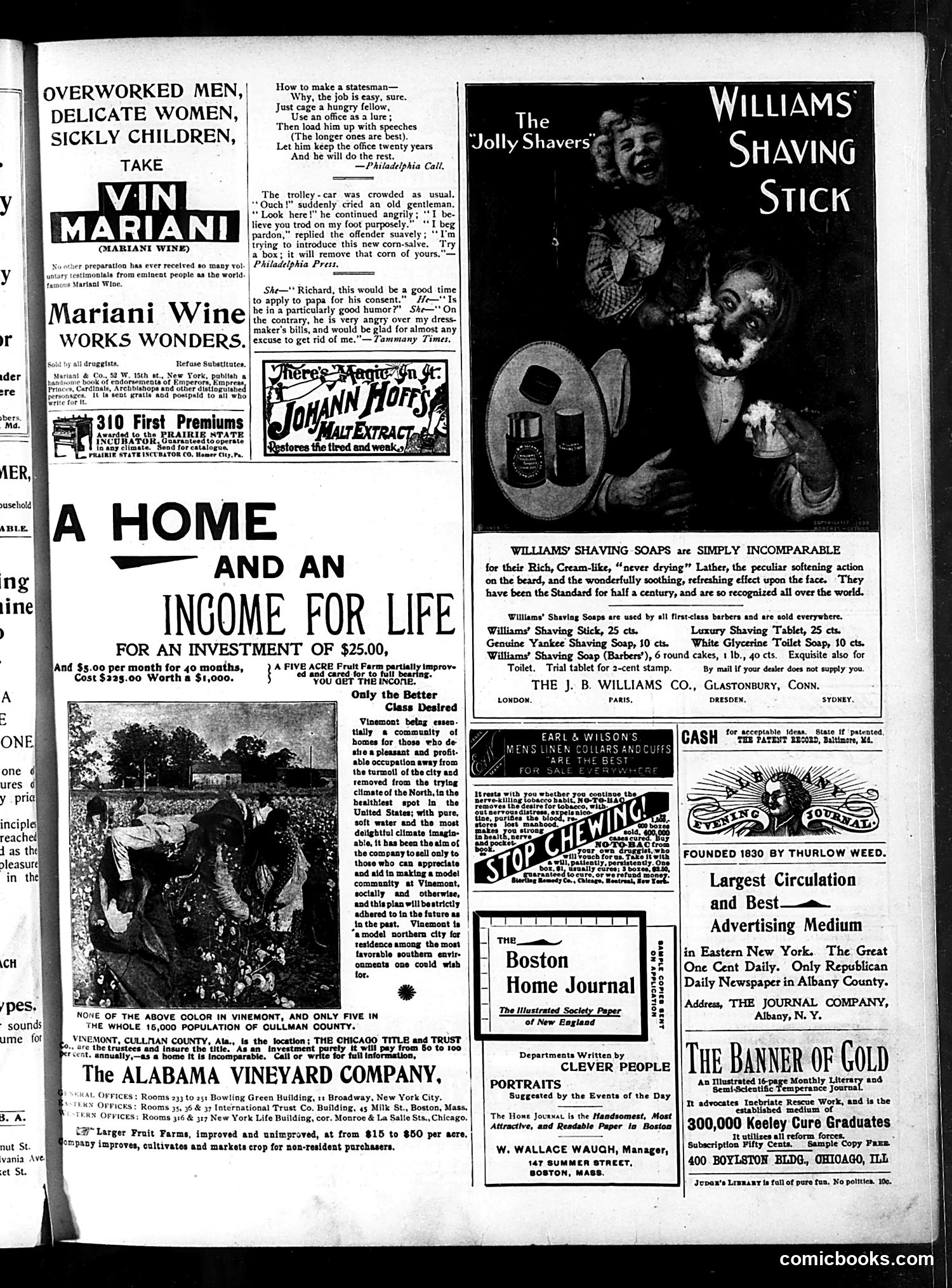
This page is primarily **advertisements and light humor** rather than political satire. The content includes: **Main Advertisement**: The Alabama Vineyard Company promotes a $25 investment in five-acre fruit farms in Vinemont, Alabama, emphasizing the area's "better class" residents and superior climate—with a notably problematic line stating "NONE OF THE ABOVE COLOR IN VINEMONT," referring to racial segregation as a selling point. **Satirical Humor**: Brief jokes about politics and daily life, including one on "How to make a statesman" (referencing career politicians who stay in office indefinitely) and comedic anecdotes about trolley cars and romantic disagreements. **Product Advertisements**: Williams' Shaving Stick and various other consumer goods dominate the lower half. **Historical Context**: The Vinemont ad's explicit racial segregation claim reflects early 1900s real estate marketing practices. The page reflects an era when such discriminatory language was openly used in advertising, illustrating attitudes that would be shocking to modern readers.
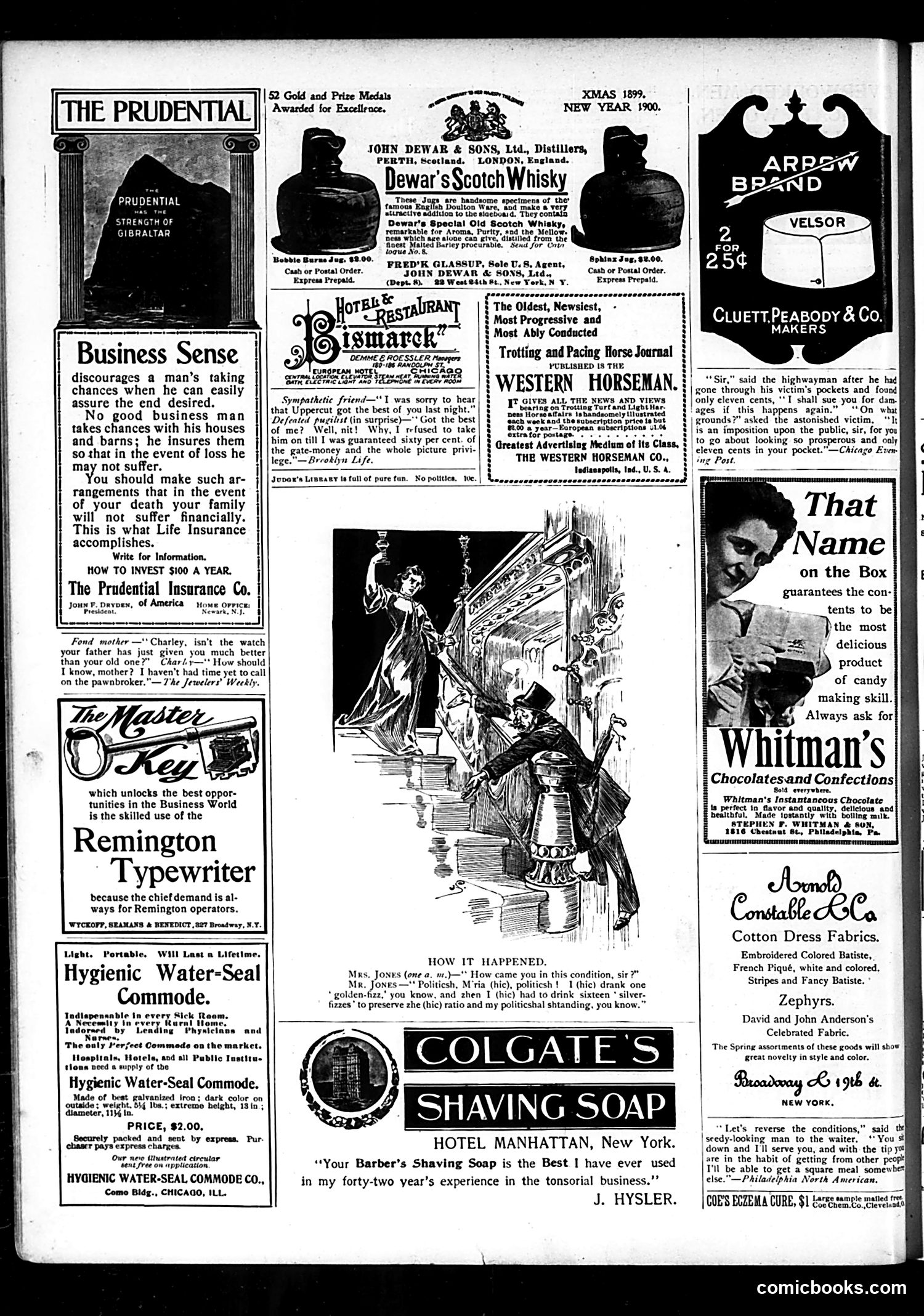
This page is primarily **advertising with minimal editorial content**. The major visual element is a cartoon titled "HOW IT HAPPENED" depicting a domestic scene where a drunk husband explains to his wife that he consumed numerous cocktails ("golden-fizz" and "silver-fizzes") to maintain proper political balance while drinking. The joke appears to reference **late 19th-century saloon culture and political debate**, suggesting men gathered in bars to discuss politics while consuming alcoholic drinks. The husband's absurd logic—that drinking different cocktails in specific ratios preserves "politicshal shtanding"—satirizes both male intoxication and the sometimes irrational nature of political discourse in saloons. The remainder of the page consists of advertisements for insurance, typewriters, whisky, toilets, candy, fabric, and other consumer goods typical of 1899-1900 American magazines. There is no other significant political or social commentary visible.
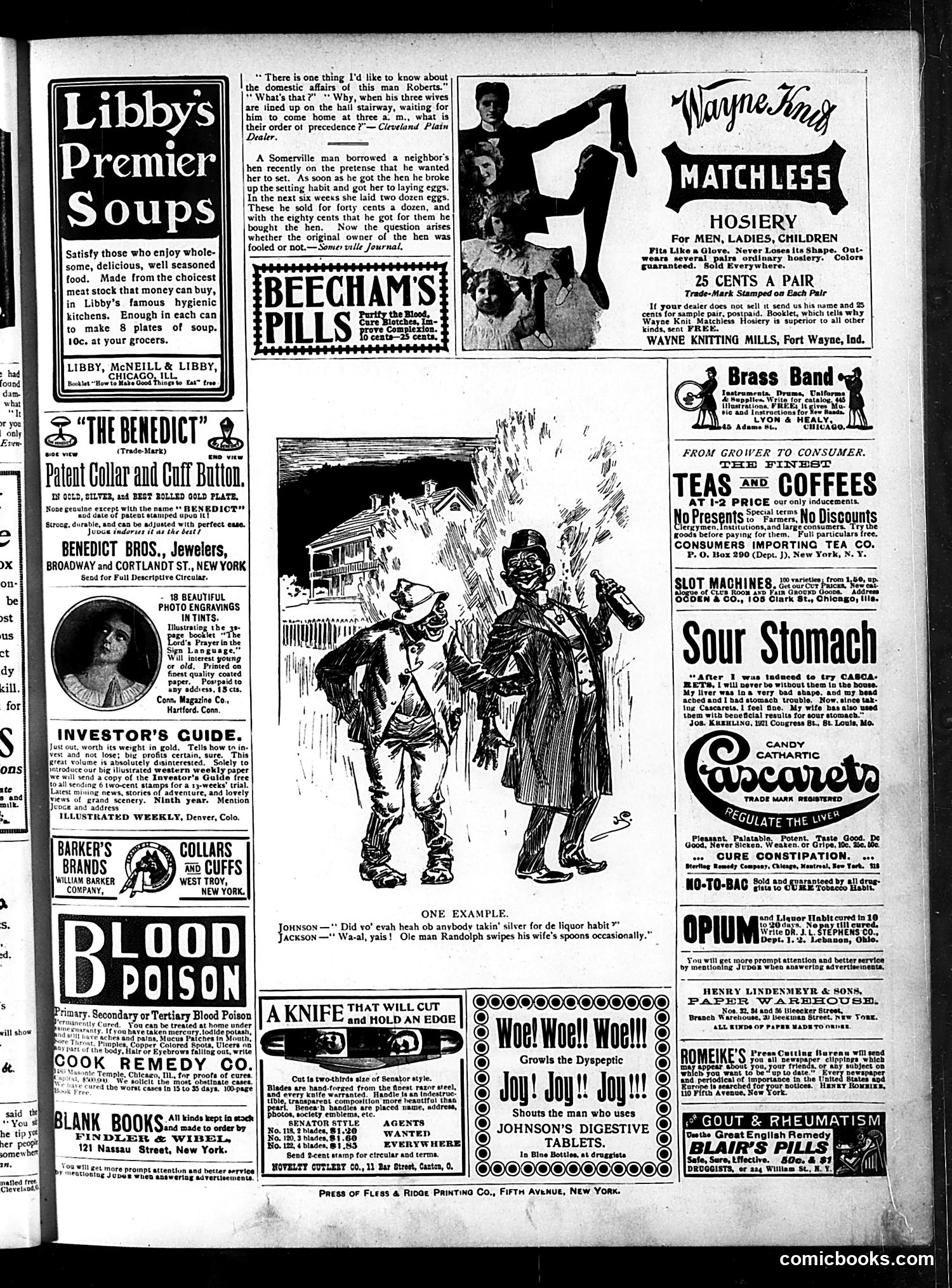
This page is primarily **advertisements** with one small cartoon at bottom-center titled "ONE EXAMPLE." The cartoon depicts two Black men in conversation—identified by the OCR text as "Johnson" and "Jackson"—discussing silver theft. Johnson asks if anyone takes silver for treating liquor addiction; Jackson responds that a man named Randolph steals his wife's spoons occasionally. **The "joke"** trades on racial stereotypes common to early 20th-century American humor: depicting Black Americans as thieves and portraying marital discord as comedic fodder. The cartoon relies on dialect ("Did yo' evah heah") to emphasize caricature. **Historical context**: This represents the casual racism endemic to mainstream American publications of this era. Judge magazine, despite its satirical reputation, regularly published content mocking Black Americans, immigrants, and other groups considered "outsiders." The surrounding page features patent medicines, hosiery, cutlery, and other consumer goods typical of period magazine advertising.
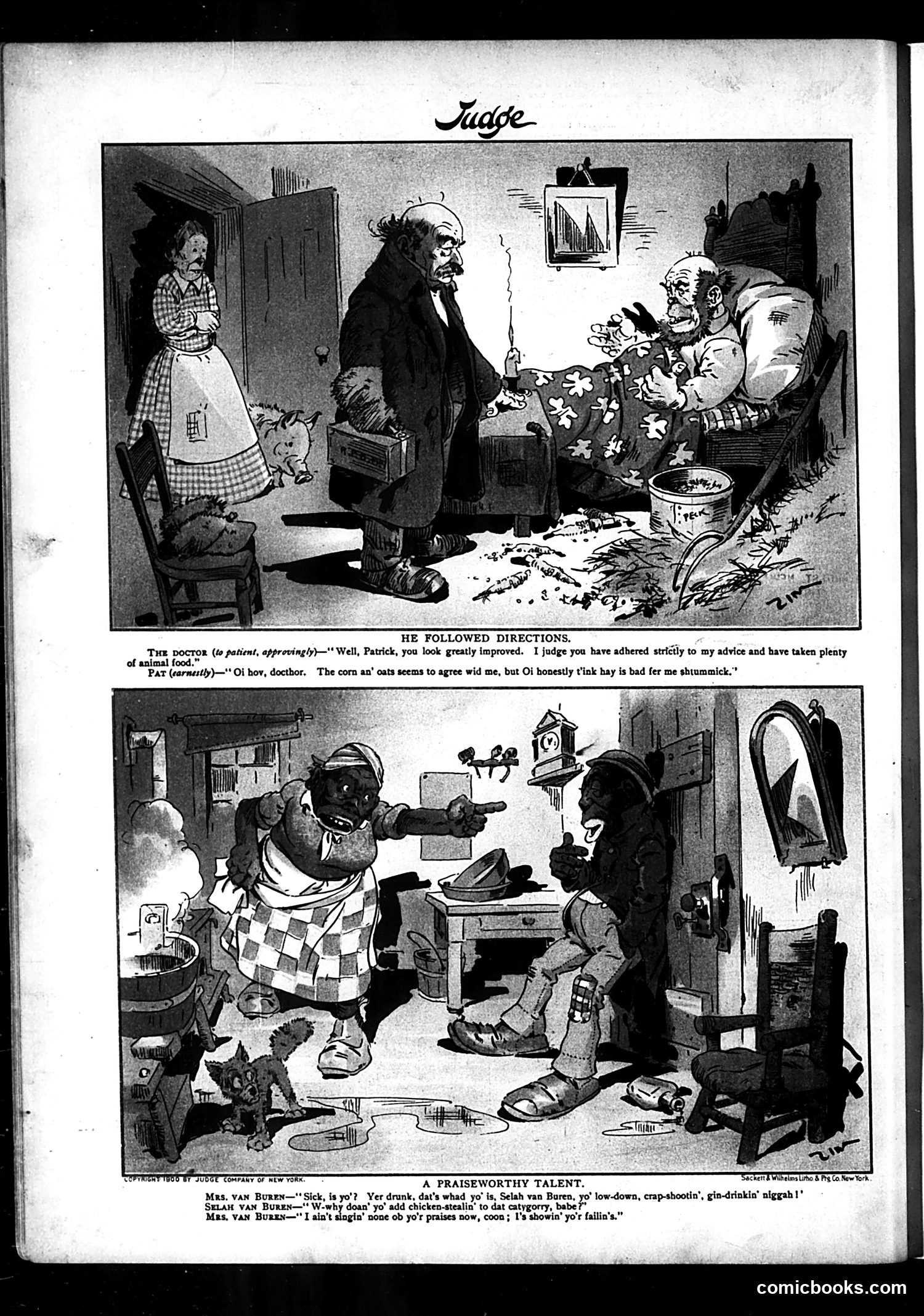
**Top cartoon ("He Followed Directions"):** A doctor advises an Irish patient (Patrick, indicated by dialect) to eat animal food for health. Patrick misunderstands, literally consuming corn and oats—animal feed—instead of meat. The joke relies on ethnic stereotyping of Irish immigrants as unintelligent and using broken English ("shtummick" for stomach). **Bottom cartoon ("A Praiseworthy Talent"):** Features African American characters using offensive period dialect and racial slurs. A woman (Mrs. Van Buren) berates a man (Selah) for drunkenness, gambling, and other vices. He sarcastically agrees, and she responds she's "showin' yo'r failin's." The cartoon presents racist caricatures meant to mock Black Americans through exaggerated stereotypes of criminality and moral failings. Both cartoons use ethnic/racial ridicule as their primary comedic mechanism, reflecting Judge magazine's casual deployment of offensive stereotypes typical of early 20th-century American satire.