
A complete issue · 16 pages · 1899
Judge — July 22, 1899
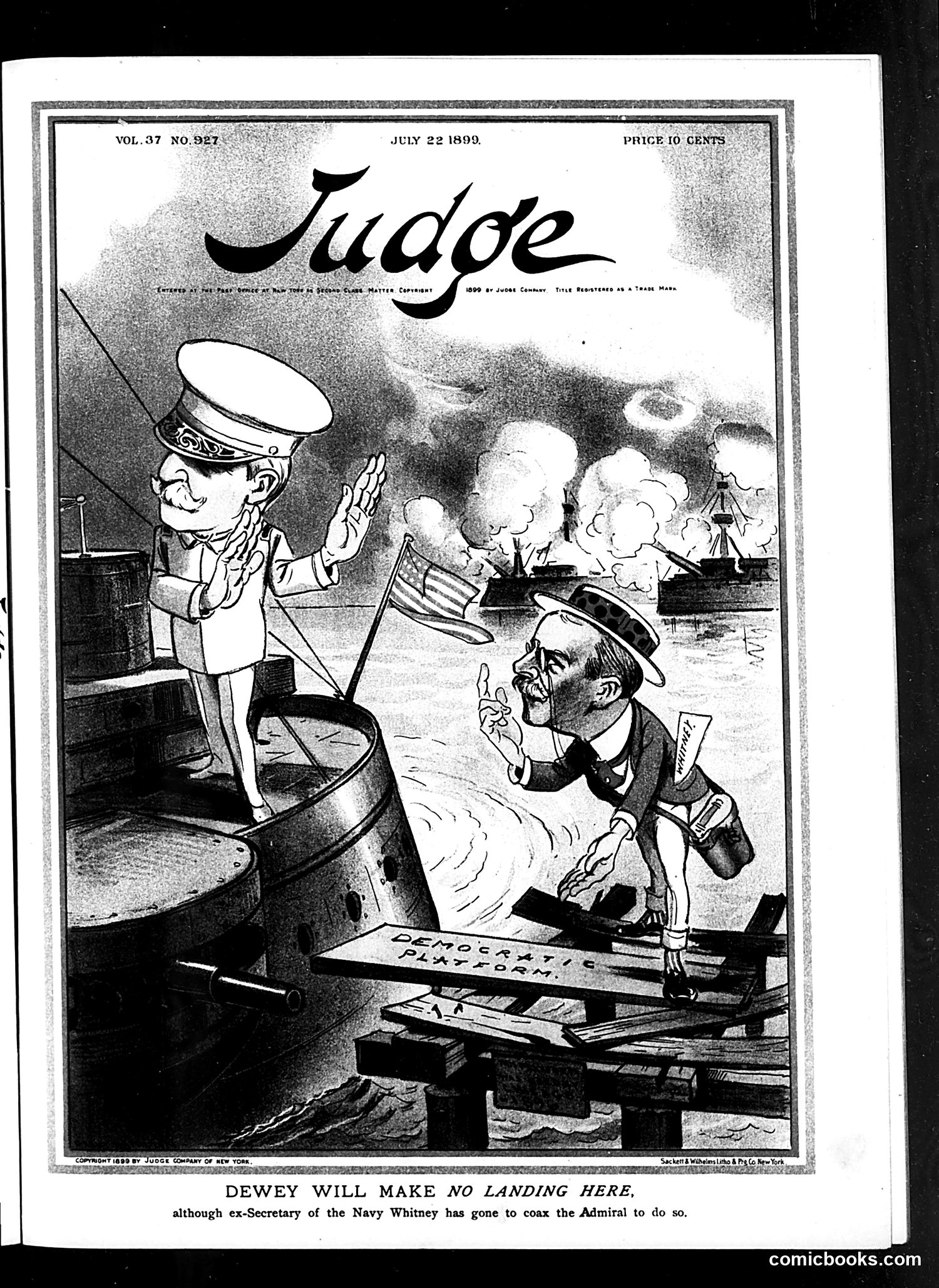
This cartoon satirizes Admiral George Dewey's potential presidential ambitions following his naval victory in the Spanish-American War. The caption reads "DEWEY WILL MAKE NO LANDING HERE, although ex-Secretary of the Navy Whitney has gone to coax the Admiral to do so." The figure on the left in naval uniform appears to be Dewey, gesturing refusal from a ship. The caricatured figure below, labeled "DEMOCRATIC PLATFORM," represents the Democratic Party attempting to recruit Dewey as a presidential candidate. The explosions in the background reference Dewey's celebrated Manila Bay victory (May 1898). The satire mocks Democratic efforts to exploit Dewey's popularity while depicting him as reluctant to enter politics, suggesting skepticism about both his political viability and the party's strategy.
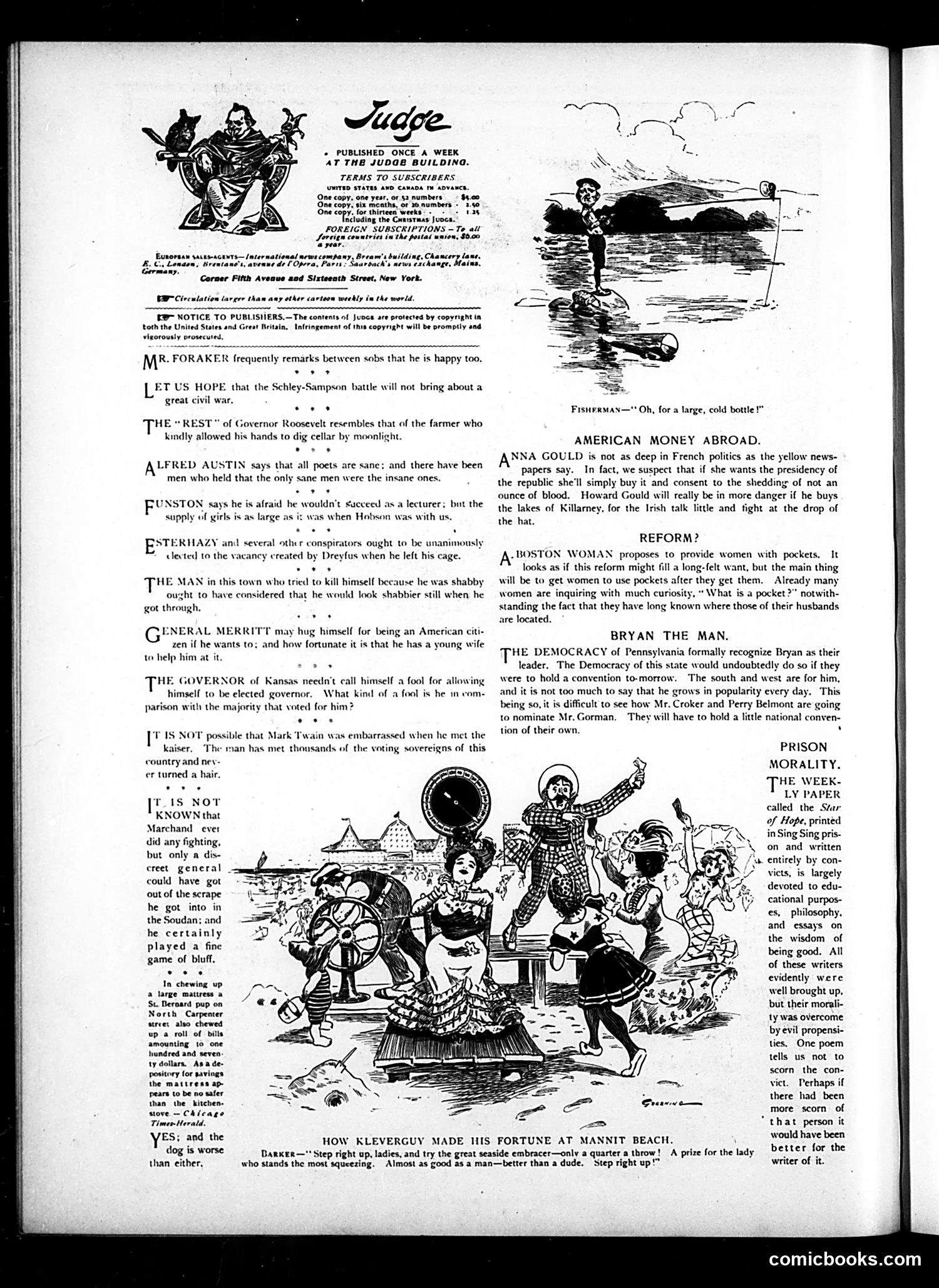
This page contains brief political commentary and two cartoons. The top section includes satirical quips about contemporary figures: Mr. Foraker (likely Ohio politician Joseph B. Foraker), Governor Roosevelt, Alfred Austin (British Poet Laureate), and others—typical of Judge's format critiquing public figures. The main cartoon, "How Kleverguy Made His Fortune at Mannit Beach," depicts a seaside con artist ("barker") using a shell game to swindle beachgoers. The caption's pun on "Kleverguy" (clever guy) satirizes tourist gullibility and boardwalk hustle culture. The upper right cartoon shows a fisherman, likely illustrating another social observation about leisure activities. The page also includes book reviews and social commentary typical of Judge's satirical journalism covering politics, society, and culture.
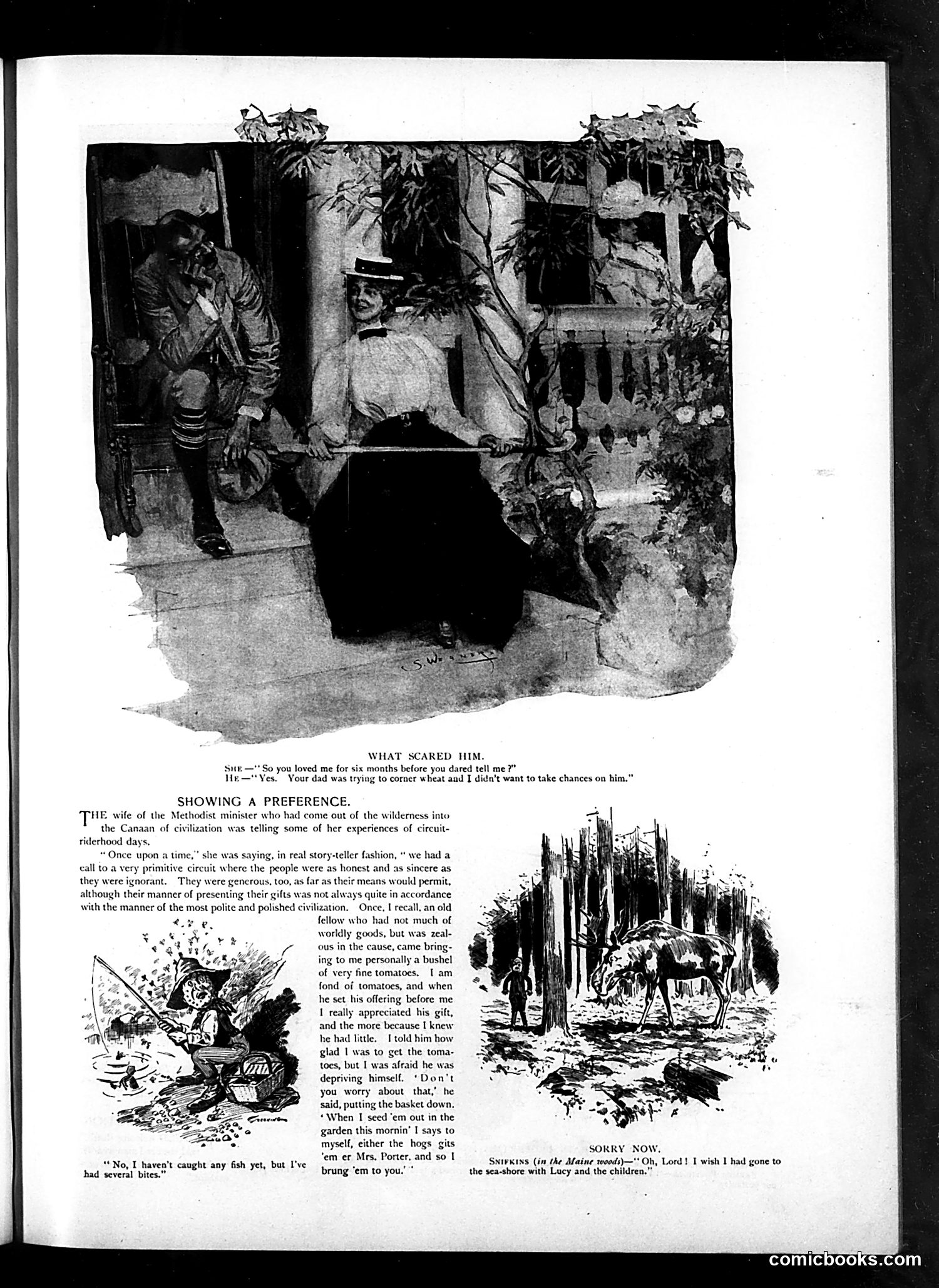
This page contains three distinct narrative/comic elements: **Top image ("What Scared Him"):** A domestic scene showing a confrontation between a man and woman. The dialogue suggests the woman discovered the man's infidelity six months prior but delayed confronting him, now using it as leverage. The humor lies in the man's fear of his wife's reaction rather than actual consequences. **Middle section ("Showing a Preference"):** A Methodist minister's wife recounts circuit-riding experiences, describing how a poor man's gift of tomatoes moved her more than wealthy parishioners' offerings. The text emphasizes sincere generosity over material wealth—a sentimental rather than satirical piece. **Bottom image ("Sorry Now"):** Depicts rural figures with livestock, likely illustrating a cautionary tale about agricultural hardship or miscalculation. The page mixes domestic humor, moral sentiment, and rural commentary typical of Judge's early satirical approach.
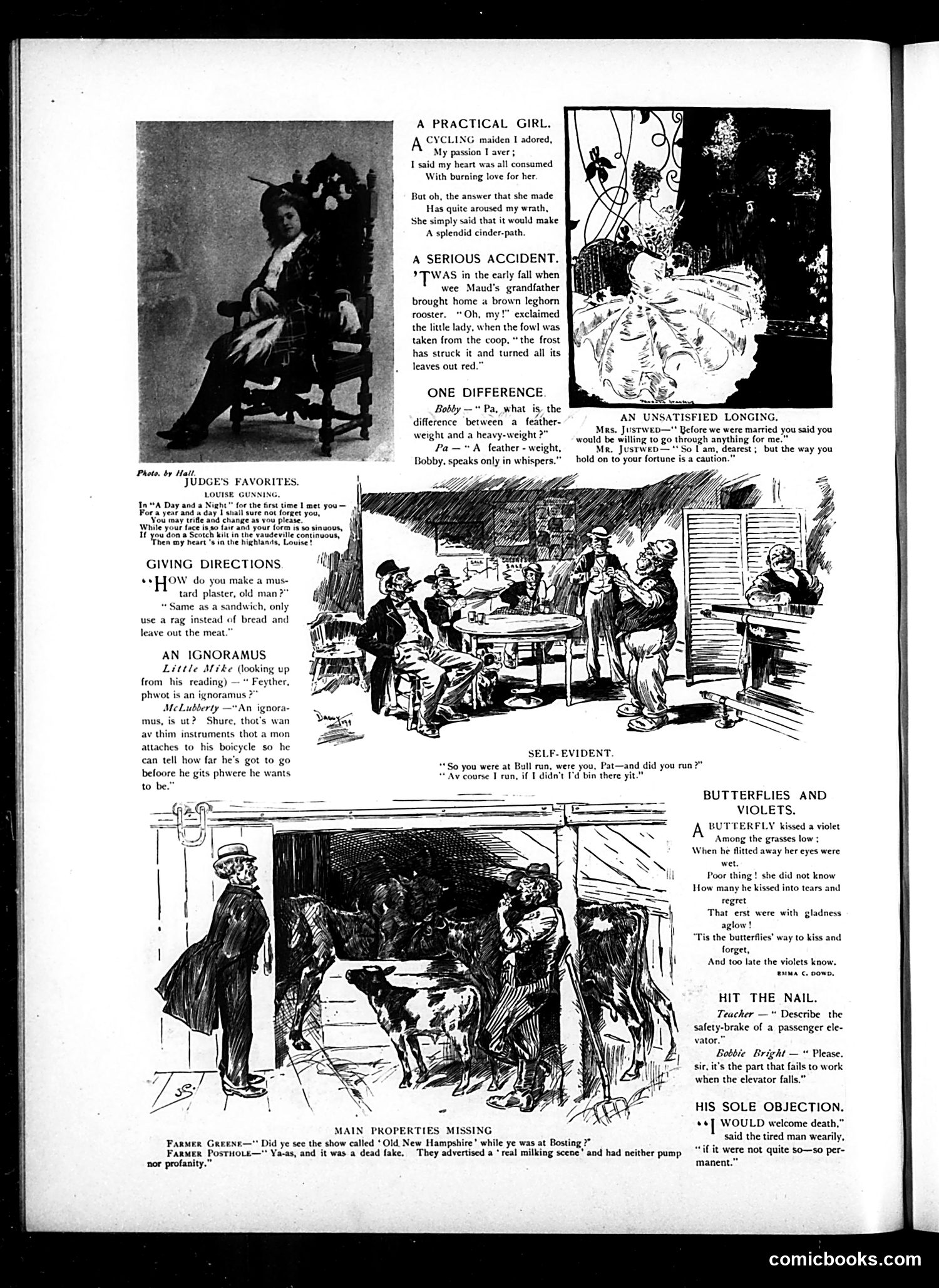
This page contains primarily **humorous anecdotes and light verse** rather than political satire. The content includes: - **"A Practical Girl"** and **"A Serious Accident"**: brief comic stories about everyday domestic mishaps - **"Judges' Favorites"**: a joke about Scottish frugality - **"An Ignoramus"**: wordplay about musical instruments - **"Self-Evident"**: a cartoon about someone at a bar run - **"Butterflies and Violets"**: sentimental poetry - Various other joke sections The illustrations are **generic comedic sketches** depicting ordinary situations—family life, bar scenes, street interactions—without specific political figures or dated references. This appears to be a **humor and entertainment page** typical of Judge's lighter content, focused on universal social comedy rather than topical satire.
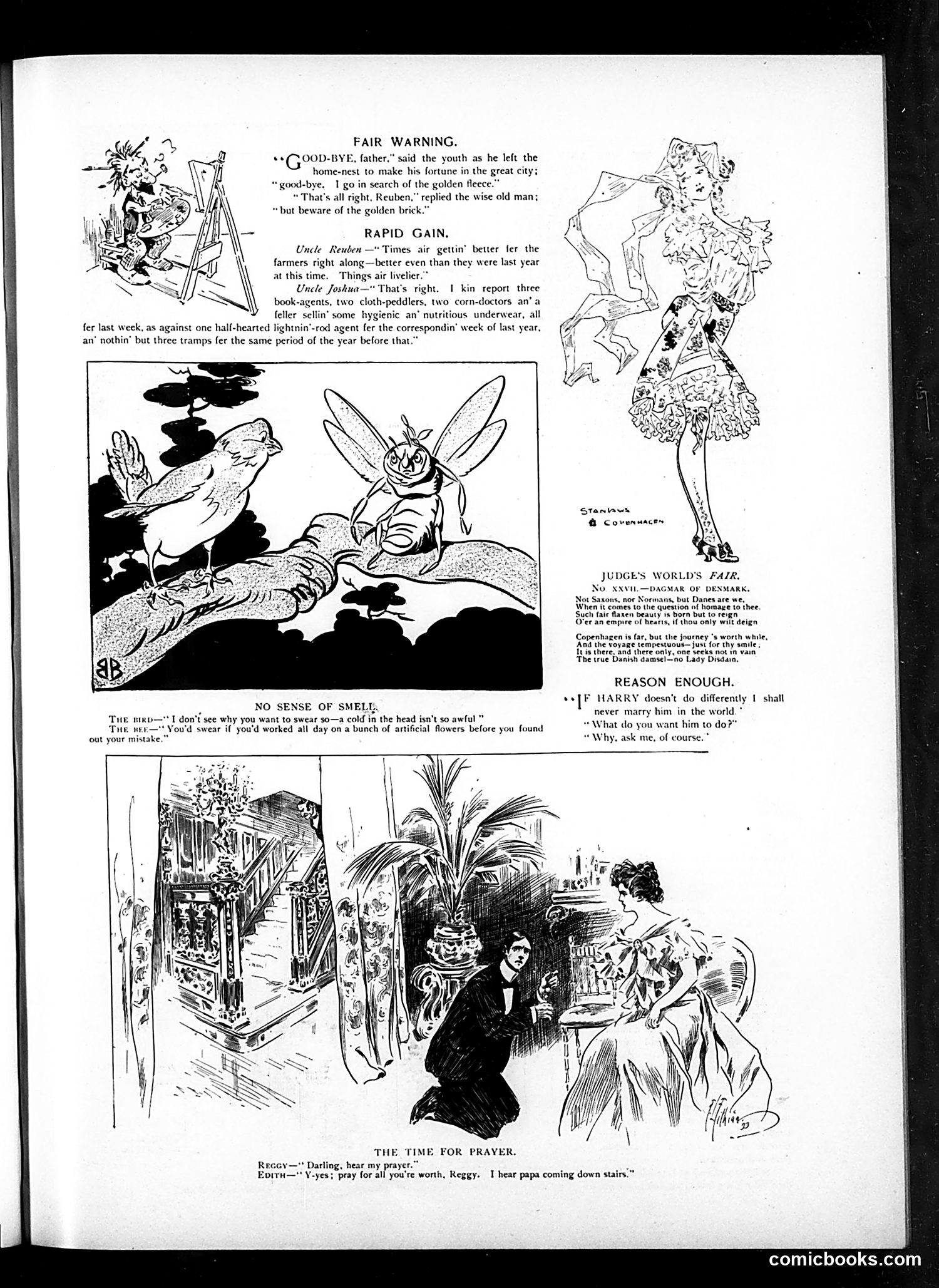
This page contains several satirical sketches typical of late 19th-century American humor: **"Fair Warning"** warns of urban con artists ("golden brick" scams) targeting naive rural youth seeking fortune in cities. **"Rapid Gain"** mocks rural gullibility through two farmers discussing "improved" conditions—which actually means more traveling salesmen, con artists, and vagrants victimizing their communities. The joke satirizes naive country people easily duped by fraudsters. **"No Sense of Smell"** jokes about a woman working with artificial flowers all day, with the implication her hands smell bad, requiring perfume before socializing. **"Judge's World's Fair"** appears to reference a beauty contest or pageant featuring Danish women, with flowery compliments about Danish femininity. **"Reason Enough"** presents a domestic comedy where a woman refuses to marry unless her fiancé does something unspecified—he suggests asking her what she wants, implying she's unreasonably demanding. **"The Time for Prayer"** humorously depicts a child being told to pray earnestly before her father arrives home, suggesting parental discipline was imminent. The overall tone reflects period attitudes toward rural simplicity, feminine vanity, and domestic hierarchies.
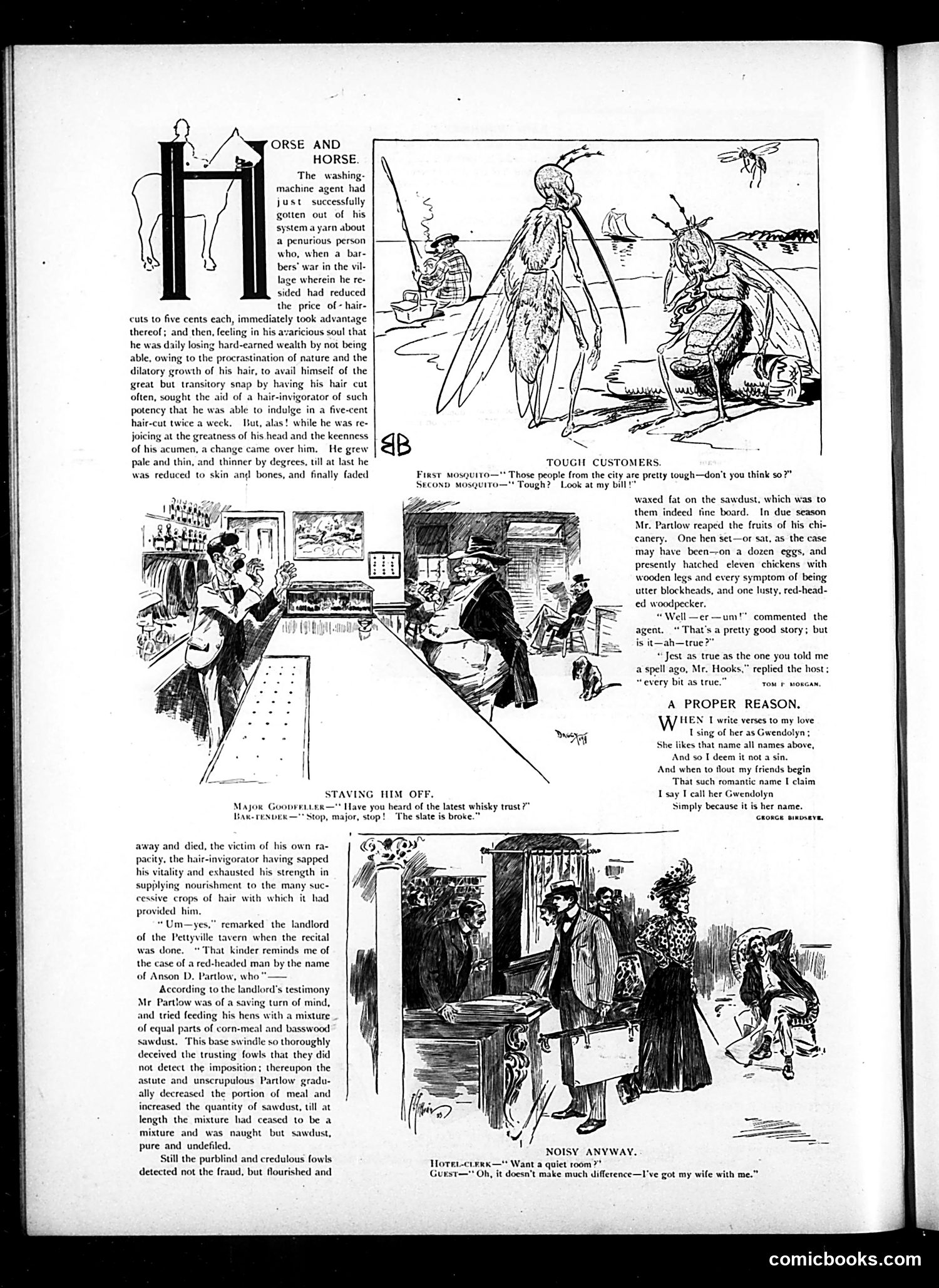
This page contains several satirical vignettes typical of Judge's humor: **"Horse and Horse"** (top): A long anecdote mocking penny-pinching. A cheap man discovers a hair-growth tonic to exploit five-cent haircuts, but the potion causes him to waste away. The tale's moral ambiguity—whether true or fabricated—becomes the joke itself. **"Tough Customers"** (center-right): Two mosquitoes discuss city visitors. The second mosquito's punchline about his "bill" (medical charges from bites, punning on the word) satirizes urban tourists as easy targets for parasites—literal and figurative. **"Staving Him Off"** (bottom-left): A major tries selling a whisky trust scheme; the bartender deflects by claiming his slate is "broke," avoiding both debt and the conversation. **"A Proper Reason"** (right): Light verse about naming one's beloved "Gwendolyn" simply because it *is* her name—mocking overwrought romantic poetry's pretension. **"Noisy Anyway"** (bottom): A guest with his wife checks in; she'll make noise regardless of room quality—a jab at nagging spouses. The page reflects Judge's genteel, moralistic satire targeting miserliness, fraud, and domestic folly.
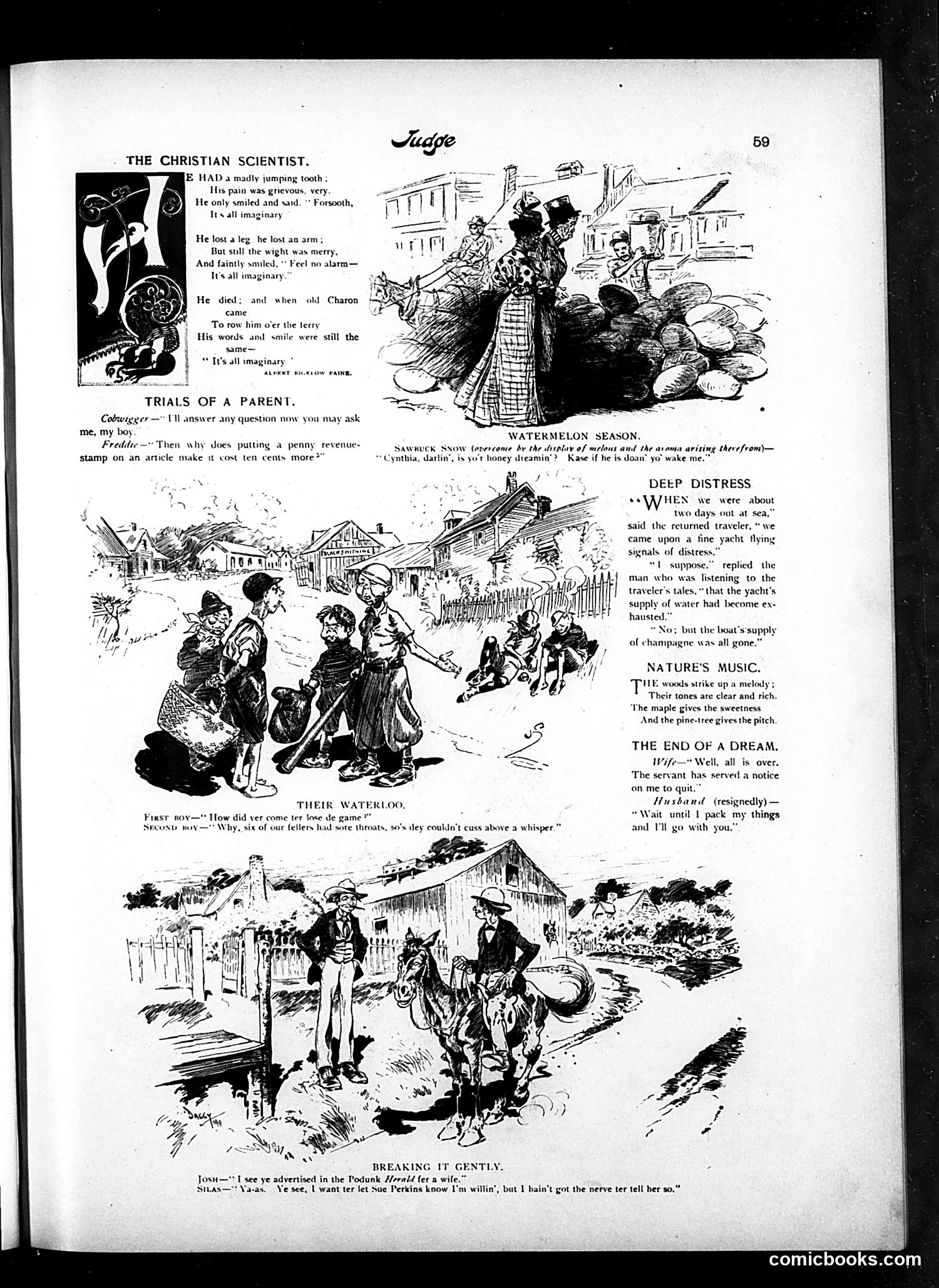
This page contains multiple satirical cartoons and jokes typical of early American humor magazines: **"The Christian Scientist"** mocks Christian Science's belief that illness is mental illusion. The cartoon depicts a man denying progressively severe afflictions (toothache, lost limbs, death itself) as "imaginary"—absurd given physical reality. **"Trials of a Parent"** presents a child's logical gotcha: asking why paying postage increases an article's cost, exposing adult economic contradictions. **"Watermelon Season"** stereotypes enslaved or working Black characters overwhelmed by watermelon displays, reflecting the racist caricatures common in period entertainment. **"Deep Distress"** jokes about wealthy yacht owners' priorities: they worry about champagne supply running out before water. **"Breaking It Gently"** depicts rural courtship awkwardness—a man advertising for a wife to indirectly signal interest rather than directly proposing. The page exemplifies Judge's mix of social satire, family humor, and period racial stereotypes typical of turn-of-the-century American magazine humor.
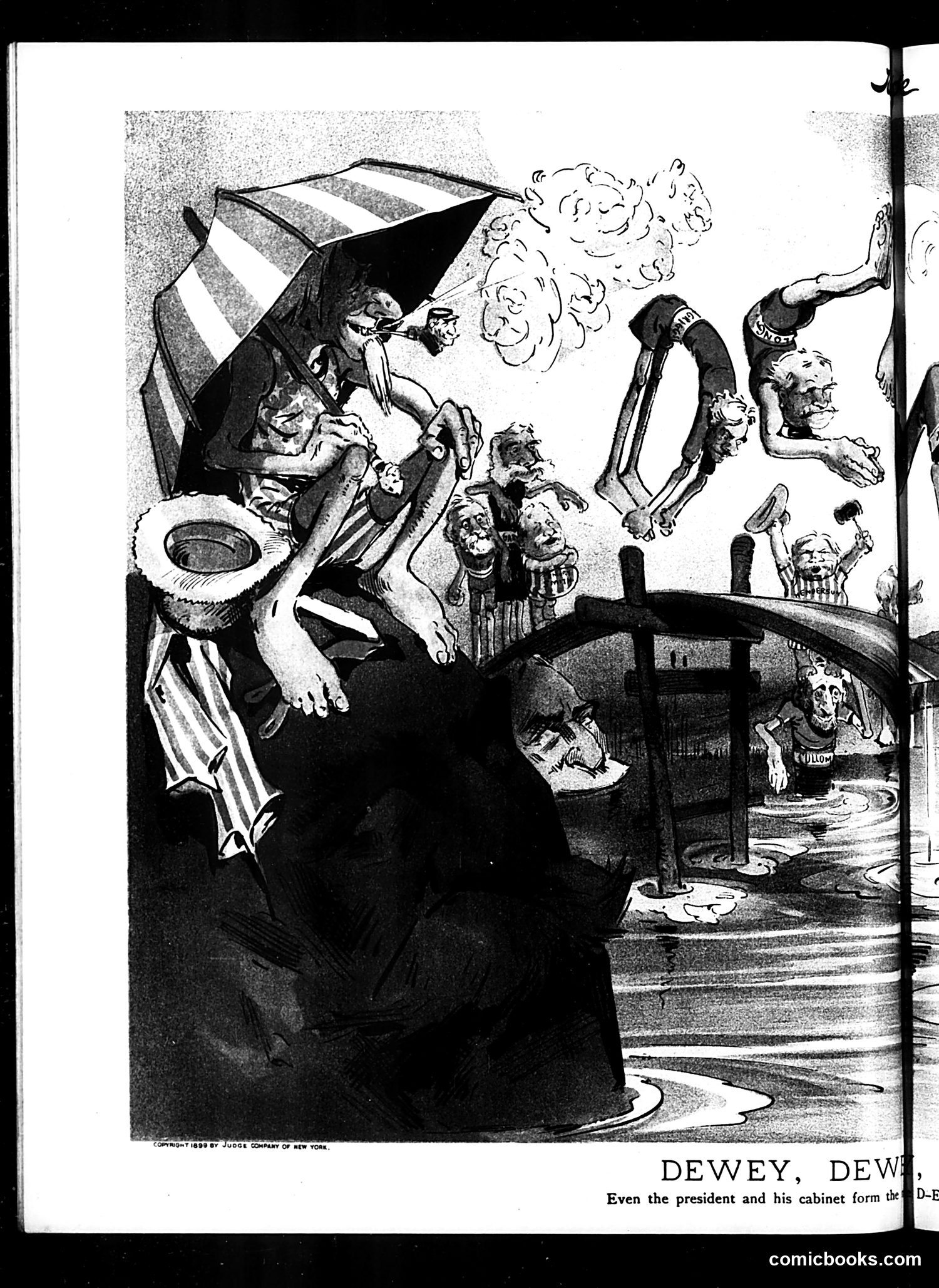
This satirical cartoon from Judge magazine (circa 1890) depicts "Dewey, Dew" — likely referencing Admiral George Dewey, whose naval victory at Manila Bay (1898) made him a celebrated American hero. The cartoon shows the President and his cabinet literally forming the letters "D-E," suggesting they've become absorbed into or are subordinate to Dewey's popularity. The imagery of figures being manipulated or transformed into letters satirizes how thoroughly Dewey's fame has dominated the political landscape. The umbrella and theatrical setting suggest the absurdity of this phenomenon. The joke critiques how even the highest government officials seem overshadowed by a military hero's celebrity, implying concerns about civil authority versus military influence in American politics during this period.
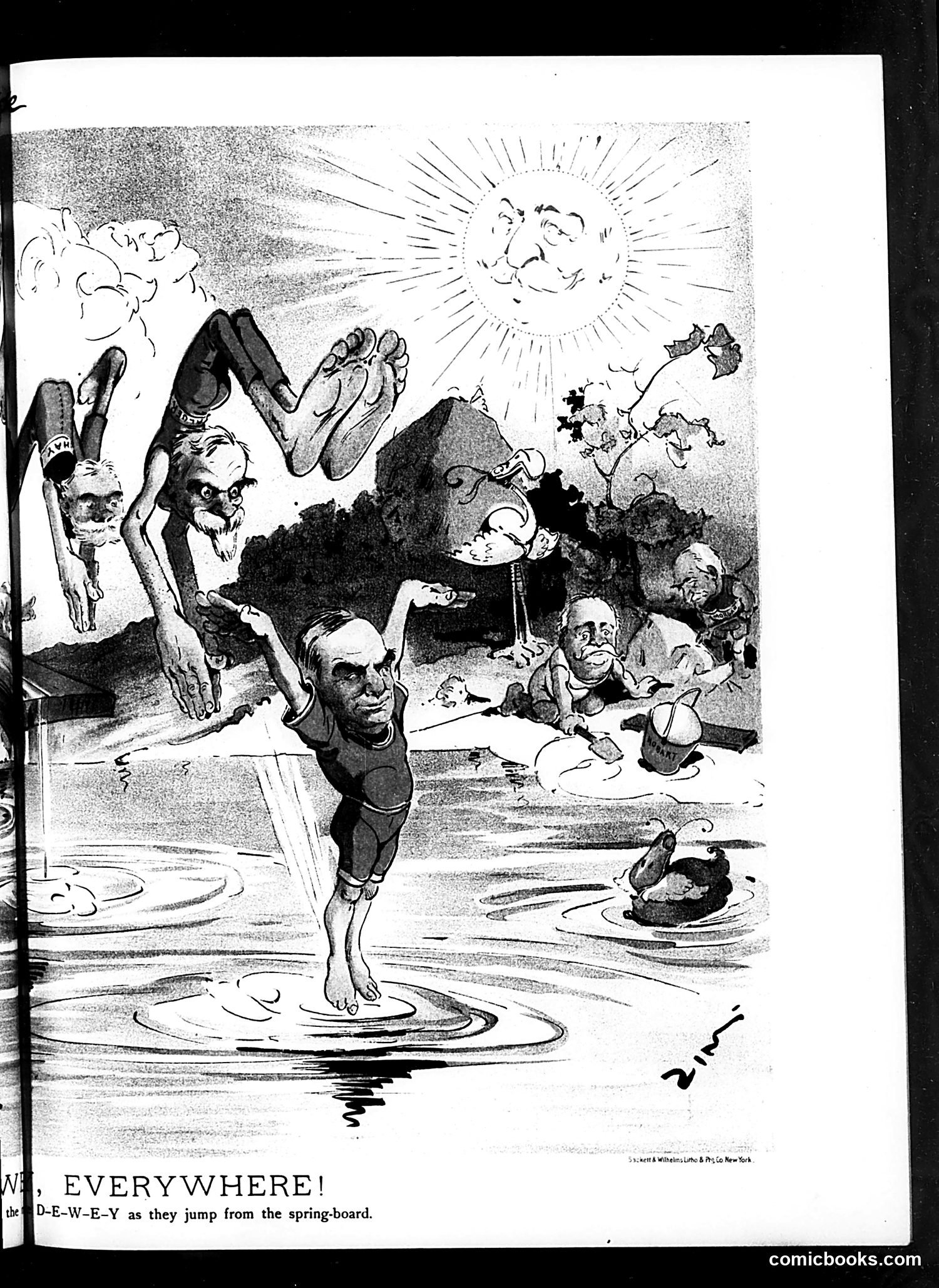
This is a political cartoon satirizing Thomas Dewey, likely from his 1944 or 1948 presidential campaign. The caption puns on "Dewey" sounding like "D-E-W-E-Y" as figures jump from a springboard into water—suggesting Dewey's ubiquitous campaign presence. The cartoon depicts caricatured figures (appearing to represent political opponents or the public) being overwhelmed by Dewey imagery/campaigning "everywhere." The exaggerated, grotesque style typical of Judge magazine's satirical approach mocks what the cartoonist saw as aggressive or inescapable campaign tactics. The smiling sun presiding overhead may suggest either optimistic campaign messaging or ironic commentary on the pervasiveness of the campaign. The water and springboard imagery conveys chaos and involuntary participation.
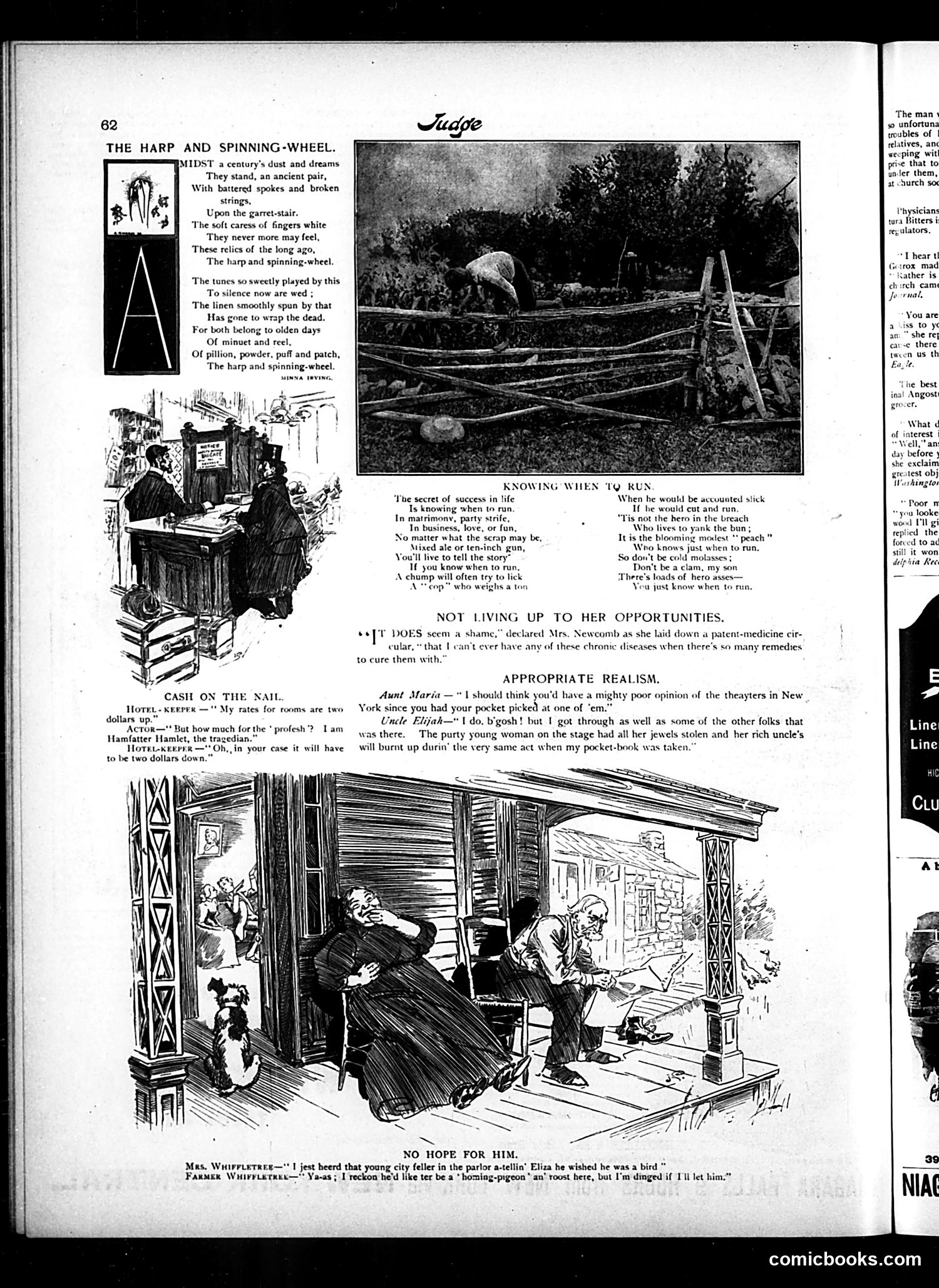
This page contains several satirical pieces typical of Judge's humor: **"The Harp and Spinning-Wheel"** (top left): A nostalgic poem lamenting obsolete domestic items, satirizing romantic idealization of the past. The worn instruments represent outdated traditions. **"Knowing When to Run"** (center): Humorous advice-verse about practical survival—literally running from fights and figuratively from marital/political conflicts. It mocks those who stand their ground foolishly. **"Not Living Up to Her Opportunities"**: Mrs. Newcomb ironically laments she can't develop chronic diseases to use patent medicines, satirizing the era's proliferation of dubious medical cure-alls aggressively marketed to consumers. **"Appropriate Realism"** and **"Cash on the Nail"**: Brief comic dialogues mocking theatrical pickpocketing and hotel price-gouging, with working-class characters (Hamfatter Hamlet, farmers). **"No Hope for Him"** (bottom): Rural humor about a city suitor wishing to be a "homing-pigeon" to stay near a farmer's daughter—satirizing courtship pretensions and country-versus-city stereotypes.
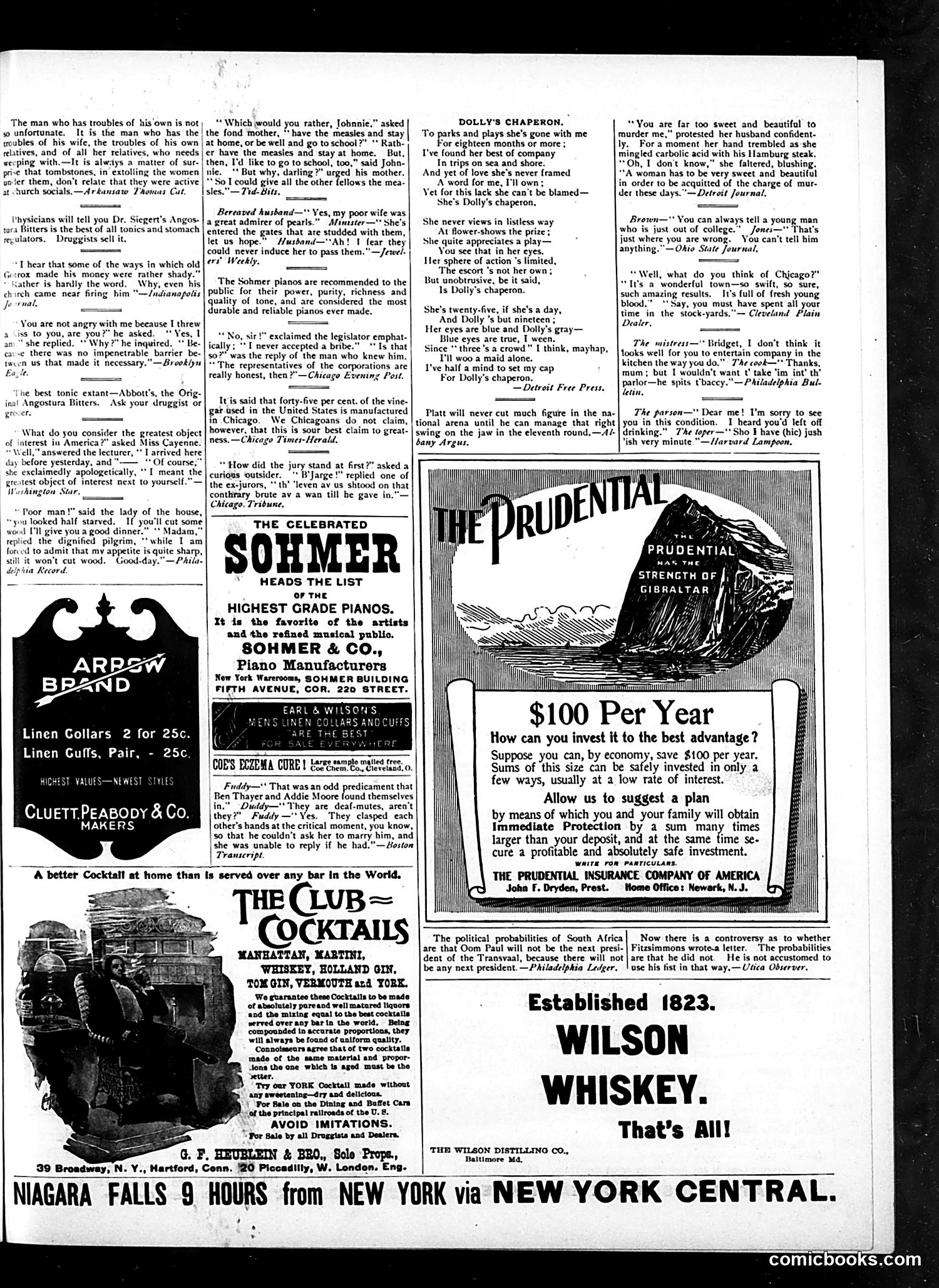
This page is primarily **advertising**, with some short humor pieces interspersed. The content consists of: **Advertisements** for products like Sohmer pianos, Arrow Brand linens, Wilson Whiskey, The Prudential Insurance Company, and various tonics and medical remedies—typical of early 20th-century magazine advertising. **Short joke pieces** scattered throughout—brief, anecdotal humor about everyday situations: a boy wanting measles to infect schoolmates, a woman who hoarded pearls, a legislator denying he took bribes, a beggar refusing to chop wood. These are generic domestic comedy sketches with no specific political or social satire. **No identifiable political cartoons or caricatures** appear on this page. The humor is situational and domesticated rather than topical. The page represents *Judge* magazine's blend of light entertainment and commercial content—not satirical commentary on current events, but rather general-interest family humor and advertising targeting early-20th-century American readers.
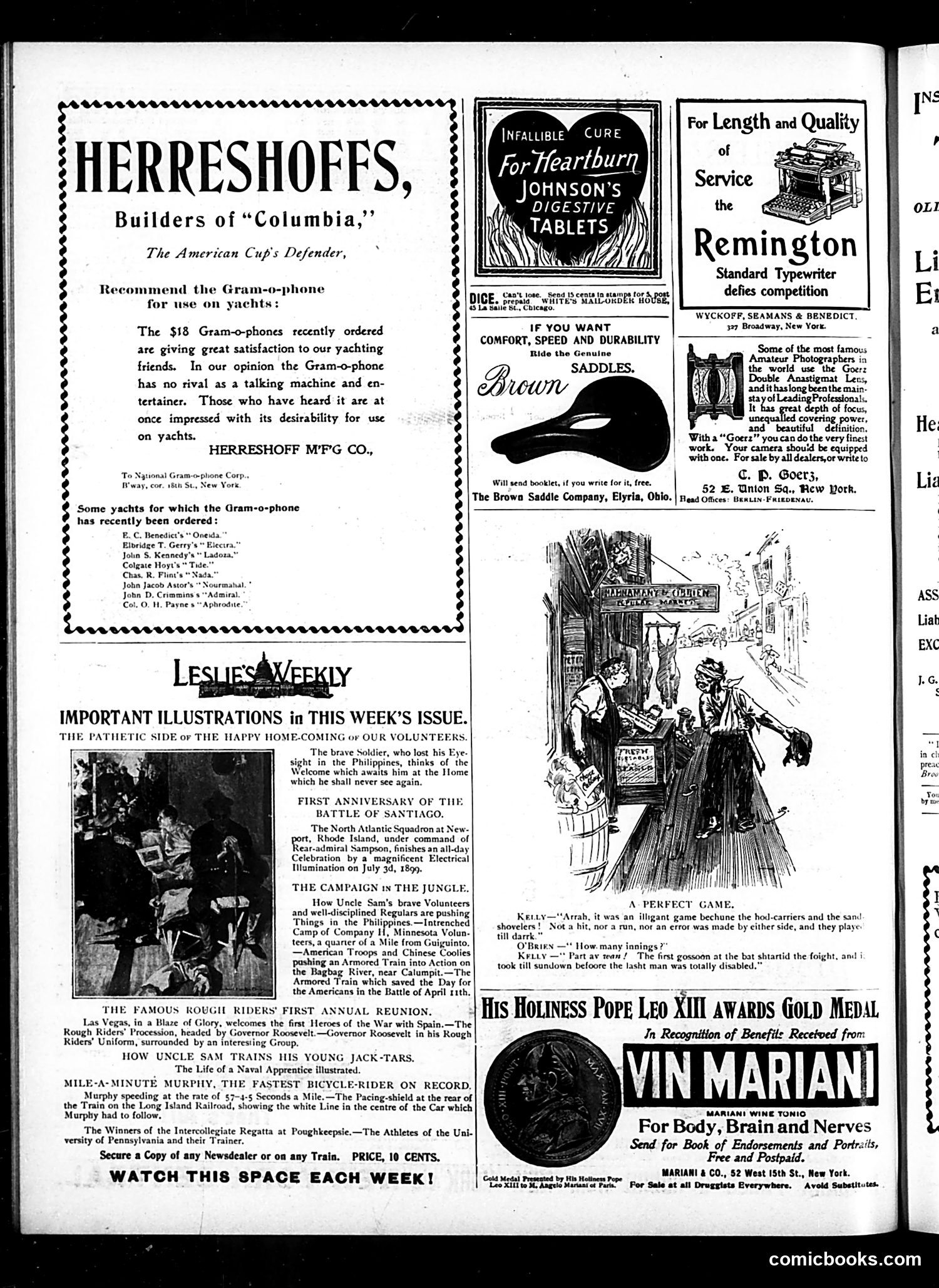
This page is primarily **advertising**, not political satire. It showcases luxury goods marketed to the wealthy elite of the era. The Herreshoff ad promotes Gram-o-phones (early phonographs) as entertainment for yachts, endorsing them through ultra-wealthy customers like John Jacob Astor and J.D. Rockefeller—establishing prestige through association with the richest Americans. The left column announces Leslie's Weekly's upcoming illustrations, focusing on the **Spanish-American War** (1898): wounded volunteers returning home, the Battle of Santiago, Philippine campaigns, and Theodore Roosevelt's Rough Riders reunion. This reflects contemporary American imperial expansion. The right side features patent medicine ads (Johnson's Digestive Tablets for heartburn), the Remington typewriter, and Brown Saddles—all positioning themselves as quality products for the affluent. The only joke appears at bottom: an ethnic Irish dialect gag about a baseball game between laborers ("hod-carriers and sand shovelers") with no hits or runs—crude working-class humor typical of period publications.
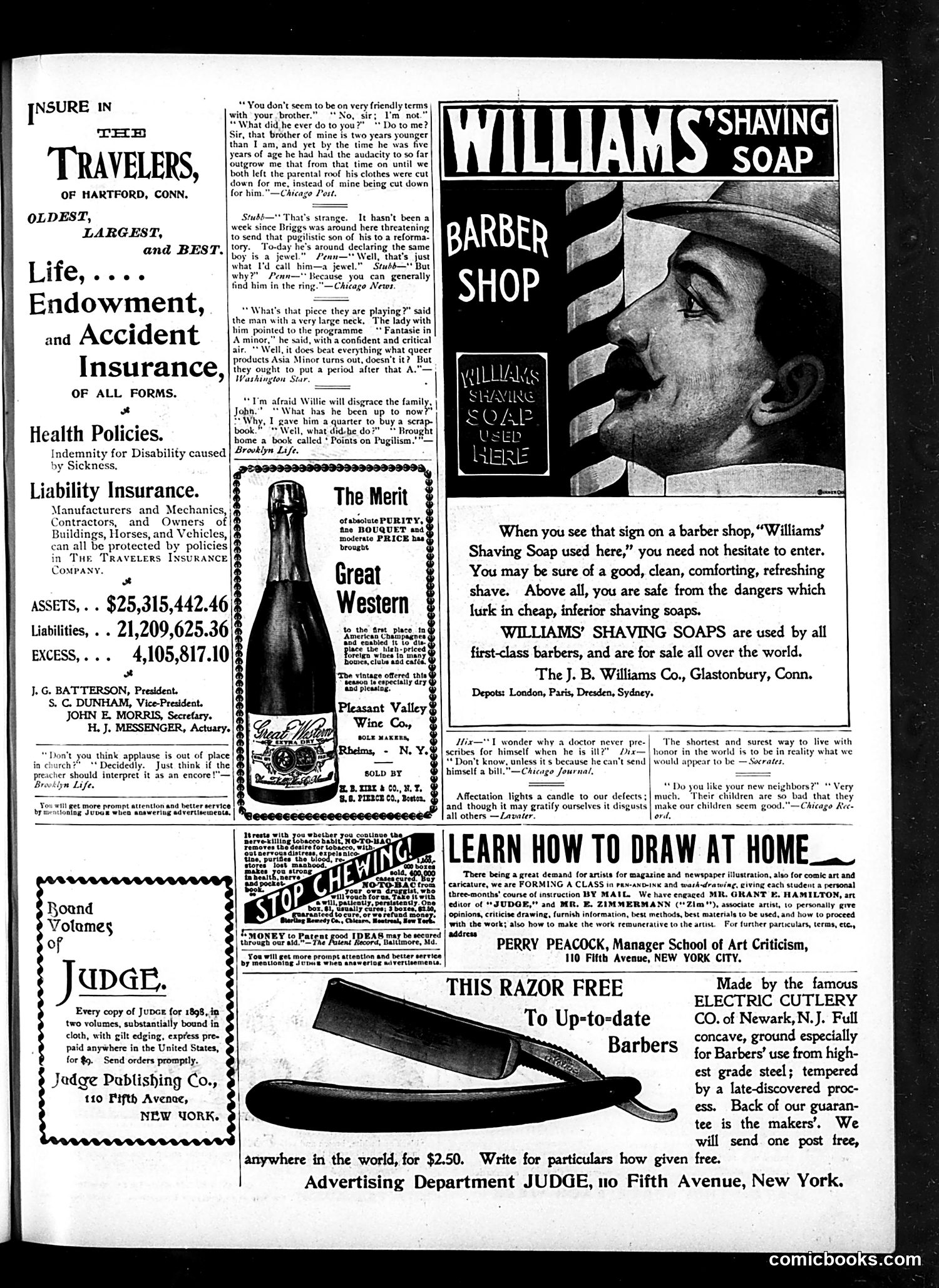
This page is primarily **advertising and filler content** rather than political satire. It consists of: **Left side**: Insurance and publishing advertisements for The Travelers Insurance Company and Judge Publishing Company's bound volumes. **Center**: Several brief humorous anecdotes (typical Judge filler material)—jokes about church applause, sibling hand-me-downs, a man's comment about "Asia Minor" producing strange things, and a father concerned his son is reading about pugilism instead of scrapbooking. These are gentle domestic humor, not political commentary. **Right side**: Full-page advertisements for Williams' Shaving Soap and a straight razor, using a barbershop sign as marketing imagery. The "Learn How to Draw at Home" ad and other commercial notices fill remaining space. There are **no identifiable political cartoons or caricatures** on this page. Judge magazine clearly devoted substantial space to advertising revenue and light domestic humor rather than satirical commentary in this particular issue.
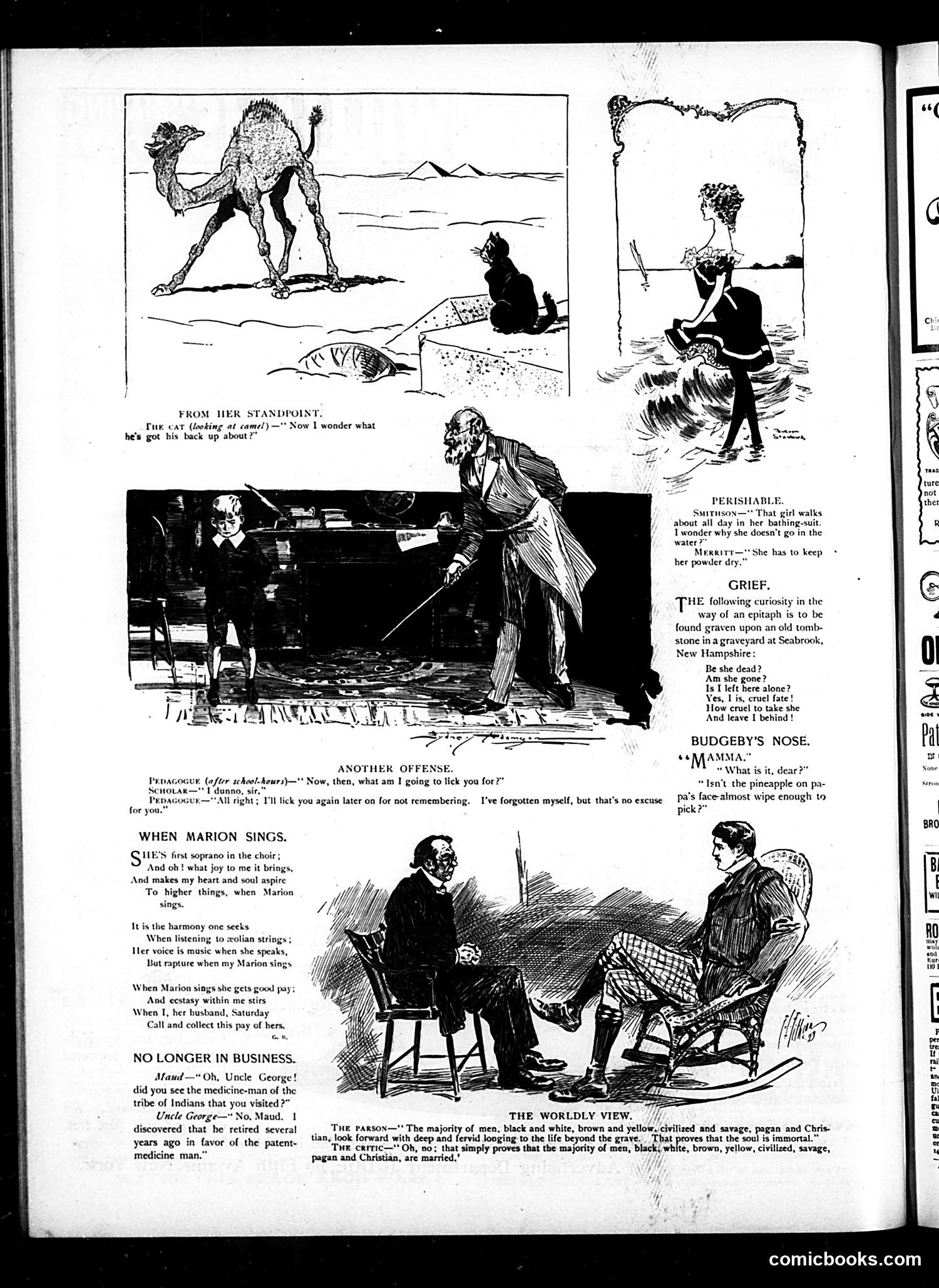
This page contains several brief satirical sketches typical of early 20th-century American humor: **"From Her Standpoint"** mocks vanity: a woman in a bathing suit won't enter the water because she needs to keep her powder dry—prioritizing appearance over the activity's purpose. **"Another Offense"** satirizes corporal punishment in schools: a teacher admits he's forgotten why he's beating a student but proceeds anyway, then punishes the child for not remembering the original offense. **"When Marion Sings"** is cynical marital humor: a husband claims to love his wife's soprano voice, but reveals his real joy is collecting her payment for singing—reducing romance to commerce. **"No Longer in Business"** jokes that a Native American medicine man retired because patent medicines undercut his practice, commenting on industrialization's impact on traditional practices. **"The Worldly View"** presents philosophical debate: one character argues belief in an afterlife proves the soul's immortality; another cynically counters that most people (especially married ones) simply want to escape their current lives. The humor relies on unexpected reversals and cynical observations about human nature.
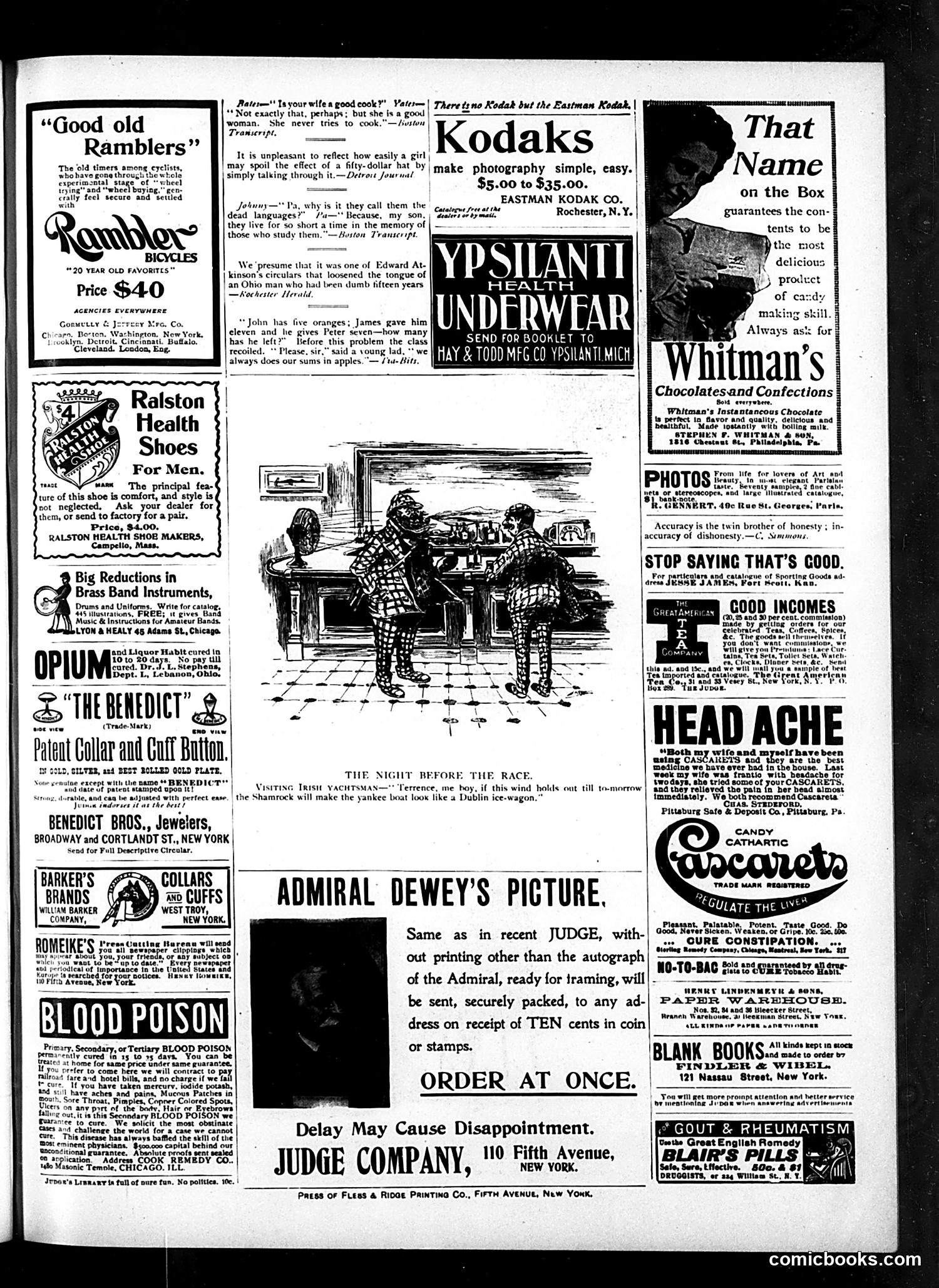
This is primarily an **advertising page** from Judge magazine with minimal editorial content. The layout showcases period advertisements for products like Ramblers bicycles, Kodak cameras, health shoes, and various patent medicines—typical of early 20th-century magazines. The one **cartoon** depicts "The Night Before the Race," showing two figures (appearing to be Irish yacht enthusiasts) discussing an upcoming race. The caption references the Shamrock, an Irish yacht, joking that if the wind holds, it will "make the yankee boat look like a Dublin ice-wagon"—a humorous prediction that the Irish vessel will vastly outperform American competition. The **satire** is mild ethnic humor about Irish-American rivalry in yacht racing, likely referencing actual America's Cup competitions of that era when Irish challengers competed against American boats. The remaining content is straightforward product advertising, including a notable patent medicine ad for "Blood Poison" cure—reflecting the era's problematic medical claims before FDA regulation.
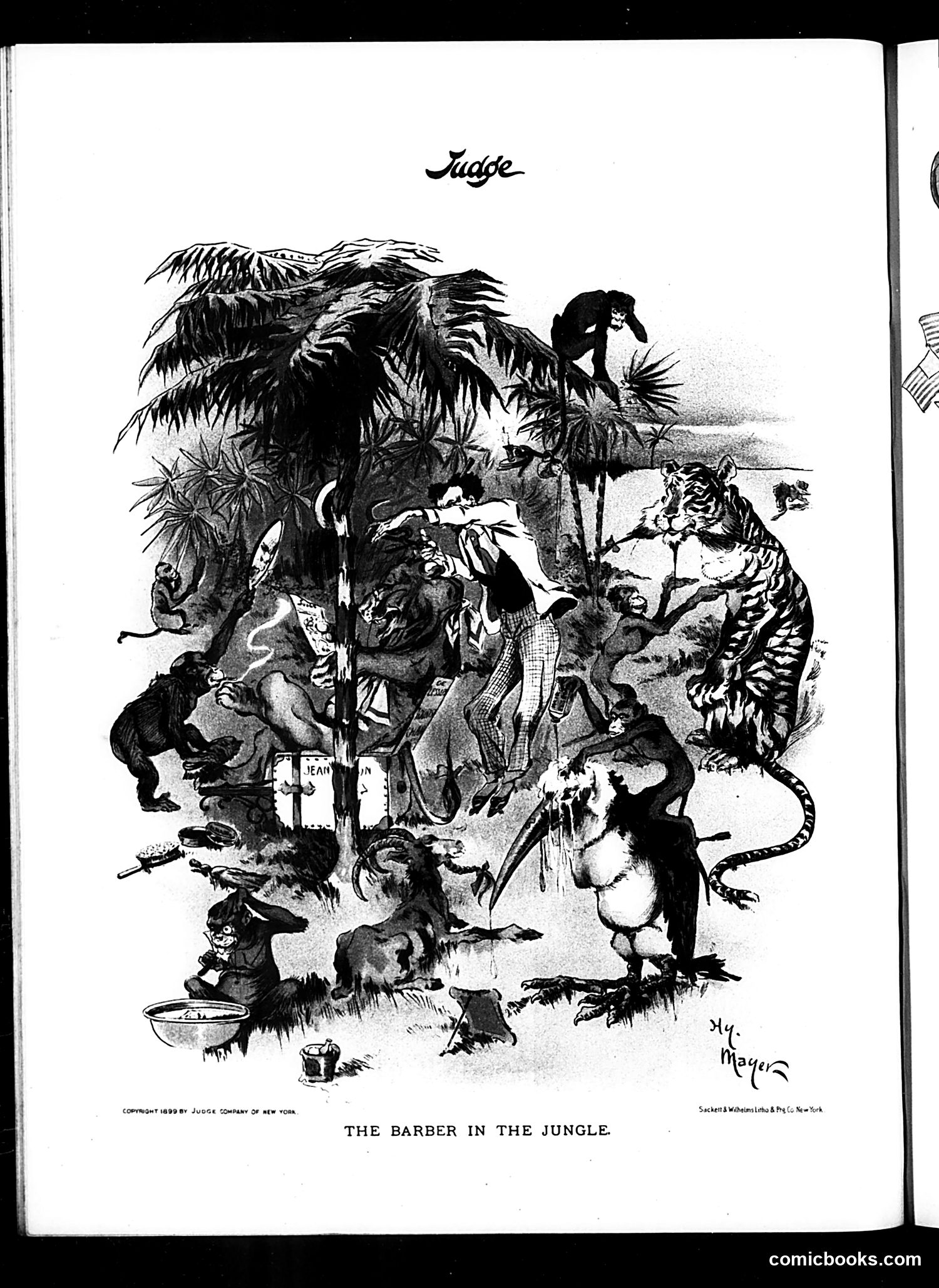
This satirical cartoon depicts a barber operating in a jungle setting surrounded by various animals—monkeys, a tiger, and other creatures—appearing to serve as his clients or audience. The scene is absurdist humor, likely satirizing either: 1. Colonial expansion into "uncivilized" territories, with the barber representing Western civilization imposing itself in inappropriate places, or 2. A commentary on attempting to bring modern urban services to primitive or wild settings. The exact political target remains unclear without additional context, but the cartoon's central joke relies on the incongruity of finding a formal barbershop operation amid jungle animals and vegetation. The artist's signature appears to be "Mayer." Judge magazine published this in 1899.