
A complete issue · 16 pages · 1899
Judge — January 14, 1899
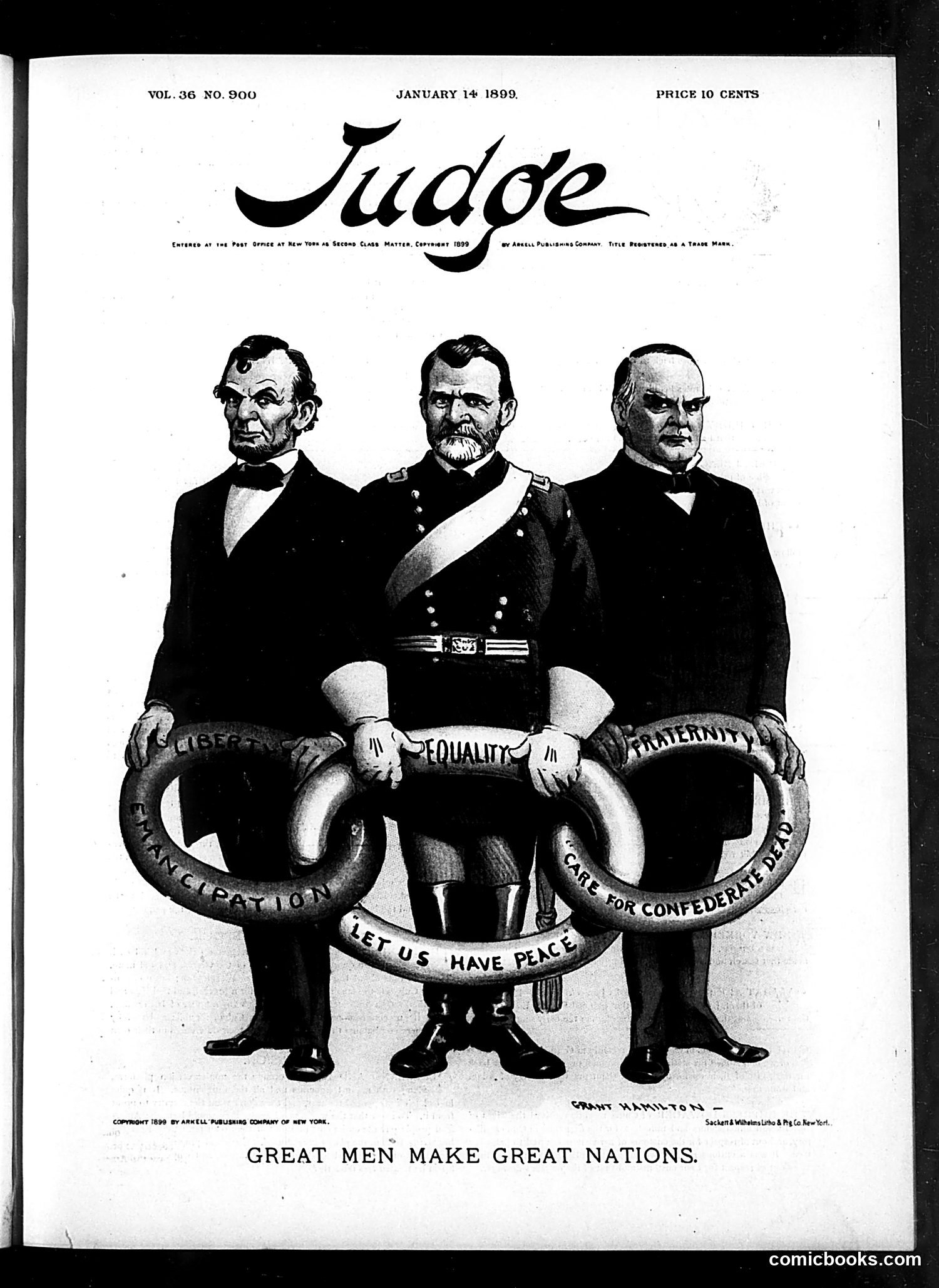
This political cartoon depicts three male figures supporting a large chain labeled "EQUALITY" with the motto "LET US HAVE PEACE" and references to "EMANCIPATION" and "CARE FOR CONFEDERATE DEAD." The center figure wears military dress with insignia, while the flanking figures wear civilian suits. The caption states "GREAT MEN MAKE GREAT NATIONS." The imagery appears to address post-Civil War reconciliation between North and South, circa 1899. The chain symbolizes unified principles of equality and peace. The mixed military-civilian representation likely represents different power structures or factions supporting this reconciliation agenda. However, specific identities of the three figures remain unclear from the image alone. The cartoon's satirical intent—whether supporting or criticizing this reconciliation effort—is also ambiguous without additional context.
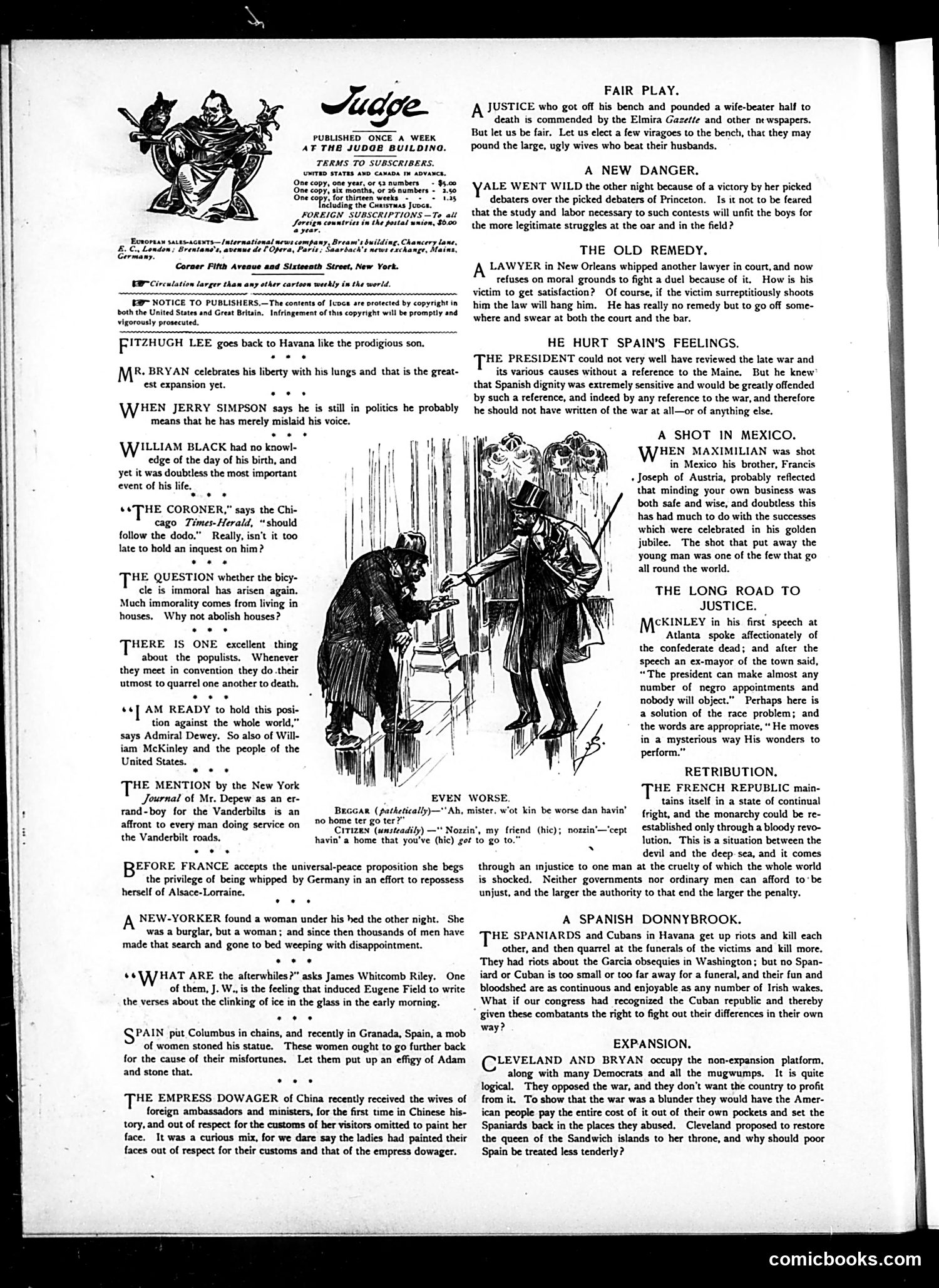
The central cartoon depicts two figures in what appears to be a confrontation at a doorway—likely a political or social commentary on a contemporary dispute. The sketch style and dramatic poses suggest conflict or accusation. The surrounding editorial text addresses multiple topics: "Fair Play" discusses wife-beating; "A New Danger" references Yale debates; "The Old Remedy" concerns a New Orleans lawyer and dueling; "A Shot in Mexico" comments on Maximilian's execution; and sections on Spanish-Cuban relations, French republicanism, and Cleveland's expansion platform. Without clearer identification of specific figures or dated references in the visible text, the exact political targets remain unclear, though the page reflects Judge's typical satirical approach to contemporary American politics, international affairs, and social issues of its era.
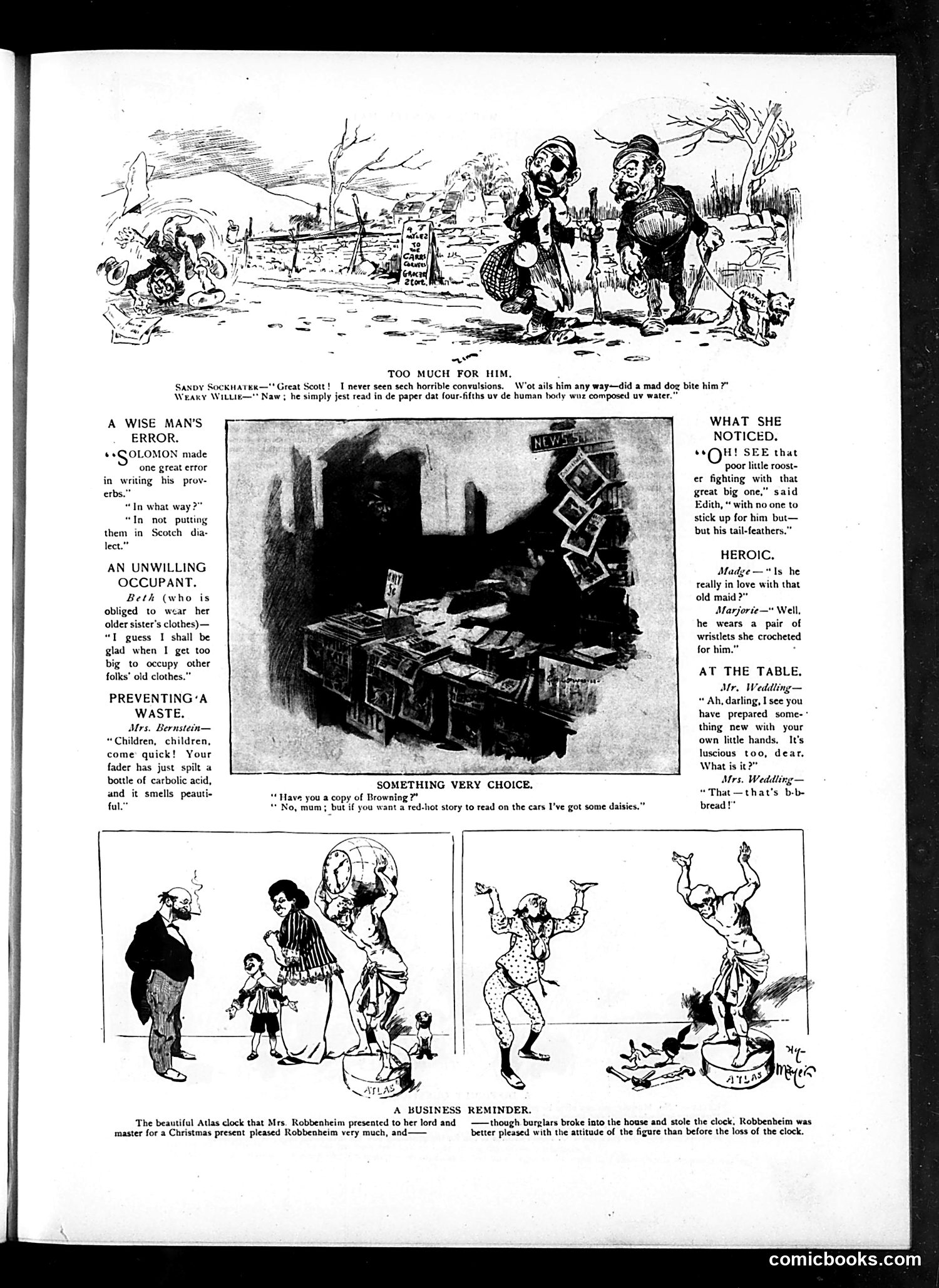
This page contains multiple unrelated satirical sketches and humorous anecdotes typical of Judge magazine's format. The top cartoon "Too Much for Him" depicts two shabby characters (Sandy Sockhater and Weary Willie) discussing a man's physical decomposition, suggesting he was "composed of water"—dark humor about human mortality. The middle photograph titled "Something Very Choice" shows a woman with papers, captioned about reading stories to cats. The bottom cartoons include domestic scenes: "A Business Reminder" depicts burglars stealing a clock from a house, with the owner oddly pleased because he'd disliked the gift anyway. The scattered text boxes contain brief jokes about Scottish dialect, wasting children's clothes, and romantic misunderstandings at dinner tables. Overall, this represents typical Judge humor: cynical, class-conscious satire mixing wordplay, domestic comedy, and social observation without clear political messaging.
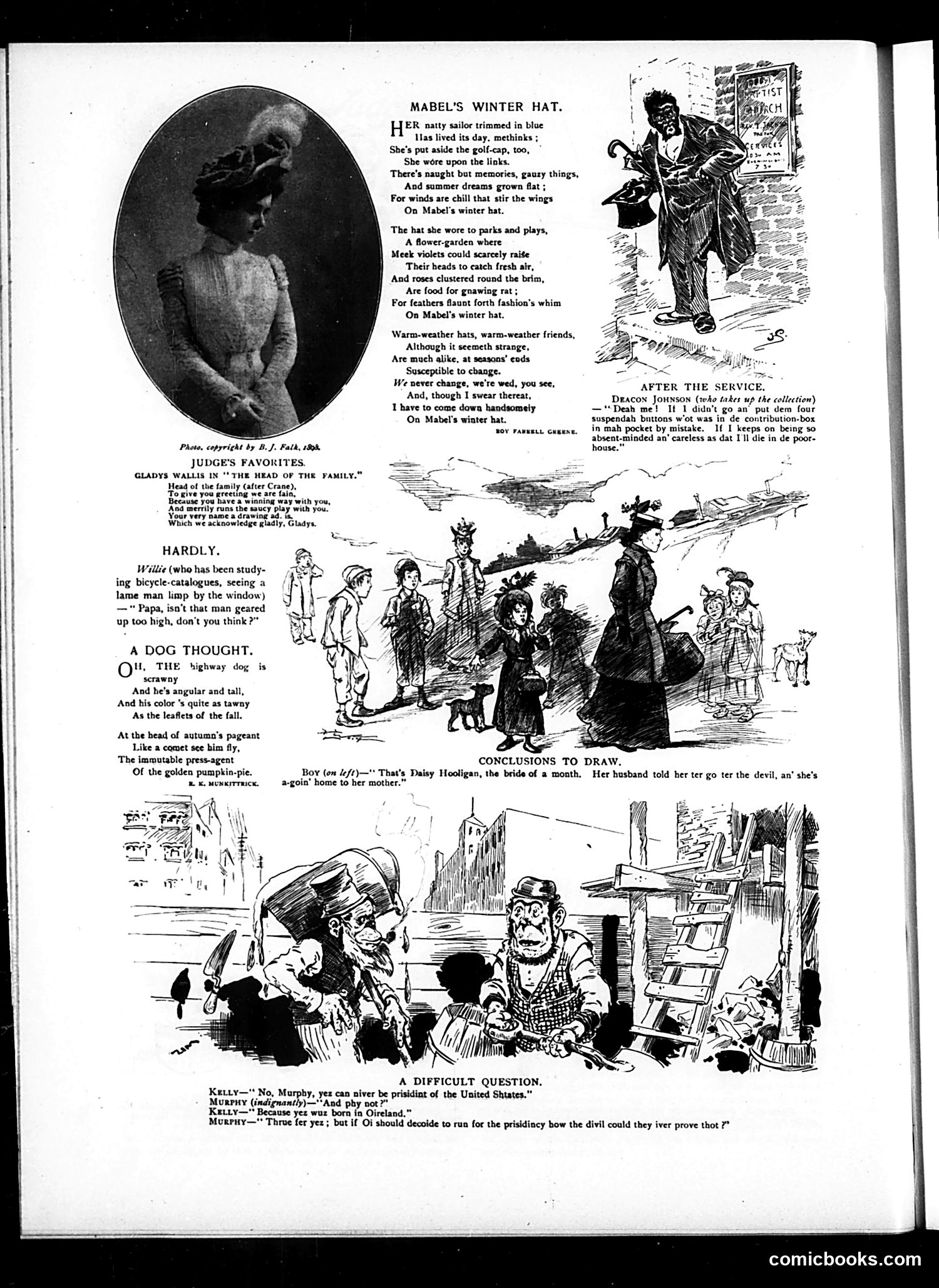
This page contains literary and humorous content rather than political satire. "Mabel's Winter Hat" is a poem by Farrell Conan about a woman's attachment to a treasured hat worn during romances and social occasions. "Hardly" and "A Dog Thought" are additional poems by other authors. The visual cartoons are social humor rather than political commentary. "After the Service" depicts a deacon making excuses to avoid visiting a parishioner. "Conclusions to Draw" shows a boy spreading gossip about newlyweds. "A Difficult Question" features two Irish characters (likely "Murphy" and "Kelly" based on stereotypical naming) debating Irish political leadership—possibly referencing Irish independence debates, though specifics remain unclear without dating information. The overall page emphasizes lifestyle humor and wordplay typical of Judge's satirical approach.
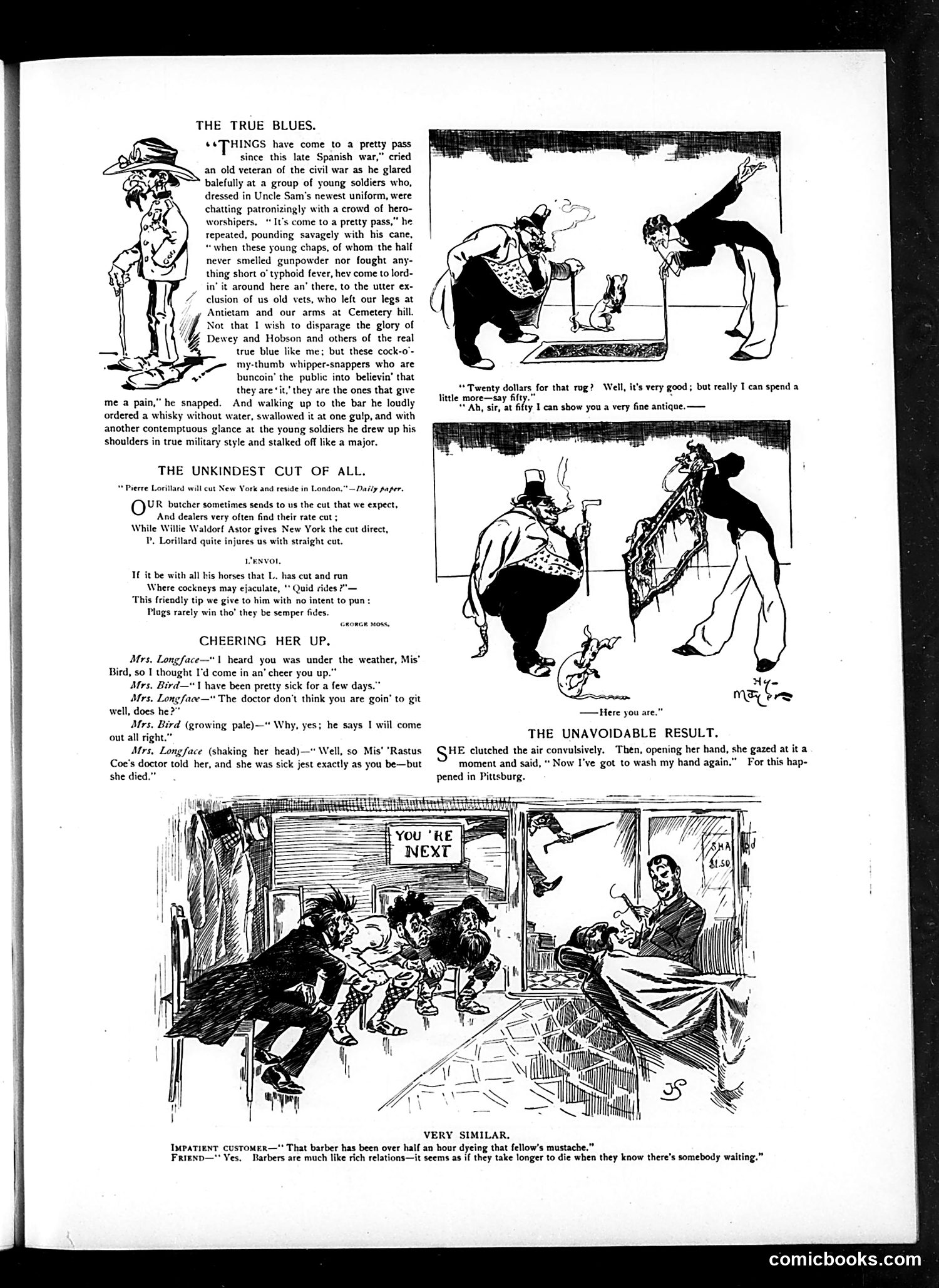
This page contains multiple satirical pieces from the Spanish-American War era (circa 1898): **"The True Blues"**: A Civil War veteran complains that young Spanish-American War soldiers are receiving undeserved glory despite minimal combat experience (some never saw gunpowder, only typhoid). He contrasts them with "real" heroes like Dewey and Hobson, resenting their celebrity status. **"The Unkindest Cut of All"**: Mocks wealthy industrialist Pierre Lorillard for relocating to London, abandoning New York. The poem plays on "cut" meanings—a butcher's cut, social snubbing, and financial loss—suggesting his departure damages the city. **"Cheering Her Up"**: Dark humor about an insensitive visitor who cheerlessly reminds a recovering woman that her doctor's optimism meant nothing when another patient died. **"The Unavoidable Result"**: A woman's hand gets dirty negotiating over an antique rug price, forcing her to wash up—implying haggling is inherently "dirty." **"Very Similar"**: A joke equating barbers' slow service with the delayed deaths of wealthy relatives when people are watching. The page showcases Judge's signature blend of social commentary and cynical humor.
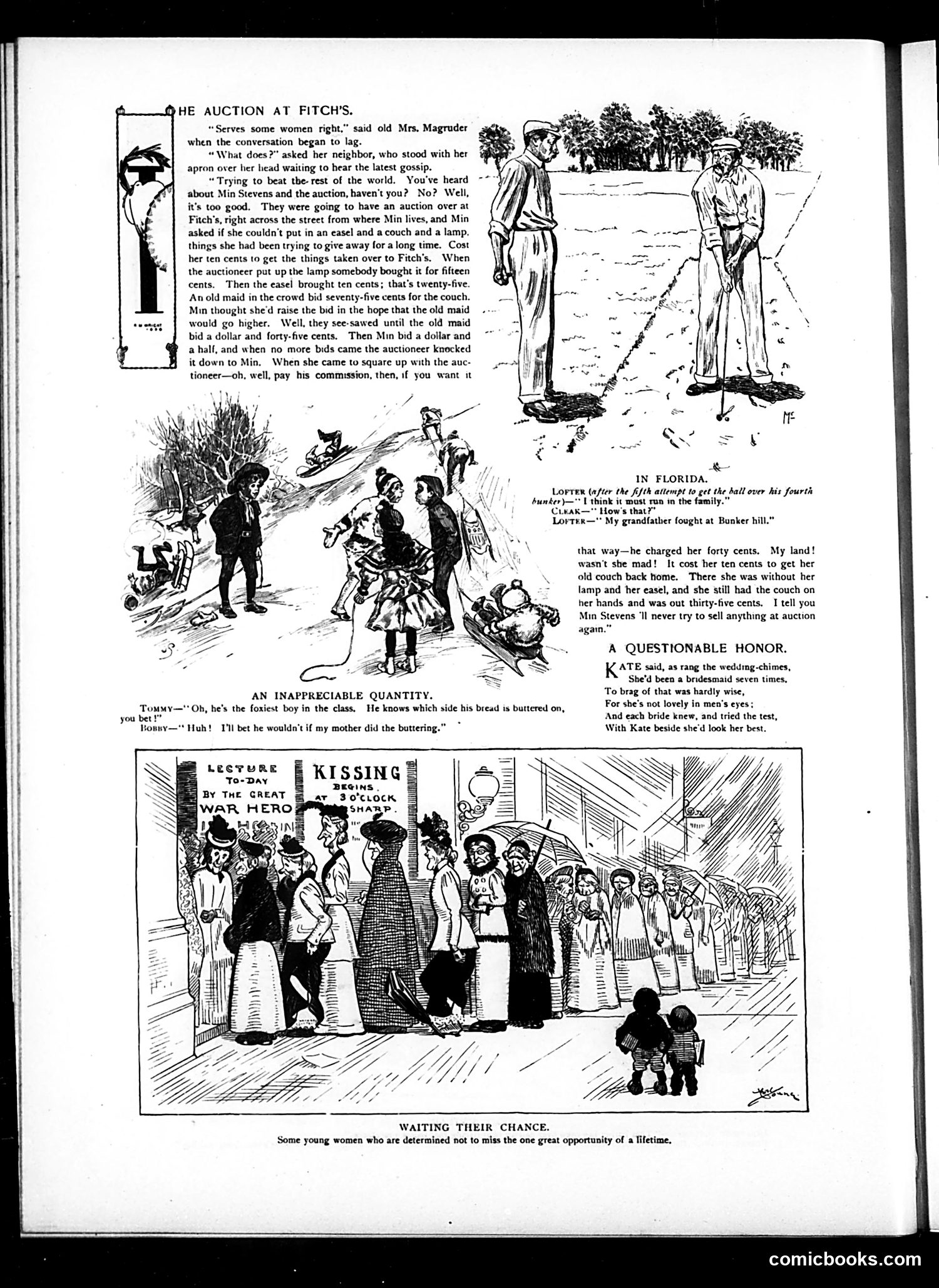
This page contains multiple humor pieces typical of early 20th-century American satirical magazines: **"The Auction at Fitch's"** mocks a woman (Min Stevens) who attempts to profit by consigning unwanted items to an auction, only to end up paying more in commissions than the items sell for—ultimately buying back her own couch at a loss. The satire targets vanity and failed schemes to appear thrifty. **"An Inappreciable Quantity"** jokes about a serial bridesmaid (Kate) who has been in seven weddings. The satire suggests she's unmarriageable herself, serving primarily as a decorative "improvement" to other brides' appearances. **"Kissing Begins at 3 O'Clock"** depicts women gathering to attend a lecture, with the caption suggesting they're primarily motivated by romantic opportunity rather than intellectual interest. **"In Florida"** appears to be a brief golf anecdote. The overall tone reflects period attitudes toward women's economic incompetence, marriageability anxiety, and superficiality—common Judge magazine stereotypes targeting middle-class female behavior.
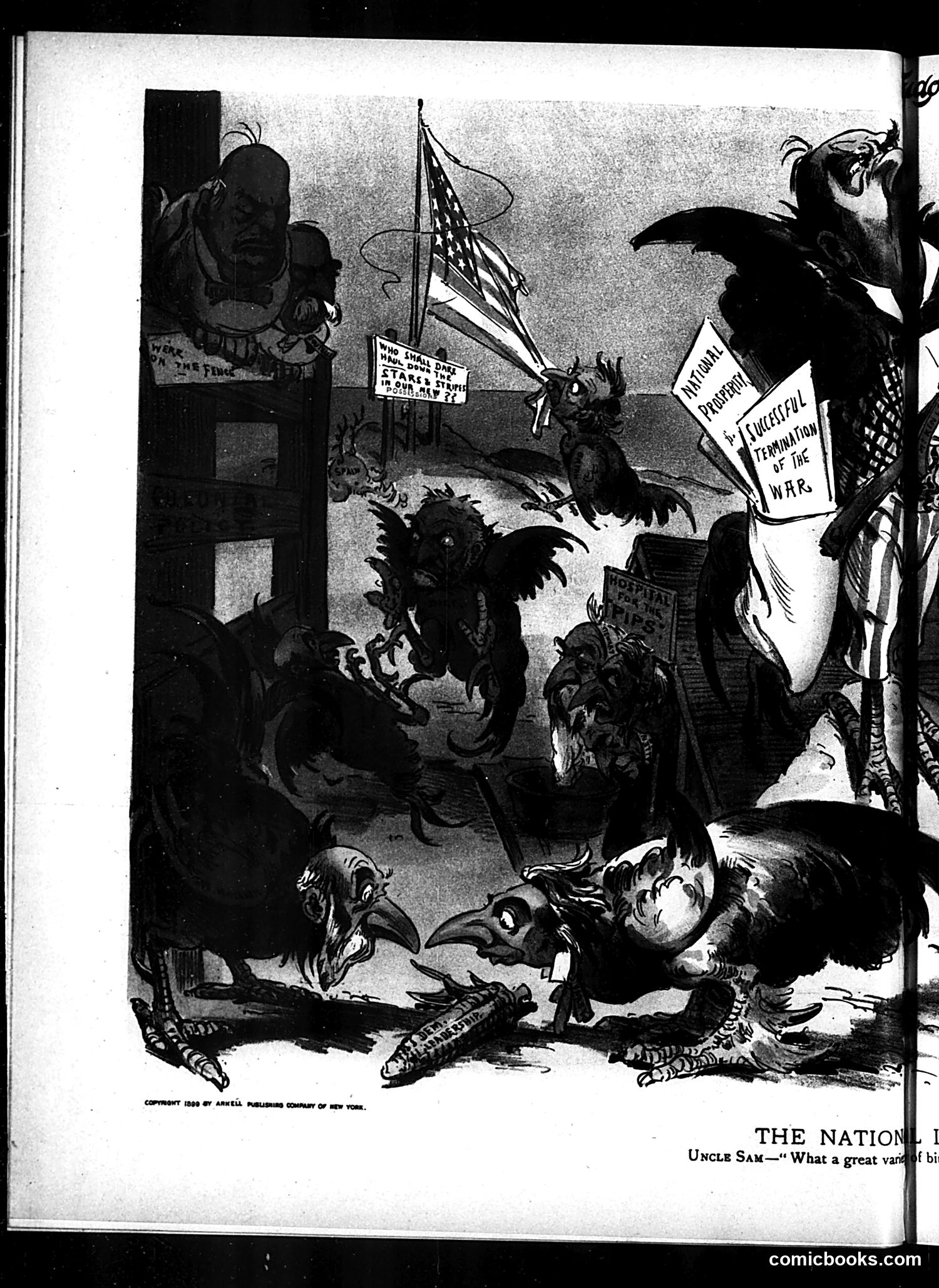
This is a satirical cartoon from *Judge* magazine showing Uncle Sam (the bearded American figure in top hat, left) observing a chaotic scene of demonic or monstrous creatures around an American flag. The monsters appear to represent internal threats or social problems. One creature carries a sign reading "VITAL PROPERTY" and "SUCCESSFUL TERMINATION OF THE W.A.R." (likely referring to WWI), suggesting criticism of wartime profiteering or corruption. The cartoon's message appears to be that while America emerged from war, internal "demons"—possibly corruption, greed, or social decay—threaten the nation from within. Uncle Sam's contemplative expression suggests concern about these domestic dangers lurking beneath patriotic surface. The exact date and specific historical references remain unclear from the visible text.
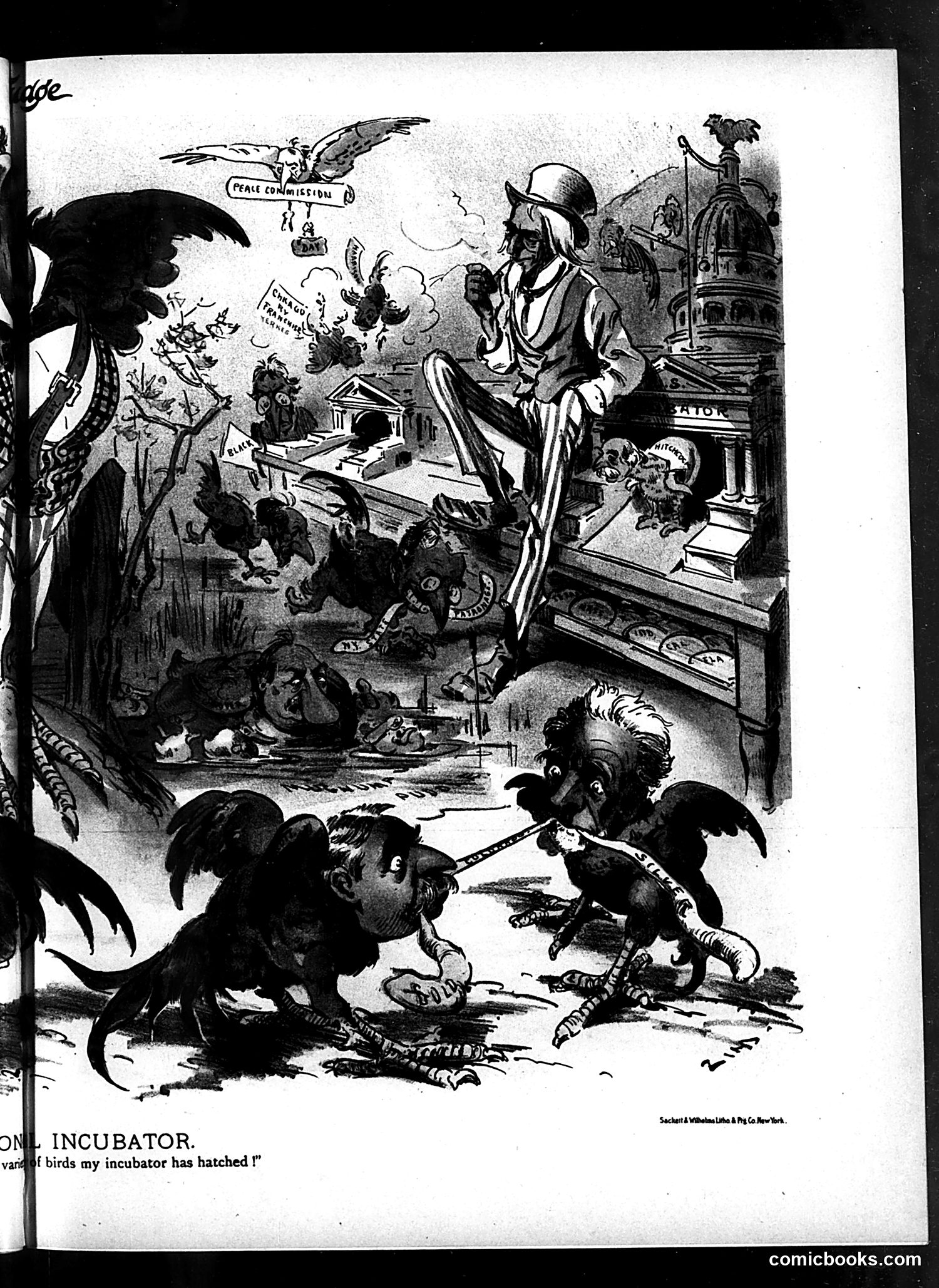
This satirical cartoon depicts a gentleman in a bowler hat presiding over various demonic or grotesque bird-like creatures emerging from an incubator. The imagery suggests he has "hatched" something undesirable or monstrous. The cartoon likely satirizes a political figure or policy that has produced negative consequences—the incubator serving as metaphor for a scheme or institution. The demons/birds represent the corrupt or harmful results of this "hatching." A dove labeled "PEACE COMMISSION" appears above, suggesting the cartoon critiques failed peacekeeping efforts or diplomatic initiatives that instead produced chaos or corruption. Without a visible date or clearer identification of the specific figure, the exact historical reference remains unclear, though the style and Judge magazine's typical focus suggests late 19th or early 20th-century American politics.
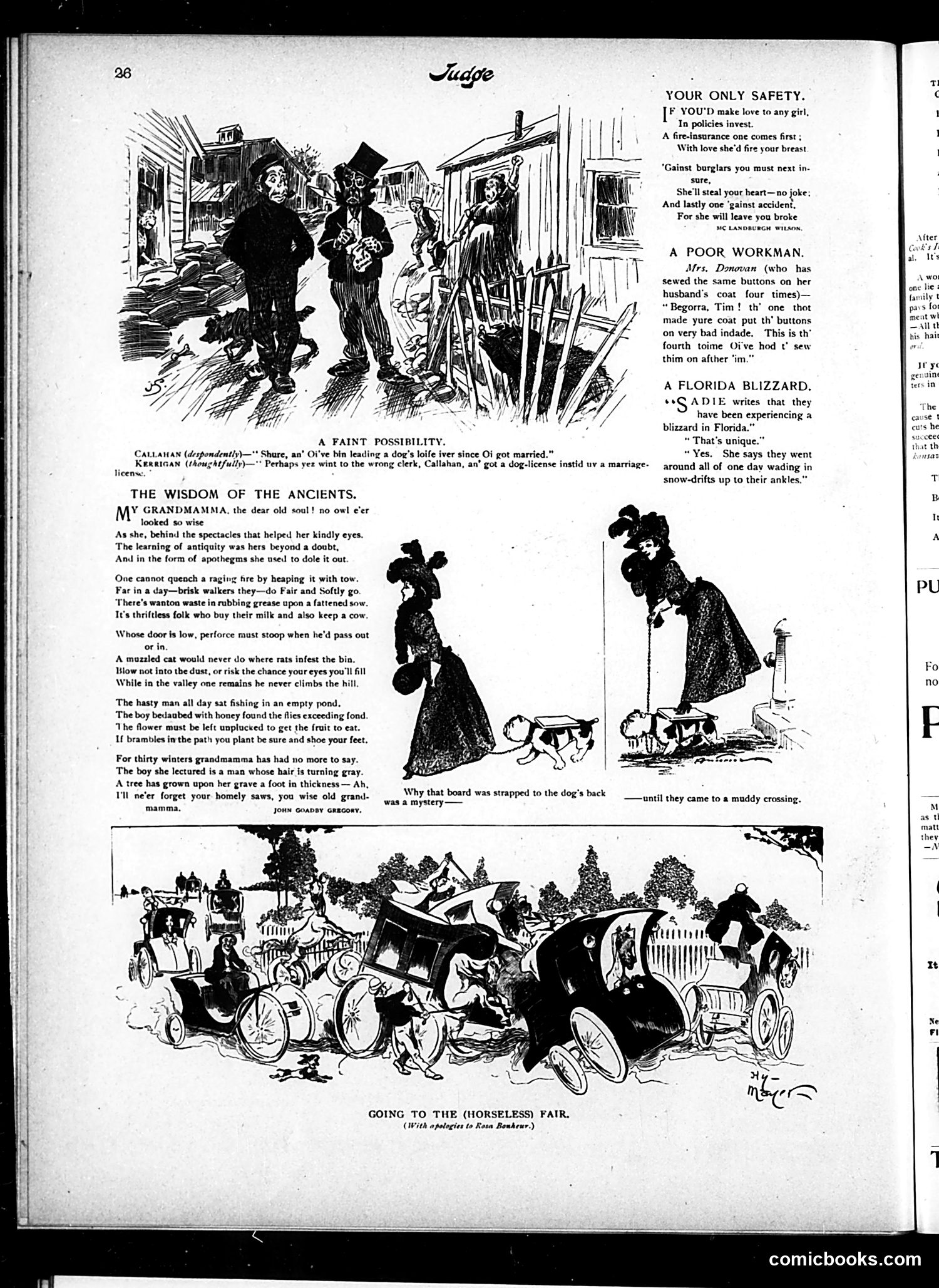
This page contains several satirical pieces targeting early 20th-century American life: **"Your Only Safety"** mocks courtship by comparing a woman to insurable hazards—fire, burglary, accidents—suggesting romantic relationships financially ruin men. **"A Poor Workman"** presents an Irish immigrant couple (characterized by dialect) complaining about cheap tailoring, satirizing working-class struggles and shoddy craftsmanship. **"A Florida Blizzard"** jokes that snow in Florida is so rare it's newsworthy—poking fun at regional exceptionalism. **"A Faint Possibility"** uses Irish dialect humor: a man married by dog-license instead of marriage-license, reversing the ironic complaint about losing freedom. **"The Wisdom of the Ancients"** presents folksy proverbs attributed to a grandmother, likely satirizing sentimentalized nostalgia for rural/old-fashioned wisdom. **"Going to the (Horseless) Fair"** depicts chaotic early automobiles at a fair, satirizing the novelty and unpredictability of automobiles replacing horse-drawn transport. The page emphasizes class humor, immigrant stereotypes (Irish dialect), and modern anxieties about technology and relationships.
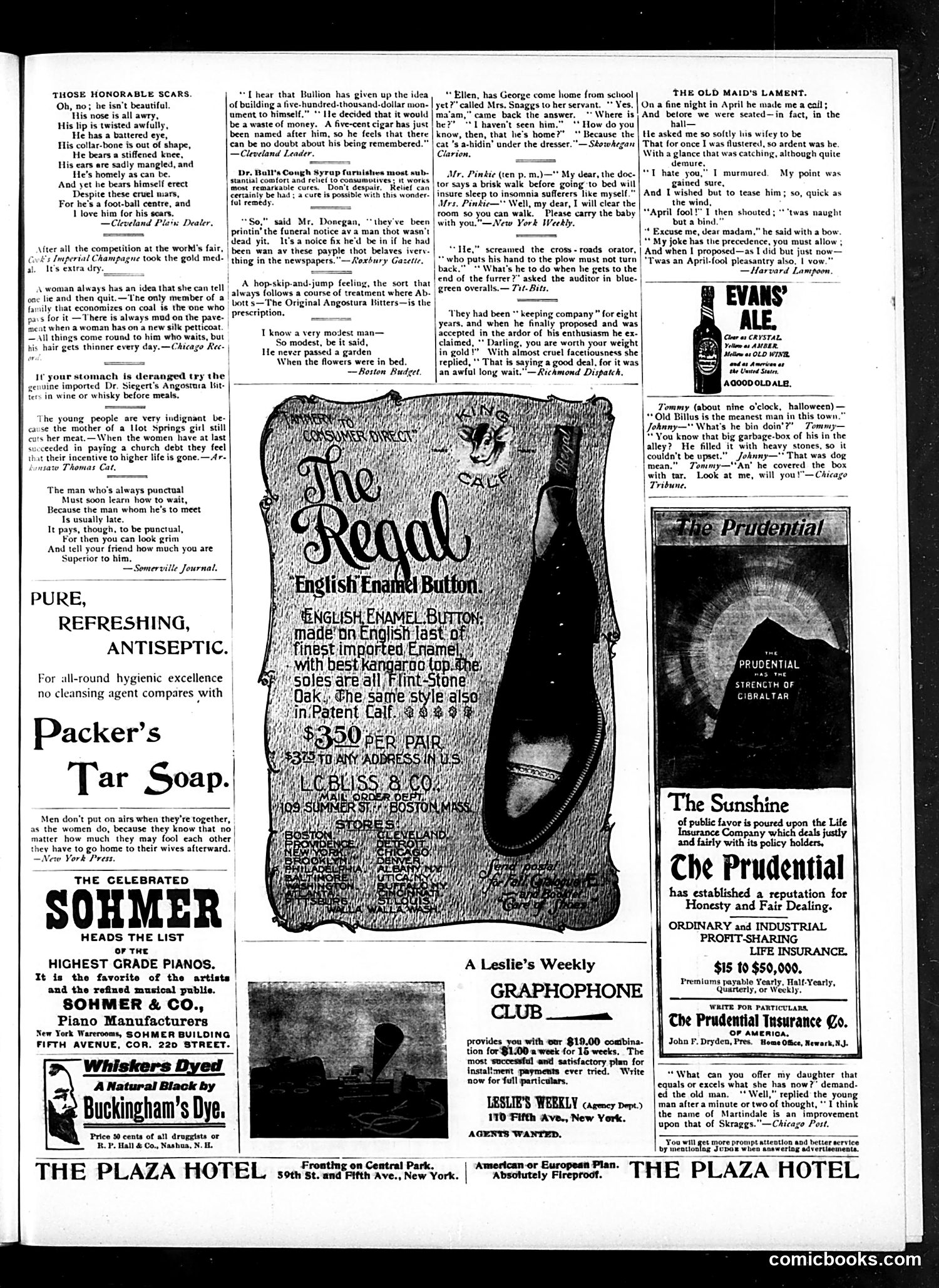
This page from Judge magazine contains miscellaneous short humorous items typical of early 20th-century American satirical publications. Rather than a single cartoon, it features: **Multiple brief jokes and quips** about everyday life—men versus women's behavior, punctuality, domestic situations—reflecting contemporary gender stereotypes common to the era. **One notable illustrated item**: "The Regal English Enamel Button" advertisement showing a shoe, integrated as part of the editorial content (common practice then). **The football poem "Those Honorable Scars"** celebrates an injured football player's dignity despite disfigurement—reflecting the era's complicated attitudes toward sports and masculinity. **Advertising dominates**: Sohmer pianos, Packer's Tar Soap, Buckingham's Dye, and various patent medicines occupy significant space, typical of Judge's revenue model. The humor relies on period-specific assumptions about gender roles, class, and social propriety now largely obsolete. No specific political figures or events are satirized on this particular page.
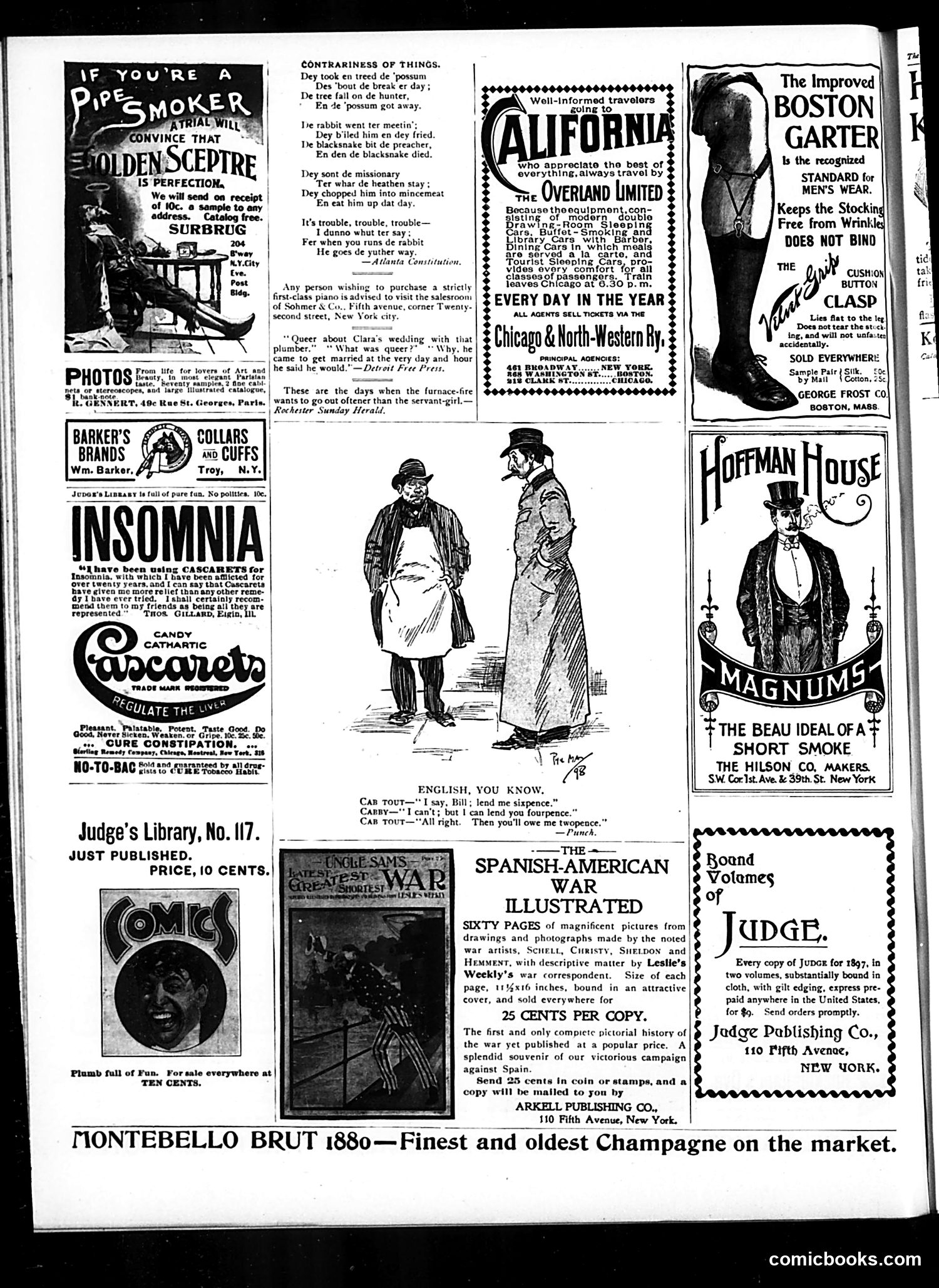
This page is primarily **advertisements and filler material** rather than political satire. The main comic content is minimal: **"English, You Know"** (center) is a brief joke from *Punch* magazine playing on mathematical confusion: a character borrows fourpence instead of sixpence, then claims the lender "owes" him twopence—absurd logic presented as an "English" quirk. **"Contrariness of Things"** (upper left) is a humorous poem from the *Atlanta Constitution* using rural/dialect language to describe ironic outcomes (hunter killed by falling tree, missionary chopped up). This reflects turn-of-the-century "comic dialect" humor treating rural or Black Southern speech as inherently funny. The page is otherwise dominated by **period product advertisements** (digestive aids, collars, garters, cigars, champagne) and promotional content for Judge's sister publications and the Spanish-American War illustrated book (25 cents)—typical magazine filler of the 1890s. No significant political figures or events are referenced or satirized on this particular page.
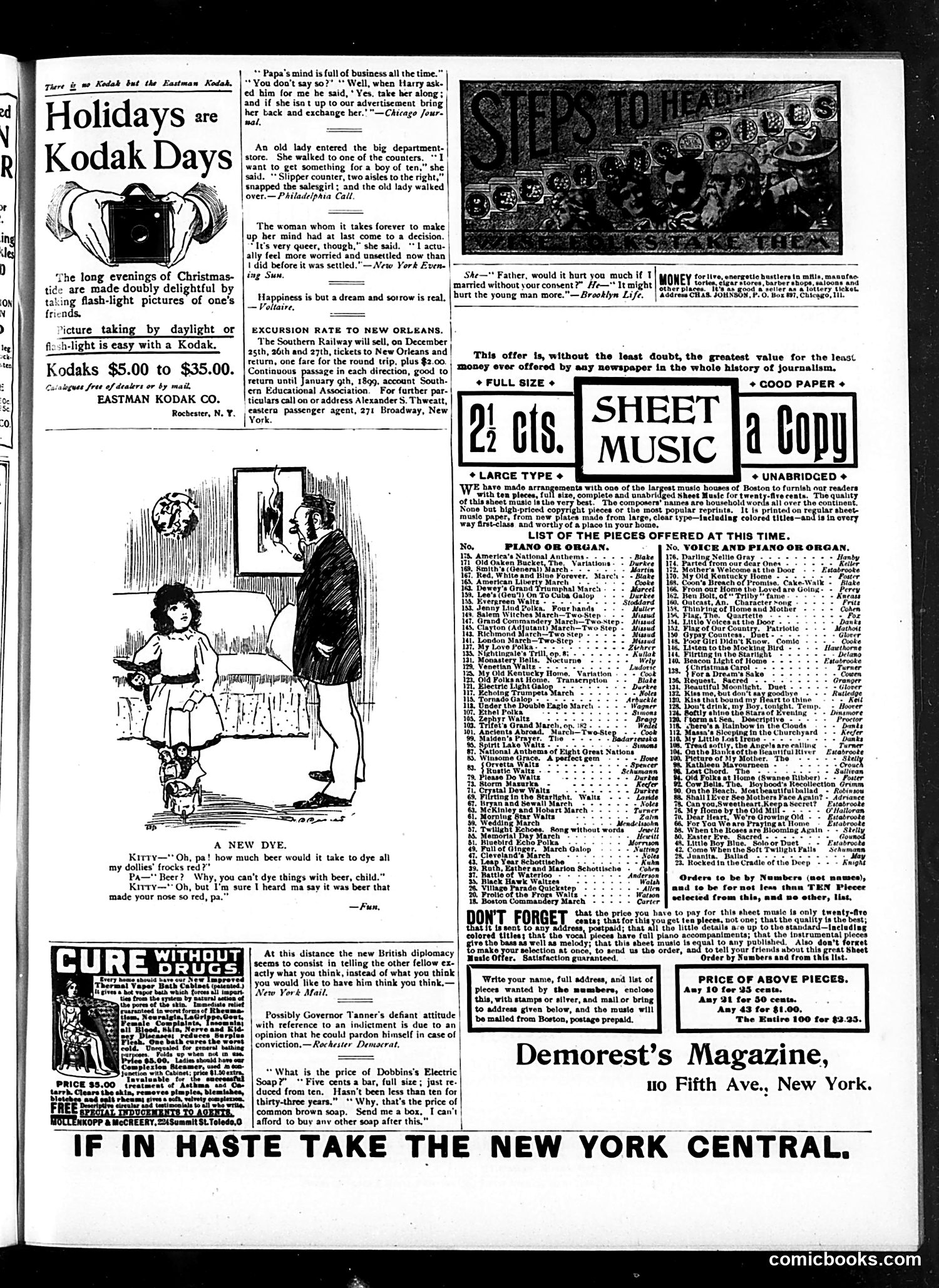
This is primarily an **advertising page** from Judge magazine, dominated by commercial promotions rather than political cartoons. The visible satirical content includes brief humor snippets: 1. **"A New Dye"** cartoon: A child asks her father if beer could dye dolls' clothes red, recalling that beer made his nose red. The joke relies on the father's implied alcoholism—a common temperance-era jab. 2. **Governor Tanner reference**: A brief political jab suggesting Illinois Governor Tanner might pardon himself if convicted—commentary on executive power abuse. 3. **Quotes and one-liners** satirize everyday absurdities: businessmen ignoring their engaged daughters, women unable to make decisions, and dubious product claims (Dobbin's soap). **The page's real focus**: massive advertisements for **Kodak cameras**, **sheet music** (2.5 cents per copy), and other consumer goods. The sheet music offer is pitched as "the greatest value for the least money ever offered by any newspaper"—clearly hyperbolic advertising copy meant humorously. This reflects Judge's business model: satirical commentary mixed with lucrative advertisements targeting middle-class consumers.
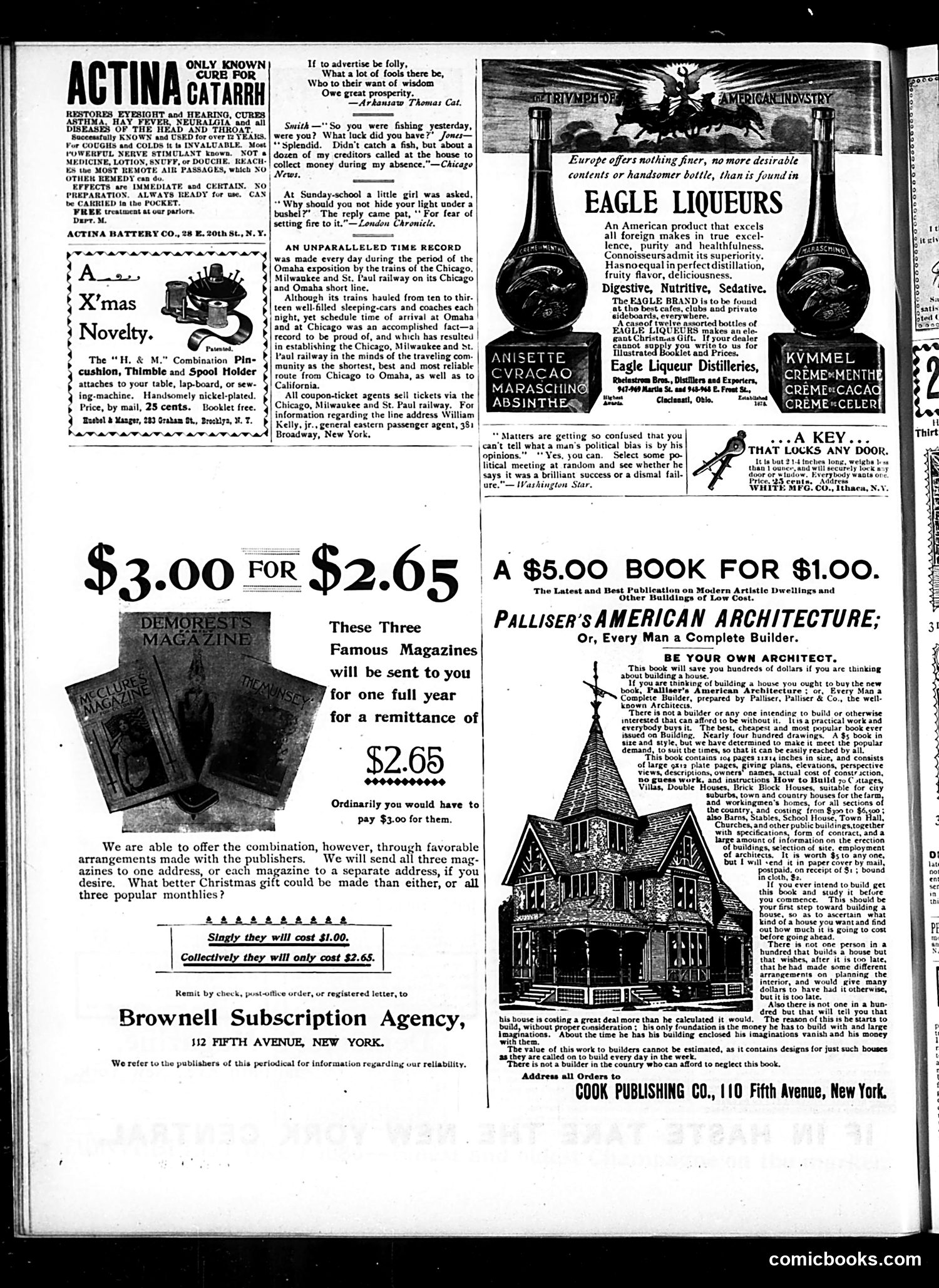
This page is primarily **advertising and promotional material** rather than editorial satire or political cartoons. The content consists of: **Main advertisements:** - Medical quack remedies (Actina Battery claiming to cure deafness, asthma, neuralgia) - Sewing notions and household goods - Magazine subscription offers (3 publications for $2.65 instead of $3.00) - Liqueur advertisements (Eagle brand and others) - An architectural pattern book ("Be Your Own Architect") **Minimal editorial content:** The few short jokes/sayings scattered throughout are generic humor typical of the era—mild observations about fishing, creditors, and Sunday school—with no identifiable political figures or satirical targets. **Historical context:** The page reflects **late 19th/early 20th-century advertising standards**, including dubious medical claims that would be illegal today. The prominence of patent medicines and unregulated products is notable. This appears to be a **filler/revenue page** rather than Judge's core satirical content, demonstrating how magazines monetized space through advertising.
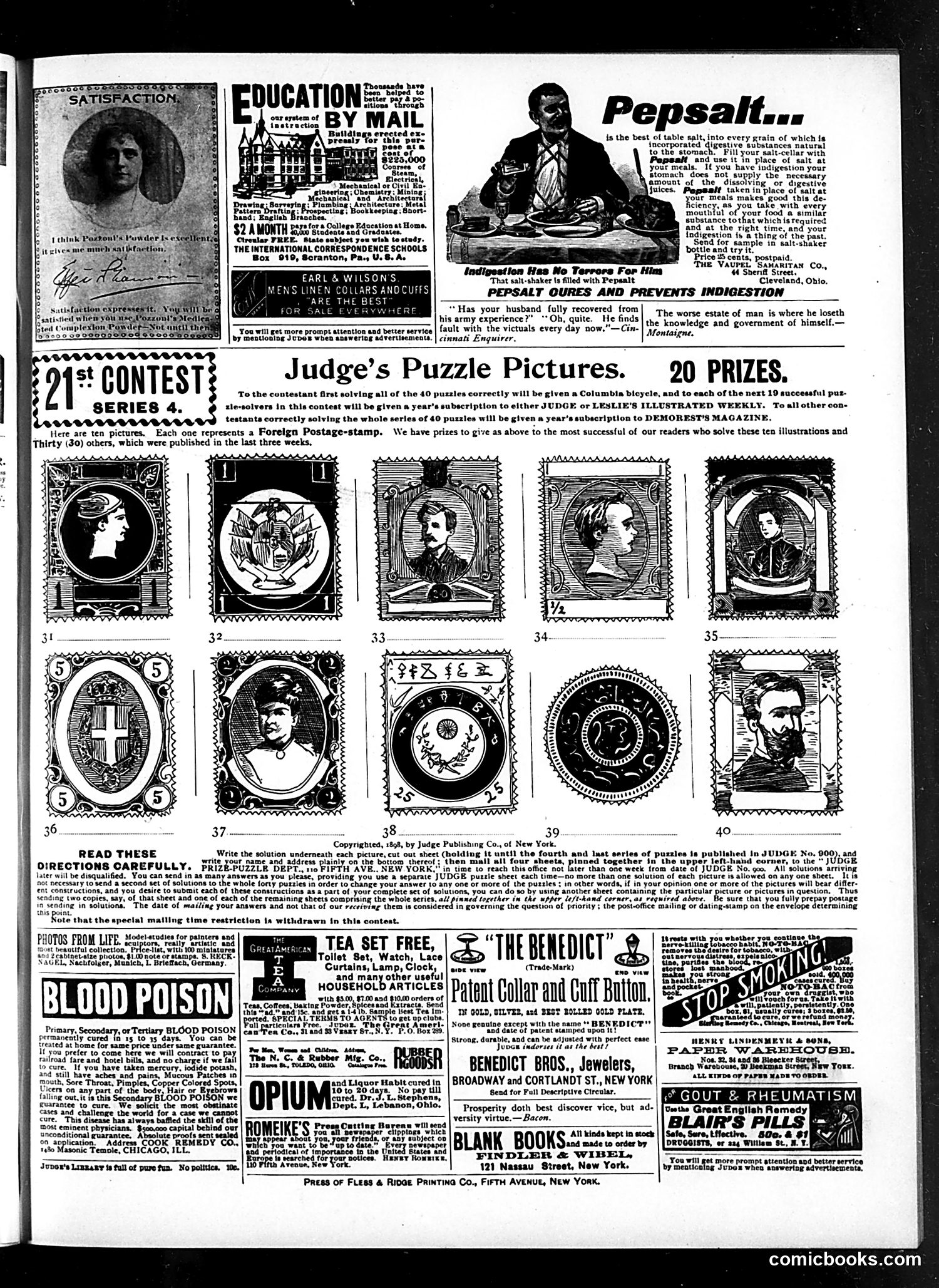
This page is primarily **advertising and contest material** rather than political satire. The main content features: 1. **"Judge's Puzzle Pictures" Contest (Series 4)**: A puzzle competition where readers identify 40 foreign postage stamps from illustrations. Winners receive a Columbia bicycle or magazine subscriptions. This was a common reader-engagement strategy for magazines of this era. 2. **Product Advertisements**: Multiple patent medicine and household product ads typical of 1890s magazines, including: - "Pepsalt" (a digestive salt claiming to prevent indigestion) - Earl & Wilson collars - Blood Poison cure - Opium treatment - Various other products 3. **Testimonial snippets**: Small humorous quotes, like one about a husband complaining about food post-military service, using product endorsement as framing. The page reflects **late 19th-century advertising practices**—heavy reliance on patent medicine claims and reader contests as circulation boosters. There is no significant political cartoon or social satire visible here.
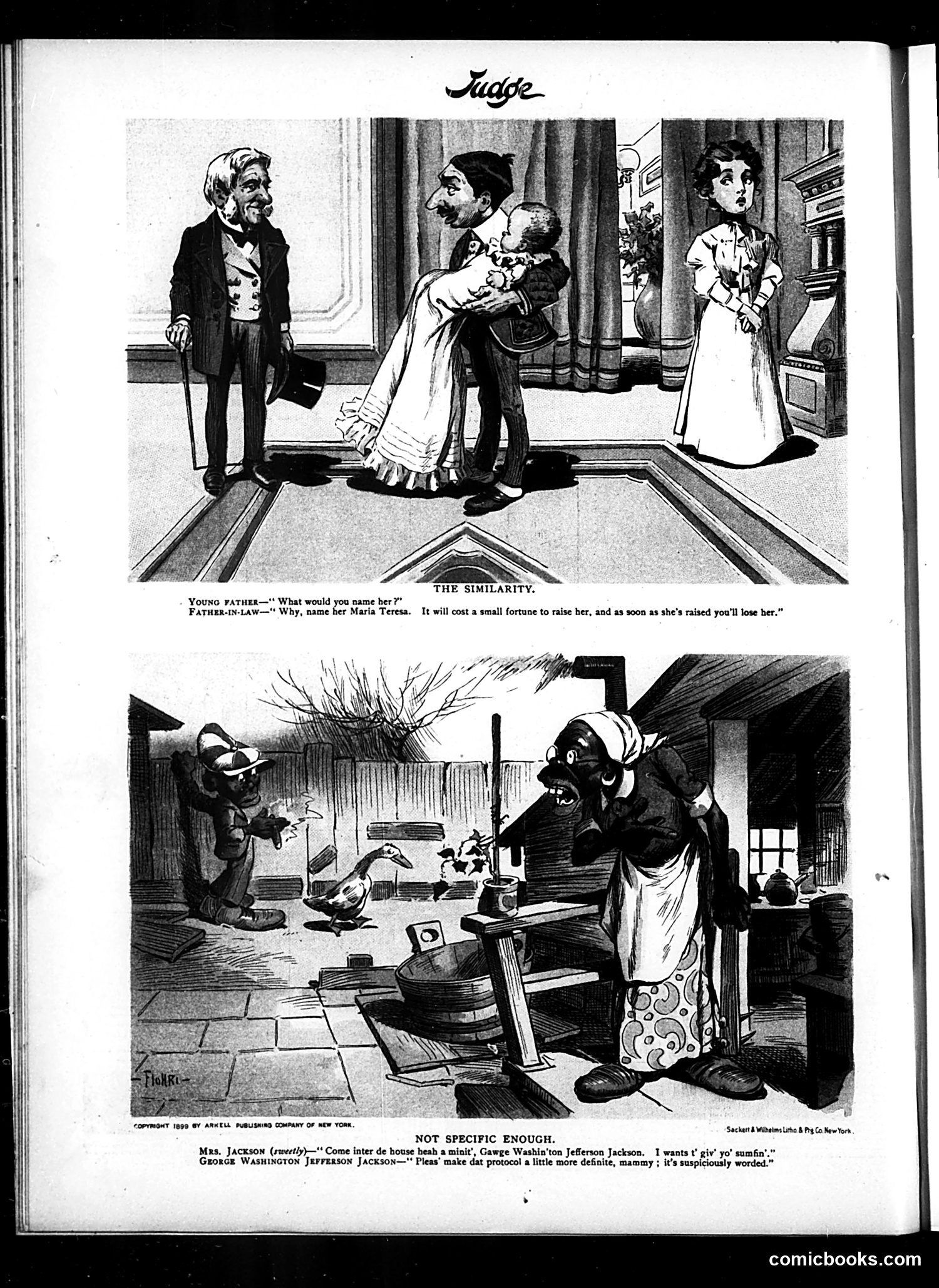
This page contains two satirical cartoons from Judge magazine (copyright 1888). **"The Similarity"** (top): A wealthy father-in-law compares naming a newborn daughter "Maria Teresa" to raising an expensive asset—one you'll inevitably lose through marriage. The joke satirizes marriage as a financial transaction where daughters are costly burdens ultimately transferred to husbands. **"Not Specific Enough"** (bottom): Features caricatured Black figures with exaggerated features and dialect speech. A woman addresses a man with the absurdly long name "George Washington Jefferson Jackson," who demands she be "more definite" about what she's "giving" him—playing on stereotypes about Black people's allegedly vague speech and suspicious motives. Both cartoons reflect late-19th-century Judge humor: one mocking upper-class marriage economics, the other using racist caricature and dialect for comedic effect. The second cartoon is particularly emblematic of period racism normalized in mainstream American publications.