
A complete issue · 16 pages · 1898
Judge — August 20, 1898
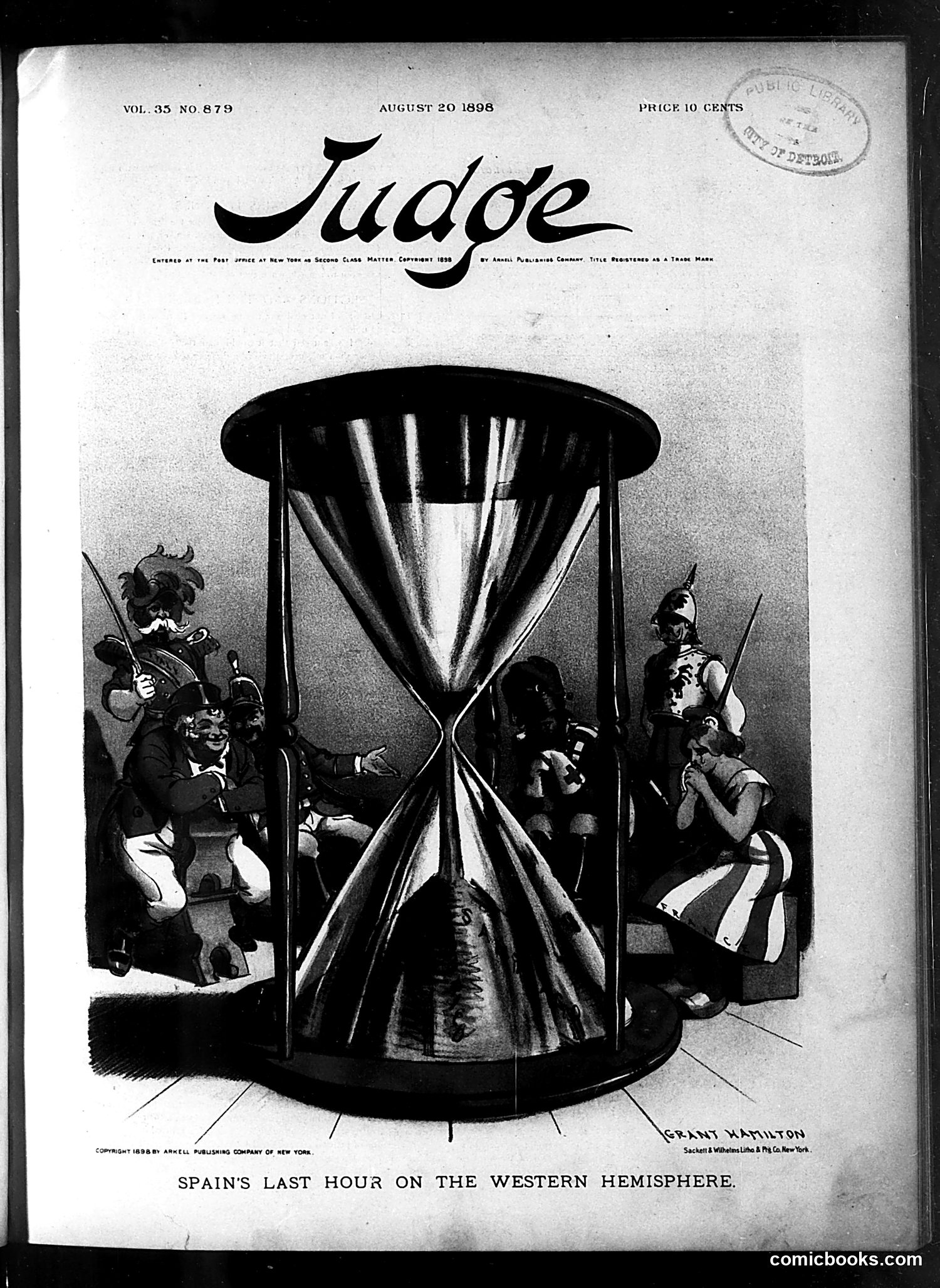
This Judge magazine cover from August 20, 1898 satirizes Spain's declining colonial power. The central image depicts an hourglass with sand running out—a visual metaphor for Spain's imminent loss of dominance in the Americas. Armed military figures stand on either side, likely representing Spanish forces or colonial powers. This references the Spanish-American War (1898), which resulted in Spain ceding territories including Cuba, Puerto Rico, and Guam. The "last hour" caption emphasizes that Spain's Western Hemisphere colonial empire is ending. The hourglass symbolizes time running out for Spanish imperial control, reflecting American victory and the shift of geopolitical power in the region.
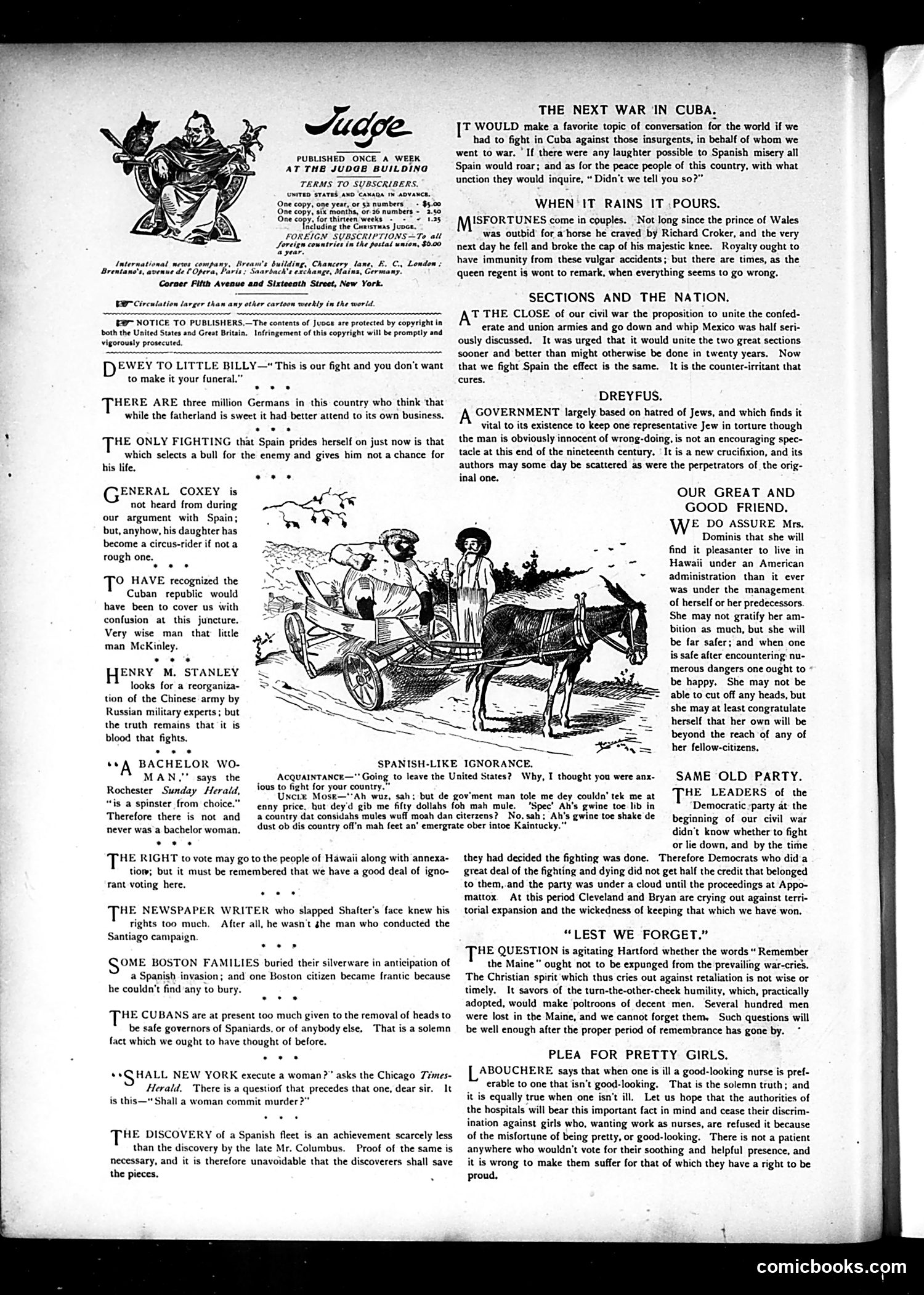
This page satirizes American debates about potential war with Spain over Cuba, likely from 1898. The central cartoon depicts a confrontation involving a horse-drawn cart, appearing to illustrate the Spanish-American tensions. The text sections mock various political positions: criticism of those favoring intervention ("THE ONLY FIGHTING THE SPANIARD PRIDES HERSELF ON"), dismissal of German-American opposition to war, and jabs at Democratic Party leadership regarding the conflict's conduct. Notable targets include General Coxey and references to McKinley's administration. The magazine criticizes both pro-war and anti-war positions while particularly mocking those who questioned American military actions or humanitarian justifications. The satirical tone suggests Judge supported intervention while ridiculing political opposition and ethnic groups' dissent regarding Cuba policy.
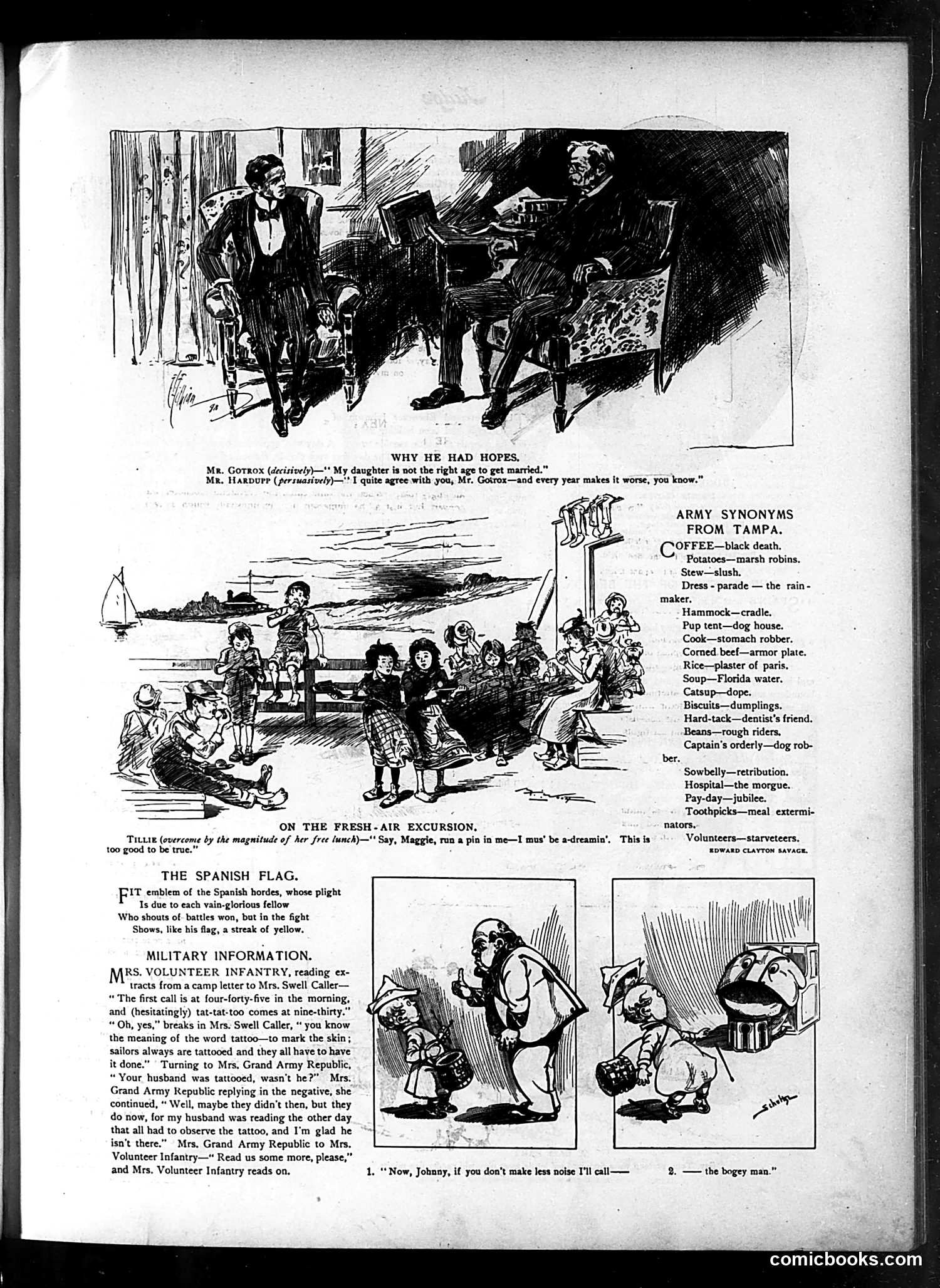
This page contains three separate humor pieces from what appears to be a WWI-era issue: 1. **"Why He Had Hopes"** depicts two men discussing marriage prospects, with one (Gotox) defending his daughter's unmarriageable status while Harduff agrees the situation worsens yearly—a domestic humor joke. 2. **"On the Fresh-Air Excursion"** shows children at leisure, with Tillie's comment about pinning her dress suggesting humor around poverty and makeshift solutions. 3. **"The Spanish Flag" and "Military Information"** sections contain wordplay about military life and tattoos, referencing soldiers' customs during wartime service. The **"Army Synonyms from Tampa"** list provides slang definitions (coffee as "black death," soup as "Florida water"), poking fun at military camp food and conditions. The cartoons appear designed for domestic wartime humor rather than political commentary.
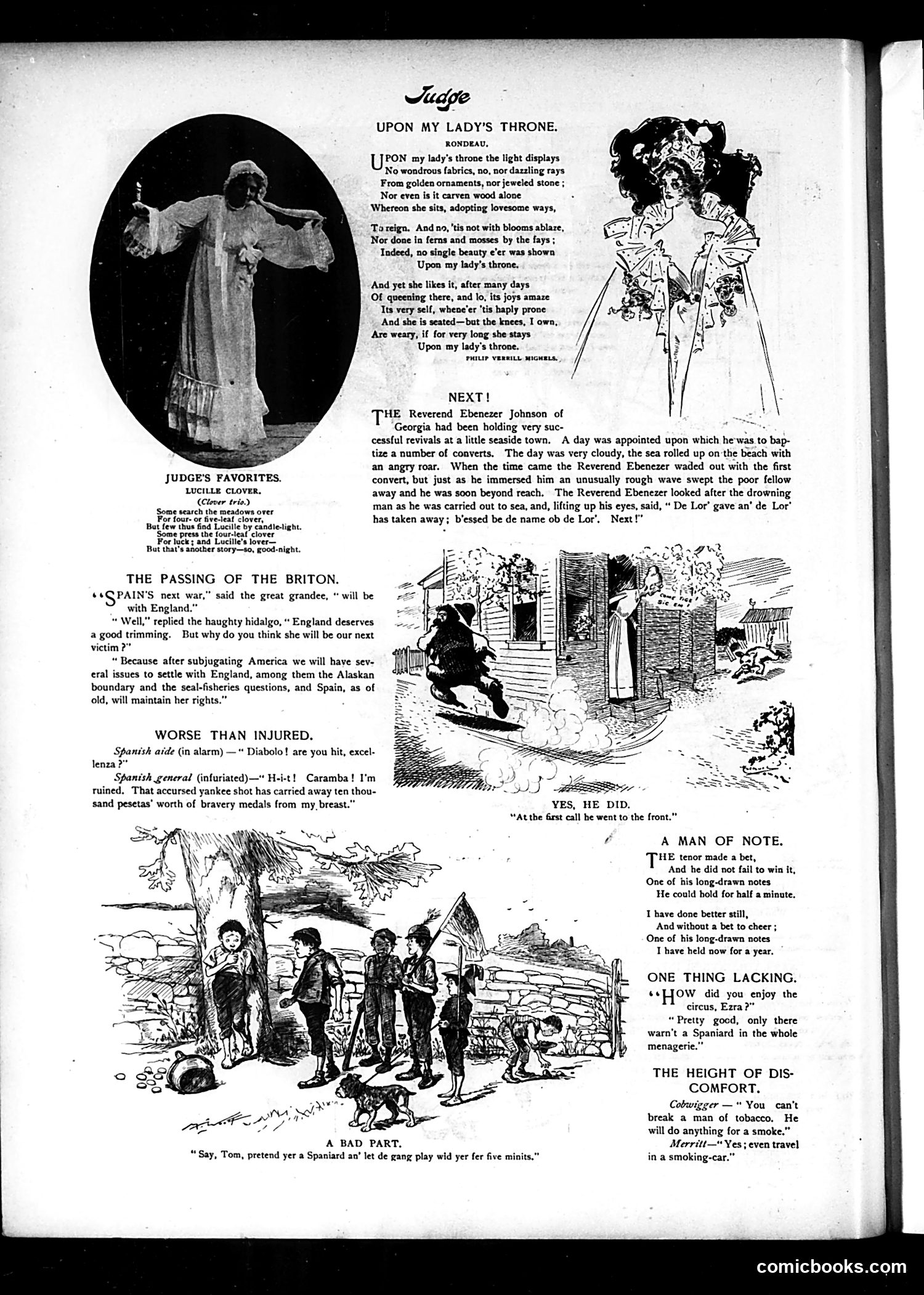
This page from *Judge* contains several satirical pieces and illustrations typical of the magazine's format. **"Upon My Lady's Throne"** is a poem mocking ornate, ostentatious interior decoration—likely critiquing Victorian excess and artificial elegance. The accompanying illustration shows an overdressed figure, satirizing pretentious wealth. **"The Passing of the Briton"** presents a dialogue about Spain's upcoming war with England, apparently referencing geopolitical tensions and American interests (mentioning Alaskan boundaries and seal fisheries). The satire critiques British arrogance. **Other brief comic pieces** include military humor ("A Bad Part," "Yes, He Did") and social commentary on betting, smoking, and discomfort. The page exemplifies *Judge's* mix of political commentary, social satire, and domestic humor aimed at educated American readers of the period.
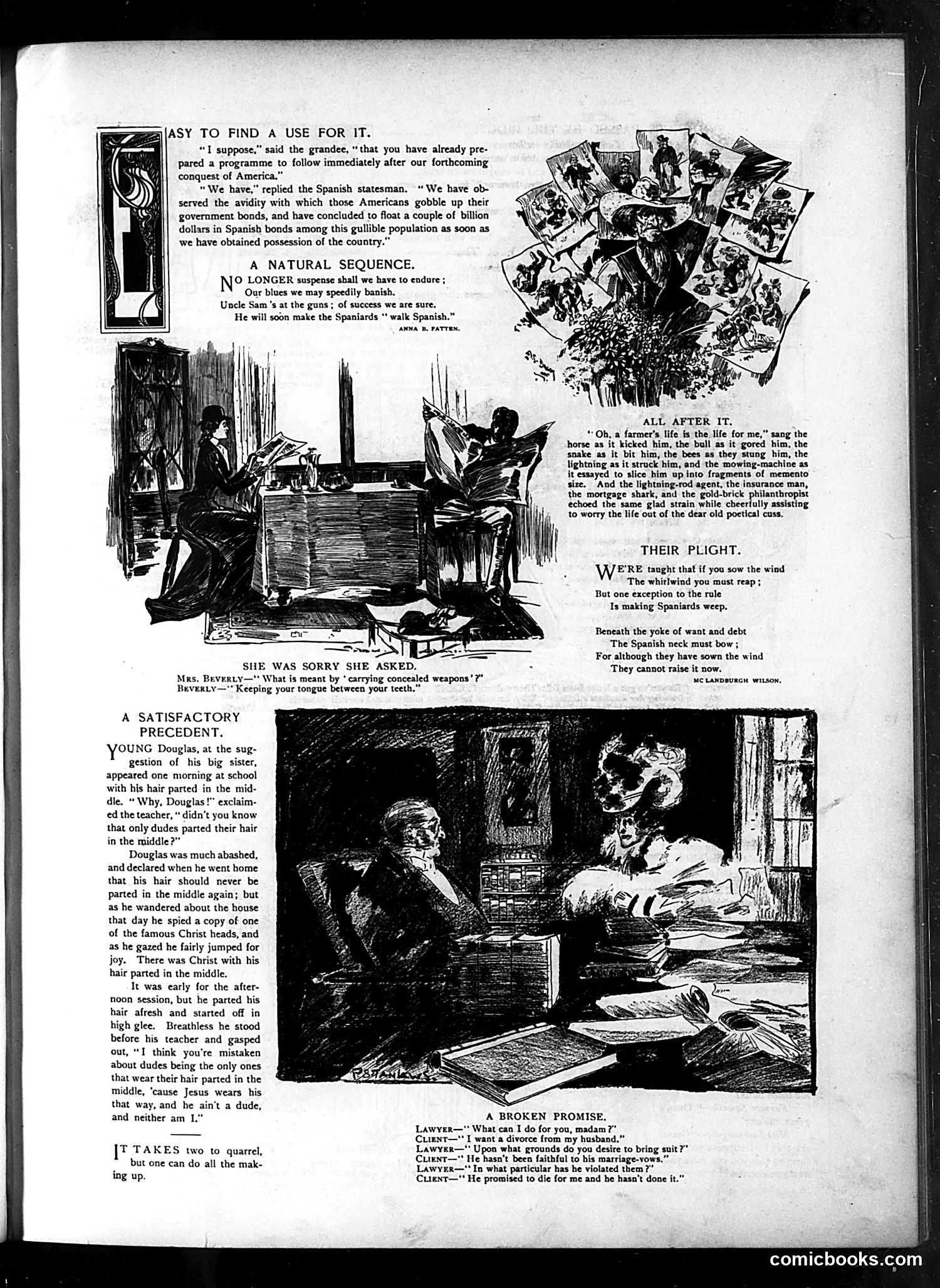
This page contains multiple satirical pieces from the Spanish-American War era (appears to be 1898). The main political cartoon mocks Spanish financial vulnerability: a Spanish statesman boasts of conquering America, then plans to exploit American gullibility by selling Spanish bonds—suggesting Spain itself is financially desperate despite military ambitions. "Their Plight" directly comments on Spain's predicament: Spain has "sown the wind" (caused its own problems through imperial overreach) but cannot "raise it now" (lacks resources to recover), contrasting with the biblical warning that those who sow wind reap whirlwinds. The remaining pieces are lighter humor: "A Natural Sequence" celebrates American military superiority; other sketches involve domestic comedy about hair parting, farming dangers, and a woman seeking divorce because her husband broke his promise to die for her. The satire assumes American readers' confidence in military victory and mocks Spain's economic weakness masked by imperial pretense.
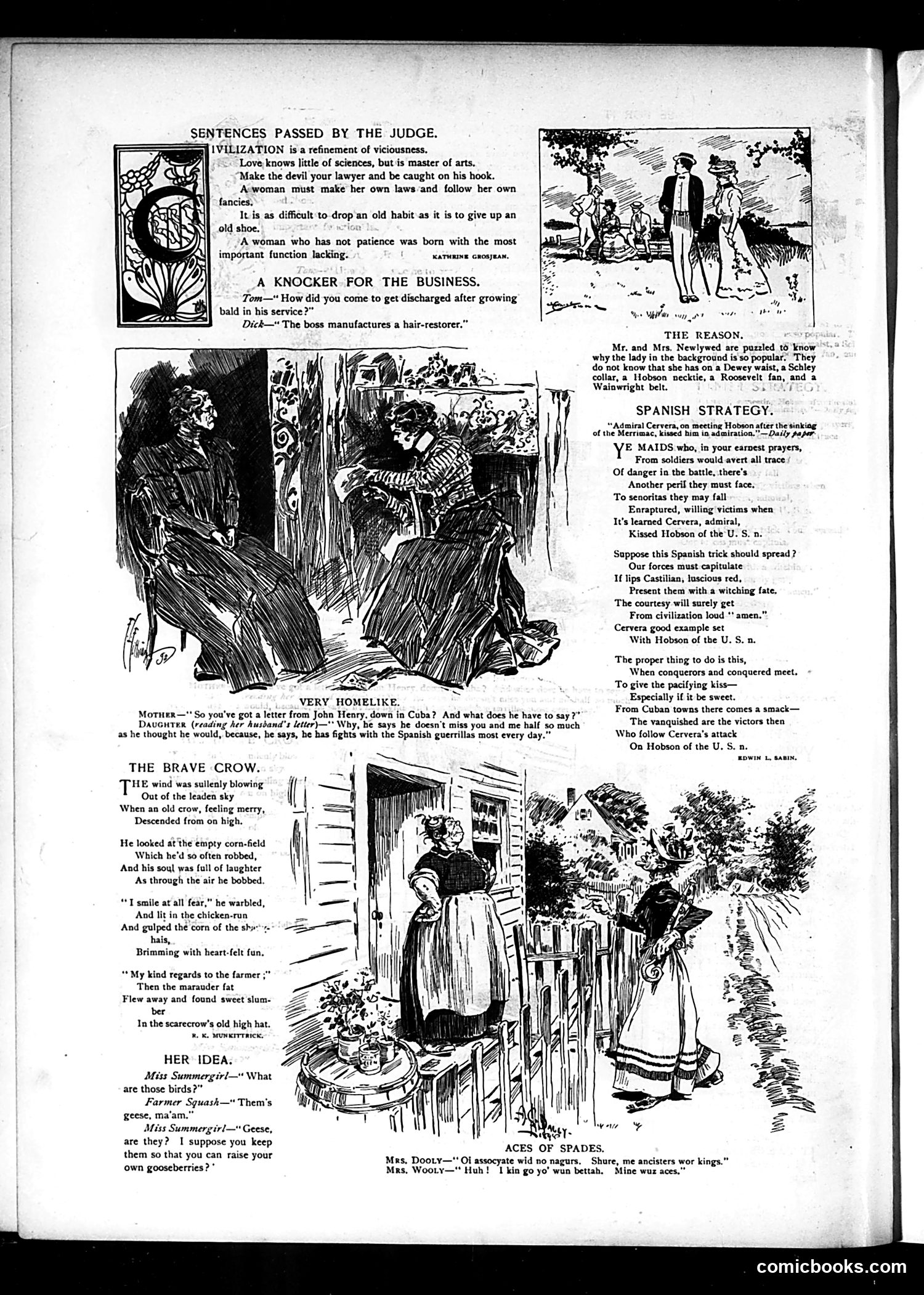
This page satirizes American military figures and events from the Spanish-American War era (circa 1898). The "Spanish Strategy" poem mocks Admiral Cervera's reported kiss of American naval officer Richmond Hobson after the sinking of the *Merrimac*—a gesture meant as respectful acknowledgment between military adversaries. The satire suggests this chivalrous act could dangerously spread, with American soldiers supposedly surrendering to Spanish women's charm rather than military force. References include Dewey (Admiral George Dewey), Schley (Admiral Winfield Schley), and Hobson—all Spanish-American War commanders. The "Very Homelike" joke uses the war as a setup: a soldier claims he misses Cuba's combat with guerrillas more than home, treating warfare as entertainment. Other content includes moralizing "Sentences," unrelated comic vignettes ("The Brave Crow," "Her Idea"), and period humor. The page exemplifies Judge's blend of political commentary and lighthearted domestic humor typical of late-19th-century American satire.
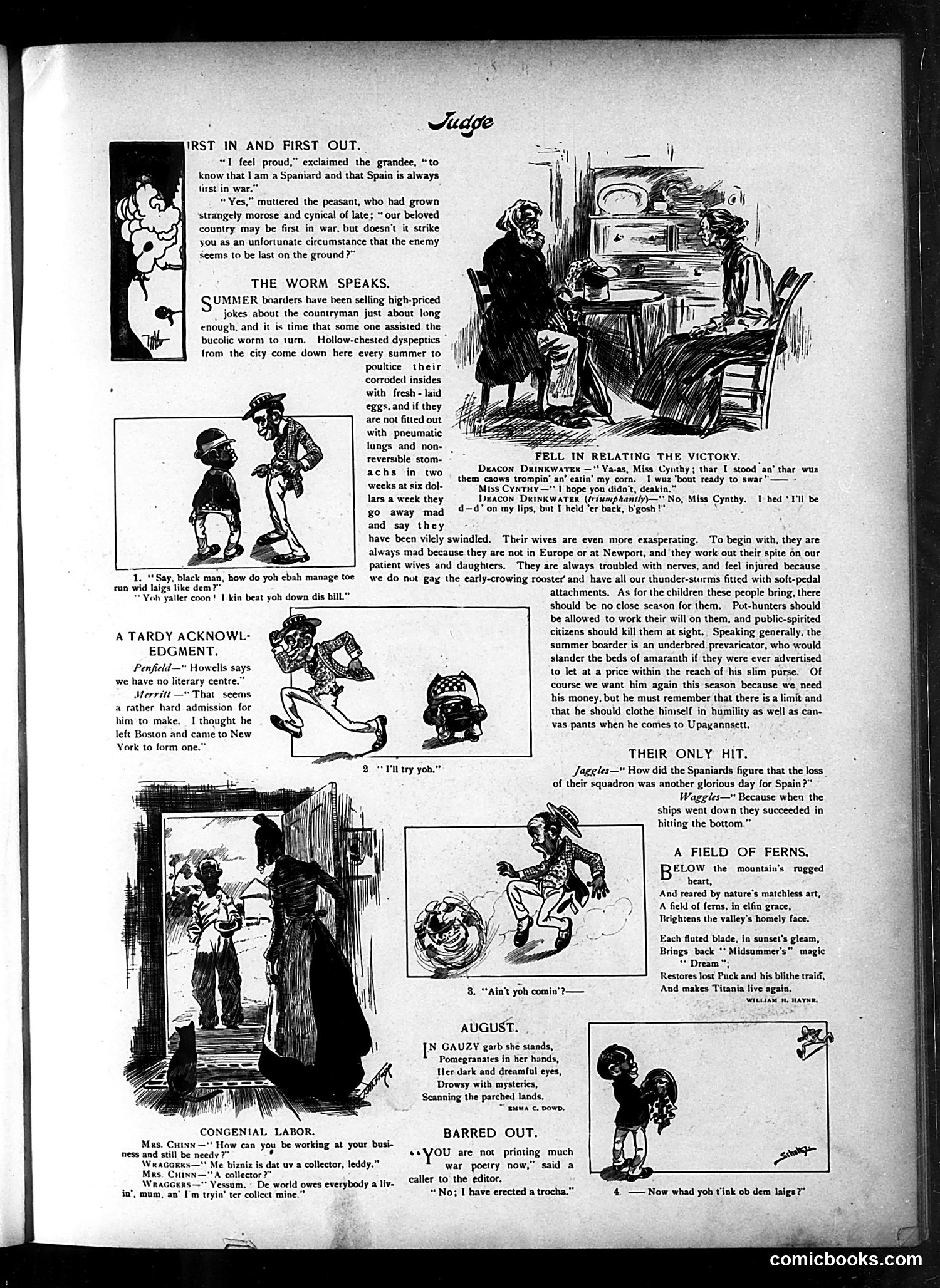
This page contains satirical commentary on Spain, likely during the Spanish-American War era (the naval reference and Spanish pride suggest this context). **Main Cartoons:** "First In and First Out" mocks Spanish military pride—a grandee boasts Spain is "always first in war," but a peasant cynically notes the enemy is "last on the ground," implying Spain loses battles despite initial confidence. "Their Only Hit" jokes that Spain's naval defeat was "glorious" because "when the ships went down they succeeded in hitting the bottom"—dark humor about the Spanish fleet's destruction. **Other Content:** "The Worm Speaks" satirizes summer boarders from the city who rent from rural landowners, complaining they're swindlers who mistreat property and staff. Various other short jokes and a poem about ferns fill the page. The overall tone is American mockery of Spanish military incompetence and social commentary on class tensions between urban and rural people.
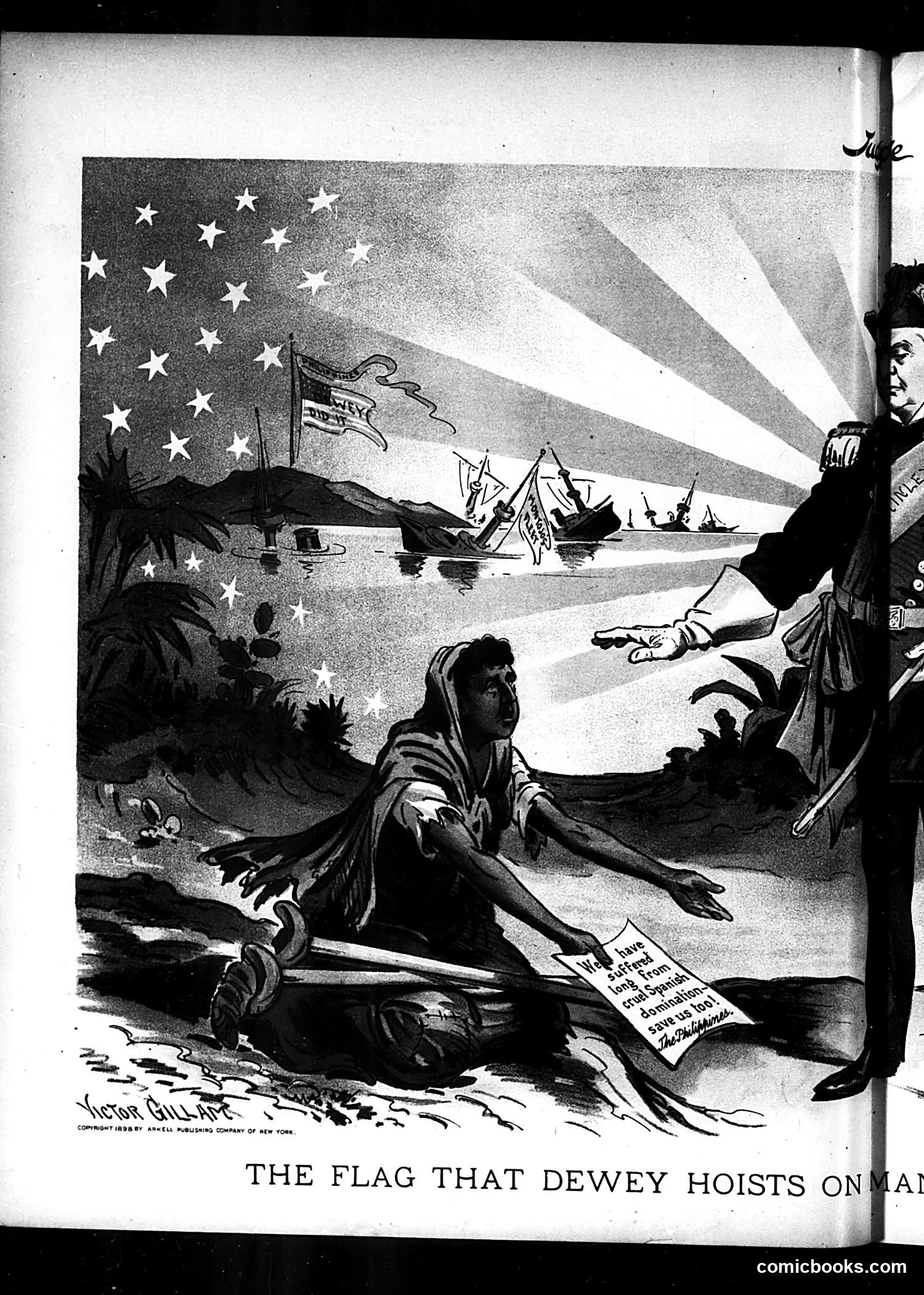
This Judge cartoon satirizes Admiral George Dewey's 1898 victory at Manila Bay during the Spanish-American War. The image shows a figure (likely representing the Filipino people or a colonial subject) drowning or struggling in water while an American military officer (representing Dewey or American imperialism) stands dominantly above, pointing. The satire critiques American expansionism: despite rhetoric about liberating Manila from Spanish rule, the cartoon suggests the U.S. is simply replacing one imperial power with another, leaving local populations in distress. The American flag and naval ships in the background emphasize the military occupation. The cartoon expresses skepticism about America's true intentions in the Philippines—whether liberation or imperialism.
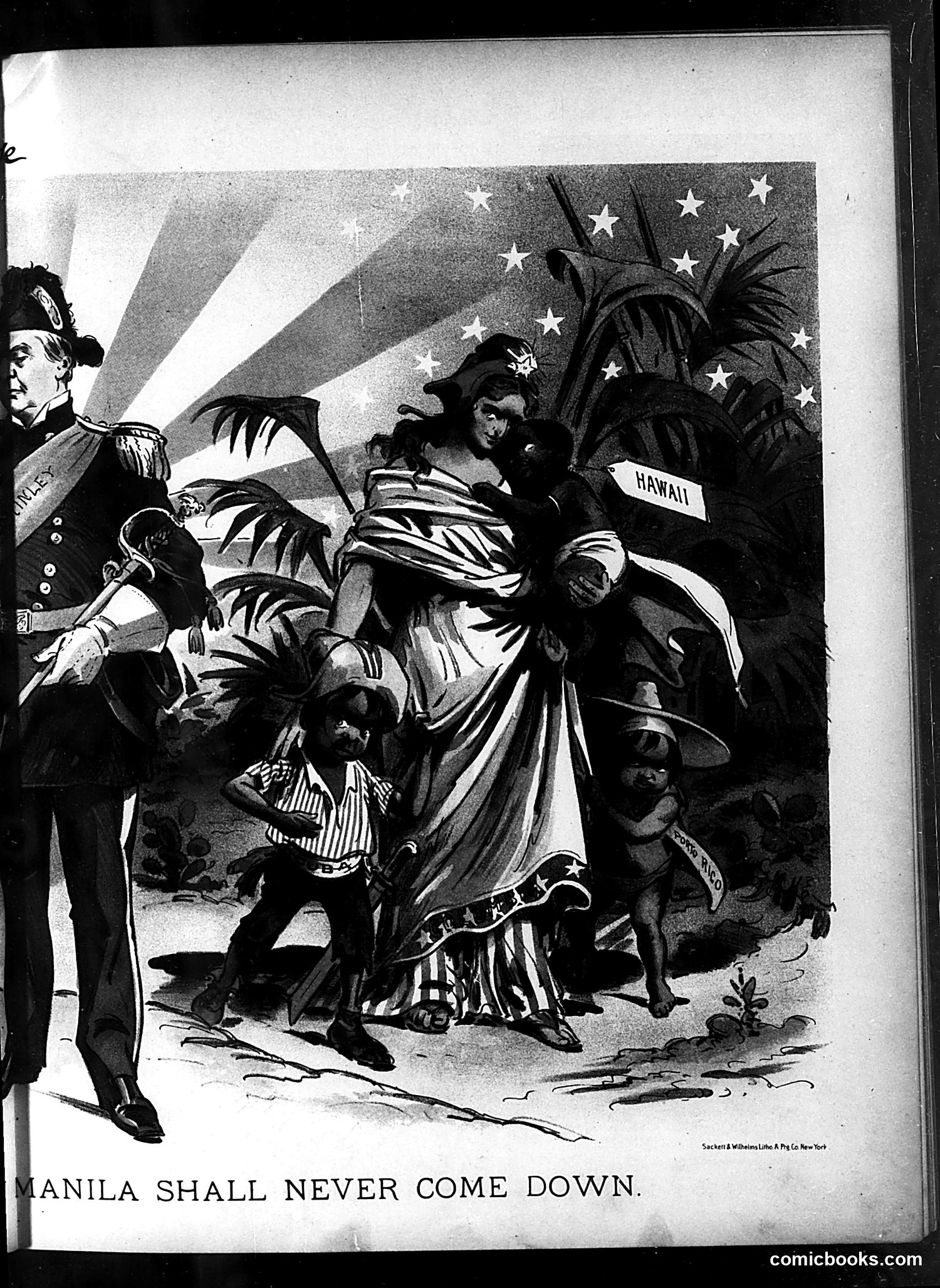
This Judge magazine cartoon satirizes American imperialism regarding the Philippines. The central female figure represents the United States (likely Columbia or Lady Liberty), protectively holding the Philippine Islands, symbolized by the palm trees labeled "HAWAII." Military and political figures surround her—including what appears to be a uniformed official on the left. The caption "MANILA SHALL NEVER COME DOWN" references America's determination to maintain control of Manila and the Philippines following the Spanish-American War (1898). The cartoon mocks American expansionist rhetoric, portraying the U.S. as possessively clutching overseas territories like a mother protecting children, while simultaneously criticizing this imperial ambition. The satirical tone suggests Judge's skepticism toward American colonial aspirations in the Pacific.
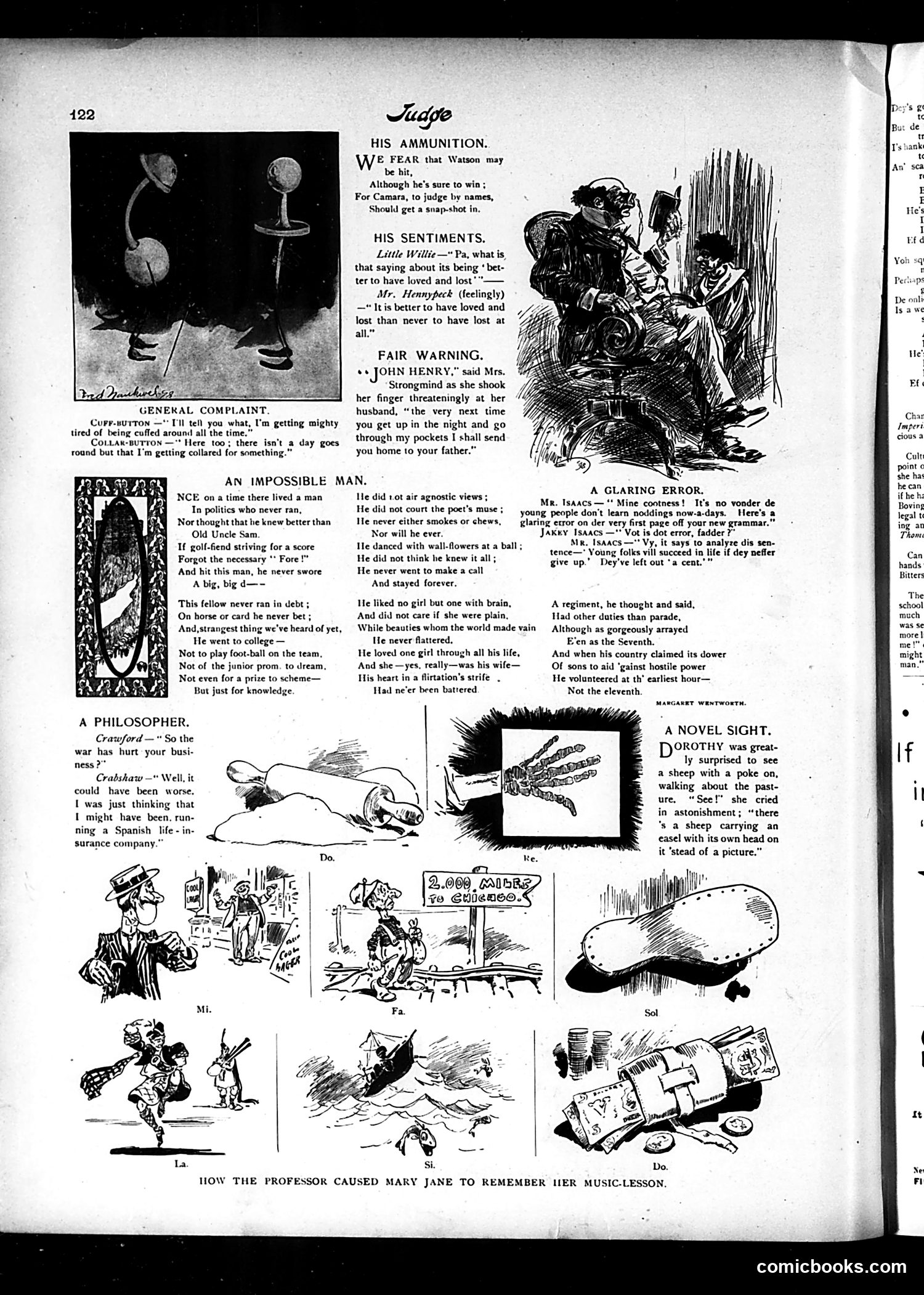
This page contains multiple satirical pieces typical of early 20th-century American humor: **"General Complaint"** depicts personified clothing (cuff and collar button) complaining about rough treatment—a pun on being "cuffed around" and "collared." **"An Impossible Man"** is a mock-heroic poem about an idealized citizen who avoids vices (gambling, smoking, excessive drinking), plays no football, attends college for learning rather than socializing, and volunteers for military service at the appropriate time rather than the "eleventh" hour. The satire mocks such impossible virtue. **"His Ammunition"** references Watson and Camara (likely boxers or politicians), using combat metaphors. **"A Glaring Error"** features a Yiddish-accented immigrant father criticizing a grammar book's sentence about perseverance, joking that it omitted "a cent"—playing on immigrant stereotypes about materialism. The remaining items are brief humorous anecdotes and visual gags typical of the magazine's format.
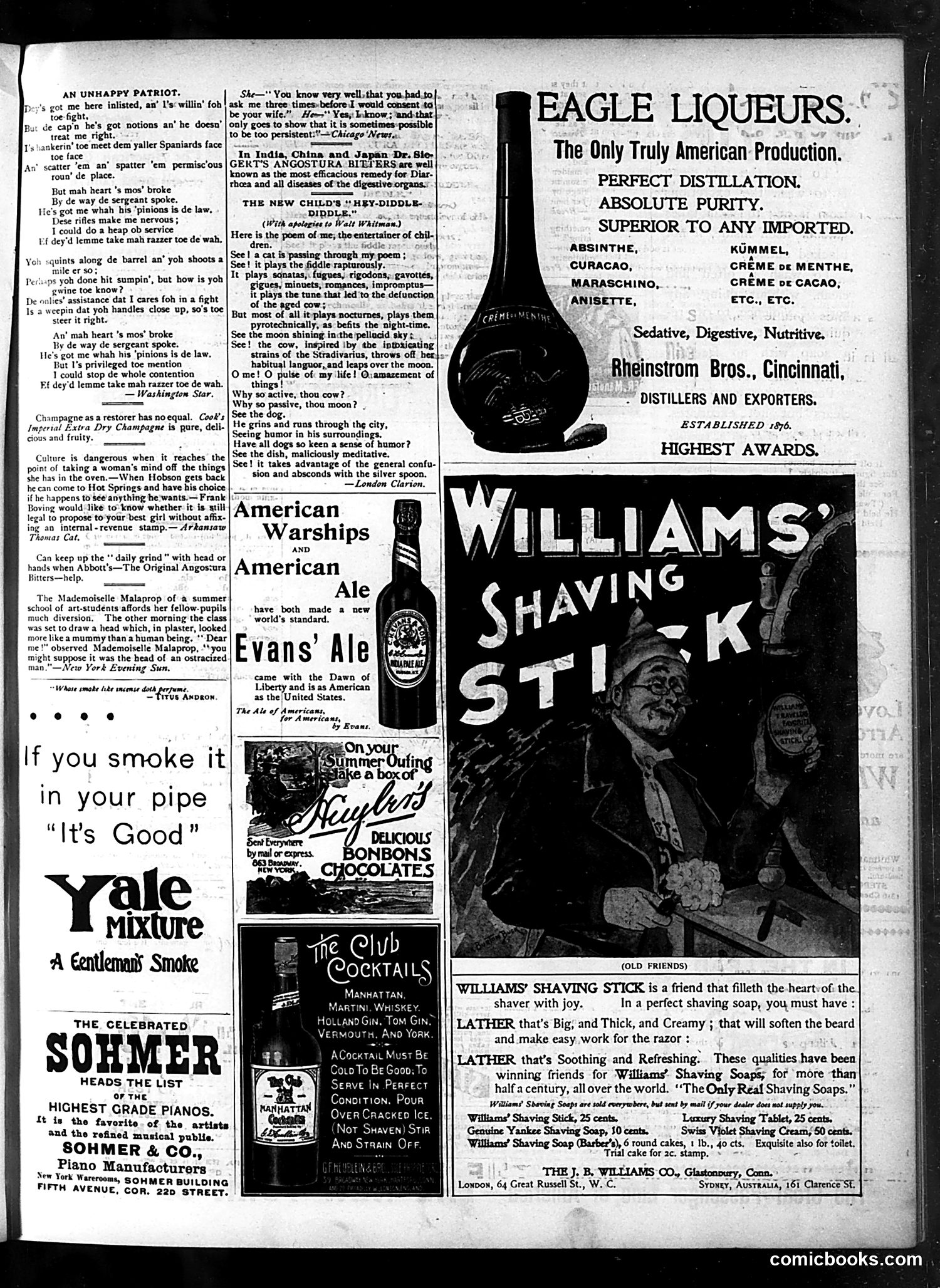
This page is primarily **advertisements and filler content** from Judge magazine, with one notable satirical poem. The main literary piece, "An Unhappy Patriot" (left column), is a dialect poem about a Black soldier willing to fight in what appears to be the **Spanish-American War** (referenced by "yaller Spaniards"). The satire hinges on the soldier's frustration that military discipline prevents him from using his preferred weapon—a razor—which he claims would be more effective than rifles. The "joke" relies on racist stereotypes of the era: depicting Black soldiers as naturally skilled with razors rather than modern weaponry, and using exaggerated dialect for comedic effect. This reflects the casual racism of 1890s American humor magazines. The rest of the page is standard period advertising: liqueurs (Eagle), ale, champagne, chocolate, piano manufacturers, cigars, and medicinal products. These ads are historically interesting as period artifacts but contain no satirical content themselves.
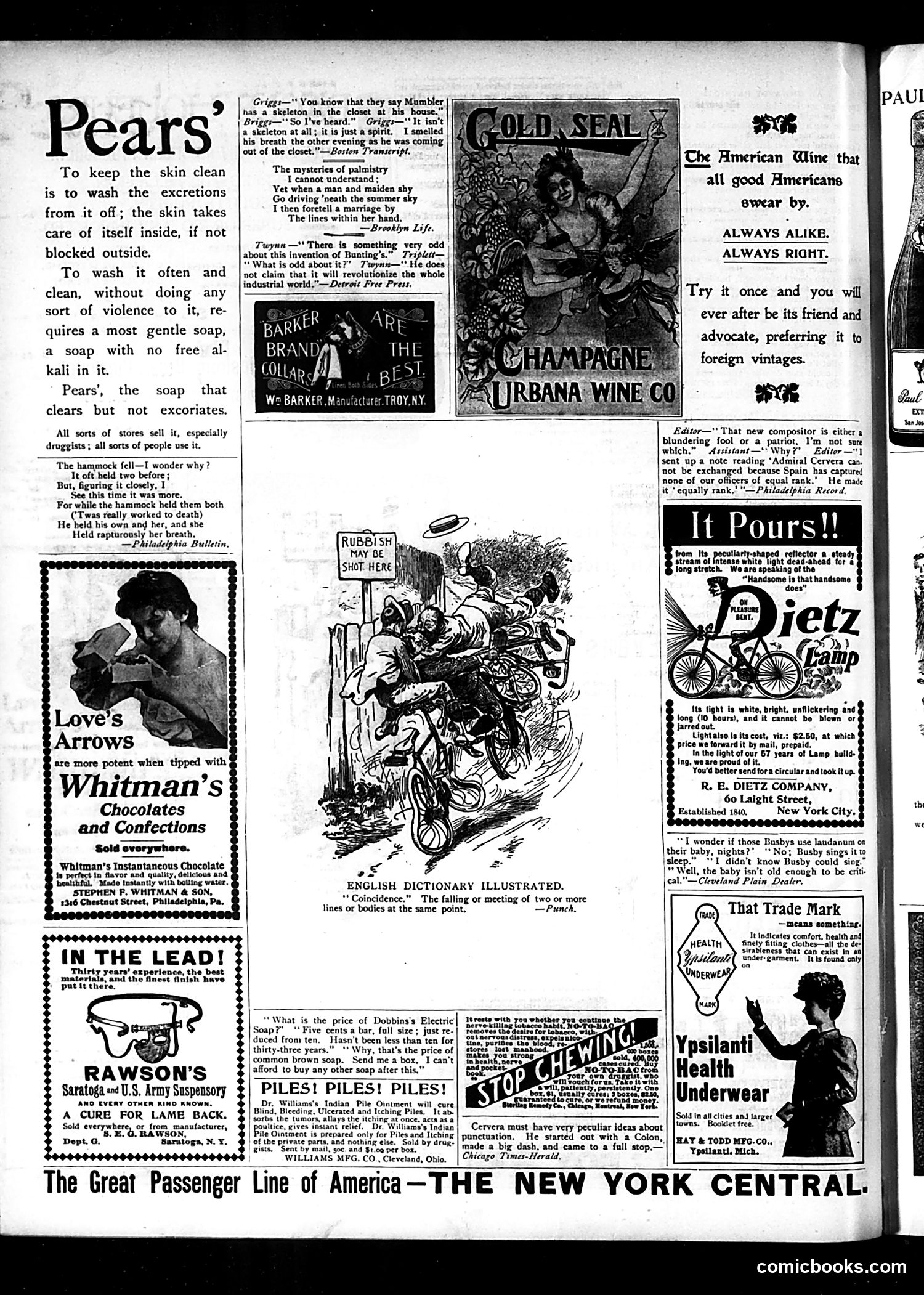
This magazine page is primarily **advertisements and humorous snippets** rather than a political cartoon. Here's what appears: The content includes various product ads (Pears' soap, Whitman's Chocolates, Dobbins's soap) alongside short, disconnected jokes and quips typical of Judge magazine's humor section. One recurring joke thread involves "Griggs" and "Mumbler" discussing whether Mumbler has a "skeleton in the closet"—a period idiom meaning a hidden shame or embarrassment in one's past. Another snippet parodies palmistry (fortune-telling), joking that a man and woman riding together under moonlight is a sure sign of coming marriage. The Spanish-American War appears briefly in a joke where someone confuses a news item about Spanish Admiral Cervera with a grammar lesson about punctuation marks (colon, dash, period). Most humor targets mundane domesticity and wordplay rather than serious political commentary. The ads suggest the magazine's audience and commercial interests during what appears to be the early 1900s.
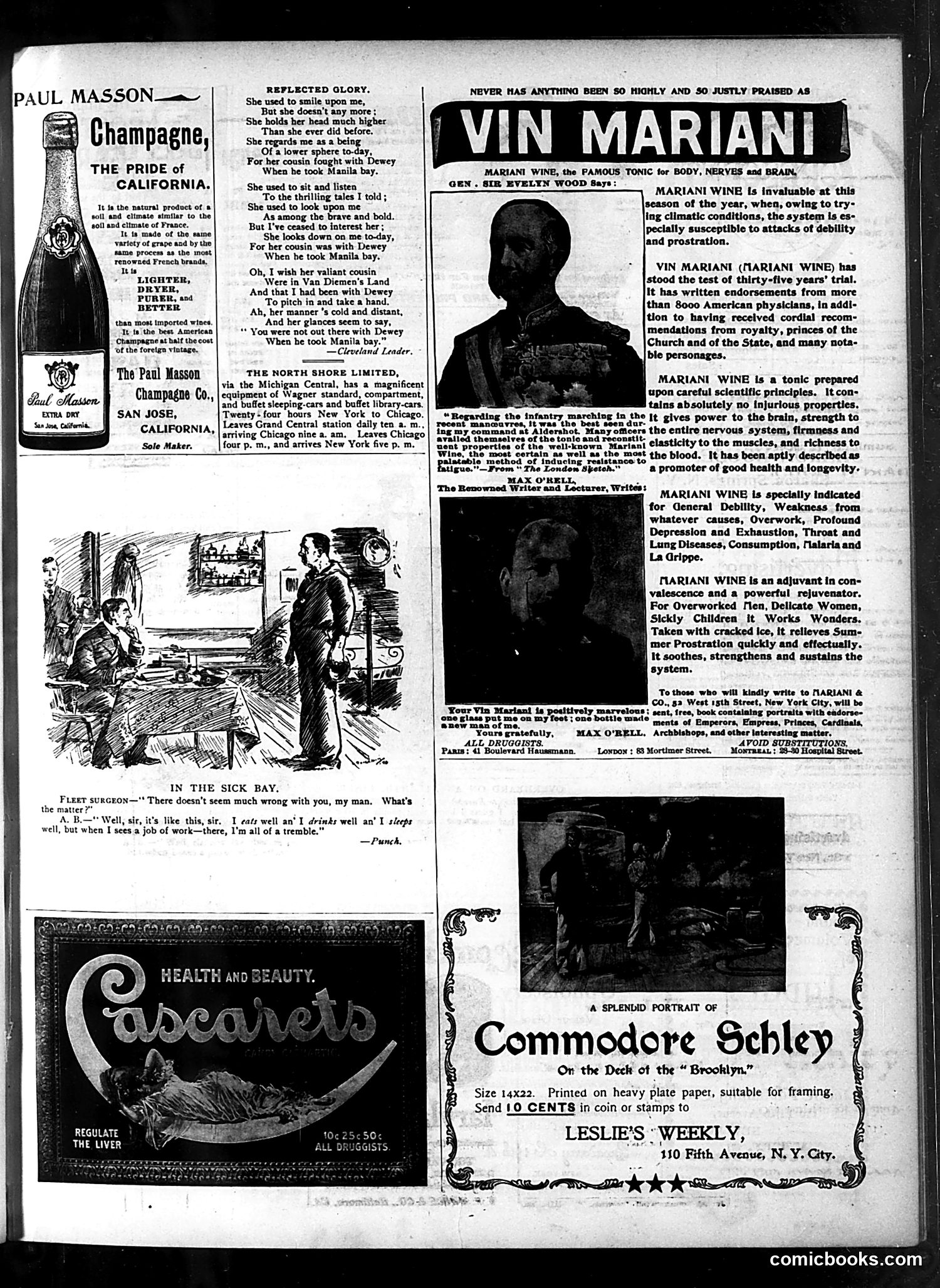
This page's main cartoon satirizes how military glory affects social status. A man laments that a woman who once admired him now ignores him—simply because her cousin fought with Admiral Dewey at Manila Bay (the 1898 Spanish-American War naval victory). The joke: she's acquired "reflected glory" through family connection rather than personal achievement, and uses this to elevate herself socially while dismissing the narrator as beneath her. The satire targets the absurdity of how Americans lionized war heroes and how associates of those heroes basked in unearned prestige. The Cleveland Leader attribution confirms this was contemporary commentary on post-war social pretension. The page also contains period advertising (Paul Masson champagne, Mariani Wine tonic, Cascarets laxative)—typical Judge magazine content mixing humor with commercial endorsements.
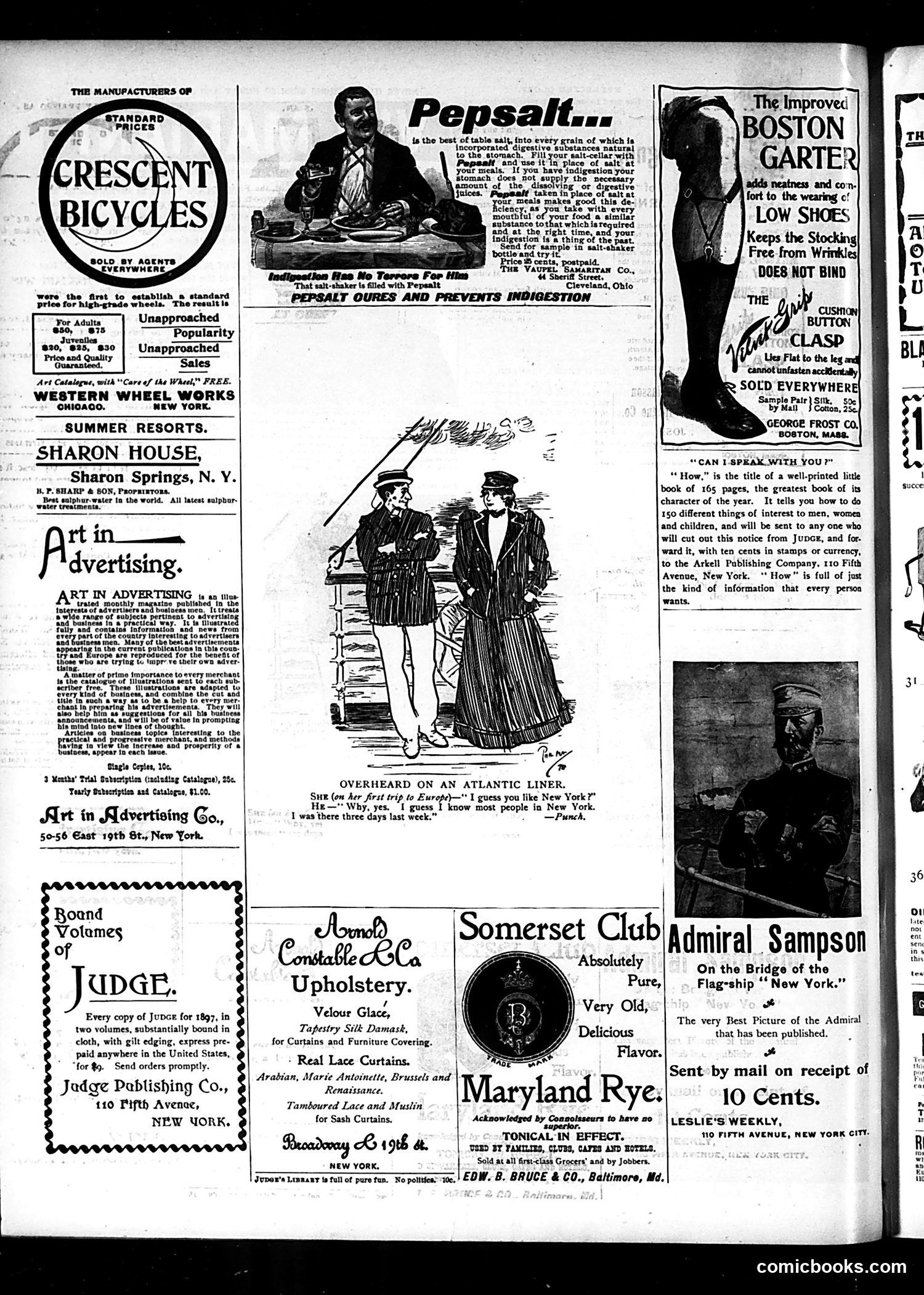
This is primarily a **advertising and filler page** from Judge magazine, with one notable cartoon. ## The Main Cartoon: "Overheard on an Atlantic Liner" The cartoon satirizes **American provincialism and social pretension**. A woman fresh from her first European trip brags to a man that she "knows most people in New York." He deflates her boast by casually mentioning he was in New York three days last week—implying her claimed familiarity is unremarkable. The joke mocks Americans who return from abroad with inflated self-importance while revealing their limited actual social standing. The source attribution to *Punch* (British publication) emphasizes this as gentle mockery of American social climbing. ## Page Content The remainder consists of period product advertisements: Crescent Bicycles, Pepsalt digestive salt, Boston garters, upholstery services, Maryland Rye whiskey, and Somerset Club beverages. There's also an ad for Judge's bound volumes and a promotional offer for a how-to book ("How"). The page reflects turn-of-century consumer culture and genteel advertising conventions.
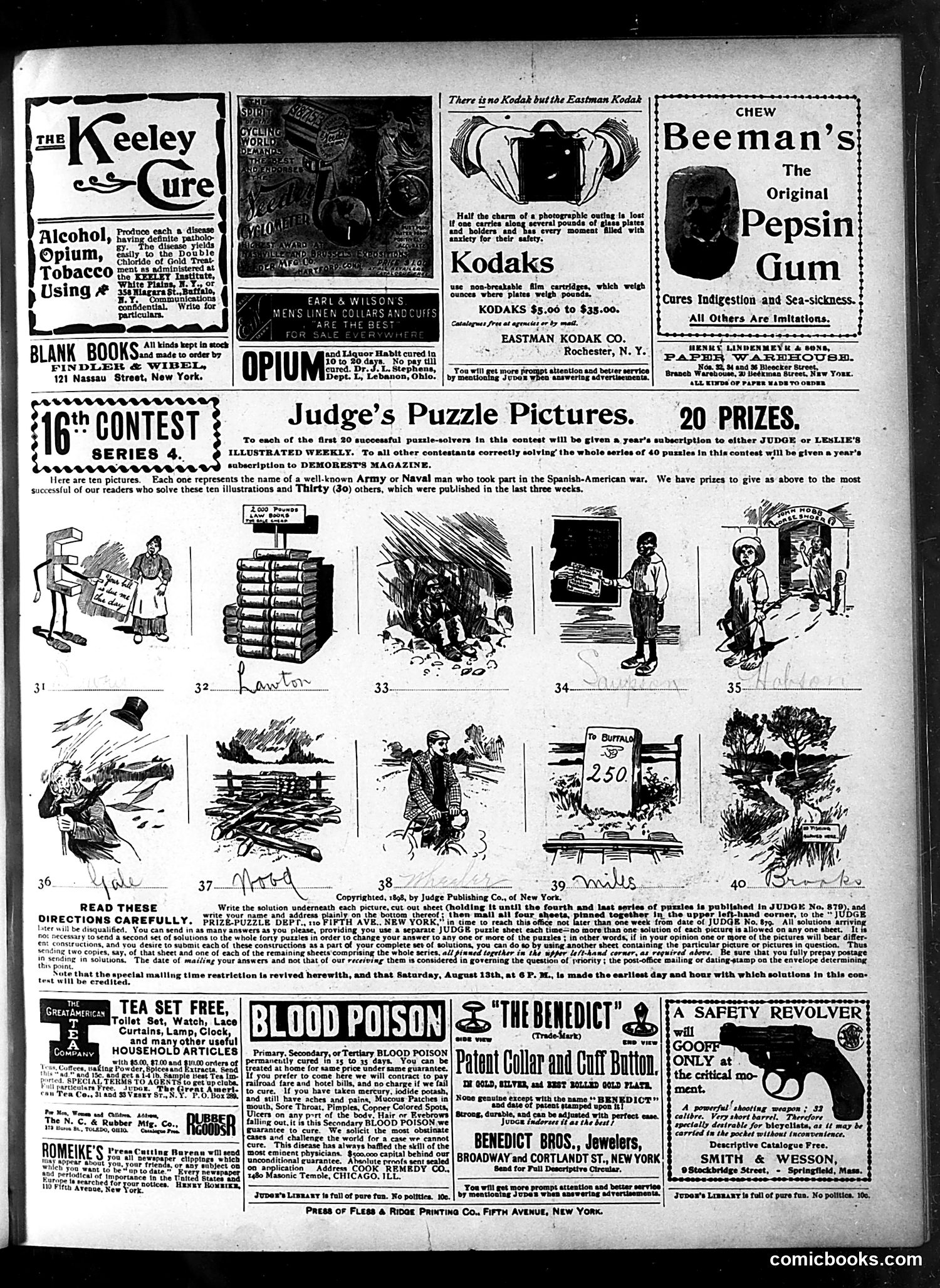
This page is primarily **advertising and a puzzle contest**, not political satire. The main feature is "Judge's Puzzle Pictures" — a contest where readers identify ten sketched figures representing Spanish-American War military leaders. Winners receive subscriptions to *Judge* or *Demorest's Magazine*. The text indicates this is part four of a series with 40 total puzzles. The surrounding advertisements reflect late-1890s consumer products: The Keeley Cure (for alcohol/opium addiction), Kodak cameras, Beeman's Pepsin Gum, blank books, and various patent medicines including "Blood Poison" treatments and "The Benedict" patent collar button. **Historical context**: The Spanish-American War (1898) is recent enough that identifying military heroes was timely entertainment. The prominence of addiction-cure advertisements reflects contemporary concerns about substance abuse, while the patent medicines reveal an era before FDA regulation, when dubious health claims were standard advertising. This page represents *Judge's* business model: blending satirical content with profitable advertising space.
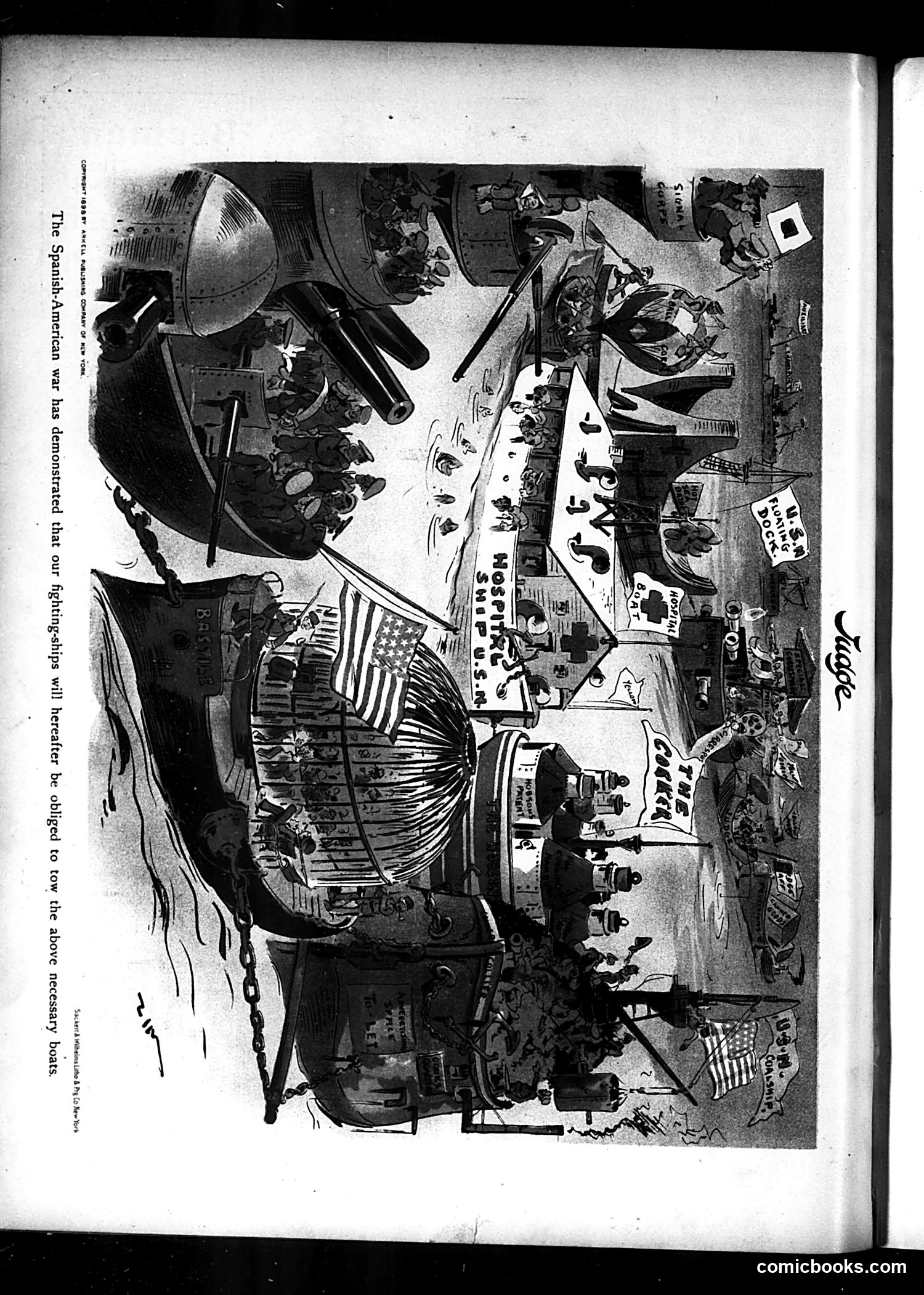
This Judge magazine cartoon satirizes American naval vulnerabilities exposed during the Spanish-American War (1898). The image depicts a warship being towed by smaller auxiliary vessels, lampooning the realization that modern battleships require support boats—likely referring to colliers (coal supply ships), tugboats, and repair vessels necessary for extended operations. The satire mocks American military preparedness, suggesting that despite possessing impressive fighting-ships, the Navy's logistical dependence on these "necessary boats" reveals impractical limitations. The cartoon criticizes either naval design flaws or inadequate infrastructure planning, arguing that warships alone cannot function independently in combat operations. The American flags visible suggest patriotic irony—the country's vaunted naval power is compromised by unglamorous but essential support requirements that the public hadn't fully appreciated before the war.