
A complete issue · 16 pages · 1898
Judge — July 9, 1898
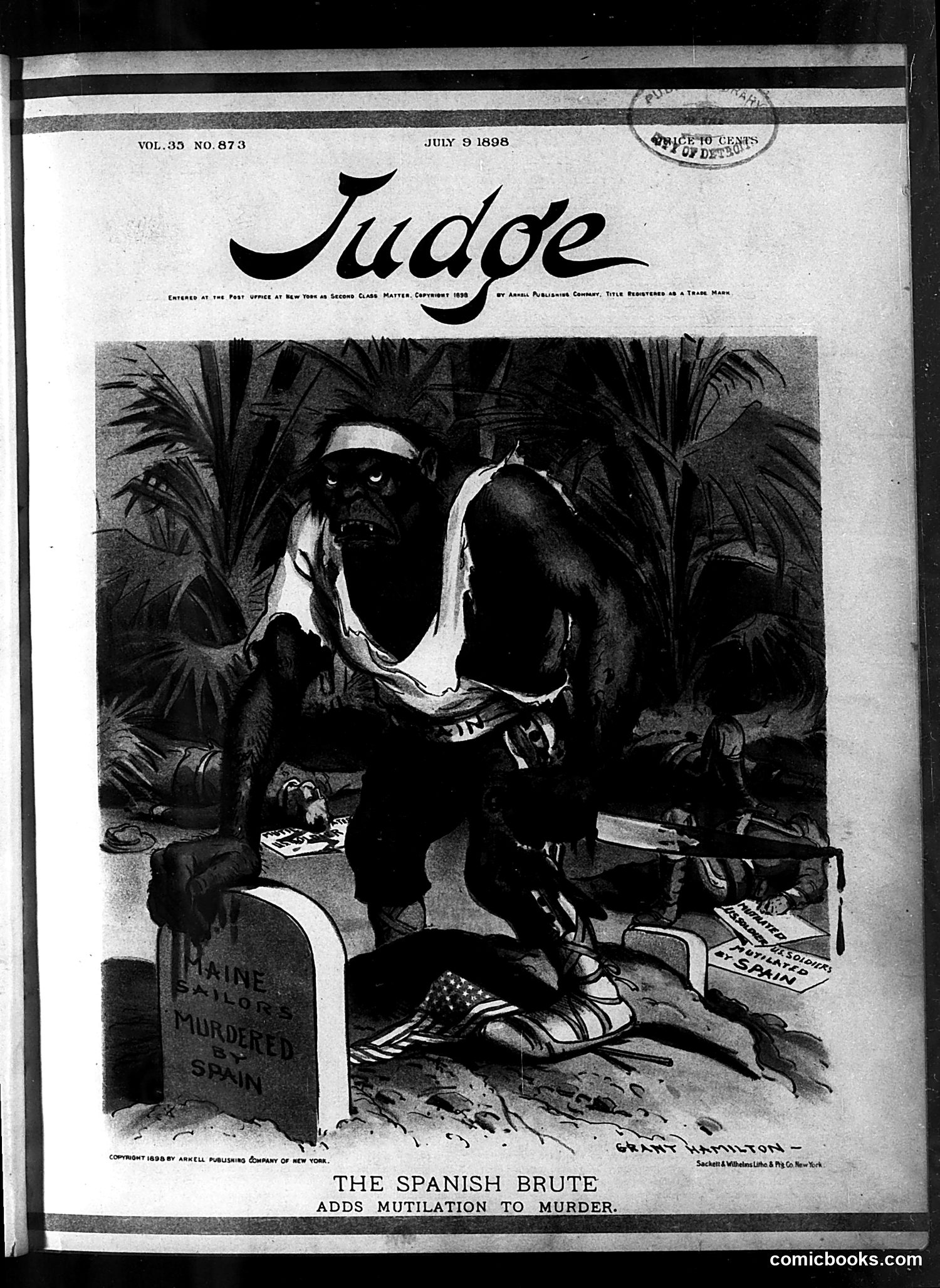
This cartoon satirizes Spanish conduct during the Spanish-American War, which had begun months earlier. The skeleton figure labeled "THE SPANISH BRUTE" represents Spain, depicted as death itself. The gravestone reads "MAINE SAILORS MURDERED IN SPAIN," referencing the USS Maine explosion (February 1898) that killed 260+ American sailors—the incident that triggered American entry into the war. The cartoon presents Spain as barbaric and murderous. The artist, Grant Hamilton, uses the skeleton motif to convey that Spanish actions constitute not legitimate warfare but atrocities. The surrounding tropical setting suggests Cuba, where Spain was fighting insurgents and where American intervention focused. This reflects American wartime propaganda portraying Spain as a cruel imperial power deserving military defeat.
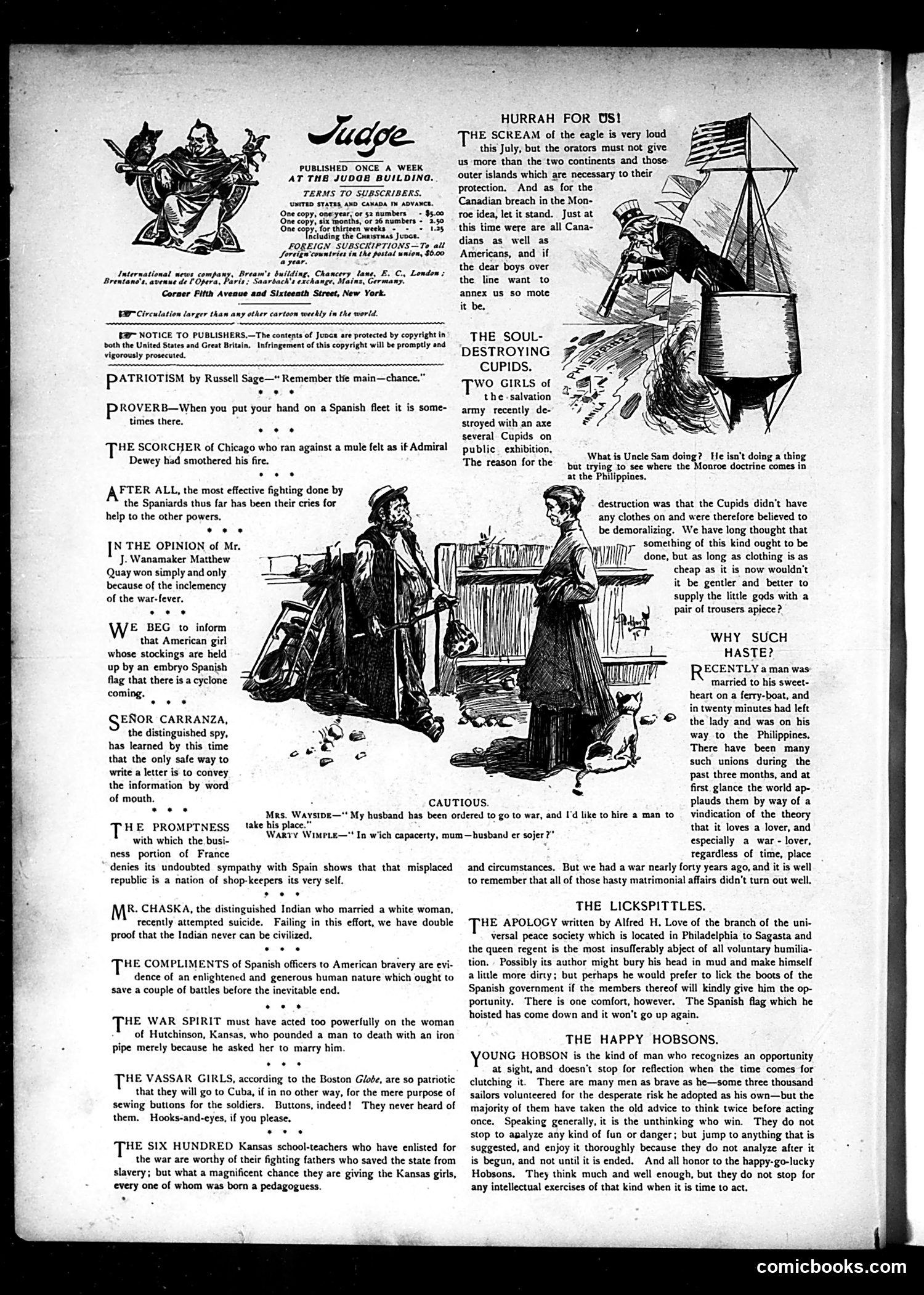
This appears to be a WWI-era satirical page (likely 1917-1918 based on references to war and the Philippines). The main cartoon depicts two figures examining what appears to be a wooden crate or box, illustrating the piece "The Soul-Destroying Cupids." The satire critiques American military involvement and foreign policy, with multiple short commentary pieces mocking: - Spanish military actions - American strategic decisions regarding the Philippines - War profiteering and hasty marriages among soldiers - Various political figures and their decisions The cartoon specifically ridicules the destruction of Filipino religious statues (Cupids) by American soldiers, suggesting moral hypocrisy in America's military conduct. The surrounding text uses sharp wit to skewer government policies, military leadership, and societal responses to the war—typical of Judge's satirical approach to contemporary political controversy.
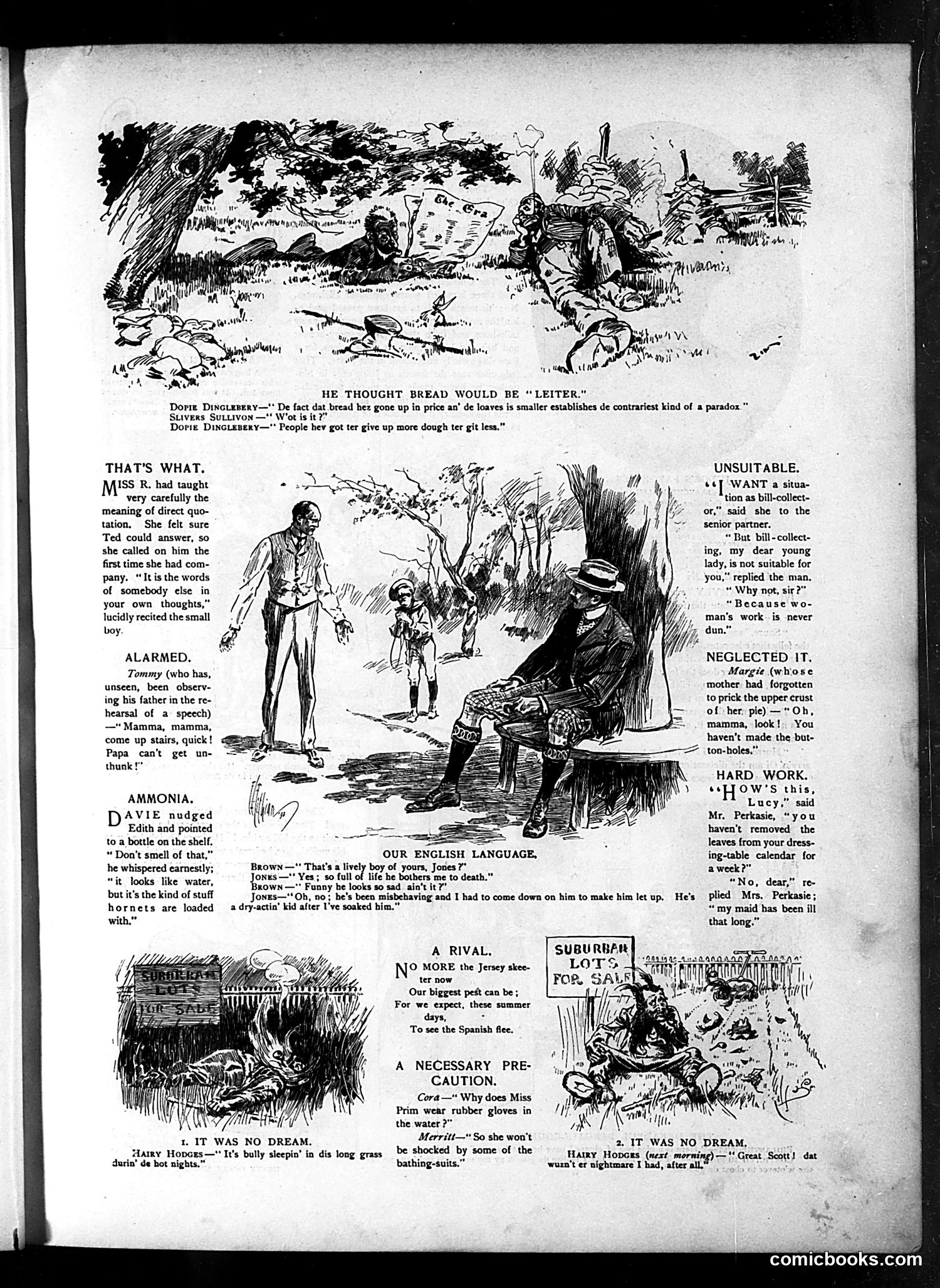
This page contains several unrelated short humor pieces and sketches rather than a unified political cartoon. The sketches illustrate various domestic and social situations: - "That's What" depicts a teacher correcting a student's definition - "Alarmed" shows a child frightened by his father rehearsing a speech - "Ammonia" humorously describes mistaking ammonia for water - "Our English Language" satirizes how regional accents affect English pronunciation - "Unsuitable," "Neglected It," and "Hard Work" depict middle-class domestic situations involving servants and household management The page also includes advertisements for suburban lot sales and other items. Rather than political satire, these pieces focus on everyday social comedy—class relationships, generational misunderstandings, and domestic mishaps typical of Judge's humor during this era.
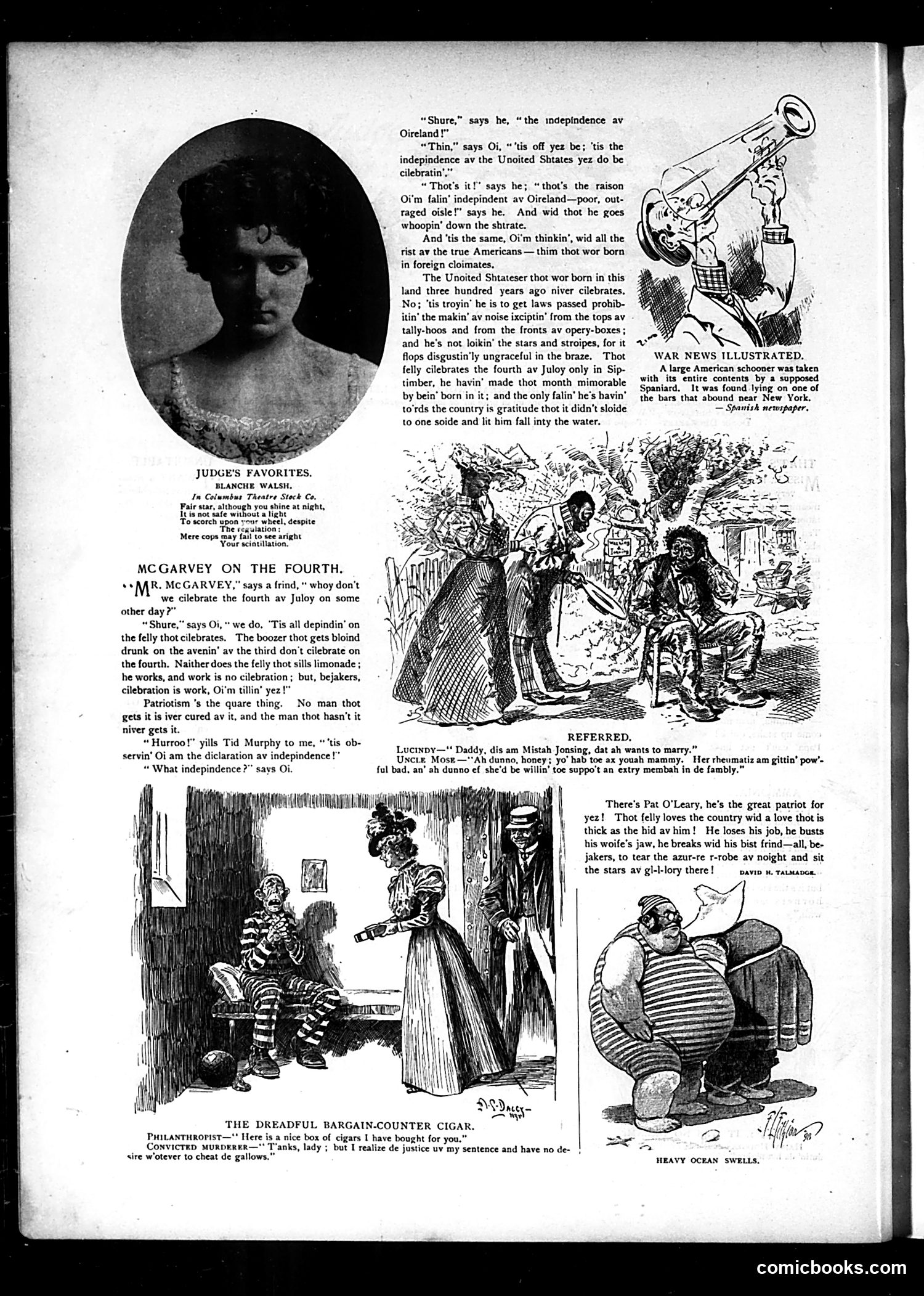
This page satirizes Fourth of July celebrations and American patriotism circa early 1900s. **"McGarvey on the Fourth"** debates whether celebrating Independence Day requires drinking—a commentary on the Irish-American working class (McGarvey appears to be an Irish character) and their association with alcohol. **"The Dreadful Bargain-Counter Cigar"** depicts a philanthropist giving cheap cigars to a "convicted murderer," satirizing paternalistic charity that feels insulting rather than genuinely helpful. **"War News Illustrated"** shows a American schooner attacked near New York. **"Referred"** and **"Heavy Ocean Swells"** are brief comic vignettes about romance and seasickness. The page mixes political/social commentary with light humor typical of Judge's satirical approach to American life and character types.
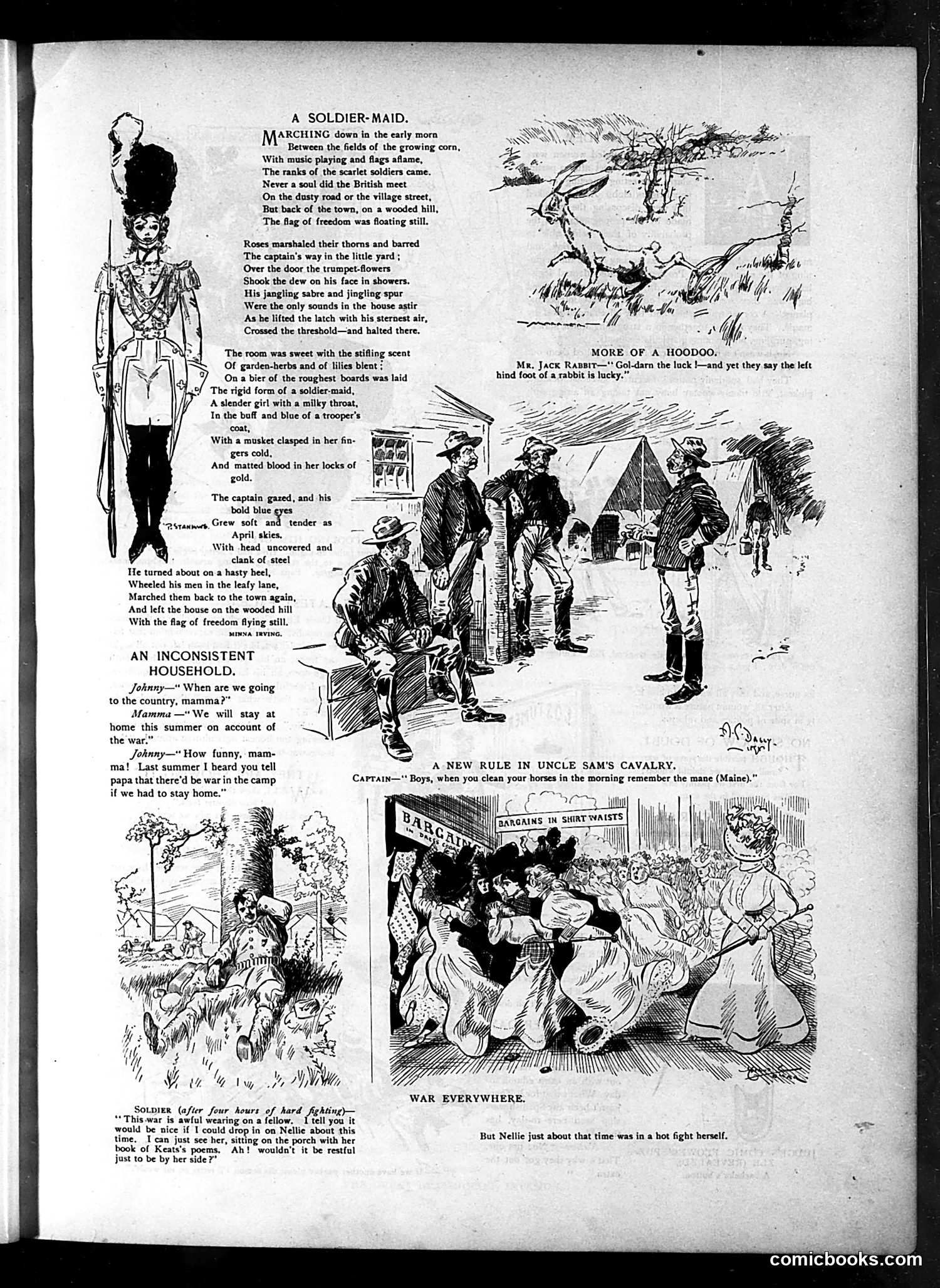
This page from Judge satirizes American life during World War I through multiple cartoons and a poem: **"A Soldier-Maid"** (poem with illustration): A romantic narrative about a British soldier encountering a dead American female soldier in uniform during the war. The twist—a woman soldier—reflects contemporary debates about women's military roles. **"More of a Hoodoo"**: A brief joke about superstition; a man blames bad luck on a rabbit's foot, reflecting folk beliefs. **"An Inconsistent Household"**: Satirizes civilian hypocrisy about war. Parents claim staying home is patriotic wartime sacrifice, but the child recalls them previously fighting about missing country visits—mocking false patriotism. **"A New Rule in Uncle Sam's Cavalry"**: A pun joke. The captain's instruction about cleaning horses' "manes" sounds like "Maine," poking fun at military orders. **"War Everywhere"**: Contrasts a soldier's romanticized fantasies of peaceful domestic life with the reality that his girlfriend is simultaneously in combat—satirizing the pervasiveness of war and shattering romantic wartime illusions.
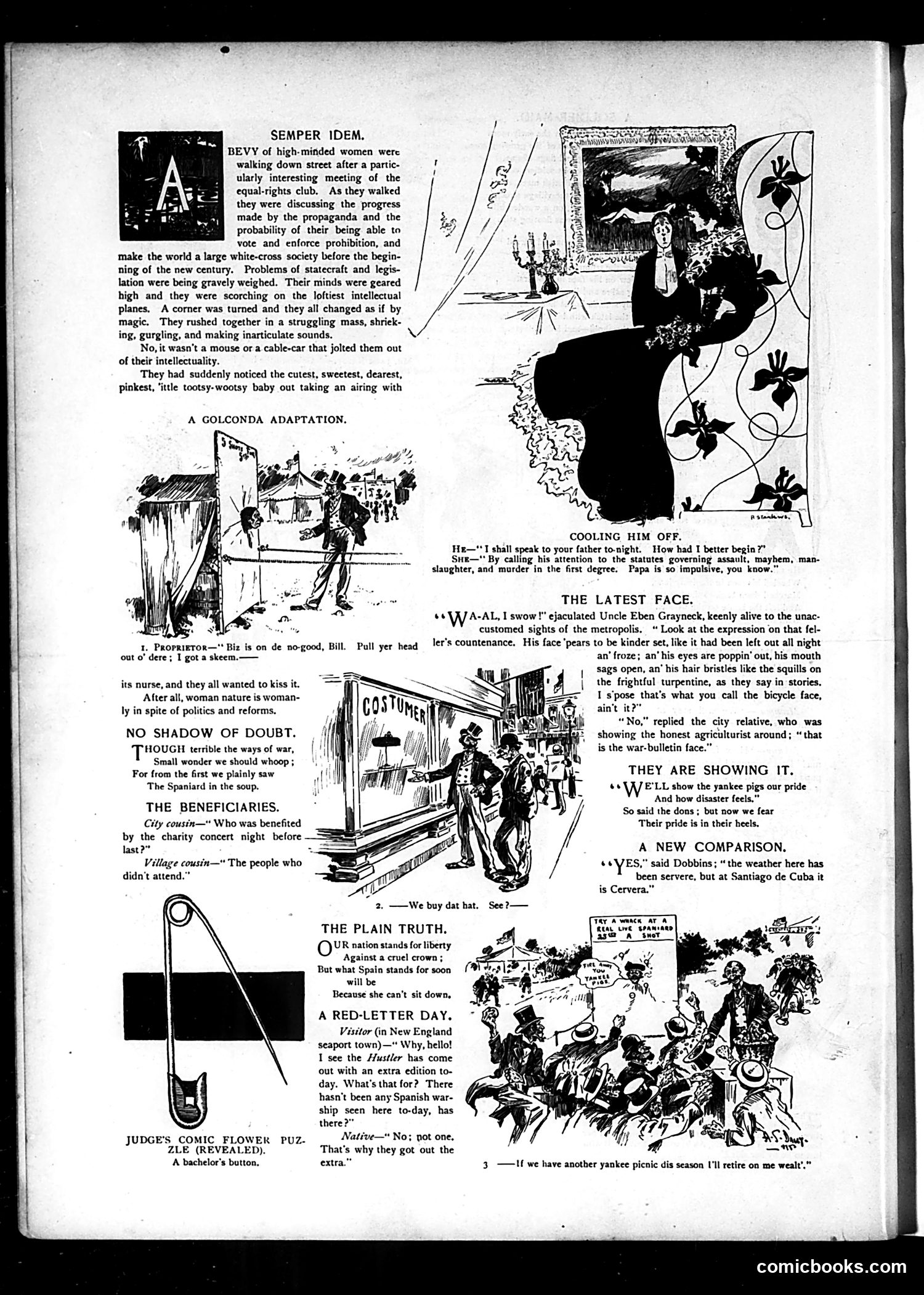
This page satirizes early progressive reform movements and gender politics circa the Spanish-American War era. **"Semper Idem"** (Latin: "always the same") mocks women's rights activists. High-minded suffragettes discuss prohibition and voting rights with intellectual gravitas, then instantly abandon their serious demeanor upon seeing a baby—the joke being that despite claims to equality, women revert to stereotypical maternal instincts. **War-related humor** dominates the lower sections. References to the Spanish-American War include jokes about Spanish vulnerability ("The Spaniard in the soup"), and a pun on **Cervera** (likely Admiral Cervera, Spanish naval commander defeated at Santiago de Cuba) conflated with "Cerveza" (beer). **"The War-Bulletin Face"** describes a shell-shocked expression—possibly referencing war reporting's sensationalism or observers' reactions to combat news. The overall tone is conservative and mocking: ridiculing progressive reformers while displaying nationalism surrounding the Spanish-American conflict. The magazine treats both subjects with irreverent humor rather than serious engagement.
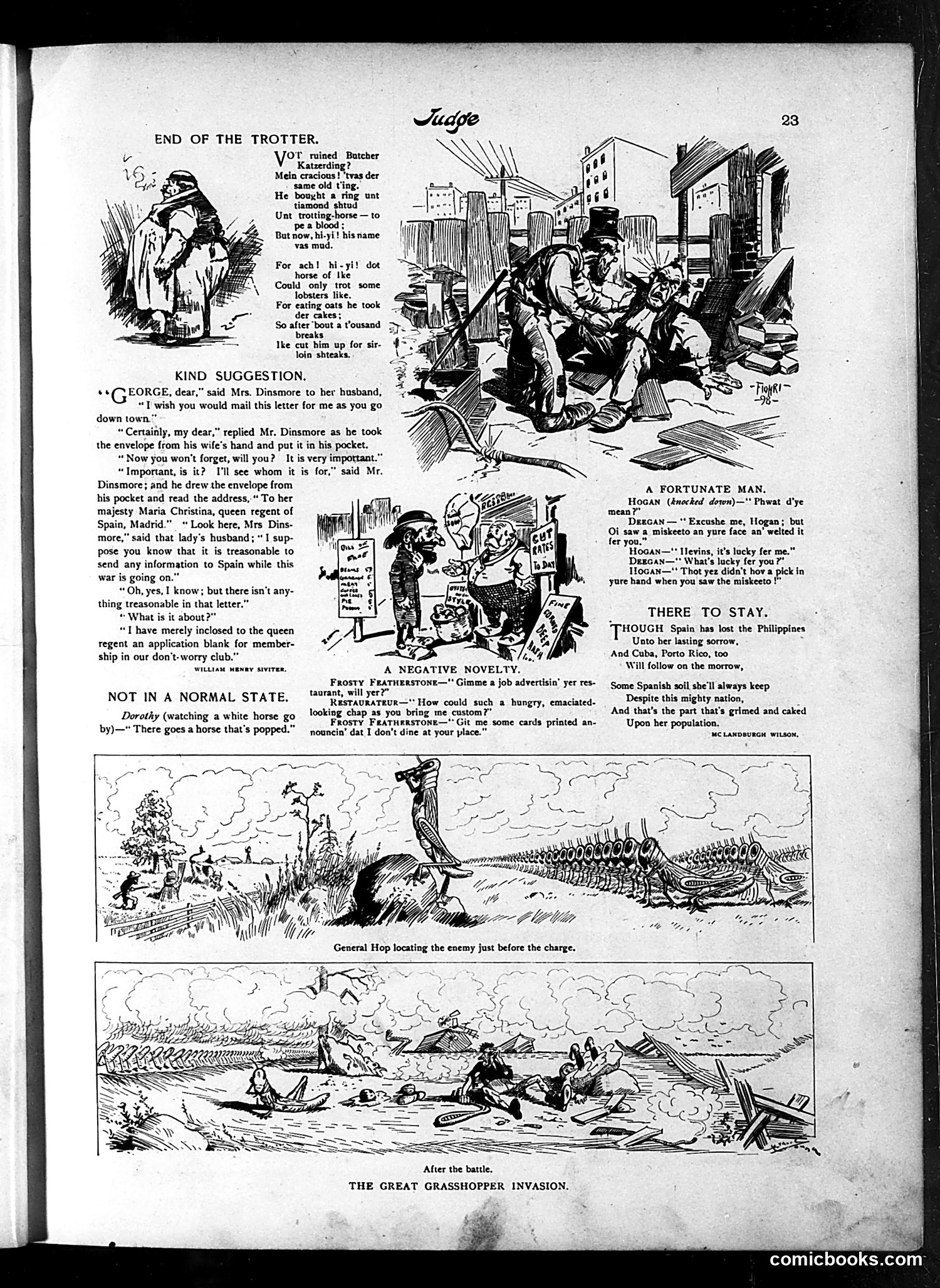
This page contains multiple satirical pieces reflecting the Spanish-American War era (appears to be 1898): **"End of the Trotter"** mocks a German-accented immigrant (stereotypically portrayed) who ruined himself buying a fancy trotting horse, which proved worthless, ultimately ending as meat. **"Kind Suggestion"** jokes about Mrs. Dinsmore sending a "don't-worry club" membership application to Spain's Queen Regent Maria Christina during wartime—implying Spain needs reassurance amid military losses. The satire targets American confidence about Spanish defeat. **"A Fortunate Man"** uses Irish-accented characters in a pun about a mosquito on someone's face being swatted—lucky because the victim didn't have a pick-axe in hand. **"There to Stay"** acknowledges Spain's losses (Philippines, Cuba, Puerto Rico) while suggesting Spain retains some colonial territory, though it's "grimed and caked"—a backhanded comment on Spain's remaining colonial possessions. The bottom illustrations depict "The Great Grasshopper Invasion"—likely a metaphorical military reference, though specifics are unclear.
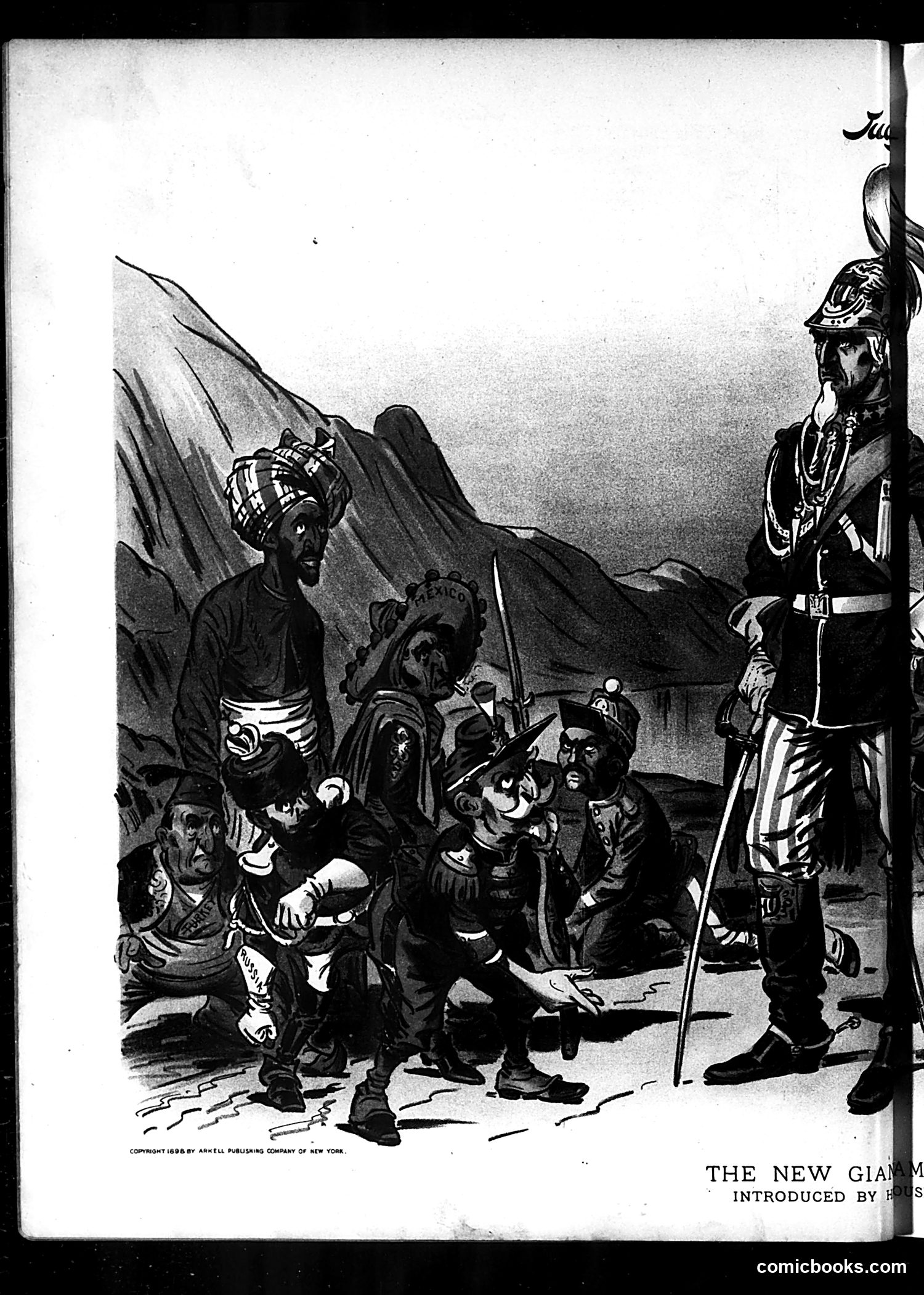
This appears to be a political cartoon from Judge magazine (copyright 1898, per the visible text). The image shows military or imperial figures in formal uniforms encountering what appear to be smaller figures or caricatures, possibly representing different nations or groups. The title "The New Giant Introduced by..." suggests commentary on a nation or power rising to prominence. Given the 1898 date, this likely references American imperial expansion following the Spanish-American War—particularly U.S. involvement in the Philippines, Cuba, or other territories. The formal uniformed figures on the right appear to represent established European powers observing America's new status as a global imperial force. The satirical point seems to critique American expansionism or mock how traditional powers must now reckon with the "new giant" of American imperialism. However, without seeing the complete caption, the specific figures and exact reference remain unclear.
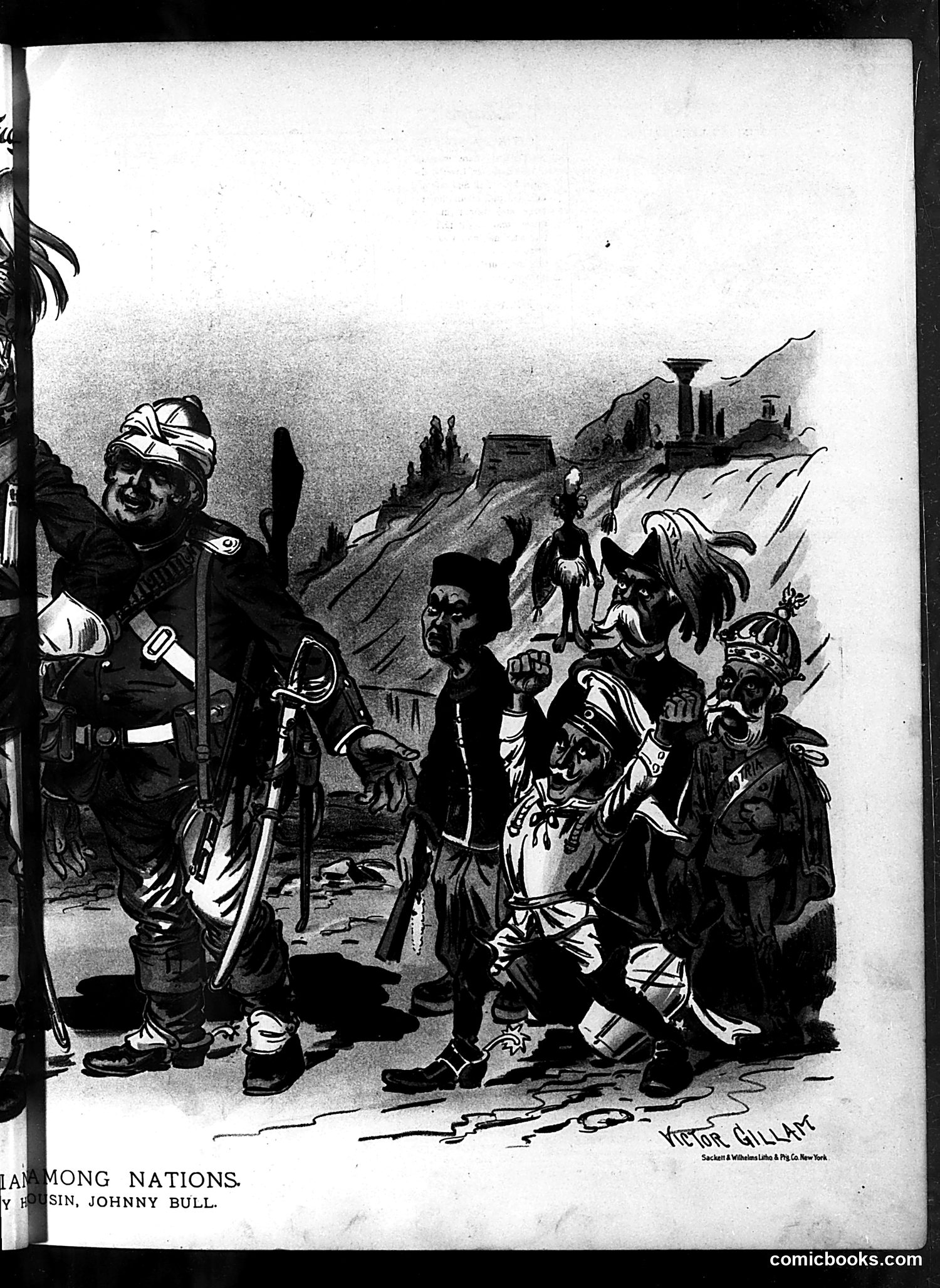
This appears to be a satirical cartoon from *Judge* magazine titled "Among Nations" with a subtitle referencing "Johnny Bull" (a traditional personification of Britain). The image depicts a large military figure on the left—likely representing a European power or imperial nation—confronting a group of smaller, caricatured figures on the right. The style and exaggerated features suggest these represent non-Western peoples or colonized nations. The cartoon appears to satirize colonial or imperialist power dynamics of the late 19th or early 20th century, contrasting the dominance of Western military forces with subjugated or marginalized populations. The specific historical context and which nations are being referenced remains unclear from the visible text alone, though the "Johnny Bull" reference indicates British imperial relations are involved.
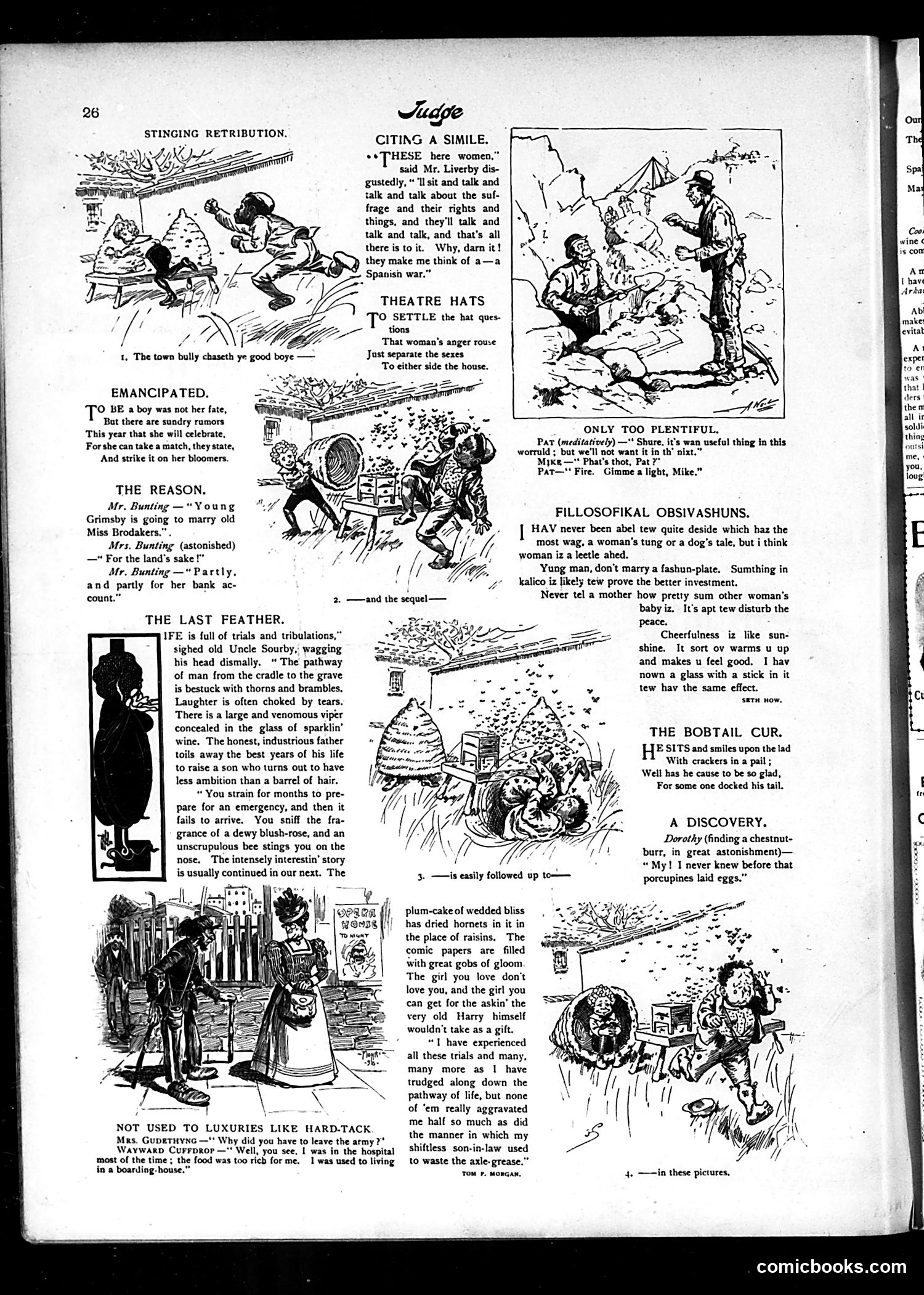
This page collects brief satirical commentaries on contemporary social issues, primarily women's suffrage and gender relations. **"Citing a Simile"** mocks men dismissing women's suffrage activism as mere talk, comparing it dismissively to the Spanish-American War—suggesting both are overblown, pointless controversies. **"Emancipated"** jokes about a woman's independence, suggesting she'll celebrate by striking matches on her bloomers (trousers)—a taunt implying "modern" women are coarse and unfeminine. **"Theatre Hats"** references a real contemporary debate: large women's hats blocked theater audiences' sightlines, causing disputes. The cartoon satirizes the conflict humorously. **"Fillosofical Obsivashuns"** presents folksy, phonetically-spelled "wisdom" discouraging men from marrying fashionable women—coded dismissal of educated, independent females. Other items mock Irish laborers, complainers, and family dynamics. The overall message: the magazine ridicules women's emancipation and suffrage advocates as frivolous, unfeminine, and socially disruptive—typical anti-feminist propaganda of the era.
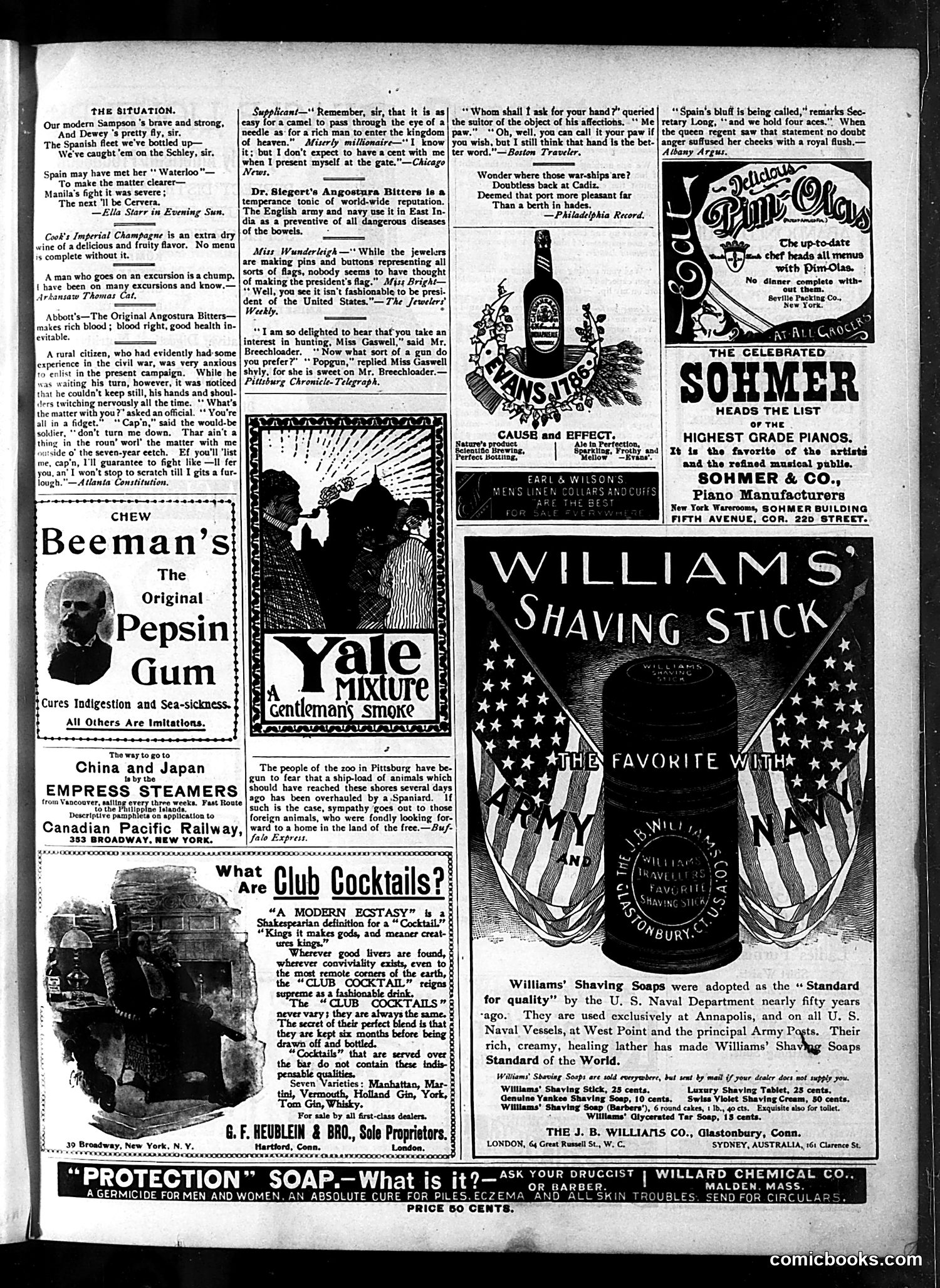
This page from Judge magazine (appears to be from the Spanish-American War era, circa 1898) primarily contains **advertisements and brief humorous anecdotes** rather than substantial political cartoons. The main satirical content relates to the **Spanish-American War**. The opening poem references Dewey (Admiral Dewey's naval victory), Schley (a naval commander), and battles at Manila and Cervera—key 1898 conflict moments. One joke mocks a Spanish ship being captured, while another features a Civil War veteran so eager to enlist against Spain that he can't stand still due to "seven-year itch." The page is dominated by product advertisements (Pepsin Gum, Yale pipe tobacco, Williams' Shaving Stick, etc.), typical of Judge's revenue model. The humor throughout is mild and patriotic, celebrating American military enthusiasm without sharp political critique. **The satire is gentle**: poking fun at recruiting eagerness and wartime fervor rather than criticizing government policy or specific political figures.
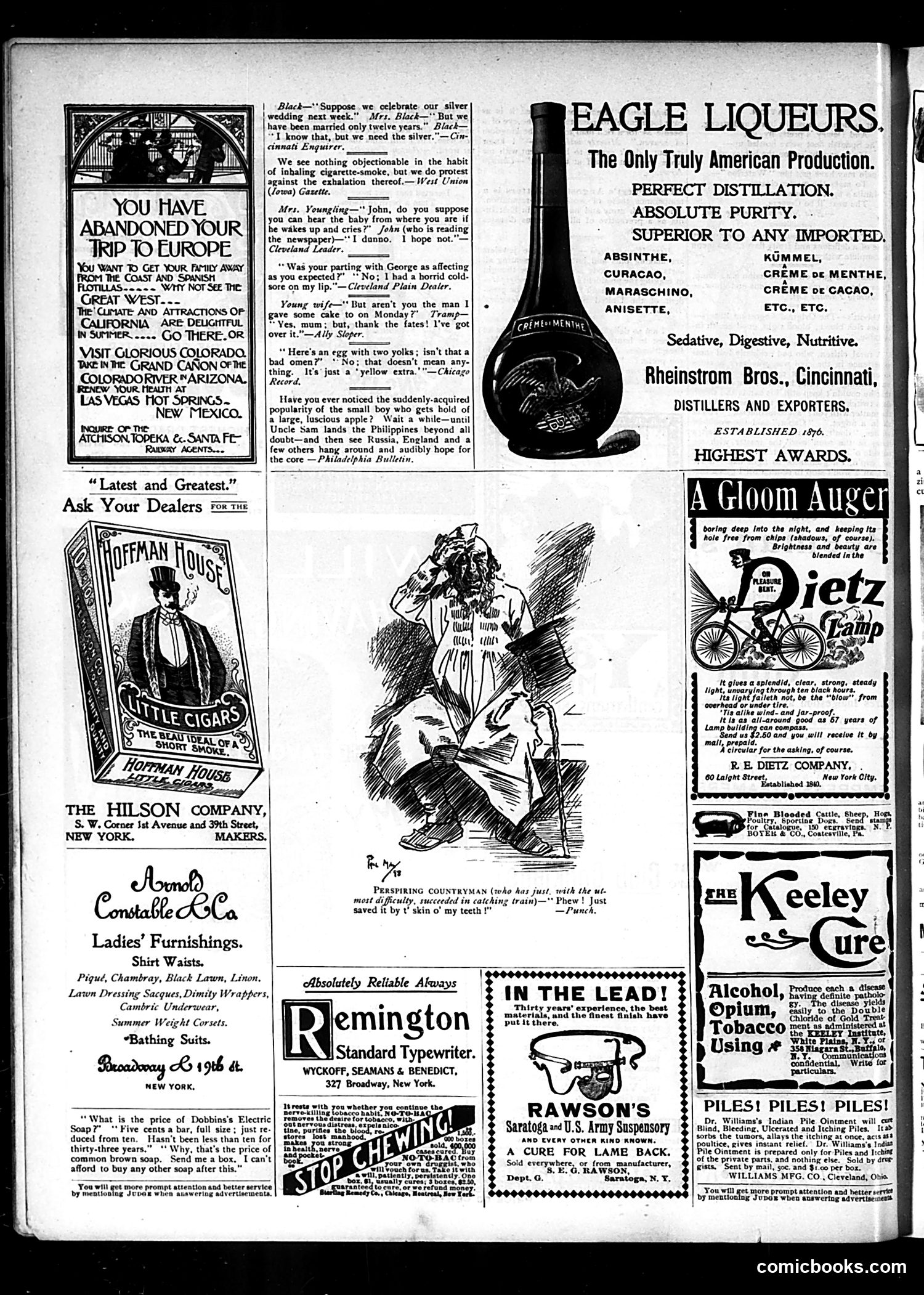
This is primarily an **advertising page** from Judge magazine, circa early 1900s, with minimal actual editorial content. The small section at top contains brief humorous anecdotes—typical Judge fare—poking fun at domestic life and social behaviors: a husband wanting to celebrate a "silver wedding" after only 12 years (because he needs money), a distracted father ignoring his crying baby, and complaints about cigarette smoke and romantic cold sores. These are gentle, apolitical jokes about everyday married life. The page is otherwise dominated by advertisements for products marketed to middle and upper-class readers: liqueurs (Eagle brand), cigars (Hoffman House), ladies' clothing, typewriters (Remington), lamps, and patent medicines—including dubious remedies for piles and alcohol/opium addiction. A striking illustration shows a "perspiring countryman" who barely caught a train, captioned with relief. **No significant political satire or caricature appears here.** It's a commercial page typical of American magazines from this era, when advertising subsidized publication costs.
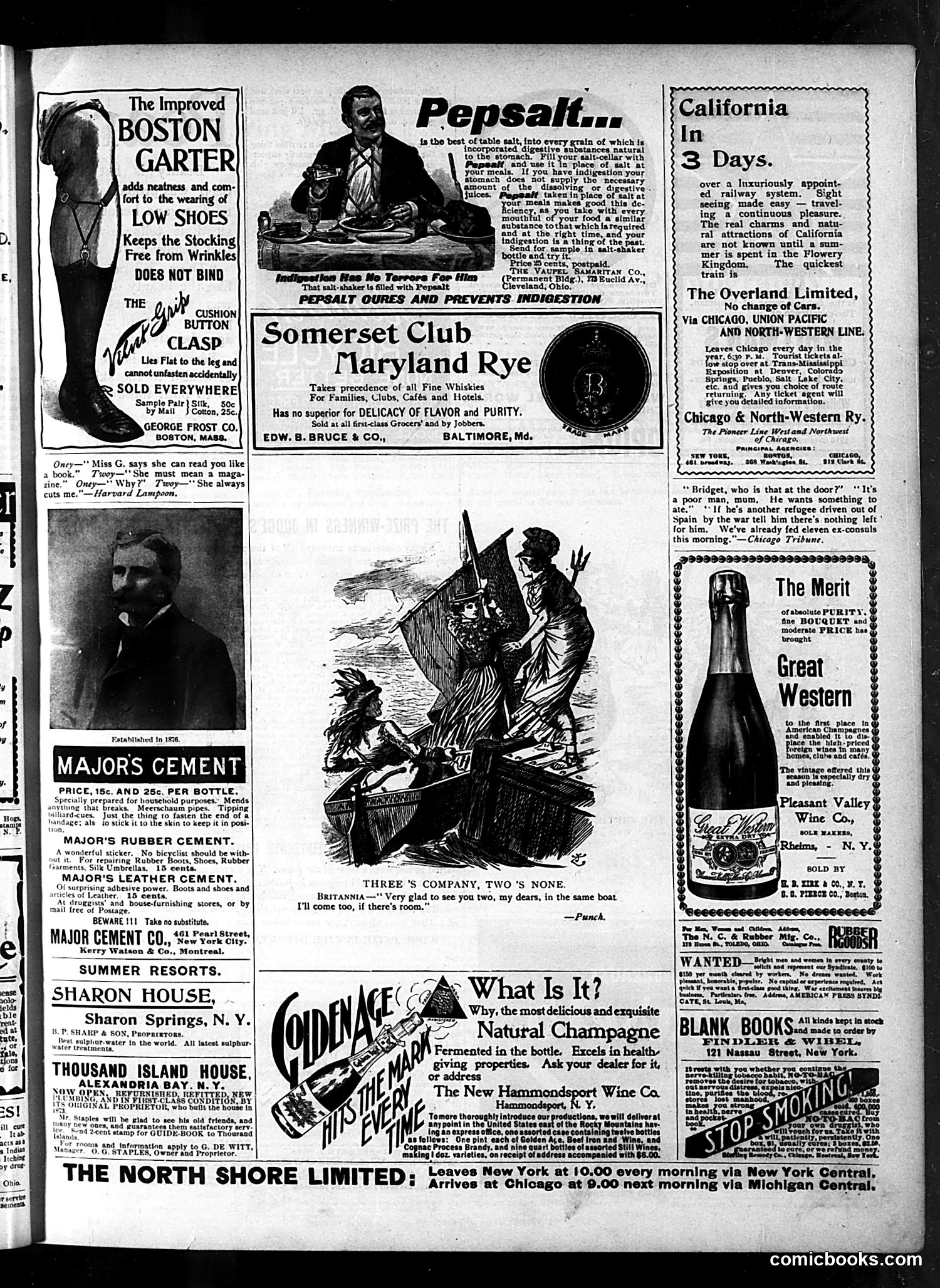
This page is primarily **advertising**, typical of Judge magazine's revenue model. However, it contains one notable political cartoon: **"THREE'S COMPANY, TWO'S NONE"** (center): A Punch cartoon showing Britannia (Britain personified) encountering two figures in a boat, offering to join if there's room. This likely references Britain's diplomatic position during a conflict—possibly the Spanish-American War era (late 1890s) or another colonial dispute—where Britain considers joining two other powers. The satire suggests overcrowding or Britain's awkward positioning in international affairs. The page also includes a joke about a "refugee driven out of Spain," suggesting recent Spanish upheaval (possibly the Spanish-American War or internal conflict). The remaining content is commercial: Pepsalt (digestive salt), Somerset Club whiskey, Majors Cement products, travel advertisements (California railways, summer resorts), and wine promotions. These ads reflect early 1900s consumer products and leisure culture.
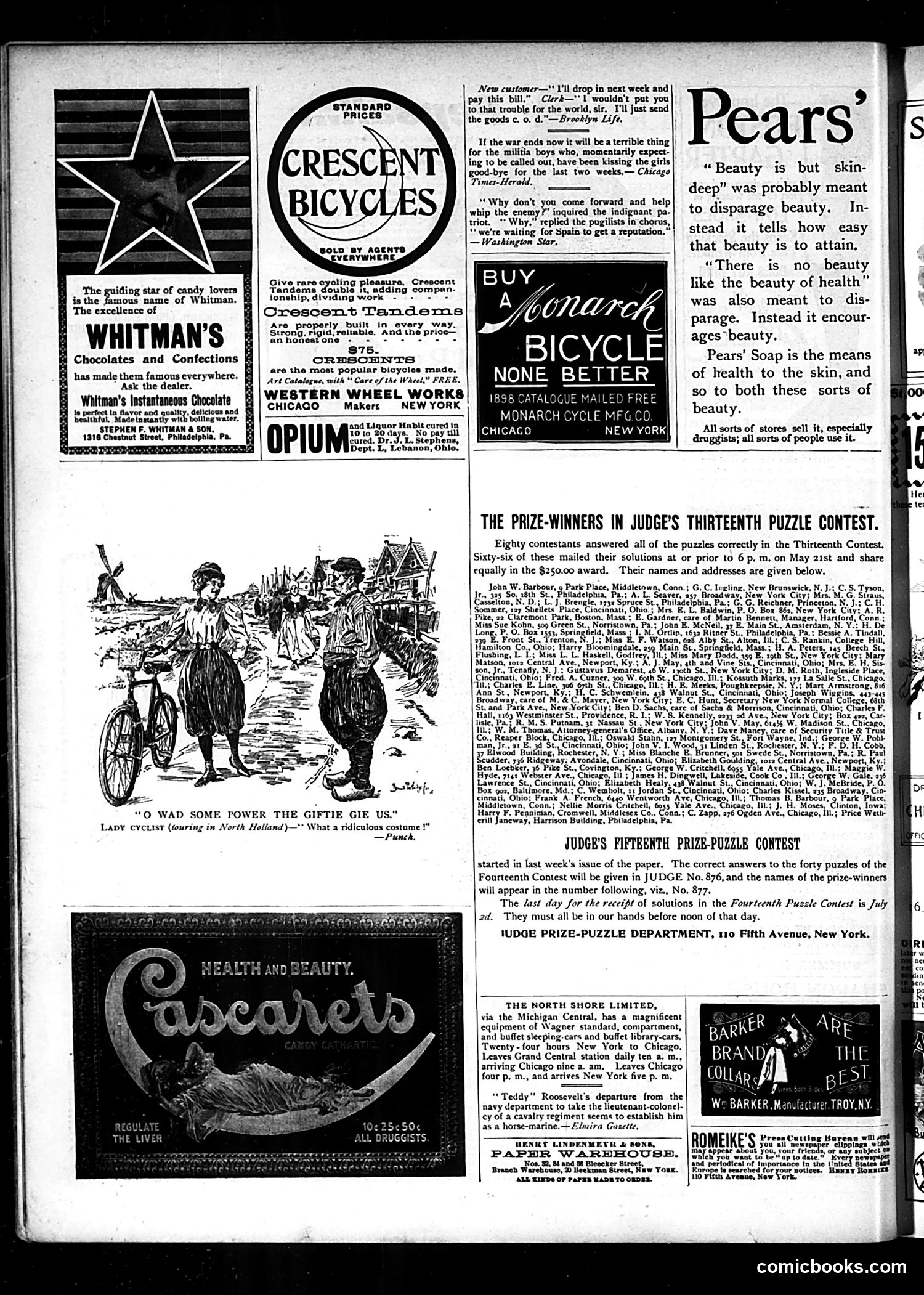
This page is primarily **advertising and contest announcements**, not political satire. The main content includes: **Advertisements:** Whitman's chocolates, Crescent bicycles, Monarch bicycles, Pears' soap, and other period products dominate the layout. **The One Cartoon:** The small illustration captioned "O Wad Some Power the Giftie Gie Us" shows a lady cyclist in North Holland commenting on someone's "ridiculous costume." This is mild social humor about cycling fashions—women cyclists were still a novelty, and their practical clothing choices drew mockery from traditionalists. The phrase references Robert Burns's poem about wishing to see ourselves as others see us, suggesting ironic perspective on fashion judgment. **Contest Results:** The bulk of the page announces winners of Judge's Thirteenth Puzzle Contest, listing 66 prize-winners who solved puzzles correctly. The page reflects early 1900s advertising and leisure culture, with bicycles and beauty products prominent—no significant political commentary.
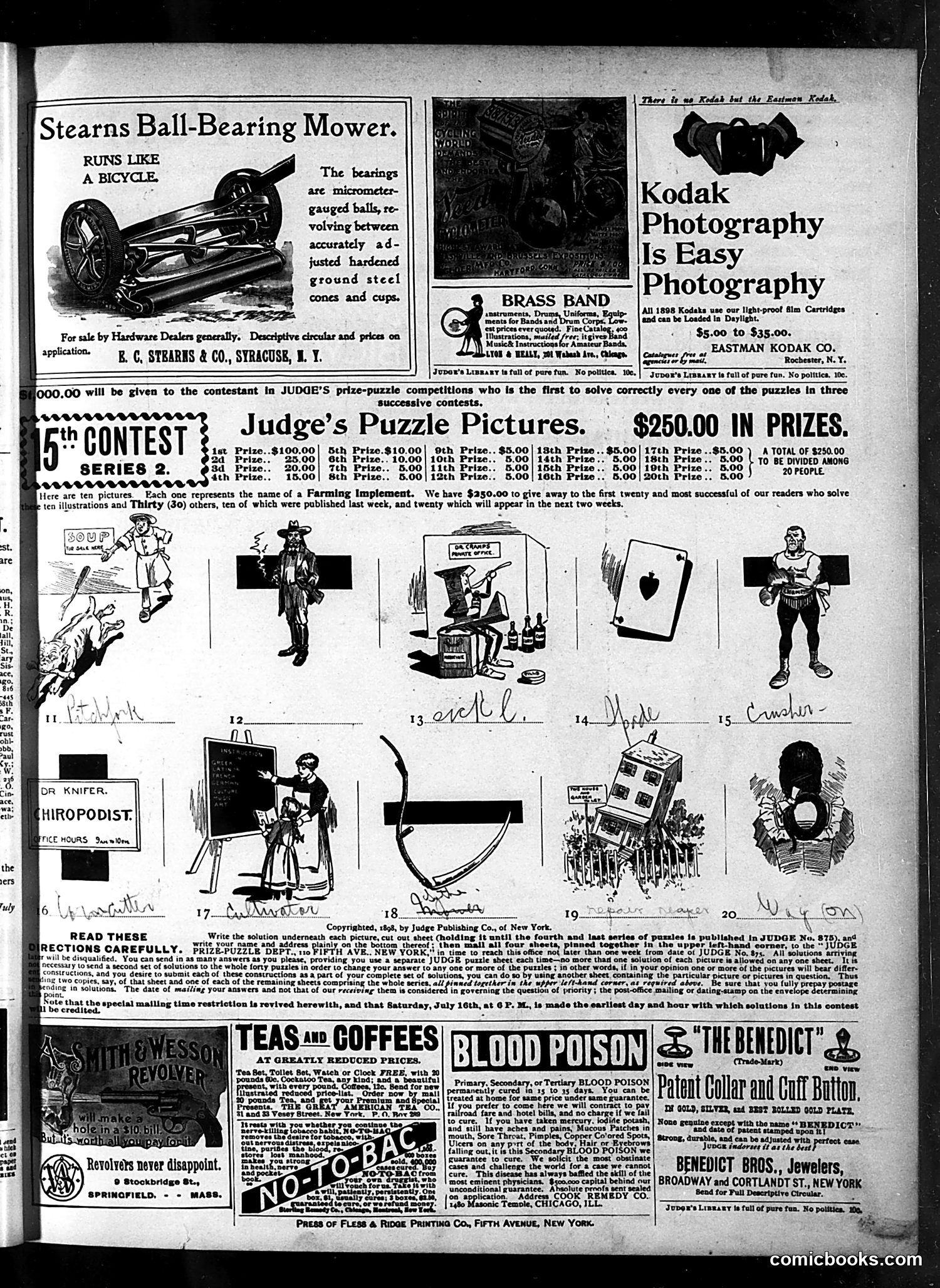
This page is primarily a **puzzle contest** rather than political satire. Judge magazine (#870, 1898) offers $250 in prizes for readers who identify ten farming implements depicted in cartoon illustrations (pictures 11-20 visible here). The puzzle instructions occupy the center and lower portion. Contestants must name each farming tool represented pictorially, cut out illustrations, and mail solutions to Judge's offices—with strict mailing deadlines noted. The page margins feature **period advertisements**: Stearns ball-bearing lawn mowers, Kodak cameras (promoting new daylight-loading film cartridges), a brass band instruction service, and various commercial products (Smith & Wesson revolvers, teas/coffees, blood poison treatments, and Benedict Bros. jewelry). The cartoons themselves appear to be visual riddles rather than satirical commentary—their humor derives from how abstractly or cleverly the farming implements are illustrated rather than from political or social critique. This represents Judge's lighter entertainment content alongside its better-known political cartooning.
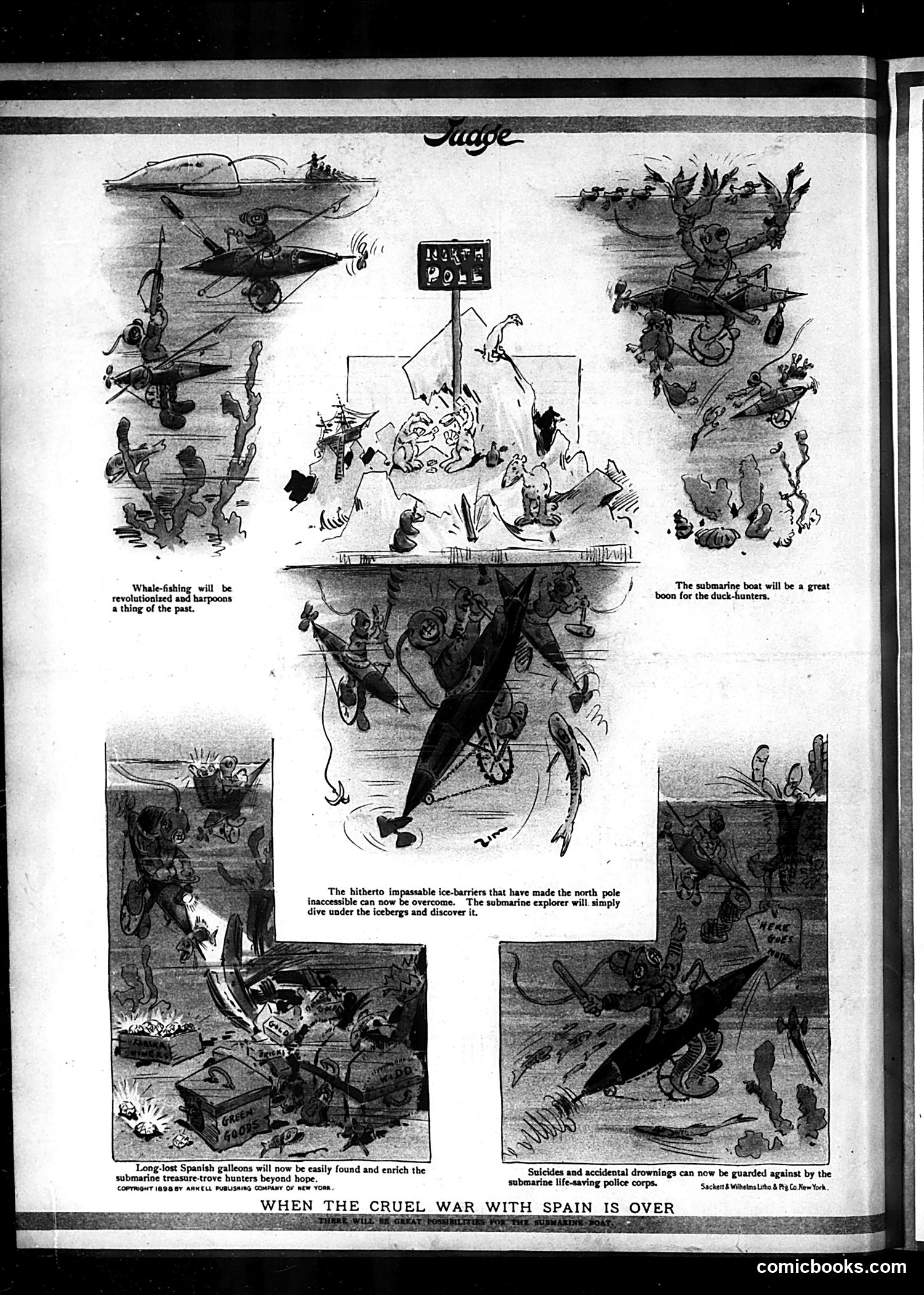
This Judge magazine satire mocks overly optimistic predictions about submarine technology following the Spanish-American War (1898). The central cartoon depicts a submarine at a voting poll, surrounded by fantastical applications for the new vessels. The page ridicules absurd claims that submarines would revolutionize whale-hunting, overcome Arctic ice barriers to reach the North Pole, locate Spanish shipwrecks for treasure, and prevent drownings. Side panels show equally implausible scenarios. The satire targets two audiences: those promoting submarines as technological panaceas for any problem, and post-war American triumphalism. By pairing the submarine's legitimate military achievement against Spain with these ridiculous civilian applications, Judge suggests people were irrationally excited about the technology's potential. The title references Spain's recent defeat, implying Americans were riding high on military victory and embracing inflated technological optimism without realistic assessment.