
A complete issue · 16 pages · 1898
Judge — June 18, 1898
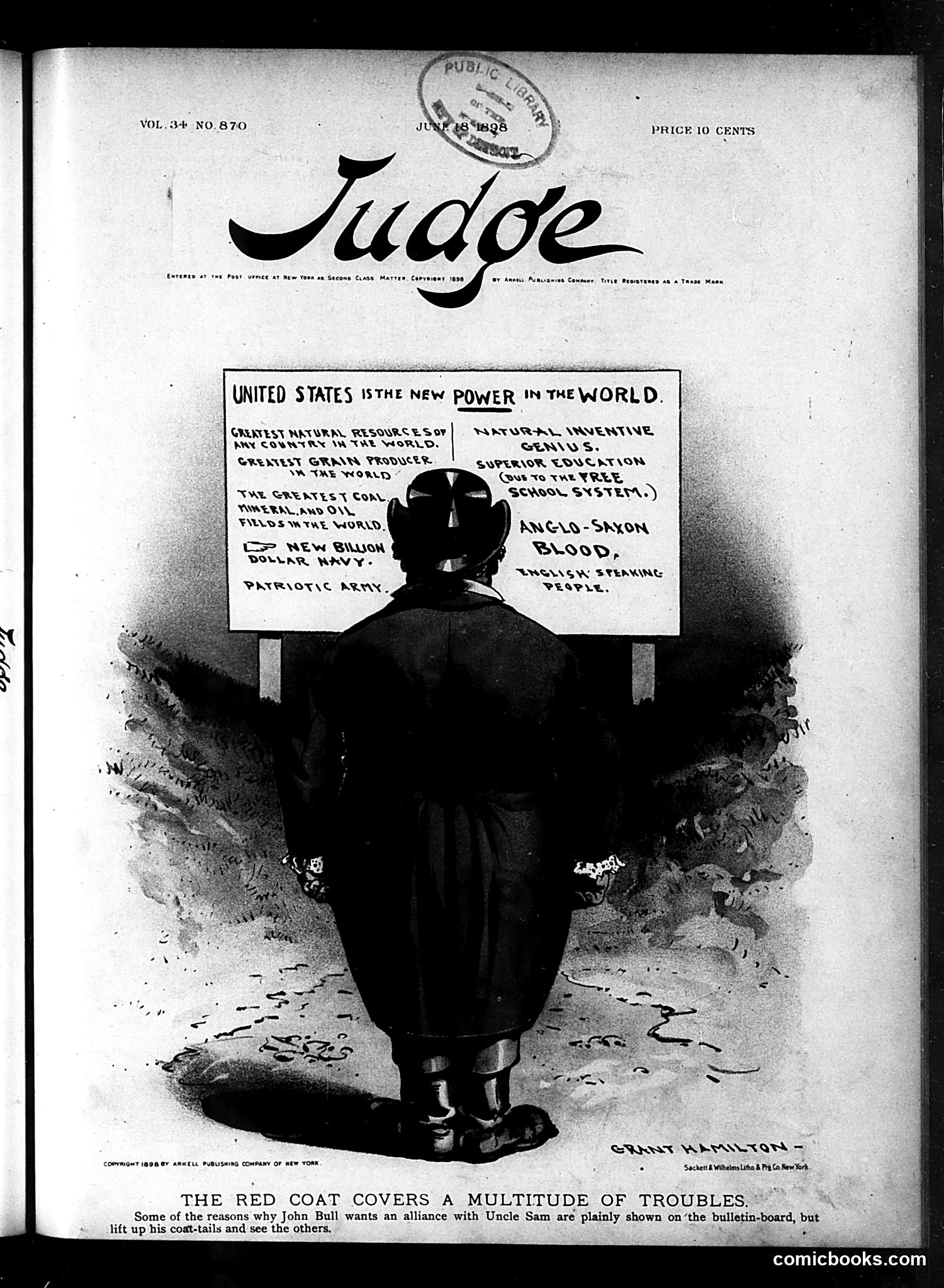
This political cartoon satirizes American expansionism and militarism at the turn of the 20th century. A figure representing "John Bull" (Britain, shown from behind) displays a bulletin-board listing America's growing power: natural resources, superior education, naval strength, and Anglo-Saxon heritage. The cartoon's caption references "John Bull" wanting "an alliance with Uncle Sam," suggesting Britain seeks partnership with the increasingly powerful United States. The "Red Coat" title alludes to British military tradition. The satire targets American boasting about its newfound global dominance—particularly relevant given the recent Spanish-American War (1898) and America's emergence as a world power. The imagery critiques American triumphalism while acknowledging Britain's recognition of this shift in global influence.
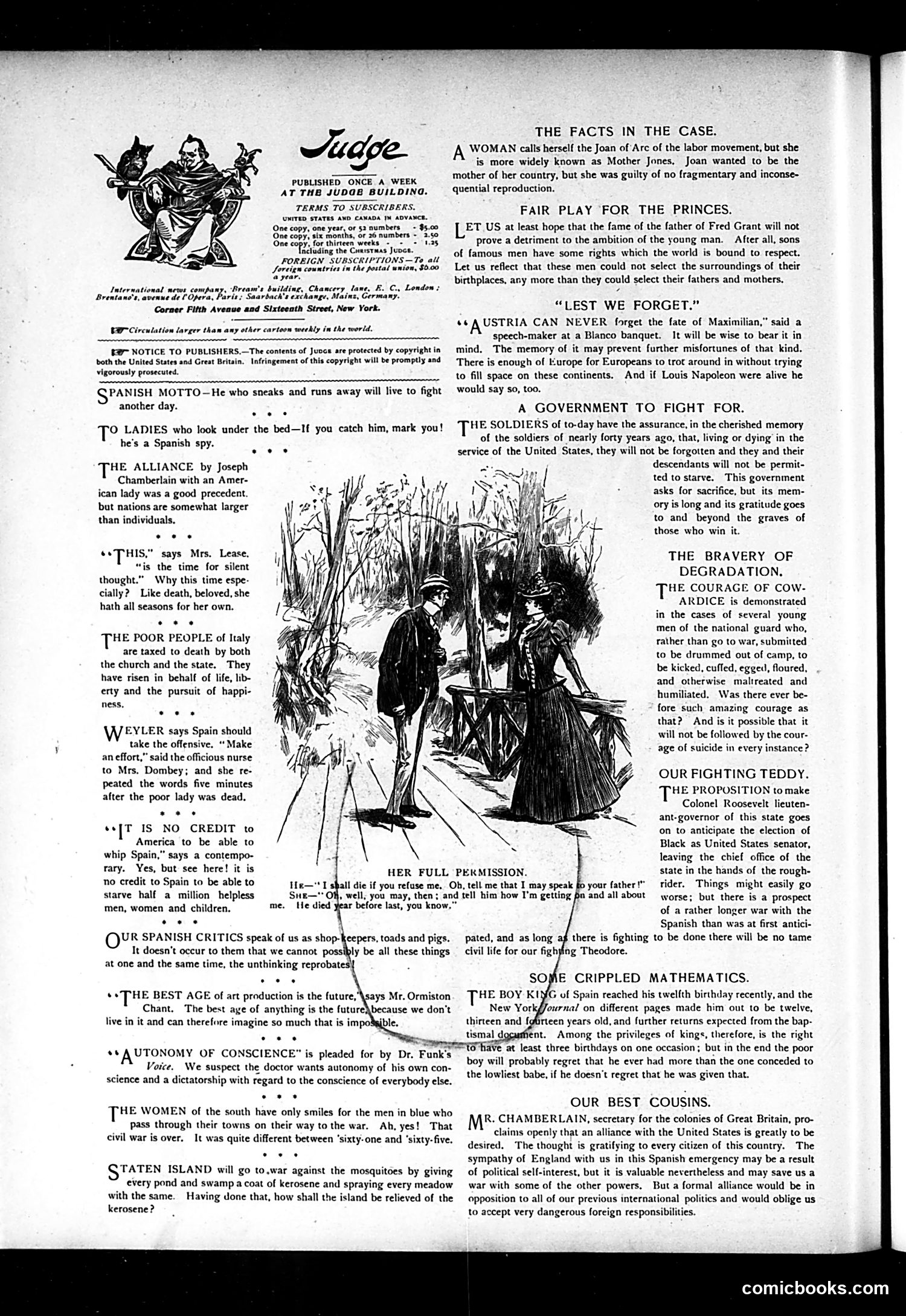
The main cartoon depicts a WWI-era military scene with soldiers in a trench. The dialogue reads: "He—'I shall die if you refuse me. Oh! tell me that I may speak to your father!' She—'Oh! well, you may; then; and tell him how I'm getting on and all about the shell and before last, you know.'" This satirizes romantic proposals during wartime, mocking the contrast between traditional courtship formality and the brutal realities of trench warfare. The soldier's earnest romantic plea is undercut by the woman's casual, practical concerns about combat conditions—suggesting the absurdity of maintaining Victorian courtship conventions amid industrial-scale killing. The surrounding text addresses WWI military sacrifices and government obligations to soldiers, reflecting American debate over potential intervention in the conflict.
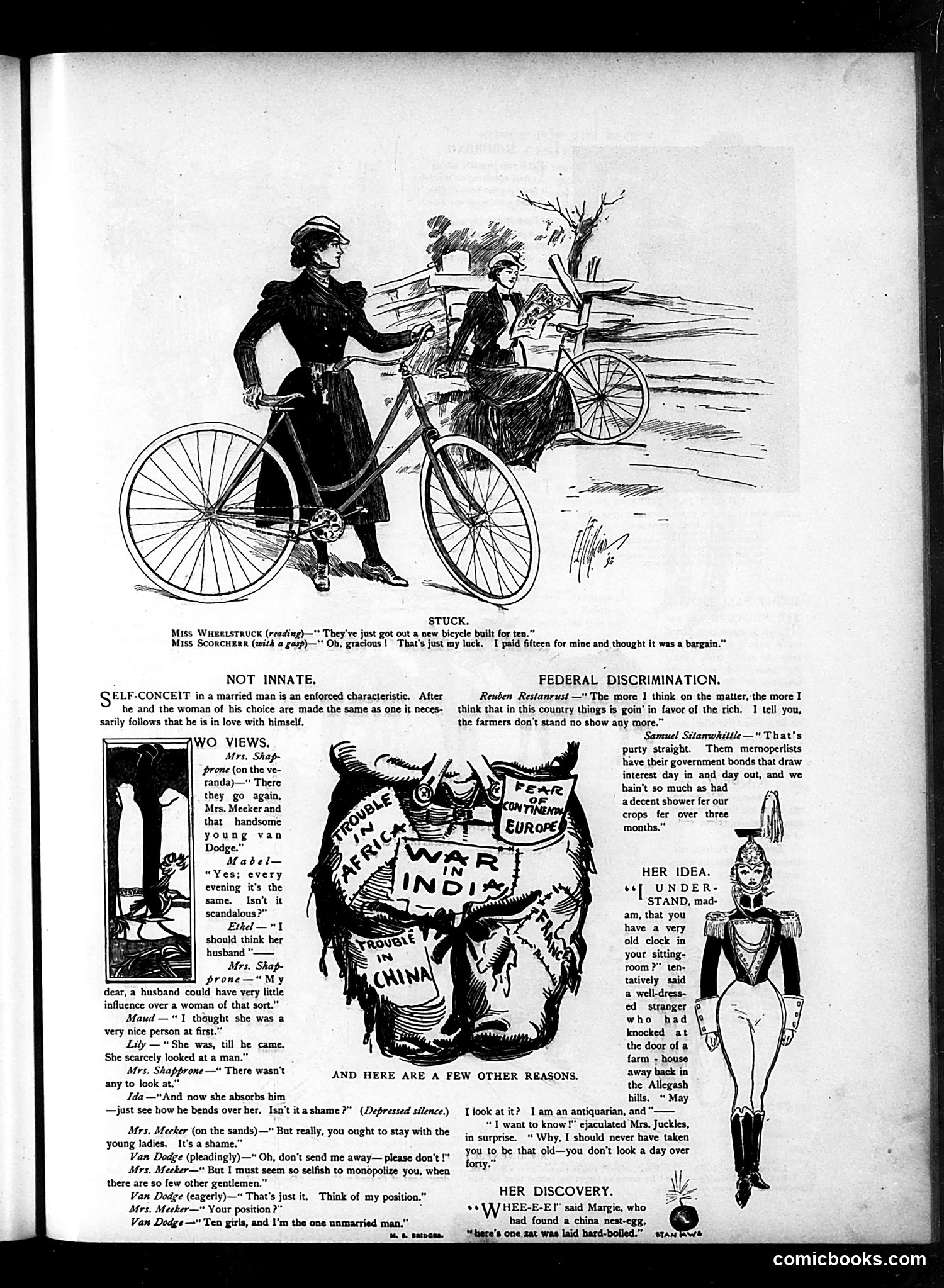
The top cartoon "STUCK" satirizes the bicycle craze of the 1890s. Two fashionable women on bicycles discuss their new purchases—one paid fifteen dollars thinking it a bargain, while the other spent more for a "tea-built" model. The joke targets the conspicuous consumption and status-seeking around the newly popular bicycle technology among wealthy women. The central political cartoon depicts a grotesque figure labeled with global conflicts: "War in India," "Trouble in China," "Fear for Europe," and "Africans in Trouble." This appears to reference late-19th-century imperial tensions and colonial conflicts threatening world peace. The remaining sections present humorous dialogue and social commentary on gender relations, marriage, and class attitudes—typical Judge magazine content mocking contemporary society and manners.
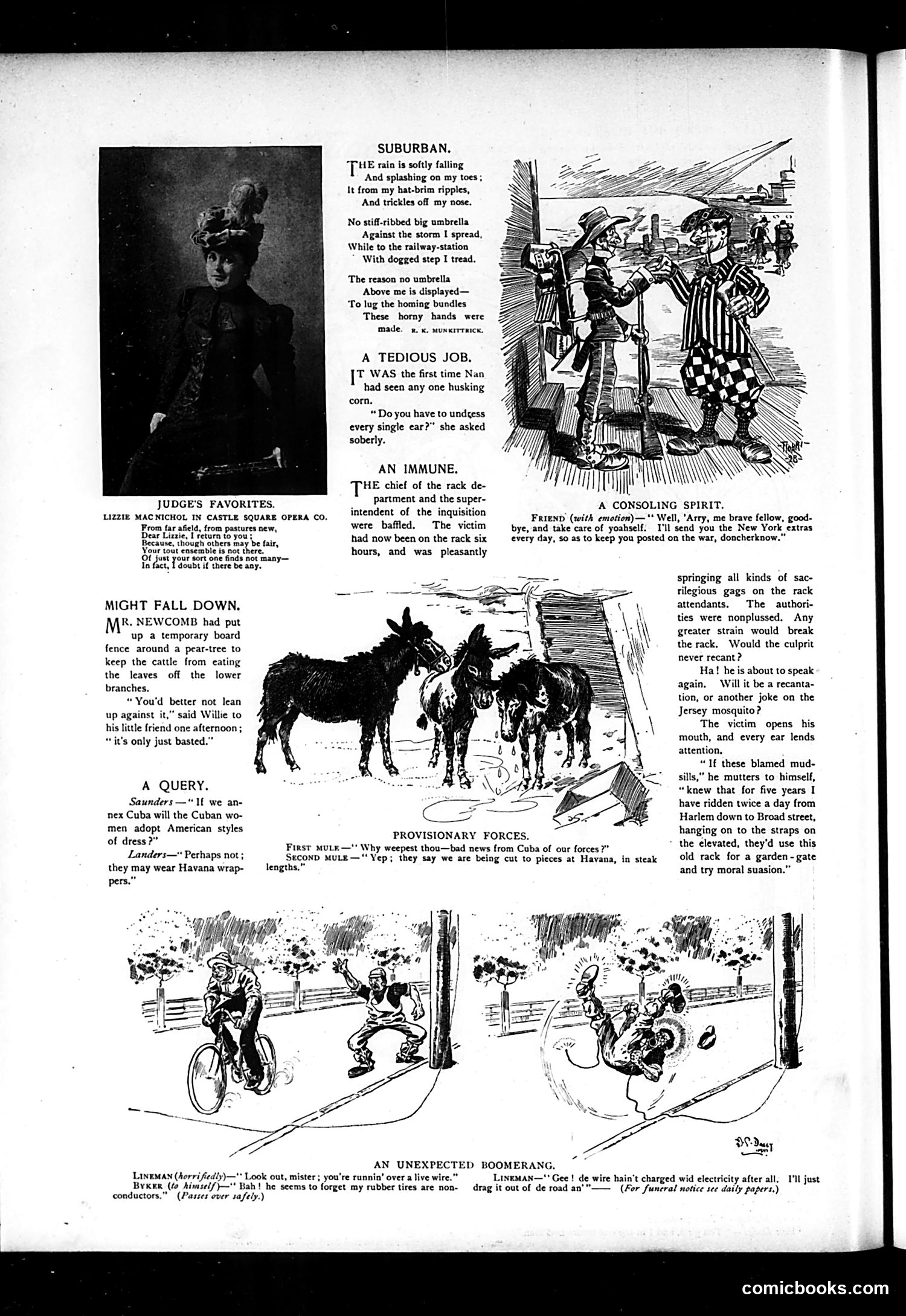
This page contains several unrelated satirical pieces and jokes typical of Judge magazine's format: **"Suburban"** mocks commuter complaints about weather and train delays. **"A Tedious Job"** jokes about a woman's first experience husking corn, asking if she must undress for every ear. **"An Immune"** references torture victims during what appears to be an inquisition or colonial context, with dark humor about endurance. **"Might Fall Down"** contains a domestic joke about a temporary fence. **"A Query"** asks whether Cuban women will wear American dress styles. **"Provisionary Forces"** features two mules discussing Cuban military news in anthropomorphized dialogue. **Bottom cartoons** depict bicycle accidents with electrical wires, making jokes about rubber tires and electricity. The page is primarily comedic rather than overtly political, using wordplay and visual gags.
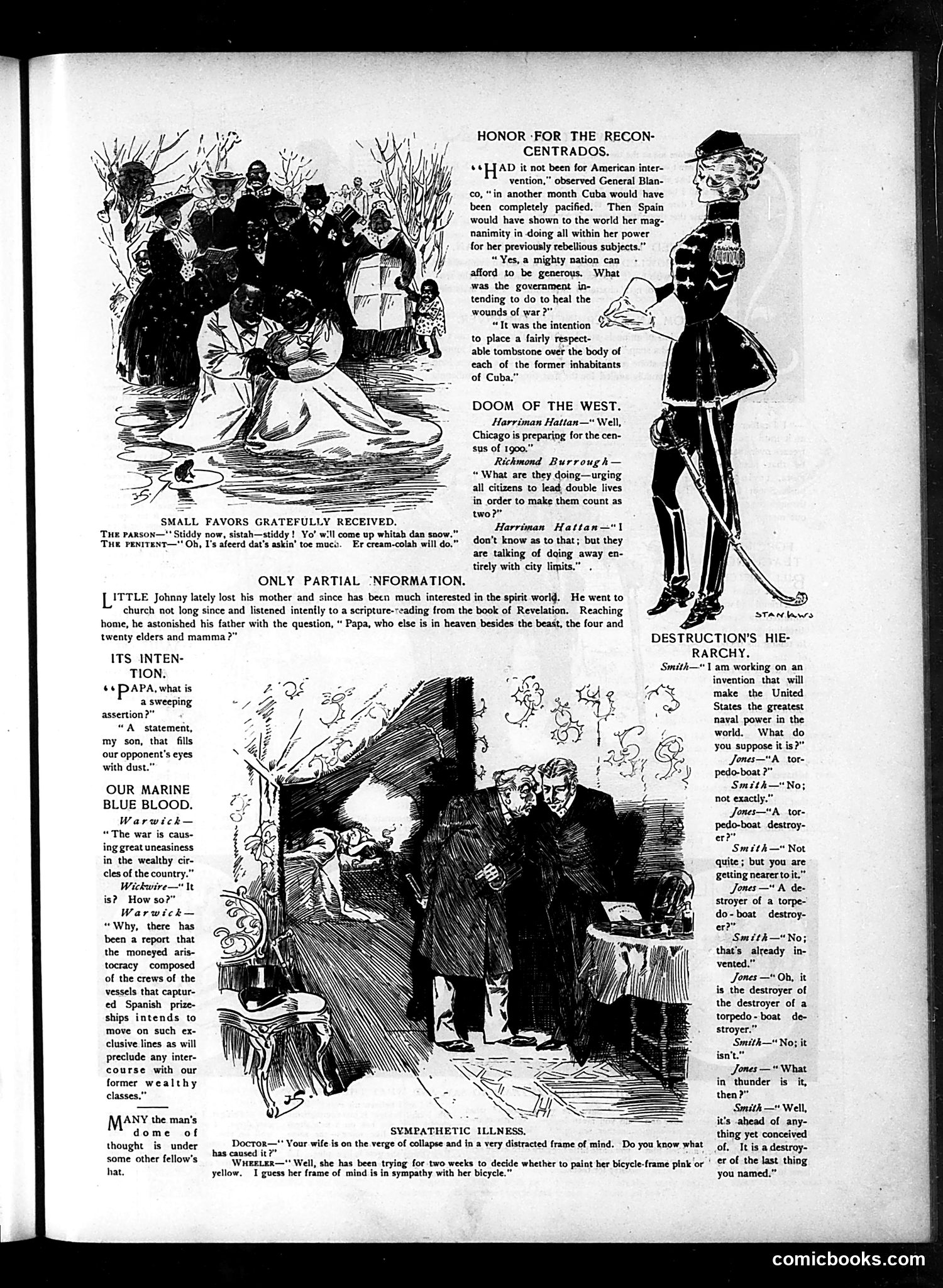
This page satirizes American intervention in Cuba during the Spanish-American War era. The top cartoon, "Honor for the Reconcentrados," mocks Spanish General Blanco's claim that Spain would have pacified Cuba without American intervention. The bitter joke: Spain's "generous" plan was merely to place tombstones over dead Cuban civilians—the "reconcentrados" were Cubans imprisoned in Spanish concentration camps where thousands died. Other cartoons address contemporary concerns: Chicago's census preparations, naval power development, and a child's theological confusion after hearing Revelation read aloud. The "Small Favors" cartoon appears to reference racial attitudes of the period through dialect humor about skin color. The satire's central point criticizes American intervention as necessary to stop Spanish brutality, while mocking Spanish claims of magnanimity. The page reflects Judge's anti-imperialist or interventionist stance during this contentious historical moment.
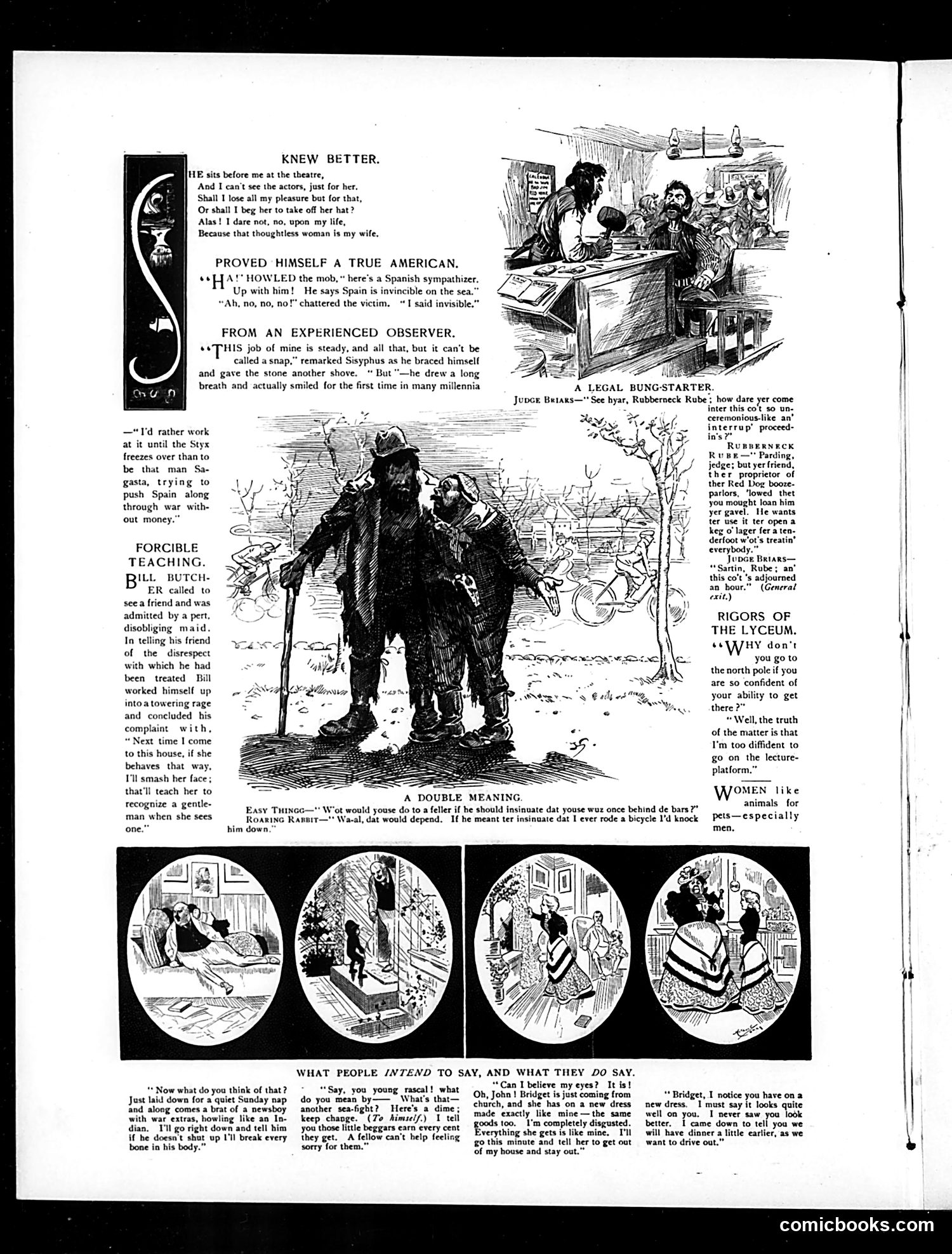
This page satirizes American social hypocrisy through several vignettes showing the gap between people's *stated* intentions and *actual* behavior. **Main themes:** The opening verses mock theater etiquette and marital dynamics. "Proved Himself a True American" lampoons mob hysteria during the Spanish-American War era—a man nearly lynched for saying Spain is "invincible" when he meant "invisible," revealing how jingoistic fervor overrides reason. **The bottom section, "What People Intend to Say, and What They Do Say,"** is the page's core satire. Four vignettes contrast what people claim they'll do with what they actually do: a man threatens violence against a rude maid but later sympathizes with newspaper boys; a napper complains about newsboys then tips them; a woman plans to shame her maid's identical dress but actually compliments her instead. The humor exposes middle-class pretense—people's claims to principle crumble when confronted with actual human circumstances, revealing their true (often kinder) nature contradicts their blustering. The peripheral sections (Sisyphus joke, lyceum story) extend this theme of contradictory human behavior.
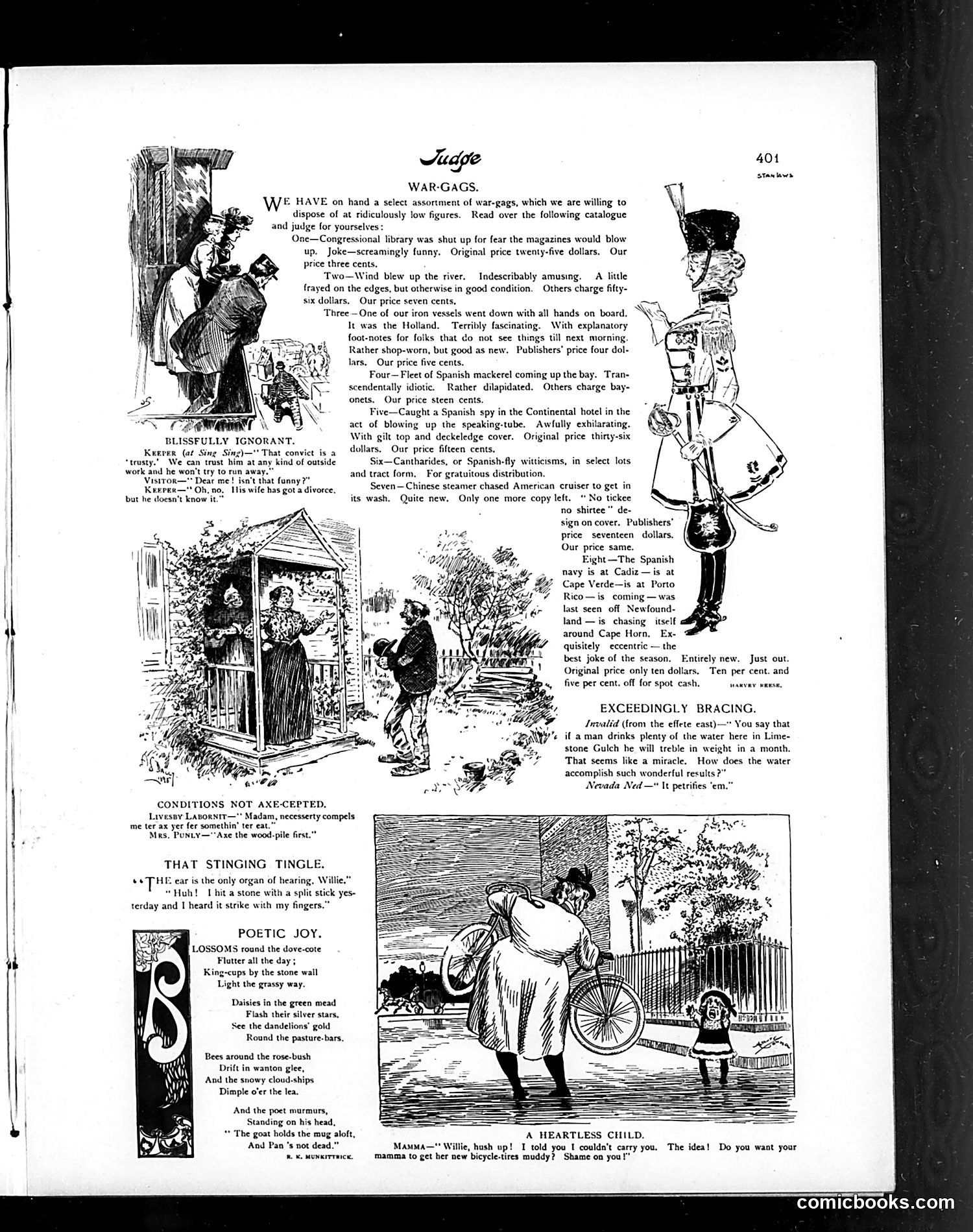
This page satirizes American jingoism during the Spanish-American War era (likely 1898). The main feature, "War-Gags," mocks how eagerly the public consumed war-related "humor" by presenting supposedly comedic items for sale at absurdly reduced prices—treating serious military events as disposable jokes. Examples include: a Congressional library incident, the USS Holland submarine disaster, Spanish spy stories, and repeated contradictions about the Spanish fleet's location ("at Cadiz—is at Cape Verde—is at Porto Rico"). The joke is that these "gags" become progressively absurd and repetitive, reflecting how war coverage had become sensationalized and farcical. The supporting cartoons mock rural ignorance and parental discipline. Overall, Judge critiques American society's casual consumption of war news as entertainment, reducing genuine military and diplomatic crises to commercial commodities for public amusement.
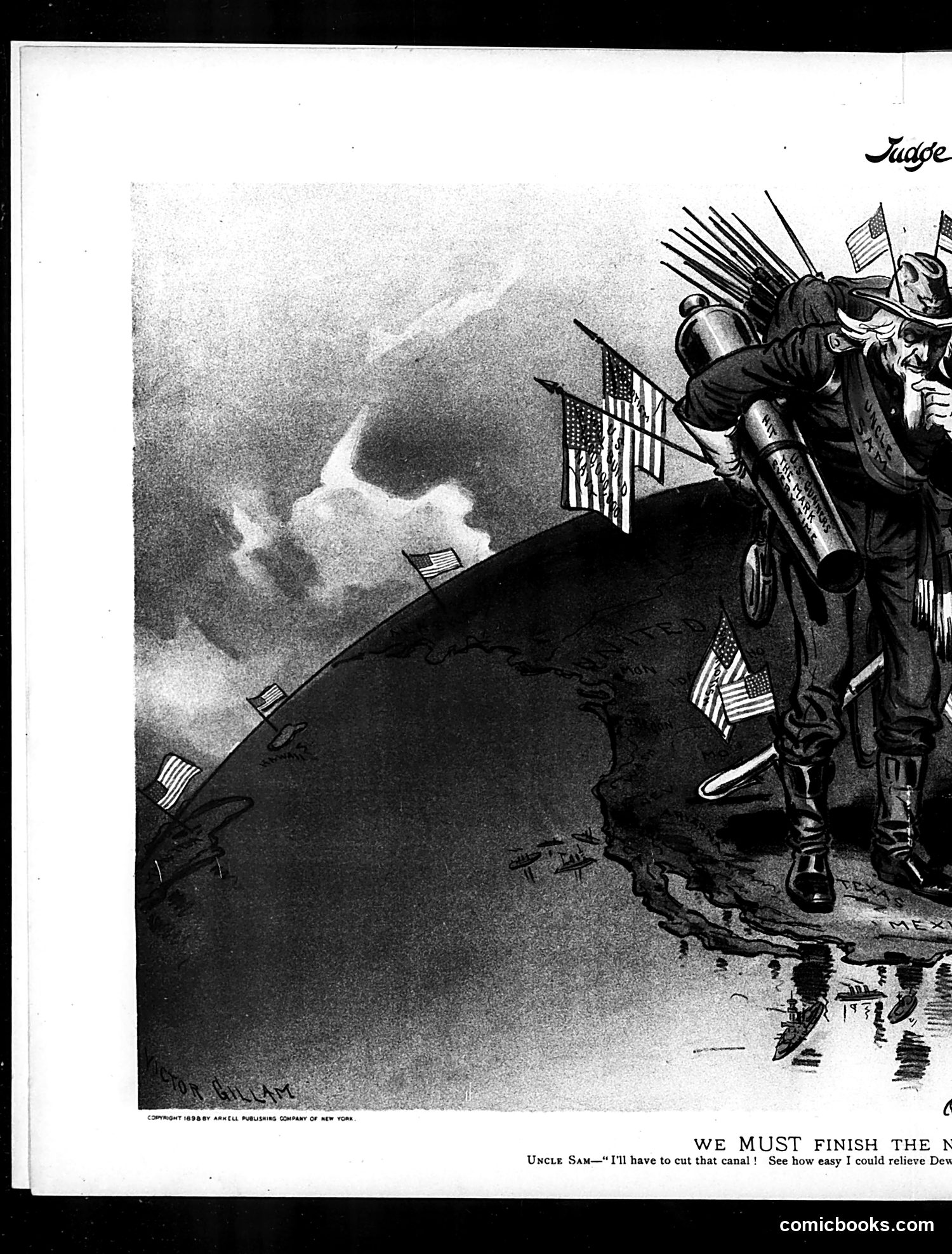
This Judge magazine cartoon depicts Uncle Sam (personified as an American soldier with military gear and flags) standing over what appears to be a partially constructed canal, likely the Panama Canal. The caption indicates Uncle Sam must "cut that canal" and mentions "relieving" someone—possibly referencing pressure or strategic military concerns. The cartoon satirizes American imperialism and canal-building ambitions in Central America. The soldier figure suggests military intervention or control. The incomplete canal with American flags planted on it implies American determination to complete this infrastructure project despite obstacles or opposition. Without a visible date, the specific historical moment remains unclear, but this reflects early 20th-century American expansionist attitudes toward the Panama Canal construction.
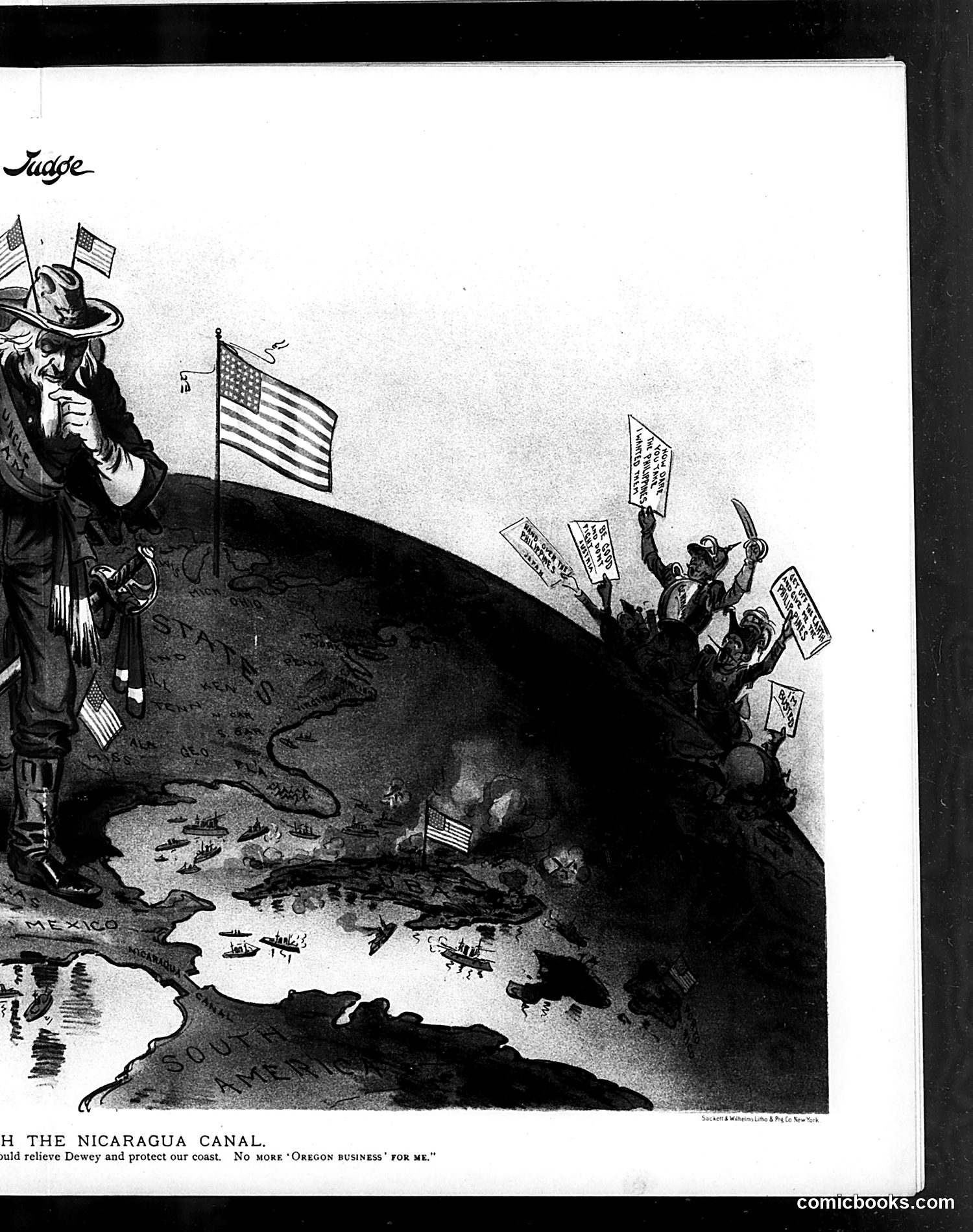
This Judge magazine cartoon satirizes the proposed Nicaragua Canal as a strategic military project. On the left stands a figure representing American interests (wearing Uncle Sam attire with flags), observing a chaotic scene below labeled "MEXICO." The cartoon depicts armed conflict in Mexico with multiple flags and combatants, suggesting regional instability. The caption references Admiral Dewey (likely George Dewey, famous from the Spanish-American War) and mentions "protecting our coast," indicating the canal was promoted as essential for American naval defense and commerce. The phrase "No More 'OREGON BUSINESS' FOR ME" appears sarcastic—likely referencing previous American expansionism or military ventures, suggesting skepticism about this new imperial project despite its strategic justifications.
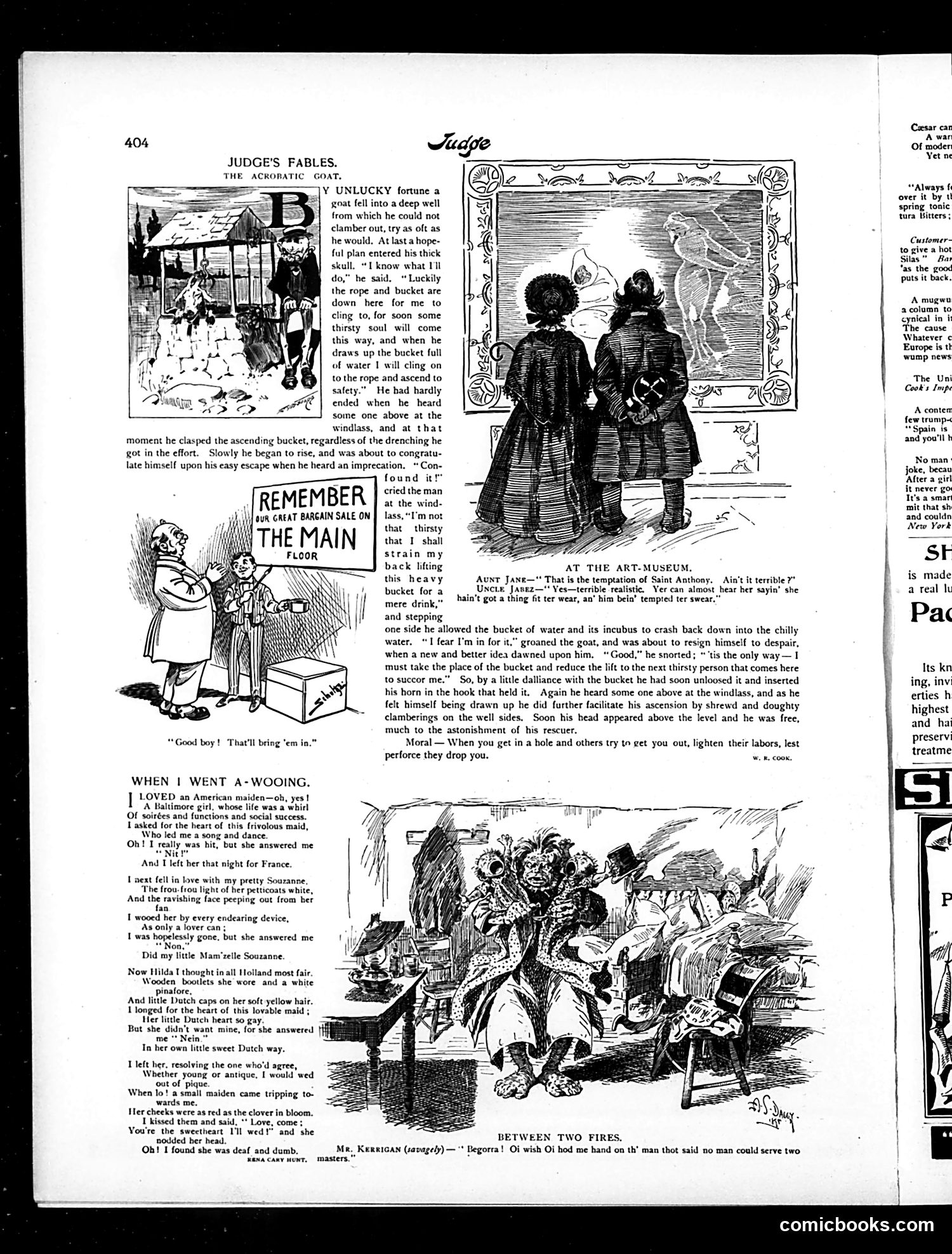
This page contains **Aesop's-style fables** and humorous poetry targeting American social attitudes circa early 1900s. **"The Acrobatic Goat"** illustrates self-reliance through a moral tale: a trapped goat escapes by making himself useful to his rescuer rather than being passive cargo. The moral explicitly advises cooperation: "lighten their labors, lest they drop you." **"When I Went A-Wooing"** is comic verse mocking American romantic pursuit across national stereotypes. The narrator is rejected by women representing different nations (American, French "Suzanne," Dutch "Hilda") who each refuse him in their language ("No," "Non," "Nein"). He succeeds only with a deaf-mute girl—a dark joke suggesting he finally found someone who won't reject him because she cannot speak. **Minor sketches** include museum visitors discussing temptation art, and an Irish character ("Kernigan") complaining about serving "two masters"—likely referencing labor/employment tensions of the era. The page reflects period attitudes about nationality, gender, courtship, and immigrant communities.
This page is primarily **advertising**, with minimal cartoon content. The visible satire appears in the short joke-quips scattered between ads—typical of Judge's format. The notable editorial content includes brief satirical observations: - A jab at "mugwump newspapers" (independent/reform-minded publications) for European cynicism about American character - Jokes about Spanish military posturing and American romantic foolishness - Commentary on feminine behavior and literary taste (likely poking at women's education pretensions) The page otherwise consists of period product advertisements: patent medicines (Angostura Bitters), soaps, champagne, pens, pianos, insurance, and "suspender braces." The ads reflect turn-of-century consumer culture and include images typical of Gilded Age marketing—dignified gentlemen, health claims, and imported luxury goods. No major political figures or specific historical events appear identifiable in the visible content. This represents Judge as a general-interest satirical magazine mixing topical humor with commercial advertising.
This page is primarily **advertising** interspersed with brief humorous items typical of Judge magazine's format. The main satirical content is a short poem at bottom-left titled "When Sally Graduates," a sentimental rural vignette about a farmer's pride in his daughter's education—likely gentle mockery of agricultural America's aspirations. More pointed is the opening verse "Now this is a warning to Spain," referencing the USS Maine explosion (1898), which sparked the Spanish-American War. The joke warns Spain of American retaliation using the playground logic of "turn about is fair play"—satirizing American jingoism and bellicose rhetoric of the period. Scattered quips mock human foibles: a man overly strict about historical accuracy, vanity about aging bodies, and a woman involved in a catfight rather than a cat scratch. The page otherwise showcases period advertisements for champagne, bicycles, patent fasteners, and leather goods—the commercial content that sustained Judge's publication.
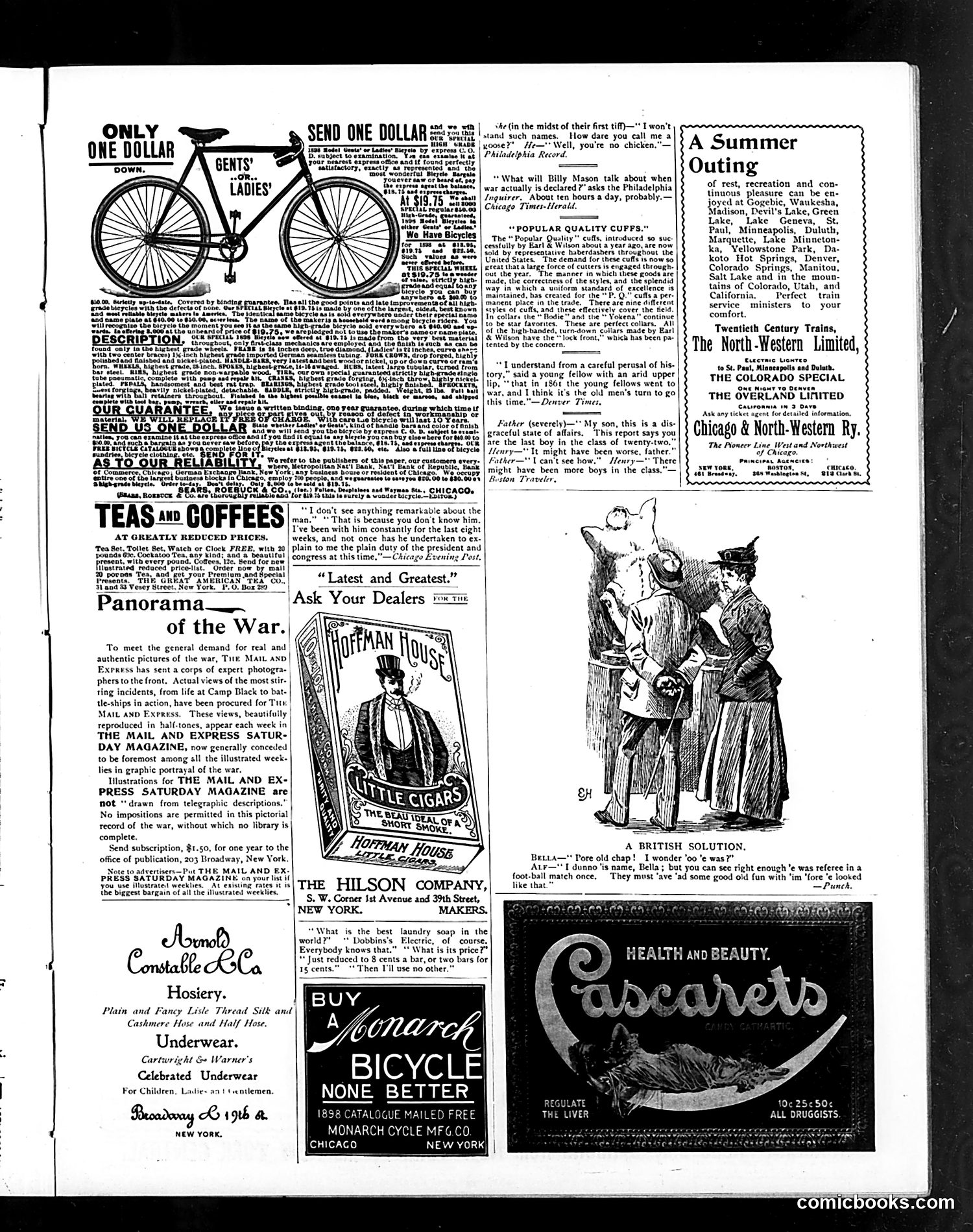
This is primarily an **advertising page**, not political satire. The dominant content is mail-order bicycle and product advertisements promising incredible deals—notably a bicycle for "only one dollar down." The small cartoon labeled "A British Solution" (bottom right) shows two women discussing a man who saves money by refusing to explain politics. The joke: avoidance of tedious political conversation is presented as wisdom. The page also advertises teas, coffees, hosiery, underwear, laundry soap, and cigars. A "Panorama of the War" section promotes *The Mail and Express Saturday Magazine*, positioning itself as offering authentic war photography against competitors who draw from "telegraphic descriptions." The context: this appears to be from around the Spanish-American War era (referenced articles mention war coverage), when illustrated weeklies competed fiercely for readers by promising exclusive, authentic war imagery. The bicycle ads exemplify the era's mail-order consumer culture boom.
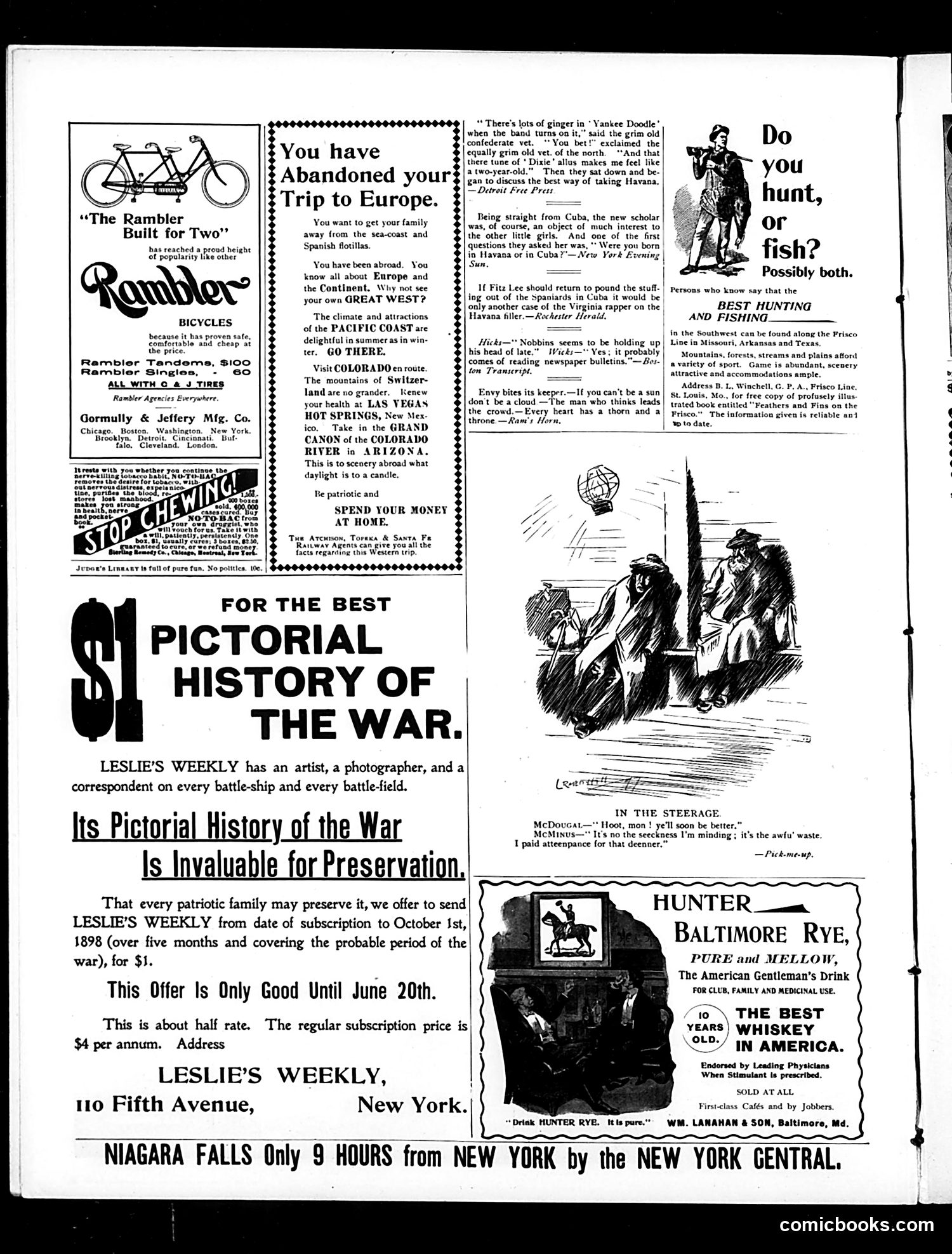
This page primarily consists of **advertisements and brief humor items** rather than a sustained political cartoon. The satirical content reflects the Spanish-American War context (1898). ## Key Content: **War-Related Humor**: Several brief items mock the conflict. One joke references Confederate and Union veterans now united in wanting to capture Havana, suggesting the war healed Civil War divisions. Another quip mentions "Fitz Lee" (likely a reference to a military figure) and Spanish forces in Cuba. **"Abandon Your Trip to Europe" Advertisement**: This pitch tries to redirect American tourism from Europe to the American West—Colorado, Las Vegas, the Grand Canyon—framing domestic travel as patriotic during wartime ("Spend Your Money at Home"). **Leslie's Weekly Ad**: Promotes a competitor magazine's war coverage, offering a discounted subscription through October 1898, claiming comprehensive battle documentation. The page captures **wartime patriotism and economic nationalism**, encouraging Americans to holiday domestically rather than abroad while the war continued. The humor is gentle, focusing on unity rather than sharp political critique.
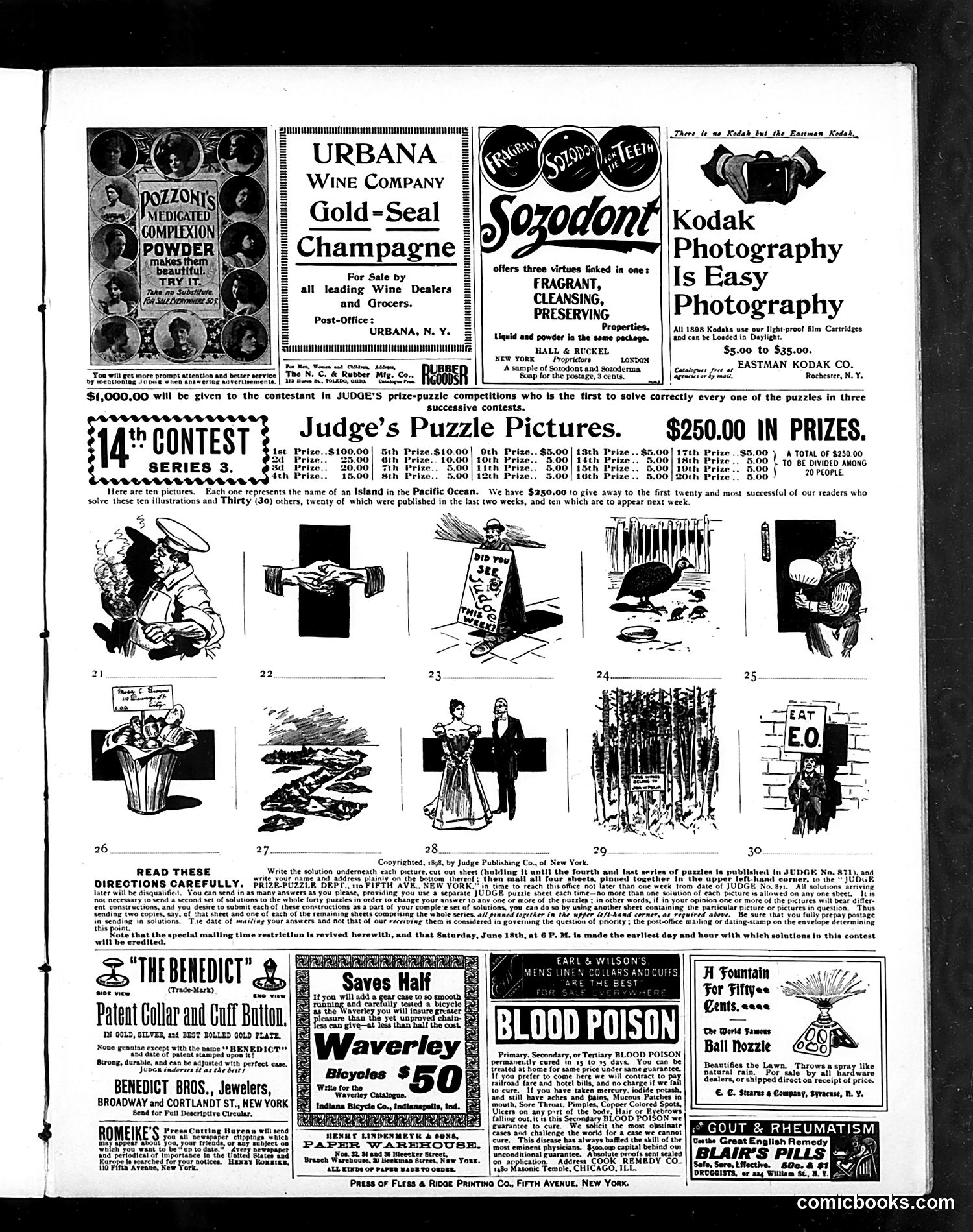
This page is primarily **advertising and a puzzle contest**, not political satire. The bulk consists of ads for period products (champagne, photography equipment, blood poison treatment, bicycles) and detailed rules for Judge magazine's "Puzzle Pictures" contest offering $250 in prizes. The puzzle contest itself occupies the center: readers must identify ten Pacific Ocean islands from illustrated rebuses (pictures representing names). Examples visible include a man pulling cabbage (appears to represent an island name through visual pun) and a scarecrow. The page's only cartoon content is minimal and decorative rather than satirical—small illustrations accompanying the puzzle clues. There is no clear political commentary or identifiable public figures being caricatured. This appears to be a typical late-1890s magazine page mixing revenue-generating advertisements with reader engagement contests, representing how Judge functioned as both satire publication and commercial enterprise.
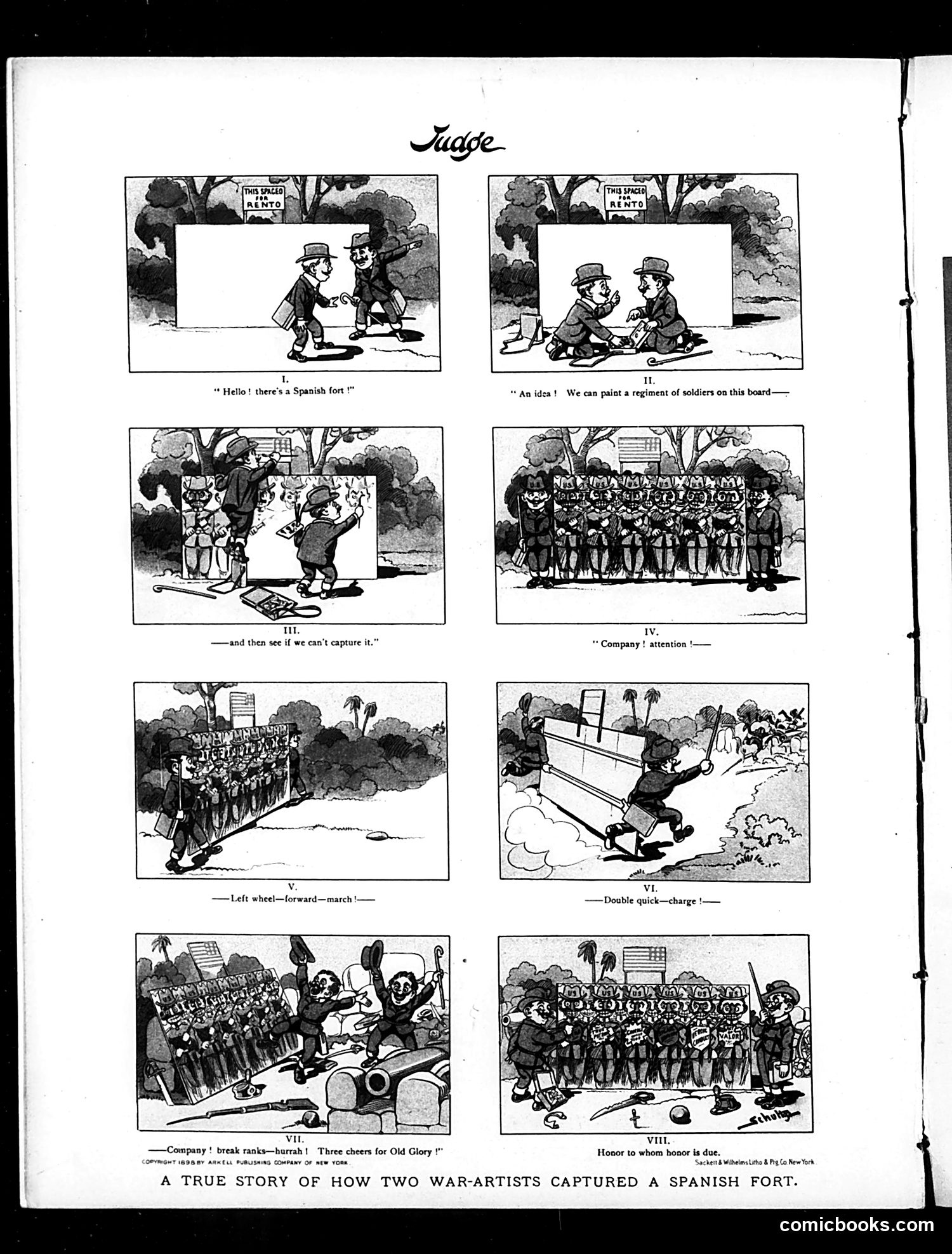
This is a humorous eight-panel comic strip satirizing war correspondents or "war-artists" during what appears to be the Spanish-American War (1898). Two men discover a Spanish fort and devise an absurd plan: they paint soldiers on a board and use it as a decoy to trick the Spanish into surrendering. The joke mocks both the bravery claims of war reporters and the supposed incompetence of Spanish forces. Through increasingly ridiculous escalations—from the initial sighting to a fake regiment to an actual military charge—the comic exaggerates how easily the fort supposedly falls. The final panel celebrates this mock-heroic victory, suggesting war-artists received disproportionate credit for military successes. It's satirical commentary on sensationalized war reporting.