
A complete issue · 18 pages · 1898
Judge — May 14, 1898
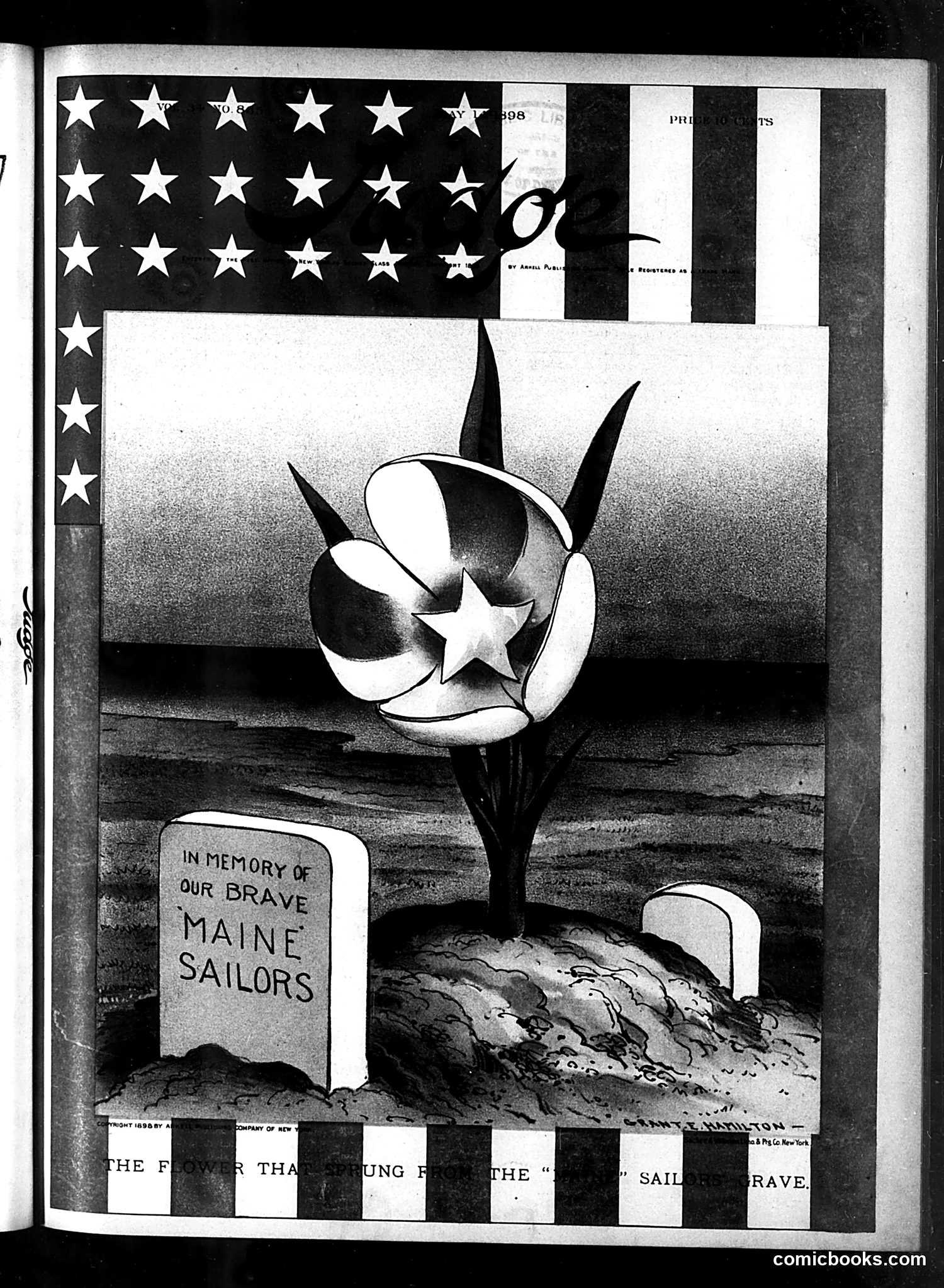
This appears to be a memorial cartoon from Judge magazine commemorating the USS Maine disaster. The image shows a flower with four thorny buds growing from a grave marked "In Memory of Our Brave Maine Sailors," with American flags displayed above. The USS Maine battleship explosion in Havana harbor (1898) killed approximately 266 American sailors and became a catalyst for the Spanish-American War, symbolized by the famous rallying cry "Remember the Maine!" The stylized flower likely represents both mourning and the growth of American patriotic fervor from tragedy. The sharp, weapon-like buds may suggest how the sailors' deaths energized military action. This reflects how American media transformed the disaster into justification for imperial expansion in Cuba and the Caribbean.
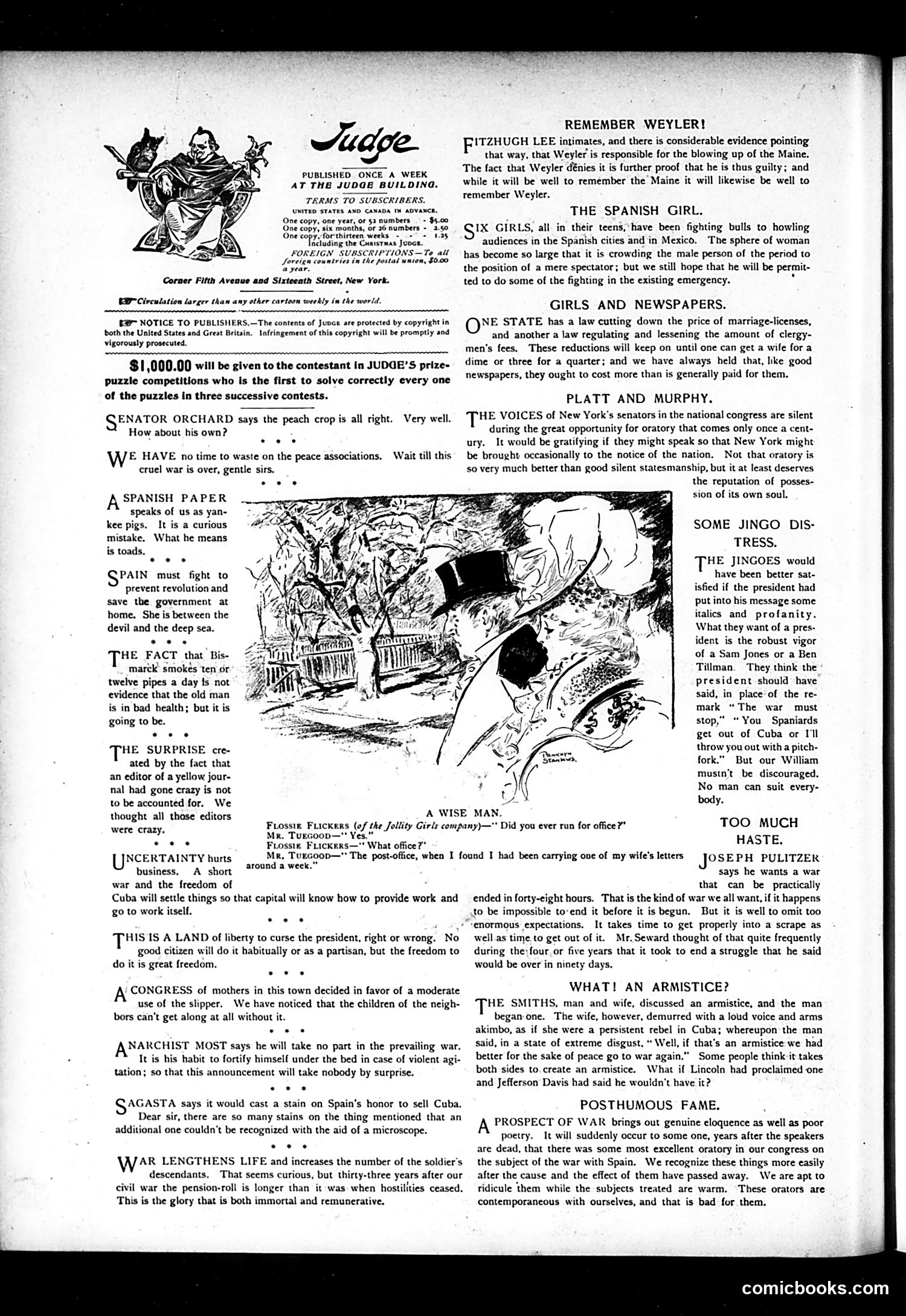
The central cartoon depicts **Flossie Flickers** (from *The Jollity Girls* company) discussing running for office with a man identified as "Mr. Toadwood"—a post-office worker. The joke plays on the man's accidental discovery of his wife's love letters while sorting mail, which prompted him to reconsider political ambition. The satire targets **political ambition and domestic life**: the cartoon suggests that exposure to others' private correspondence (literally reading people's mail) has given this would-be candidate pause about public service. It's a commentary on how political positions expose one to unseemly knowledge and complications—making domestic tranquility preferable to public office. The humor relies on the irony that a postal worker becomes the wisest person by choosing to avoid politics altogether.
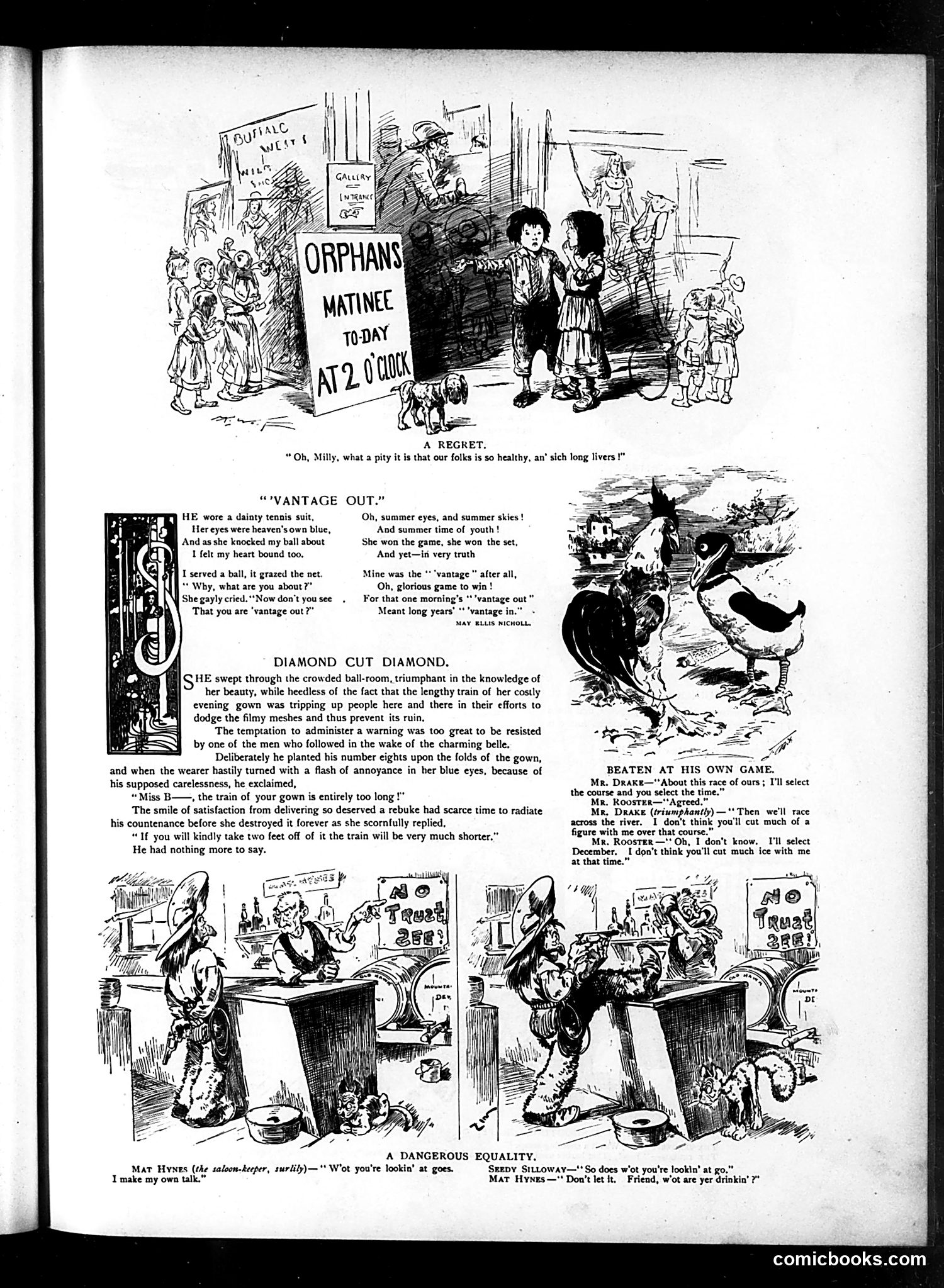
This page contains several satirical pieces and illustrations typical of early 20th-century humor magazines. The top cartoon mocks a matinee performance of "The Orphans," with a caption about healthy living. The "Vantage Out" poem satirizes a woman's romantic conquest through sports, playing on double meanings of "vantage" and "game." "Diamond Cut Diamond" appears to be a satirical story about a woman manipulating social situations at a ball, using her beauty strategically while maintaining her composure—a commentary on female social maneuvering in upper-class settings. "A Dangerous Equality" (bottom) depicts comedic domestic conflict between characters identified as Mat Hynes and Sandy Silloway, suggesting satirical commentary on class relations or social pretension through their drinking conversation. The cartoons employ caricature and wordplay typical of Judge's satirical approach to contemporary social behavior and gender relations.
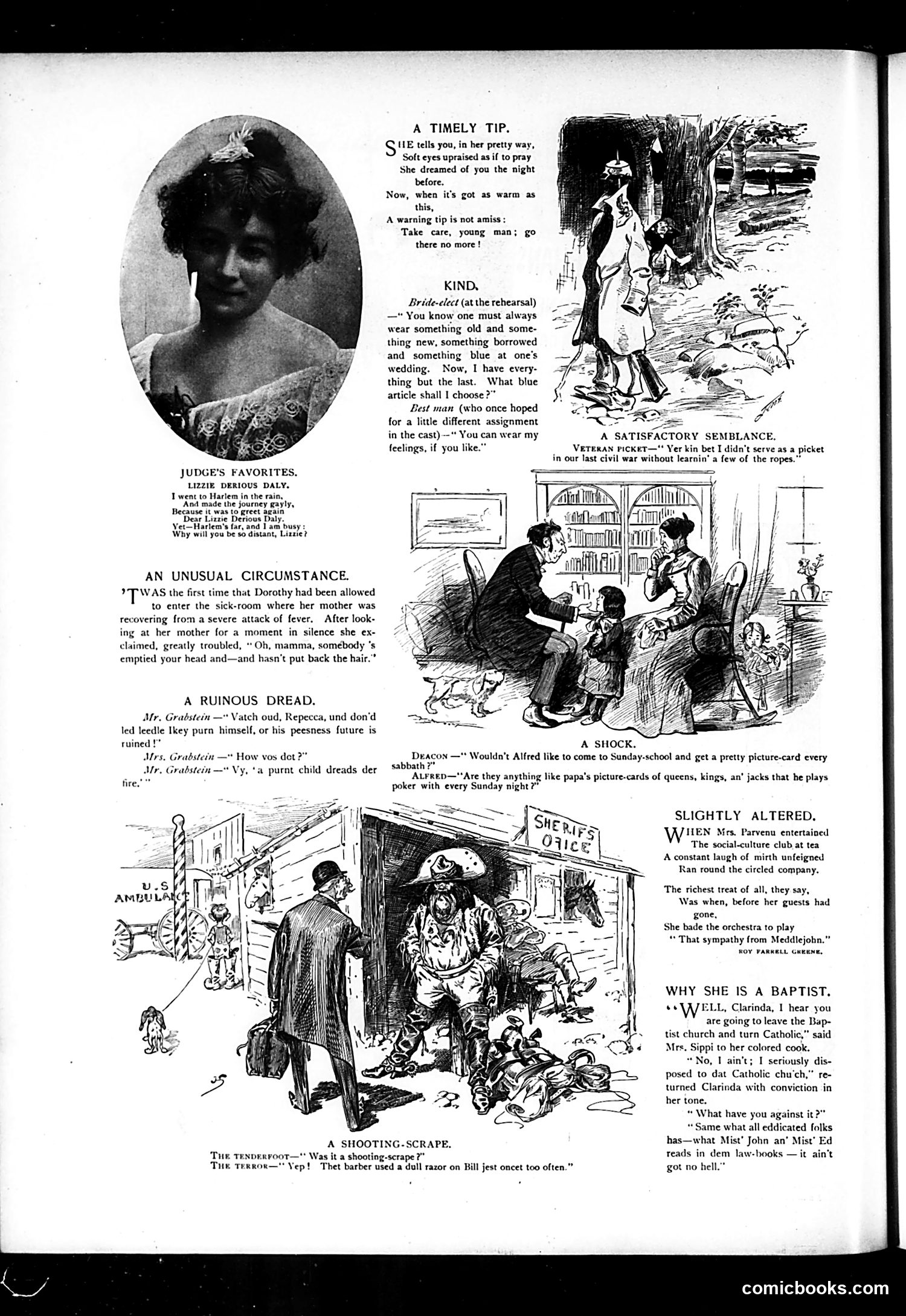
This page contains several humorous anecdotes and satirical cartoons typical of Judge's style: **"A Timely Tip"** and **"Kind"** mock wedding traditions—specifically the superstition about "something old, something new, something borrowed, and something blue." The humor lies in the groom's practical suggestion to simply borrow his feelings. **"An Unusual Circumstance"** jokes about a mother's concern when her daughter removes her hat indoors—suggesting impropriety. **"A Shooting-Scrape"** uses wordplay: a barber used a "dull razor" (tenderfoot slang) instead of a literal razor in a fight. **"A Shock"** and **"Slightly Altered"** satirize social pretension and club culture around music and entertainment. **"Why She Is a Baptist"** pokes fun at religious conversion logic, with someone rejecting Catholicism because it "ain't got no hell." The cartoons reflect early 20th-century American social customs and class anxieties.
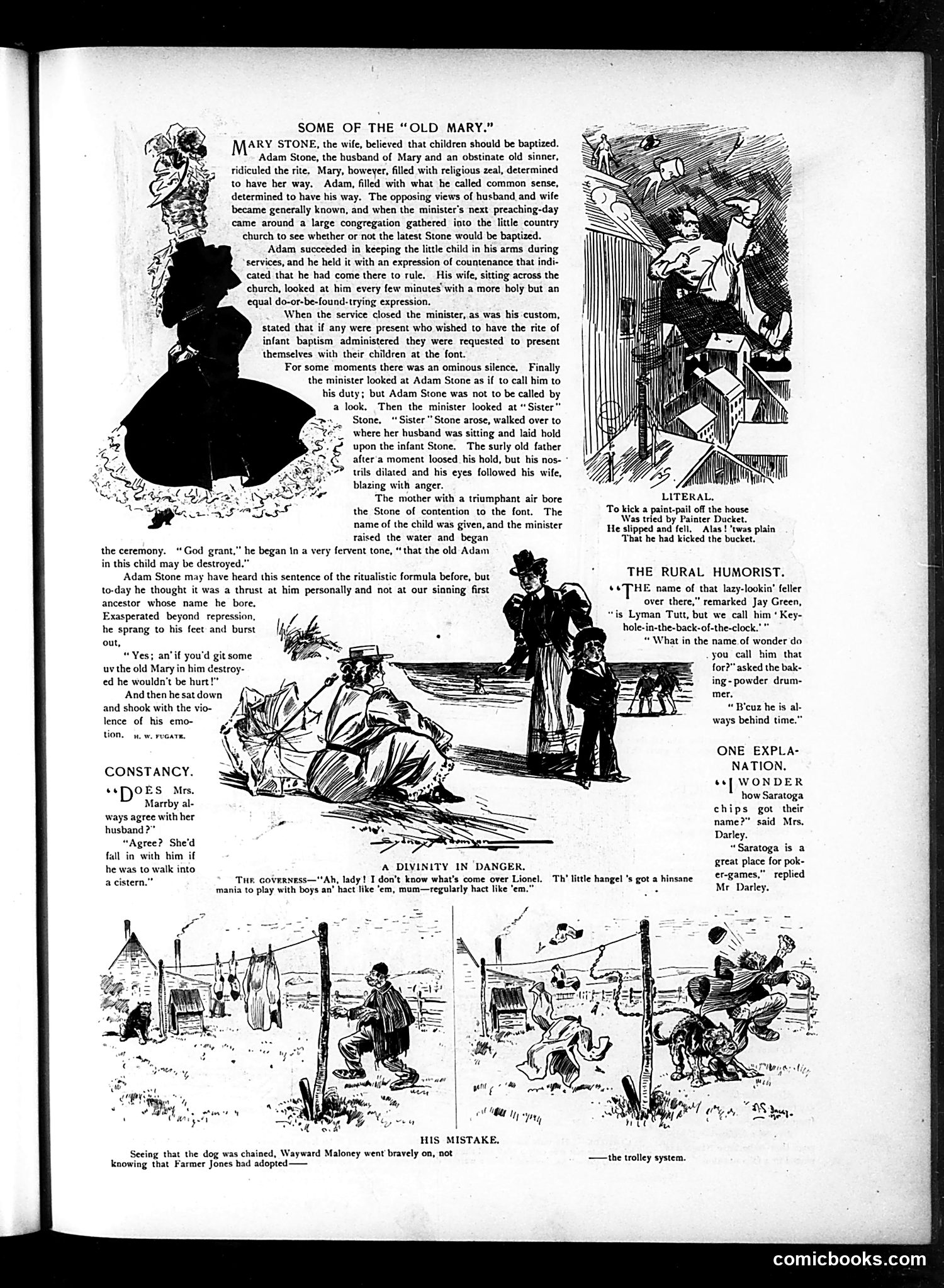
This story-cartoon satirizes marital conflict over religious practice. Adam Stone, a skeptical husband, resists baptizing his infant child despite his devout wife Mary's insistence. When the minister intones the baptismal prayer—"that the old Adam in this child may be destroyed"—Stone misinterprets this standard religious formula as a personal attack, ironically proving the minister's point about human stubbornness. He erupts in anger, validating Mary's frustration. The satire targets rigid masculinity and religious obstinacy. Adam's "common sense" proves foolish; his defensive rage over a theological phrase demonstrates the very "old Adam" (sinful nature) clergy sought to wash away. The humor lies in how his attempt to assert authority backfires, making him appear childish rather than principled.
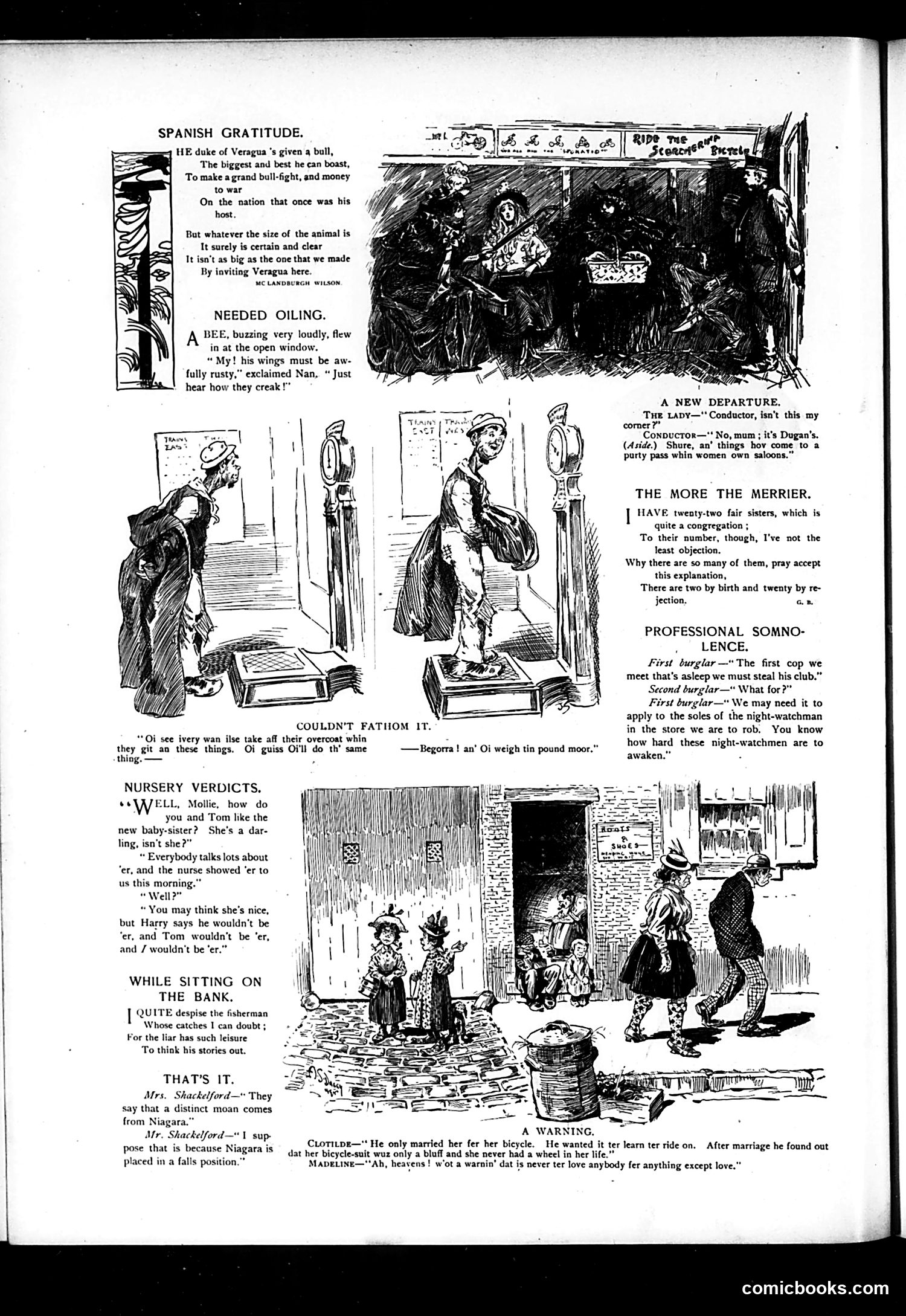
This page contains multiple satirical cartoons and jokes typical of late 19th/early 20th-century American humor: **"Spanish Gratitude"** criticizes the Duke of Veragua, a Spanish nobleman who visited America (likely during Columbus celebrations) and was honored as a guest, yet returned home to support Spain in war against the U.S. The cartoon sarcastically suggests America's hospitality was wasted—the "bull" (gift) pales compared to the massive favor of the invitation itself. The remaining items are lighthearted domestic humor: children's candid opinions about a new baby sister, Irish immigrant dialect jokes about clothing and weight, puns about Niagara Falls, fishing tall tales, and a gag about a woman marrying for a bicycle. One sketch references women owning saloons—a topical reference to changing social attitudes about women's independence and business ownership, treated here as comedic shock value. The "Professional Somnolence" burglar dialogue is straightforward criminal humor about robbing sleeping night-watchmen. Overall: mostly gentle social satire with one notable political jab at Spanish-American relations.
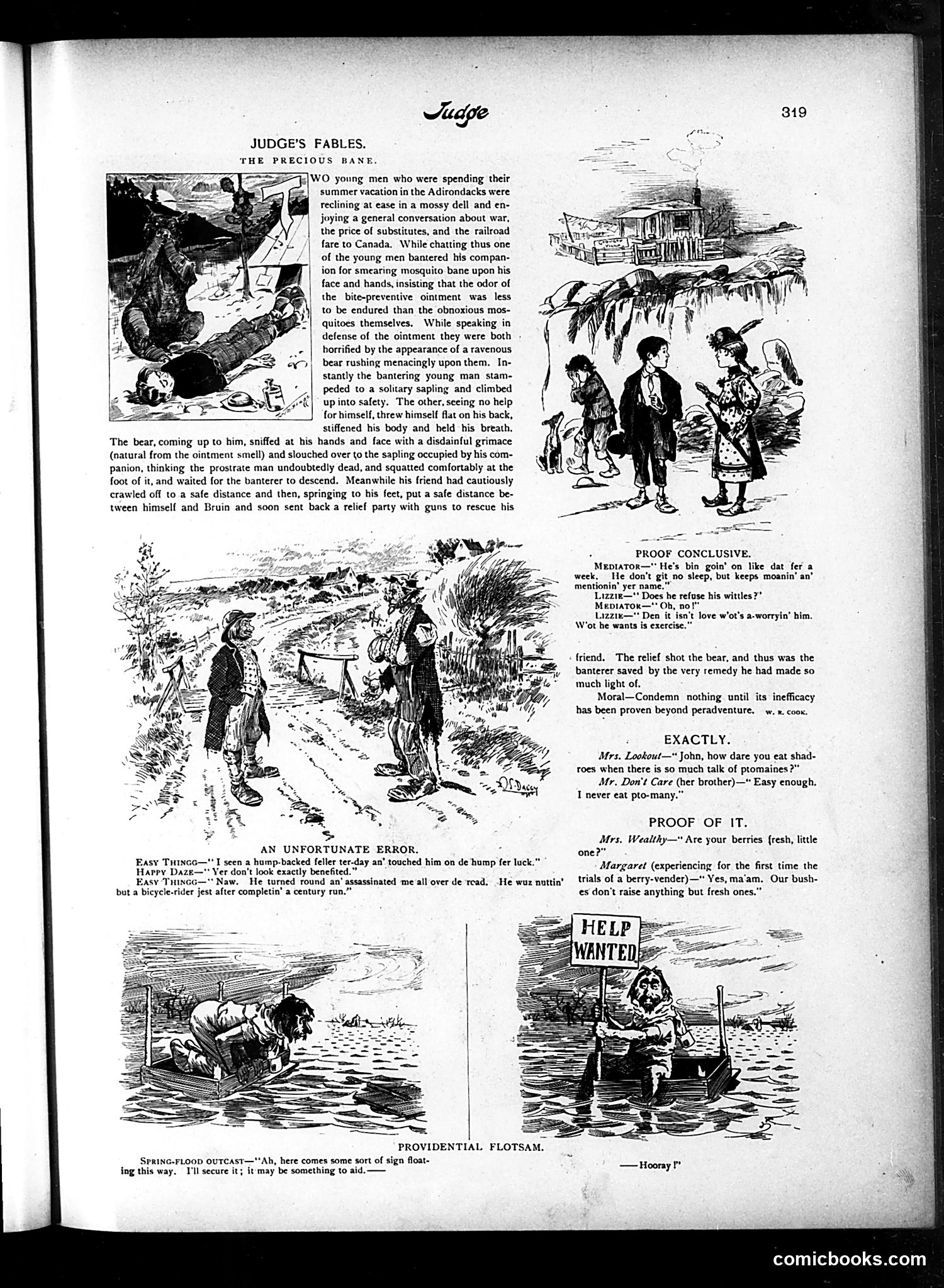
This page contains several unrelated humorous fables and jokes typical of Judge's satirical format: **"The Precious Bane"** (main story): A moral tale where one young man mocks his companion for using mosquito repellent ointment in the Adirondacks. When a bear attacks, the ointment's smell saves the scoffer's life—the bear finds the other man (who applied it) so distasteful it attacks the unprotected man instead. The moral: don't condemn remedies before proving their worthlessness. The remaining items are brief joke vignettes with no political content: wordplay about "ptomaines" (food poisoning), servant gossip about lovesickness, and humor about fresh berries. **Context for modern readers**: The references to Civil War substitutes and Canadian railroad fares in the opening suggest this dates to the American Civil War era, but the page itself contains no political satire—just conventional Victorian-era family humor and animal fables.
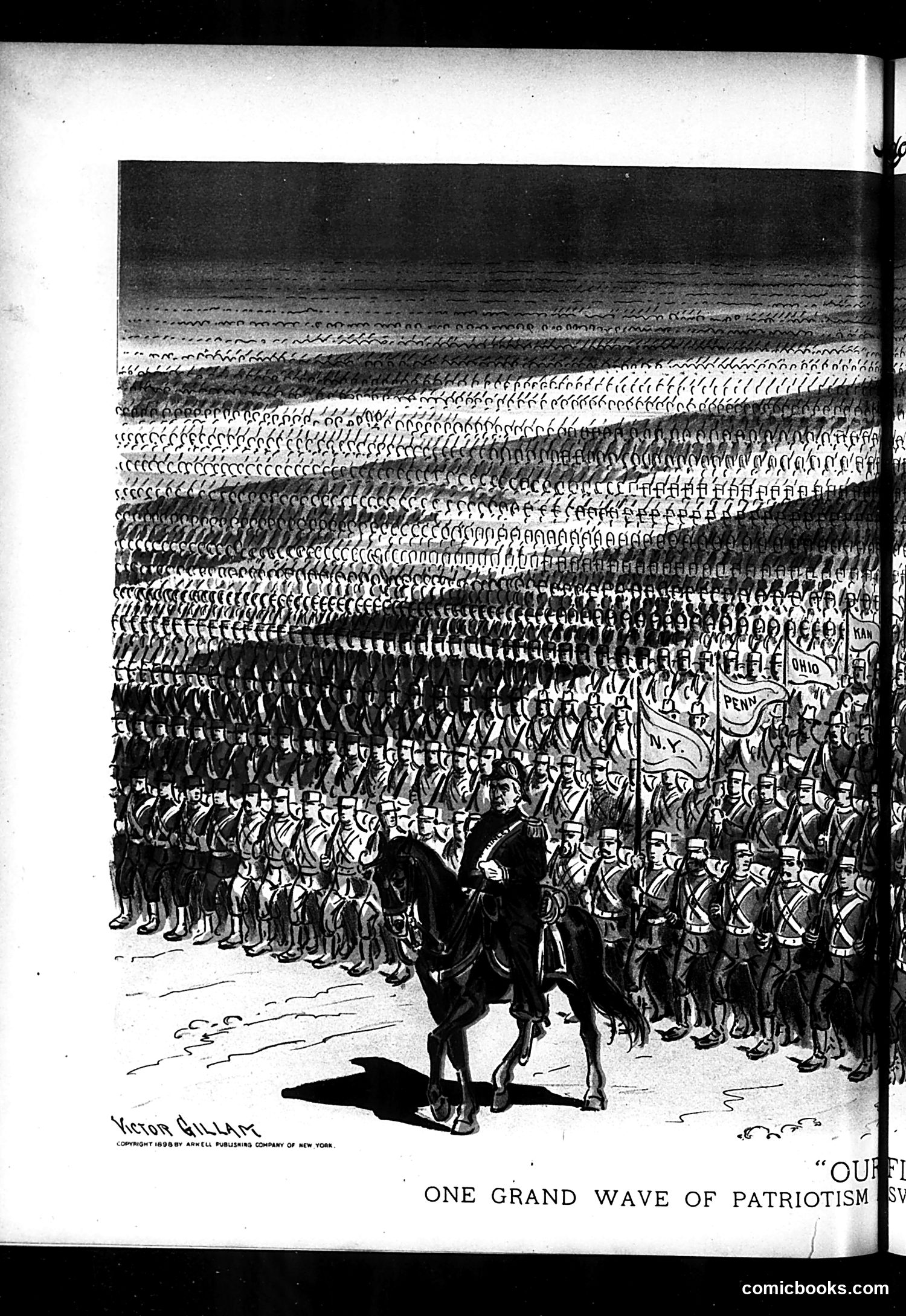
This satirical illustration by Victor Gillam depicts an enormous military parade or assembly viewed from above, creating a visual metaphor of a "wave." Thousands of uniformed soldiers fill the composition, their synchronized formation emphasizing mass mobilization and collective patriotic fervor. The cartoon appears to celebrate American military strength and patriotic unity, likely from the Spanish-American War era (1898) or similar period of American imperial expansion. Two mounted officers on horseback command the assembled troops, representing military leadership directing this "grand wave." The satire likely critiques either the romanticization of militarism or questions the authenticity of patriotic enthusiasm when orchestrated from above. The overwhelming scale and regimented uniformity could suggest that individual identity is subsumed into nationalist ideology—a common Judge magazine theme exploring tensions between authentic patriotism and manufactured consensus.
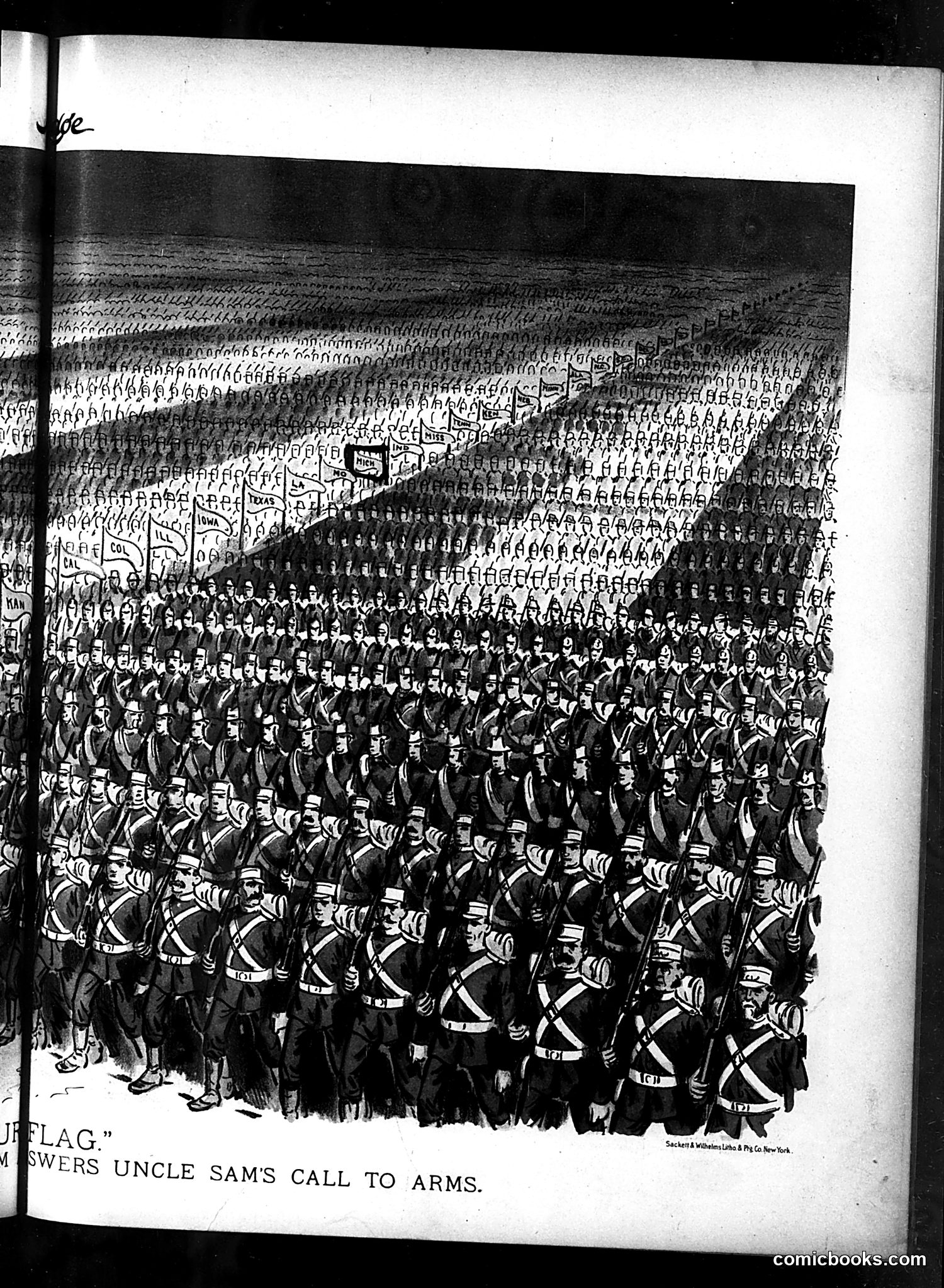
This political cartoon depicts a massive military mobilization, with thousands of uniformed soldiers assembled in formation wearing what appear to be military dress uniforms with crossed belts. The title references Uncle Sam—the personification of the United States government—issuing a call to military service. The satirical point appears critical of mass militarization: the sheer repetitive scale of identically-dressed soldiers suggests either the overwhelming scope of military recruitment/conscription or satirizes the dehumanizing uniformity of military organization. The tiny figures visible in the background (possibly representing citizens or the general population) emphasize how the military dwarfs civilian life. Without the magazine's date visible, the specific conflict referenced remains unclear—this could reference Spanish-American War preparations, WWI mobilization, or another period of American military expansion. The cartoon likely critiques either aggressive military expansion or the loss of individual identity in militarism.
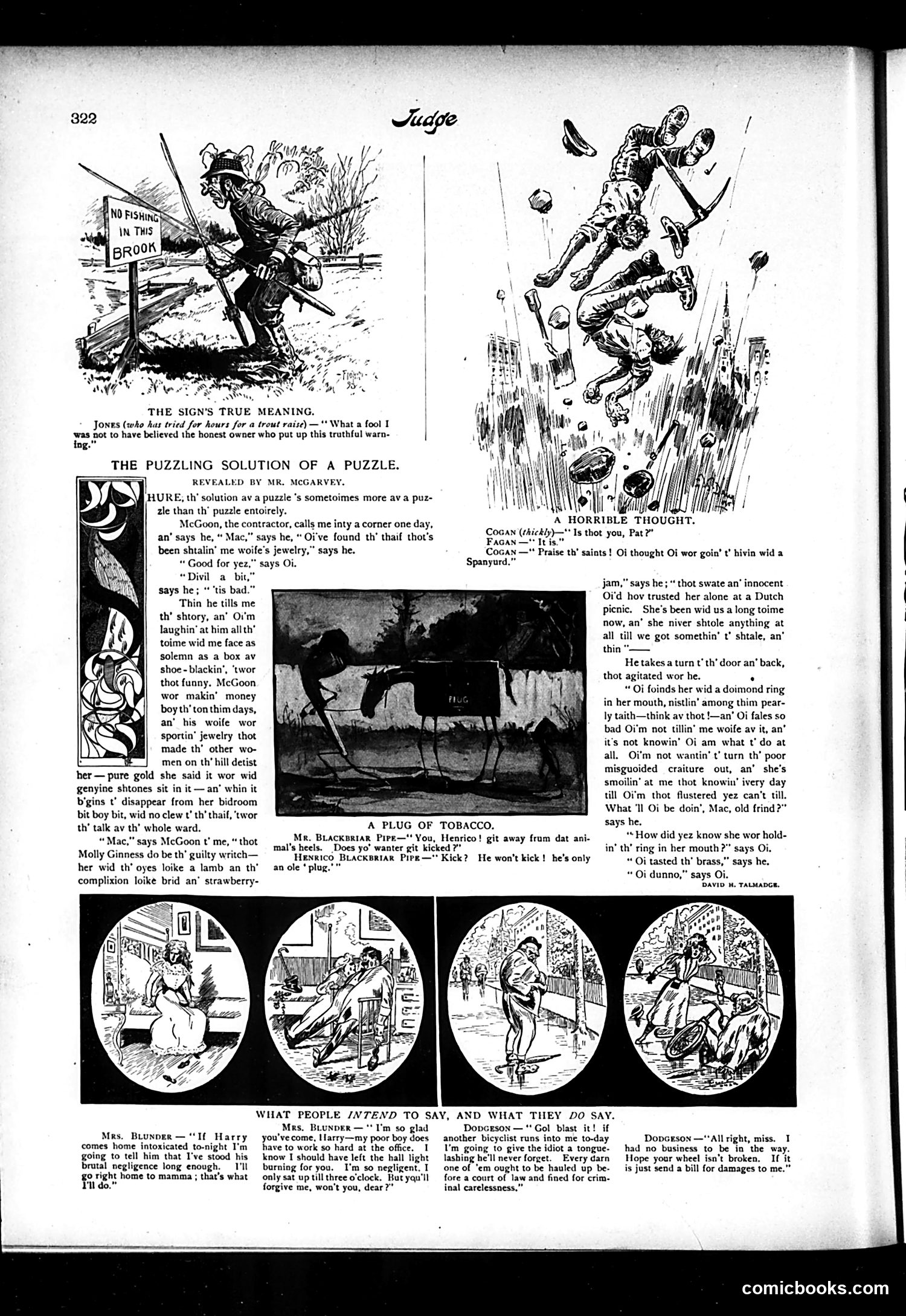
This page contains several unrelated satirical pieces typical of Judge's format: **"The Sign's True Meaning"** (top left): A fisherman ignores a "No Fishing" warning sign, only to discover it was accurate—a joke about trusting practical advice over skepticism. **"The Puzzling Solution of a Puzzle"** (center): An Irish-dialect story by McGarvey about a contractor whose wife's jewelry disappears. He suspects their maid Molly, but discovers his own wife was secretly stealing from herself—likely satirizing domestic suspicion and marital deception among the working class. **"A Plug of Tobacco"** (center): Brief dialogue mocking an African American servant's accent and obedience. **"What People Intend to Say and What They Do Say"** (bottom): Four panels contrasting polite intentions with actual behavior—showing people's hypocritical social courtesy versus selfish reality (cyclist accidents, infidelity, negligence, and bicycle damage claims). The page reflects early 20th-century American humor: class-based stereotypes, domestic comedy, and satirical observations of social pretense.
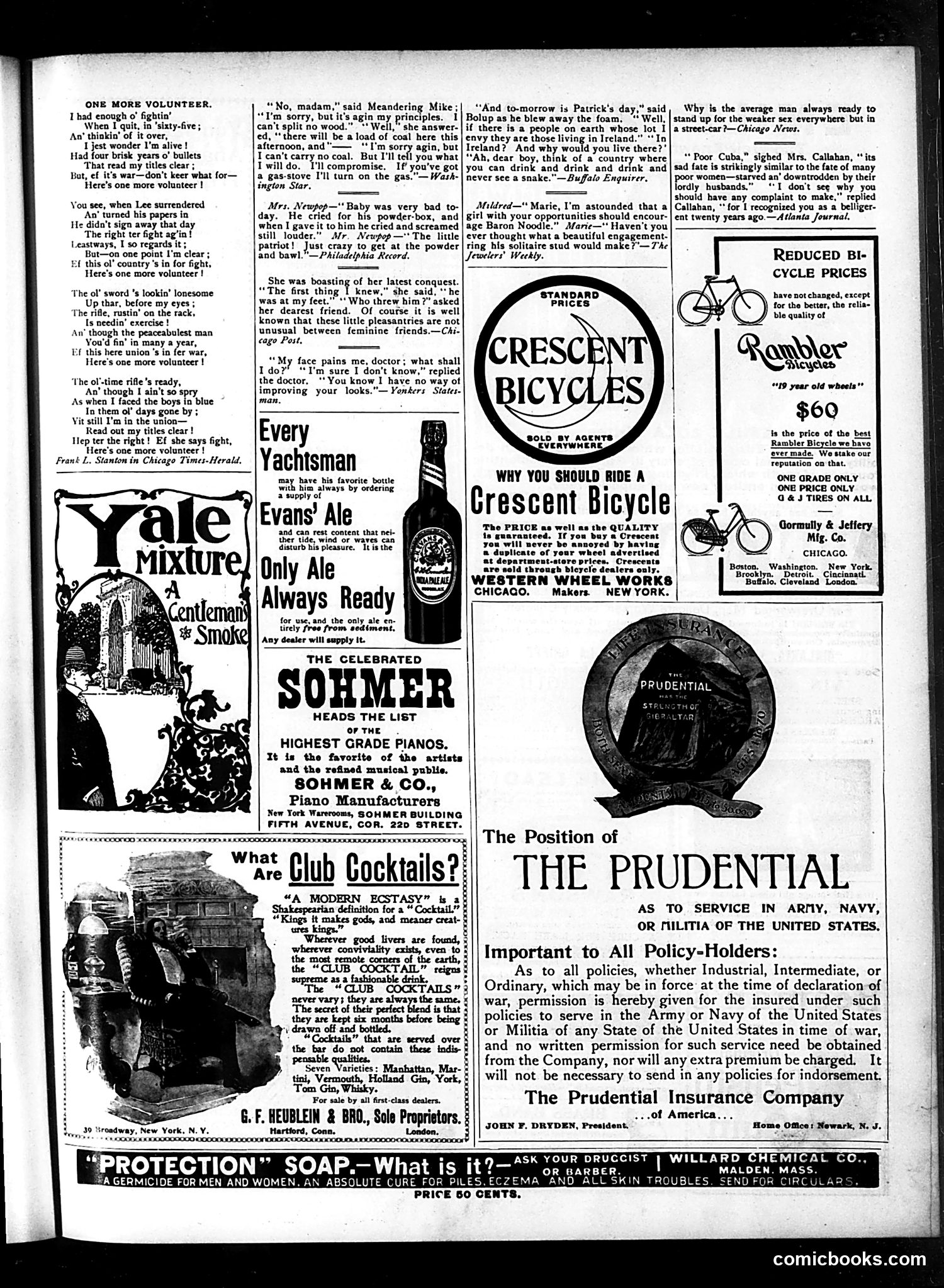
This is primarily an **advertising page** from Judge magazine, interspersed with brief humorous anecdotes rather than political cartoons. **Notable content:** The opening poem "One More Volunteer" addresses post-Civil War reunification—an aging veteran declares he'd fight again for the Union, honoring both North and South as part of one nation. This reflects late-1800s sentiment about sectional reconciliation. The short jokes display period humor: a character refusing to work on principle but willing to turn on gas (social commentary on lazy behavior), stereotypes about Irish drinking ("Patrick's day" joke about Ireland having no snakes), and gendered humor about women valuing engagement rings over romance. **Advertisements dominate:** pianos, bicycles, ale, soap, and insurance—typical of Judge's revenue model. The Prudential insurance ad specifically addresses Civil War-era soldiers, offering military service coverage. The page reflects late-19th-century concerns: national unity, immigration stereotypes, and commercialism targeting nostalgic war veterans.
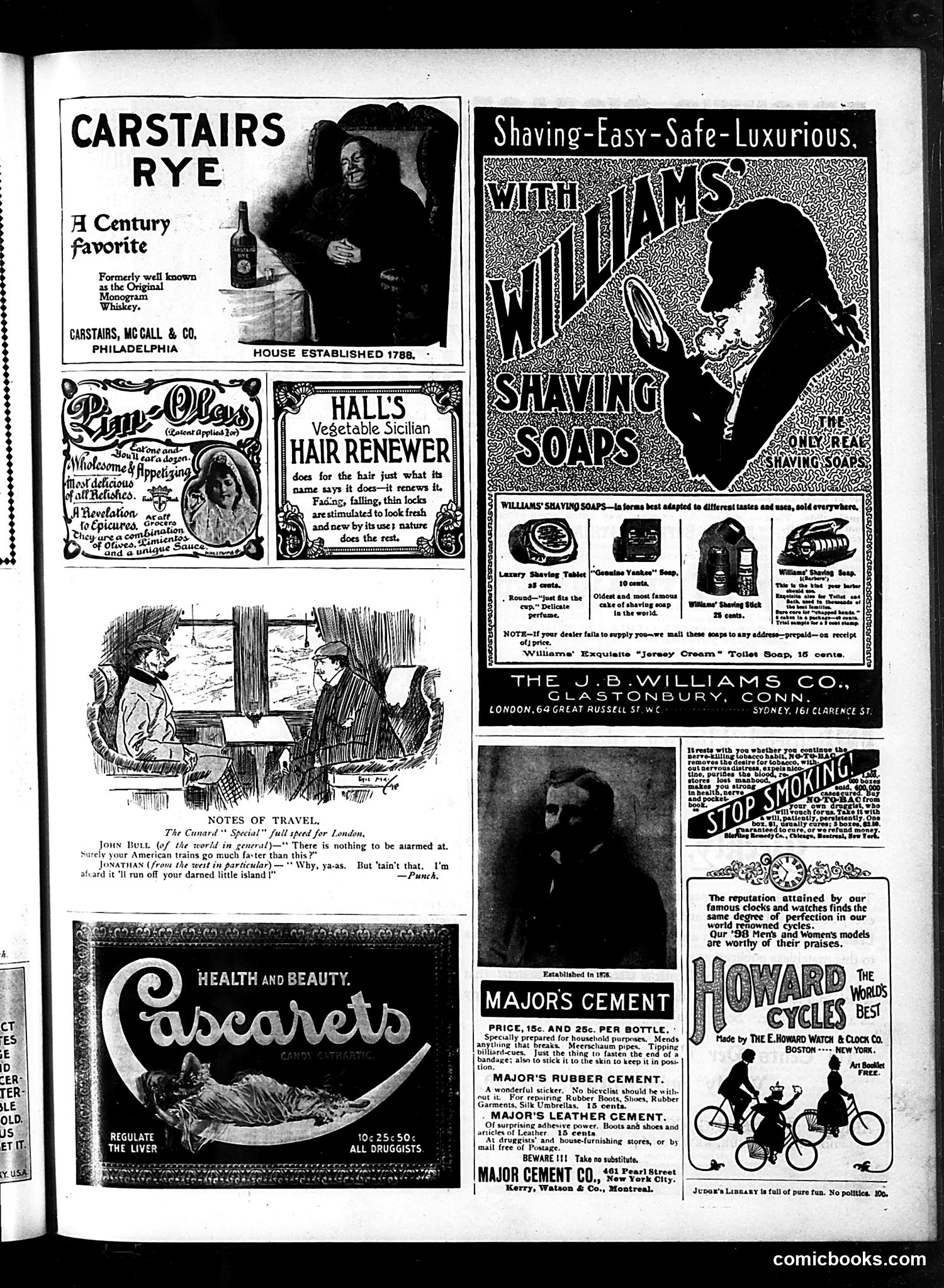
This page is primarily **advertising**, not editorial cartoon content. The ads promote period products: Carstairs Rye whiskey, hair renewal treatments, Williams' shaving soaps, Cascaret laxatives, Major's cement products, Howard bicycles, and a Cunard ocean liner service. The only satirical content is a small "Notes of Travel" cartoon depicting two men aboard a Cunard ship bound for London. One appears to be identified as "John Bull" (the personification of Britain), while the other is "Jonathan" from the American West. Jonathan expresses fear the American train will run so fast it will "run off your darned little island"—a joke about American railroad speed and confidence versus European caution. This reflects early 20th-century attitudes about American industrial prowess and the cultural stereotype of brash American travelers. The remainder is pure commercial advertising typical of Judge's business model.
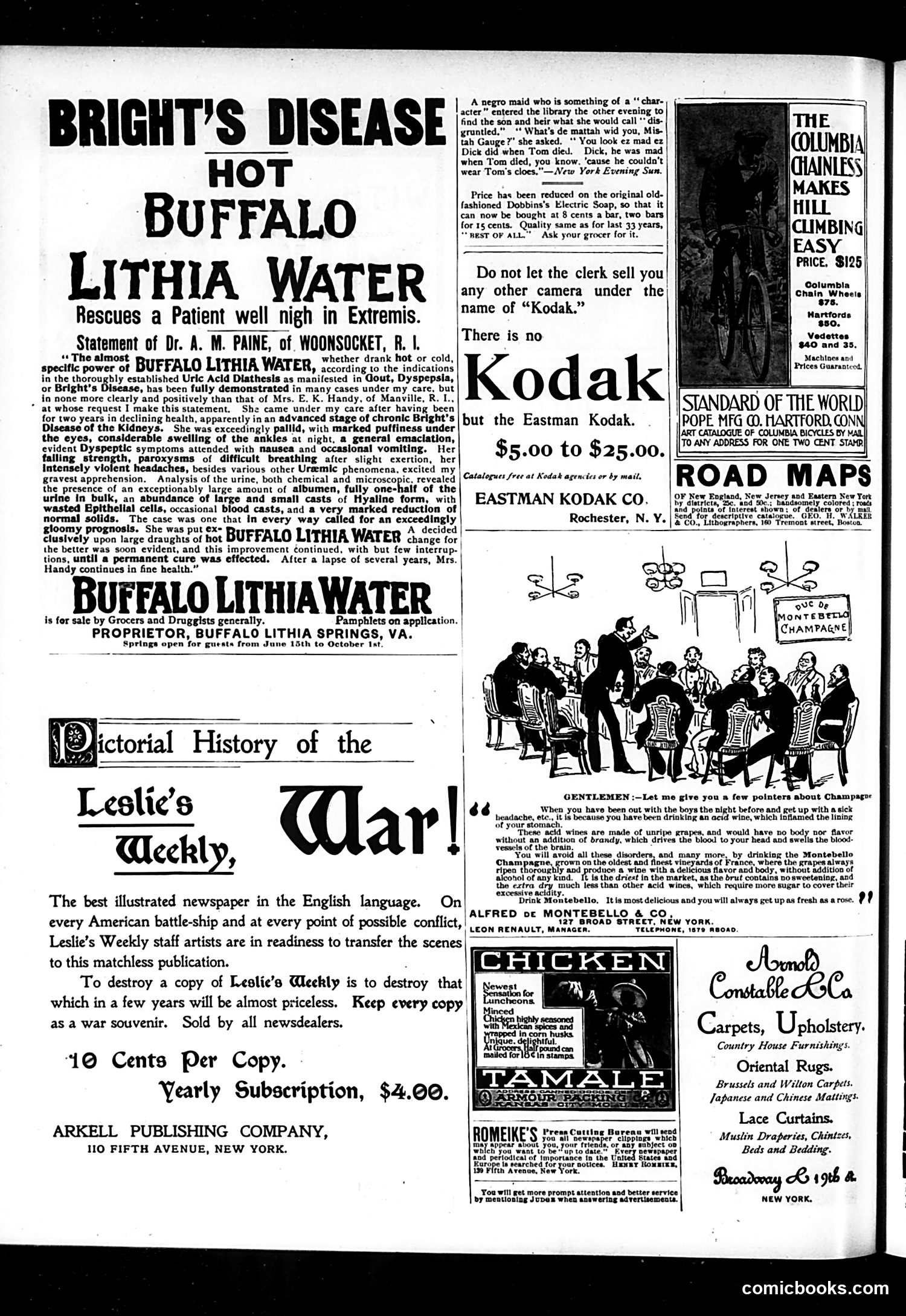
This page is primarily **advertisements and product promotions**, not political satire. The main content includes: 1. **Buffalo Lithia Water ad** (top left): A medical testimonial claiming the mineral water cures Bright's Disease (kidney disease). Dr. Paine's statement describes a patient miraculously healed—typical of dubious patent medicine claims common in this era. 2. **Leslie's Weekly promotion** (center): An illustrated newspaper advertisement emphasizing its war coverage and illustrations, soliciting subscriptions. 3. **Other ads**: Kodak cameras, Columbia bicycles, Dobbins's Electric Soap, and various furnishings. The only identifiable humor appears to be a small **dialect joke** (top right) about an Irish maid's garbled English regarding a character named Tom. This isn't satirical commentary but rather a **commercial page**, typical of Judge magazine's revenue model, mixing editorial content with patent medicine and consumer product pitches aimed at readers.
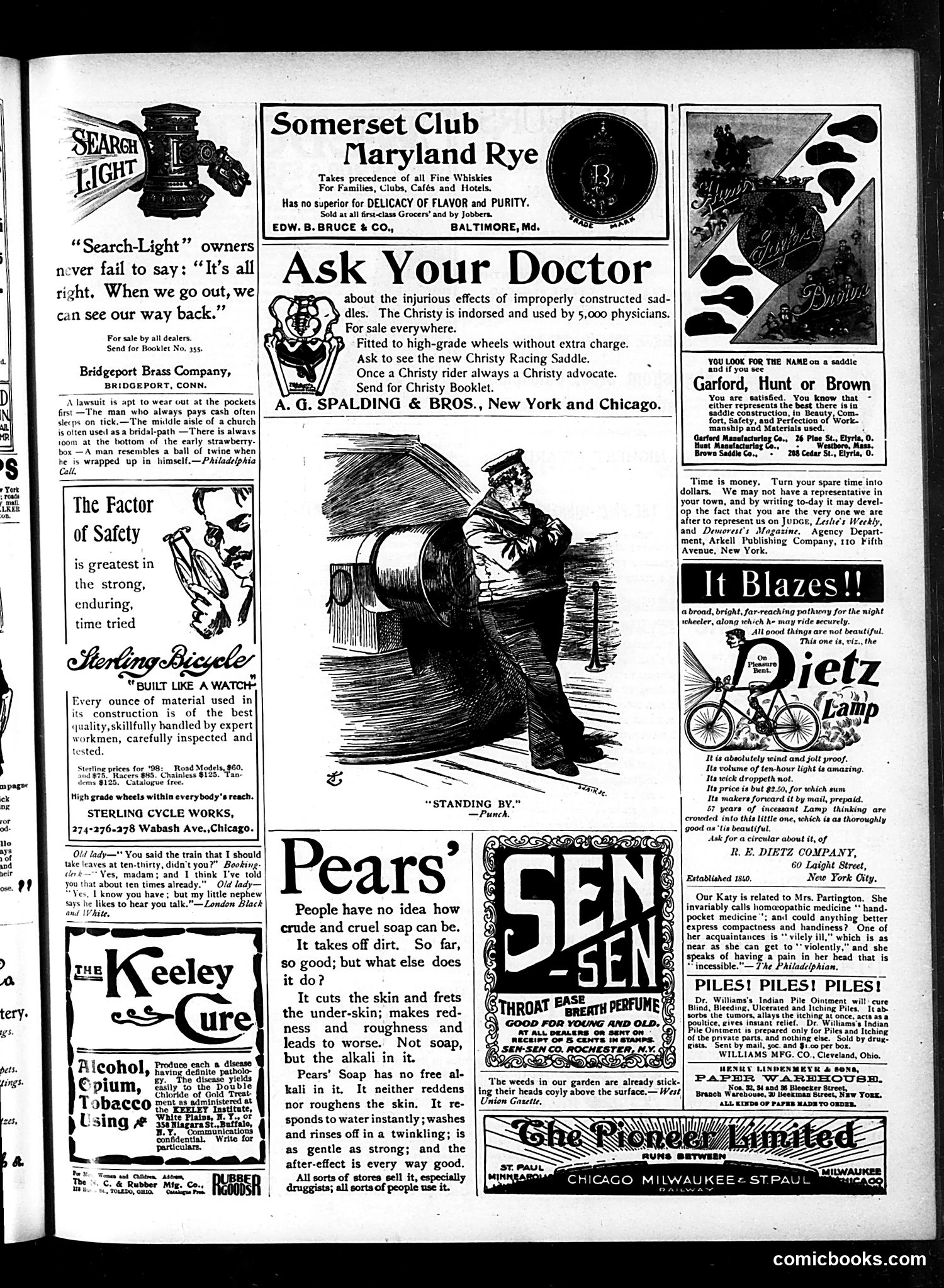
This page is primarily **advertisements** from circa 1890s-1900s, with minimal satirical editorial content. The central cartoon, "Standing By," depicts a well-dressed man beside a horse—likely illustrating a humorous anecdote about loyalty or steadfastness, though the specific reference is unclear without additional context. The bulk of the page comprises product ads for bicycles (Sterling, Christy saddles), soaps (Pears'), whiskey (Somerset Club), lamps (Dietz), saddles (Garford, Hunt, Brown), and patent medicines (Keeley Cure for alcohol/opium addiction). Notable is the Keeley Cure ad, representing the period's widespread faith in dubious medical "cures." The Christy saddle advertisement's claim of endorsement by "5,000 physicians" exemplifies era-typical exaggeration in advertising. The page reflects turn-of-century consumer culture, bicycle popularity, and Victorian attitudes toward health and safety.
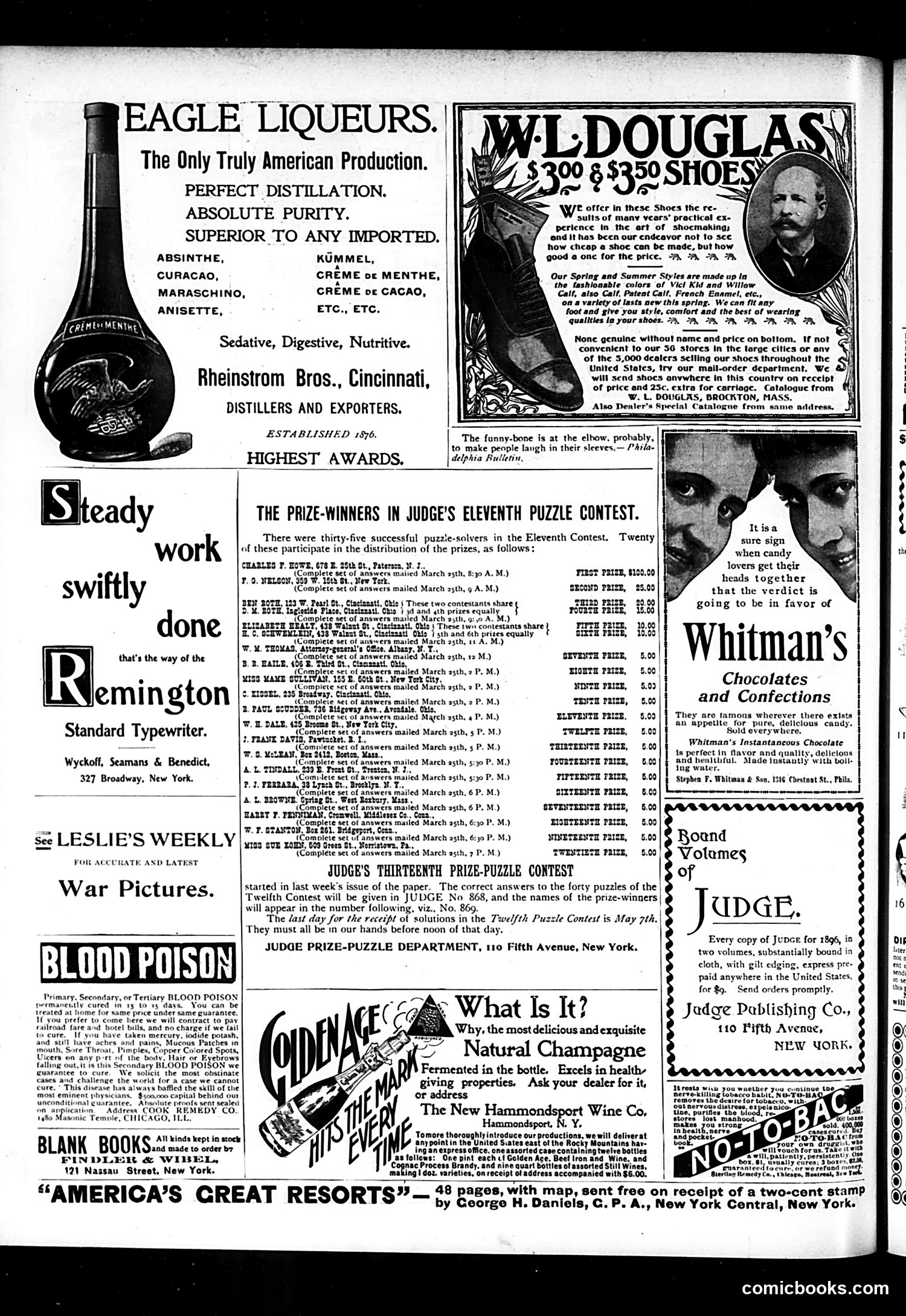
This page is primarily **advertising and contest results**, not political satire. The main content includes: **Advertisements:** Eagle Liqueurs (spirits), W.L. Douglas Shoes (featuring a portrait of the shoe company owner), Remington typewriters, and Whitman's Chocolates dominate the page. **Contest Results:** The central feature announces winners of Judge's "Eleventh Puzzle Contest," listing 20 successful puzzle-solvers and prize amounts ($100 first prize down to $5 for later places). Winners' names and cities are published. **Minor note:** A small joke appears: "The funny-bone is at the elbow, probably, to make people laugh in their sleeves." There is **no significant political cartoon or satire visible** on this page. It represents typical late-19th/early-20th-century magazine content where advertising revenue and reader contests subsidized publication costs. The page reflects consumer culture and commercial enterprises of the era.
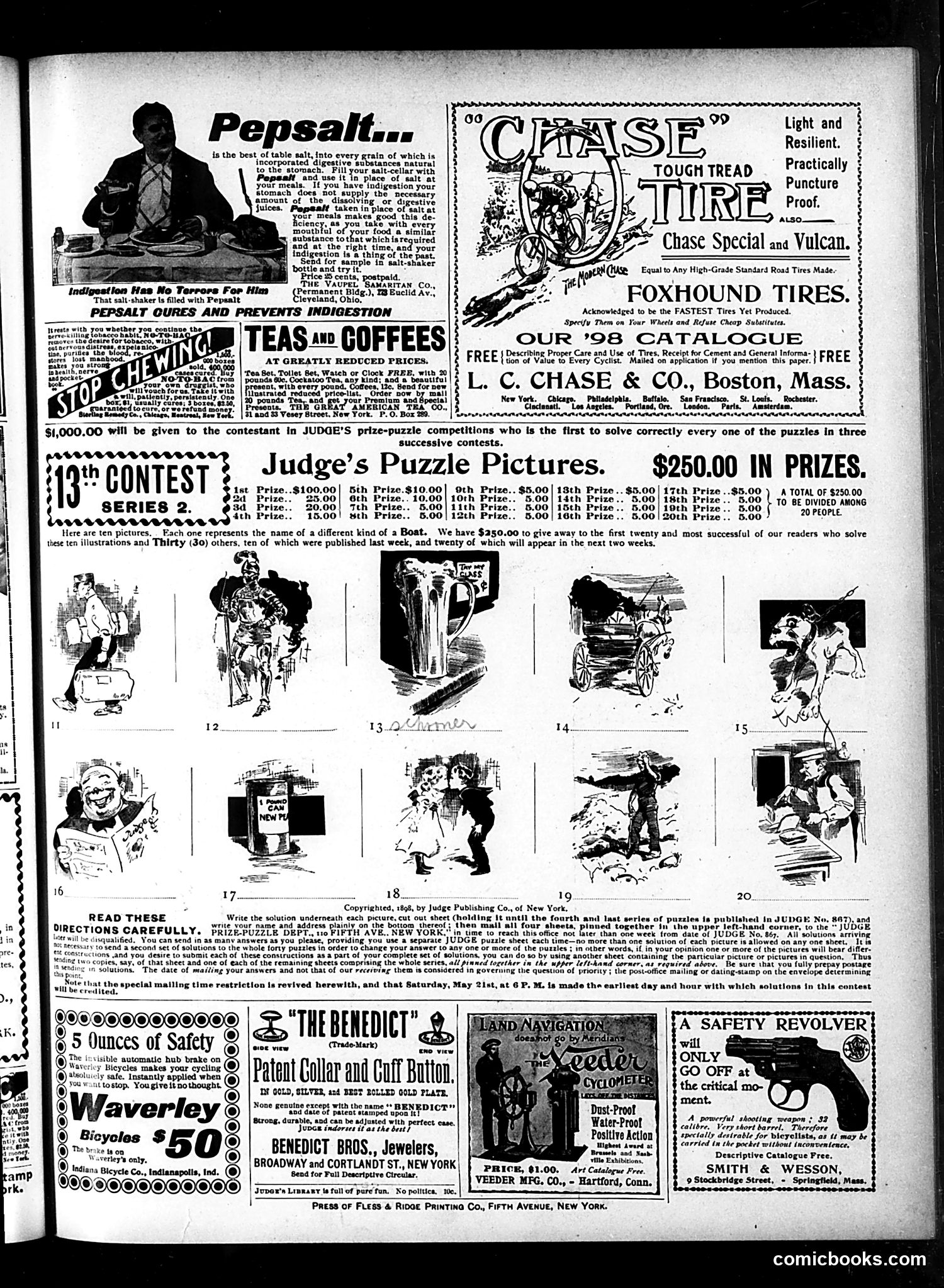
This page is primarily **advertising and contest material**, typical of Judge magazine's revenue model. The main content is a **"Judge's Puzzle Pictures" contest** offering $250 in prizes. Readers must identify ten different types of boats from cartoon illustrations (numbered 11-20 visible), then solve thirty additional puzzles across three consecutive contests. The first person solving all puzzles correctly wins $1,000. **Notable advertisements include:** - **Pepsalt**: A patent medicine claiming to cure indigestion by replacing table salt—typical of the era's dubious health claims - **Waverley Bicycles** ($50): Reflects the 1890s bicycle craze - **Chase Tough Tread Tires** and **Foxhound Tires**: Early automobile tire ads - **Benedict Patent Collar and Cuff Button**: Men's fashion - **Smith & Wesson Safety Revolver**: Firearm advertisement The page reflects turn-of-the-century commercial culture: patent medicines, emerging automobile technology, and consumer goods marketed aggressively to magazine readers. No political cartoons appear on this particular page.
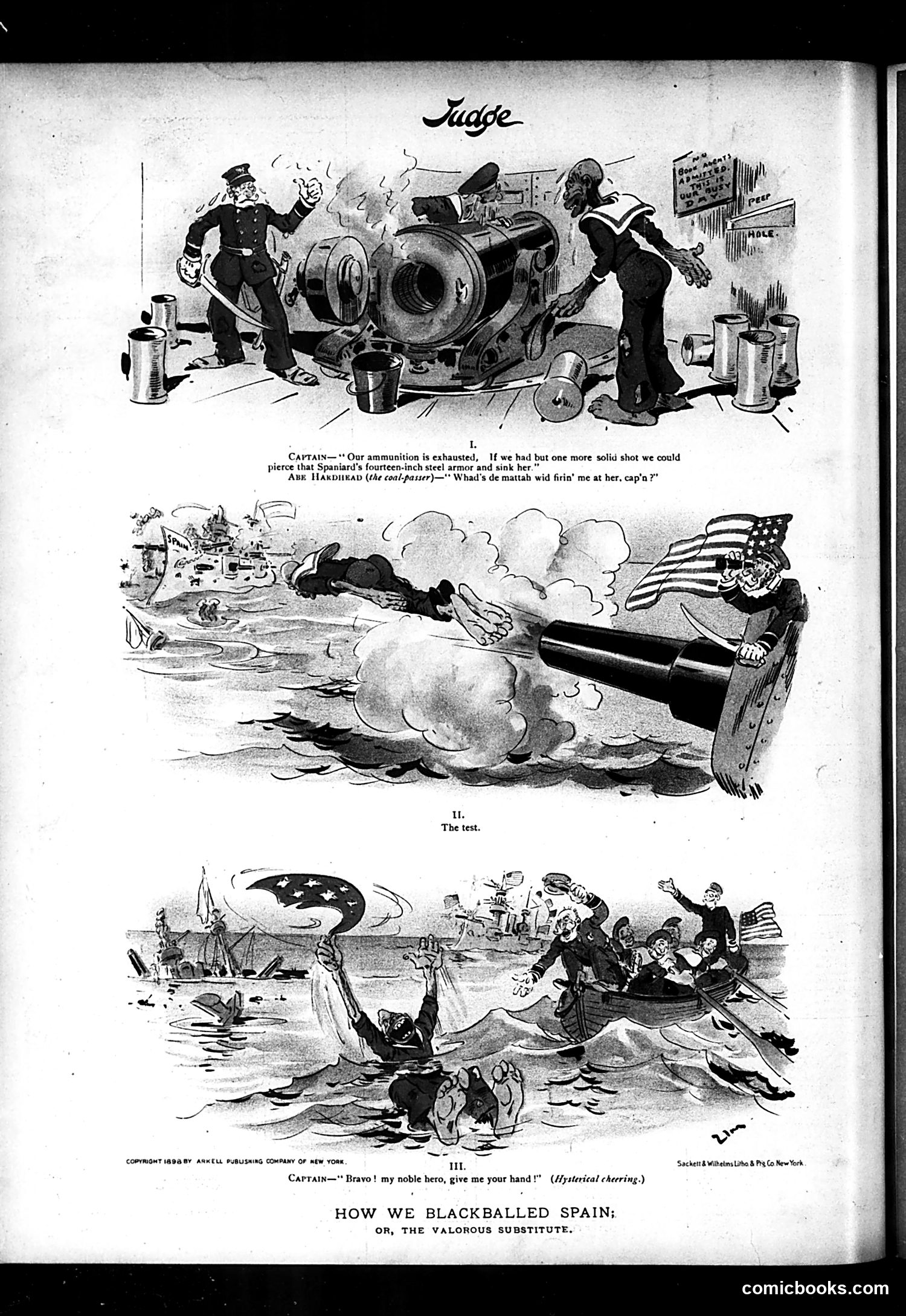
This three-panel Judge cartoon from 1898 satirizes the Spanish-American War through working-class humor. **Panel I** shows naval officers lamenting depleted ammunition during combat with a Spanish ship. An Irish coal-passer (identified by dialect as "Aue Hardihead") volunteers himself as a human projectile—a crude joke about substituting immigrant labor for military resources. **Panels II-III** depict the outcome: the coal-passer is literally fired from a cannon at the American flag, destroying Spanish vessels. He's then celebrated as a hero by officers. The satire targets both military incompetence and the exploitation of working-class immigrants—particularly Irish-Americans—who were viewed as expendable. The title "Blackballed Spain" puns on both cannons and social exclusion. The cartoon mocks American militarism while reflecting period prejudices against immigrant workers, treating their sacrifice as comedic fodder rather than tragedy.