
A complete issue · 18 pages · 1898
Judge — March 5, 1898
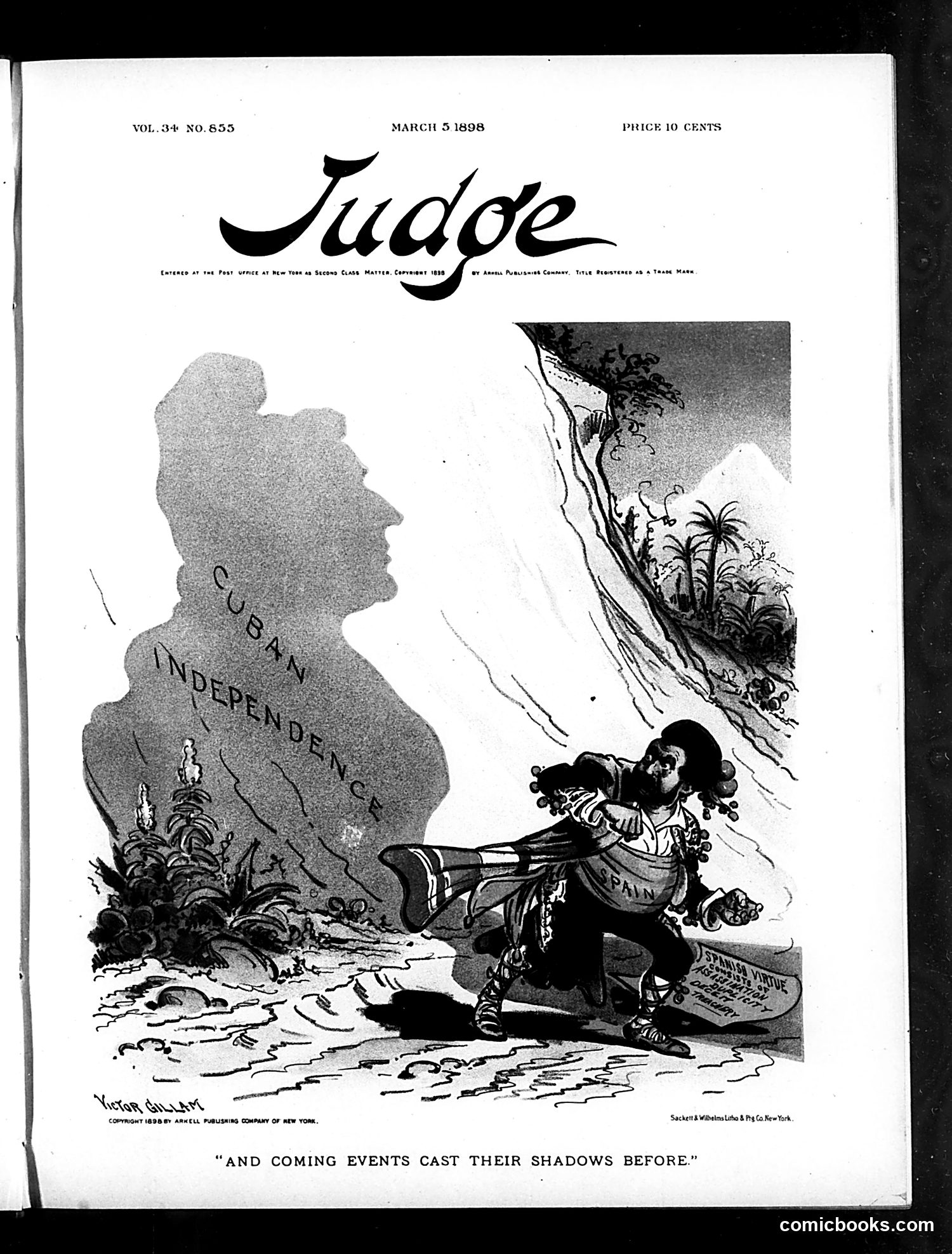
This cartoon depicts a military or political figure labeled "Cuban Independence" as a large stone bust being toppled by a smaller, aggressive character labeled "Spain." The figure of Spain appears to be a soldier or military representative attempting to destroy or suppress Cuban independence efforts. The caption—"And coming events cast their shadows before"—suggests this is prophetic commentary about impending conflict over Cuban independence. This likely references the Spanish-American War (which erupted in April 1898, just weeks after this publication), when American intervention would support Cuban independence from Spanish colonial rule. The cartoon appears to criticize Spain's violent opposition to Cuban self-determination.
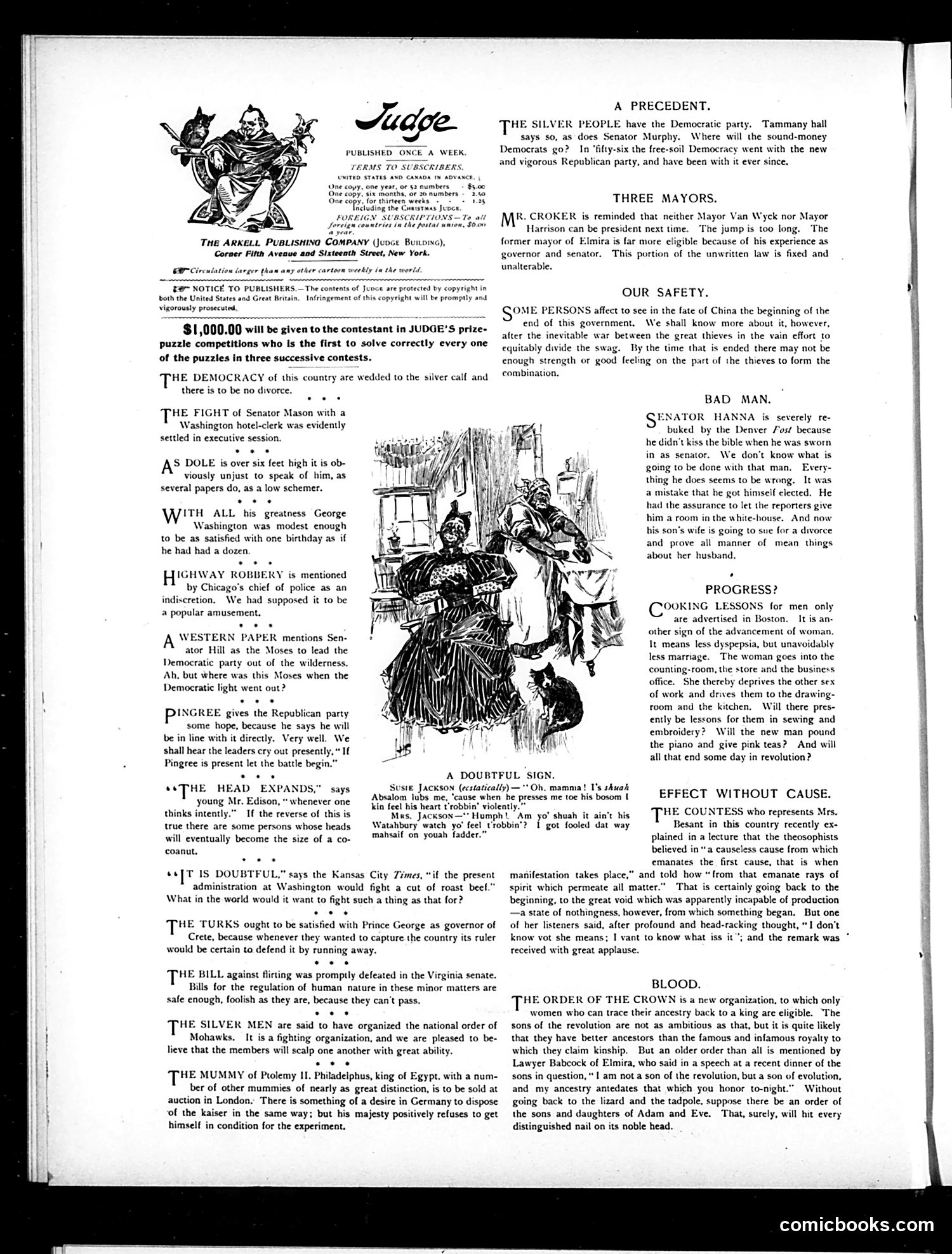
This page contains political commentary rather than a single cartoon. The main illustration depicts a woman in Victorian dress confronting what appears to be a man in an interior setting—likely satirizing marital conflict or domestic politics of the era. The text sections address contemporary political issues: Democratic party durability ("silver call"), Senate appointments, and police leadership in Chicago. One piece criticizes "cooking lessons for men" advertised in Boston as evidence of women's advancement, sarcastically suggesting this represents progress while depriving traditional female domestic roles. Another section mocks "The Order of the Crown," an apparently new organization limiting membership to women claiming aristocratic ancestry—satirizing both class pretension and women's organizational ambitions during this period. The overall tone is conservative, skeptical of both political and social changes.
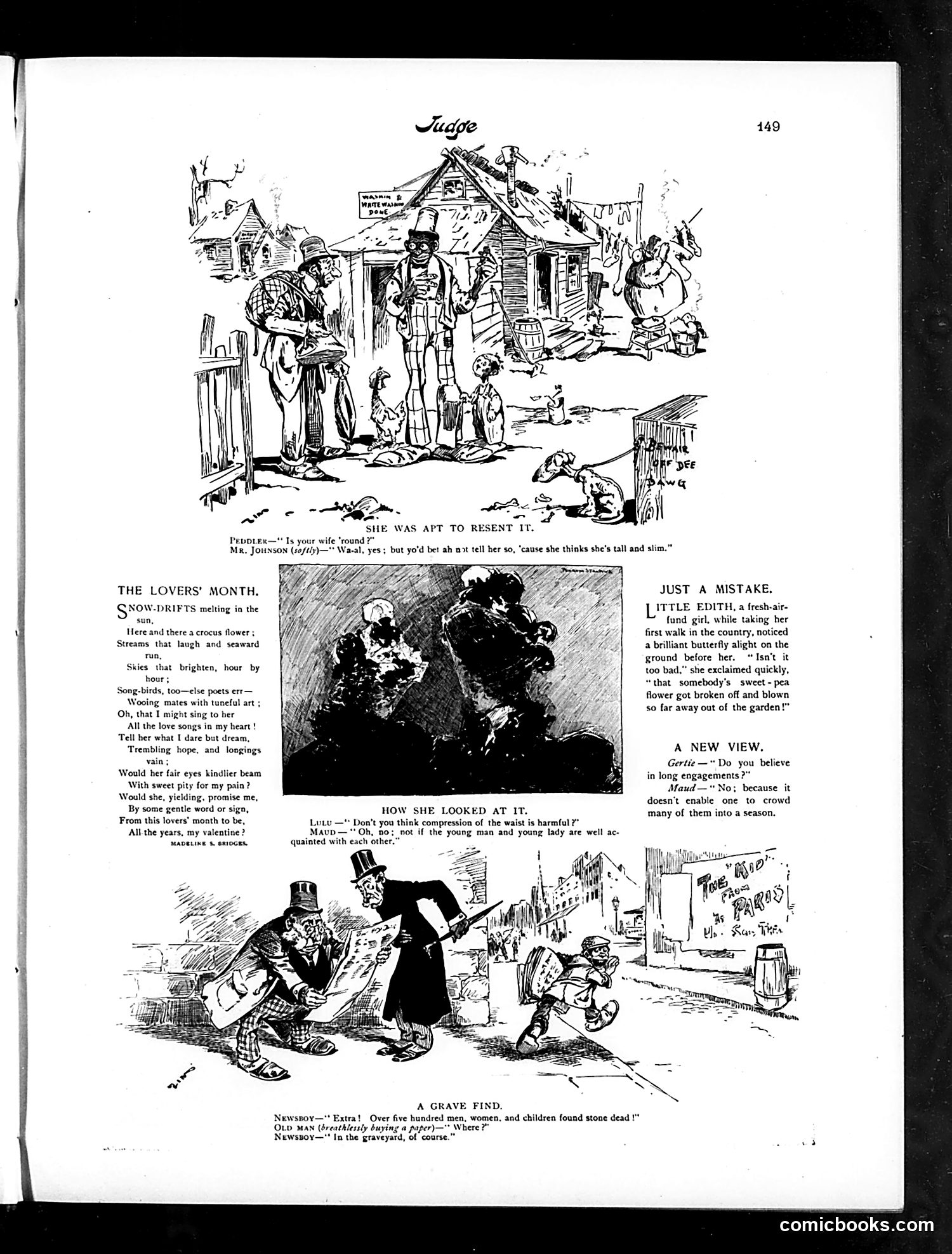
This page contains several short humorous pieces typical of late 19th/early 20th-century satirical magazines: 1. **Top cartoon**: Rural/poverty-themed joke about a wife's appearance, with the punchline suggesting she's "tall and slim" due to malnourishment. 2. **"The Lovers' Month"**: A sentimental poem celebrating June romance, conventional for the era. 3. **"Just a Mistake"**: A brief anecdote about a girl mistaking a butterfly for a flower. 4. **"A New View"**: A dialogue questioning the wisdom of long engagements. 5. **"A Grave Find"**: A dark humor piece about a gravedigger discovering remains. The cartoons use period stereotypes (poverty, class differences) for comedic effect. No specific political figures or contemporary events are clearly referenced. The content reflects typical Judge magazine fare: sentimental poetry mixed with crude humor targeting working-class subjects.
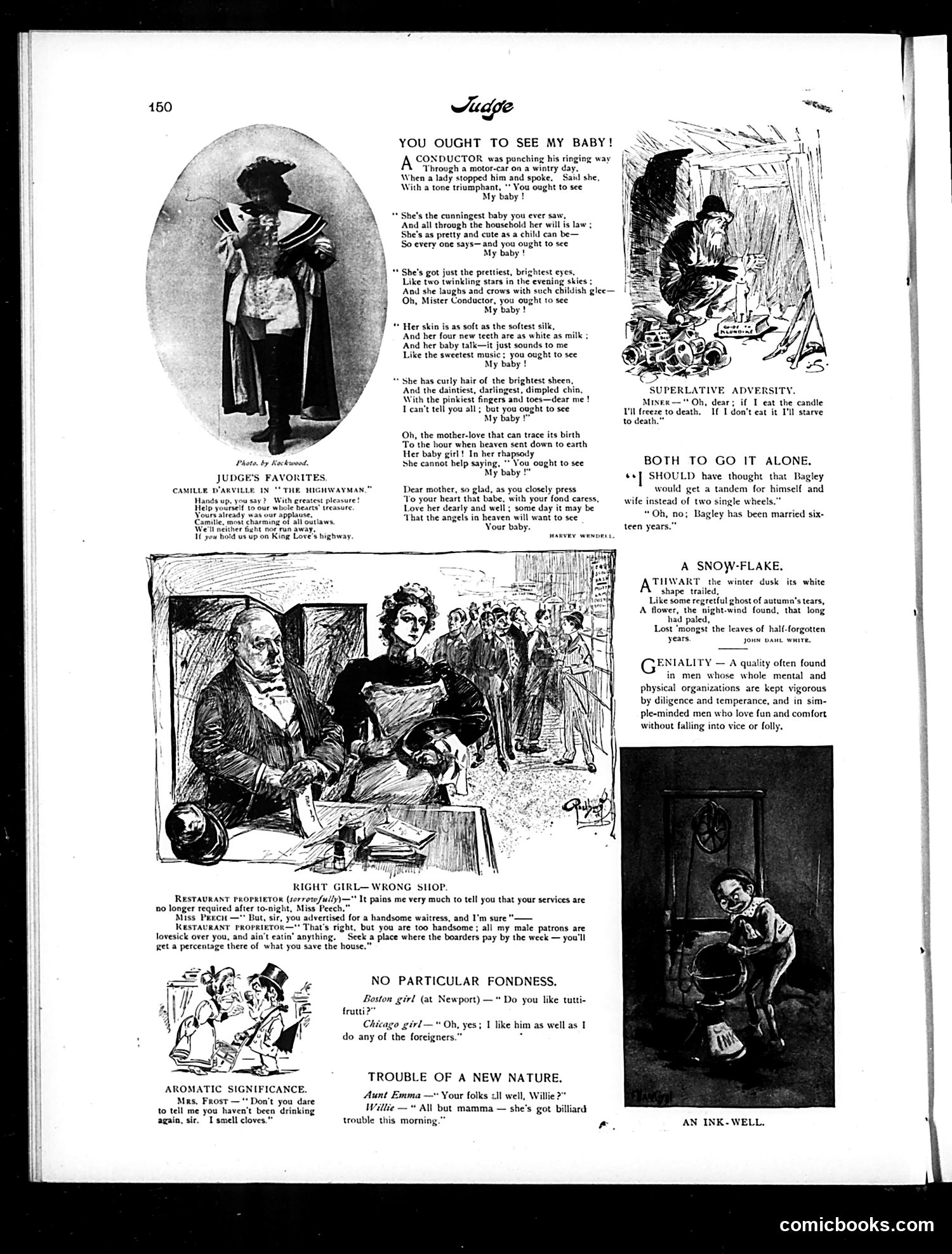
This page contains several satirical pieces typical of Judge magazine's humor: **"You Ought to See My Baby!"** features a conductor boasting about his baby to a lady, who responds with sarcasm. The joke mocks new parents' tendency to bore others with endless baby talk. **"Both to Go It Alone"** satirizes a recently married couple (Bagley, married sixteen years) who already squabble over domestic responsibilities. **"Right Girl—Wrong Shop"** depicts a restaurant proprietor dismissing a waitress seeking better wages, reflecting labor tensions of the era regarding fair compensation. Other brief satirical exchanges mock regional dialects and domestic situations. The cartoons target recognizable social types—boastful parents, argumentative spouses, and exploitative employers—using humor to critique common social behaviors rather than specific political figures.
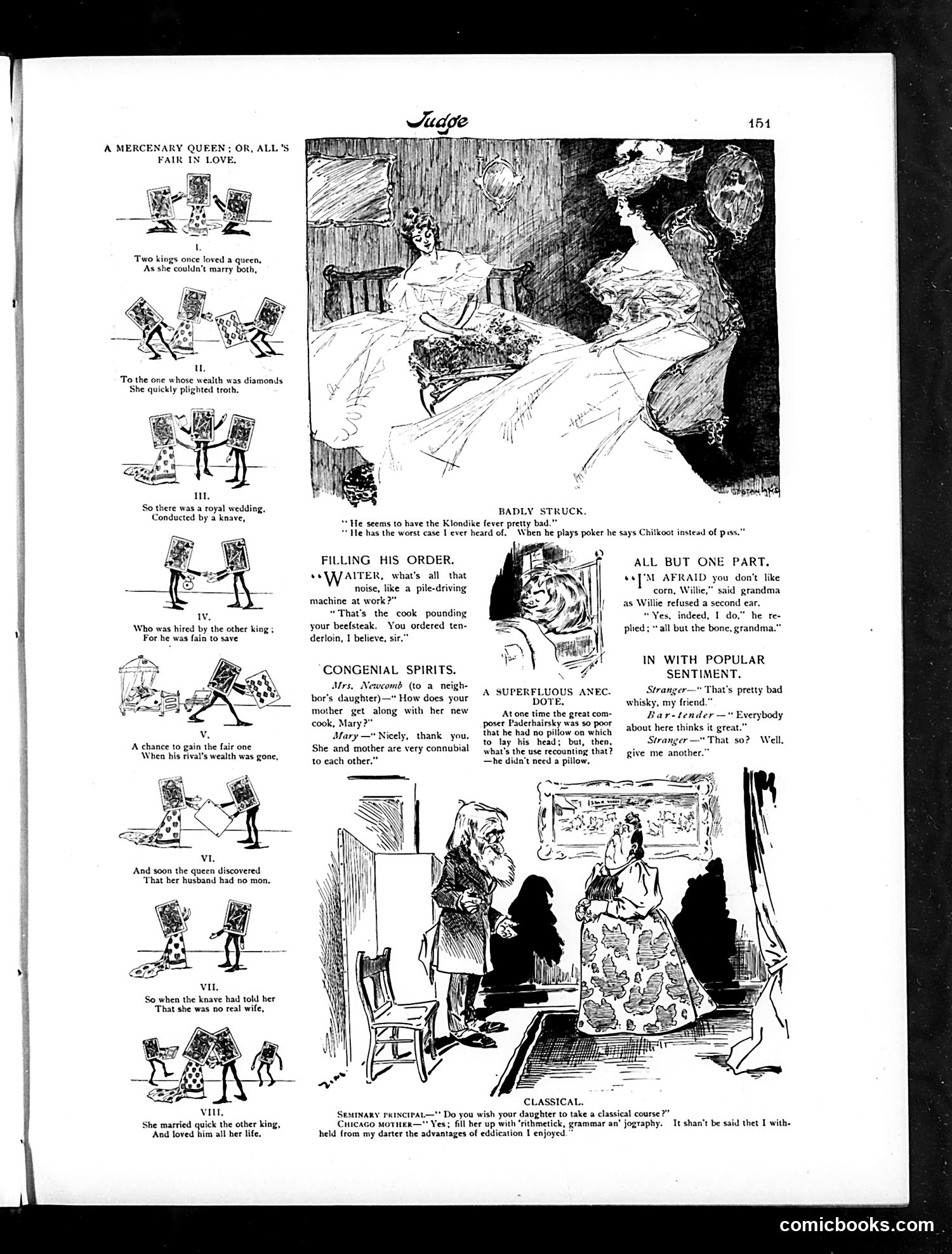
This page contains multiple satirical cartoons mocking contemporary social attitudes. The title story uses a fairy-tale format to ridicule mercenary marriage—a queen chooses the wealthier king, marries him, then abandons him for his richer rival when his fortune disappears, finally settling with the second king "for life." The "Klondike" references allude to the 1890s Yukon gold rush, satirizing the get-rich-quick fever it inspired. Other jokes target pretentious behavior (the seminary principal's malapropisms about "rithmetick" and "jography"), working-class dining complaints, and upper-class affectations. The cartoons collectively mock materialism, social climbing, and the era's class anxieties through humor aimed at various targets: greedy women, nouveau riche prospectors, and poorly educated rural Americans. The tone is lighthearted but barbed social commentary typical of Judge magazine's satirical approach.
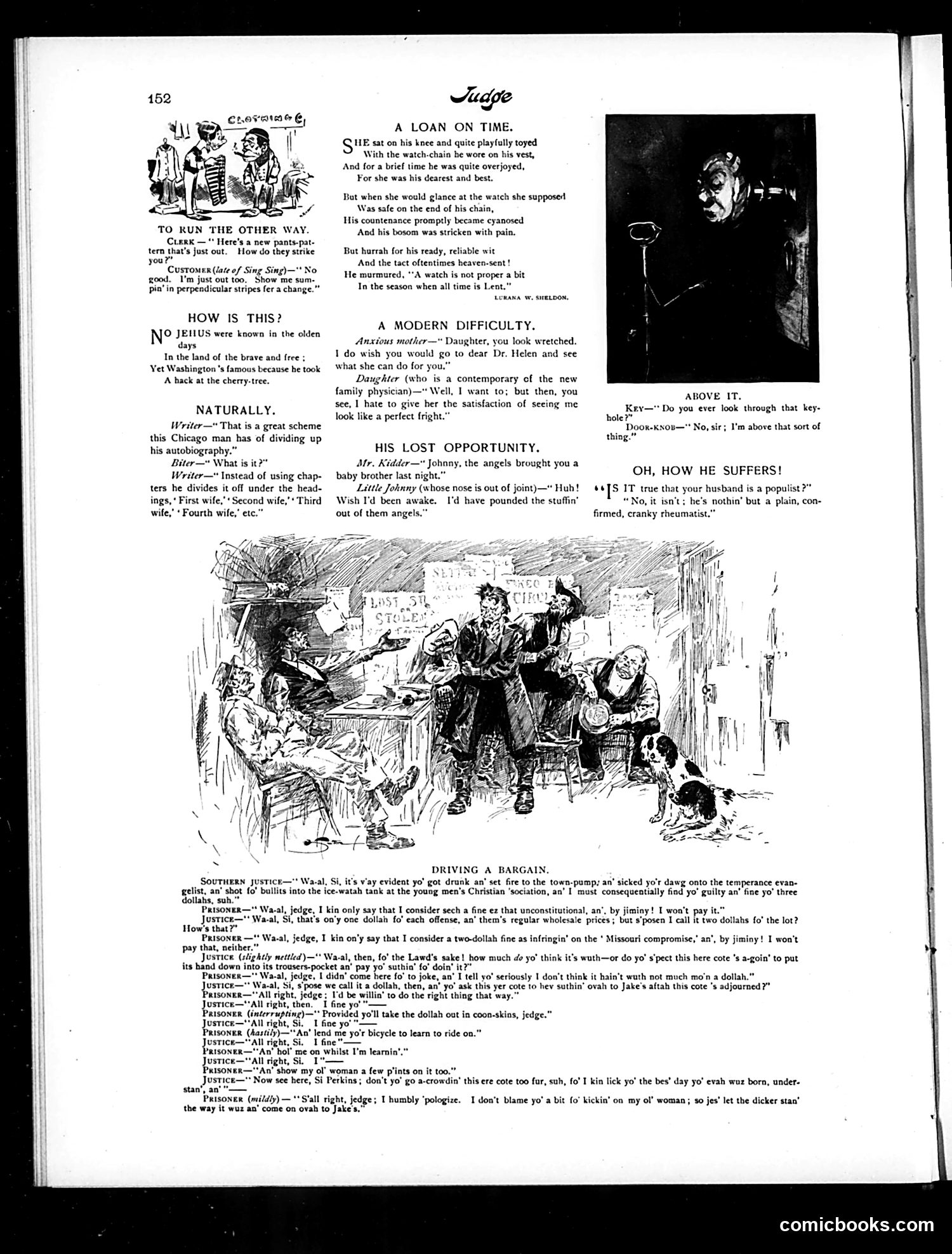
This large cartoon satirizes Southern rural justice and the stereotyped "backwoods" legal system. A prisoner charged with multiple offenses (drunkenness, animal cruelty, vandalism) negotiates his fine downward with a judge through absurd constitutional objections. The humor lies in the prisoner's ridiculous invocation of legal principles (calling fines "unconstitutional," citing the "Missouri Compromise") to haggle like a merchant. The judge, exasperated, eventually agrees to accept payment in barter (coon-skins) rather than cash. The satire targets both the prisoner's mercenary dishonesty and the judge's willingness to compromise justice itself—suggesting that in the South, legal proceedings were mere dickering sessions rather than serious proceedings. The dialect and characterizations reflect period stereotypes about rural Southern culture and justice.
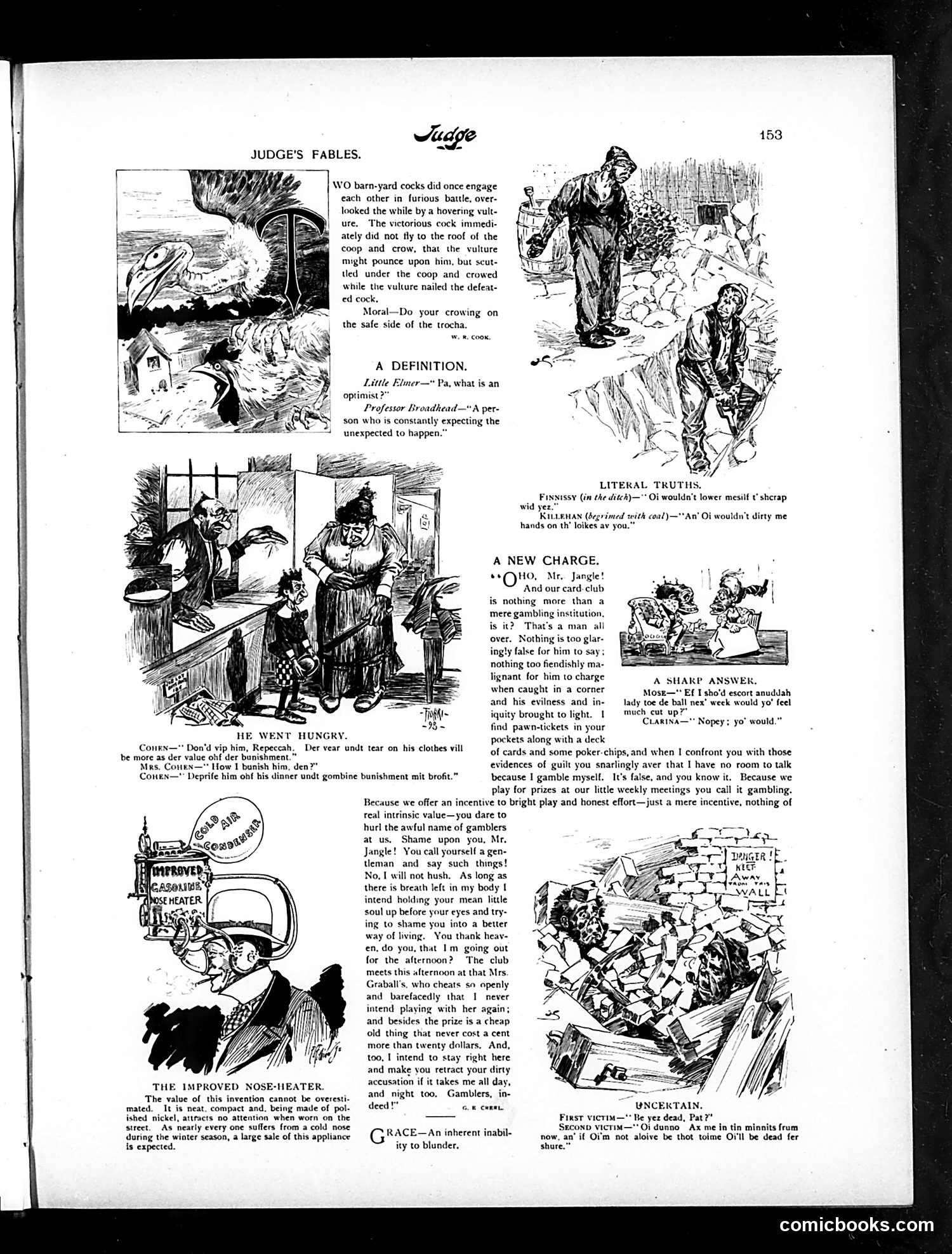
This page contains several satirical pieces typical of early 20th-century American humor: **"Judge's Fables"** presents a moral lesson about discretion—a cock avoids the vulture's attack by crowing safely rather than ostentatiously. The trocha (fortified line) reference suggests military context, likely alluding to Spanish-American War strategy. **"A Definition"** offers wordplay: an optimist expects the unexpected—a paradox mocking naive hopefulness. **"A New Charge"** satirizes upper-class hypocrisy. A man accuses his wife's social club of "gambling" over card games with trivial prizes, while himself engaging in similar activities. The satire exposes how the wealthy rationalize identical behavior differently based on social standing and who's involved. **"Literal Truths"** and dialect pieces use working-class Irish and African American characters in humorous exchanges about dignity and social pretension. **"The Improved Nose-Heater"** advertises a novelty device for cold noses—likely satirizing absurd patent medicines common in the era. The page exemplifies Judge's approach: social commentary through exaggeration, class-based humor, and character stereotyping.
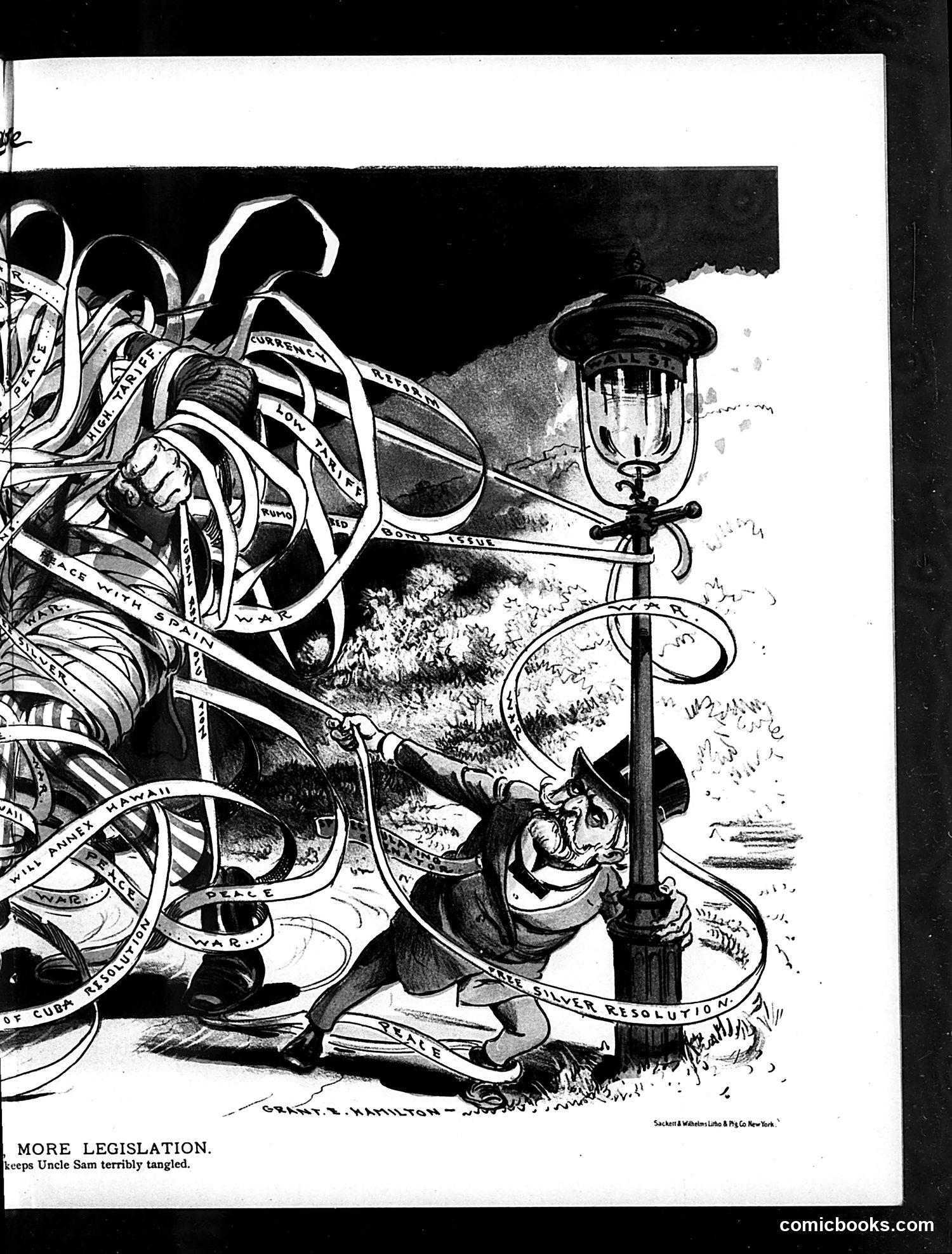
This political cartoon depicts Uncle Sam (representing the United States government) becoming severely entangled in red tape and ribbons labeled with various legislative measures and resolutions—including references to "CUBA" and "SILVER RESOLUTION." A small figure (likely representing Congress or a politician) struggles to untangle the mess while holding a lamp, suggesting they're trying to find clarity amid confusion. The satire criticizes excessive legislation and bureaucratic red tape that has become so complex it paralyzes government action. The title "MORE LEGISLATION" suggests that additional laws only worsen the problem rather than solve it. This appears to reference late 19th-century Congressional gridlock over Cuban policy and monetary issues (silver coinage debates were prominent in this era), where competing legislative proposals created bureaucratic confusion rather than effective governance.
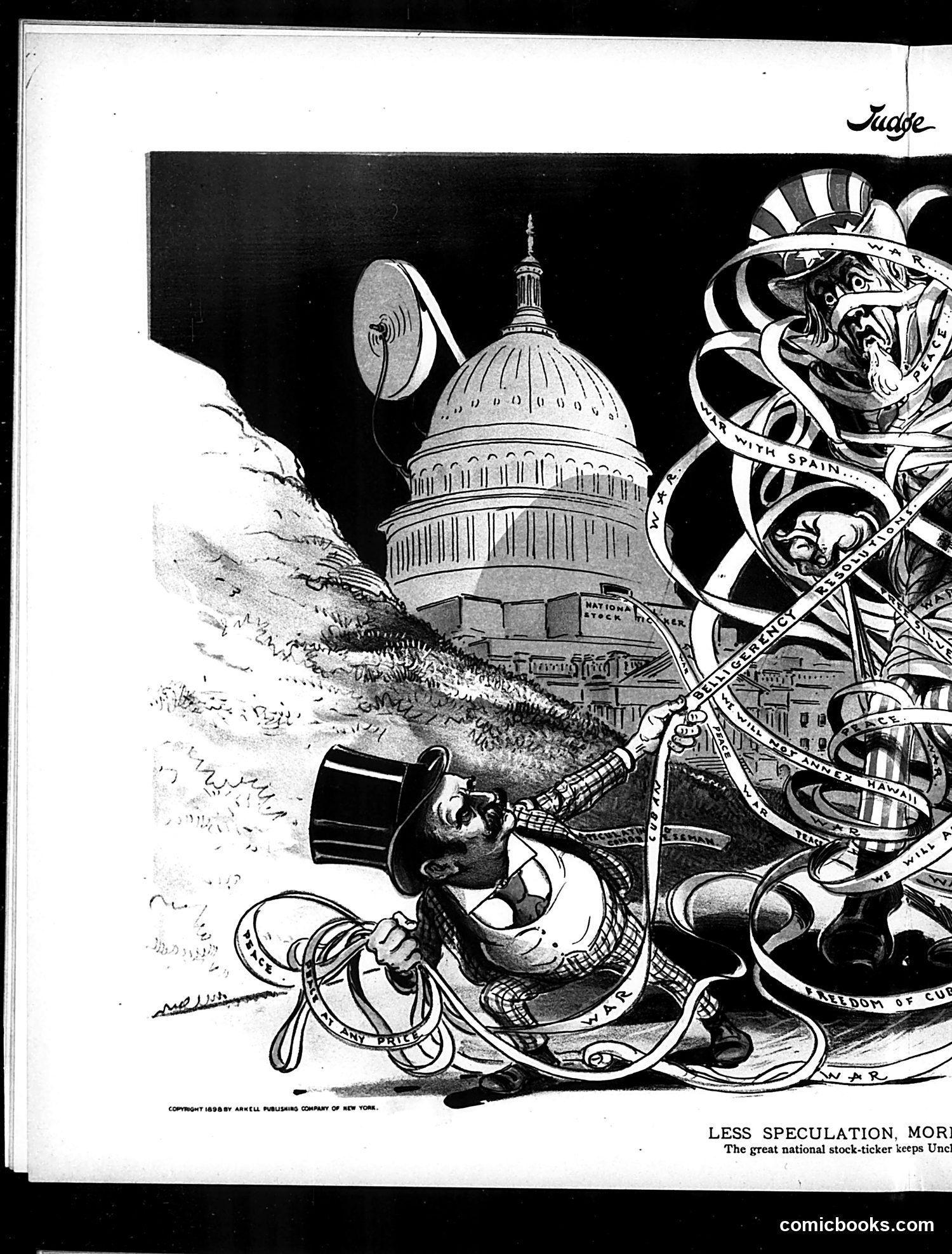
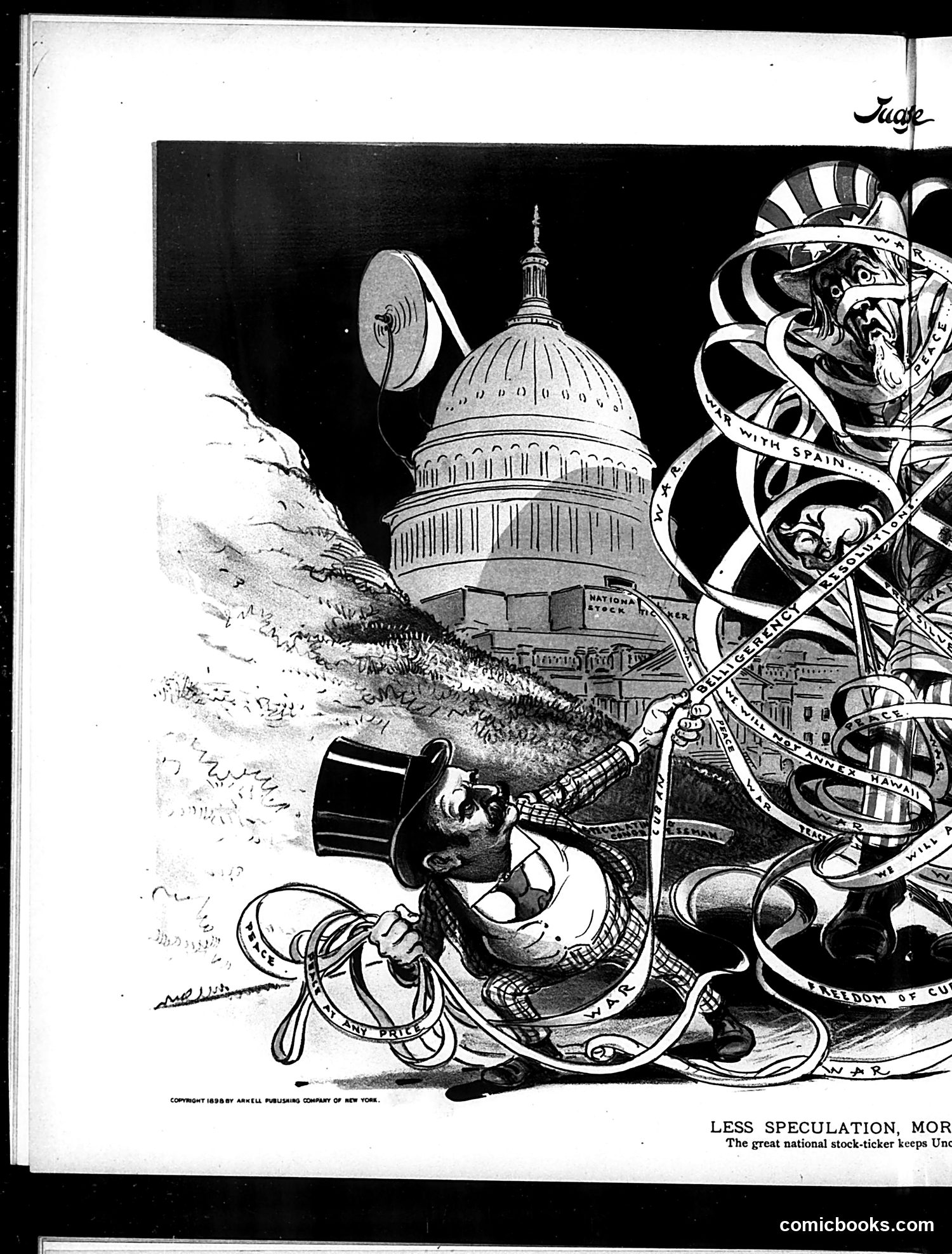
This satirical cartoon depicts Uncle Sam (identifiable by his top hat and characteristic appearance) wielding a large hammer or mallet labeled "STOCK TICKER" at the U.S. Capitol building. The caption reads "LESS SPECULATION, MORE[...]" with text about "the great national stock-ticker keeps Uncl[e Sam]." The cartoon appears to criticize stock market speculation and its influence on American government. The tangled ribbons and mechanical imagery suggest the stock market's complex, pervasive control over national policy. Uncle Sam is portrayed as being manipulated or constrained by market forces rather than governing independently. The publication date (1928, per the copyright notice) places this during the pre-Great Depression stock boom, when speculative trading was rampant. The cartoon likely advocates for government regulation to reduce risky financial speculation.
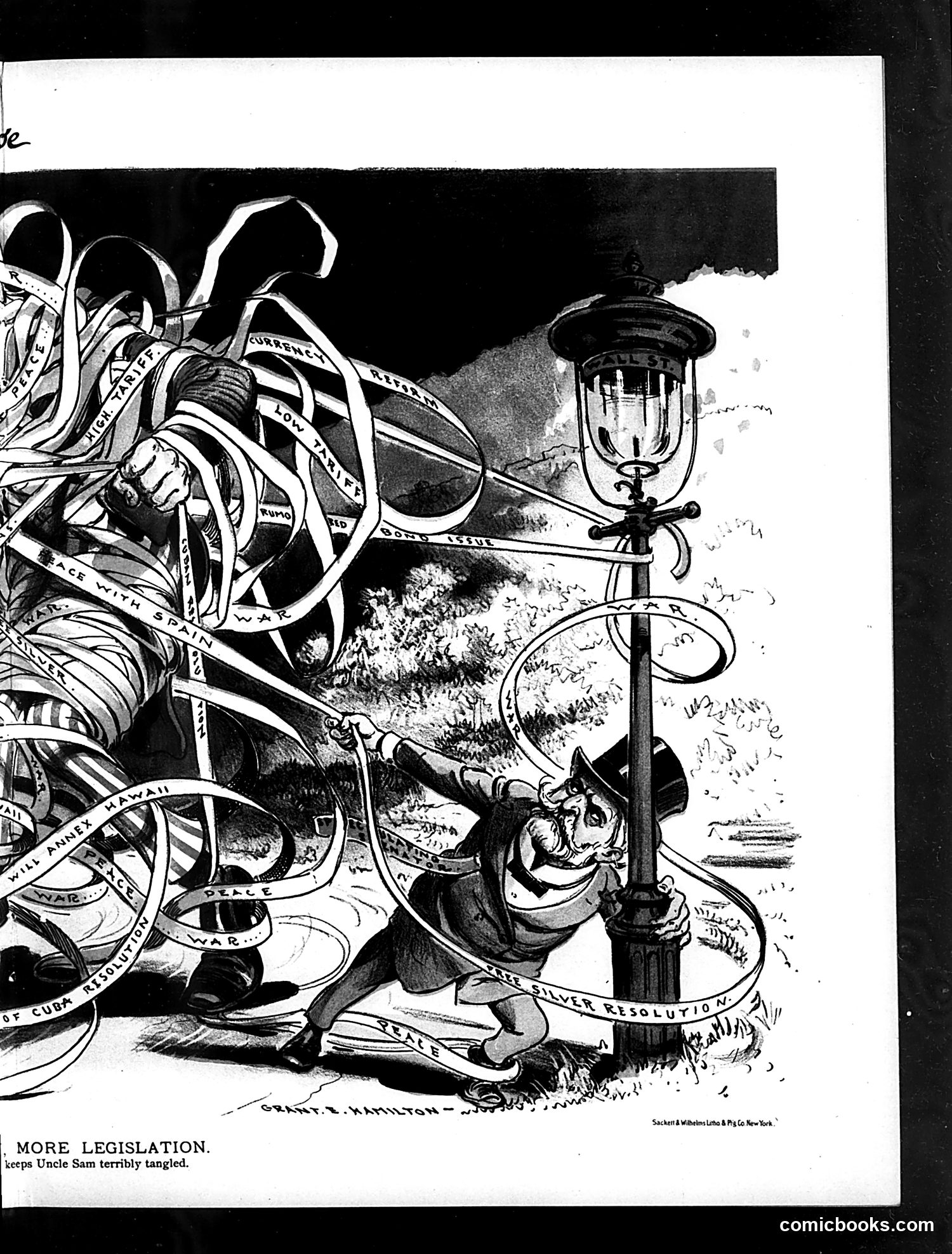
This is a satirical cartoon titled "MORE LEGISLATION" showing Uncle Sam (representing the U.S. government) entangled in ribbons labeled with various legislative resolutions and acts—including references to "Cuba," "Silver Resolution," and other policy matters. A small figure, likely a politician or legislator, struggles to hold a lamp post while drowning in this bureaucratic mess. The cartoon critiques legislative overreach and complexity: the proliferation of laws and resolutions has become so excessive that it literally tangles and immobilizes the government itself. The tangled ribbons suggest confusion and contradiction in policymaking, while Uncle Sam's predicament illustrates how excessive legislation paralyzes rather than helps the nation. This reflects Progressive-era concerns about government inefficiency and legislative gridlock.
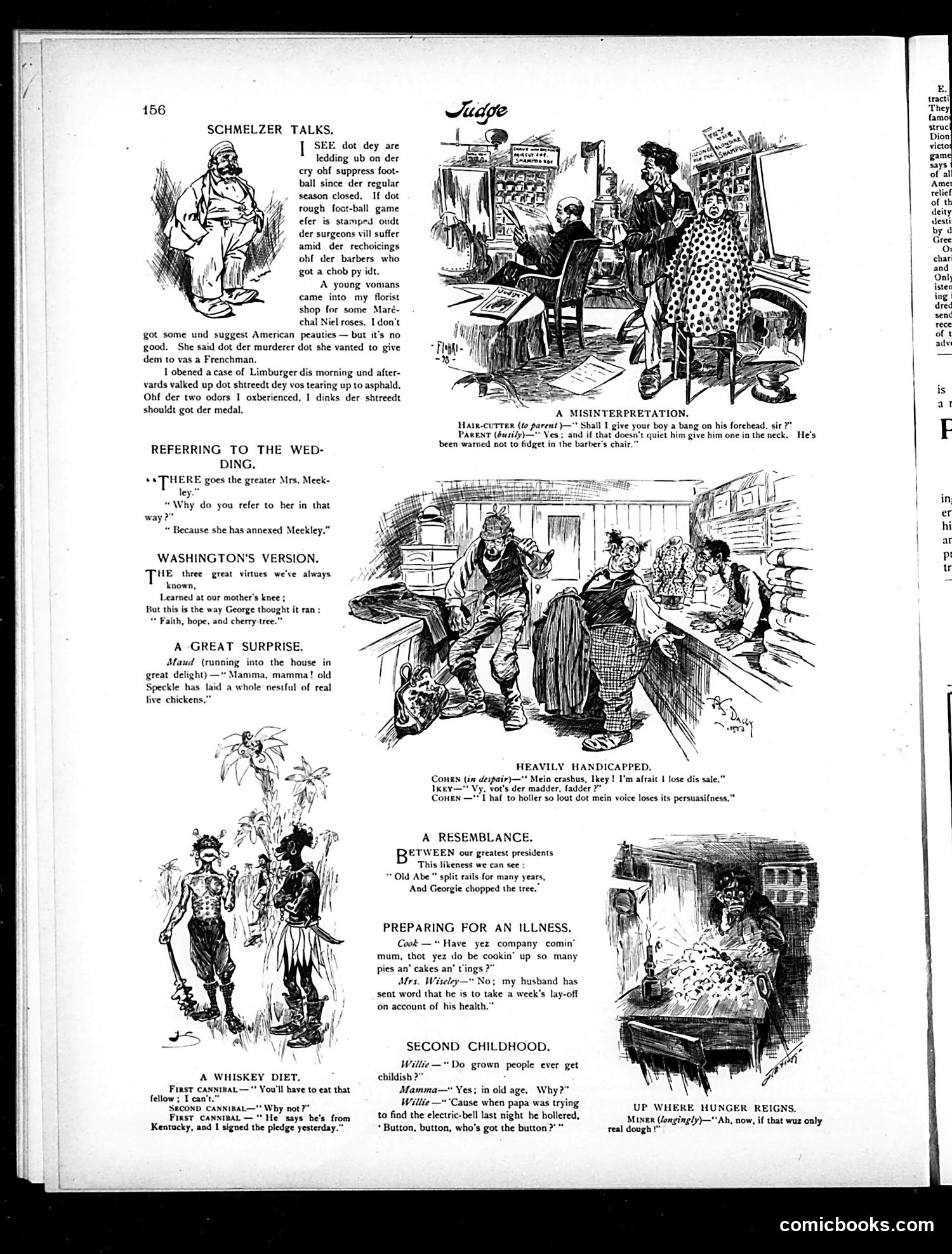
This page contains multiple short humor pieces typical of early 1900s Judge magazine, mixing ethnic dialect humor with social commentary: **"Schmelzer Talks"** features a German-accented character making observations about contemporary issues: football injuries, floral preferences, and urban construction odors. The humor relies on heavy dialect ("dot," "vos," "shtreedt"). **Other notable pieces:** - "A Misinterpretation" jokes about a barber's ambiguous phrasing to a distracted parent - "Referring to the Wedding" references a woman who "annexed" her husband's name - "Washington's Version" riffs on the cherry-tree legend, substituting "cherry-tree" for "cherry-tree" (unclear original intent) - "Second Childhood" depicts elderly people behaving childishly - "A Whiskey Diet" and "Cannibals" offer dark humor about dietary constraints The cartoons illustrate these jokes with period-appropriate sketches. The overall tone blends slapstick, ethnic stereotyping, and gentle social observation—typical of American humor magazines of this era. The page demonstrates how early 20th-century satire often relied on dialect caricature that would be considered offensive today.
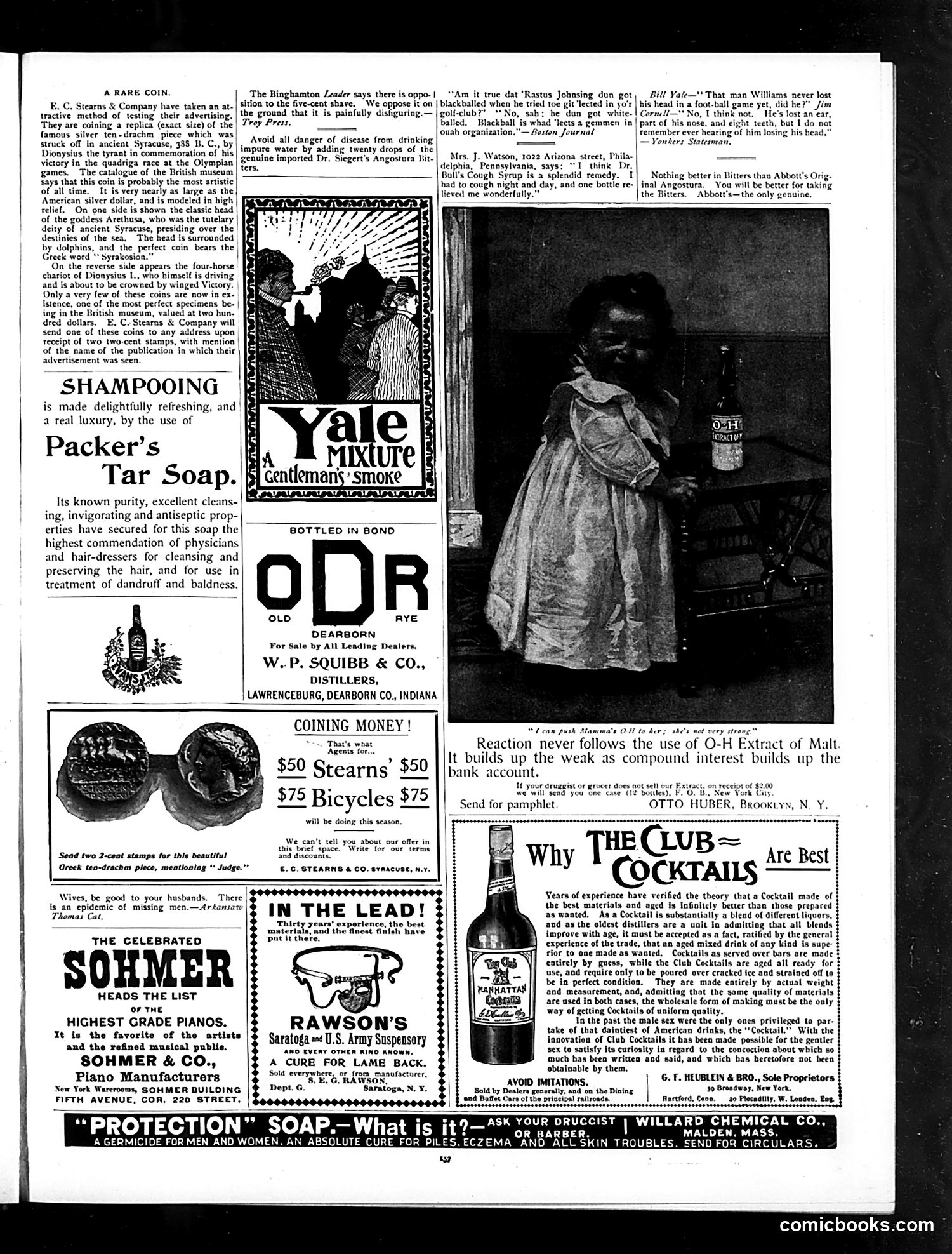
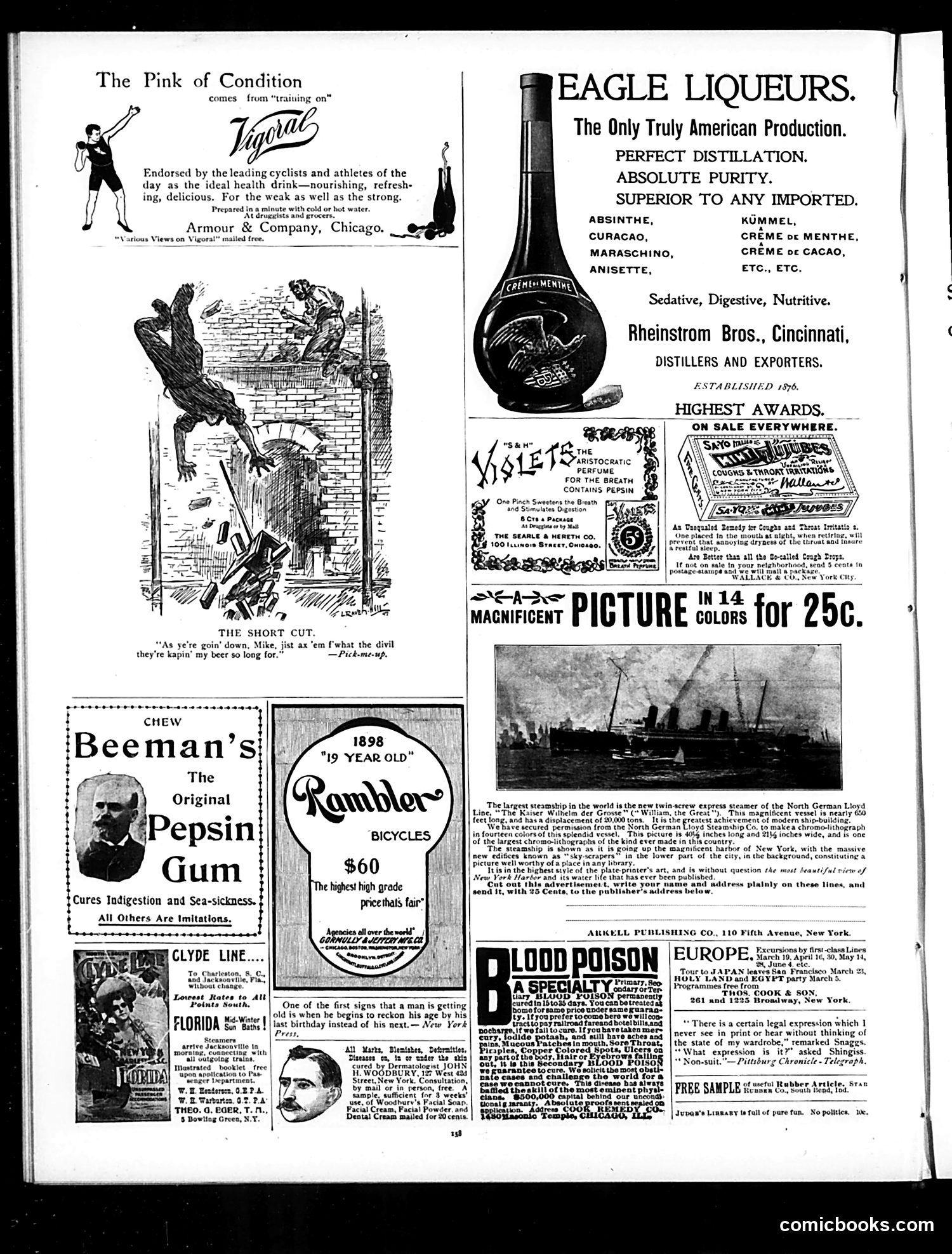
This page is primarily **advertising**, typical of late-19th-century magazines. The cartoons are minimal. ## The Cartoons: **"The Short Cut"** (left): A brief Irish-accented joke about a man waiting for beer, with no clear political satire—just period humor. **"One of the first signs..."** (bottom left): A single-panel observation about aging, not satire. ## The Advertisements: The page showcases period products: Vigoral (health drink), Beeman's Pepsin Gum, Rambler Bicycles, Eagle Liqueurs, Vislet's perfume, and various remedies. These ads reflect 1898 consumer culture—health tonics, bicycles (then cutting-edge), and patent medicines. **Notable context**: The large illustration promotes a chromolithograph of the *Kaiser Wilhelm der Grosse*, a German steamship, marketed as a 25-cent picture. This reflects the era's fascination with modern industrial achievements and transatlantic commerce. The page demonstrates Judge's reliance on advertising revenue rather than political commentary on this particular spread.
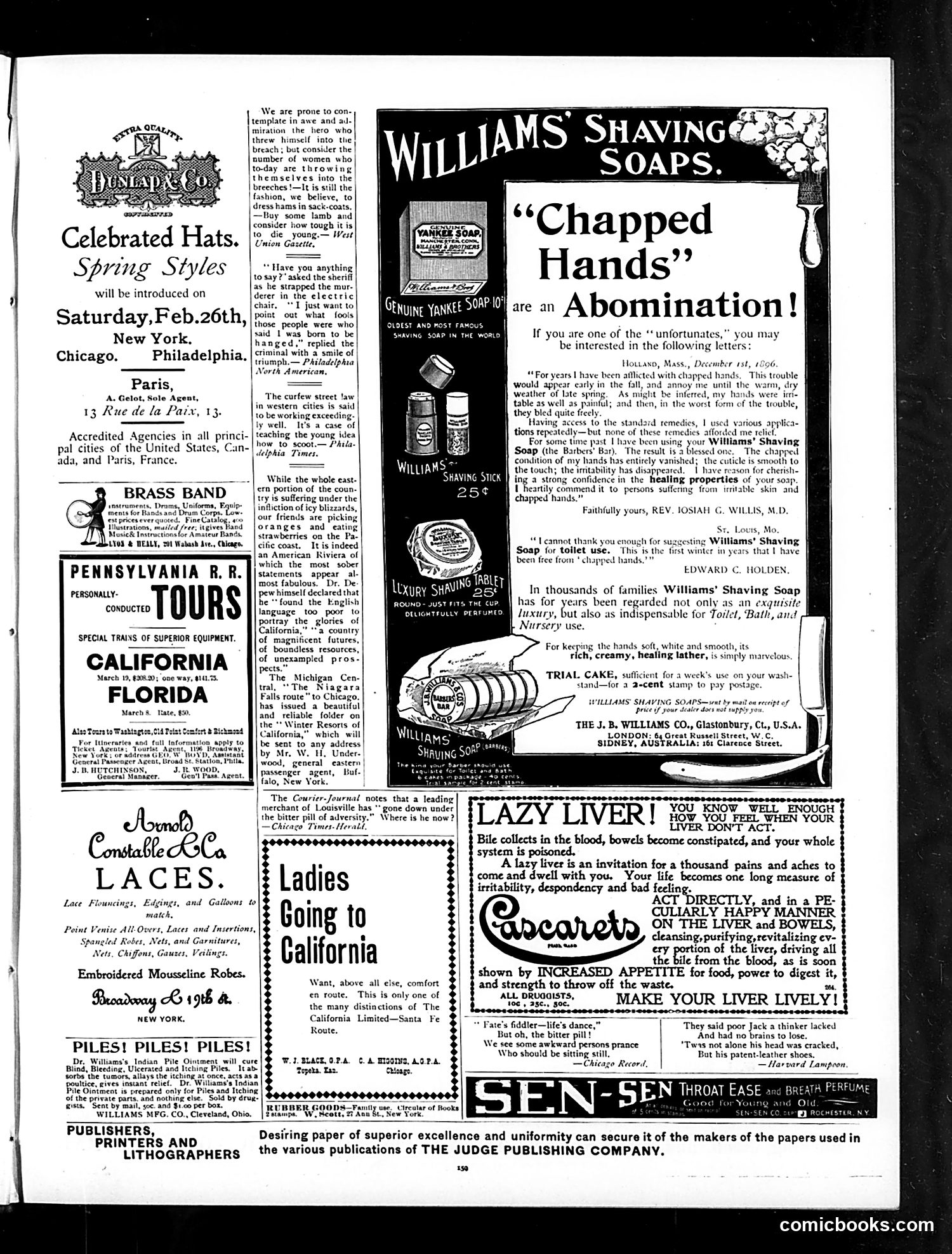
This page is primarily **advertisements and notices**, not satirical content. The main items are: **Williams' Shaving Soaps advertisement** dominates the right side, featuring testimonial letters from satisfied customers (a reverend and a doctor) claiming the soap cures chapped hands. This represents typical early-1900s patent medicine advertising style—using authority figures and emotional testimonials to sell products. **Travel/Railroad advertisements** advertise Pennsylvania Railroad tours to California and Florida, Dunlap hats, and Arnold Constable laces—typical commercial notices of the era. **Minor humorous items** scattered throughout include brief anecdotes (a condemned man's quip about being "born to be hanged"), but these are filler content, not political satire. The page also includes ads for "Cascarets" (a laxative) and "Sen-Sen" throat lozenges—period remedies for common ailments. This appears to be a regular Judge advertising section rather than a page featuring political or social satire, which the magazine was otherwise known for.
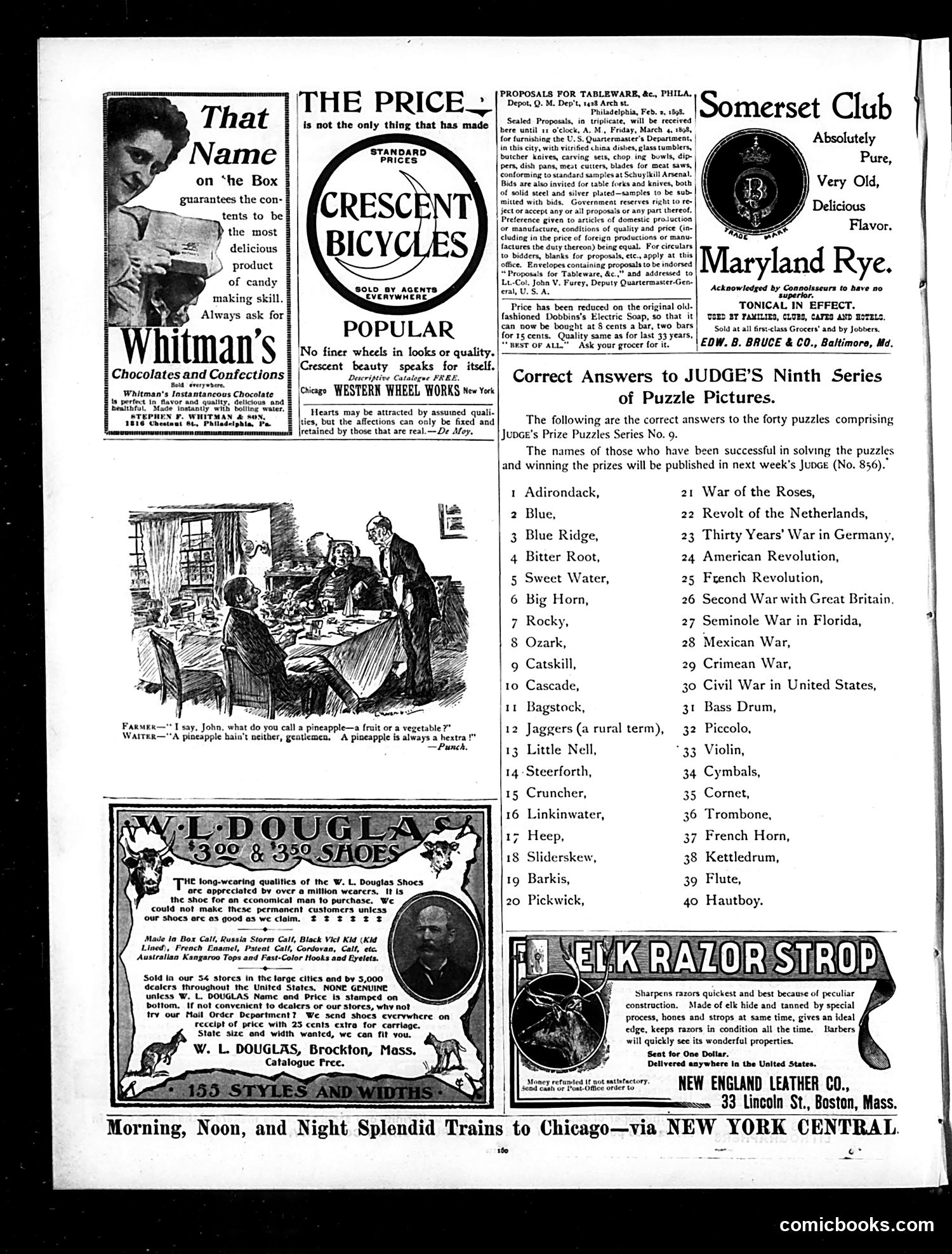
This is primarily an **advertising page** rather than a satirical cartoon page. The content consists of period advertisements (circa 1898, based on the visible date) for consumer goods: Whitman's chocolates, Crescent bicycles, Somerset Club rye whiskey, W.L. Douglas shoes, and Elk razor strops. The only non-advertising content is a section titled "Correct Answers to JUDGE'S Ninth Series of Puzzle Pictures"—a reader participation feature listing 40 historical and cultural references (geographical features, wars, Dickens characters, and musical instruments) that readers solved in a previous issue. The page reflects **late-19th-century commercial culture**, showcasing how Judge magazine supported itself through advertising while offering readers puzzles and games. There is no political satire or social commentary visible on this particular page.
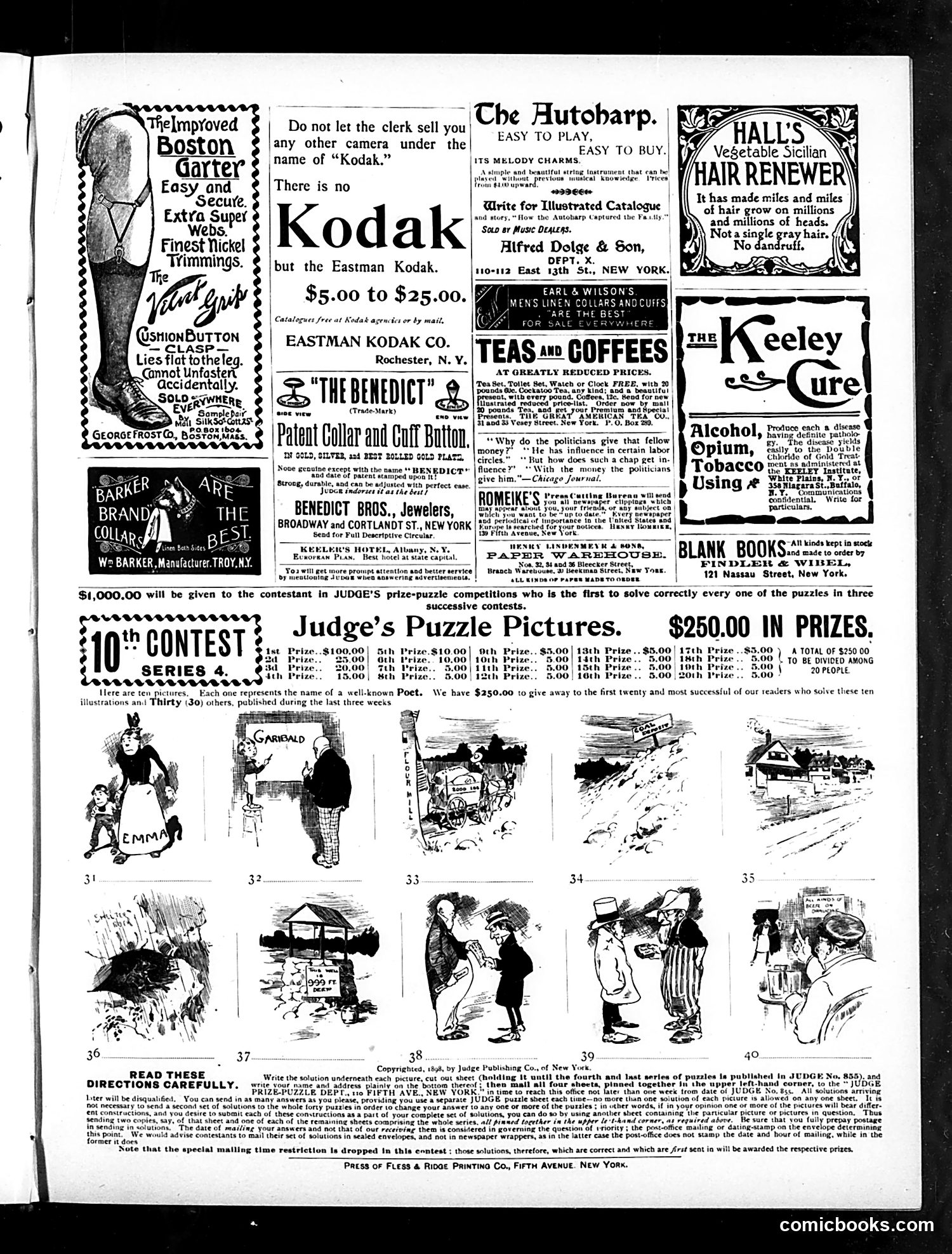
This page is primarily **advertising and a puzzle contest**, not political satire. The main content is a "Judge's Puzzle Pictures" competition offering $250 in prizes. Ten numbered cartoon illustrations are presented for readers to solve—likely identifying hidden objects, matching captions, or finding inconsistencies. The text directs contestants to submit solutions, with the first correct answer winning $100. The surrounding advertisements promote period products: Kodak cameras, hair treatment, patent collar buttons, teas/coffees, and medical remedies (opium, alcohol-based tonics for tobacco use). The cartoons themselves appear to depict everyday humorous scenes—a child labeled "Emma," someone named "Garfield," street vendors, and social encounters—typical of early 1900s satirical illustration style, but without clear political commentary visible here.
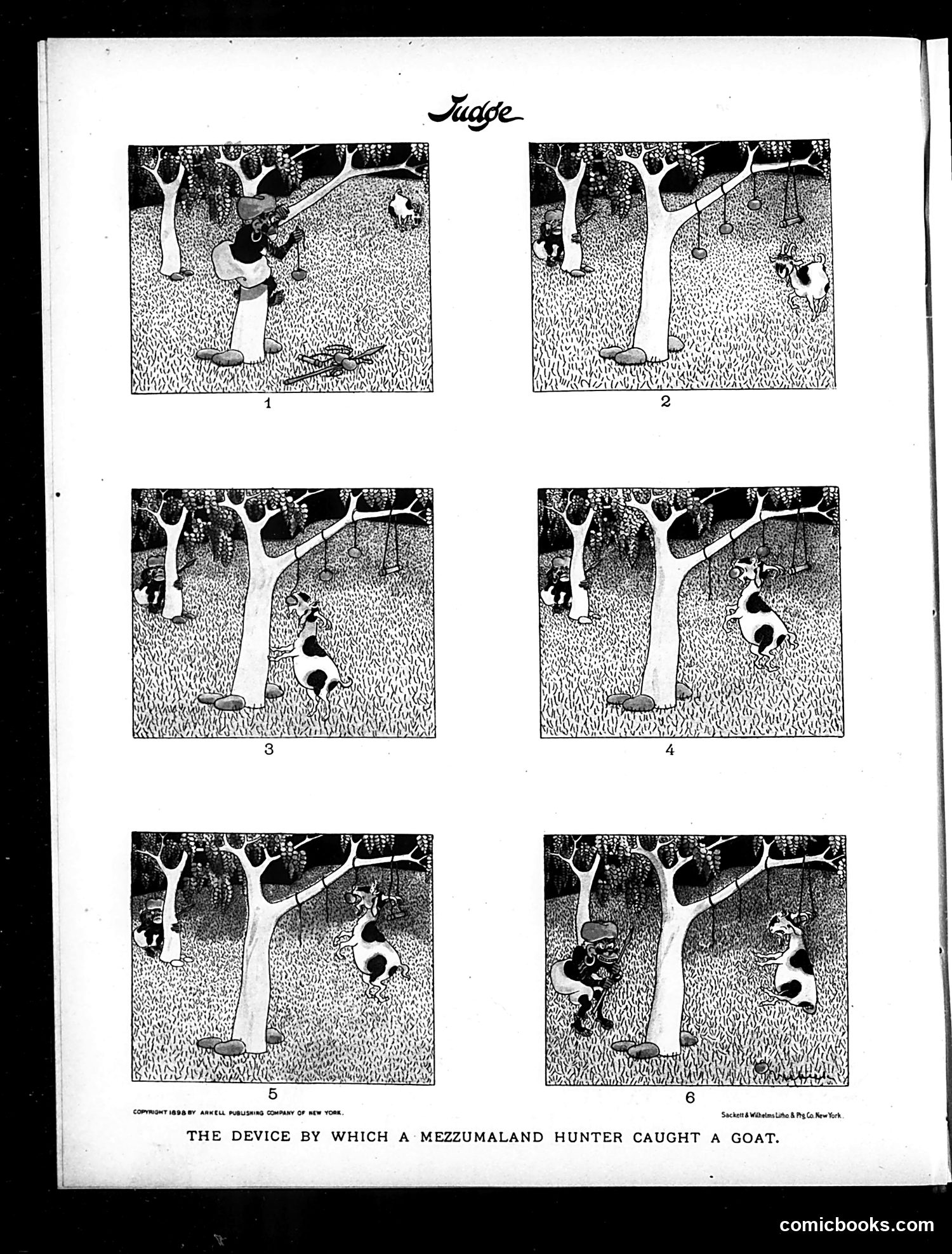
This is a six-panel visual gag from Judge magazine (copyright 1898). The comic depicts a "Mezzumaland Hunter" using an increasingly elaborate mechanical device to catch a goat. The humor works through escalating absurdity: Panel 1 shows a hunter setting up a complex contraption near a tree. Panels 2-6 reveal the device's actual mechanism—it appears to involve the hunter himself being caught or tangled in the very trap he constructed, while the goat remains largely unaffected or escapes. The joke satirizes ineffective problem-solving and overwrought, impractical solutions. "Mezzumaland" appears to be a fictional exotic locale (likely a Judge magazine invention for comedic effect), allowing the cartoonist to mock the idea of "primitive" hunting methods while actually showing modern incompetence. The visual format—sequential panels showing cause-and-effect—anticipates modern comic strip storytelling conventions.