
A complete issue · 16 pages · 1897
Judge — August 7, 1897
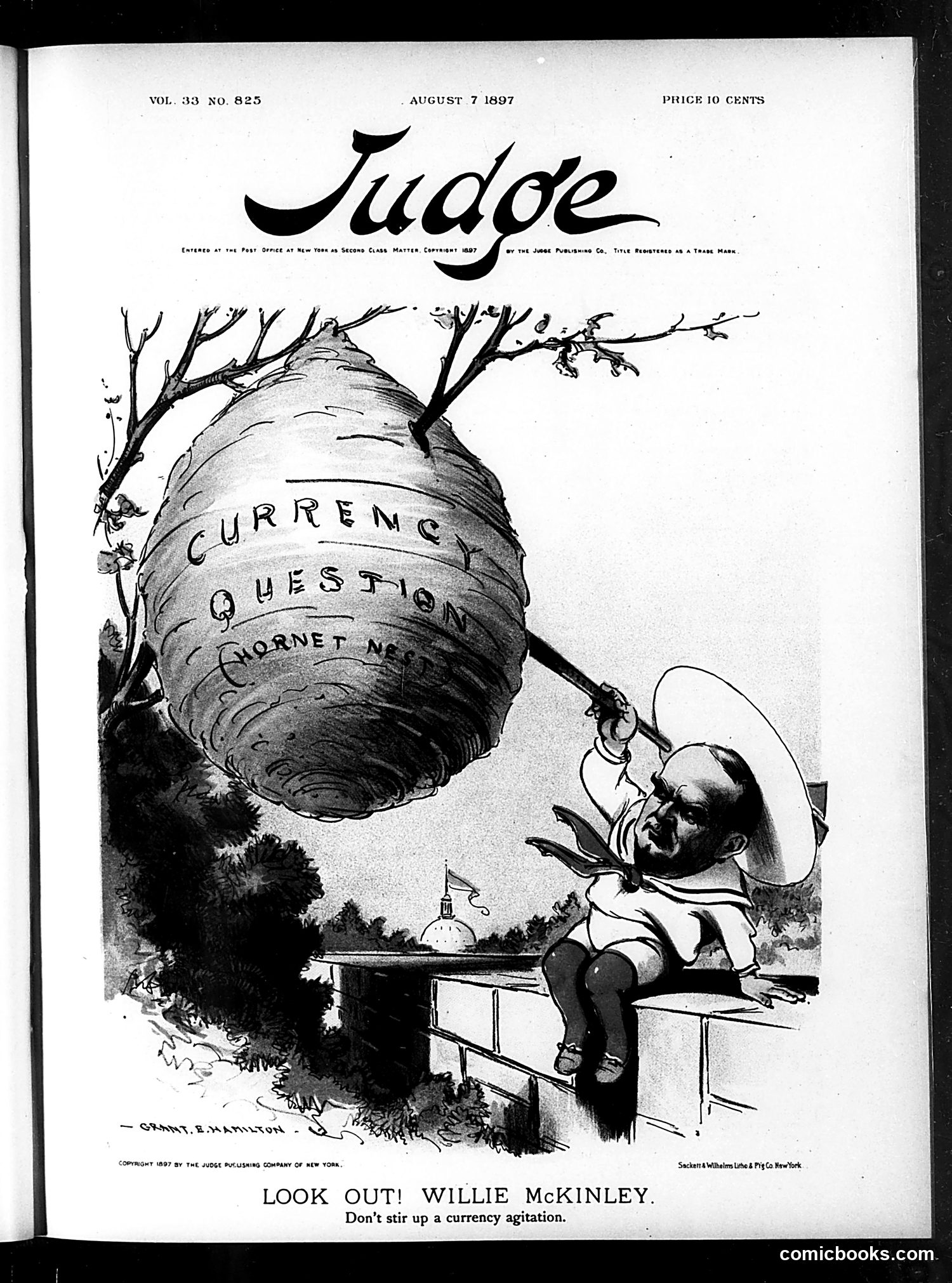
This August 1897 *Judge* cartoon satirizes President William McKinley regarding currency policy. The image shows a figure (likely McKinley, nicknamed "Willie") poking a hornets' nest labeled "CURRENCY QUESTION" and "HORNET NEST" with a stick—an idiom meaning to provoke a dangerous, volatile issue. The bare tree and aggressive wasps suggest the dangerous consequences of stirring up currency debate. The caption warns McKinley against initiating a "currency agitation"—political controversy over monetary policy, likely referencing debates between gold and silver standards that dominated 1890s politics. The satire criticizes McKinley for potentially creating political turmoil by engaging with contentious currency issues rather than avoiding them.
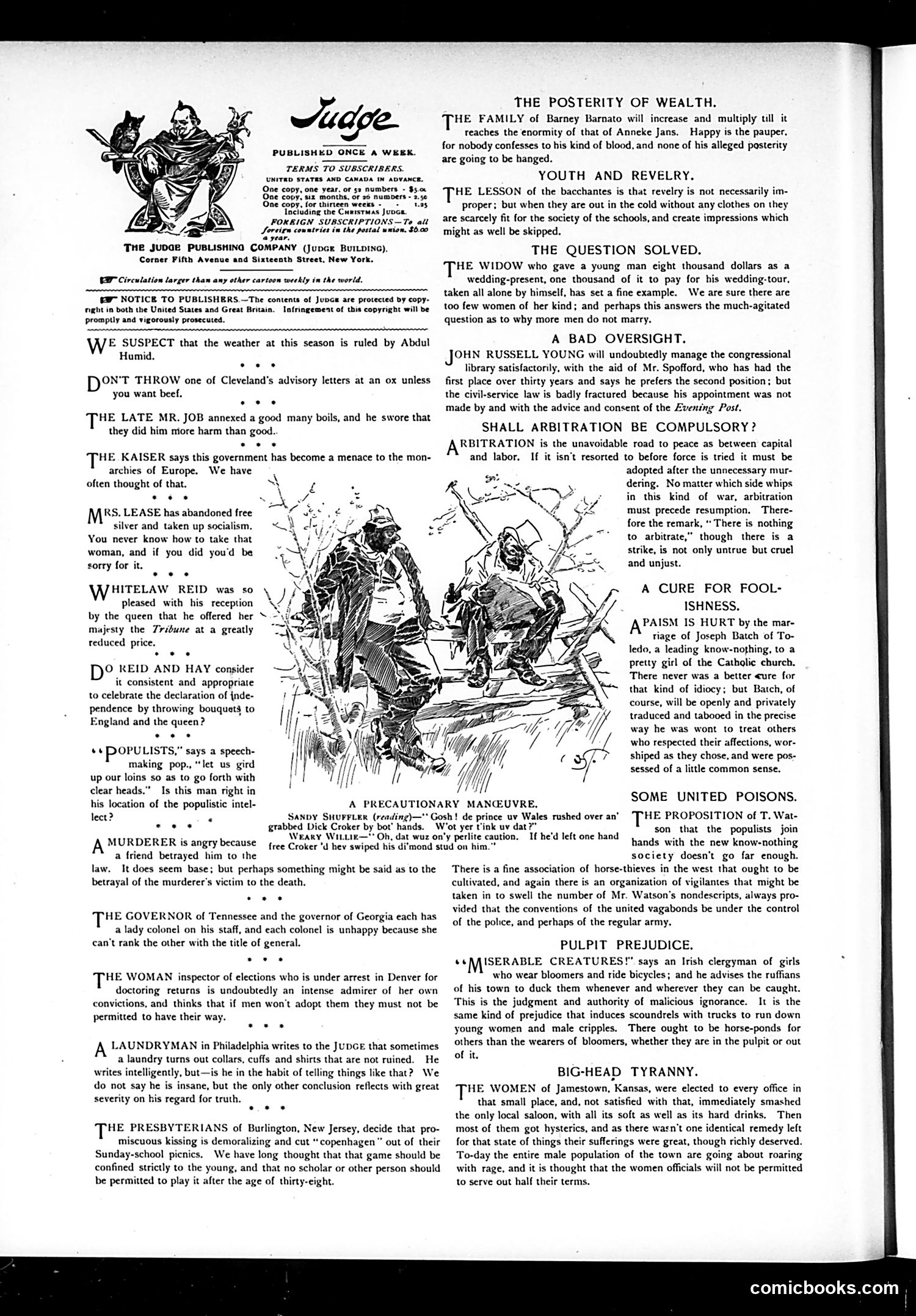
The main cartoon depicts "A PRECAUTIONARY MANOEUVRE" showing two figures on horseback engaged in what appears to be a confrontational encounter. The caption references "Sandy Shuppler" and involves dialogue about Wales, horses, and a "Croker" — likely referring to Boss Croker, the Tammany Hall political figure. The surrounding text consists of brief satirical commentaries on various social and political topics, including references to government figures (the Governor of Georgia), religious institutions (Presbyterians), and social issues like women's rights and labor disputes. Without clearer visual identification of the specific figures or knowledge of the exact historical moment, the cartoon's precise political reference remains unclear, though it appears to mock political maneuvering or confrontation typical of Judge's satirical coverage.
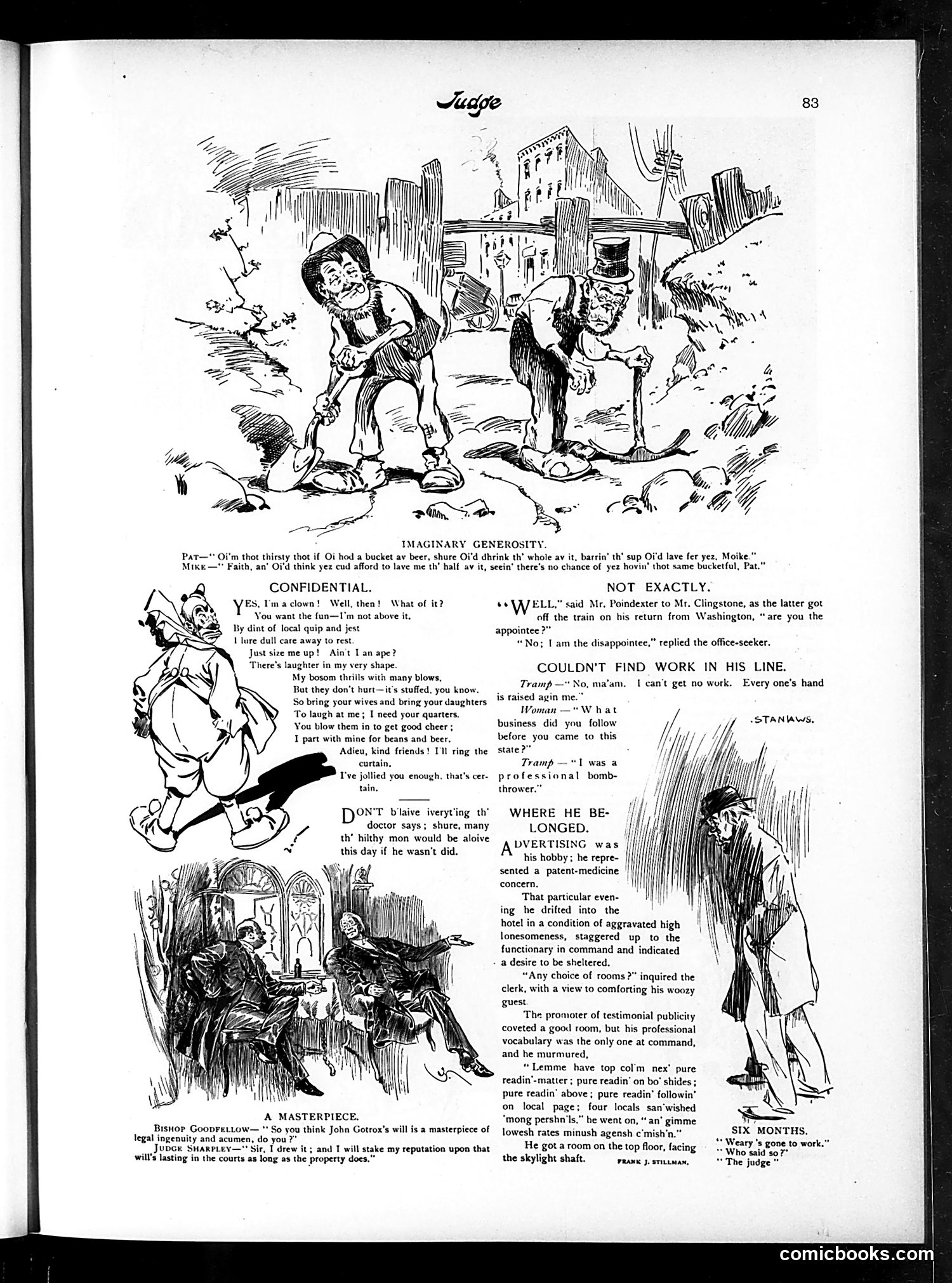
This page contains several satirical sketches and brief humorous pieces typical of Judge's social commentary: **"Imaginary Generosity"** (top): Mocks working-class men's unrealistic fantasy of sharing wealth—Pat and Mick imagine giving away beer and money they can't afford, highlighting the gap between aspirations and economic reality. **"Confidential"** (left): A rotund figure complains about physical ailments and debts, satirizing hypochondria and financial irresponsibility among certain social types. **"Where He Belonged"** (right): A man seeking work reveals he was a "professional bomb-thrower"—likely referencing anarchist or radical labor activism of the era, suggesting such individuals were unemployable in respectable society. The remaining pieces appear to be miscellaneous jokes about lawyers, advertising charlatans, and hotel accommodations—typical Judge fare mocking contemporary social pretense and dishonesty.
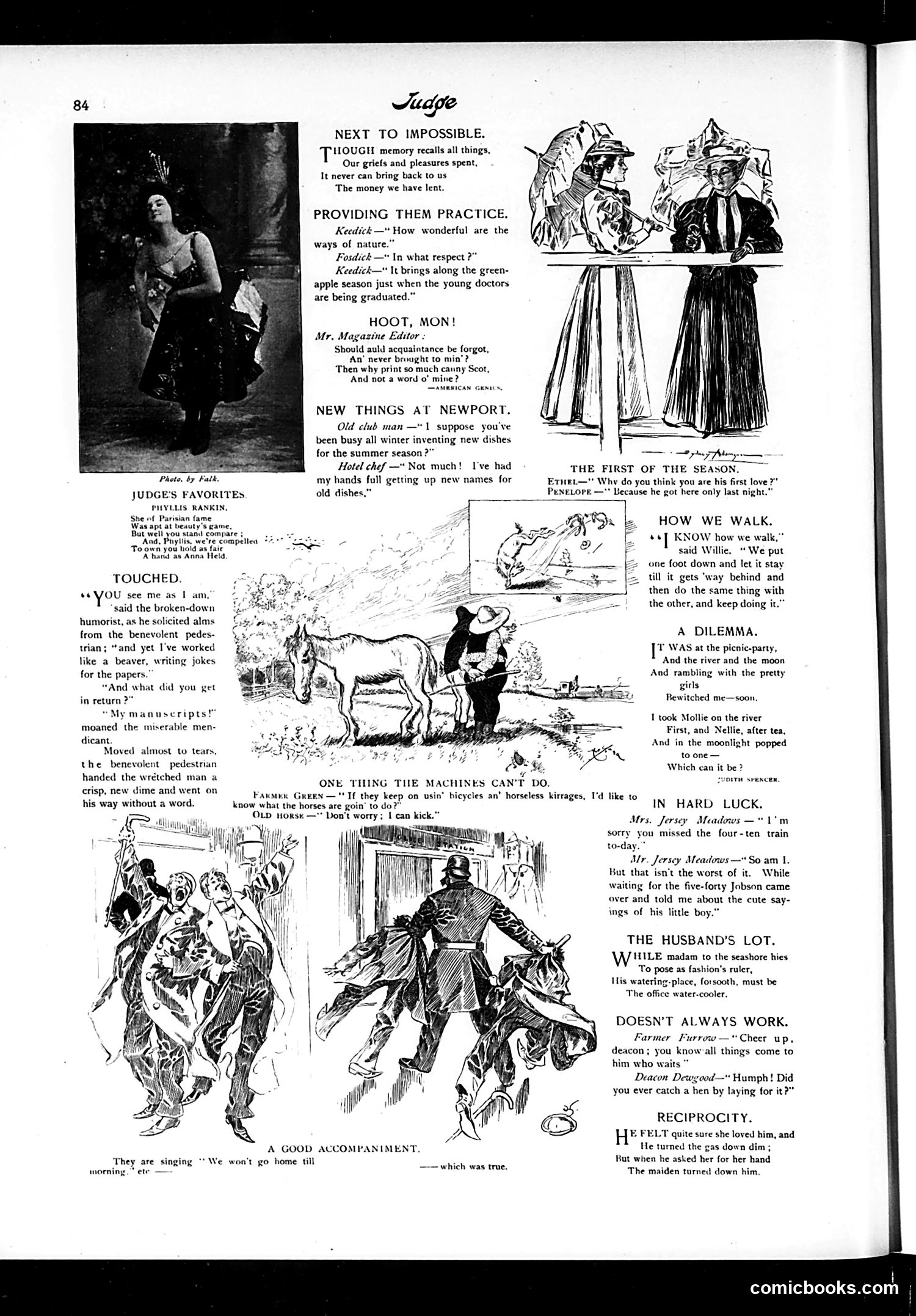
This page from Judge (a major American satirical magazine) contains multiple standalone humor pieces typical of early 20th-century comedy: **Key Content:** The cartoons satirize contemporary social situations rather than specific political figures. Notable pieces include: - **"Next to Impossible"**: A joke about the impossibility of recovering loaned money—universal humor about debt - **"Providing Them Practice"**: Mocks the coincidence of green-apple season arriving when young doctors graduate (implying the doctors will have patients with stomach ailments) - **"New Things at Newport"**: Satirizes wealthy Newport society, where a hotel chef invents fancy *names* for old dishes rather than creating anything genuinely new—commentary on upper-class pretension - **"The Husband's Lot"**: Gender satire—wives enjoy seaside leisure while husbands suffer office routines The humor targets universal human experiences and social pretension rather than specific politicians or events. The illustrations complement lighthearted jokes about love, marriage, social climbing, and class differences.
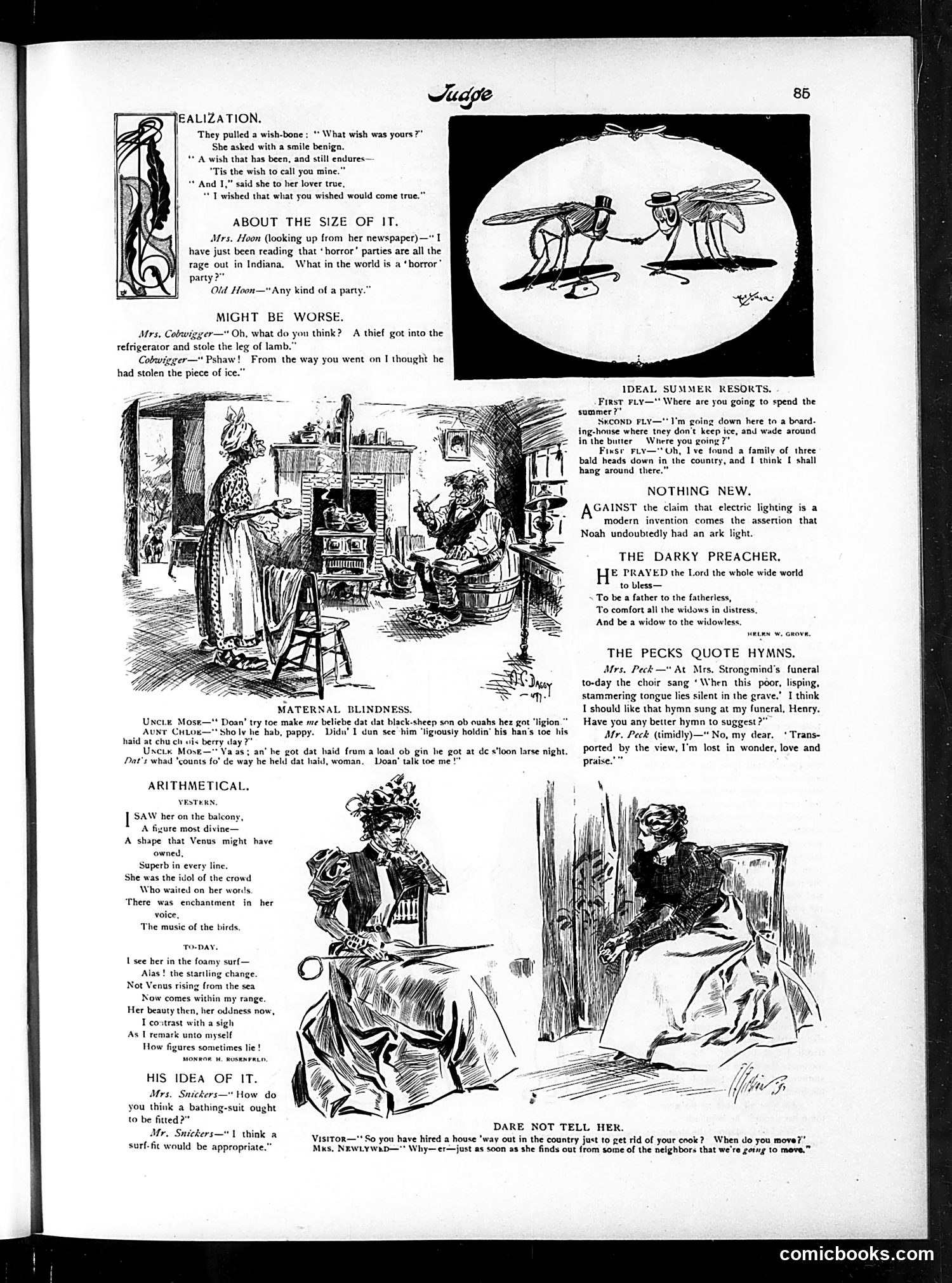
This page from Judge contains multiple satirical vignettes typical of early 20th-century American humor: **"Arithmetical"** contrasts a woman's beauty on a balcony versus in the ocean surf, joking that "figures sometimes lie"—playing on both mathematical and physical meanings. **"Maternal Blindness"** mocks a father's obliviousness to his child's misbehavior, suggesting parental denial. **"The Pecks Quote Hymns"** satirizes a timid husband unable to assert himself with his domineering wife, even regarding his own funeral hymn choice. **"The Darky Preacher"** uses racist dialect humor (typical of the era) to mock a preacher's malapropism—saying "widow to the widowless" instead of "widower." **Summer Resort flies** personify insects choosing unsanitary locations (butter, bald heads) for breeding—lowbrow puns on vacation spots. Other brief jokes mock "horror parties" as mundane social events and reference electric lighting as old as Noah's ark. The tone is lighthearted domestic satire with period-typical racial caricature.
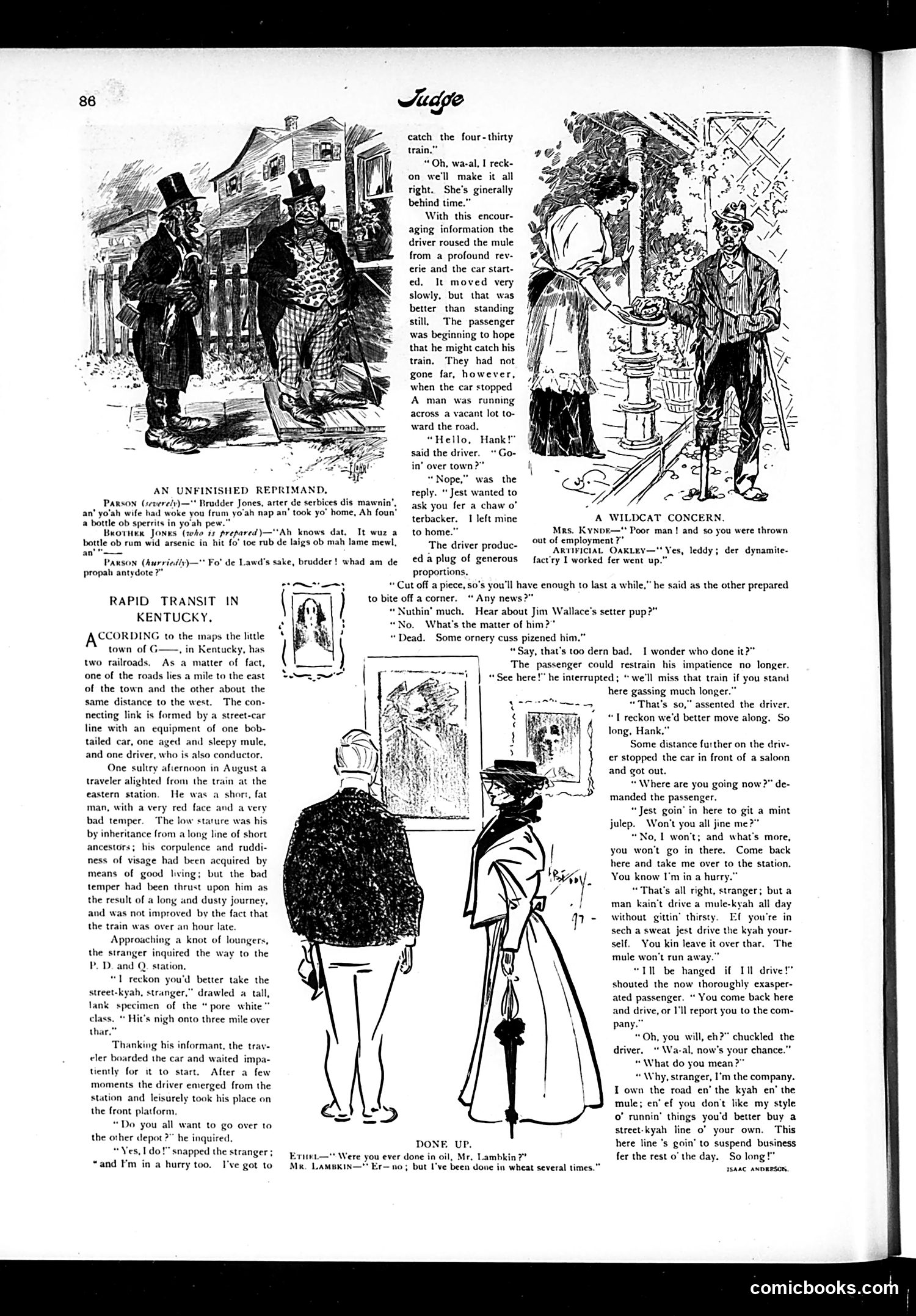
This page contains two satirical pieces mocking rural American life and regional stereotypes: **"Rapid Transit in Kentucky"** (main story) satirizes the absurd inefficiency of a small Kentucky town's transportation system. A impatient, wealthy Northern businessman boards a decrepit streetcar pulled by a mule to reach the train station. The driver—a stereotypical slow, folksy Southerner—repeatedly stops to socialize (borrowing tobacco, discussing a dead dog) and visit a saloon, completely indifferent to the passenger's schedule. The satire mocks both the South's infrastructure and its casual, unhurried culture clash with Northern urgency and business mentality. The smaller vignettes use exaggerated dialect humor ("po' white" characters, malapropisms) typical of period publications to ridicule rural ignorance and poverty. The cartoons reinforce Gilded Age stereotypes: the South as backward, inefficient, and culturally inferior to industrializing Northern society.
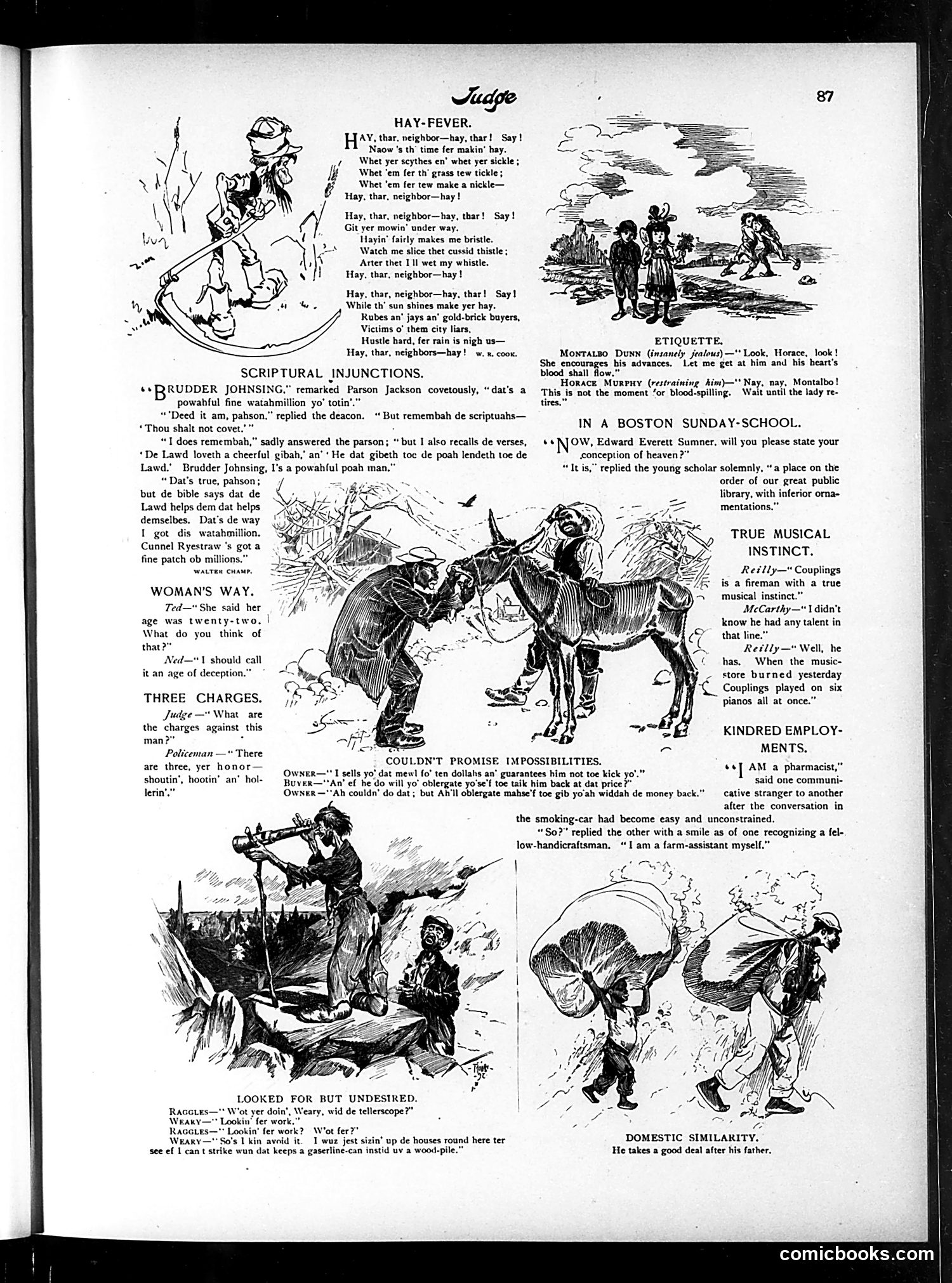
This page contains several satirical pieces typical of Judge's style: **"Hay-Fever"** is a dialect poem mocking rural/rustic speech patterns, with the repeated refrain "Hay, thar, neighbor—hay!" It satirizes farmers and rural life through exaggerated colloquialisms. **"Scriptural Injunctions"** features African American characters (Parson Jackson and Brudder Johnsing) using dialect to discuss Biblical verses about coveting and charity—satirizing selective Biblical interpretation to justify material acquisition. **Multiple short humor pieces** exploit period stereotypes: "Woman's Way" jokes about female deception regarding age; "Three Charges" uses racial dialect humor; "In a Boston Sunday-School" mocks pretentious urban culture; "True Musical Instinct" plays on Irish stereotypes (Reilly/Couplings as fireman names). **"Couldn't Promise Impossibilities"** uses African American dialect in a buyer-seller negotiation over a mule. The page reflects Judge's reliance on ethnic and class-based humor—particularly minstrel-show dialect—now recognized as offensive but standard for 1890s American satire magazines.
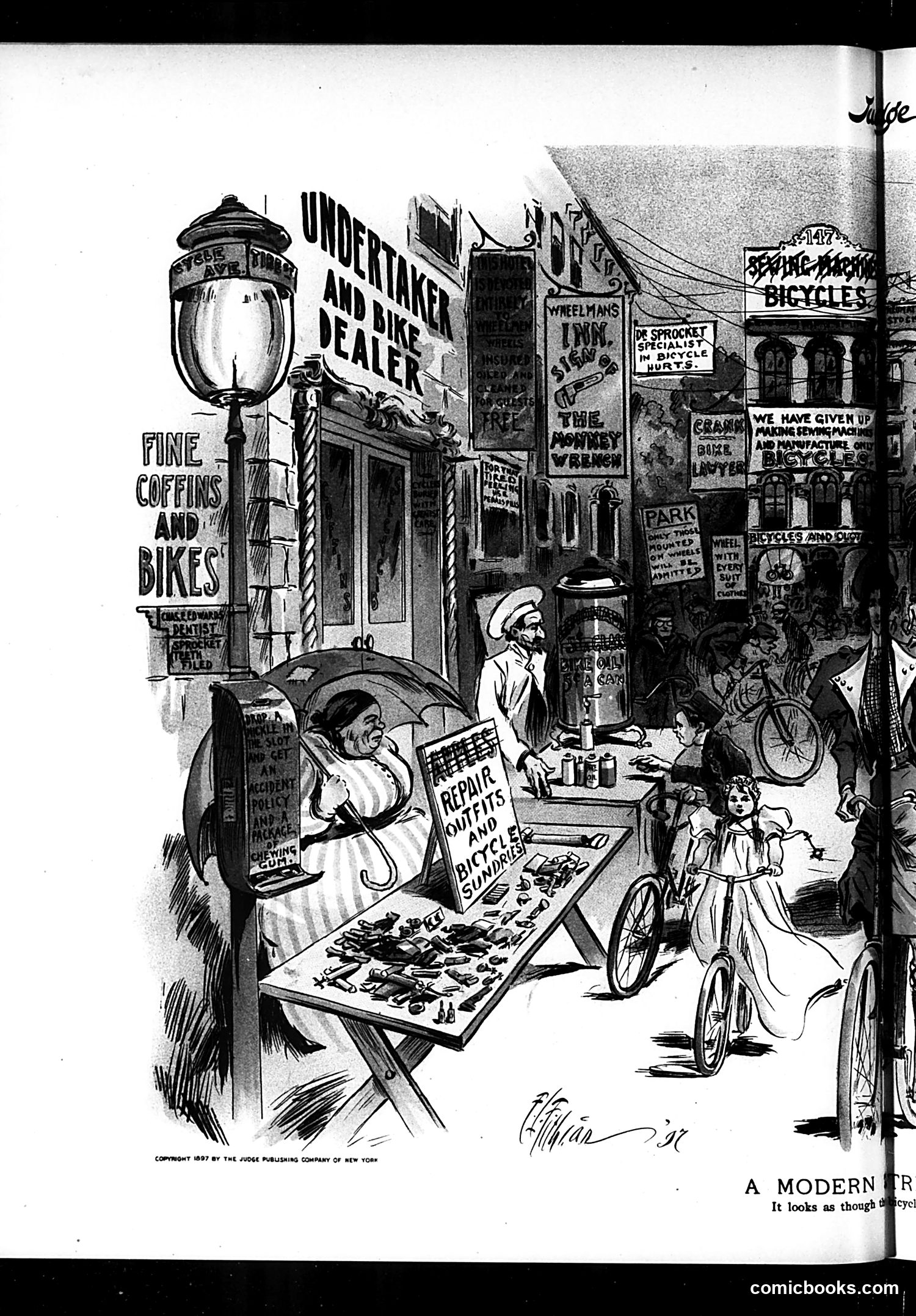
This is a satirical cartoon depicting a busy urban street scene centered on bicycle commerce and repair. The image shows various storefronts advertising bicycle-related services—"Undertaker and Bike Dealer," "Fine Coffins and Bikes," "Spring Magic Bicycles," and repair shops. The satire appears to mock the bicycle craze of the late 19th/early 20th century, when bicycles were wildly popular. By pairing coffin dealers with bicycle shops and filling the street with cyclists of all ages, the cartoon suggests bicycles are everywhere—omnipresent in urban life. The juxtaposition of coffins with bikes may humorously imply that bicycling is dangerous, or simply that bicycles have become as fundamental to city commerce as death itself. The crowd of pedestrians, cyclists, and vendors suggests the bicycle industry's dominance of contemporary urban culture.
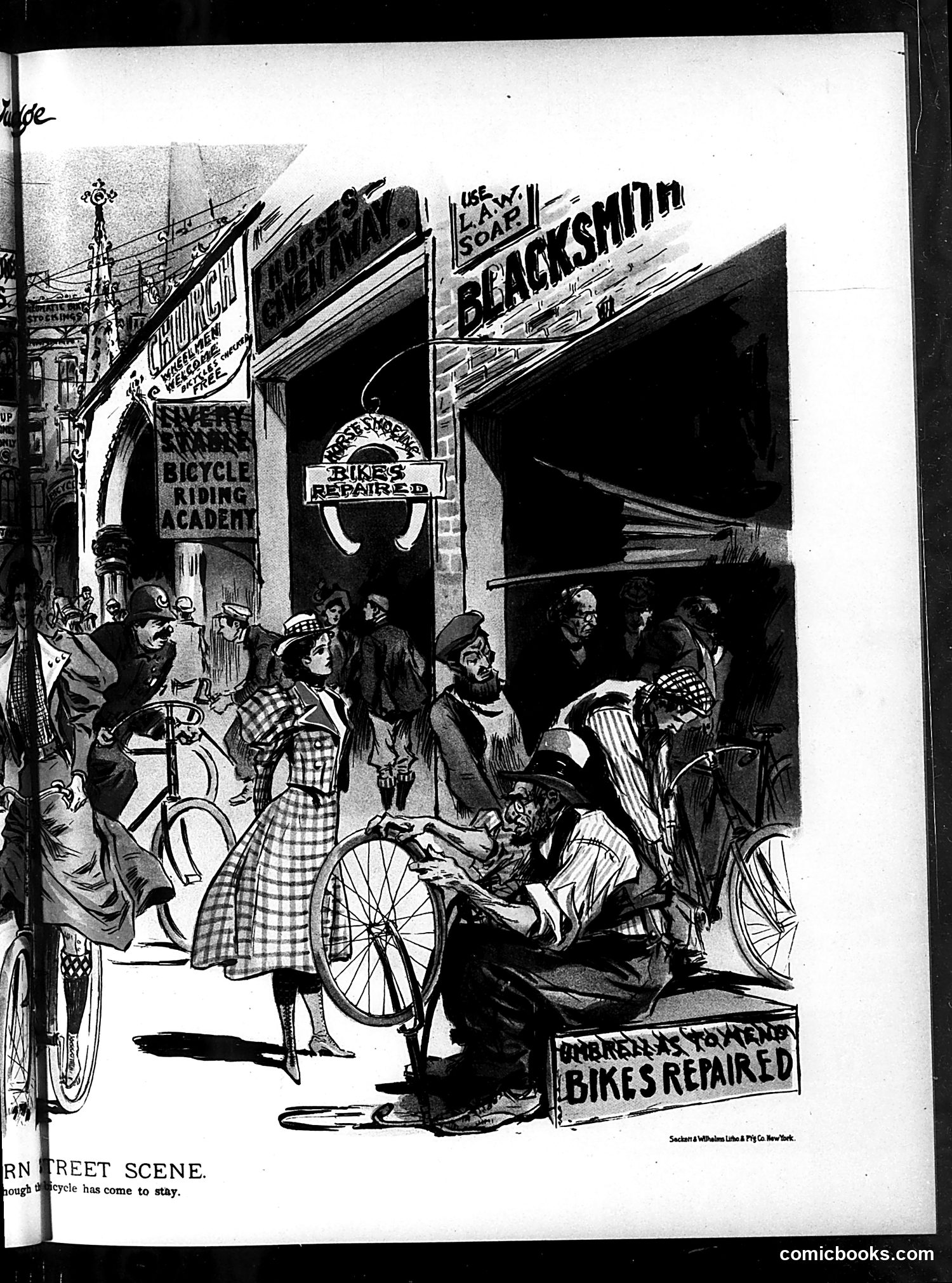
This is a street scene illustration titled "Modern Street Scene," with the caption "though the bicycle has come to stay." The cartoon depicts a busy urban blacksmith/bike repair shop with a horseshoe sign reading "BIKES REPAIRED." Multiple figures—appearing to be working-class people in period dress—crowd around with bicycles, while a repairman works in the foreground. The satire targets the bicycle craze of the late 1800s. The "blacksmith" shop visual pun mocks how bicycle repair has displaced traditional horseshoeing work, suggesting the bicycle's sudden dominance in urban transportation. The crowded scene emphasizes the bicycle's massive popularity and cultural impact, transforming city streets and disrupting established trades. Judge magazine regularly satirized technological and social upheaval, and this cartoon captures anxieties about rapid modernization and economic disruption during the bicycle boom.
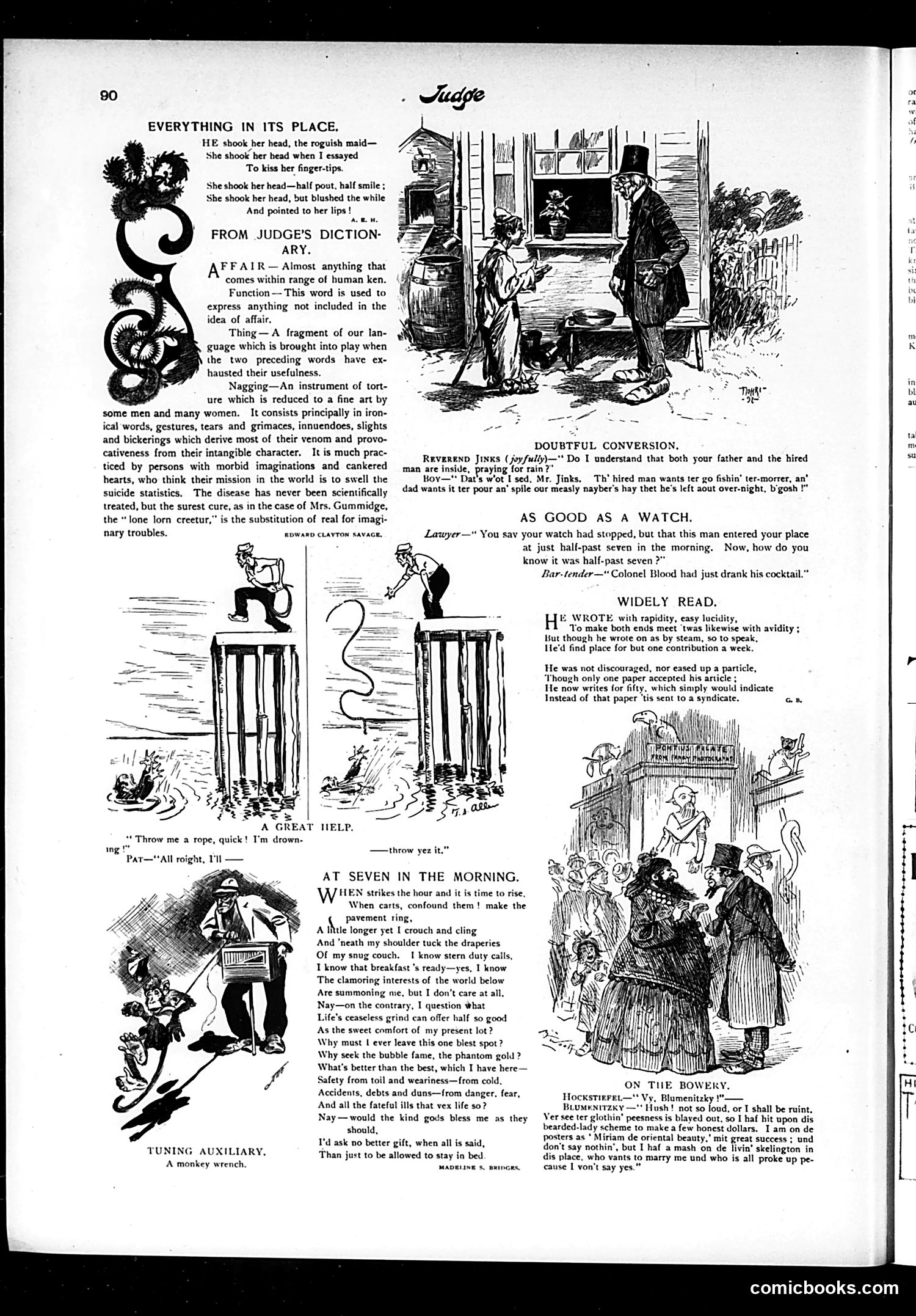
This page contains several unrelated satirical pieces typical of Judge magazine's format: **"Everything in Its Place"** depicts a flirtatious young woman rejecting a suitor's kiss attempt, then pointing to her lips—a playful commentary on courtship rituals and female coyness. **"From Judge's Dictionary"** mocks contemporary American speech by defining vague terms like "affair," "function," and "thing" as catch-all words for expressing ideas, and "nagging" as a refined art form practiced by women—reflecting period gender stereotypes. **Other sketches** include a drowning man's Irish friend misunderstanding "throw me a rope"; a lawyer's witness using a drunk man's cocktail as a time reference; and commentary on a prolific writer who now syndicates his work to fifty papers instead of one. **"On the Bowery"** features ethnic caricature: a Yiddish-accented man advertising a "bearded lady" (possibly referring to a cross-dressing scheme) to earn money—reflecting Judge's frequent use of ethnic stereotypes for humor. The overall tone is lighthearted social observation with period-typical gender and ethnic mockery.
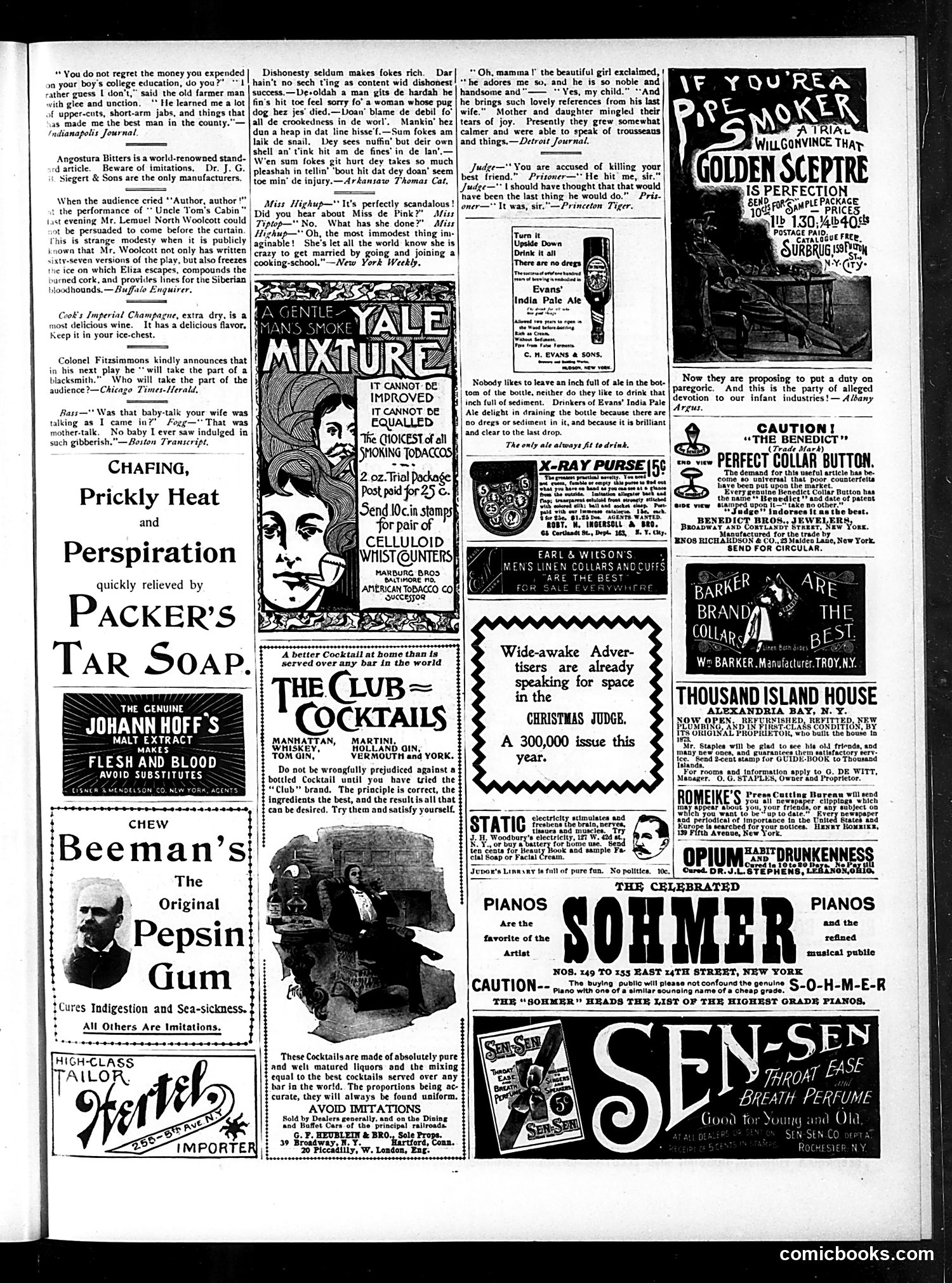
This page is primarily **advertising** from an early-20th-century American magazine, interspersed with short humorous anecdotes and jokes typical of *Judge* magazine's satirical format. The small cartoons/jokes include: - A farmer proud his son learned boxing ("upper-cuts") rather than academics - Social commentary on immodest behavior and women joining cooking schools to find husbands - A prisoner's dark joke about his murdered friend - Observations on human nature (dishonesty, vanity, gossip) presented in dialect humor The bulk of the page consists of product advertisements for items now obsolete or infamous: patent medicines (Angostura Bitters, Johann Hoff's Malt Extract), tobacco products, cocktail mixers, and dubious remedies like tar soap for skin conditions and pepsing gum for digestion. The humor reflects period attitudes toward gender, class, and courtship. The advertisements reveal what contemporaries believed cured common complaints—many products we'd now recognize as ineffective or dangerous.
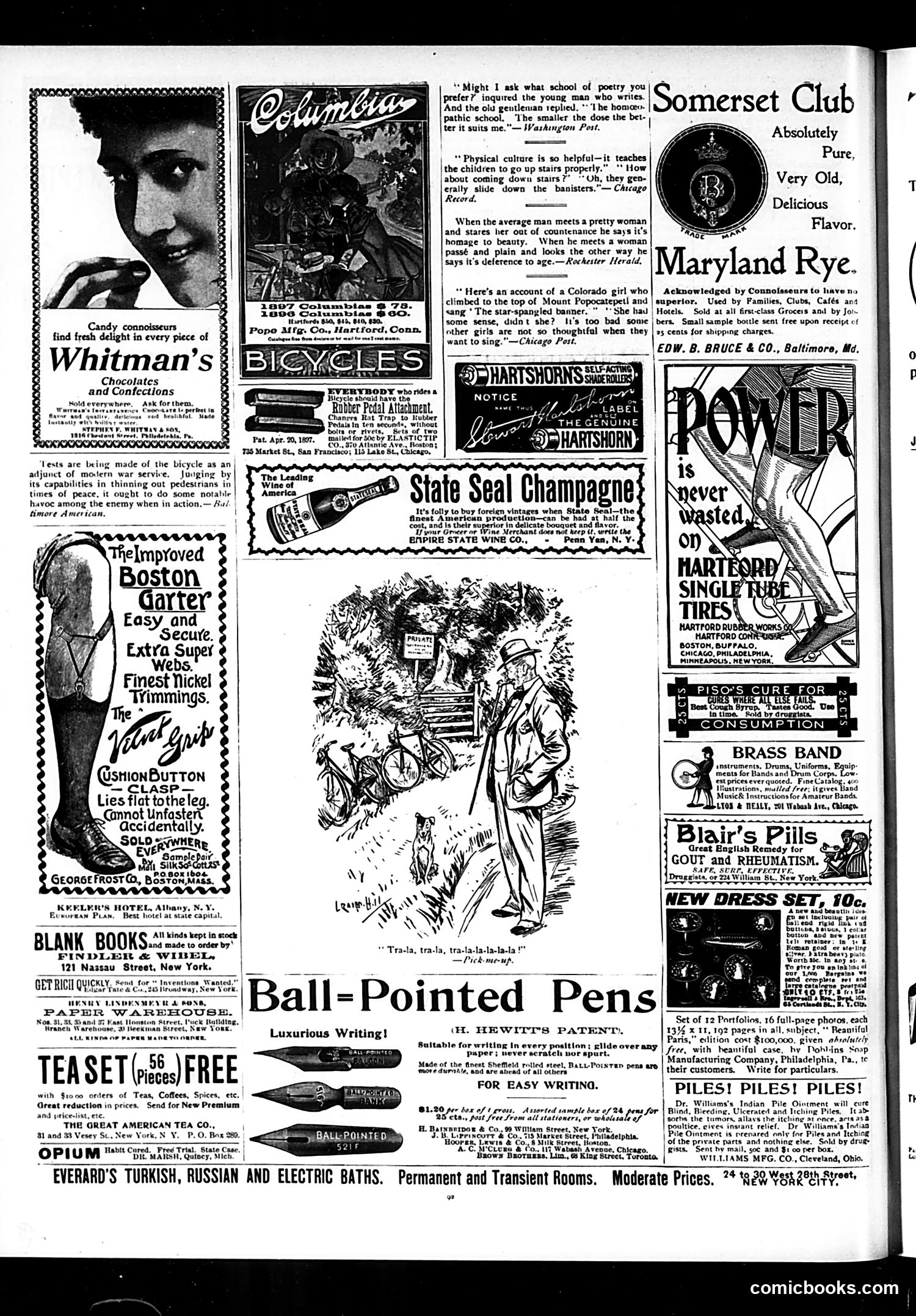
This page consists primarily of **advertisements and brief satirical quips**, not a cohesive cartoon narrative. The main illustration—a sketch of a man and woman on a country road captioned "Trasla, tra-la, tra-la-la-la-la!"—appears to accompany a humorous piece about a Colorado girl who climbed Mount Popocatépetl and sang "The Star-Spangled Banner" at the summit. The joke mocks the girl's unnecessary patriotic fervor in an incongruous location. The page also includes several short satirical observations about contemporary social behavior: homeopathic poetry (valuing brevity), physical culture's irony regarding stair-climbing, male hypocrisy regarding female appearance, and bicycle use in warfare. The remainder consists of period advertisements for goods (chocolates, garters, tea, pens, champagne, pills) and services (hotels, baths). This was typical Judge editorial content—mixing light humor with commercial sponsorship. Without additional context, most social references remain accessible to modern readers.
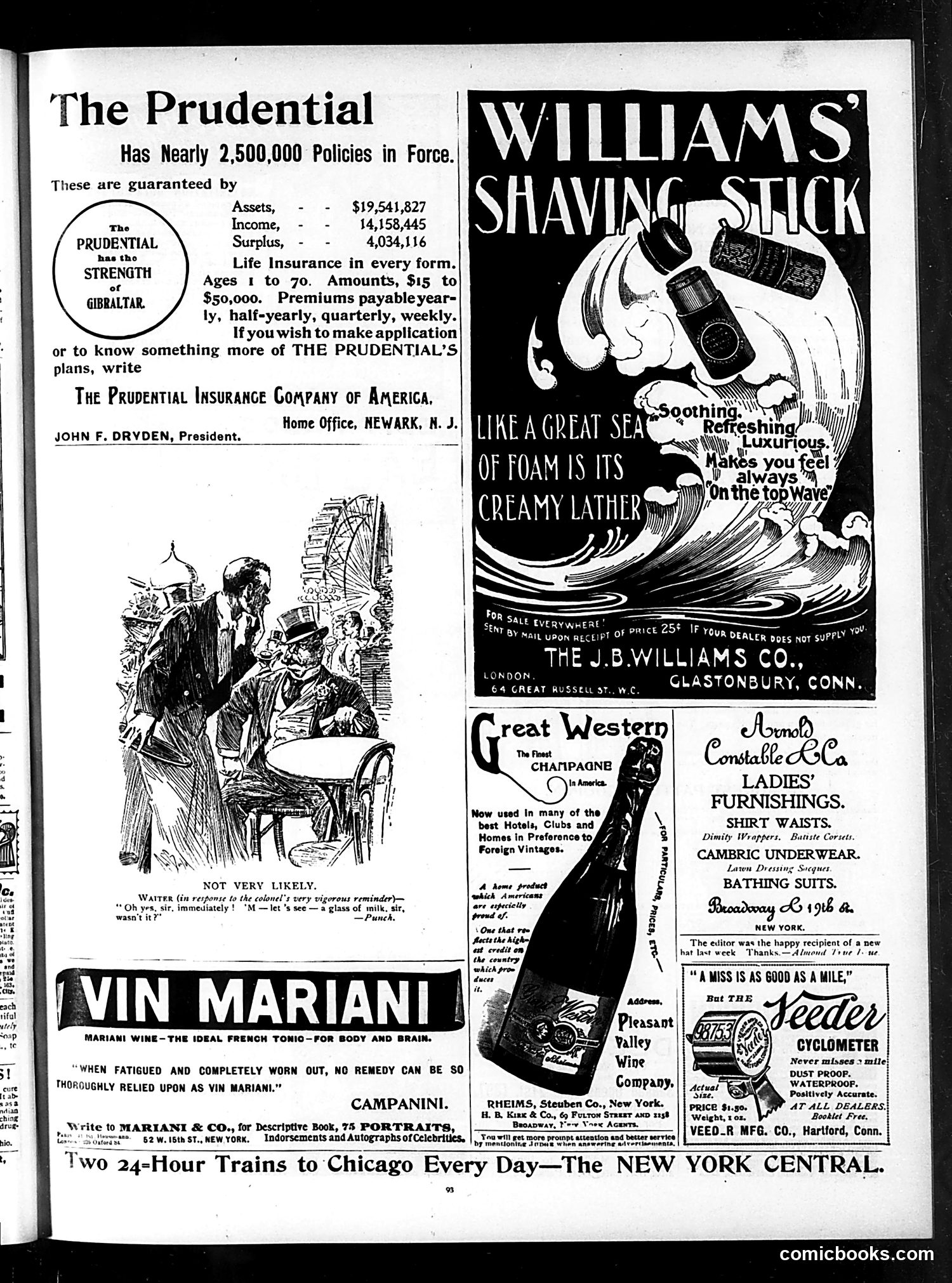
This page is primarily **advertisements** with one small cartoon. The cartoon, titled "Not Very Likely," depicts a Colonel sternly reminding an absent-minded Warren of something. Warren responds by offering milk instead—suggesting the Colonel had requested something stronger (likely alcohol). The humor lies in Warren's deliberate or genuine misremembering, making the reminder ineffective. The attribution to *Punch* indicates it's reprinted British humor. The page is dominated by product advertisements typical of early 20th-century magazines: life insurance (Prudential), French wine tonics (Vin Mariani and Great Western Champagne), shaving products (Williams), ladies' clothing (Constable), and bicycle accessories (Cyclometer). These ads reflect contemporary consumer culture and patent medicines marketed with celebrity endorsements—common advertising practices of the era.
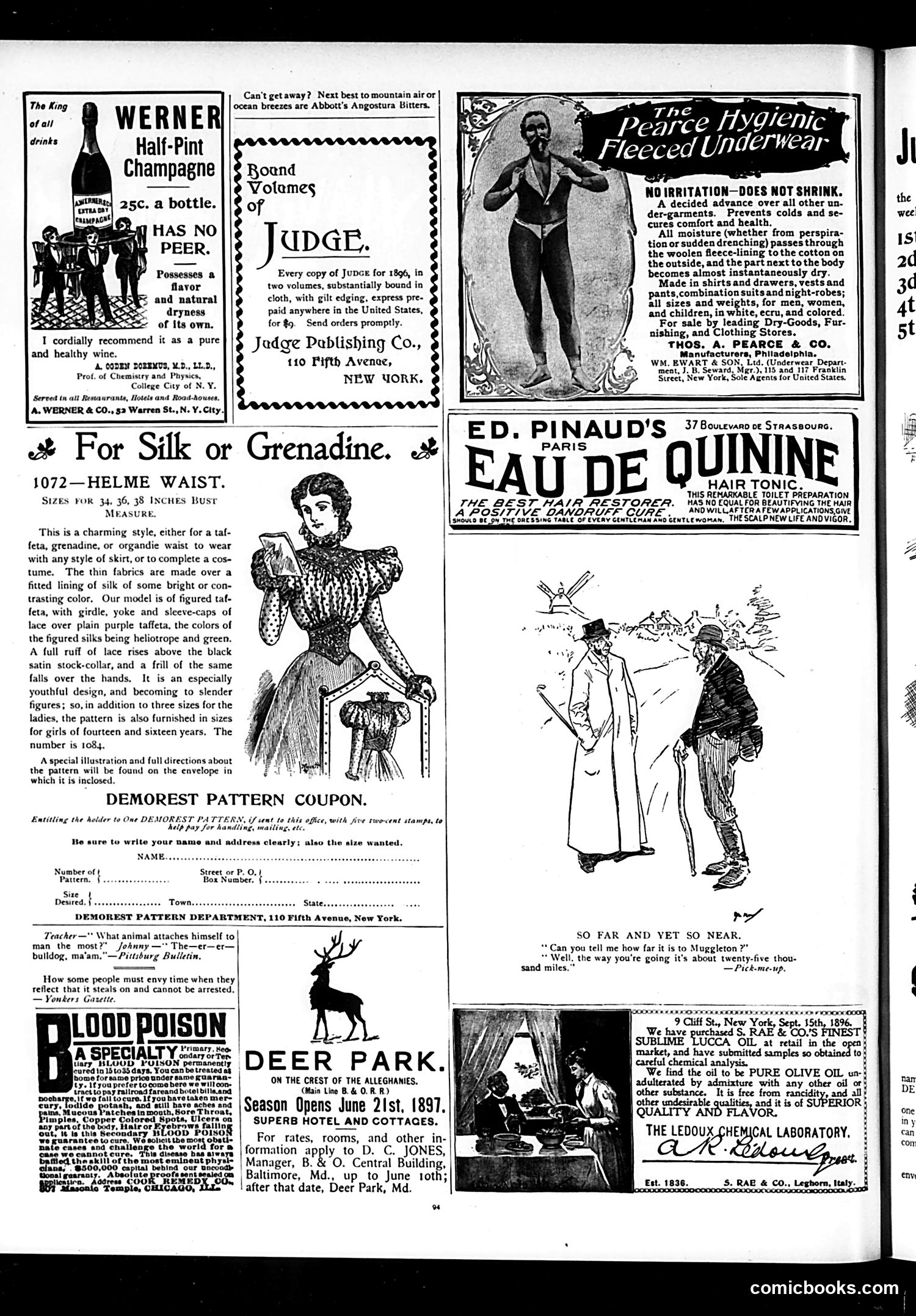
This page is primarily **advertising**, with small comic jokes interspersed. The main content includes: **Advertisements:** champagne, patent medicines (Angostura Bitters, hair tonic, blood poison cure), undergarments, and a fashion pattern coupon for a "Helme Waist." **Comic Content:** Three brief jokes appear: - A teacher asks what animal "attaches himself to man the most"—the answer is "bulldog" (a pun on loyalty/attachment) - A traveler asks distance to "Muggleton"; told he's going the wrong way, making it "twenty-five thousand miles" (exaggeration humor) - A quip about time stealing but not being arrested (wordplay on "arrested") **Notable Advertisement:** Deer Park resort opening June 21, 1897, promoting mountain air as health cure. The page reflects late-19th-century consumer culture and patent medicine marketing typical of Judge magazine's commercial content.
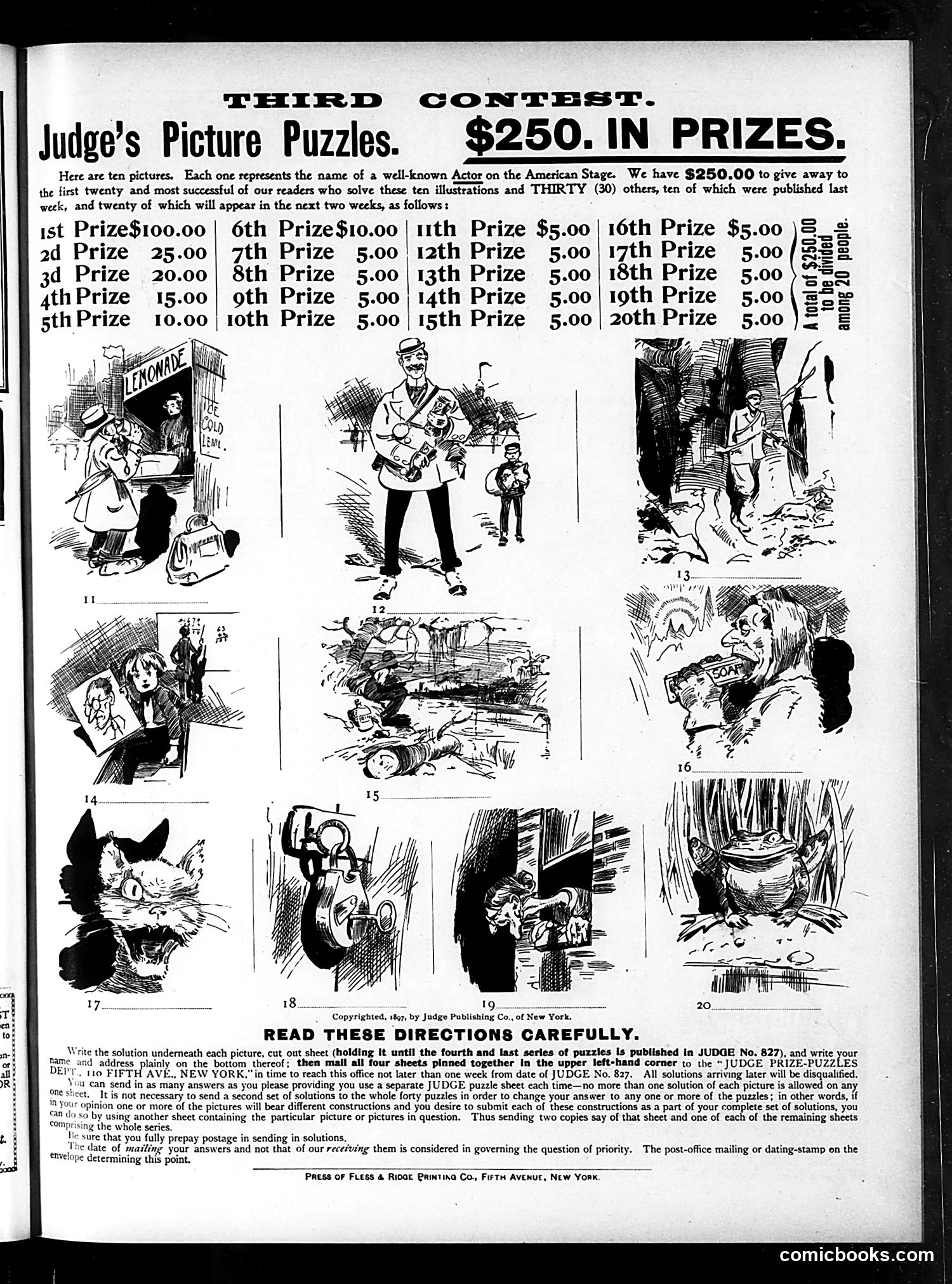
This page announces a contest where readers solve rebus-style picture puzzles depicting the names of famous American stage actors. Ten puzzles are shown here; forty total will appear across four weeks in Judge magazine. The puzzles use visual puns and symbolic imagery—for example, image 11 shows a lemonade stand (likely representing an actor's name phonetically or through wordplay), image 12 depicts a man juggling, and image 15 shows a large wheel or mechanical object. The contest offered $250 in prizes distributed among the first twenty correct solvers, with the top prize worth $100. This was typical of Judge's reader-engagement contests in the 1890s—interactive entertainment that encouraged audience participation and repeat purchases of the magazine. The elaborate submission rules emphasize that entries must arrive by a specific deadline and include careful instructions for cutting, pinning, and mailing solutions to Judge's offices on Fifth Avenue in New York.
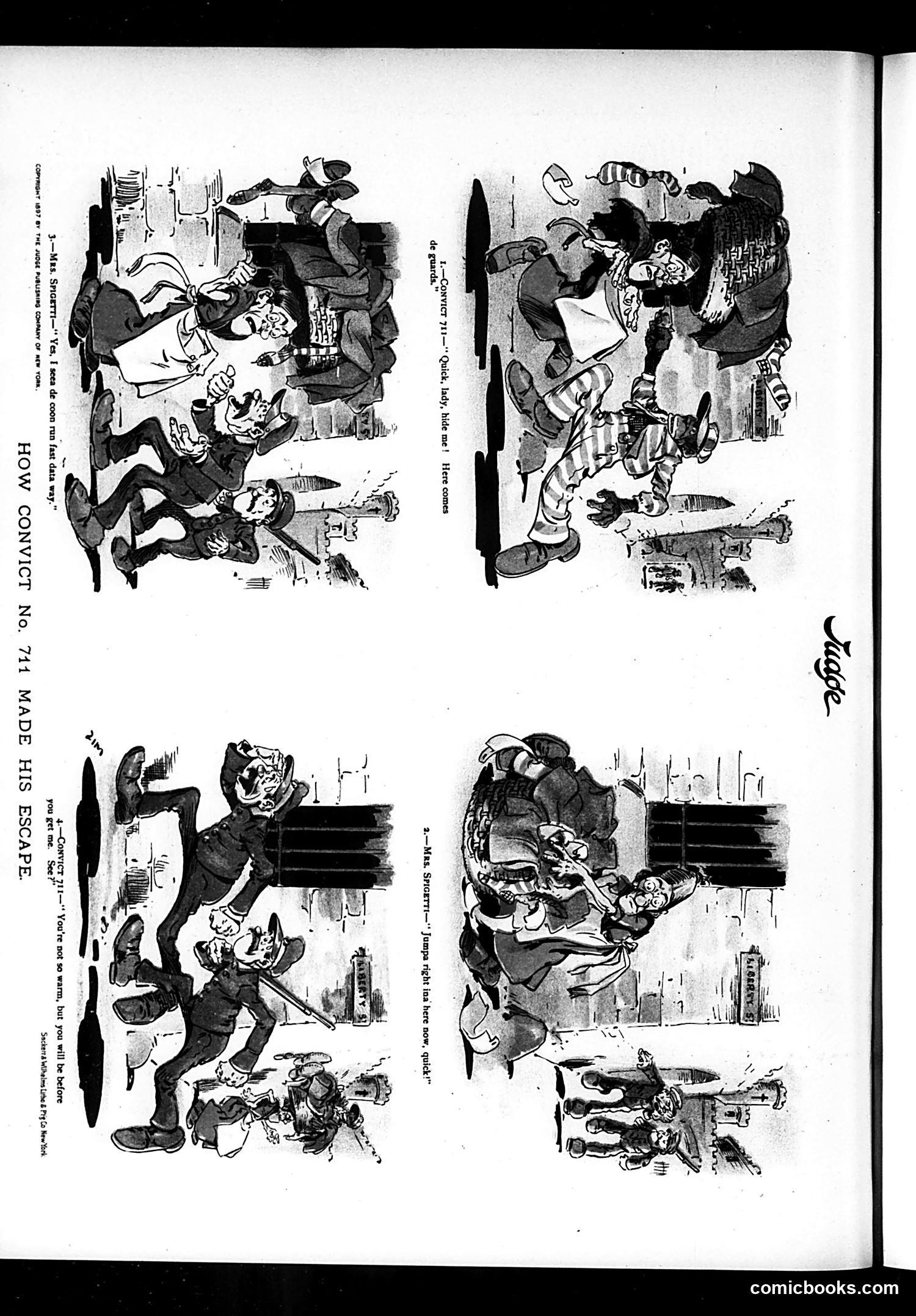
I cannot reliably read the OCR text on this page—it appears severely corrupted or inverted, making it impossible to verify the actual captions and titles. From the **images alone**, I can see four cartoon panels featuring caricatured figures in what appears to be early 20th-century dress engaged in various comedic scenarios. The style and presentation suggest social or political satire typical of *Judge* magazine. However, **without legible text identifying the specific figures, events, or context**, I cannot accurately explain what political or social issues are being satirized or who the caricatures represent. To provide an accurate analysis, I would need either clearer OCR text or the ability to read the original caption legibly. I can confirm these are satirical comics from a vintage American publication, but the specific joke or message remains unclear to me from this reproduction.