
A complete issue · 16 pages · 1897
Judge — March 20, 1897
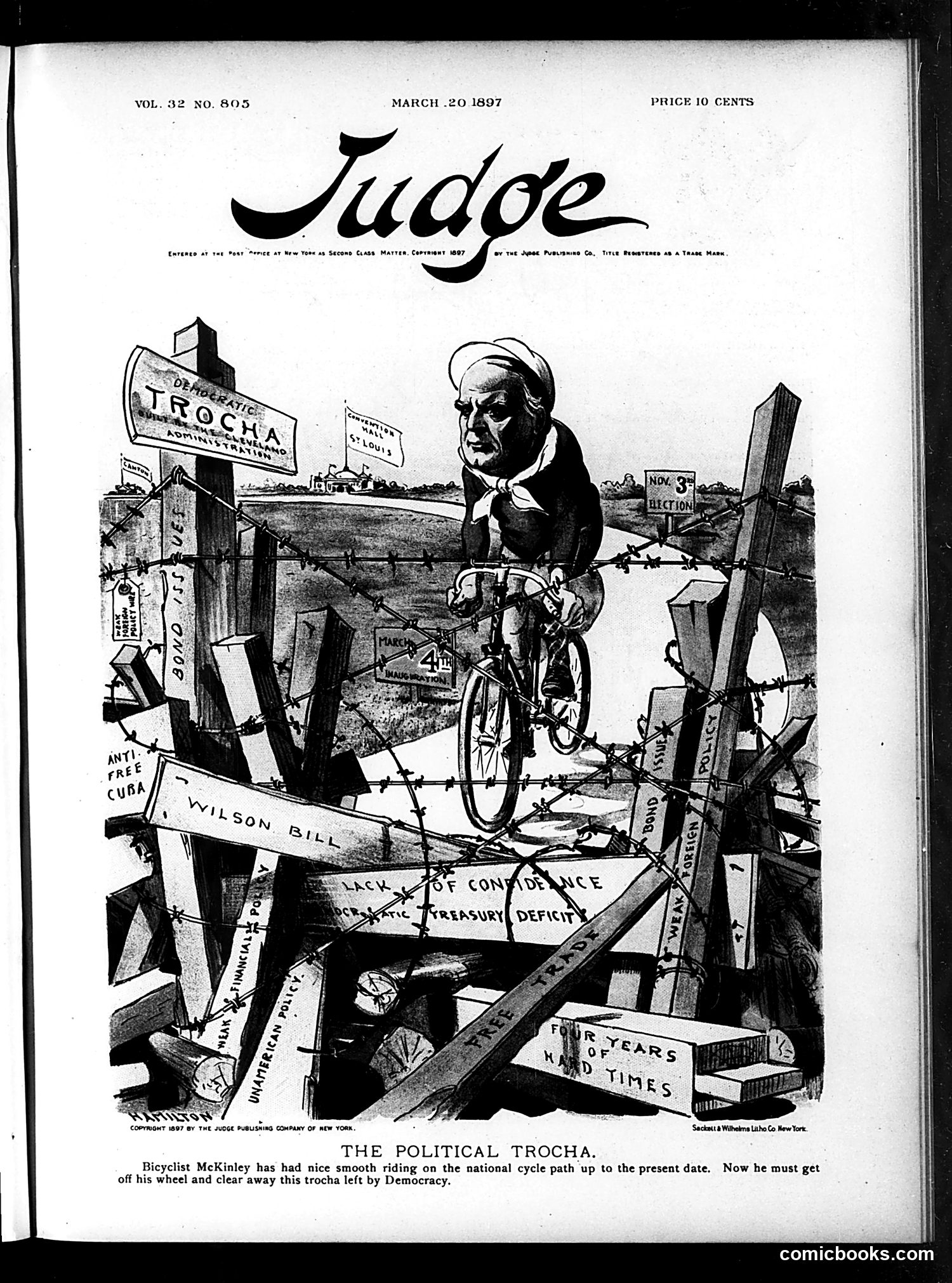
This political cartoon depicts President William McKinley as a cyclist navigating treacherous obstacles labeled with contemporary political problems: "Anti-Free Cuba," "Wilson Bill," "Lack of Confidence," "Sporadic Treasury Deficit," and "For 6 Years Bad Times." The caption explains the satire: McKinley has enjoyed smooth riding on the "national cycle path" but now must dismount and clear away obstacles created by the Democratic party—represented by the debris blocking his path. The "trocha" (Spanish term for a path) likely references Cuba, where Spain was constructing military roads to combat insurgents. The cartoon critiques McKinley's early presidency challenges while suggesting Democratic obstruction of his agenda.
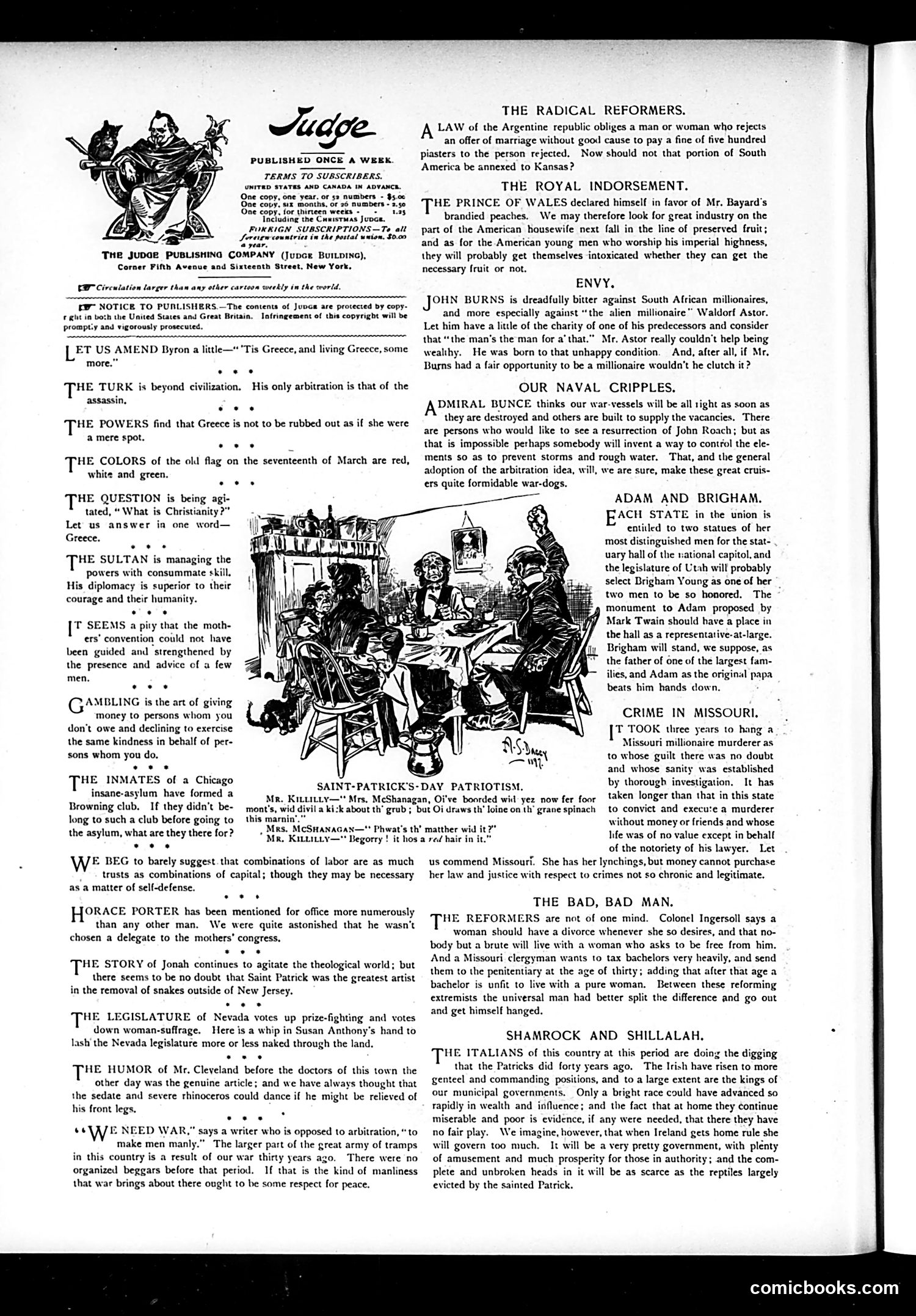
The central cartoon depicts an Irish domestic scene with figures gathered around a table, likely celebrating Saint Patrick's Day. The accompanying dialogue—where "Mrs. Killifaddy" and "Mrs. Kailley" discuss their husbands' drinking and behavior—satirizes Irish-American stereotypes, particularly the association of Irish immigrants with heavy alcohol consumption and domestic discord. The humor relies on period ethnic caricature: exaggerated Irish accents and the portrayal of working-class Irish life as chaotic and alcohol-fueled. The cartoon mocks both Irish-American culture specifically and, more broadly, the tensions between immigrant communities and established American society during this era. The "patriotism" referenced in the title appears ironic, suggesting hollow national pride masking social dysfunction.
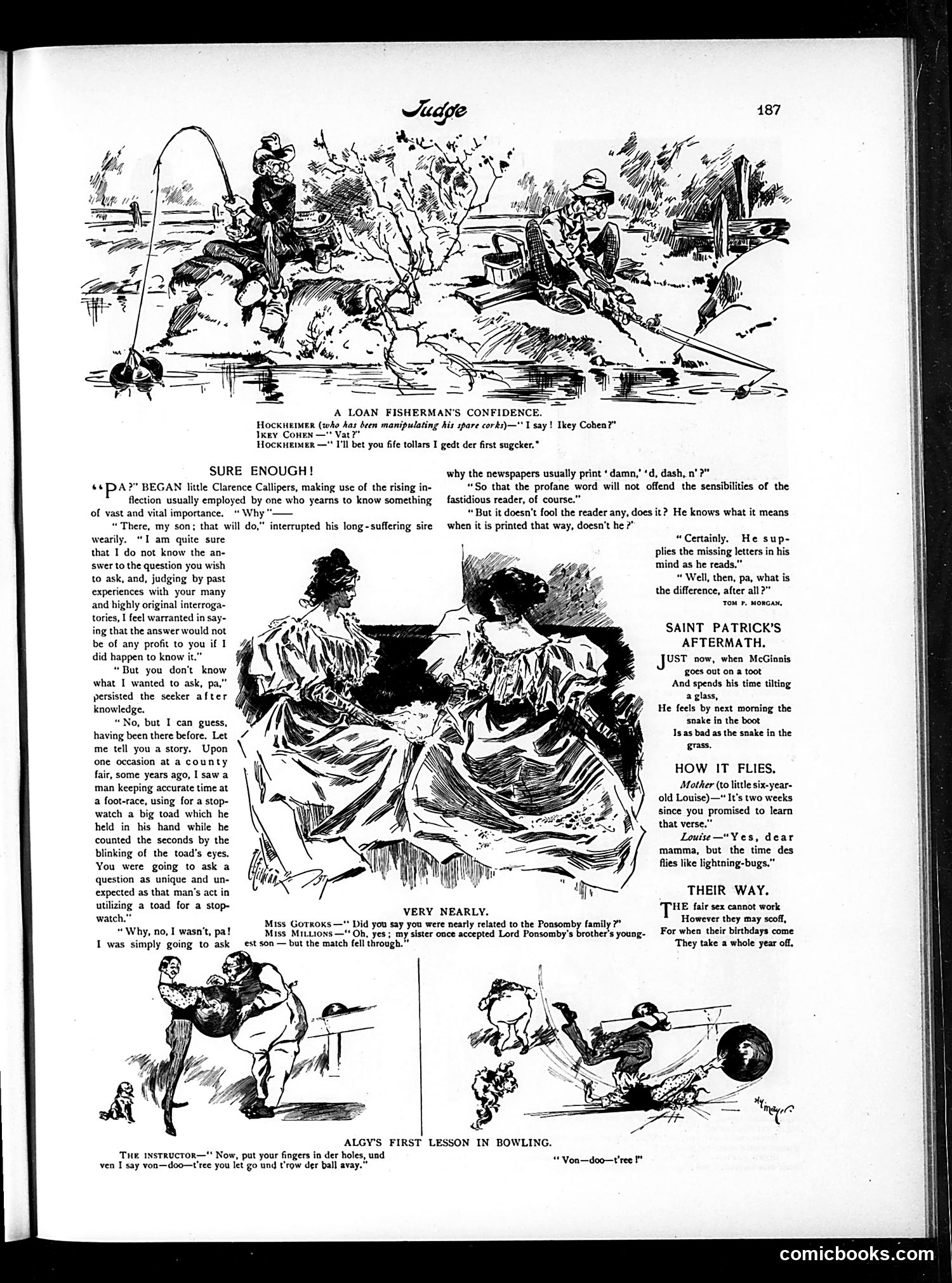
This page contains several humorous sketches and short comic pieces typical of Judge's satirical style: **"A Loan Fisherman's Confidence"** (top) depicts a fishing scene where a character named Hocksheimer boasts about his fishing prowess to "Ike Cohen," likely playing on ethnic stereotypes common to the era. **"Sure Enough!"** presents Pa's story about a stopwatch-toad used to time a foot-race, a tall tale meant to entertain. **"Very Nearly"** and **"How It Flies"** appear to be brief, self-contained joke pieces with minimal context needed. **"Algy's First Lesson in Bowling"** shows a comedic instructional scene, poking fun at an amateur learning the sport. The page relies on physical comedy, dialect humor, and simple situational jokes rather than political commentary. No specific political figures or events are clearly referenced.
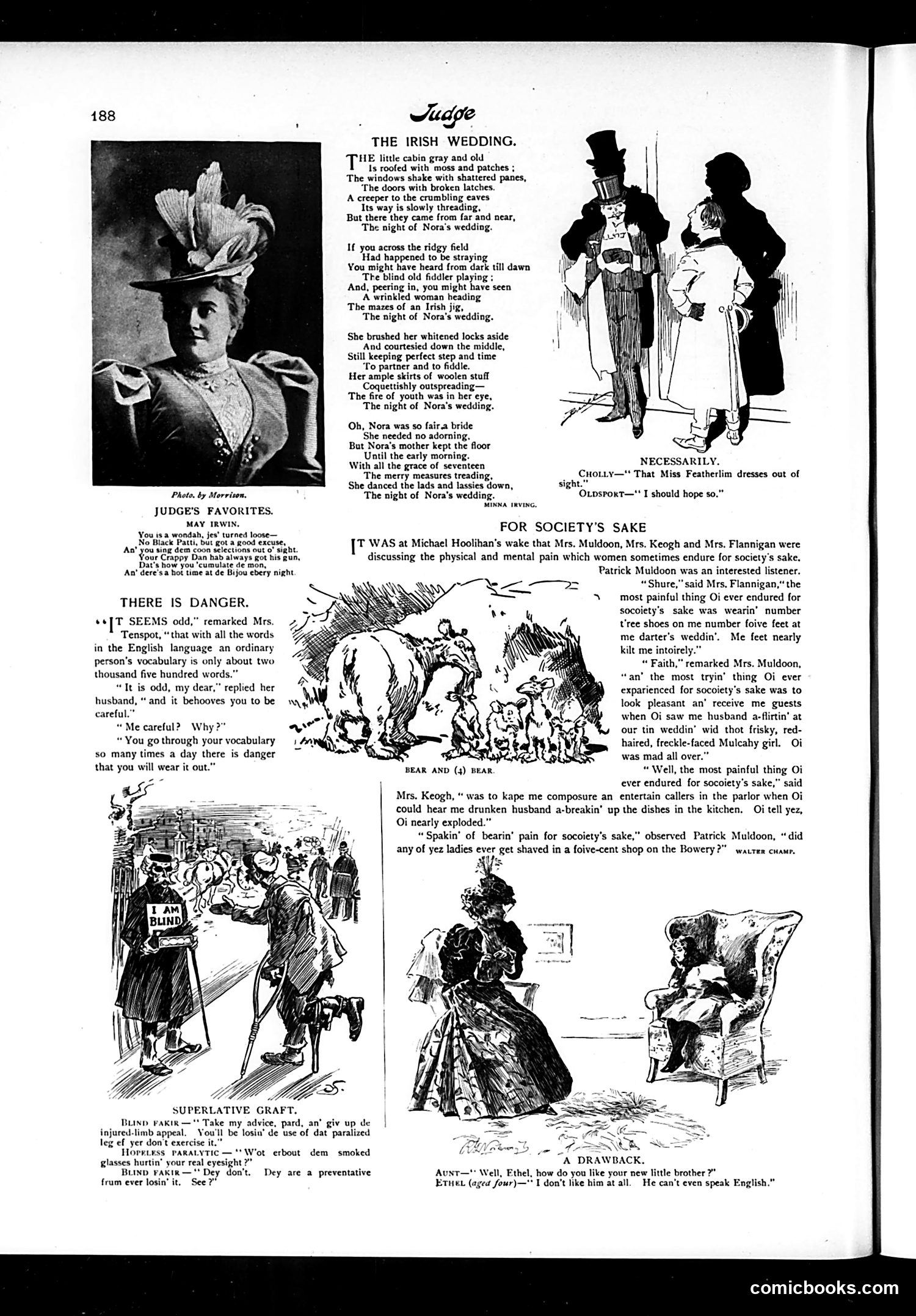
This page from Judge presents satirical content mocking Irish-American and working-class experiences. **"The Irish Wedding"** is a sentimental poem celebrating a rural Irish celebration, contrasting the poverty of "the little cabin gray and old" with the vitality of the dancing community—likely appealing to Judge's readers' nostalgia or condescension toward Irish immigrants. The main satire appears in **"For Society's Sake,"** where three Irish-American working-class women (identifiable by their thick dialect spelling) discuss physical suffering endured for respectability: tight shoes, entertaining guests while husbands misbehave, maintaining composure during domestic chaos. The humor derives from their earnest acceptance of discomfort as the price of "society"—mocking both their social aspiration and the arbitrary demands of respectability culture. Supporting cartoons about language, disability, and a child rejecting a non-English-speaking sibling reinforce themes of assimilation and social conformity. The overall effect satirizes how marginalized groups internalize painful social standards to gain acceptance.
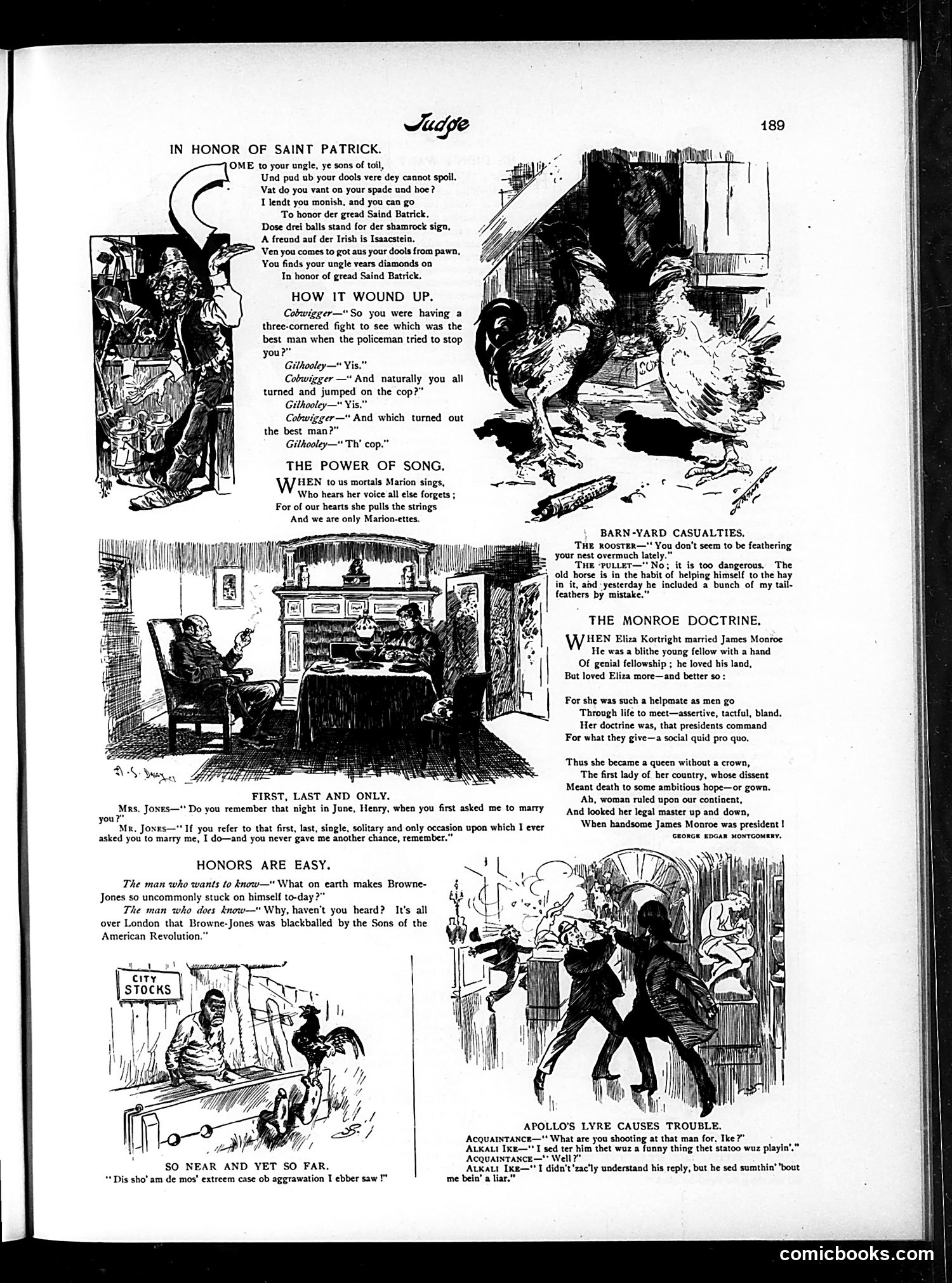
This page contains multiple satirical pieces typical of Judge's humor: **"In Honor of Saint Patrick"** uses exaggerated Irish dialect (phonetic misspelling) to mock Irish immigrants and Jewish moneylenders. The stereotype presents an Irish laborer borrowing from a Jewish pawnbroker ("Isaacstein") to celebrate St. Patrick's Day—satirizing both ethnic groups through crude caricature. **"How It Wound Up"** jokes about Irish street fighting and police brutality, suggesting that when Irish men fight, they unite to attack the policeman—who emerges as "the best man." **"The Monroe Doctrine"** is a clever wordplay poem about James Monroe's wife Eliza, reframing the historical "Monroe Doctrine" (foreign policy) as her domestic control over her husband and the nation. **"Apollo's Lyre Causes Trouble"** depicts the stock character "Alkali Ike" (a Western ruffian) shooting at someone, misunderstanding a joke about a statue playing music. The page reflects late 19th/early 20th-century American attitudes: crude ethnic stereotyping, particularly of Irish and Jewish immigrants, alongside genteel humor about high society.
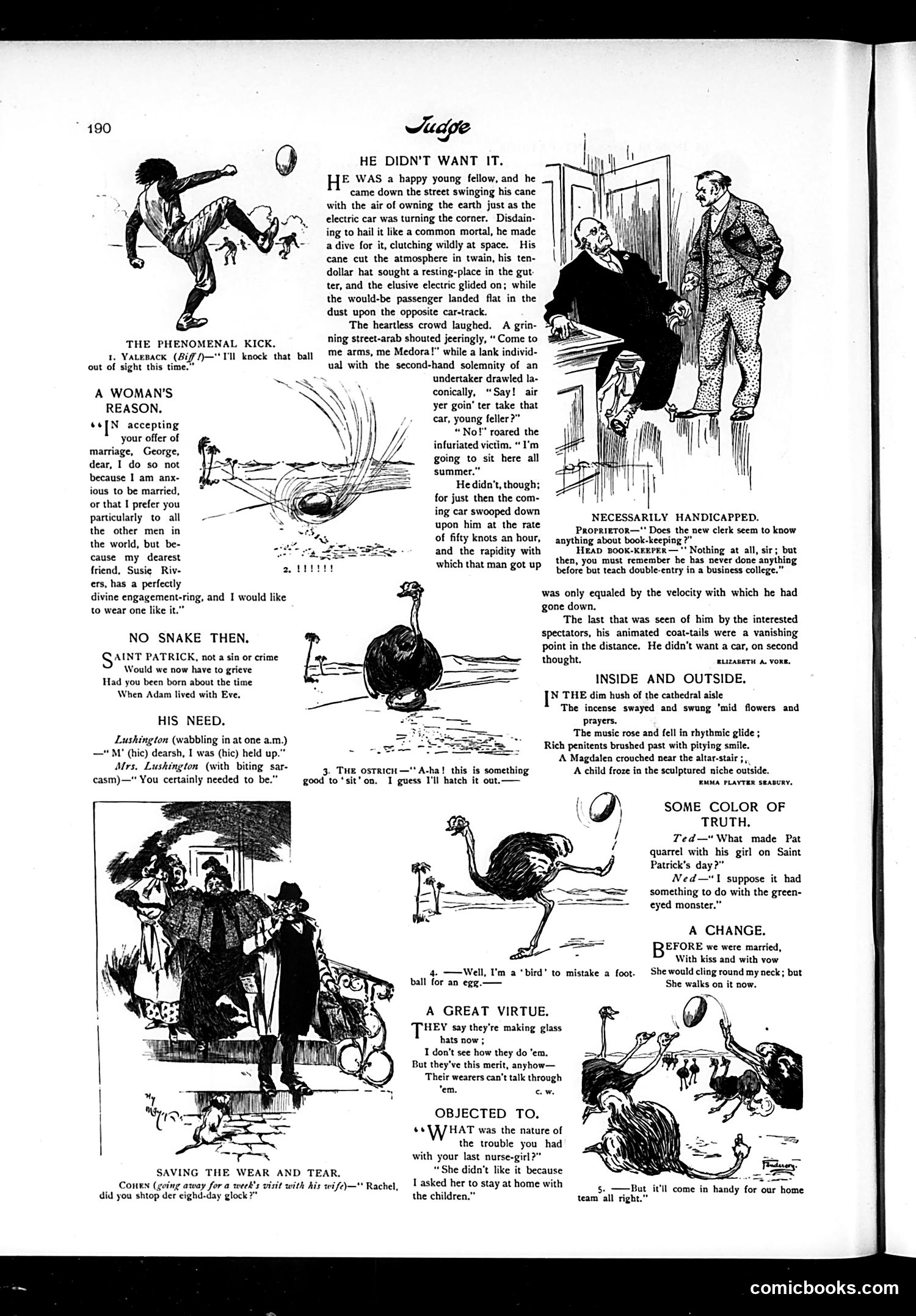
This page from *Judge* contains multiple unrelated humor pieces typical of the magazine's satirical format. **"He Didn't Want It"**: A young man arrogantly attempts to board a moving electric streetcar without properly hailing it, disdaining "common mortal" behavior. He's knocked down, losing his hat and dignity. The joke satirizes upper-class pretension and the hazards of early automobile traffic—electric cars were relatively new, fast technology that could catch the unwary. **Other pieces** include brief jokes about engagement rings, book-keeping incompetence, Irish stereotypes (Saint Patrick reference), drunkenness, streetcars, and domestic life. "Some Color of Truth" plays on the "green-eyed monster" (jealousy) and an Irishman's stereotypical temperament. The cartoons illustrate slapstick consequences and social commentary on modern urban life, class behavior, and domestic relationships. The satire targets human folly rather than specific political figures or events.
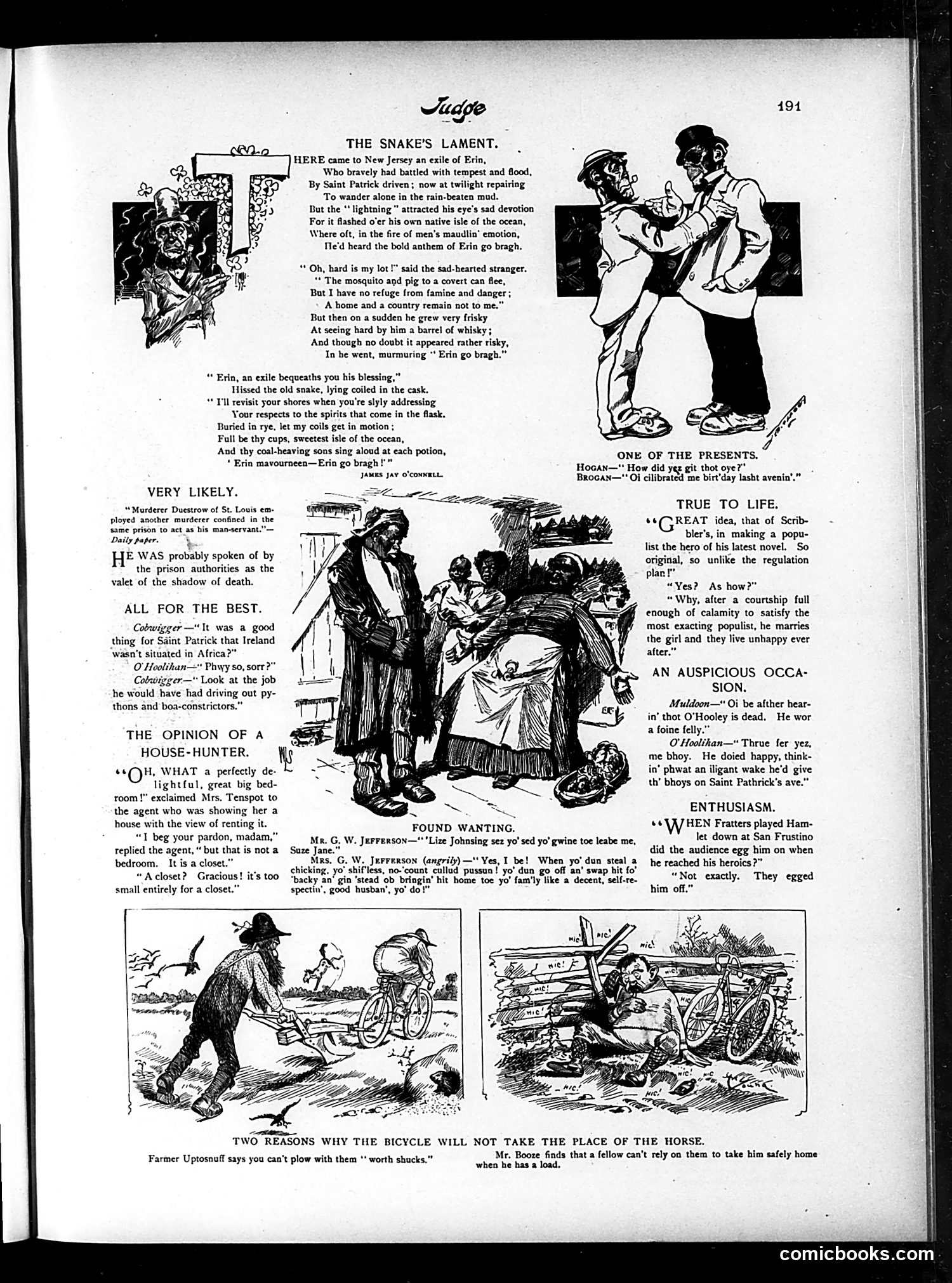
This page satirizes Irish immigrants to America, particularly their stereotyped drinking habits and cultural nostalgia. The main poem presents an Irish exile arriving in New Jersey, lamenting his displacement, who then encounters a whiskey barrel. A serpent inside—representing temptation or corruption—promises to reach Ireland *through* American whiskey consumption, suggesting Irish-Americans are defined by alcohol rather than productive citizenship. The surrounding jokes reinforce ethnic stereotypes: Irish characters speak in exaggerated brogue, discussing whiskey and wakes. One section mocks a house-hunter's size perception; another depicts African American dialect humor (then-standard in period publications). The bottom cartoons make practical arguments against bicycles replacing horses—one farmer notes you can't plow with them, another suggests they're unreliable transportation when drunk. The overall message reflects late-19th-century nativist attitudes: immigrants, particularly the Irish, are portrayed as comically backward, drink-obsessed, and incompatible with modern progress.
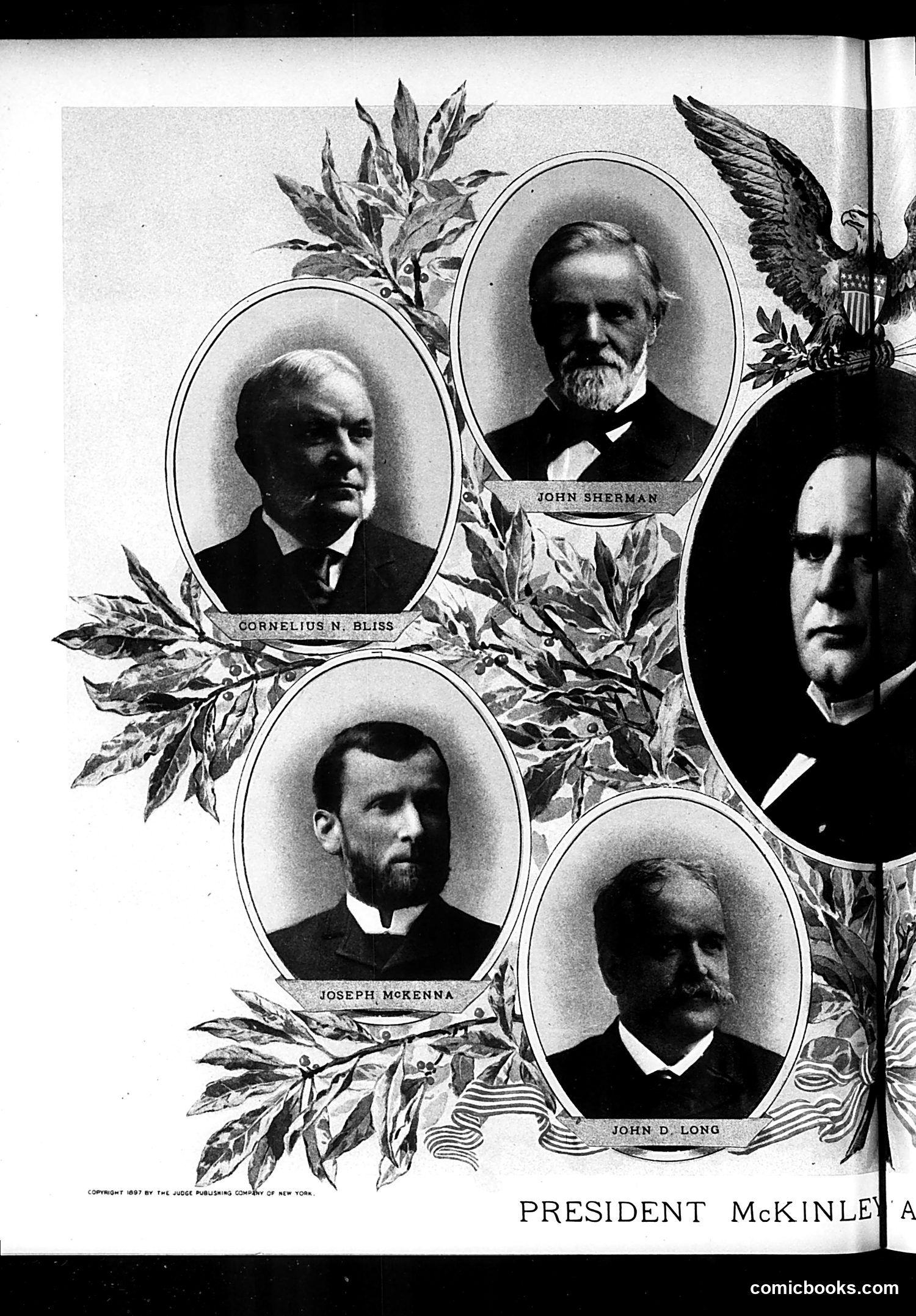
This appears to be a commemorative or editorial page from *Judge* magazine featuring five oval portraits of men in formal attire, arranged decoratively with laurel branches and an eagle emblem. The identified figures are: - Cornelius N. Bliss - John Sherman - Joseph McKenna - John D. Long - One unlabeled portrait (right side) The page is titled "PRESIDENT McKINLEY A[nd his cabinet]," suggesting this depicts President William McKinley's administration. The ornate, reverential presentation—with classical imagery and formal framing—suggests this is likely a *laudatory* government portrait gallery rather than satire. The eagle and laurels emphasize patriotic authority and legitimacy of McKinley's leadership team.
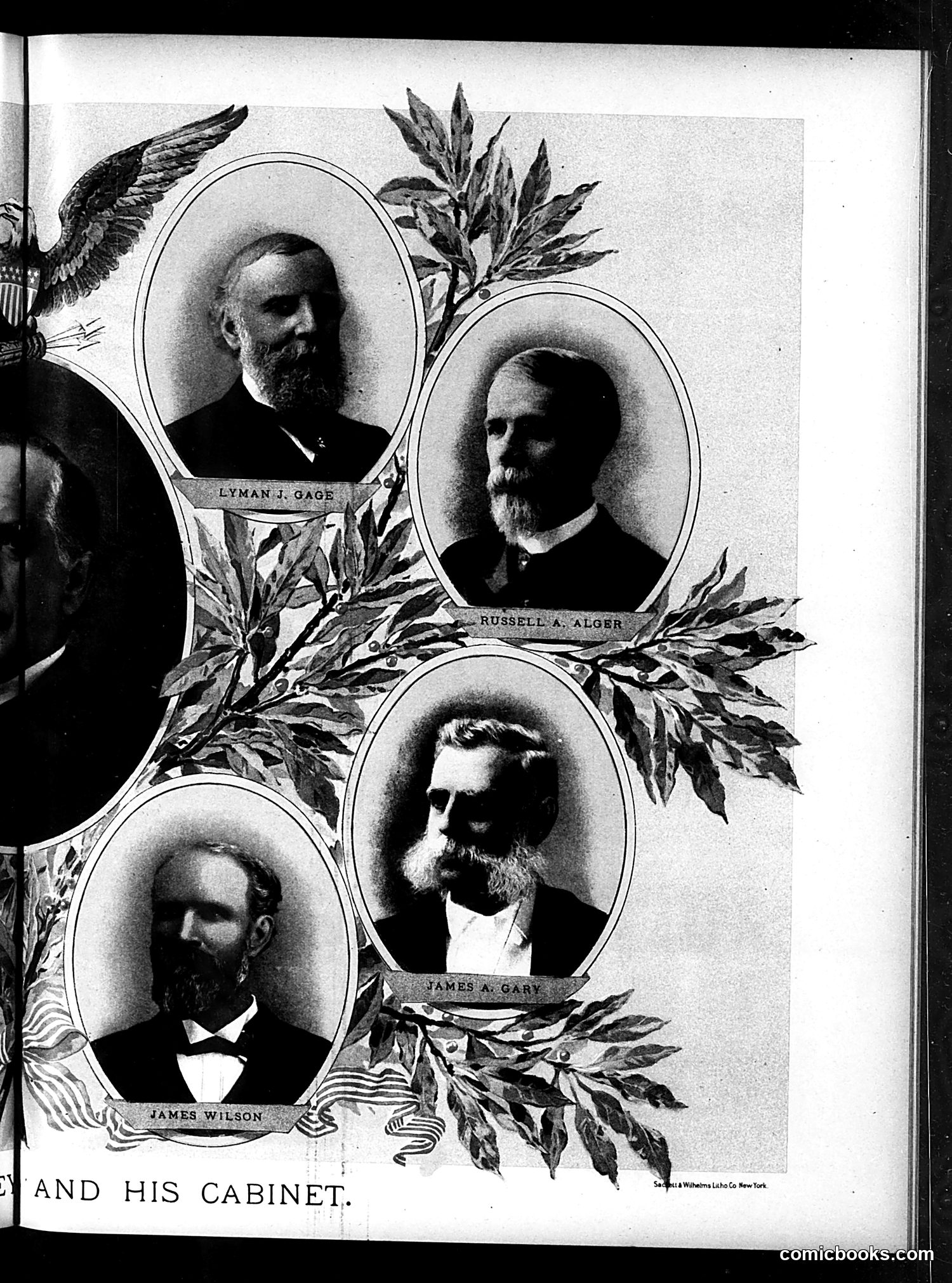
This page from *Judge* magazine shows four men identified as members of a presidential cabinet: **Lyman J. Gage**, **Russell A. Alger**, **James A. Gary**, and **James Wilson**. The title reads "AND HIS CABINET," though the president's name is cut off. The decorative arrangement—oval portraits surrounded by laurel wreaths and an eagle—mimics classical commemorative imagery, typically used to honor statesmen. The satire likely mocks either the cabinet's competence or composition. Without the president's identity visible, the specific political critique is unclear, but *Judge's* satirical intent suggests these men were viewed as unfit or controversial appointees. The formal, dignified presentation contrasts ironically with the magazine's satirical purpose.
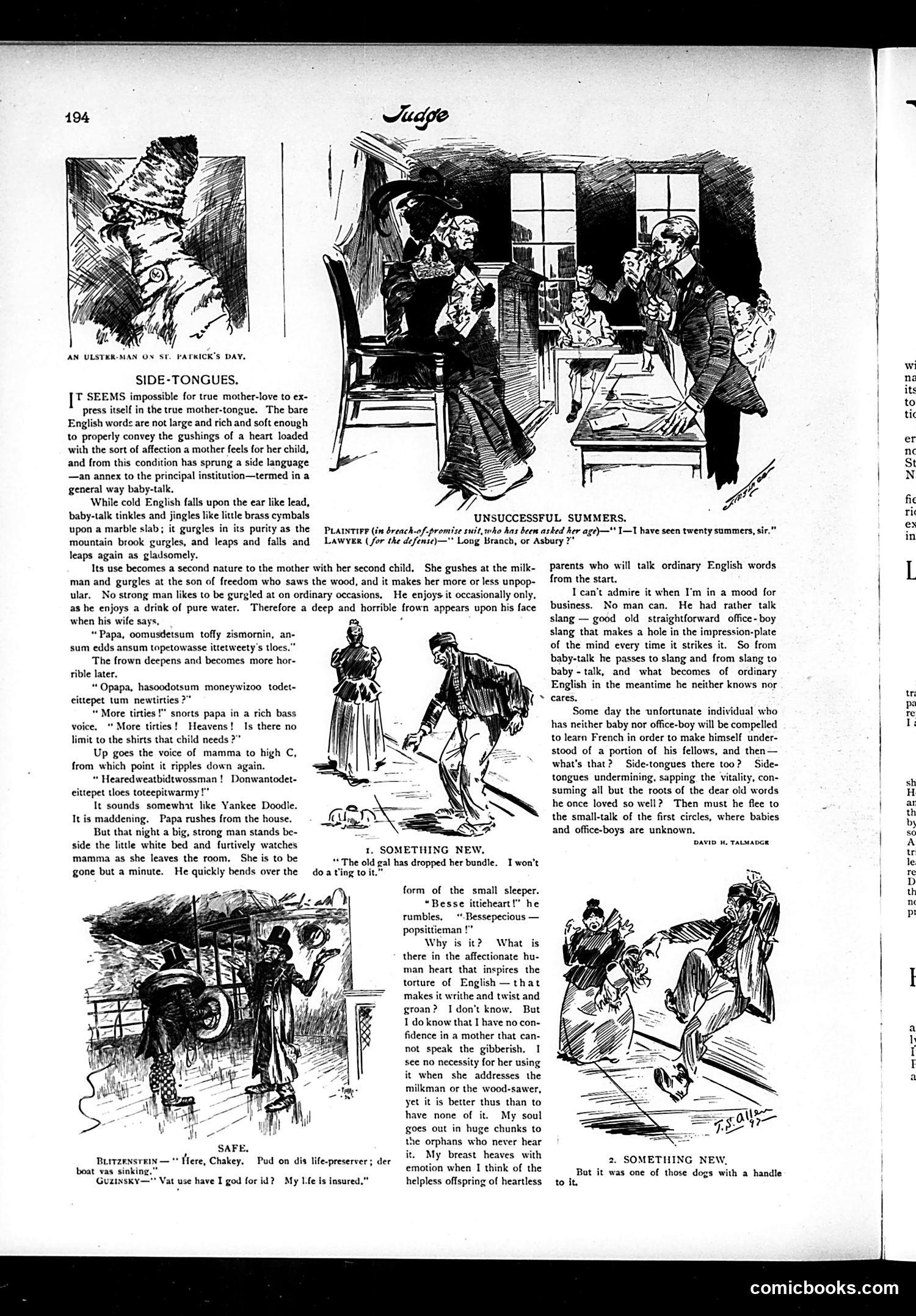
This page satirizes **baby-talk**—the diminutive language mothers use with children—as socially problematic despite its affectionate origins. The main article argues that while English cannot adequately express maternal love, resorting to baby-talk ("Papa, oomusdetsum toffy zismornin") makes mothers unpopular with everyone else, particularly husbands. The satire suggests fathers endure this linguistic torture, then overcompensate by using crude office slang, creating a linguistic chaos. The cartoons illustrate domestic friction caused by excessive baby-talk: an "Ulster-man" figure (likely Irish immigrant), scenes of family discord, and a courthouse "breach of promise" joke mocking a woman claiming to be twenty, with a lawyer sarcastically asking if she meant summers at Long Branch (a resort, implying age-concealment). The humor targets the perceived absurdity of how language shifts across social contexts—domestic sentimentality versus public propriety—a concern specific to Victorian-era anxieties about class and respectability.
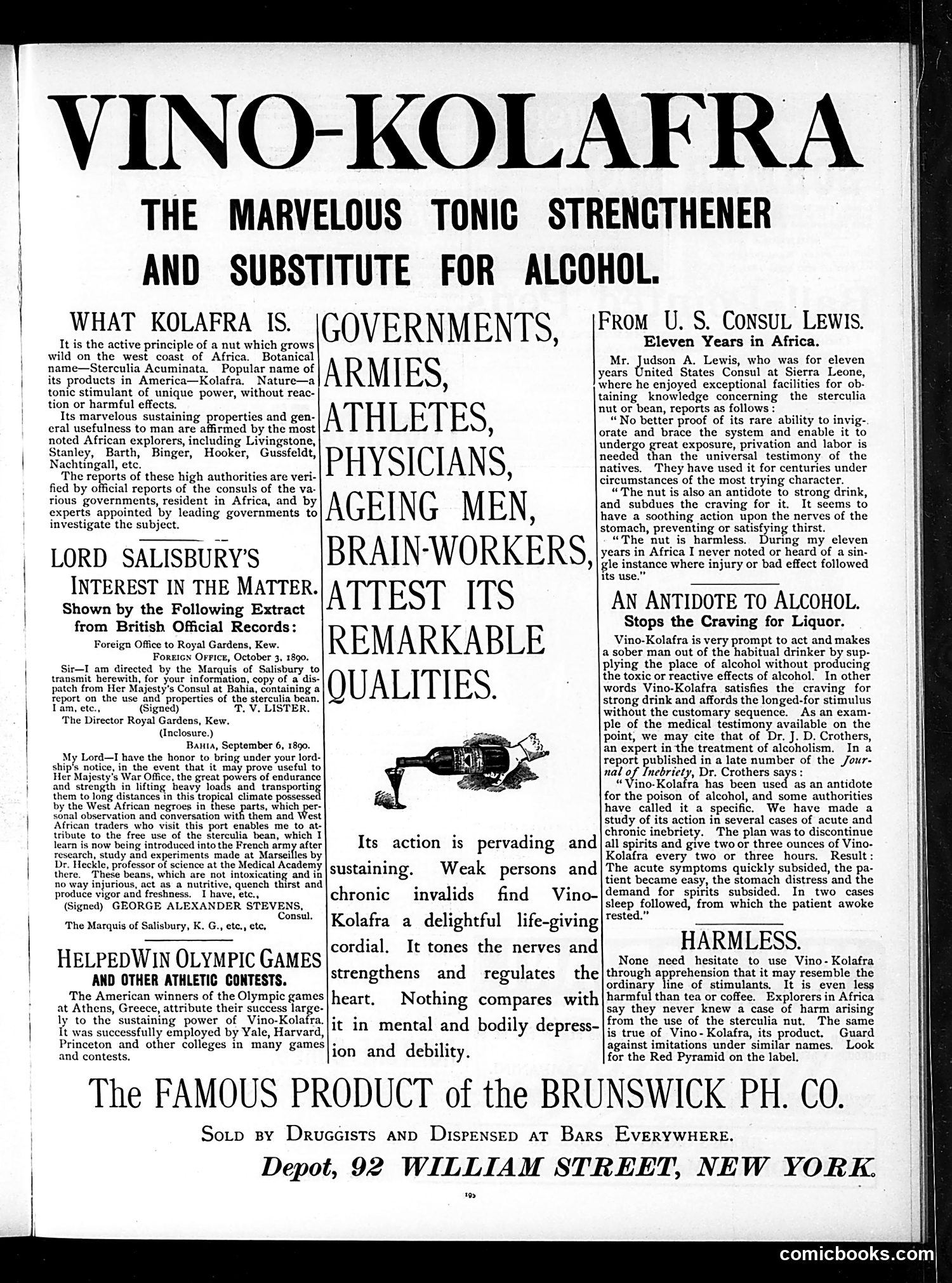
This page is primarily a **patent medicine advertisement** from the late 1800s rather than satirical content. It promotes Vino-Kolafra, a tonic made from African kola nuts, claimed to be a stimulant and alcohol substitute. The ad uses testimonials from prestigious figures—including Lord Salisbury (British Prime Minister), U.S. consuls, and references to Olympic athletes—to establish credibility. It claims the product cures alcoholism, strengthens weak persons, and aids athletes without causing harm. **The satire lies in the absurdity itself**: Judge magazine likely published this to mock such dubious medical claims common in that era. The grandiose endorsements from government officials and the vague promises of universal benefit are precisely the kind of quackery 1890s satirical magazines targeted. The product's claimed ability to simultaneously provide stimulation AND cure alcohol addiction exemplifies the contradictory logic of patent medicine marketing that satirists loved to expose.
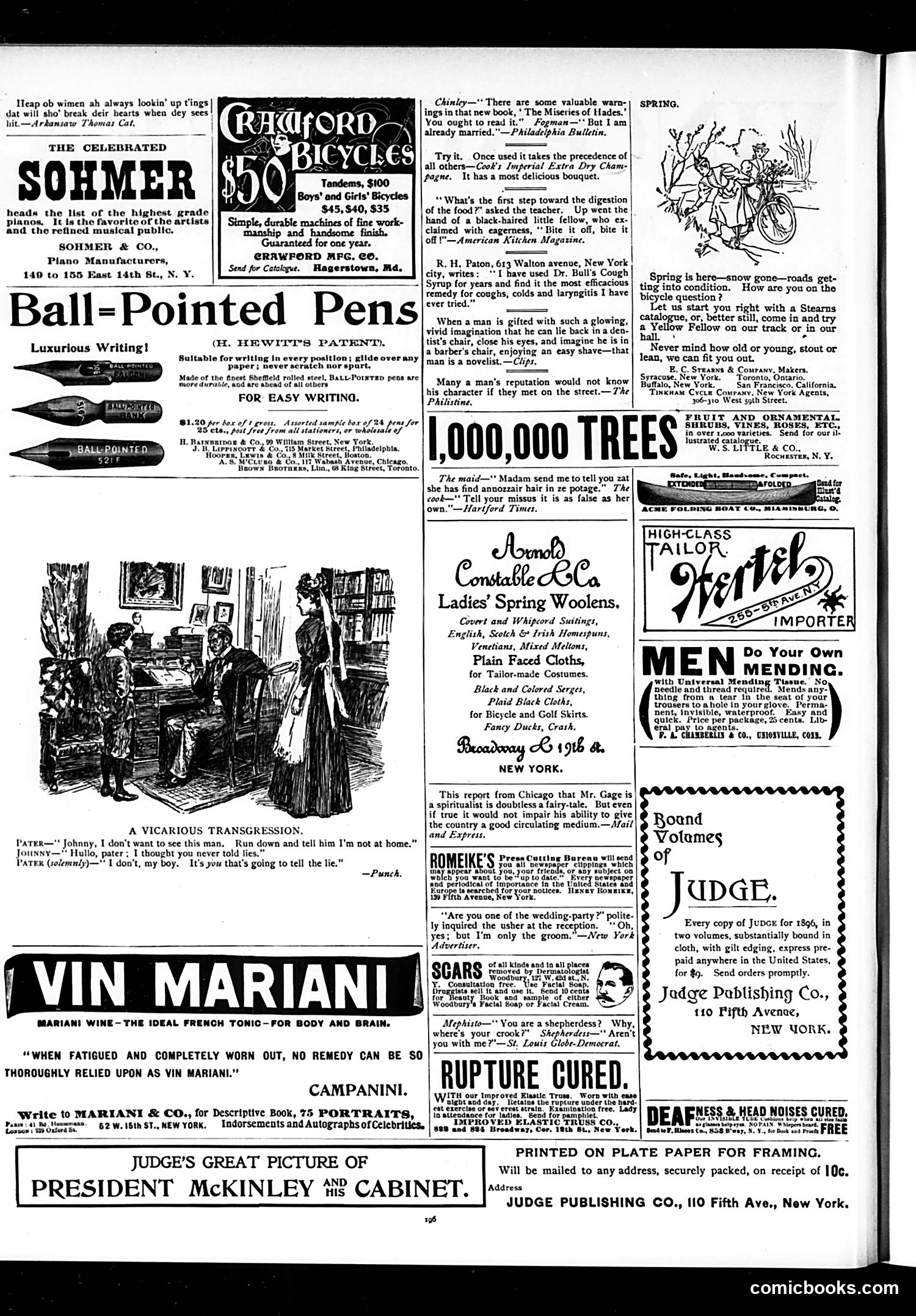
This page is **primarily advertisements** interspersed with brief satirical jokes typical of Judge magazine's format. The main cartoon, "A Vicarious Transgression," depicts a father instructing his son Johnny to lie to a visitor by claiming the father isn't home—then sanctimoniously telling the boy that *he* (the father) never lies, so the boy must deliver the falsehood. The satire mocks Victorian parental hypocrisy: adults who demand moral behavior from children while committing the same infractions themselves, here framed as a darkly comedic domestic scene. The remaining content consists of period advertisements (pianos, pens, wine tonics, bicycles, nurseries, clothing) and scattered one-liners on various topics—marriage, digestion, reputation—that reflect late-19th/early-20th-century humor sensibilities. The page contains no major political satire or identifiable public figures. It represents Judge's typical mixed editorial-advertising format rather than focused political commentary.
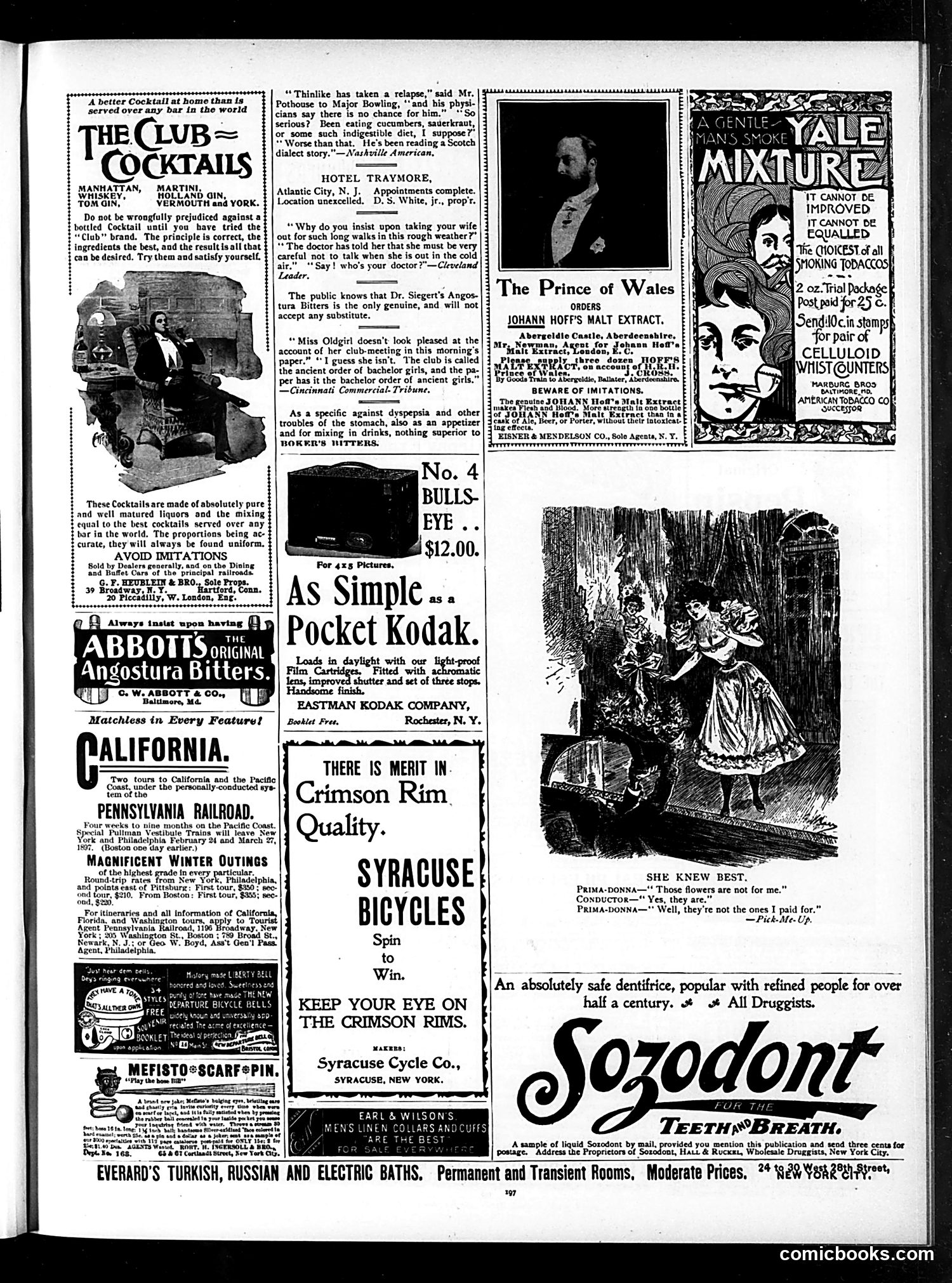
This is primarily an **advertising page** from Judge magazine (circa 1897, based on railroad tour dates). The layout features paid advertisements for consumer products interspersed with brief humorous anecdotes typical of the era. The small cartoons and jokes are lightweight social humor rather than political satire: - A joke about a man reading Scottish dialect stories causing his friend's illness (mocking heavy dialect literature) - A quip about a doctor telling a wife to avoid talking during cold walks - A club meeting mix-up where "Ancient Order of Bachelor Girls" is misreported as "Bachelor Order of Ancient Girls" - A final cartoon about a prima donna confused about which flowers were her paid gift **The main content is commercial**: advertisements for cocktail mixers, bitters, bicycles, cameras (Kodak), dentifrice (Sozodont), and railroad tours. The "Prince of Wales" references Johann Hoff's Malt Extract, apparently endorsed by or associated with that title. This reflects Judge's business model: satirical magazine covers subsidized by advertising revenue.
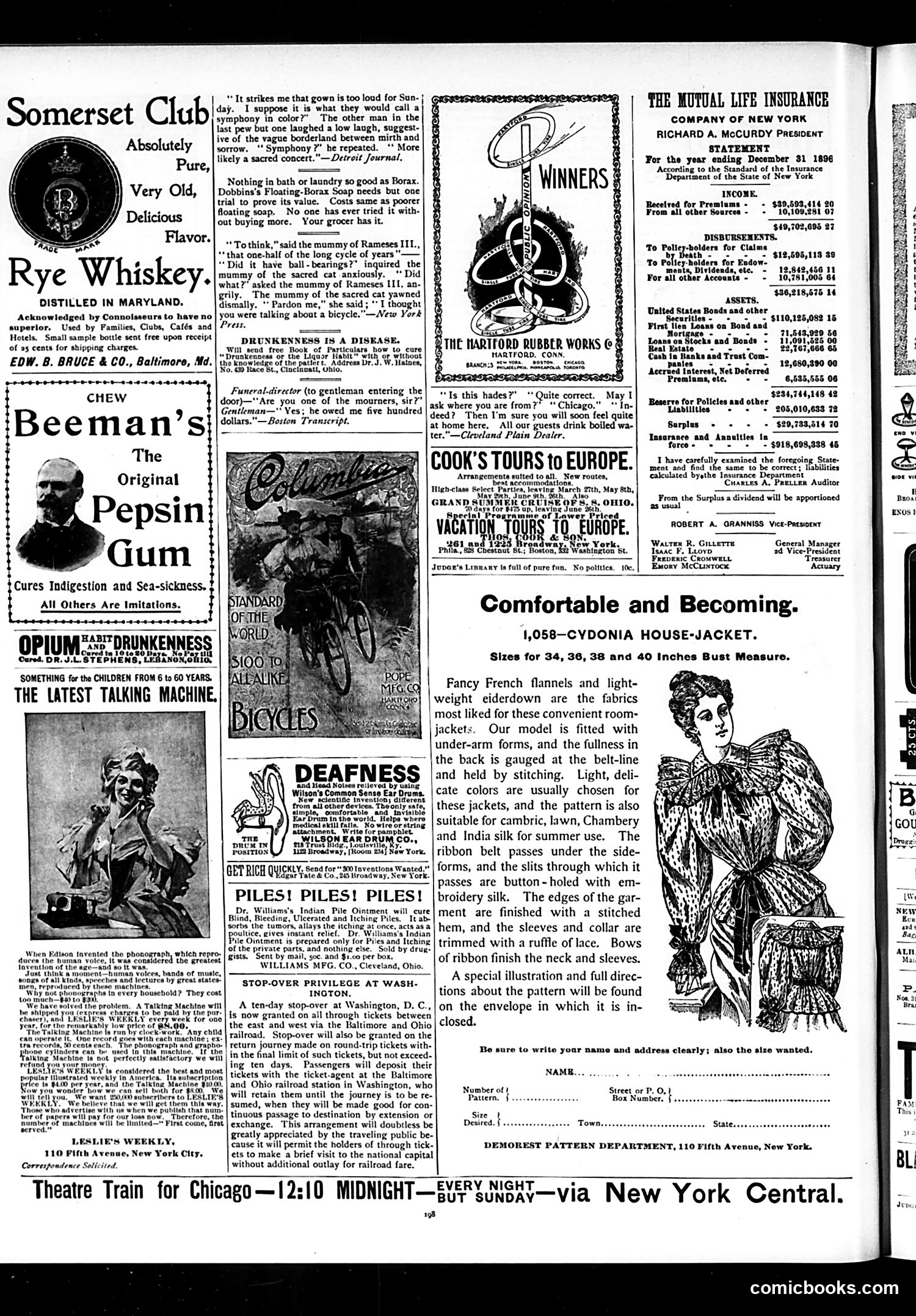
This page is primarily **advertising**, typical of late 19th-century American magazines. The content includes pitches for: - **Somerset Club Rye Whiskey** (Maryland distilled) - **Beeman's Pepsin Gum** (for indigestion) - **Opium and drunkenness "cures"** (reflecting era's unregulated patent medicine era) - **Edison's talking machine** (phonograph) - **Medical treatments** for deafness and piles - **Cook's Tours to Europe** (travel agency) - **Cydonia House-Jacket** (women's clothing) - **Railroad passes** (Baltimore & Ohio) The **brief humorous items** include a joke about a woman's colorful church dress ("symphony in color") and ancient mummy chatter about ball-bearings—light satirical filler typical of Judge's format. The page reflects **1890s consumer culture**: patent medicines (many containing opium), emerging technologies, and genteel travel aspirations. It's historically valuable for showing what companies advertised and what ailments were marketed-to, rather than for political satire.
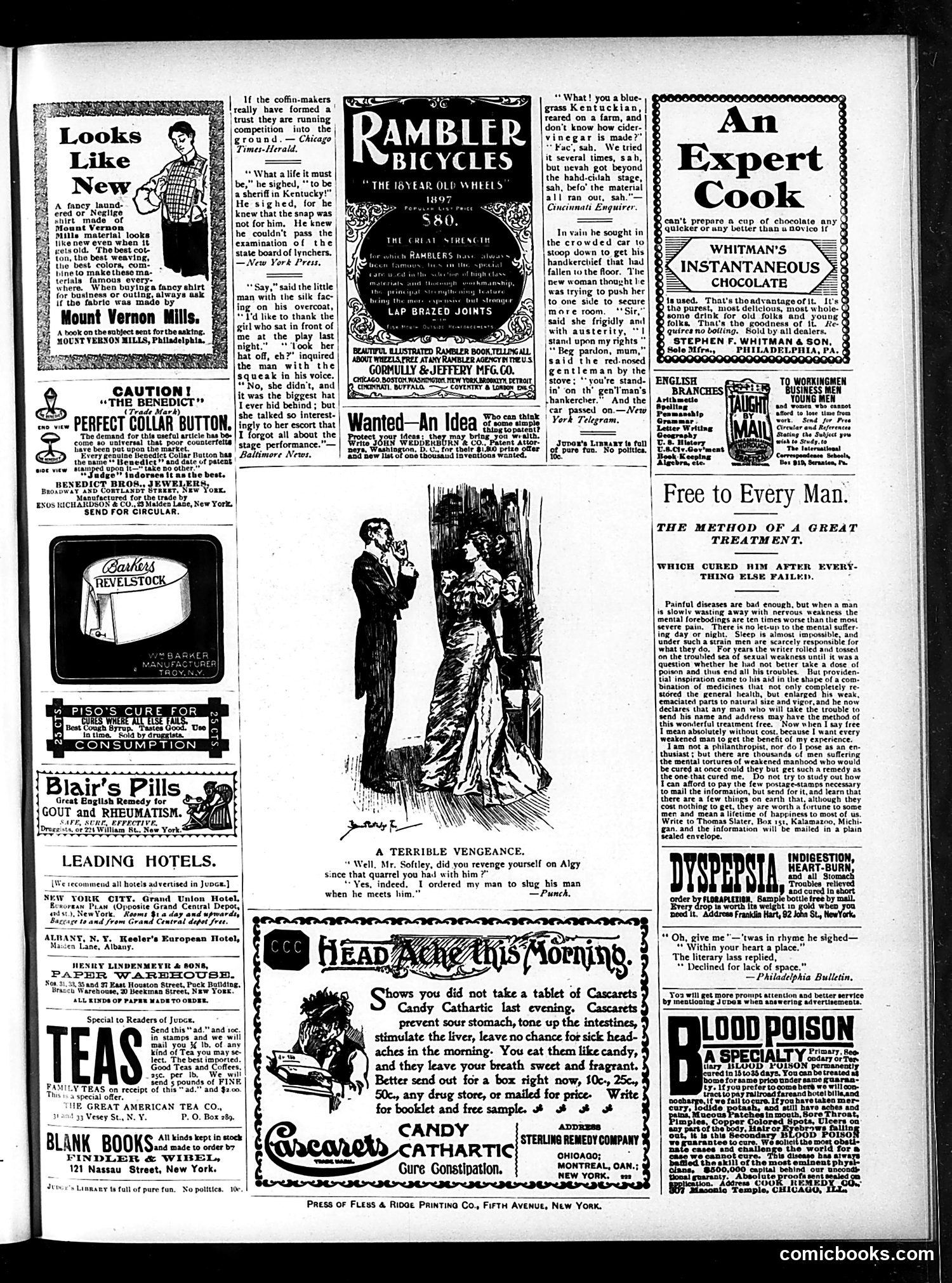
This page from *Judge* magazine contains several brief satirical pieces poking fun at everyday situations and regional dialects. The main cartoon, "A Terrible Vengeance," depicts a man threatening another over a quarrel, with the punchline suggesting petty revenge—likely satirizing exaggerated masculine posturing over minor disputes. Other snippets mock regional speech patterns: a dialogue about Kentucky farm life and vinegar-making ridicules rural ignorance, while another piece features a character with a heavy dialect (rendered as "sah" and "gen'T'man") in a crowded streetcar, poking fun at working-class or African-American speech. The page is largely advertisements for patent medicines, collar buttons, and other commercial products typical of the era. The satirical content reflects *Judge*'s focus on lampooning American social types and regional stereotypes common to turn-of-the-century humor.
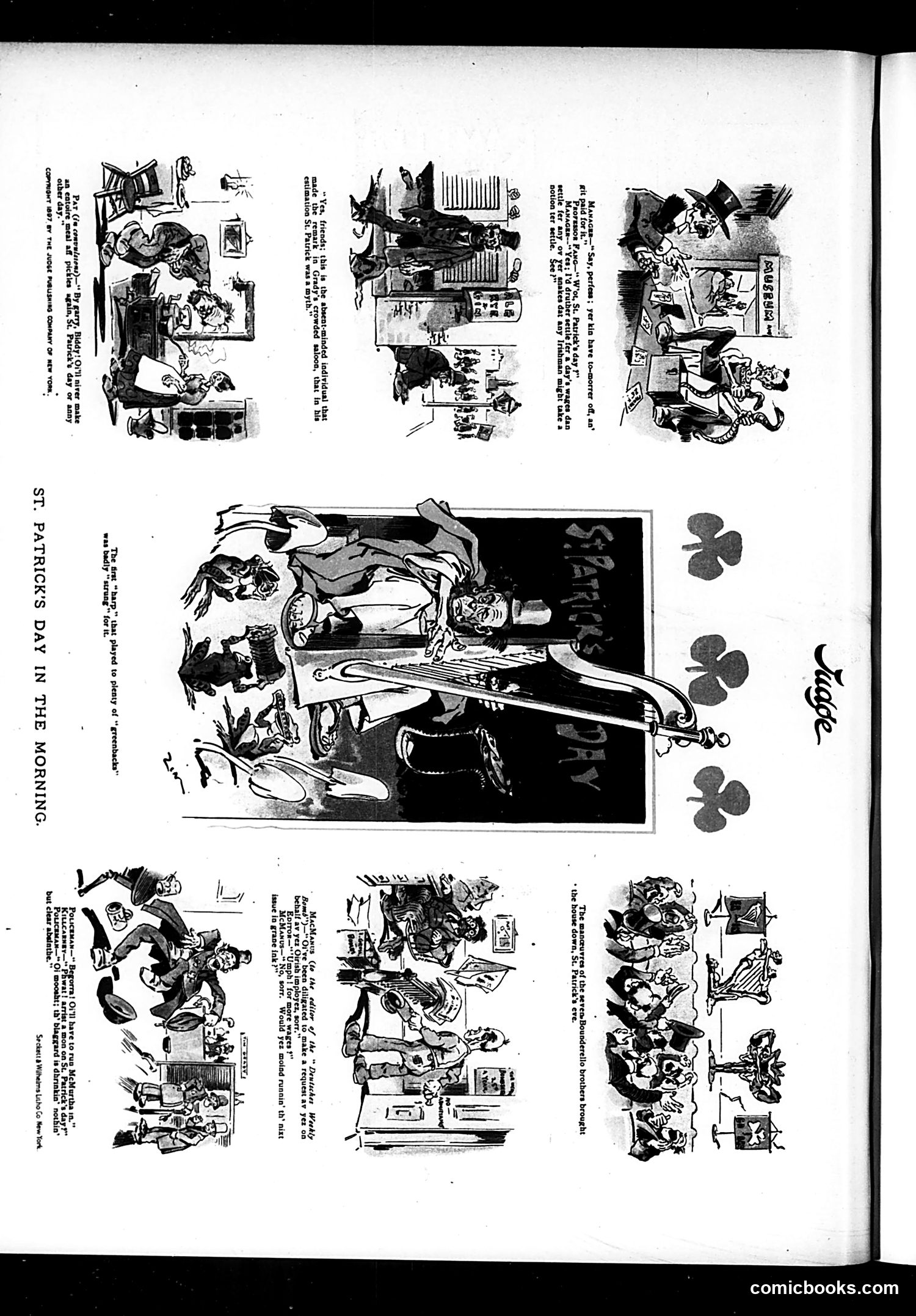
This page satirizes anti-Irish prejudice through slapstick consequences. The central narrative depicts a professor who insulted St. Patrick as a "myth" in an Irish saloon, facing violent retaliation from Irish patrons. The cartoon plays on stereotypes: Irish workers ("Managan") speaking in exaggerated dialect, frequenting saloons, and resorting to physical violence over religious insult. The humor—dark by modern standards—relies on depicting Irish-Americans as quick-tempered and prone to fighting. References to "greenbacks" (money), harps, and St. Patrick's symbols reinforce ethnic caricature. A policeman appears amid the chaos. The satire targets both anti-Irish prejudice (the professor's dismissal of their saint) and Irish-American culture itself, mocking their defensive pride. This reflects 1890s attitudes when Irish immigrants faced discrimination; Judge used ethnic stereotypes as comedic fodder while ostensibly critiquing bigotry.