
A complete issue · 24 pages · 1897
Judge — March 13, 1897
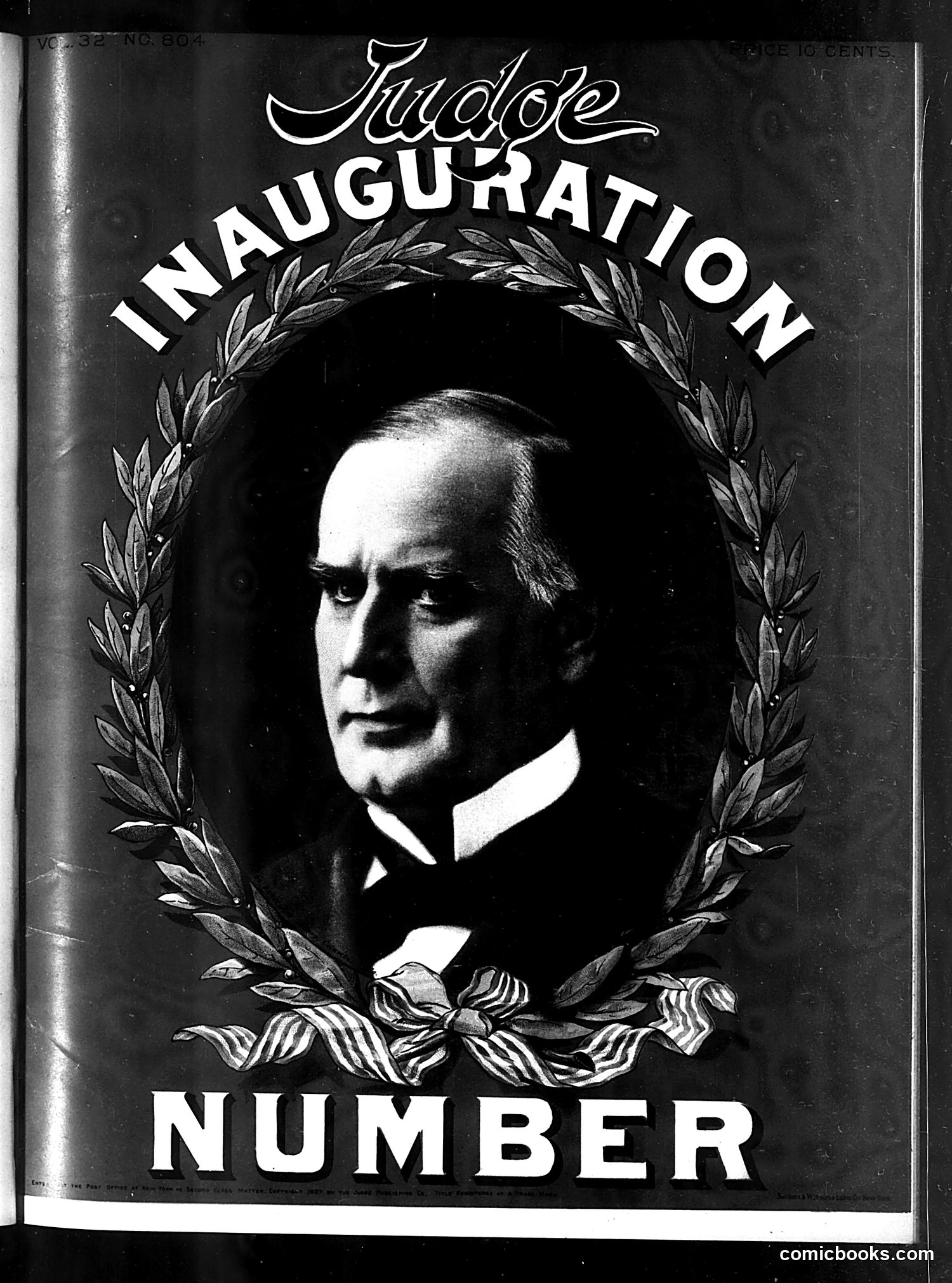
This appears to be a **Judge magazine "Inauguration Number"** — likely a special issue commemorating a judicial appointment or swearing-in ceremony. The cover features a formal black-and-white portrait of a distinguished man in formal attire, framed by an ornate laurel wreath (symbolizing honor and achievement) with a decorative bow at the bottom. Without additional text identifying the specific figure or date, I cannot definitively state which judge or appointment this celebrates. However, the elaborate presentation—combining the formal portrait with classical symbolic imagery—suggests this was a significant judicial event noteworthy enough for *Judge* magazine's special coverage. The satirical magazine likely used this issue to comment on judicial affairs of the moment.
This page is primarily **advertising**, not satirical content. It's a want-ad placed by John Wedderburn & Co., a Washington D.C. patent attorney firm, offering a $1,800 prize for novel inventions. The ad uses the phrase "Wanted—An Idea" as a hook, appealing to potential inventors to submit simple concepts for patenting. To lend credibility, it lists a "Board of Awards" featuring prominent Washington figures including a U.S. Senator, Congressman, and bank cashier. This represents early 20th-century entrepreneurial marketing—using prestigious names to encourage public participation in an invention contest, essentially soliciting clients for the patent firm while offering financial incentives.
This page is primarily **advertising, not satire or political commentary**. It's a full-page advertisement from the Overman Wheel Company promoting their "Victor Road Racer" bicycle, dated January 20th, 1897. The ad targets serious cyclists ("Expert road riders") and emphasizes the bicycle's quality craftsmanship and modern features for that era. The company claims to be "the oldest American makers of Safety Bicycles" and notes they pioneered safety bicycle construction in 1887. There are no cartoons, caricatures, or satirical figures visible. The headline "Have you seen the Victor Road Racer?" is a straightforward marketing question. This represents typical late-1890s bicycle industry advertising during the peak of the American cycling boom.
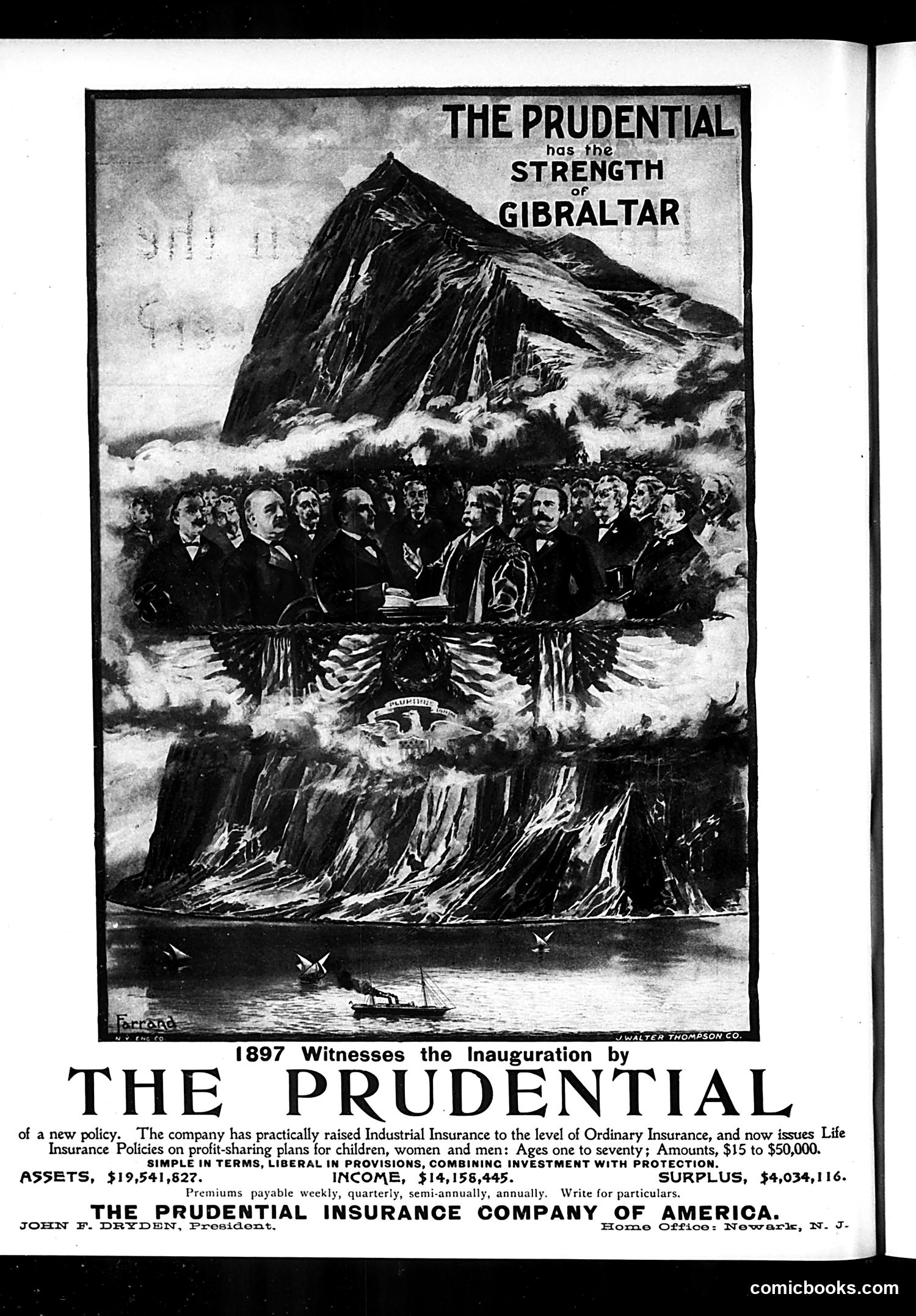
This is primarily **advertising, not satire**—a full-page 1897 Prudential Insurance Company advertisement disguised as editorial content in *Judge* magazine. The image depicts a ceremonial gathering of well-dressed men before the Rock of Gibraltar, with an eagle shield below. The visual metaphor compares Prudential's financial strength to Gibraltar's legendary impregnability. The "inauguration" language suggests a momentous business event. The advertisement emphasizes Prudential's expansion into life insurance for ordinary people (ages 1-70, affordable amounts $15-$50,000), positioning this as democratizing insurance previously unavailable to working-class families. Terms like "profit-sharing" and "investment with protection" appealed to middle-class aspirations. The astronomical financial figures ($19+ million in assets) were meant to reassure customers of the company's stability during an era when insurance companies frequently collapsed, leaving policyholders with nothing. This represents early corporate advertising strategy: using a humor/satire magazine's credibility to promote products through visually striking, quasi-editorial presentations.
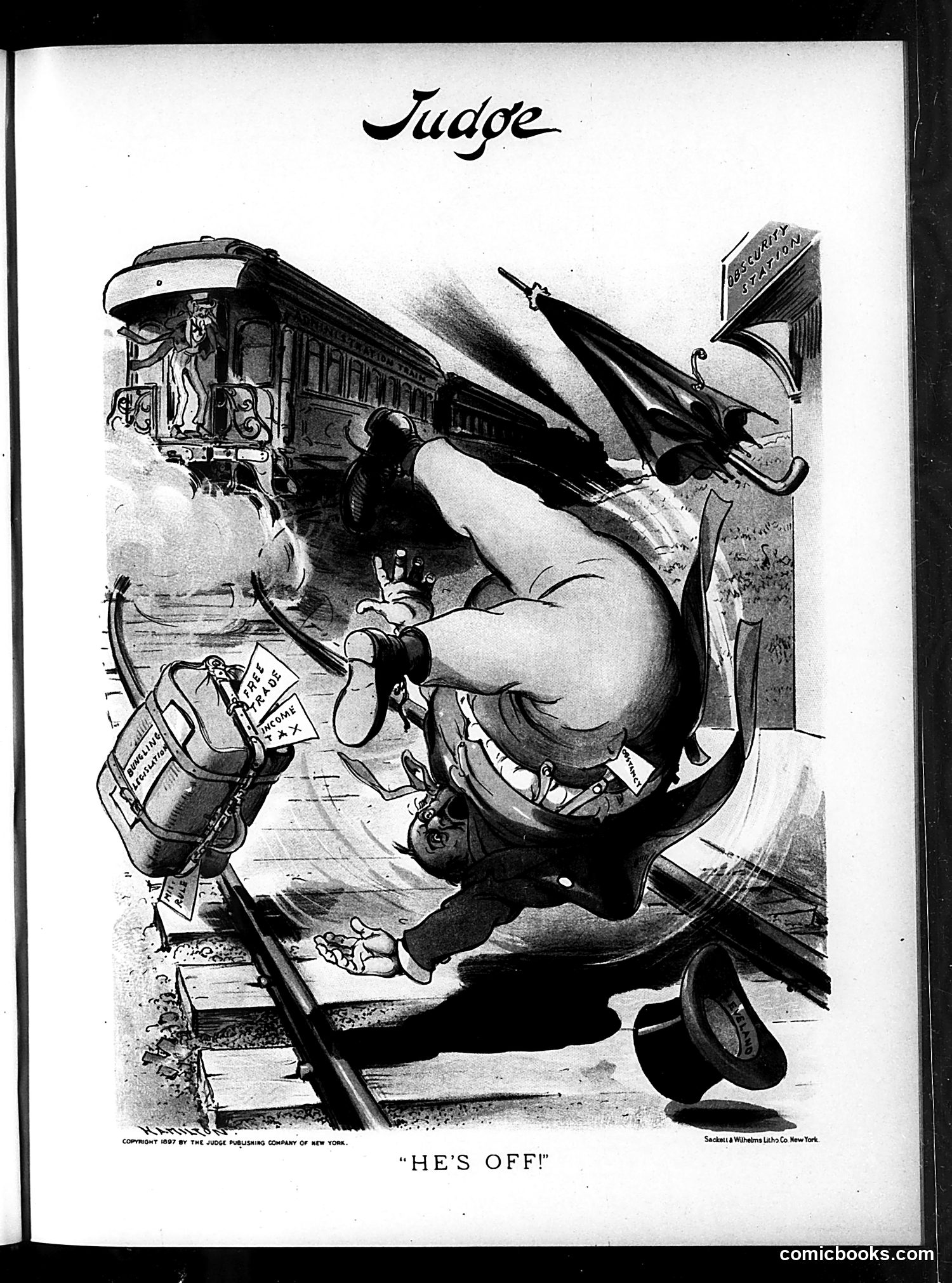
This Judge magazine cartoon depicts a rotund figure being ejected from a train platform, with luggage and belongings scattering. The title "He's Off!" suggests forced departure or removal from office. The figure appears to be a political or judicial official (given the magazine Judge's focus), though the specific identity isn't entirely clear from visual cues alone. The exaggerated caricature—oversized body, disheveled appearance—was typical of late 19th-century satirical portraiture used to mock authority figures. The train setting and scattered belongings suggest either removal from a government position or departure from power. The cartoon likely comments on a contemporary political scandal or dismissal, though without additional context, the precise event referenced remains unclear. The comedic brutality of the imagery emphasizes the cartoonist's mockery of the subject's downfall.
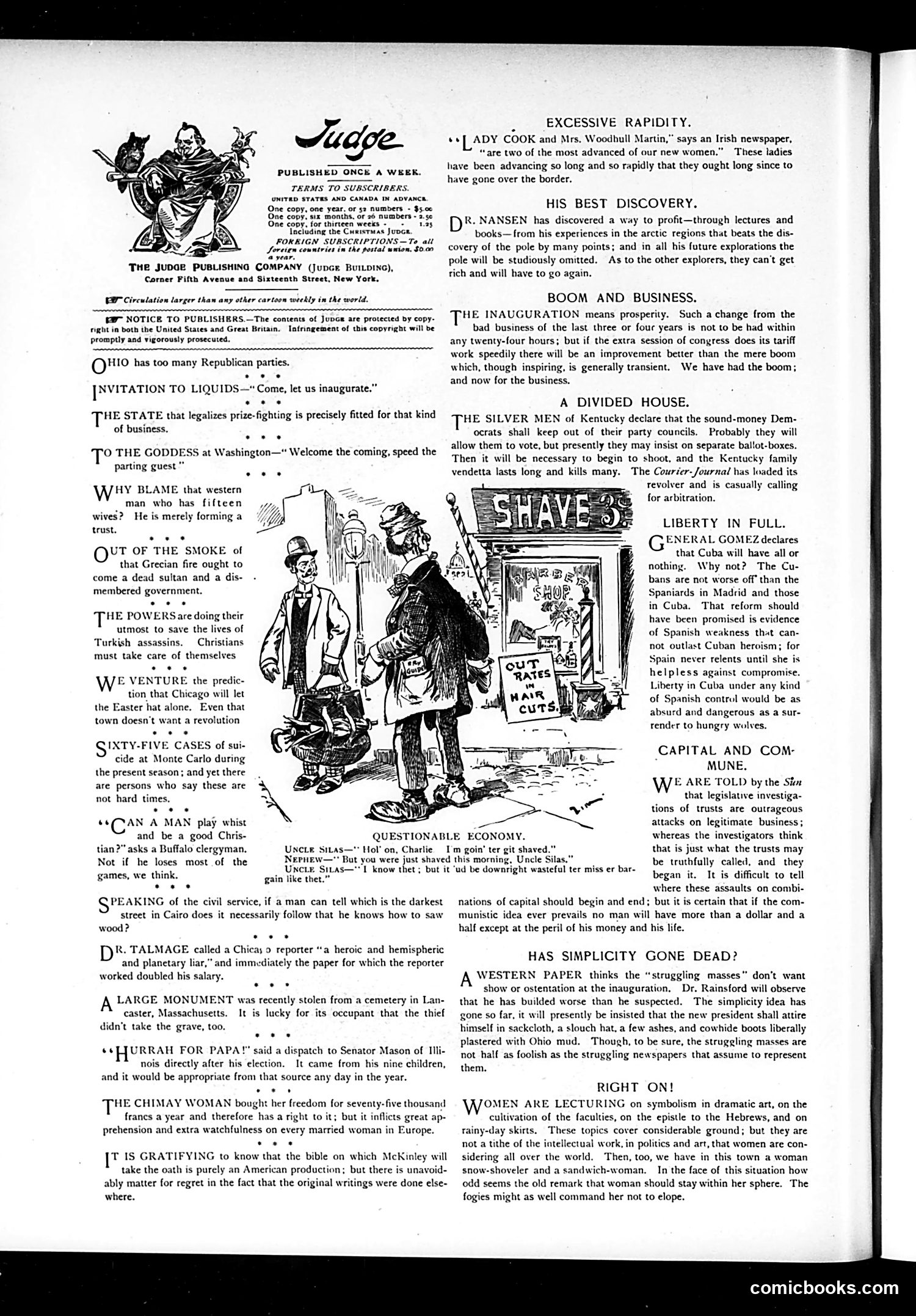
This page contains brief political and social commentary typical of Judge's satirical format. Key items include: **"Excessive Rapidity"**: Mocks Lady Cook and Woodhull Martin as radical "new women" who've advanced so far they should leave the country—satire of 1890s feminism. **"His Best Discovery"**: Dr. Nansen (Arctic explorer) discovered lecturing about polar expeditions is more profitable than actual exploration—mocking commercialism and celebrity. **The Main Cartoon** ("Questionable Economy"): Shows Uncle Silas being shaved twice in one day. The barber justifies it as economical—satirizing working-class financial desperation during hard times. **Civil Service Jokes**: Mock government jobs as requiring no real skill ("if a man can tell...Cairo's darkest street...can he saw wood?"). **General Tone**: The page reflects 1890s anxieties: women's rights, labor conditions, government inefficiency, and economic hardship. The humor targets both social reformers and institutional incompetence.
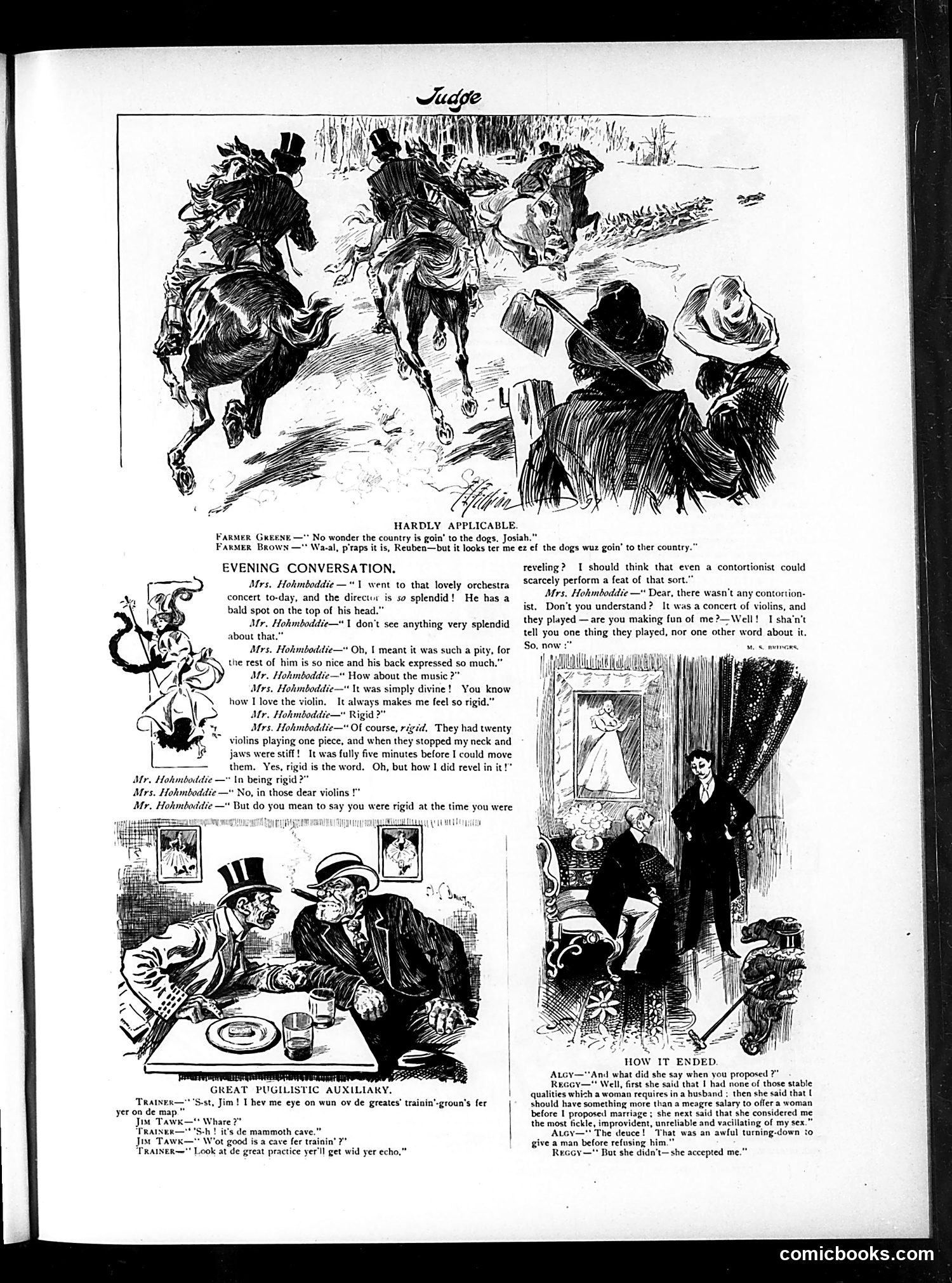
This page contains three satirical pieces typical of late 19th-century American humor: **"Evening Conversation"** mocks Mrs. Hohmboddie's malapropisms and pretension about classical music. She misuses "rigid" (meaning stiff) when she means "rapt" or "transported," creating absurd descriptions of her concert experience. The joke targets middle-class affectation and misuse of sophisticated vocabulary. **"Great Pugilistic Auxiliary"** is a brief visual gag about trainers using a mammoth cave as a boxing gym for echo practice—a pun on the word "training." **"How It Ended"** plays on romantic expectations: a woman delivers harsh criticisms about the suitor's character and finances before—unexpectedly—accepting his proposal anyway. The satire targets both women's mercenary marriage calculations and men's confusion about female logic. The top cartoon "Hardly Applicable" depicts two farmers debating whether the country or its dogs are going to ruin—political commentary on rural decline that remains unclear without additional context.
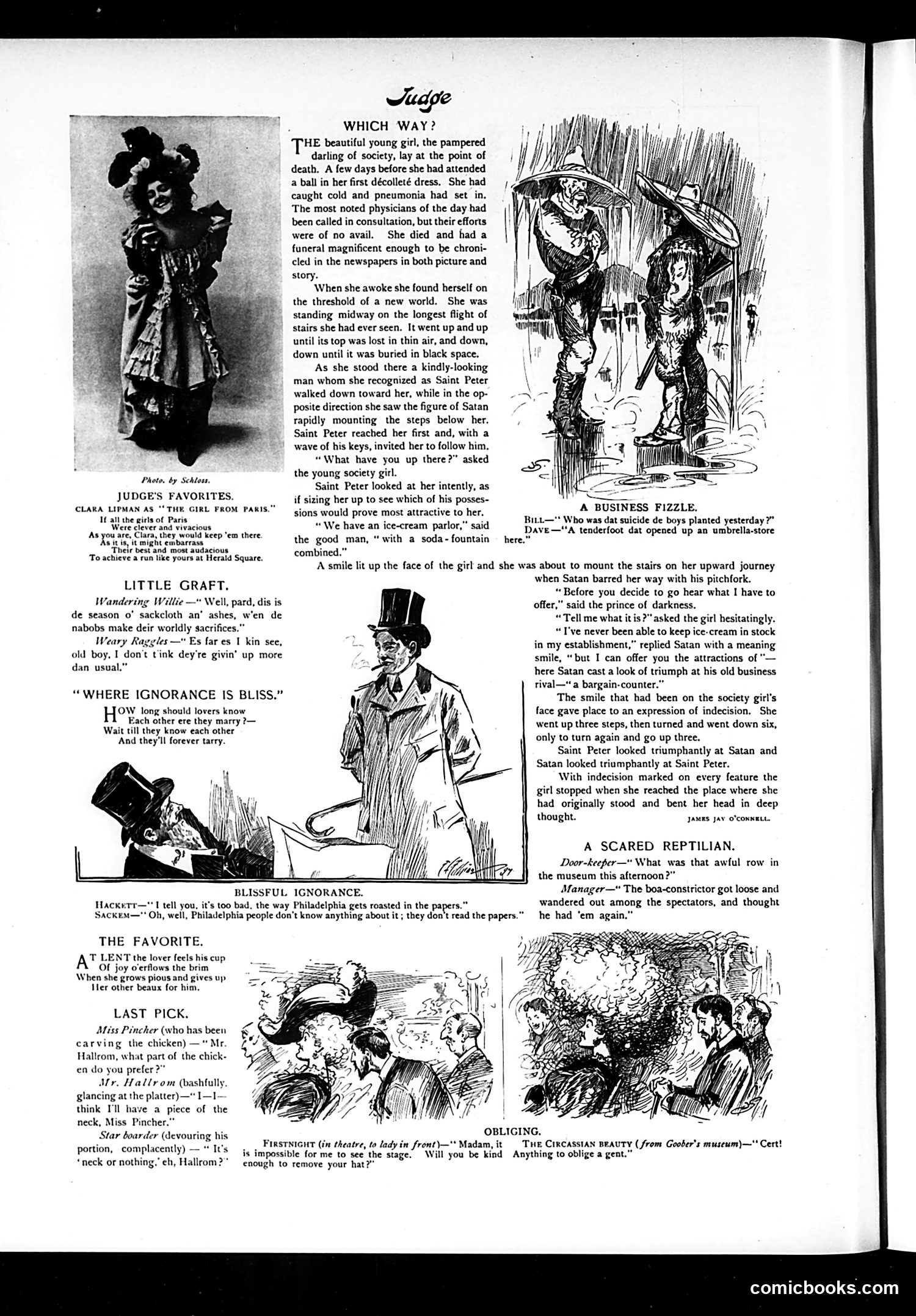
This page contains multiple short satirical pieces typical of Judge magazine's format. **"Which Way?"** is the main narrative cartoon: a society girl dies, then faces a literal choice between heaven (with Saint Peter offering an ice-cream parlor and soda fountain) and hell (Satan offering a bargain-counter). The satire mocks the materialistic values of wealthy young women—she's genuinely torn between these options, unable to decide based on virtue but only on consumer attractions. This reflects early 20th-century anxiety about commercialism and the shallow priorities of the leisure class. **Supporting jokes** include: - "Little Graft": wordplay on political corruption - "Where Ignorance is Bliss": cynical take on courtship - "A Business Fizzle": immigrant humor (the "tenderfoot" who fails at business) - "The Favorite" and "Last Pick": romantic humor The material reflects Judge's typical blend of social commentary, class-based humor, and gentle mockery of contemporary American life, particularly targeting wealth, materialism, and changing social customs.
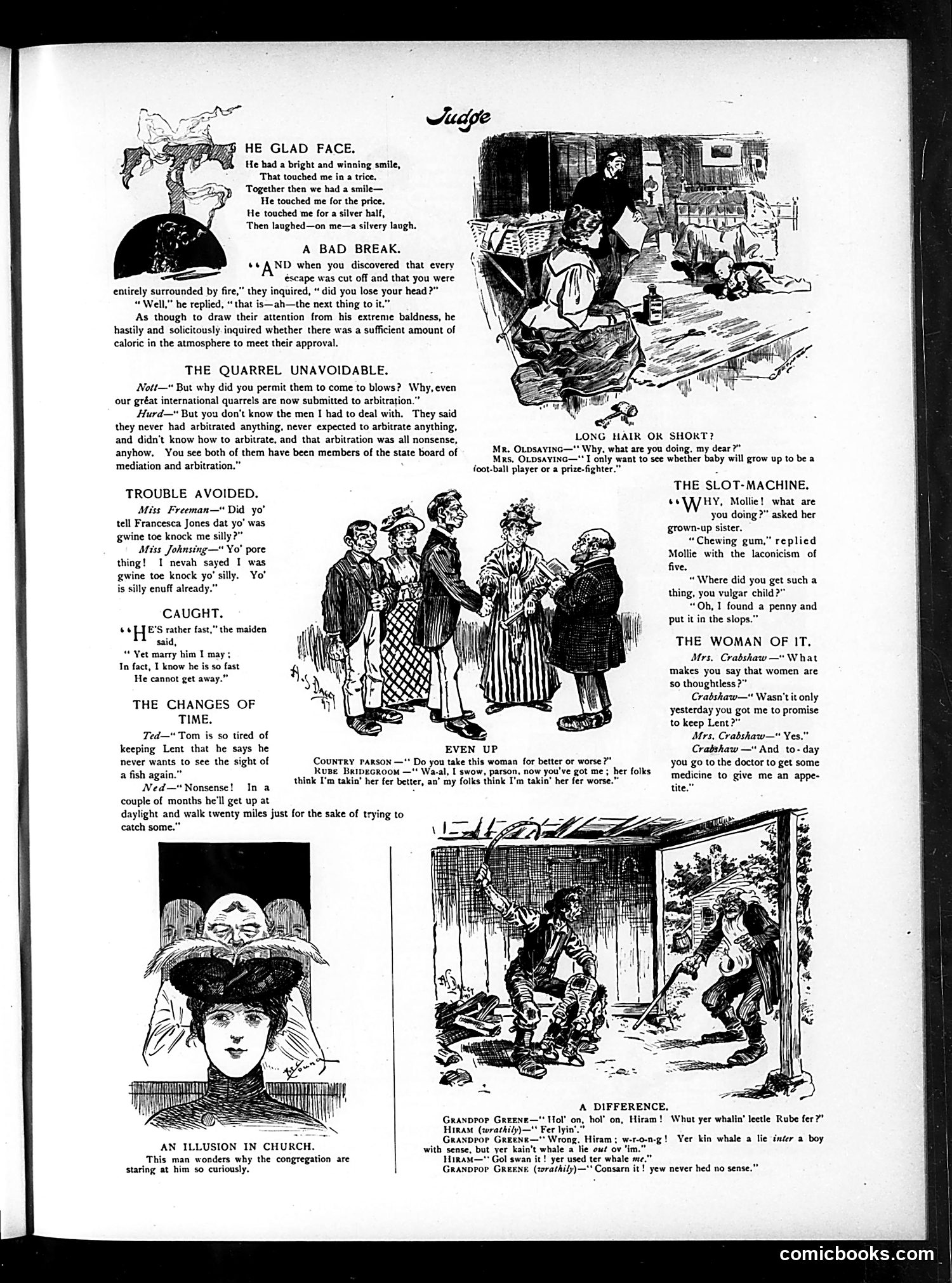
This page collects brief humorous sketches typical of early 20th-century American satire. The humor relies on wordplay, social observation, and character types recognizable to contemporary readers: **Key sketches:** - **"He Glad Face"**: Satirizes con artists who use charm to extract money ("touched me for the price") - **"A Bad Break"**: Mocks a bald man trying to deflect attention from his baldness during a dramatic fire story - **"The Quarrel Unavoidable"**: References arbitration boards—contemporary institutions meant to resolve disputes—yet ironically features board members who refuse arbitration - **"Trouble Avoided"**: Features dialect humor (African American servants), common in period publications - **"The Slot-Machine"**: Jokes about children finding pennies in unexpected places - **"A Difference"**: Rural dialect sketch contrasting lying in children The illustrations support slapstick and social comedy. The page reflects period attitudes including casual ethnic stereotyping and class-based humor that modern readers would find dated or offensive.
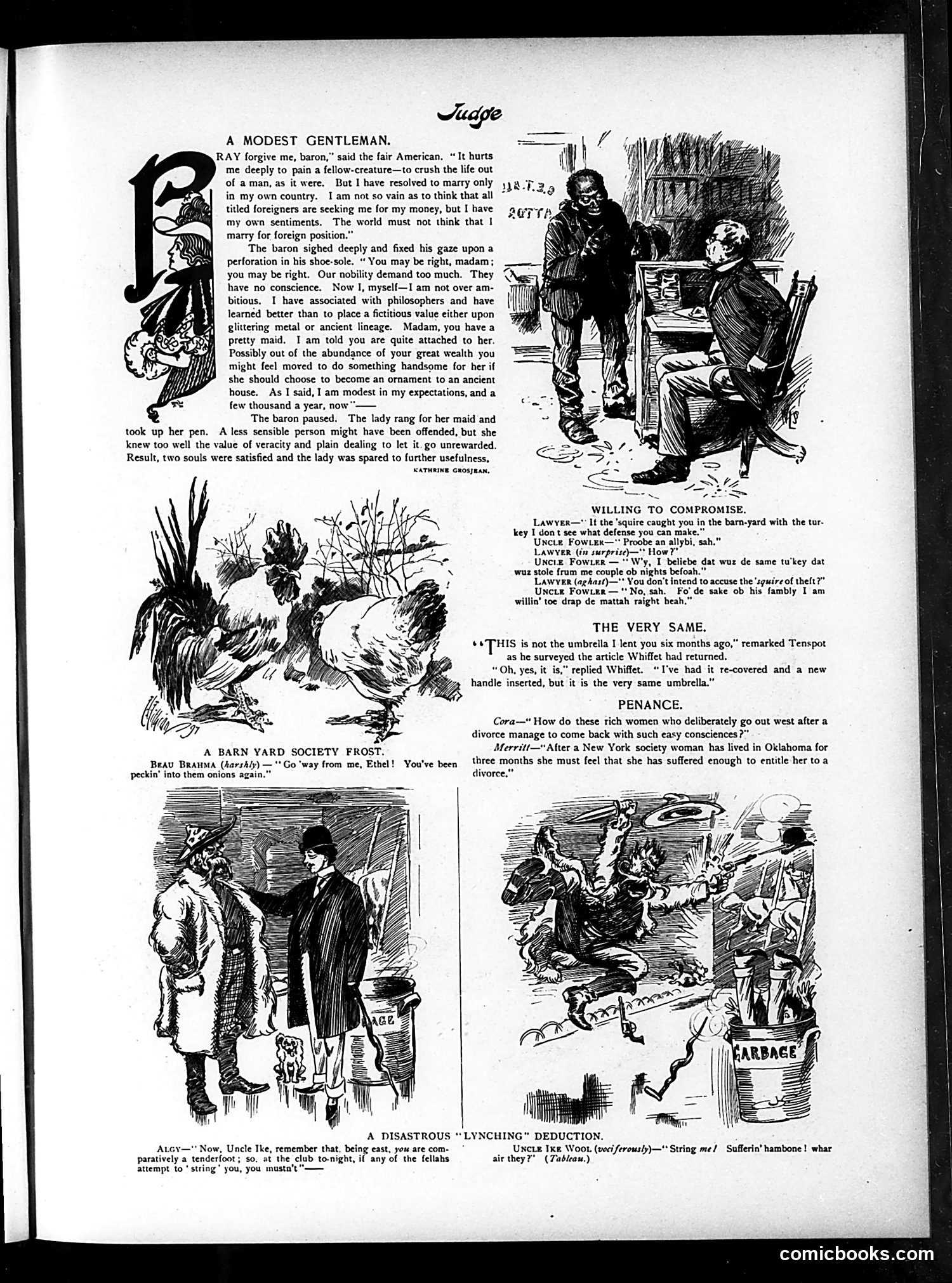
This page contains five separate satirical pieces mocking social pretensions and hypocrisy of the Gilded Age: **"A Modest Gentleman"**: An American heiress rejects a European baron's proposal, claiming she won't marry for foreign titles. The baron then shamelessly propositions her by offering to take her maid "as an ornament to an ancient house" for "a few thousand a year"—revealing the mercenary nature he claimed to despise. The satire targets both fortune-hunting foreign nobility and American wealth. **Other sketches** include domestic disputes, marital infidelity excuses, and a racial dialect piece involving an African American character named "Uncle Fowler" who strategically drops a theft complaint to protect his white employer's reputation—a dark commentary on post-Reconstruction racial dynamics. **"A Disastrous Lynching Deduction"** plays on Eastern versus Western social customs, with "stringing" (friendly teasing) misunderstood as actual lynching. The humor relies on period-specific social anxieties: transatlantic marriages, servants' relationships with employers, and American regional differences.
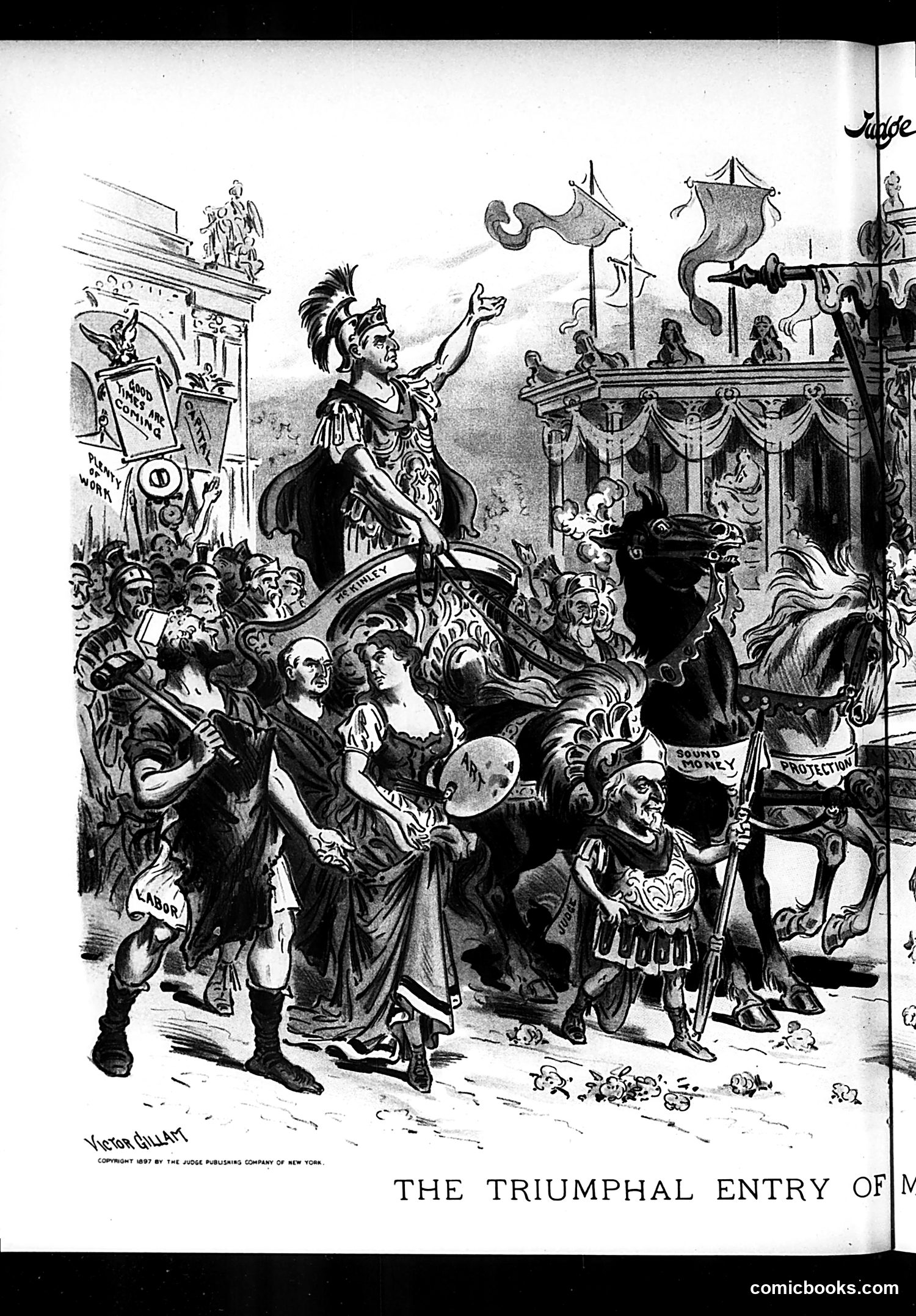
This political cartoon depicts a grand Roman-style procession. A central figure stands triumphantly on an ornate chariot, while crowds below hold banners labeled "LABOR," "PROTECTION," and "MONEY." The elaborate setting includes classical architecture, flags, and attendants in period costume. The incomplete title suggests this satirizes a political figure's celebrated return or victory, likely related to late-1890s American politics. The iconography—Roman triumph, crowds, labeled interests—mocks the grandiosity of the subject's self-promotion or public reception. The visible labels suggest commentary on economic policies or class tensions of the era. Without the complete title or artist attribution visible, the specific target remains unclear, though the style and 1897 date place it within Judge magazine's satirical commentary on Gilded Age politics and wealth.
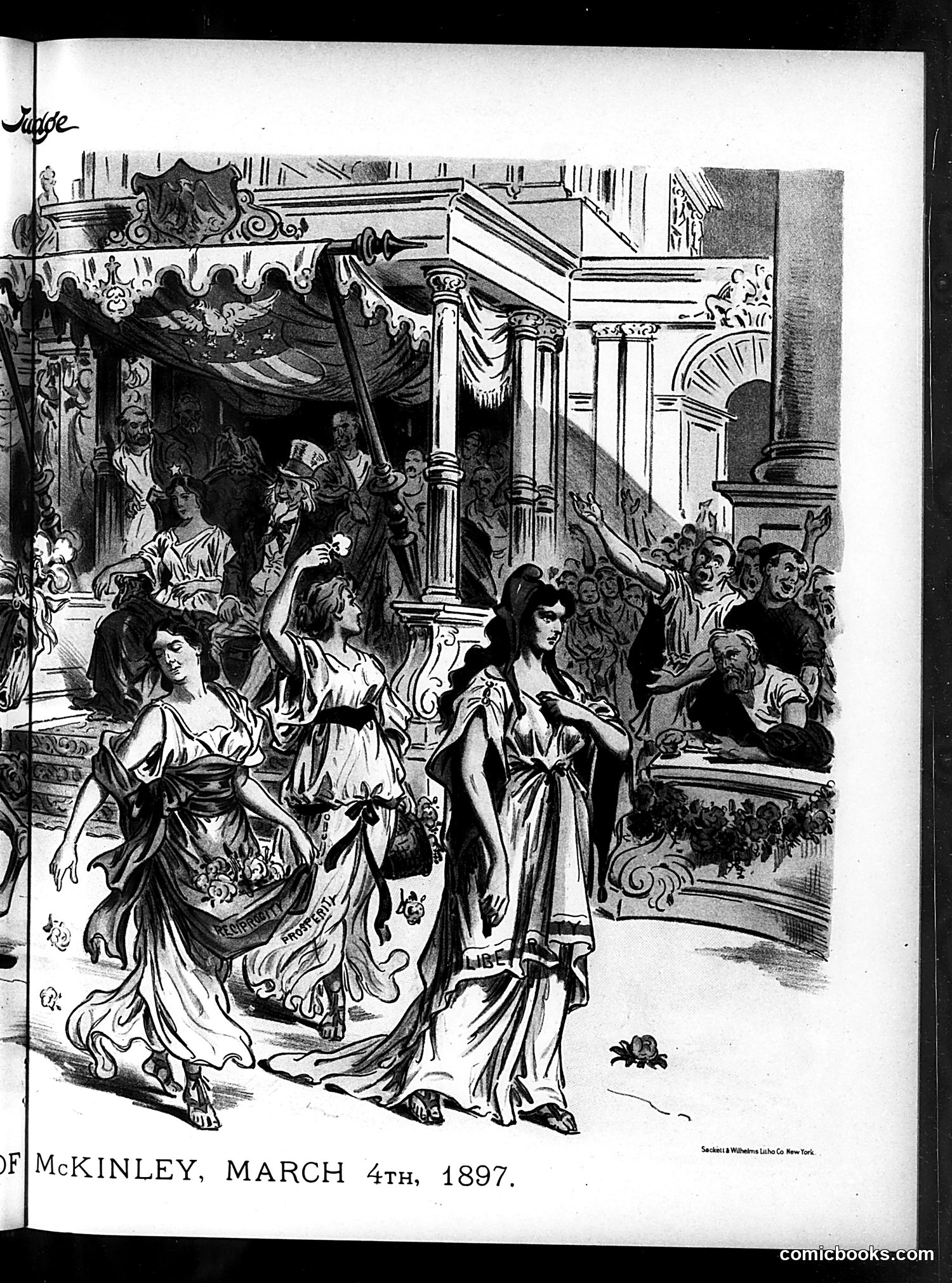
This satirical illustration depicts William McKinley's inauguration as the 25th U.S. President. The classical architectural setting and allegorical female figures (representing concepts like Liberty and Prosperity) celebrate the occasion with ceremonial grandeur. The cartoon's satire likely critiques the pageantry surrounding McKinley's presidency or comments on political expectations versus reality. The crowded scene and prominent positioning of female allegorical figures suggest Judge magazine was either celebrating or ironically mocking the ceremonial spectacle of American political transition. The date marks McKinley's actual inauguration, making this contemporary political commentary on a significant moment in American history, particularly relevant given McKinley's later role in the Spanish-American War (1898).
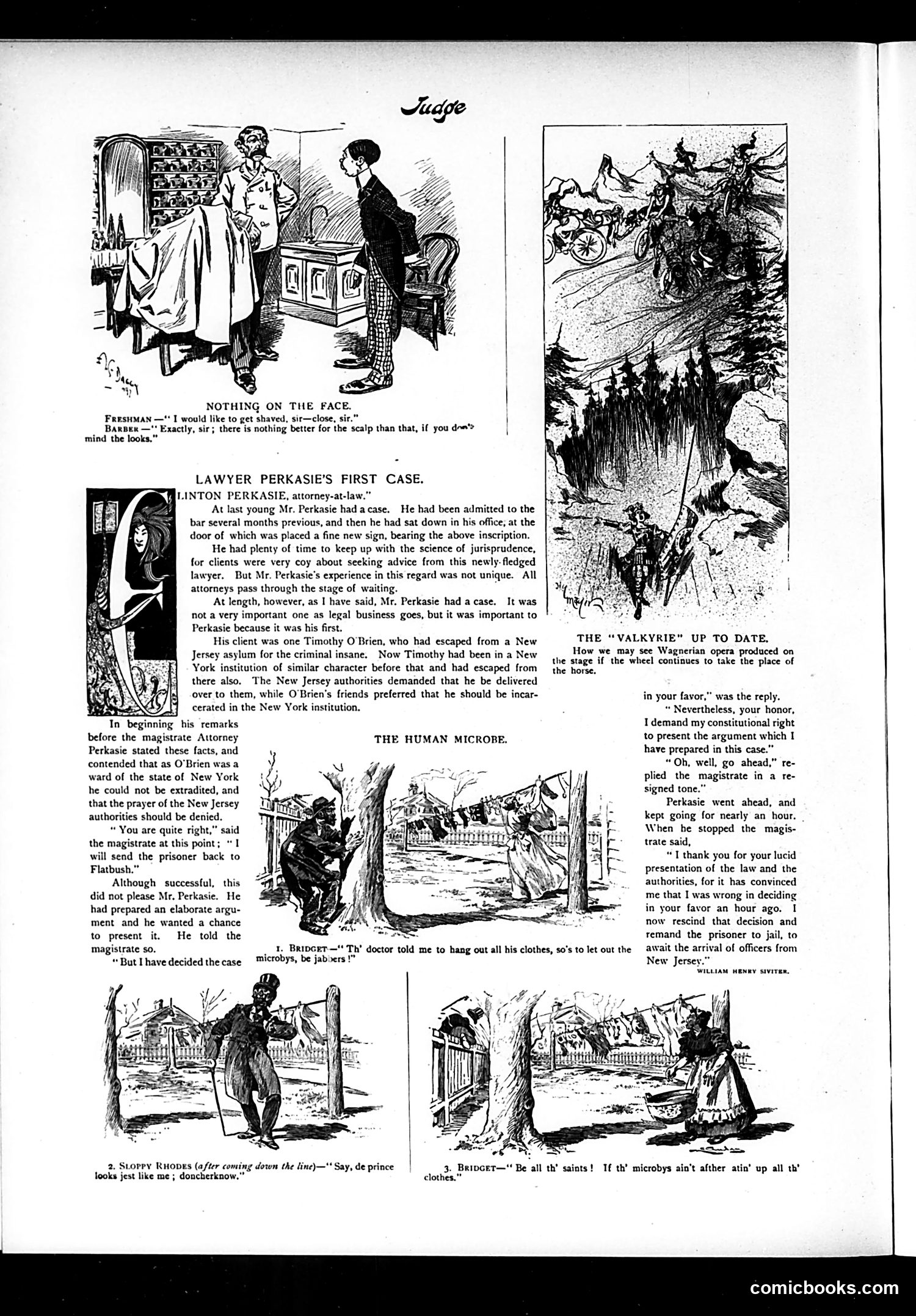
This page satirizes several topics: **"Lawyer Perkasie's First Case"** mocks inexperienced lawyers. Young attorney Perkasie finally gets a client—Timothy O'Brien, an escaped asylum patient—but the magistrate dismisses the case instantly. When Perkasie insists on delivering his prepared argument anyway, the magistrate listens politely, then reverses his decision, ruling against Perkasie. The joke: excessive legal argumentation can undermine a winning position through sheer verbosity. **"The Human Microbe"** depicts Irish immigrant characters (dialogue suggests working-class Irish accents) discussing germ theory. A doctor recommends airing out clothes to eliminate microbes; the humor derives from these characters' confused understanding of scientific concepts—treating microbes as visible entities requiring clotheslines. **"The Valkyrie Up to Date"** references Wagner's opera, suggesting that if bicycles replace horses, stage productions would absurdly feature cyclists instead of mounted heroes—mocking both the opera and the bicycle craze. All three are light satirical humor typical of Judge's turn-of-century style.
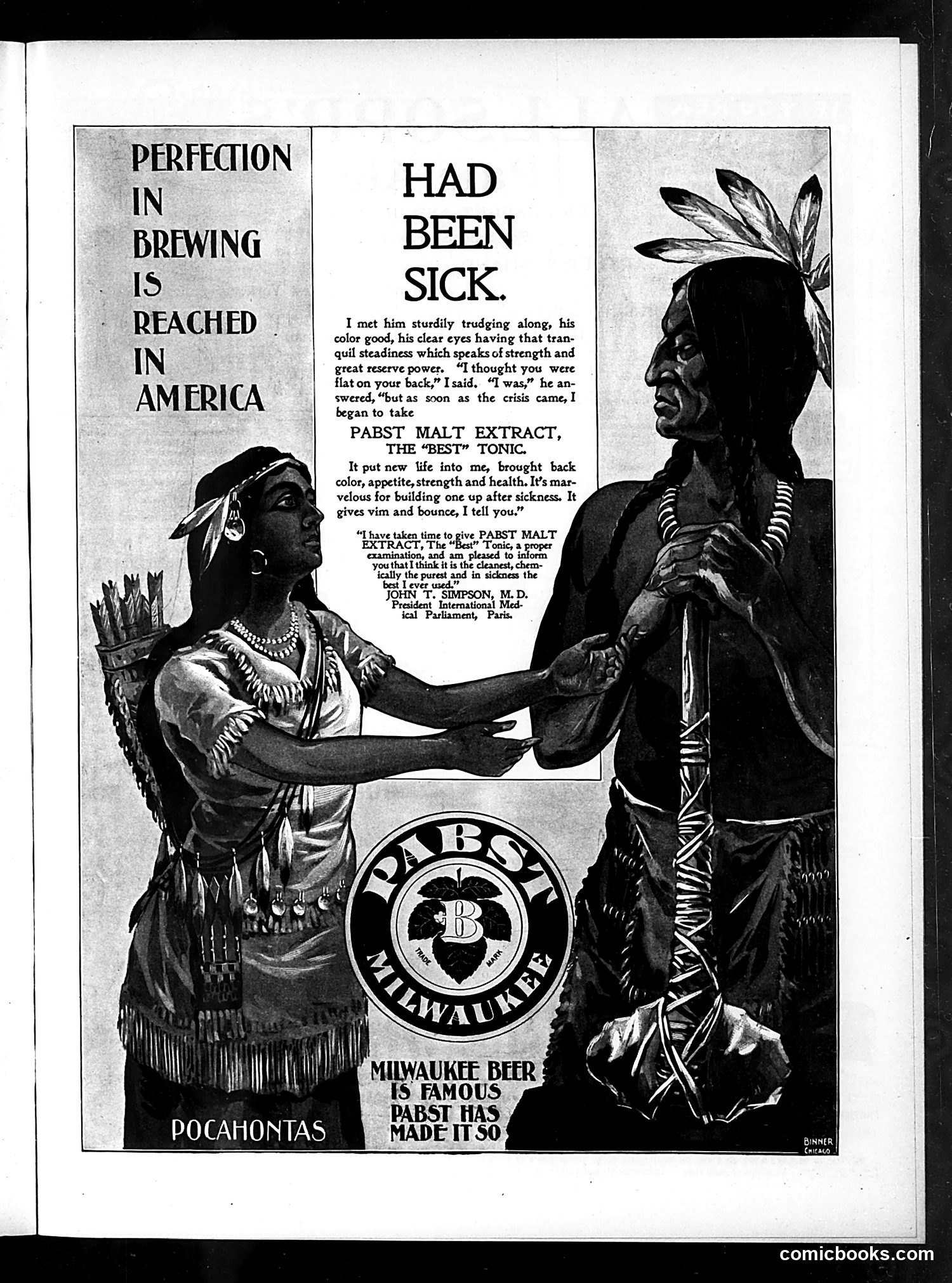
This is an advertisement for Pabst Malt Extract disguised as editorial content in Judge magazine. The page uses racist imagery and stereotypes common to early 20th-century advertising. Two Native American figures are depicted—labeled "Pocahontas" on the left—in a dialogue where one describes recovering from illness through Pabst Malt Extract. A fake testimonial from "John T. Simpson, M.D., President International Medical Parliament, Paris" claims the product is chemically pure and medically beneficial. The headline claims "Perfection in Brewing is Reached in America," positioning Pabst as an American achievement. This exploits Native American imagery to suggest the product's naturalness and authenticity, a common advertising tactic of the era. The entire premise—using Indigenous people to endorse a medicinal alcohol product—reflects both the racist conventions of period advertising and dubious health claims made before modern FDA regulations.
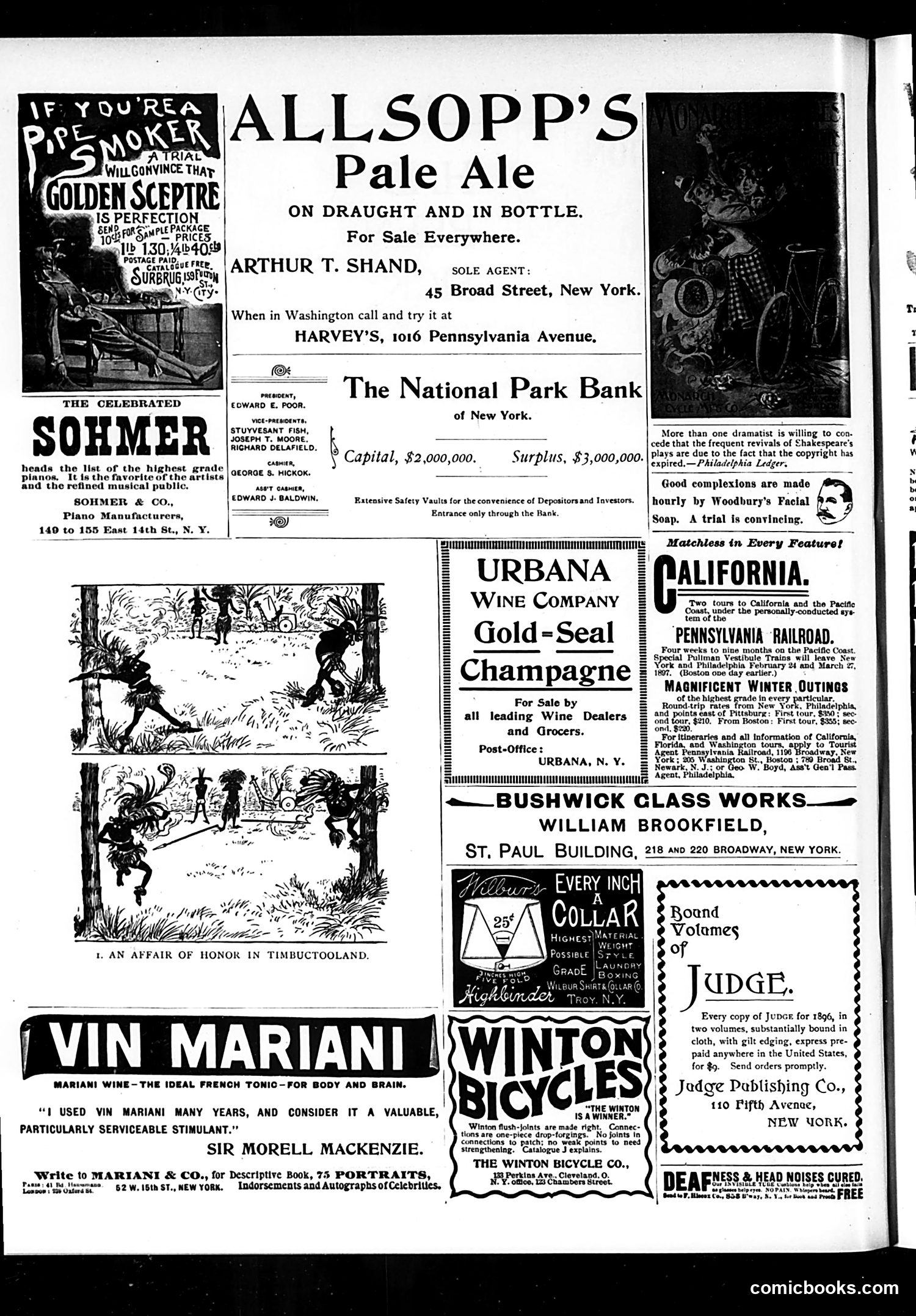
This is primarily an **advertising page** from Judge magazine, circa 1896-1897, with minimal satirical content. The page contains **commercial advertisements** for various products: Allsopp's Pale Ale, Sohmer pianos, The National Park Bank, Woodbury's Facial Soap, Urbana Wine Company champagne, Pennsylvania Railroad California tours, Bushwick Glass Works, Winton bicycles, and other goods. The only **editorial content** is a brief satirical note claiming dramatists willingly revive Shakespeare plays because copyrights have expired—a joke about financial motivation rather than artistic merit. The two **cartoons** titled "An Affair of Honor in Timbuctooland" (showing figures in what appears to be colonial or exotic settings) lack context on this page, making their specific satirical target unclear. The page reflects the magazine's business model: combining humor with paid advertising to wealthy readers interested in luxury goods, travel, and consumer products.
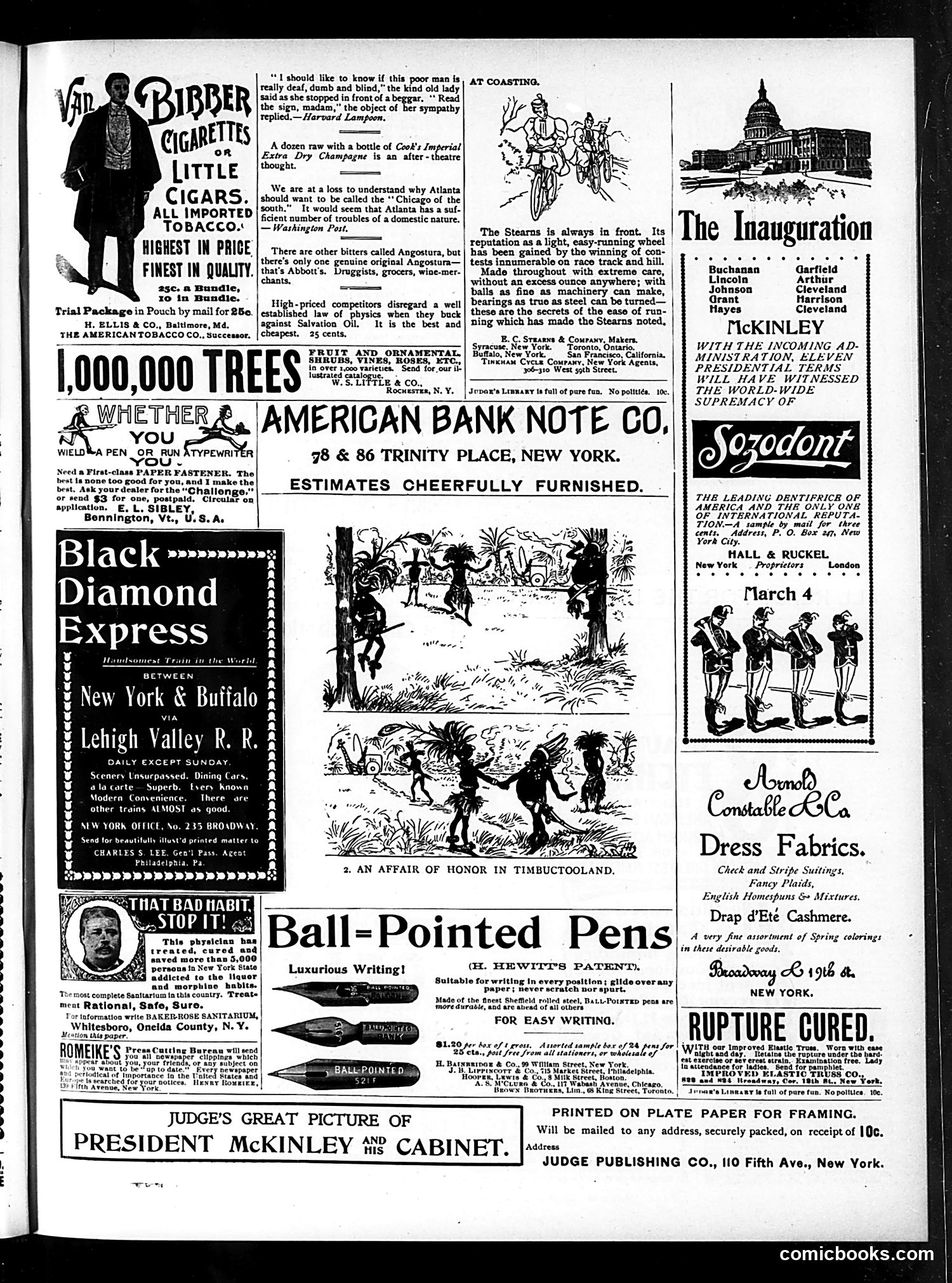
This page is primarily **advertisements**, not editorial content. The one cartoon present is titled "An Affair of Honor in Timbuctooland," showing two figures in what appears to be a duel or confrontation in an African setting. The humor likely plays on racial stereotypes common to 1890s publications, depicting African peoples in exaggerated or mocking scenarios. The remainder consists of period commercial ads: Van Bibber cigars, a railroad (Black Diamond Express), pens, bicycles, dental products (Sozodont), and dress fabrics. A sidebar celebrates McKinley's inauguration as president, boasting that American products like Sozodont toothpaste have dominated "world-wide supremacy" during successive presidential administrations. The page reflects both commercial advertising and subtle nationalist pride typical of the era.
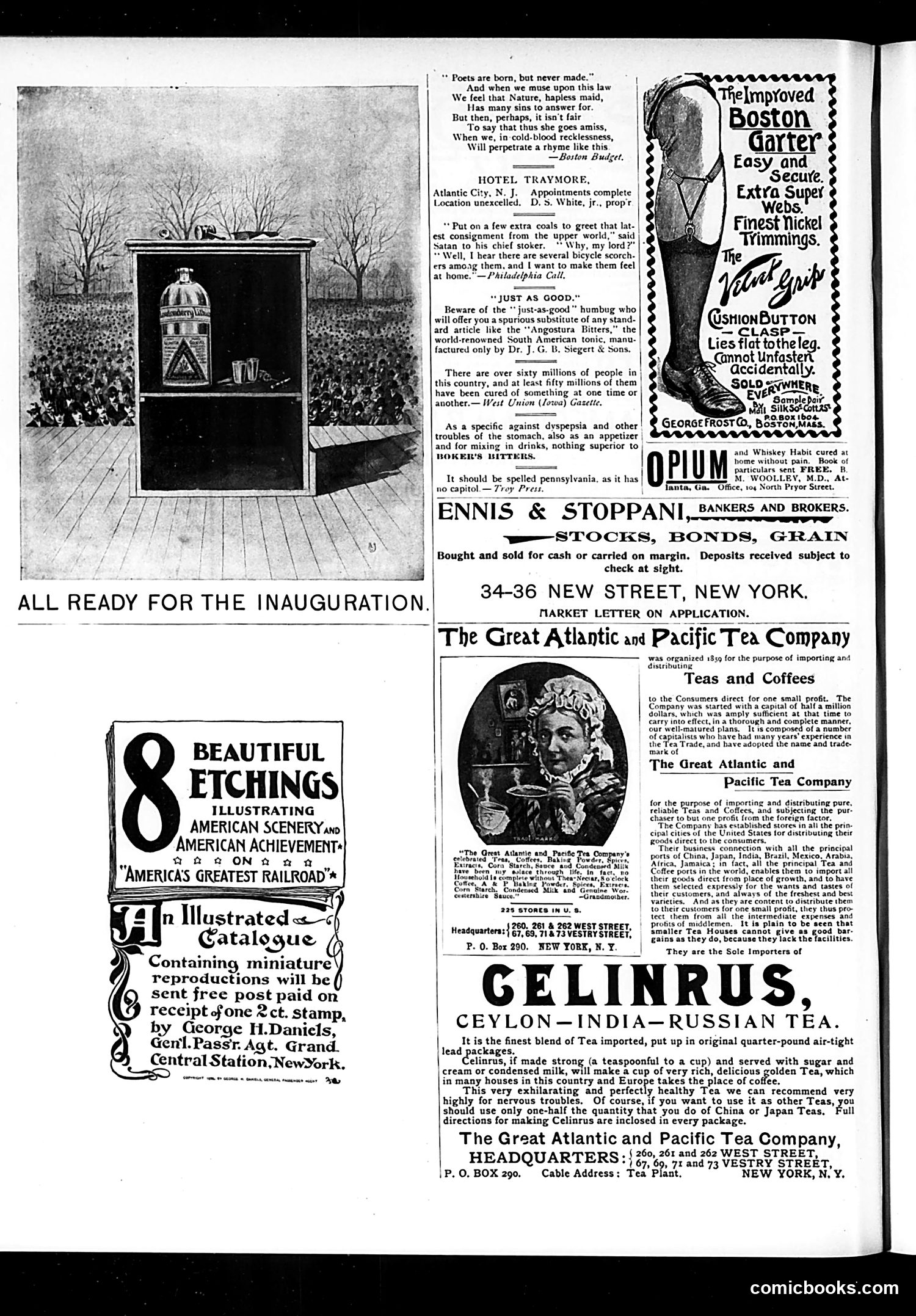
This page is primarily **advertising**, with one small cartoon at the top left. ## The Cartoon: "All Ready for the Inauguration" The image shows an elaborate display or structure being prepared, captioned "All Ready for the Inauguration." The accompanying text is a humorous poem from the *Boston Budget* mocking poets and bad verse-writing. The cartoon appears to be visual satire about preparing for a presidential inauguration—likely depicting either excessive or absurd preparations for the ceremony, though the specific inauguration referenced is unclear from the page alone. Below the cartoon is a joke about Satan preparing to receive "bicycle scorchers" (reckless cyclists) in Hell, suggesting contemporary anxiety about dangerous bicycling. ## Advertising Content The remainder is filled with period advertisements: a Boston garter advertisement, a railroad etchings offer, the Great Atlantic & Pacific Tea Company promotion, Gelinrus tea, and various banking/medical services—typical of late 19th-century magazine content.
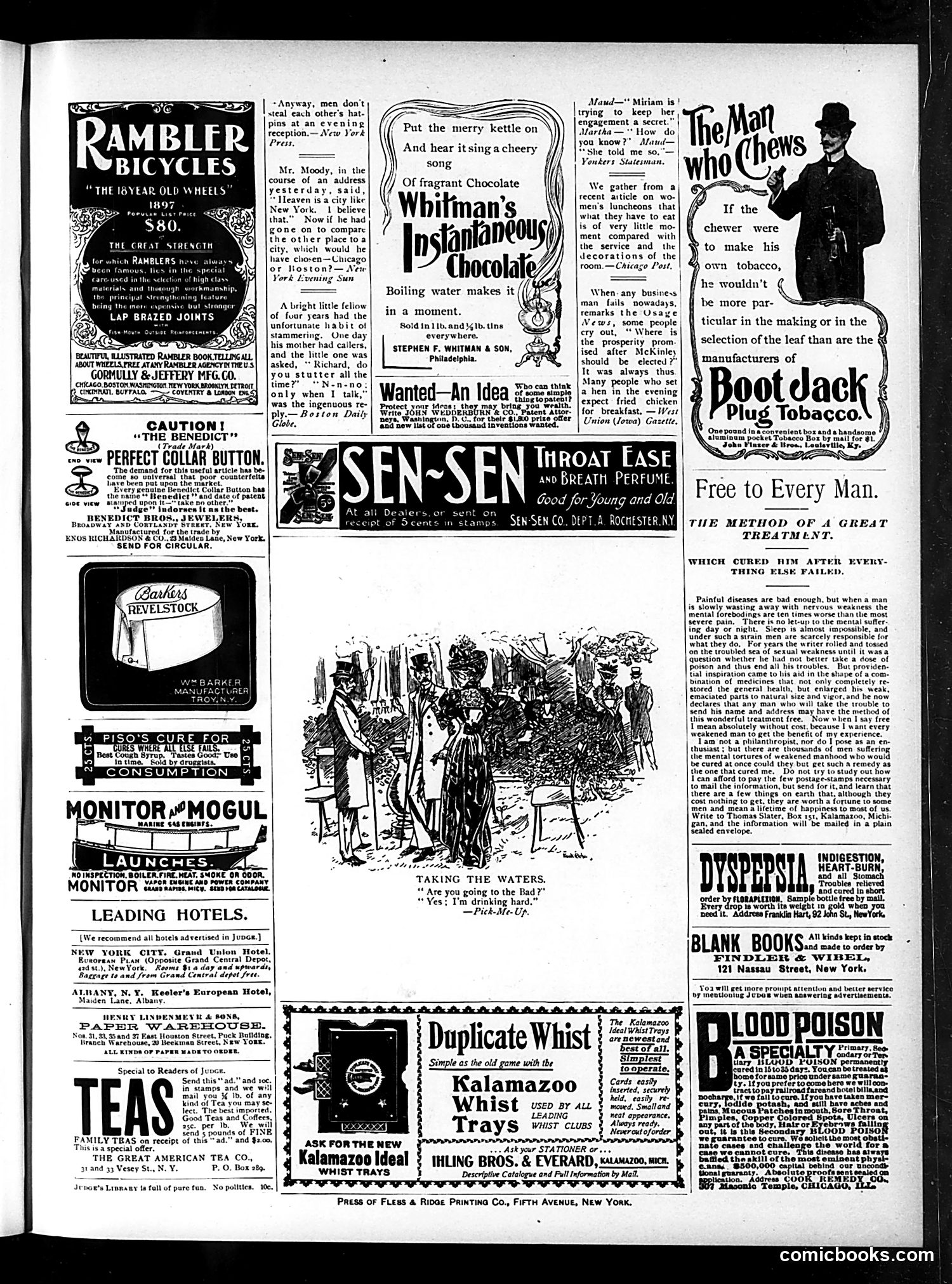
This page consists primarily of **advertisements and short humorous items** rather than political cartoons requiring historical context. The few jokes present are domestic/social humor typical of 1897: - A quip about men not stealing hat-pins at receptions - Wordplay about a four-year-old boy who stammers - A joke contrasting "Heaven is like New York" with comparisons to Chicago/Boston (mild urban rivalry satire) - A pun about expecting fried chicken after setting a hen in the evening The only illustration with narrative content shows "Taking the Waters"—a dialogue joke about someone going to "the Bad" (likely Baden-Baden, a spa town) and drinking hard instead of taking therapeutic waters. **The page is dominated by period product advertisements** (Rambler bicycles, Whitman's chocolate, Sen-Sen breath perfume, Fiso's Cough Cure) and hotel listings. It reflects 1890s consumer culture rather than political commentary. No specific political figures or events are referenced or caricatured.
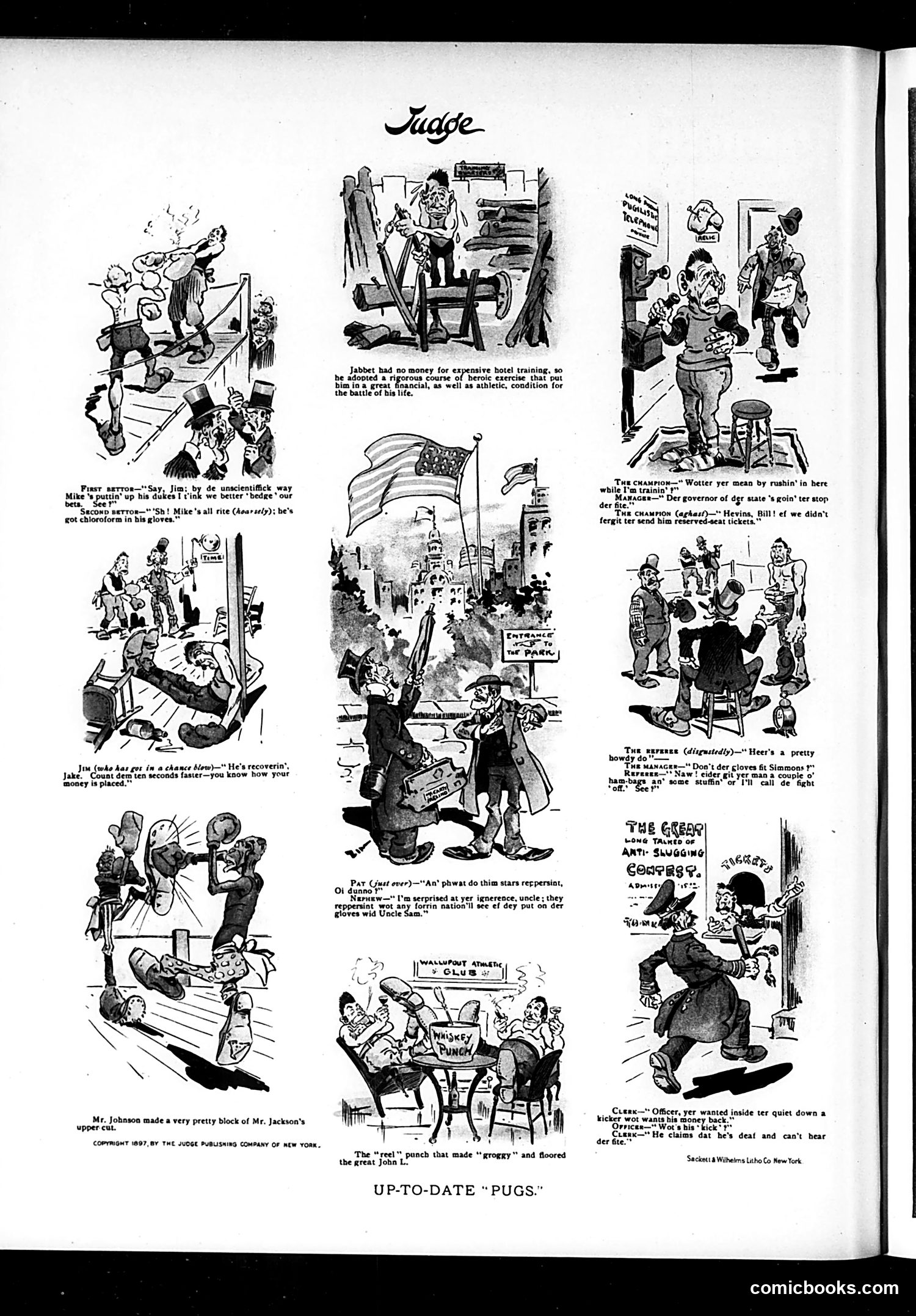
This page satirizes late-19th-century American boxing through anthropomorphized characters (likely prizefighters depicted as "pugs"—slang for boxers). The cartoons mock contemporary boxing culture and training methods. Key satirical elements: **The matches depicted** appear to reference real prizefights, with characters like "Jabbet" and references to competitors training and fighting. The humor targets corrupt practices: spectators discussing fixed bets, trainers allegedly using chloroform-laced gloves, and managers obsessed with profit over fair competition. **"Anti-slugging courtesy"** panel jokes about nationalism—Uncle Sam boxing opponents and stars representing foreign nations he'd "floor"—mixing sports satire with American exceptionalism humor. **Social critique** focuses on boxing's seediness: money-driven corruption, rigged matches, and the sport's association with lower-class gambling and vice. The overall message mocks how turn-of-the-century boxing combined athletic spectacle with obvious fraud and moral degradation.
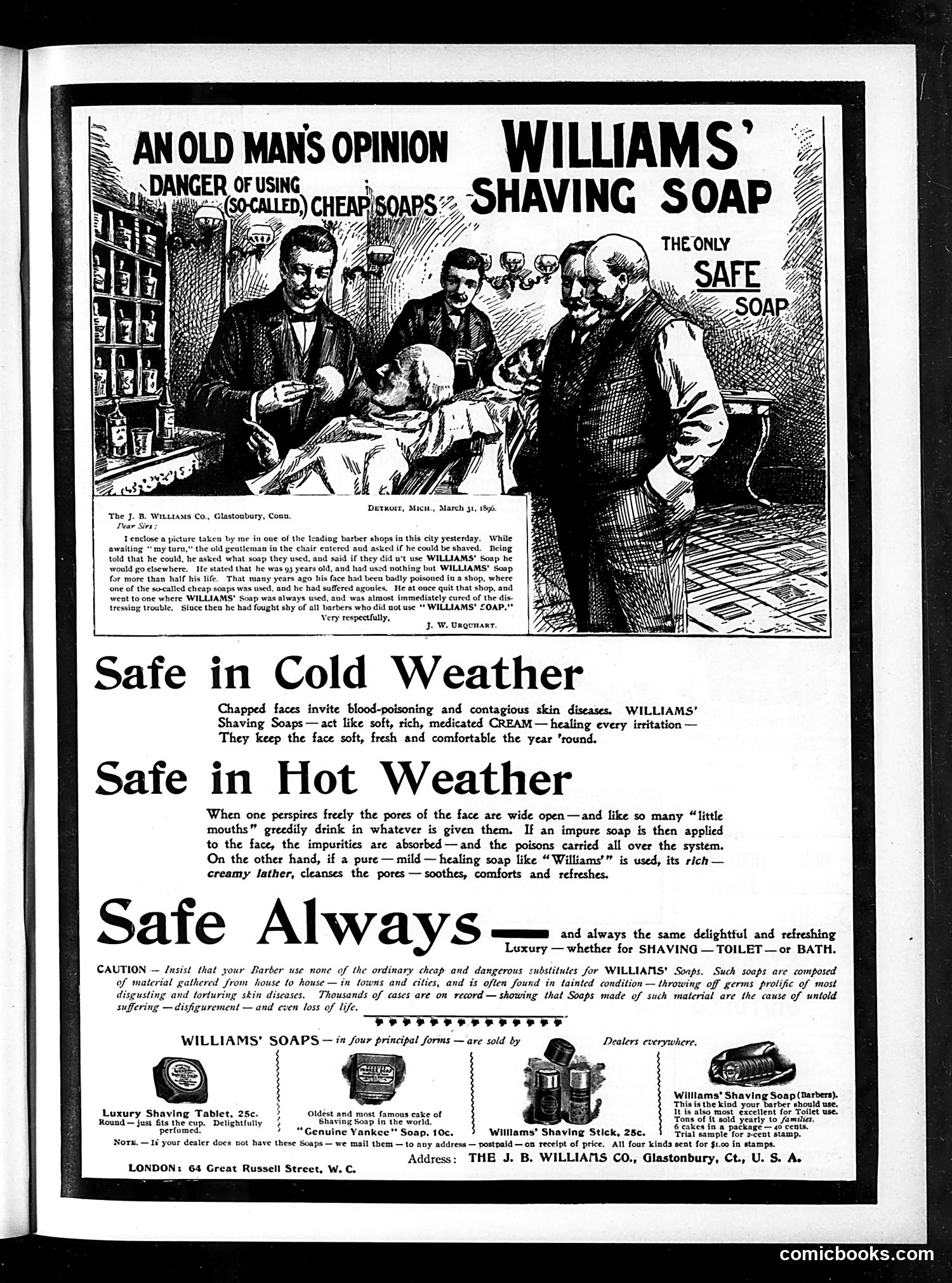
This is primarily a **product advertisement**, not political satire. The "cartoon" depicts a testimonial: an old man (allegedly 93 years old) in a Detroit barbershop insists on Williams' soap after suffering poisoning from cheap soaps decades earlier. The advertisement uses this anecdote to warn consumers about dangerous "cheap soaps" allegedly made from scrap materials collected door-to-door in cities. The copy claims such soaps cause skin diseases, blood poisoning, and disfigurement—assertions presented as medical fact. The marketing strategy exploits late-Victorian anxieties about industrial contamination and hygiene. The "caution" section essentially vilifies competitors' products as diseased refuse, while positioning Williams' as the safe, pure alternative suitable for all weather conditions. This reflects 1890s patent medicine and consumer product advertising tactics: fear-based marketing with dramatic health claims and testimonial "proof."
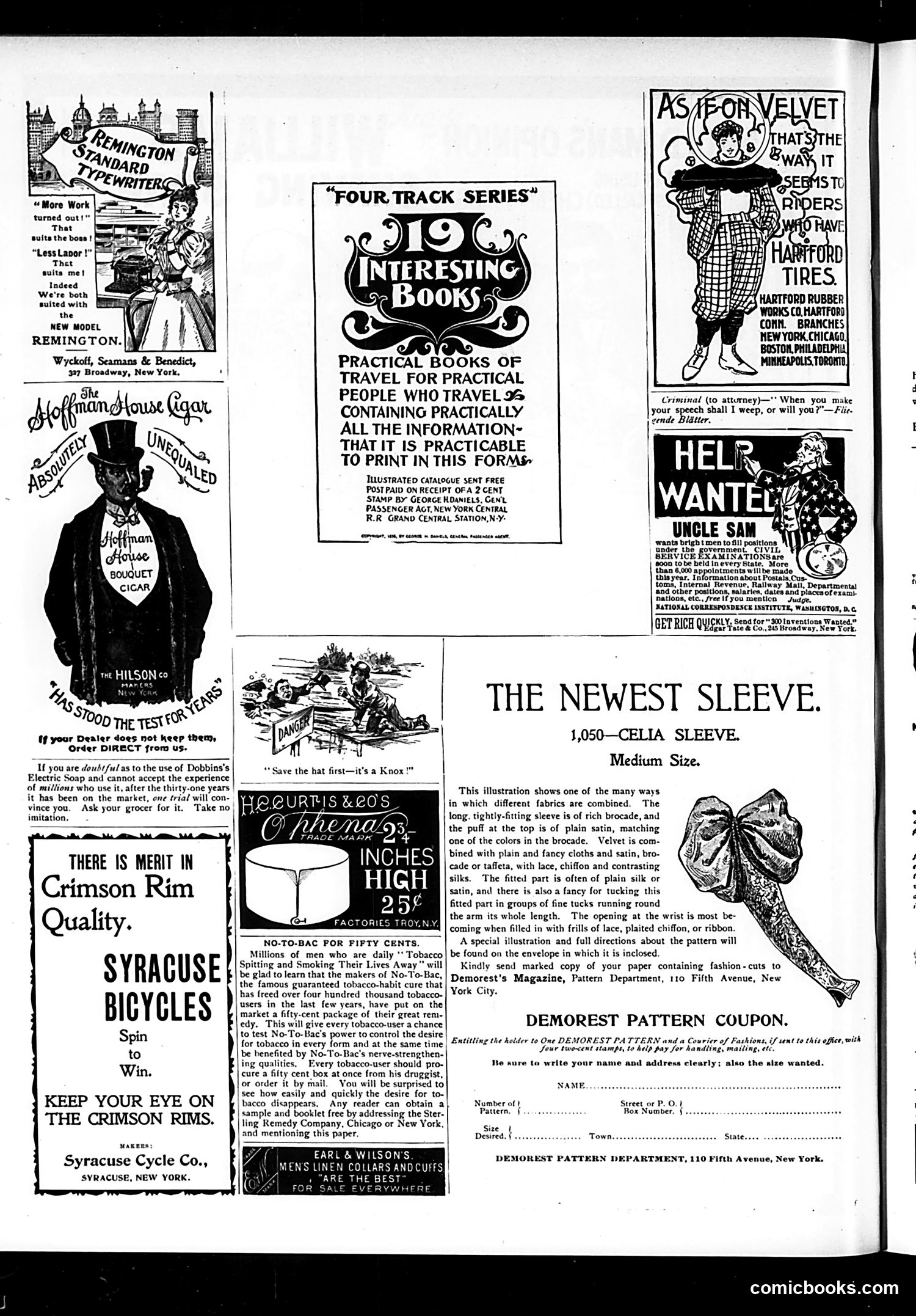
This page is primarily **advertising and fashion content**, not political satire. It features: **Main Content:** - A fashion illustration titled "The Newest Sleeve" showing a detailed women's dress sleeve design from Demorest's Magazine, with a pattern coupon for readers to order - Multiple product advertisements (Remington typewriters, Syracuse bicycles, Dobbins soap, No-To-Bac tobacco-cessation remedy, Hoffmann House cigars) - A government job recruitment ad for Uncle Sam seeking civil service workers - Travel guide promotion for the New York Central Railroad **The One Cartoon:** A small joke at top-right shows a criminal asking his attorney whether he should weep during the trial speech or if the attorney will do it—a light gag about courtroom melodrama. This appears to be a typical early 1900s Judge magazine page mixing light humor with commercial advertising. The fashion sleeve pattern and product ads dominate; there is no substantive political or social satire visible.
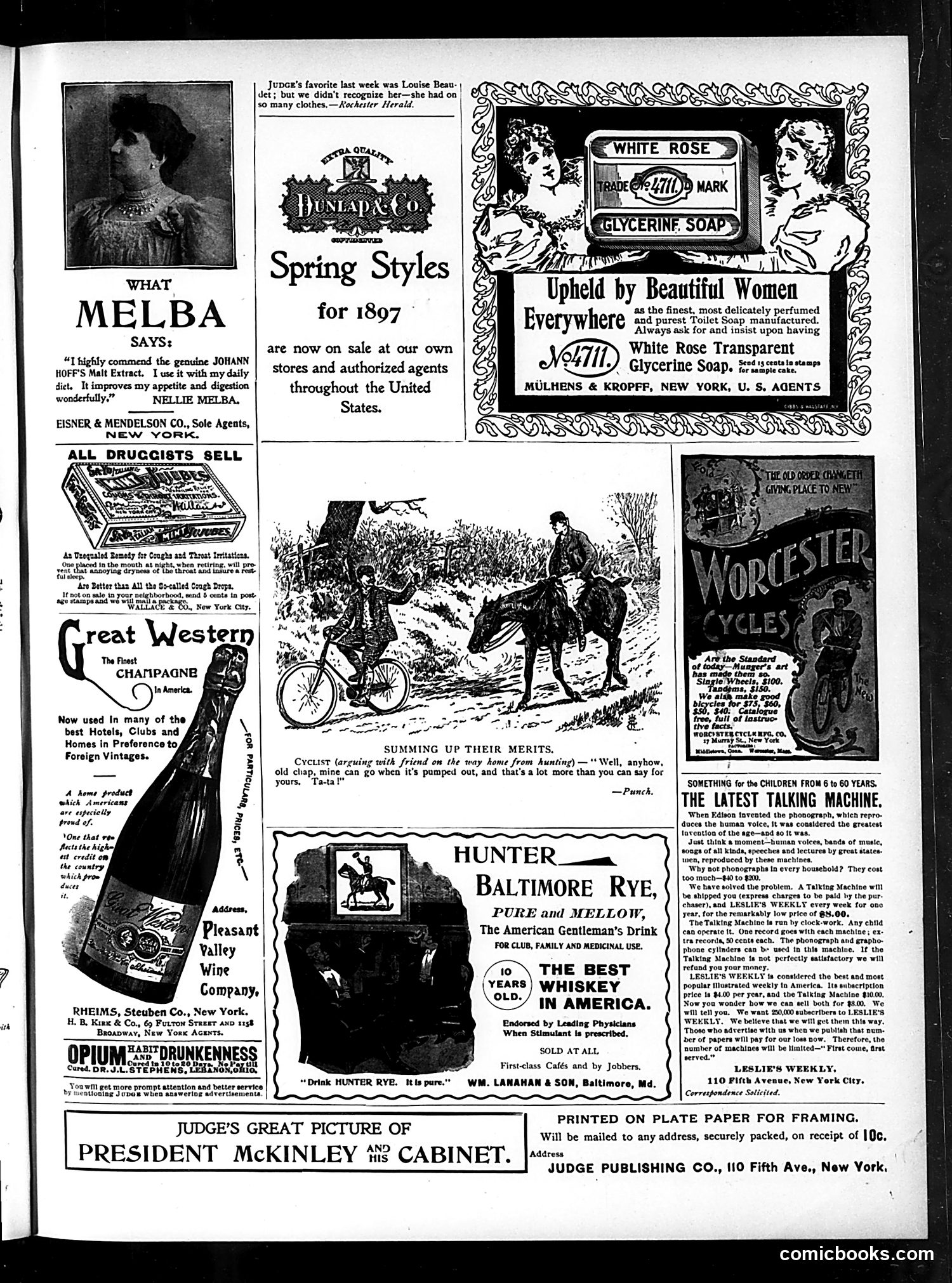
This page is primarily **advertising**, not political satire or cartoons in the traditional sense. The only cartoon present is a small, untitled illustration captioned "SUMMING UP THEIR MERITS"—a Punch reproduction showing two cyclists comparing their bikes after a hunting trip. It's a light humor piece about bicycle reliability, unrelated to politics. The page features product advertisements typical of 1897: malt extract, soap, champagne, bicycles, whiskey, a phonograph/talking machine, and medicine. One small editorial joke at top mocks actress Louise Beaudet for wearing excessive clothing. At bottom, there's an advertisement for a Judge-published portrait of President McKinley and his Cabinet, suggesting McKinley was president at the time of this publication (1897). Otherwise, there's minimal political content—this appears to be a revenue-generating advertising page rather than the satirical editorial content Judge was known for.
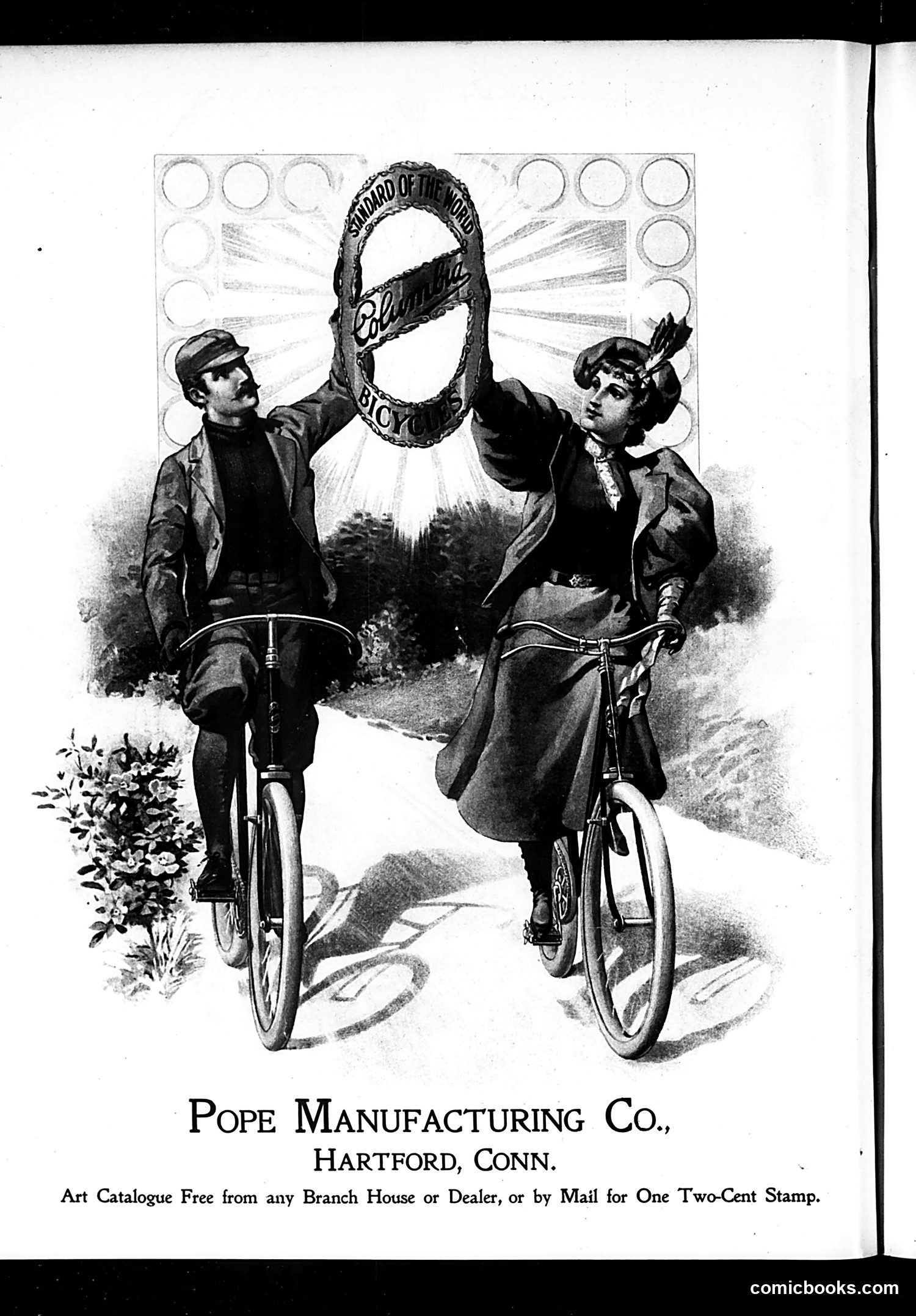
This is an advertisement for Pope Manufacturing Company of Hartford, Connecticut, a bicycle manufacturer. The image shows two men riding bicycles, gazing upward at a large bicycle wheel with "Pope" branding and radiating light rays—a visual metaphor suggesting the bicycle as an aspirational, almost spiritual product. The ad employs common late-19th-century advertising rhetoric that positioned bicycles as modern marvels. The cataloguing of circular elements (likely representing catalog pages) framing the scene reinforces this is promotional material. The offer of a free art catalogue for a two-cent stamp was typical period marketing. Pope Manufacturing was a major American bicycle maker during the 1880s-1890s cycling boom, so this advertisement targets that enthusiastic market.