
A complete issue · 16 pages · 1897
Judge — March 6, 1897
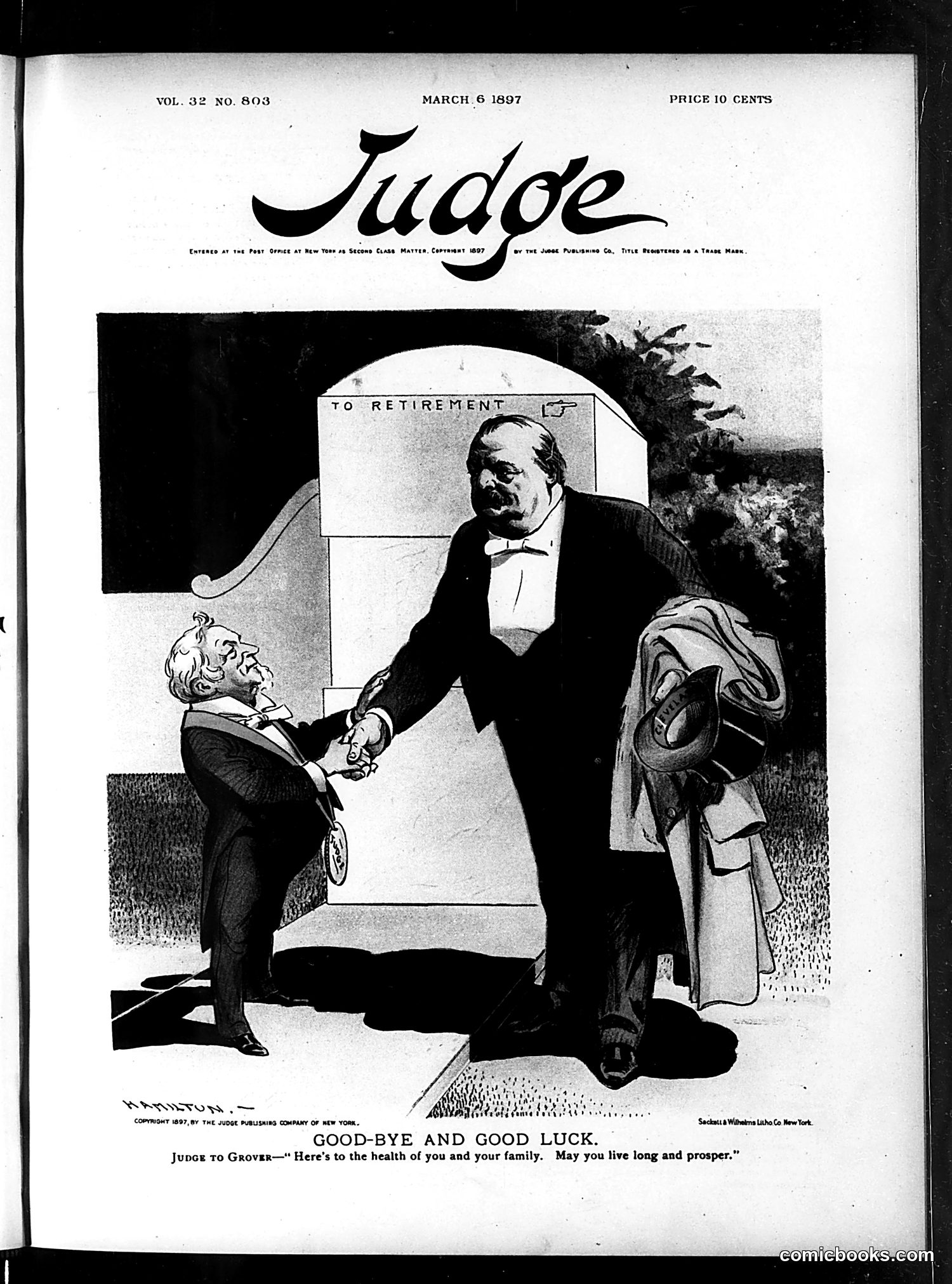
This political cartoon depicts a farewell scene titled "Good-Bye and Good Luck." A tall, dignified man in formal attire shakes hands with a small figure on the left while a woman in a coat stands on the right. The doorway behind them is labeled "TO RETIREMENT." The caption quotes the tall man (identified as "Judge to Grover"): "Here's to the health of you and your family. May you live long and prosper." This appears to reference **Grover Cleveland's retirement from the presidency**. Cleveland served two non-consecutive terms (1885-1889 and 1893-1897), with his second term ending in March 1897. The cartoon satirizes his departure from office, depicting the farewell with mock-ceremonial dignity while suggesting relief or irony about his exit from power.
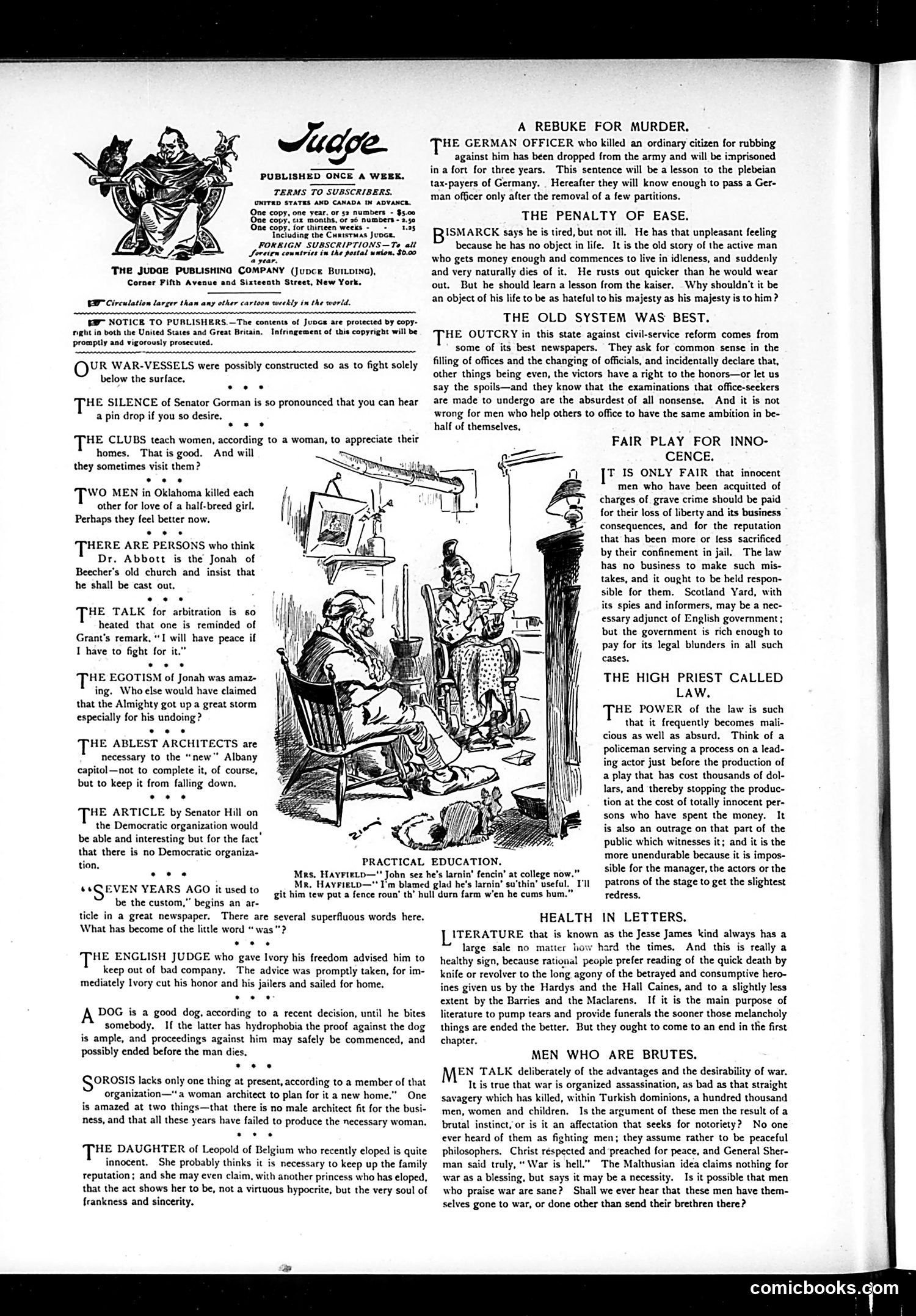
This page contains editorial commentary rather than traditional political cartoons. The "Practical Education" illustration depicts a domestic scene where a man teaches a child about farm life through hands-on experience. The text columns address various wartime and social issues: German military justice, Bismarck's indolence, proper examination of acquitted defendants, and law's power. There's also commentary on Jesse James literature and war's brutality. The overall tone is critical of institutional failures and societal problems. Without clear date markers visible, the references to "German officers," "Turkish dominions," and war casualties suggest this is WWI-era content. The page critiques both military conduct and sensationalist literature that glorifies violence, while advocating for practical education and fair legal treatment—typical progressive-era Judge magazine themes.
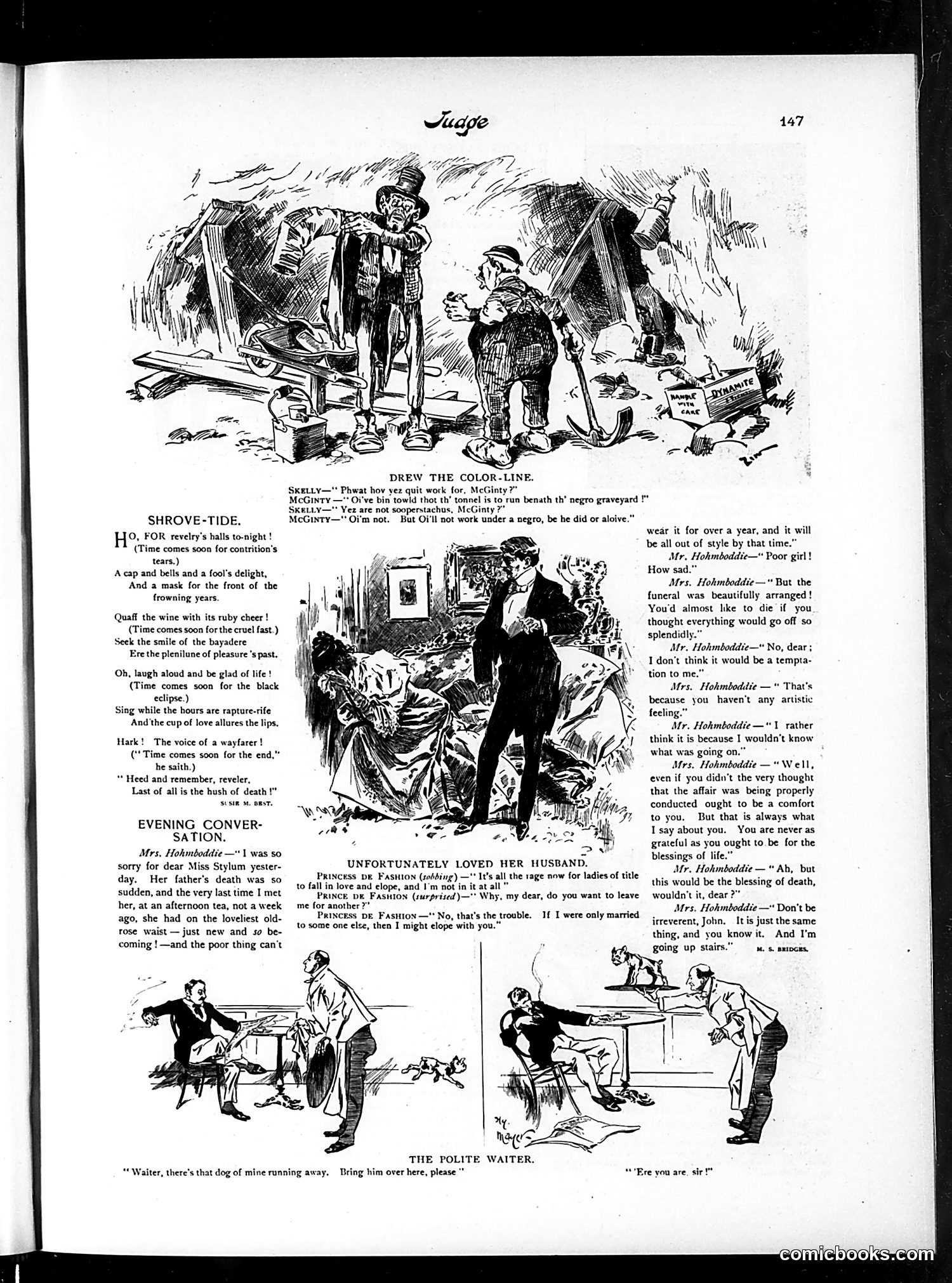
This page contains several unrelated satirical pieces typical of Judge magazine's format: **"Drew the Color-Line"** (top): A cartoon mocking labor disputes, showing workers named Skelly and McGinty debating whether Black workers should be hired. The satire targets racial prejudice within the labor movement itself. **"Shrove-Tide"** (left): A poem about carnival excess and revelry. **"Evening Conversation"** (center): A dialogue between Mrs. Holmbsadde and her husband about a funeral she attended, satirizing shallow social pretense and her lack of genuine emotional response to death. **"The Polite Waiter"** (bottom): A brief comic about a waiter retrieving a runaway dog. **"Unfortunately Loved Her Husband"** (right): A dialogue between a Princess and fashionable woman, mocking aristocratic attitudes toward marriage and social status. The page represents typical Judge content: multiple short satirical pieces targeting various social hypocrisies.
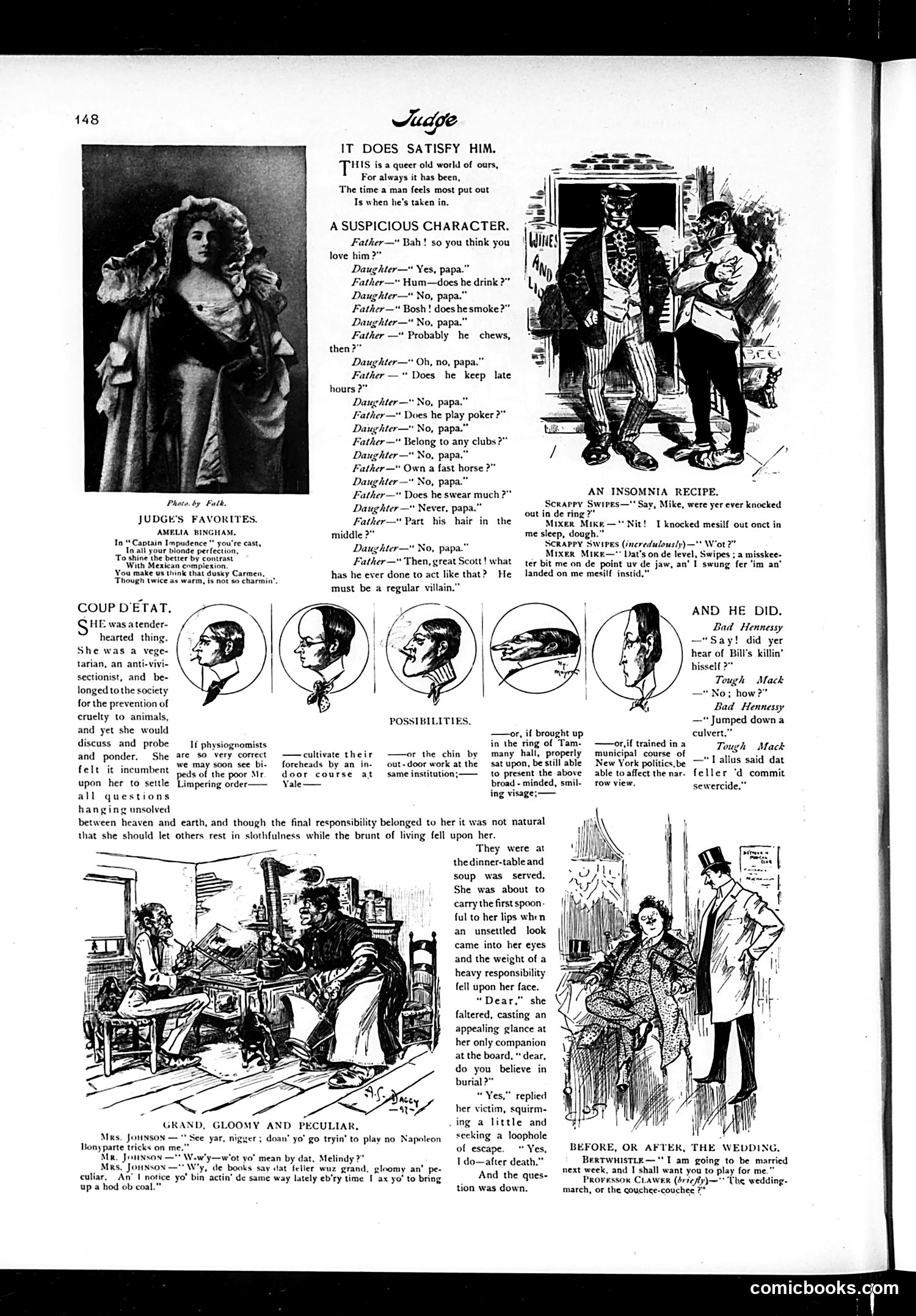
This page contains several unrelated satirical pieces typical of early 1900s Judge magazine: **"Judge's Favorites"** celebrates actress Amelia Bingham, contrasting her "blonde perfection" favorably against "Mexican complexion"—reflecting period racial hierarchies. **"Coup d'Etat"** mocks an overly conscientious vegetarian woman who lectures others on morality while feeling obligated to solve all world problems herself—satire of self-righteous activism. **"Grand, Gloomy and Peculiar"** uses racist dialect humor about an African American woman accusing her husband of imitating Napoleon Bonaparte—appearing to reference some contemporary event (unclear which). **"A Suspicious Character"** humorously depicts a father interrogating his daughter's suitor, discovering the man has no vices whatsoever—the joke being that such virtue makes him suspiciously "regular villain" material. Remaining items are brief, crude jokes using period racial stereotypes and working-class dialect humor that was standard Judge fare. The page reflects the magazine's casual racism and class-based mockery typical of early American satire.
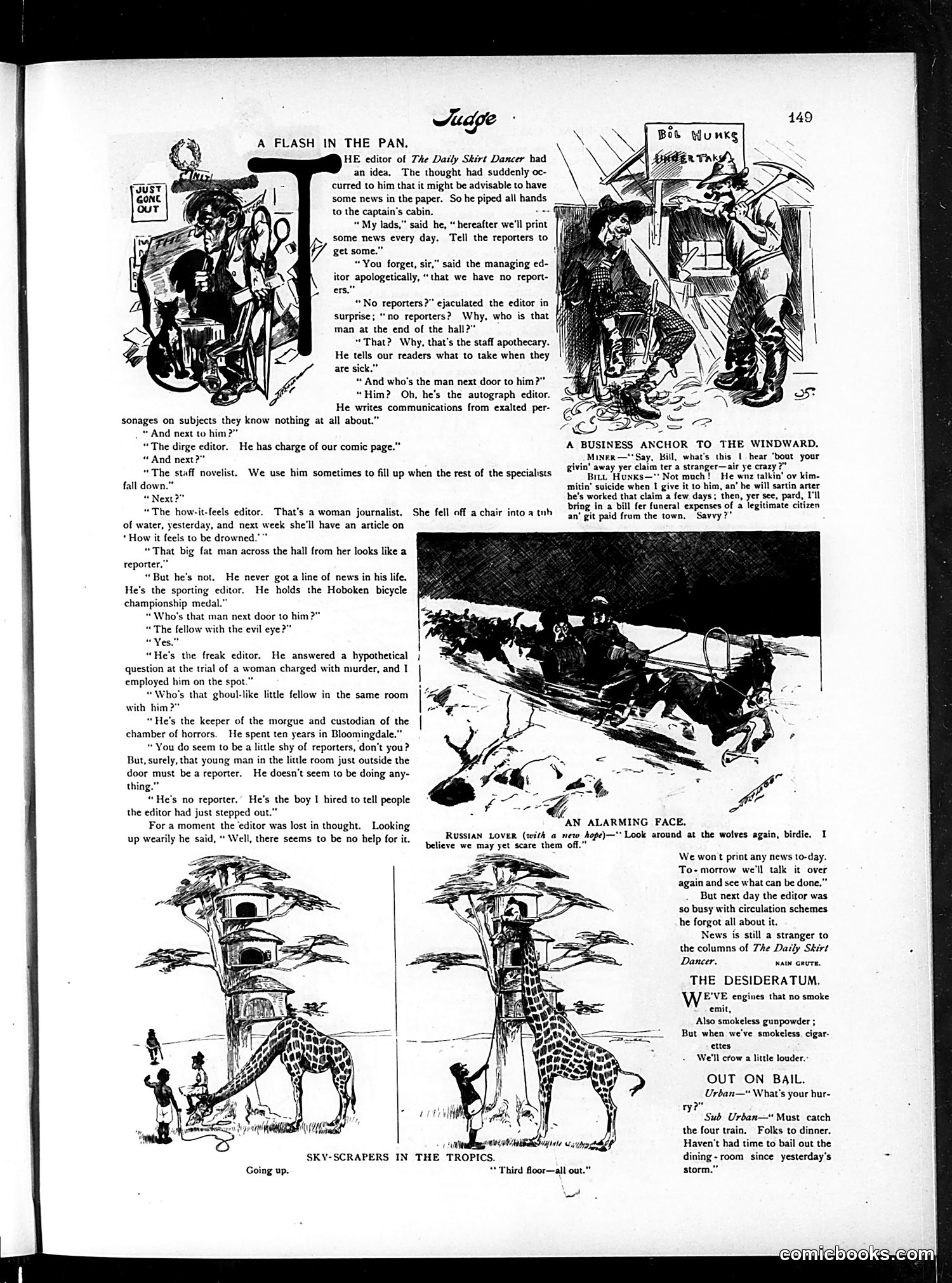
This page satirizes newspaper incompetence and editorial mediocrity through the main cartoon "A Flash in the Pan," which mocks *The Daily Skirt Dancer*—likely a sensationalist publication of the era. The editor discovers he has no actual reporters, only specialized staff members: an apothecary posing as a health columnist, an "autograph editor" fabricating celebrity quotes, a novelist filling space, a female journalist who writes personal essays from accidents, a sports editor known only for a bicycle medal, a "freak editor," a morgue keeper, and a boy hired to say "the editor stepped out." The satire targets yellow journalism's hollow pretense of newsworthiness—substituting genuine reporting with recycled content, fake celebrity endorsements, human-interest fluff, and sensationalism. The punchline (refusing to print news) exposes how such papers never intended serious journalism anyway. Other minor cartoons satirize mining fraud and modern inconveniences (smokeless technology, suburban storm damage).
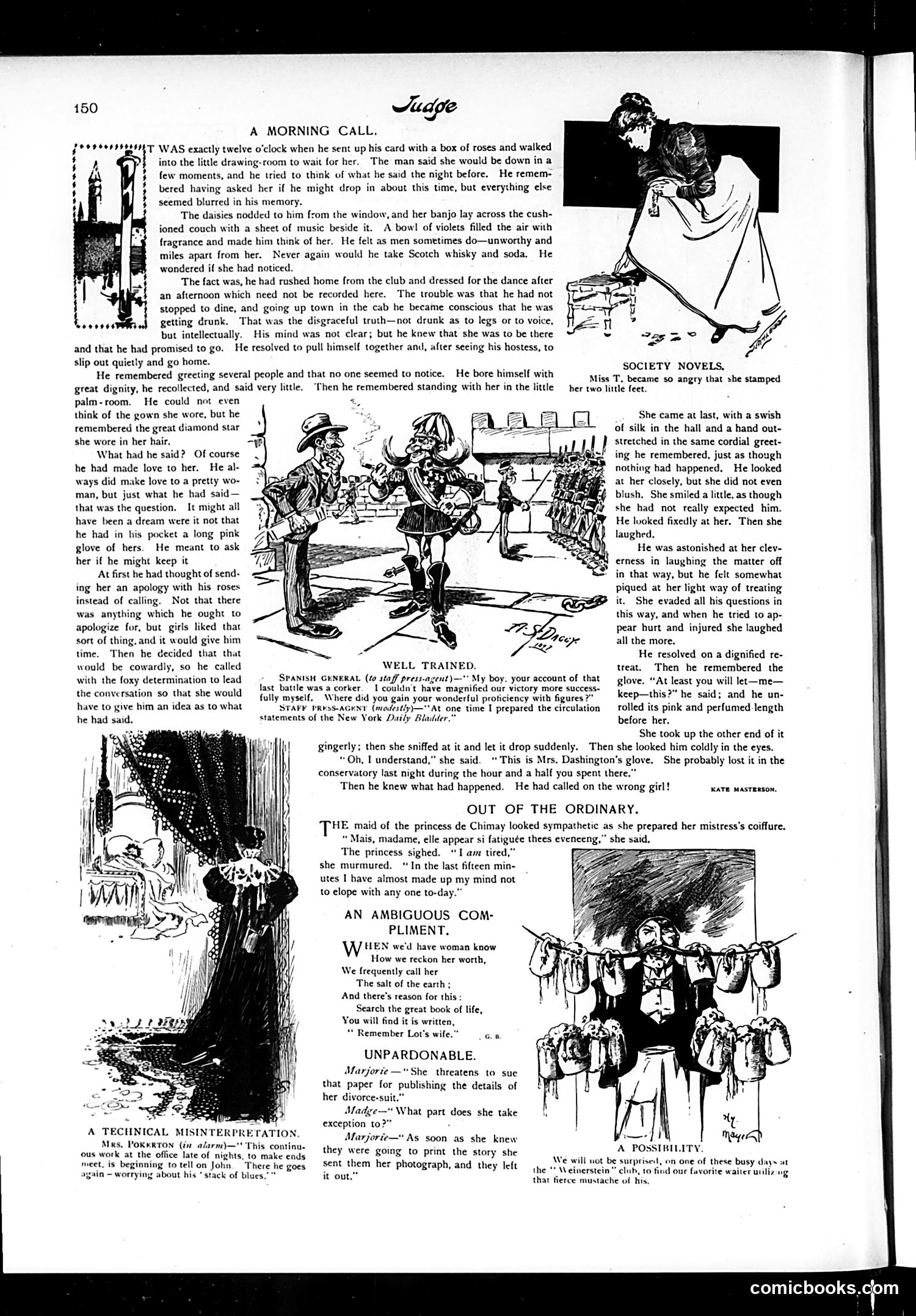
This page contains multiple satirical pieces typical of Judge's humor: **Main Story ("A Morning Call"):** A cautionary tale about a gentleman who got drunk at a party, made romantic advances to a woman, and can't remember what he said. He visits her the next morning anxious and awkward, carrying her pink glove as evidence. The humor lies in his embarrassment and her cool, unbothered response—she treats the incident as trivial, which both relieves and irritates him. It satirizes upper-class social etiquette and male anxiety about romantic indiscretions. **"Well Trained" cartoon:** A Spanish general credits his press agent for inflating victory reports. The agent boasts he once worked for the *New York Daily Bladder*, implying newspapers exaggerate circulation numbers—satire of journalistic dishonesty. **"Technical Misinterpretation":** A brief joke about a man's "stack of blues" (depression/debts) being mistaken for actual stacks of money, wordplay humor. The overall theme: social pretense, dishonesty in institutions (press/military), and romantic awkwardness among the leisure class.
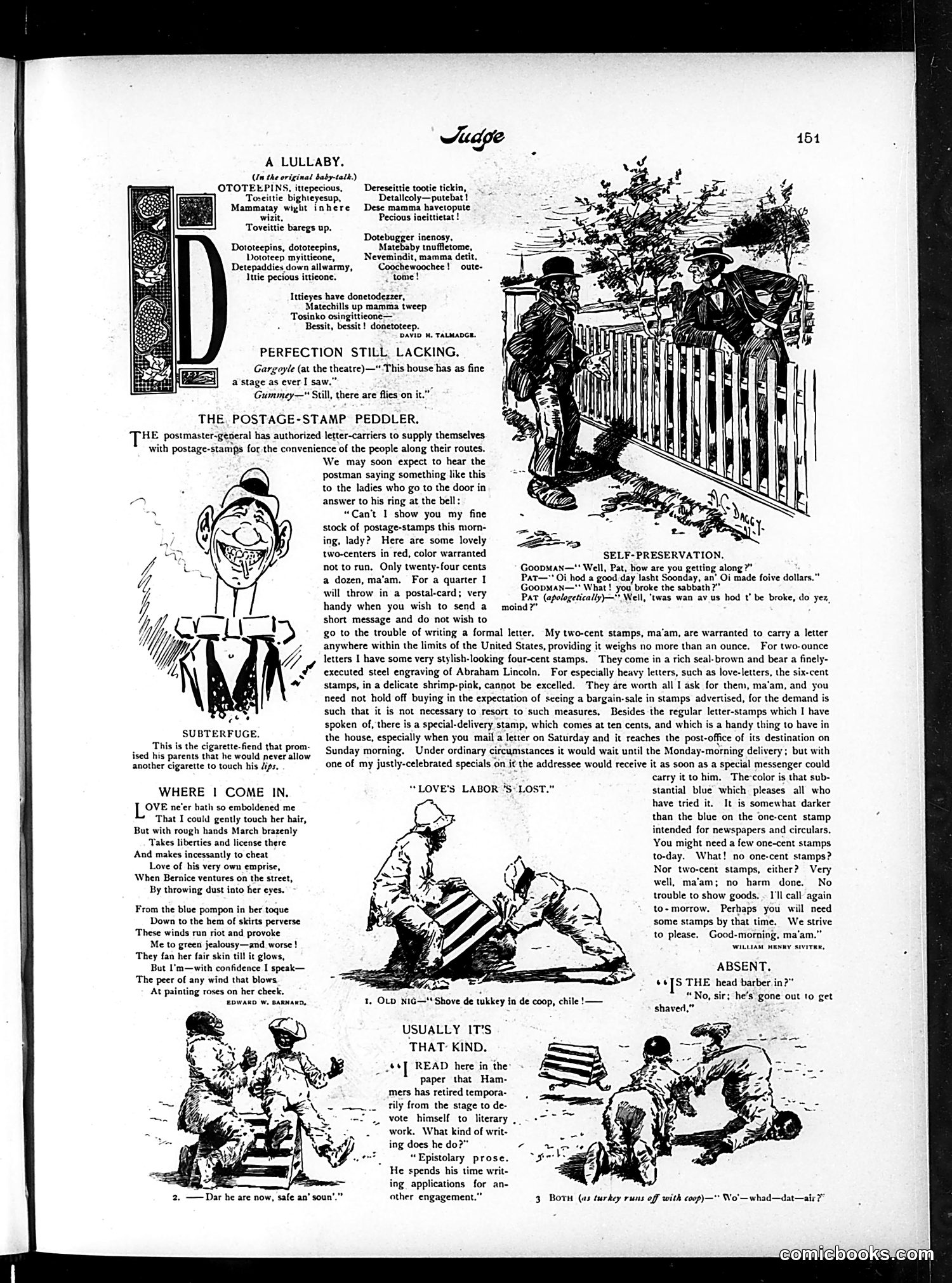
This page contains several satirical pieces typical of Judge's humor: **"A Lullaby"** presents mock baby-talk—exaggerated nonsense mimicking how adults speak to infants. It's gentle domestic humor rather than political satire. **"The Postage-Stamp Peddler"** is the main satirical content. It mocks a recent postal service decision allowing mail carriers to sell stamps directly to customers. The extended monologue parodies an overeager salesman, with absurd details (colored stamps "warranted not to run," special delivery stamps for Saturday mail reaching Monday destinations). The satire targets both the inefficient postal bureaucracy and aggressive commercial opportunism. **"Where I Come In"** is romantic verse about March winds interfering with courtship—lighthearted rather than political. The cartoons show various humorous scenarios, including what appears to be commentary on cigarette addiction ("cigarette-fiend") and domestic life. Overall, this page blends gentle domestic humor with workplace/institutional satire, typical of Judge's turn-of-century approach to American social criticism.
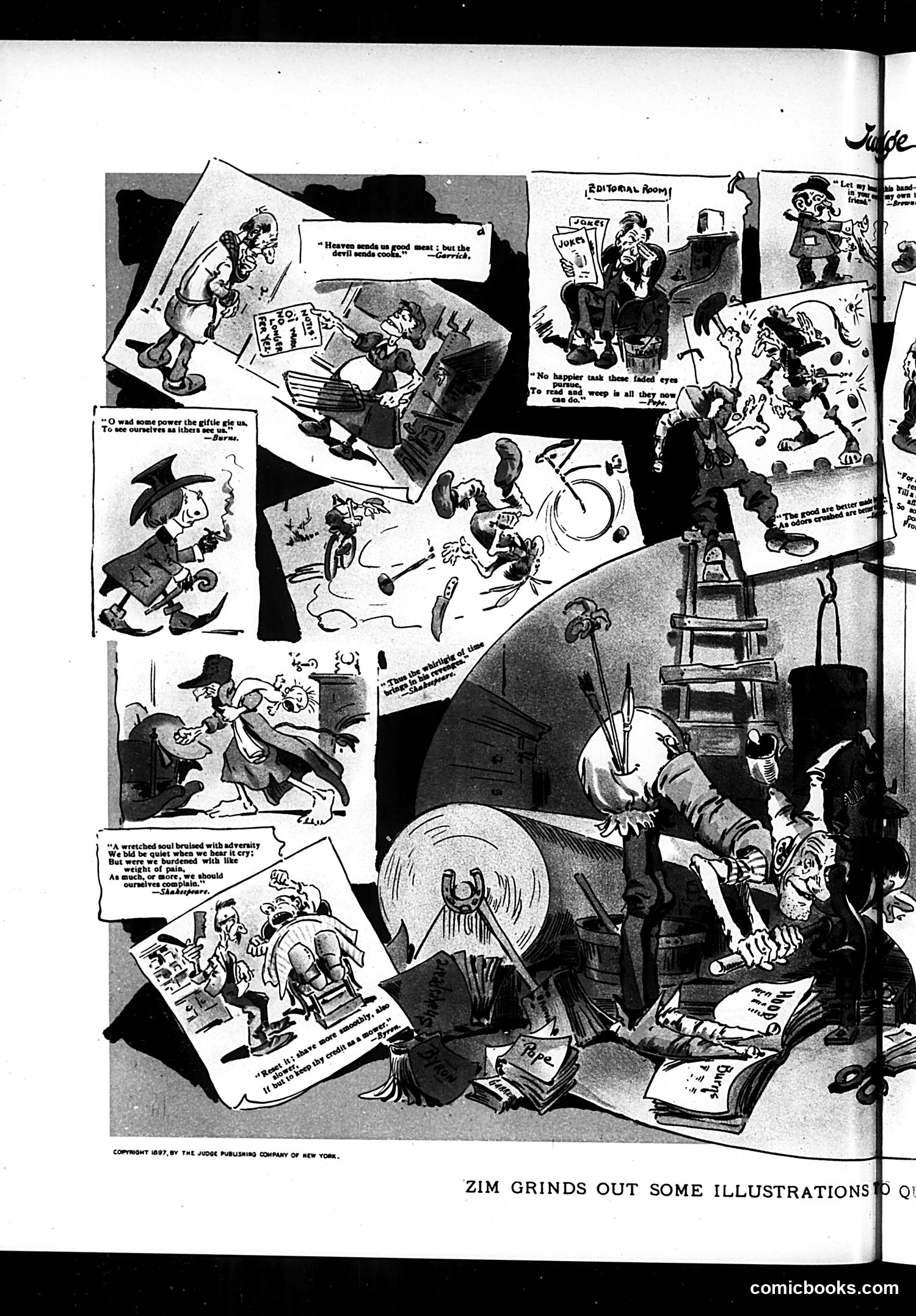
This page satirizes an illustrator named Zim (likely Eugene Zimmerman, a prolific Judge cartoonist) churning out commercial artwork. The central image shows Zim literally grinding illustrations through a mechanical device—a visual metaphor for mass-producing cartoons as factory work rather than fine art. The scattered comic panels around him represent his various output: political cartoons, humorous domestic scenes, and editorial illustrations. The Robert Burns quote ("O wad some power the giftie gie us, / To see ourselves as ithers see us") ironically suggests Zim should reflect on whether he's prostituting his talent for commercial gain. The satire critiques the industrialization of artistic work—how illustrators became assembly-line producers of content rather than serious artists. This reflects broader turn-of-century anxieties about commercialization of creative labor and the tension between artistic integrity and market demands.
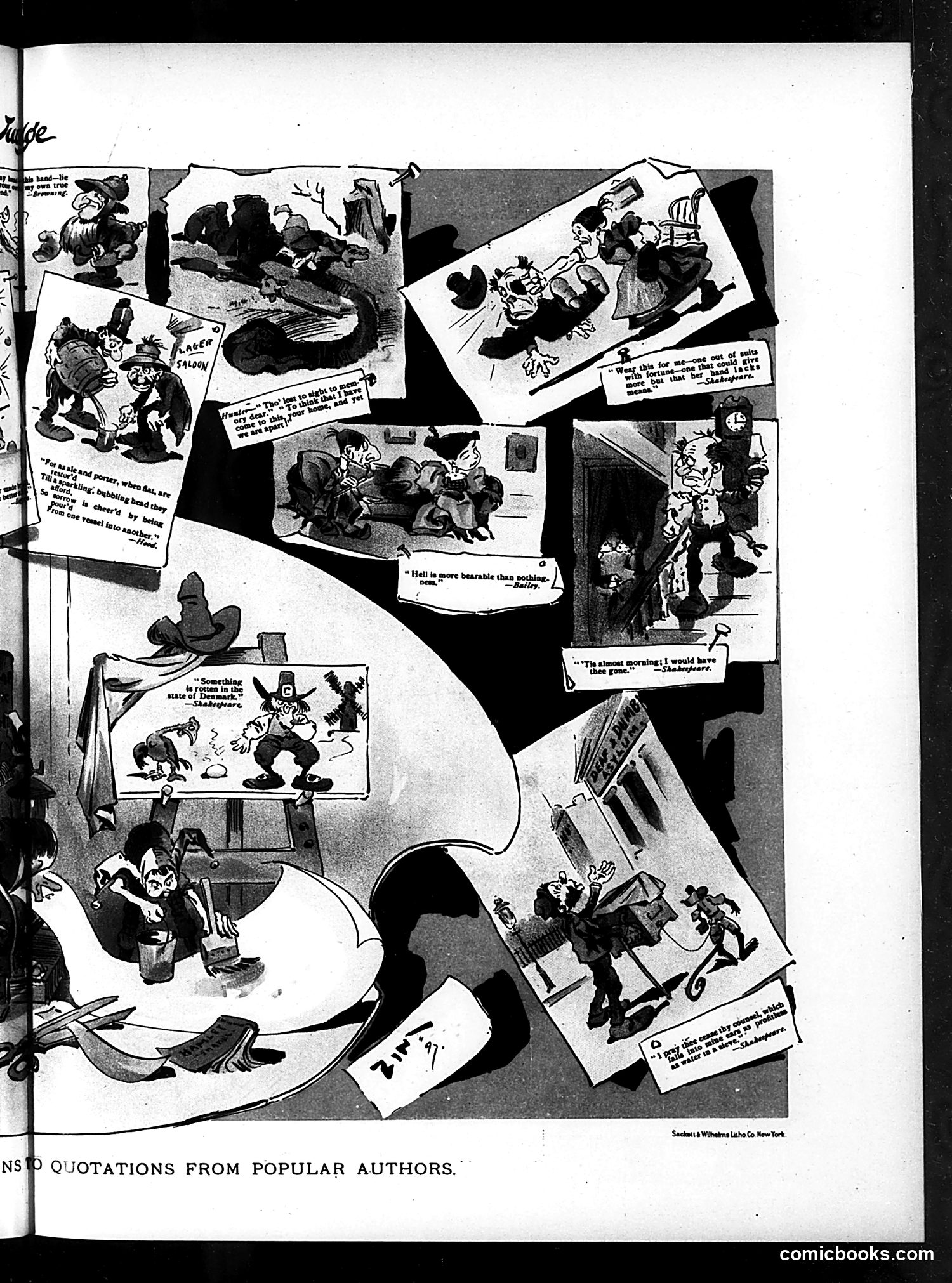
This page from *Judge* magazine presents a collage of cartoon vignettes illustrating "Quotations from Popular Authors." The cartoons appear to be satirical adaptations of literary quotations, rendered as humorous scenes with exaggerated characters and physical comedy typical of early 20th-century comic art. The individual panels show various dramatic or comedic situations—characters in distress, confrontation, or absurd predicaments—paired with dialogue balloons containing the quoted text. Without being able to clearly read all captions, the specific literary references remain unclear, though the style suggests well-known authors of the era being mocked through visual humor. The overall effect lampoons both the literary quotes and the pretension of citing "popular authors," treating serious literature as fodder for slapstick comedy.
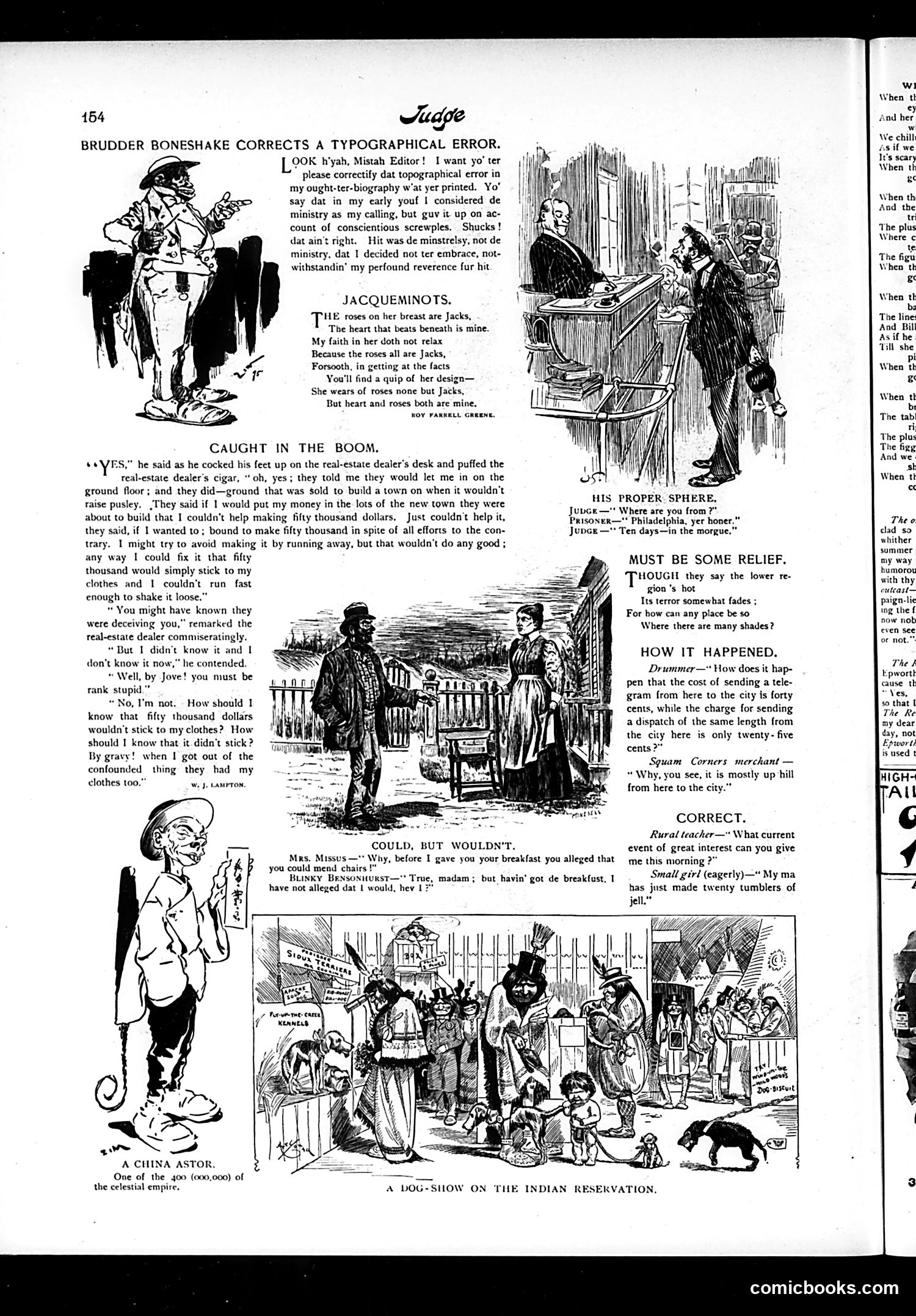
This page contains multiple brief satirical pieces typical of Judge magazine's format: **"Brudder Boneshake Corrects a Typographical Error"**: A dialect-heavy joke where a Black character claims the editor misprinted his biography—he pursued minstrelsy (performing in blackface shows), not ministry. The satire targets both the character's malapropisms and the editor's supposed carelessness. **"Caught in the Boom"**: Mocks real-estate speculation schemes. A man was promised fifty thousand dollars profit from investing in a new town development but lost everything instead. The joke hinges on his literal interpretation that money would "stick to his clothes." **"His Proper Sphere"**: A prisoner claims he told his landlady he could mend chairs before getting breakfast, implying he lied for food. **"A Dog-Show on the Indian Reservation"**: The caption (bottom) suggests a humorous contrast, likely mocking either Native Americans or dog shows as spectacles. The page also includes minor jokes about telegraphy rates, jello, and roses. The tone reflects period assumptions about race, class, and rural/urban divides without deeper political commentary.
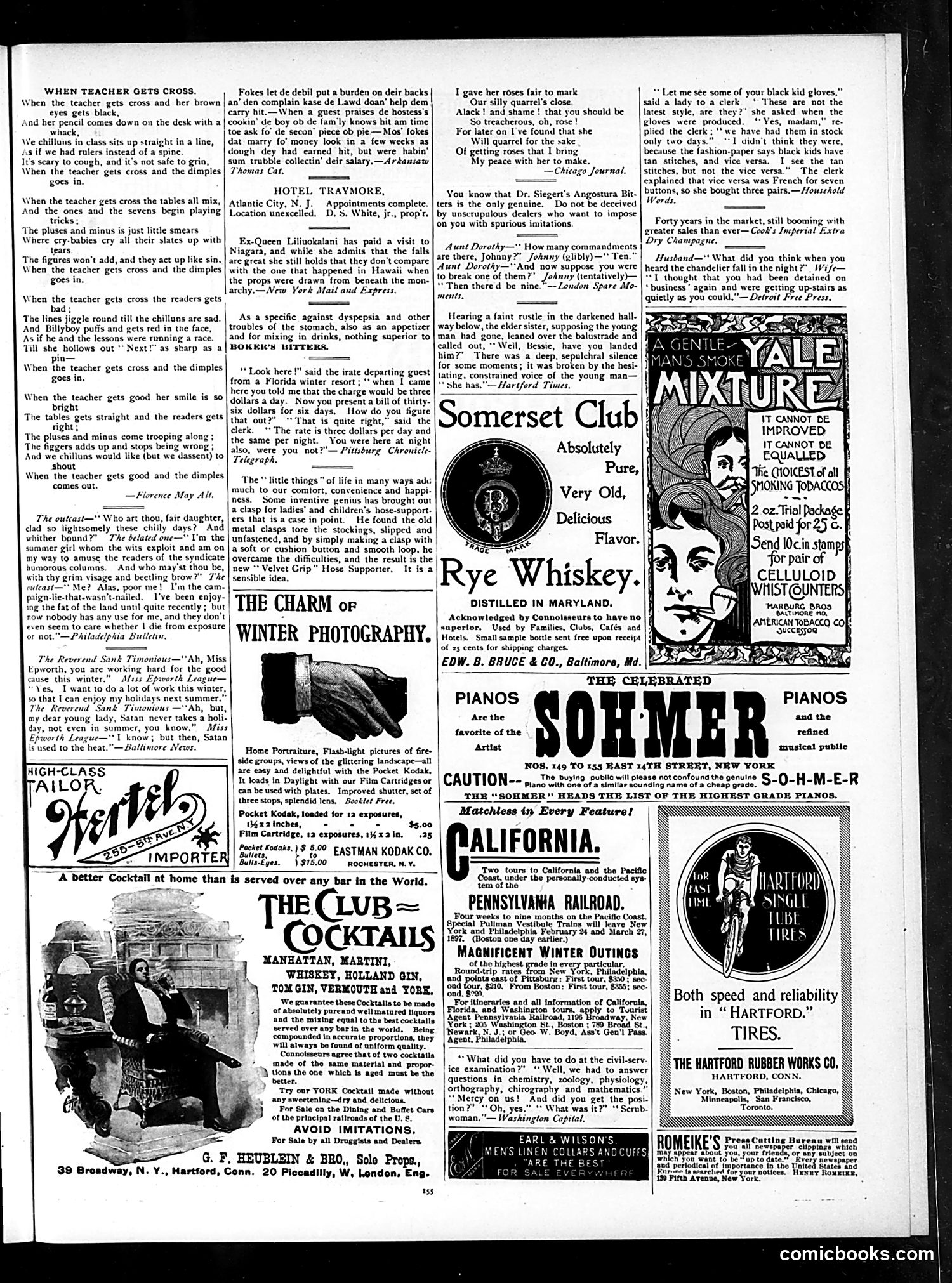
This page is primarily **advertising with scattered humorous poems and anecdotes**—not political cartoons. The main content is "When Teacher Gets Cross," a dialect poem by Florence May Alt depicting a schoolroom where a stern teacher's mood dramatically affects student behavior and mathematical accuracy. It's gentle humor about authority and childhood, not satire. The page also contains brief jokes mocking specific targets: Ex-Queen Liliuokalani of Hawaii (her complaint that Niagara Falls doesn't compare to the Hawaiian monarchy's collapse), and a hotel clerk's wordplay about daily versus nightly rates. The bulk of the page comprises **advertisements** for Somerset Club Rye Whiskey, Sohmer Pianos, Hartford Tires, Pennsylvania Railroad tours, and other products typical of early-20th-century magazines. There are **no identifiable political cartoons or caricatures**. The humor is situational rather than political—targeting pretension, incompetence, and human folly in everyday contexts.
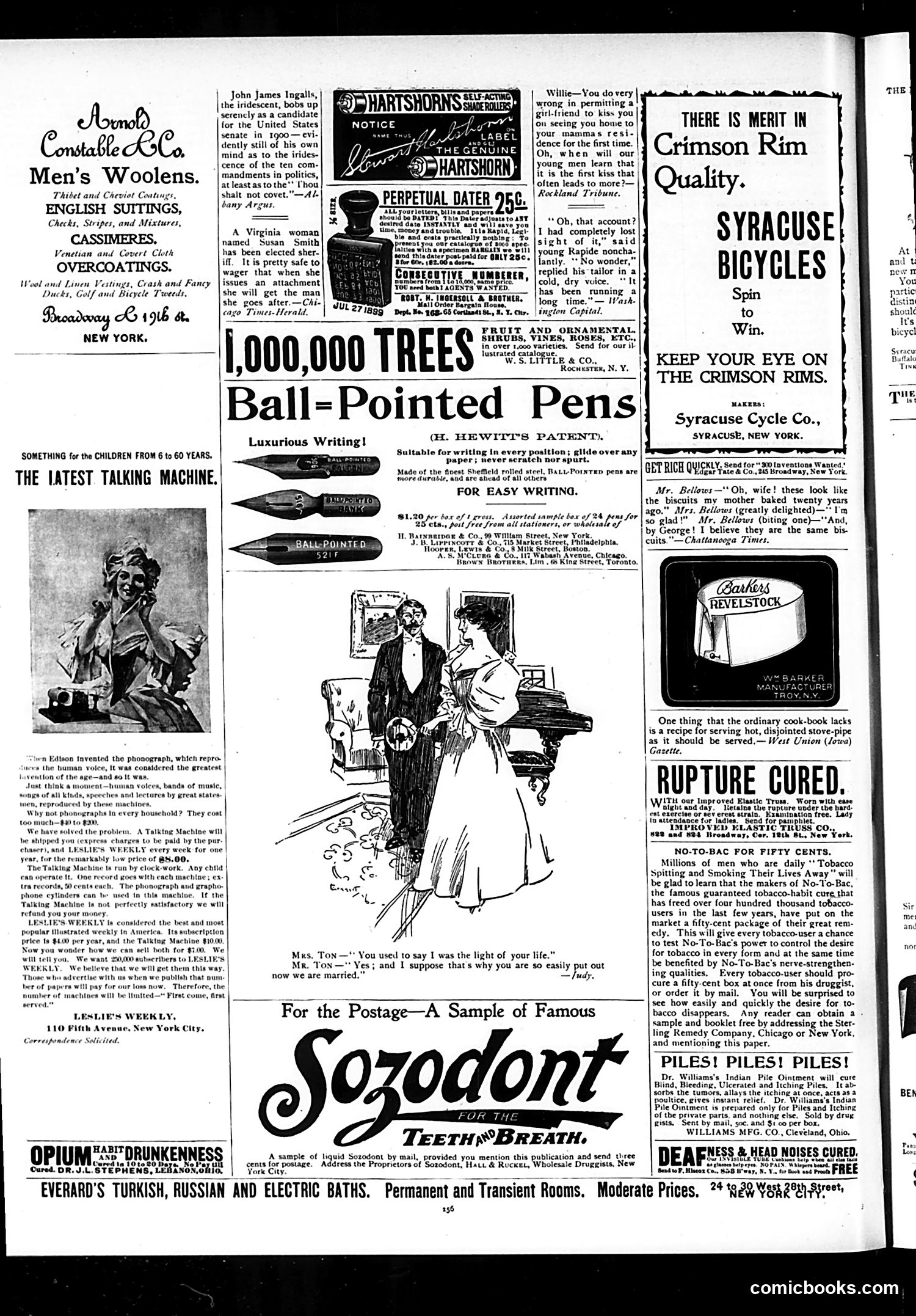
This page is primarily advertising, with several small satirical items typical of Judge magazine's humor section. The main cartoon (center-bottom) depicts "Mrs. Ton" and "Mr. Ton" in domestic conversation. She references his former romantic compliment that she was "the light of your life," and he responds that this explains why she's "so easily put out"—a pun playing on "put out" meaning both extinguished (like a light) and annoyed. The satire targets post-marriage disillusionment and the husband's casual wit at his wife's expense, common marital humor of the era. The page otherwise consists of product advertisements (bicycles, pens, talking machines, teeth whitener) interspersed with brief comedic one-liners about contemporary topics: a woman sheriff, a Virginia politician named John James Ingalls, and comments on courtship propriety. No major political figures or events are identifiable here. This is light domestic and consumer-focused humor typical of Judge's miscellaneous content pages.
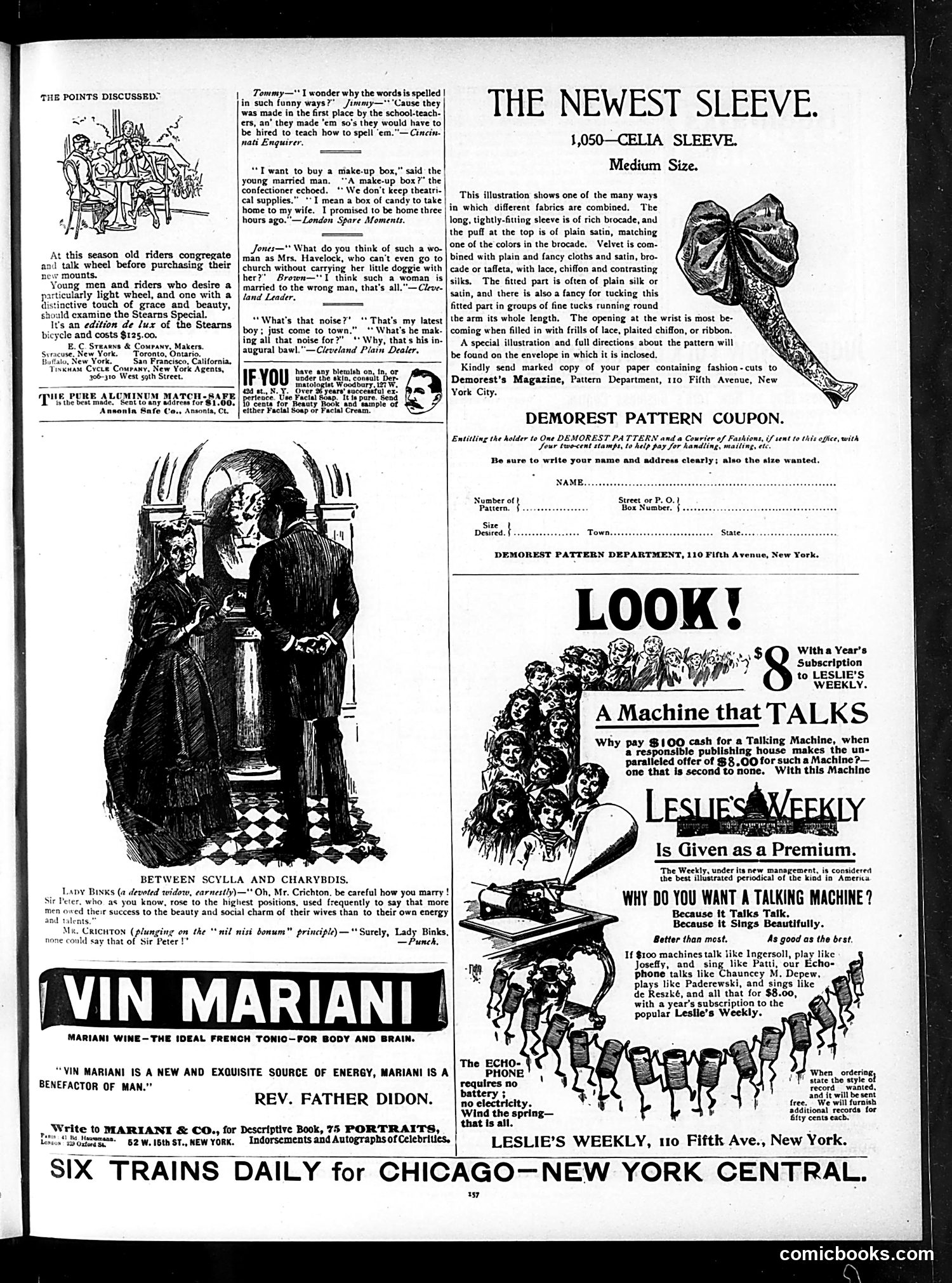
This page is primarily **advertising and fashion content** rather than political satire. The main elements are: **"The Newest Sleeve"** section features a fashion pattern (Celia Sleeve, #1,050) for women's clothing—specifically describing a fitted sleeve with puff top combining brocade, satin, velvet, and lace. Readers could order the pattern via coupon. **Small humor pieces** at top include jokes about spelling instruction, makeup boxes as apologies, and a woman taking her dog to church—typical light domestic humor of the era. **Advertisements** dominate: Vin Mariani (a wine tonic endorsed by clergy), Woodbury's Facial Soap, the Pere Aluminum Match Safe, Stearns bicycles, and Leslie's Weekly magazine (promoting a talking machine as a premium offer). **One cartoon** titled "Between Scylla and Charybdis" depicts a widow warning a man about marrying for beauty—a classical reference to being trapped between two dangers. The page reflects early 1900s concerns: bicycles as modern leisure, cosmetics marketing, talking machines as novelties, and fashion's importance to women readers.
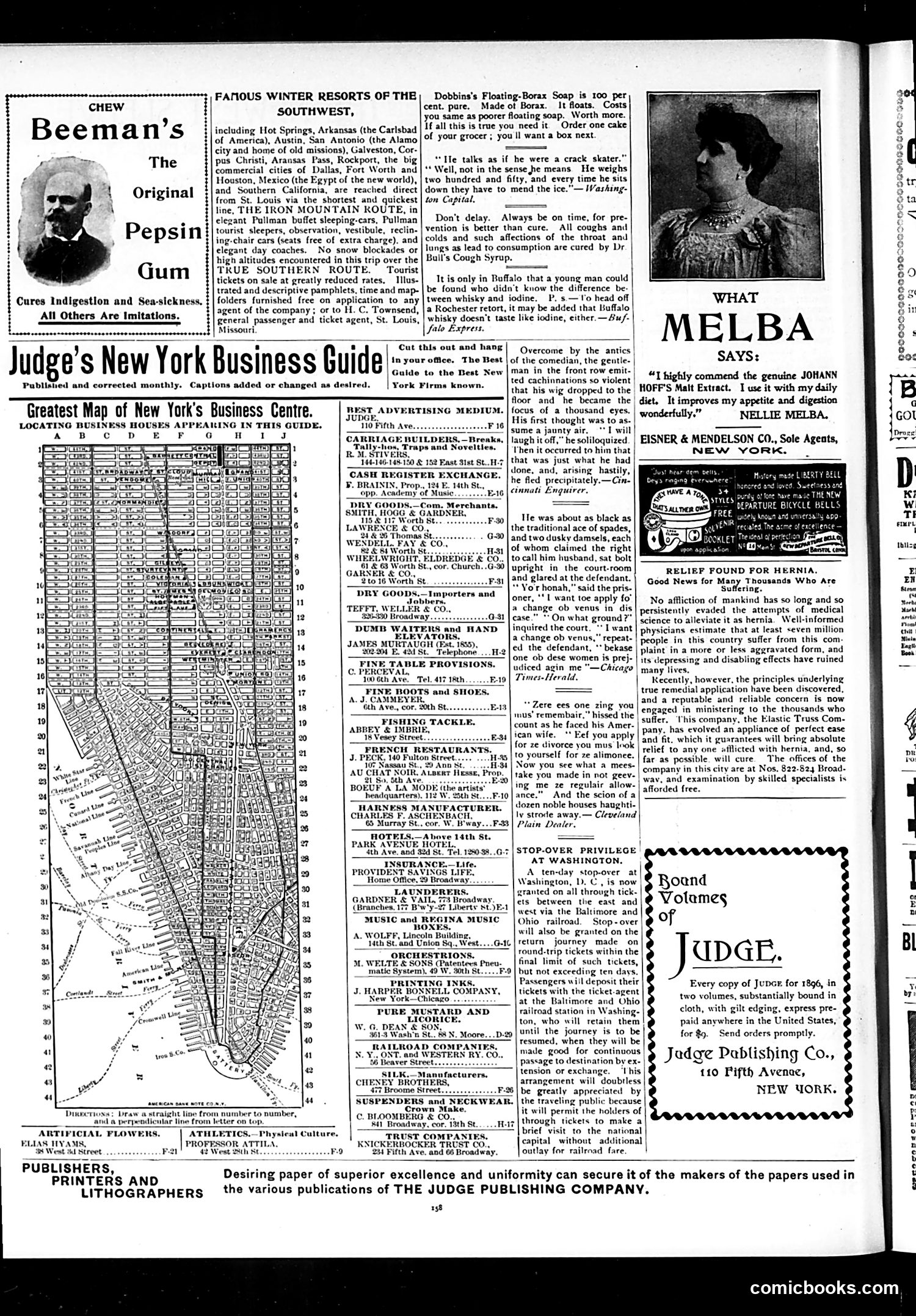
This is primarily a **business directory and advertising page** rather than a political cartoon page. The main content consists of: 1. **Beeman's Pepsin Gum ad** (top left): A patent medicine advertisement claiming to cure indigestion and seasickness—typical of late 19th-century American advertising with unverified medical claims. 2. **Three brief humor pieces** (center): Short satirical jokes about: - A heavy man claiming to be a "crack skater" (visual humor about obesity) - A Buffalo man who can't distinguish whisky from iodine (regional mockery) - A Black defendant requesting a "change of venue" because women are prejudiced against him (racial caricature using dialect) 3. **Judge's New York Business Guide**: A detailed map and business directory, the page's primary purpose. The humor reflects period attitudes—casual racism, regional stereotyping, and patent medicine skepticism. No specific political figures or events are referenced. This is characteristic of Judge magazine's lighter content: advertisements, business listings, and mild satirical vignettes rather than sharp political commentary.
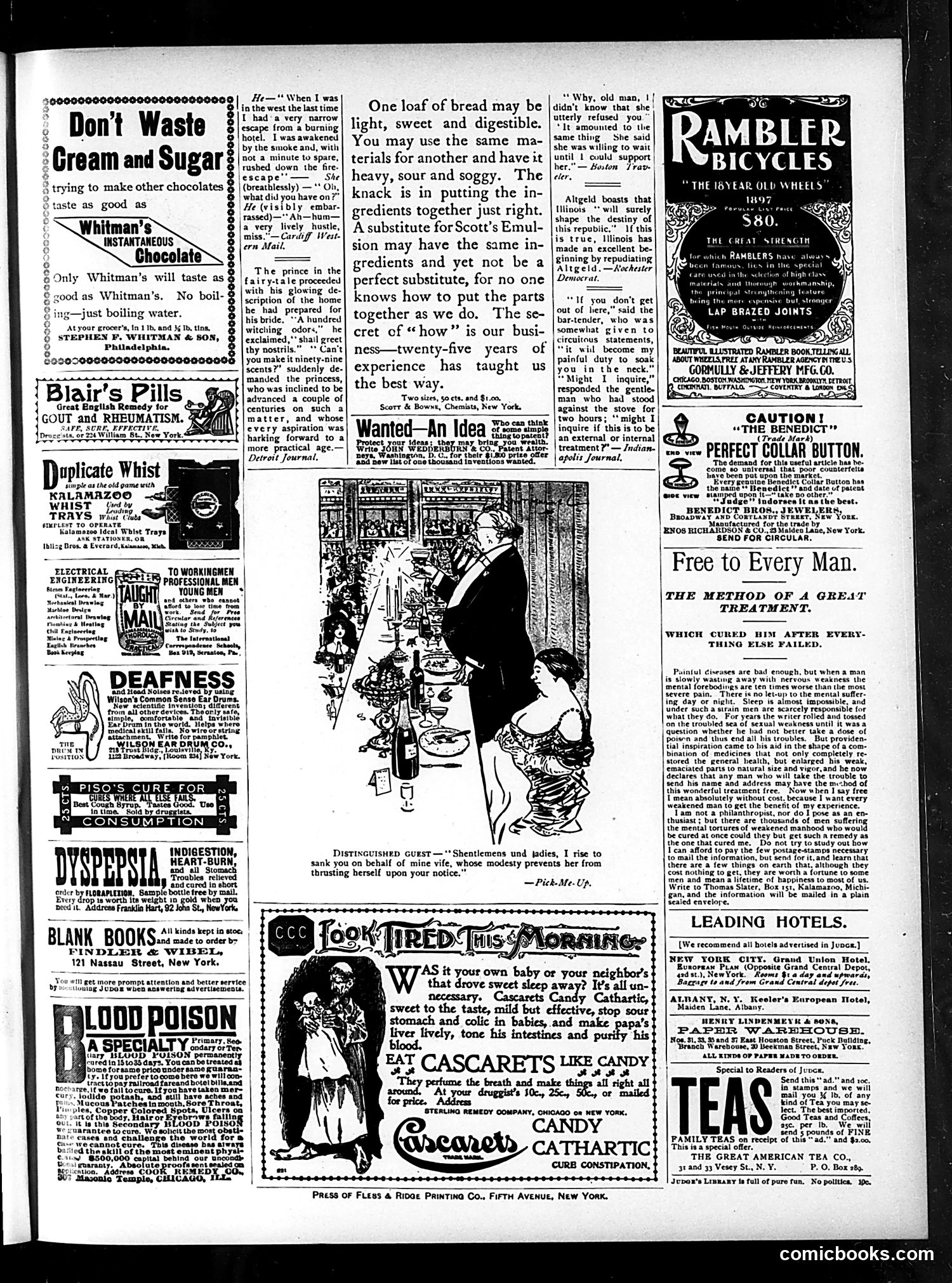
This page is primarily **advertising**, typical of early-20th-century American magazines. However, there are several small satirical cartoon vignettes worth noting: **Main cartoon (center):** Shows a well-dressed gentleman at a dinner table with a woman, captioned "Distinguished Guest—'Skentlemen and ladies, I rise to thank our host of astis, whose modesty prevents him from thrusting himself upon your notice.'" This is gentle satire about false modesty and social pretension at formal dinners. **Text vignettes** include humorous domestic exchanges: a wife asking about a hotel fire, a princess haggling over rose prices, and a man asking if a remedy is internal or external. These are light comic sketches mocking marital discord, bargaining, and hypochondria. The **advertisements** (Whitman's chocolate, Blair's Pills, Cascaret laxatives) use common period marketing tactics. The page reflects Judge's model: mixing mild social satire with commercial content aimed at middle-class readers. No major political figures or events are referenced; the humor is domestic and commercial rather than political.
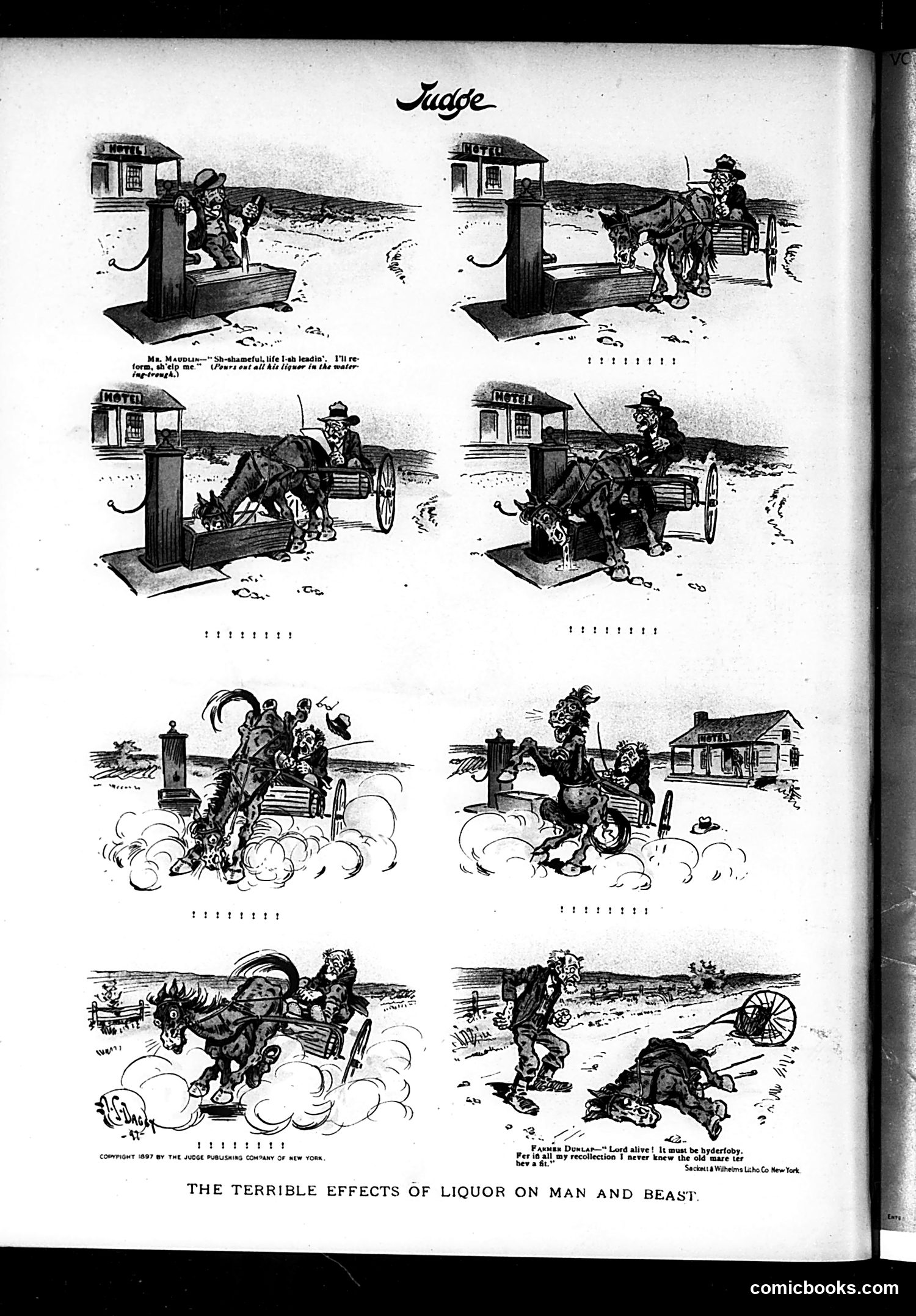
This is a temperance cartoon satirizing alcohol's impact. The sequential narrative shows a drunk man at a watering trough progressively losing control—pouring out liquor in a drunken promise of reform, then becoming increasingly intoxicated while driving a cart pulled by a horse. The joke culminates when the horse, presumably affected by alcohol fumes or the chaotic driving, also appears drunk or disoriented. The final panels show both man and animal in complete disarray—the cart overturned, the man collapsed. The satire mocks not just alcohol's destructive power but also the drunk's self-delusional reform ("I'll reform, sh'elp me") immediately before catastrophe. The horse's reaction suggests alcohol's effects extend absurdly even to innocent animals, amplifying the message that drinking harms everyone around the drinker. This reflects late-19th-century American temperance advocacy through Judge magazine.