
Judge, 1897-03-06 · page 2 of 16
Judge — March 6, 1897 — page 2: what you’re looking at
What you’re looking at
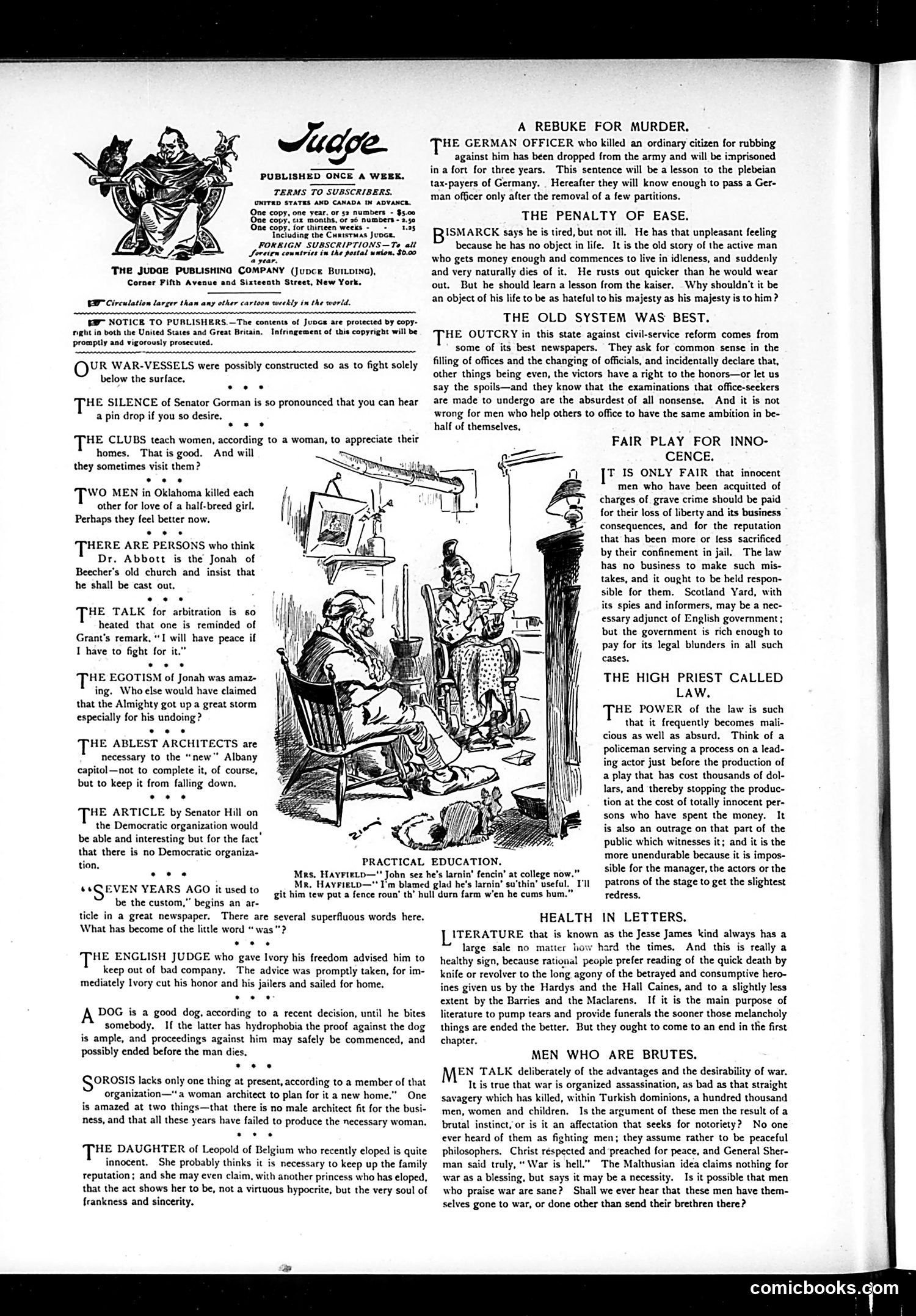
This page contains editorial commentary rather than traditional political cartoons. The "Practical Education" illustration depicts a domestic scene where a man teaches a child about farm life through hands-on experience. The text columns address various wartime and social issues: German military justice, Bismarck's indolence, proper examination of acquitted defendants, and law's power. There's also commentary on Jesse James literature and war's brutality. The overall tone is critical of institutional failures and societal problems. Without clear date markers visible, the references to "German officers," "Turkish dominions," and war casualties suggest this is WWI-era content. The page critiques both military conduct and sensationalist literature that glorifies violence, while advocating for practical education and fair legal treatment—typical progressive-era Judge magazine themes.
📄 Transcribed text from this page (OCR, searchable)
Machine-transcribed from the original scan — historical spelling and the odd misread are preserved.
uape PUBLISHED ONCE A WEEK. TERMS TO SUBSCRIBERS. ONITRD STATES AND CANADA IM ADVANCE, s2 numbers - $5.00 of 26 numbers - 2.50 One copy. for thirteen weeks == 1.35 Including the Cwnisraas Juocs, FORBIGN SUBSCRIPTIONS —To alt Soreigm countries im the postal union, $0.00 ‘a year. THE JUDGE PUBLISHING COMPANY (JuDcE BUILDING), Corner Fifth Avenue and Sixteenth Street, New York, [W-Circulation larger than any other cartoon weekly in the world. 6 NOTICE TO PURLISHERS.—The contents of Junce are protected by copy- nght in both the United States and Great Britain. Infringement of this copyright will be promptly and vigorously prosecuted. QUR WAR-VESSELS were possibly constructed so as to fight solely below the surface, ae THE SILENCE of Senator Gorman is so pronounced that you can hear apin drop if you so desire. © THE CLUBS teach women, according to a woman, to appreciate their homes. That is good. And will they sometimes visit them? eee Two MEN in Oklahoma killed each other for love of a half-breed girl. Perhaps they feel better now. eee HERE ARE PERSONS who think Dr. Abbott is the Jonah of Beecher's old church and insist that he shall be cast out. eee 'HE TALK for arbitration is 60 heated that one is reminded of Grant's remark, “I will have peace if I have to fight for it.” eee 'HE EGOTISM of Jonah was amaz- ing. Who else would have claimed that the Almighty got up a great storm especially for his undoing? see HE ABLEST ARCHITECTS are necessary to the “new” Albany capitol—not to complete it, of course, but to keep it from falling down, eee THE ARTICLE by Senator Hill on the Democratic organization would be able and interesting but for the fact’ that there is no Democratic organiza- tion, eee +*GEVEN YEARS AGO it used to be the custom,” begins an ar- ticle in a great newspaper. There are several superfluous words here. What has become of the little word “ was"? THE ENGLISH JUDGE who gave Ivory his freedom advised him to keep out of bad company. The advice was promptly taken, for im- mediately Ivory cut his honor and his jailers and sailed for home. A POG is a good dog. according to a recent decision, until he bites somebody. If the latter has hydrophobia the proof against the dog is ample, and proceedings against him may safely be commenced, and possibly ended before the man dies. vee SoRosis lacks only one thing at present, according to a member of that organization—“'a woman architect to plan for it a new home.” One is amazed at two things—that there is no male architect fit for the busi- ness, and that all these years have failed to produce the necessary woman. THE DAUGHTER of Leopold of Belgium who recently eloped is quite innocent. She probably thinks it is necessary to keep up the family reputation; and she may even claim, with another princess who has eloped, that the act shows her to be, not a virtuous hypocrite, but the very soul of frankness and sincerity. PRACTICAL EDUCATION. Mrs. HayrteLp—" John sez he’s larnin’ fencin’ at college now.” Mr. HayFigLp—"* I'm blamed glad he's larnin’ su'thin’ useful. git him tew put a fence roun’ th’ hull durn farm w’en he cums hum. A REBUKE FOR MURDER, HE GERMAN OFFICER who killed an ordinary citizen for rubbing against him has been dropped from the army and will be imprisoned in a fort for three years. This sentence will be a lesson to the plebeian tax-payers of Germany. . Hereafter they will know enough to pass a Ger- man officer only after the removal of a few partitions. THE PENALTY OF EASE. BISMARCK says be is tired, but not ill. He has that unpleasant feeling because he has no object in life. It is the old story of the active man who gets money enough and commences to live in idleness, and suddenly and very naturally dies of it. He rusts out quicker than he would wear out. But he should learn a lesson from the kaiser. Why shouldn't it be an object of his life to be as hateful to his majesty as his majesty is to him? THE OLD SYSTEM WAS BEST. HE OUTCRY in this state against civil-service reform comes from some of its best newspapers. They ask for common sense in the filling of offices and the changing of officials, and incidentally declare that, other things being even, the victors have a right to the honors—or let us say the spoils—and they know that the examinations that office-seekers are made to undergo are the absurdest of all nonsense, And it is not wrong for men who help others to office to have the same ambition in be- half of themselves, FAIR PLAY FOR INNO- CENCE. T IS ONLY FAIR that innocent men who have been acquitted of charges of grave crime should be paid for their loss of liberty and its business consequences, and for the reputation that has been more or less sacrificed by their confinement in jail. The law has no business to make such mis- takes, and it ought to be held respon- sible for them. Scotland Yard, with its spies and informers, may be a nec- essary adjunct of English government; but the government is rich enough to pay for its legal blunders in all such cases, THE HIGH PRIEST CALLED LAW. THE POWER of the law is such that it frequently becomes mali- cious as well as absurd. Think of a policeman serving a process on a lead- ing actor just before the production of a play that has cost thousands of dol- lars, and thereby stopping the produc- tion at the cost of totally innocent per- sons who have spent the money. It is also an outrage on that part of the public which witnesses it; and it is the more unendurable because it is impos- sible for the manager, the actors or the T'll__ patrons of the stage to get the slightest redress, HEALTH IN LETTERS. LITERATURE that is known as the Jesse James kind always has a large sale no matter how hard the times. And this is really a healthy sign, because rational people prefer reading of the quick death by knife or revolver to the long agony of the betrayed and consumptive hero- ines given us by the Hardys and the Hall Caines, and to a slightly less extent by the Barries and the Maclarens. If it is the main purpose of literature to pump tears and provide funerals the sooner those melancholy things are ended the better. But they ought to come to an end in the first, chapter. MEN WHO ARE BRUTES. MEN TALK deliberately of the advantages and the desirability of war. It is true that war is organized assassination, as bad as that straight savagery which has killed, within Turkish dominions, a hundred thousand men, women and children. Is the argument of these men the result of a brutal instinct, or is it an affectation that seeks for notoriety? No one ever heard of them as fighting men; they assume rather to be peaceful philosophers. Christ réspected and preached for peace, and General Sher- man said truly, “ War is hell.” The Malthusian idea claims nothing for war as a blessing, but says it may be a necessity. Is it possible that men who praise war are sane? Shall we ever hear that these men have them- selves gone to war, or done other than send their brethren there? comicbooks.¢ m