
A complete issue · 16 pages · 1897
Judge — February 20, 1897
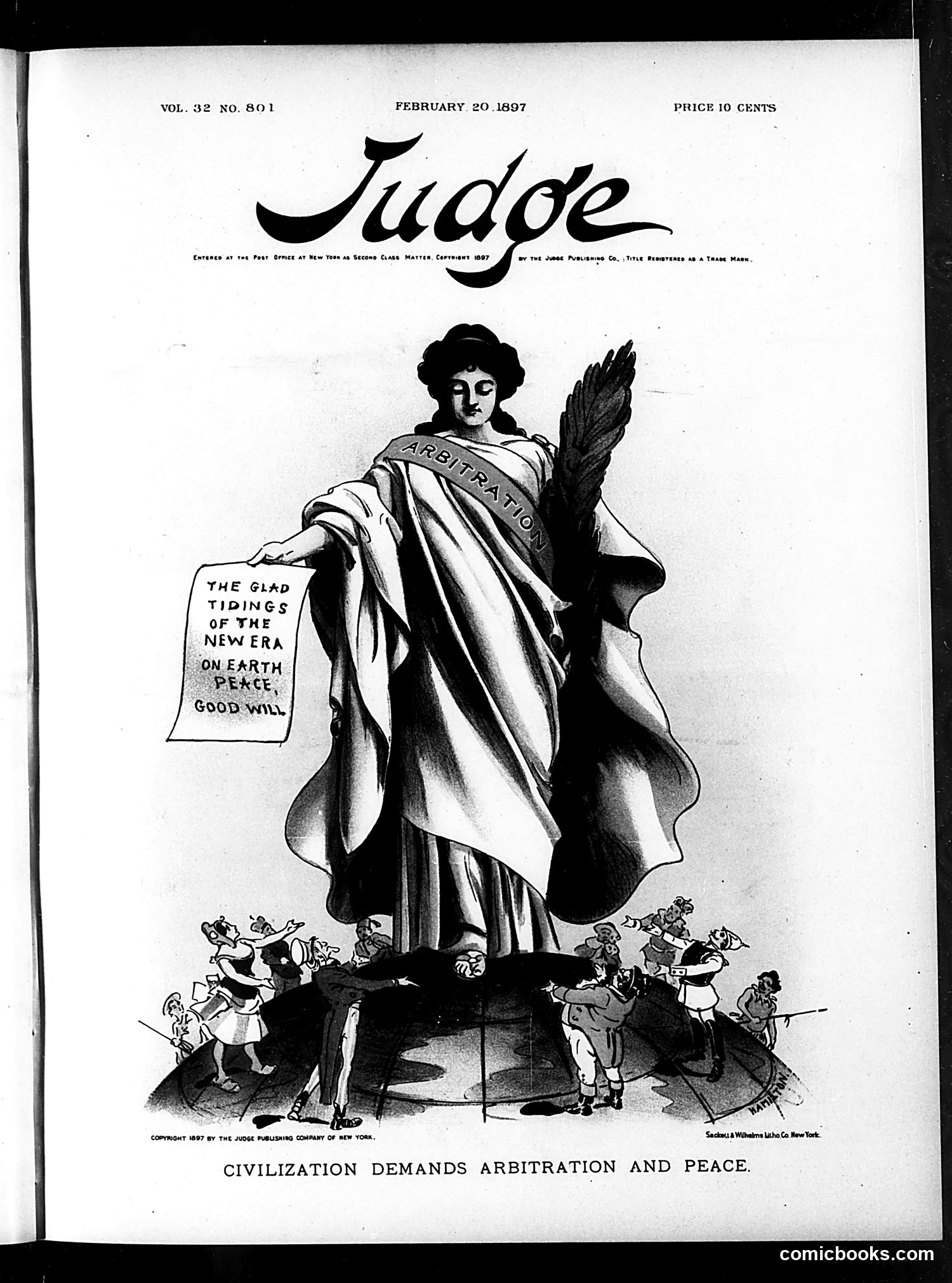
This political cartoon depicts an allegorical female figure labeled "ARBITRATION" standing on a large head (likely representing a political leader or nation). She holds a banner reading "THE GLAD TIDINGS OF THE NEW ERA ON EARTH PEACE, GOOD WILL" while wearing a sash marked "ARBITRATION." Small figures at the base appear to be celebrating or supporting this ideal. The caption states "CIVILIZATION DEMANDS ARBITRATION AND PEACE." The cartoon likely responds to contemporary international disputes—possibly involving America or European powers—advocating for peaceful arbitration over military conflict. This reflects 1890s progressive sentiment favoring international dispute resolution rather than warfare, a popular cause among American reform-minded publications of the era.
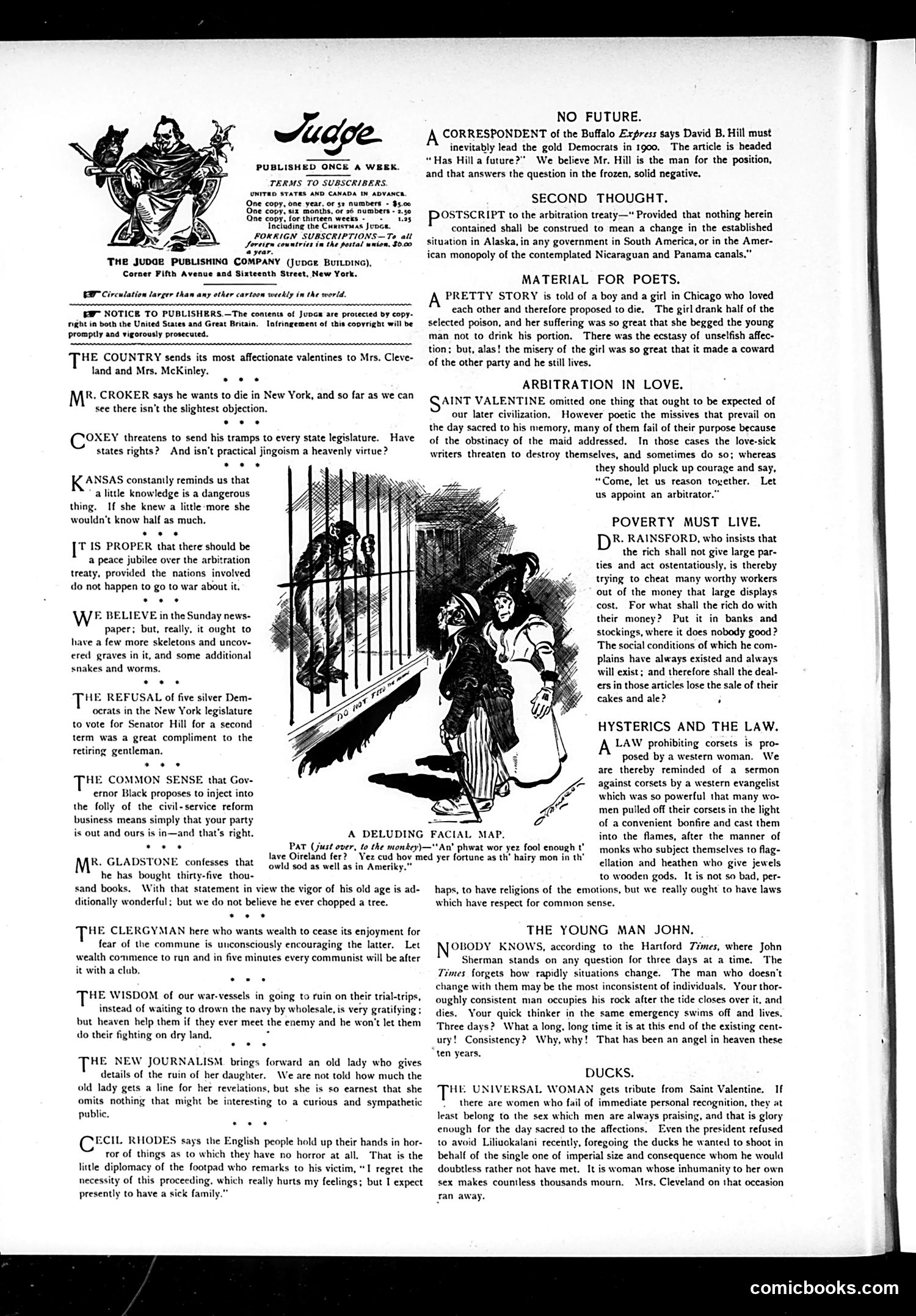
The main cartoon titled "A Deluding Facial Map" depicts a fortune teller reading a client's palm, with the caption suggesting the fortune teller is making false predictions. This satirizes the popular practice of fortune-telling and palm-reading as deception. The page's editorial sections critique various contemporary issues: David B. Hill's political prospects, Coxey's "tramp" movement (likely referring to Coxey's Army, a 1894 labor protest), Kansas's lack of self-knowledge, and debates over wealth distribution and ostentatious display. The "Arbitration in Love" and "Young Man John" sections use humor to satirize sentimentality and inconsistency in romantic matters. Overall, the page targets social pretension, false prophecy, and political/romantic hypocrisy through satirical commentary and illustration.
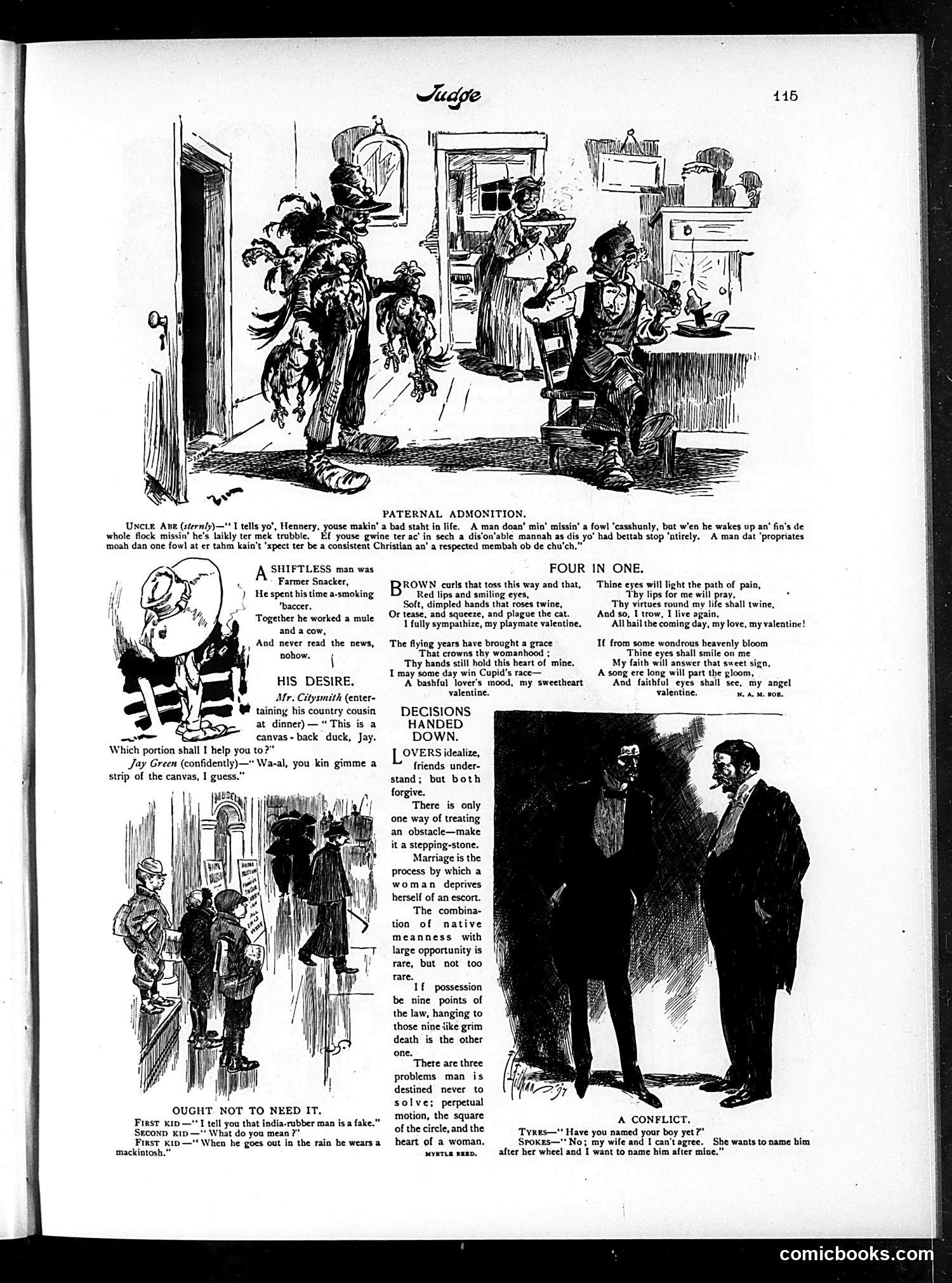
This page contains multiple satirical pieces targeting social behavior and gender relations of the era. **"Paternal Admonition"** depicts a disheveled man warning his son about the dangers of loose living—a moral lecture on vice and respectability. **"Four in One"** is a sentimental poem about romantic devotion, using flowery Victorian language about a sweetheart's eyes and virtues. **"His Desire"** shows a man reluctant to help his country cousin with manual labor, preferring leisure. **"Decisions Handed Down"** discusses marriage cynically as a process where women lose independence, treating matrimony as a legal obstacle requiring compromise. The other sketches mock social pretense ("Ought Not to Need It") and domestic naming disputes ("Complain"). Overall, the page satirizes Victorian courtship conventions, class anxieties, and marriage's constraints on women's autonomy.
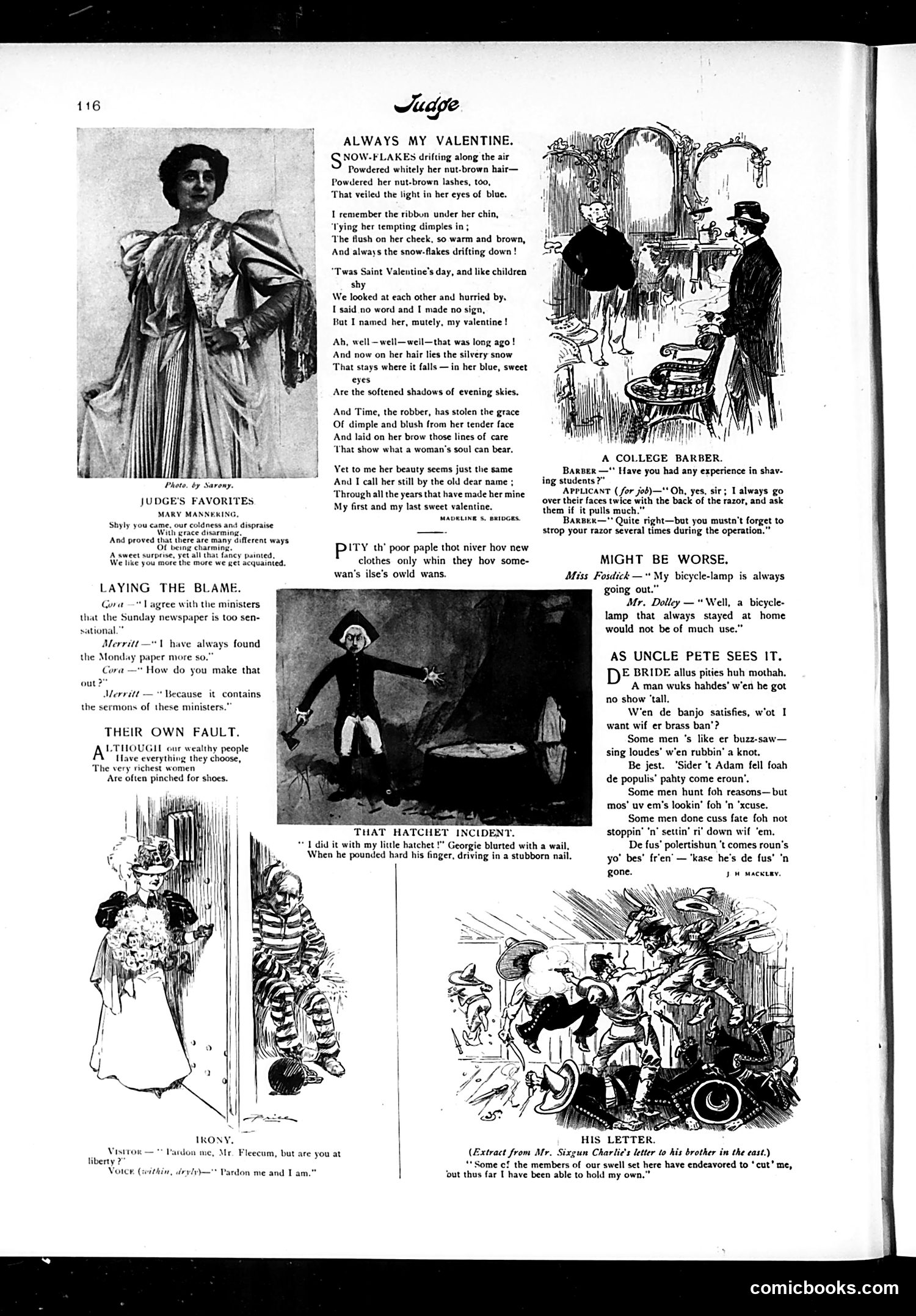
This page contains multiple short humor pieces typical of late 19th/early 20th-century American satire: **"Always My Valentine"** is a sentimental poem about aging love—contrasting a man's memory of a young woman on Valentine's Day with her present aged appearance, yet his enduring devotion. It's romantic rather than satirical. **The brief jokes** mock familiar social targets: Sunday newspapers criticized as sensational (blamed on ministers' Monday sermons), wealthy women lacking shoe choices despite wealth, and a college barber's inexperienced technique. **"As Uncle Pete Sees It"** uses dialect humor (an African American character's rural observations) to comment on human nature—men's contradictions, political opportunism, and fate. This represents period humor that relied on racial stereotyping for comic effect. **"That Hatchet Incident"** is a pun-based children's joke about a boy hitting his finger while nailing. The cartoons are largely *domestic* and *social* humor rather than political satire—focused on relationships, class anxieties, and everyday foolishness rather than current events or politicians.
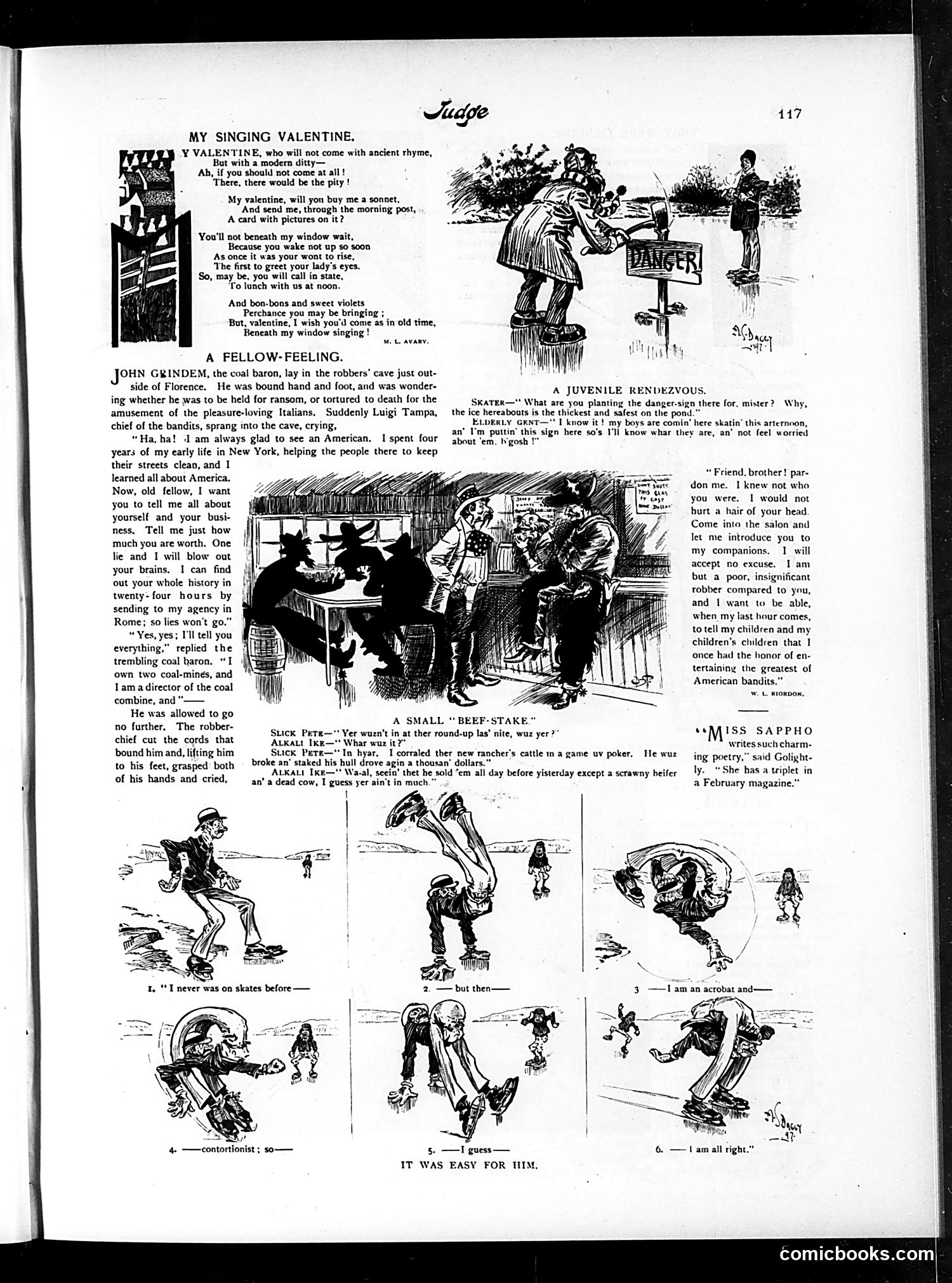
This page contains multiple unrelated satirical pieces typical of Judge magazine's format: **"My Singing Valentine"** is a sentimental poem mocking modern romance's decline—the speaker wishes their valentine would serenade them "as in old time" rather than merely visiting for lunch. It's gentle satire on how courtship has become mundane and commercialized. **"A Fellow-Feeling"** tells of an American coal baron (Grindem) kidnapped by Italian bandits. The joke: the bandit chief, Luigi Tampa, worked in New York and is thrilled to meet an American, treating him as a peer rather than a victim. The satire appears to mock both American industrial ruthlessness and romanticized notions of Italian bandits. **"A Juvenile Rendezvous"** shows a man placing a danger sign on thin ice where children skate—contradicting the skater's claim the ice is safe. Dark humor about parental negligence. The remaining sketches depict cowboys playing poker and someone learning to ice skate, offering visual comedy with minimal text. The overall tone reflects early 20th-century American middle-class anxieties about modernity, crime, and social change.
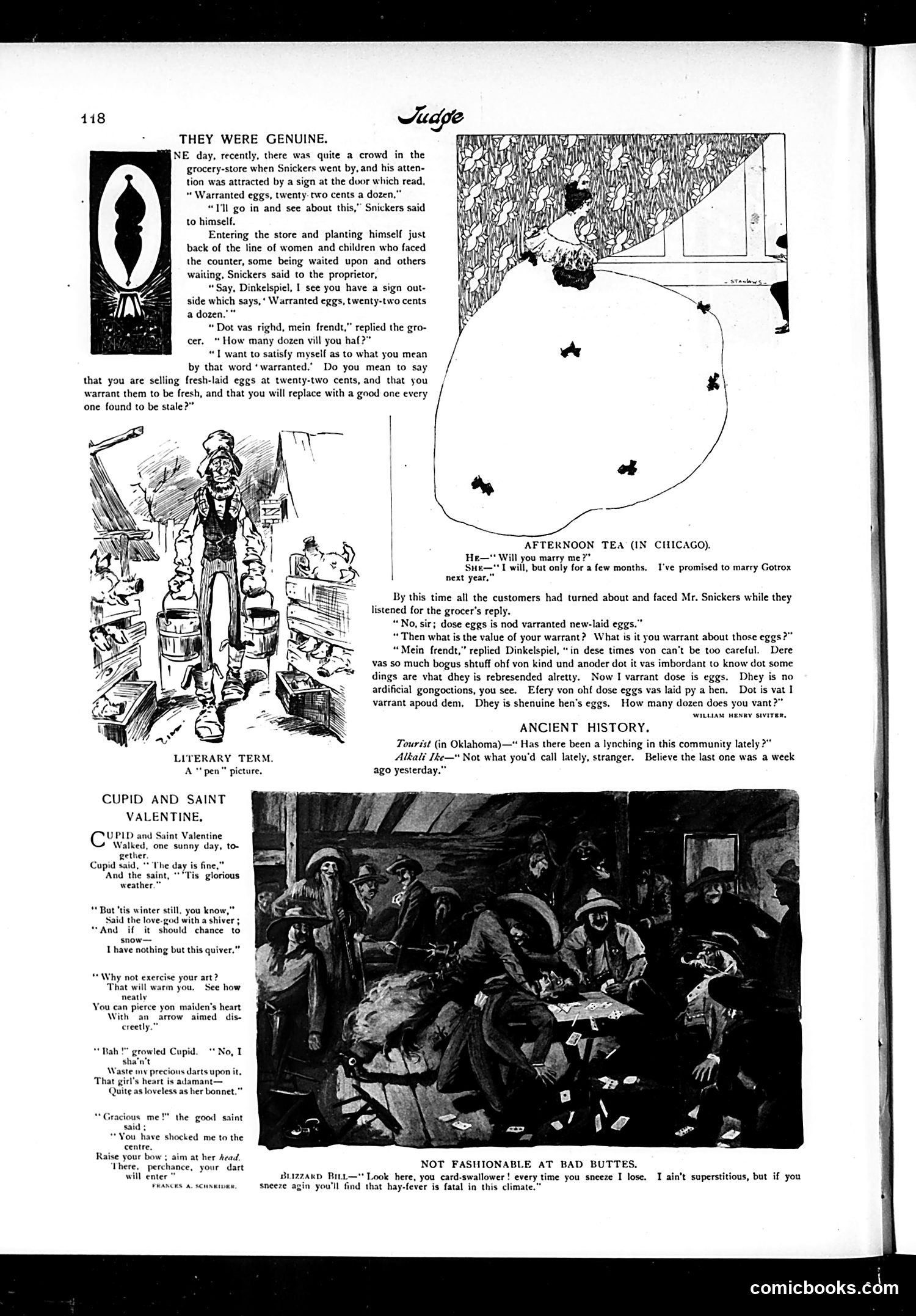
This page contains three satirical pieces typical of early 20th-century American humor: **"They Were Genuine"** mocks immigrant grocers and consumer fraud concerns. A customer (Snickers) interrogates a Jewish grocer (Dinkelspiel, identified by Yiddish dialect) about "warranted eggs." The grocer's circular logic—eggs are "guaranteed" simply because they're genuine hen's eggs—exposes the worthlessness of the warranty. The satire targets both deceptive marketing and ethnic stereotyping through exaggerated dialect. **"Cupid and Saint Valentine"** is a light romantic poem contrasting Cupid's pragmatism with Saint Valentine's idealism about love. **"Ancient History"** and **"Not Fashionable at Bad Buttes"** are brief jokes about Oklahoma lynching and blizzard hardships, using regional stereotypes for humor. The page reflects period anxieties about food safety, immigrant merchants, and frontier life—all delivered through ethnic caricature common to Judge's era.
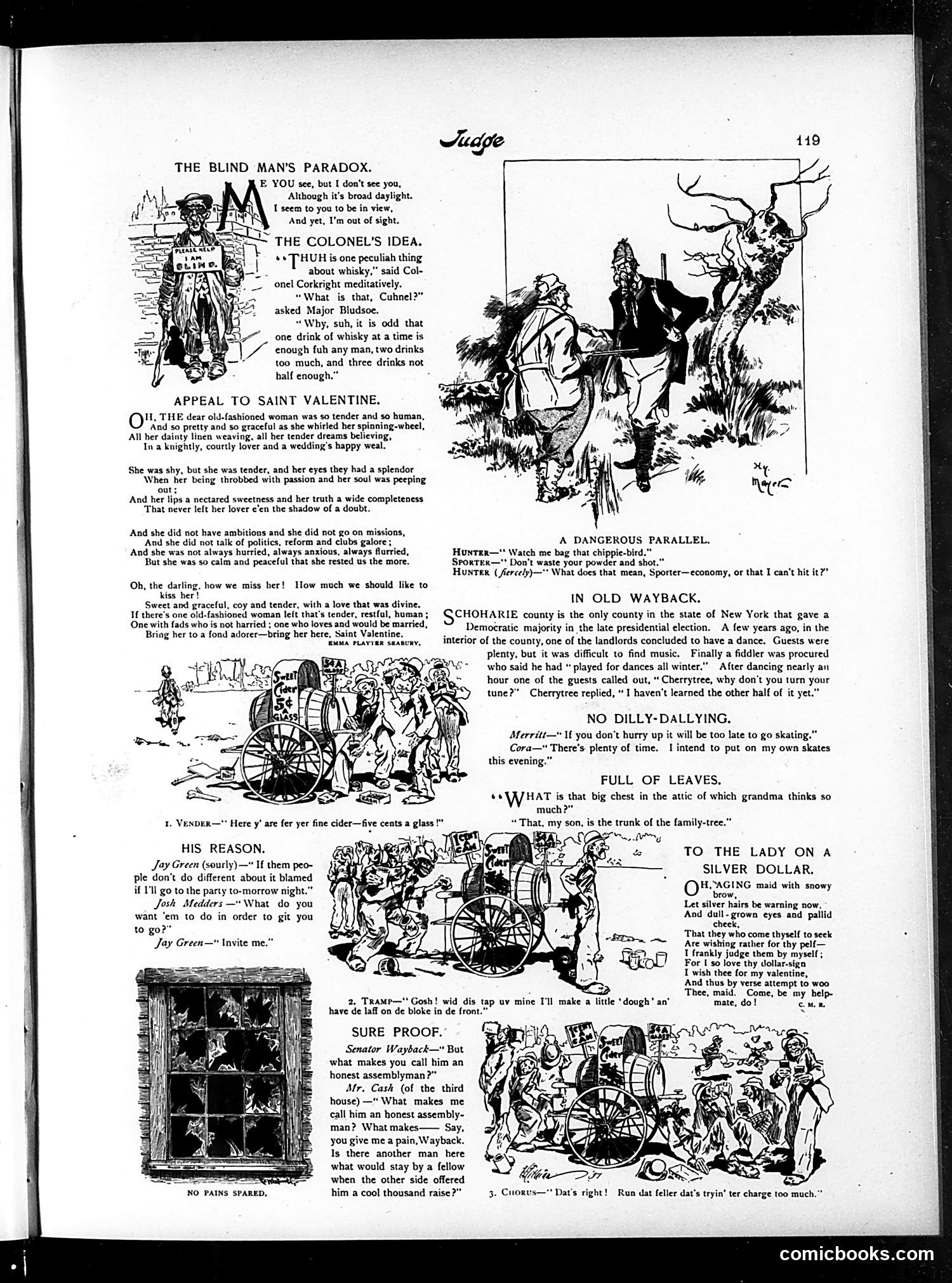
This page contains multiple satirical items typical of late-19th-century American humor magazines: **Political/Social Satire:** - "The Colonel's Idea" mocks Southern aristocratic logic about whisky consumption—a jab at both alcohol culture and regional pretension. - "Appeal to Saint Valentine" nostalgically idealizes old-fashioned women while critiquing modern women's ambitions, education, and activism—typical anti-feminist sentiment of the era. - "In Old Wayback" satirizes rural/backwoods ignorance through the story of a fiddler who'd only learned half a tune. - "Sure Proof" appears to mock political corruption, with "Mr. Cash (of the third house)"—a euphemism suggesting bribery in state legislatures. **Social Commentary:** - "To the Lady on a Silver Dollar" cynically suggests suitors pursue women only for money. - Various short quips mock courtship, social climbing, and human folly. The cartoons use exaggerated dialect and stereotypes typical of period humor. The overall tone reflects Gilded Age anxieties about modernity, women's changing roles, and political dishonesty.
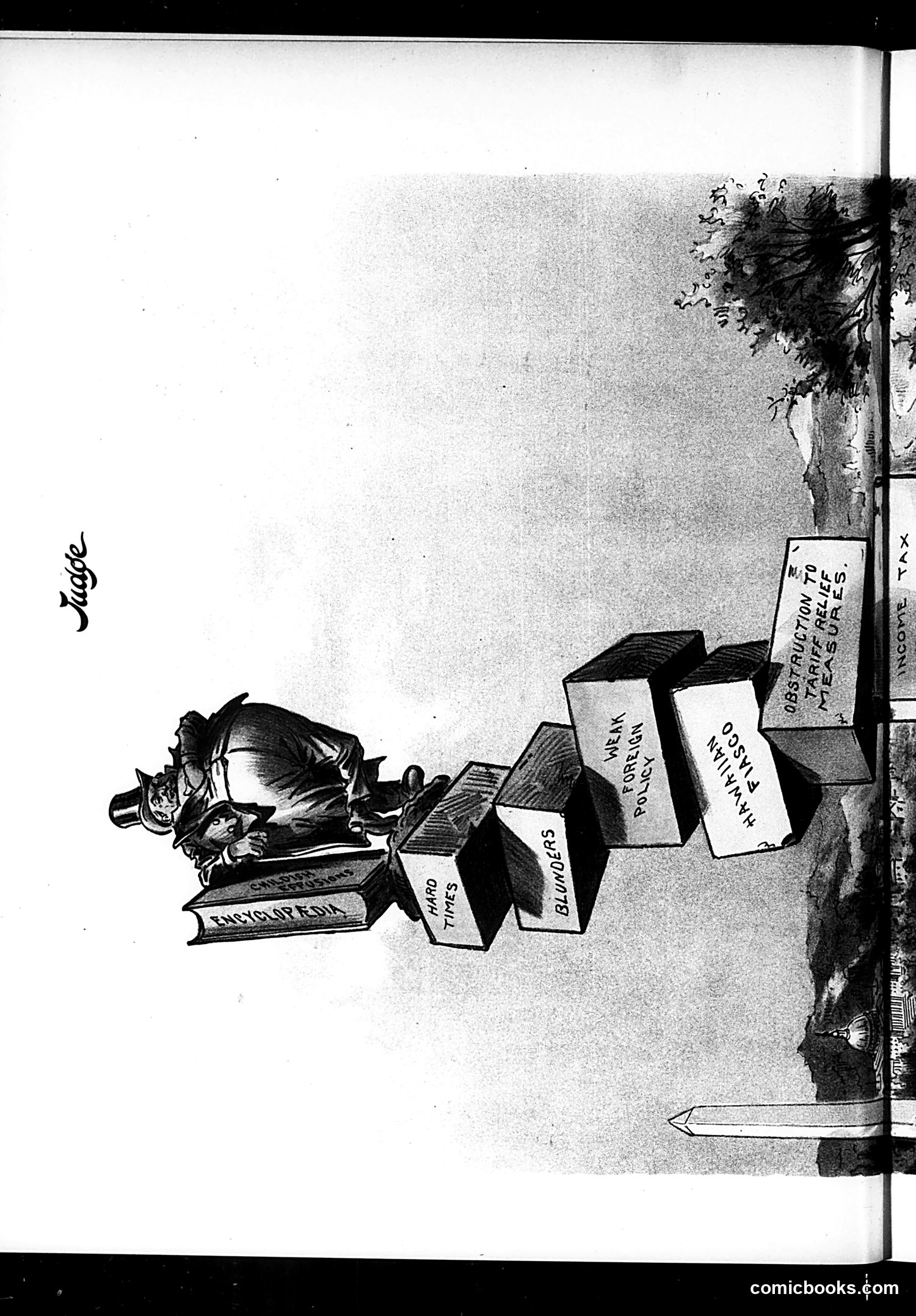
This appears to be a Judge magazine cartoon depicting a figure (rendered as a caricatured head) surrounded by stacked boxes or books labeled with various topics. The visible labels include words like "THIRD THINGS," "BLINDNESS," "OPENING," and what appears to be "ENCYCLOPEDIA" on the leftmost item. The satire seems to critique information overload or intellectual confusion—suggesting that accumulating knowledge from multiple sources creates chaos rather than clarity. The figure appears overwhelmed by this stack of competing subjects and facts. However, without a clear date, specific figure identification, or complete legible labels on all boxes, I cannot definitively explain which historical figure or event this targets. The signature appears to read "Judge" in the upper left, but more context would be needed for precise interpretation.
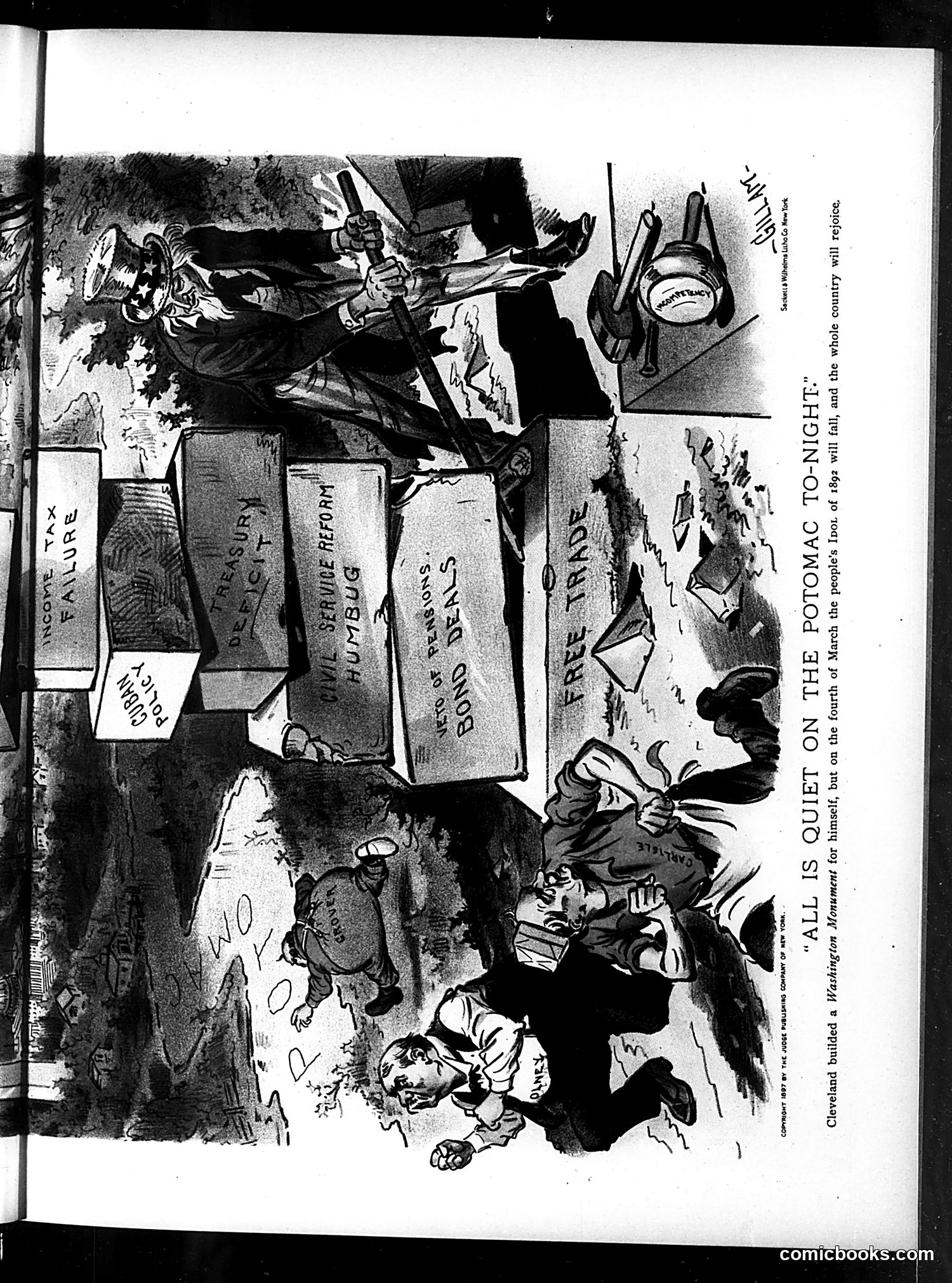
This political cartoon from *Judge* magazine satirizes American isolationism and military unpreparedness during what appears to be the pre-WWII era. The image depicts a sleeping or negligent figure (representing America or American leadership) surrounded by boxes labeled with various global threats: "Good Beans," "Trouble," "Brewing Hubbub," and others suggesting international conflicts. Weapons and military implements are scattered about, while ominous figures loom overhead—likely representing foreign aggression or dictatorial powers. The title "ALL IS QUIET ON THE POTOMAC TO-NIGHT" mocks American complacency, using the famous Civil War-era phrase ironically. The caption warns that "Heedless America" ignores gathering storms abroad while the nation sleeps, suggesting America's failure to recognize and prepare for emerging global dangers. The satire criticizes both political leadership and public apathy toward international threats.
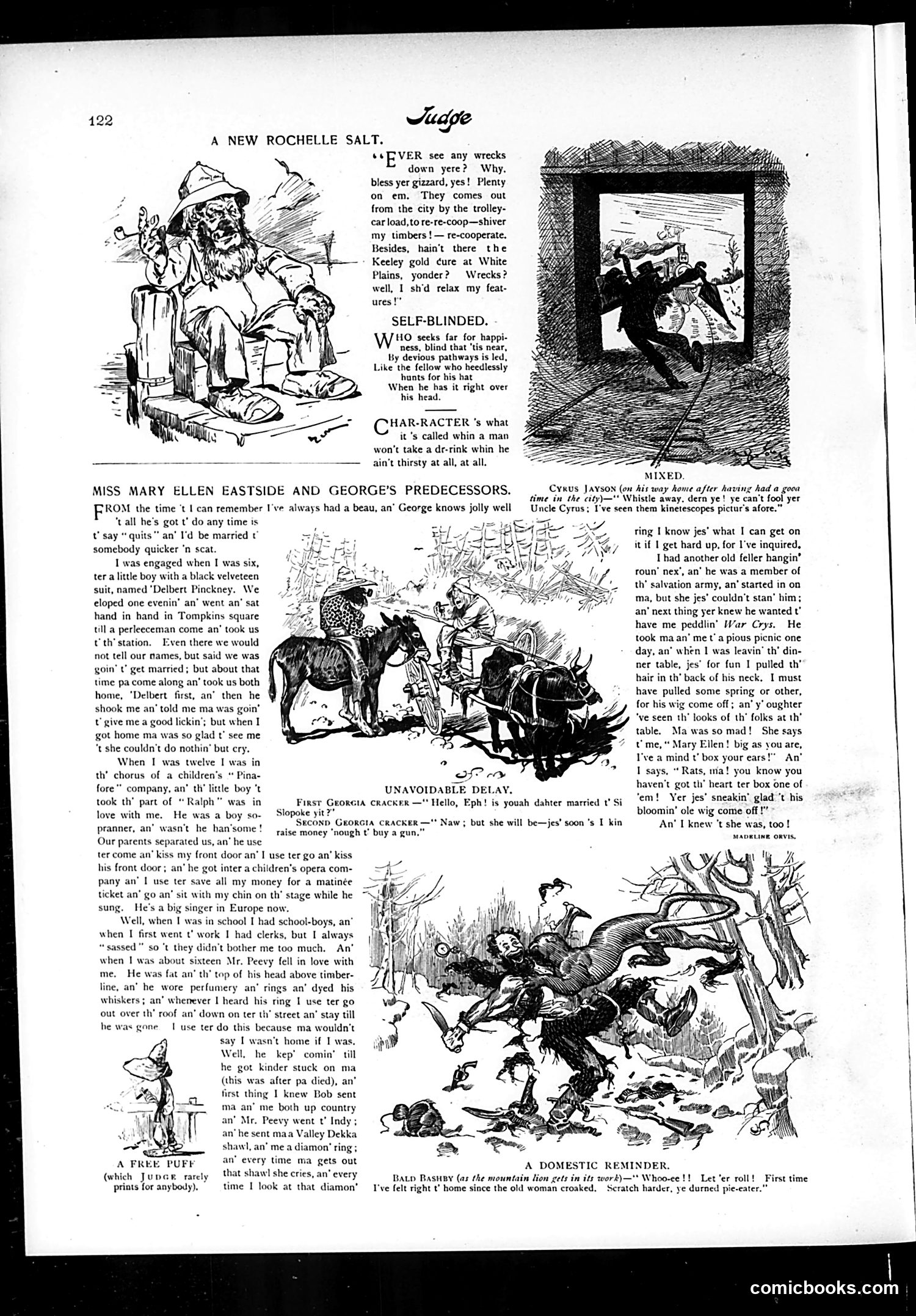
This page contains several satirical vignettes typical of Judge magazine's early 20th-century humor: **"A New Rochelle Salt"** mocks wealthy New Yorkers who traveled to New Rochelle seeking rest cures. The old sailor's dialect jokes that "wrecks" (burned-out urbanites) arrive by trolley seeking recuperation, referencing the Keeley Gold Cure for alcoholism at White Plains—satirizing the era's health-spa culture and substance-abuse treatments. **"Self-Blinded" and "Character"** are brief philosophical quips about seeking happiness in wrong places and abstaining from drink when not thirsty. **"Miss Mary Ellen Eastside and George's Predecessors"** is a lengthy humorous monologue from a working-class woman recounting her romantic history with various suitors—a common Judge format mixing dialect humor with social commentary on courtship customs among the urban poor and working classes. The scattered cartoons illustrate these narratives with typical period caricatures and crowded, energetic line work characteristic of Judge's visual style.
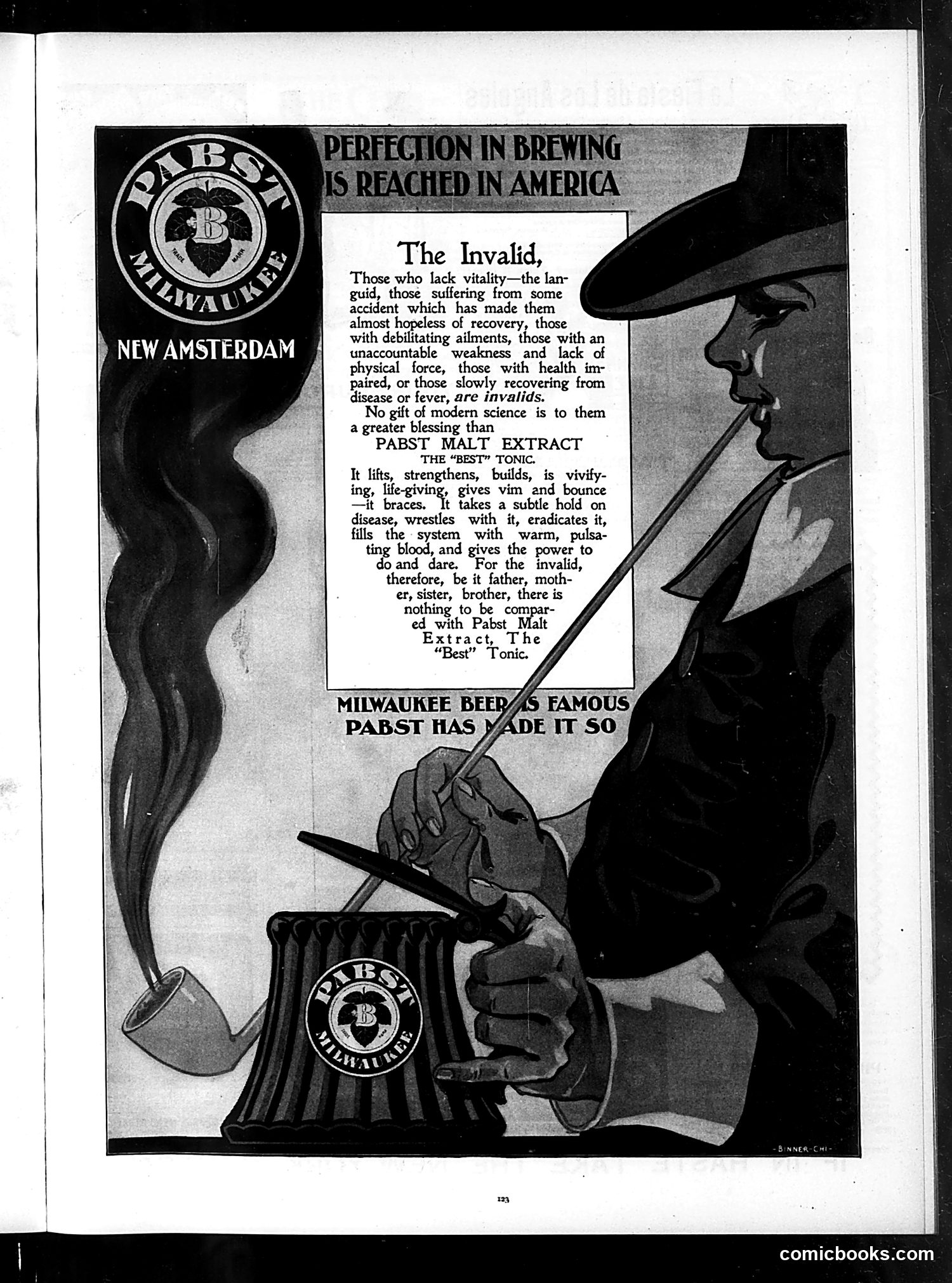
This is a **Pabst beer advertisement**, not satire or political commentary. The page promotes Pabst Malt Extract as a medicinal tonic for invalids—people suffering from weakness, illness, or poor health. The illustration shows a caregiver (likely a nurse or doctor, indicated by the pipe and professional bearing) administering the product to a bedridden patient. The text lists various ailments the extract supposedly treats: debilitating illness, weakness, fever recovery, and lack of vitality. **Historical context modern readers miss:** This reflects early 20th-century patent medicine marketing, when alcohol-based tonics were sold as legitimate medical treatments for broad health complaints. Pabst Malt Extract contained malt and likely alcohol, marketed with exaggerated therapeutic claims that would today violate FDA regulations. Such "cure-all" tonics were common before modern medical standards and consumer protection laws. The ad's earnest, clinical language attempting to position beer extract as serious medicine is what appears absurd to contemporary viewers.
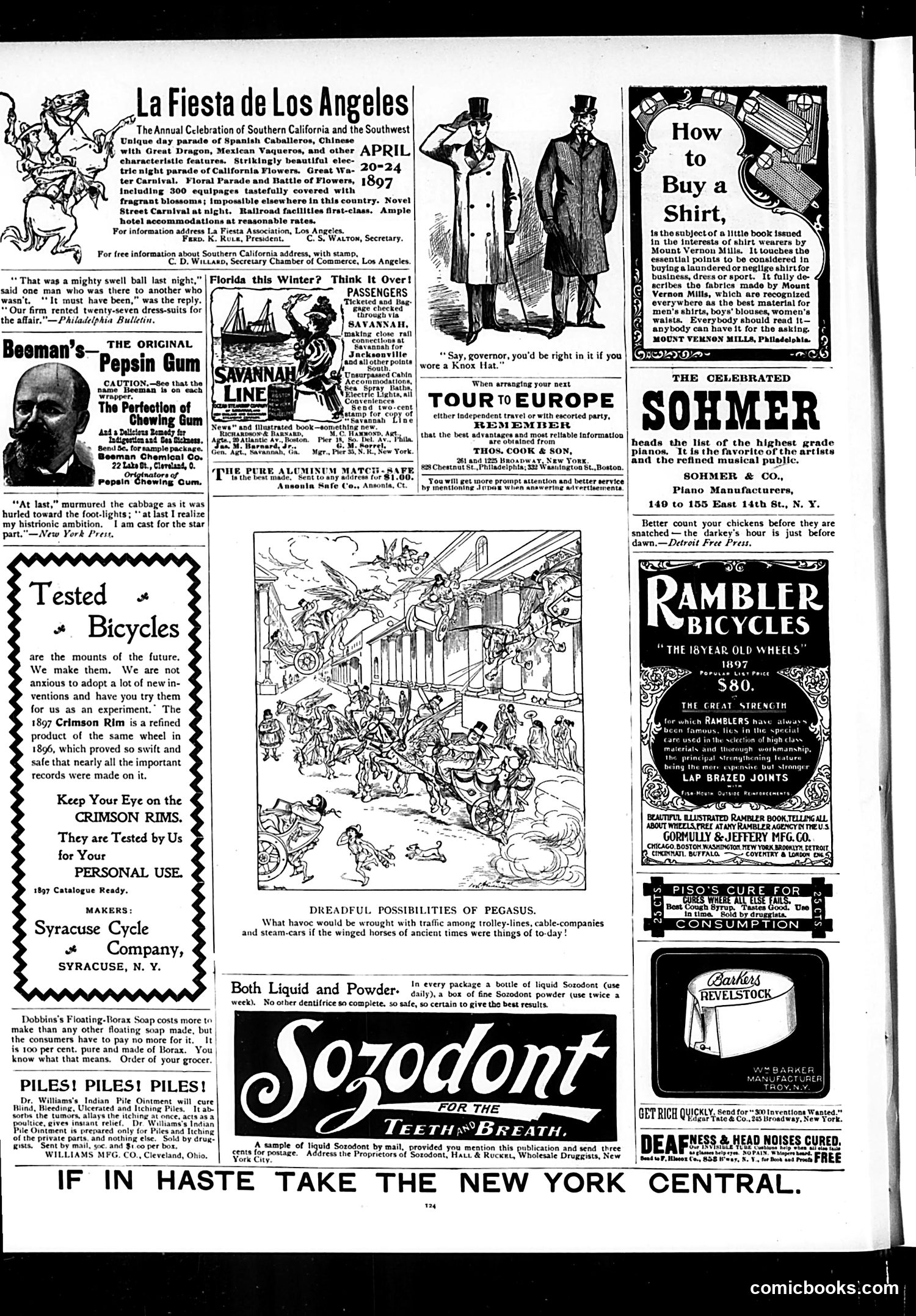
This is primarily an **advertising page** from Judge magazine (circa 1897, based on visible dates). The dominant content comprises commercial advertisements for products ranging from chewing gum to pianos, bicycles, and patent medicines. The single **cartoon element** titled "Dreadful Possibilities of Pegasus" appears as a detailed illustration showing chaotic urban street traffic—trolley lines, cable cars, and pedestrians—with the humorous caption imagining what would happen if Pegasus (the mythological winged horse) were loose among modern city transportation systems. This is gentle satire on the rapid modernization and crowding of late-19th-century American cities. The page also includes a prominent announcement for "La Fiesta de Los Angeles" (April 20-24, 1897), describing an elaborate festival celebrating California culture. Otherwise, the page consists almost entirely of commercial promotions typical of the era: medicines (Sozodont toothpaste, Piso's Cure), bicycles, pianos, and various consumer goods—reflecting how magazines sustained themselves through advertising revenue.
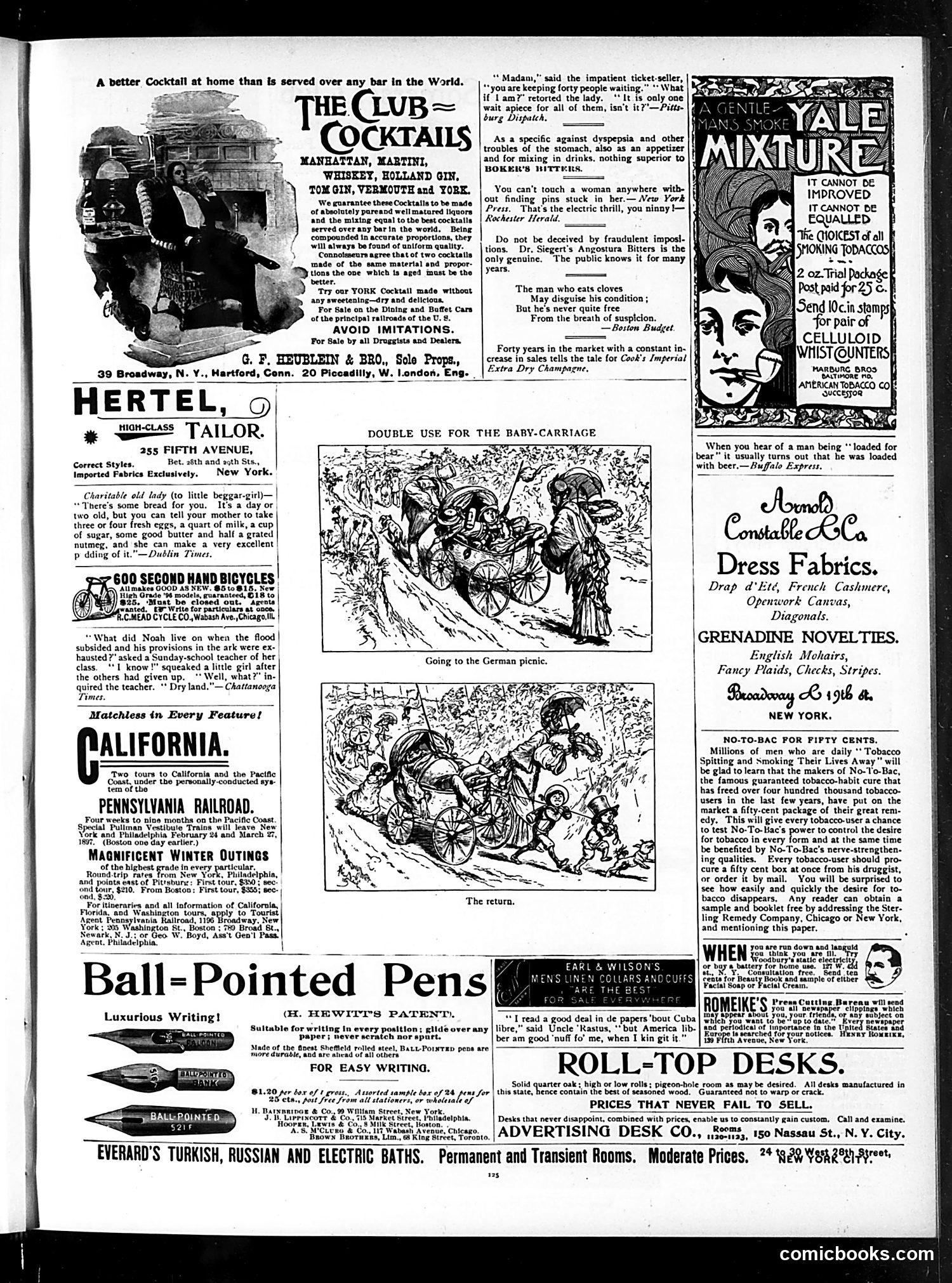
This page is predominantly **advertising**, typical of Judge's revenue model. However, it includes several humorous short jokes interspersed among product ads: **The visible jokes:** 1. **Ticket-seller exchange**: A woman delays a queue; when criticized, she responds that each person only waits "one wait apiece"—absurdist humor about female logic (reflecting period stereotypes). 2. **Woman and pins**: A crude observation about women's clothing, playing on the abundance of pins used in late-Victorian dress construction. 3. **Noah and provisions**: A Sunday-school joke where a child answers Noah survived on "dry land" after the flood—wordplay on literal versus figurative meaning. 4. **"Loaded for bear"**: A fragmentary joke (cut off) about misinterpreting the phrase as literal drunkenness rather than prepared-for-confrontation. These are gentle, domestic humor pieces reflecting turn-of-the-century attitudes toward gender and language. The page itself serves primarily as an advertising vehicle for cocktails, tailoring, bicycles, railroads, and patent medicines—the era's consumer goods.
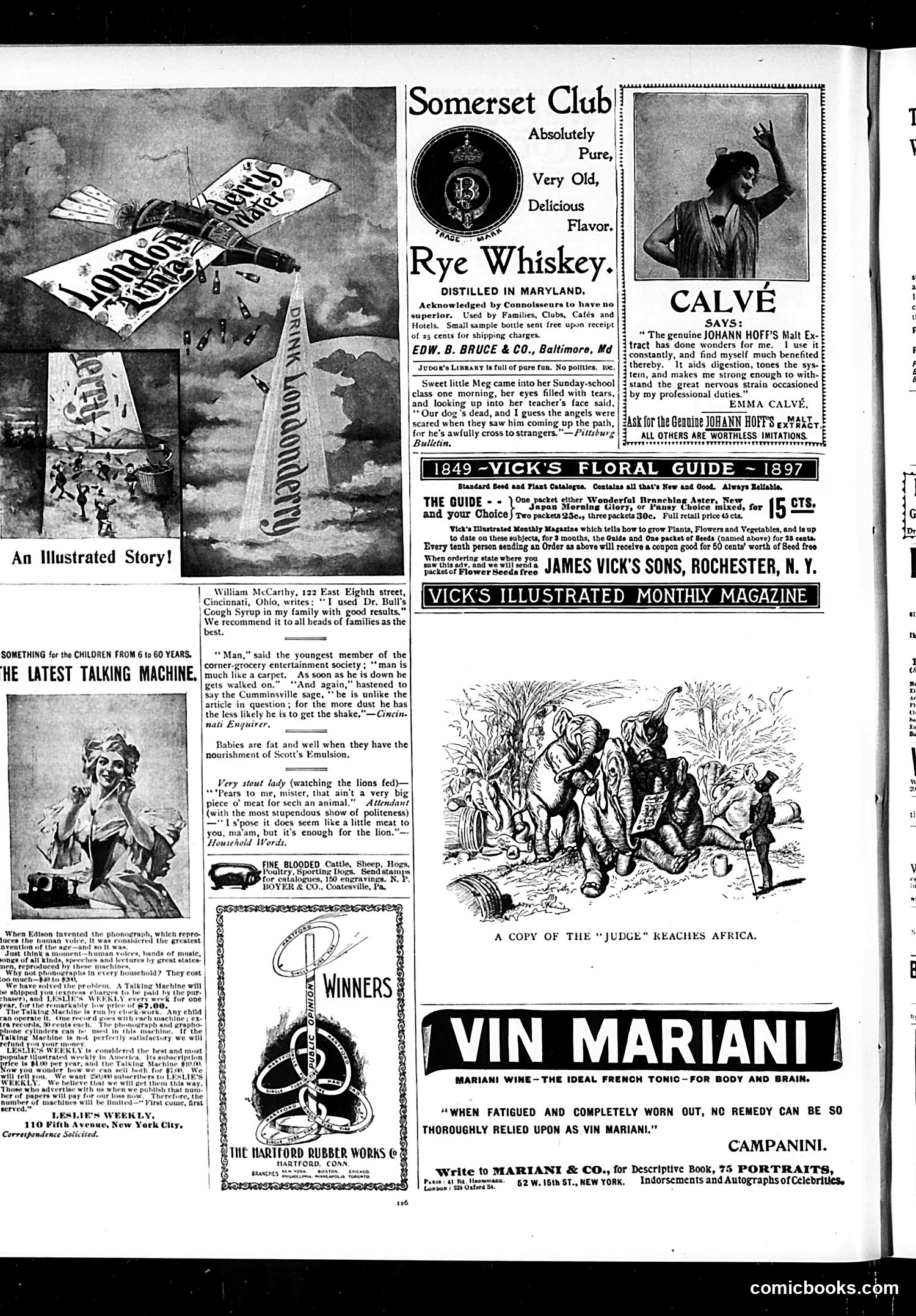
This page is primarily **advertising with minimal editorial content**. The dominant features are product advertisements typical of late-19th-century magazines: **Main Advertisements:** - Somerset Club Rye Whiskey (Maryland distilled) - Calvé (testimonial from opera singer Emma Calvé) - Vick's Floral Guide seed catalog - Vin Mariani (French tonic wine marketed as health remedy) - Johann Hoff's Malt Extract **Minor Comic Content:** Several brief anecdotes appear scattered among ads—including a children's Sunday school joke about a dog, and a joke about a stout woman watching lions being fed. These are generic humor pieces, not political satire. **Vick's Advertisement Features:** An illustration captioned "A Copy of the 'Judge' Reaches Africa" shows African figures, reflecting era-typical colonial imagery used to advertise the magazine's reach. **Historical Context:** This reflects the patent medicine and proprietary health tonic boom of the 1890s, when alcohol-based tonics (Vin Mariani, malt extracts) were marketed as cure-alls without regulation. The page demonstrates that Judge, while known for satirical cartoons, also generated revenue through extensive advertising.
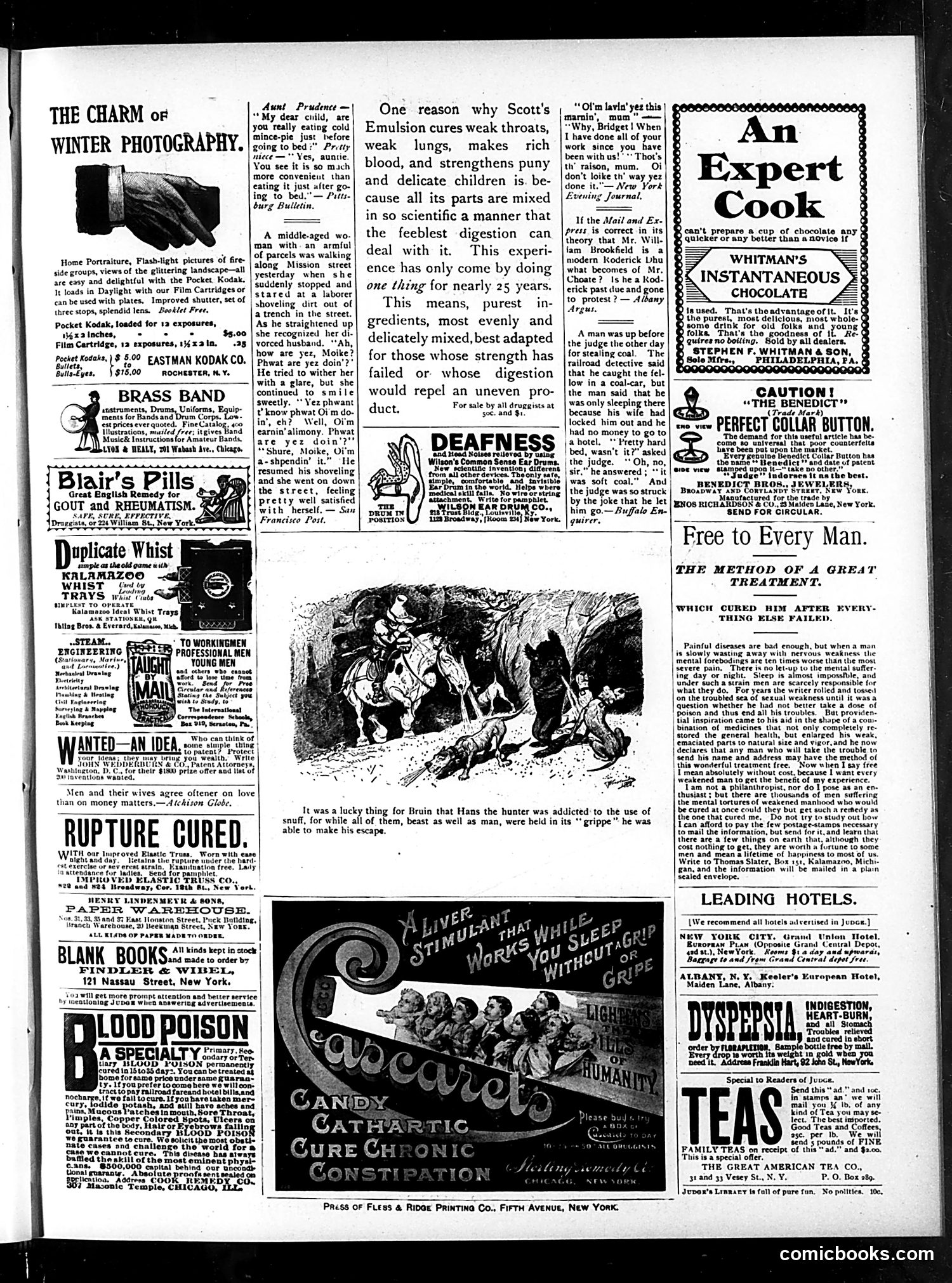
This page is primarily **advertisements and filler content** interspersed with brief humorous anecdotes, typical of Judge magazine's format. The visible cartoons/jokes include: **"Aunt Prudence"** - A domestic humor piece about a niece eating cold mince pie before bed, with the joke being her preference for convenience over propriety. **The divorced couple on Mission Street** - An Irish-dialect anecdote where a woman encounters her ex-husband shoveling dirt for alimony money. The humor relies on class reversal and the woman's satisfaction at his comeuppance. **Servant/employer exchange** - Brief dialogue where an Irish maid (Bridget) critiques her employer's housework, reversing the typical power dynamic for comedic effect. **The coal-stealing case** - A man caught sleeping in a railroad coal car claims his wife locked him out; the judge presumably found this amusing. The page reflects **late 19th/early 20th-century American humor**: stereotyped Irish dialects, domestic sarcasm, class-based comedy, and working-class situations. The heavy advertising suggests this was a commercial publication relying on patent medicines and consumer goods for revenue.
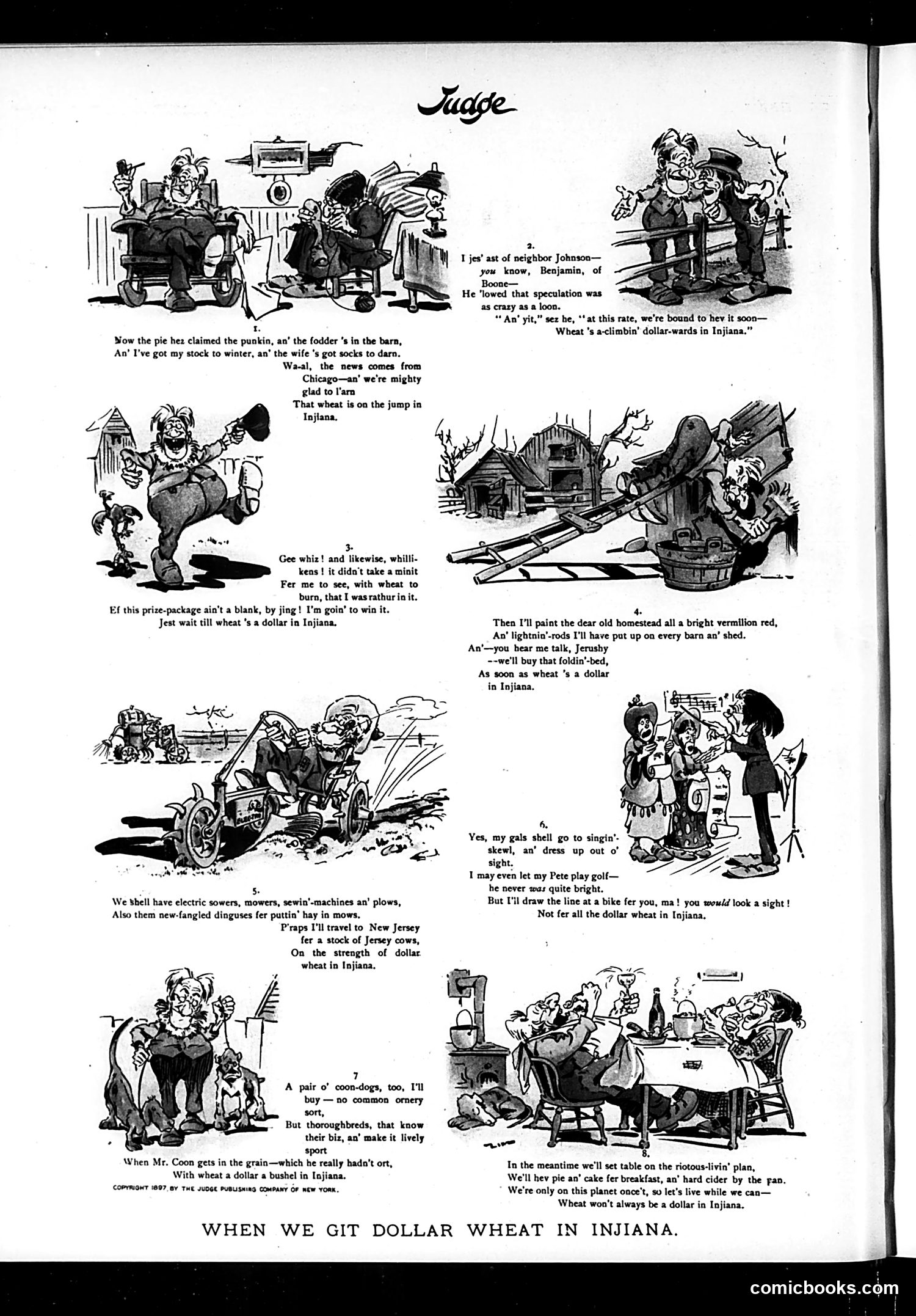
This is a comic narrative satirizing rural American optimism and speculation during a wheat price boom. The unnamed farmer protagonist, speaking in exaggerated rural dialect ("Injiana," "wa-al"), imagines elaborate spending plans if wheat reaches one dollar per bushel—electric farm equipment, Jersey cows, purebred hunting dogs, home improvements, and urban luxuries like bicycles and golf. The satire targets two things: farmers' naive belief that temporary commodity price spikes guarantee prosperity, and the tension between rural self-denial and urban consumerism. The farmer's fantasies escalate absurdly (even considering letting his son play golf), while the final panel reveals the joke's moral—indulgent "riotous livin'" during good times, knowing "wheat won't always be a dollar." The dialect and caricatured rural characters were period-standard for Judge's urban audience to mock agricultural speculation and rural materialism.