
Judge, 1897-02-20 · page 4 of 16
Judge — February 20, 1897 — page 4: what you’re looking at
What you’re looking at
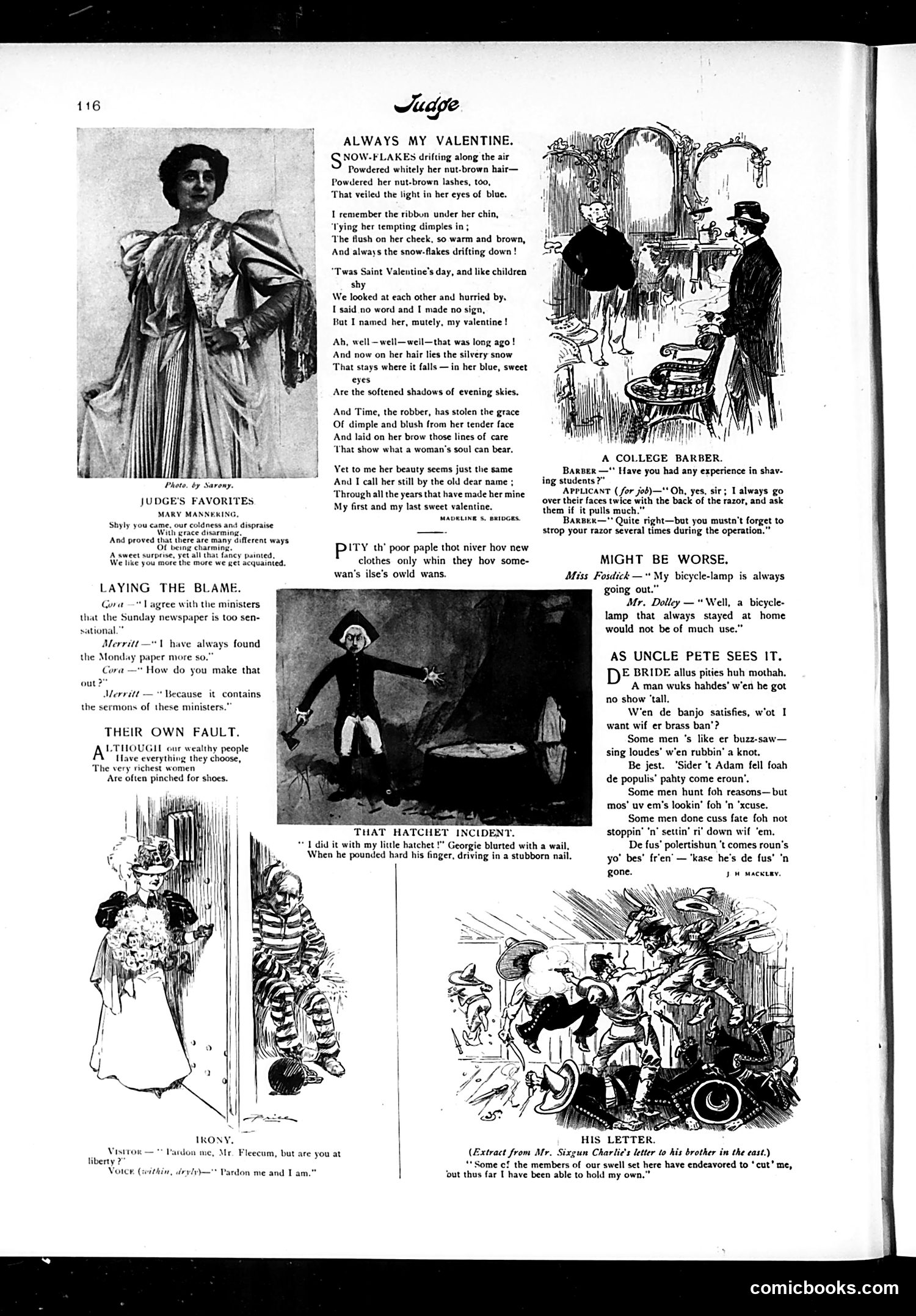
This page contains multiple short humor pieces typical of late 19th/early 20th-century American satire: **"Always My Valentine"** is a sentimental poem about aging love—contrasting a man's memory of a young woman on Valentine's Day with her present aged appearance, yet his enduring devotion. It's romantic rather than satirical. **The brief jokes** mock familiar social targets: Sunday newspapers criticized as sensational (blamed on ministers' Monday sermons), wealthy women lacking shoe choices despite wealth, and a college barber's inexperienced technique. **"As Uncle Pete Sees It"** uses dialect humor (an African American character's rural observations) to comment on human nature—men's contradictions, political opportunism, and fate. This represents period humor that relied on racial stereotyping for comic effect. **"That Hatchet Incident"** is a pun-based children's joke about a boy hitting his finger while nailing. The cartoons are largely *domestic* and *social* humor rather than political satire—focused on relationships, class anxieties, and everyday foolishness rather than current events or politicians.
📄 Transcribed text from this page (OCR, searchable)
Machine-transcribed from the original scan — historical spelling and the odd misread are preserved.
Hi by Sarony. FAVORITES « And proved that there are man; Df being charming A sweet surprise, yet all that fancy painted, We like you more the more we get acquainted, LAYING THE BLAME. Gora —“Lagree with the ministers that the Sunday newspaper is too sen- sational.”* Merritt —"\ have al the Monday paper more so. Cora —* How do you make that out?” Merritt —* Because it contains the sermons of these ministers.” 's found THEIR OWN FAULT. LTHOUGIL our wealthy people Have everything they choose, The very richest women Are often pinched for shoes. IRONY, Vistror —"* Vardon me, Mr Fleecum, but are you at liberty 2” Voice (within, dryly)—"* Pardon me and Tam." uage ALWAYS MY VALENTINE, GNOW-FLAKES drifting along the air Powdered whitely her nut-brown hair— Powdered her nut-brown lashes, too, That veiled the light in her eyes of blue. I remember the ribbun under her chin, “Tying her tempting dimples in ; ‘The flush on her cheek, so warm and brown, And always the snow-flakes drifting down ! “Twas Saint Valentine's day, and like children shy We looked at each other and hurried by, I said no word and I made no sign, But I named her, mutely, my valentine ! Ab, well—well—weil—that was long ago! And now on her hair lies the silvery snow That stays where it falls — in her blue, sweet eyes, Are the softened shadows of evening skies. And Time, the robber, has stolen the grace Of dimple and blush from her tender face And laid on her brow those lines of care ‘That show what a woman's soul can bear. Yet to me her beauty seems just the same And I call her still by the old dear name ; ‘Through all the years that have made her mine My first and my last sweet valentine, MADRLINE S. axIDGRS ITY th’ poor paple thot niver hov new clothes only whin they hov some- wan’s ilse’s owld wans. AE Oe 4 THAT HATCHET INCIDENT. ** L did it with my little hatchet !" Georgie blurted with a wail, When he pounded hard his finger, driving in a stubborn nail. Miss Fosdick — A COLLEGE BARBER. Barner —" Have you had any experience in shav- ing students ?* APPLICANT ( for job)—"' Oh, yes, sir; L always go over their faces twice with the back of the razor, and ask them if it pulls much.” Barbex—" Quite right—but you mustn't forget to strop your razor several times during the operation.” MIGHT BE WORSE. My bicycle-lamp is always going out.” Mr. Dolley —" Well, a bicycle- lamp that always stayed at home would not be of much use.” AS UNCLE PETE SEES IT. E BRIDE allus pities huh mothah. A man wuks hahdes’ w'en he got no show ‘tall. W'en de banjo satisfies, w'ot I want wif er brass ban’? Some men ‘s like er buzz-saw— sing loudes’ w'en rubbin’ a knot. Be jest. ‘Sider ‘t Adam fell foah de populis’ pahty come eroun’. Some men hunt foh reasons—but mos’ uv em’s lookin’ foh ‘n ‘xcuse. Some men done cuss fate foh not stoppin’ ‘n’ settin’ ri’ down wif ‘em. De fus’ polertishun ‘t comes roun’s yo" bes’ fr'en’ — ‘kase he's de fus’ ‘n gone. JM stacktay, (Extract from Mr. Sixgun Charlie's letter to his brother in the east.) ‘*Some cf the members of our swell set here have endeavored to ‘cut’ me, ‘out thus far I have been able to hold my own,” comicbooks.com