
A complete issue · 16 pages · 1896
Judge — December 12, 1896
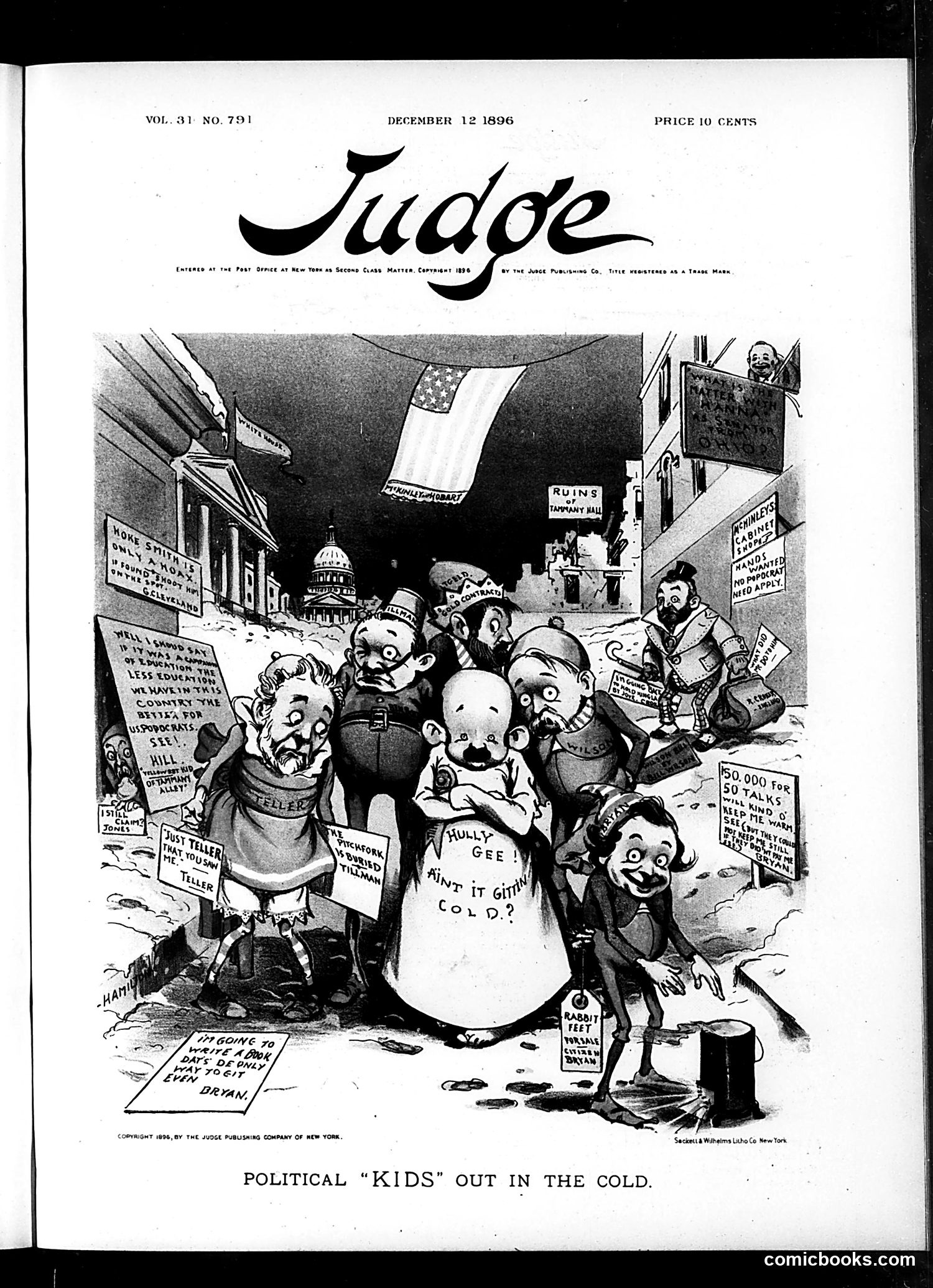
This December 1896 cartoon satirizes Republican political figures portrayed as irresponsible children abandoned in winter. The central oversized baby labeled "Gee! Ain't it gittin' cold?" appears to represent a key Republican policy or politician facing hardship. The surrounding caricatured "kids" hold signs referencing contemporary political failures—visible references to tariffs, education inadequacy, and financial troubles. The ruins of buildings and Capitol dome in the background suggest institutional collapse or mismanagement. The "cold" likely metaphorically represents economic hardship or political consequences. The cartoon suggests Republican leadership has neglected governance, leaving their policies and supporters vulnerable. The exact identities of some figures remain unclear without additional historical context, though the overall message criticizes Republican incompetence or abandonment of responsibility during this election year.
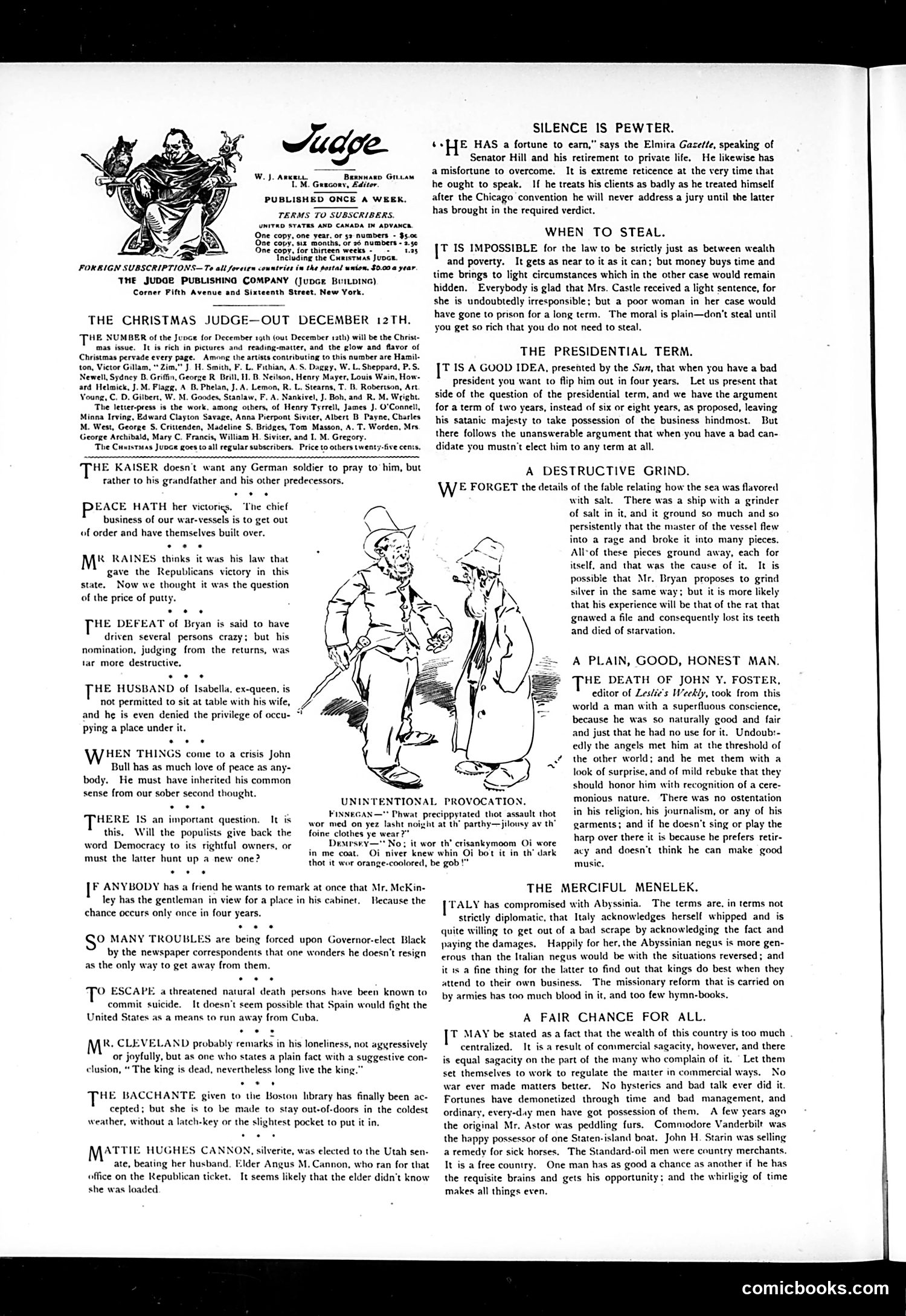
This page contains editorial commentary rather than political cartoons. The main illustration depicts two figures in what appears to be a satirical scene labeled "UNINTENTIONAL PROVOCATION," though the specific context is unclear from the image alone. The text discusses various political and social issues including Senator Hill's silence on matters of state, presidential term limits, Bryan's political defeat, and Italy's negotiations with Abyssinia (Ethiopia). One section mocks the exclusion of women from dining privileges based on marital status. The cartoon itself is difficult to interpret without clearer context, but the surrounding editorials suggest Judge was critiquing political figures' inaction, presidential politics, and contemporary diplomatic situations—typical of late 19th/early 20th-century American political satire.
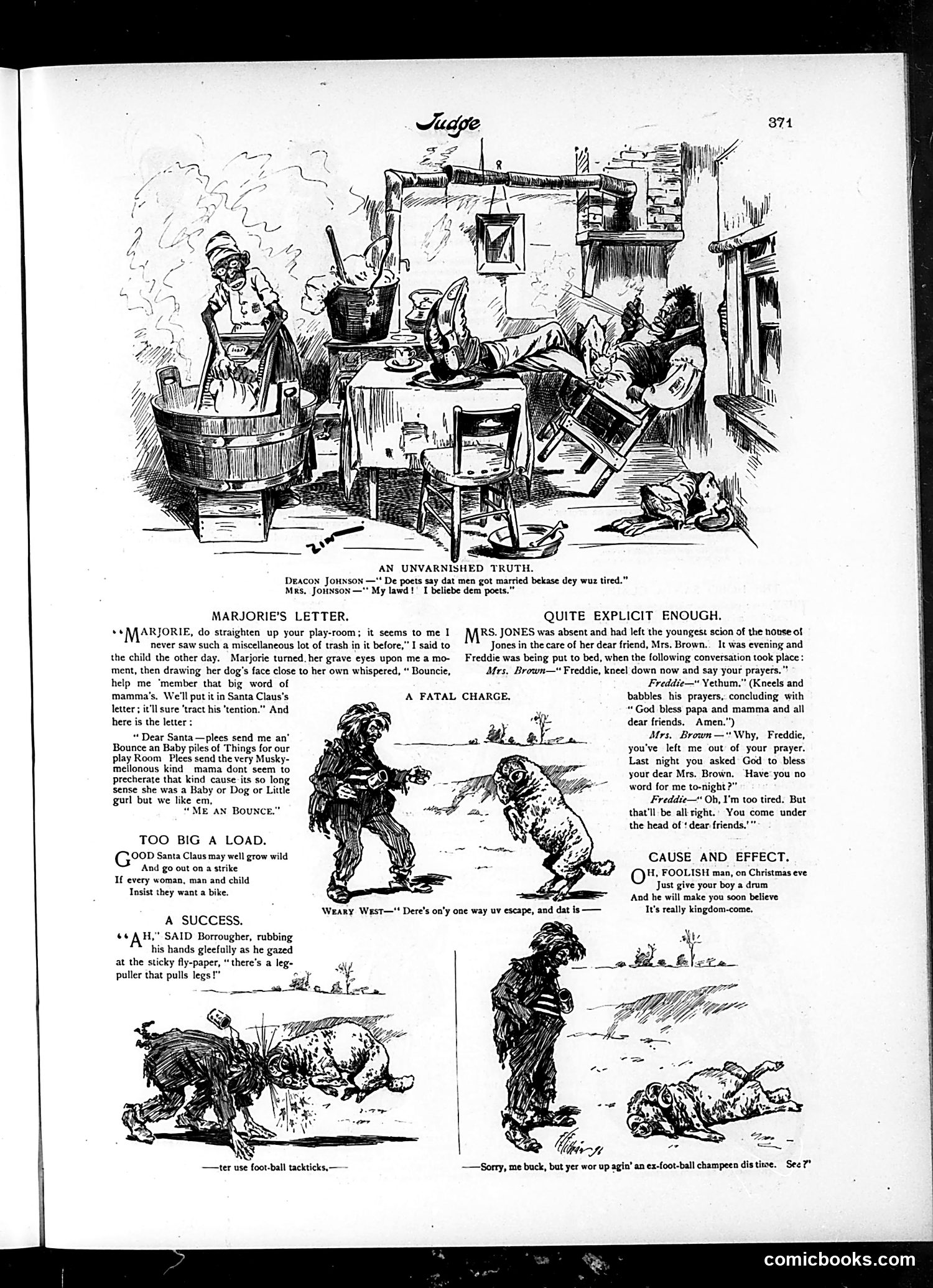
This page contains several humorous sketches and brief comic pieces typical of Judge's satirical format. The top illustration, "An Unvarnished Truth," depicts a domestic scene with multiple figures in what appears to be a modest home, likely satirizing working-class life or domestic discord. The text pieces include "Marjorie's Letter," "Too Big a Load," and others featuring wordplay and slapstick humor. The dog illustrations—showing canines in various predicaments—appear to be standalone visual gags rather than political satire. "A Fatal Charge" and subsequent sketches continue the comedic tone with domestic and animal-related humor. Overall, this page emphasizes personal/domestic satire and puns rather than political commentary, which was common in Judge's mixed content approach during this era.
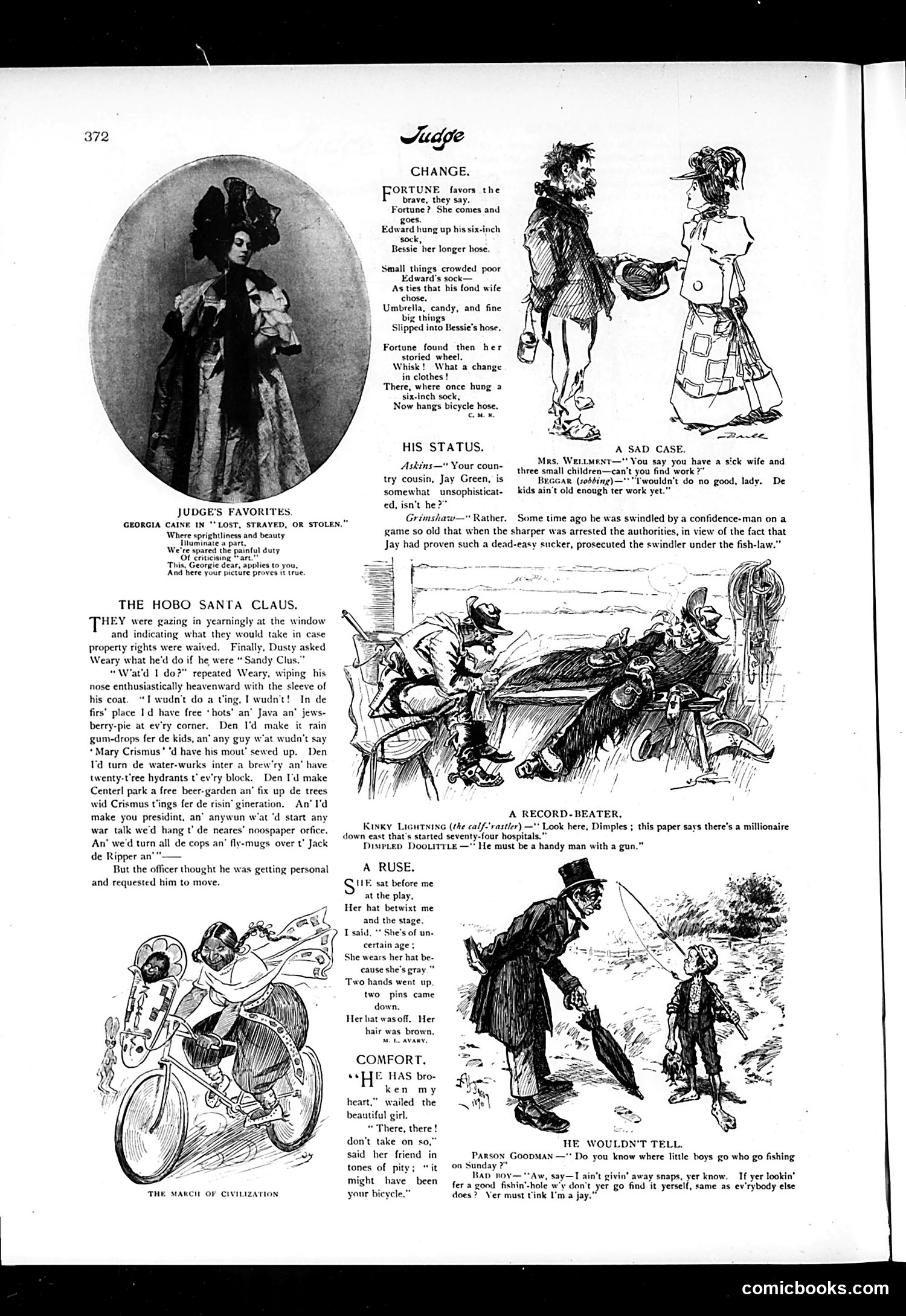
This page from *Judge* magazine contains several satirical pieces reflecting early 20th-century American humor: **"Change"** mocks the reversal of fortune—Edward's expensive six-inch socks get replaced by bicycle hose, suggesting unexpected social or financial downturns treated as comedy. **"The Hobo Santa Claus"** features working-class characters ("Weary" and "Dusty") fantasizing about impossible redistributions of wealth and resources if they controlled society. It satirizes both poverty and utopian thinking. **"A Sad Case"** shows an unemployed man claiming even work won't help because his children are too young—a dark joke about poverty's inescapability, presented without sympathy. **"A Ruse"** jokes about a woman removing her hat at a theater, revealing brown hair despite claiming gray hair explained her hat-wearing. The humor relies on vanity and deception. **"He Wouldn't Tell"** features a parson (clergyman) refusing to reveal where boys go fishing, suggesting such information is secret or shameful—likely innuendo about youth misbehavior. The tone throughout is dismissive toward working-class struggles and human weakness.
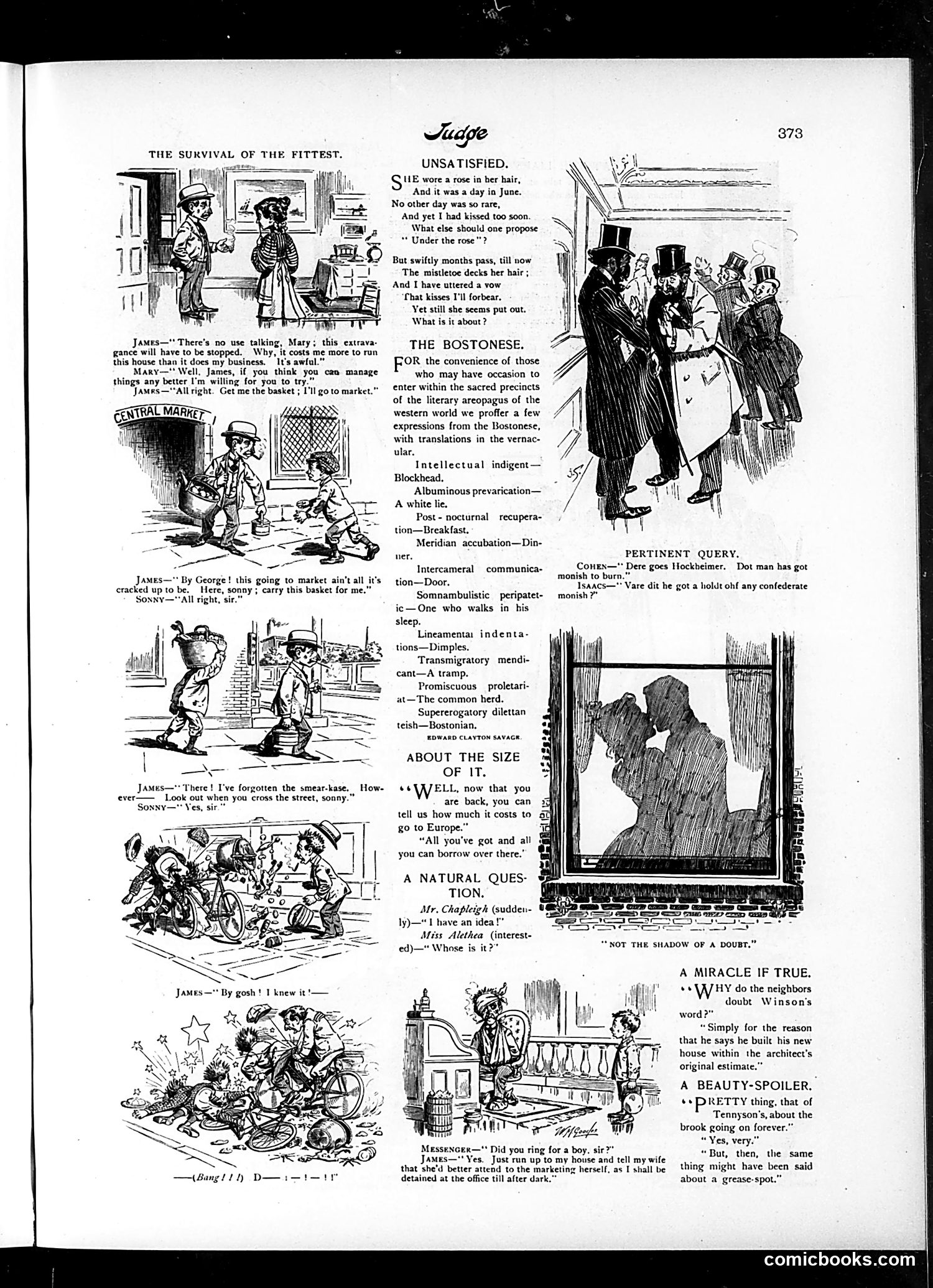
This 1880s satirical page contains several unrelated humor pieces typical of the era: **"The Survival of the Fittest"** mocks domestic economics through slapstick: a husband convinced he can manage household expenses better than his wife attempts marketing, only to cause a child to be hit by a streetcar—the "fittest" surviving through natural selection, ironically darkening the joke. **"The Bostonese"** ridicules Boston intellectuals' pretentious vocabulary, providing mock-translations of their affected speech into plain English (e.g., "intellectual indigent" = blockhead). This reflects period class anxiety about educated elites. **Other pieces** include romantic/domestic humor ("Unsatisfied"), travel cost jokes, and wordplay ("whose idea is it?"). **The illustration** "Not the Shadow of a Doubt" appears to reference skepticism about someone's claims. The page reflects Gilded Age preoccupations: gender roles, class pretension, immigrant dialect humor, and consumerism. The humor relies heavily on slapstick, puns, and social stereotyping now considered crude.
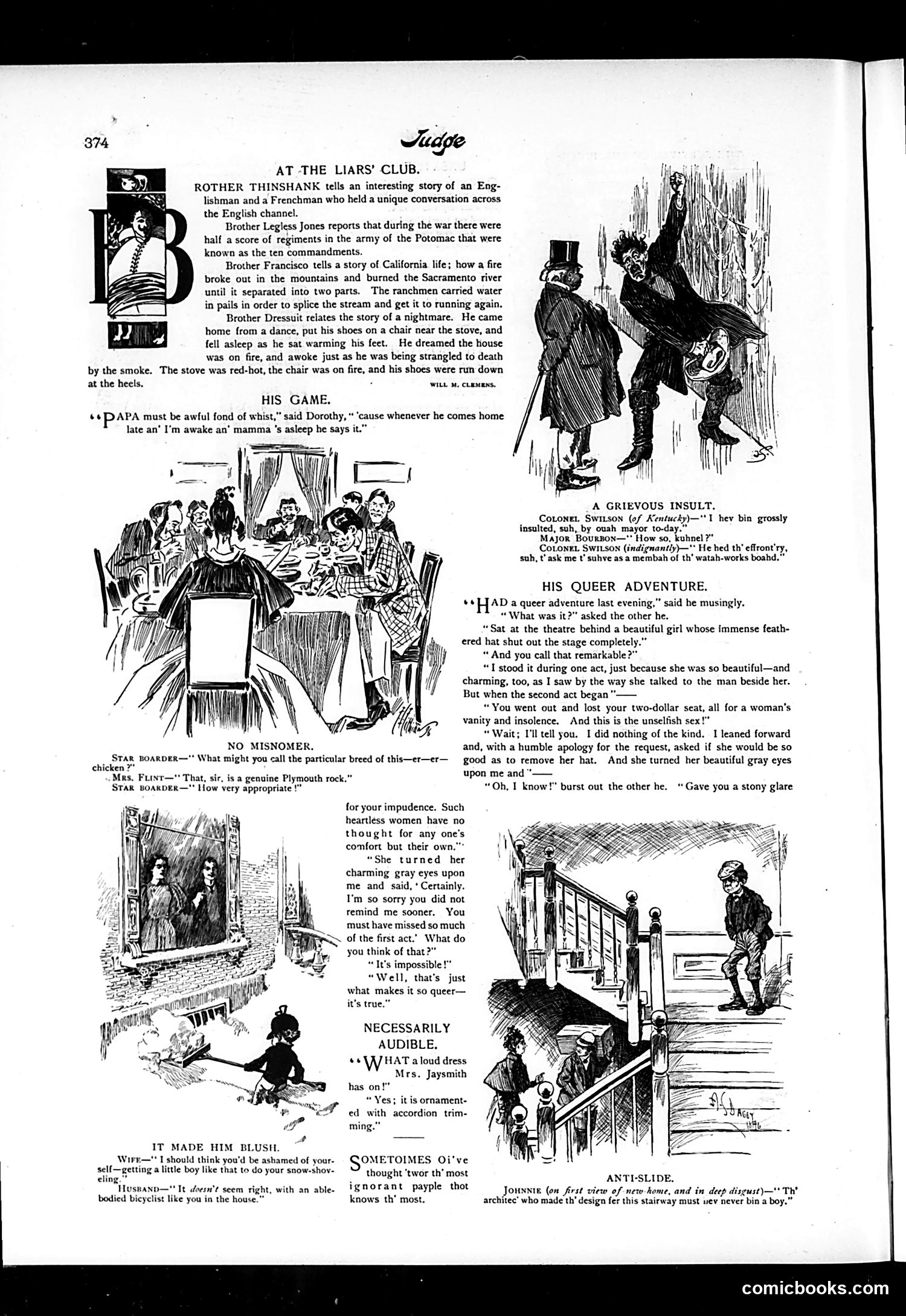
This page from Judge magazine contains multiple short humorous pieces typical of the publication's satirical style: **"At the Liars' Club"** presents absurdist tall tales—exaggerated stories involving Civil War regiments, a fire that splits a river, and a nightmare with burning shoes. The humor relies on deliberately implausible scenarios. **"His Game"** is a brief domestic joke where a child misunderstands her father's late-night card games as something requiring secrecy from her mother. **"A Grievous Insult"** uses dialect humor (Kentucky colonels speaking in exaggerated Southern accent) to satirize social pretension—the colonel considers being asked to serve on a water-works board as an insult. **"His Queer Adventure"** subverts expectations: a man expects to complain about a woman's theater hat blocking his view, but she graciously removes it, confounding his anticipated grievance. Additional short pieces mock fashion ("audible dress"), gender stereotypes, and physical humor. The illustrations complement each joke with period-appropriate line drawings. Overall, the page reflects late-19th/early-20th-century American humor conventions emphasizing wordplay, social observation, and domestic situations.
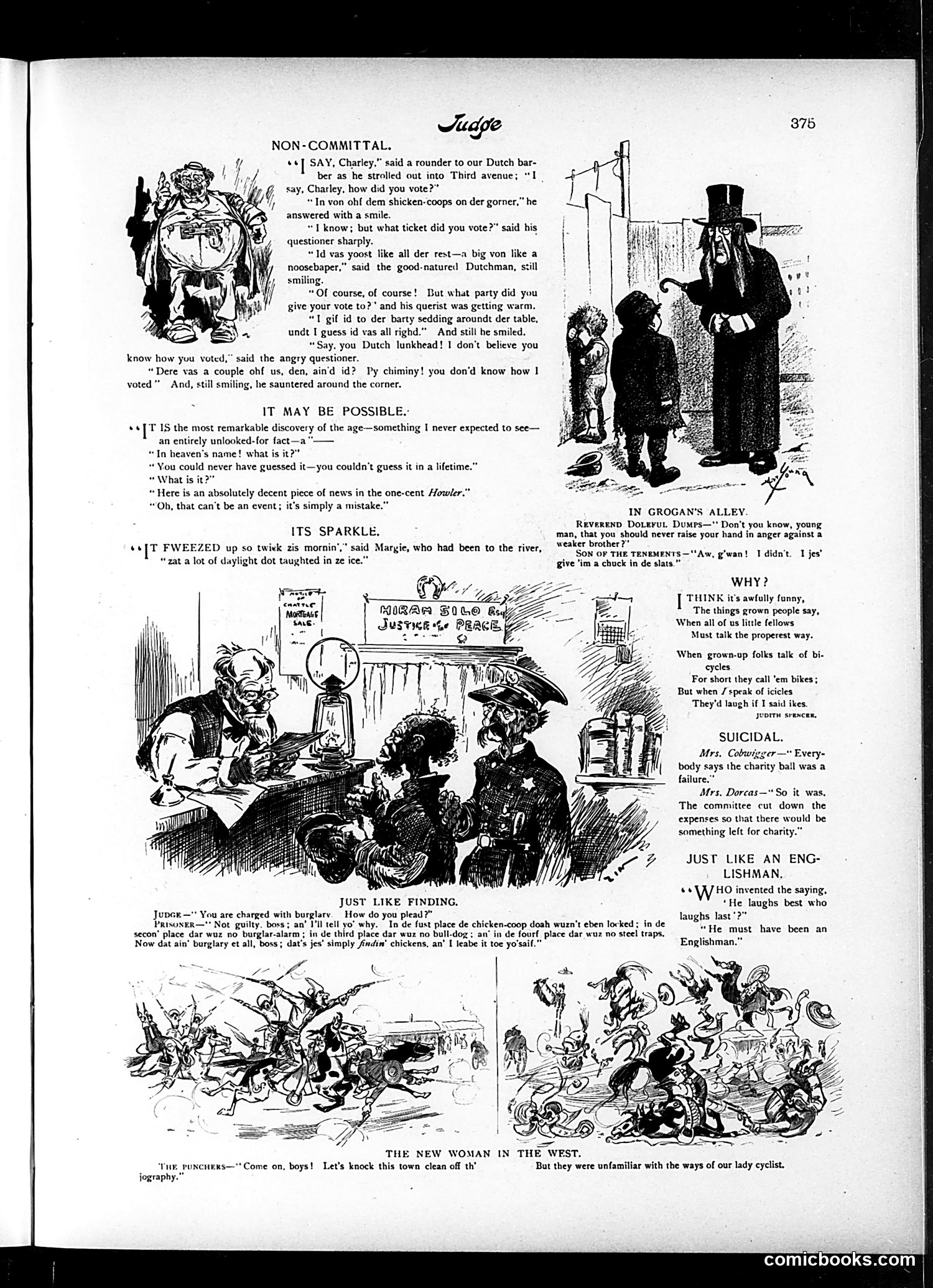
This page from *Judge* (a 19th-century American satirical magazine) contains multiple short humor pieces mocking various social types: **"Non-Committal"** ridicules an apolitical Dutch immigrant barber who votes without understanding politics—he describes his ballot as "a big von like a noosebaper" and admits ignorance when pressed about his choice. The satire targets both immigrant voters perceived as uninformed and political disengagement. **"Just Like Finding"** presents a burglar's absurd legal defense: he claims stealing chickens isn't burglary but "finding" because the coop lacked locks, alarms, or guard dogs. The joke satirizes criminal logic. **"The New Woman in the West"** depicts female cyclists (the "new woman" of the era) confusing frontier vigilantes, who expect traditional feminine behavior. The humor targets the novelty of independent, athletic women. Other brief pieces mock charity fundraisers, social hypocrisy, and linguistic quirks. The overall tone reflects late 19th-century American humor: dismissive toward immigrants, criminals, and women's changing social roles.
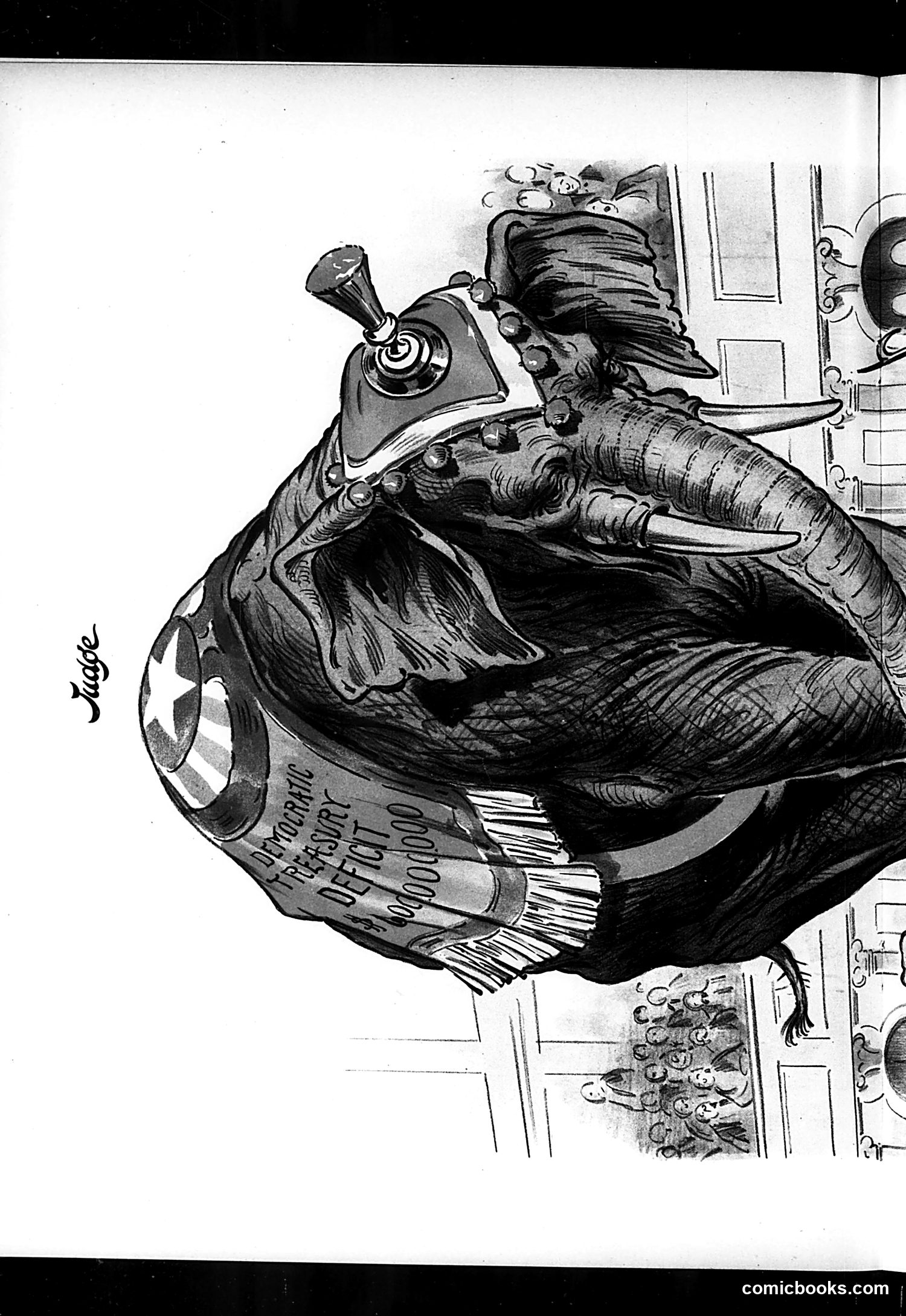
This appears to be a political cartoon from *Judge* magazine, though the OCR text is too corrupted to read clearly. The image shows a caricatured figure in formal dress holding what appears to be a spray device or weapon. The figure has exaggerated features typical of early 20th-century satirical illustration. There's text on a banner or label that's partially visible but difficult to decipher completely in this image quality. The artistic style and caricature technique suggest this is commentary on a political or social figure of the period, but without legible text, I cannot definitively identify who is being satirized or what specific issue is being addressed. The spray device may reference a particular policy or action, but this remains unclear from the visible elements alone.
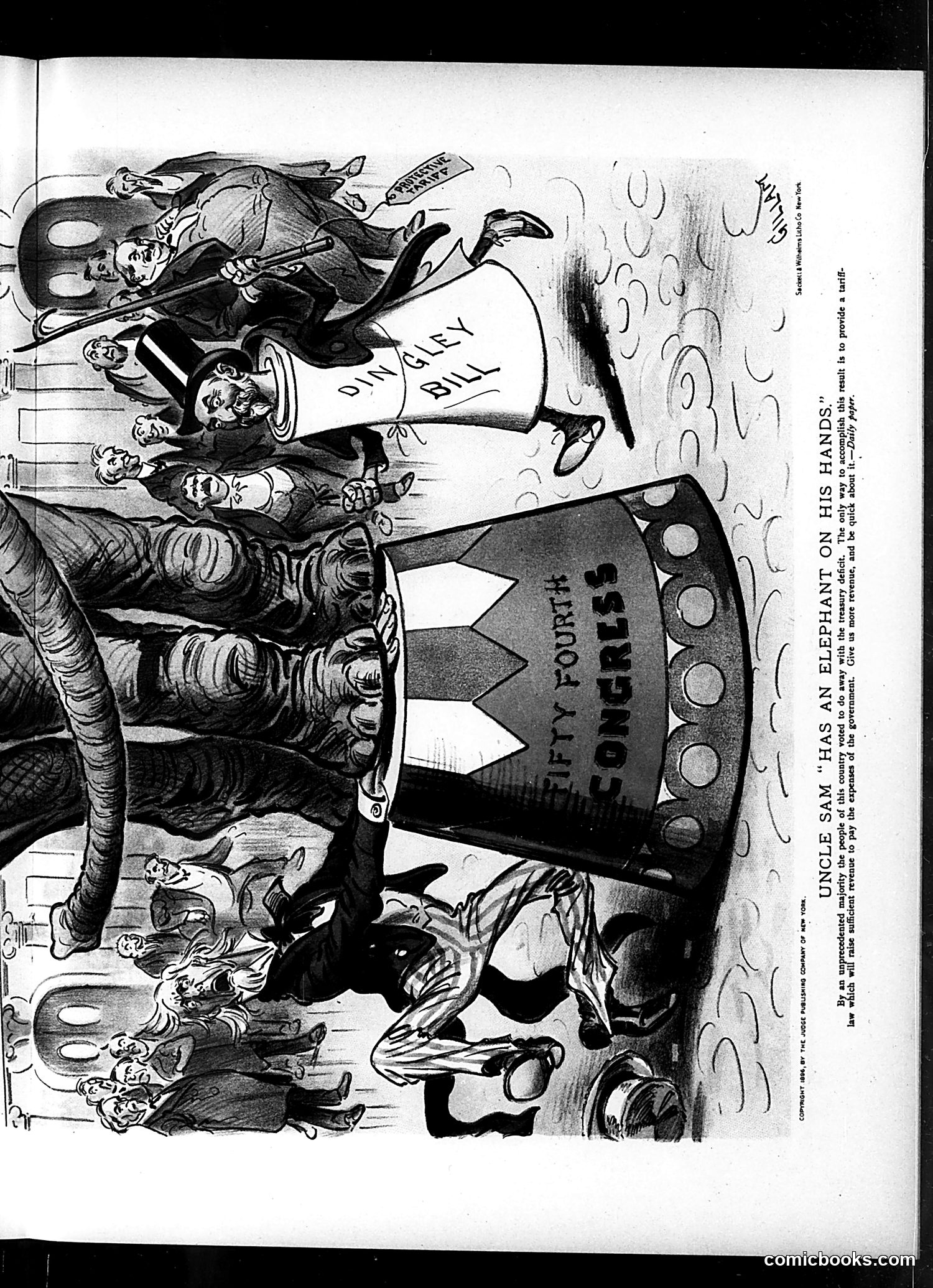
This appears to be a satirical cartoon from *Judge* magazine titled "Uncle Sam Has an Elephant on His Hands." The image depicts Uncle Sam (identifiable by his characteristic top hat and appearance) struggling to manage a large elephant labeled "Fifty-Foot Congress," while various political figures crowd around him demanding attention. The "elephant" likely references the Republican Party (whose symbol is the elephant), suggesting Congress has become an unwieldy, burdensome institution. The figures surrounding Uncle Sam appear to represent different political factions or special interests competing for his attention and resources. The cartoon's satire critiques the difficulty of managing a fractious Congress and competing political demands. Without a clear date visible, the specific legislative crisis being referenced remains unclear, though the imagery suggests commentary on Congressional dysfunction and the strain it places on federal governance.
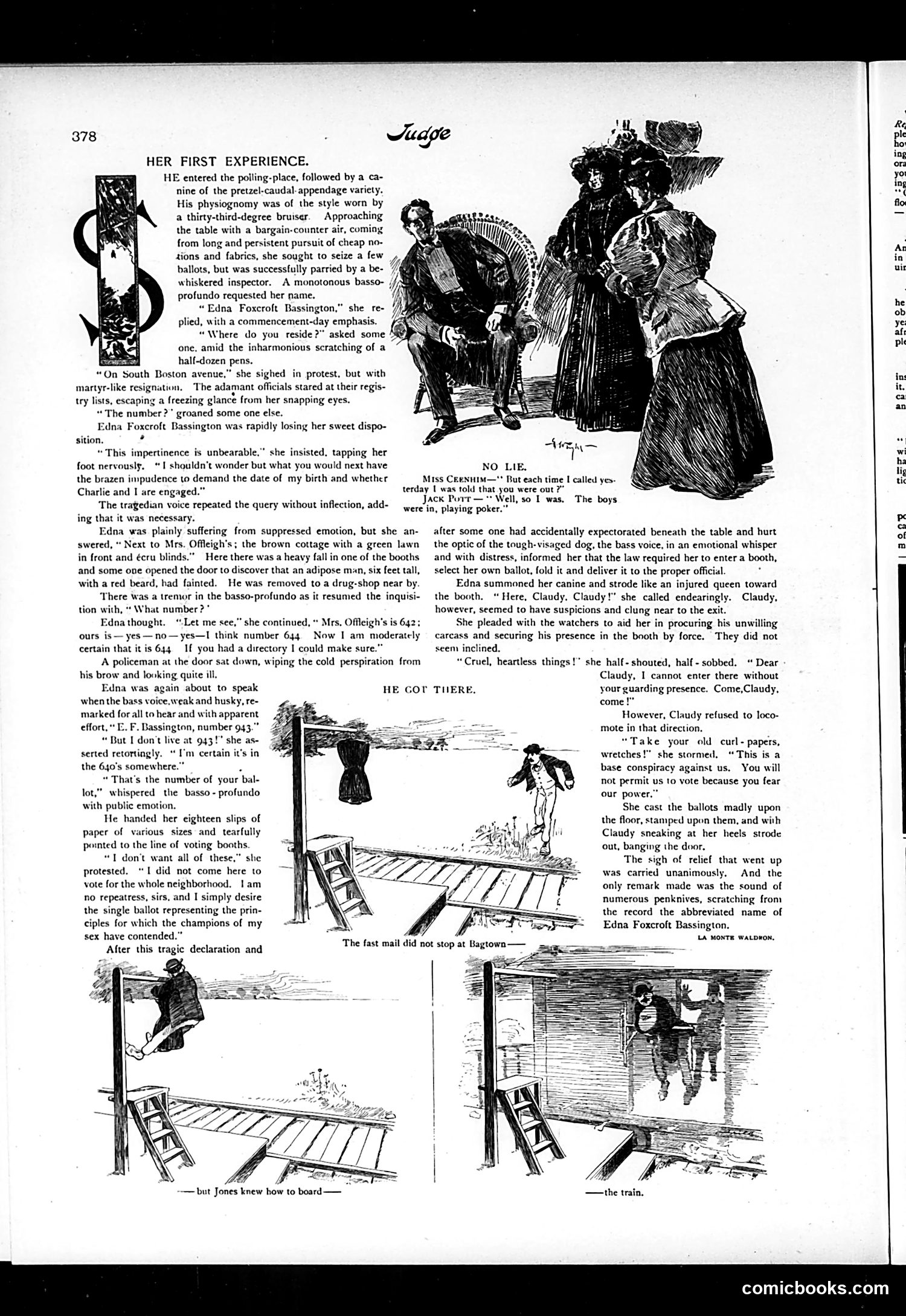
This satirical story mocks a woman voter's first experience at the polls. Edna Foxcroft Bassington, characterized as imperious and dismissive, arrives with a dog and demands to simply "seize a few ballots" without the standard registration procedures. The humor derives from her indignation at routine questioning—address, residence number—which she finds unnecessarily intrusive. When officials insist she must enter a voting booth alone to select and fold her own ballot, she protests, believing she shouldn't need to follow such procedures. The satire targets both female suffrage advocates (portraying the first woman voter as foolishly demanding) and the absurdity of male election officials' patronizing resistance to women voting. Her demand for a "single ballot" representing women's principles, combined with her general imperviousness and the comic chaos of her dog, suggests Judge magazine's skepticism toward women's voting rights during the suffrage era.
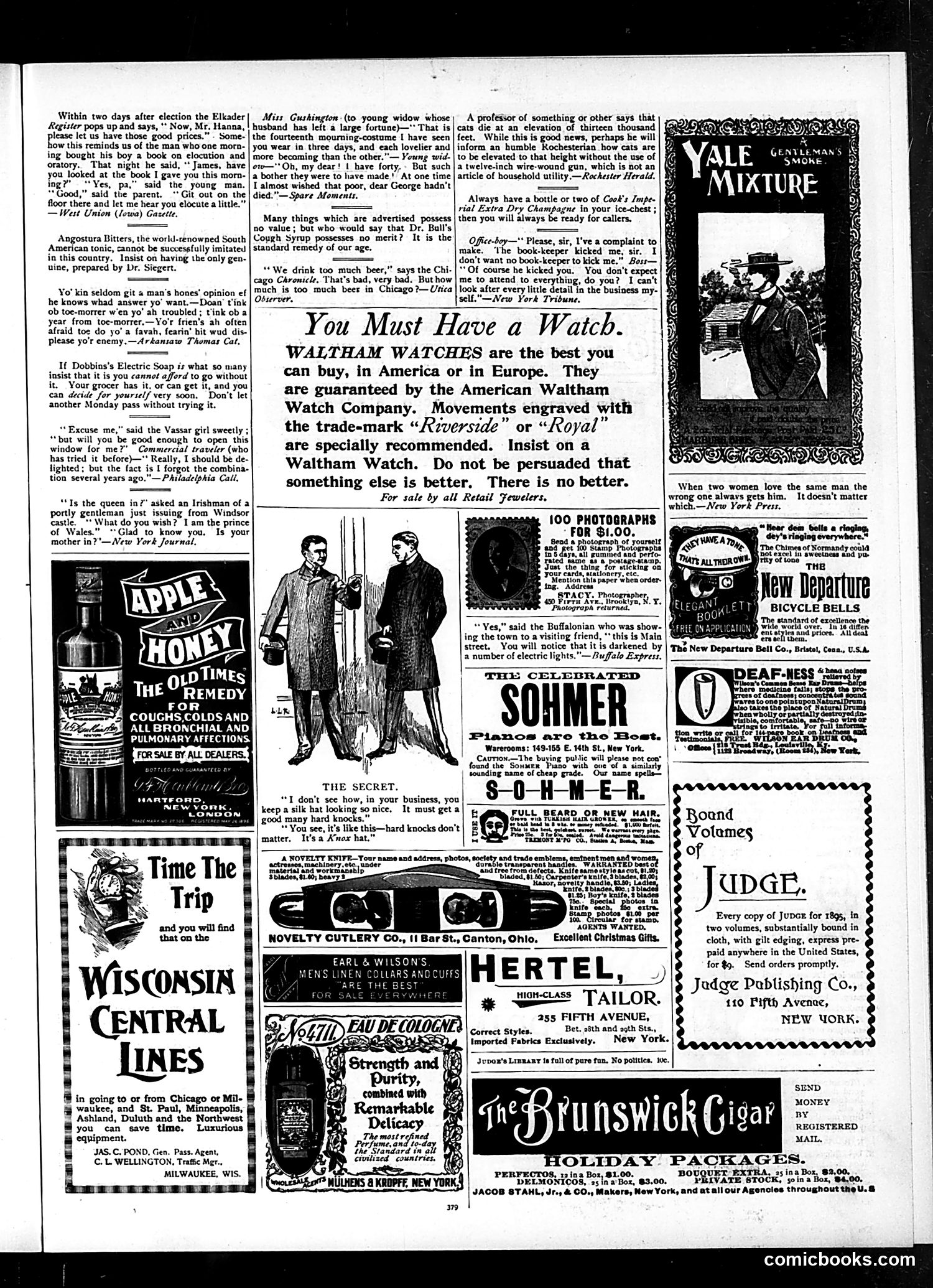
This page from *Judge* magazine is primarily **advertising**, with several brief satirical items interspersed. The notable satirical content includes: **Political reference**: A brief item about the "Elkader Register" requesting good prices from someone named "Hanna" after an election. This likely refers to **Mark Hanna**, the powerful Republican political operative and McKinley ally, suggesting newspapers would curry favor with political power brokers immediately after electoral victories. **Social satire**: Several short jokes mock pretension and hypocrisy—a Vassar girl's presumption, an Irishman's irreverence toward royalty, a widow's excessive mourning costumes, and a boss's indifference to employee mistreatment. The remainder is **product advertising**: Waltham watches, Angostura Bitters, Dobbins's Electric Soap, Dr. Ball's Cough Syrup, Cook's Champagne, and various other goods typical of early 1900s marketing. The page reflects *Judge*'s format: light social commentary mixed with commercial promotion aimed at middle-class American readers.
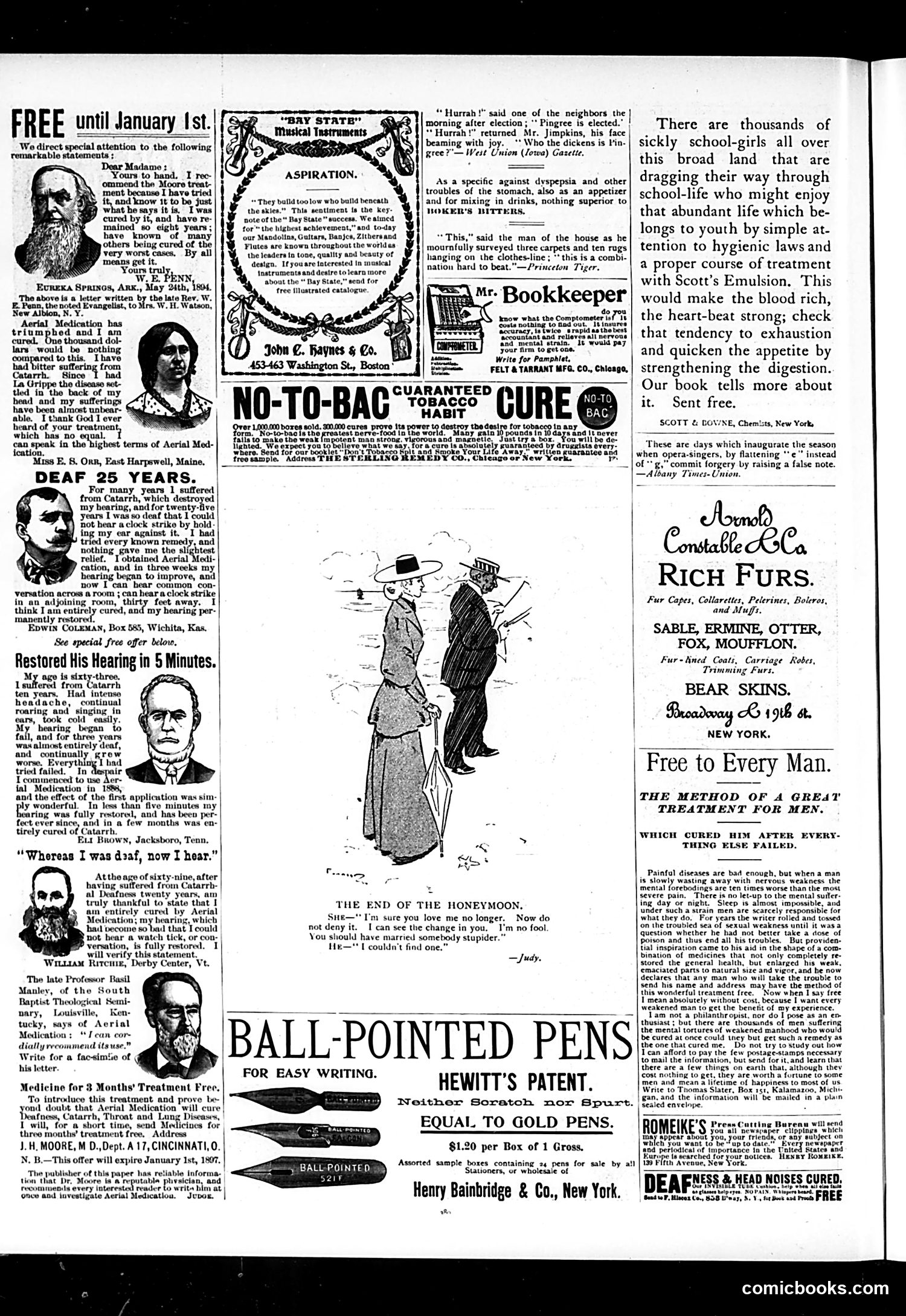
This page is primarily **advertising and testimonials**, not political satire. It contains multiple "cure-all" medical ads typical of the 1800s, including: **"Aerial Medication"** — a patent treatment claiming to cure deafness and catarrah (respiratory illness), supported by testimonial letters from named individuals describing miraculous recoveries. **"No-To-Bac"** — a tobacco-cessation product promising to cure nicotine addiction. **Other ads** for ball-point pens, a "Comptometer" (early calculator), and fur sales. The one cartoon visible shows a couple labeled "The End of the Honeymoon," depicting marital discord—a common Judge magazine joke theme unrelated to the medical content. **For modern context**: These ads represent the largely unregulated patent medicine industry of the era. Such testimonials were common marketing tactics, often fabricated. The Federal Food and Drug Administration didn't regulate such claims until 1906.
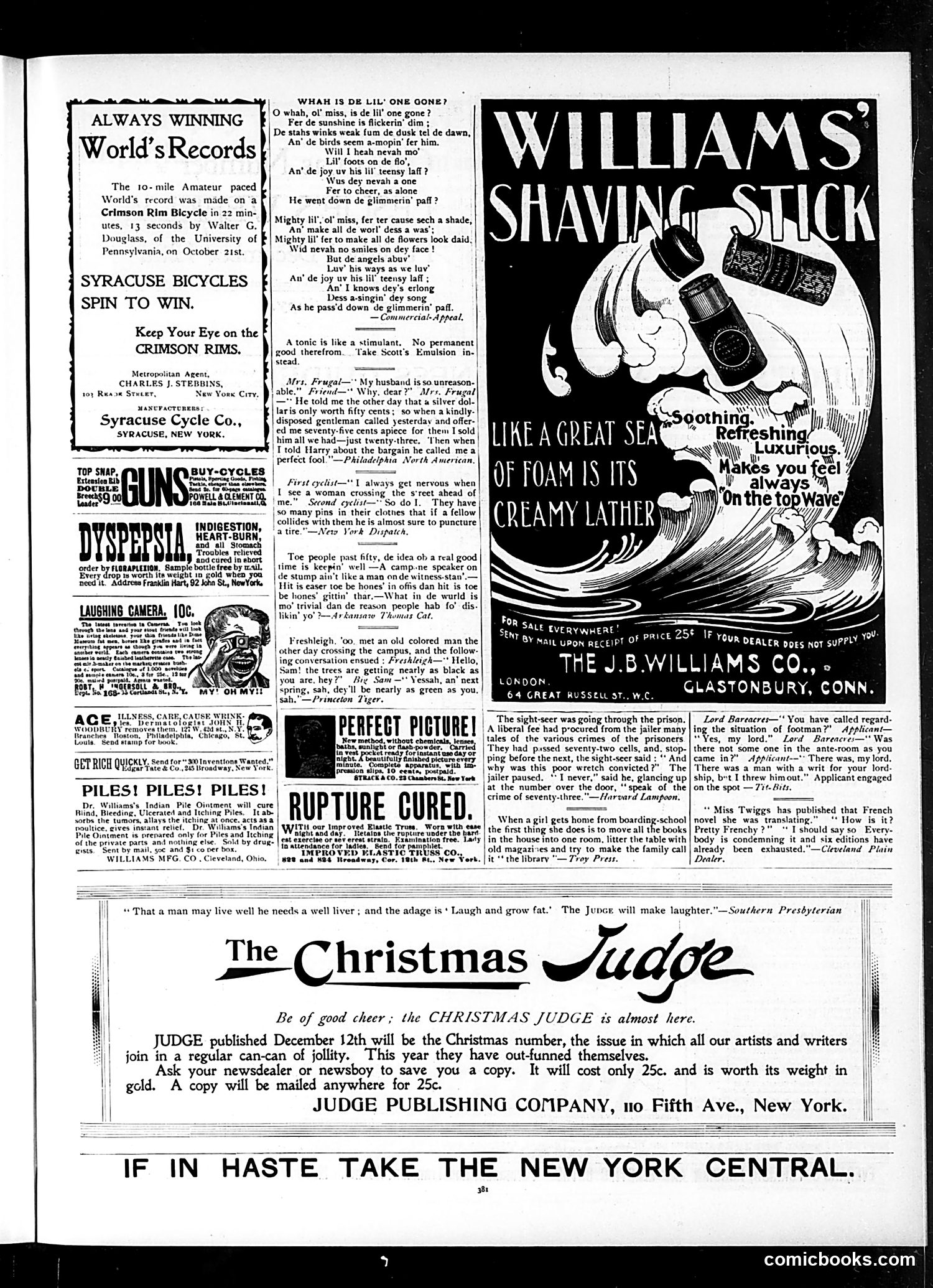
This page is primarily advertising and light humor rather than political satire. The main content consists of: 1. **Product advertisements**: bicycles, medical remedies (for piles, indigestion, rupture), and a laughing camera device. 2. **Dialect humor pieces**: Scattered throughout are racist caricatures using exaggerated "Negro" dialect, common to early-1900s publications: - "Whah Is De Lil' One Gone?" - sentimental verse in dialect about a child's death - "Mrs. Frugal" - joke about a woman cheated on currency value - Campus dialogue between a white student ("Freshleigh") and a Black man ("Sam") 3. **Advertisement for *Judge*'s Christmas issue** at bottom. The racial material reflects the era's casual racism but contains no specific political commentary. The page functions as a typical turn-of-century magazine layout—mixing ads, light jokes, and promotional content without substantial satirical commentary.
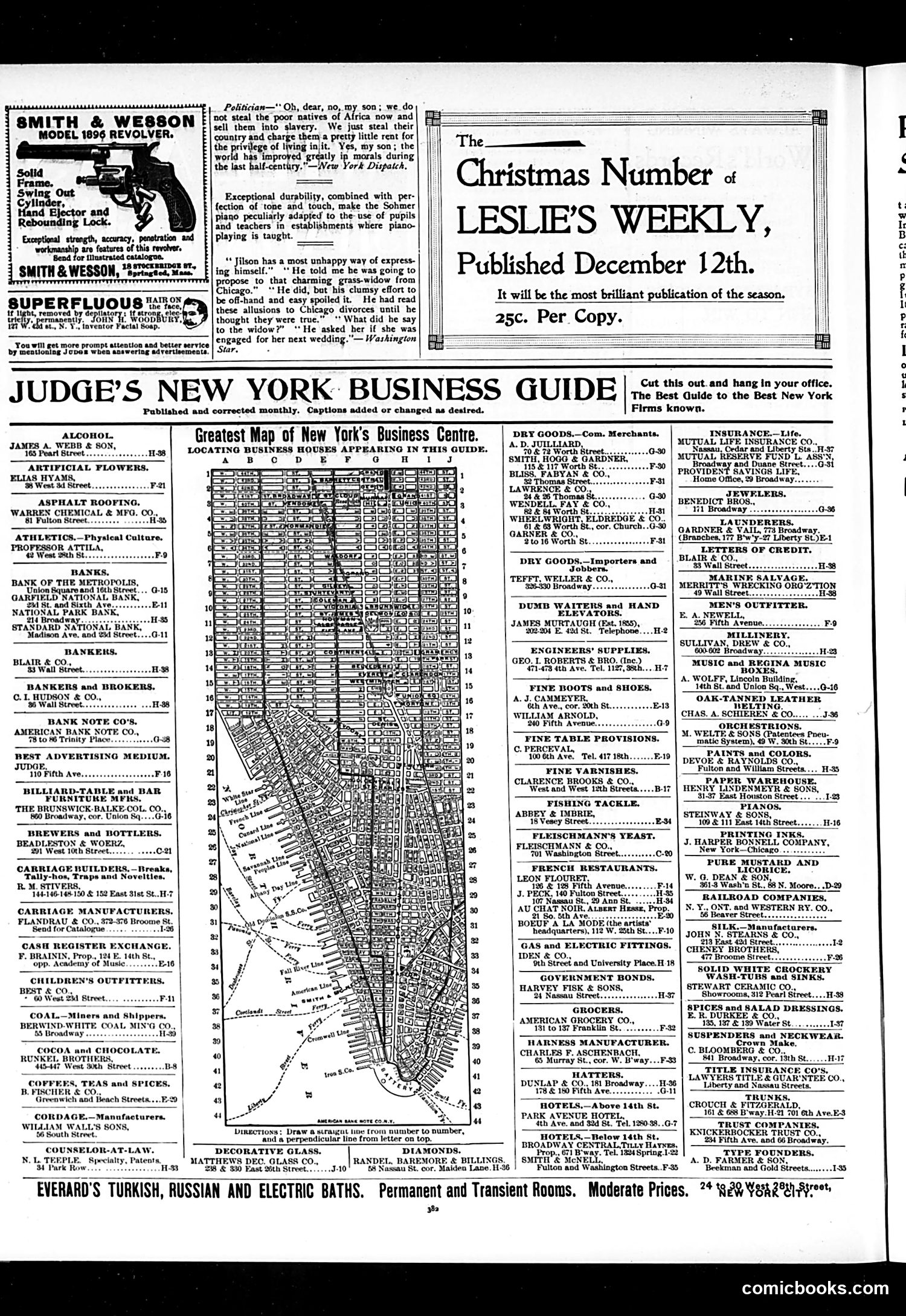
This page is primarily an **advertising directory and business guide** for New York City, not a satirical section. However, it does contain **one small cartoon with political/social satire** at the top left. The cartoon depicts a **Politician instructing his son** about colonial exploitation in Africa. The satire mocks hypocrisy: the politician claims his country doesn't "steal" African natives into slavery anymore—they've merely "improved greatly in morals." Instead, the joke reveals they now steal the natives' **land and charge them rent** for living on it. This is a form of economic exploitation dressed as moral progress. **Context for modern readers:** This references European colonialism's shift from slavery to economic imperialism (likely early 1900s). The satire exposes how "civilization" and "progress" often masked continued extraction of resources and labor from colonized peoples through legal/economic mechanisms rather than direct slavery. The rest of the page is a straightforward business directory to New York firms.
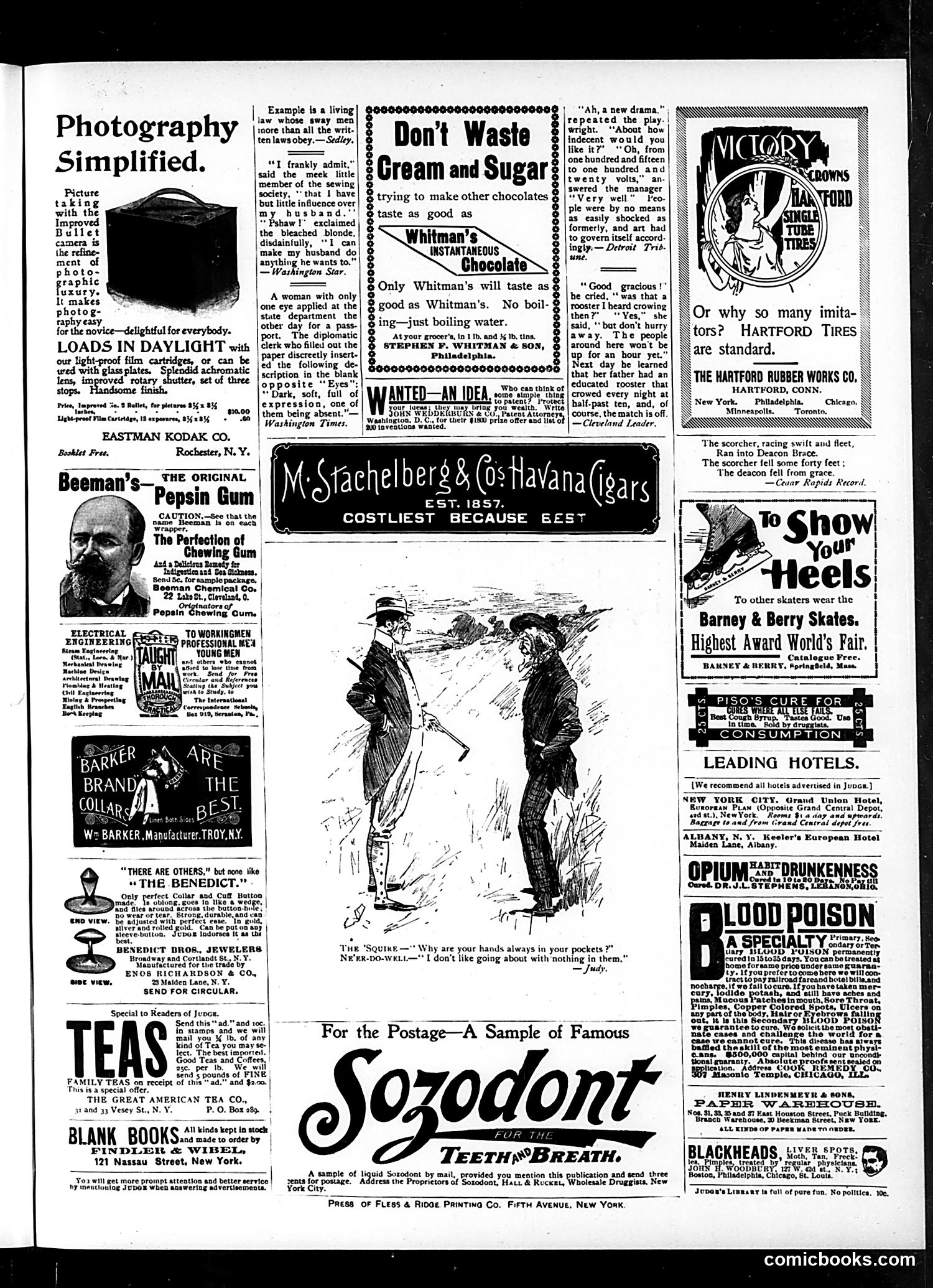
This is primarily an **advertising page** from Judge magazine, with one small cartoon and numerous product advertisements typical of early-20th-century American periodicals. The single cartoon depicts two men in formal dress on a snowy slope. One asks the other why his hands are always in his pockets. The reply—"I don't like going about with nothing in them"—is a joke about poverty or financial hardship: the character keeps his hands in his pockets because he has no money to spend or nothing to show for himself. The page otherwise features ads for products including Whitman's Chocolates, Hartford Tires, Sozodont toothpaste, Barney & Berry ice skates, and various hotels and patent medicines. The ads reflect period consumer culture and the commercial nature of humor magazines, which relied heavily on advertising revenue. No political satire or social commentary appears on this particular page beyond the modest pocket-money joke.
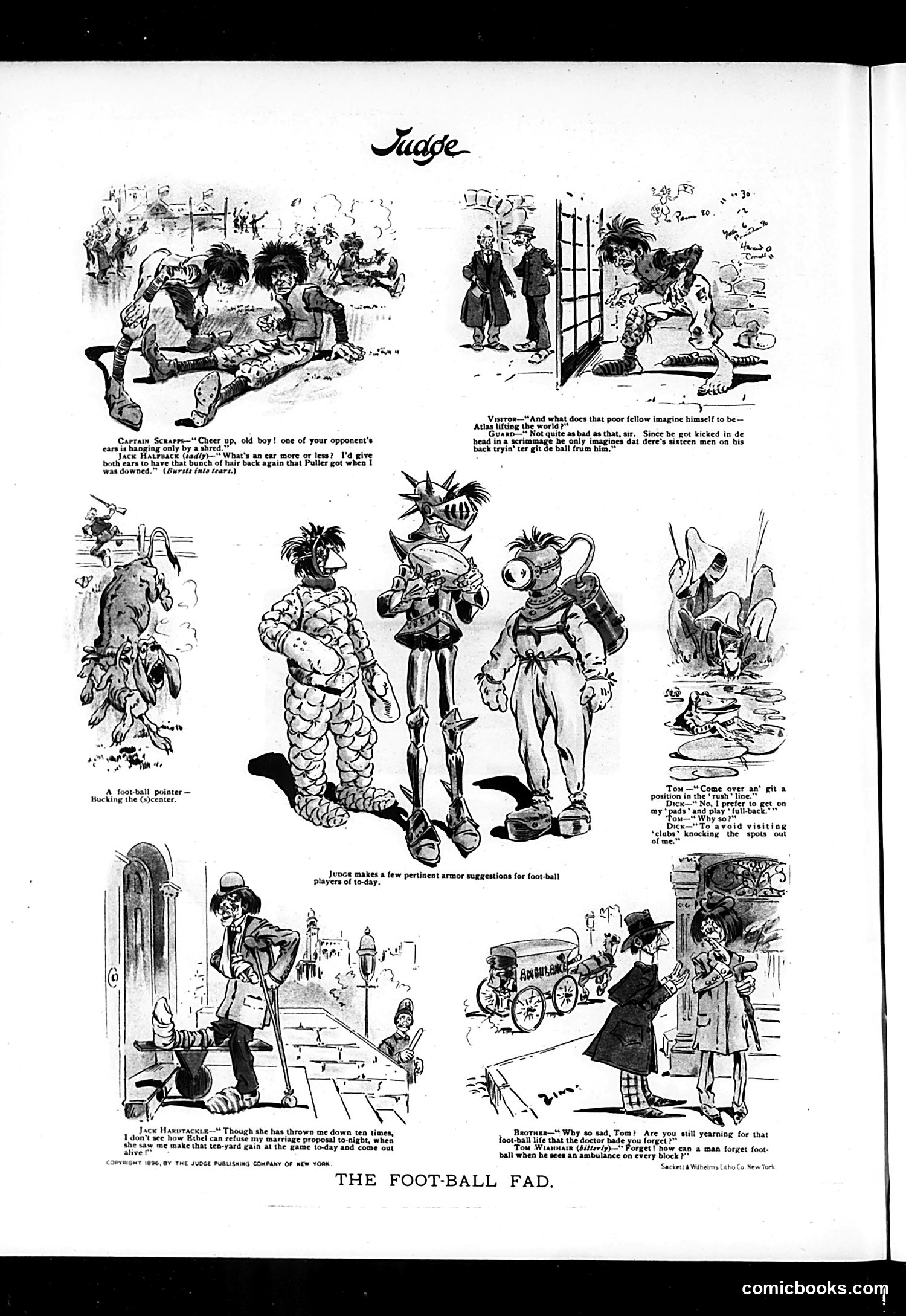
This page mocks the American obsession with football in the 1890s. The cartoon shows football's grip on society through exaggerated scenarios: **Key satirical points:** - Players suffer grotesque injuries (ears hanging by threads, repeated concussions) yet remain obsessed - A man uses a football injury to impress a woman into accepting his marriage proposal - Football "suggestions" mock the sport's brutality disguised as strategy - A character admits he can't escape football—he sees ambulances on every block **The satire:** Judge presents football as a dangerous craze causing physical destruction and social madness. Despite obvious harm, characters remain devoted, using the sport to court women and make life decisions. The 1890s context: American football was genuinely violent and unregulated, causing serious injuries and deaths. Judge's exaggeration highlights contemporary concerns about whether this new sport's dangers justified its popularity. The humor depends on readers recognizing football mania as absurd and excessive—a critique lost on modern audiences who normalized American football decades ago.