
A complete issue · 16 pages · 1896
Judge — December 5, 1896
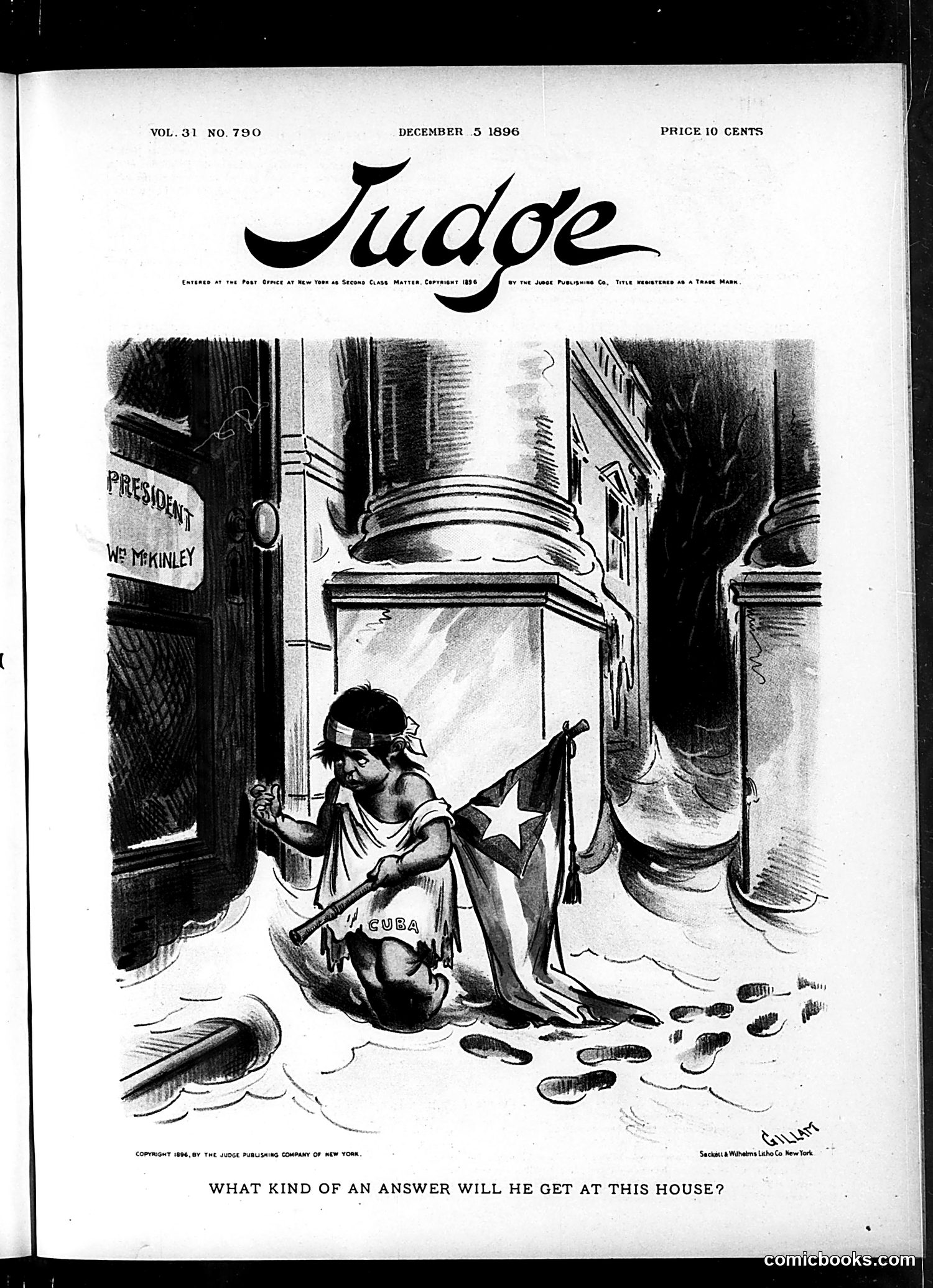
This political cartoon satirizes President William McKinley's handling of the Cuban independence crisis. The figure labeled "Cuba" sits outside the White House (marked "President W. McKinley"), holding a flag and seeking help. The large door represents McKinley's office, and the caption asks: "What kind of an answer will he get at this house?" The satire criticizes McKinley's reluctance to intervene in Cuba's struggle against Spanish colonial rule—a major political issue in 1896. The cartoon suggests Cuba is literally knocking on the president's door for assistance but may be turned away. This reflects public pressure on McKinley regarding U.S. policy toward Cuba, which would intensify and eventually lead to the Spanish-American War in 1898.
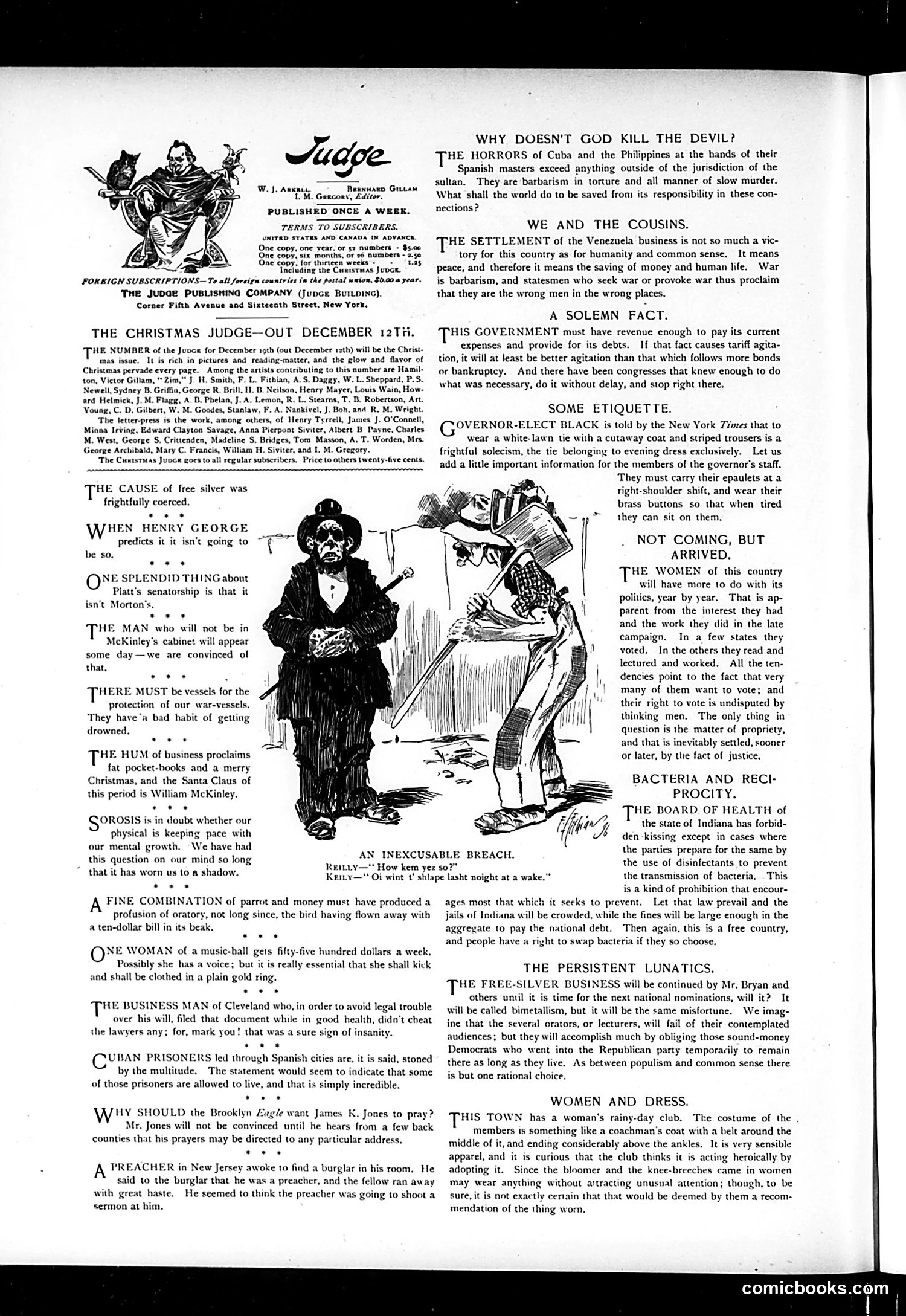
This cartoon satirizes the contrast between formal propriety and crude reality. A well-dressed gentleman in top hat and monocle (appearing dignified and proper) confronts a woman in disheveled dress, with the caption showing him asking "How ken ye see?" and her responding "O what I slupe last night at a wake." The joke targets class pretension: the man's exaggerated formal appearance and speech patterns ("ken") suggest affected gentility, while the woman's frank reference to sleeping rough at a funeral wake (an Irish custom) represents honest working-class life. The satire mocks how the wealthy maintain artificial standards of propriety while ordinary people deal with harsh realities. The "inexcusable breach" is the woman's blunt honesty interrupting the gentleman's pretense.
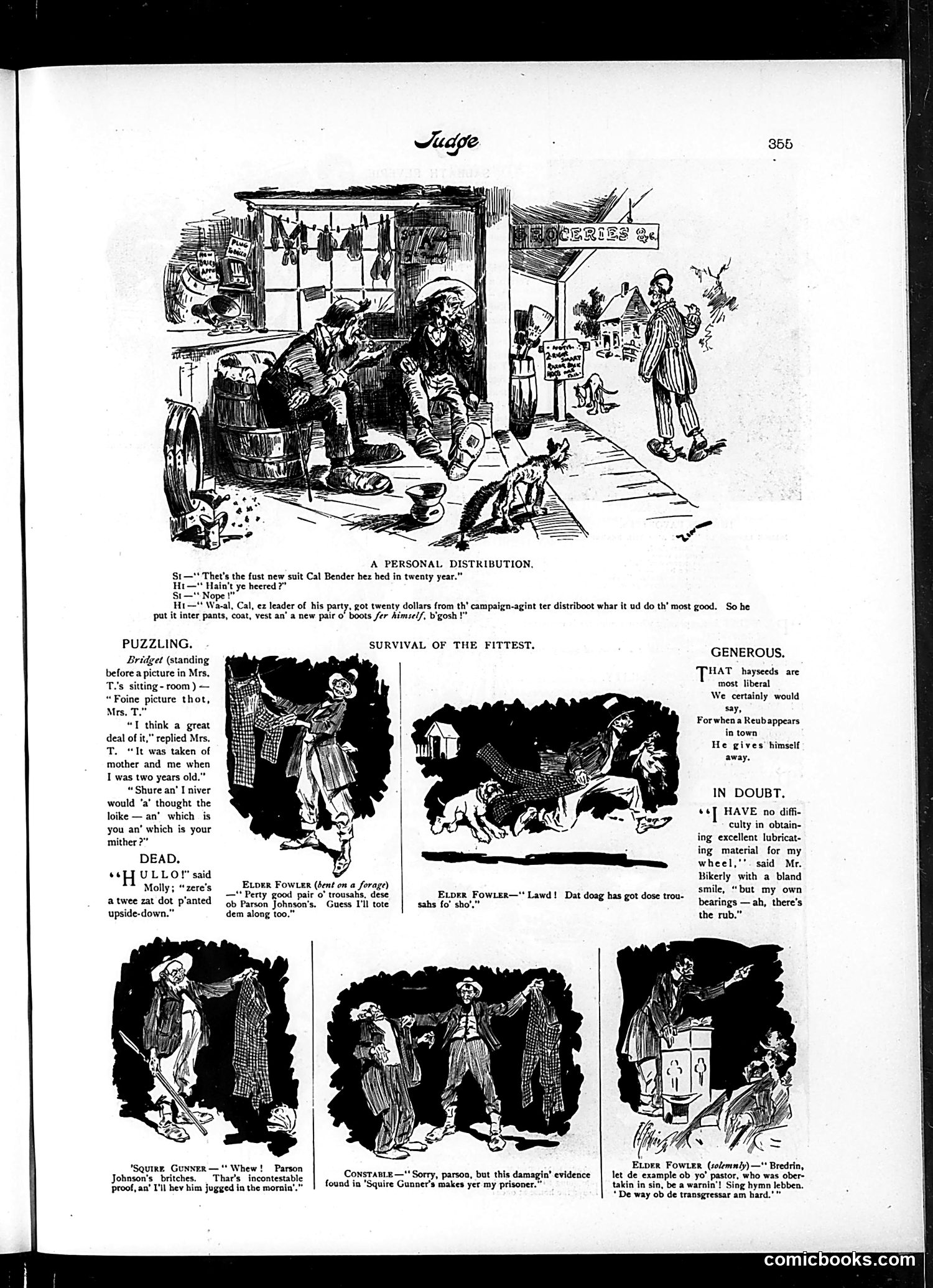
This page contains several unrelated humorous sketches and short jokes typical of Judge's format. **"A Personal Distribution"** (top): Depicts a political candidate distributing money from campaign funds to constituents—a satire on corruption and vote-buying. Cal Bender, described as a party leader, distributes twenty dollars disguised as personal aid (hidden in clothing). **Other sketches** include domestic humor ("Puzzling," "Dead," "Generous," "In Doubt," "Survival of the Fittest") featuring working-class or rural characters in everyday situations—wives, dogs, parsons, and farm scenes. The humor relies on wordplay, situational comedy, and character types recognizable to contemporary readers but now obscure without historical context about early 20th-century American social attitudes and vernacular speech patterns.
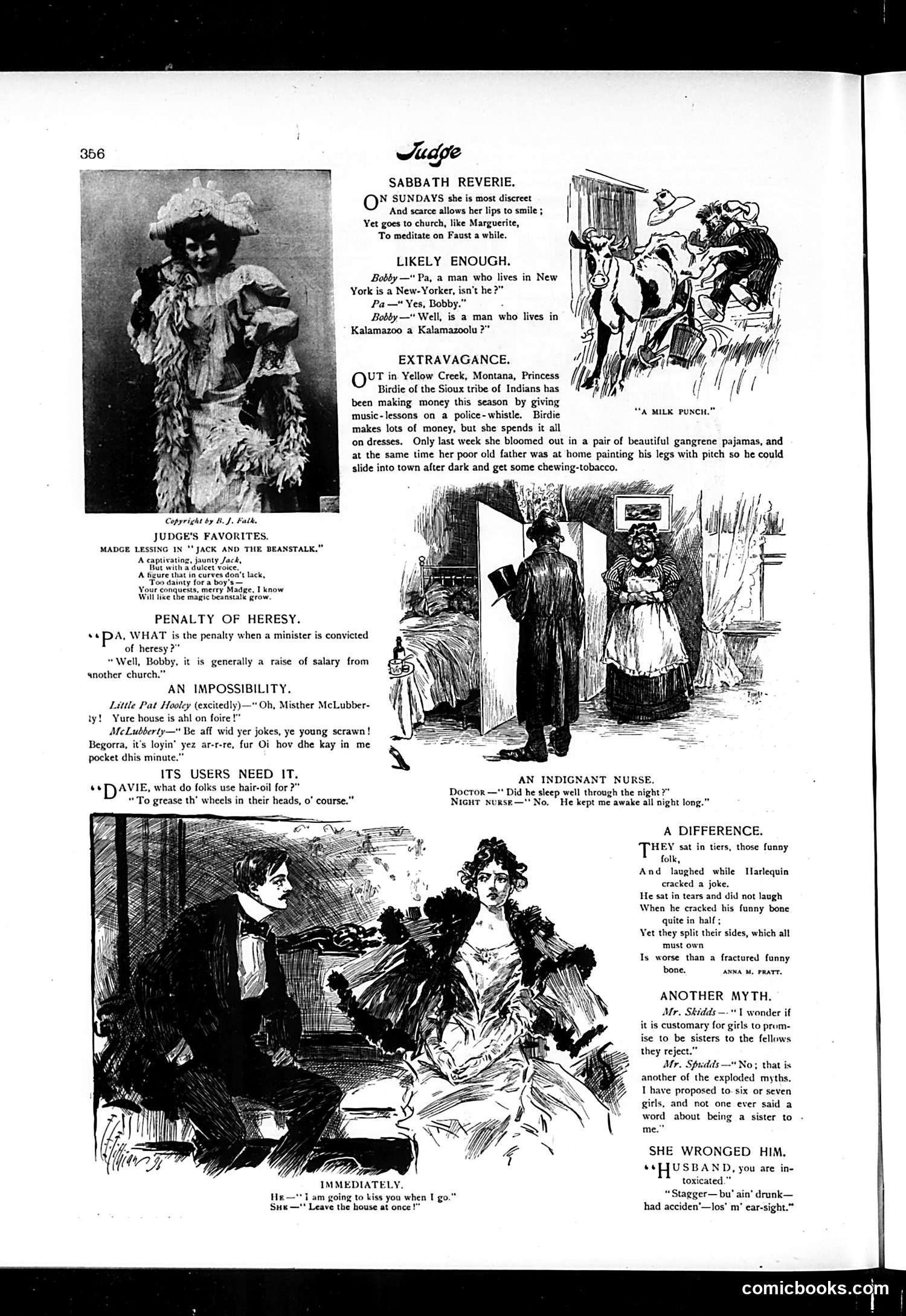
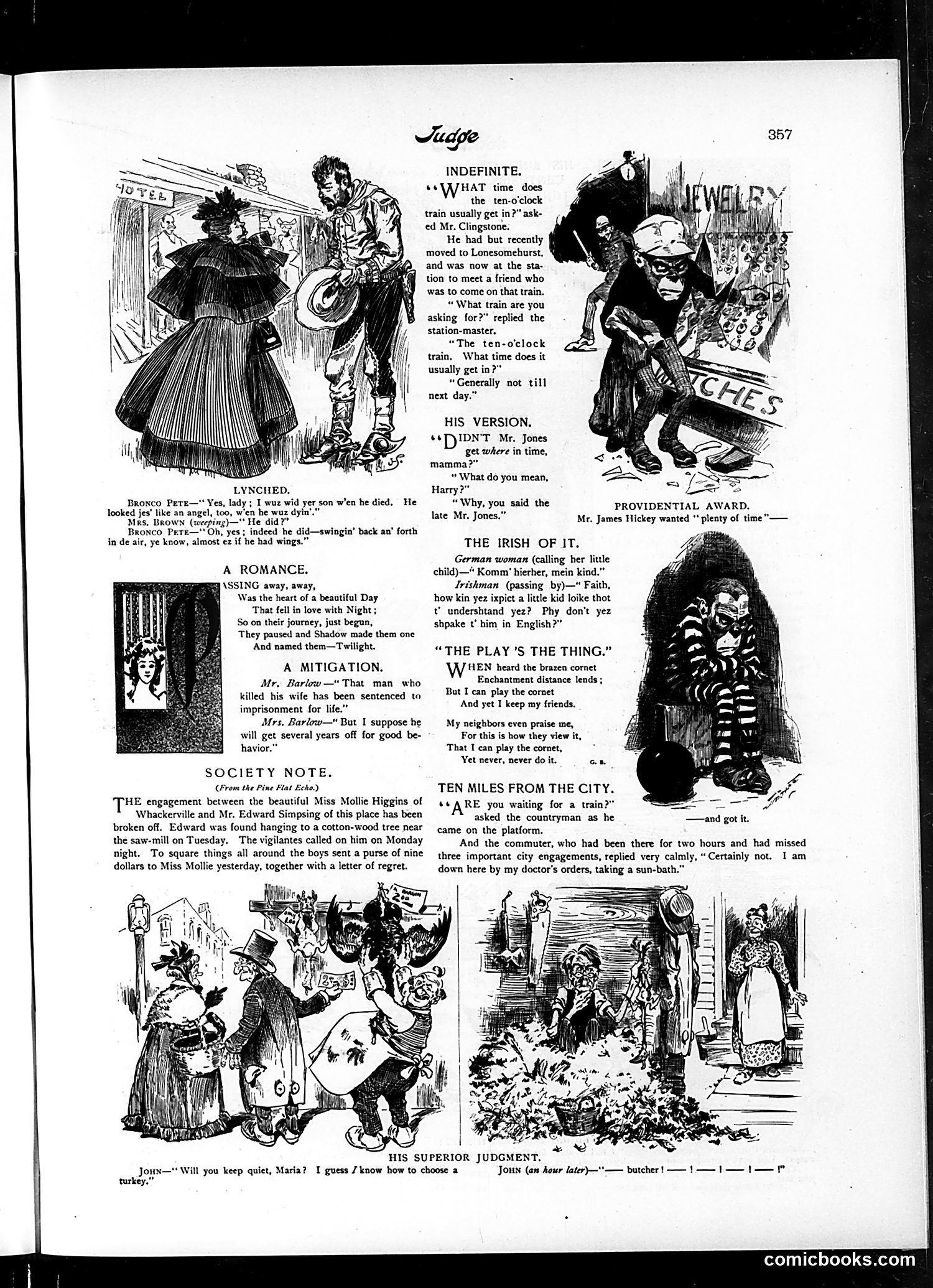
This page contains multiple short satirical pieces typical of late 19th-century American humor: **"Lynched"** — A darkly cynical joke about a lynching victim, presented as casual conversation. The humor relies on grotesque irony about the corpse's appearance. **"Society Note"** — Satirizes frontier "justice" by reporting a man's death by vigilante hanging as a routine social announcement, with monetary compensation to his fiancée presented matter-of-factly. **"The Irish of It"** — Ethnic stereotype humor mocking Irish immigrants' inability to understand German, playing on period prejudices about language and assimilation. **Other pieces** — Include wordplay jokes ("His Version"), gentle domestic humor, and observational comedy about train schedules and urban commuting. The overall tone reflects Judge magazine's satirical approach to American social issues, using crude humor, ethnic caricature, and dark satire common to 1890s-era publications. Modern readers would find the lynching content particularly disturbing—presented as comedy rather than tragedy.
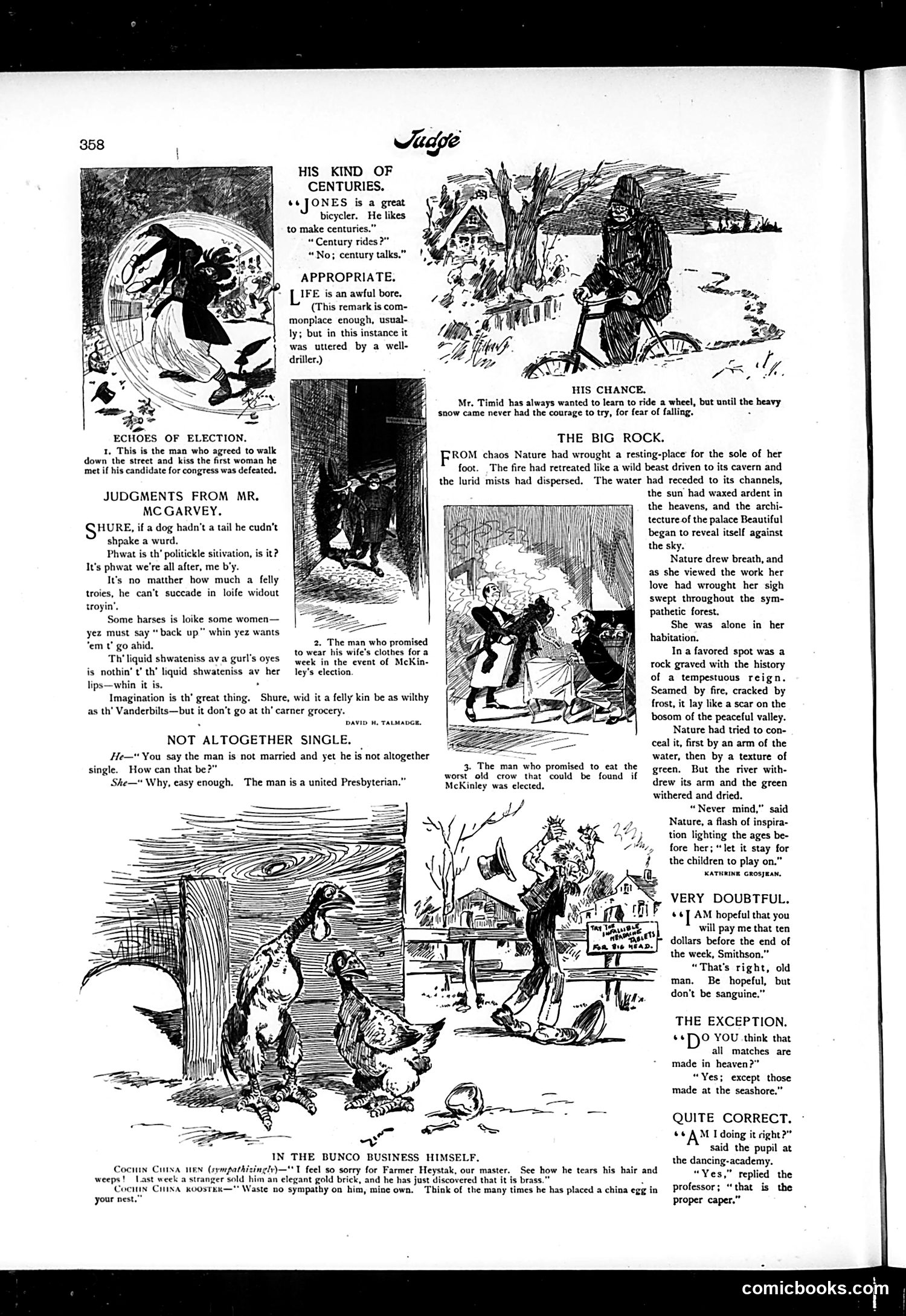
This page from *Judge* magazine contains multiple satirical pieces reflecting post-election politics (likely following McKinley's 1896 victory, based on references). **"Echoes of Election"** mocks men who made dramatic campaign promises they now must keep—one agreed to kiss the first woman he met if his candidate lost; another promised to wear his wife's clothes; a third vowed to eat "crow" (admit defeat). The satire ridicules empty political boasting. **"Judgments from Mr. McGarvey"** features an Irish-accented character delivering homespun philosophy, typical of the era's ethnic humor stereotypes. **"Not Altogether Single"** jokes that a "united Presbyterian" man is neither married nor single—Presbyterian church doctrine apparently created ambiguity about his marital status. The remaining pieces are unrelated humor: a timid cyclist, nature poetry, and puns about "proper caper" (dance step). The "Bunco Business" section mocks farmers repeatedly deceived by scams.
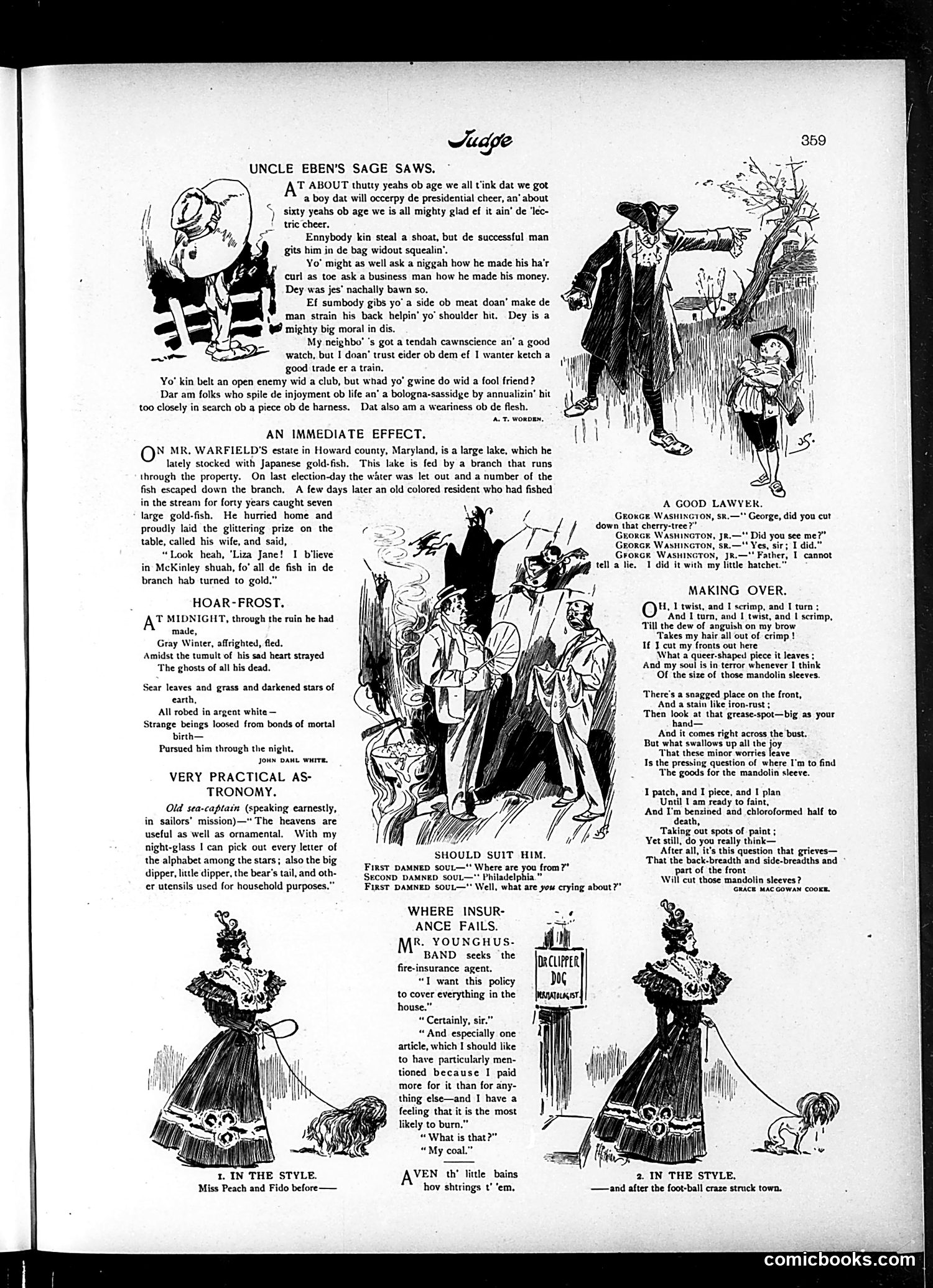
This page from Judge contains several satirical pieces typical of late 19th/early 20th-century American humor: **"Uncle Eben's Sage Saws"** features racist dialect humor common to the era, presenting an African American character dispensing folk wisdom about politics, business, and morality—a format Judge used regularly despite its offensive stereotyping. **"An Immediate Effect"** satirizes the McKinley administration (likely 1890s-1900s), suggesting that McKinley's policies miraculously transformed ordinary fish into "gold"—a jab at claims that his economic policies enriched the nation. **"A Good Lawyer"** parodies the famous Washington cherry-tree legend, playing on assumptions about inherited character and honesty. **"Where Insurance Fails"** mocks the absurdity of fire insurance, with a customer highlighting coal as the item most likely to burn—dark humor about insurance gaps. The remaining pieces are lighthearted verse and fashion humor about clothing alterations. The page blends political commentary with period-typical stereotypes and domestic comedy.
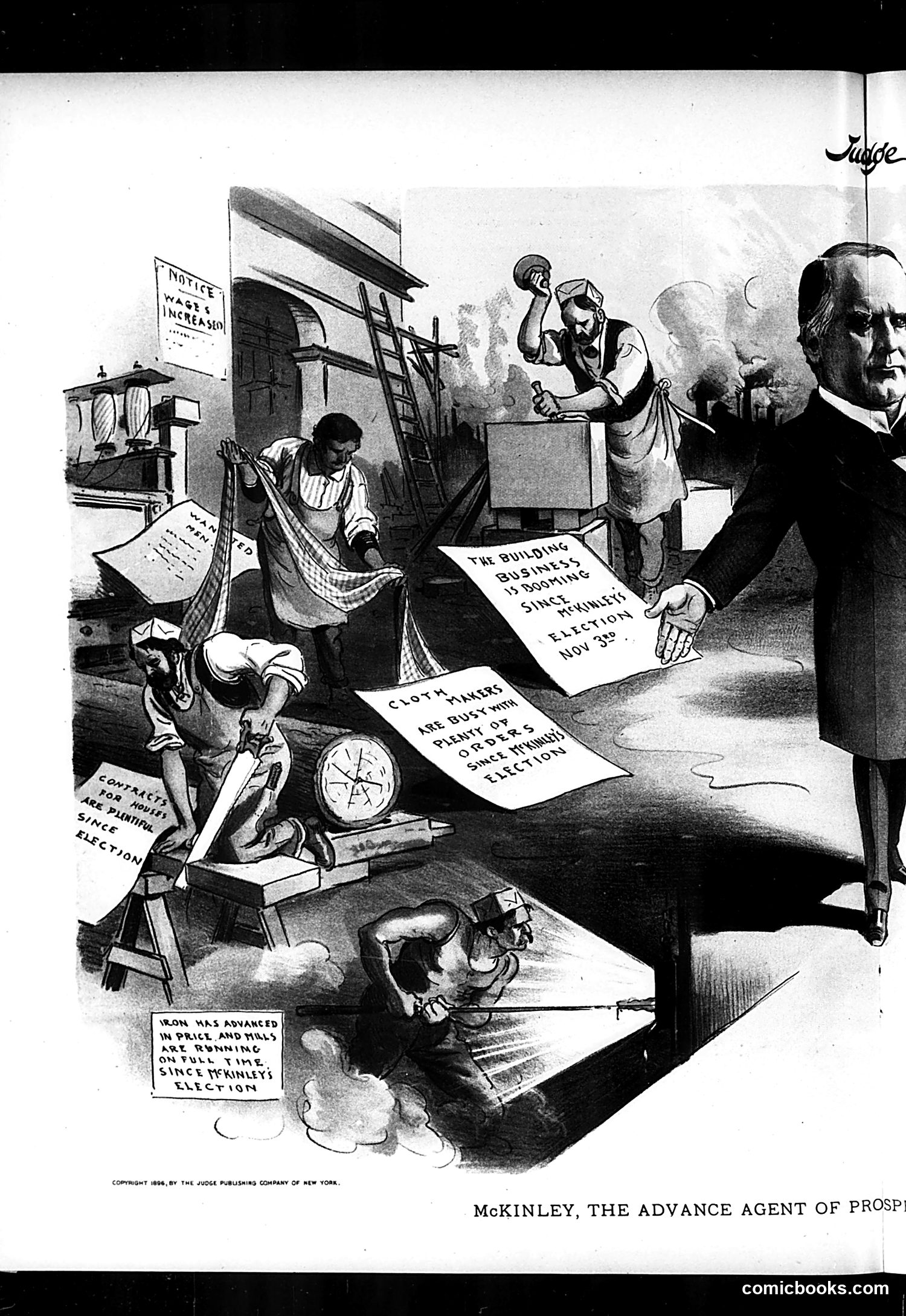
This 1896 political cartoon satirizes William McKinley's presidential campaign promises. The title suggests McKinley claims to herald economic prosperity. The cartoon depicts workers and businesses in disarray—skeletal figures labeled with economic hardships ("Contract Labor," "Cloth Makers"), rising prices for iron, and notices of business decline since previous elections. A well-dressed man (McKinley) appears detached on the right, presented as merely an "advance agent" making hollow promises while actual economic suffering continues around him. The satire suggests his rhetoric about prosperity doesn't match grim economic reality facing laborers and manufacturers. This reflects Democratic criticism of McKinley's tariff policies and Republican economic claims during the 1896 election cycle.
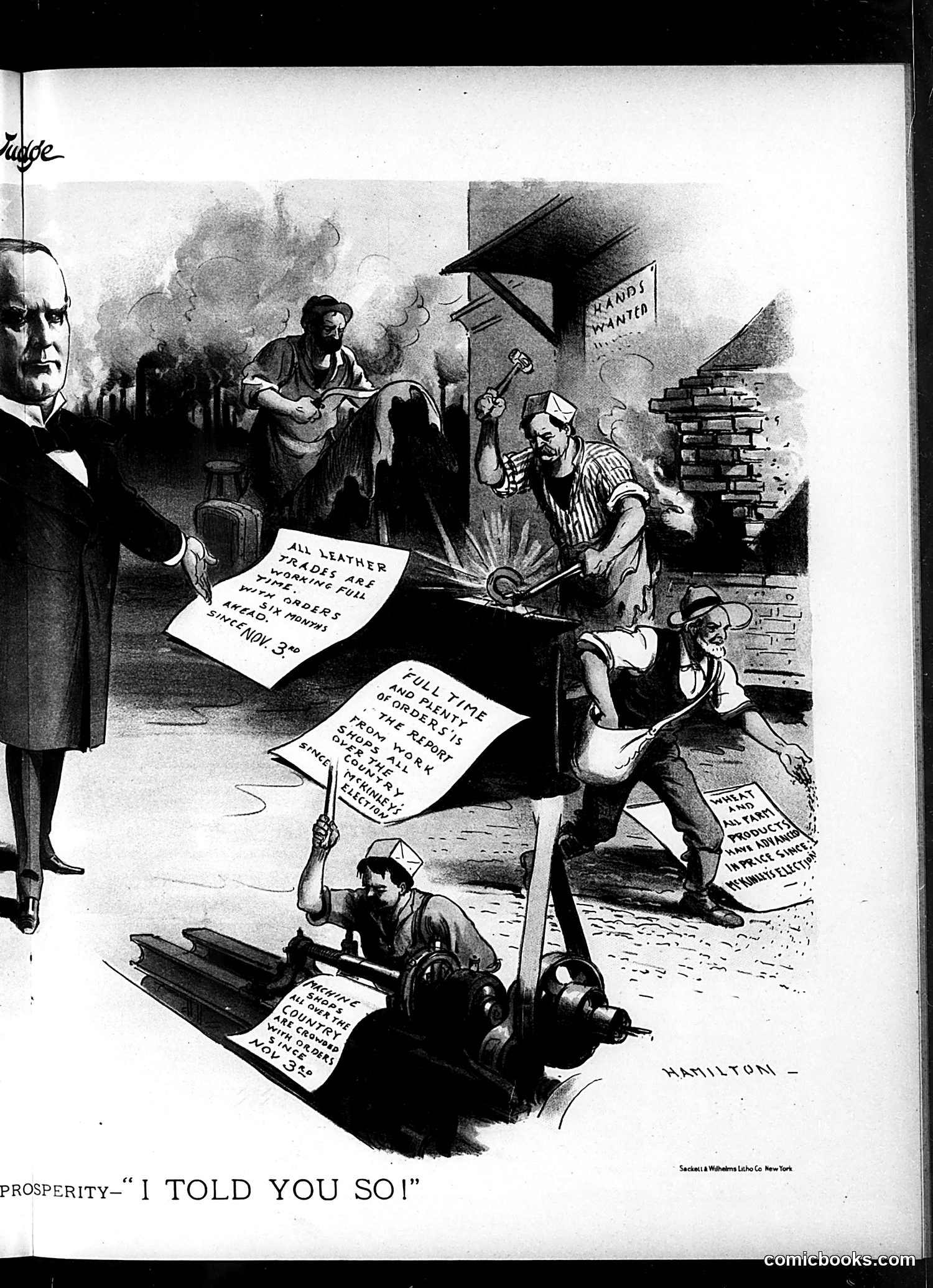
This appears to be a post-election or post-economic-crisis cartoon titled "Prosperity—'I Told You So!'" A well-dressed figure on the left (likely representing a political figure or economic pundit) stands apart, gesturing "I told you so" toward a chaotic scene of struggling workers and laborers. The workers are shown amid industrial elements, carrying signs with text about wages, work conditions, and economic hardship (text is partially legible but references bills, orders, and labor disputes). The satire critiques someone claiming vindication while ordinary workers suffer economic distress. The cartoon suggests a disconnection between politicians/elites boasting about predictions and the actual suffering of working people dealing with poor wages and difficult conditions. The artist is Hamilton (signed at bottom), and this was published by Judge magazine's lithography company.
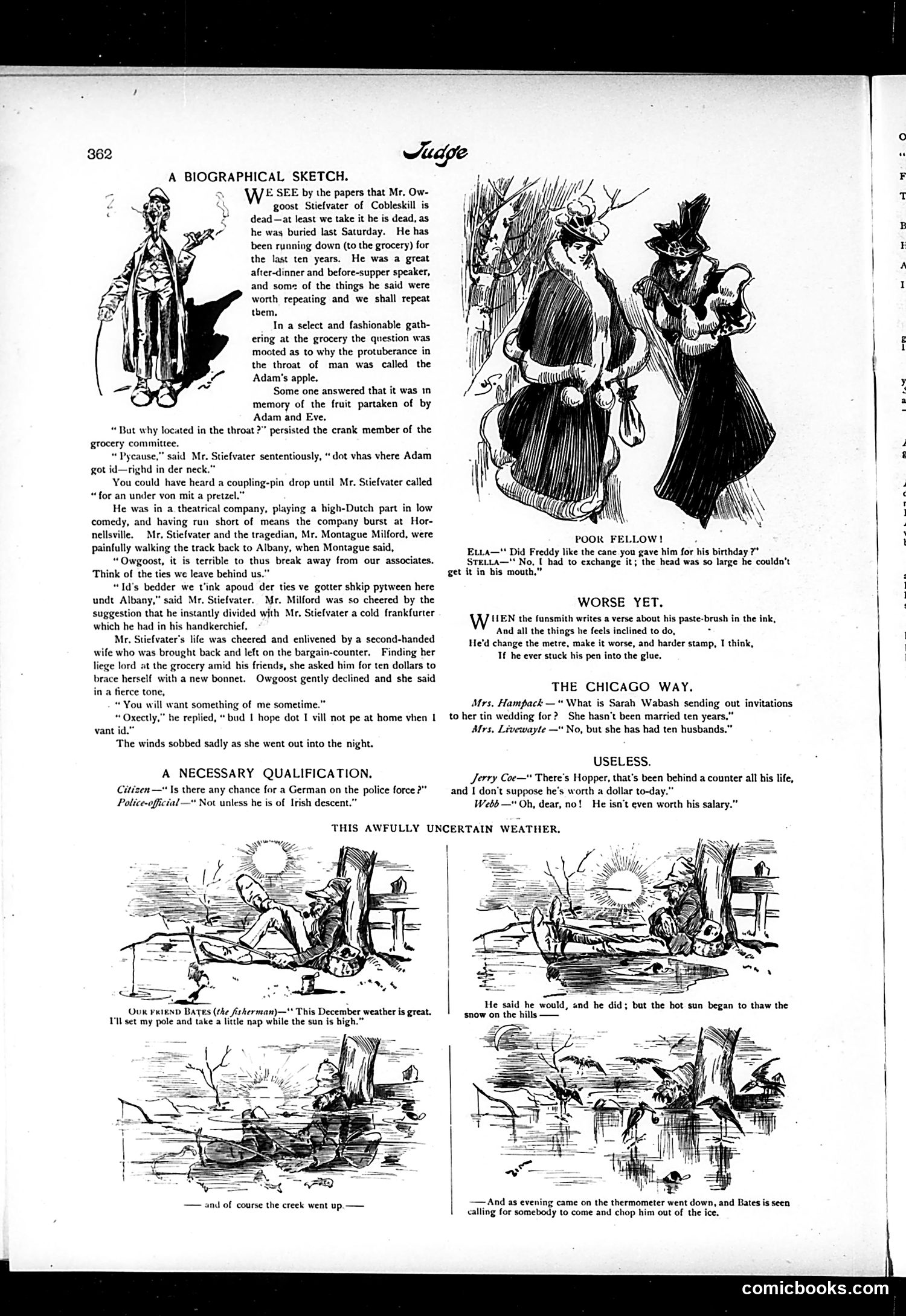
This page from *Judge* collects several unrelated humorous sketches typical of the magazine's format. **"A Biographical Sketch"** mocks a character named Owgoost Stiefvater, a German immigrant (indicated by his accent and dialect) portrayed as an eccentric small-town figure. The humor relies on ethnic stereotyping common to the era—his thick German accent and malapropisms ("righd in der neck") are the main joke. The anecdotes about his shabby life and interactions are presented as typical local gossip. **The remaining items** are brief joke segments: "Poor Fellow!" puns on a child's birthday gift; "Worse Yet" jokes about writing; "The Chicago Way" and "Useless" mock urban types and their financial situations. **"This Awfully Uncertain Weather"** features a four-panel comic strip about a fisherman who falls through ice—visual slapstick humor with minimal text. The page exemplifies *Judge*'s satirical approach: ethnic caricature, wordplay, and physical comedy targeting working-class and immigrant characters for urban middle-class readers' amusement.
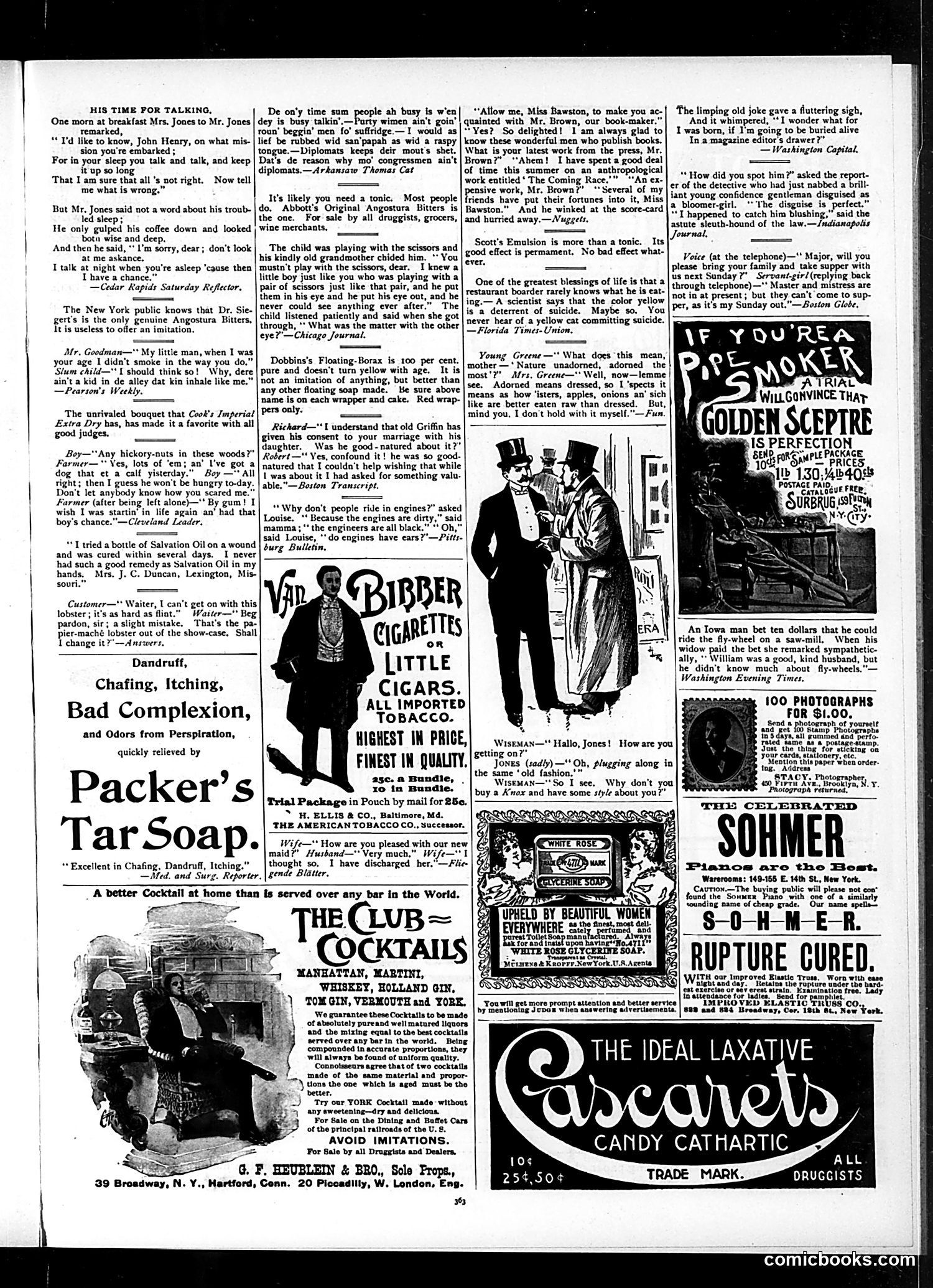
This page from Judge magazine contains primarily **short humorous anecdotes and advertisements** rather than political cartoons. The main comic content includes: - A domestic joke about a husband who talks in his sleep, blamed on needing a tonic (Angostura Bitters advertisement) - Racial dialect humor featuring an "Arkansaw Thomas Cat" making crude observations about women's suffrage and politicians - A confidence man disguised as a "bloomer-girl" (woman in bloomers/athletic wear) caught because he blushes—satirizing either cross-dressing or the artificiality of disguises - Various brief witticisms about restaurants, suicide deterrents, and children **The page is primarily advertising-driven**, featuring prominent ads for Packer's Tar Soap, Club Cocktails, Van Bibber Cigarettes, and various patent medicines (Cascaret laxative, rupture cures, photograph offers). The humor reflects early 20th-century sensibilities: casual racism, gender stereotyping, and reliance on sentimental or absurdist punchlines rather than sharp political satire. No specific political figures or events are clearly identifiable on this page.
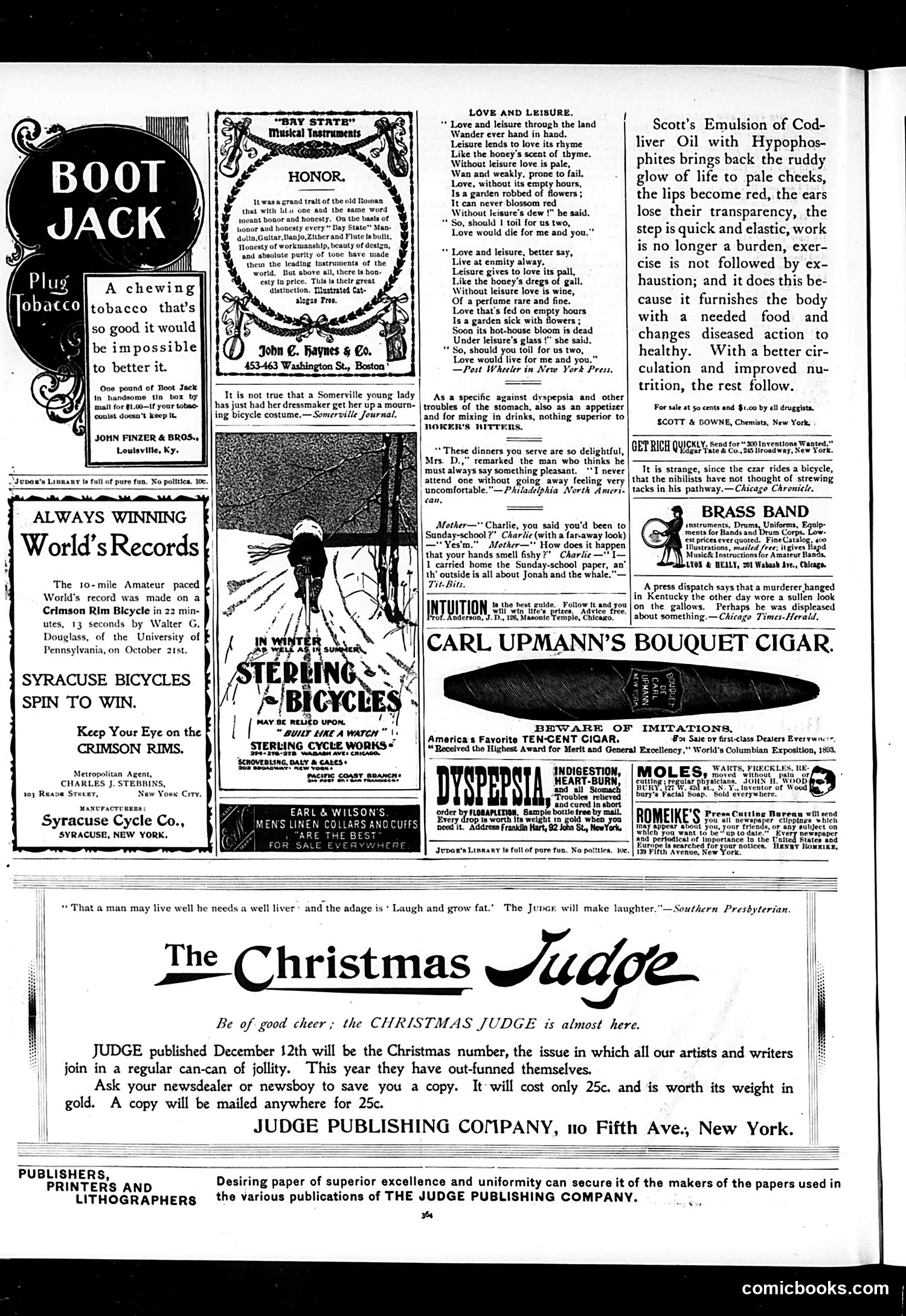
This page is primarily **advertising and announcements** rather than political cartoons or satire requiring historical context. The visual elements include: - **Boot Jack** tobacco ad (decorative period styling) - **Sterling Bicycles** advertisement - **Scott's Emulsion of Cod-liver Oil** pharmaceutical ad - Various small advertisements for Syracuse bicycles, Carl Upmann cigars, and other products The text includes a poem titled "Love and Leisure" by Post Wheeler about romantic relationships, plus several short humorous anecdotes typical of Judge magazine's style—jokes about a young lady with a bicycle costume, a child's Sunday school explanation about Jonah, and commentary on a murderer's expression at execution. **The page's significance**: It reflects late 19th/early 20th century commercial culture and light humor. The repeated bicycle advertisements suggest bicycles were a trending consumer item during this era. The pharmaceutical advertisements show how openly health products were marketed without modern FDA regulation.
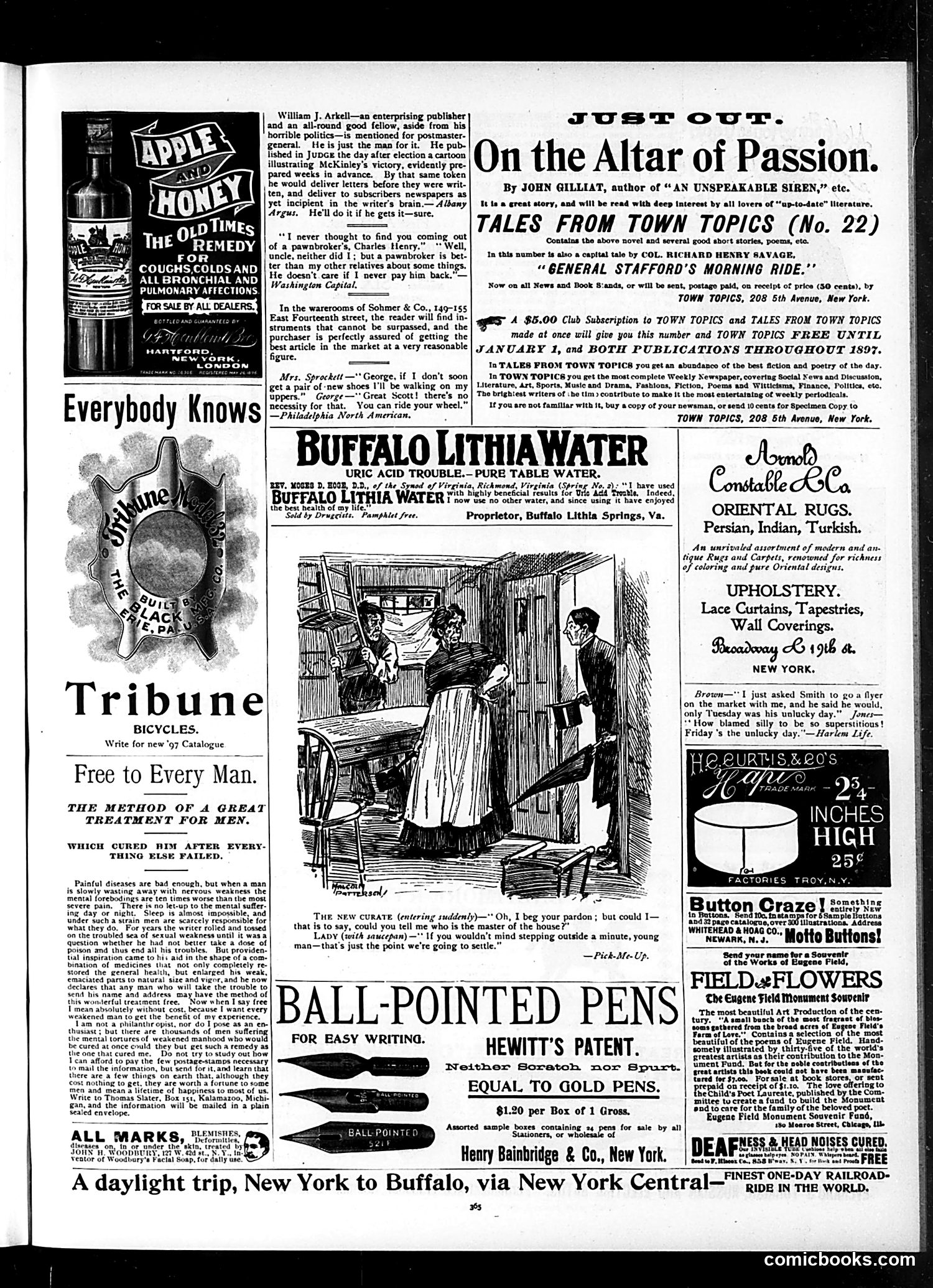
This page from *Judge* magazine (circa 1897, based on context clues) contains mostly **advertisements and literary notices** rather than political cartoons. The notable content includes: 1. **A satirical editorial note** on William J. Arkell, the publisher. The writer jokes that Arkell is so efficient he could deliver mail before it's written—mocking his capacity while also ribbing his political alignment (implied to be Republican after McKinley's election). 2. **The main cartoon** shows a domestic scene: a woman showing a priest/curate around a home. The caption jokes about the visitor's identity and authority in the household, suggesting subtle commentary on religious authority or domestic relations. 3. **Extensive patent medicine and self-help advertisements**, including one for treatments of "weakened manhood"—typical of the era's dubious medical marketing. The page primarily advertises serialized fiction ("On the Altar of Passion"), bicycles, musical instruments, and other merchandise. The humor is light and domestic rather than sharp political satire.
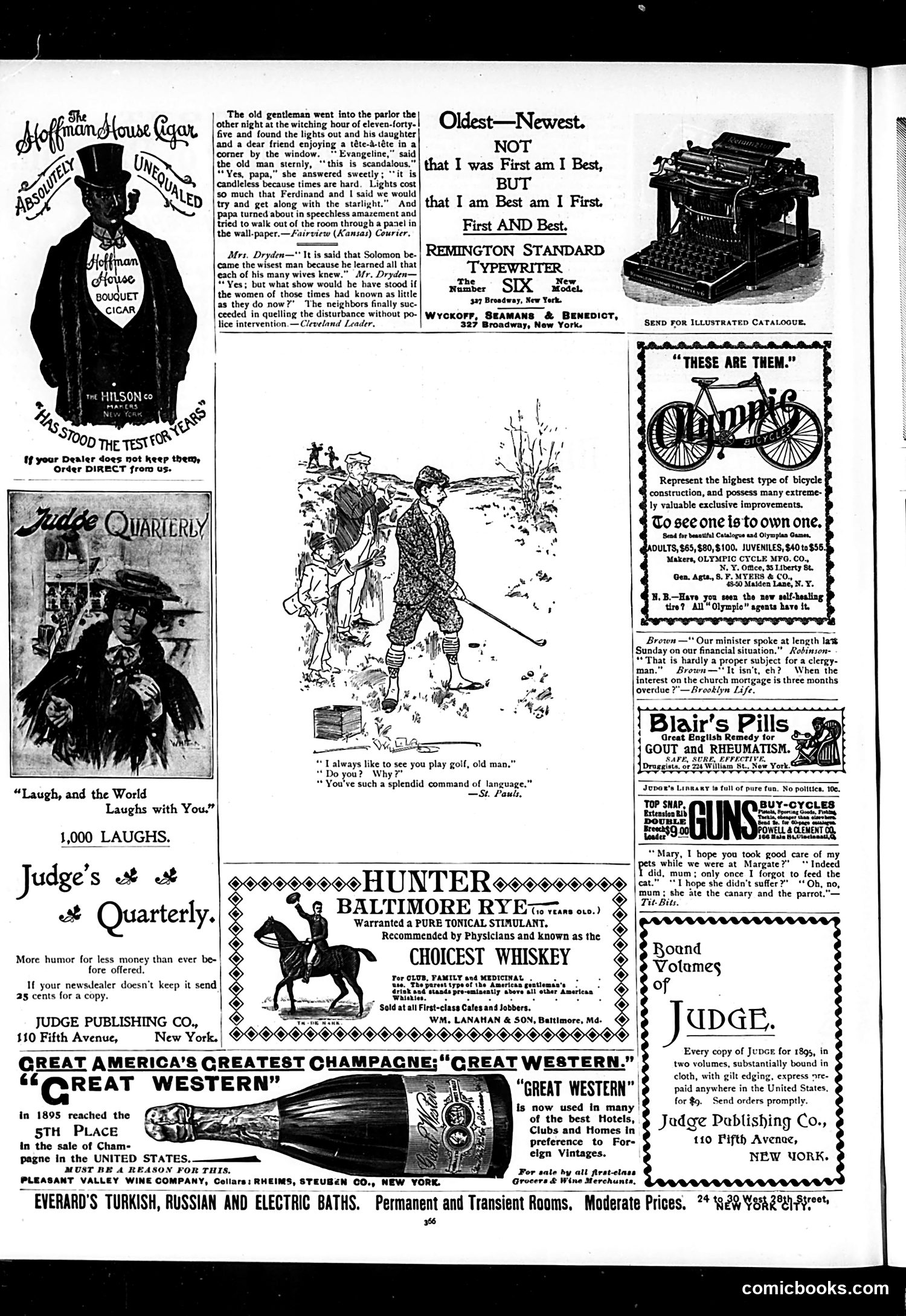
This is primarily an **advertising and humor page** from Judge magazine, circa 1895. The page contains several short comic anecdotes rather than a single political cartoon. The humor relies on turn-of-the-century domestic situations and gender dynamics: 1. **"Evangeline" anecdote**: A daughter caught in the dark with a male friend claims they're economizing on candlelight—satirizing both Victorian courting propriety and the economic hardships of the 1890s. 2. **Solomon/wives joke**: Mocks women's perceived ignorance while suggesting they'd cause chaos if educated equally to men—typical period sexism presented as humor. 3. **Golf/language joke**: Gentle mockery of upper-class leisure activities. The page is dominated by **product advertisements** (typewriters, bicycles, whiskey, champagne, pills, baths) typical of Judge's revenue model. These ads reflect late-Victorian consumer culture and patent medicines of dubious efficacy. The content overall reflects period attitudes toward gender roles, class, and commerce rather than specific political satire.
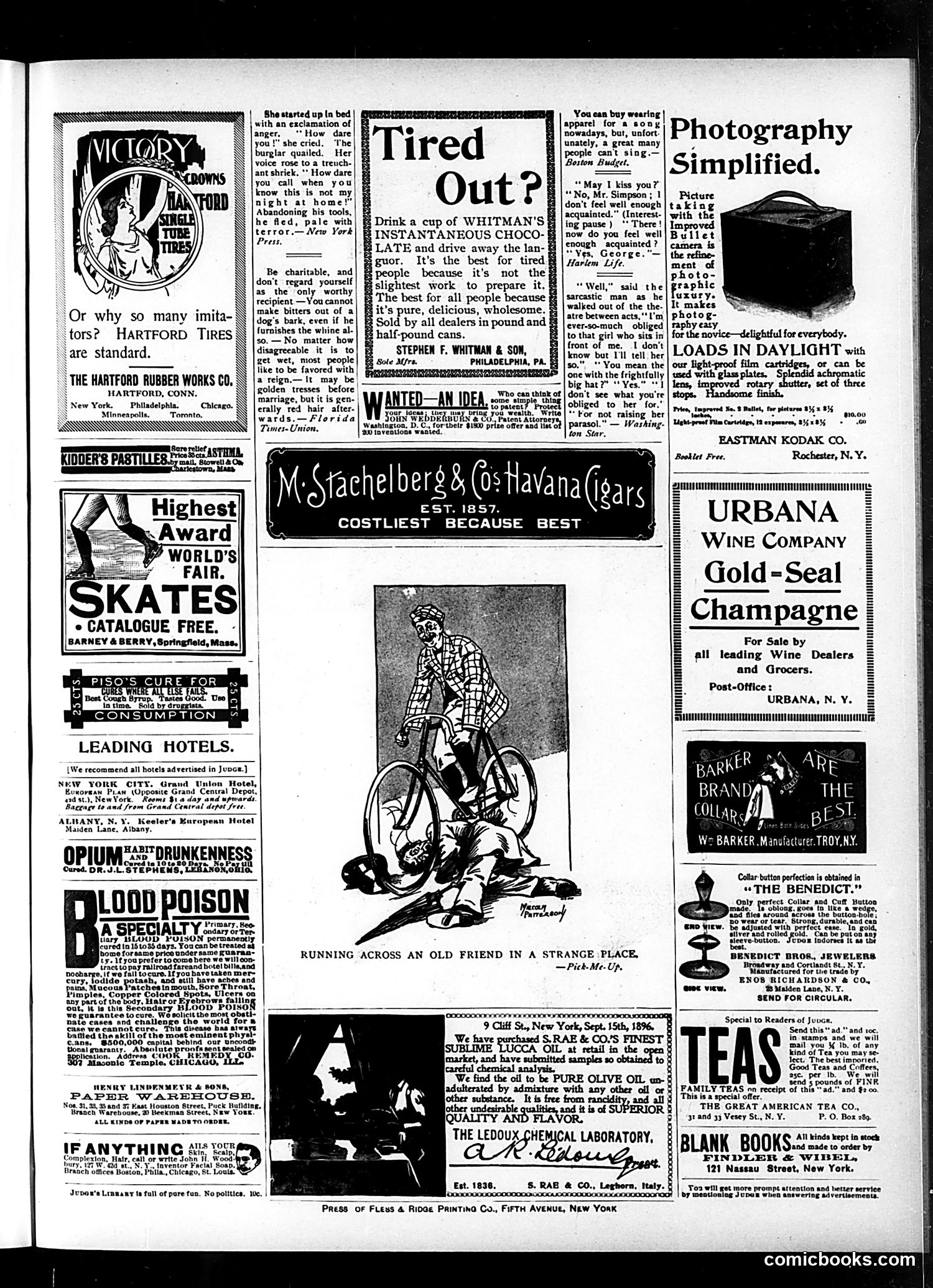
This page is primarily **advertising**, typical of early 1900s magazines. The notable editorial content is a single cartoon titled "Running Across an Old Friend in a Strange Place" showing a man on a bicycle encountering someone on the ground. The page's humor items are brief anecdotes rather than political satire: - A woman burglar is frightened away not by force but by the lady of the house indignantly claiming it's "not my night at home"—satirizing the era's strict social conventions about women's schedules and propriety - Various quips about romance, marriage, and gender relations (women with "golden tresses before marriage, but...red hair afterwards") - A joke about a theater-goer grateful to a woman with a large hat for not raising her parasol, blocking his view The advertisements reflect period concerns: Hartford Tires, ice skates, treatments for opium addiction and blood poison, Whitman's chocolate, Eastman Kodak cameras, and wine. These ads reveal contemporary anxieties and consumer culture rather than political commentary.
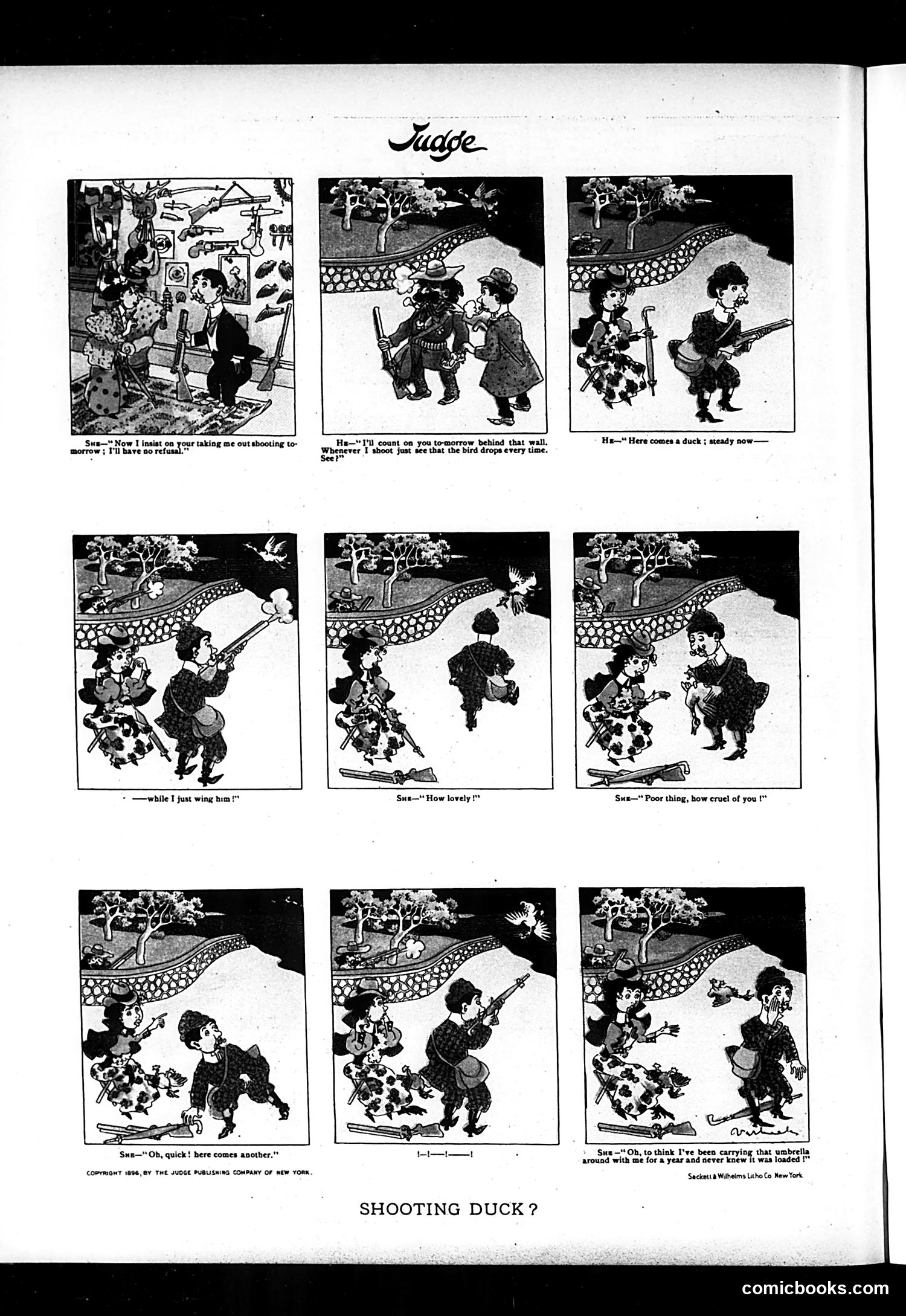
This comic strip satirizes gender dynamics and marksmanship pretense in the 1890s. A man boasts to a woman about his hunting prowess, claiming he never misses—that he "wings" ducks rather than kills them cleanly. When an actual duck appears, he shoots and misses repeatedly while the woman watches. The punchline reveals the woman has unknowingly been carrying a loaded umbrella for a year. The satire mocks the man's exaggerated claims of skill and masculinity; his demonstrated incompetence contrasts sharply with his initial braggadocio. The woman's innocent comment about the umbrella being "loaded" provides ironic wordplay, as she's been literally armed without knowing it—a subtle jab at male presumptions of superiority and female naiveté during this era. The title's question mark suggests skepticism about the hunting narrative from the start.