
A complete issue · 16 pages · 1896
Judge — November 21, 1896
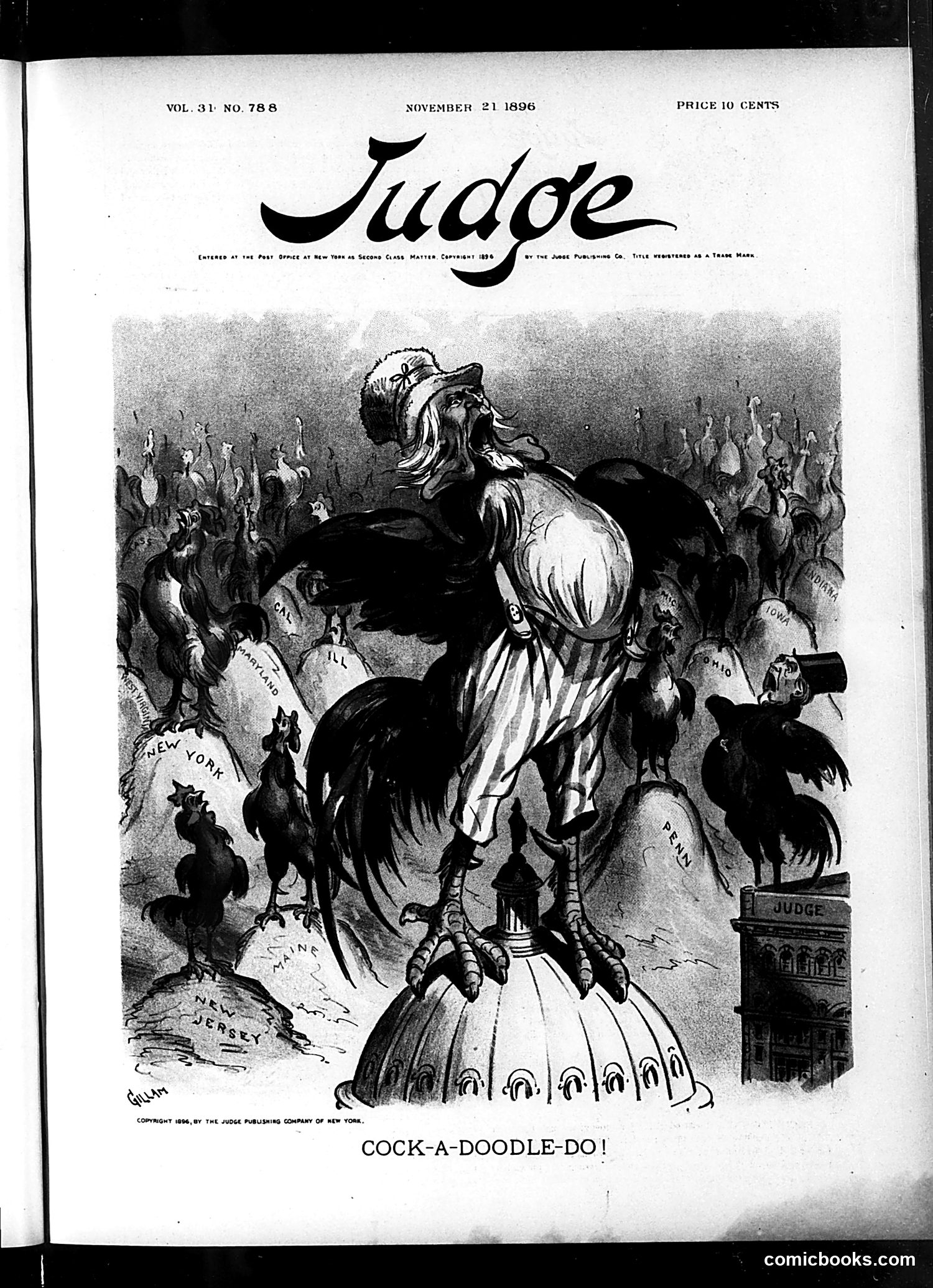
This political cartoon depicts a rooster standing triumphantly on a pedestal labeled "JUDGE," surrounded by smaller roosters representing different states (visible labels include "NEW YORK," "JERSEY," and others). The imagery suggests a electoral victory—the 1896 presidential election occurred on November 3, 1896, making this publication's timing significant. The rooster is a traditional symbol of Republican politics. The cartoon likely celebrates a Republican electoral success, with the dominant rooster representing the victorious candidate (William McKinley won the 1896 presidency) and surrounding roosters representing state-level Republican victories. The "cock-a-doodle-do" crowing suggests triumphant announcement of these election results across multiple states.
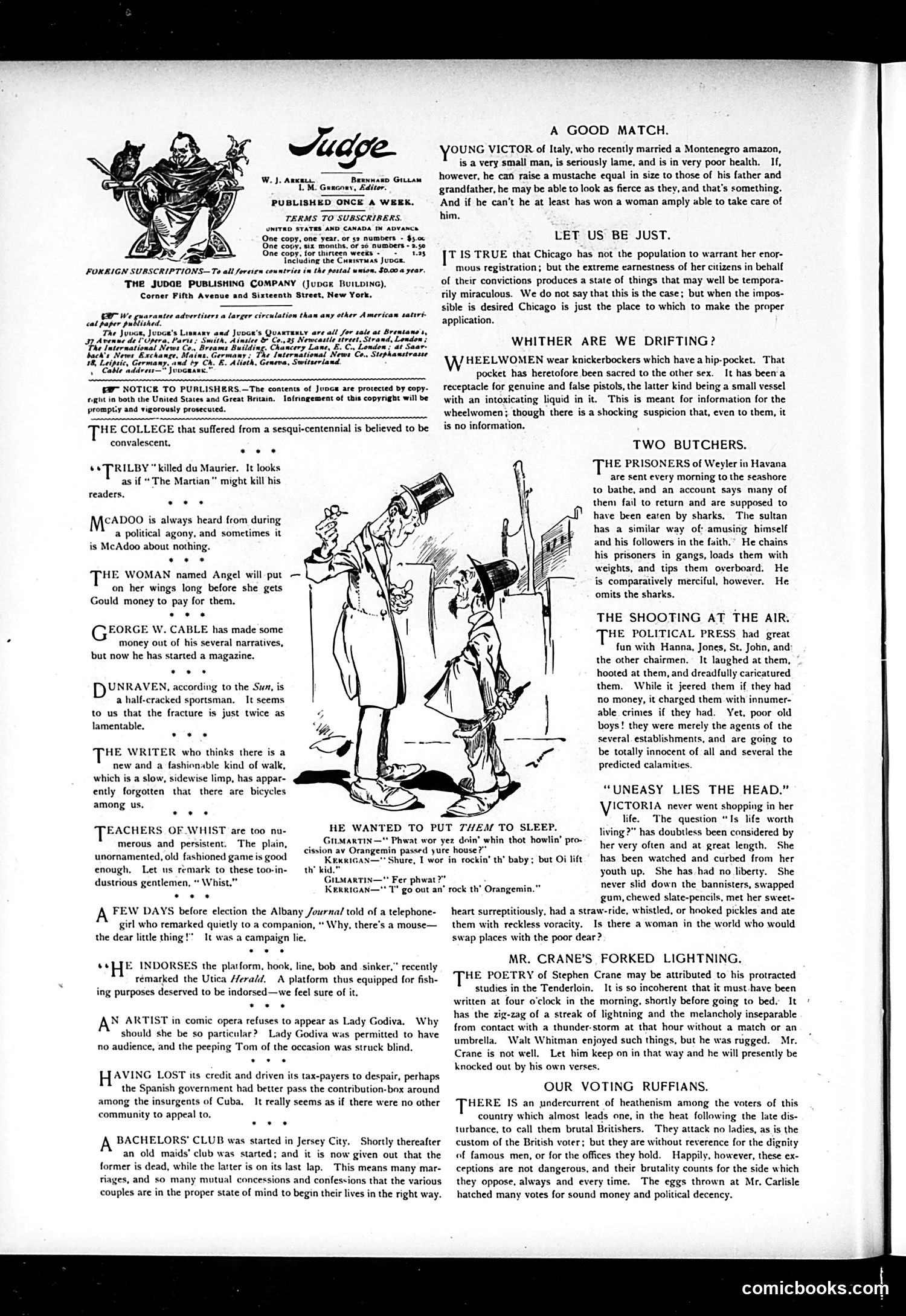
This page contains multiple short satirical items rather than a single cartoon. The main illustrated piece, "He Wanted to Put Them to Sleep," depicts what appears to be a man attempting to use chloroform on two figures—likely a social commentary on crime or medical malpractice of the era. Other brief items mock various targets: a college's "semi-centennial," literary figures like "Trilby," and Chicago's registration system. One section critiques wheelmenwomen (cyclists) carrying pistols and "intoxicating liquid"—reflecting early 1900s concerns about women's independence and new recreational freedoms. The tone throughout is satirical commentary on contemporary social issues, technology adoption, and public figures, typical of Judge's editorial approach during this period.
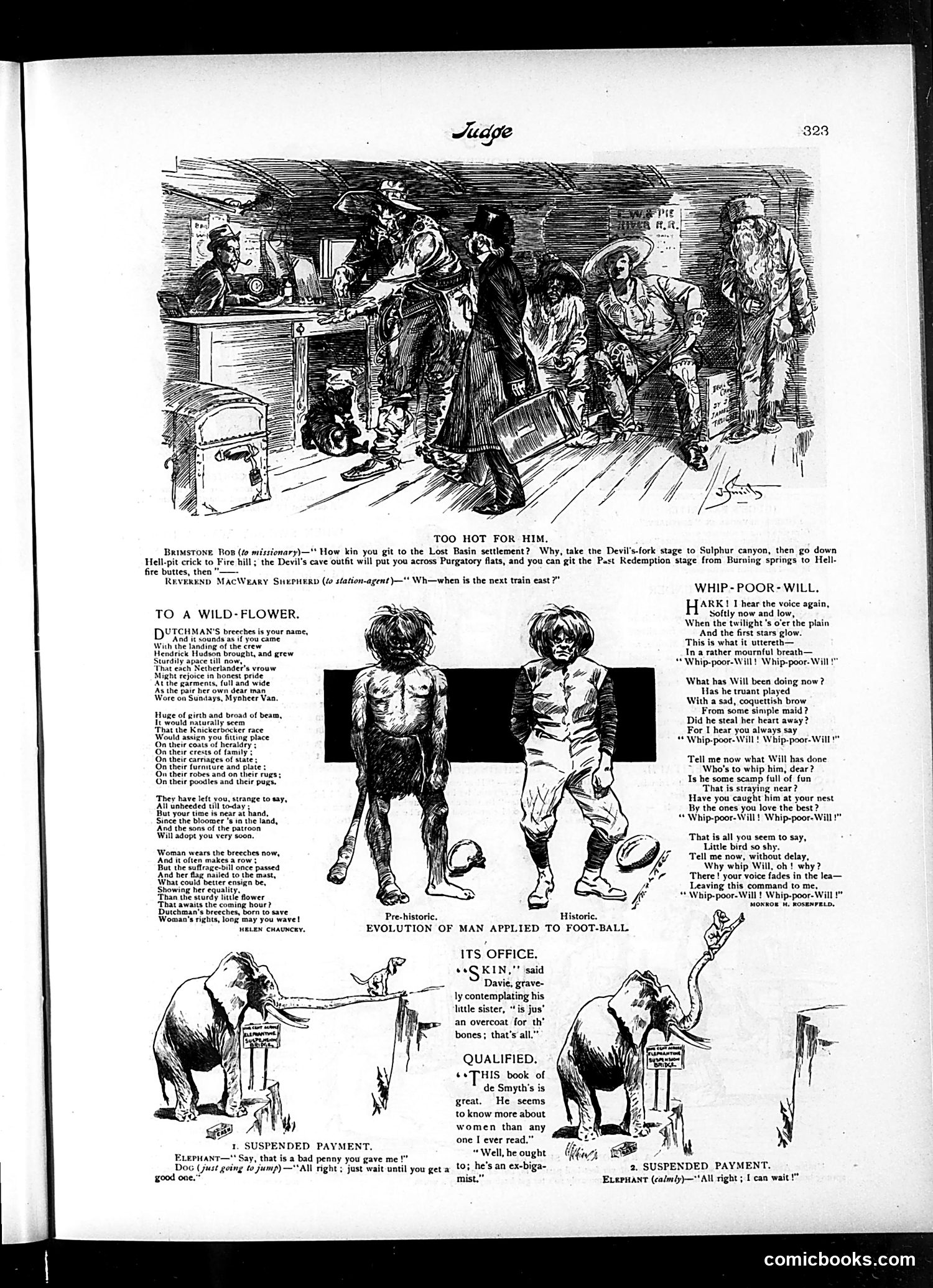
This page from *Judge* contains several satirical pieces: **"Too Hot for Him"** (top): A courtroom scene mocking a prospector's complaint about travel routes to the Lost Basin settlement, featuring absurdist suggestions involving "Devil's half-stage" and hellish locations. The satire targets impractical or exaggerated frontier settlement claims. **"Evolution of Man Applied to Foot-Ball"** (center): Compares two primitive humanoid figures labeled "Pre-historic" and "Historic," satirizing football players as evolutionarily primitive. This reflects late-19th-century anxieties about football's brutality and the athletes who played it. **"Its Office," "Qualified," and "Suspended Payment"** (bottom): Brief humorous dialogues featuring elephants in human situations, using animal characters for social commentary—likely about business dealings or financial matters, though specific references are unclear. The page blends political and social satire typical of *Judge's* editorial approach.
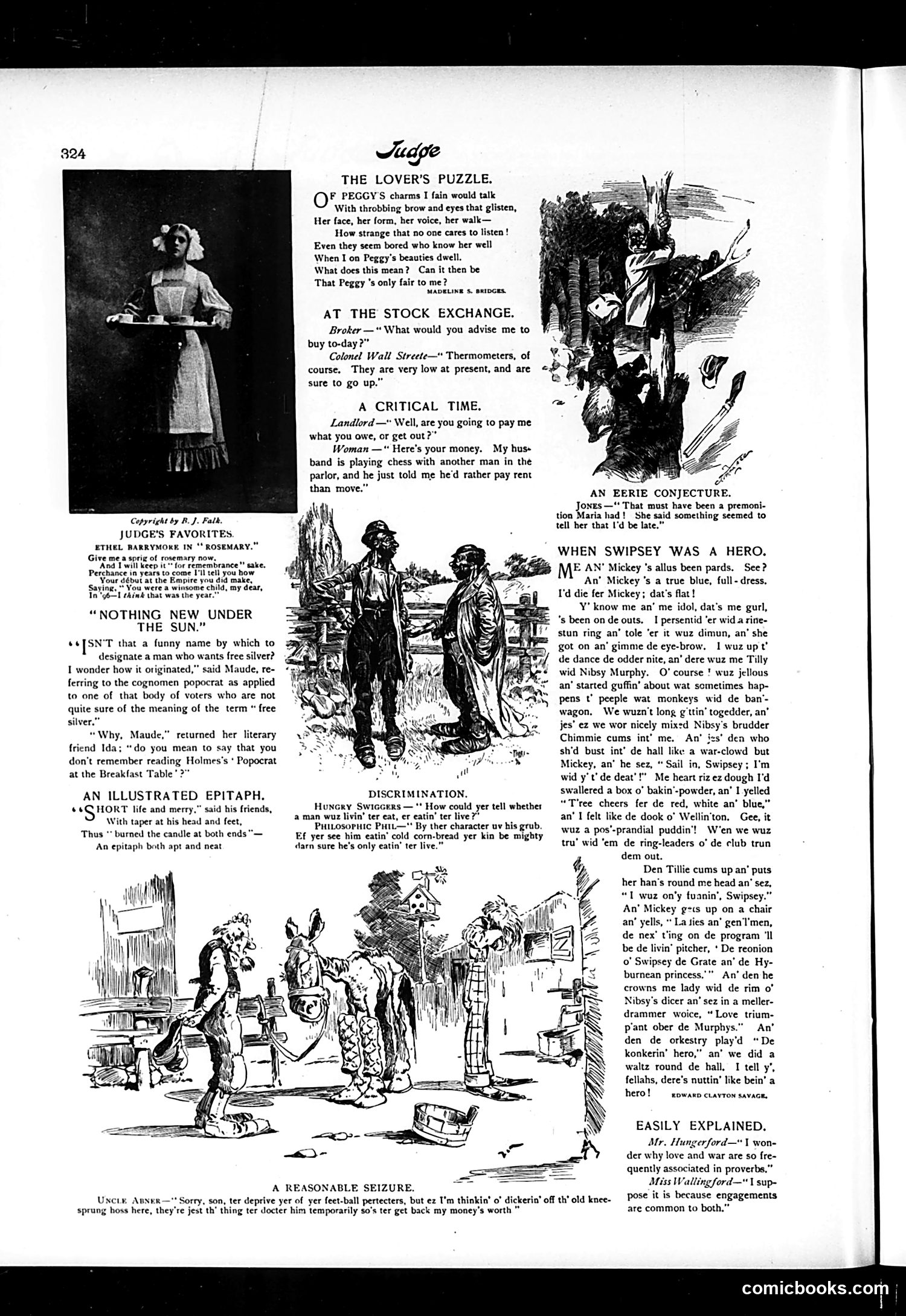
This page contains several brief satirical pieces typical of early 20th-century humor magazines: **"The Lover's Puzzle"** mocks a man boring everyone by constantly praising his girlfriend Peggy—the joke being his romantic obsession makes him tedious to others. **"At the Stock Exchange"** is a financial joke: a broker advises buying thermometers because "they are very low...and sure to go up"—a pun treating weather instruments like stocks. **"When Swipsey Was a Hero"** features working-class dialect humor about a man named Swipsey whose friend Mickey initially alienated him over a girl, but then publicly reconciles with him, making Swipsey feel heroic. It's sentimental working-class melodrama played for laughs. Other brief pieces include jokes about landlords, chess obsession, and premonitions. The **Ethel Barrymore** reference notes her theatrical performance in "Rosemary." The cartoons use period illustration styles with exaggerated characters. Overall, the humor targets romantic sentimentality, stock market speculation, class pretension, and everyday domestic situations—typical Judge magazine fare emphasizing clever wordplay and relatable social situations.
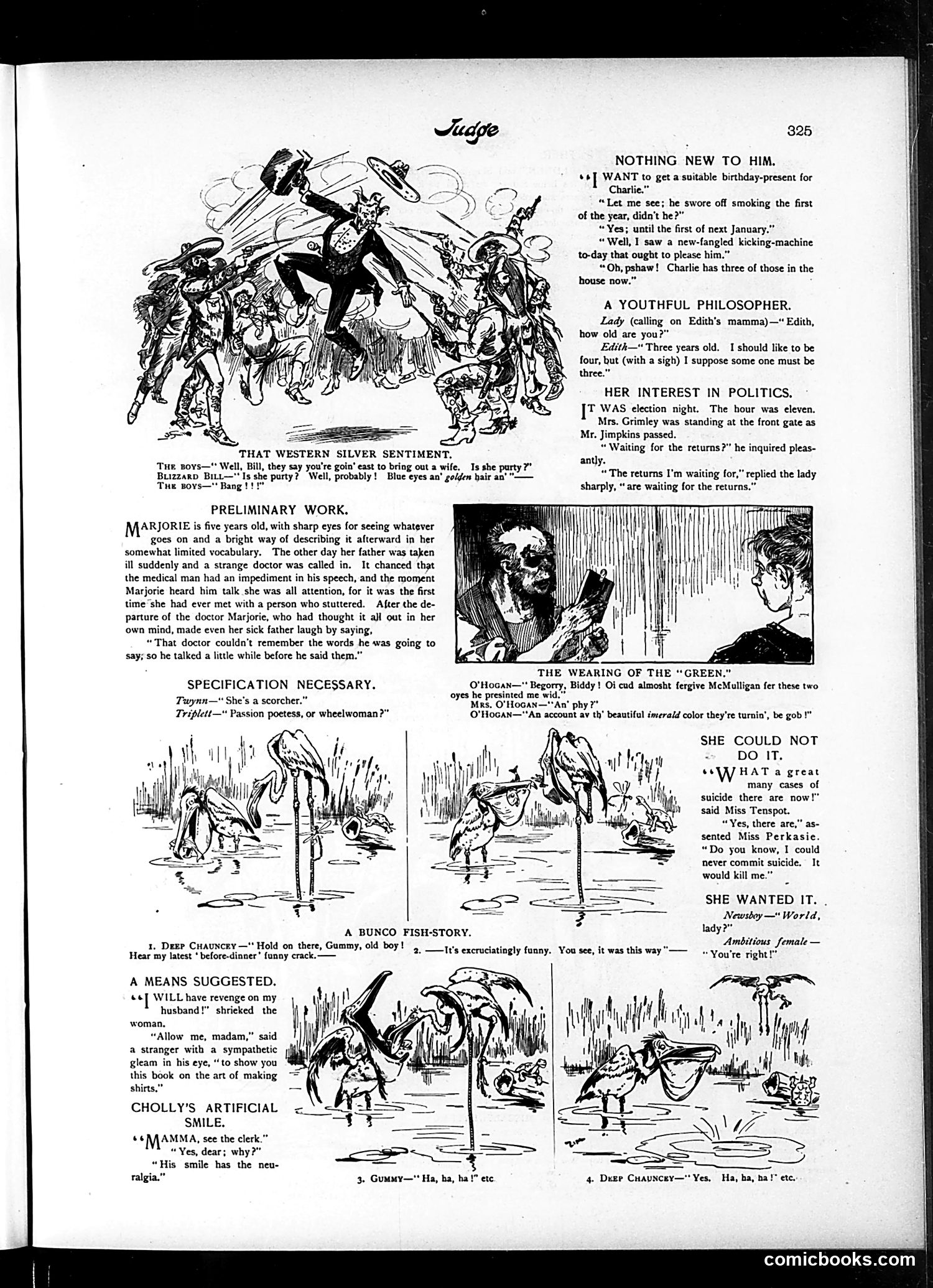
This page contains several short humorous pieces typical of early 20th-century satirical magazines: **Main jokes include:** - A man whose friend Charlie repeatedly breaks New Year's resolutions (smoking, kicking machines) - A precocious three-year-old philosopher accepting her age with resignation - Mrs. Grimley waiting at her gate on election night—but for her husband's *return* rather than election results, a dig at women's supposed political indifference - A child's logical explanation of a doctor's stutter as forgetfulness - Irish dialect humor (O'Hogan and McMulligan discussing someone turning green) - A woman claiming she "couldn't commit suicide because it would kill me"—wordplay on the phrase - A "fish story" comic strip about exaggerated tall tales - A man trying to help a woman make shirts - "Cholly's" forced smile described as having neuralgia The humor is gentle domestic and character-based comedy, relying on wordplay, malapropisms, Irish-American stereotypes, and observations about human nature rather than political commentary.
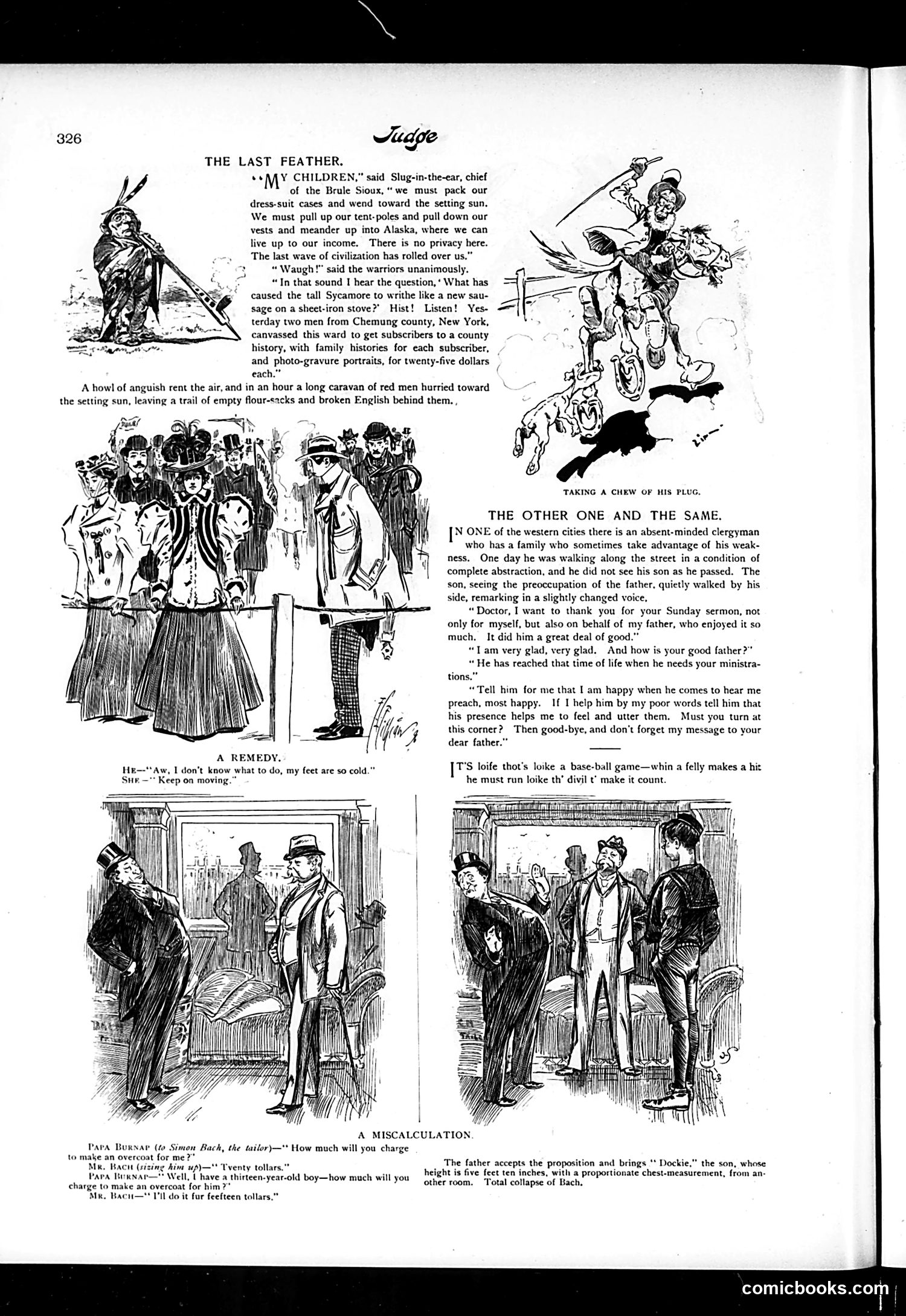
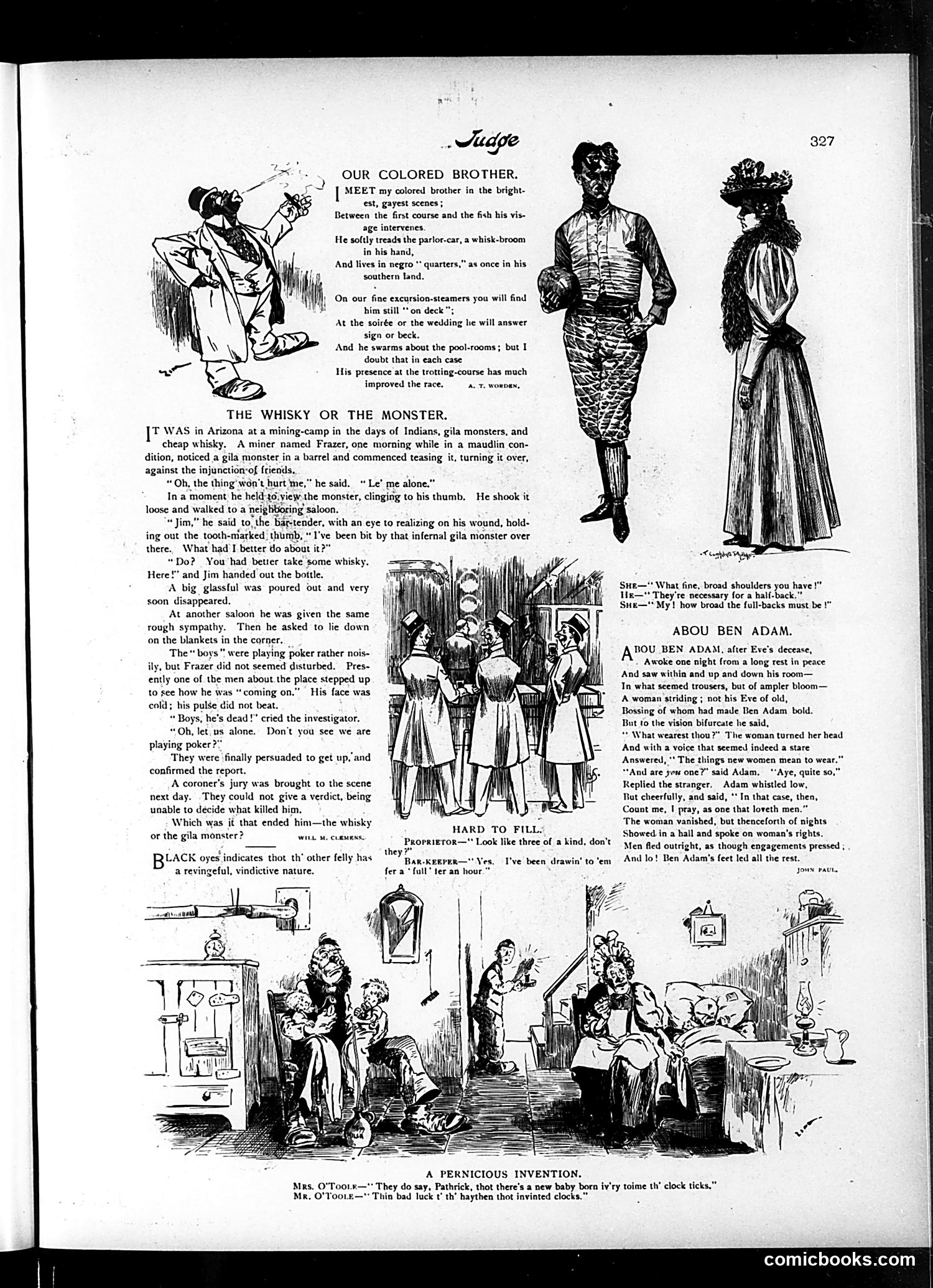
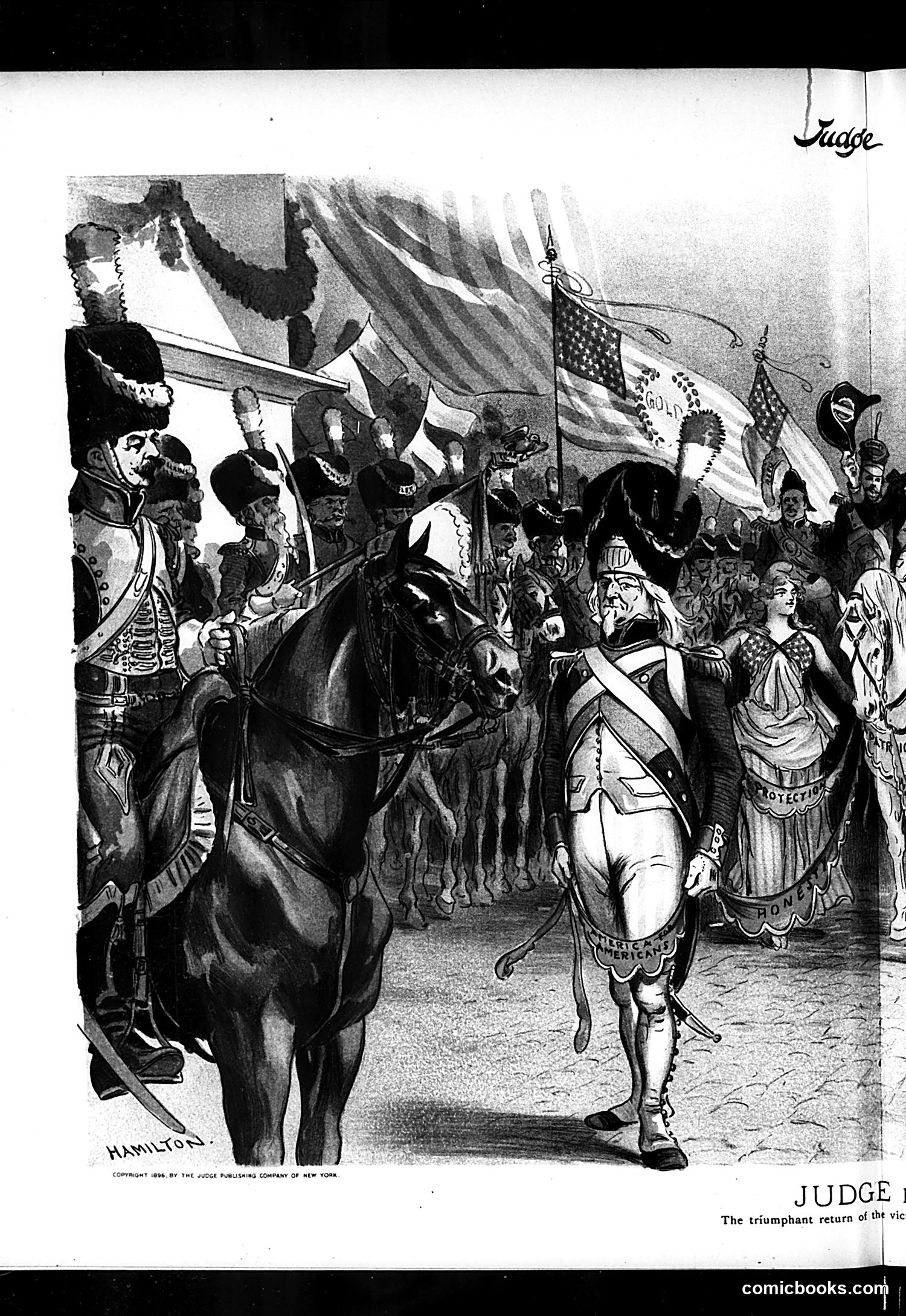
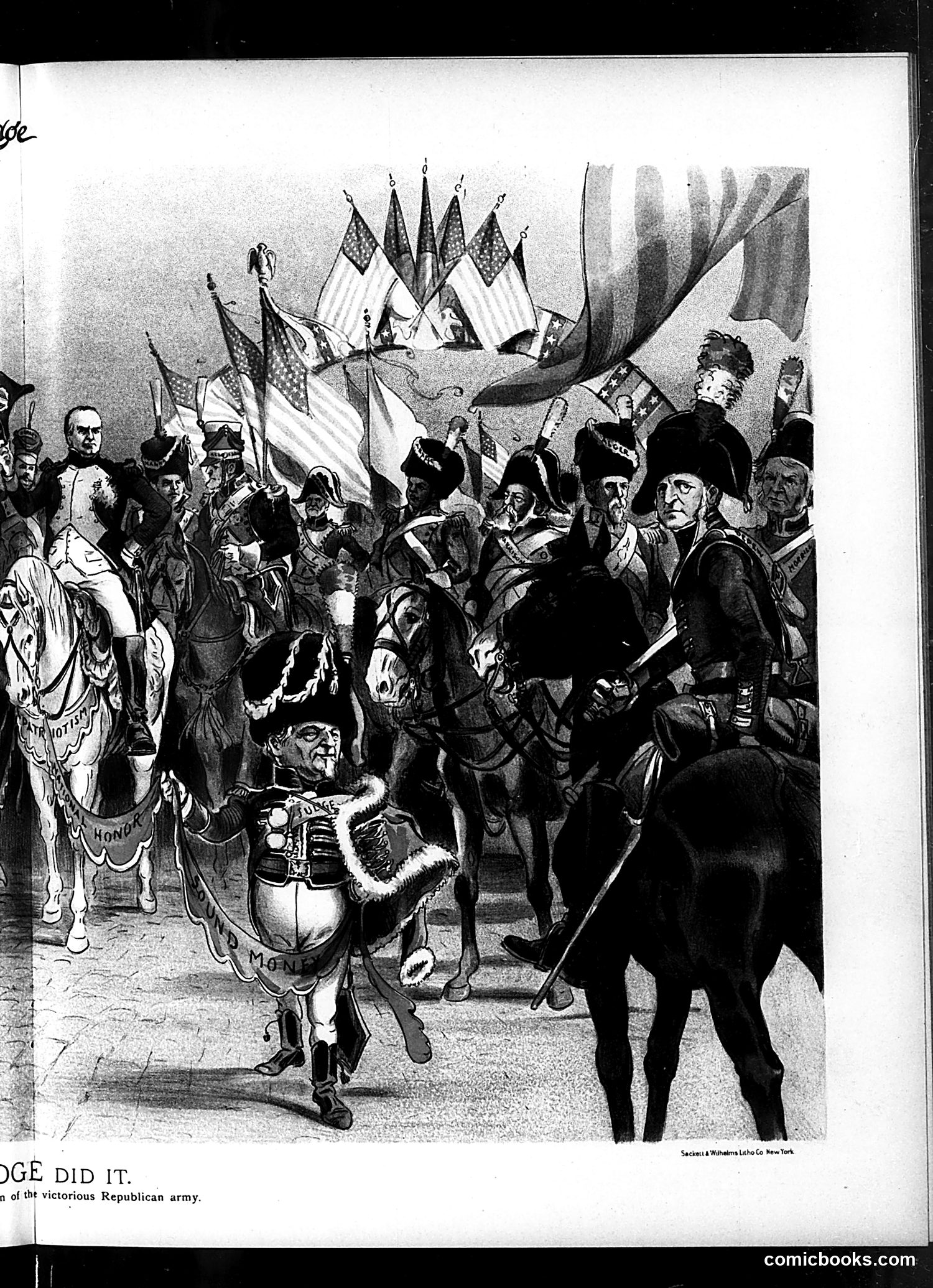
This Judge magazine cartoon depicts a military or political procession with uniformed figures on horseback and accompanying dignitaries, American flags visible in the background. The title references "The triumphant return of the vic[tor]" (text is cut off). The cartoon appears to commemorate a victorious military or political leader's homecoming parade. The elaborate military dress, formal procession, and flags suggest celebration of military success—likely from a late 19th or early 20th-century conflict. Without the complete caption or date, I cannot definitively identify which specific victory or leader is depicted. The artistic style and composition suggest satire of triumphalism or military pageantry, though the exact satirical target remains unclear from the visible portion.
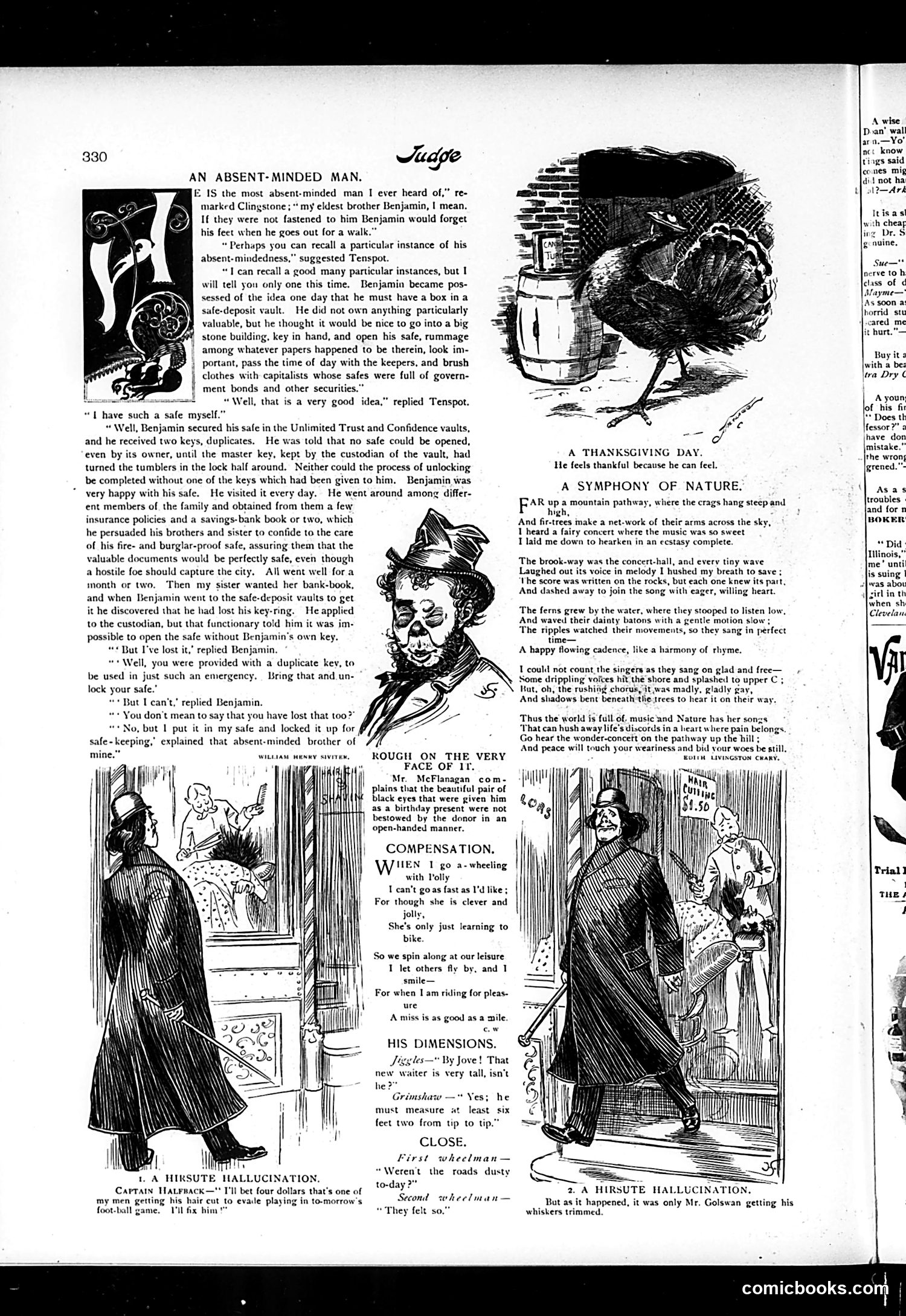
This page contains several humorous short pieces typical of Judge magazine's satirical format: **"An Absent-Minded Man"** is the main story, a comedic anecdote about Benjamin, who rents a safe-deposit box not for valuables but for the social performance of wealth. The joke culminates when he loses his key-ring, then reveals he locked his duplicate key *inside the safe itself*—a perfect illustration of absent-mindedness that would resonate with any era. The other items are brief comic vignettes: "A Hirsute Hallucination" (a joke about a barber and haircut), "His Dimensions" (wordplay about a tall waiter), and "Close" (a pun on "felt" roads). There's also sentimental poetry ("A Symphony of Nature," "A Thanksgiving Day") and lighter fare about bicycling and romance. The cartoons use period-appropriate line illustrations. The content reflects turn-of-century American humor: mildly absurdist situations, social observation, and gentle satire of middle-class pretension and romance.
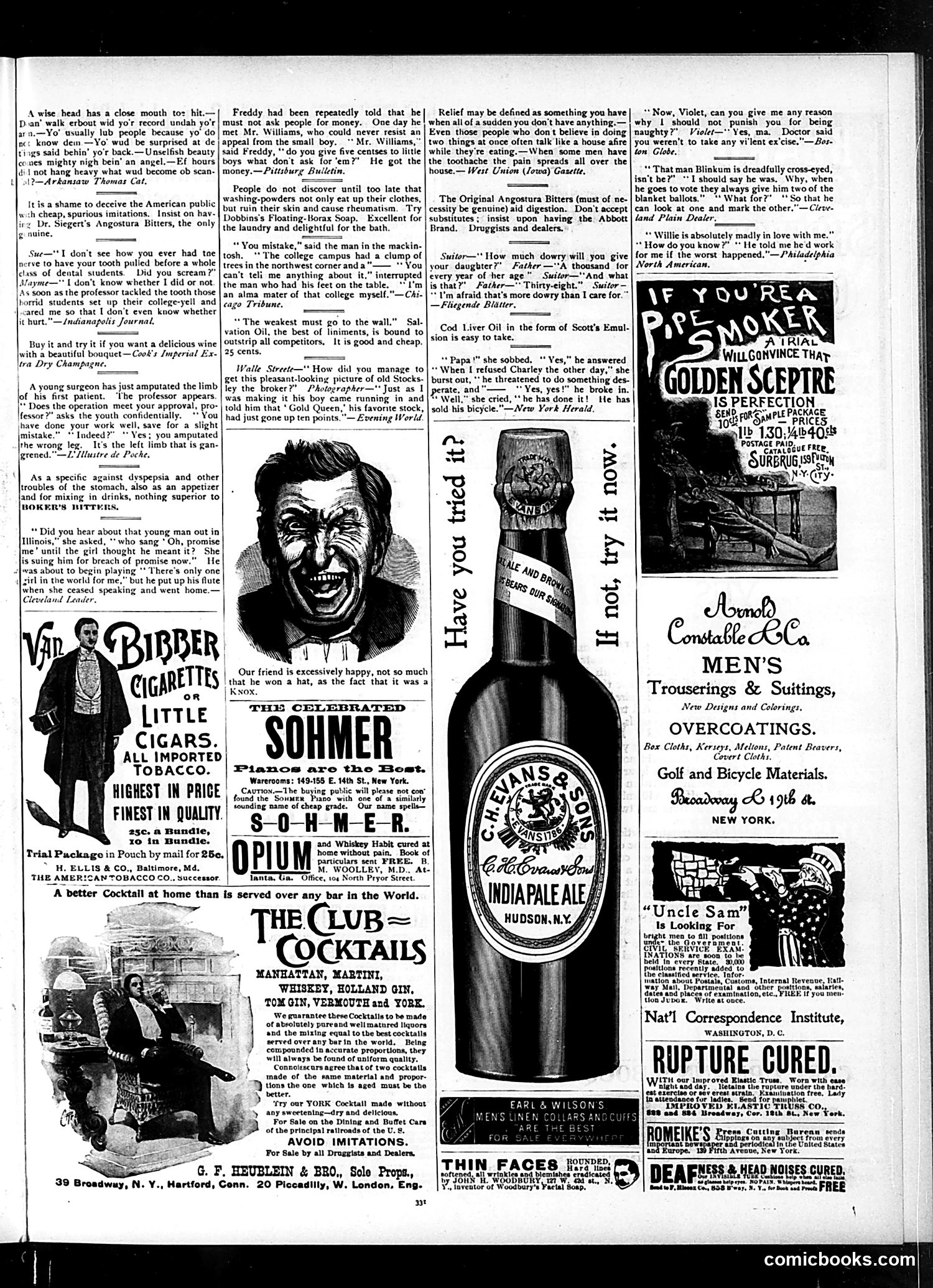
This page is primarily **advertising**, not editorial or cartoon content. While there are a few humorous anecdotal snippets scattered throughout (jokes about dental students, finance, and a misunderstanding about campus locations), there are no identifiable political cartoons or figures to analyze. The advertisements dominate: Sohmer Pianos, Van Bibber Cigarettes, Judge Club Cocktails, Dobbins Soap, Boker's Bitters, and various other patent medicines and commercial products typical of early-20th-century magazines. One small cartoon shows a laughing face labeled "The Celebrated Sohmer," but it's merely a product mascot, not political satire. The page appears to be a standard advertising section from *Judge* magazine, with light humor used to fill space between paid advertisements rather than provide satirical commentary.
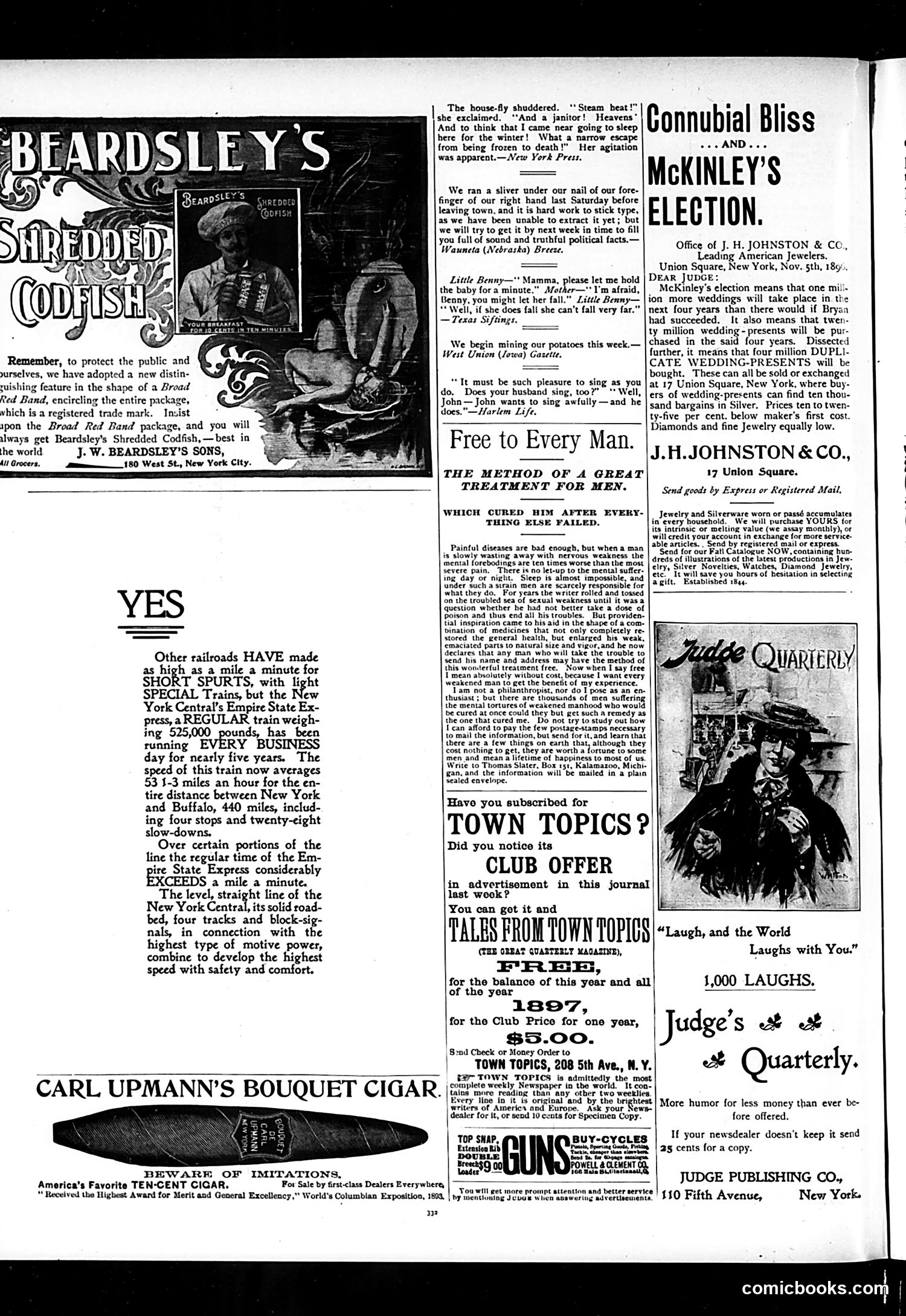
This page is primarily **advertising and filler content** rather than political cartoons. The main visual is **Beardsley's Shredded Codfish advertisement**, featuring a domestic scene with a woman discovering a janitor and steam heat in her house—a mild joke about her narrow escape from freezing. The page includes: - **Railroad advertising** for the New York Central's Empire State Express, boasting speed and reliability - **Carl Upmann's Bouquet Cigar ad** - Multiple **humorous short anecdotes** from regional newspapers (jokes about a child holding a baby, potato harvesting, singing husbands) - A **dubious medical advertisement** promising to cure "nervous weakness" and sexual dysfunction "free"—typical quack medicine marketing of the era There are **no identifiable political cartoons or caricatures** here. The page represents Judge's mixed content model: satirical magazine wrapped around commercial advertisements and reprinted humor, reflecting turn-of-the-century publishing practices.
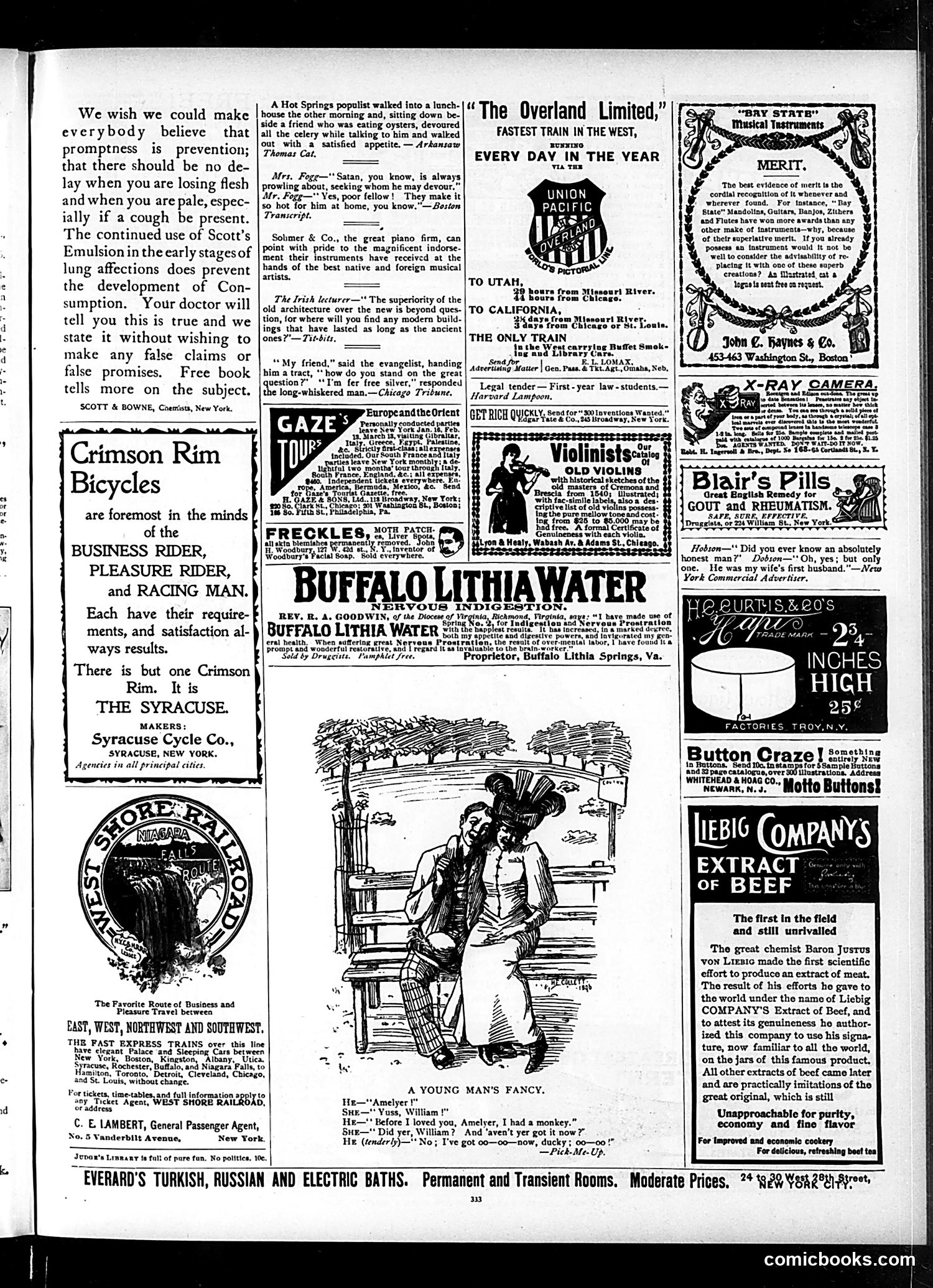
This is primarily an **advertising page** from Judge magazine, with minimal editorial content. The few cartoon/joke items are brief: **Main humor pieces:** - A short joke about a "Hot Springs populist" eating celery at a lunch counter—likely satirizing Populist Party members as unsophisticated or greedy - Several one-liner jokes about religion, marriage, and legal education scattered throughout **The large central illustration** labeled "A YOUNG MAN'S FANCY" depicts a romantic scene of a man and woman on a bench, accompanying period verse about courtship—standard sentimental content, not satirical. **The advertisements dominate**, promoting bicycles (Crimson Rim), pianos (Sohmer & Co.), patent medicines (Scott's Emulsion for tuberculosis, Blair's Pills), Buffalo Lithia Water, trains, and musical instruments. The medical ads reflect the era's unregulated patent medicine industry. **Overall**: This is a typical late-19th-century magazine page mixing light humor with commercial promotions rather than serious political satire.
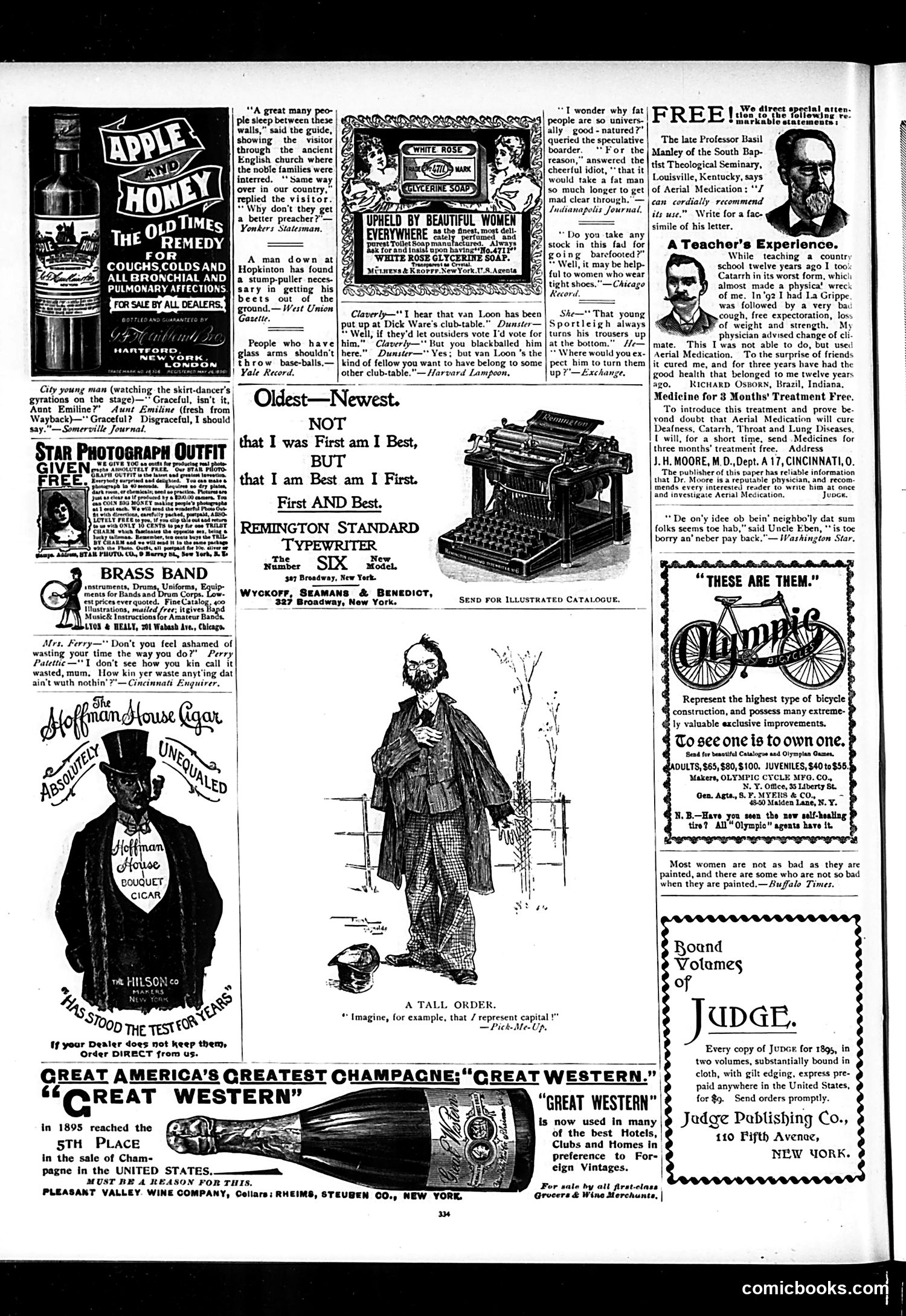
This is primarily an **advertising page** with several short humorous anecdotes scattered throughout. The main content consists of product advertisements (Apple and Honey cough remedy, typewriters, champagne, cigars, bicycles) interspersed with brief joke-style exchanges. The cartoon illustration shows a man in period dress labeled "A Tall Order," captioned with a quote: "Imagine, for example, that I represent capital!" This appears to be **social commentary on class and economics**, though the full context is unclear from the visible text. The page includes typical Judge magazine features: **light social satire** about contemporary life (church attendance, fashion, barefoot walking trends) presented as brief comic dialogues. The humor targets urban middle-class manners and foibles—typical of Judge's satirical approach in this era. The ads reflect 1890s consumer goods and services—including "Aerial Medication," a patent medicine claiming therapeutic benefits, typical of the period's unregulated health claims.
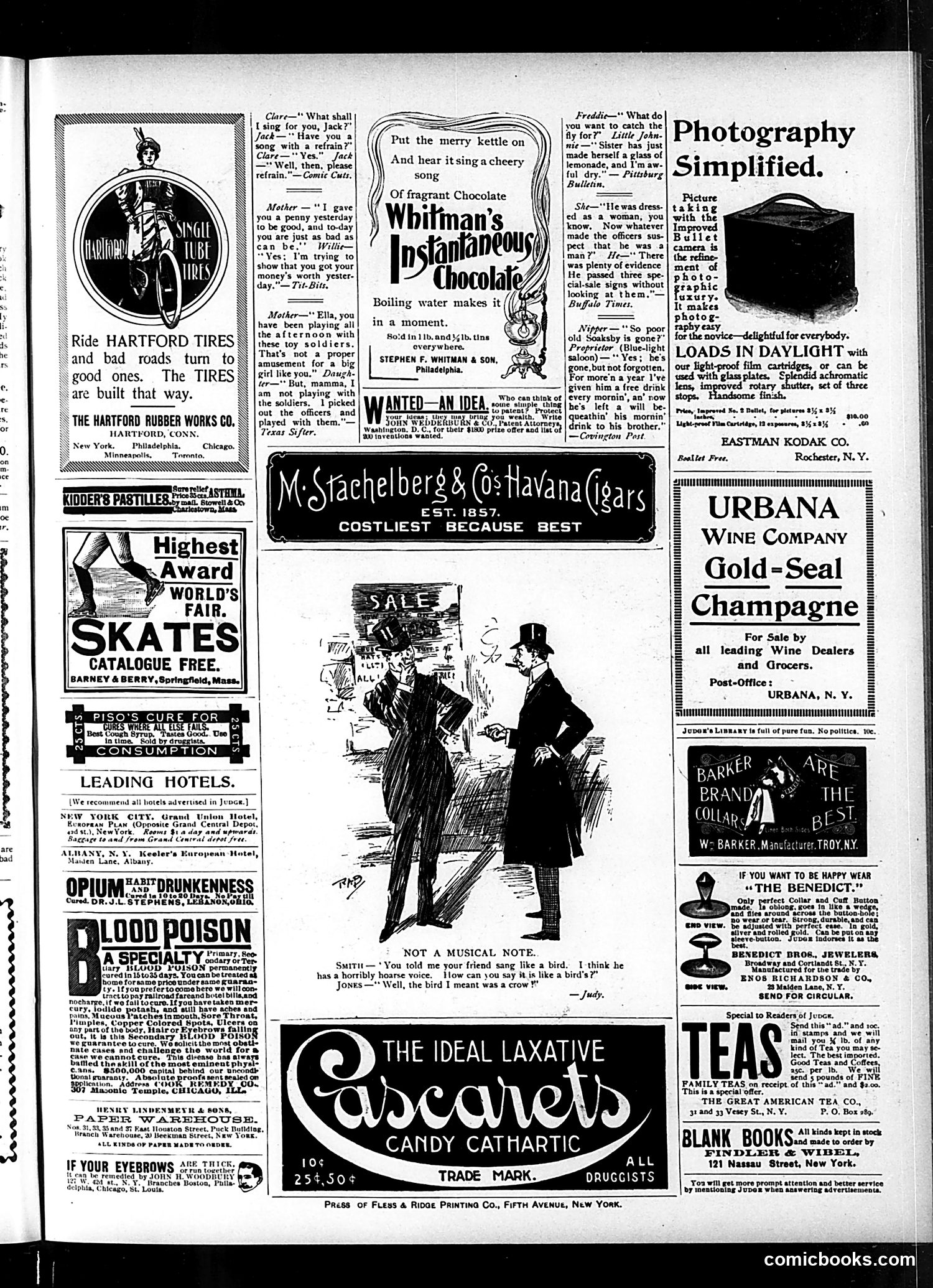
This page is primarily **advertisements and brief comic quips**, not political satire. The content reflects early 1900s consumer culture. **Key elements:** The main cartoon (center) shows two well-dressed men at a sale, with the caption "NOT A MUSICAL NOTE." It's a mild visual pun—one man mentions his friend "sang like a bird," but clarifies he meant a *crow* (harsh-sounding). The joke plays on the phrase "sings like a bird" typically meaning beautiful singing. **Notable ads** include: - Hartford Tires and photography equipment (Eastman Kodak) - Whitman's Chocolate, Piso's Cure, and various patent medicines (some likely containing harmful substances like mercury or opium) - Champagne, cigars, and collar brands The scattered comic **one-liners** feature wordplay and domestic humor typical of the era—children's pranks, marriage quips, and puns. None reference contemporary politics. This is essentially a **commercial page** showcasing period products and light humor, with no apparent political commentary.
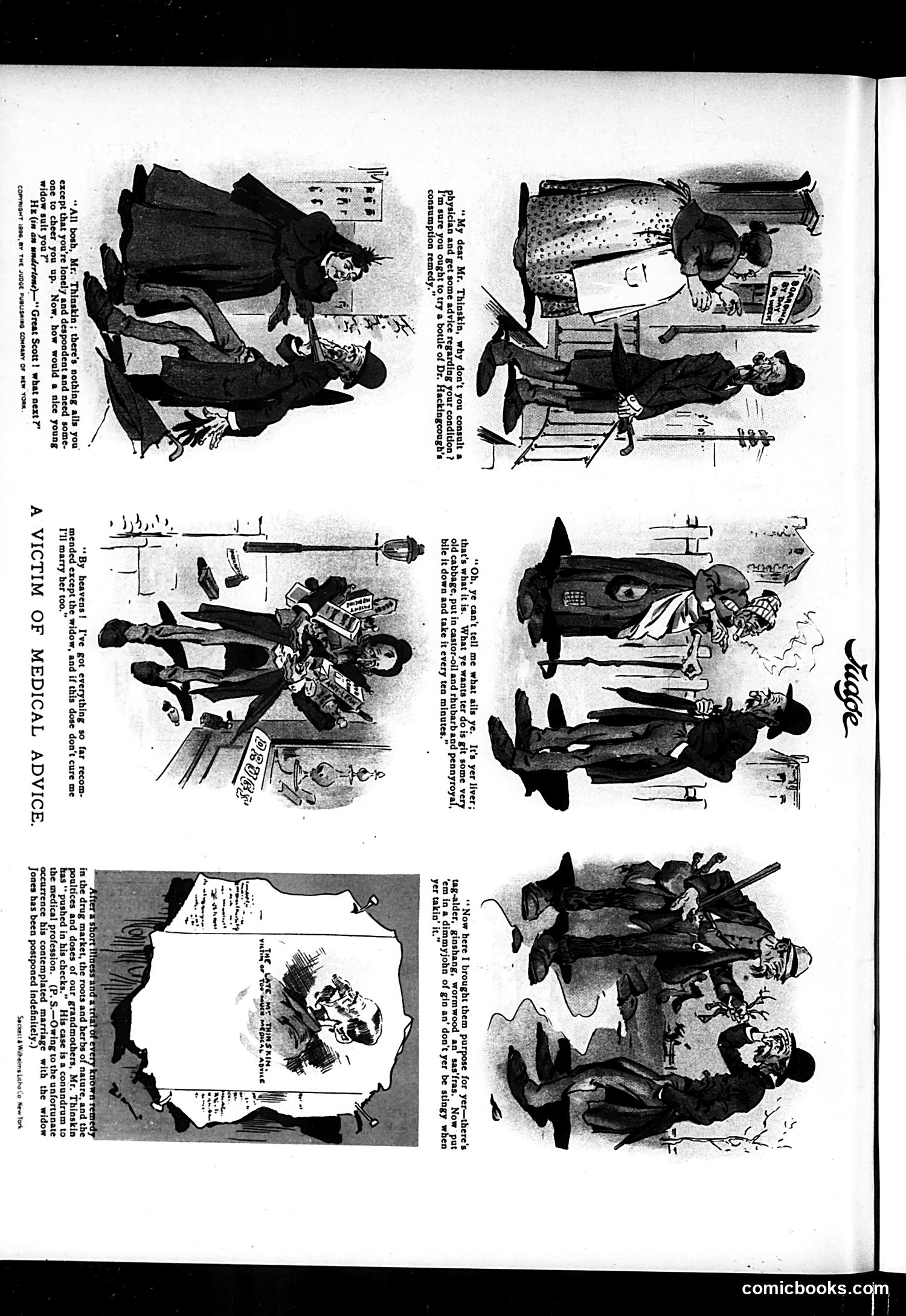
This 1896 Judge cartoon satirizes the era's abundance of unregulated medical quackery and folk remedies. A sickly man named "Thinskin" receives increasingly absurd health advice from various sources: a physician pushing patent medicine ("Dr. Hackingcough's consumption remedy"), a matchmaker suggesting marriage as a cure, and an old woman recommending bizarre herbal concoctions (tag-alder, ginseng, wormwood, sassafras mixed in gin). The humor builds as each "cure" proves more ridiculous than the last. Thinskin's exasperated final line—threatening to marry the widow if none of this works—suggests he's overwhelmed by contradictory, worthless advice. The footnote indicates an actual wedding was postponed due to his condition, underlining the chaos these false remedies create. The cartoon mocks both medical incompetence and the gullibility of patients desperate for relief in an era before modern medicine or FDA regulation.