
A complete issue · 16 pages · 1896
Judge — September 12, 1896
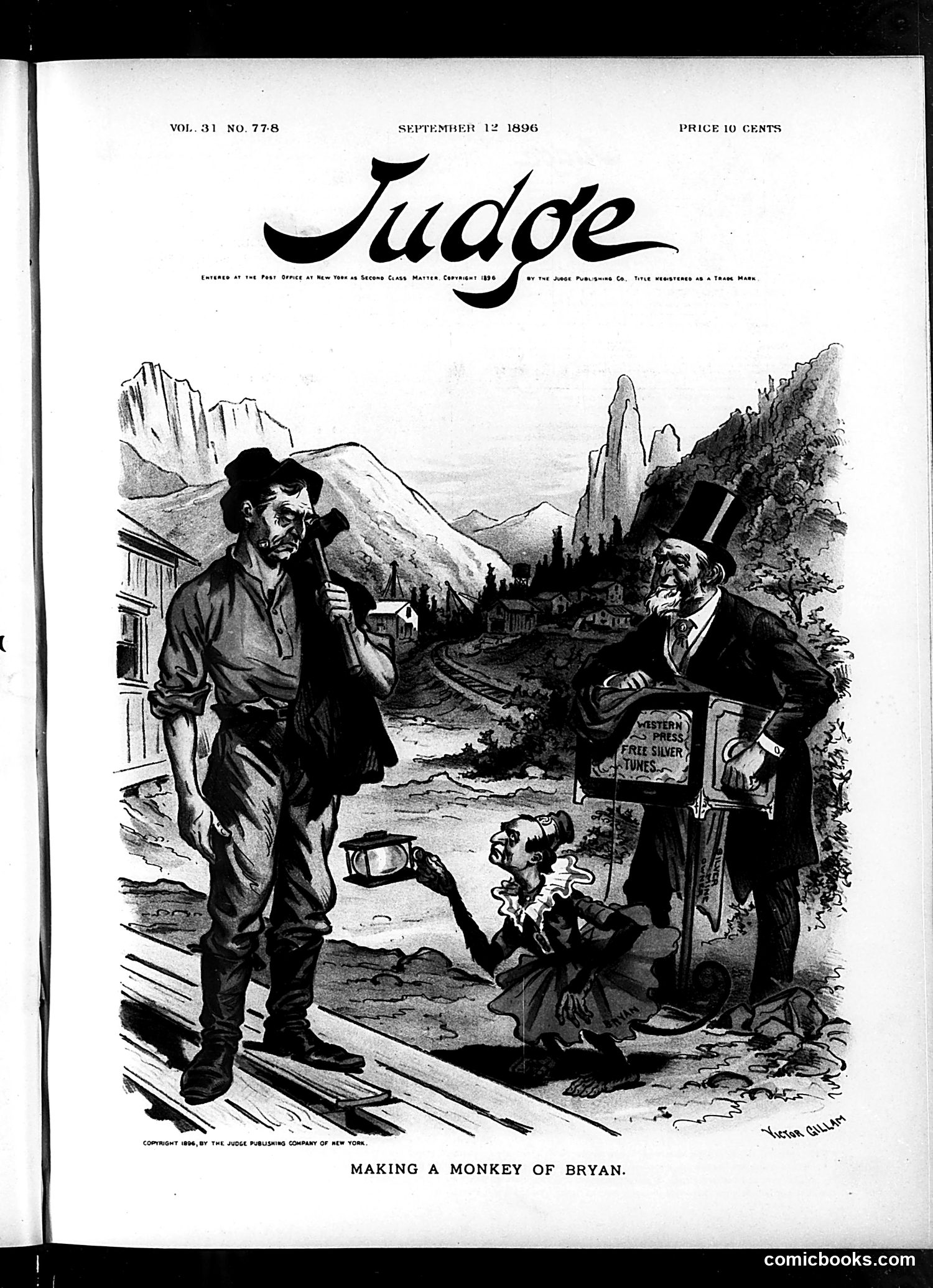
This cartoon satirizes William Jennings Bryan, the 1896 Democratic presidential candidate, during his famous "Free Silver" campaign. The image shows a man (likely representing a political opponent or the establishment) literally making a monkey of Bryan—depicted as a small figure in the center being manipulated or mocked. The signs visible reference "Free Silver" and "Silver Tunes," alluding to Bryan's populist push for unlimited silver coinage, which his opponents ridiculed as economically reckless. The mountainous backdrop and rural setting suggest the Western mining interests supporting Bryan's platform. Judge magazine, Republican-leaning, used this imagery to mock Bryan as foolish and easily manipulated—a common attack on his candidacy during the 1896 election.
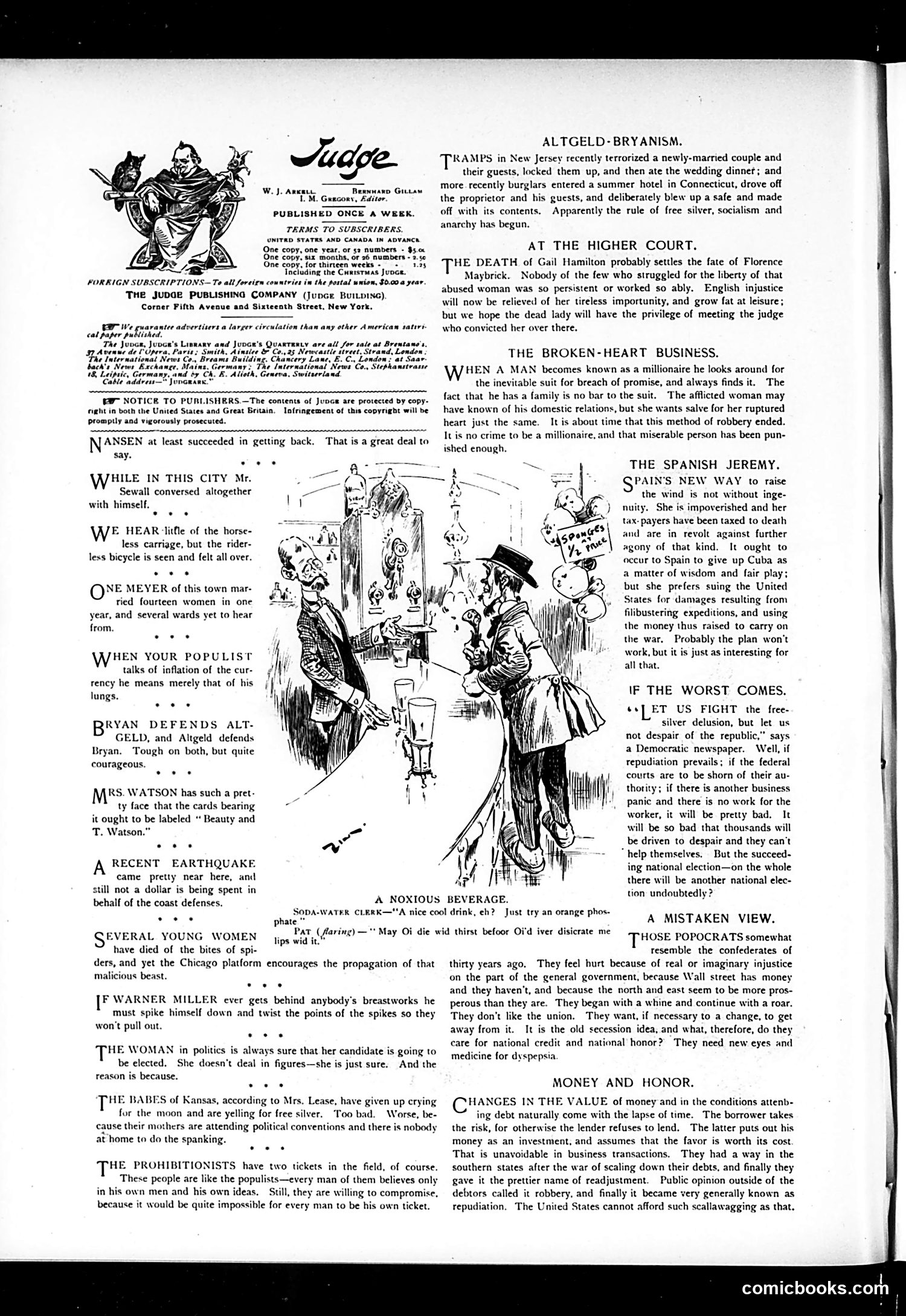
This cartoon satirizes Spanish colonial administration in Cuba during a period of independence unrest. The central figure appears to be a Spanish official or representative forced to consume a bitter drink—representing Cuba itself as an indigestible "beverage" for Spain. The surrounding figures likely represent various stakeholders: Cuban insurgents, American interests, and Spanish authorities. The caption "A Noxious Beverage" suggests Spain finds Cuba an impossible colonial possession—costly, troublesome, and increasingly unpalatable to maintain. The context references Spain's deteriorating control over Cuba in the 1890s, when independence movements and American interest threatened Spanish colonial power. The cartoon mocks Spain's predicament: Cuba has become unbearable to hold but politically difficult to release, creating an impossible situation for Spanish leadership.
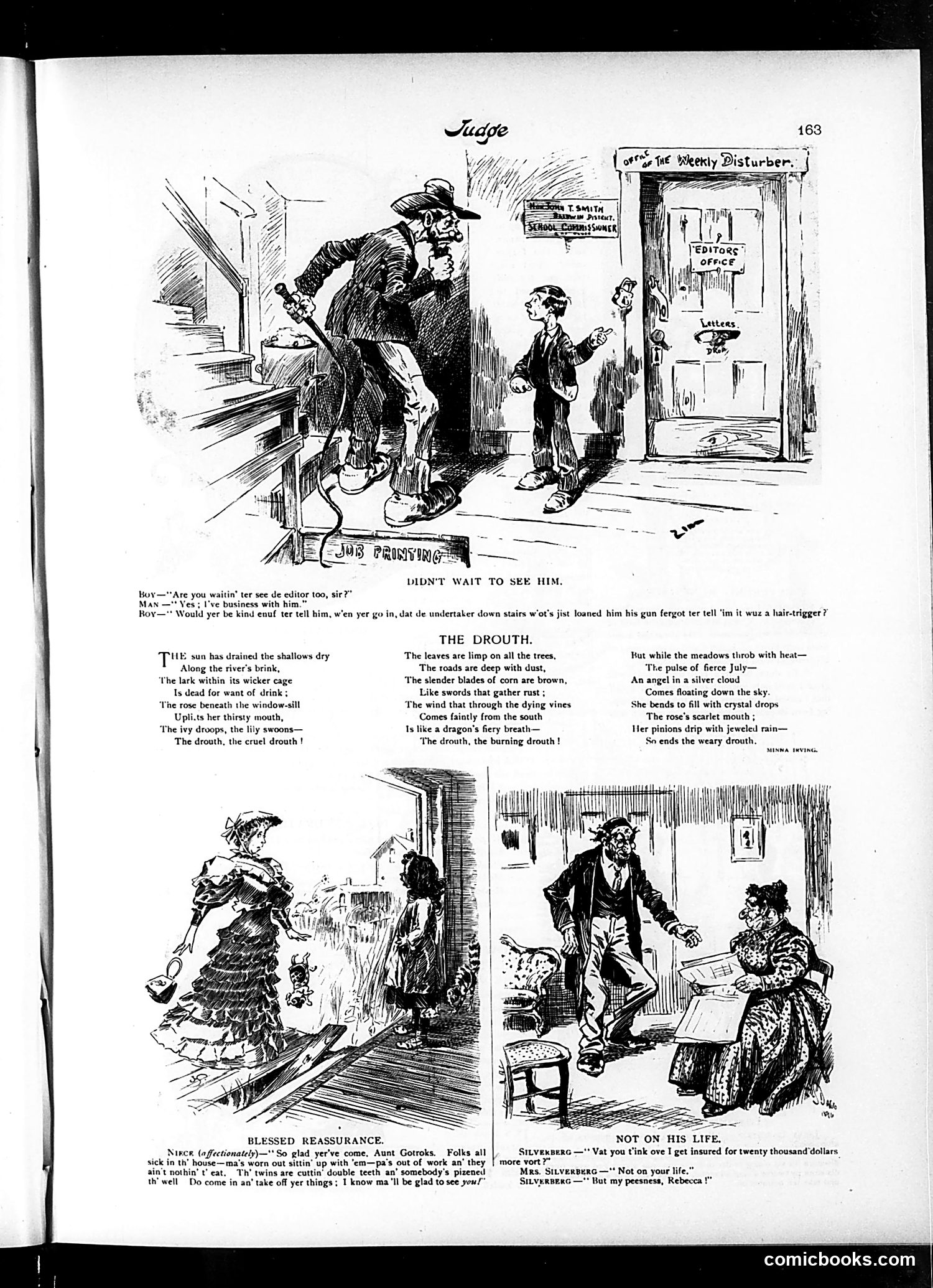
**Top Cartoon: "Didn't Wait to See Him"** A man representing a school commissioner or official encounters a boy near an office door. The satire concerns an undertaker located downstairs—the joke being that the boy didn't wait to consult the commissioner before visiting the undertaker, suggesting the official is so ineffectual or unpopular that people prefer dealing with death itself. **"The Drouth" Poem** A seasonal poem about drought conditions, depicting dry weather's effects on landscape and nature. **Bottom Cartoons** Two separate domestic scenes: "Blessed Reassurance" shows relief at a visitor's arrival; "Not on His Life" depicts a financial dispute over insurance—a man refusing to sign paperwork, likely resisting paying premiums or claiming coverage. The page combines political/social commentary with domestic humor typical of Judge magazine's satirical approach.
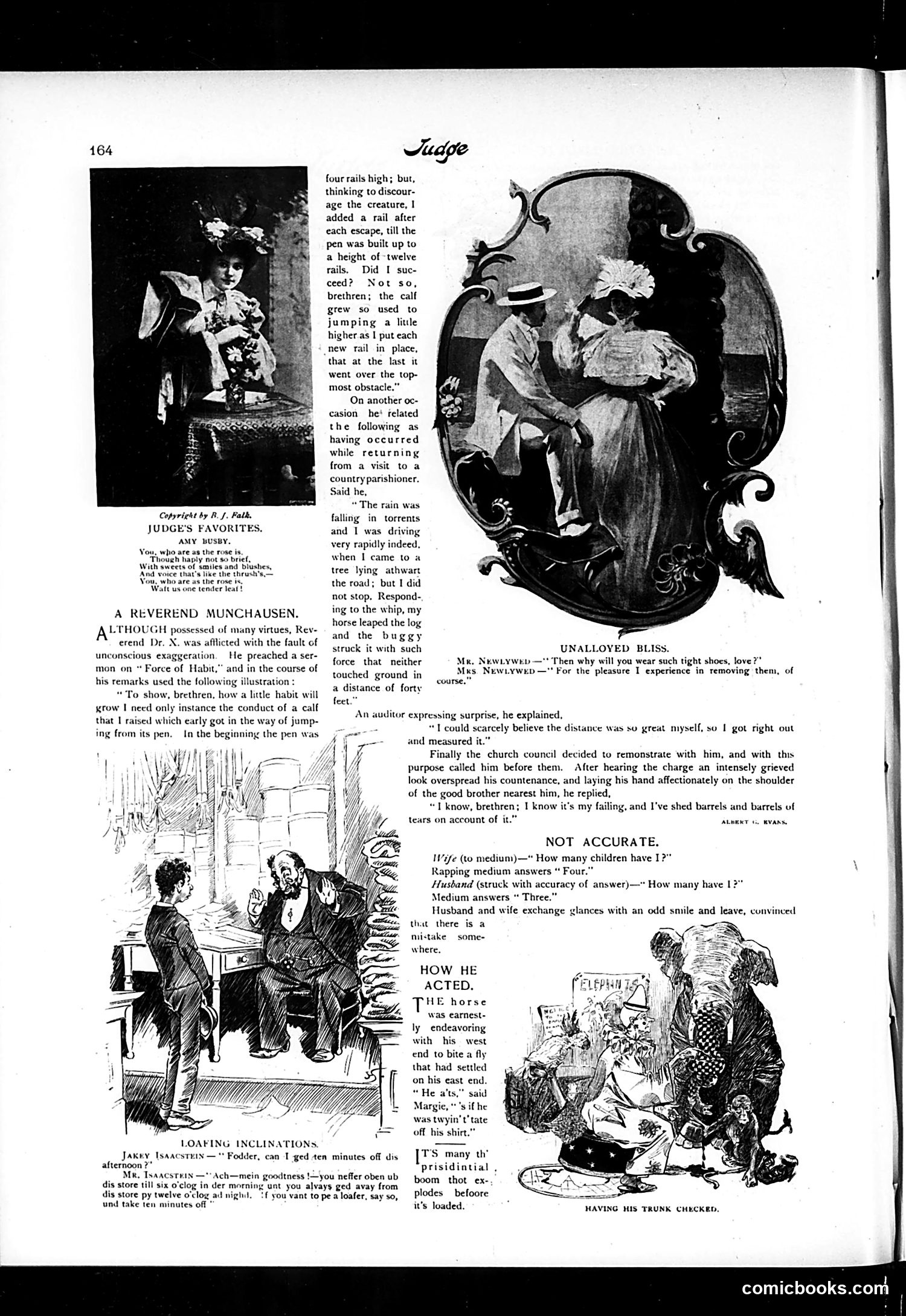
This page from Judge contains multiple unrelated humorous anecdotes and cartoons typical of the magazine's format. The main feature is "A Reverend Munchausen," satirizing a clergyman famous for tall tales. The reverend tells increasingly implausible stories—a calf that jumps higher as rails are added, driving through a fallen tree without stopping—demonstrating how habit and self-deception enable chronic lying. The satire targets both his compulsive dishonesty and the church council's ineffectual attempts to reform him. Secondary items include: - "Not Accurate": A séance medium fails—correctly guessing four children, then three, revealing the couple's actual situation - "How He Acted": A visual gag about a horse trying to bite a fly on opposite ends of its body - "Loafing Inclinations": An ethnic dialect joke about a Jewish shopkeeper and employee The cartoons employ period-typical stereotypes and slapstick humor. The overall tone is gentle mockery of human folly rather than political commentary.
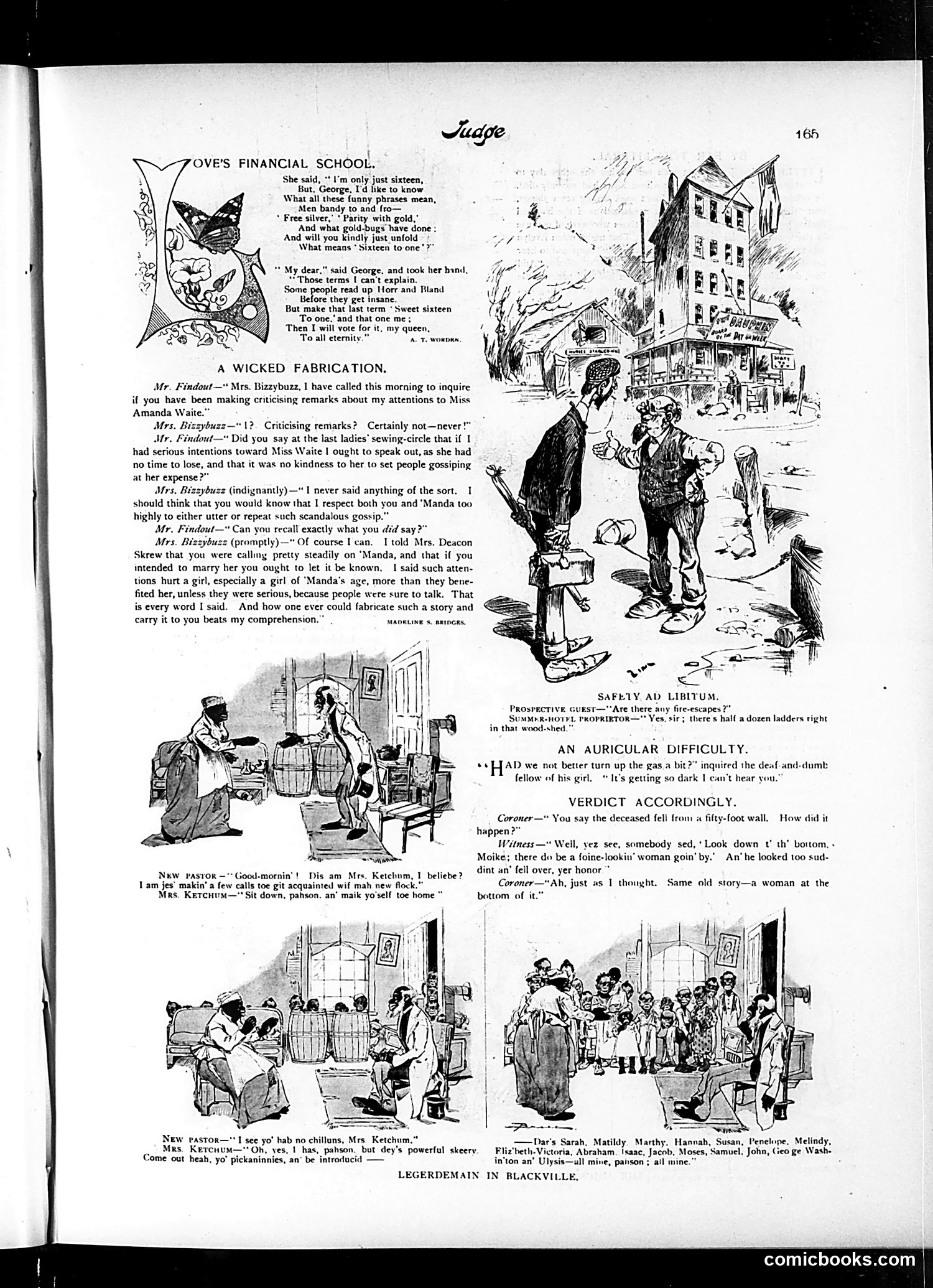
This page contains several satirical pieces typical of late 19th-century American humor: **"Love's Financial School"** mocks the era's heated debate over monetary policy ("free silver," "gold bugs," "parity"). A young woman asks her suitor to explain these terms; he dismisses them as incomprehensible and proposes instead the ratio "Sweet sixteen to one"—a flirtatious pun on the actual political debate over silver-to-gold ratios. **"A Wicked Fabrication"** satirizes small-town gossip culture. A man accuses Mrs. Bizzybuzz of spreading rumors about his courtship; she denies it, then admits saying nearly identical things—demonstrating how gossips justify spreading damaging information through semantic hairsplitting. **Other brief sketches** include: deaf-and-dumb humor ("can't hear you" in darkness), Irish dialect comedy about a fatal fall ("a woman at the bottom of it"), and a section titled "Legerdemain in Blackville" featuring racial caricature with stereotypical Black dialect and large family names—reflecting period prejudices. The illustrations are crude woodcuts typical of the era's popular press.
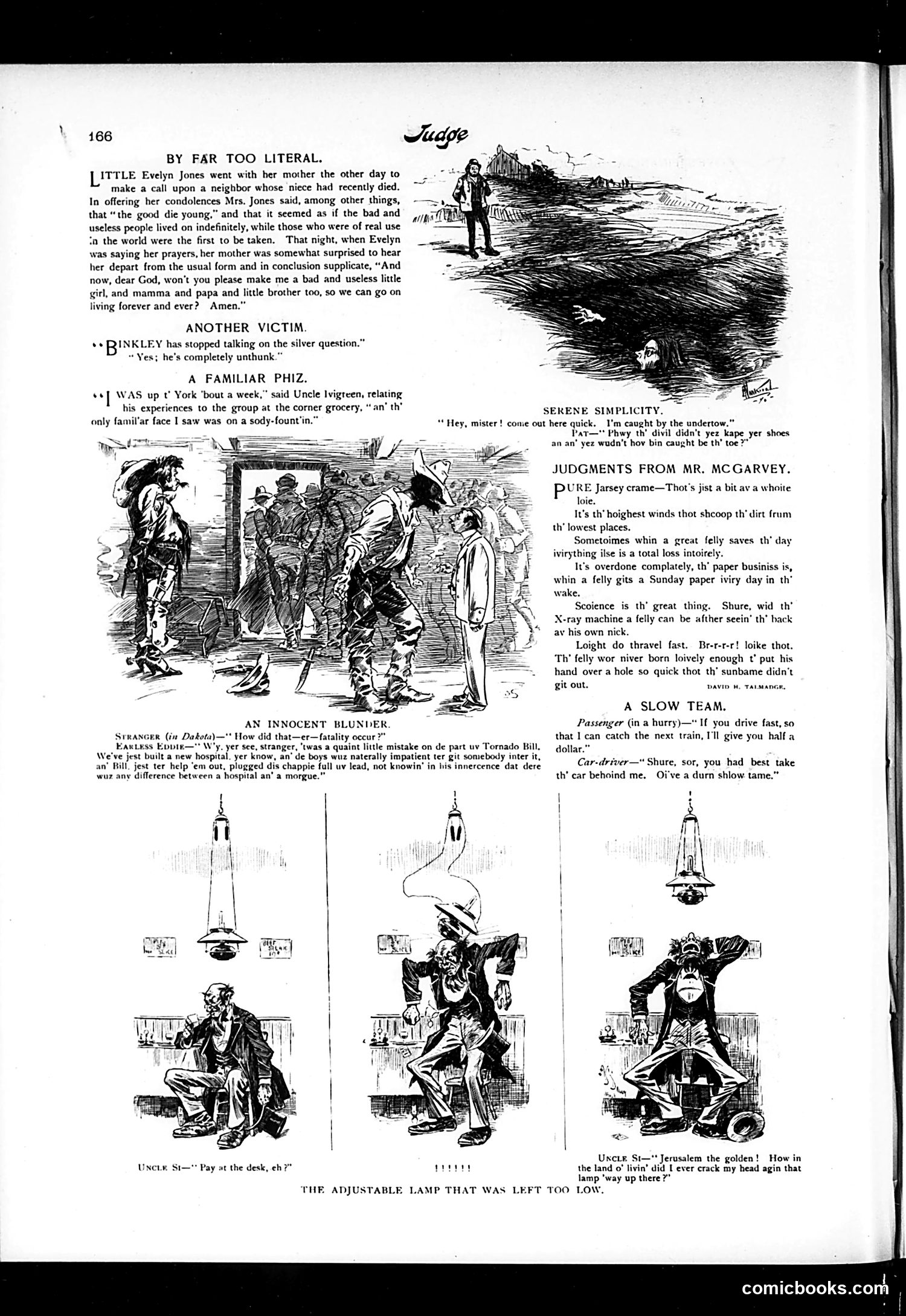
This page contains multiple humorous vignettes typical of late-19th-century American satire: **"By Far Too Literal"** mocks childhood innocence—a girl takes her mother's condolence cliché ("the good die young") literally and prays to become "bad and useless" to live forever. **"Another Victim"** jokes that someone has stopped discussing the "silver question" (likely referring to the monetary debates of the 1890s-1900s over silver coinage) because he's become mentally incapacitated ("unthunk"). **"A Familiar Phiz"** uses dialect humor: Uncle Iveigeen saw only his own face reflected in a soda fountain mirror during a trip. **"Serene Simplicity"** depicts an Irish immigrant ("Pat") caught by an undertow, with another character suggesting he should have worn shoes—obvious practical advice, the humor derived from working-class dialect and perceived naïveté. **"Judgments from Mr. McGarvey"** presents McGarvey as a folksy philosopher offering rustic observations in exaggerated Irish brogue. The remaining cartoons use similar dialect humor and situational comedy, reflecting period attitudes toward immigration and class stereotypes.
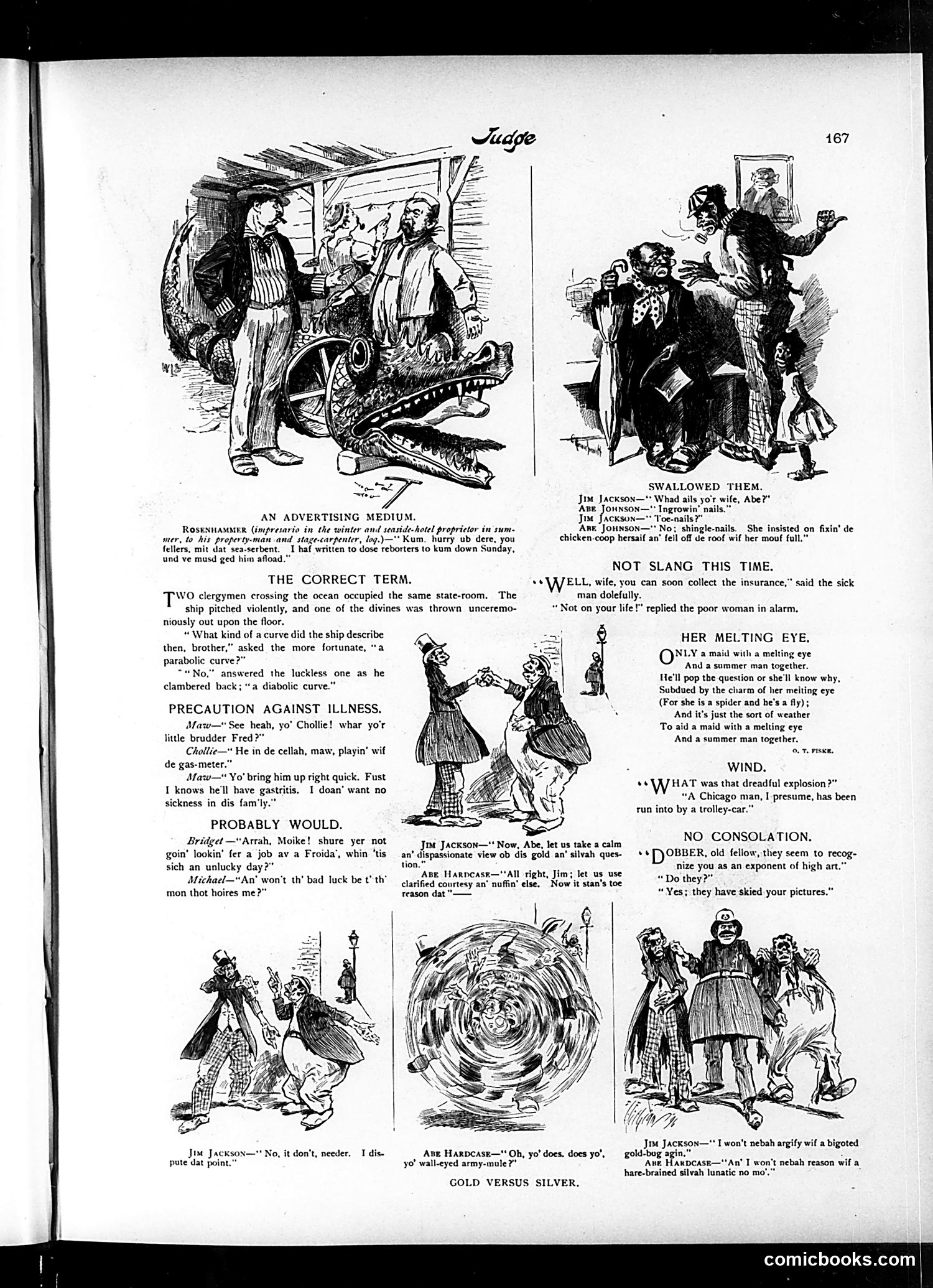
This page contains multiple satirical sketches typical of late 19th-century American humor. **"An Advertising Medium"** mocks theatrical impresarios using exaggerated immigrant dialect (Yiddish-inflected English), showing a showman exploiting a sea serpent attraction for publicity. **"The Correct Term"** is a simple pun: clergymen debating whether a ship's violent motion describes a "parabolic" or "diabolic" curve. **"Gold Versus Silver"** features Jim Jackson and Abe Harcaase—characters appearing to represent different positions in the heated late-1890s debate over monetary policy (gold standard vs. silver coinage). Their exaggerated dialect and stubborn refusal to listen satirizes how Americans of different classes and backgrounds talked past each other on this divisive economic issue. Other sketches use period stereotypes (Irish maids, African American dialect characters) for domestic humor. The page reflects Judge's mix of political commentary and broad comedy typical of American satirical magazines of this era.
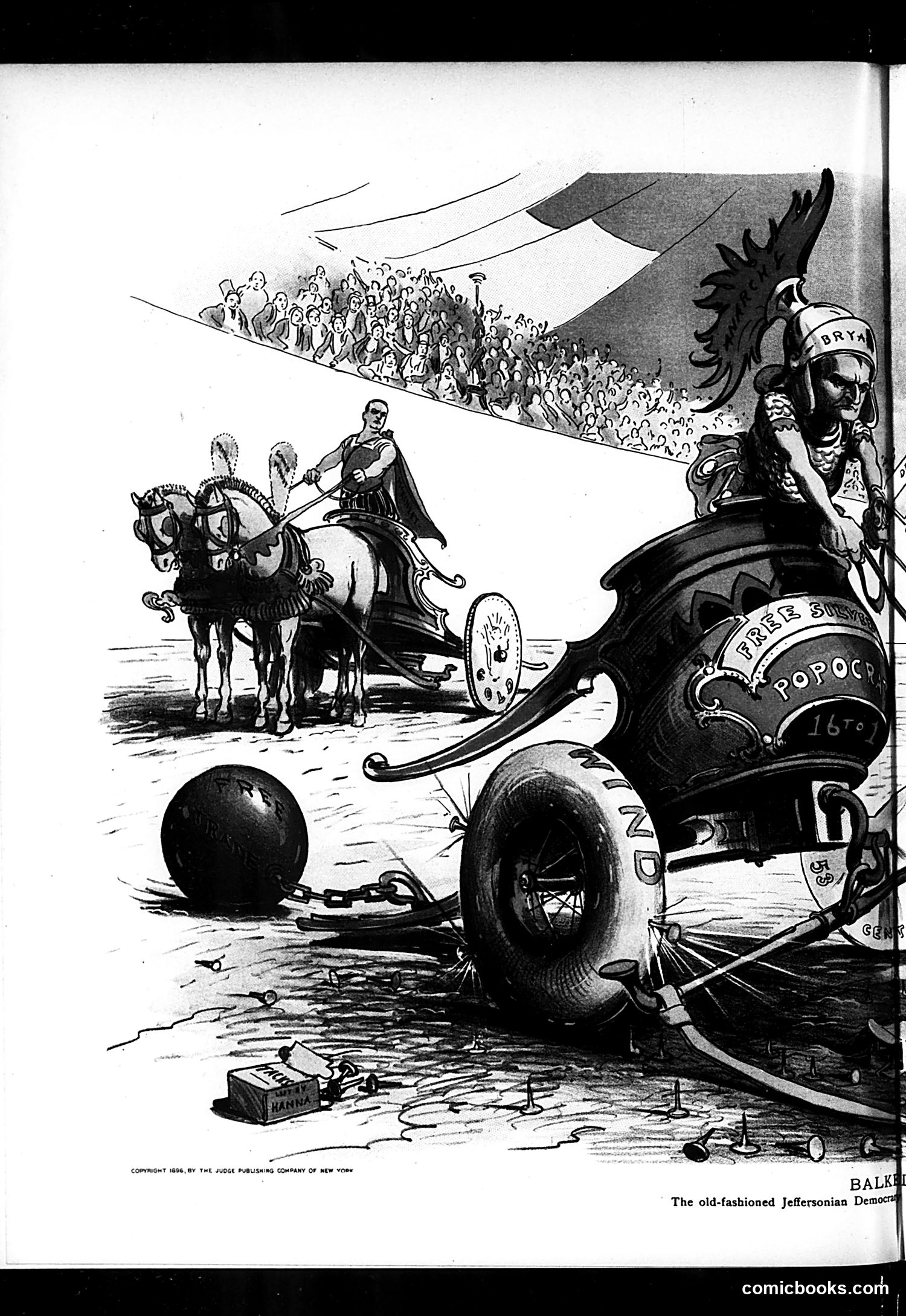
This cartoon satirizes the Democratic Party by depicting it as an obsolete, broken-down vehicle—literally a wrecked "Populocracy" wagon with a flat tire and cannonball damage. An elaborately dressed figure (likely representing Democratic leadership, possibly William Jennings Bryan based on the "BRYA" text visible) sits atop the wreckage wearing classical armor labeled with democratic ideals. Meanwhile, a modern horse-drawn carriage with fresh horses departs in the distance, carrying a large crowd uphill—suggesting the Republicans or progressive forces moving forward successfully. The title "The old-fashioned Jeffersonian Democrat" mocks the Democratic Party for clinging to outdated 19th-century Jeffersonian principles while the nation modernizes. The cartoon appears to critique Democratic failure to adapt to contemporary politics, positioning them as relics of a bygone era.
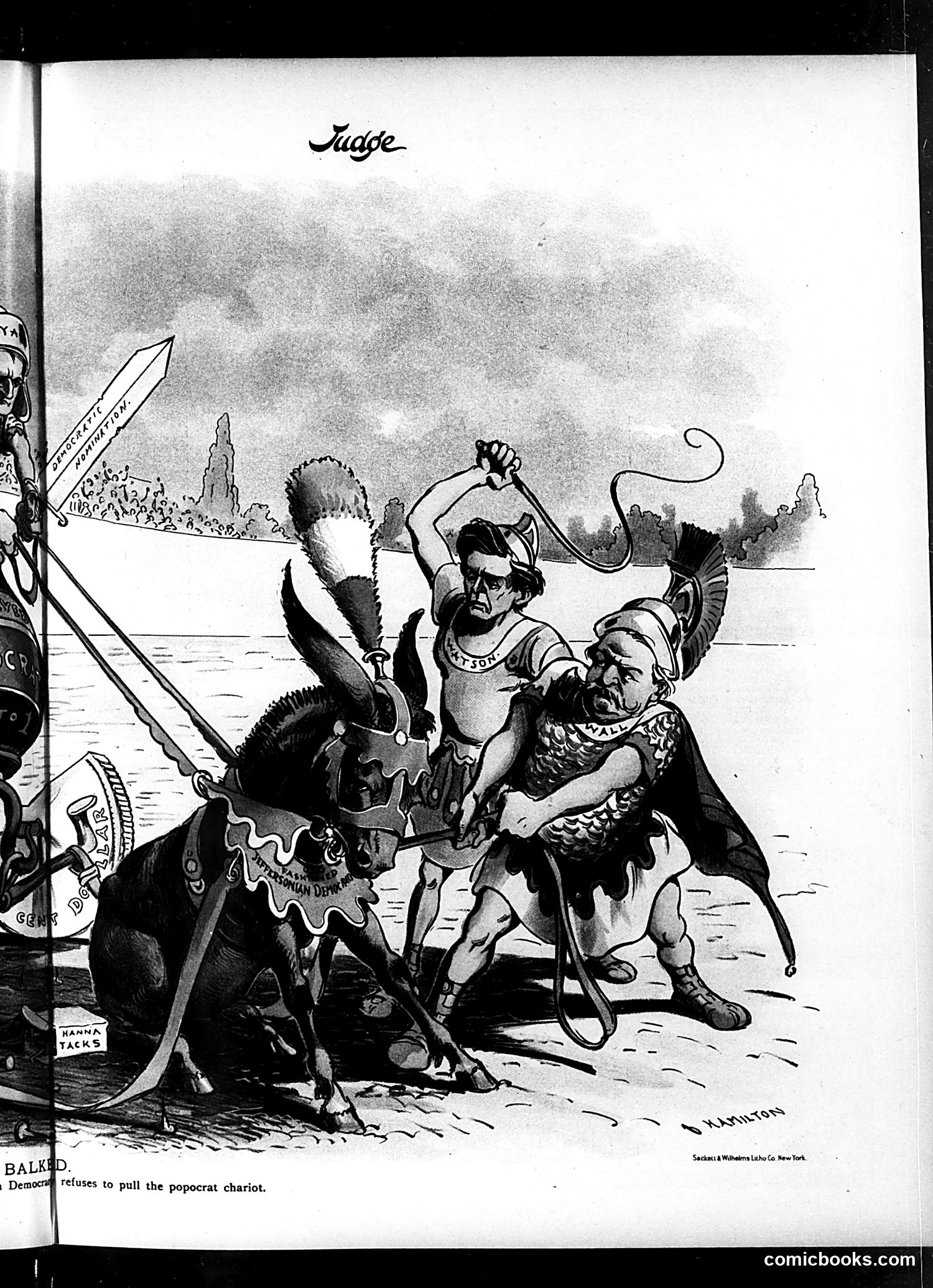
This cartoon depicts a Democratic donkey refusing to pull a chariot labeled "popocrat" (likely referring to Populist Party politics). The figures appear to be politicians or political operators attempting to harness the donkey to their vehicle, but the animal resists. The satire critiques the Democratic Party's reluctance to align with or support Populist movement goals during the late 19th century. The "popocrat chariot" represents Populist political objectives, while the stubborn donkey symbolizes Democratic resistance to cooperation or merger with that movement. The caption's wordplay—"popocrat" combining "populist" and "democrat"—underscores the tension between these political forces. This reflects actual historical debates about potential political alliances between Democrats and Populists during this era.
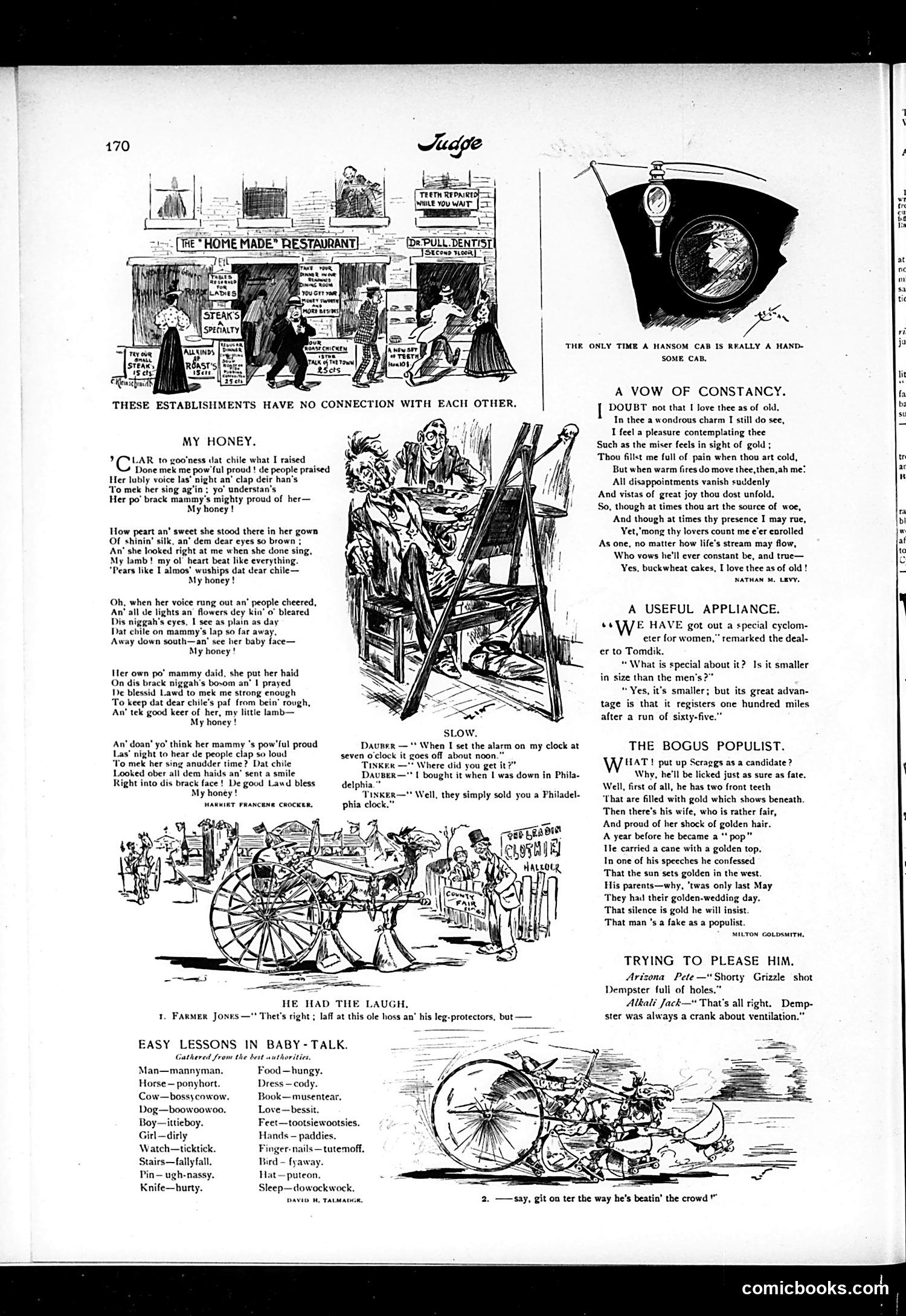
This page contains several satirical pieces typical of late 19th-century American humor magazines: **"My Honey"** is a sentimental poem written in exaggerated dialect, apparently depicting a Black father's pride in his daughter's singing performance. The dialect usage reflects period stereotyping common in Judge's humor, though the sentiment itself—parental pride—is presented sympathetically. **"Easy Lessons in Baby-Talk"** offers humorous pseudo-phonetic reductions of common words ("mannyman" for man, "boowoowoo" for dog), mocking simplified speech patterns. **"A Vow of Constancy"** is a romantic poem that humorously reveals its true subject is buckwheat cakes, not a lover—typical of Judge's twist-ending satire. **"The Bogus Populist"** mocks a political candidate by cataloging his family's excessive displays of wealth ("golden" references), suggesting he falsely presents himself as a populist while being demonstrably wealthy—a dig at 1890s Populist movement hypocrisy. The page combines sentimental, domestic, and political humor typical of the era's satirical magazine format.
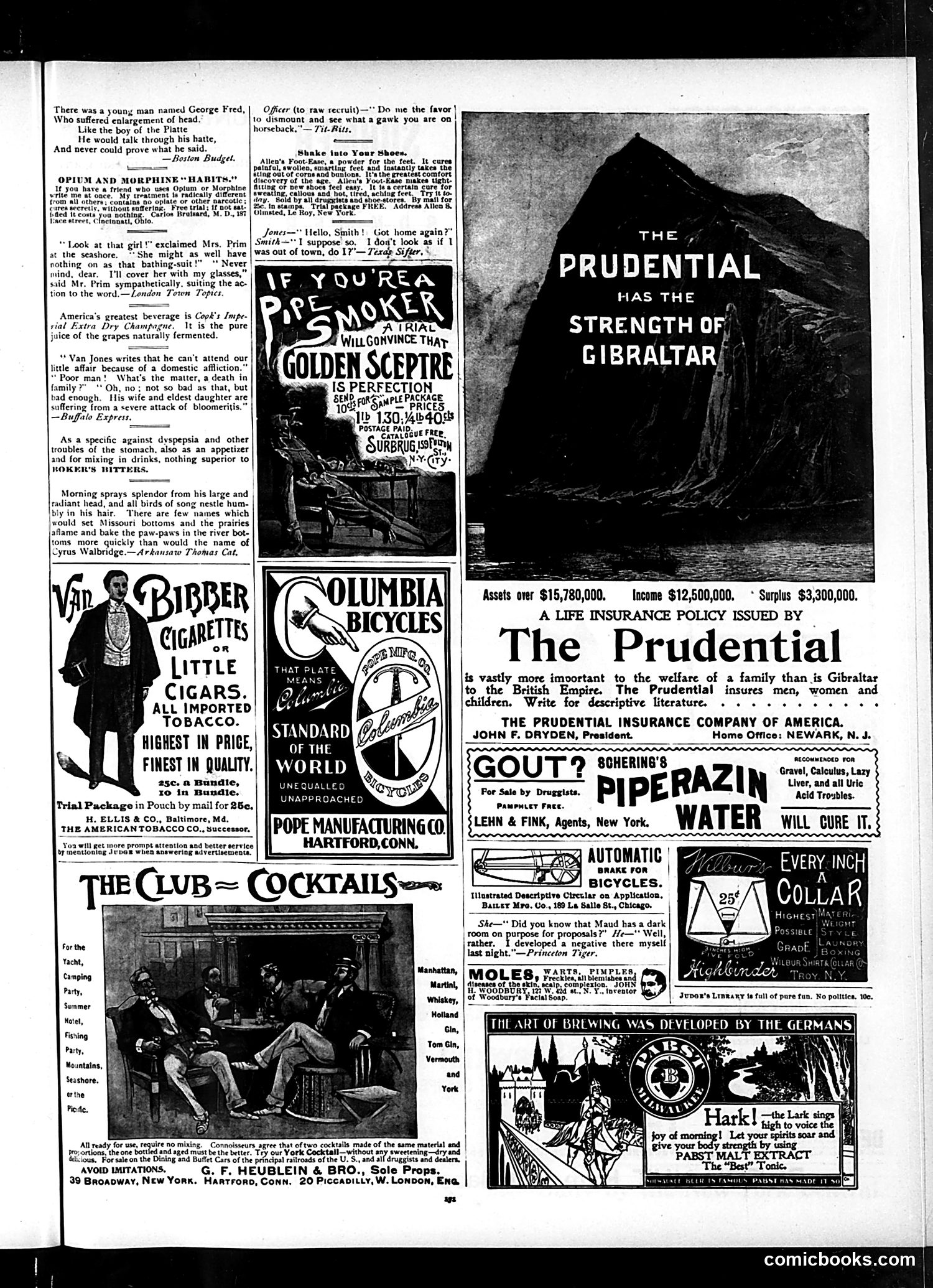
This page is primarily **advertising**, typical of Judge magazine's revenue model. The content includes: **Main Advertisement**: The Prudential Insurance Company dominates the right side, comparing their financial strength ("$15,780,000 assets") to Gibraltar's strategic importance to the British Empire—a metaphor suggesting unshakeable stability. **Humor Sections**: Brief jokes appear throughout, including: - A limerick mocking a verbose man named George Fred who "talks through his hat" but can't substantiate claims - A joke about "bloomerits" (women wearing bloomers, then-controversial attire) - Bar/cocktail humor in "The Club Cocktails" section **Other Ads**: Van Bibber Cigarettes, Columbia Bicycles, patent medicines (Piperazin for gout, Noker's Bitters), and various tobacco products. **Context**: The page reflects late 19th/early 20th-century American society—medical quackery was rampant, women's fashion reforms sparked ridicule, and insurance was a growing industry. The overall tone is genteel satire for an educated, affluent audience.
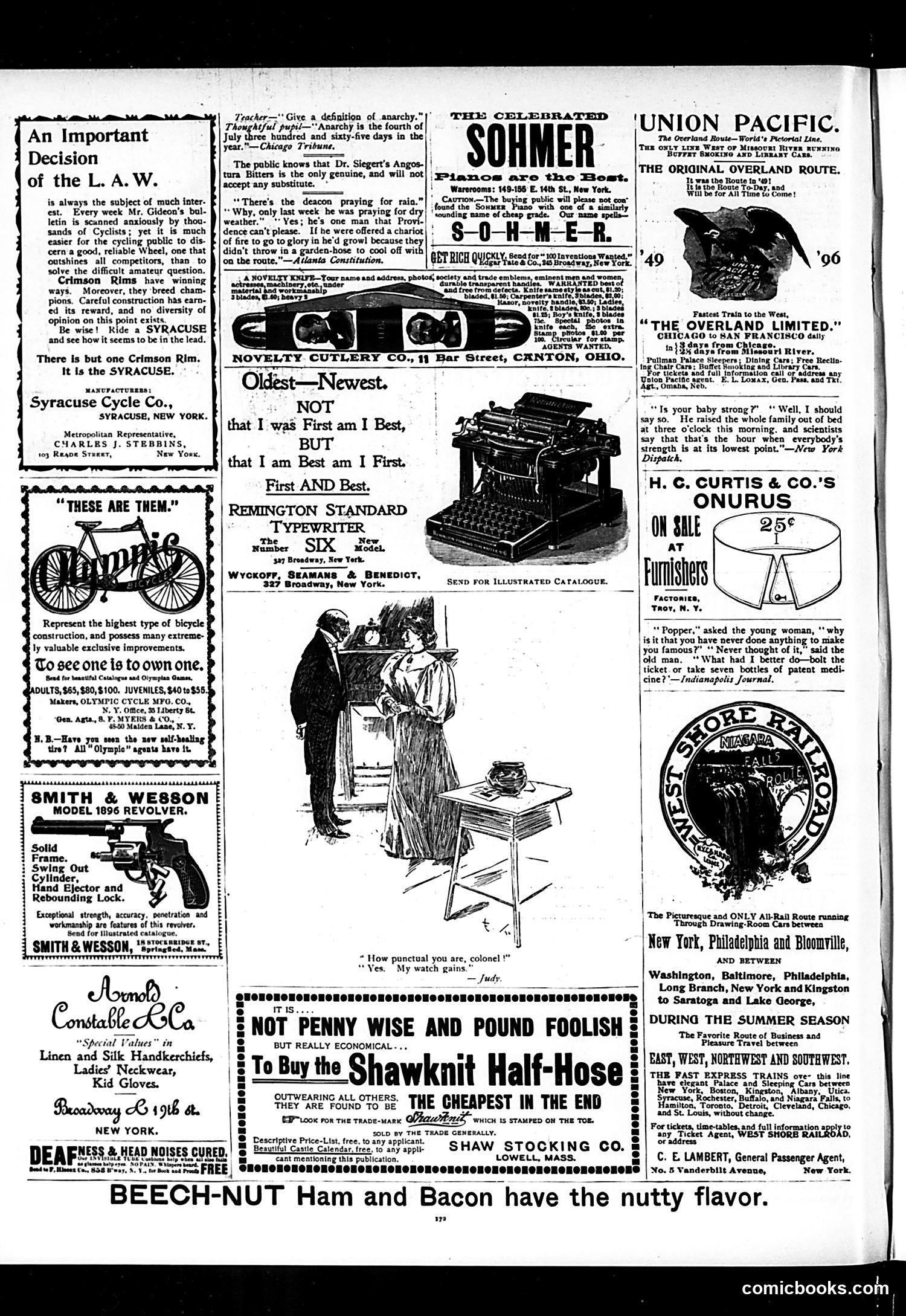
This page from Judge magazine is primarily **advertisements** for consumer products and services from the late 1890s-early 1900s, arranged around one cartoon. **The Main Cartoon** (lower center, captioned "How punctual you are, colonel!" / "Yes."): A brief social scene showing a man and woman shaking hands. The joke appears to be a play on timing or punctuality, though the punchline is cut off by the OCR. It likely mocks Victorian social pretense or romantic courtship conventions. **Key Advertisements Include:** - Bicycles (Syracuse Cycle Co., Olympic Cycle Mfg. Co.) - Remington Standard typewriters - Smith & Wesson revolvers - Sohmer pianos - Union Pacific Railroad ("The Overland Limited") - Various consumer goods (razors, hosiery, etc.) **Context for Modern Readers:** These ads reveal early-1900s consumer culture obsessed with new technologies: bicycles, typewriters, and railroads were cutting-edge. The magazine functioned as both satire and advertising vehicle for upscale audiences.
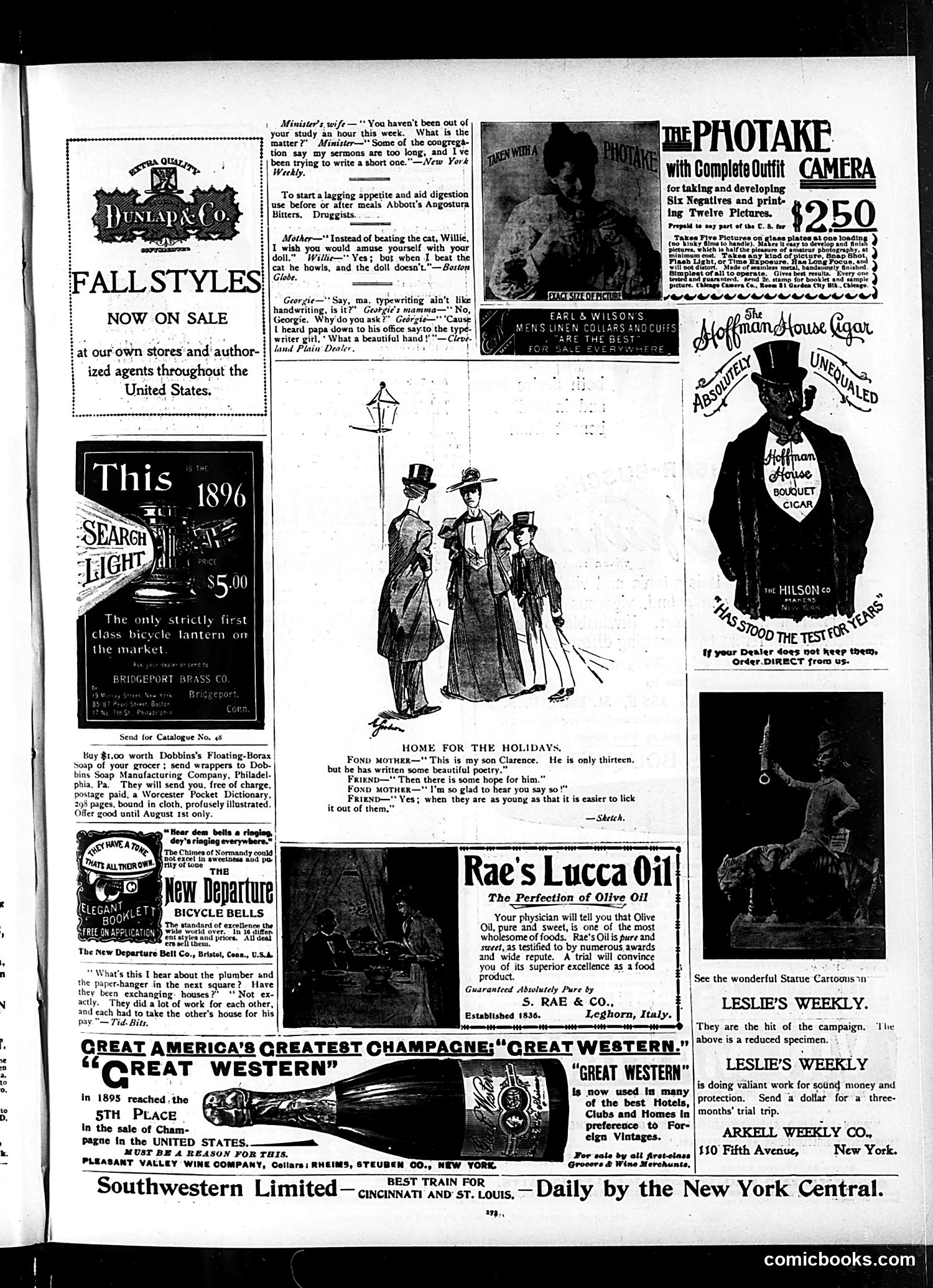
This is primarily an **advertising page** with interspersed brief comedic sketches typical of Judge magazine's format. The **cartoons** are short, domestic humor pieces: - A minister's wife complaining he spends too long writing sermons - A mother noting her son beats the cat (which howls) rather than his doll (which doesn't) - A boy asking why typewriting differs from handwriting, having overheard an office worker complimented on her "beautiful hand" - A "Home for the Holidays" sketch about a proud mother showing off her young son's poetry These represent **genteel late-Victorian domestic comedy**—gentle satire of middle-class life, parenting, and social pretension. The humor relies on wordplay and mild absurdism rather than political commentary. The **advertisements** promote period products: bicycles, champagne, olive oil, cigars, and cameras—reflecting the affluent readership Judge targeted. The "Great Western" champagne ad notably references 1895 sales rankings, dating this issue to circa 1896. No political figures or events are clearly referenced on this visible page.
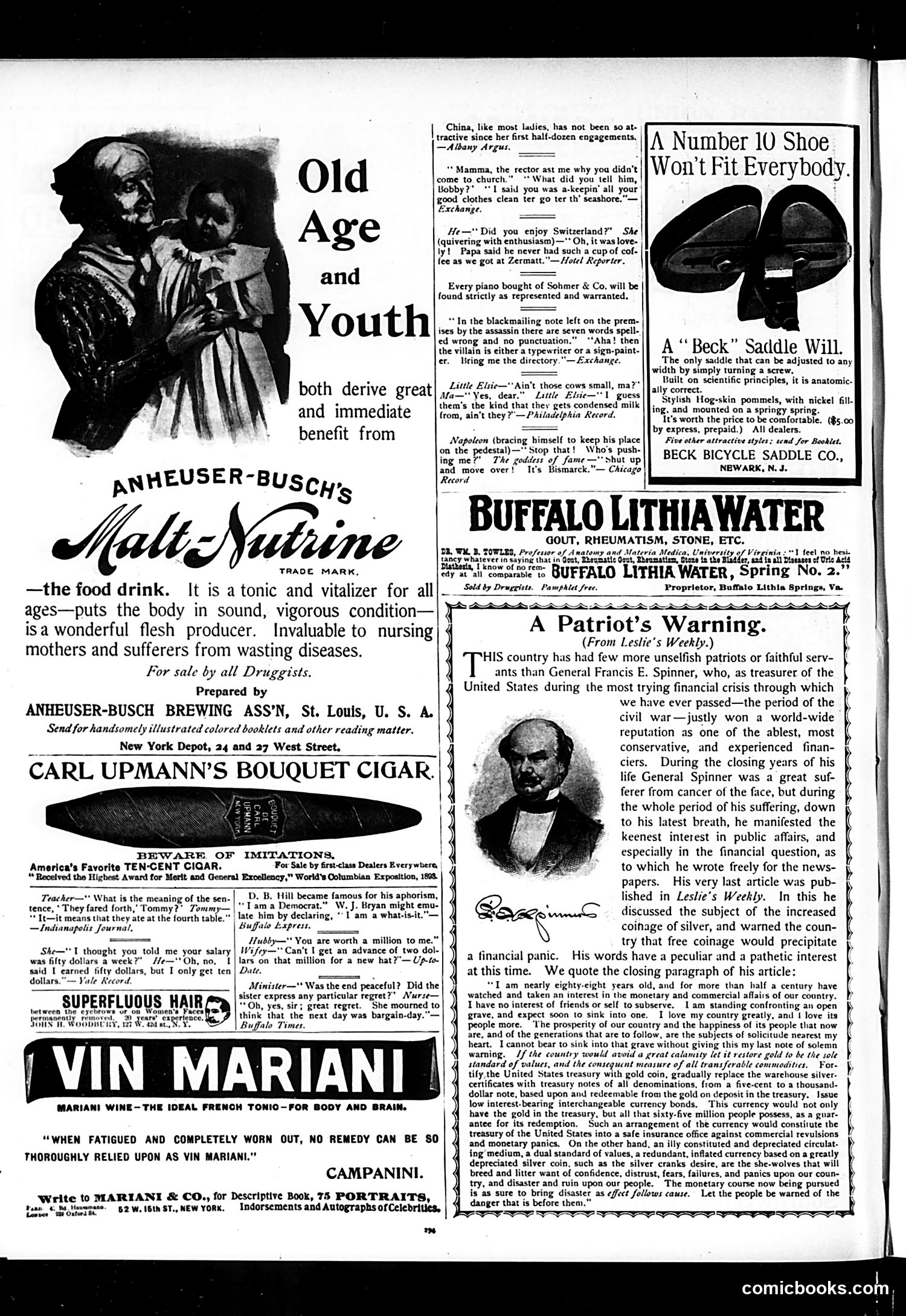
This page is primarily **advertisements and short humor pieces**, typical of Judge magazine's format. **Notable Content:** The largest cartoon features an allegorical figure labeled "Old Age and Youth" promoting Anheuser-Busch's Malt Nutrine as a health tonic—reflecting late 19th-century patent medicine marketing, when breweries marketed beer as medicinal. **The Political Joke:** A brief quip references D. B. Hill (Democratic politician) and W. J. Bryan, mocking their political identities. Hill was famous for declaring "I am a Democrat"; the joke suggests Bryan struggles to define himself similarly ("I am a what-is-it"). **Other Humor:** Most pieces are mild domestic comedy: a child misunderstanding "fared forth," a wife wanting an advance on her husband's theoretical wealth, and wordplay about salaries versus earnings. **Advertisements** dominate: cigars, bicycle saddles, wine tonics, and hair removal products—all with period health claims now recognized as dubious. The page reflects *Judge's* blend of genteel satire and commercial promotion typical of American magazines circa 1890s-1900s.
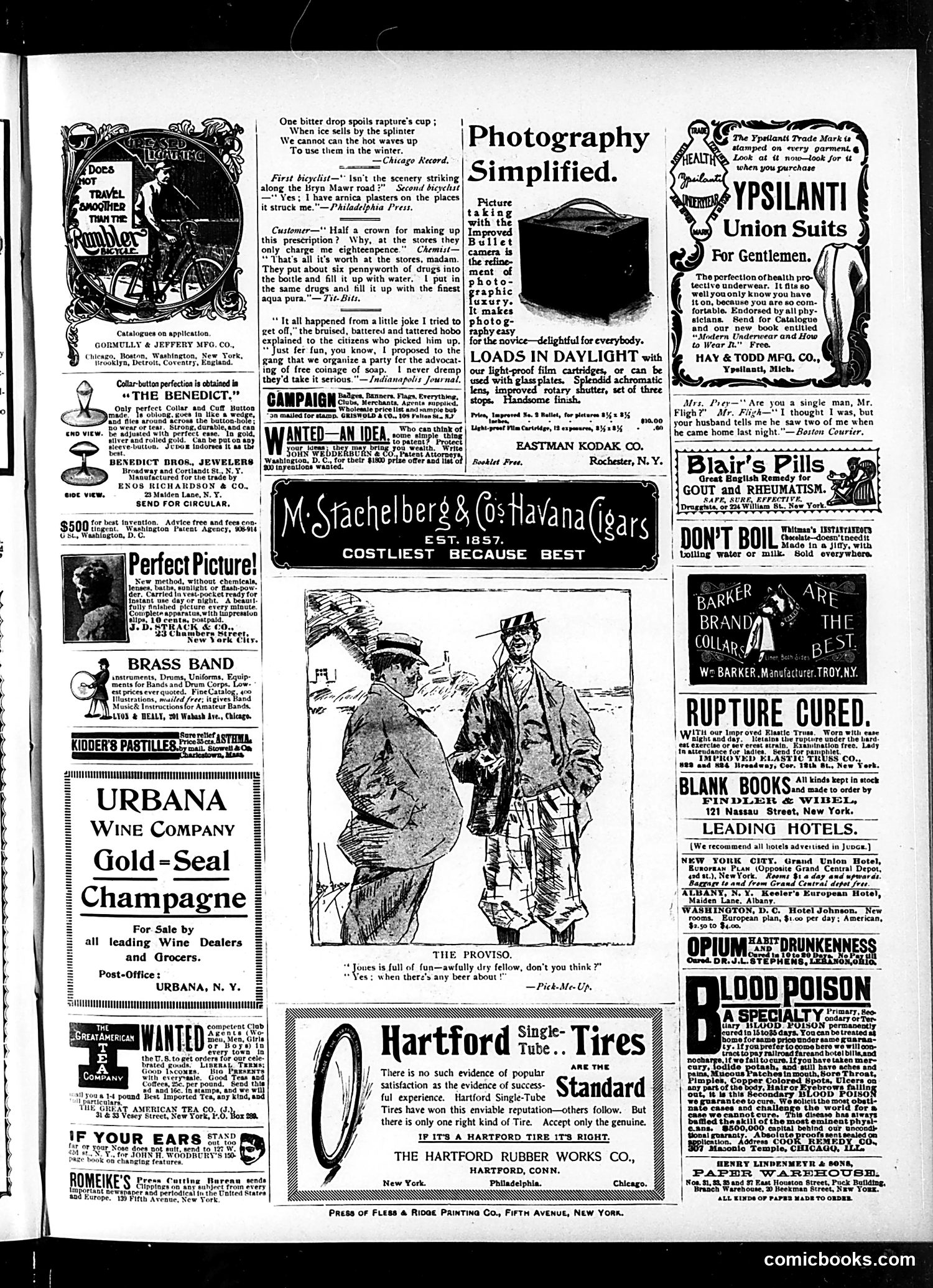
This page is primarily **advertising**, typical of Judge magazine's revenue model. The advertisements showcase products marketed to middle-class American men circa early 1900s: collar buttons, brass band instruments, champagne, tire tubes, patent medicines, and undergarments. The small **humorous anecdotes** scattered throughout reflect period preoccupations: a bicyclist injured on scenic roads; a chemist defending high prices by claiming superior water quality; a hobo beaten for joking about "free coinage of soap" (likely referencing the currency debate of the era). These are gentle, domestic humor rather than political satire. The one illustration—"The Proviso"—shows two men with a caption about love and infidelity, typical sentimental humor of the period. **No significant political or social satire appears on this page.** It's a working advertisement section designed to monetize the magazine while providing light comic relief between more substantive editorial content elsewhere in the publication.
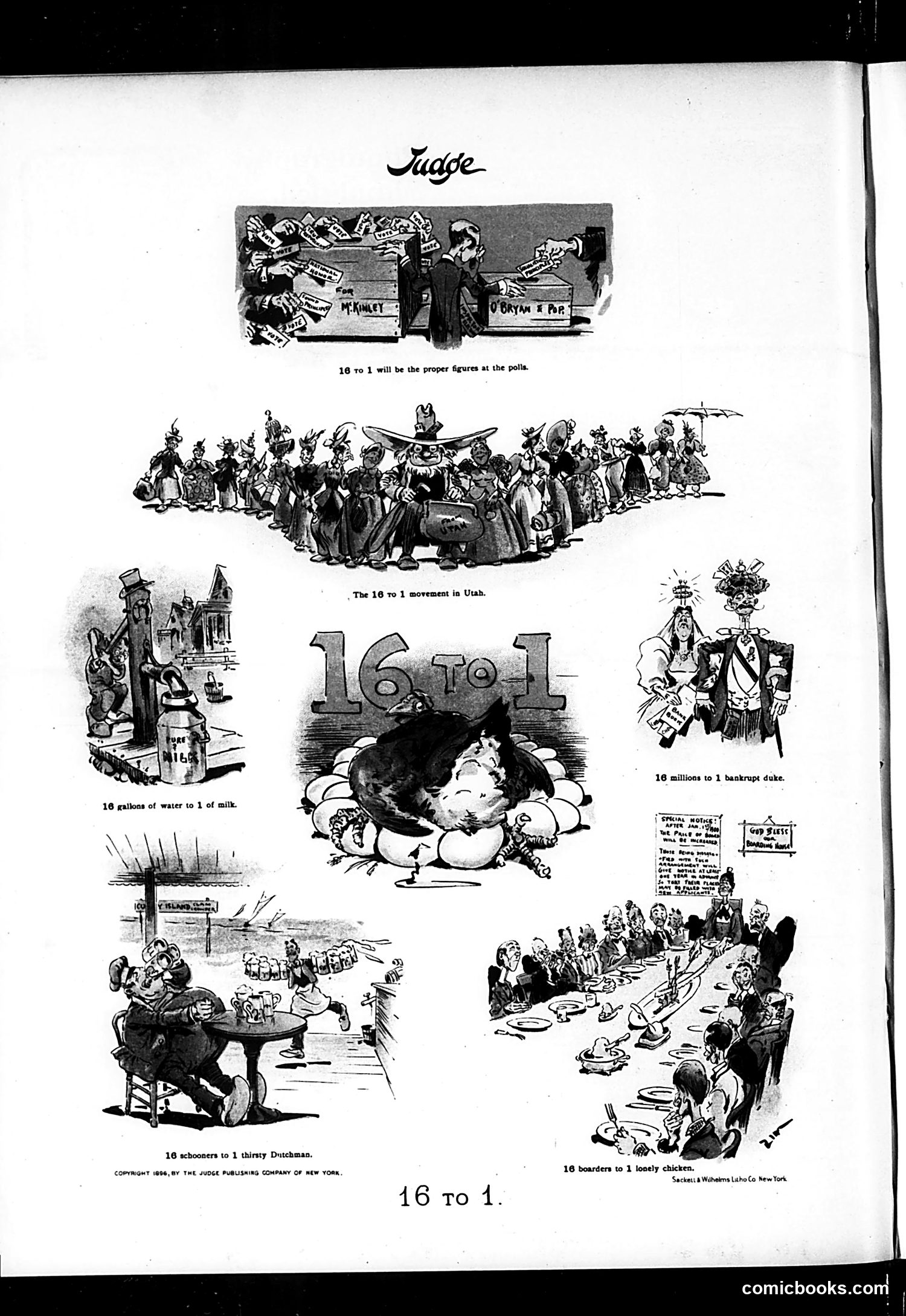
This page presents satirical comparisons using "16 to 1" ratios to mock what appears to be late 19th-century political or social excess. The central image shows a bear (likely representing Russia or another foreign power) crushing figures, surrounded by absurd ratio illustrations. The visible captions mock consumption and imbalance: "16 schooners to 1 thirsty Dutchman" and "16 boarders to 1 lonely chicken" employ exaggeration to ridicule gluttony, overconsumption, or resource misallocation. Other panels reference "16 gallons of water to 1 of milk" and similar ratios. The top section shows the "10 to 1 movement in Utah," likely referencing political controversy surrounding Mormon polygamy practices in Utah Territory. The overall satire criticizes disproportion and excess in American society and politics, though the specific historical context requires additional research to identify all referenced figures and events precisely.