
A complete issue · 16 pages · 1896
Judge — September 5, 1896
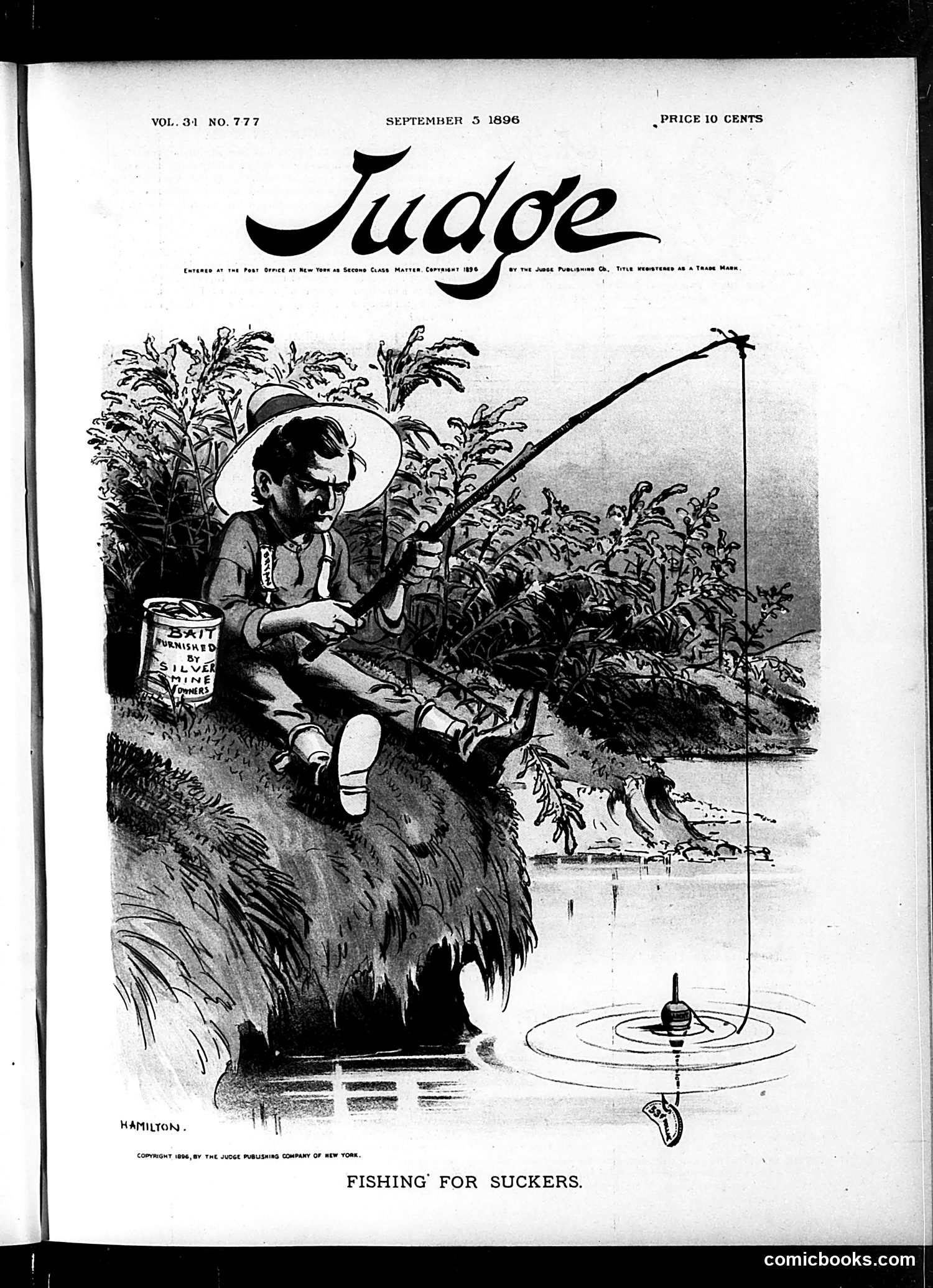
This cartoon uses fishing as a metaphor for political deception. A man in old-fashioned attire sits fishing by a riverbank, baiting his hook with what appears to be a "Bait" container labeled with text (illegible in reproduction). The fish he's catching are labeled "suckers"—a term meaning gullible people. The satire likely targets political campaigning or fraud circa 1896. The artist (Hamilton, per signature) suggests politicians or con artists are deliberately "baiting" and catching foolish voters/citizens. The pastoral, innocent setting contrasts with the predatory activity, emphasizing how manipulation disguises itself as harmless recreation. The specific political context remains unclear without additional historical markers.
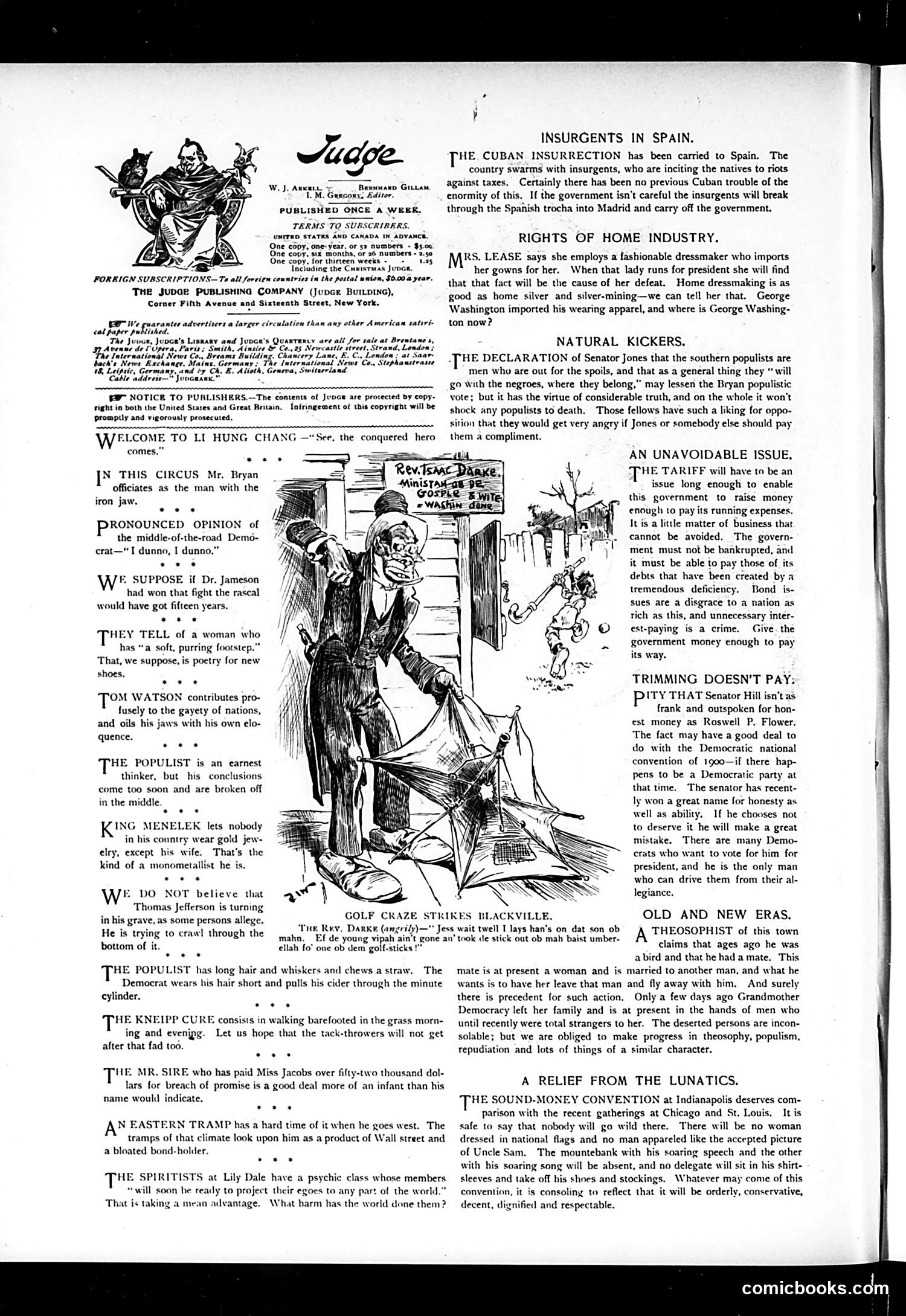
The main cartoon, "Golf Craze Strikes Blackville," depicts a racist caricature of a Black minister or reverend attempting to play golf while a young Black child watches. The humor relies on a cruel stereotype portraying Black people as comically inept at the golf sport—then an exclusive, upper-class white activity. The accompanying text snippets mock various social and political figures with brief satirical comments, including references to "Natural Kickers," Senator Platt, and debates about tariffs and Democratic politics. This page exemplifies Judge's typical approach: combining visual racist caricature with snide political commentary. The satire assumes reader agreement with both class-based and racial hierarchies of the era.
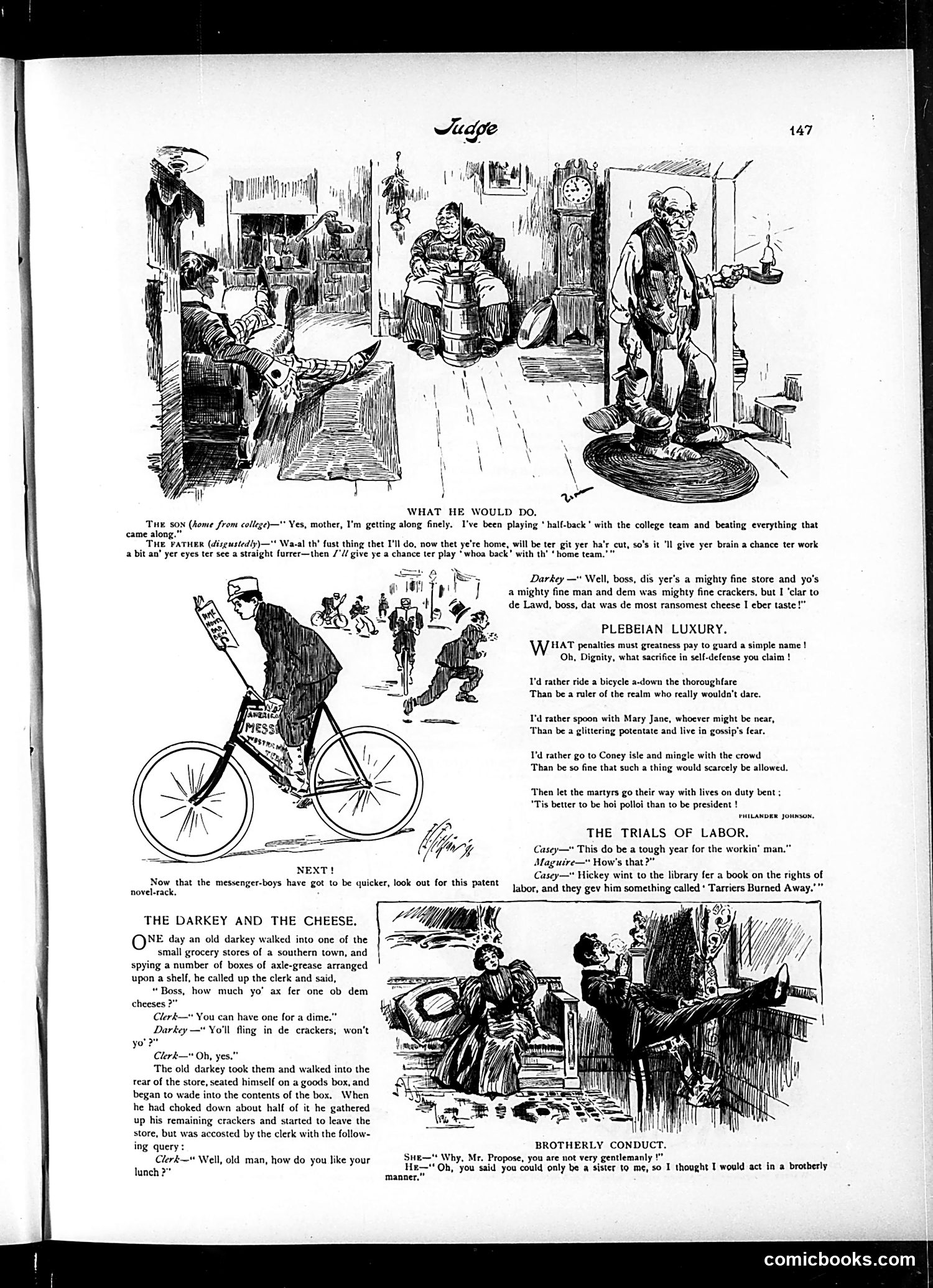
This page contains several satirical pieces from Judge magazine (a late 19th/early 20th-century humor publication): **"What He Would Do"** depicts a young man home from college bragging about football achievements to his skeptical father, who suggests the son use his brain for work instead—satirizing privileged college athletes and parental exasperation. **"Plebeian Luxury"** is a poem mocking class pretensions, preferring humble pleasures to ruling society. **"The Darkey and the Cheese"** appears to be a dialect humor story featuring racial stereotypes common to period American comedy, involving a grocer's employee and crackers. **"Brotherly Conduct"** shows a domestic dispute where a man objects to his sister's "unladylike" proposal—satirizing gender role expectations. The page reflects typical Judge content: social commentary through class and gender humor, alongside period racial caricature.
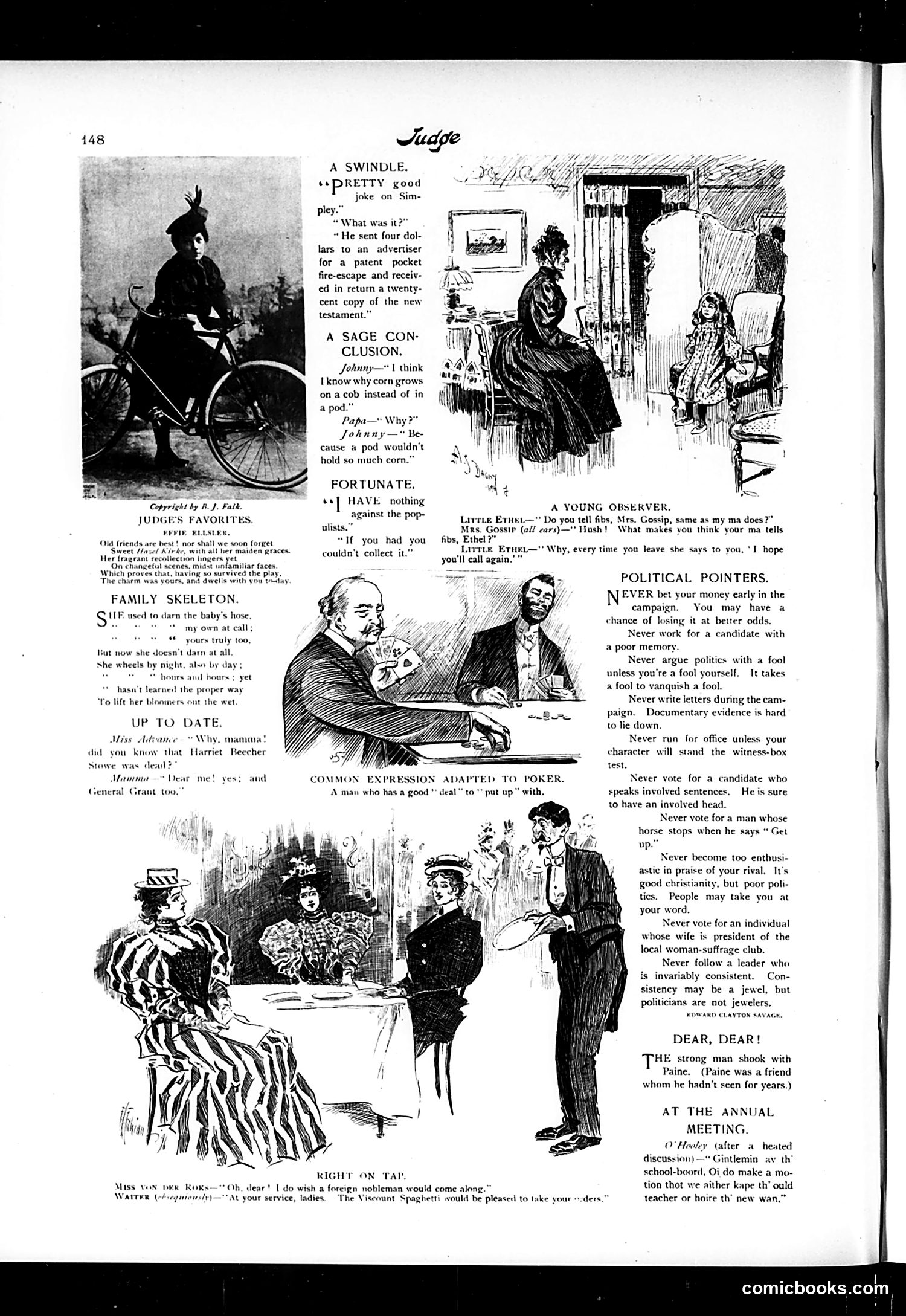
This page from *Judge* contains multiple brief satirical pieces typical of the publication's format: **"A Swindle"** mocks mail-order fraud—a common scam where "Simpley" paid four dollars for a patent "pocket fire-escape" and received only a cheap pamphlet. **"A Sage Conclusion"** is a simple children's joke about corn growing on cobs. **"Family Skeleton"** satirizes changing gender roles: a wife who once did domestic work now refuses, showing evolving attitudes toward women's labor. **"Political Pointers"** offers cynical voting advice by Edward Clayton Savage, warning against voting for inconsistent politicians, poor speakers, or candidates with difficult wives—typical Gilded Age commentary on electoral corruption and suffragism skepticism. **"Right on Tap"** and other brief items mock social pretension and gossip. The cartoon illustrations accompany these jokes with period-appropriate caricatures. The page reflects *Judge's* mix of humor targeting contemporary social anxieties: fraud, changing gender norms, political corruption, and immigration (the foreign nobleman reference).
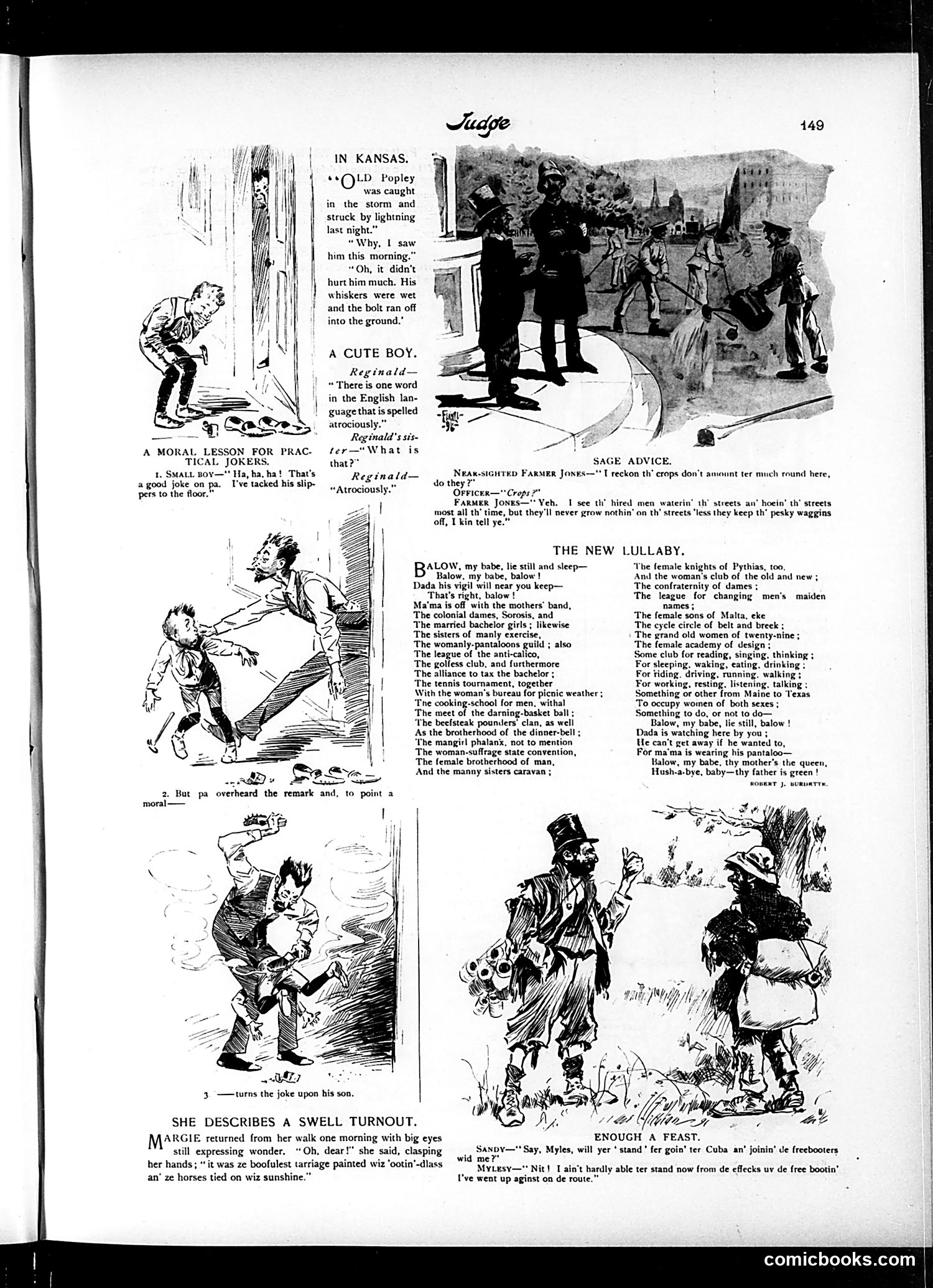
This page satirizes late-19th-century women's activism and changing gender roles. The central piece, "The New Lullaby" by Robert J. Burdette, mocks the proliferation of women's organizations and clubs—listing real groups like Sorosis, the Colonial Dames, and references to women's suffrage movements. The poem presents a father left home alone ("wearing his pantaloo") while his wife attends endless female societies, implying men are emasculated and displaced by women's social engagement. Surrounding sketches employ gentler humor: a child's wordplay joke, a farmer's befuddlement about crops, and an Irish immigrant girl (indicated by dialect) charming someone with her malapropism about a carriage decorated with "ootin'-glass" and horses tied with "sunshine." The satire reflects conservative anxiety about women's independence, professional aspirations, and political organization during the Progressive Era—positioning these developments as absurd rather than legitimate social progress.
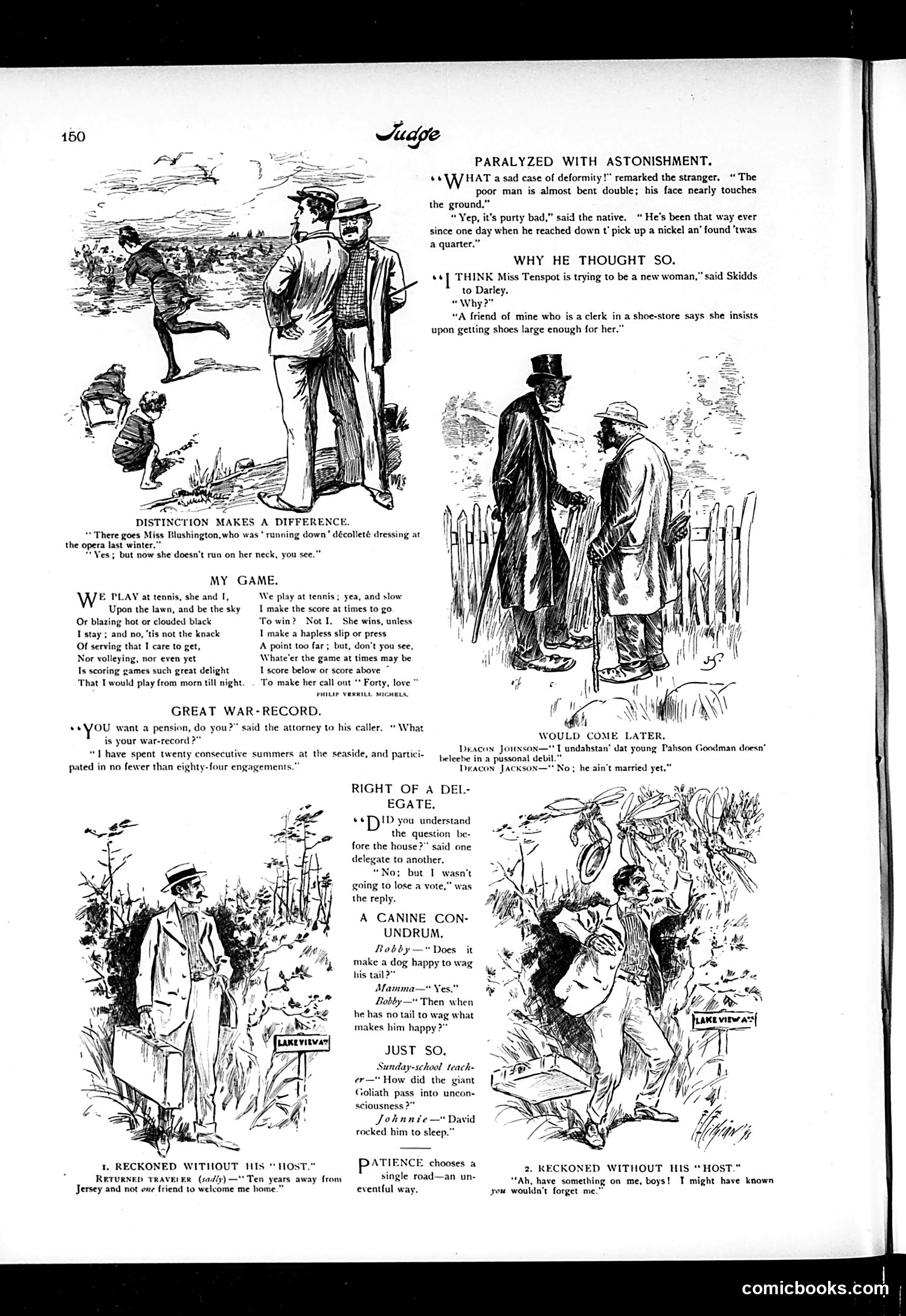
This page from the satirical magazine **Judge** contains multiple standalone jokes and cartoons typical of early 20th-century American humor. **Key content:** The cartoons mock social pretension and human folly. "Paralyzed with Astonishment" satirizes rural poverty—a man remains permanently bent from retrieving a dropped nickel, only to discover it was actually a quarter (worthless in comparison). "Why He Thought So" ridicules the "New Woman" movement by suggesting a woman seeking larger shoes is trying to be modern, playing on anxieties about women's liberation. Other pieces include dated humor about war pensions (someone claims eighty-four romantic "engagements" as military service), a tennis flirtation joke, and religious humor (a child's naive biblical answer). The "Reckoned Without His Host" cartoons contrast a lonely traveler returning to Jersey with warm friends greeting someone else—visual jokes about expectations versus reality. The overall tone reflects Judge's characteristic brand of genteel satire targeting social climbers, modern women, and human vanity.
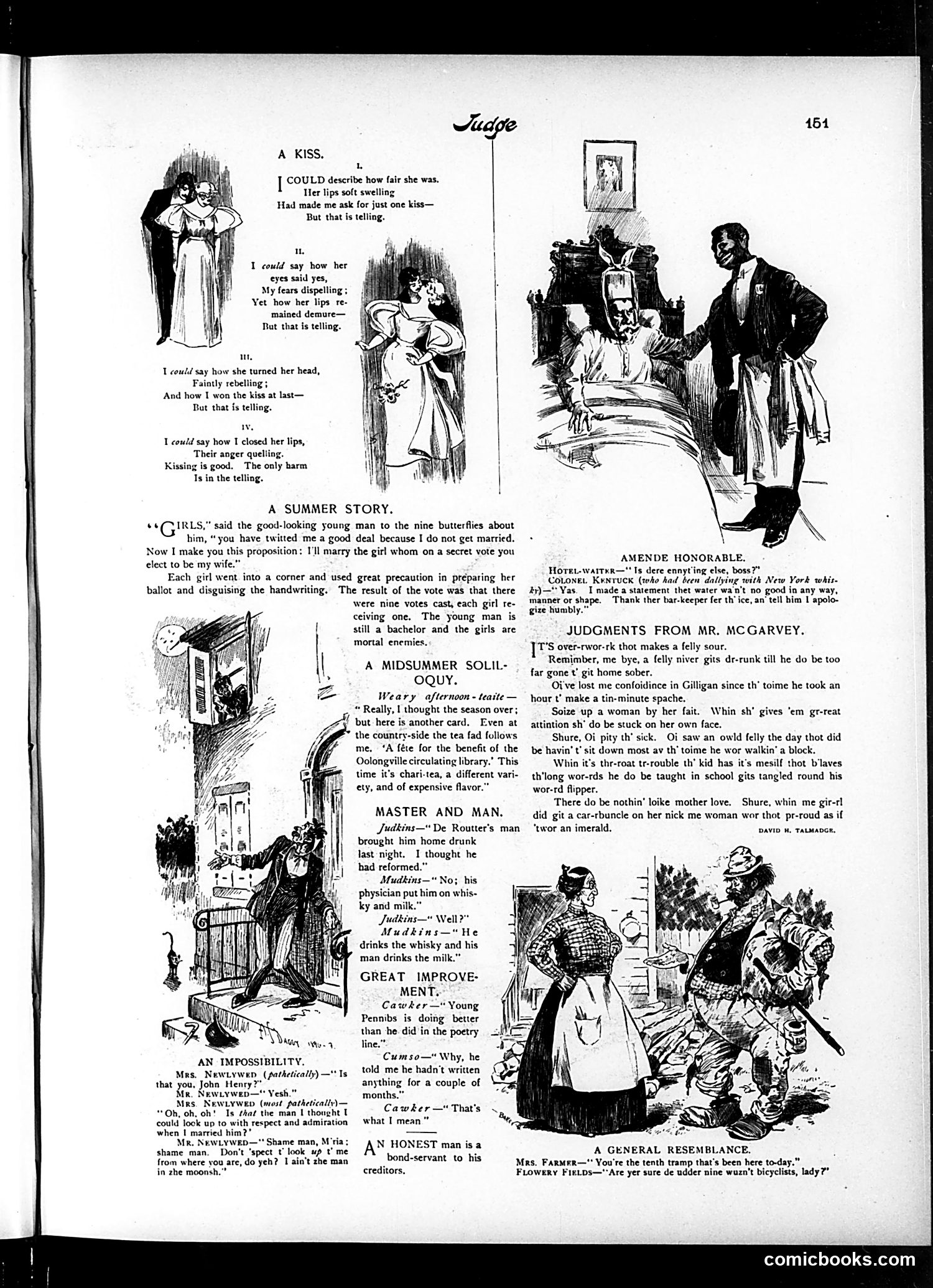
This page contains several short humorous pieces typical of late 19th-century American satire: **"A Kiss"** is a coy poem playing on Victorian propriety—the speaker teases that describing a romantic encounter would be improper "telling." **"A Summer Story"** satirizes women's equality: nine butterflies each vote secretly for which girl the bachelor should marry, but each receives one vote. The joke is that giving women equal say creates deadlock and conflict rather than harmony. **"An Impossibility"** mocks newlyweds through dialect humor, with a wife disappointed her husband isn't the idealized figure she imagined. Other brief pieces satirize contemporary fads (**"chari-tea"** for charitable fundraising), class relationships (servants and masters), and social pretension. **"Judgments from Mr. McGarvey"** presents Irish-dialect aphorisms—McGarvey appears to be a recurring character offering working-class wisdom and humor. The cartoons use period illustration styles and target upper-middle-class concerns: marriage, social expectations, and leisure activities.
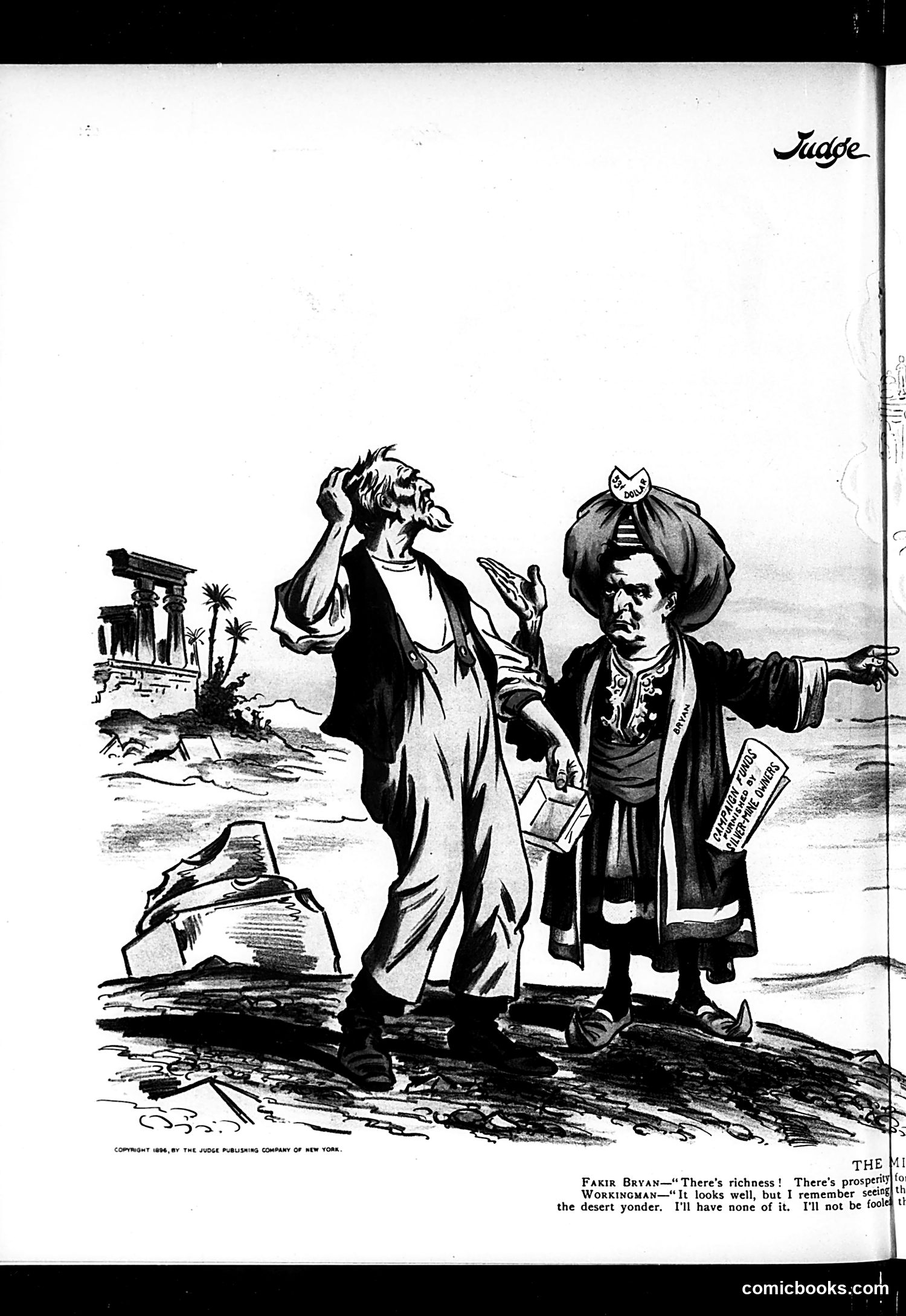
This 1896 Judge cartoon satirizes William Jennings Bryan's presidential campaign. "Fakir Bryan" (a fakir being a charlatan or con artist) displays illusory wealth and prosperity to an ordinary workingman. The workingman, however, remains skeptical—he recalls seeing similar desert mirages before and refuses to be fooled by Bryan's promises. The cartoon critiques Bryan's rhetoric as empty promises and deception. The desert setting and mirage imagery suggest his vision of prosperity is merely illusion. Bryan's radical platform (likely his free silver advocacy) is presented as a con artist's trick rather than genuine economic policy. The workingman's resistance represents the skeptical voter who sees through populist rhetoric to its underlying dangers.
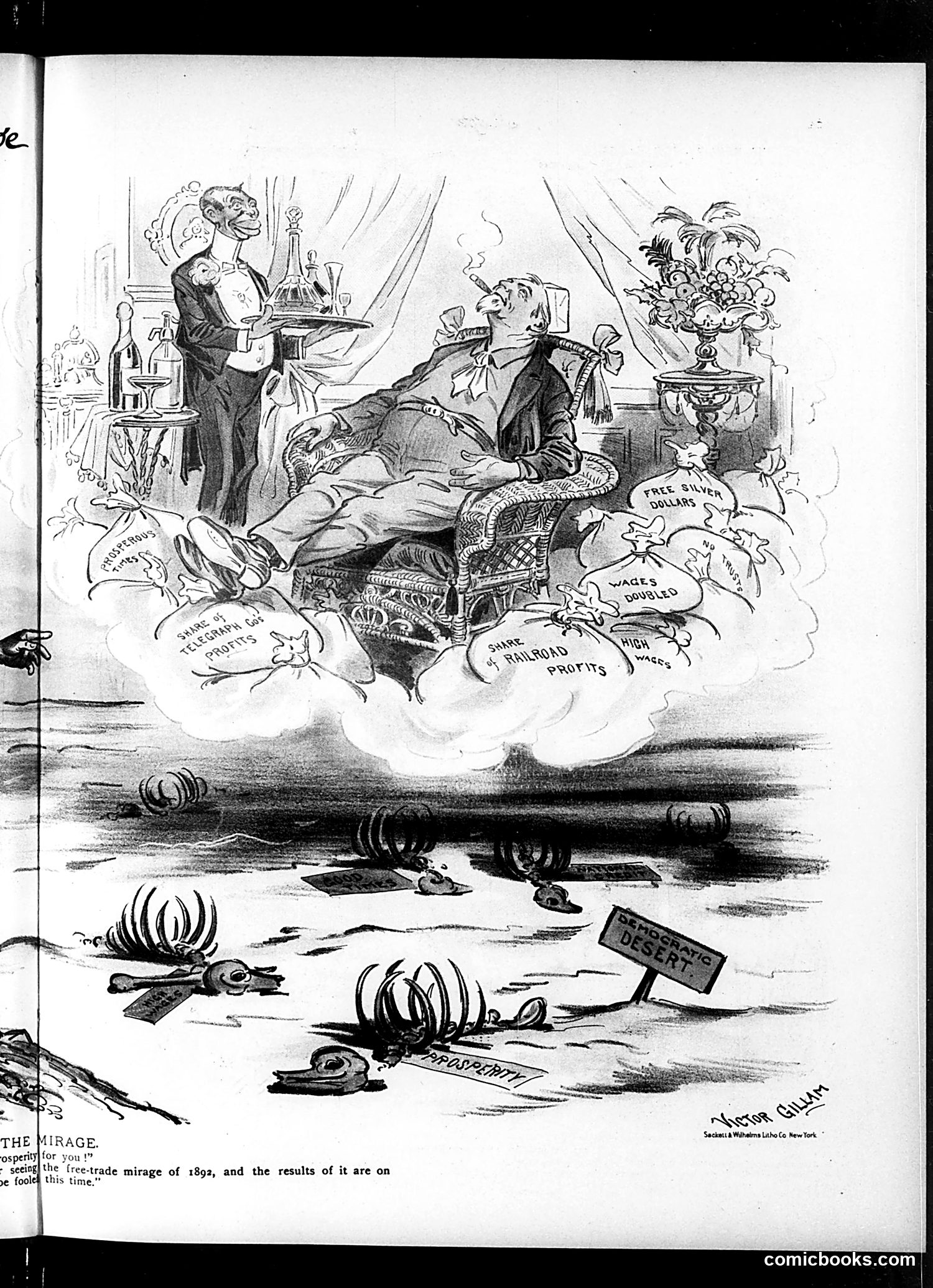
This political cartoon satirizes the 1892 free-trade debate in American politics. A wealthy businessman lounges luxuriously on a cloud, attended by servants and surrounded by indulgences (wine, flowers, profits). Below him lies a barren landscape littered with abandoned factories labeled "PROSPERITY," "FREE SILVER COLLARS," "WAGES DOUBLED," and "RAILROAD PROFITS"—all promises that failed to materialize. The cartoon argues that free-trade advocates offered voters false prosperity in 1892, claiming these economic benefits would result. Instead, the landscape shows destroyed industry and broken promises. The figure at bottom states he won't be "fooled this time," suggesting voters learned their lesson. The cartoon presents free-trade as a mirage—an illusion that enriched elites while devastating working-class prosperity and industrial capacity.
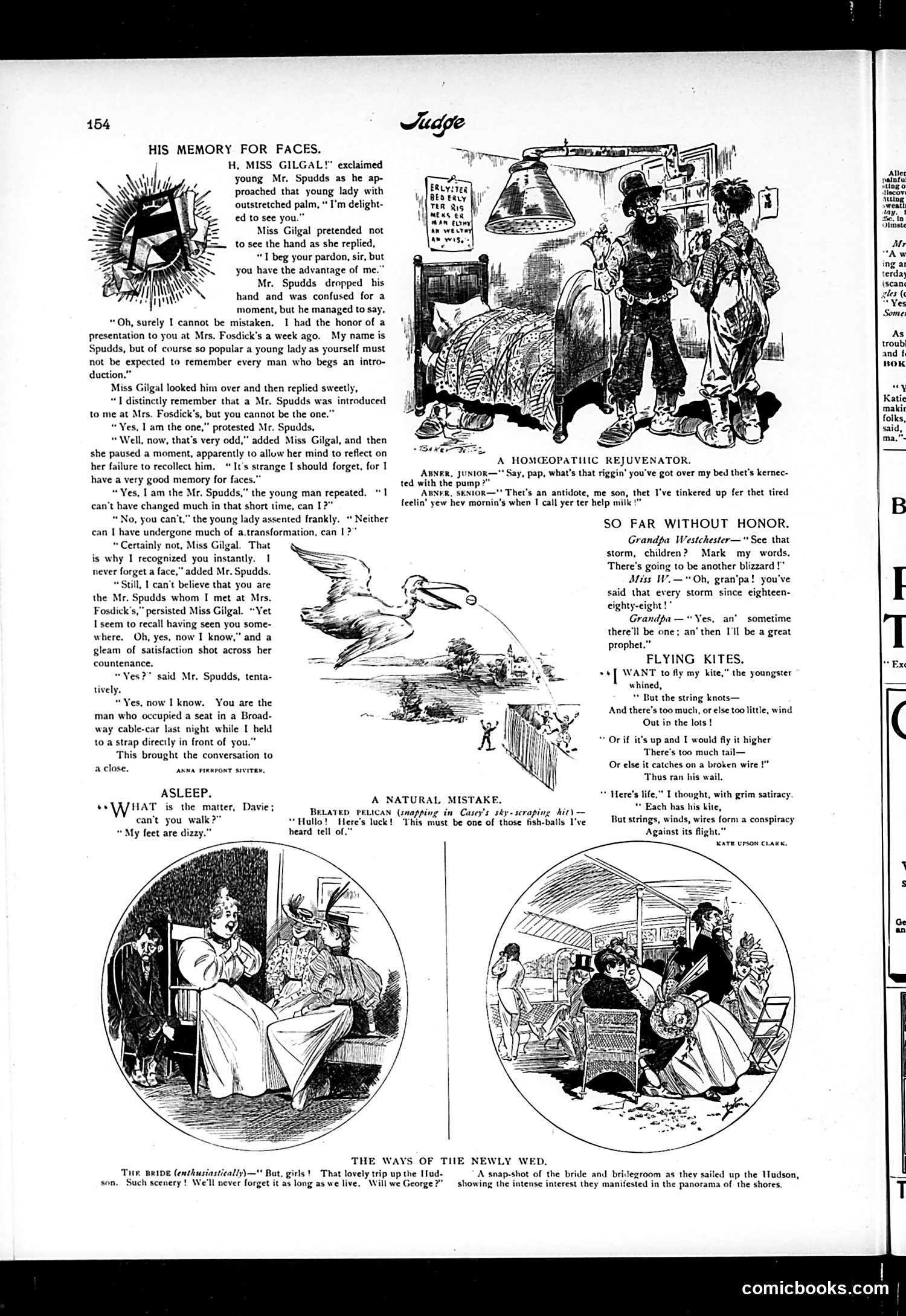
This page collects multiple short satirical pieces typical of Judge's humor: **"His Memory for Faces"** — A social comedy where Mr. Spudds repeatedly claims to remember Miss Gilgal from a recent introduction, but she insists he's mistaken. The punchline reveals she *does* remember him—as a rude man who hogged a seat on a Broadway cable car, forcing her to stand. The satire targets masculine obliviousness and poor manners in public transit. **Other pieces** include domestic humor ("Asleep," "A Homeopathic Rejuvenator"), a newlywed couple ignoring scenic beauty for each other, a grandfather's false storm predictions, and a child frustrated flying a kite—each offering gentle social observation rather than political commentary. The illustrations and brief verses reinforce middle-class anxieties: rudeness, courtship confusion, aging fathers, family dynamics. These reflect Judge's typical 1880s-1890s approach: satirizing everyday social behavior and manners rather than specific political figures or events.
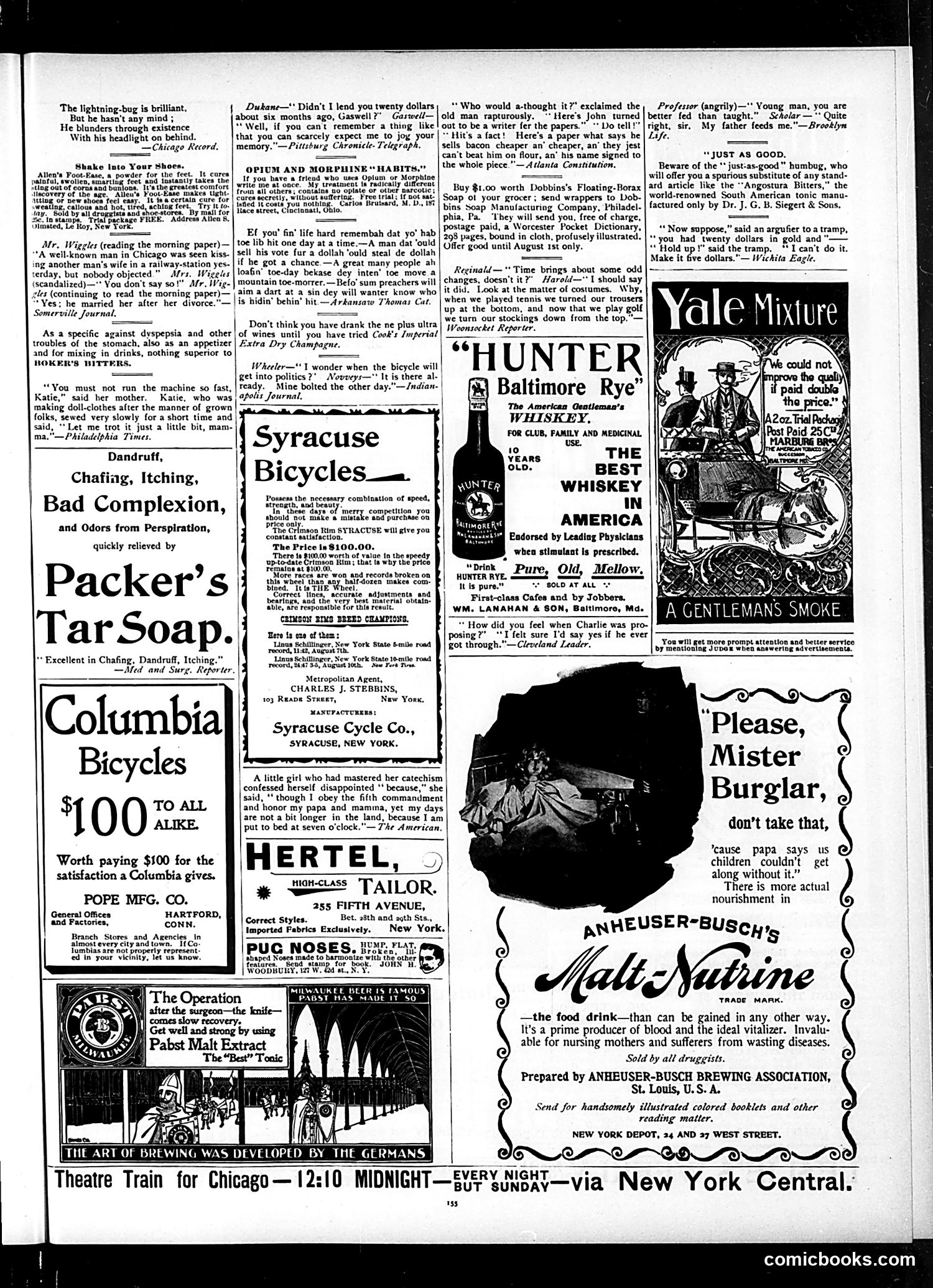
This appears to be primarily an **advertising page** from Judge magazine, not a political cartoon. The page is dominated by commercial ads for various products—bicycles (Columbia, Syracuse, Hertel tailor services), medicinal products (Packer's Tar Soap, foot powder), and patent medicines (opium/morphine treatments, Pabst Malt Extract). Interspersed are short humorous **joke items** typical of Judge's satirical format: anecdotes about marital scandals, bicycle absurdities, and frontier wisdom. These are mild social humor rather than serious political satire. The most substantial ad is for **Hunter Baltimore Rye whiskey**, which claims to be "the best whiskey in America" and is endorsed by physicians. This reflects **Gilded Age attitudes** where alcohol was marketed as medicinal and respectable. Overall, this page demonstrates how early American humor magazines funded themselves entirely through advertising, mixing commerce with comedy. The content reflects period preoccupations: bicycles as technology novelties, concerns about propriety and scandal, and patent medicine ubiquity.
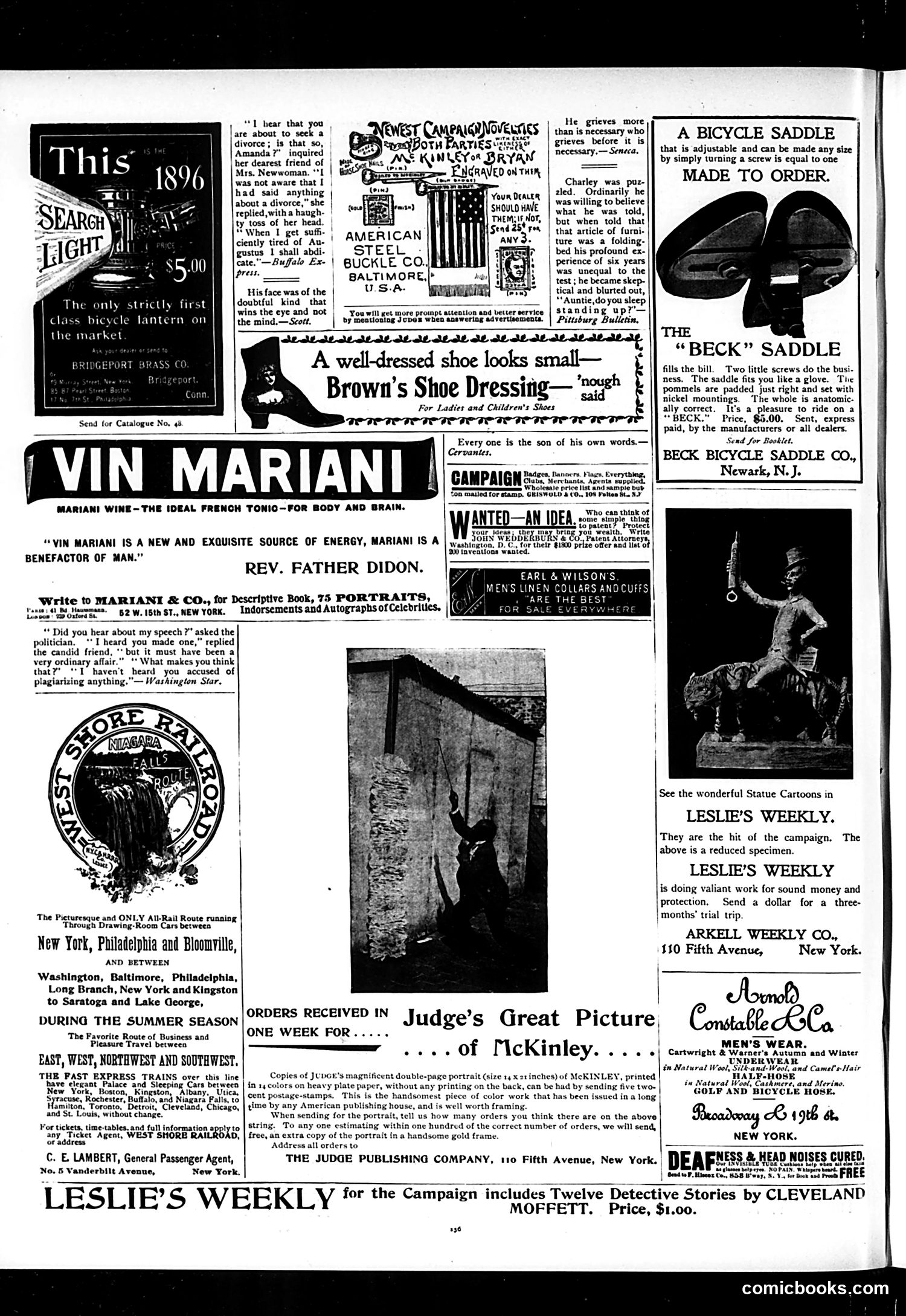
This is primarily an **advertising page** with one small satirical dialogue at the top. ## The Cartoon/Dialogue The brief text exchange mocks the "New Woman" of the 1890s—a social anxiety figure. Mrs. Newwoman denies seeking divorce, but her friend has heard gossip. The humor targets anxieties about women's independence: the joke suggests that modern women discussing anything casually gets interpreted as marital discord. It's gentle social satire on how threatening independent women seemed to contemporary society. ## Context This reflects the 1890s "New Woman" debate—a cultural panic about women gaining education, voting rights, and autonomy. The dialogue trivializes women's concerns while mocking those who spread rumors about them. ## Advertisements The page is dominated by product ads: bicycle saddles, shoe dressing, wine tonics, railroad services, and McKinley campaign memorabilia (suggesting this is from the 1896 presidential election period). These ads reveal period consumer culture and the convergence of commerce with political campaigns.
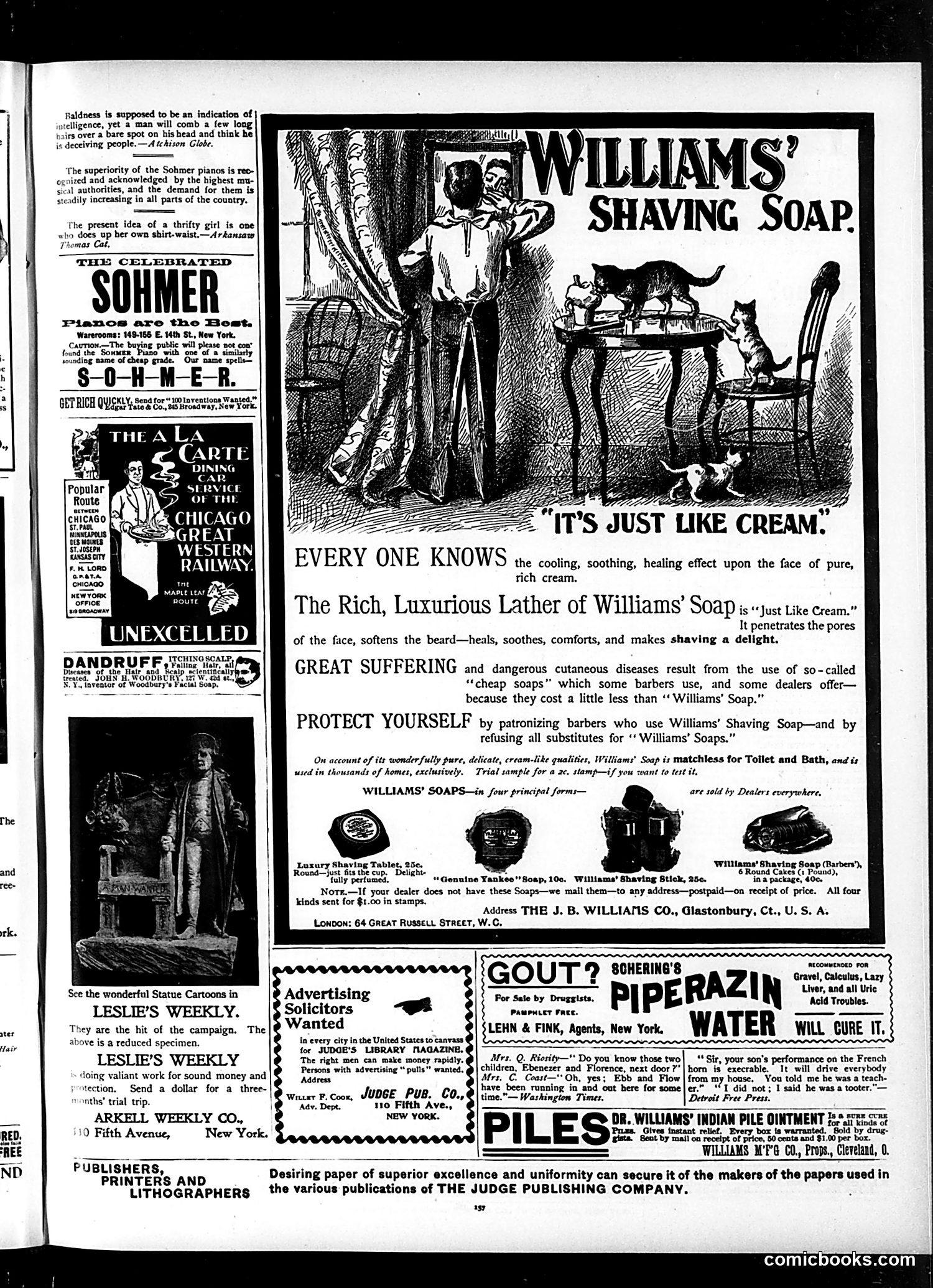
This page is primarily **advertisements** rather than satirical content. The dominant feature is a large Williams' Shaving Soap advertisement depicting a man shaving with cats nearby, claiming the soap is "Just Like Cream." The ads address practical consumer concerns of the era: Williams' warns against "cheap soaps" used by barbers that cause "great suffering and dangerous cutaneous diseases," positioning their product as superior and safer. This reflects genuine public health anxieties about product quality before FDA regulation. Other advertisements include Sohmer pianos, Leslie's Weekly magazine (promoting "sound money"), Piperazin water (claimed to cure gout and liver ailments), and Dr. Williams' Indian Pile Ointment—typical patent medicines of the period making extravagant health claims. The page includes brief humorous snippets about baldness and thrifty girls, but these are minor editorial filler rather than substantial satire. This appears to be a typical Judge issue mixing light humor with extensive advertising revenue.
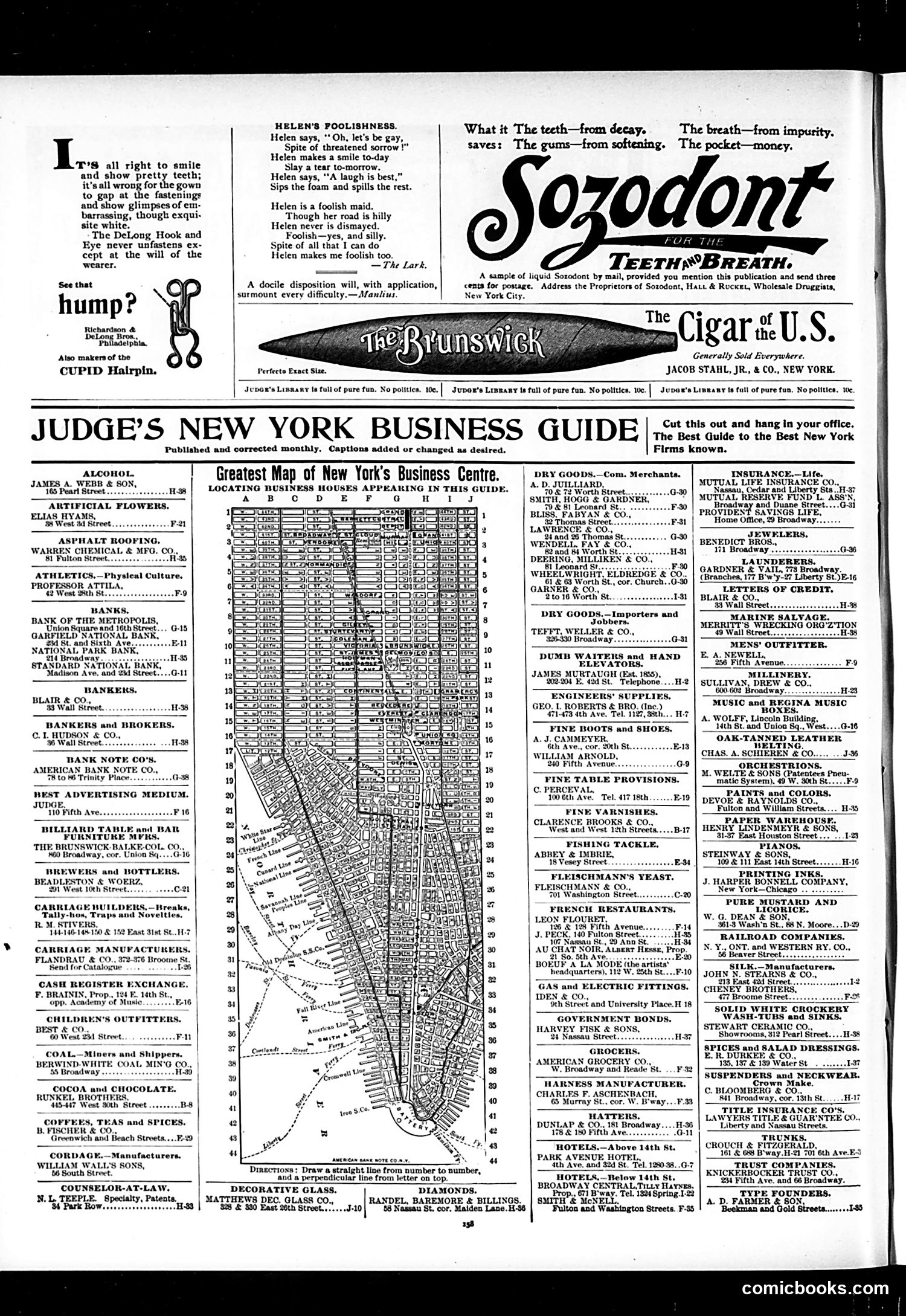
This page is primarily a **business directory and advertisement section** from *Judge* magazine, not a political cartoon or satire. The dominant content is "Judge's New York Business Guide"—a classified business listing with a detailed map of Manhattan's business district. It includes advertisements for products like Sozodont (tooth powder), the Brunswick cigar, and the DeLong hook-and-eye fastener. There is one brief satirical poem, "Helen's Foolishness," presenting "Helen" as a carefree, foolish young woman who laughs despite troubles—a light, moralistic joke typical of period humor. The Sozodont ad uses copywriting wordplay ("teeth—from decay...pocket—money"). Otherwise, this is essentially a **commercial yellow pages** for New York businesses, arranged alphabetically by trade (alcohol, artificial flowers, banks, dry goods, etc.). The instruction to "cut this out and hang in your office" confirms its practical business reference purpose rather than editorial satirical content.
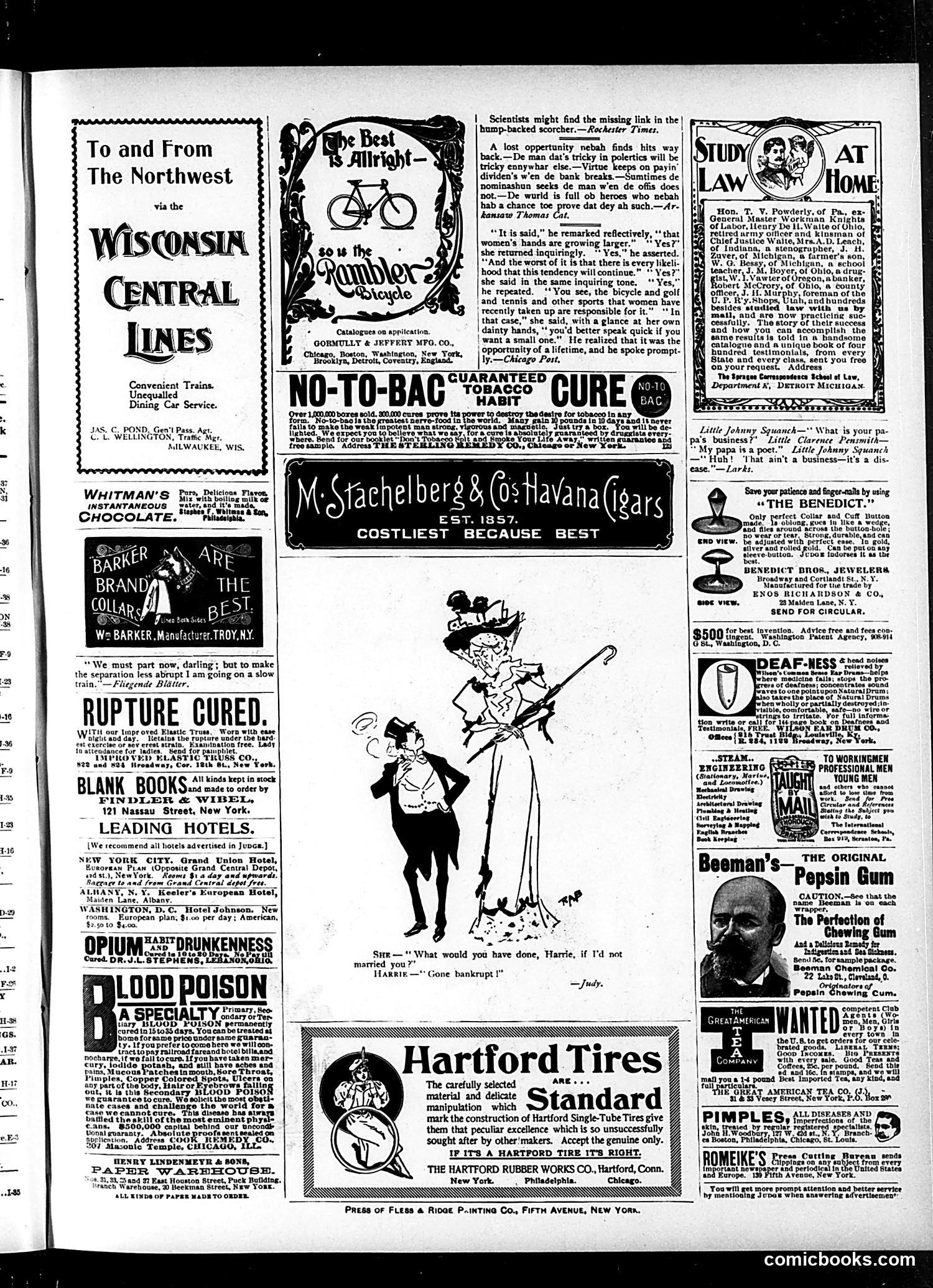
This is primarily an **advertising page** from an early 1900s issue of Judge magazine, with one notable cartoon. ## The Main Cartoon The cartoon shows a man proposing to a woman while she holds a golf club, illustrating a satirical joke about **women's expanding hand size** from sports. The humor derives from contemporary anxieties about women's changing roles: as women increasingly participated in bicycling, golf, and tennis (relatively new activities for women at the time), social commentators worried this would literally enlarge their hands and make them less "dainty" or feminine. The cartoon satirizes this concern by suggesting a man must propose quickly before women's hands grow too large—mocking both the ridiculous pseudo-scientific worry and the shallow standards that would motivate such haste. ## The Advertisements The page is dominated by ads for period products: patent medicines (No-To-Bac tobacco cure, blood poison treatments), hotels, tires, cigars, and books. These reflect typical Judge readership and early 20th-century commerce. The satire targets emerging anxieties about **modernization and changing gender roles**, presented as absurdly biological rather than social.
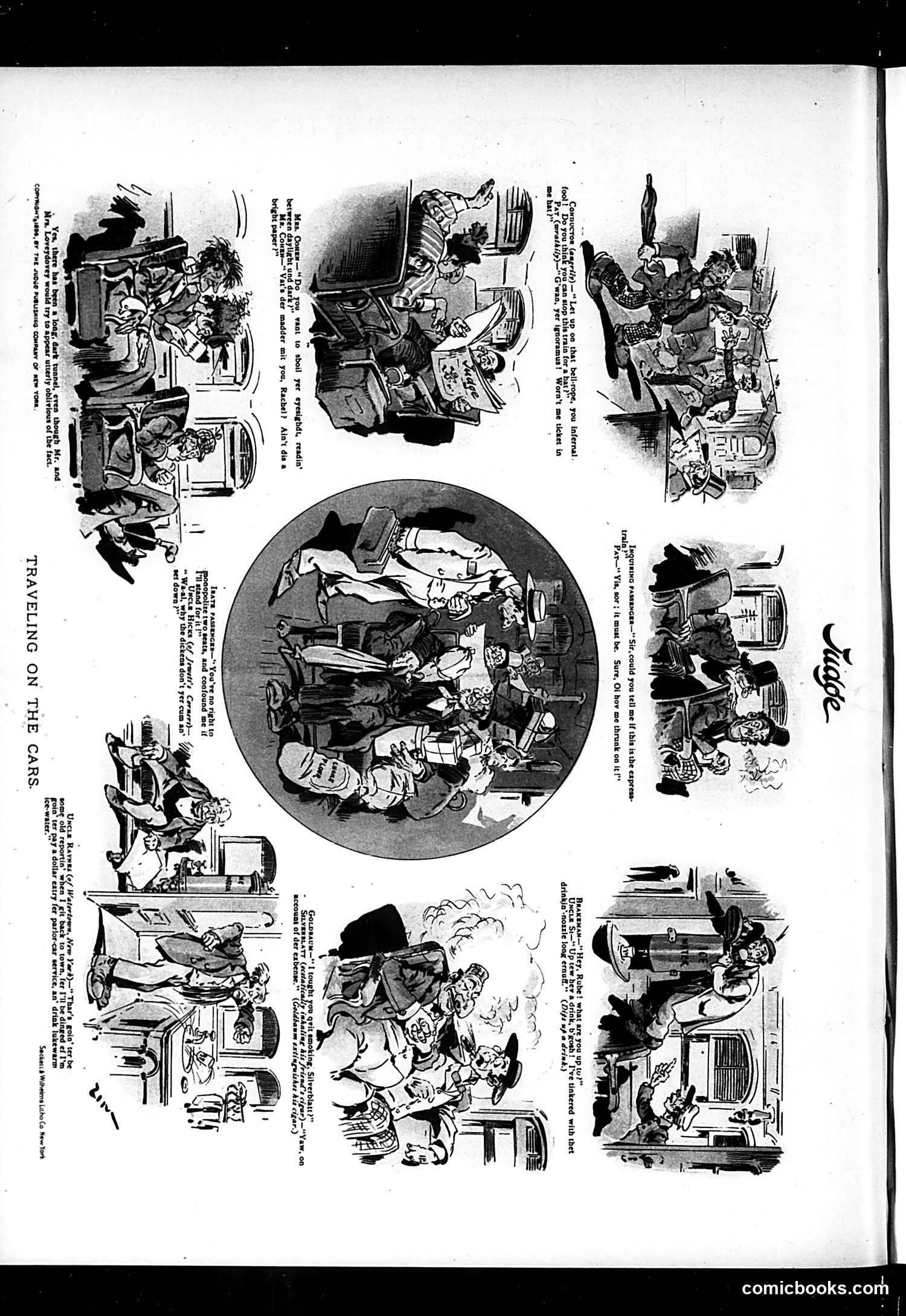
This page presents multiple satirical vignettes about train travel, mocking common passenger behaviors and social types of the era. The central circular illustration and surrounding panels depict stereotypical characters: Irish immigrants (Pat), German immigrants (Mr. Cozz), and working-class passengers engaging in crude or inconsiderate behavior aboard trains. The humor relies on ethnic caricature and dialect humor typical of late-19th/early-20th-century American comedy. Key gags include: passengers misusing train amenities, conductors dealing with rowdy travelers, couples attempting privacy in dark tunnels, and disputes over ticketing and seat upgrades. The "dollar extra for parlor car service" reference suggests class anxiety about rail travel costs. The satire targets both passenger misconduct and the indignities of rail travel itself—portraying trains as spaces where social pretense breaks down and various classes collide awkwardly. The ethnic stereotyping reflects period prejudices against immigrant passengers.