
A complete issue · 22 pages · 1896
Judge — June 20, 1896
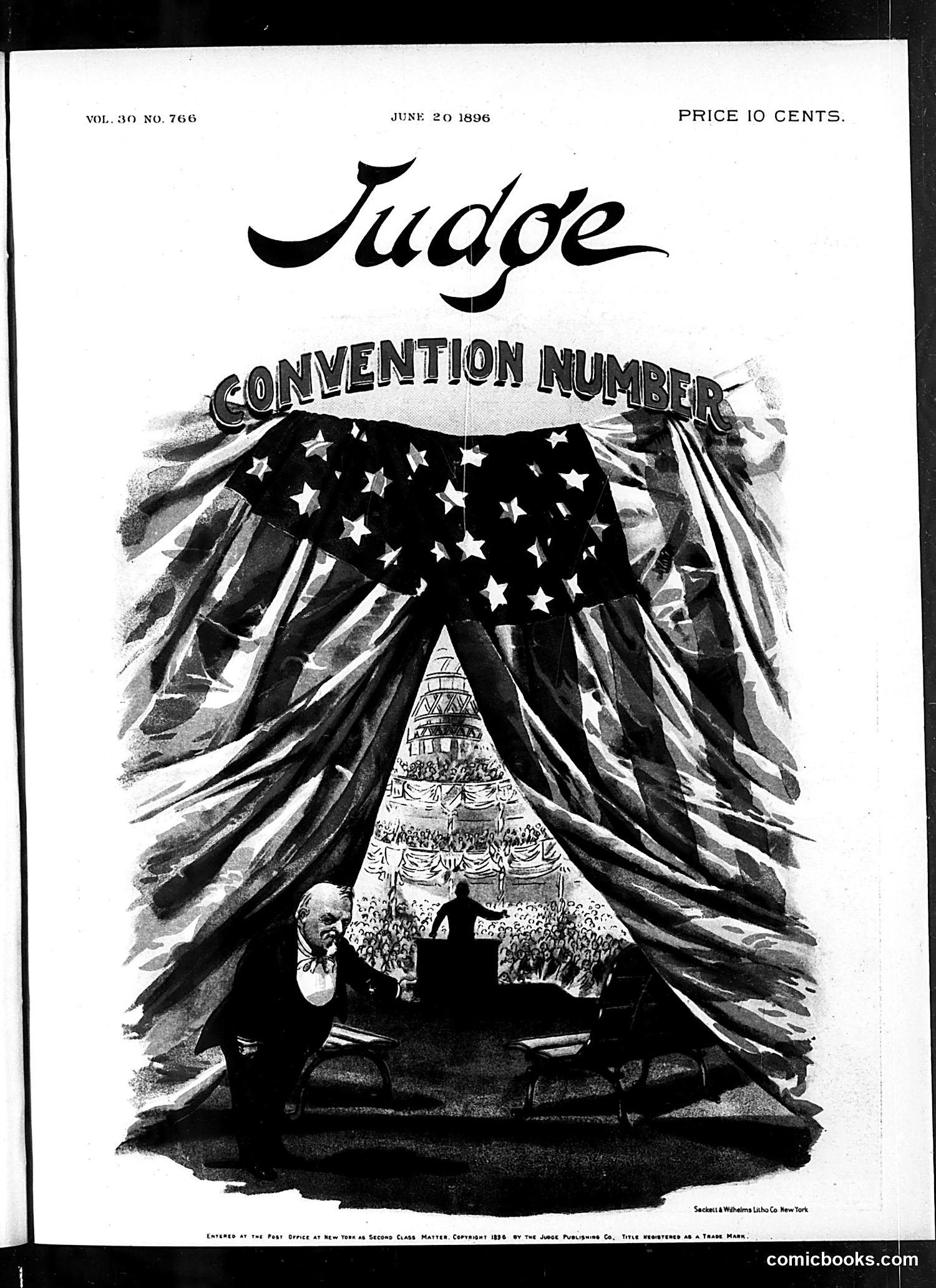
This is the "Convention Number" of Judge, likely referencing the 1896 presidential nominating conventions. The cover depicts a grand political gathering beneath a massive American flag canopy, with crowds filling an ornate hall decorated with patriotic bunting. The silhouetted figures in the foreground appear to represent political speakers or delegates at the convention. The elaborate staging—the draped flags, the Capitol-like dome visible through the opening, the assembled masses—suggests this celebrates (or satirizes) the pageantry and spectacle of American democratic process. Without identifying specific figures clearly visible, the satire likely comments on the theatrical nature of political conventions, the manipulation of patriotic symbolism, or the contrast between grand democratic ideals and political reality. The "Convention Number" framing indicates this is timely political commentary on that year's major political event.
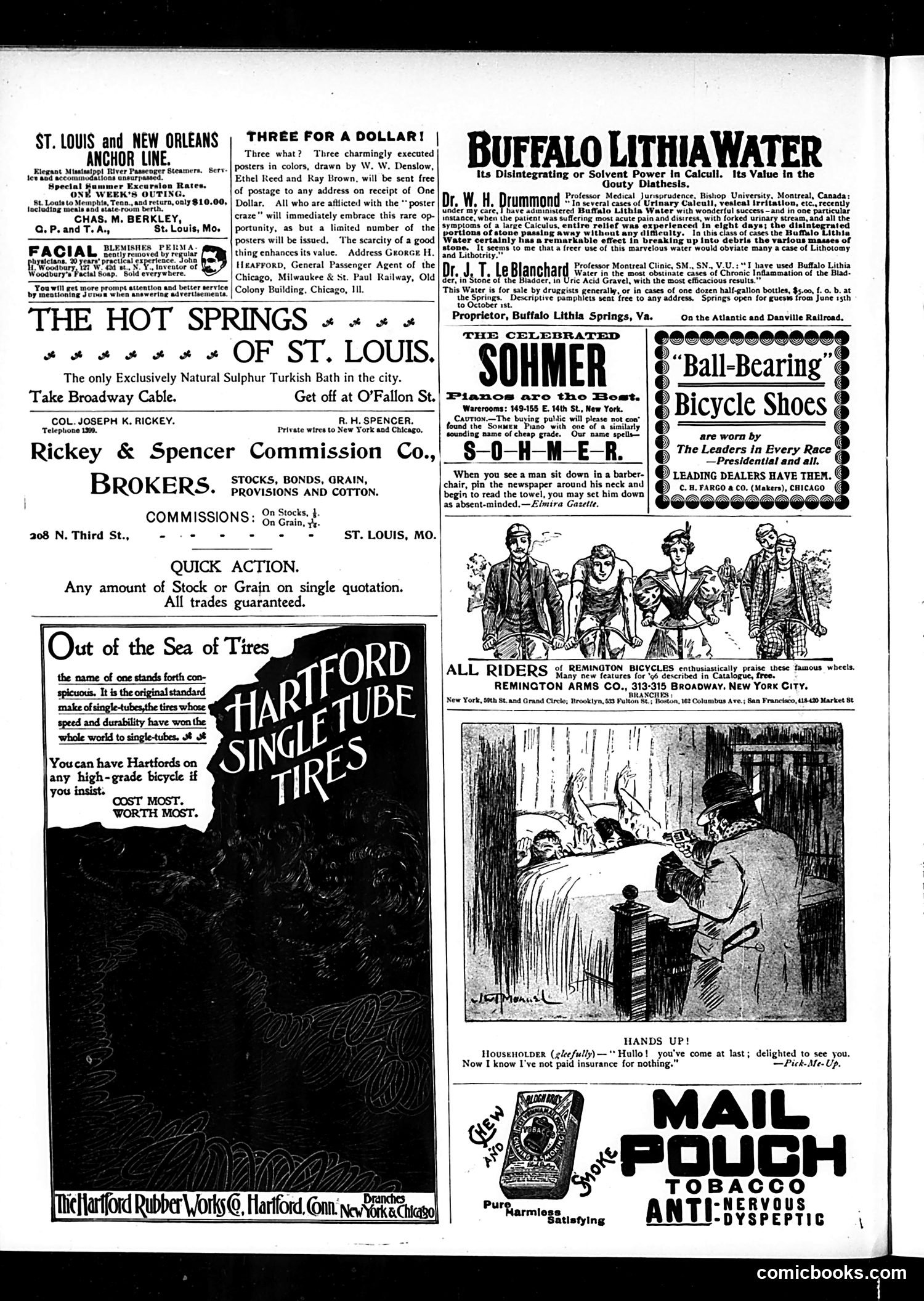
This page is **primarily advertising** with one cartoon insert. The main satirical content is the cartoon titled "HANDS UP!" showing a householder confronting what appears to be a burglar in a bedroom at night. The joke's caption reads: "HOUSEHOLDER (gleefully)—'Hello! you've come at last; delighted to see you. Now I know I've not paid insurance for nothing.'" The satire **mocks insurance culture**: the householder is so relieved to finally have a robbery occur that he can justify his insurance payments. This reflects early-20th-century anxieties about insurance being wasteful spending on unlikely disasters. The dark humor suggests people felt they were throwing money away on premiums for events that never happened—until, ironically, one does. The rest of the page consists of period advertisements for tires, bicycles, springs, and tobacco products.
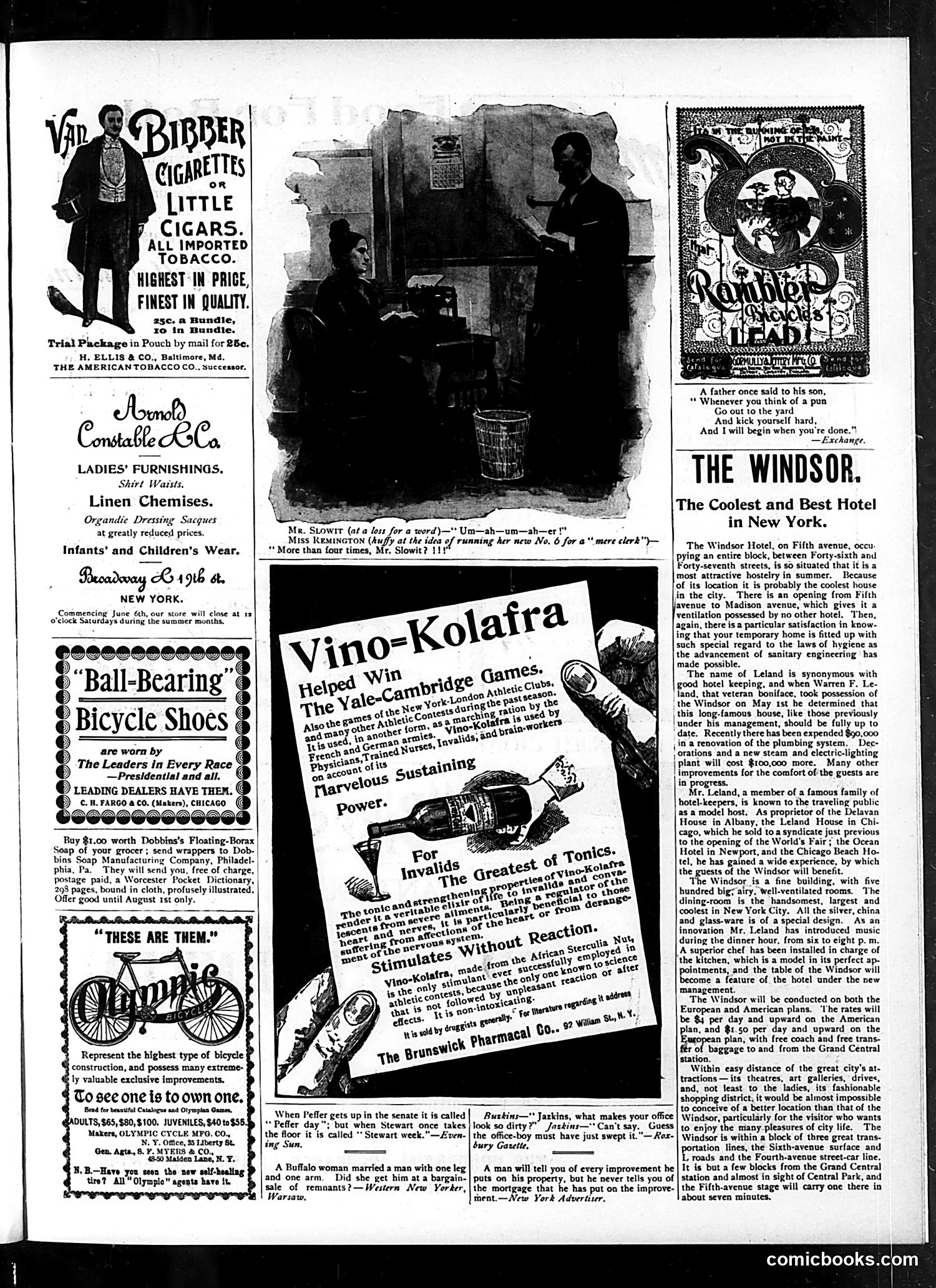
This page is **primarily advertising** rather than political satire. It contains vintage product advertisements including: - **Val Bibber Cigarettes** (top left) - promoting imported tobacco - **Ball-Bearing Bicycle Shoes** - marketed as worn by "Leaders in Every Race" - **Vino-Kolafra** (center) - a tonic claiming to have "Helped Win The Yale-Cambridge Games," marketed as a sustaining drink with "marvellous Power" - **The Windsor Hotel** (right) - describing itself as "The Coolest and Best Hotel in New York" There is one **illustrated vignette** showing what appears to be a domestic scene with servants or workers, but without clearer context it's difficult to determine if this contains satire. The page reflects early 20th-century advertising conventions and consumer culture rather than explicit political commentary.
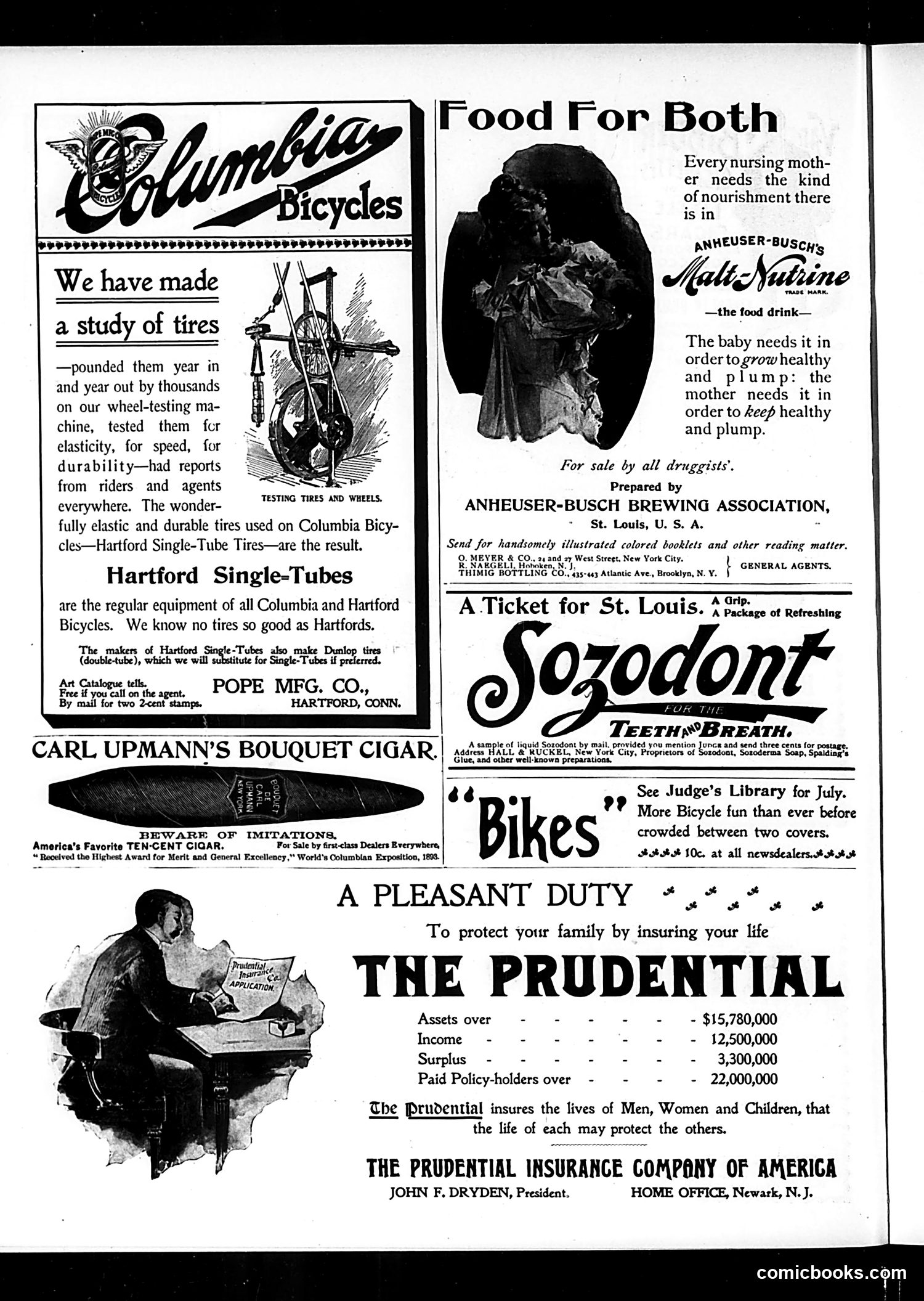
This page is **primarily advertising** with no political cartoons. It's a collection of turn-of-the-century commercial advertisements typical of Judge magazine's revenue model. Notable ads include: - **Columbia Bicycles**: promoting Hartford Single-Tube tires through pseudo-scientific testing claims - **Anheuser-Busch Malt Nutrine**: a "food drink" marketed to nursing mothers and babies—reflecting era attitudes about beer as nutrition (likely containing minimal alcohol but marketed as healthful) - **Carl Upmann's Cigar**: emphasizing authenticity against imitations - **Sozodont toothpaste**: offering free samples - **The Prudential Insurance**: displaying financial assets to build consumer confidence The **Anheuser-Busch ad is most striking to modern readers**—suggesting beer consumption during nursing seems shocking today but reflected contemporary beliefs about fermented beverages' supposed medicinal and nutritional properties. The paternalistic language ("plump") and focus on women's bodies reflects period attitudes toward gender and health.
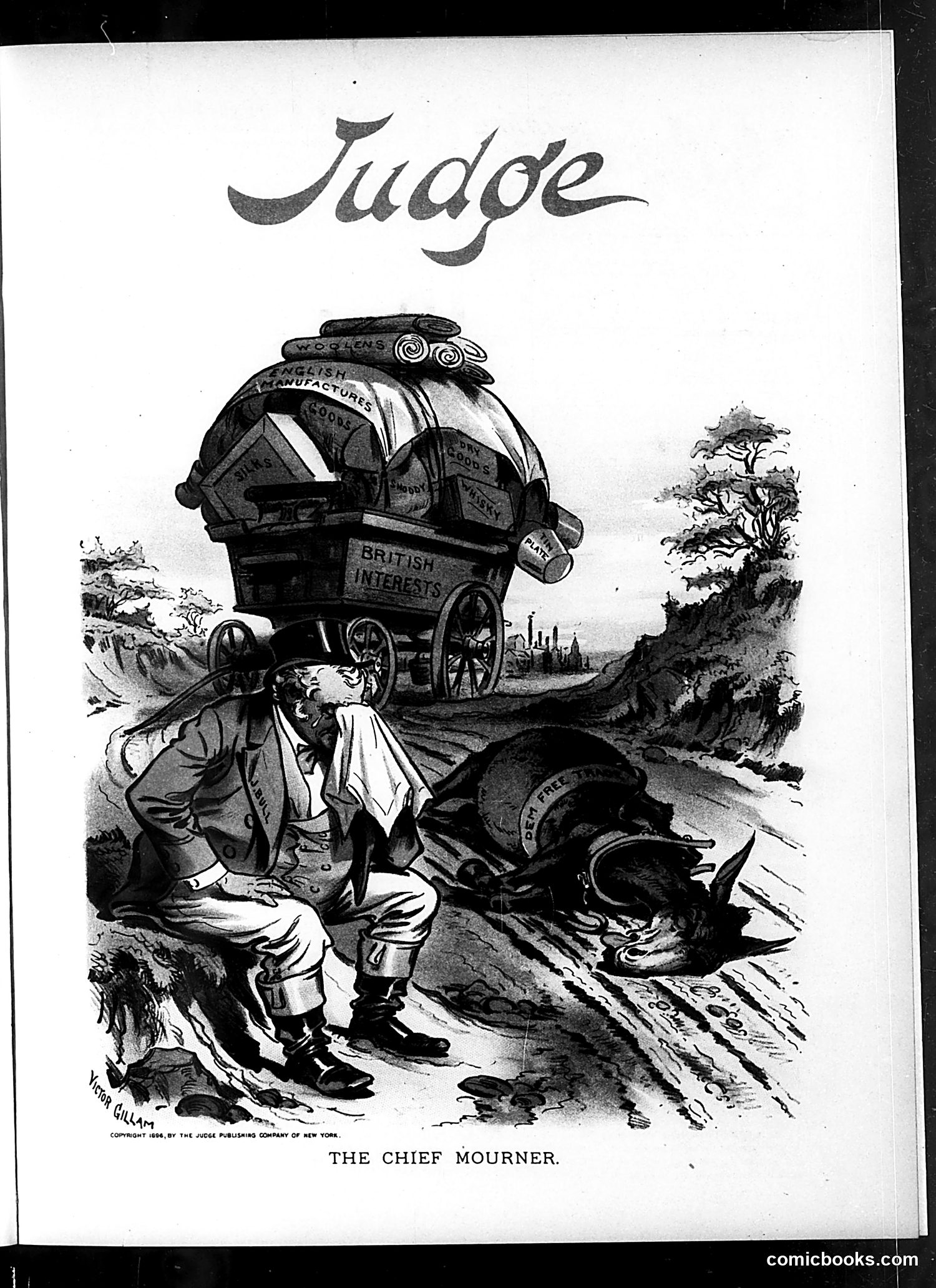
This political cartoon depicts a figure mourning beside an overturned cart laden with labeled goods including "British Interests" and "English Manufactures." The cart appears wrecked, with spilled contents marked "Free Trade." The satire critiques someone—likely a British political figure or Britain itself—as "the chief mourner" of failed free trade policies. The imagery suggests that free trade advocacy has resulted in economic damage to British commercial interests. The cartoon likely dates to a period of trade policy debate in American politics, though the specific historical moment remains unclear without additional context. The cart's precarious state symbolizes economic disruption, with the mourning figure lamenting the consequences of their trade positions.
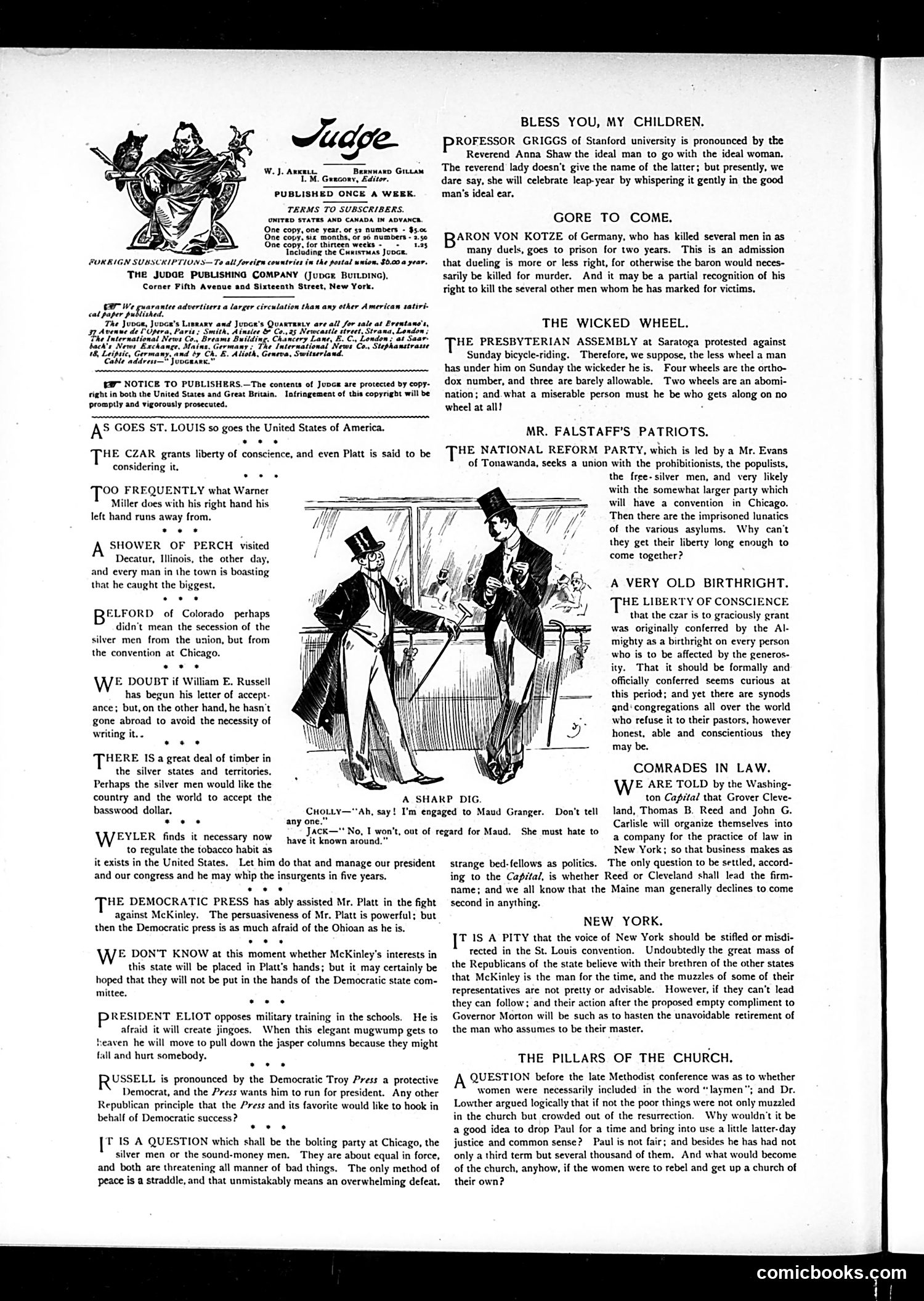
This page from **Judge** magazine contains brief political satirical comments typical of the publication's format. Key items include: **"Bless You, My Children"**: Mocks Professor Griggs of Stanford and Reverend Anna Shaw's endorsement of him as an "ideal man," sarcastically suggesting Shaw will soon confess romantic feelings during leap year. **"Gore to Come"**: References Baron von Kotze of Germany, who killed men in duels but receives only a two-year prison sentence—satirizing the hypocrisy that dueling is punished lightly while murder is serious. **"The Wicked Wheel"**: Ridicules Presbyterian Assembly opposition to Sunday bicycle-riding as absurdly prudish. **"Mr. Falstaff's Patriots"**: Critiques the National Reform Party's attempt to unite prohibitionists, populists, and free-silver advocates—suggesting such diverse groups cannot cohere. The cartoon (bottom half) depicts two men in top hats in conversation, likely illustrating one of these political satirical points, though the specific reference is unclear from the visible image alone.
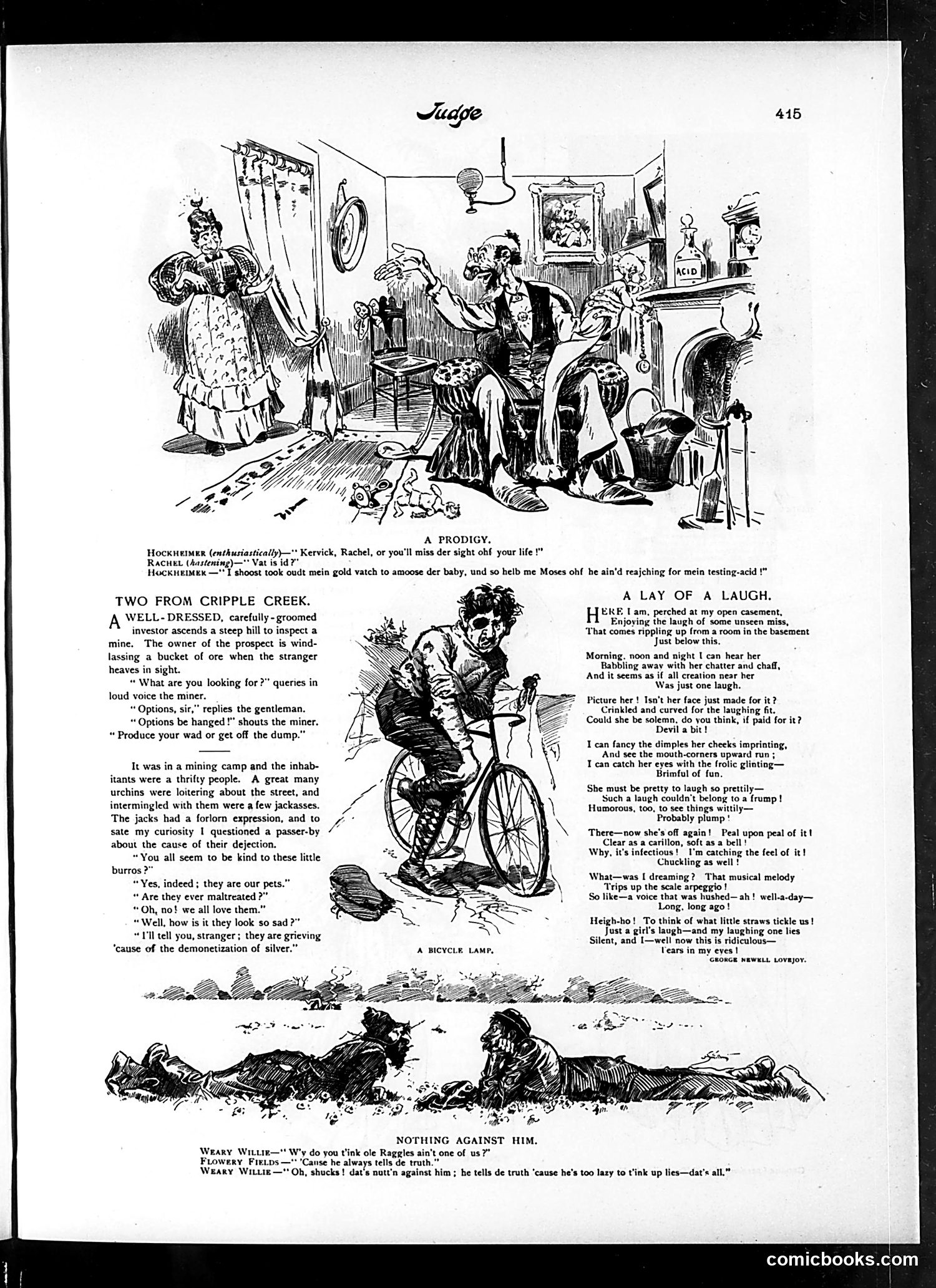
This page contains multiple satirical pieces reflecting late-19th/early-20th century American concerns: **"A Prodigy"** mocks nouveau riche Jewish immigrants through stereotyped dialect, depicting a man so eager to show off his gold watch that he endangers his baby with testing acid—satirizing both materialism and parental negligence. **"Two from Cripple Creek"** references the Colorado mining boom, satirizing get-rich-quick schemes where miners demand cash ("wad") over mere stock options from investors. **"Nothing Against Him"** features two vagrants (Weary Willie and Flowery Fields, stock characters in period humor) joking that their peer Raggles isn't truly one of them because he tells the truth—implying honesty is uncommon among their class. **"A Lay of a Laugh"** is a sentimental poem about a woman's infectious laughter triggering memories of a lost love, representing the magazine's lighter romantic content. The page blends ethnic caricature, mining-era satire, class commentary, and sentimentalism typical of Judge's editorial mix.
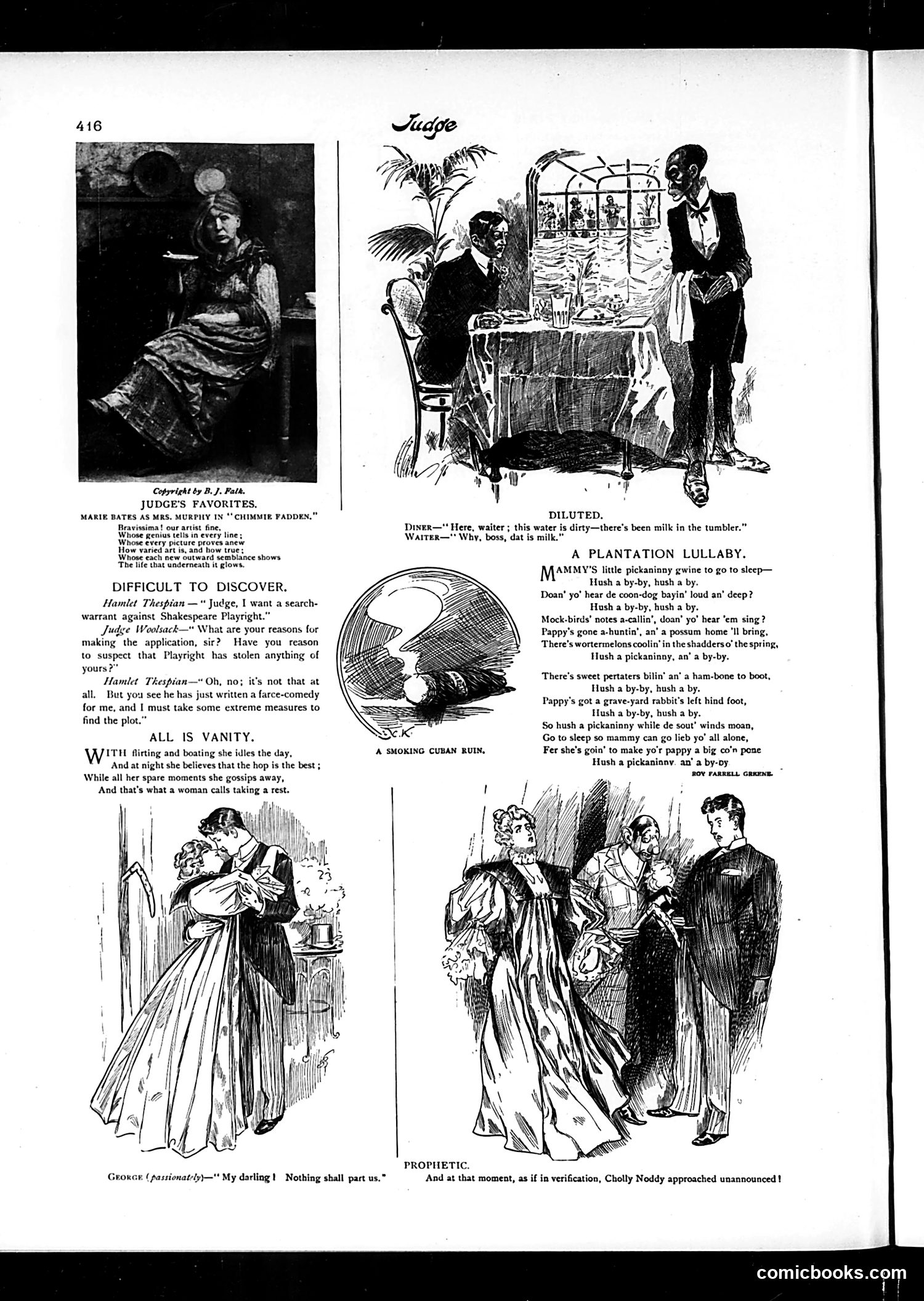
This page from the satirical magazine **Judge** contains multiple humorous sketches typical of late 19th/early 20th-century American comedy: **"Difficult to Discover"** mocks theatrical farce by having an actor (Hamlet Thespian) seek a legal warrant against a playwright for stealing—not his work, but the *plot* of a farce-comedy written for him, implying the play has no coherent plot. **"Diluted"** is a simple restaurant joke: a diner complains water is dirty with milk; the waiter reveals it actually *is* milk, inverting the complaint. **"A Plantation Lullaby"** uses dialect humor common to the era, presenting a nursery rhyme sung to an enslaved child, filled with stereotypical imagery (coon-dogs, watermelons, possum hunting). This reflects period racial attitudes rather than satire of them. The page also includes portrait photography and romantic sketches with light social commentary on vanity and relationships. The humor relies on wordplay, situational comedy, and period-specific theatrical references rather than political content.
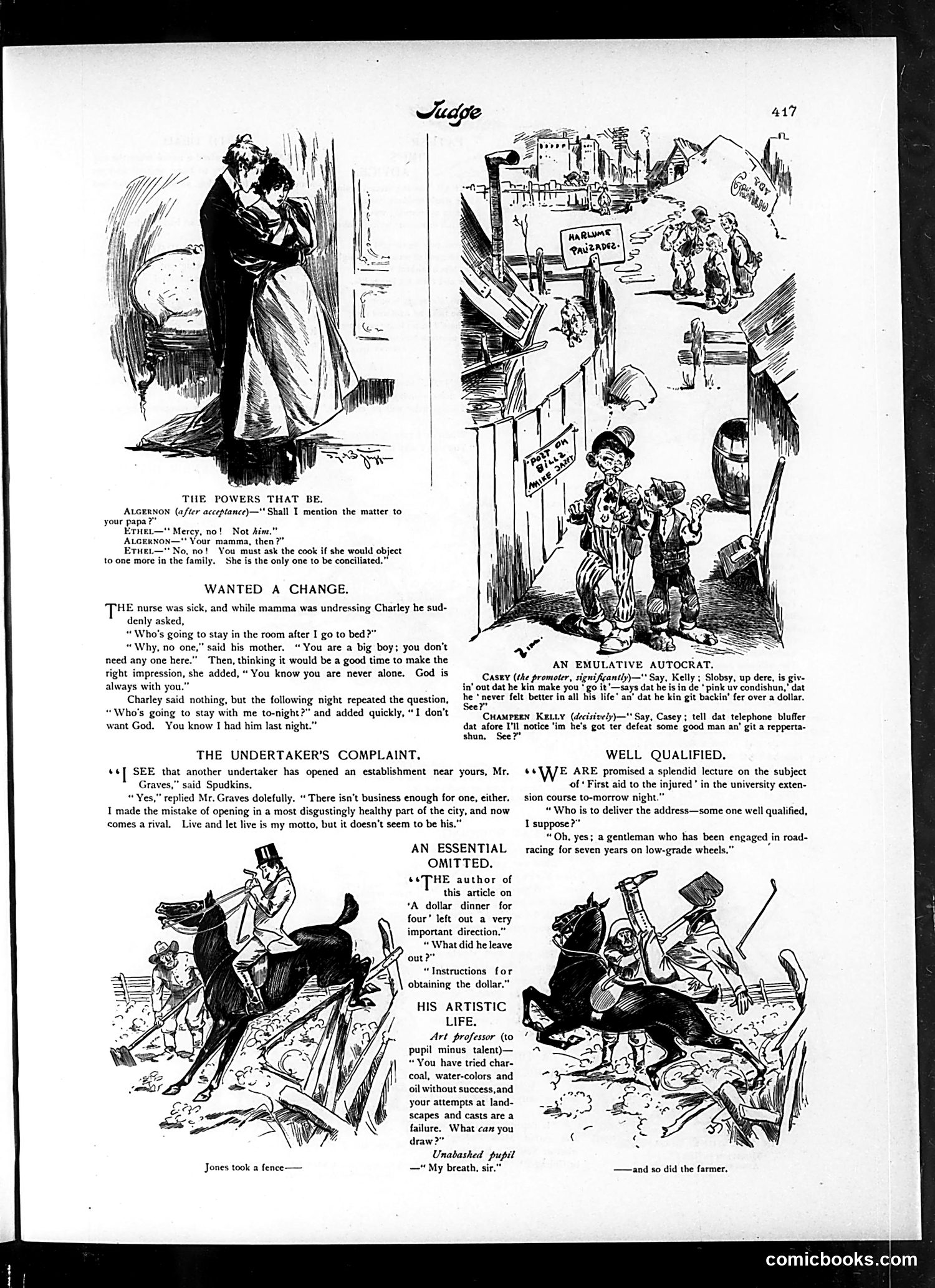
This page contains six separate humorous short comic sketches typical of Judge's satirical format: 1. **"The Powers That Be"**: A social satire on class hierarchy—a newly engaged man must seek permission from the cook (the household servant) rather than family members to add another person to the household, suggesting servants held more practical power than the family itself. 2. **"Wanted a Change"**: A child's joke about religious faith. When mother reassures the boy that "God is always with you," he replies he doesn't want God present—he had Him "last night," implying boredom or treating divine presence as an unwanted companion. 3. **"The Undertaker's Complaint"**: Dark humor about an undertaker's business struggles due to a competitor opening in a healthy neighborhood with few deaths. 4. **"An Essential Omitted"**: Satirizes get-rich-quick schemes and boxing promotion—a promoter claims someone can earn money without actually explaining *how*. 5. **"Well Qualified"**: Mocks incompetent "experts"—a road-racer (dangerous activity on poor bicycles) is qualified to teach first aid. 6. **"His Artistic Life"**: A talentless art student, unable to draw anything successfully, offers "My breath, sir"—a pun on drawing/exhaling.
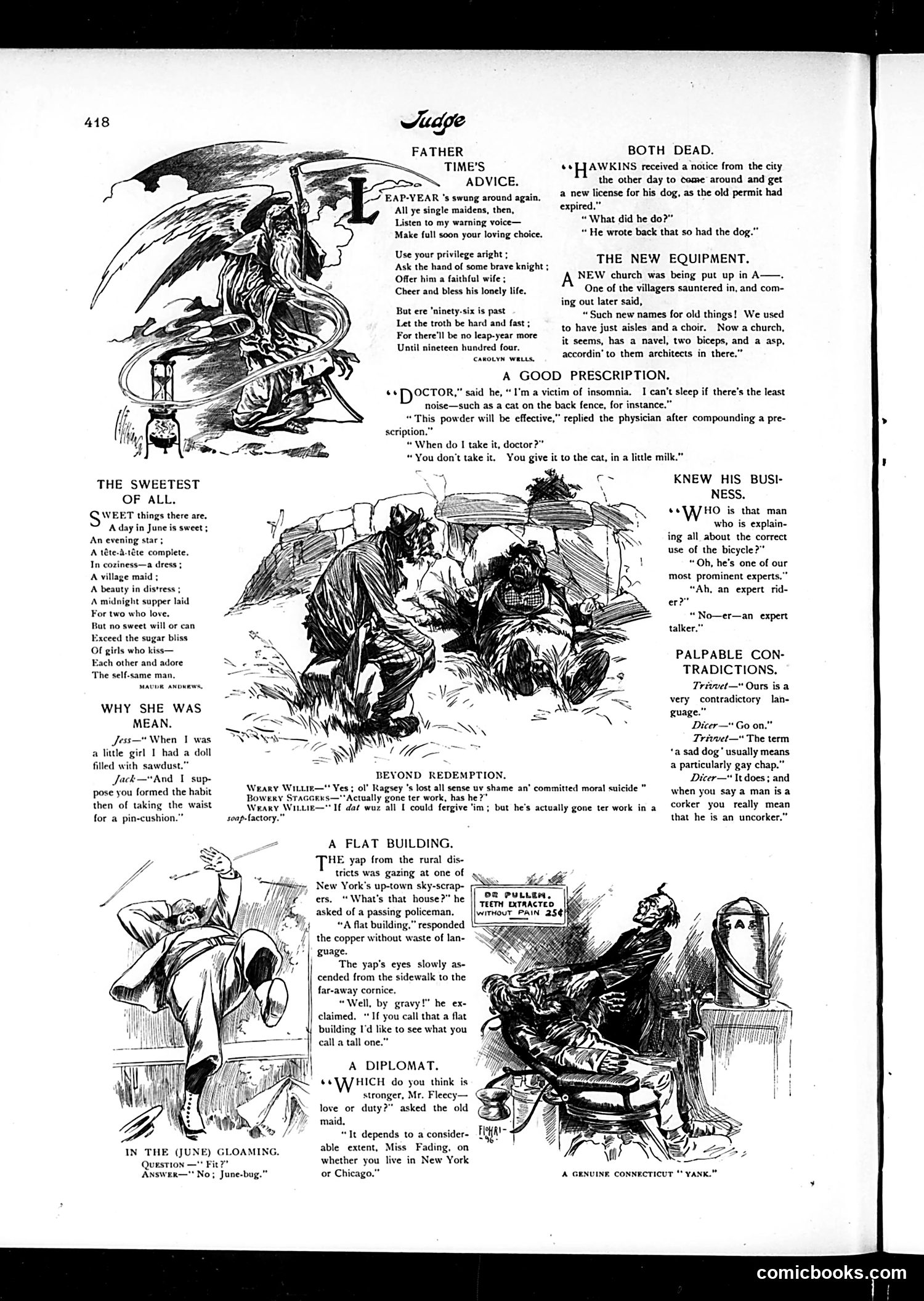
This page from *Judge* contains multiple short humor pieces typical of early American satirical magazines: **"Father Time's Advice"** addresses the leap-year tradition (when women could propose to men), urging unmarried women to act before 1896, as the next leap year wouldn't occur until 1904. **"Both Dead"** jokes about a dog license expiring alongside its owner's death. **"The New Equipment"** satirizes rural Americans' unfamiliarity with modern architectural terminology, substituting anatomical terms ("navel," "biceps") for church features. **"A Good Prescription"** presents a doctor's humorous solution to insomnia: giving sleep-inducing powder to a cat causing noise. Other brief jokes mock rural visitors to New York (confusing "flat building" with skyscrapers), linguistic contradictions ("sad dog" meaning a gay chap), and romantic/social situations. The cartoons feature rustic characters and city folk, emphasizing class and regional humor common to the era. The overall tone is light, pun-based humor without explicit political content.
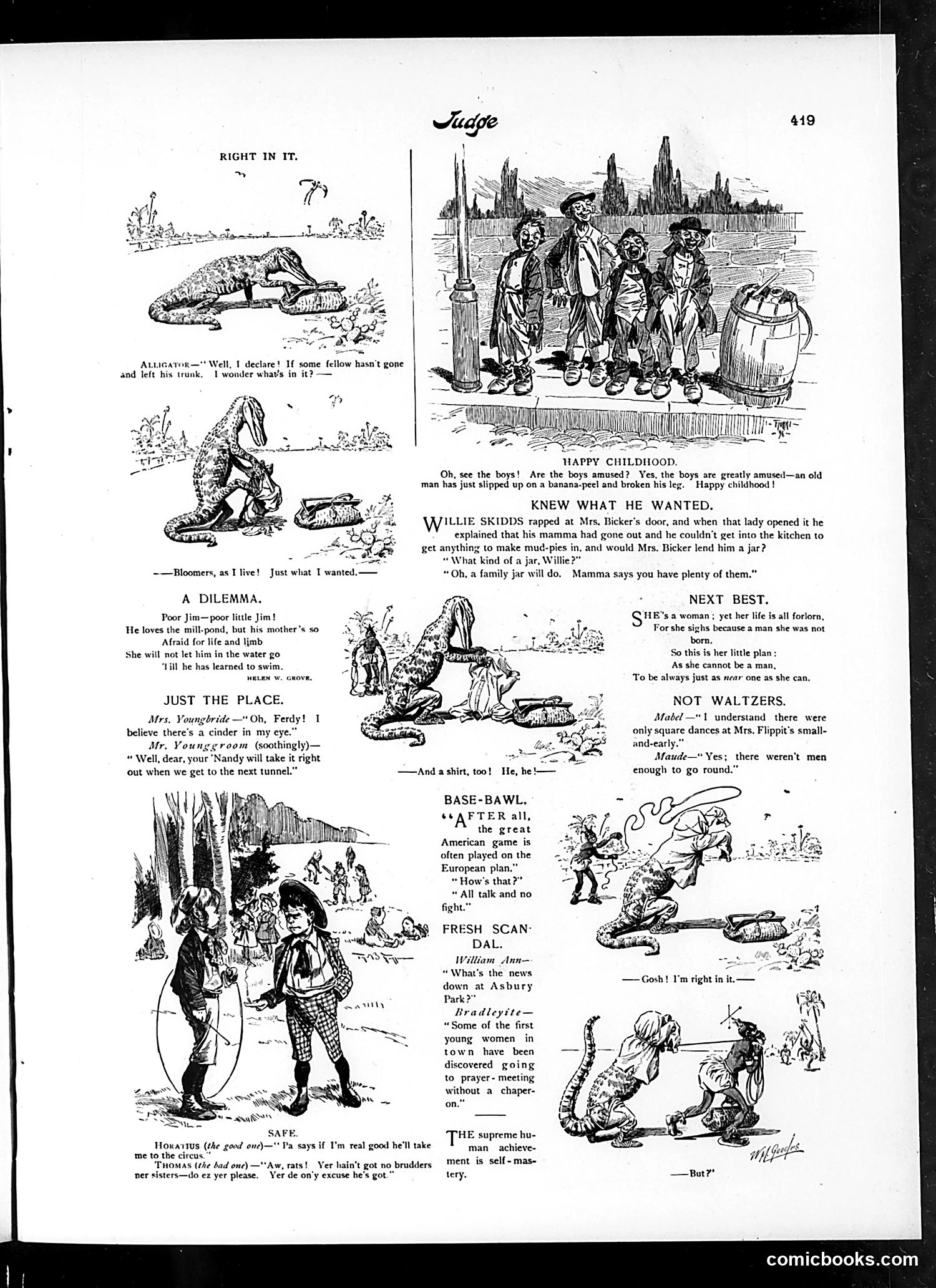
This page contains multiple short humor pieces typical of late-19th-century satirical magazines: **Social/Gender Commentary:** - "Bloomers" references women's emerging fashion freedom—divided skirts that scandalized Victorian society - "Next Best" mocks women's frustration with limited roles, suggesting they must live vicariously through men - "Not Waltzers" jokes about gender imbalance at social events—insufficient men for dancing partners - "Fresh Scandal" satirizes small-town prudishness: young women attending prayer meetings *without* chaperones is shocking gossip **Parental/Childhood Humor:** - "A Dilemma" and "Just the Place" use domestic situations for mild comedy - "Happy Childhood" darkly jokes about children finding amusement in an elderly man's misfortune (slipping on banana peel) **Sports/Americanism:** - "Base-Bawl" plays on baseball's popularity, claiming it's played "European style" (all talk, no action)—possibly critiquing American sporting pretension or European politics The cartoons reflect Judge's blend of social observation, gender-role anxiety, and gentle mockery of contemporary American life and fashions.
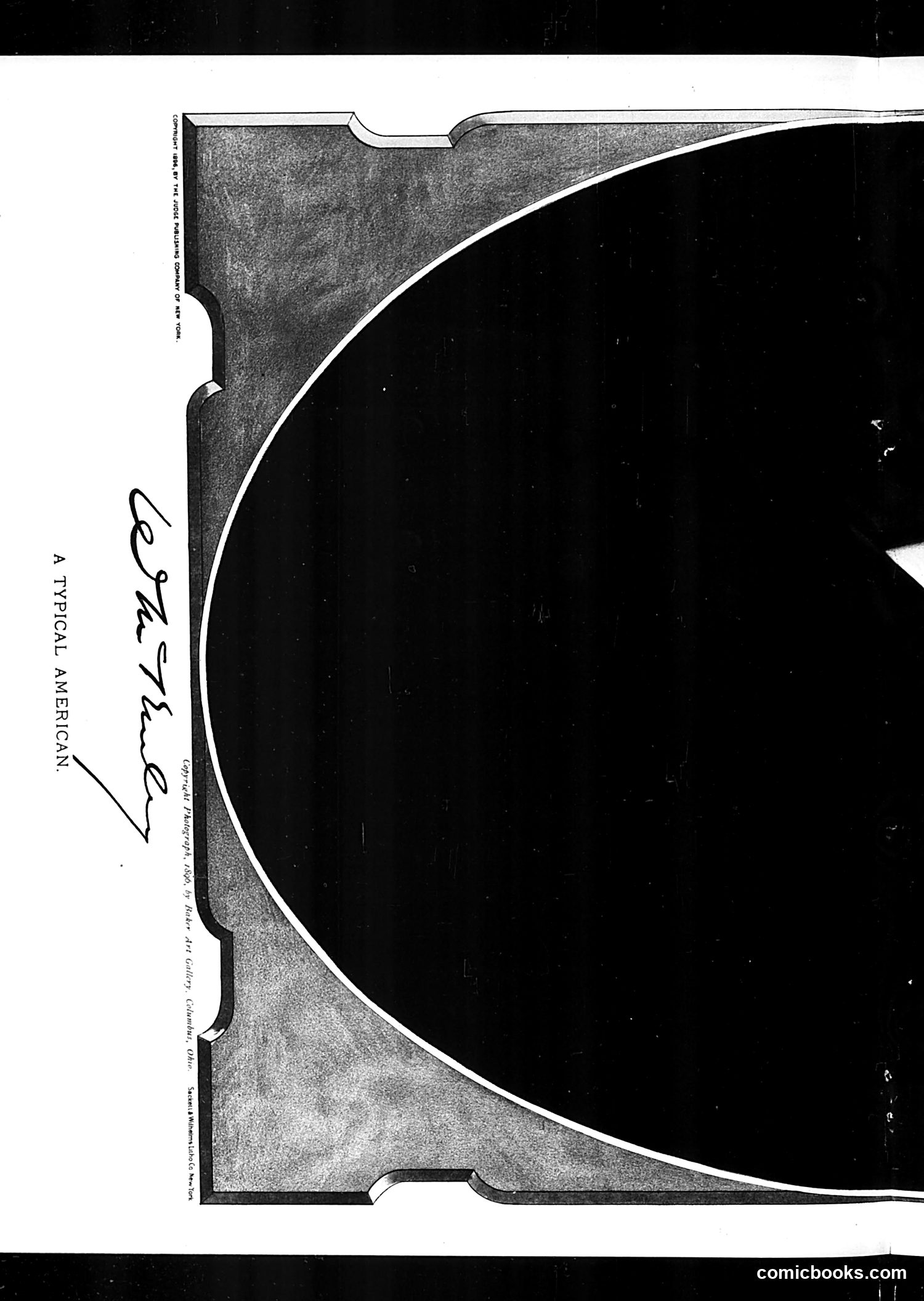
This appears to be a title page or cover from Judge magazine (copyright 1896). The image shows a large curved silhouette in black against a gray decorative border, with the text "A TYPICAL AMERICAN" positioned vertically on the left side. The silhouette's outline suggests it depicts a human profile, though the specific features are difficult to discern clearly in this reproduction. Without additional visual details or context visible on the page, I cannot definitively identify which specific public figure or character type this caricature represents or what particular social commentary it intended. The late 19th-century date and Judge's reputation for political satire suggest this likely referenced contemporary American society or politics, but I cannot specify the exact target or meaning without more legible details or accompanying text.
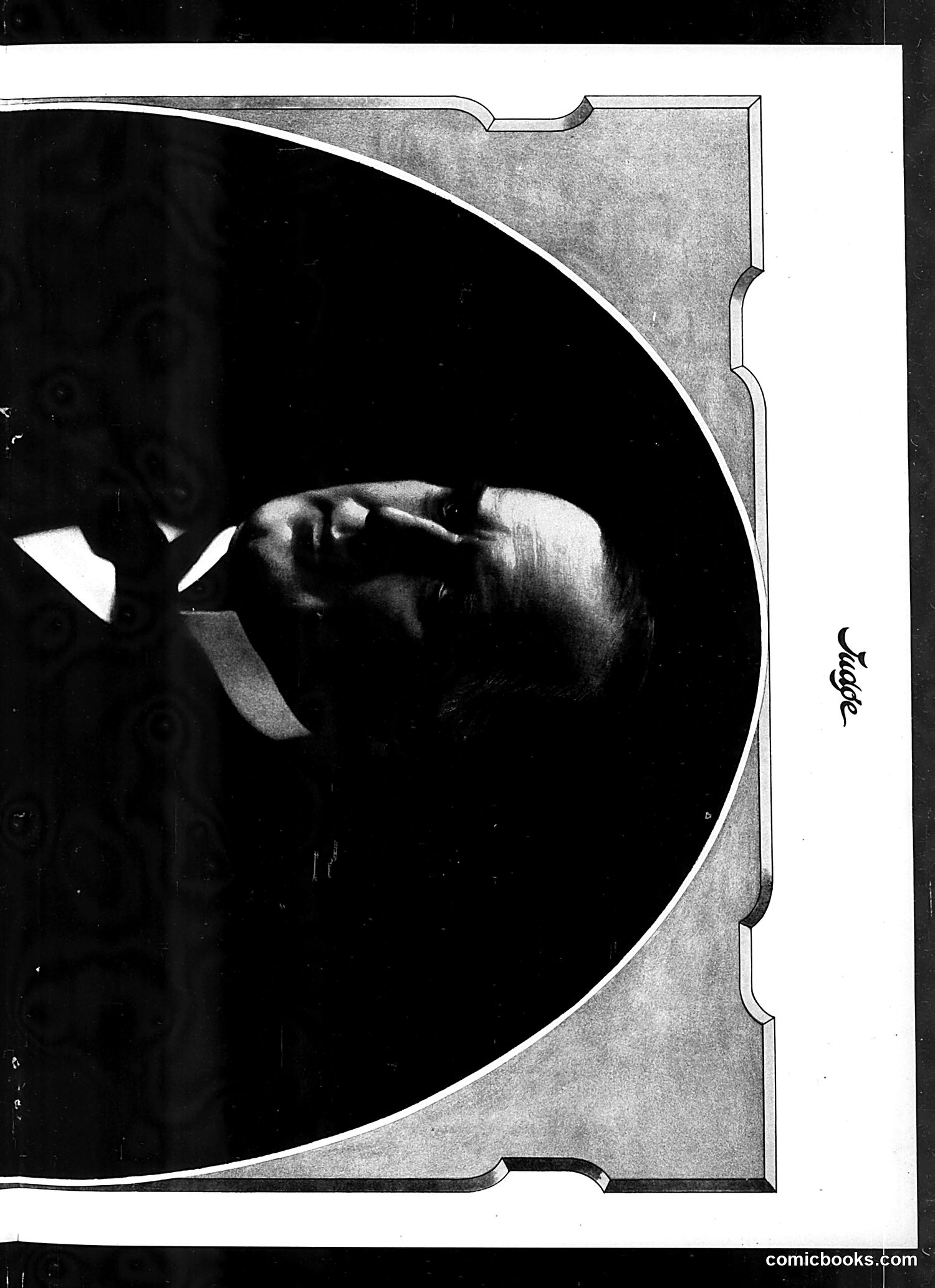
This appears to be a cover or title page from *Judge* magazine featuring a dramatic black-and-white portrait photograph of a man's face in profile, shown within an ornate circular frame. The image uses strong contrast lighting typical of early-to-mid 20th century portraiture. However, without visible text identifying the subject, I cannot definitively state who this person is or what political or social commentary the image intends. The ornate frame design suggests this was likely a prominent figure worthy of *Judge*'s satirical attention, but the OCR text provided ("comicbooks.com") offers no contextual information about the subject, the date of publication, or the magazine's commentary. To properly explain the satire's meaning, I would need additional identifying text or captions that are not legible in this image.
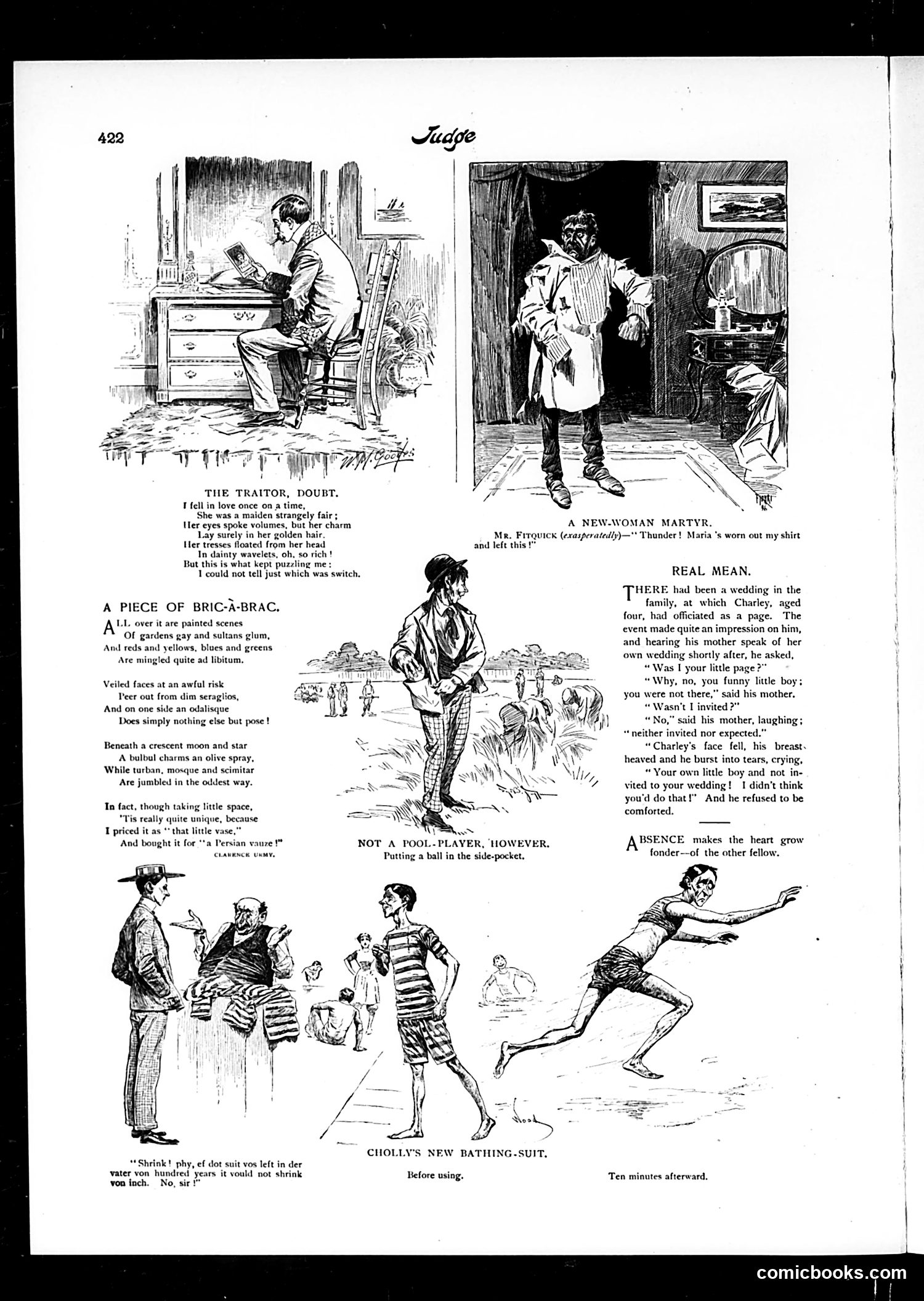
This page contains several unrelated satirical pieces typical of Judge magazine's format: **"The Traitor, Doubt"** — A romantic poem mocking male insecurity. The narrator fell in love with a woman but couldn't enjoy it because he couldn't tell if her beautiful golden hair was natural or a switch (hairpiece), a common Victorian women's fashion concern. **"A Piece of Bric-à-Brac"** — Satirizes the Victorian craze for "Oriental" decorative items. The poem mocks mass-produced pseudo-Persian vases with orientalist imagery that were fashionable but aesthetically jumbled and inauthentic. **"A New-Woman Martyr"** and **"Real Mean"** — Domestic humor sketches about marriage and family relations. **"Cholly's New Bathing-Suit"** — Visual gag showing a man's bathing suit shrinking dramatically after use, contrasting a tailor's exaggerated quality claims with reality. **"Not a Pool-Player, However"** — Brief comic sketch about a man putting a ball in a pocket (ambiguous humor). The page exemplifies Judge's mix of light verse, social observation, and domestic comedy aimed at middle-class readers.
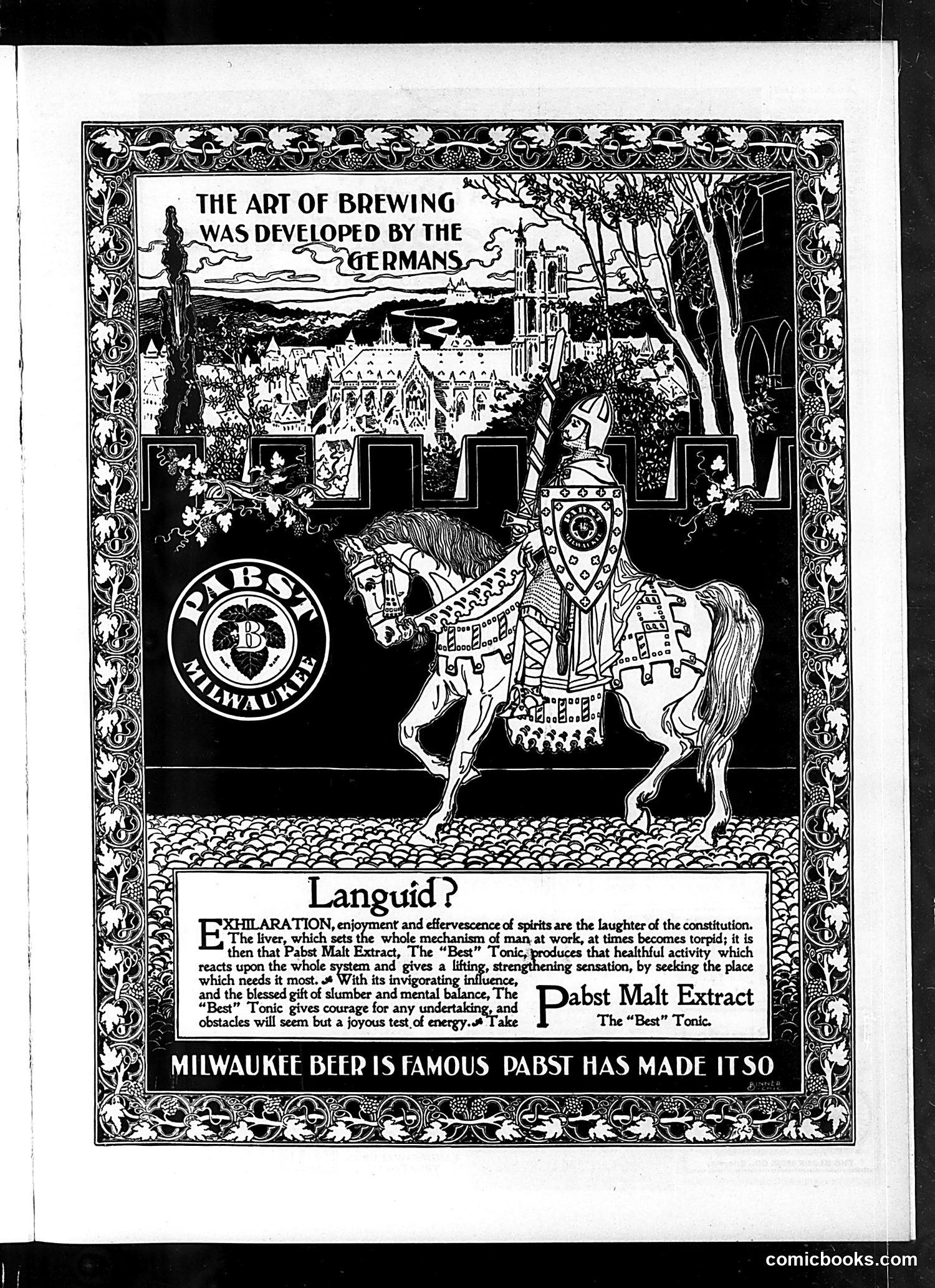
This is primarily a **beer advertisement**, not political satire. The page promotes Pabst's Milwaukee beer and Pabst Malt Extract tonic. The central image depicts a **medieval German knight on horseback**, reinforcing the headline's claim that "The Art of Brewing Was Developed by the Germans." This visual establishes German brewing authority and tradition. The advertisement claims Pabst Malt Extract is a health tonic that combats "languor" (lethargy) by stimulating the constitution and providing "lifting, strengthening sensation." The text promises it gives "courage for any undertaking." This reflects early 20th-century marketing practices where alcohol products were marketed as medicinal tonics rather than pure beverages. The nostalgic Germanic imagery appeals to Milwaukee's large German-immigrant population while suggesting Pabst beer represents authentic German quality. The slogan "Milwaukee Beer is Famous—Pabst Has Made It So" emphasizes brand prestige.
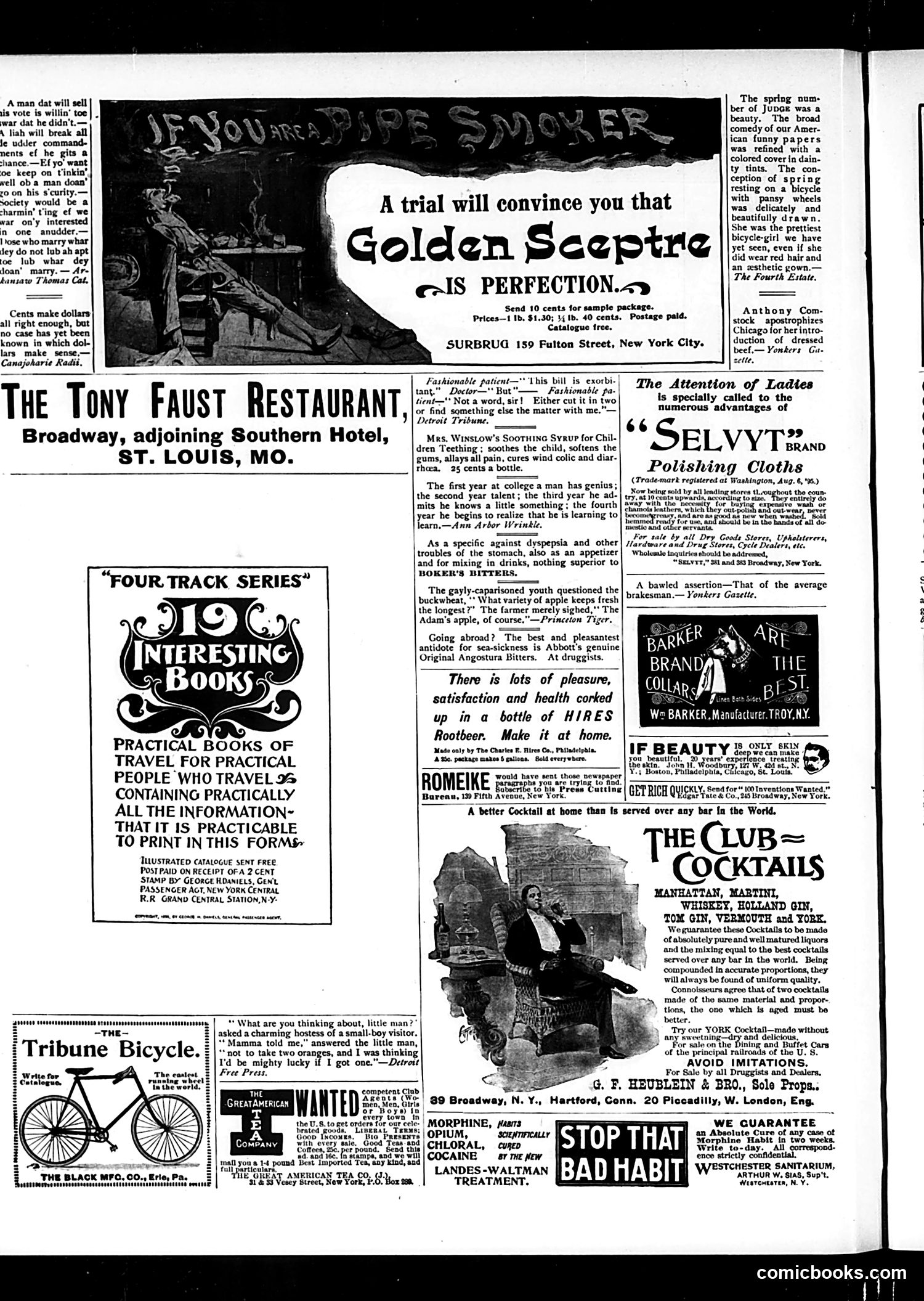
This is primarily an **advertising page** from Judge magazine, interspersed with brief humorous quotations—typical filler content rather than sustained satire or political commentary. The page contains numerous product advertisements (Golden Sceptre bicycle, Selvyt polishing cloths, Hires rootbeer, various tonics and remedies) alongside short comic quips attributed to various sources. These one-liners employ period stereotypes—including what appears to be dialect humor ("A man dat will sell his vote...") representing working-class or immigrant speech patterns. Notable is the "Stop That Bad Habit" advertisement promoting the "Landes-Waltman Treatment" for morphine, opium, and cocaine addiction—reflecting the era's unregulated patent medicine industry and widespread drug dependency issues before prohibition and regulation. The Tony Faust Restaurant ad and Tribune Bicycle advertisement represent typical commercial placements. No identifiable political figures or sustained editorial cartooning appears on this page.
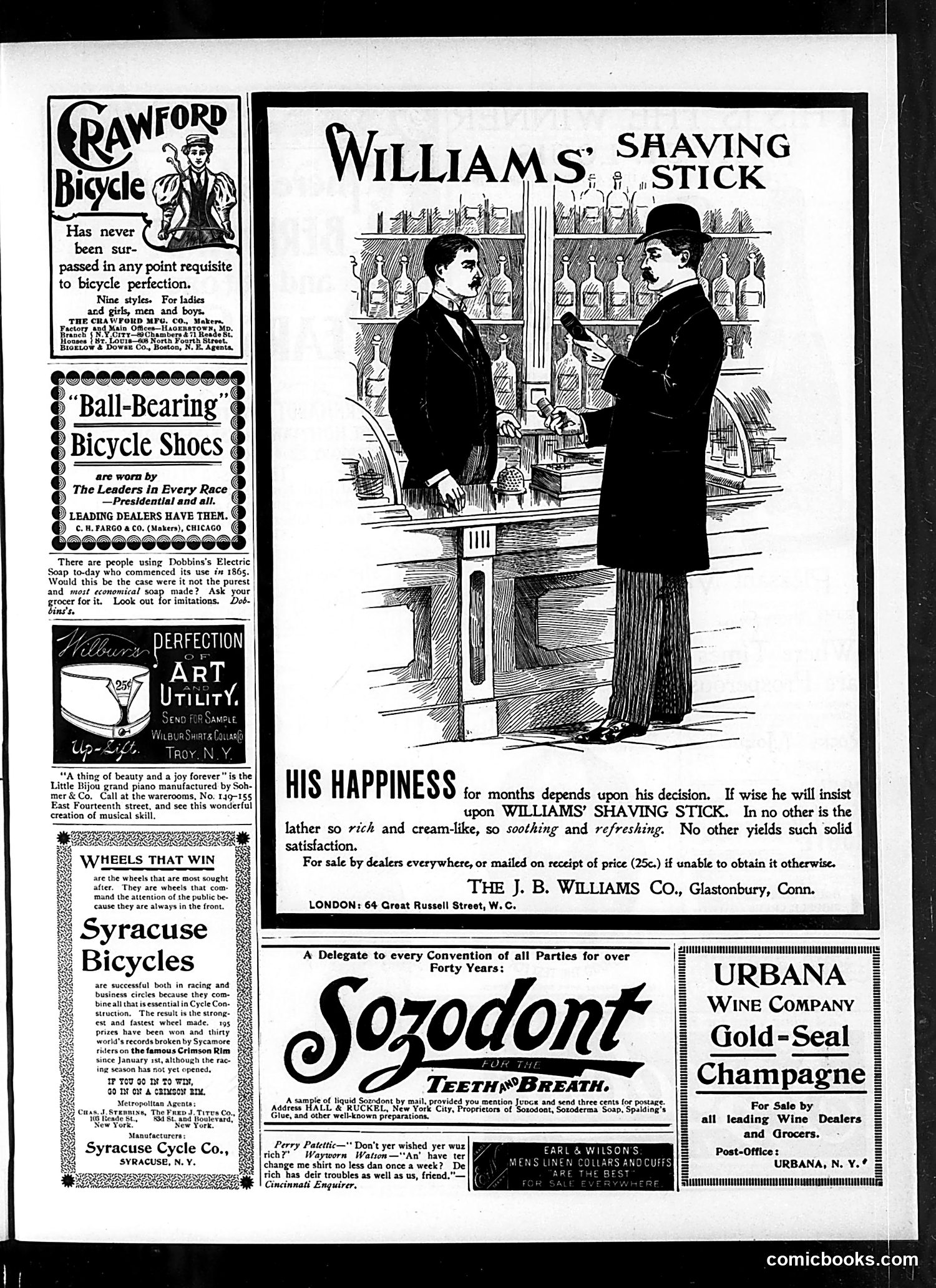
This page is primarily **advertising**, not satire. It contains multiple product advertisements typical of late 19th/early 20th-century magazines. The main illustration depicts two well-dressed men in a barbershop, advertising **Williams' Shaving Stick**. The caption "HIS HAPPINESS" suggests that marital contentment depends on using this product—a humorous exaggeration common to period advertising. The surrounding ads promote **bicycles** (Crawford, Syracuse brands), **bicycle shoes**, **soap** (Dobbins), a **piano** (Sohmer & Co.), **Sozodont toothpaste**, and **Urbana Champagne**. These reflect consumer goods marketed to middle and upper-class readers. A small comic strip at bottom features "Perry Pathetic" and "Wayworn Wation"—characters discussing how the wealthy have troubles too (needing frequent shirt changes). This is mild social commentary on class differences. The page demonstrates how Judge mixed editorial content with commercial advertising to support its publication.
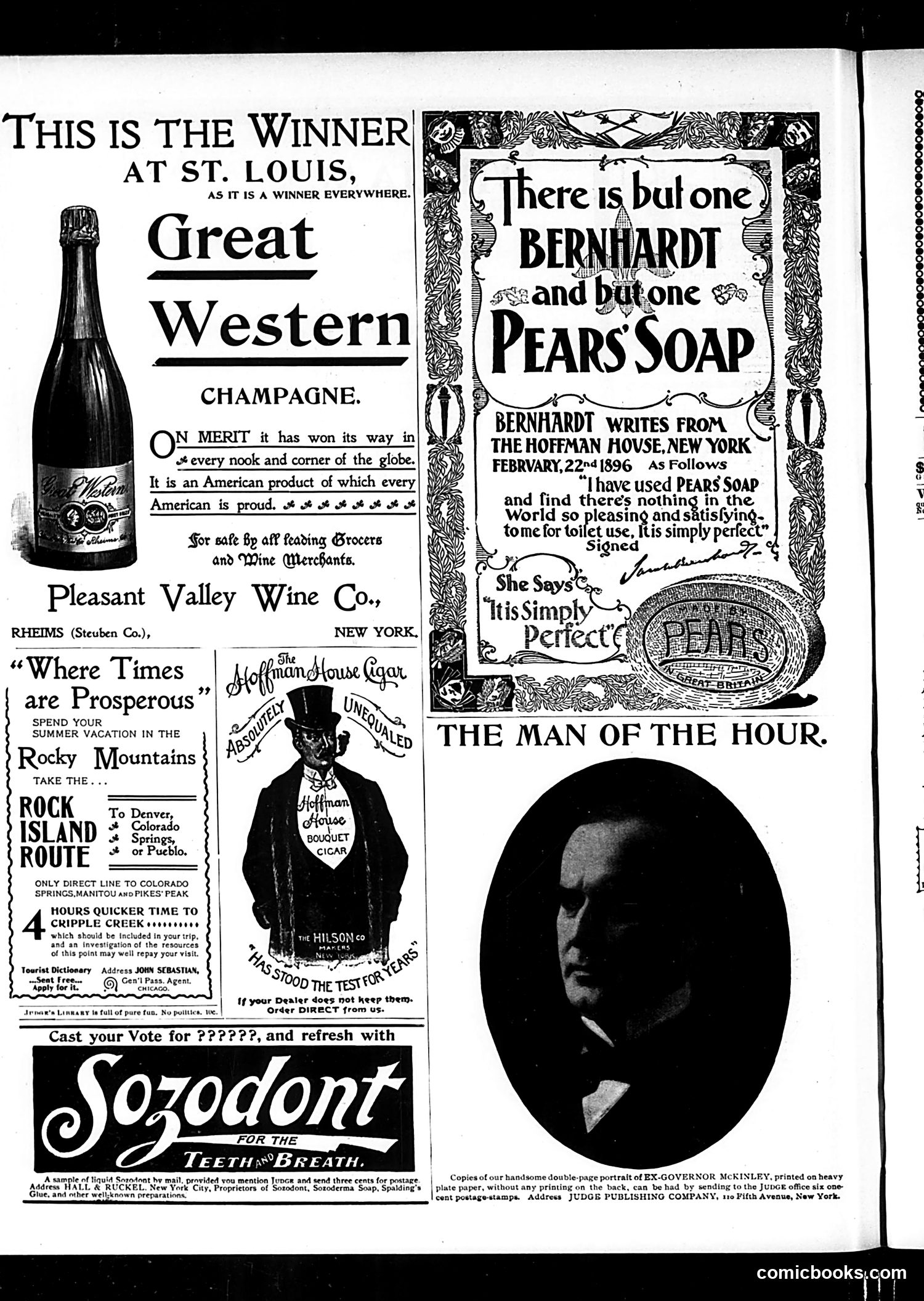
This page is primarily **advertising**, not political satire. It features product endorsements typical of 1890s publications: **Key Content:** - Great Western Champagne (top left): American wine marketed as a national pride product - Pears Soap (top right): Features a testimonial from "Bernhardt" dated February 22, 1896, claiming the soap is "simply perfect" - Hoffman House Cigar: A branded product advertisement - Rock Island Route: Railroad vacation advertising to Colorado - Sozodont: Toothpaste advertisement - Large portrait at bottom right: Identified as "Ex-Governor McKi[nley]" — likely William McKinley, who was Ohio Governor before his 1896 presidential campaign **The "Man of the Hour" reference** appears to celebrate McKinley as a political figure of current importance. The page's tagline "Cast your Vote for ??????" suggests this was published during an election cycle, with McKinley likely the implied candidate. This is essentially a **commercial publication page** using celebrity endorsements and political figures to sell products.
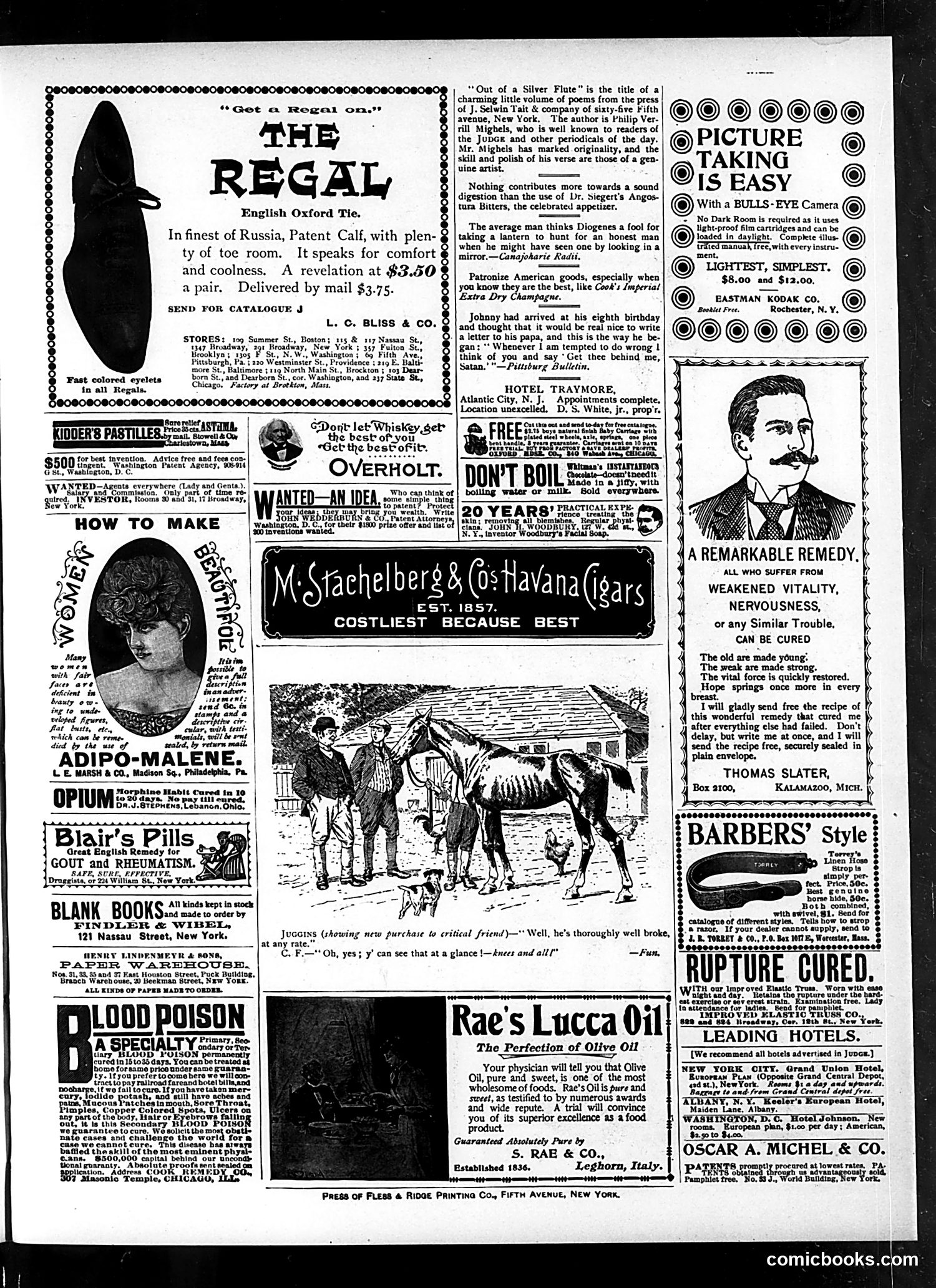
This page is primarily **advertising**, typical of Judge magazine's format. The main cartoon appears near the bottom: a man shows his friend a horse, claiming it's "thoroughly well broke." The friend skeptically responds he can see that "at a glance," suggesting the horse appears worn-out or exhausted—a joke about the horse's poor condition being obvious. The page features numerous patent medicines and dubious remedies common to the era: "Adipo-Malene" (weight loss), "Blood Poison" treatments, "Opium" cures, and various tonics. These ads reflect turn-of-the-century quackery that Judge likely satirized editorially while accepting advertising revenue. Notable is the casual mention of opium as a legitimate commercial product, reflecting pre-regulation pharmaceutical practices. The ads for hotels, blank books, and legitimate businesses (L.C. Bliss shoe company) mix with obvious medical frauds—typical of Judge's pages, where satirical content coexisted with commercial sponsorships that themselves became subjects of cultural critique.
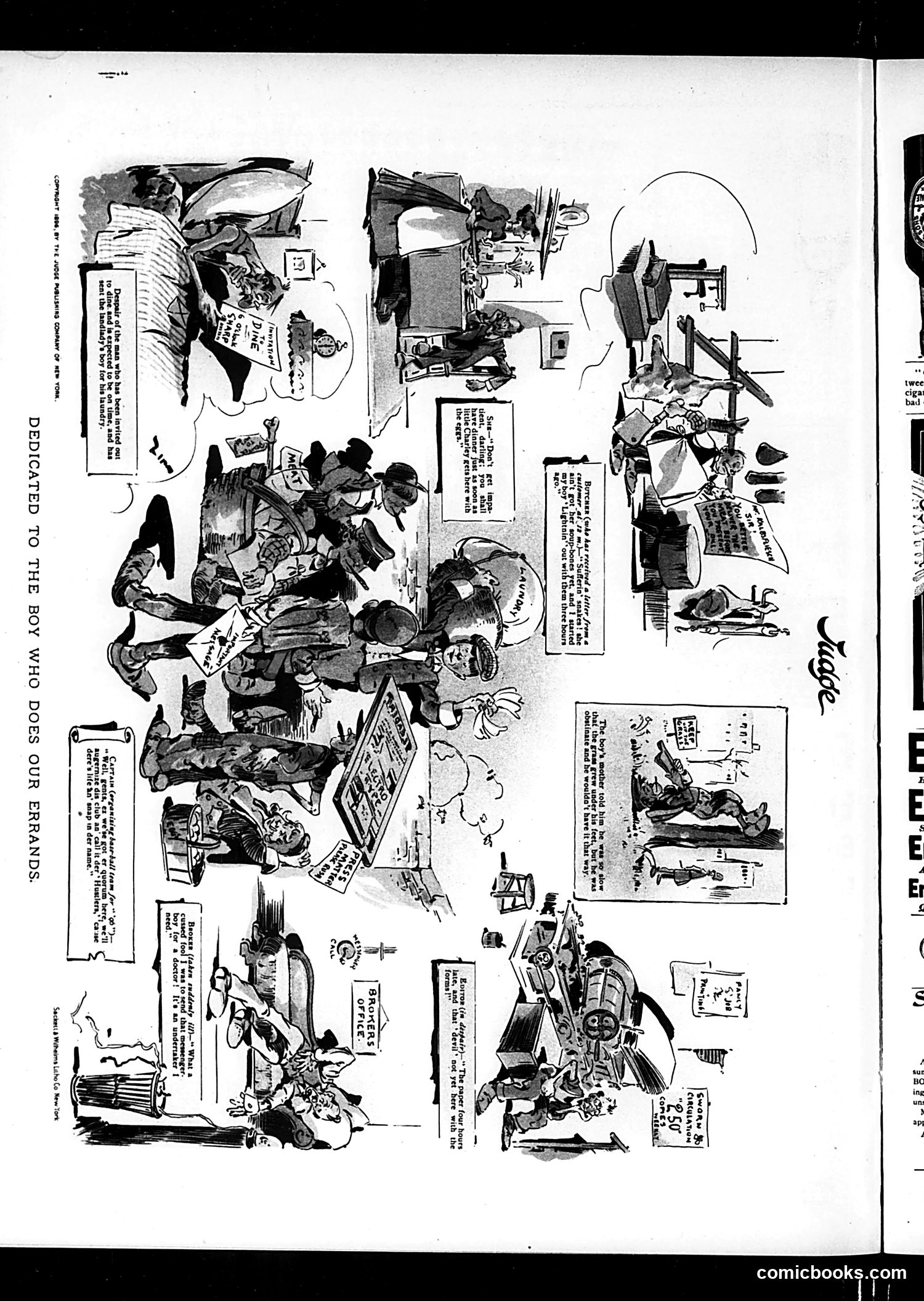
This is a humorous cartoon mocking the incompetence and excuses of errand boys—young messengers commonly employed in early 20th-century offices and households. The page depicts multiple scenes of a hapless boy failing at simple tasks: delivering newspapers late, losing messages, forgetting packages, and generally bungling his responsibilities. The central joke targets not just the boy's incompetence, but the absurd excuses he offers—blaming grass growth under his feet, obstinate behavior, and other ridiculous explanations for his failures. The title's dedication is sarcastically affectionate, poking fun at a widespread social frustration: the universal experience of hiring unreliable young workers for basic errands. This reflects early 1900s workplace culture where such boys formed the backbone of office and commercial operations, making their failures a relatable source of comedy for Judge's readers.
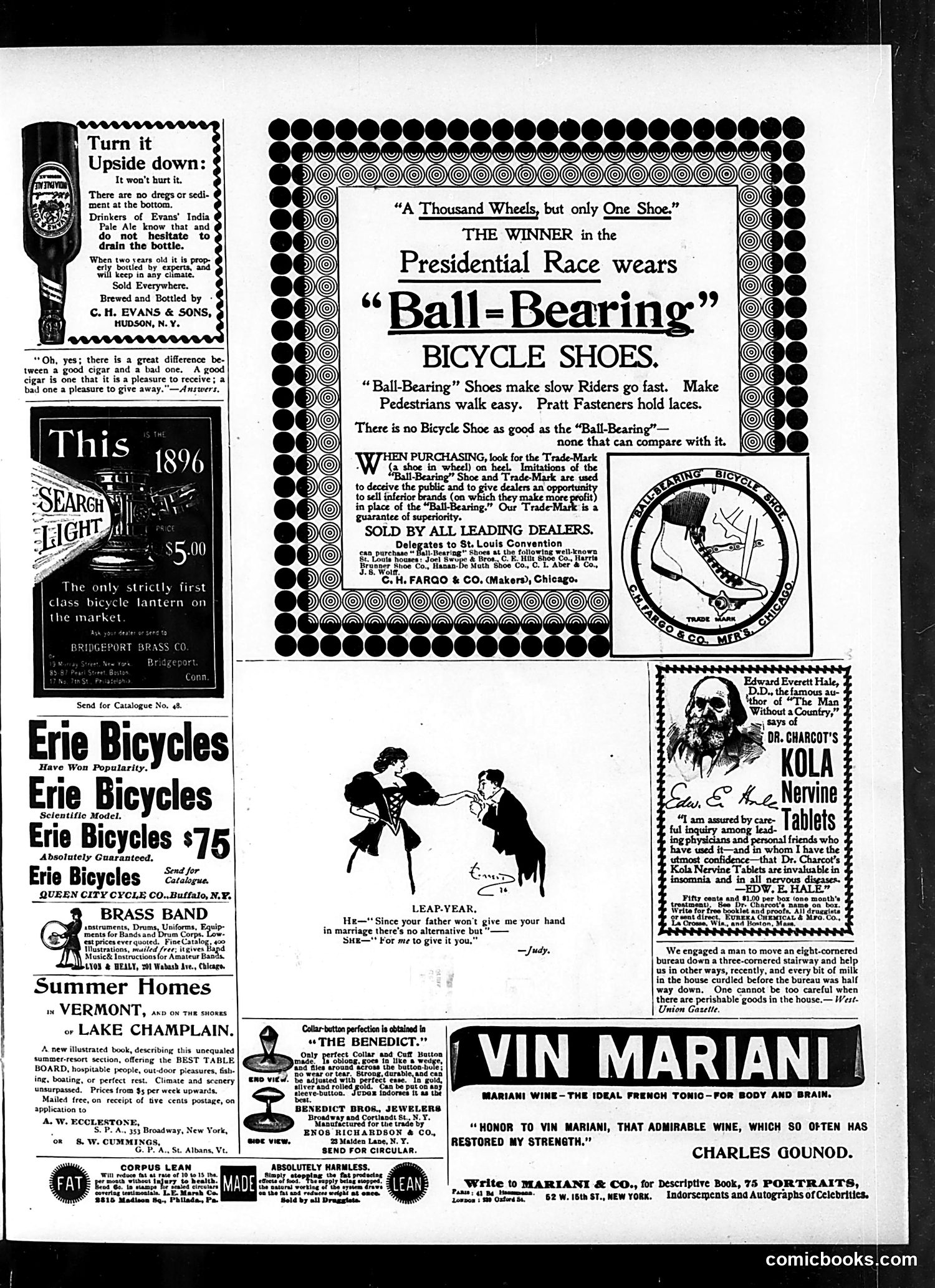
This page is primarily **advertising** rather than political satire, though one cartoon offers social commentary. The main cartoon, titled "LEAP-YEAR," depicts a marriage proposal scenario. The man says he cannot marry without her father's permission, leaving "no alternative but—" to which the woman responds "For me to give it you." This references **leap year tradition**: in some cultures, leap years supposedly allowed women to propose to men, inverting normal courtship gender roles. The joke satirizes rigid Victorian marriage conventions by showing a woman taking the initiative when socially permitted—mocking both the constraint of female passivity and the absurdity of arbitrary rules governing romance. The page otherwise features period advertisements for bicycles, wines, patent medicines, and summer resorts—typical Judge content. The "Ball-Bearing Bicycle Shoes" ad references a "Presidential Race," likely alluding to an 1896 election, though specifics remain unclear from the image alone.
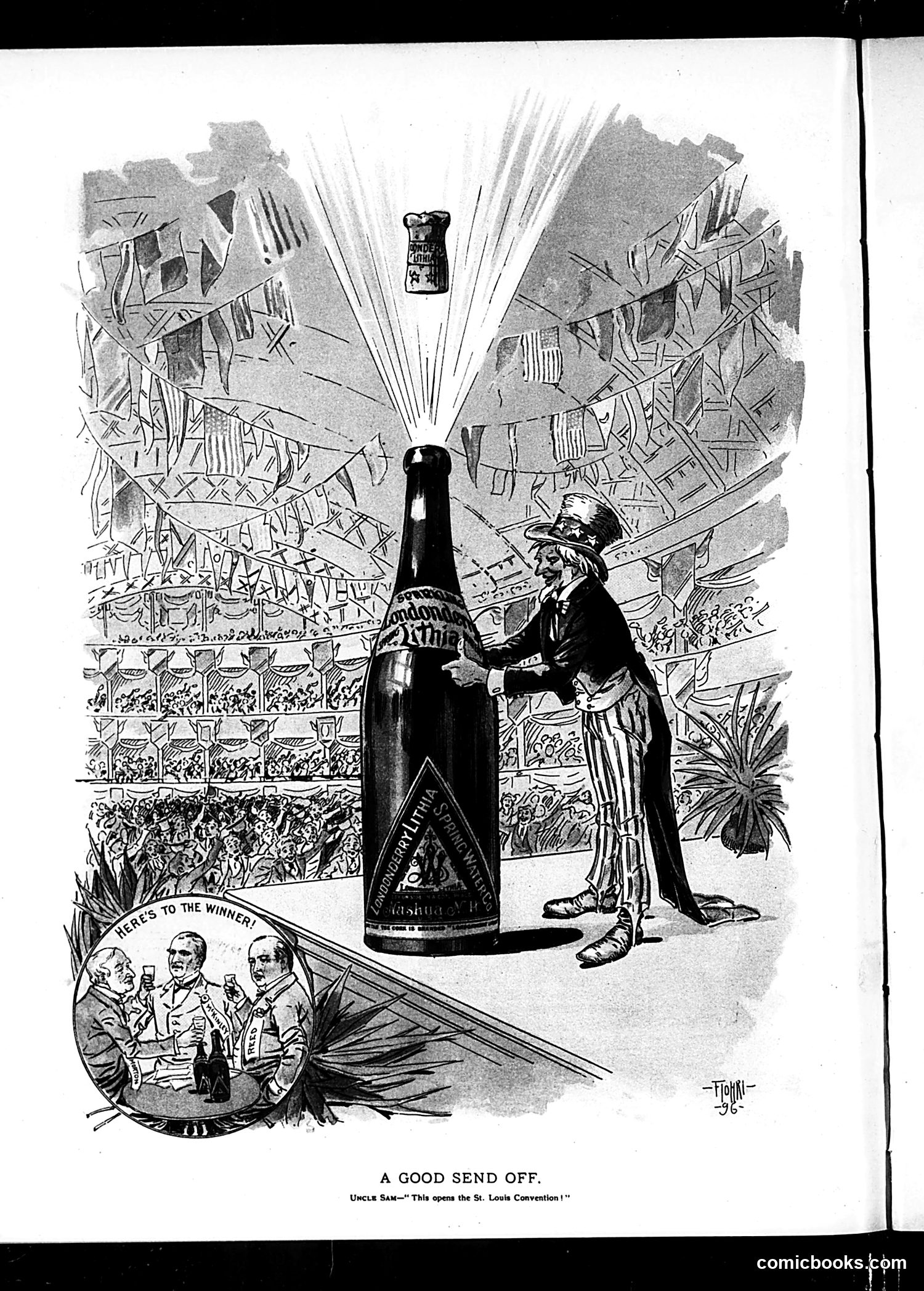
This satirical cartoon depicts Uncle Sam launching a massive champagne bottle like a weapon or missile toward two competing buildings (likely representing political factions). The bottle's label reads "opens the St. Louis Convention," referencing the 1896 Republican National Convention held in St. Louis. The inset shows three men toasting "Here's to the Winner," suggesting the cartoon satirizes the convention as a consequential political battle. The enormous bottle serves as visual hyperbole—the convention's opening is treated as a dramatic, explosive event worthy of ceremonial celebration. The artist (signed "Figman") critiques the intensity and importance placed on the convention proceedings, using the champagne bottle as metaphor for political power being wielded or "fired off" to determine the election's outcome. The scale emphasizes how dramatically Americans viewed this pivotal political moment.