
Judge, 1896-06-20 · page 9 of 22
Judge — June 20, 1896 — page 9: what you’re looking at
What you’re looking at
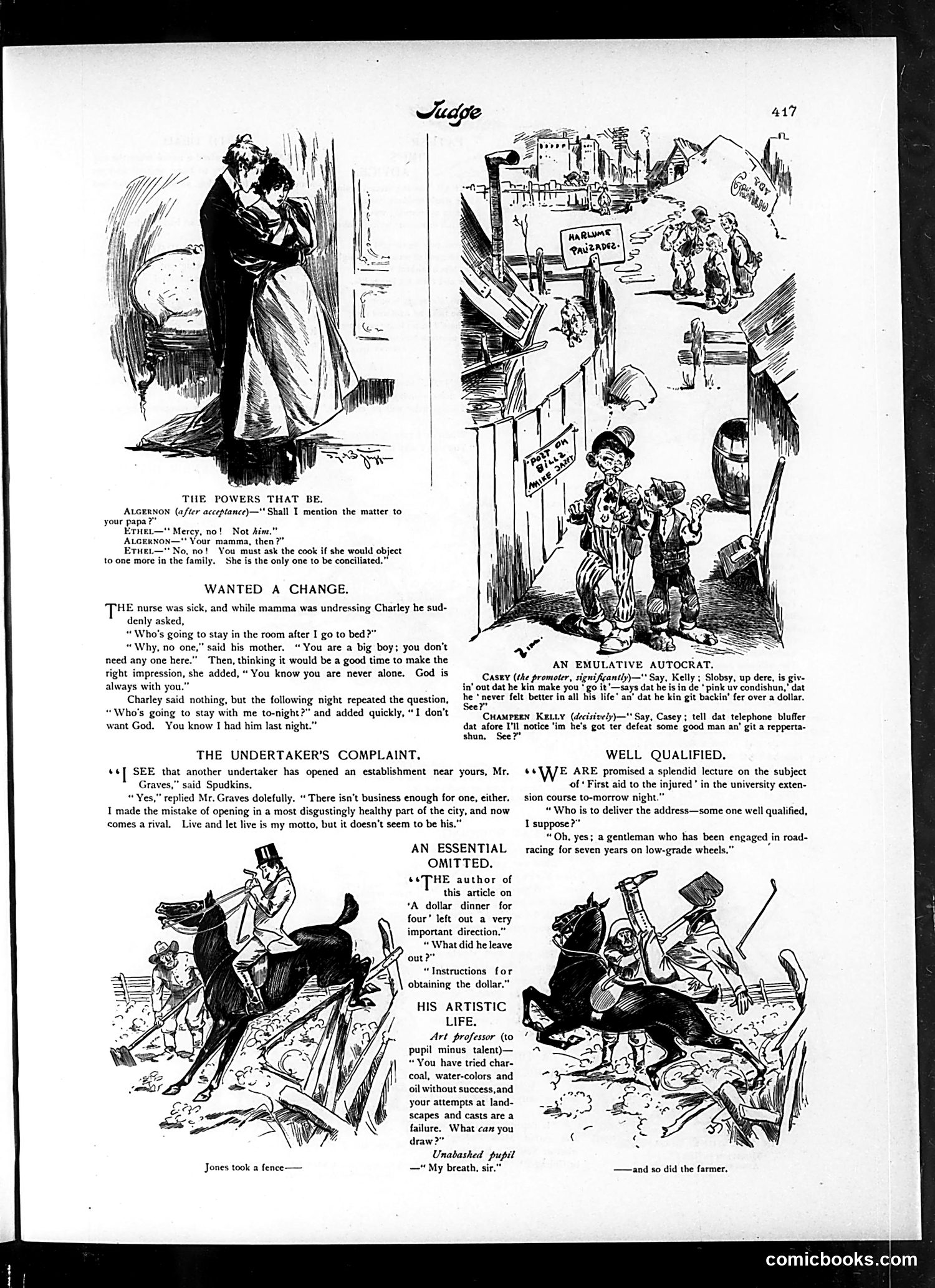
This page contains six separate humorous short comic sketches typical of Judge's satirical format: 1. **"The Powers That Be"**: A social satire on class hierarchy—a newly engaged man must seek permission from the cook (the household servant) rather than family members to add another person to the household, suggesting servants held more practical power than the family itself. 2. **"Wanted a Change"**: A child's joke about religious faith. When mother reassures the boy that "God is always with you," he replies he doesn't want God present—he had Him "last night," implying boredom or treating divine presence as an unwanted companion. 3. **"The Undertaker's Complaint"**: Dark humor about an undertaker's business struggles due to a competitor opening in a healthy neighborhood with few deaths. 4. **"An Essential Omitted"**: Satirizes get-rich-quick schemes and boxing promotion—a promoter claims someone can earn money without actually explaining *how*. 5. **"Well Qualified"**: Mocks incompetent "experts"—a road-racer (dangerous activity on poor bicycles) is qualified to teach first aid. 6. **"His Artistic Life"**: A talentless art student, unable to draw anything successfully, offers "My breath, sir"—a pun on drawing/exhaling.
📄 Transcribed text from this page (OCR, searchable)
Machine-transcribed from the original scan — historical spelling and the odd misread are preserved.
if! THE POWERS THAT BE. ALGERNON (after acceptance)—"' Shall I mention the matter to Mercy, no! Not Ain.” (on—"* Your mamma, then ?” ‘0, no! You must ask the cook if she would object to one more in the family. She is the only one to be conciliated.”” WANTED A CHANGE. HE nurse was sick, and while mamma was undressing Charley he sud- denly asked, “ Who's going to stay in the room after I go to bed?” “Why, no one,” said his mother. “You are a big boy; you don't need any one here.” Then, thinking it would be a good time to make the right impression, she added, “You know you are never alone. God is always with you. Charley said nothing, but the following night repeated the question, “Who's going to stay with me to-night?” and added quickly, “1 don’t want God. You know I had him last night. THE UNDERTAKER’S COMPLAINT, 46] SEE that another undertaker has opened an establishment near yours, Mr. Graves,” said Spudkins. “Yes,” replied Mr. Graves dolefully. ‘ There isn’t business enough for one, either. I made the mistake of opening in a most disgustingly healthy part of the city, and now Live and let live is my motto, but it doesn’t seem to be his.” comes a rival. AN ESSENTIAL Casey (the promoter, significantly) —'* Say, Kelly ; Slobsy, up dere, is giv- in’ out dat he kin make you "go it'—says dat he is in de ' pink uv condishun," dat he ‘never felt better in all his life’ an’ dat he kin git backin’ fer over a dollar. CHAMPEEN KeLLy (decisively}—"* Say, Casey ; tell dat telephone bluffer dat afore I'll notice ‘im he's got ter defeat some good man an’ git a repperta- shun, WELL QUALIFIED. ‘SWE ARE promised a splendid lecture on the subject of ' First aid to the injured’ in the university exten- sion course to-morrow night.” “ Who is to deliver the address—some one well qualified, I suppose?” “Oh, yes; a gentleman who has been engaged in road- racing for seven years on low-grade wheels.” a OMITTED. seTHE author of this article on ‘A dollar dinner for four’ left out a very important direction.” “ What did he leave out?” “Instructions for obtaining the dollar.” HIS ARTISTIC LIFE. Art professor (\o pupil minus talent)— “You have tried char- coal, water-colors and oil without success,and your attempts at land- scapes and casts are a failure. What can you draw?” Unabashed pupil Jones took a fence— —" My breath, sir.” —and so did the farmer, comicbooks.com