
A complete issue · 18 pages · 1896
Judge — May 23, 1896
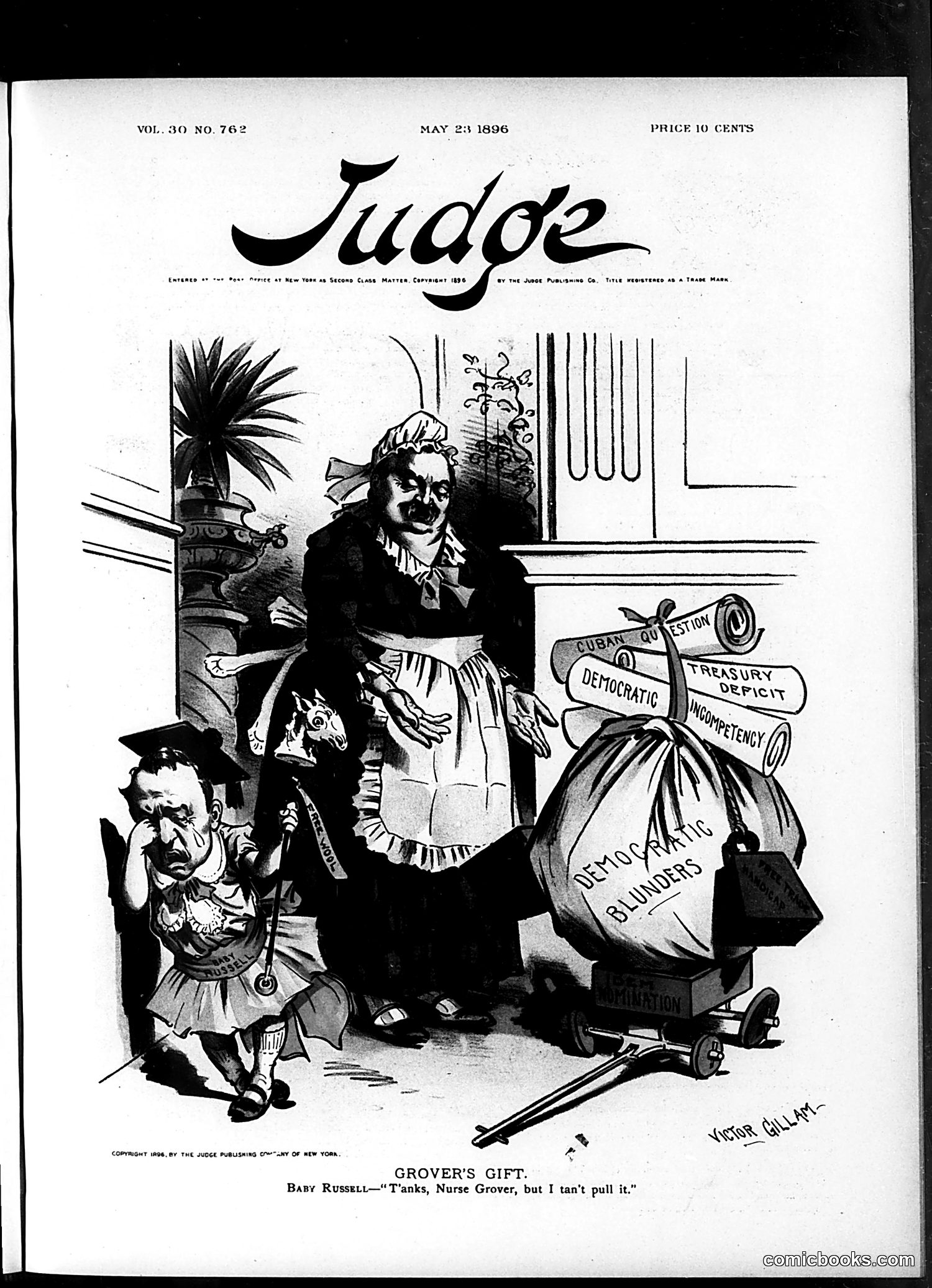
This political cartoon satirizes President Grover Cleveland's administration. The central figure appears to be Cleveland's nurse or advisor, struggling to manage a baby (labeled "Baby Russell," likely referring to a political figure or policy) who refuses a large, unwieldy gift—a wheelbarrow overflowing with Democratic Party liabilities. The logs stacked on the wheelbarrow are labeled "Custom Question," "Democratic Inefficiency," "Treasury Deficit," and "Democratic Blinders," representing failures of Cleveland's Democratic administration. The baby's refusal to accept these problems—"Thanks, Nurse Grover, but I can't pull it"—mocks Cleveland's inability to solve or pass along the party's accumulated problems to his successor. The artist is Victor Gillam.
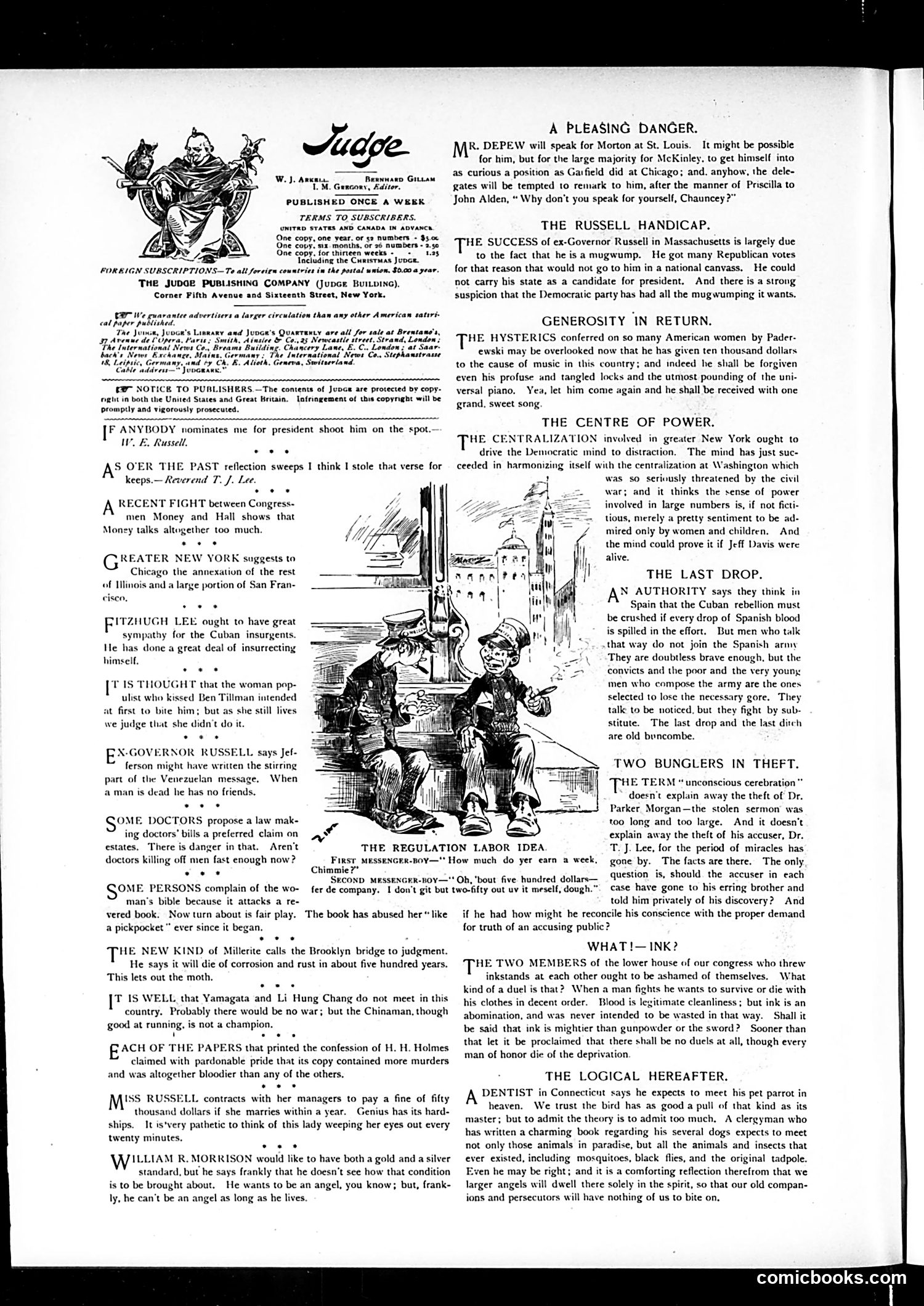
The central cartoon titled "THE REGULATION LABOR IDEA" depicts two working-class men in conversation. The first messenger-boy asks "How much do yer earn a week, Chinaman?" The second responds "Oh, 'bout five hundred dollars—for de company. I don't git but two-fifty out ov it myself, dough." **What this means:** This is satire about labor exploitation and wage theft. The joke reveals that employers (the "company") pocket the majority of workers' earnings while employees receive a pittance. The reference to a Chinese worker likely reflects contemporary anxieties about immigrant labor undercutting American wages—a common 1890s-1900s concern. The cartoon critiques both unfair wage practices and the system enabling them, using humor to highlight economic inequality during America's industrial era.
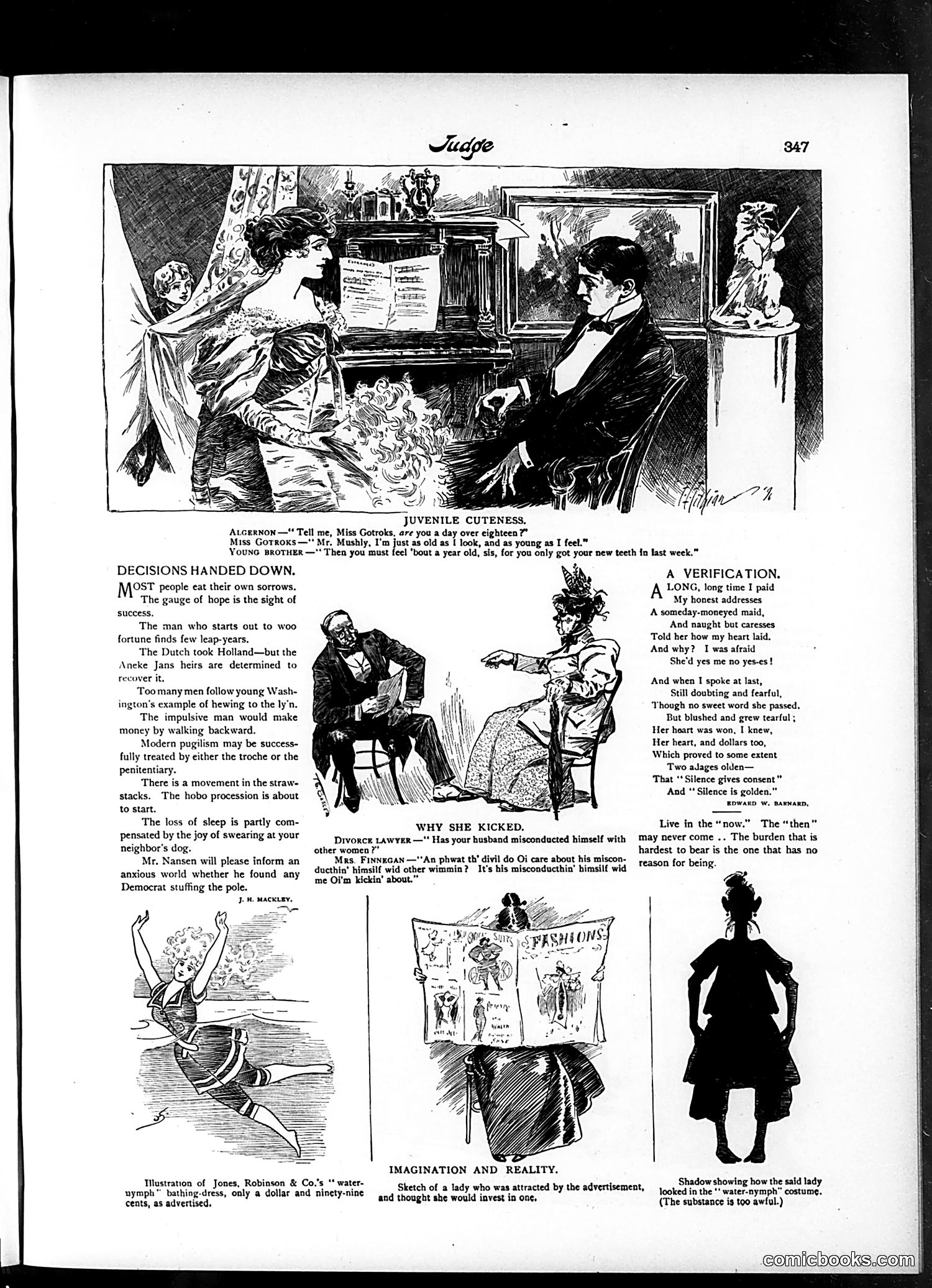
This page contains several satirical sketches typical of Judge's humor circa early 1900s: **"Juvenile Cuteness"** depicts a flirtation scene mocking sentimental romance—the woman's affected flattery about the man's "new teeth" is juxtaposed with his obvious discomfort, satirizing insincerity in courtship. **"Decisions Handed Down"** and **"A Verification"** are standalone poems about love and relationships, offering cynical commentary on romance and female deception. **"Why She Kicked"** presents domestic conflict dialogue—the wife's complaint about her husband's "misconduct" with implied infidelity, mocking marital discord. Lower sketches include **"Imagination and Reality"** (contrasting advertisements' promises with disappointing reality) and fashion-related humor. The overall theme critiques courtship rituals, marriage, advertising deception, and gender relations through the magazine's characteristic blend of illustration and verse.
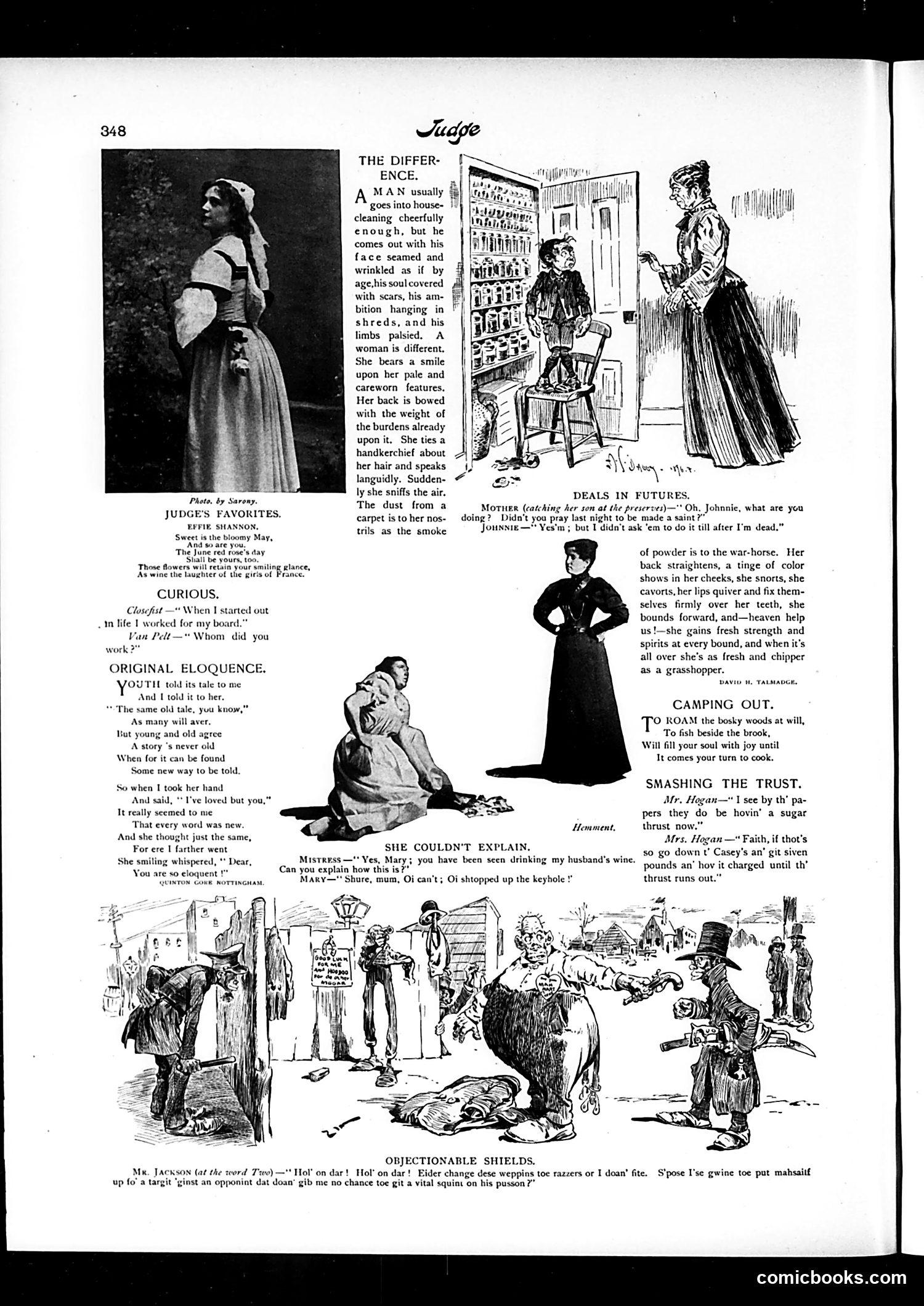
This page contains several unrelated humorous pieces typical of Judge's satirical format: **"The Difference"** contrasts how men and women react to housecleaning—men emerge exhausted and defeated, while women, despite physical burden, are mysteriously revitalized by the activity, particularly by carpet-beating dust. The satire mocks both genders' stereotypical responses to domestic labor. **"Deals in Futures"** shows a mother catching her son stealing preserves. The joke: he prayed to become a saint, but specified it shouldn't happen until after he's dead—satirizing hypocritical religious practice and childhood logic. **"Objectionable Shields"** depicts a boxer (Mr. Jackson) complaining his opponent uses shields in a boxing match, demanding "razors" instead—likely mocking overly aggressive fighting rhetoric or safety concerns in boxing. **"Smashing the Trust"** features working-class Irish characters discussing the sugar trust (monopoly). Mrs. Hogan suggests buying sugar on credit until the trust "runs out"—absurdist humor about economic naïveté during the Progressive Era's anti-trust campaigns. The page also includes poetry, theatrical advertisements, and lighter romantic humor throughout.
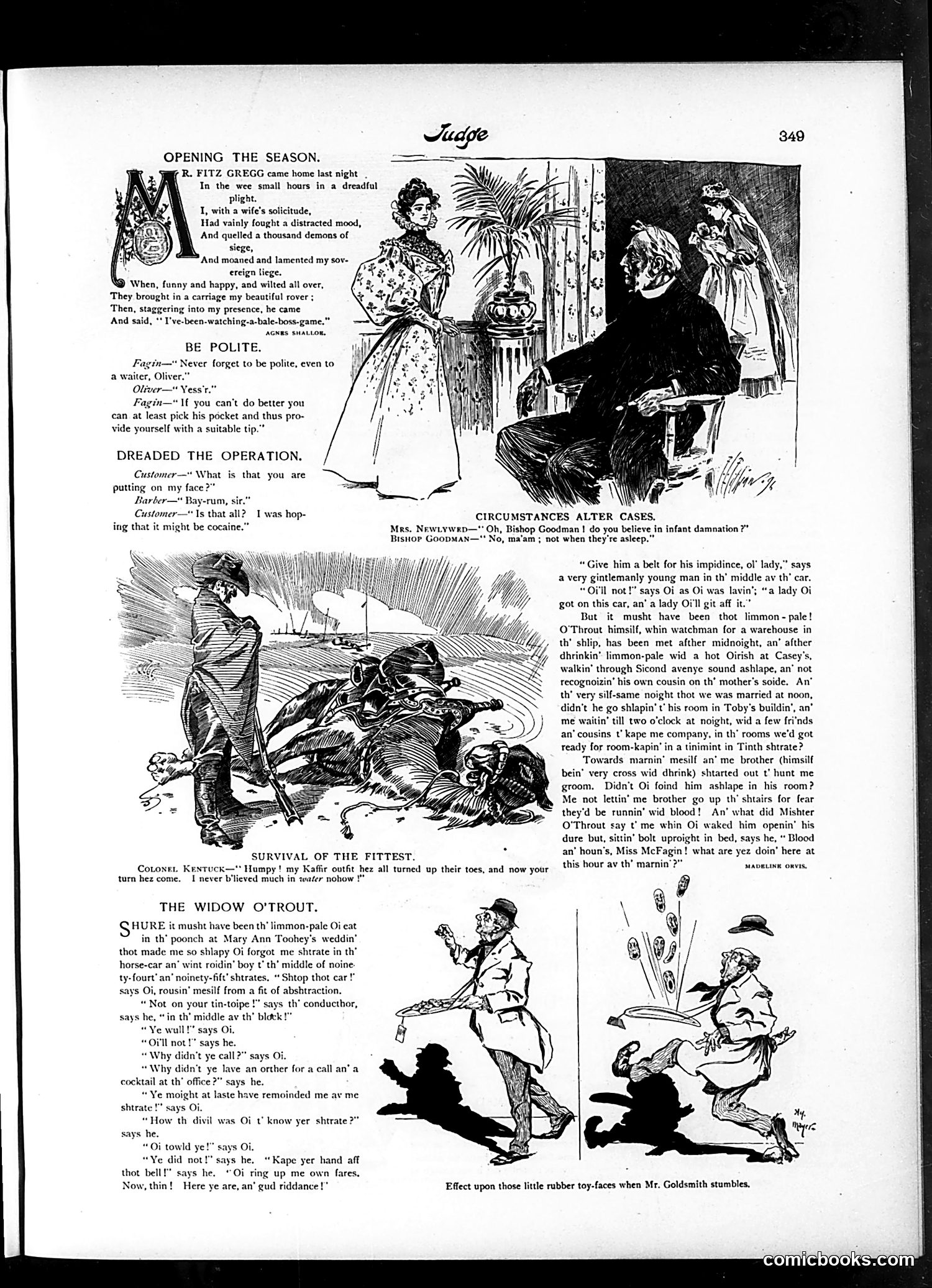
This page from Judge contains multiple brief satirical sketches typical of the magazine's format. **"Opening the Season"** mocks a husband's excuse for coming home drunk—he claims he was watching a "bale-boss game" (baseball), a flimsy alibi his frustrated wife sees through. **"Be Polite"** and **"Dreaded the Operation"** are short joke exchanges with minimal social commentary. **"The Widow O'Trout"** is the page's centerpiece—a lengthy Irish-dialect monologue satirizing Irish-American working-class culture. A woman recounts her husband's drunken behavior after their wedding, blaming "limmon-pale" (lemon-flavored liquor). The satire targets both Irish stereotypes (heavy drinking, volatile behavior) and urban transportation frustrations. The cartoon depicts slapstick consequences when a drunk man encounters toy rubber faces. **"Circumstances Alter Cases"** jokes that a bishop denies infant damnation because sleeping babies can't sin—mild religious satire. The page reflects late-19th-century American attitudes toward Irish immigrants and urban working-class life.
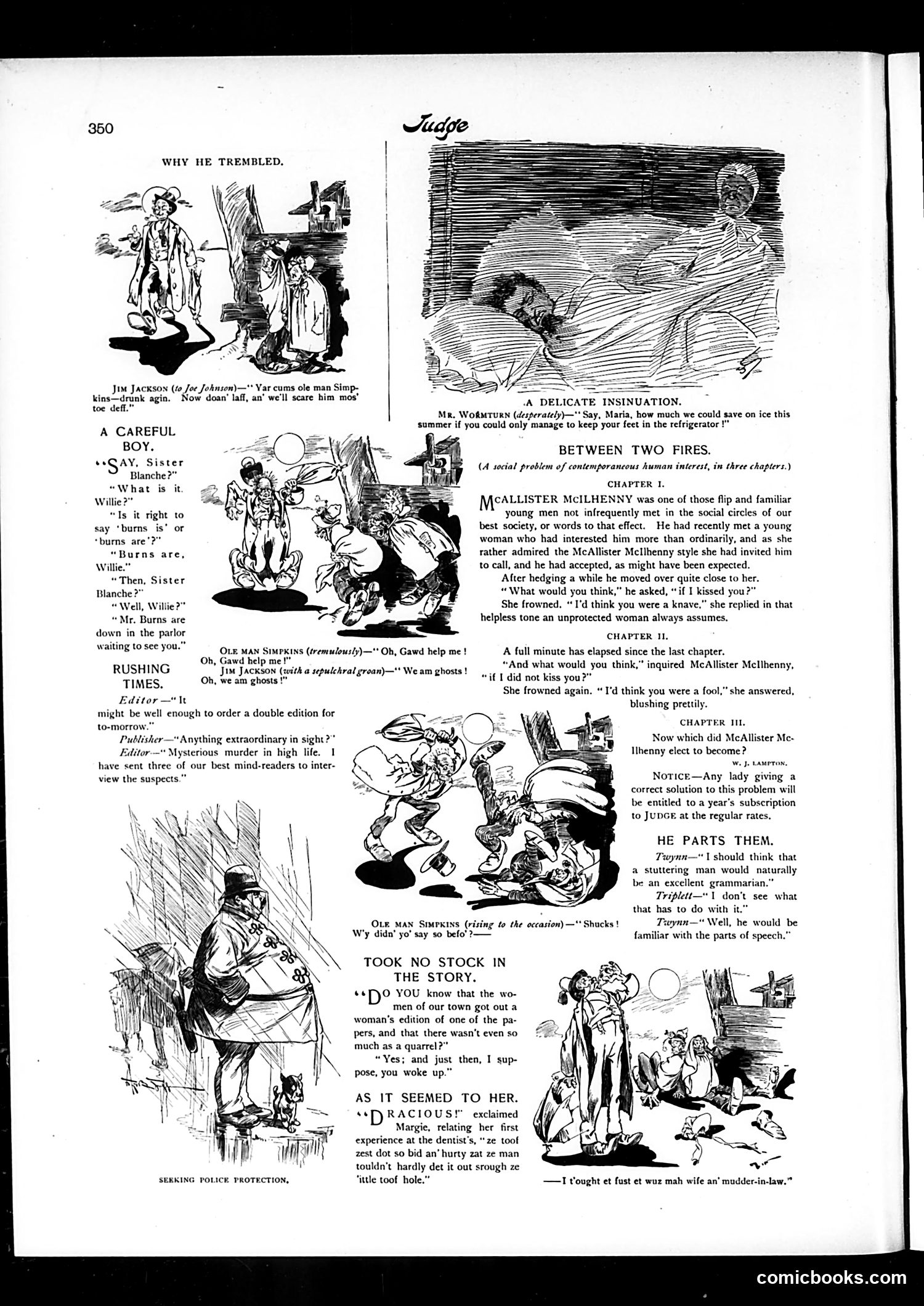
This page contains multiple standalone jokes and a serialized story, typical of Judge's satirical format. **"Why He Trembled"** mocks a husband's awkward attempt to shame his wife about household expenses by suggesting she keep her feet in the refrigerator to save on ice—a crude, insulting "joke" that reveals period attitudes toward marital dynamics. **"Between Two Fires"** is a three-chapter serialized story parodying sentimental romance fiction. McAllister McIlhenny courts a young woman, asking her permission to kiss him. The humor lies in the exaggerated melodrama and the woman's stereotypical "helpless" responses—satirizing both romantic conventions and contemporary ideas about feminine propriety. **Minor jokes** include puns on grammar ("burns are" vs. "burns is"), a quip about women's newspapers being too peaceful to be newsworthy, and dental humor. The page reflects Judge's blend of social satire targeting marriage dynamics, gender roles, and contemporary literary conventions—all delivered through period-appropriate humor that often relied on mockery of women's supposed limitations.
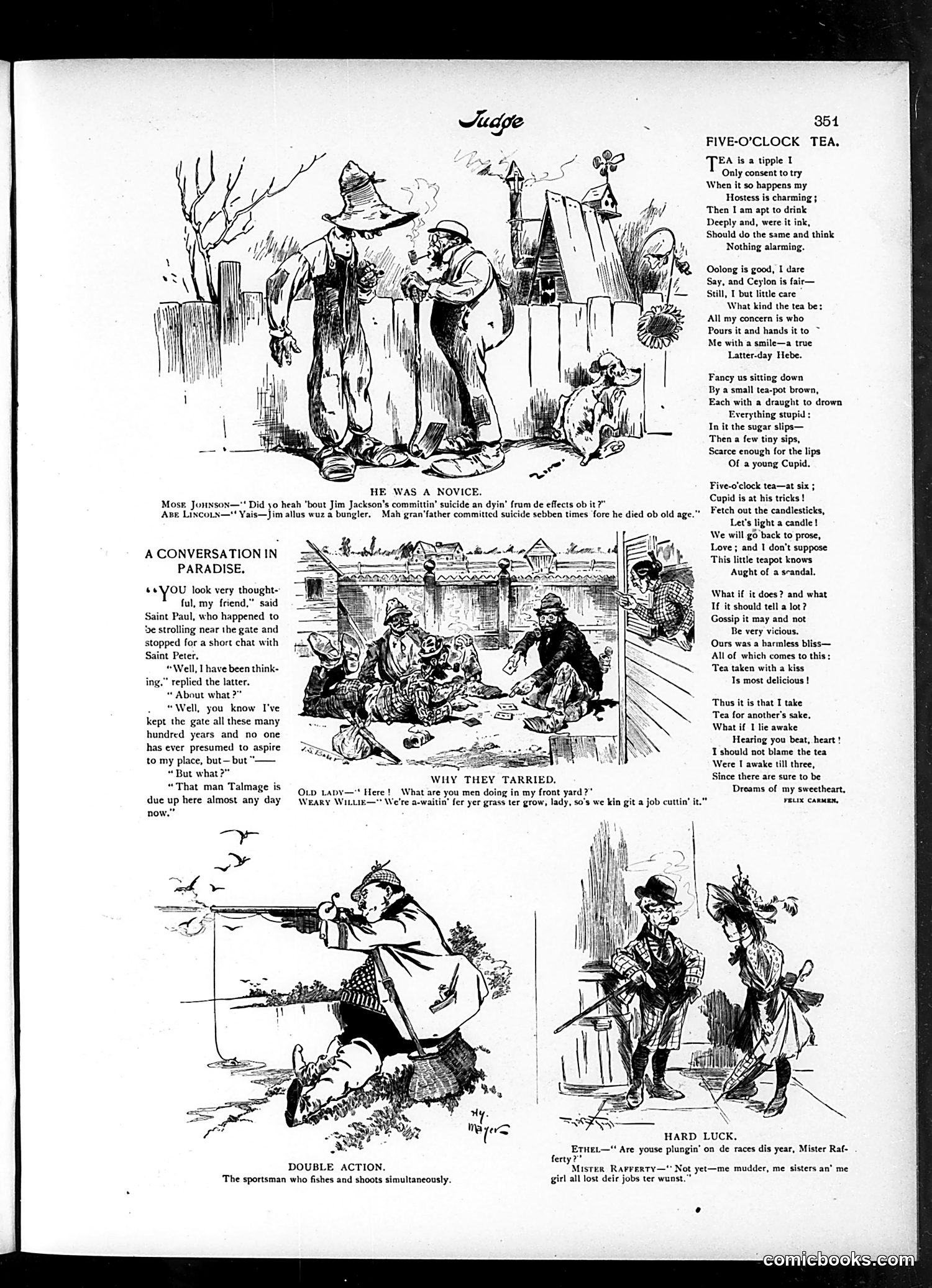
This page contains several unrelated satirical cartoons and humorous verses typical of Judge's format: **"He Was a Novice"** mocks African American dialect humor (common but offensive in this era), depicting characters discussing suicide attempts. **"A Conversation in Paradise"** shows Saint Peter and Saint Paul discussing the preacher Talmage's expected arrival—likely satirizing a contemporary religious figure. **"Five O'Clock Tea"** is a romantic poem about courtship disguised as tea-drinking commentary, playing on the Victorian social ritual of afternoon tea as a romantic rendezvous opportunity. **"Why They Tarried"** depicts poor laborers waiting in a woman's yard for grass to grow so they can find work—satirizing economic desperation and unemployment. **"Hard Luck"** uses Irish-dialect humor to show a man unable to gamble because his mother and sisters lost their jobs, suggesting economic hardship affecting entire families. **"Double Action"** is a visual gag about a sportsman fishing and shooting simultaneously. The page reflects Judge's mix of gentle social satire, romance, period dialect humor, and economic commentary typical of late 19th/early 20th-century American magazines.
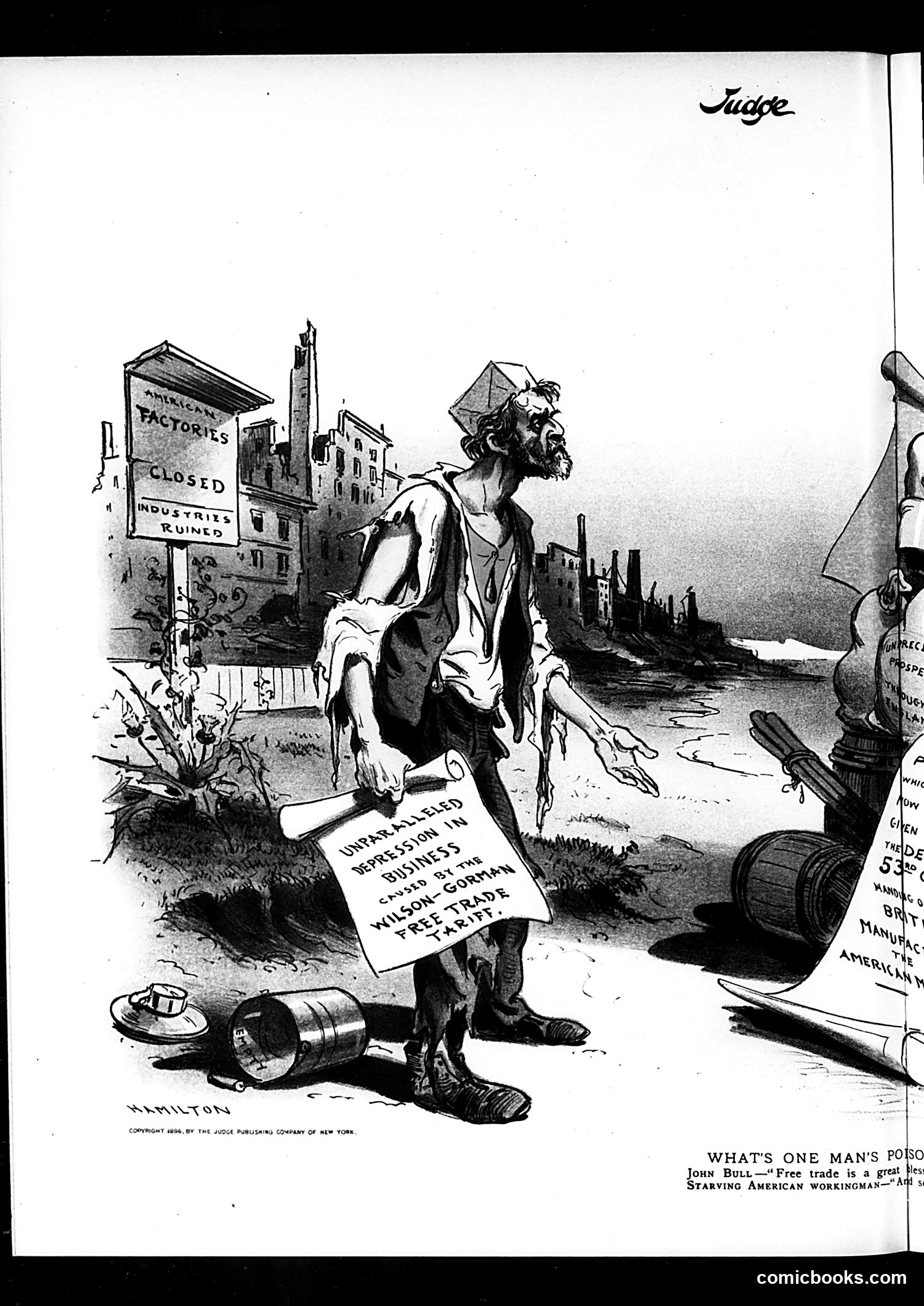
This 1896 Judge cartoon satirizes the free-trade debate dividing American politics. The emaciated figure labeled "Starving American Workingman" stands amid closed factories and industrial decay, holding a sign about "Unrestricted Importations" and "Wilson-Gorman Free Trade Tariff." The cartoon argues that free trade—advocated by figures like John Bull (representing British interests)—devastates American workers and industry. The desolate landscape with shuttered factories emphasizes economic damage. The skeletal workman contrasts sharply with the prosperity free-trade advocates claim to promote. This reflects the intense protectionist-versus-free-trade political conflict of the 1890s, with American manufacturers and workers opposing imports that undercut domestic production. The cartoonist clearly sides with protectionists, depicting free trade as poisonous to American labor.
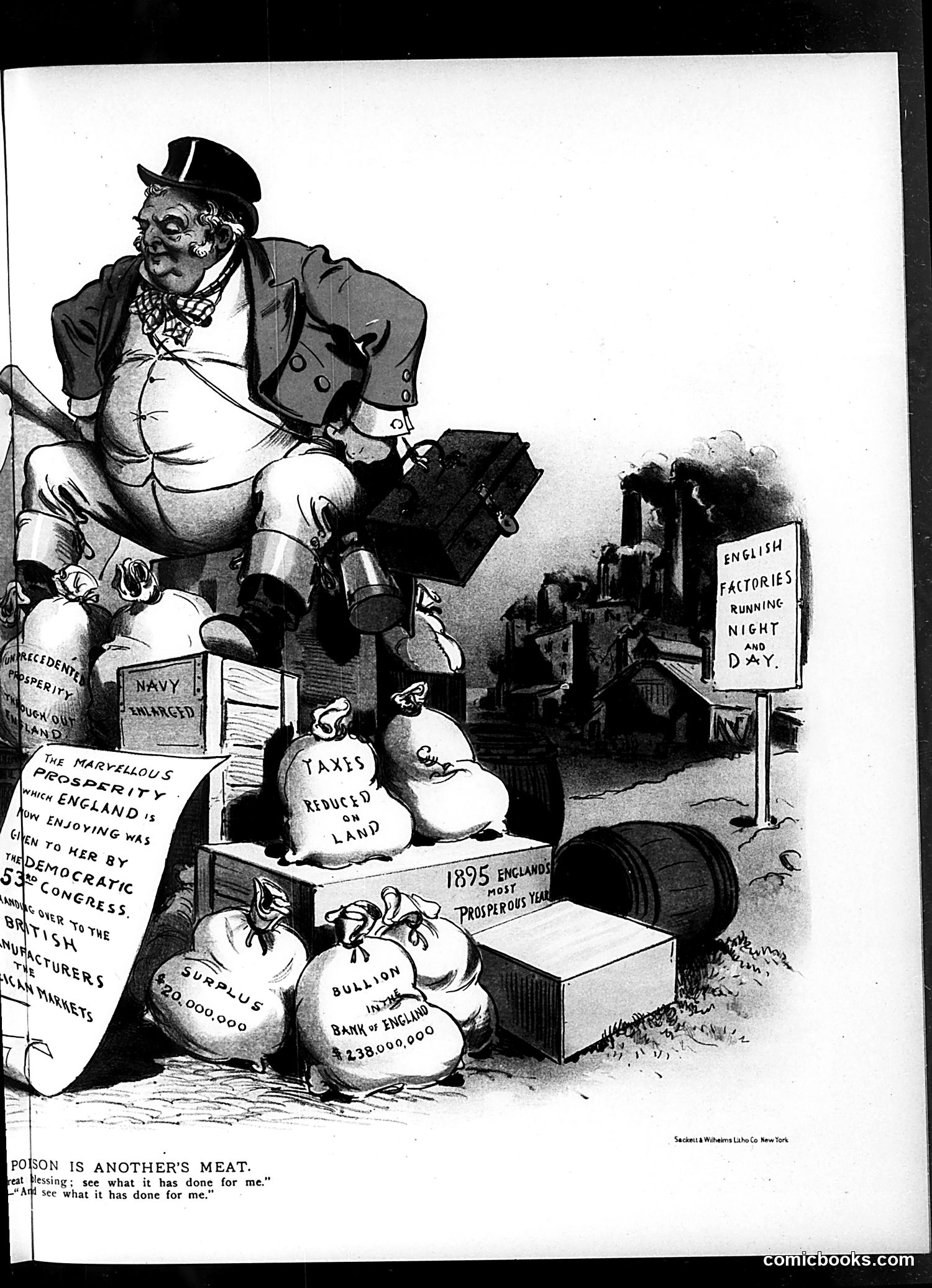
This is a satirical cartoon titled "One Man's Poison Is Another's Meat," depicting a rotund, well-fed figure (likely representing a wealthy industrialist or politician) sitting atop various sacks labeled with Britain's economic problems: "Navy Enlarged," "Taxes Reduced on Land," "Surplus," and "Bullion in Bank of England" (£238,000,000). The figure appears satisfied despite these contradictions. In the background, "English Factories Running Night and Day" suggests industrial prosperity. The accompanying text references "The Marvellous Prosperity which England is now Enjoying" and mentions a Democratic Congress, suggesting American political commentary about British economic conditions. The satire critiques how wealth inequality allowed the privileged to prosper while workers endured harsh conditions—what benefits the rich harms ordinary people.
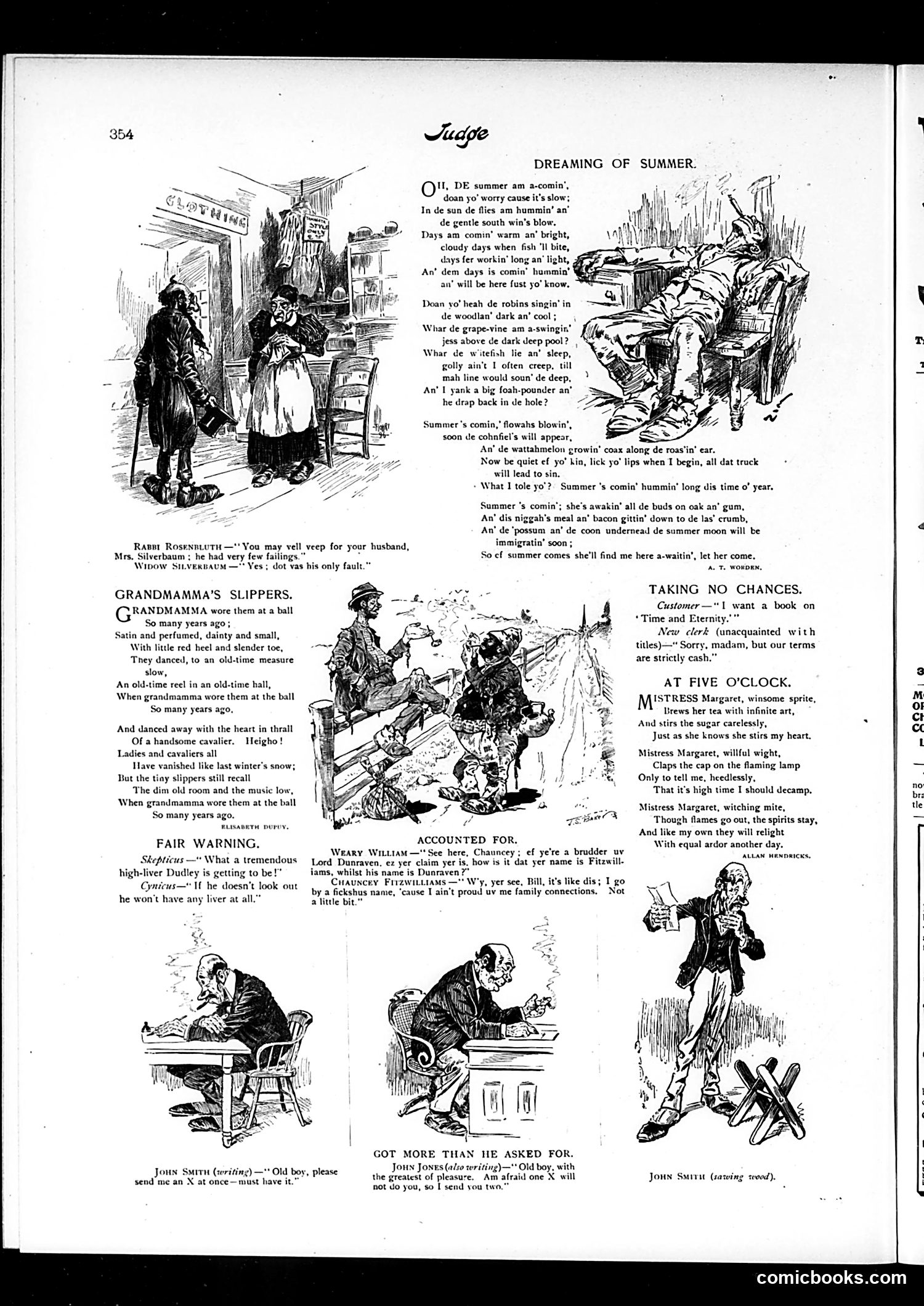
This page contains several short humorous pieces typical of Judge's satirical style: **"Dreaming of Summer"** is a dialect poem in African American vernacular describing anticipation for warm weather—fishing, hunting possum and coon, watermelon crops. The nostalgic, detailed imagery contrasts sharply with the dehumanizing stereotypes embedded in the dialect representation itself. **"Grandmamma's Slippers"** is sentimental verse about an old woman's cherished dance slippers from her youth, evoking lost romance and time's passage. The remaining items are brief comic sketches: a clerk refusing credit for a book ("Time and Eternity"), a woman brewing tea, and exchanges about family names and borrowed tools—light domestic humor typical of the magazine's miscellaneous filler content. The illustrations throughout use exaggerated caricature common to the period. The page demonstrates Judge's mix of verse, social observation, and simple comedic situations aimed at middle-class readers.
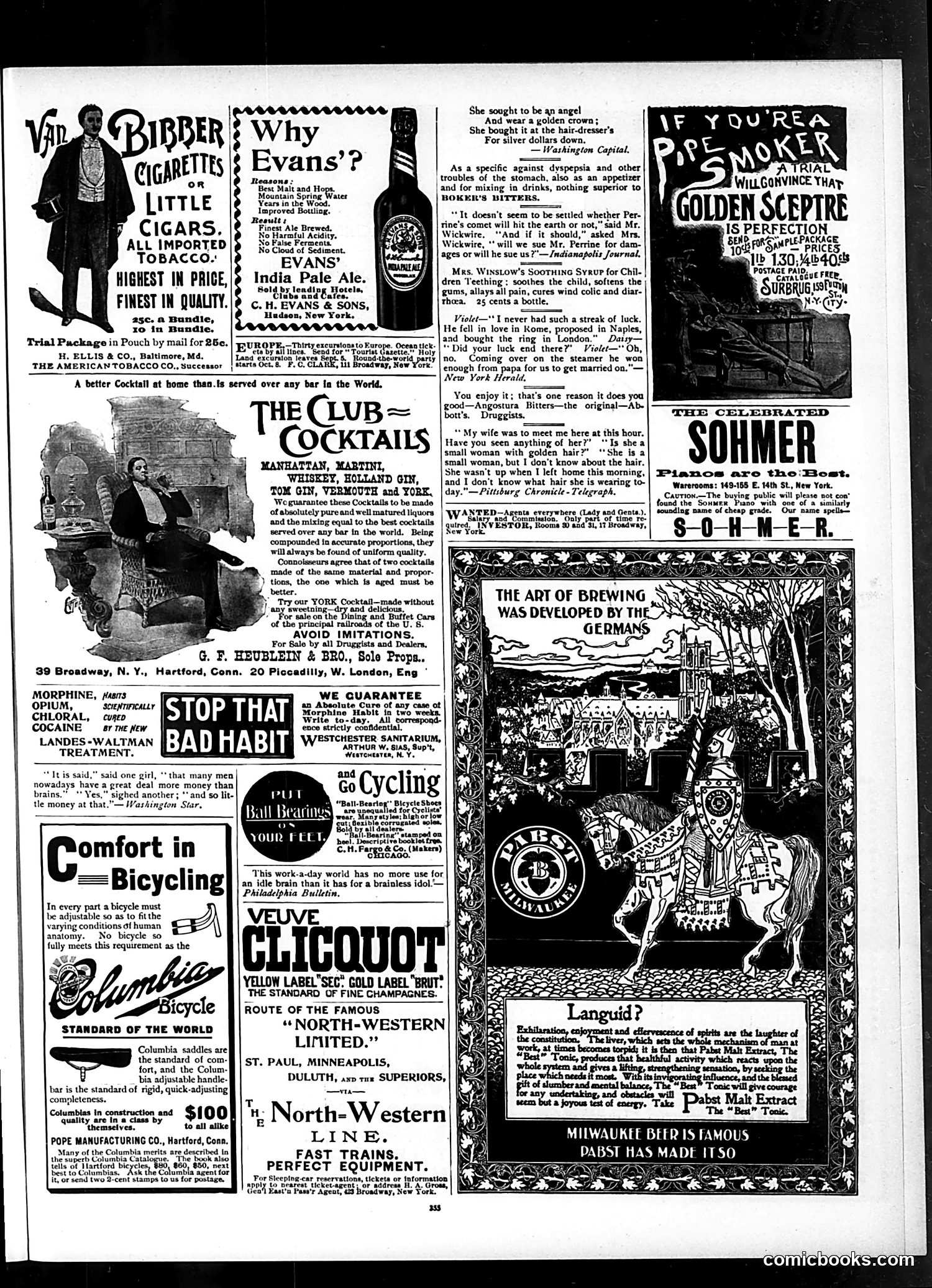
This is primarily an **advertising page** from Judge magazine, featuring various patent medicines, alcoholic beverages, bicycles, and transportation services typical of early 20th-century American commerce. Notable satirical content includes: **"Stop That Bad Habit"** – A medical advertisement for addiction treatment (morphine, opium, cocaine, chloral) at Westchester Sanitarium, reflecting the era's widespread drug dependency and the unregulated pharmaceutical industry. **The hairpin joke** about a woman buying a golden crown at a hair-dresser's for "silver dollars" – satirizing women's vanity and the commercialization of beauty. **The Perrine's comet joke** – Mocking both scientific uncertainty and frivolous lawsuit culture. The page exemplifies Judge's dual nature: a satirical publication that simultaneously accepted advertisements for products (tonics, alcohol, addictive drugs) that modern readers would recognize as dangerous or fraudulent, revealing the era's lack of consumer protection and advertising regulation.
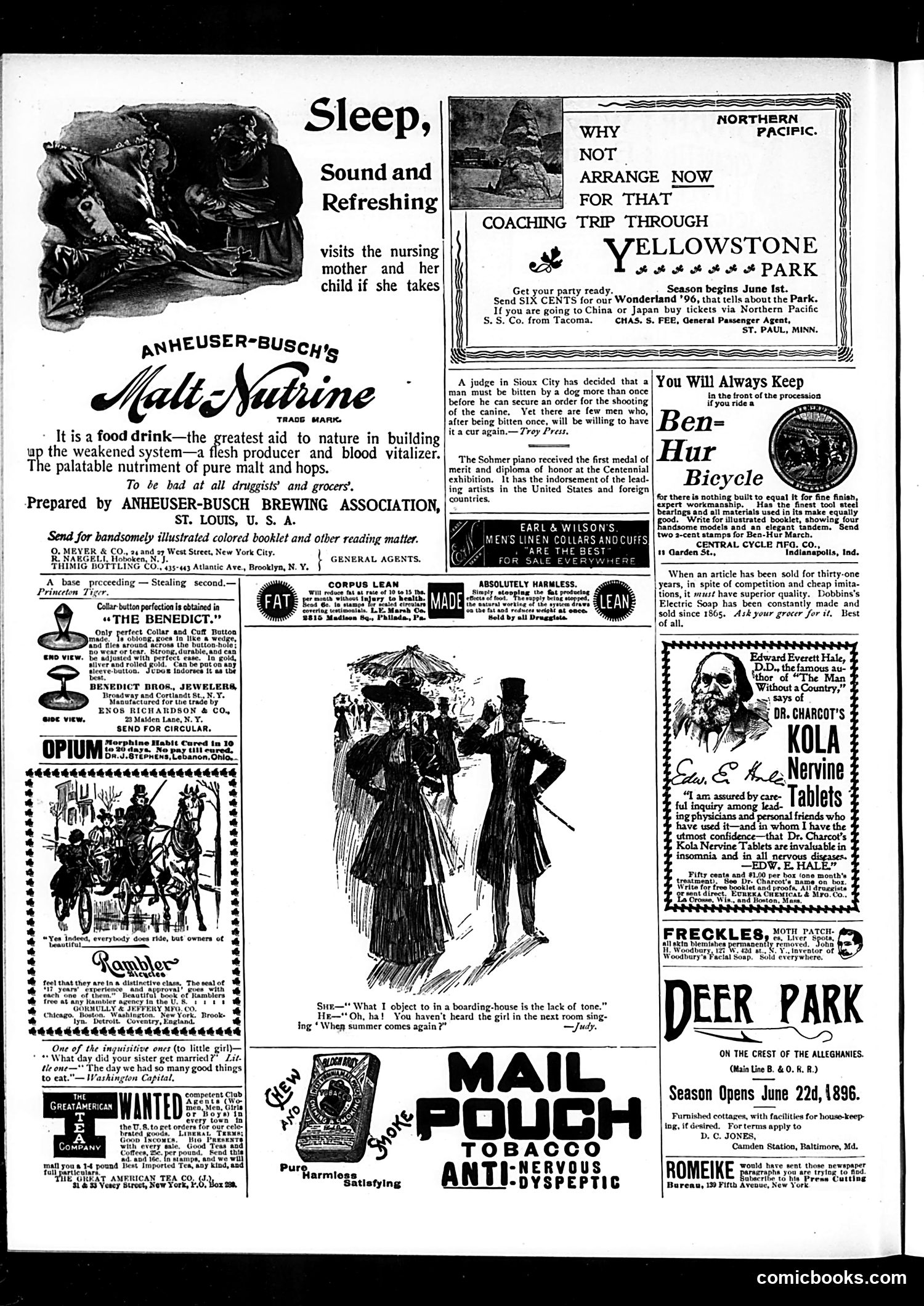
This page is primarily **advertising content** with no significant political or satirical cartoons. It appears to be from a 1896 issue of Judge and contains mostly commercial advertisements for products and services: Anheuser-Busch's Malt Nutrine (a food drink), railroad travel promotions (Northern Pacific, B&O Railway), bicycles, jewelry, patent medicines (Dr. Charcot's Kola Nervine Tablets), soap, and resort destinations. There is one brief non-advertising element: a **humorous interchange** about boarding-house life, where a character objects to "lack of tone," referring to a girl singing in the adjacent room. This is mild domestic humor typical of the period. The page demonstrates how heavily Judge magazines relied on advertising revenue while maintaining small sections of satirical content elsewhere in each issue.
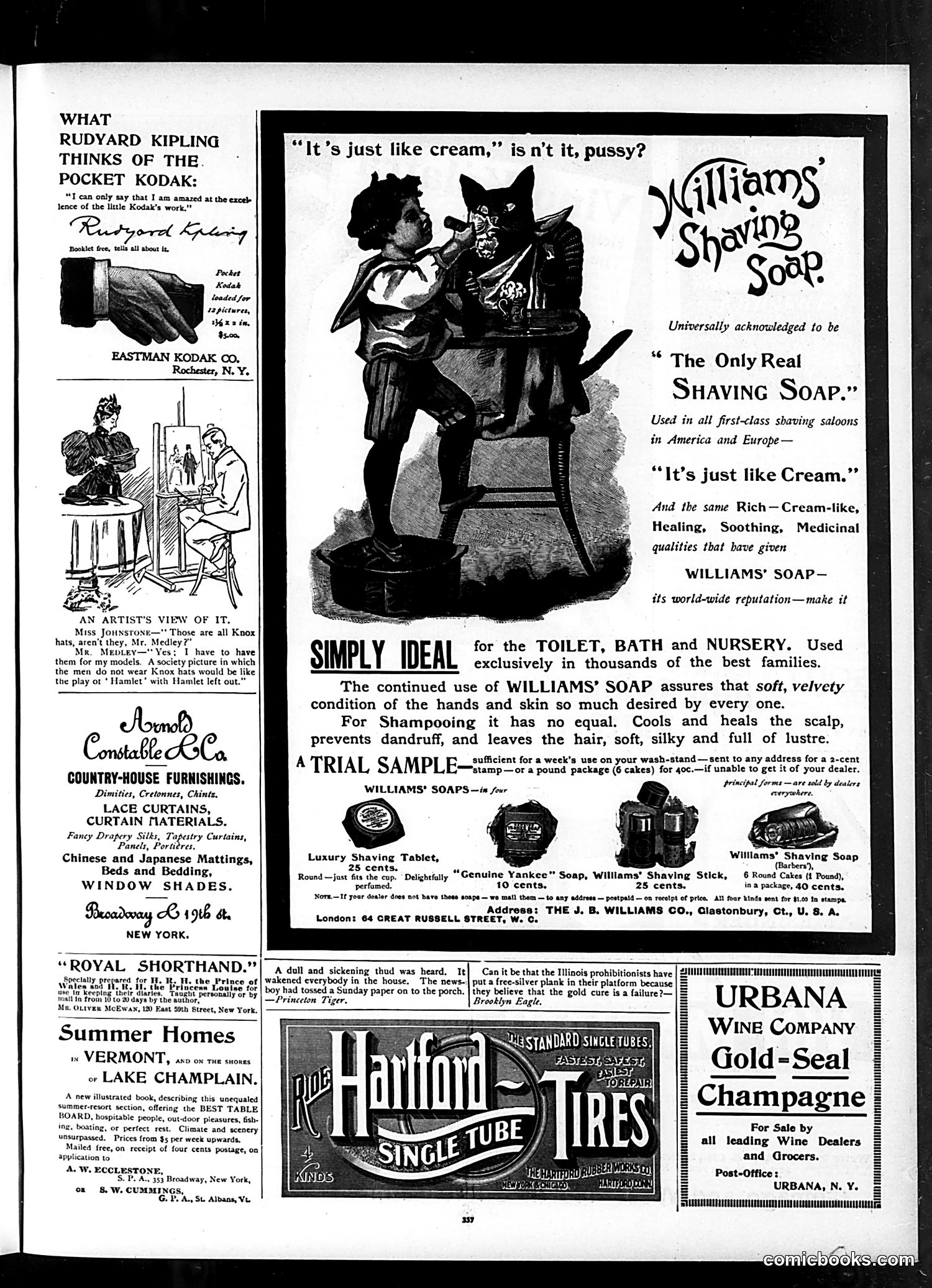
This page is primarily **advertising**, with minimal editorial content. The main cartoon features a cat and person with the caption "It's just like cream, isn't it, pussy?"—a visual pun promoting Williams' Shaving Soap, which the advertisement claims feels "like cream." The page includes two celebrity endorsements: Rudyard Kipling praising the Pocket Kodak camera, and an anecdote from "An Artist's View" where a society painter claims Knox hats are essential to his work (implying they're indispensable to fashionable society portraiture). At the bottom are two brief joke items: one about a newspaper hitting a porch like a "thud," and another political jab at Illinois prohibitionists who supposedly promoted free silver, implying prohibition advocates are as misguided as free-silver supporters. The page otherwise contains ads for furniture, real estate, typewriter shorthand instruction, wine, and tires—typical of Judge's advertising-heavy format circa 1910s.
This is primarily **an advertising page** from Judge magazine, not a political cartoon. The page comprises multiple product and service advertisements from the late 19th/early 20th century, with minimal editorial content. The few non-advertisement items include: - A short joke about Atlas carrying his town (satirizing urban congestion) - A photographer's joke about being photographed "without bones" - A quote about poetry coming from the reader, not the writer The advertisements reveal the period's consumer interests: bicycles (several brands), patent services, tonics and medicines (gout remedies, Vin Mariani wine-tonic), tourist destinations (Deer Park resort), brass band instruments, and women's magazines. The only satirical content is minimal—brief one-liners typical of Judge's humor section. There are no identifiable political figures or social commentary of substance on this particular page.
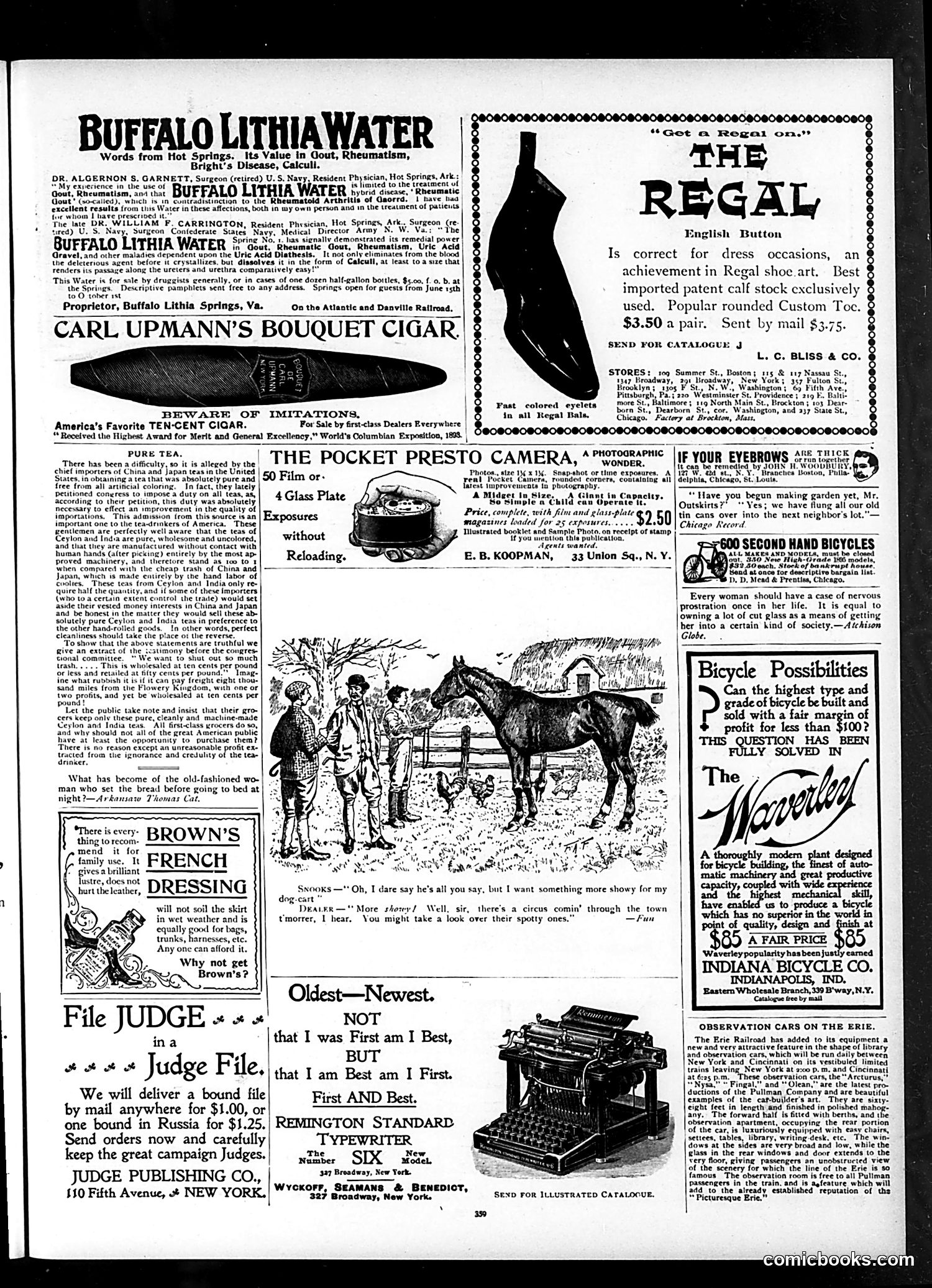
This page is primarily **advertising** from circa 1893 (based on the World's Columbian Exposition reference). The notable cartoon appears in the center—a rural scene showing two men discussing a dog and circus, with dialogue suggesting one man is gossiping or exaggerating about entertainment coming to town. The page contains product advertisements for: - **Buffalo Lithia Water** (medicinal spring water for gout/rheumatism), endorsed by military physicians - **Carl Upmann's Bouquet Cigar** (award-winning ten-cent cigar) - **Regal English Button shoes** (dress footwear, $3.50) - **Pocket Presto Camera** (early photographic equipment) - **Judge File** (office supplies) - **Remington Standard Typewriter** - **Waverely bicycle** The small cartoon's humor appears to mock rural gossip or exaggeration—the "dapper" man's skepticism about the circus visitor's claims. The page reflects 1890s consumer culture and product marketing aimed at Judge's middle-class readership.
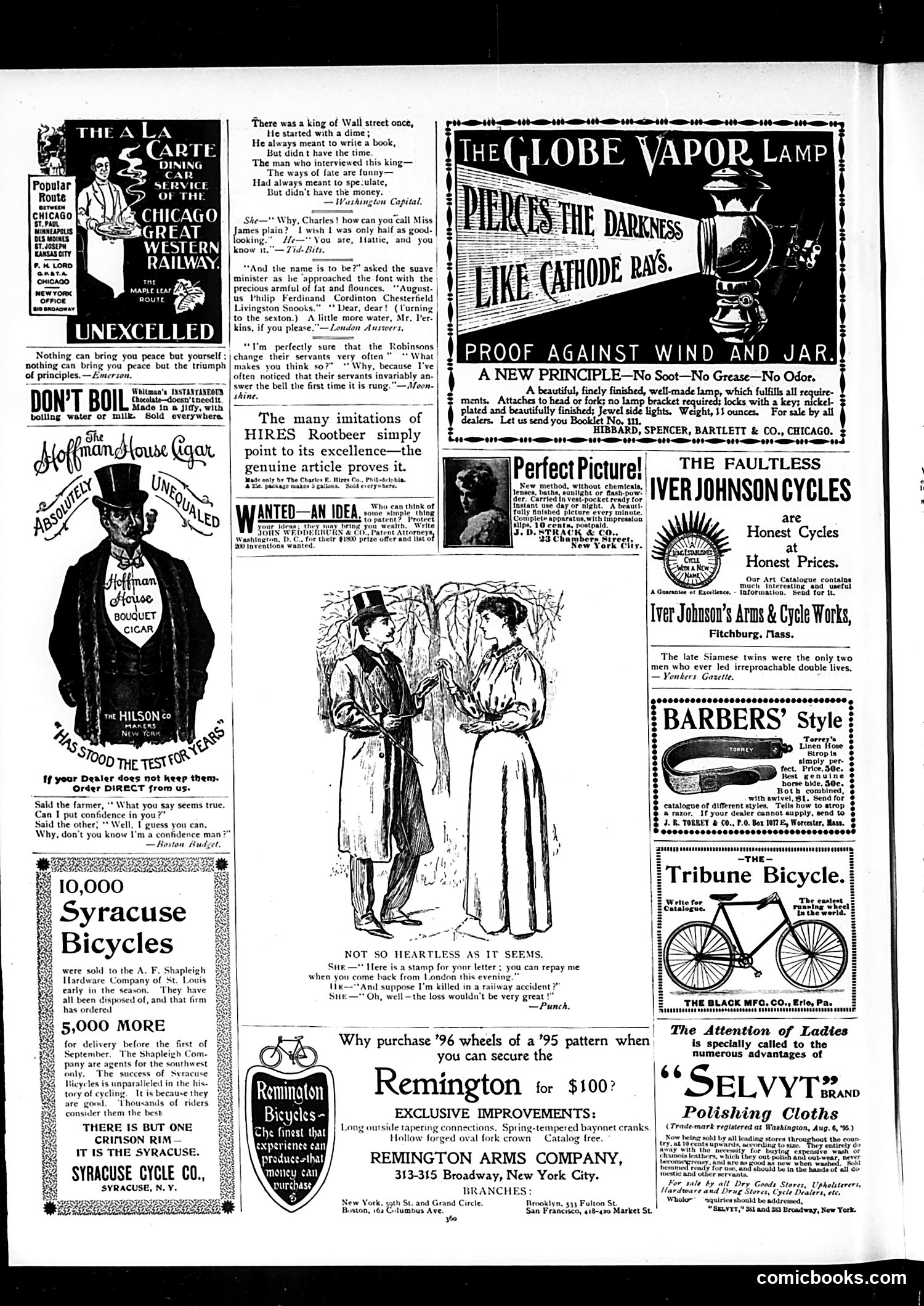
This page is primarily **advertising**, with several small satirical jokes and cartoons interspersed. The main content includes: **Cartoons/Jokes:** - A brief exchange about a "confidence man" (a con artist) - A sketch titled "NOT SO HEARTLESS AS IT SEEMS" showing two figures discussing a letter and hypothetical train accident—dark humor about mortality and indifference - Small jokes about Wall Street ambition, servant turnover, and Siamese twins **Advertisements:** The page is dominated by product ads: bicycles (Syracuse, Remington, Iver Johnson, Tribune brands), the Globe Vapor Lamp, Hoffman House cigars, Hires Root Beer, Remington Arms, and clothing polish. **Historical Context for Modern Readers:** The "confidence man" reference points to 19th-century American con-artist culture. The bicycle ads reflect the 1890s cycling craze. The Siamese twins joke references the famous Chang and Eng, whose deaths were recent enough to be topical. The overall tone—cynical about money and human nature—reflects Judge magazine's satirical stance on American commercialism and social pretension.
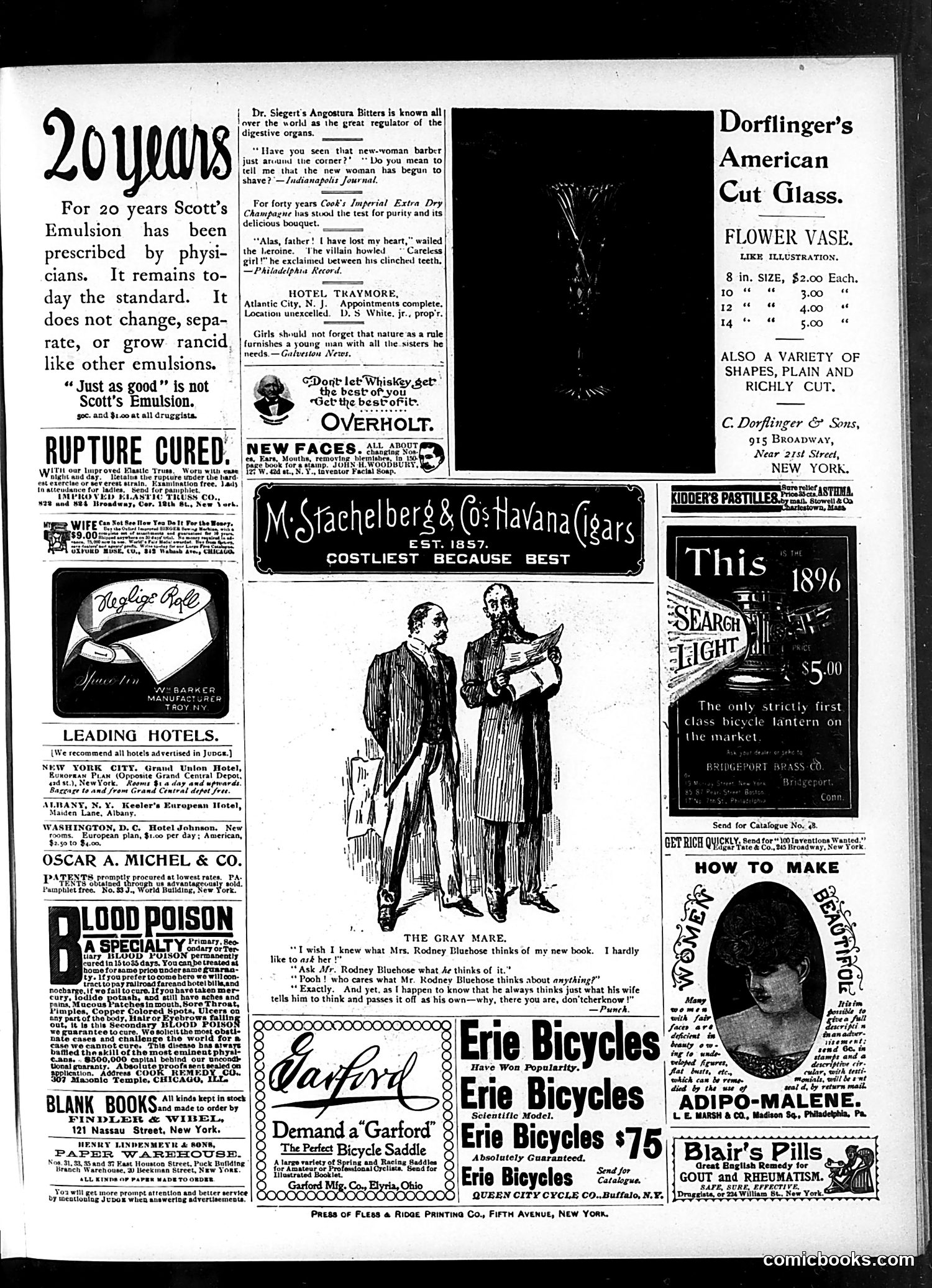
This page is primarily **advertising** with one small cartoon titled "The Gray Mare." ## The Cartoon "The Gray Mare" depicts two men discussing a third man's literary work. The joke plays on the phrase "the gray mare is the better horse" (meaning a wife controls her husband). One man asks if he should seek the husband's opinion on his book; the other reveals the husband merely echoes his wife's views—he "always thinks just what his wife tells him to think and passes it off as his own." The satire targets **male deference to wives' opinions** while maintaining the social fiction of male authority. For modern readers, it reflects late-19th-century anxieties about women's intellectual influence and the awkwardness of admitting spousal dependence. ## Advertisements The page features typical 1890s products: Scott's Emulsion (patent medicine), Havana cigars, bicycles, cut glass, hotels, blood poison treatments, and various remedies. These reveal consumer culture preoccupations and the prevalence of dubious medical claims in period advertising.
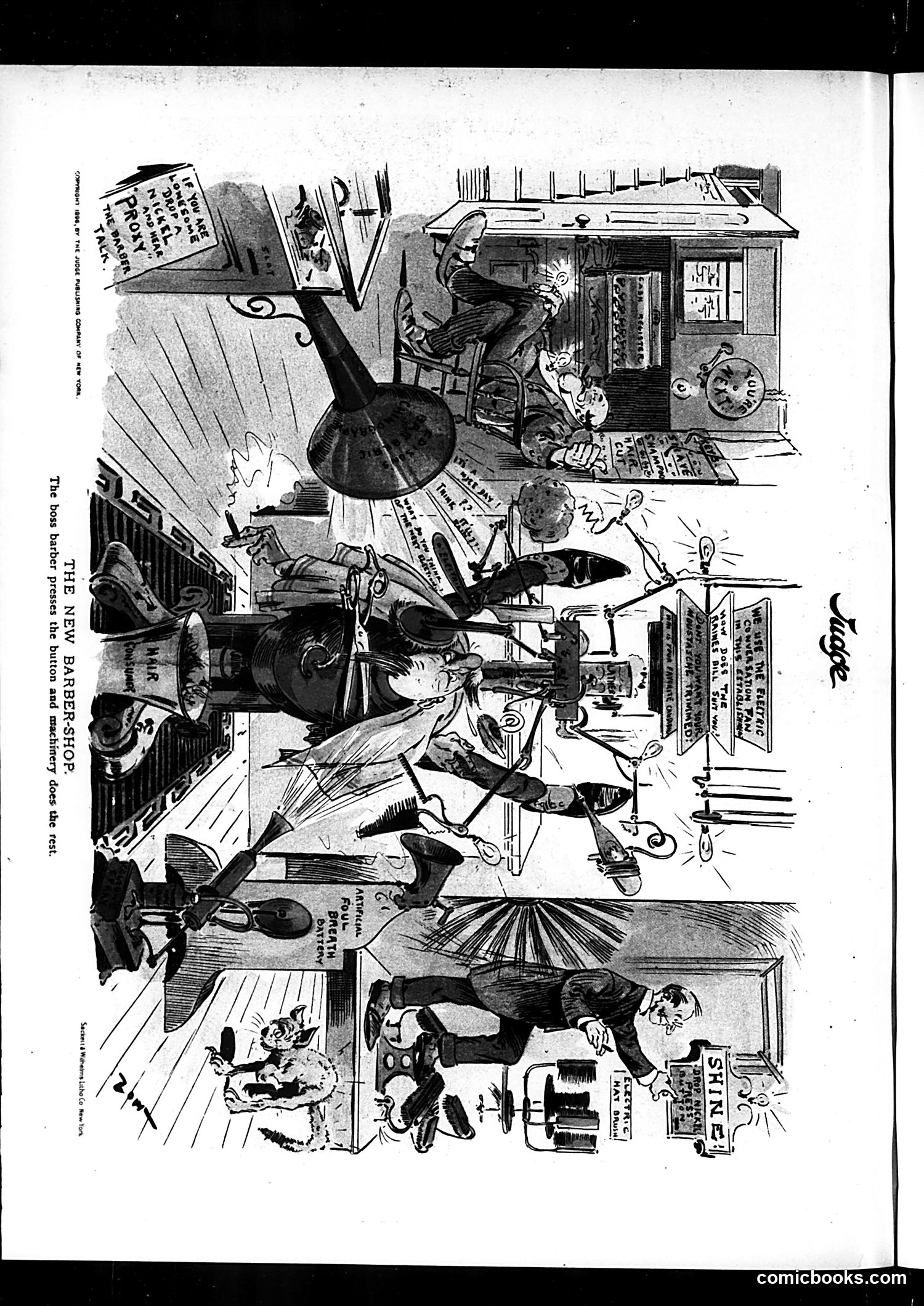
This appears to be a satirical cartoon titled "The New Barber-Shop" depicting an automated, mechanized barbershop where "the boss barber presses the button and machinery does the rest." The cartoon shows a chaotic scene with various mechanical contraptions, pulleys, and automated devices performing typical barber tasks (cutting hair, shaving, etc.) on customers. The satire likely mocks the early 20th-century obsession with mechanization and labor-saving devices, suggesting that over-automation of even simple services creates confusion and absurdity rather than improvement. The cartoon criticizes the era's faith that machines could replace human skill and craftsmanship, showing instead a ridiculous tangle of machinery that appears dangerous and comically inefficient. This reflects broader anxieties about industrialization's impact on skilled trades and traditional labor.