
A complete issue · 18 pages · 1896
Judge — May 9, 1896
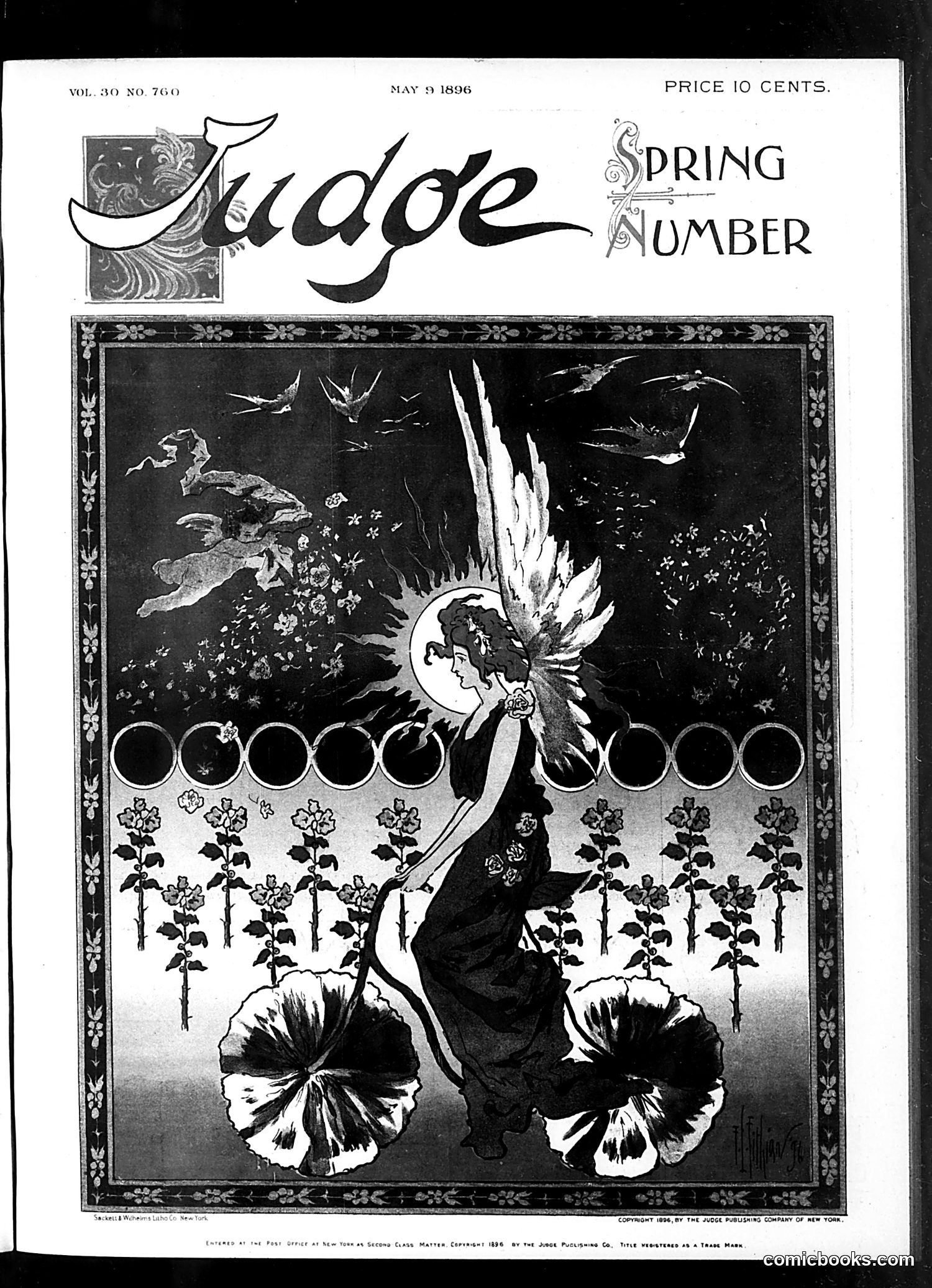
This cover illustration depicts a fantastical spring scene featuring a woman in elegant dress with large butterfly wings, positioned among flowering plants and celestial imagery. She holds a crescent moon and appears to be a personification of Spring itself—a common allegorical figure in turn-of-the-century American art and magazines. The scene includes flying cherubs, flowers, and decorative circular elements arranged symmetrically. Rather than political satire, this appears to be decorative seasonal artwork typical of Judge's "Spring Number" issues, celebrating the renewal and beauty associated with the season. The elaborate Art Nouveau-influenced design was characteristic of high-end American periodicals of the 1890s.
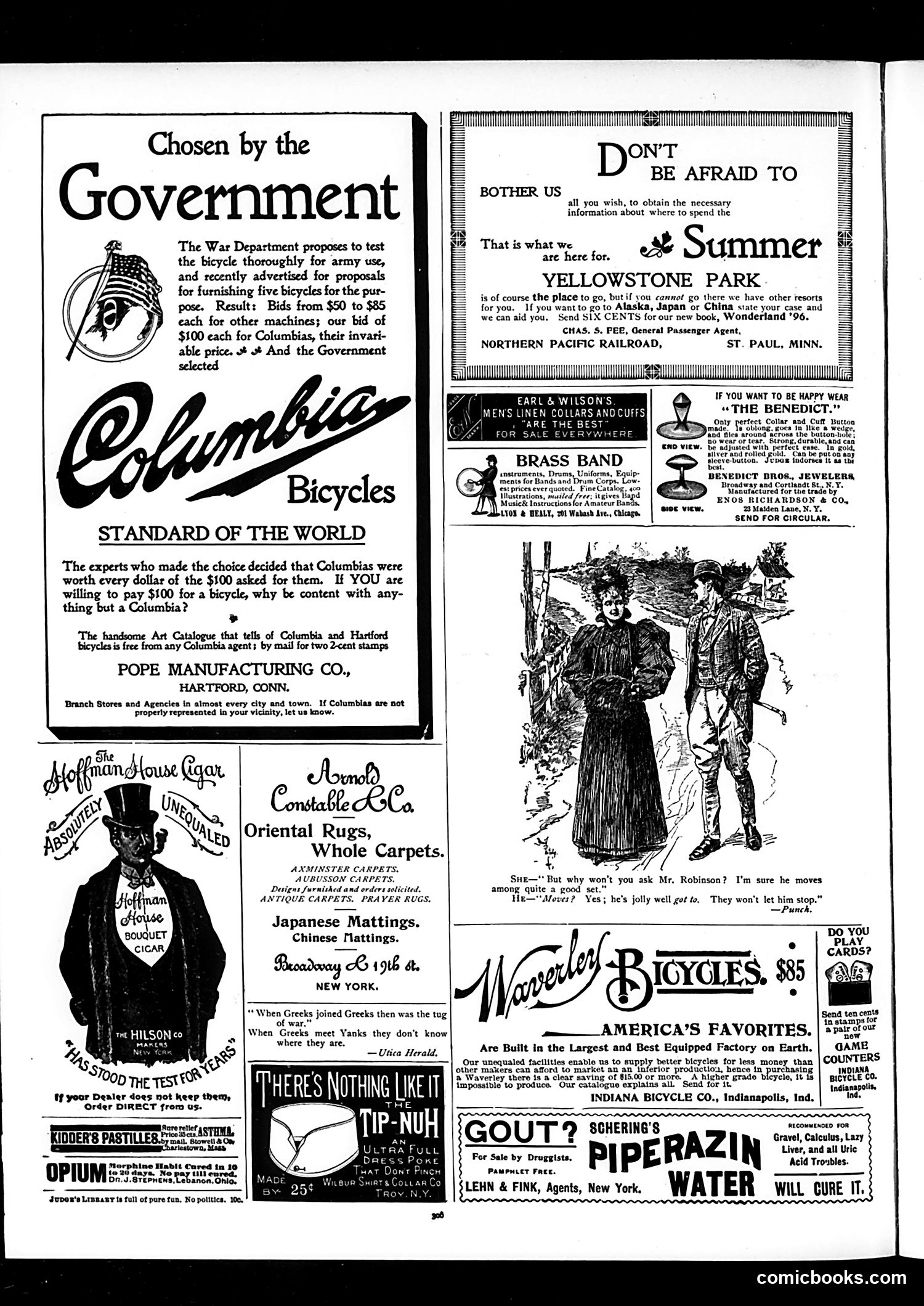
This page is primarily **advertisements** with one small cartoon panel. The main content includes ads for Columbia Bicycles ("Standard of the World"), Marvelous Bicycles, Earl & Wilson's linen collars, Oriental rugs, cigars, and patent medicines. The single cartoon depicts a couple in period dress. The woman says she won't let Mr. Robinson join "quite a good thing," and the man replies they won't let him stop. The joke's meaning is **unclear without additional context**—it appears to reference some contemporary social or business situation unknown to modern readers. The page reflects early 20th-century consumer culture and advertising rather than substantive political satire. The bicycle ads suggest this likely dates to the cycling craze of the 1890s-1910s.
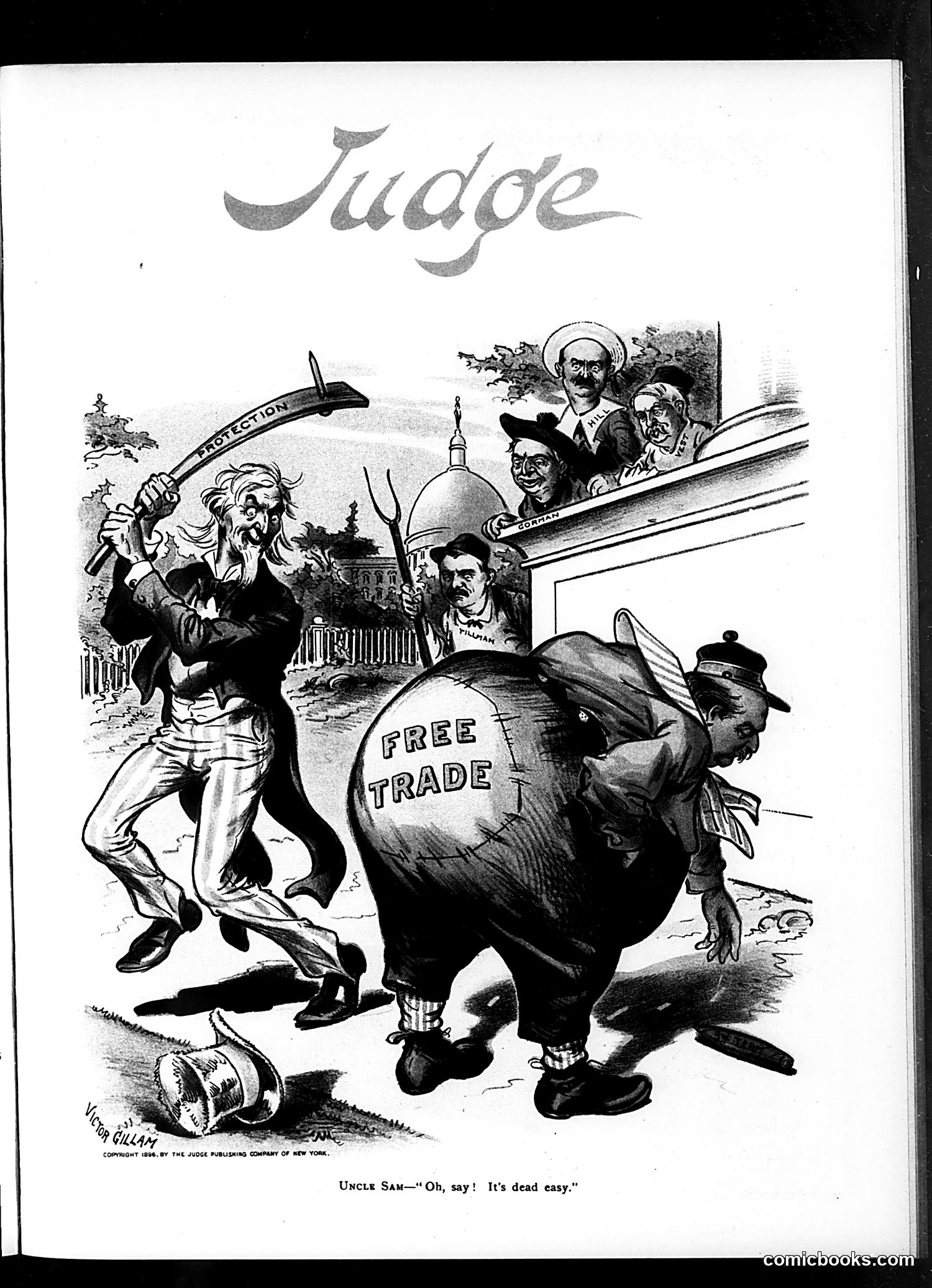
This cartoon satirizes opposition to **free trade** policy. Uncle Sam (representing the United States) appears exhausted, struggling with a large sphere labeled "FREE TRADE." A demonic figure wielding a "PROTECTION" sword attacks from the left, while several men in a window above (likely representing protectionist politicians or industrialists) look on. The caption—"Oh, say! It's dead easy"—is sarcastic, suggesting that dismantling free trade is supposedly simple. The cartoon reflects late 19th-century American political divisions between **free-trade advocates** (represented by Uncle Sam) and **protectionists** (the attacking demon), who supported tariffs to shield domestic industries. The Capitol dome in the background emphasizes this is a national policy debate.
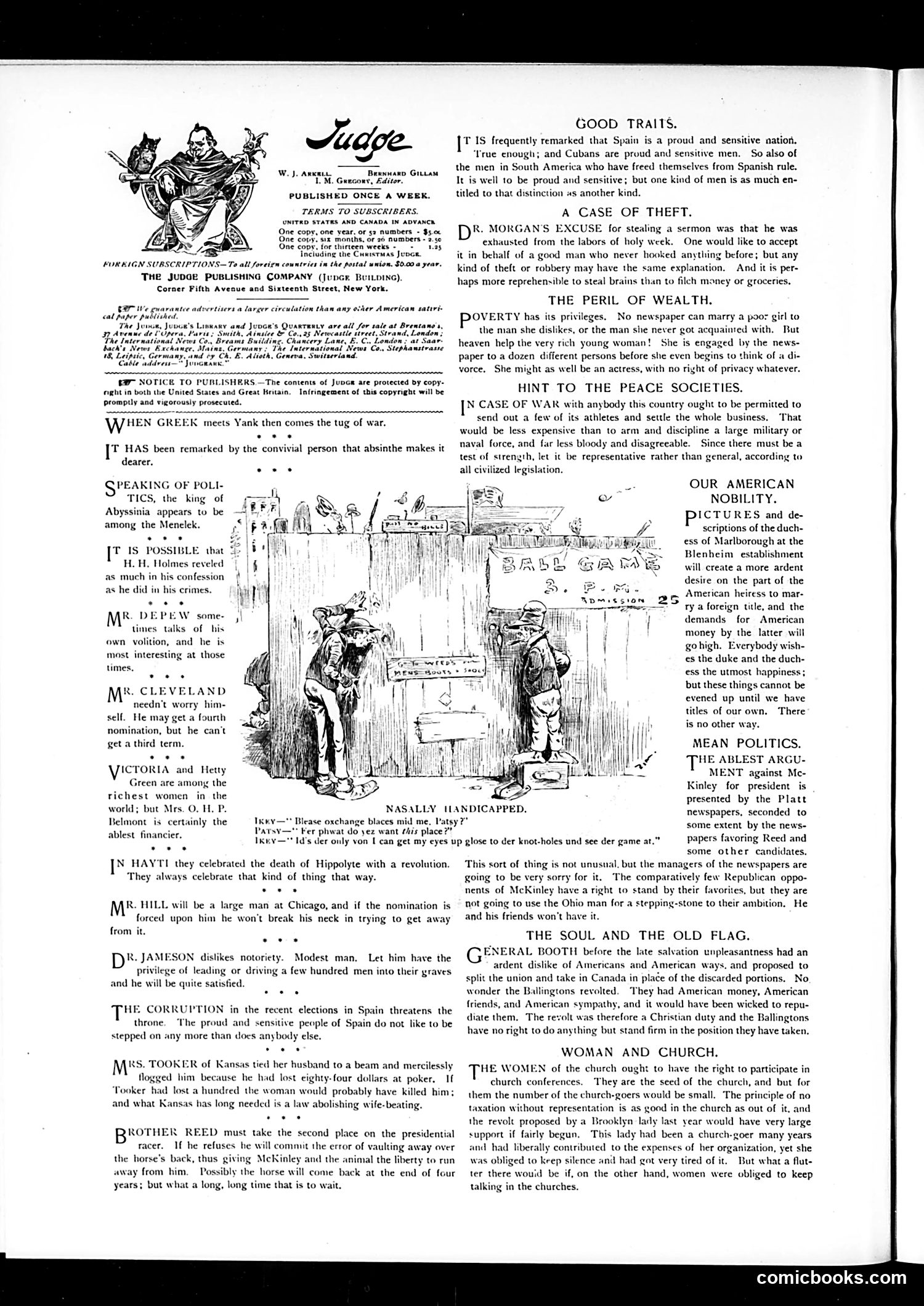
This page from *Judge* magazine (circa 1890s based on references) contains multiple brief satirical items and one central cartoon titled "Nasally Handicapped." The cartoon depicts two working-class men at what appears to be a baseball game. One complains he can only see the action through the knot-holes in the fence because of his large nose—a visual gag about ethnic caricature (suggested by the dialect spelling "der" and "von"). The humor relies on period stereotyping of Irish or German immigrants. The surrounding text consists of one-liner political jabs at contemporary figures: references to Cleveland's potential third term, McKinley's presidential ambitions, the Spanish-American tensions over Cuba, and critiques of various politicians' vanity or corruption. Items mock H.H. Holmes (a famous serial killer), wealthy women, and Spanish political instability. The satire targets political hypocrisy, corruption, and social pretension typical of Gilded Age commentary.
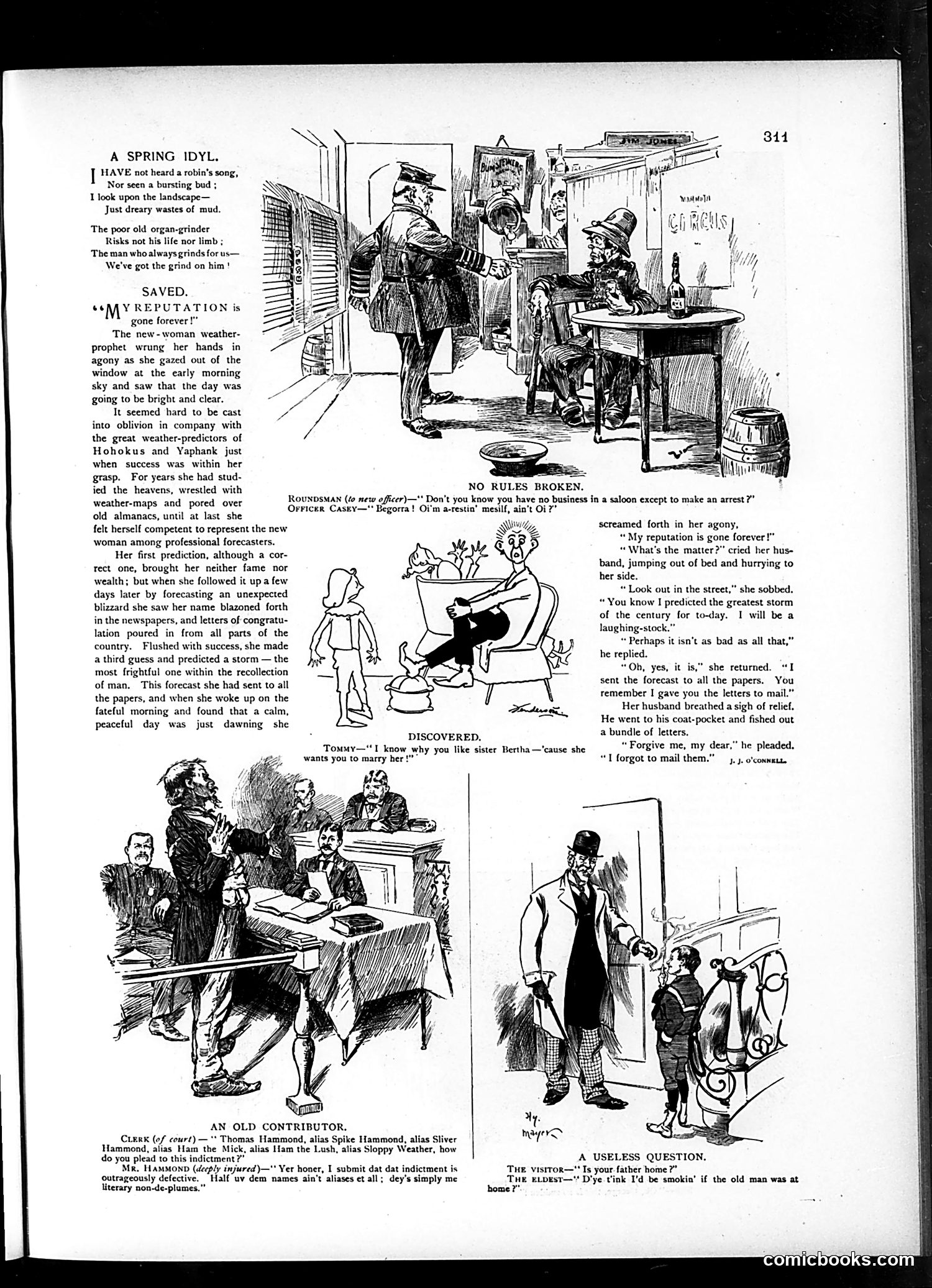
This Judge magazine page contains several satirical vignettes mocking early 1900s social trends: **"A Spring Idyl"** jokes that spring weather forecasting is so unreliable that even the organ-grinder (street musician) won't venture out—a topical reference suggesting widespread skepticism about weather prediction. **"Saved"** satirizes the "new woman" movement. A female weather forecaster predicts a catastrophic storm to gain professional credibility, but wakes to find perfect weather. Her reputation seems ruined—until her husband reveals he forgot to mail her forecasts, saving her reputation by accident. The satire mocks both new women entering professions and the general unreliability of weather science. **"No Rules Broken"** appears to joke about Irish police officers using saloons as rest stops rather than enforcement venues. **"An Old Contributor"** and **"A Useless Question"** are brief character humor sketches, the latter joking about youth smoking indoors. The overall theme: satirizing modern institutions (weather science, professional women, law enforcement) through humorous failure.
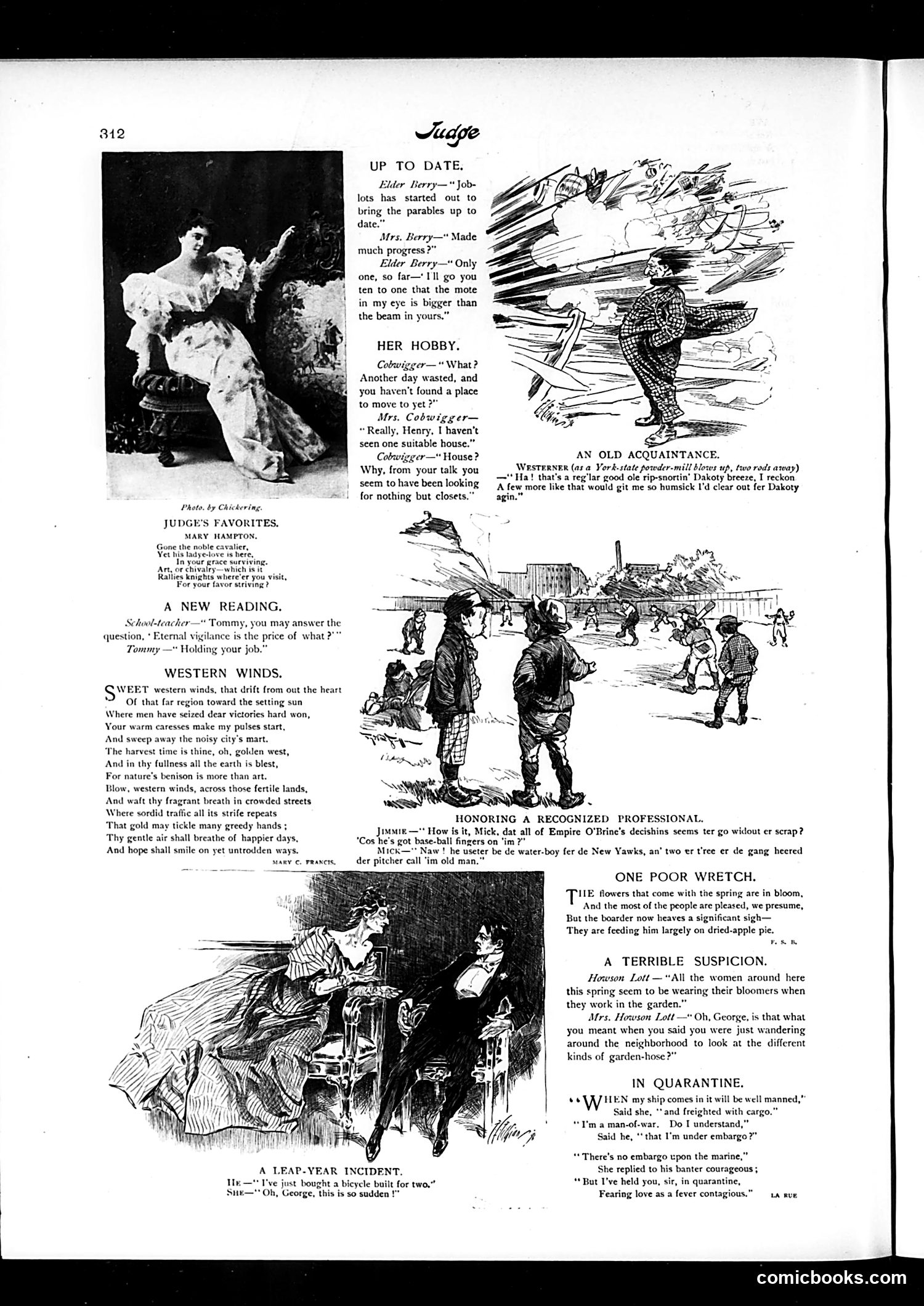
This page contains multiple brief satirical jokes and comic situations typical of Judge's humor: **"Up to Date"** mocks attempts to modernize Biblical parables—Elder Berry "updates" Jesus's teaching about removing the mote from one's eye into a betting proposition. **"Her Hobby"** satirizes women's endless house-hunting; the wife searches perpetually for the "perfect" home while only finding closets. **"An Old Acquaintance"** jokes about a Westerner's crude appreciation for Dakota explosions as pleasant weather. **"Honoring a Recognized Professional"** appears to reference a baseball player (Empire O'Brien) whose decisions go unchallenged because he was formerly a water-boy for the New York team—mocking unearned authority through nepotism. **"One Poor Wretch"** depicts a boarder's disappointment when fed only dried-apple pie despite spring's abundance. The remaining items are brief romantic comedies and puns about relationships, unremarkable to modern readers. The page reflects Gilded Age concerns: social climbing, women's roles, employment, and romantic conventions.
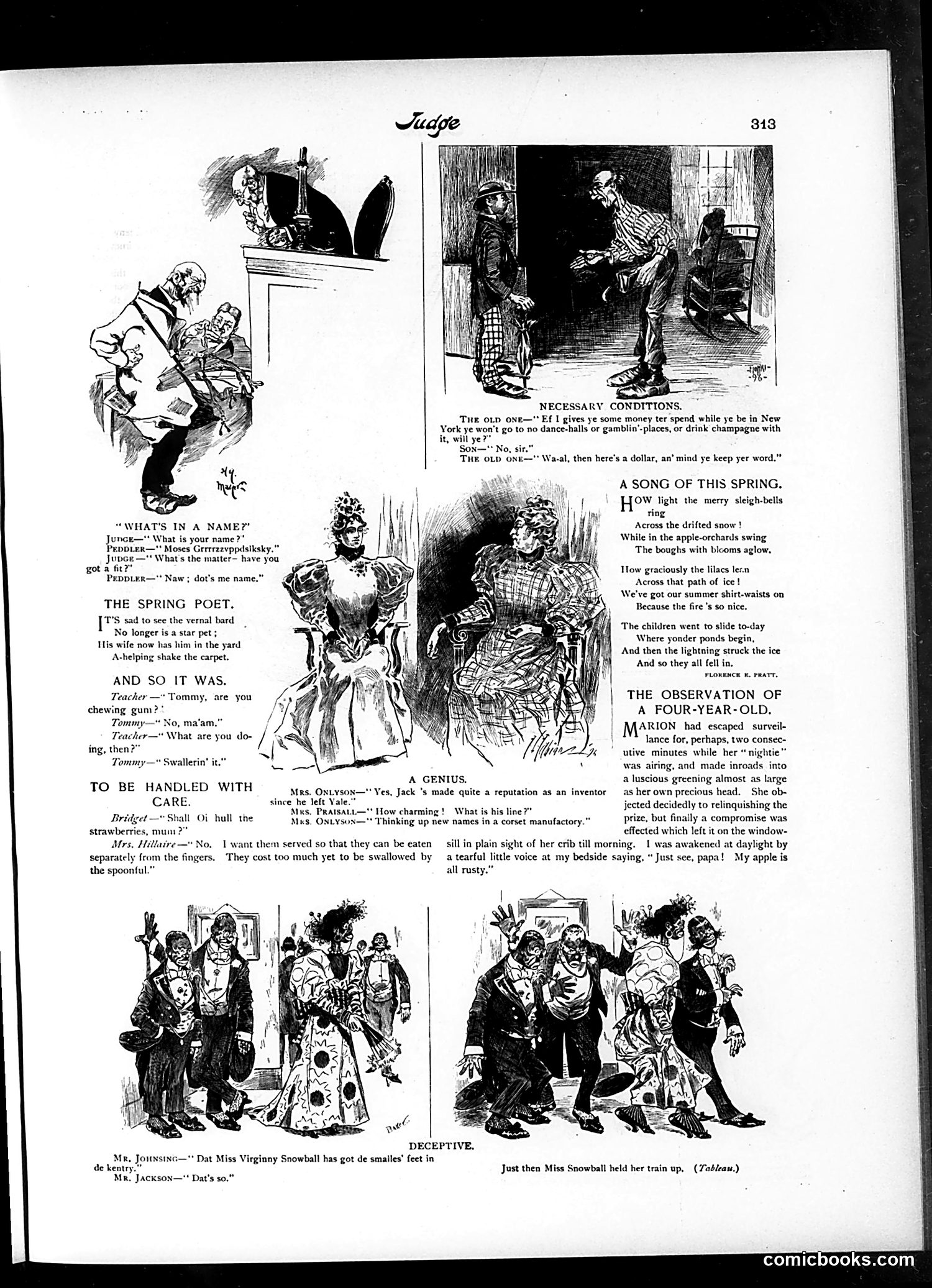
This page contains several brief humorous sketches typical of late 19th/early 20th-century American satire: **"What's in a Name?"** mocks immigrants with difficult surnames—a judge questions a peddler's name "Moses Grrrzzvppdsiksky," implying ethnic stereotyping and xenophobia common in the era. **"The Spring Poet"** satirizes romantic poets by showing one relegated to domestic chores (shaking carpets) rather than composing verse—a commentary on the impracticality of artistic pursuits. **"And So It Was"** and **"To Be Handled With Care"** are mild observational humor about children and household situations. **"A Genius"** jokes about a corset manufacturer inventing new model names—satirizing commercial invention over genuine innovation. **"A Song of This Spring"** contrasts spring beauty with practical hardship (children falling through ice), typical of Judge's sardonic tone. **"The Observation of a Four-Year-Old"** presents innocent childhood logic—a child disappointed her apple turned "rusty" overnight. The overall tone reflects period attitudes toward immigrants, social class, and domestic life through quick, often crude humor.
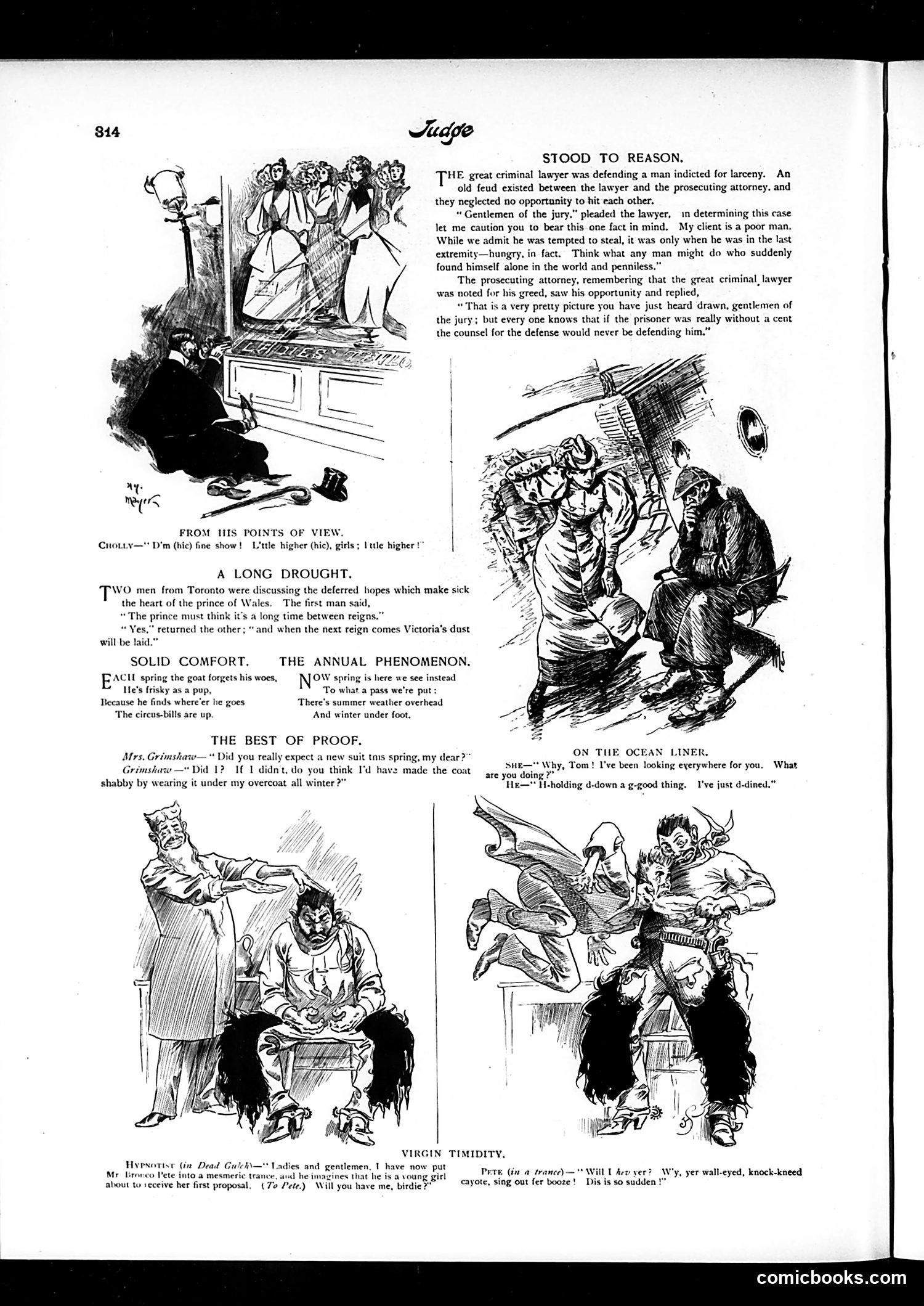
This page contains multiple short satirical pieces typical of Judge's humor: **"Stood to Reason"** mocks a wealthy criminal defense lawyer's hypocrisy. He argues his poor client stole from desperation, but the prosecutor exposes the absurdity: if the client were truly penniless, this greedy lawyer wouldn't be defending him for free. The joke critiques lawyers' self-interest masquerading as social conscience. **"A Long Drought"** makes a dark joke about the Prince of Wales (later Edward VII), referencing the long gap between Queen Victoria's reign and his succession—implying he's waiting for her death. **Other pieces** include comic verses about seasonal weather, a wife's proof that she expected a new dress (by wearing her old coat shabby), and two brief vignettes about rural/frontier life and virginal awkwardness. The illustrations are period-appropriate pen sketches. Overall, the page exemplifies Judge's blend of legal satire, political jabs, and domestic humor targeting middle and upper-class American readers.
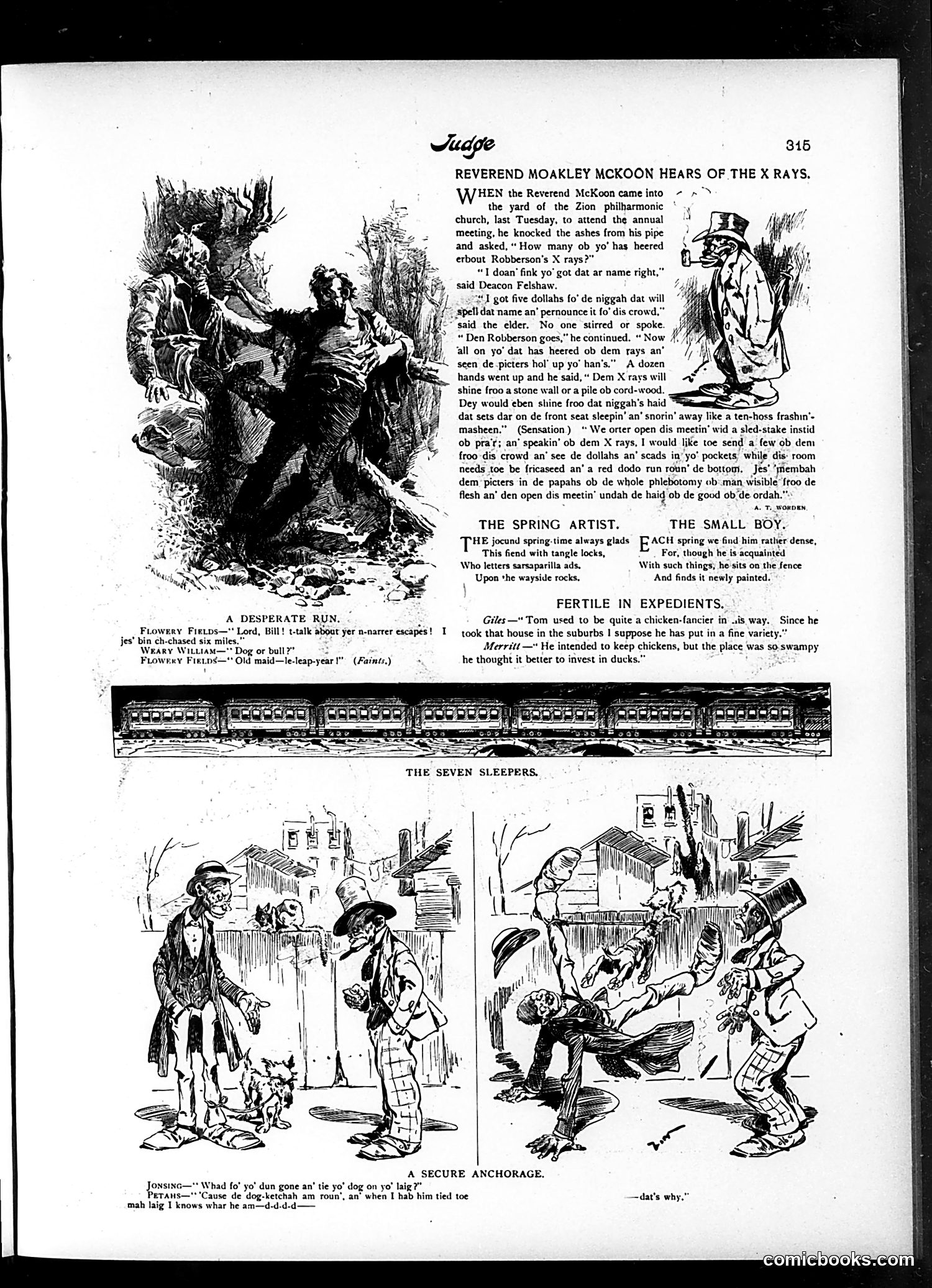
This page contains several satirical pieces mocking African American vernacular and behavior—reflecting the racist humor conventions of late 19th-century Judge magazine. The main feature, "Reverend Moakley McKoon Hears of the X Rays," satirizes a Black church elder's mangled attempt to discuss Roentgen's newly-discovered X-ray technology (a sensation of the 1890s). The humor derives from his malapropisms, mispronunciations, and crude church-meeting commentary—stereotyping Black speech patterns and religiosity. The shorter pieces—"The Spring Artist," "The Small Boy," "A Desperate Run," "The Seven Sleepers," and "A Secure Anchorage"—are brief comic vignettes about everyday mishaps and misunderstandings, some involving working-class or rural characters. The satire targets technological ignorance, class pretension, and behavioral absurdity rather than specific political figures, though the racist dialect and caricature reflect the publication's editorial biases.
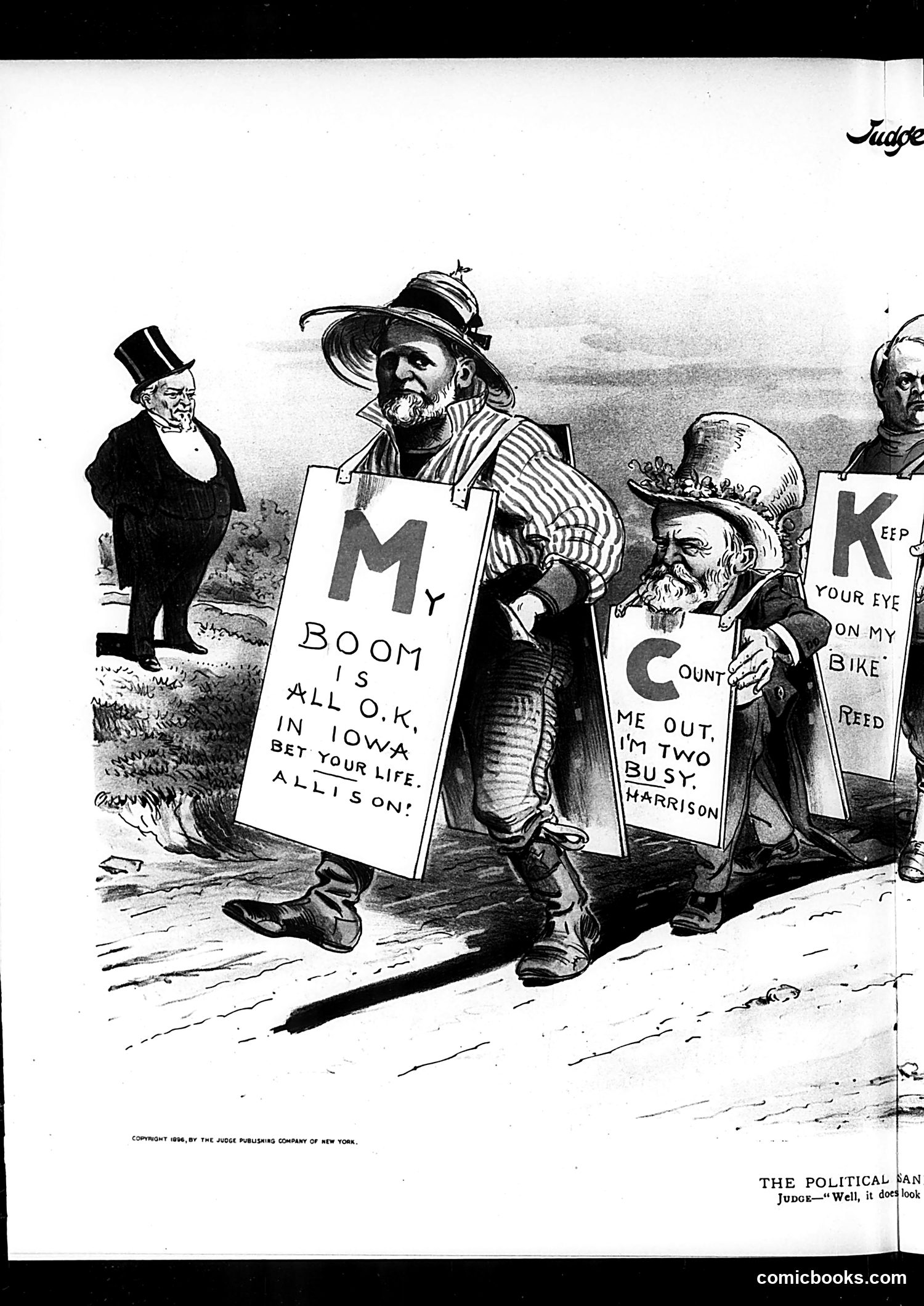
This Judge magazine cartoon satirizes political campaigning, likely from the 1880s based on the copyright date. The central figure carries a sign reading "MY BOOM IS ALL O.K. IN IOWA, BET YOUR LIFE, ALLISON!" — referencing William B. Allison, an Iowa politician seeking support. Other figures hold signs mentioning "COUNT ME OUT. I'M TWO BUSES HARRISON" and partial text about keeping "YOUR EYE ON MY BIKE." The satire depicts political candidates as street-level promoters aggressively hawking their campaigns to voters like carnival attractions. The exaggerated caricatures and undignified positioning mock the desperation and circus-like nature of electoral politics. The accompanying caption "Well, it does look" (likely completing a skeptical observation) reinforces the cartoon's mocking tone toward these political "booms."
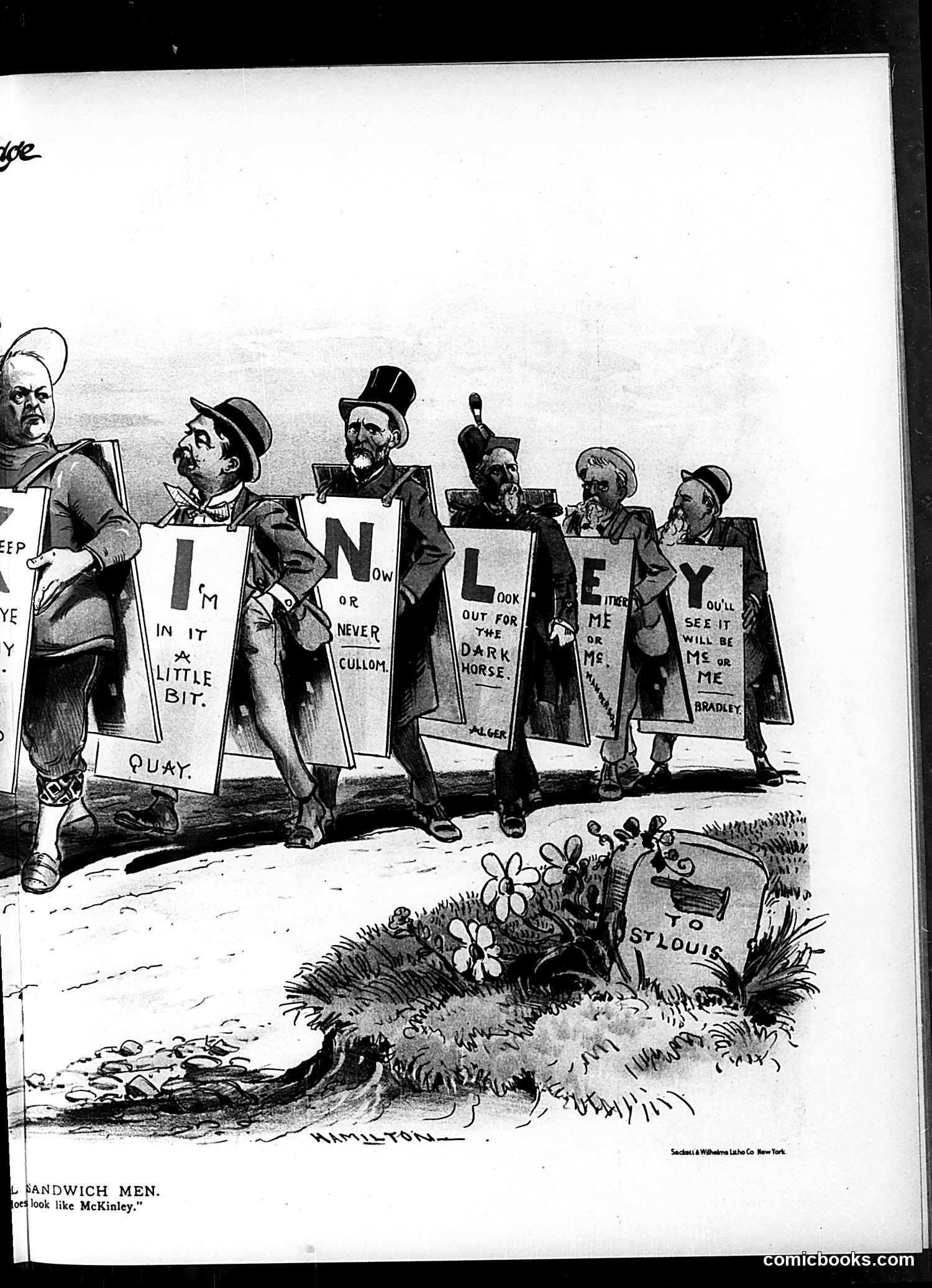
This political cartoon depicts "sandwich men"—workers who carried advertising boards front and back—caricatured as prominent political figures. Each figure holds a placard with partial text visible: "I'M IN IT A LITTLE BIT," "NOW OR NEVER," "LOOK OUT FOR THE DARK HORSE," "SEE ME OR ME," and similar phrases. The caption states these "look like McKinley," referring to President William McKinley, suggesting the cartoon satirizes politicians or political candidates who, like sandwich men, display contradictory or vague messages to the public. The grave marked "ST. LOUIS" at the bottom likely references political events surrounding that city. The satire mocks political figures for their unclear platforms and opportunistic positioning.
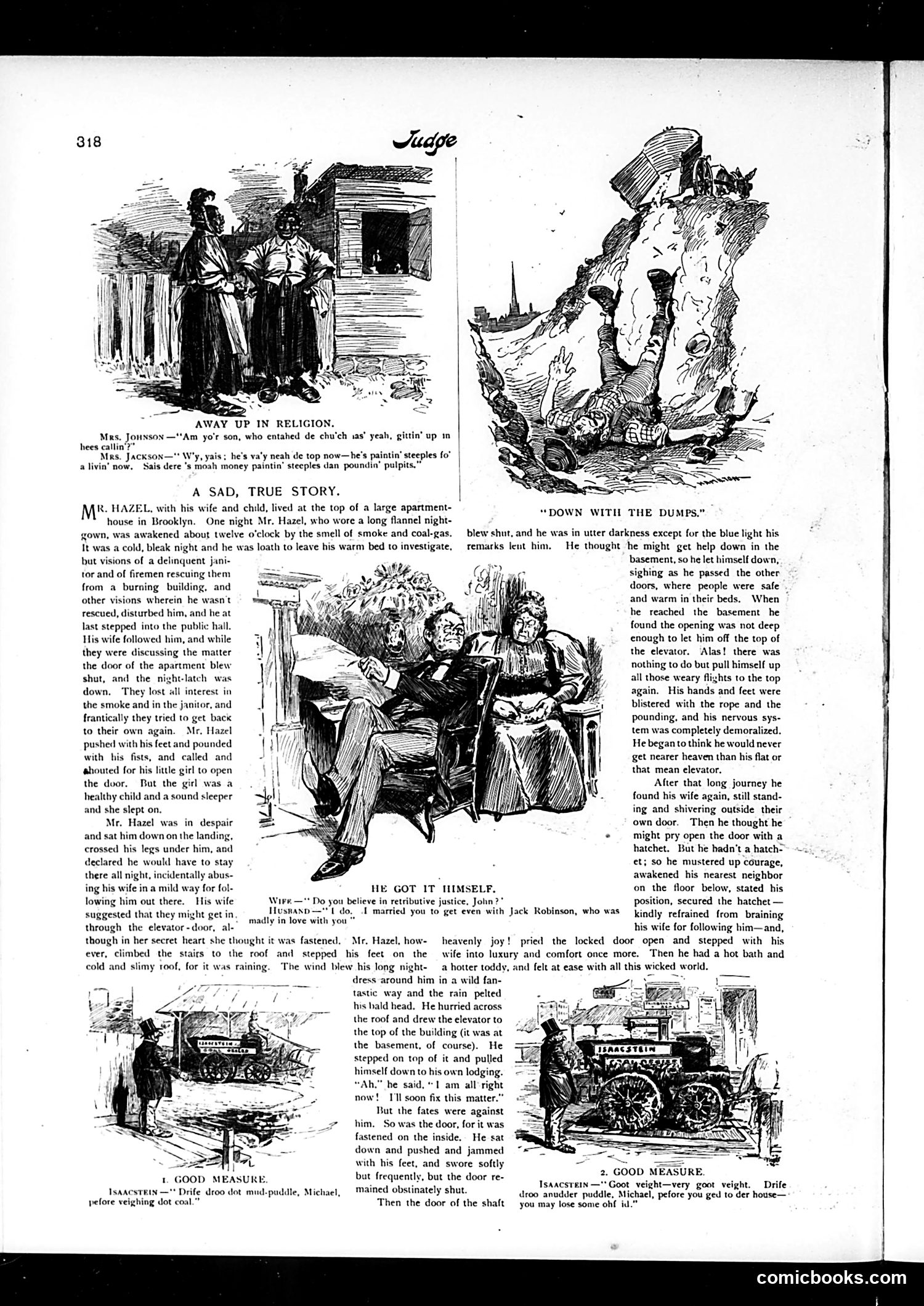
This page contains multiple satirical pieces typical of the late 19th-century *Judge* magazine: **"Away Up in Religion"** (top left): A joke mocking social climbing and religious hypocrisy. Two women discuss a son who "got religion" but now paints church steeples for money rather than pursuing ministry—the satire being that spiritual calling proved less lucrative than manual labor. **"A Sad, True Story"** (main narrative): A darkly comedic account of Mr. Hazel locked out of his Brooklyn apartment after investigating a gas smell. His attempted rescues—climbing to the roof, descending into the basement via elevator shaft, enlisting neighbors—all fail catastrophically. The satire targets urban apartment-living inconveniences and the helplessness of the middle class when mechanical systems fail. **"He Got It Himself"** and other short captions: Brief joke exchanges about revenge and retributive justice. The cartoons illustrate these misadventures with exaggerated, detailed engravings. The overall tone is working-class urban humor, mocking both pretension and the indignities of modern city life.
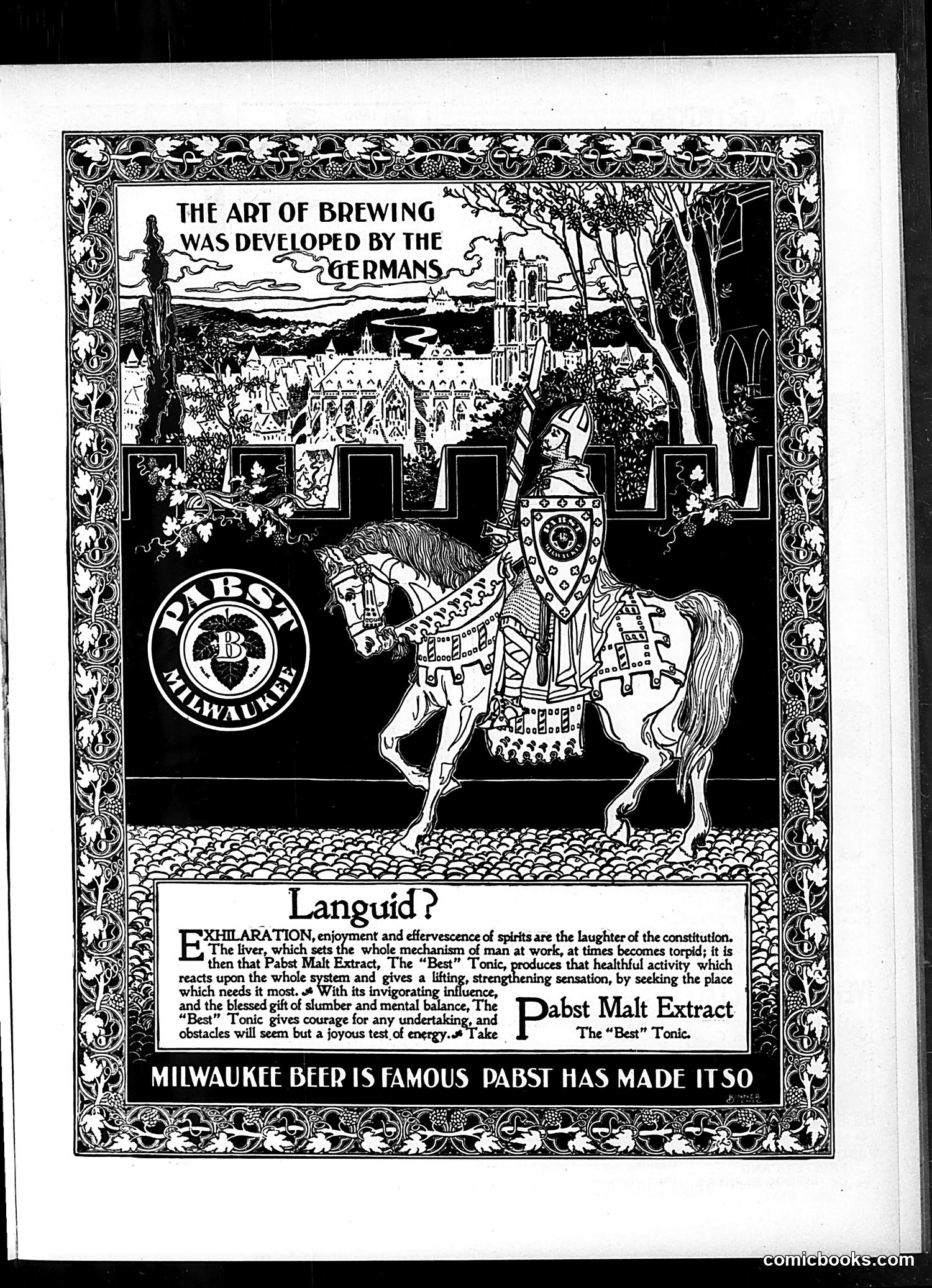
This is primarily a **Pabst beer advertisement** rather than political satire. The page promotes Pabst Malt Extract as a health tonic, leveraging German brewing heritage. **Key elements:** - **The medieval German knight on horseback** represents the claimed German origin of brewing expertise ("The Art of Brewing Was Developed by the Germans") - **The Pabst Milwaukee logo** establishes the company's legitimacy through this heritage connection - **The "Languid?" headline** addresses a common early-20th-century concern about vitality and energy - **The text claims medicinal benefits**: the product allegedly combats fatigue, aids digestion, strengthens the nervous system, and boosts courage for "any undertaking" This reflects the era when patent medicines and tonics made broad health claims now considered false advertising. The German imagery was marketing leverage in Milwaukee, a heavily German-immigrant city. The appeal combines heritage authenticity with pseudo-medical promises typical of the period.
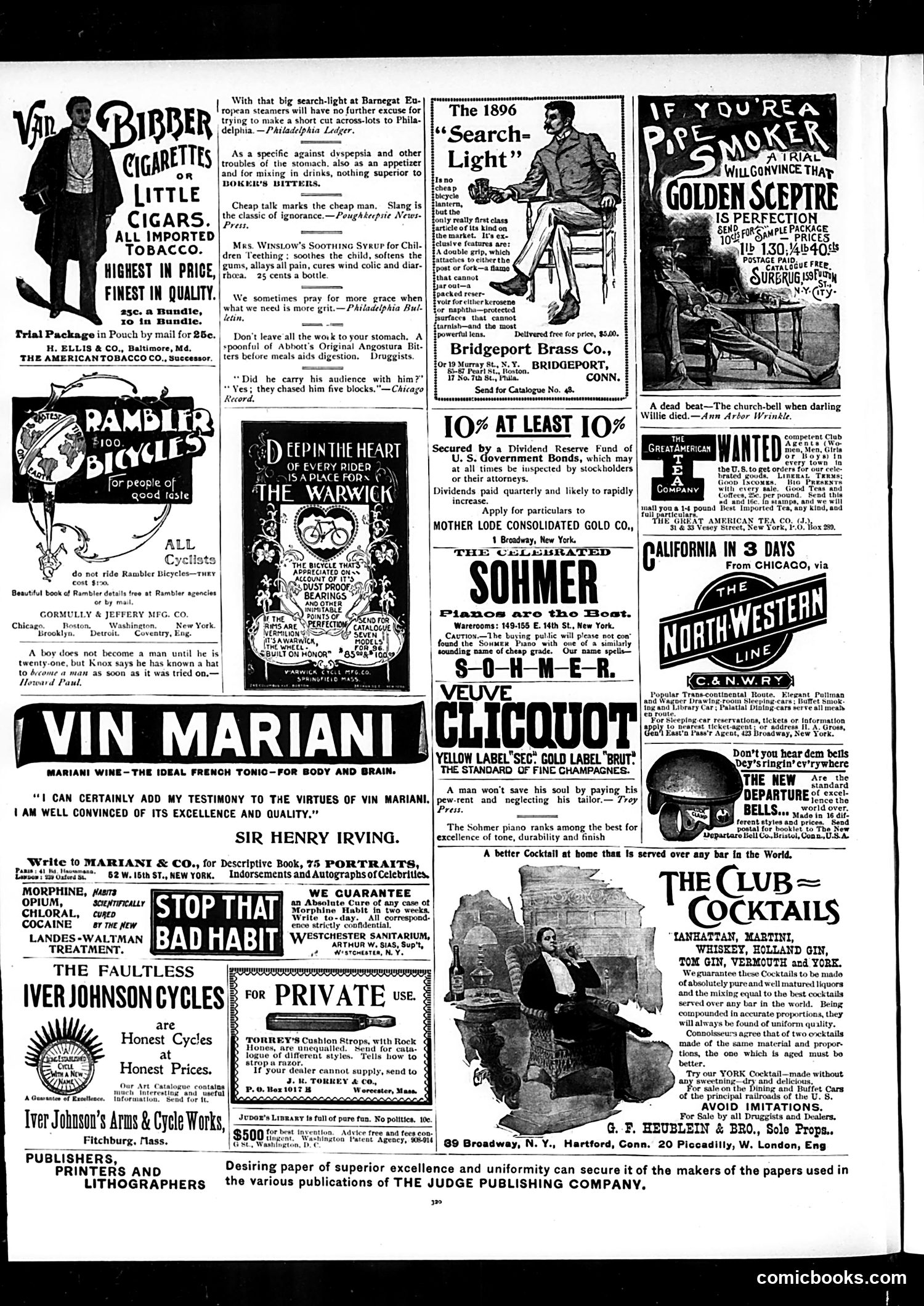
This page is primarily **advertising**, typical of Judge magazine's revenue model. Notable content includes: **Satirical/Editorial Elements:** - A brief joke about European steamers using a searchlight at Barnegat (appears to reference coastal navigation safety) - Humorous one-liners on morality and language scattered throughout **Major Advertisements:** The page heavily features patent medicines and tonics reflecting late-1890s practices—now recognized as dubious or harmful: - **Vin Mariani** (wine-based tonic, endorsed by actor Sir Henry Irving) - **Boker's Bitters** (digestive remedy) - **Mrs. Winslow's Soothing Syrup** (for teething children) - **Addiction treatment clinics** (morphine, opium, cocaine)—indicating these were openly advertised remedies **Products:** Bicycles, pianos, and various patent medicines dominate. The Iver Johnson Cycles ad emphasizes "honest prices." **Cultural Context:** This reflects an era before FDA regulation where manufacturers freely advertised substances now controlled or banned, and before modern advertising standards. The page reveals what Americans considered legitimate health and consumer products circa 1896.
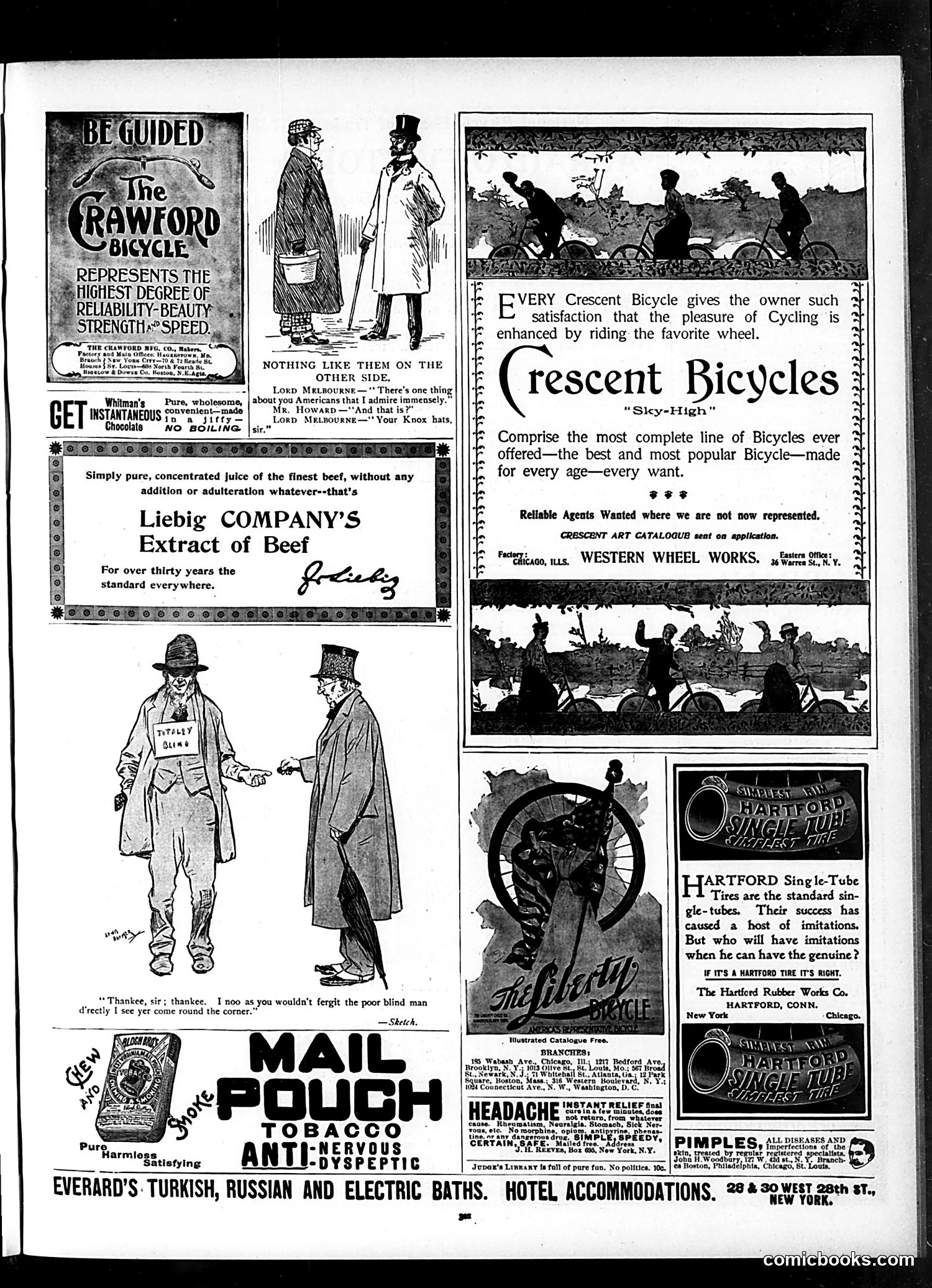
This is primarily an **advertising page** from Judge magazine, with one satirical cartoon at the top. ## The Main Cartoon The cartoon depicts a conversation between **Lord Melbourne** (a British aristocrat) and **Mr. Howard** (an American). Melbourne compliments Americans on their Knox hats—a popular American hat brand. The joke is genteel flattery: a distinguished British peer admits that Americans excel at *one thing*—hat manufacturing. This satirizes both British snobbery (implying Americans are otherwise inferior) and American pride in industrial goods. The humor relies on the absurdity of hat quality being the sole American achievement worth praising to a British lord. ## The Advertisements The remainder consists of period product ads: Crawford bicycles, Liebig beef extract, Whitman's chocolate, Mail Pouch tobacco, Crescent and Hartford bicycles, and medicinal products. These reflect early 1900s consumer goods and are historically interesting but not satirical. The lower cartoon (showing a blind beggar) is unrelated to the page's main content.
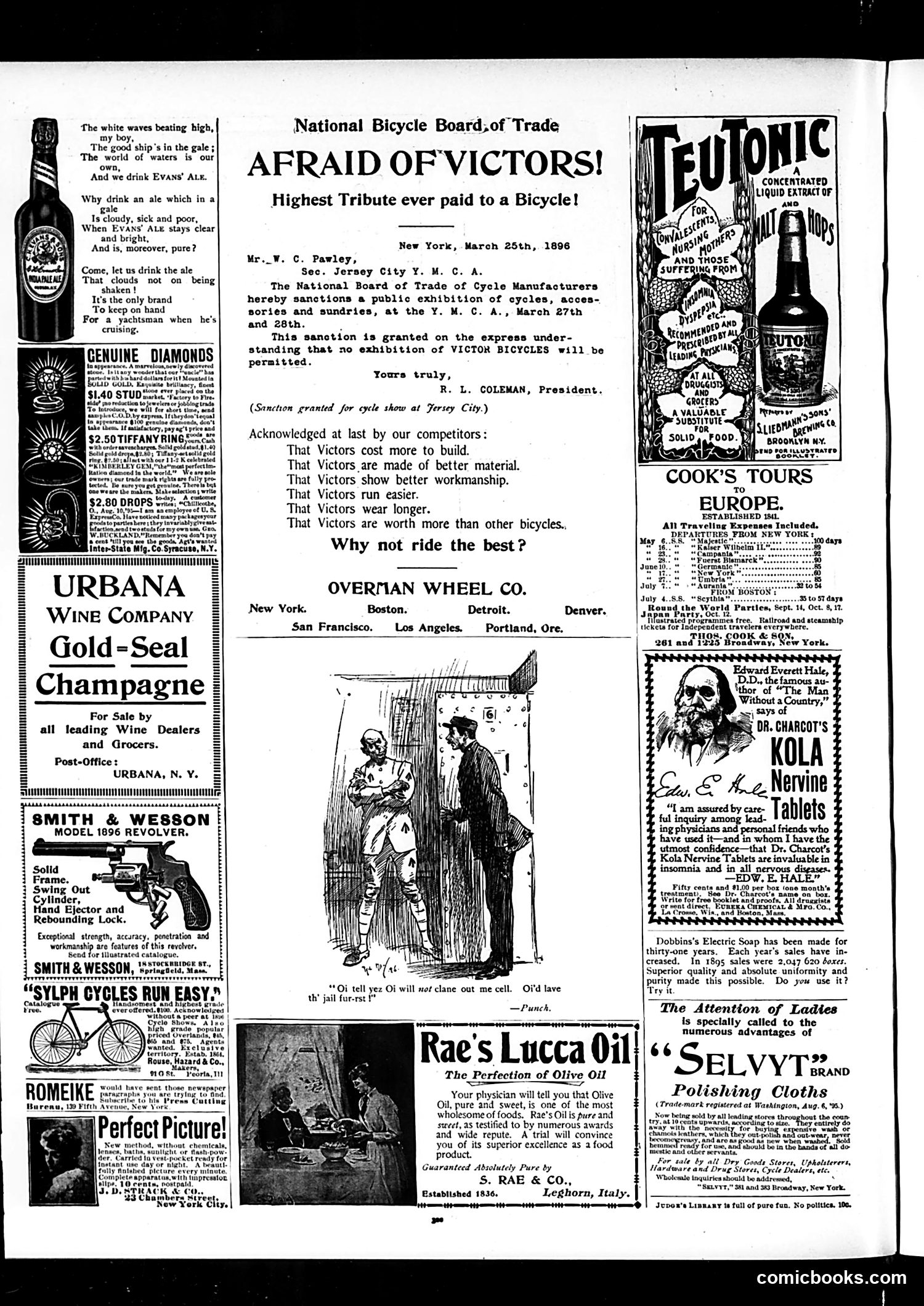
This page's central feature is a satirical advertisement by the Overman Wheel Company, which manufactures Victor bicycles. The humor lies in a letter from the National Bicycle Board of Trade granting permission for a cycle show—**on the condition that Victor bicycles be explicitly excluded from exhibition**. The satire is the contradiction: the letter claims this exclusion proves competitors' grudging acknowledgment that Victors are superior ("cost more to build," "made of better material," "run easier," "wear longer"). By banning the competitor's product, the board inadvertently advertises its dominance. The page headline—"Afraid of Victors!"—drives home the joke: the competitors' protectionist measure backfires as an accidental endorsement. This reflects 1890s bicycle industry competition, when bicycles were major consumer products and brands competed fiercely for market share. The cartoon's satire mocks trade organizations' transparent self-interest while promoting Victor bicycles through humorous irony.
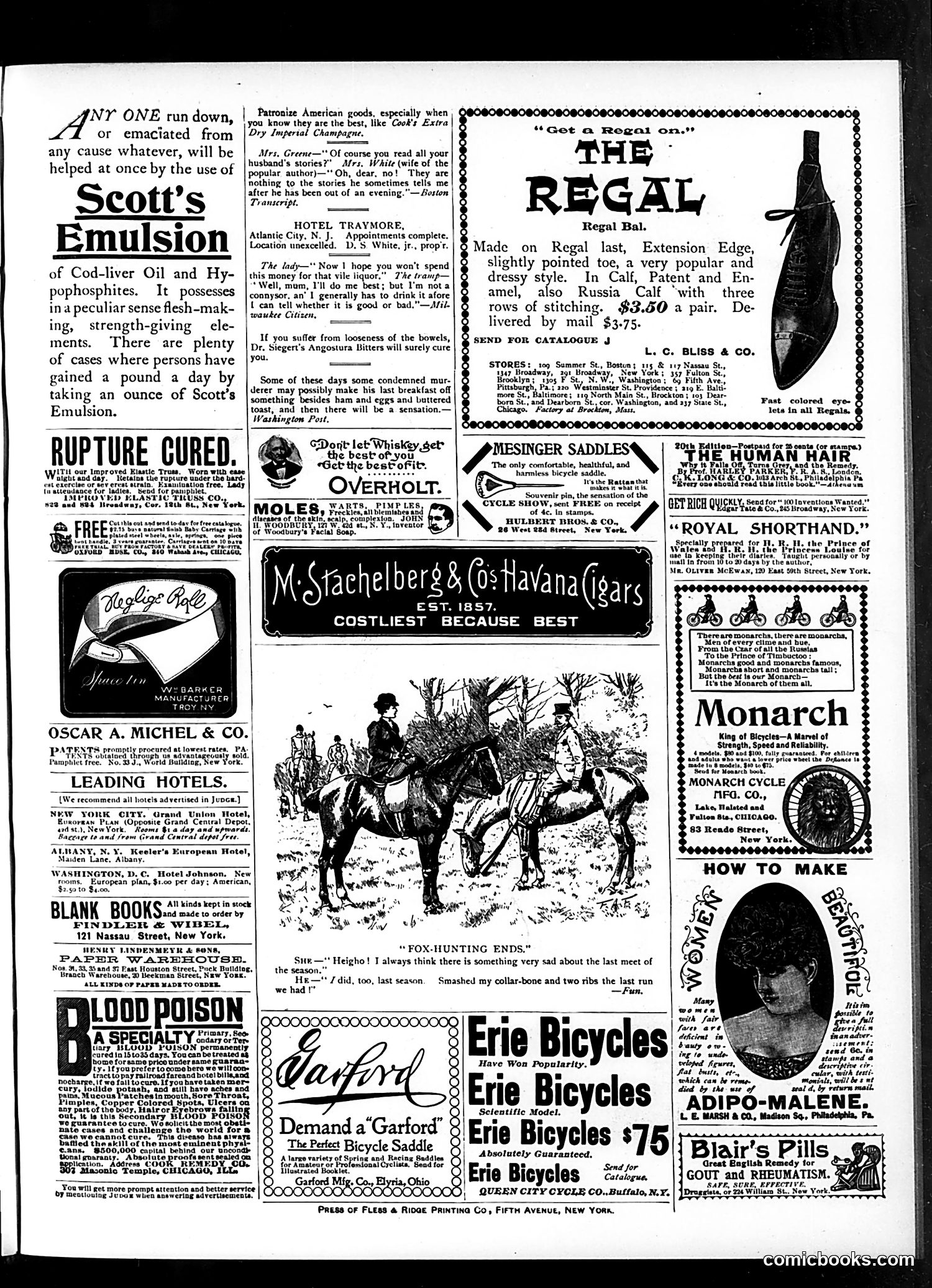
This is primarily an **advertising page** from Judge magazine, containing product promotions rather than satirical cartoons requiring political analysis. The one illustrated cartoon shows two horsemen in a landscape with the caption "FOX-HUNTING ENDS," depicting a conversation between hunters about a disappointing season—a gentle joke about disappointing results rather than political satire. The page features numerous late-19th/early-20th century advertisements for products including Scott's Emulsion (cod-liver oil supplement), patent medicines, hotels, bicycles, and saddles. Notable is period medical advertising now considered dubious—blood poison treatments, rupture cures, and various nostrums claiming broad curative powers. Several brief humorous quotations appear (labeled as from publications like the *Washington Post* and *Milwaukee Citizen*)—light domestic humor about wives, tramps, and condemned prisoners. The **dominant content is commercial**, not satirical commentary, reflecting Judge's revenue model of advertising-supported humor magazines of that era.
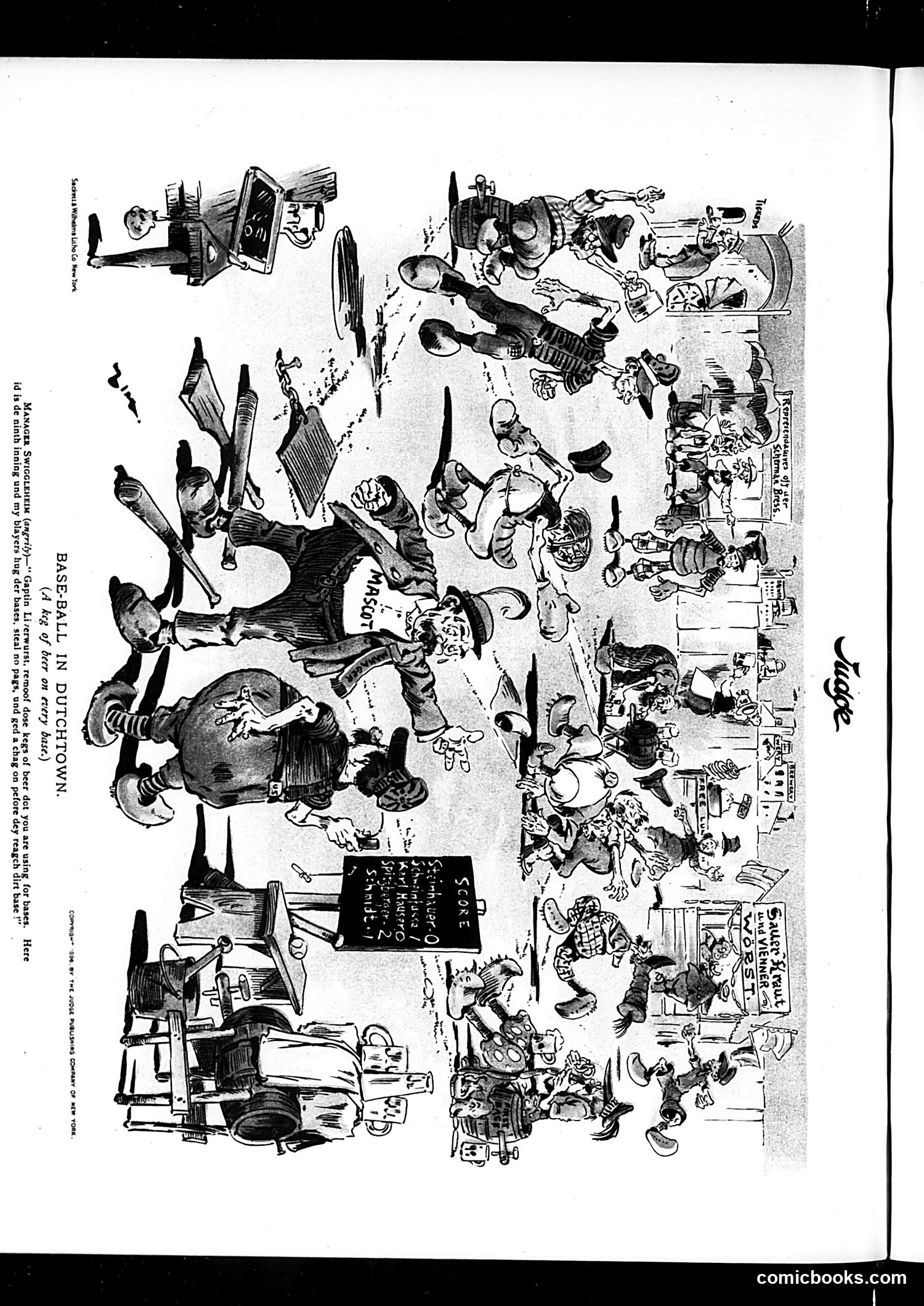
This Judge cartoon satirizes German-American immigrants through ethnic stereotyping. The scene depicts a baseball game where beer kegs serve as bases—a joke about German beer culture and supposed German immigrant obsession with alcohol. The manager, speaking in exaggerated German dialect ("dose kegs," "der bases," "dey reagch"), orders the captain to remove the beer kegs. The humor relies on the stereotype that German-Americans prioritized drinking over the rules of baseball itself, with players allegedly stopping to drink rather than advancing bases properly. The dialect spelling and mispronunciations reinforce period xenophobia toward German immigrants. "Dutchtown" refers to German neighborhoods (from "Deutsch"). This reflects early-20th-century American nativism, when immigrant communities faced ridicule in popular media.