
A complete issue · 16 pages · 1896
Judge — May 2, 1896
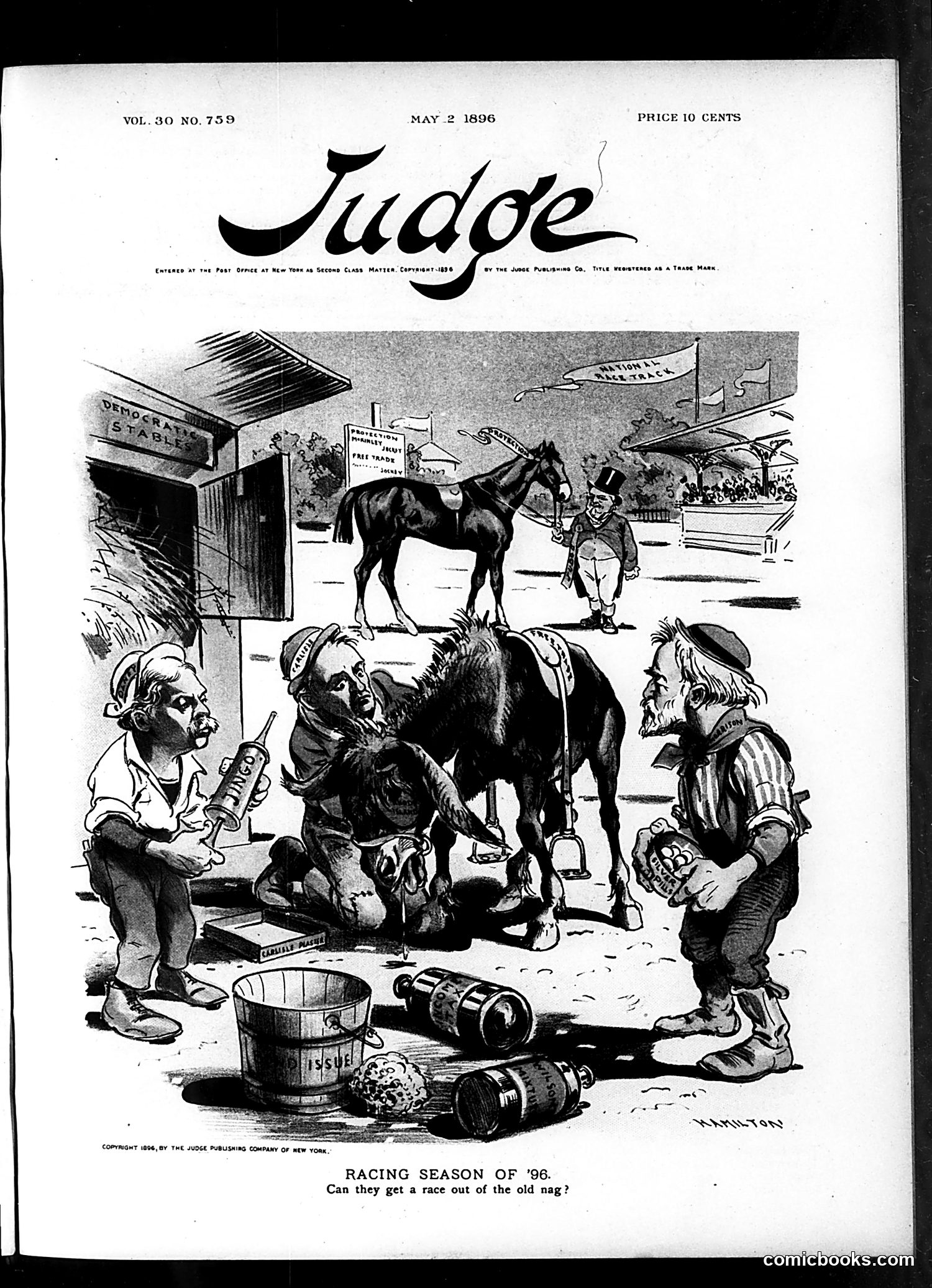
This political cartoon satirizes the 1896 U.S. presidential race. The caption asks "Can they get a race out of the old nag?" suggesting the Democratic Party (represented by the tired horse) faces difficulties in the upcoming election. Three figures in caricatured style (appearing to represent Democratic political figures or factions) cluster around the exhausted horse with various tools and bottles—possibly depicting attempts to revive or stimulate the party's prospects through different remedies or strategies. The "Democratic Stables" sign and racing setting serve as extended metaphor: the Democratic candidate and party are like worn-out racehorses unlikely to win the 1896 election. The satire mocks the party's apparent weakness and internal division heading into that year's presidential campaign.
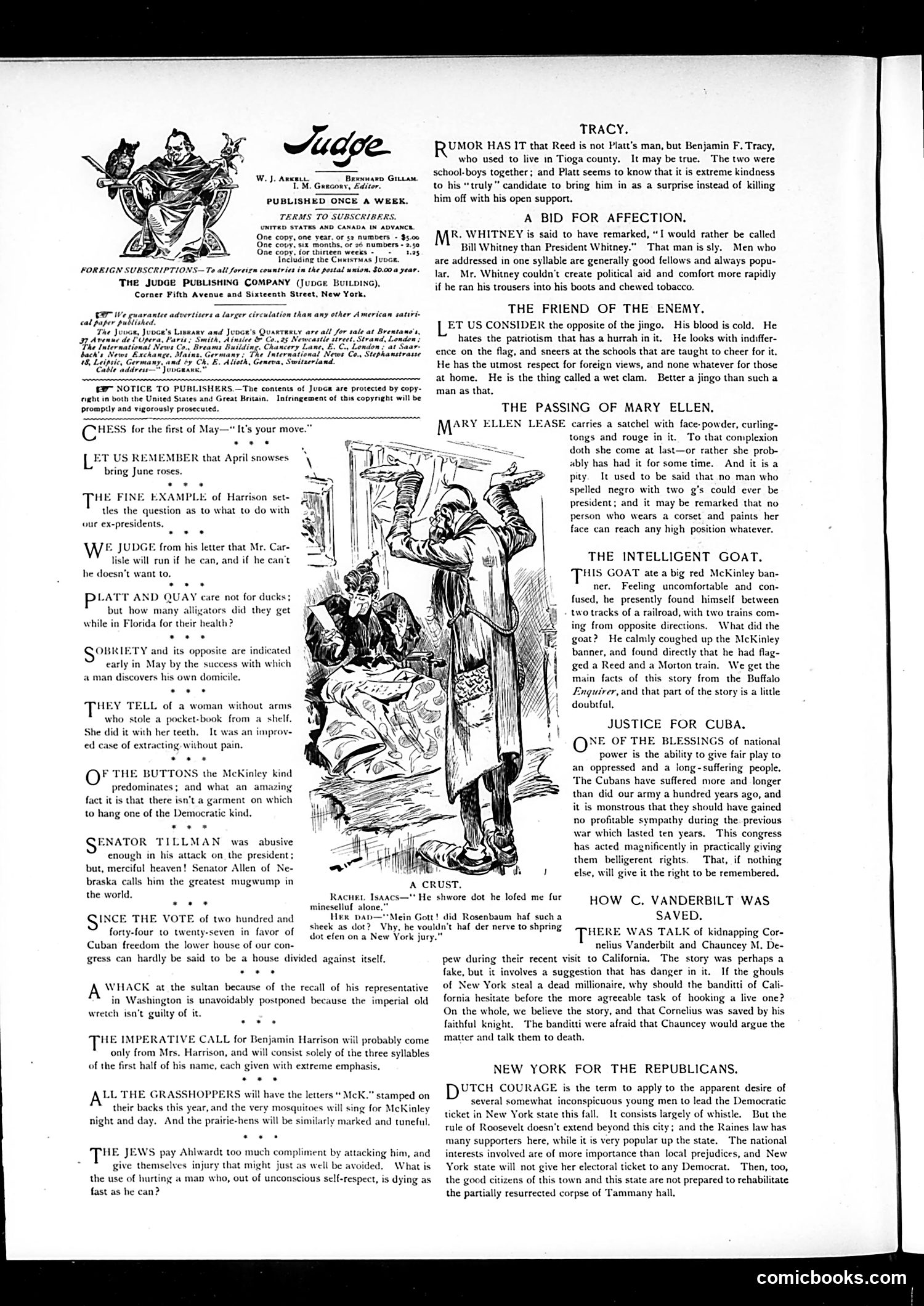
The main cartoon titled "A Crust" depicts a figure labeled "ISAAC" in what appears to be a train accident or collision scenario. The accompanying text discusses a man named Isaac who "swore dot he fared me for some years," using dialect speech that stereotypes Jewish immigrants. The surrounding editorial content addresses various political figures and issues of the era, including references to Benjamin Harrison, McKinley, and Cuban independence. Several short satirical paragraphs mock politicians and public figures through wordplay and commentary. Without clearer dating or more context, the specific historical moment is unclear, but the page reflects Judge's typical approach: combining crude ethnic stereotyping with political commentary aimed at contemporary readers who would recognize the figures and events referenced.
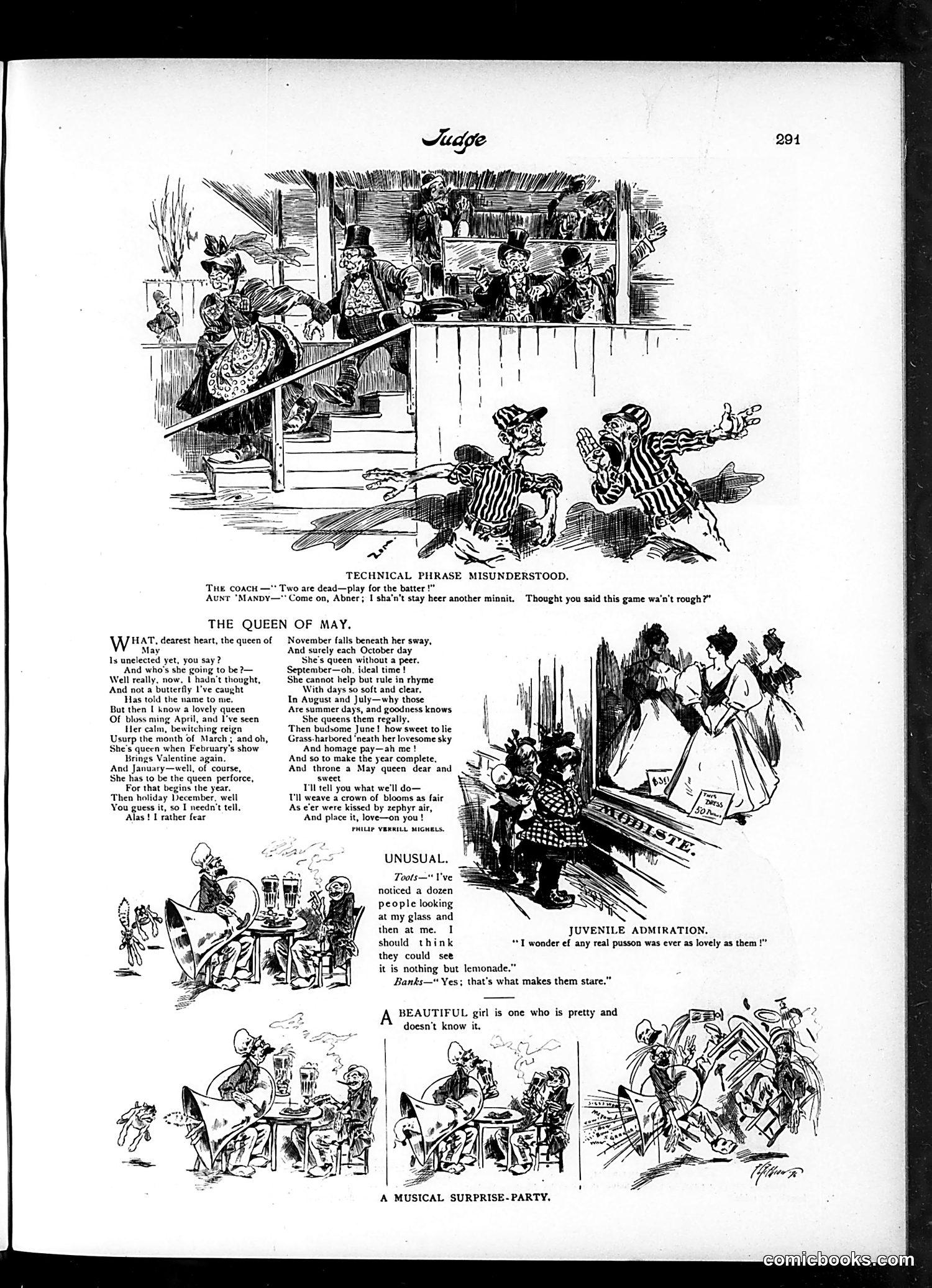
This page contains several unrelated satirical sketches typical of Judge's format: **"Technical Phrase Misunderstood"** shows a baseball coach and players, satirizing miscommunication through sports jargon—a coach's instruction about "dead" players confuses young players who take it literally. **"The Queen of May"** is a poem celebrating May and spring, with accompanying illustrations of social scenes. **"Unusual"** and **"Juvenile Admiration"** are brief dialogue jokes about observing people and attraction, likely mocking social pretension. **"A Beautiful Girl"** and **"A Musical Surprise-Party"** appear to be sequential cartoon gags about romance and social gatherings, common Judge fare satirizing upper-class courtship customs and party etiquette of the era. The page emphasizes humor through misunderstandings and social situations rather than explicit political commentary.
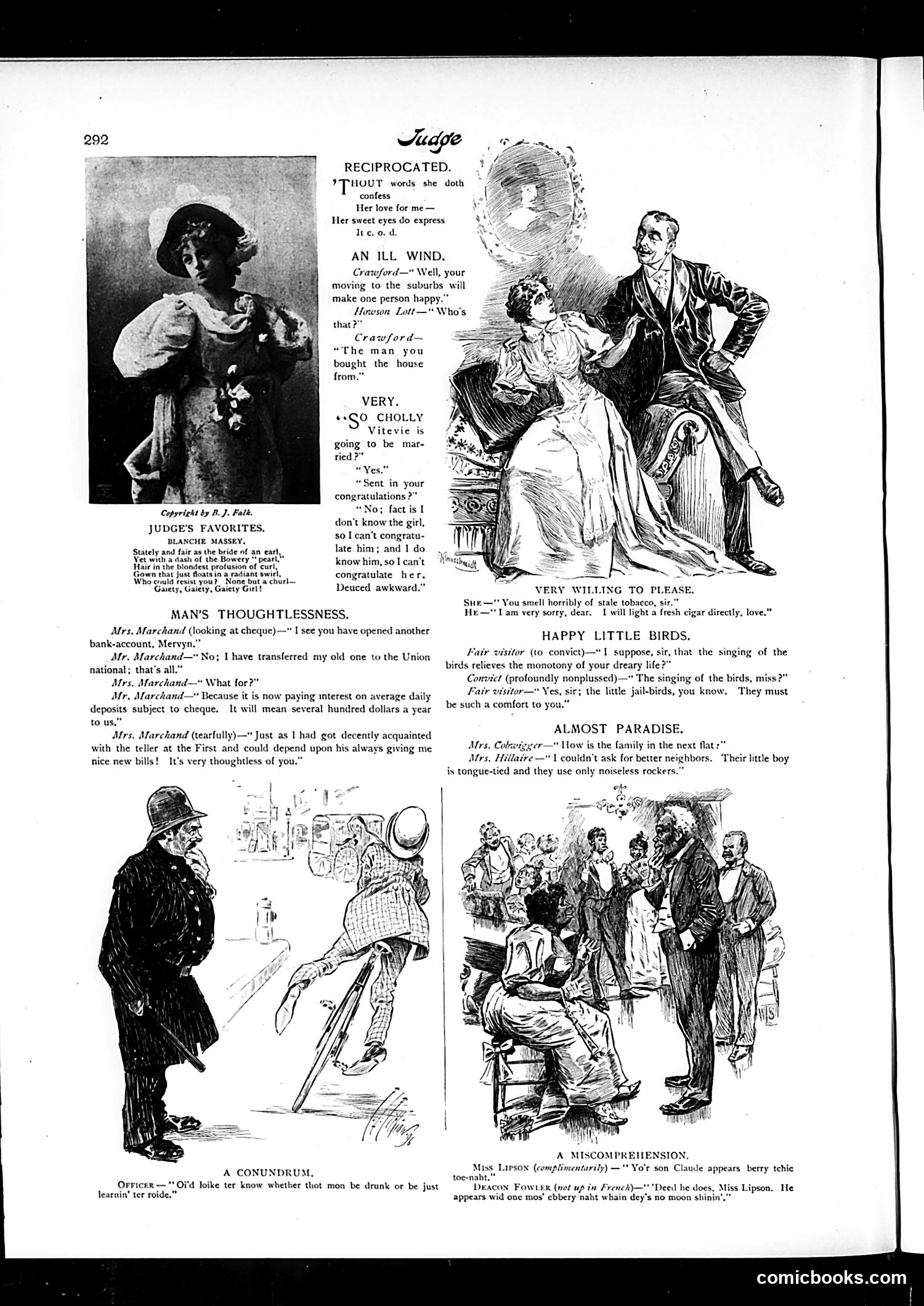
This page from *Judge* magazine contains several short satirical vignettes mocking middle-class social conventions and marital dynamics circa early 1900s. **Key sketches:** - **"Man's Thoughtlessness"**: A husband transfers his bank account to avoid his wife's access, then opens a new one earning interest—the joke being his self-centered obliviousness to her emotional hurt. - **"An Ill Wind"**: A man brags that moving to suburbs will make "someone happy"—the seller, because the buyer overpaid, satirizing suburban real estate deals. - **"Very, So Cholly"**: A man won't congratulate an engaged couple because he doesn't know either party well enough—mocking superficial social etiquette and its absurdities. - **"Almost Paradise"**: Neighbors are praised for having a "tongue-tied" child and silent rockers—satirizing the desire for quiet, well-behaved neighbors. The humor targets petty bourgeois anxieties: money management, social climbing, marital tension, and neighborhood propriety. The tone is gently mocking rather than vicious.
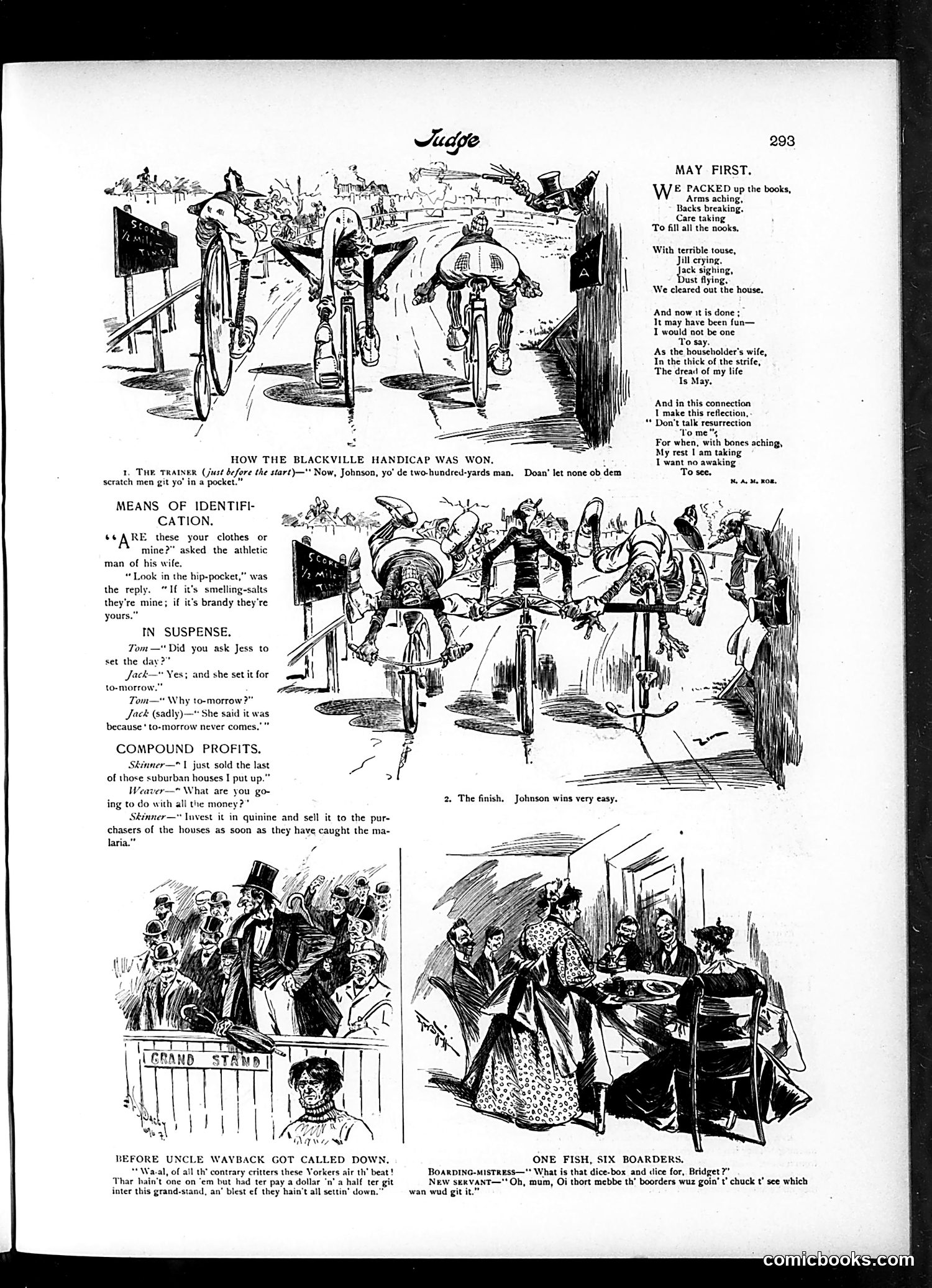
This page contains multiple unrelated satirical cartoons and humorous sketches typical of early 20th-century Judge magazine. **"May First"** depicts moving day frustrations—a household wife's complaint that the annual May 1st moving tradition is exhausting and dreaded. **"The Blackville Handicap"** appears to be a racial caricature depicting a bicycle race, using period stereotypes in dialect ("Doan' let none ob dem scratch men git yo'"). **Other sketches** include: a marital joke about identifying clothes by contents (salts vs. brandy); a dark joke about a woman setting her wedding for "tomorrow" because "tomorrow never comes"; a developer's scheme to sell quinine with suburban houses to malaria victims; a rural character's complaint about workers; and a boarding-house servant's misunderstanding about dice and fish. The humor reflects era-typical attitudes: casual racism, gender stereotypes, and crude commercial cynicism. These sketches aimed at Judge's middle-class readership through familiar domestic and social scenarios.
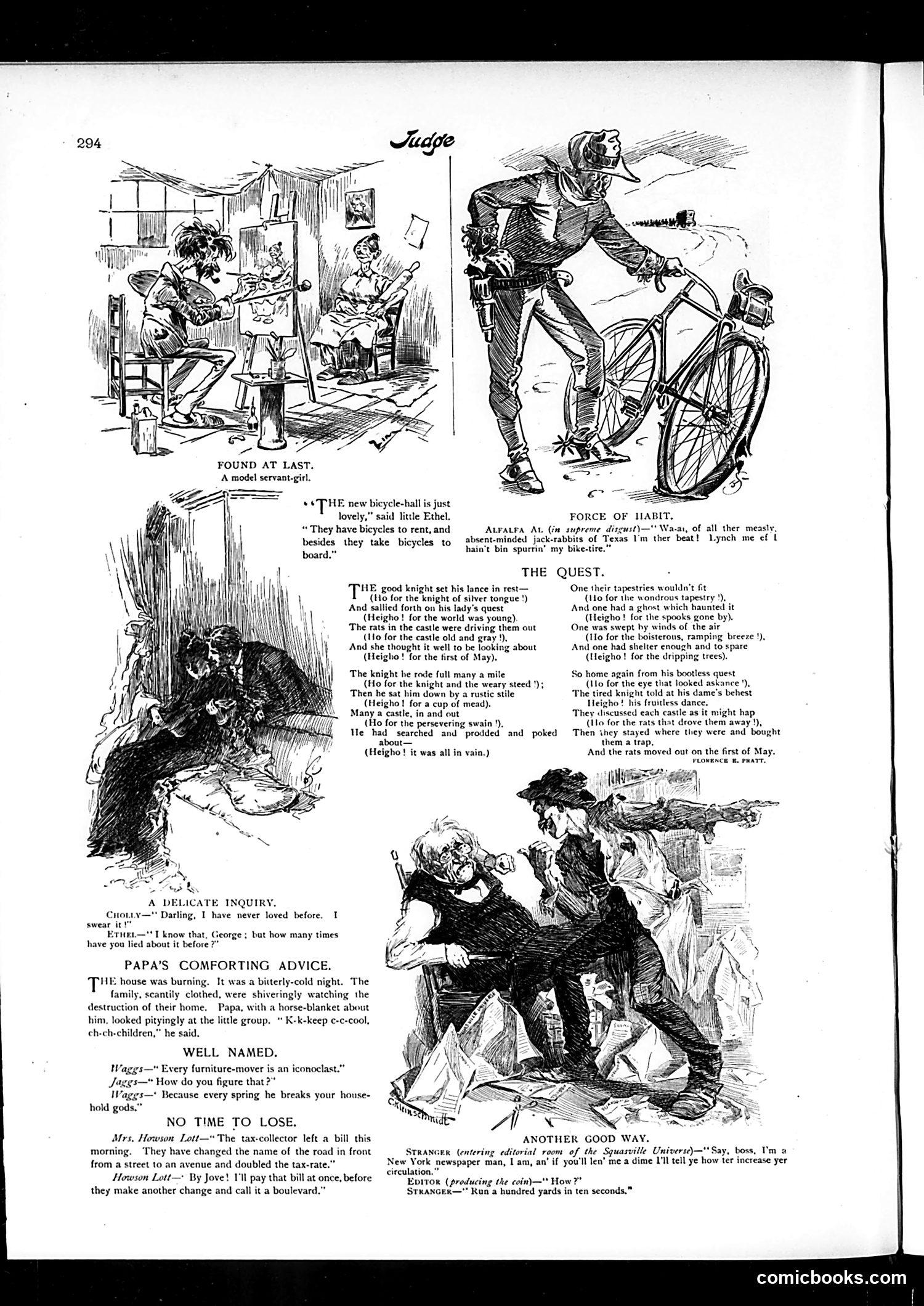
This page contains several short humorous sketches typical of Judge's satirical style: **"Found at Last"** mocks the era's "servant problem"—the difficulty wealthy households faced hiring domestic help. The joke satirizes employers' unrealistic expectations. **"A Delicate Inquiry"** plays on Victorian courtship anxieties, with a woman questioning her suitor's past dishonesty before accepting his love declaration. **"Papa's Comforting Advice"** uses absurdist humor: a father tells his freezing family to "keep cool" while their house burns—impractical wisdom presented deadpan. **"Well Named"** makes a pun about furniture movers as "iconoclasts" (breakers of idols/household goods). **"The Quest"** is a mock-heroic poem about a knight searching castles for a lady, only to find them unsuitable due to rats, ghosts, and weather—deflating romantic adventure. **"No Time to Lose"** satirizes municipal bureaucracy: renaming streets to "avenues" increases property taxes, prompting the character to pay quickly before further name changes occur. The page reflects turn-of-century American middle-class anxieties: domestic service issues, courtship etiquette, and government inefficiency.
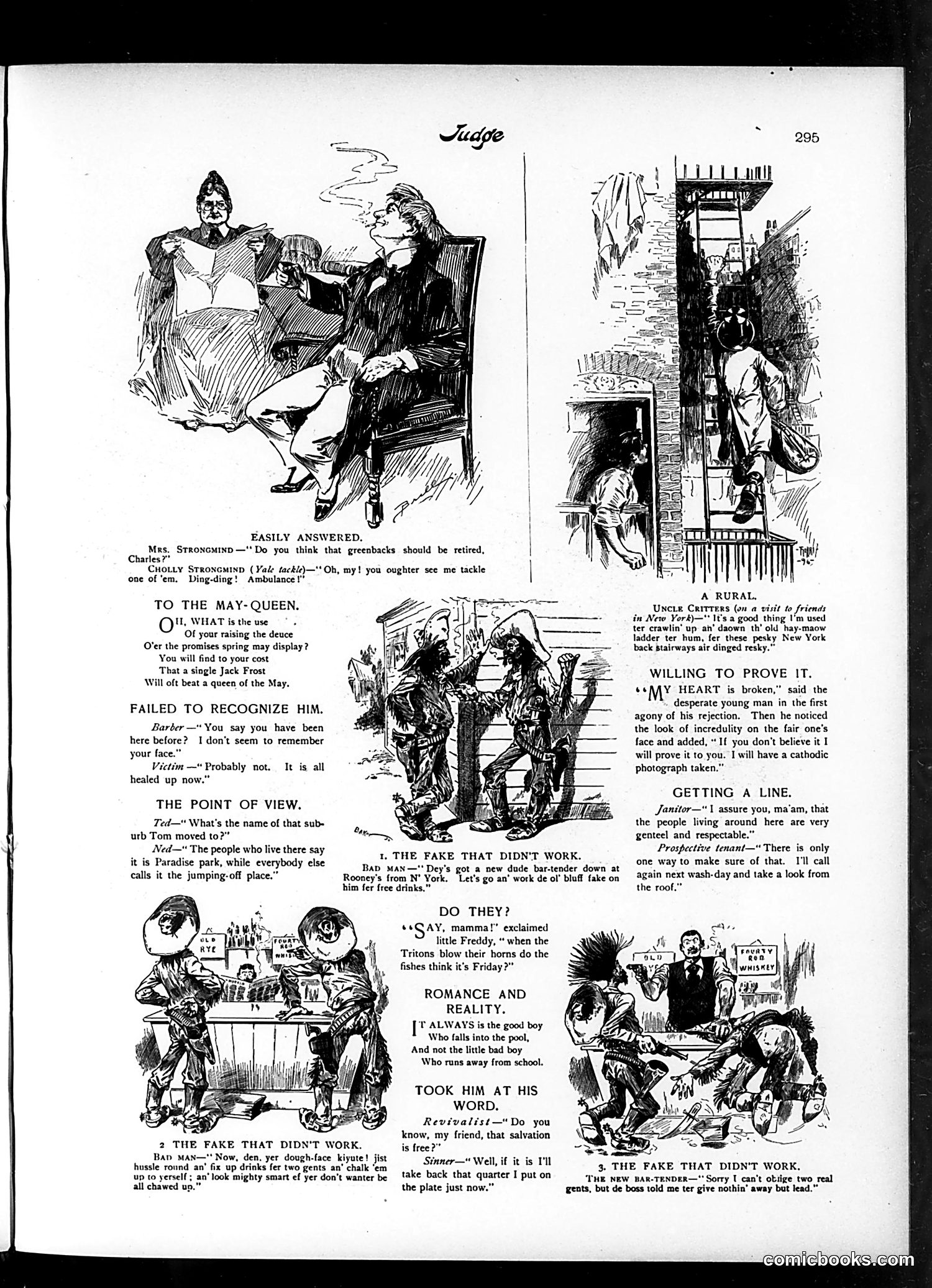
This page of satirical humor contains multiple short jokes reflecting Gilded Age concerns and social types. **"Easily Answered"** mocks a Yale student (identified as "Cholly") who misunderstands "retiring greenbacks" (paper currency) as a football tackle, confusing financial policy with sports. **"Failed to Recognize Him"** jokes about a barber who doesn't remember a customer whose face has healed from previous injuries—implying the victim was badly beaten. **"The Fake That Didn't Work"** (appears twice) shows con artists attempting schemes: one tries to bilk a bartender by posing as a free-spender; another attempts to deceive customers. Both fail when confronted with honest refusal. **"Romance and Reality"** contrasts Victorian moral tales (good boys suffer) with actual behavior (bad boys escape). **Other sketches** satirize: rural ignorance about urban stairs, a heartbroken suitor's theatrical dramatics, tenant skepticism about neighborhood gentility, and a child's innocent misunderstanding about mythological creatures. The humor targets pretension, fraud, class differences, and naive romanticism typical of 1890s-era American satire.
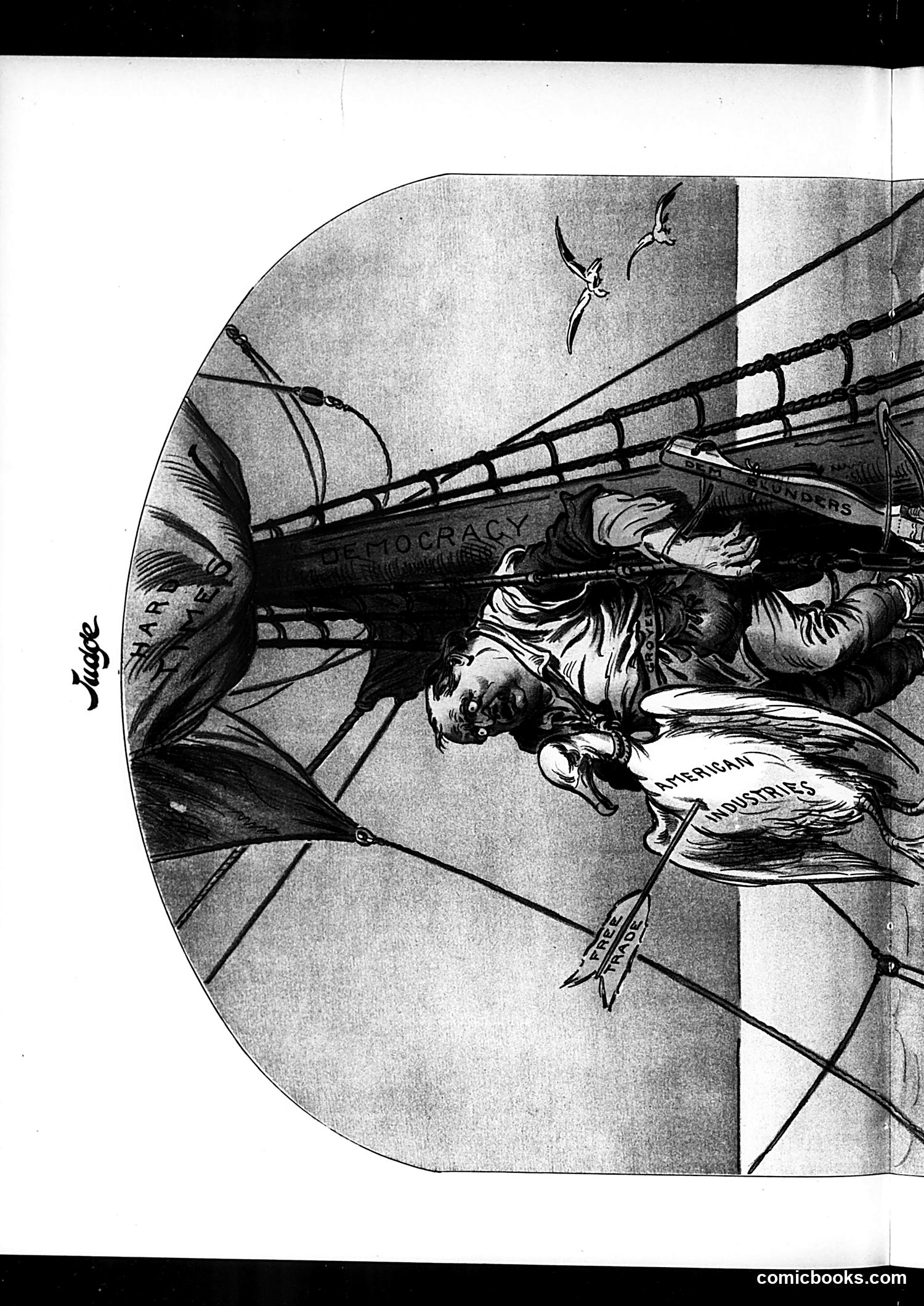
This appears to be a political cartoon from *Judge* magazine satirizing American democracy and governance. The image shows a figure labeled "Democracy" being steered like a ship by what appears to be political operators or "Tammany" officials (visible text references Tammany Hall, the notorious New York Democratic political machine). The figure at the helm is depicted as controlling or manipulating democracy itself, suggesting corruption and backroom political control. The cartoon critiques how machine politics—particularly Tammany Hall's notorious influence—undermined genuine democratic principles by placing power in the hands of political bosses rather than the people. The ship metaphor represents the nation's course being determined by corrupt political machinery rather than legitimate democratic processes.
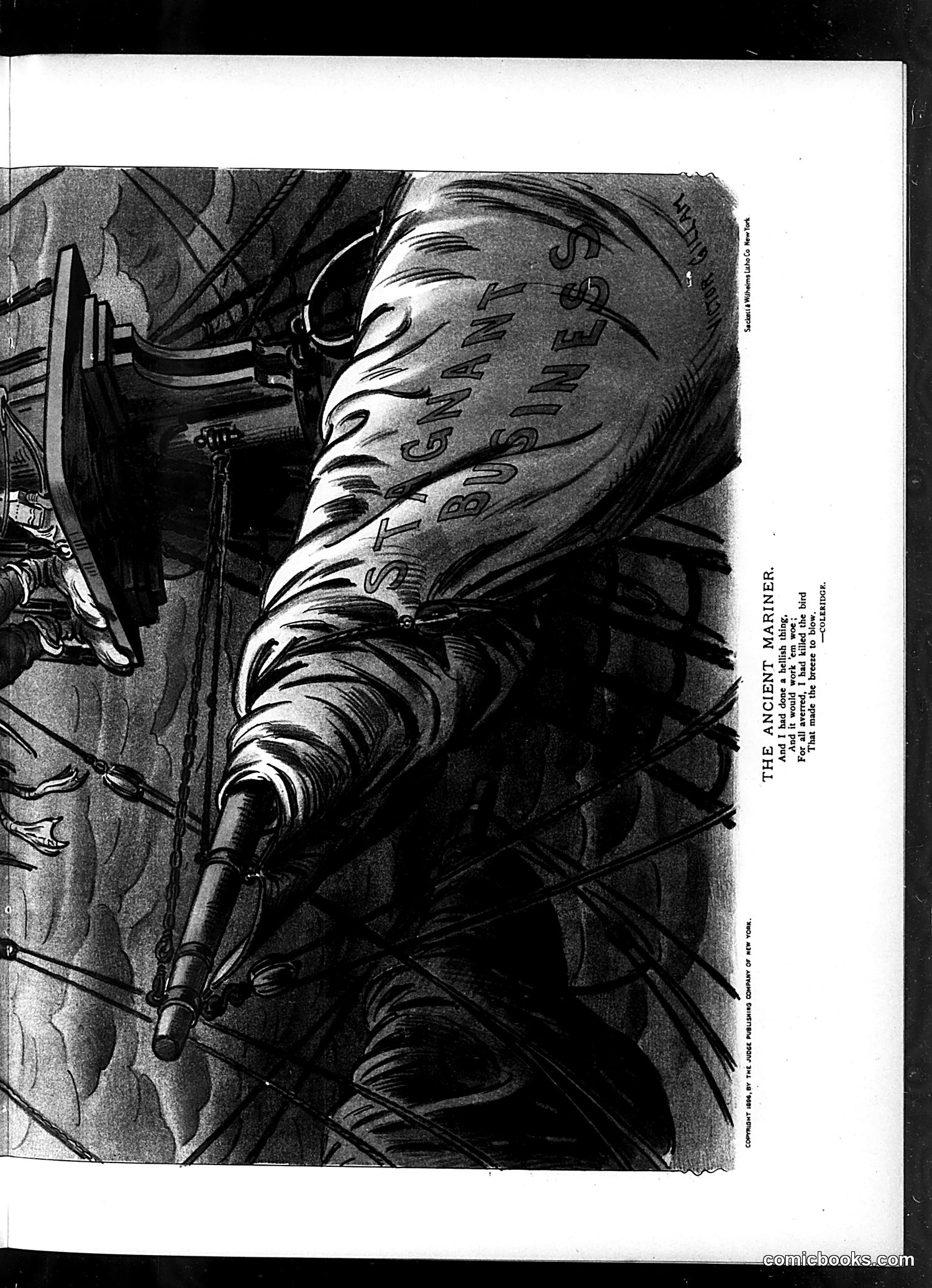
This appears to be a satirical illustration titled "The Ancient Mariner," likely referencing Samuel Taylor Coleridge's famous 1798 poem. The image shows a figure with numbered sections marked on the body, rendered in dramatic black-and-white illustration style typical of Judge magazine's political cartoons. The exact satirical target is unclear from the OCR'd text, which appears corrupted. However, the "Ancient Mariner" reference typically invoked themes of curse, burden, or being doomed to wander—suggesting the cartoon critiques some contemporary political or social figure as trapped by circumstances or their own history. Without clearer context about the publication date and caption, the specific target remains uncertain.
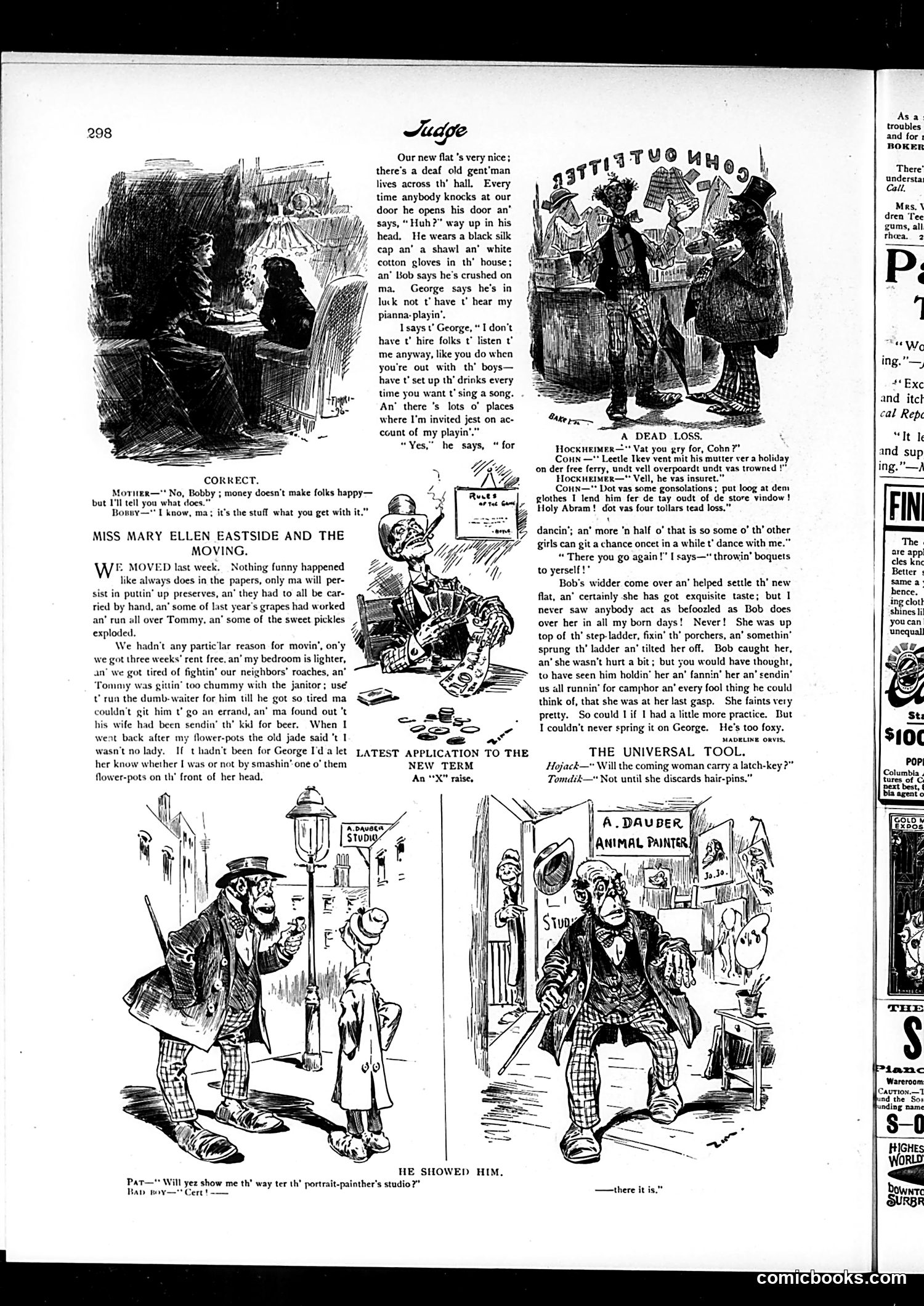
This page contains several satirical pieces typical of Judge magazine's social humor: **"Miss Mary Ellen Eastside and the Moving"** is a domestic comedy about working-class moving day mishaps—preserves exploding, grapes spilling on children, pickles bursting. The humor targets both the chaos of tenement life and Mary Ellen's sharp-tongued observations about neighbors and janitors. **"A Dead Loss"** depicts two Jewish characters (identified by dialect) grieving over a child who drowned during a ferry outing. The satire is callous: one man notes the boy was insured, but laments the four dollars in borrowed clothes lost—making the monetary loss the "real" tragedy. This reflects period stereotypes about Jewish merchants. **"The Universal Tool"** is a brief joke about women's liberation: a man asks if the "coming woman" will carry a latchkey (independence), and the punchline suggests she won't until she stops wearing elaborate hair-pins—implying women's fashion choices prevent their emancipation. The cartoons use exaggerated dialect and caricature typical of early 20th-century American humor, often reflecting period prejudices.
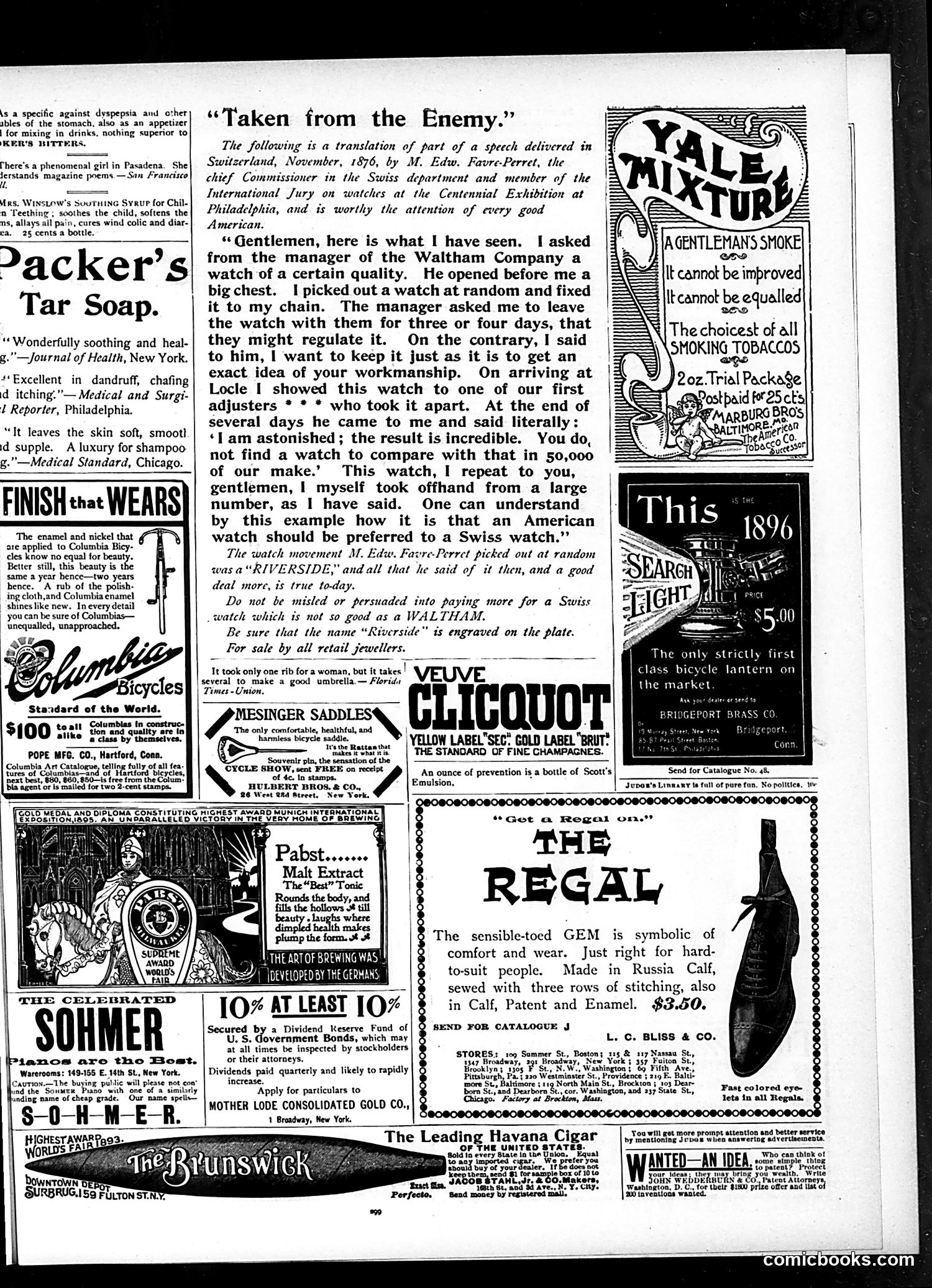
This page is primarily a **Waltham watch company advertisement** disguised as editorial content. The "article" quotes M. Edw. Favre-Perret, a Swiss official at the 1876 Centennial Exhibition, praising American manufacturing quality. The satire targets **Swiss watchmaking dominance**. Favre-Perret claims that a randomly selected Waltham "Riverside" watch so impressed Swiss adjusters that they called it superior to 50,000 Swiss timepieces. By attributing this praise to a respected foreign expert, the ad leverages competitive nationalism—suggesting American industrial superiority had overtaken traditionally dominant Swiss craftsmanship. The headline "Taken from the Enemy" reinforces this: Swiss watches were the established competition, and Waltham had allegedly "taken" the market. The ad thus appeals to American pride in domestic manufacturing while undercutting foreign competitors through professional testimony. The page contains numerous other period advertisements (bicycles, saddles, soap, champagne) typical of **Judge magazine's format**.
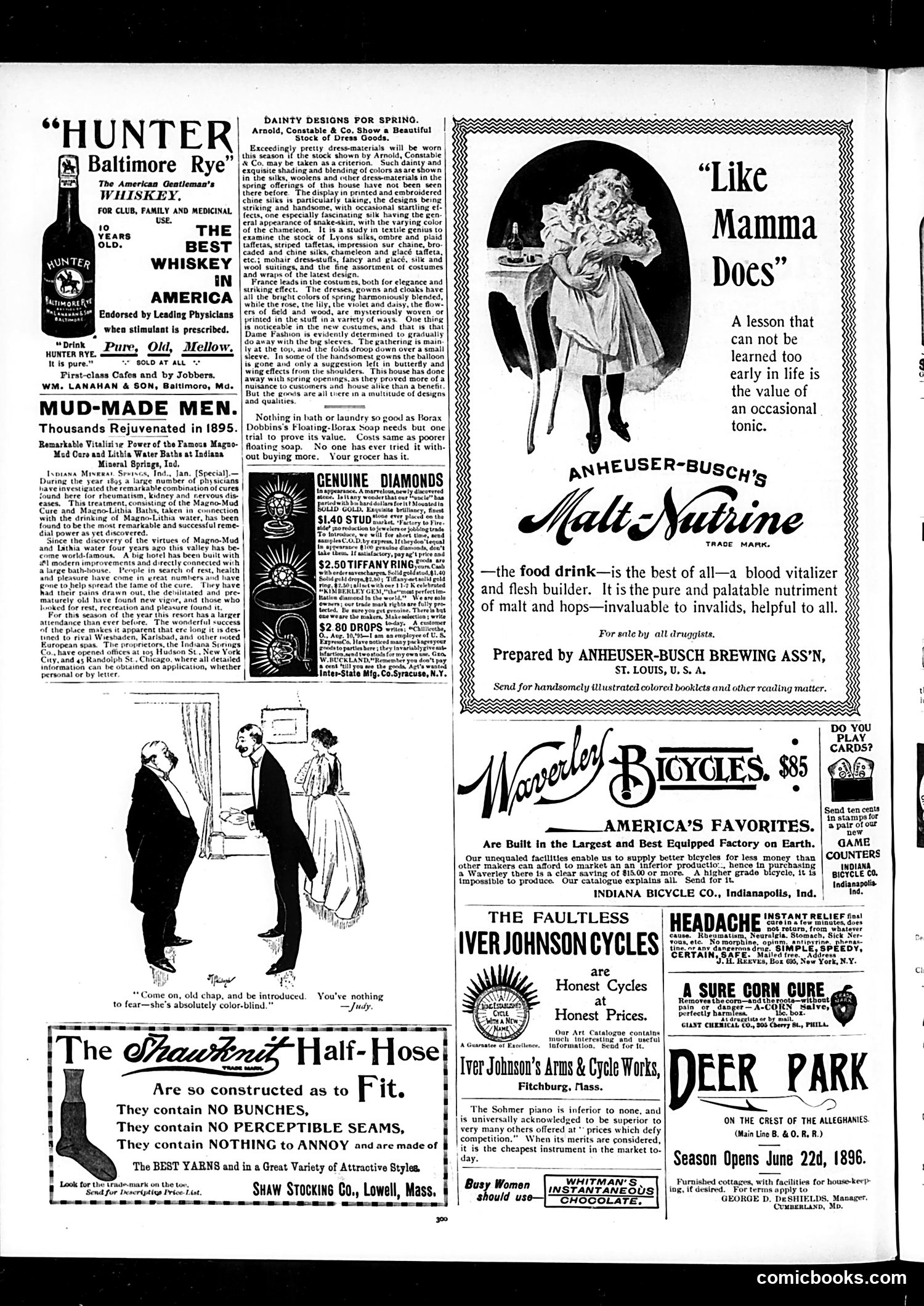
This page is primarily **advertising**, not satire or political commentary. It contains product advertisements typical of 1890s American magazines, including: - **Hunter Baltimore Rye whiskey** (promoted as medicinal, "endorsed by leading physicians") - **Magno-Mud spa treatments** at Indiana Mineral Springs, claiming to cure rheumatism and nervous diseases - **Genuine Diamonds** and jewelry - **Anheuser-Busch's Malt-Nutrine** (a malt beverage marketed as a "blood vitalizer") - **Watterley Bicycles**, **Iver Johnson Cycles**, and other products The single cartoon depicts two men in conversation with the caption "Come on, old chap, and be introduced to her. You've nothing to fear—she's absolutely color-blind." This appears to be a social/romantic joke about appearance or fashion, likely relating to the spring dress goods advertised above it. The page reflects late 1890s consumer culture and advertising practices, including dubious health claims now recognized as false.
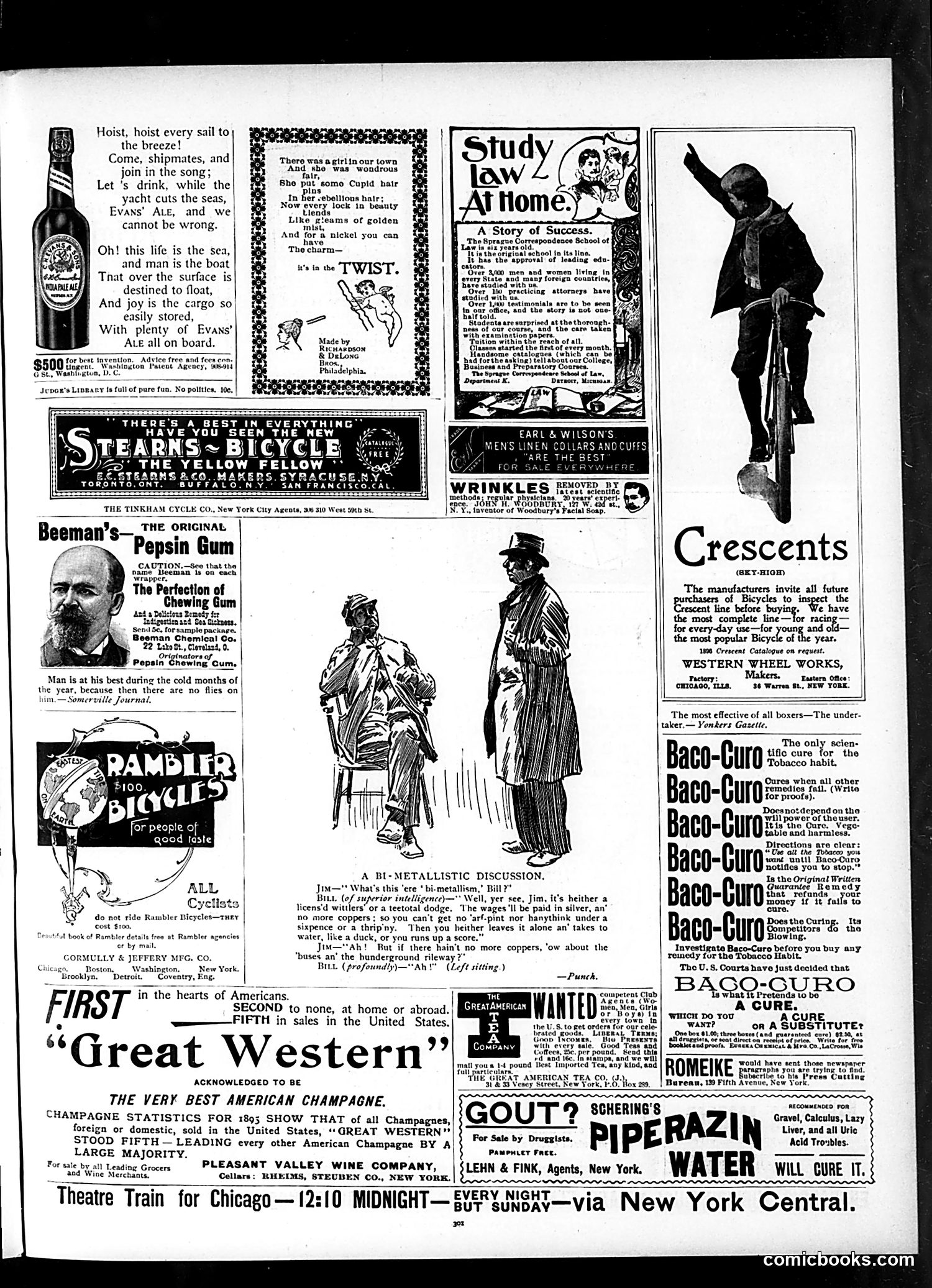
This is primarily an **advertising page** from Judge magazine, with one notable satirical cartoon. ## The Main Cartoon: "A Bi-Metallistic Discussion" The cartoon depicts two working-class men (Jim and Bill) debating **bimetallism**—a major 1890s political controversy over whether currency should be backed by both gold and silver. Bill, claiming "superior intelligence," gives a deliberately nonsensical explanation, comparing it to either getting a liquor license or going teetotal, then confusing it with payment methods and transportation systems. **The satire**: This mocks how ordinary people didn't understand the heated bimetallic debate dominating American politics. The joke suggests that even those pretending expertise (Bill) spoke gibberish about the issue—reflecting public confusion over monetary policy that dominated the 1890s. ## Advertisements The page is filled with period product ads: Evans' Ale, bicycles (Stearns, Rambler, Crescent), Beeman's Pepsin Gum, "Great Western" champagne, and various patent medicines—typical of Judge's revenue model. The cartoon essentially satirizes public incomprehension of serious economic debate through deliberately absurd dialogue.
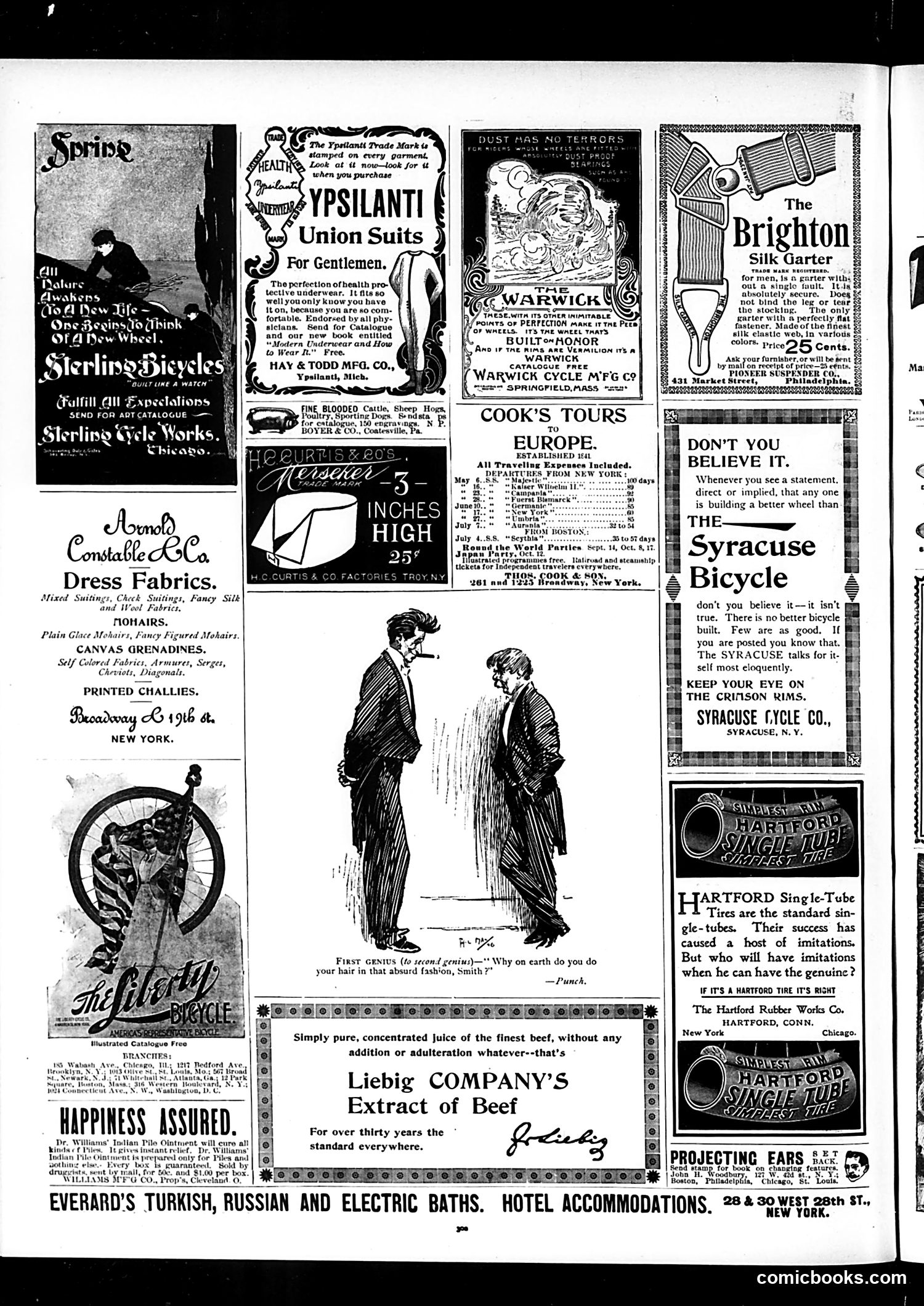
This page is primarily **advertisements** for late-19th/early-20th-century products: bicycles (Sterling, Syracuse, Liberty brands), men's underwear (Ypsilanti Union Suits), silk garters, bicycle tires (Hartford), fabric goods, and Liebig's Extract of Beef. The only **cartoon** is a small sketch labeled from *Punch* magazine showing two gentlemen, where one asks the other why he styles his hair in such an "absurd fashion." This is gentle social satire about men's grooming conventions—mocking exaggerated or unusual hairstyles as ridiculous affectation. The advertisements use typical period marketing: bold claims of superiority ("there is no better bicycle built"), appeals to endorsements and quality, and warnings against imitations. The page reflects the commercial competition of the Gilded Age bicycle boom and men's consumer goods market. No specific political content or identifiable public figures appear on this page.
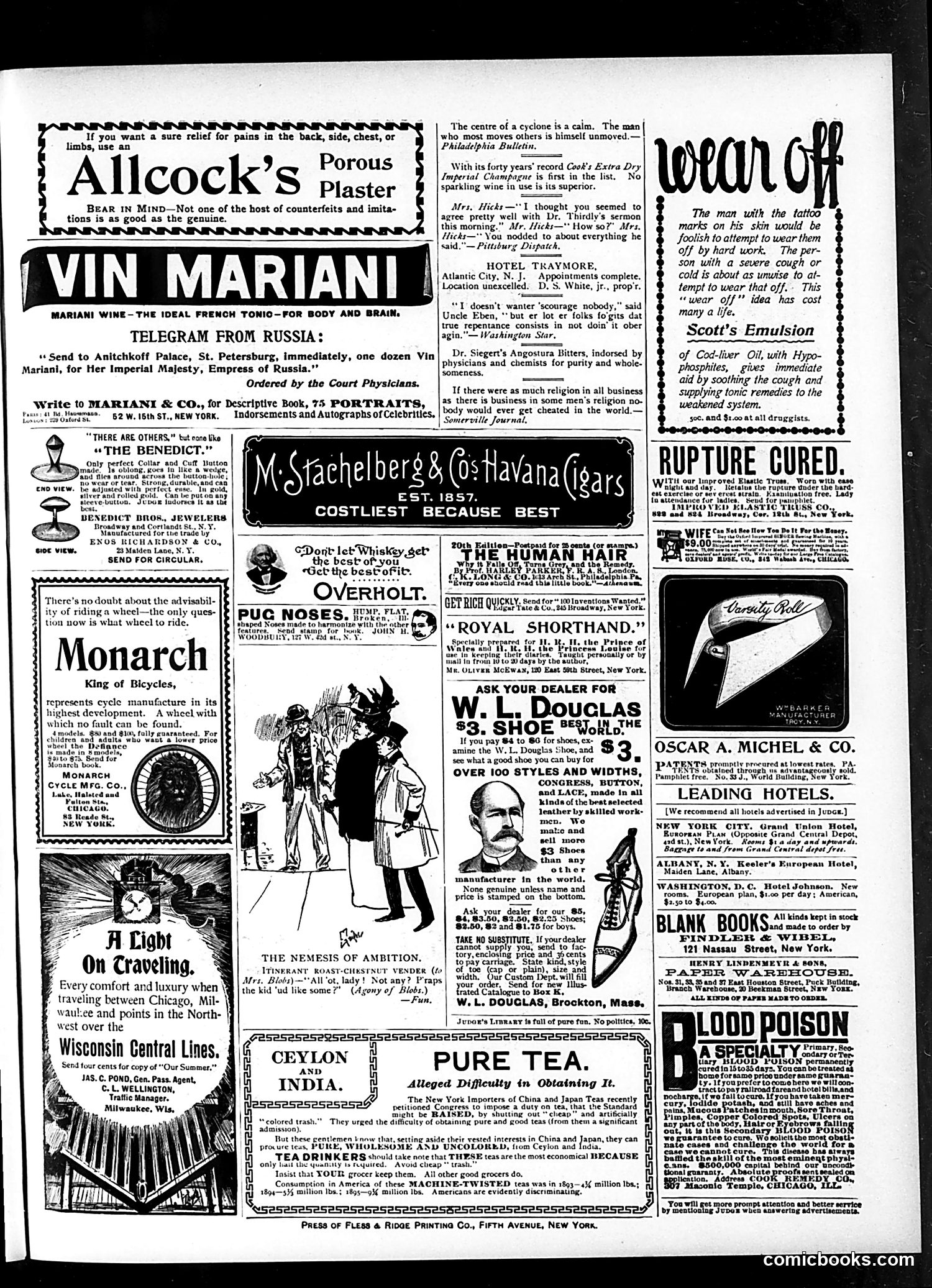
This is primarily an **advertising page** from Judge magazine, with minimal editorial content. The advertisements showcase patent medicines, luxury goods, and services typical of the late 19th century. The one identifiable **cartoon** depicts "The Nemesis of Ambition"—showing a street vendor (likely Italian, based on the stereotype dialect) attempting to sell roasted chestnuts to a wealthy woman ("Mrs. Blobs"). The humor lies in **class contrast**: the ambitious street vendor persistently pitches his wares even to the indifferent rich, who dismiss his product. The "nemesis" is that ambition cannot overcome social hierarchy—no matter how enterprising, the vendor cannot breach the class barrier separating him from his intended customers. The surrounding advertisements reflect **patent-medicine culture** and conspicuous consumption: Vin Mariani (wine tonic), Angostura Bitters, bicycles, and premium shoes. These ads exploit health anxieties and aspirational consumption common to Gilded Age readers.
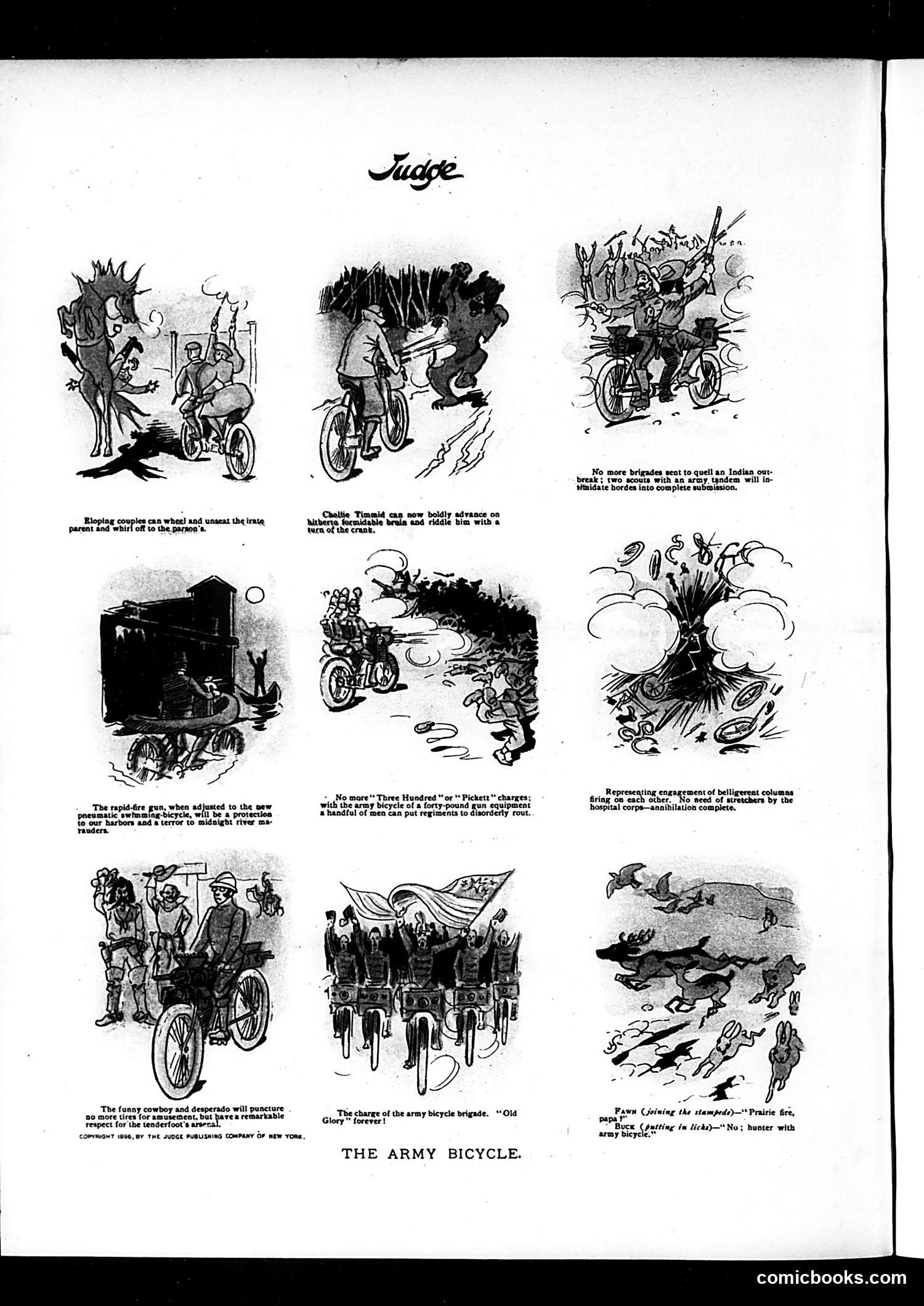
This is a satirical comic strip mocking the U.S. Army's experimental adoption of bicycles for military purposes (likely early 1890s). The panels ridicule this impractical idea through absurdist scenarios: **The satire targets:** - Using bicycles against Native Americans in Western conflicts ("Indian outbreak") - Bicycle brigades as military hardware ("army bicycle brigade") - The notion that bicycles could replace horses for cavalry and transport **Key jokes include:** - Cyclists colliding with each other and terrain obstacles - Cowboys and frontiersmen's skepticism toward this "tenderfoot" technology - The final image showing bicycles causing stampedes rather than controlling them The underlying point: bicycles are ridiculous for serious military applications, especially frontier combat. The satire mocks both the Army's progressive (but foolish) modernization and the clash between old-fashioned frontier warfare and new mechanical technology.