
A complete issue · 16 pages · 1896
Judge — January 11, 1896
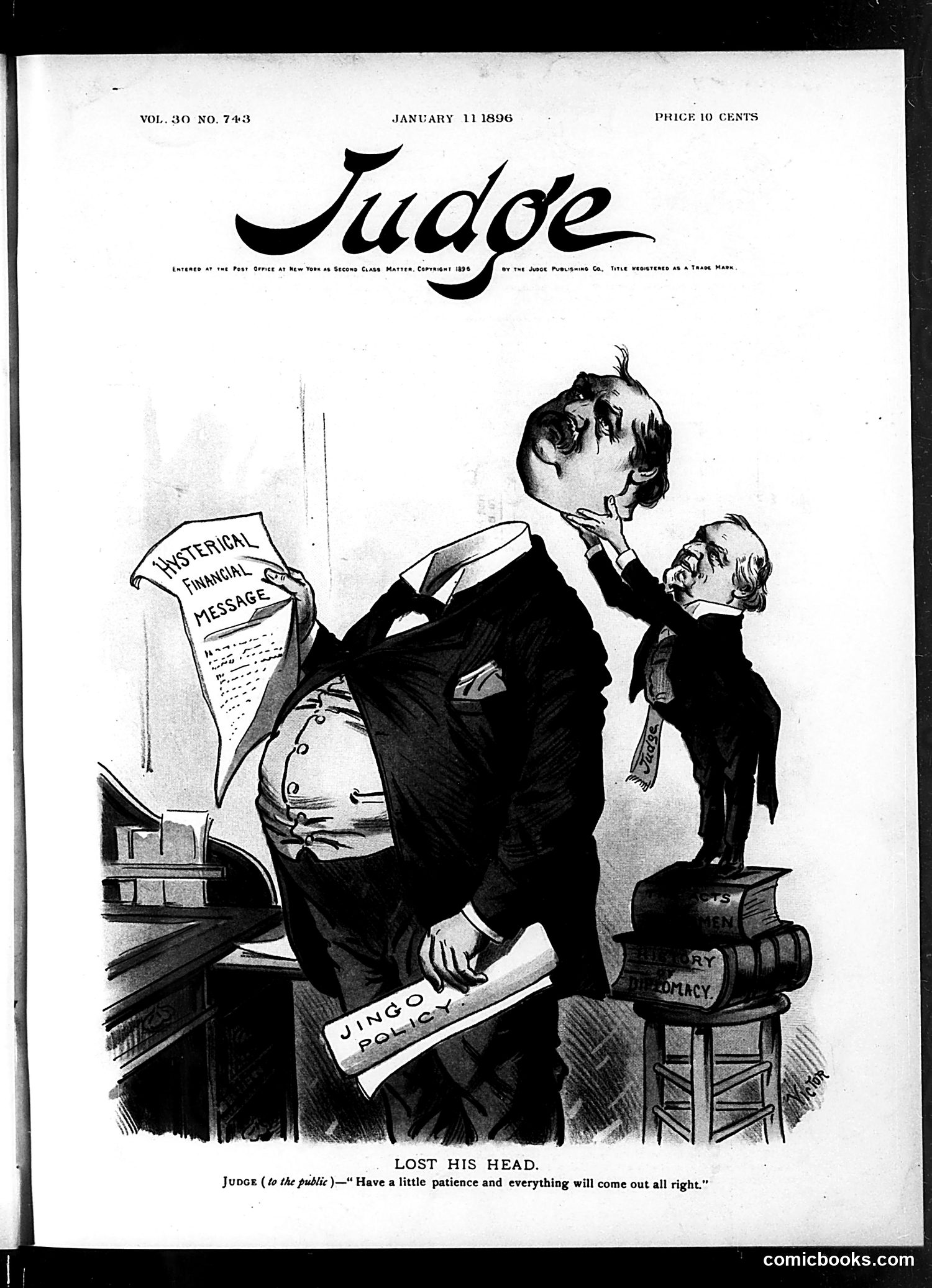
This political cartoon satirizes a judge who has lost composure during financial turmoil. The central figure—a judge holding documents labeled "Judging Policy" and "Hysterical Financial Message"—appears panicked and disheveled, literally losing his head (shown detached above). A smaller figure labeled with what appears to be "Prophecy" stands on law books beside him. The satire criticizes judicial overreaction to financial crisis and alarmist messaging. The caption quotes the judge telling the public to "have a little patience and everything will come out all right"—ironic advice given his own hysteria. This likely references 1890s financial market turmoil and judicial responses to banking crises or economic uncertainty of that era.
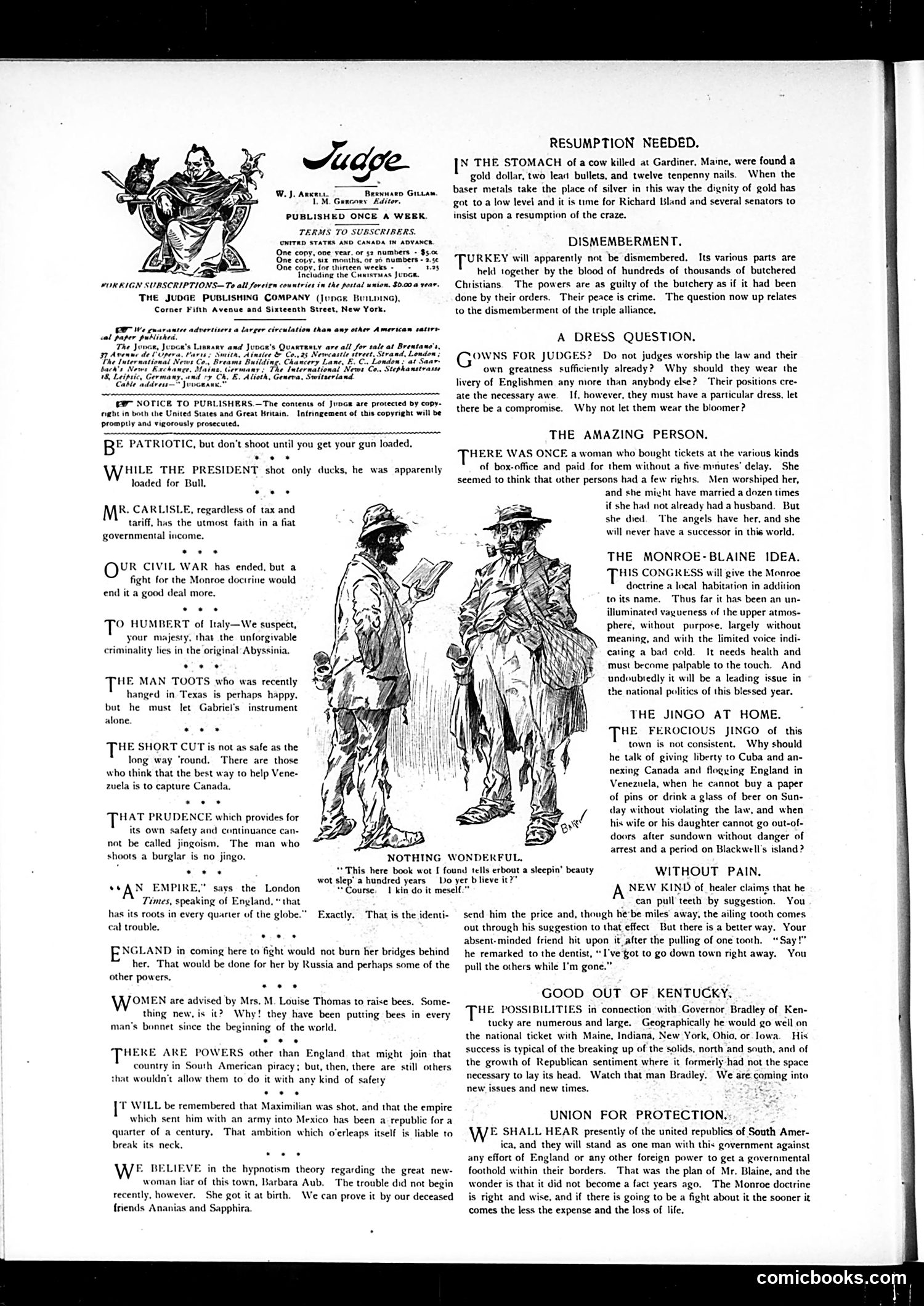
The central cartoon depicts two men in conversation—likely representing political or social figures of the era, though specific identities aren't clearly marked. The dialogue bubble references "nothing wonderful," suggesting commentary on contemporary politics or public figures. The surrounding text consists of brief satirical editorials on various topics: criticism of President Taft ("loaded for Hell"), commentary on Carlisle and tariffs, the Civil War and Monroe Doctrine, Italian politics, and Canadian relations. These short pieces employ Judge's characteristic acerbic wit to mock political positions and current events. Without clearer labeling or dates visible in the image, precise historical context is difficult to establish. The page appears designed as a mix of visual and textual satire targeting American political and social issues of the early 20th century.
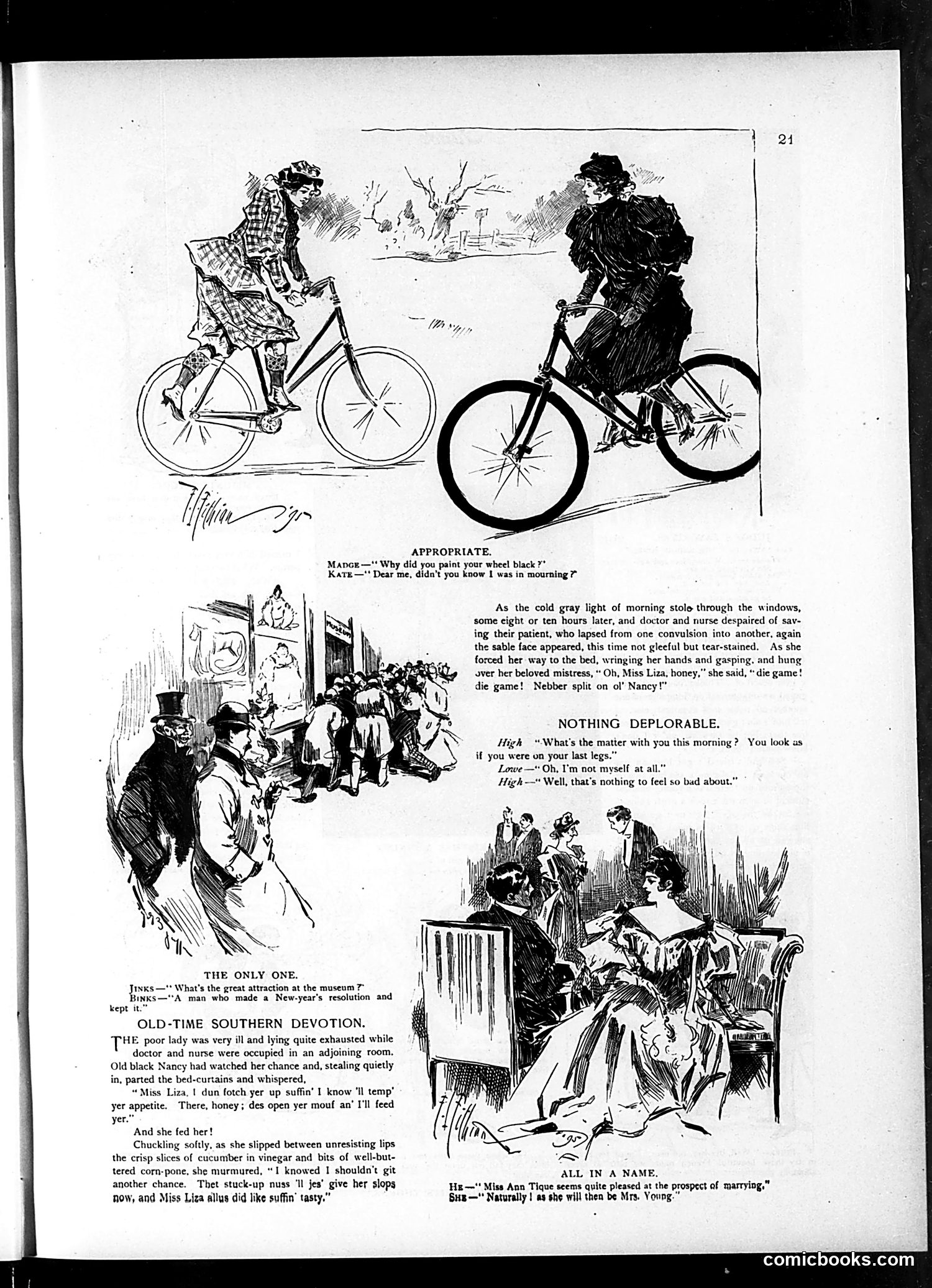
This page from *Judge* magazine contains four separate humorous illustrations with accompanying narratives, primarily focused on social situations rather than political satire. **Top cartoon "APPROPRIATE"**: Two women on bicycles joke about one's wheel being painted black. The humor relies on early bicycle culture and fashion—the woman wore mourning clothes (black dress) and didn't realize it was morning, creating an unintentional visual pun. **Lower sections** present domestic comedy sketches: "NOTHING DEPLORABLE" depicts a bedridden woman making light of her condition; "OLD-TIME SOUTHERN DEVOTION" shows a servant caring for an ill woman; "ALL IN A NAME" features women gossiping about marriage prospects. These appear to be general-interest humor pieces reflecting late-Victorian/Edwardian social conventions, gender roles, and domestic situations rather than topical political commentary.
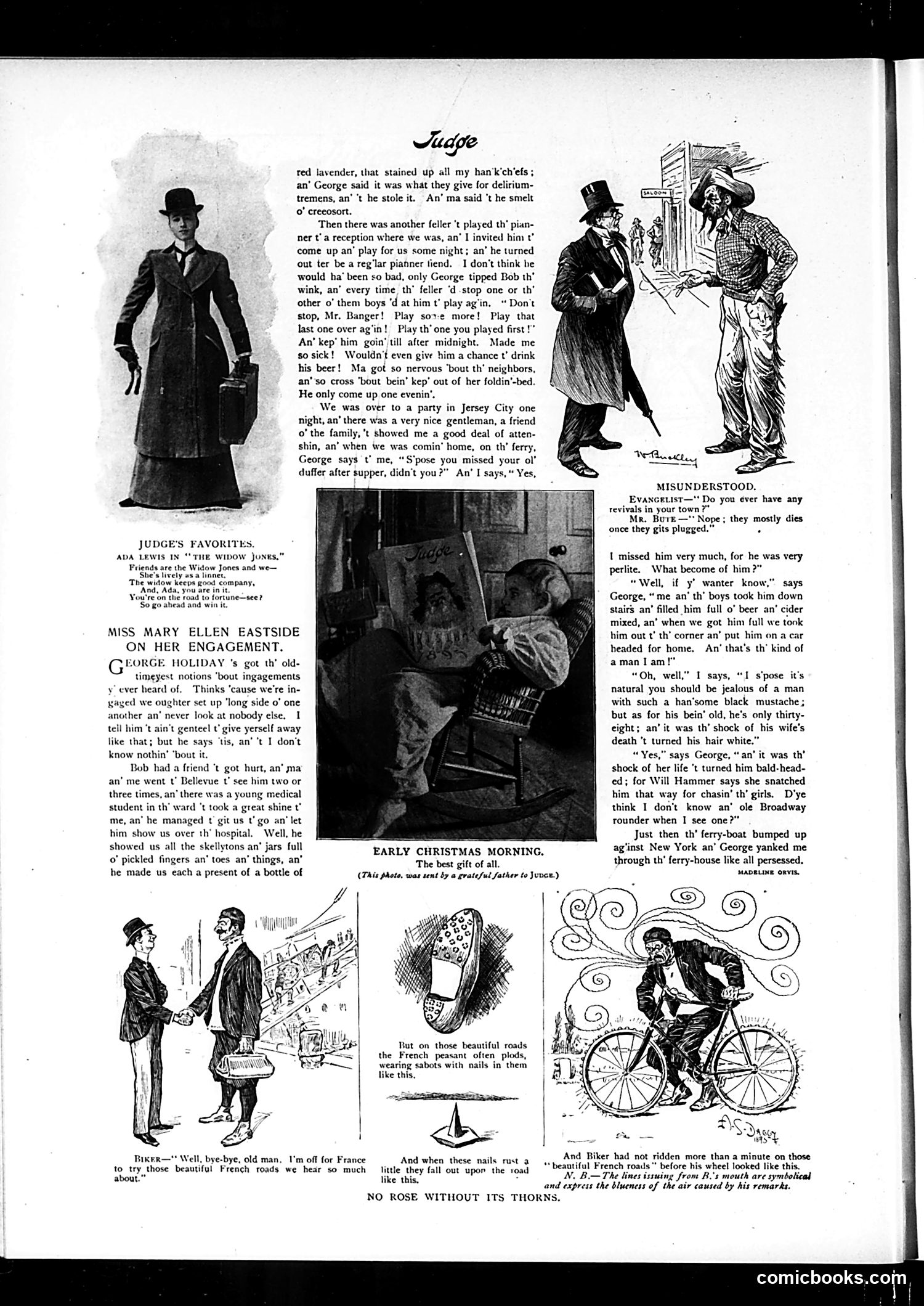
This page contains humorous domestic and social commentary typical of early Judge magazine. The main content centers on "Miss Mary Ellen Eastside On Her Engagement," where a woman complains about her fiancé George's jealous behavior toward male acquaintances—a medical student, pianist, and gentleman on the ferry. George deliberately sabotages these friendships (forcing the pianist to play until midnight, getting the student drunk), revealing his possessiveness. The satire mocks conventional engagement propriety: the woman believes engaged couples shouldn't be "genteel" about socializing, while George enforces strict fidelity. The humor derives from her naive justifications for male attention and George's absurd, aggressive jealousy. Supporting items include theatrical promotion for "The Widow Jones," engagement etiquette jokes, and illustrated anecdotes about French road hazards and revival meetings—typical period magazine filler celebrating working-class dialect and domestic conflict as entertainment.
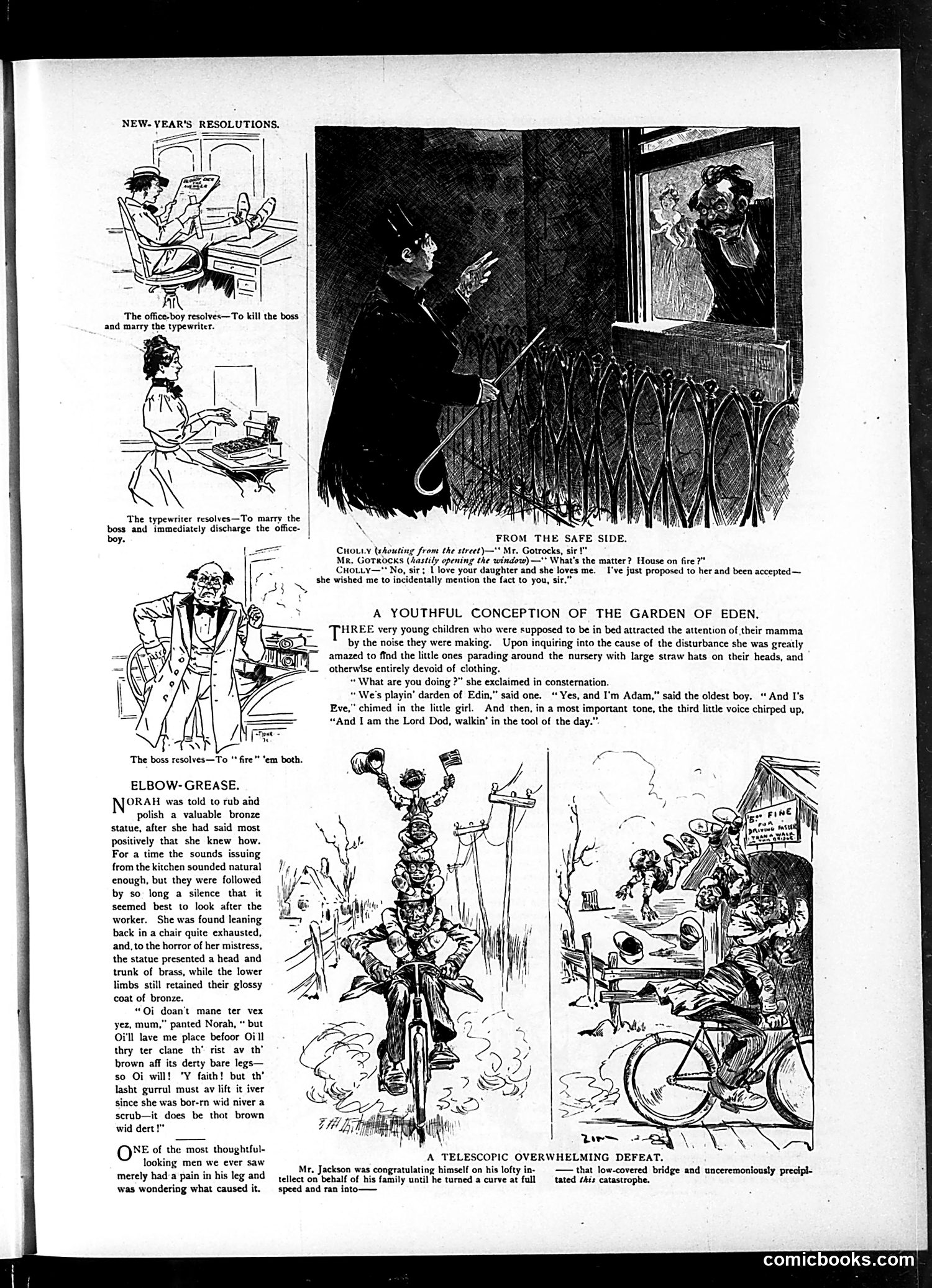
This page from **Judge** magazine contains several short humorous pieces typical of early 20th-century American satire: **"New Year's Resolutions"**: Office workplace humor—the office boy and typewriter (female secretary) have conflicting ambitions, while the boss cynically fires them both. **"From the Safe Side"**: Satirizes wealthy men's anxiety about their daughters' romantic prospects. A suitor (Cholly) announces his engagement to "Mr. Gotrocks'" daughter from the street, forcing the wealthy father to listen through a window—mocking the pretense of propriety among the wealthy. **"Garden of Eden"**: A children's misunderstanding joke: naked children playing Adam and Eve in the nursery, with one claiming to be "the Lord God" walking in "the cool of the day"—innocent malapropism humor. **"Elbow-Grease"**: Immigrant servant (Irish dialect) accidentally polishes a bronze statue so thoroughly she removes the patina, exposing bare brass underneath. **"Telescopic Overwhelming Defeat"**: A man on a bicycle hits a low bridge while looking up, presumably through a telescope, causing a crash. Visual punchline humor.
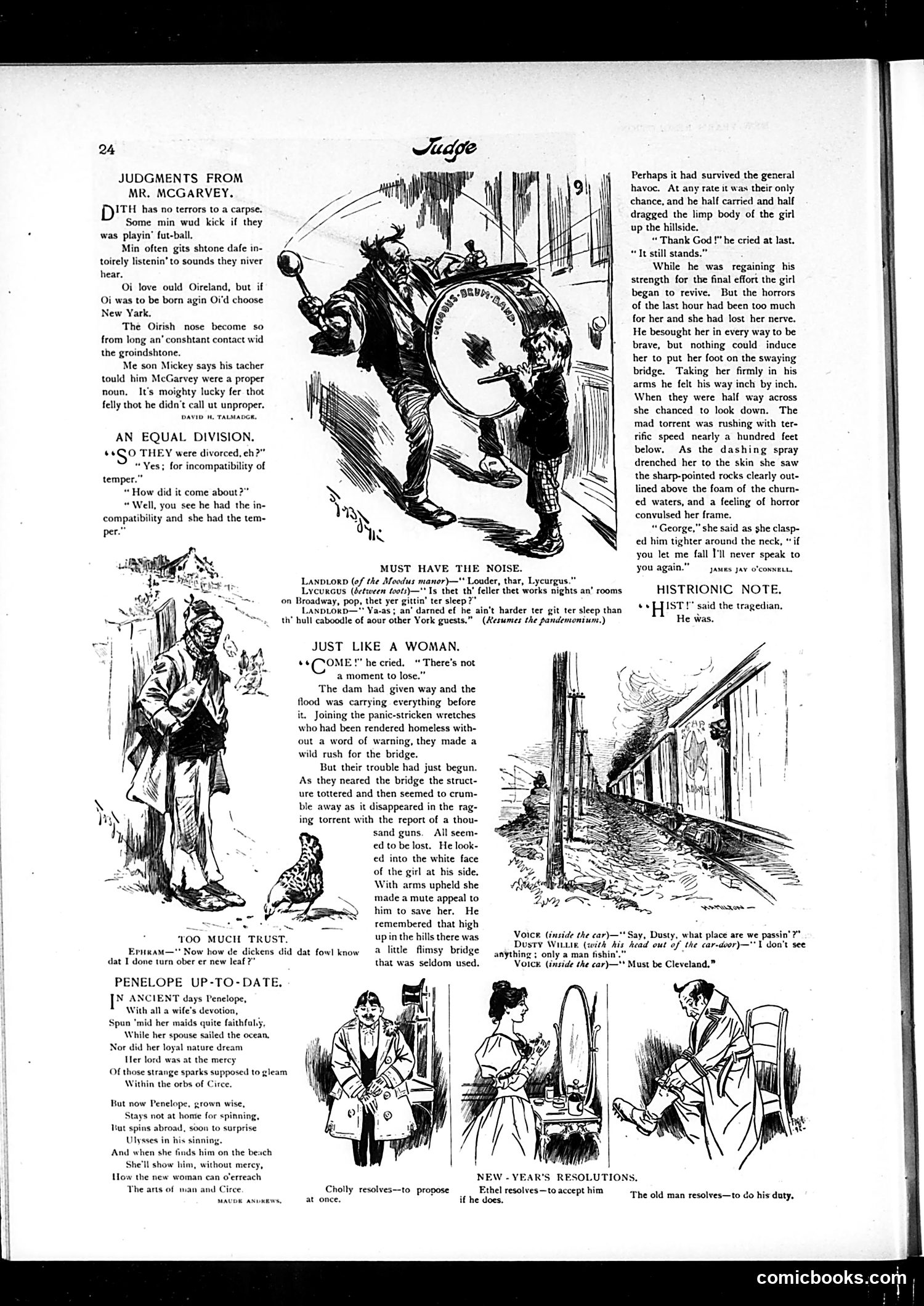
This is a satirical humor page from *Judge* magazine featuring several jokes and cartoons reflecting turn-of-the-century American attitudes. **"Judgments from Mr. McGarvey"** presents stereotyped Irish immigrant observations—McGarvey speaks in exaggerated brogue, making self-deprecating jokes about Irish people (bent noses from grindstones, etc.) while expressing preference for New York over Ireland. This reflects the common practice of ethnic humor in period publications. **"An Equal Division"** is a brief divorce joke playing on wordplay—the couple split their incompatibilities, with the husband having "incompatibility" and wife having "temper." **"Just Like a Woman"** is a melodramatic story about a flood rescue where the saved woman, after being carried across a dangerous bridge, threatens never to speak to her rescuer if he drops her—depicting women as illogical and ungrateful even when saved from death. **"Penelope Up-to-Date"** mocks "new women" (feminists) by reimagining the classical faithful Penelope as modern and aggressive, now pursuing her wandering husband rather than waiting dutifully. The humor relies on period stereotypes about immigrants, women, and gender roles.
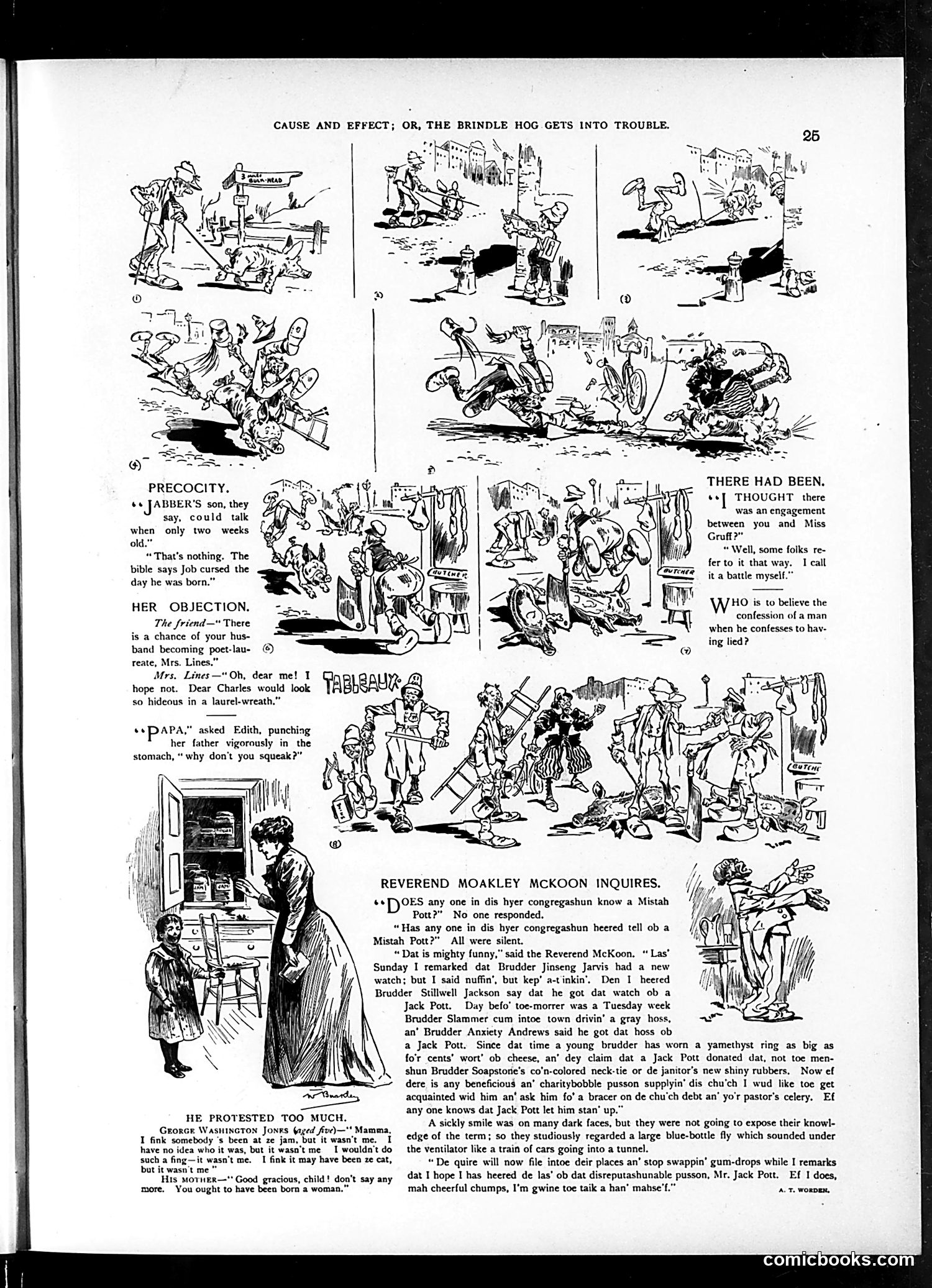
This *Judge* magazine page contains several satirical pieces satirizing American life and manners: **"Cause and Effect; or, The Brindle Hog Gets Into Trouble"** (top) is a visual gag comic strip showing slapstick chaos—a runaway pig causes mayhem among townspeople. **The short jokes** mock contemporary domestic life: a wife fears her husband becoming a "poet laureate" (unfashionable); a child punches her father asking "why don't you squeak?" (crude humor); a man makes obviously false excuses about breaking something. **"Reverend Moakley McKoon Inquires"** (bottom) satirizes Black Southern rural churches through heavy dialect, depicting a preacher searching for "Jack Pott"—apparently a mysterious benefactor who's donated watches, horses, and jewelry to congregation members. The humor relies on ethnic caricature and the implication of either charity fraud or the preacher's gullibility. This reflects the magazine's period racism and stereotyping. The page exemplifies *Judge*'s mix of slapstick, domestic comedy, and racially-stereotyped humor typical of early 20th-century American satire.
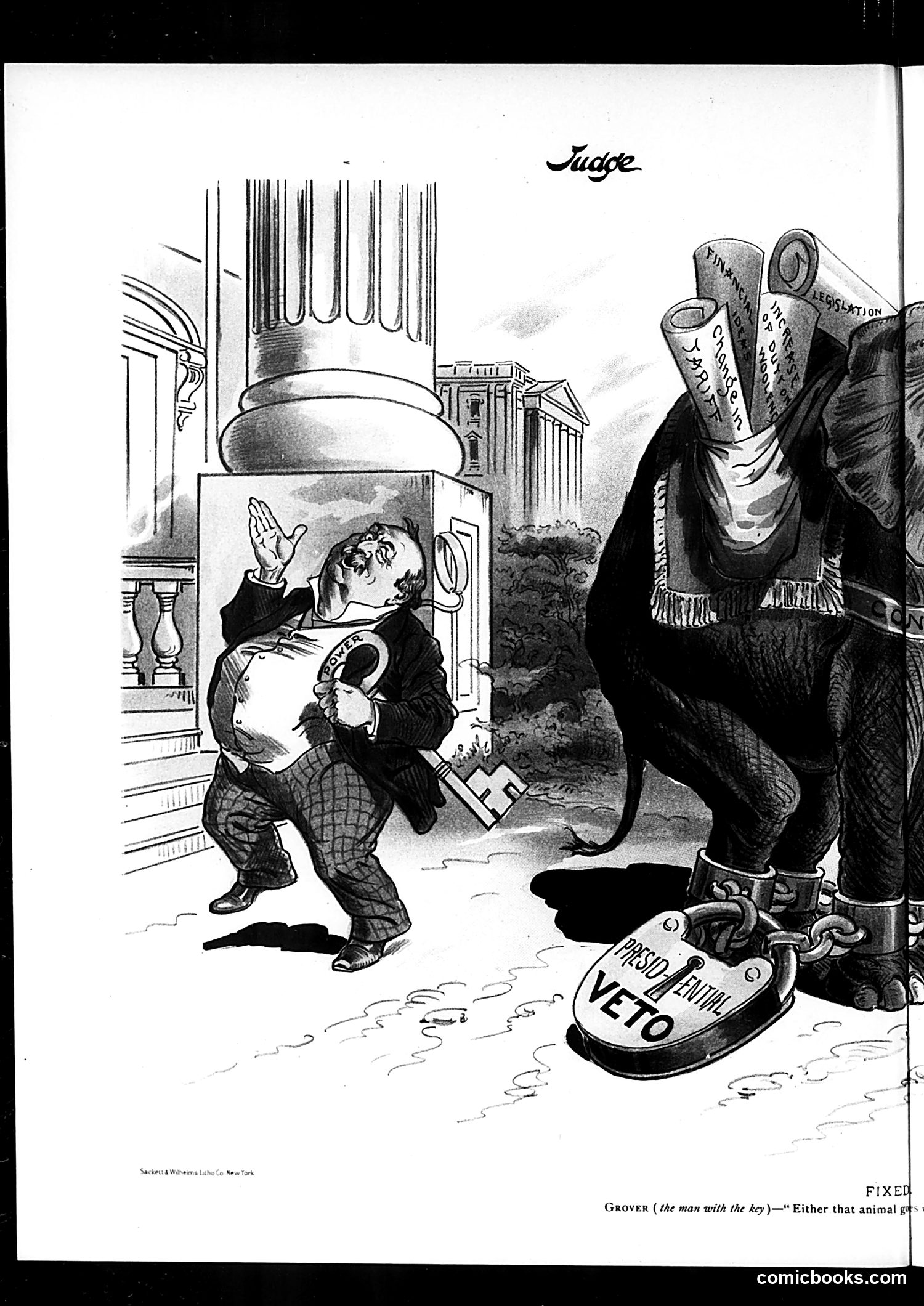
This Judge magazine cartoon depicts **Grover Cleveland** (identified by text as "the man with the key") confronting a large, menacing figure representing either a political opponent or institution. The figure wears military/official regalia with scrolls labeled "LEGISLATION" and carries a boot stamped "FIRST FAITH VETO." The satire concerns Cleveland's use of **presidential veto power**—he famously vetoed numerous bills during his terms. The cartoon suggests a power struggle: Cleveland wields a key (executive authority), while his opposition represents legislative force. The phrase "Either that animal goes" implies Cleveland is threatening to use his veto to remove unwanted policies or opponents. The artwork satirizes the tension between executive and legislative branches during Cleveland's presidency.
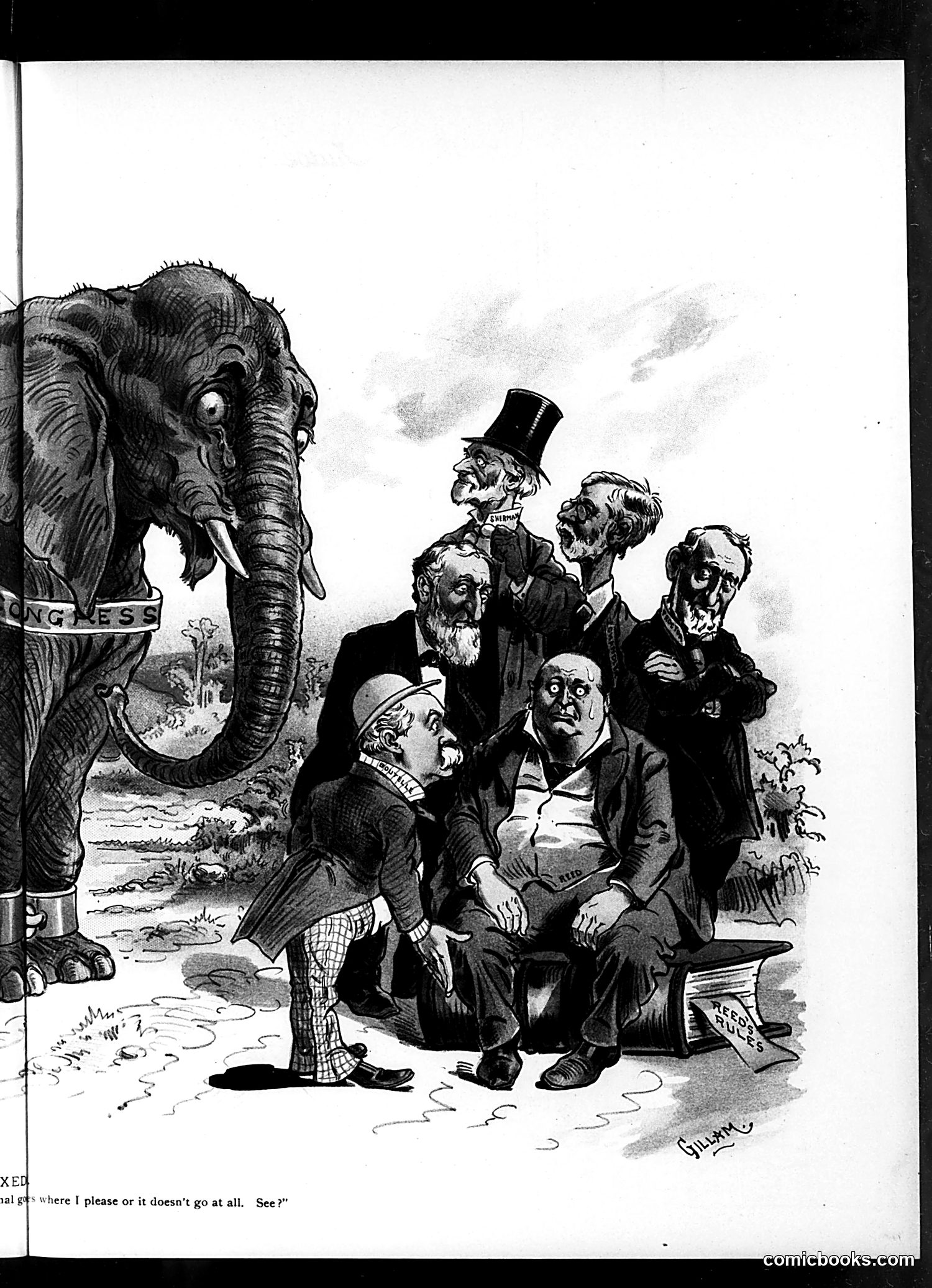
This is a satirical cartoon from *Judge* magazine depicting a group of anxious politicians or businessmen confronting a large elephant labeled "CONGRESS." The elephant appears menacing and uncontrollable. The caption reads: "...where I please or it doesn't go at all. See?" suggesting the elephant (Congress) is asserting its power and refusing to be directed. The men's fearful expressions and body language indicate they feel threatened by Congressional authority. This appears to be commentary on Congressional power overriding executive or private interests during a particular political period. Without visible dates or clearer identifying labels on individual figures, the specific historical moment remains unclear, but the cartoon satirizes the tension between competing centers of political power.
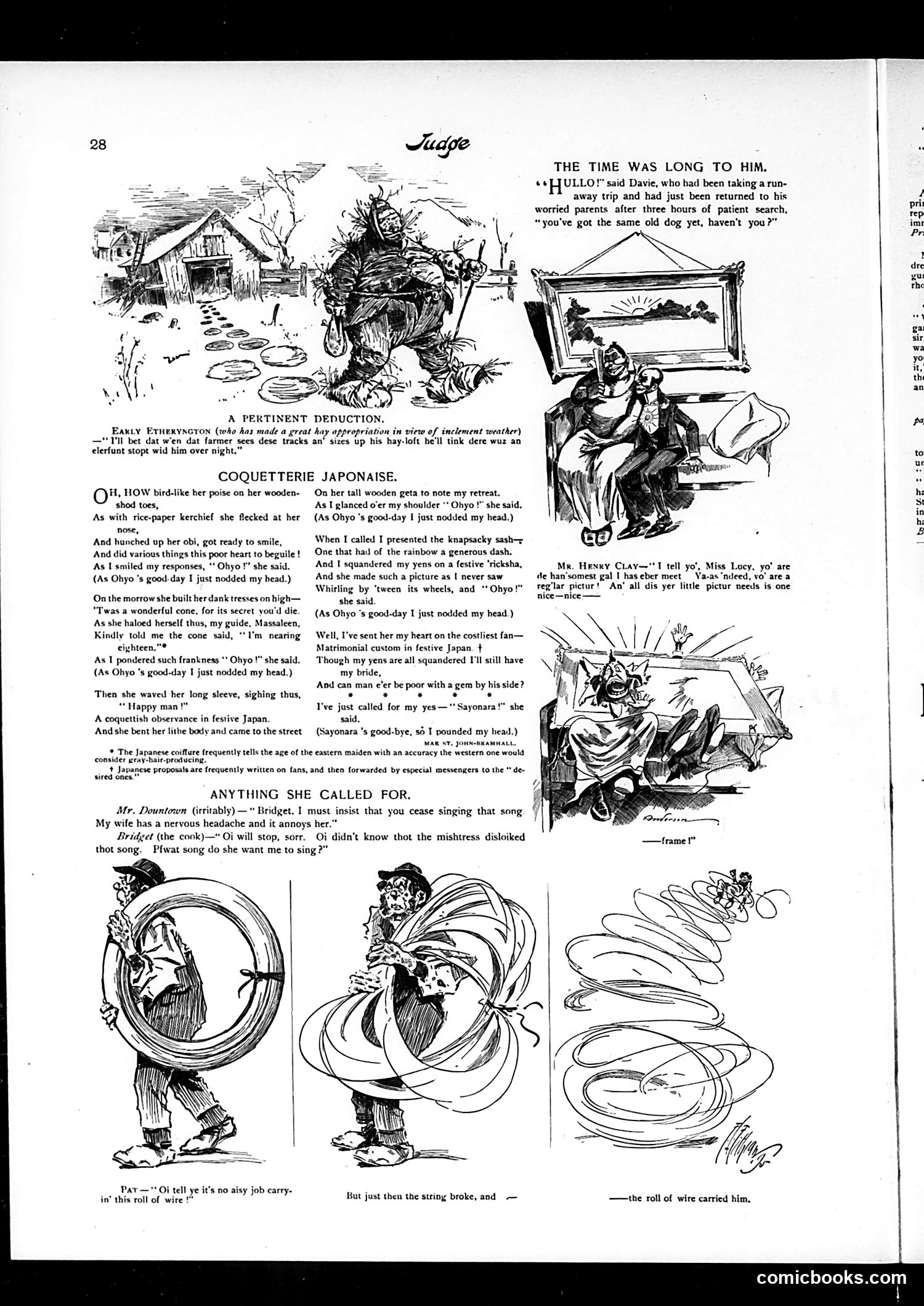
This page contains three distinct satirical pieces: **"The Time Was Long to Him"** — A brief domestic joke about a boy's three-hour absence feeling endless to him, playing on childhood's subjective time perception. **"A Pertinent Deduction"** — A farmer's comic logic: seeing large tracks and damaged hay, he deduces an elephant visited overnight. The satire mocks rural folk wisdom and exaggerated conclusions from limited evidence. **"Coquetterie Japonaise"** — A romantic narrative poem mocking Western male fascination with Japanese women. The repeated phrase "Ohyo! (good-day)" becomes comedic through exhausted repetition. The piece gently satirizes both the exoticized perception of Japanese women and the narrator's sentimental gullibility. The side conversation with "Mr. Henry Clay" adds commentary on attractiveness being superficial. **"Anything She Called For"** — A brief Irish-accented servant joke: the mistress wants a different song but the cook cannot specify which one, creating absurdist humor from miscommunication. The bottom illustrations show a man wrapped repeatedly in wire, literalizing the phrase "roll of wire."
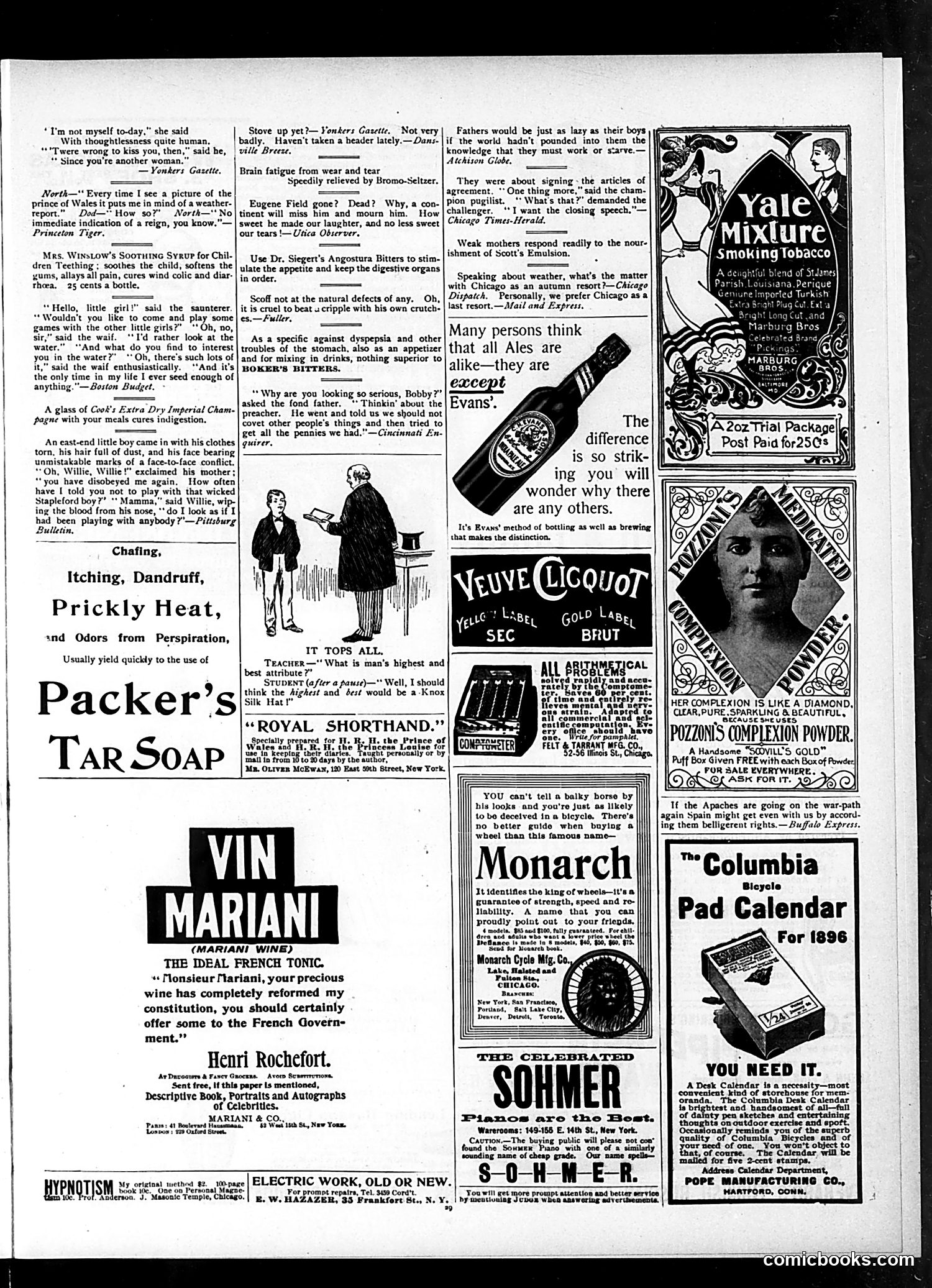
This page from Judge magazine (a satirical publication) contains primarily **short humorous anecdotes and advertisements** rather than political cartoons requiring historical context. The notable content includes: **Cartoons/Jokes:** Several brief satirical pieces lampooning social behavior—a father commenting that seeing pictures of the Prince of Wales reminds him of weather reports (implying the Prince is unremarkable), and a story about a boy defending himself against accusations of misbehavior by pointing out his bruises prove he fought someone stronger. **Social Satire:** References to contemporary concerns like brain fatigue, dyspepsia (indigestion), and child-rearing. One joke criticizes a preacher for telling children not to covet things, then asking for donations—mocking religious hypocrisy. **Advertisements:** The page is dominated by period product ads (Packer's Tar Soap, Vin Mariani tonic, Evans' ale, Monarch bicycles), reflecting Judge's revenue model. The humor relies on wordplay and observations of everyday life rather than specific political events or recognizable figures.
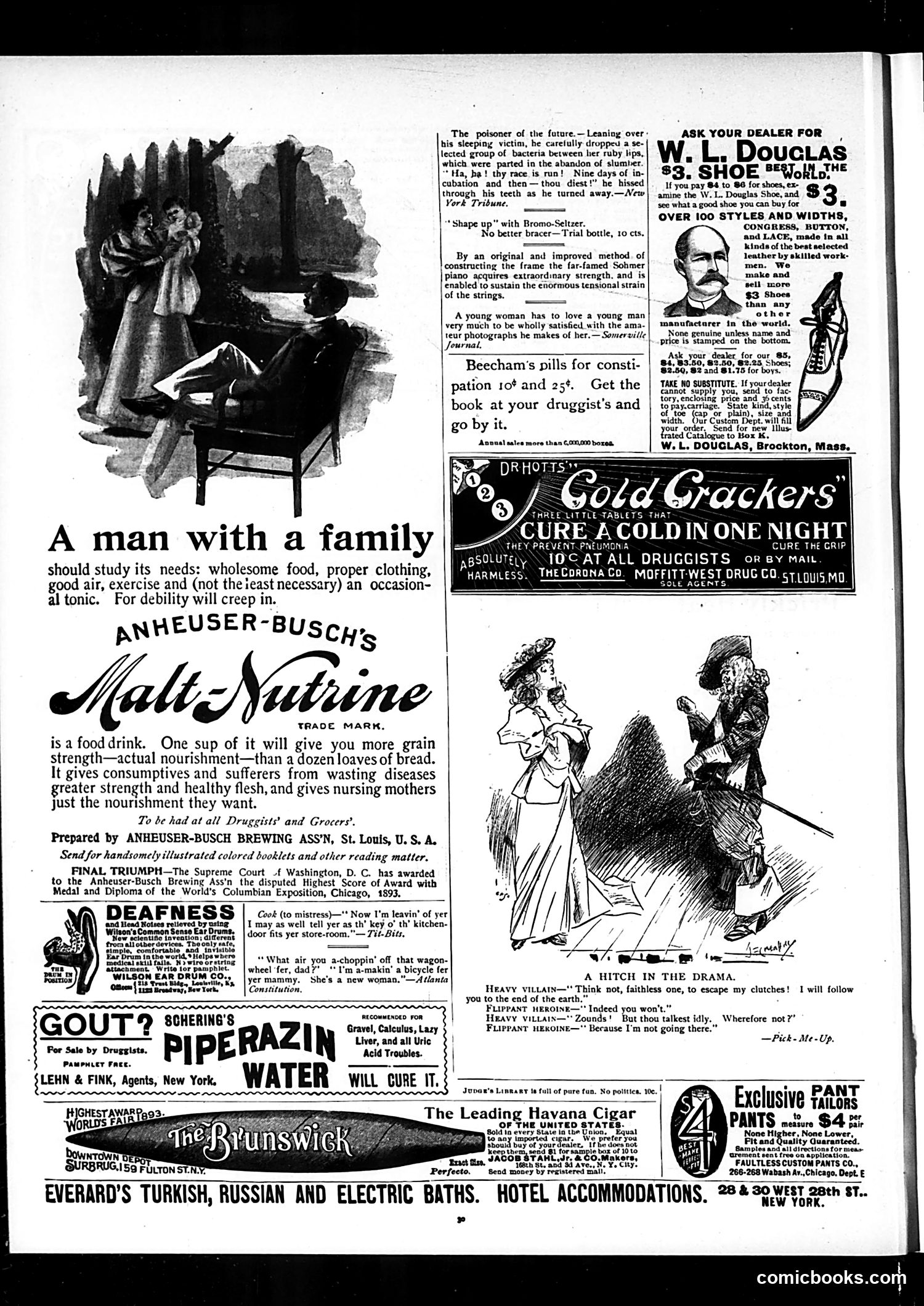
This page is primarily **advertisements** with minimal editorial satire. The main content consists of patent medicine and consumer product ads typical of late-19th century magazines. The small cartoon dialogue at bottom-right, titled "A Hitch in the Drama," mocks melodramatic theater conventions. A villainous character threatens to pursue the heroine "to the end of the earth," but she deflates his threats by saying "Indeed you won't"—because "I'm not going there." The satire targets overwrought theatrical villainy and the artificial dramatic conflicts of period stage plays. The other brief humorous items scattered throughout are filler jokes about domestic life (wives and amateur photography, servants and "new women" cyclists), typical period humor. Most notable is the advertisement for Anheuser-Busch's "Malt-Nutrine," which claims medicinal properties—reflecting the era's widespread marketing of beer as a health tonic for invalids and nursing mothers, before modern food and drug regulations.
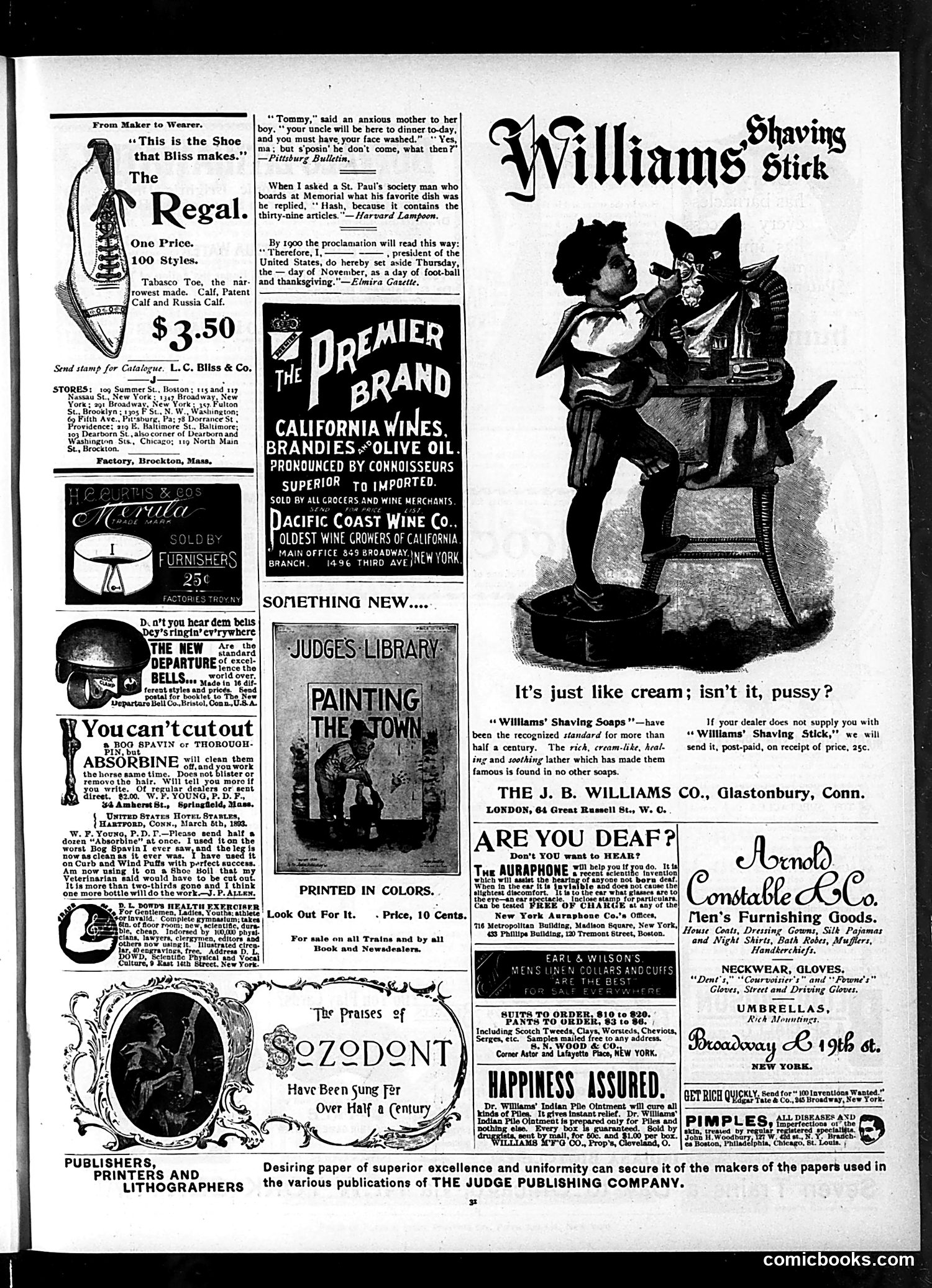
This page is primarily **advertising content** rather than political satire. The dominant image shows a cartoon of a cat being shaved by a well-dressed man, accompanying an advertisement for "Williams' Shaving Stick." The visual joke plays on the phrase "It's just like cream; isn't it, pussy?"—a double entendre. The cat represents both a literal animal being shaved and uses "pussy" as period slang. The humor relies on suggesting the shaving product is so smooth and pleasant that even a cat would enjoy the experience. The page contains numerous other product advertisements (shoes, wines, health products, hearing devices) typical of Judge magazine's commercial content. There are scattered brief humorous quotes from other publications in the margins, but no significant political commentary or social satire appears on this particular page.
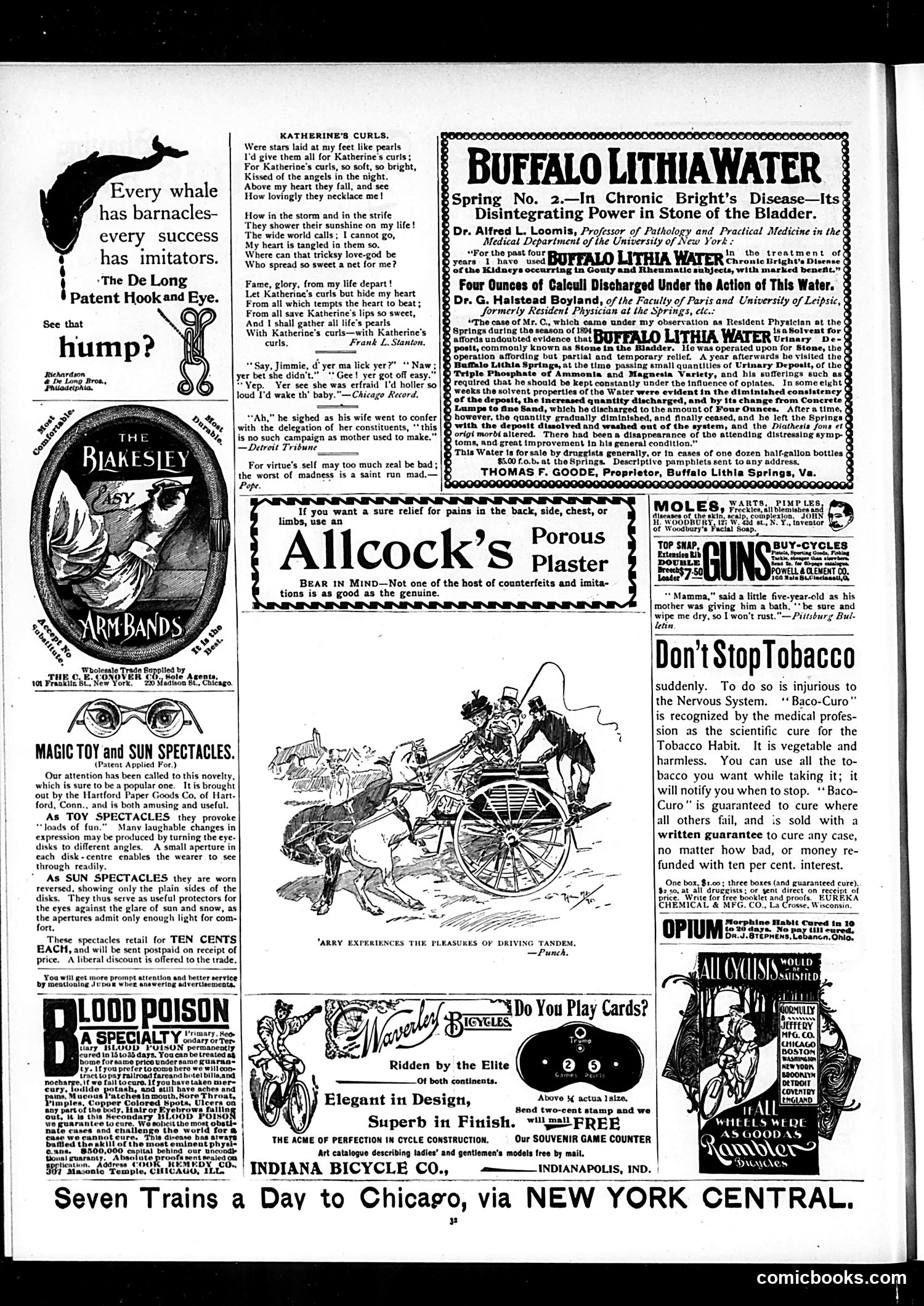
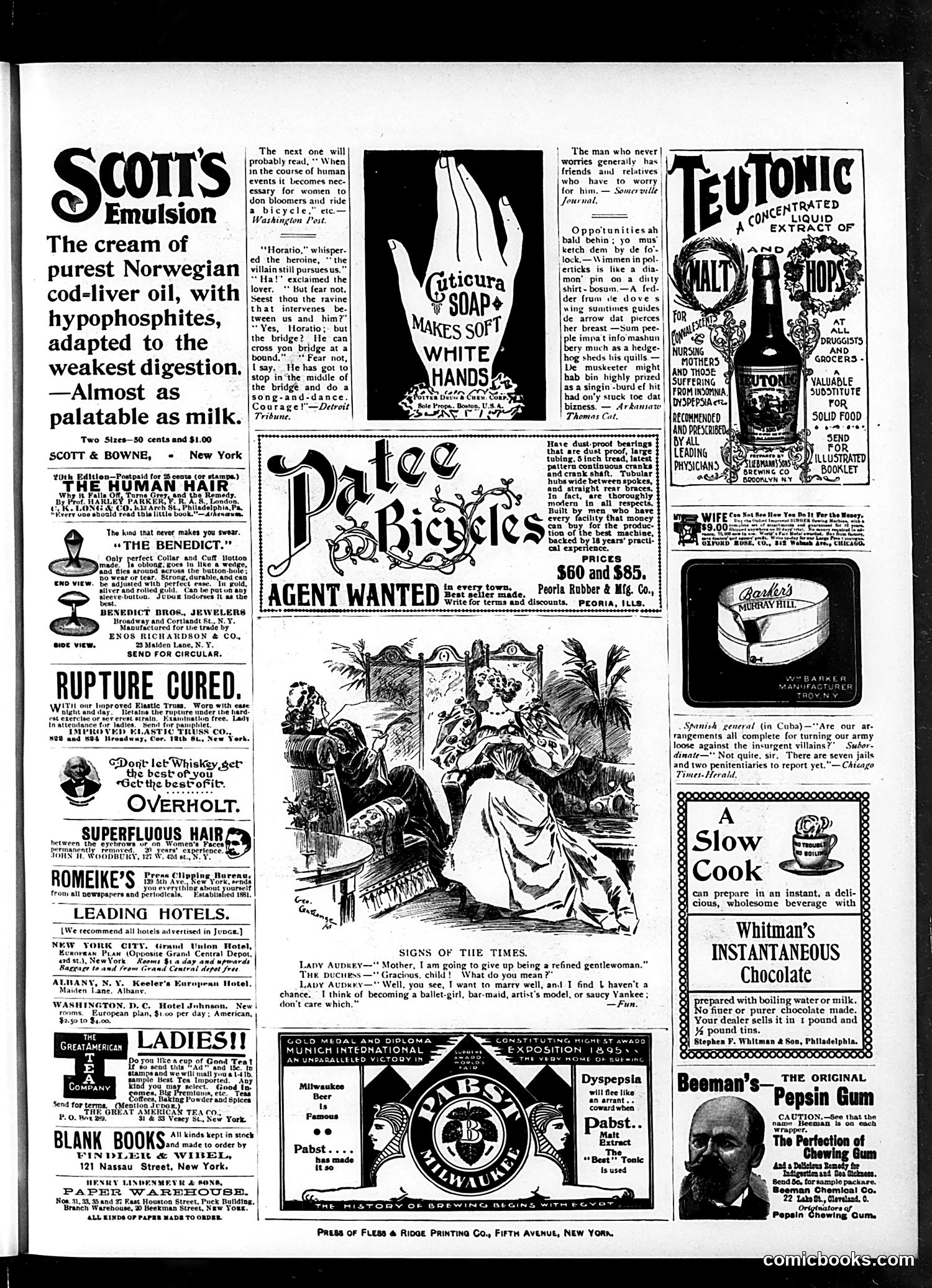
This page is primarily **advertisements** with minimal political cartoon content. The main satirical element appears in the "SIGNS OF THE TIMES" section, depicting conversations between upper-class women ("Lady Audrey") considering unconventional life paths—becoming a ballet girl, barmaid, or artist's model—if they cannot marry wealthy. This satirizes Victorian-era women's limited options and their dependence on advantageous marriage. A second brief political reference appears in the Spanish general cartoon at bottom right, mocking Spanish military operations in Cuba (likely referencing the 1890s Cuban conflict). The joke—that they must empty jails before deploying troops—suggests satirizing the Spanish colonial military's desperation or incompetence. The page otherwise consists of patent medicine ads, bicycle promotions, and household product advertisements typical of 1890s *Judge* magazine advertising revenue.
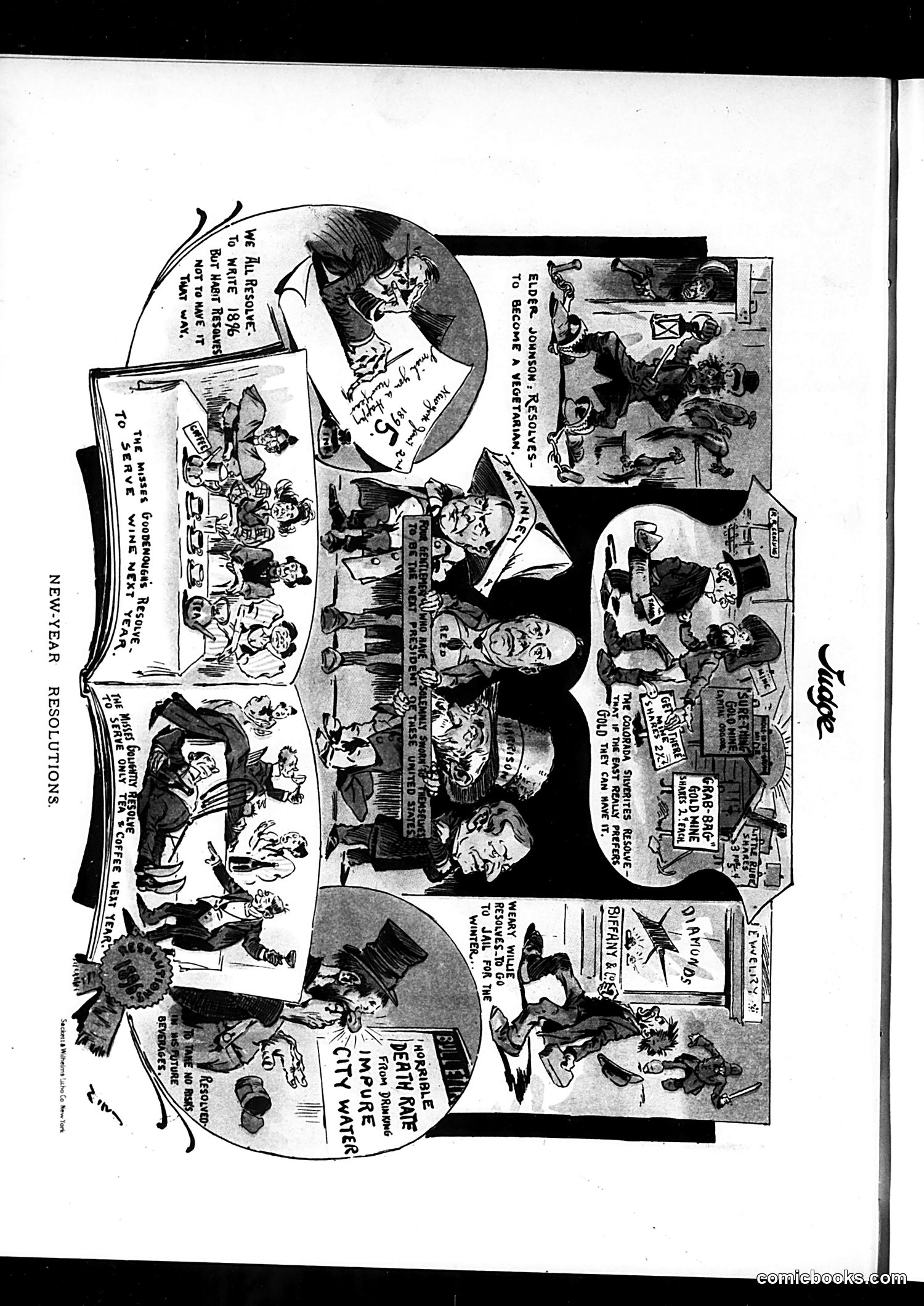
This is a satirical comic about New Year's resolutions—the famously broken promises people make annually. The page shows multiple cartoon vignettes, each depicting a character stating an ambitious resolution, with the implicit joke being that these won't be kept. Visible resolutions include Elder Johnson resolving to become vegetarian, "Weary Willie" making unspecified promises, and "The Misses" planning to serve wine next year (with a note that Cousin Cora resolves to drink only tea—likely ironic commentary on temperance). The humor relies on the universal human experience of making grandiose New Year's pledges while everyone knows they'll fail. The cartoons appear to mock various social types and their predictable, hollow self-improvement attempts. The satire is social rather than explicitly political, targeting human nature and hypocrisy.