
Judge, 1896-01-11 · page 4 of 16
Judge — January 11, 1896 — page 4: what you’re looking at
What you’re looking at
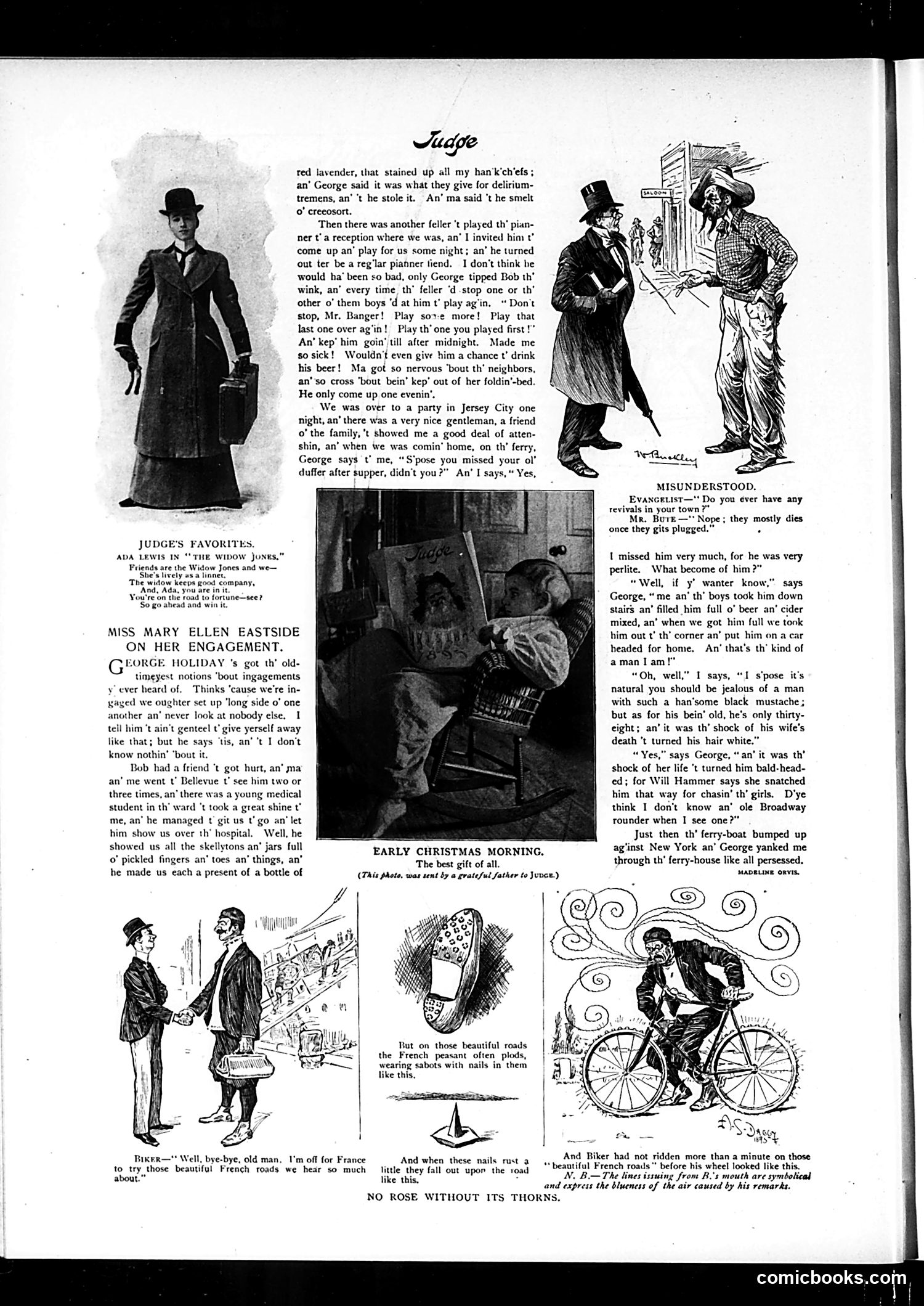
This page contains humorous domestic and social commentary typical of early Judge magazine. The main content centers on "Miss Mary Ellen Eastside On Her Engagement," where a woman complains about her fiancé George's jealous behavior toward male acquaintances—a medical student, pianist, and gentleman on the ferry. George deliberately sabotages these friendships (forcing the pianist to play until midnight, getting the student drunk), revealing his possessiveness. The satire mocks conventional engagement propriety: the woman believes engaged couples shouldn't be "genteel" about socializing, while George enforces strict fidelity. The humor derives from her naive justifications for male attention and George's absurd, aggressive jealousy. Supporting items include theatrical promotion for "The Widow Jones," engagement etiquette jokes, and illustrated anecdotes about French road hazards and revival meetings—typical period magazine filler celebrating working-class dialect and domestic conflict as entertainment.
📄 Transcribed text from this page (OCR, searchable)
Machine-transcribed from the original scan — historical spelling and the odd misread are preserved.
JUDGE'S FAVORITES. ADA LEWIS IN “THE WIDOW Jones.” Friends are the Widow Jones and we— She's lively #s a linet. The widow keeps good company, And, Ada, you are in it You're on the road to fortune—see? ‘So go ahead and win it MISS MARY ELLEN EASTSIDE ON HER ENGAGEMENT. JRGE. HOLIDAY 's got th’ old- timeyest notions ‘bout ingagements y' ever heard of. Thinks ‘cause we're in- yayed we oughter set up ‘long side o” one another an’ never look at nobody else. I tell him ‘t ain't genteel t give yerself away like that; but he says ‘tis, an’ 't I don't know nothin’ ‘bout it. Bob had a friend ‘t got hurt, an’ ma an’ me went t’ Bellevue t’ see him two or three times, an’ there was a young medical student in th’ ward ‘t took a great shine t” me, an’ he managed t git us t’ go an’ let him show us over th’ hospital. Well, he showed us all the skellytons an’ jars full 6’ pickled fingers an’ toes an’ things, an’ he made us each a present of a bottle of Biker—"* Well, bye-bye, old man. I'm off for France to try those beautiful French roads we hear so much about.” Suage ted lavender, that stained up all my han’k'ch’efs ; an’ George said it was what they give for delirium- tremens, an’ ‘t he stole it. An’ ma said ‘t he smelt 0’ creeosort. Then there was another feller 't played th’ pian- ner t'a reception where we was, an’ I invited him t" come up an’ play for us some night; an’ he turned out ter be a reg'lar pianner tiend. 1 don’t think he would ha’ been so bad, only George tipped Bob th’ wink, an’ every time th’ feller ‘d stop one or th’ other o' them boys ‘d at him t’ play ag'in. “Don't stop, Mr. Banger! Play sove more! Play that last one over ag’in! Play th’ one you played first !" An’ kep’ him goin’ till after midnight. Made me so sick! Wouldn't even give him a chance t’ drink his beer! Ma got so nervous ‘bout th’ neighbors, an’'so cross ‘bout bein’ kep’ out of her foldin’-bed. He only come up one evenin’. We was over to a party in Jersey City one night, an’ there was a very nice gentleman, a friend o' the family, ’t showed me a good deal of atten- shin, an’ when te was comin’ home, on th’ ferry, George says t’ me, “S'pose you missed your ol” duffer after supper, 8. Yes, EARLY CHRISTMAS MORNING. ‘The best gift of all. (This photo, was tent by a grateful father to Juvcr.) But on those beautiful roads the French peasant often plods, | wearing sabots with nails in them like this, And when these nails rust a little they fall out upor the road like this. NO ROSE WITHOUT ITS THORNS. MISUNDERSTOOD. Evaxcrtist—" Do you ever have any revivals in your town?” Mr. Burz—'* Nope; they mostly dies once they gits plugged.” 3 I missed him very much, for he was very perlite. What become of him ?” “Well, ify’ wanter know,” says George, “me an’ th’ boys took him down stairs an’ filled him full o beer an’ cider mixed, an’ when we got him full we took him out t’ th’ corner an’ put him on a car headed for home, An’ that's th’ kind of aman I am!" “Oh, well,” I says, “I s'pose it's natural you should be jealous of a man with such a han’some black mustache; but as for his bein’ old, he’s only thirty- eight; an’ it was th’ shock of his wife's death ‘t turned his hair white.” “Yes,” says George, an’ it was th’ shock of her life ‘t turned him bald-head- ed; for Will Hammer says she snatched him that way for chasin’ th’ girls. D'ye think I don’t know an’ ole Broadway rounder when I see one?” Just then th’ ferry-boat bumped up ag’inst New York an’ George yanked me through th’ ferry-house like all persessed. MADELINE ORVIS, And Biker had not ridden more than a minute on those * beautiful French roads N. B.—The lines issuing from B.'s mouth are symbolical and express the bluencss of the air caused by his remarks. before his wheel looked like this. comicheoksicoin { i