
A complete issue · 18 pages · 1896
Judge — January 4, 1896
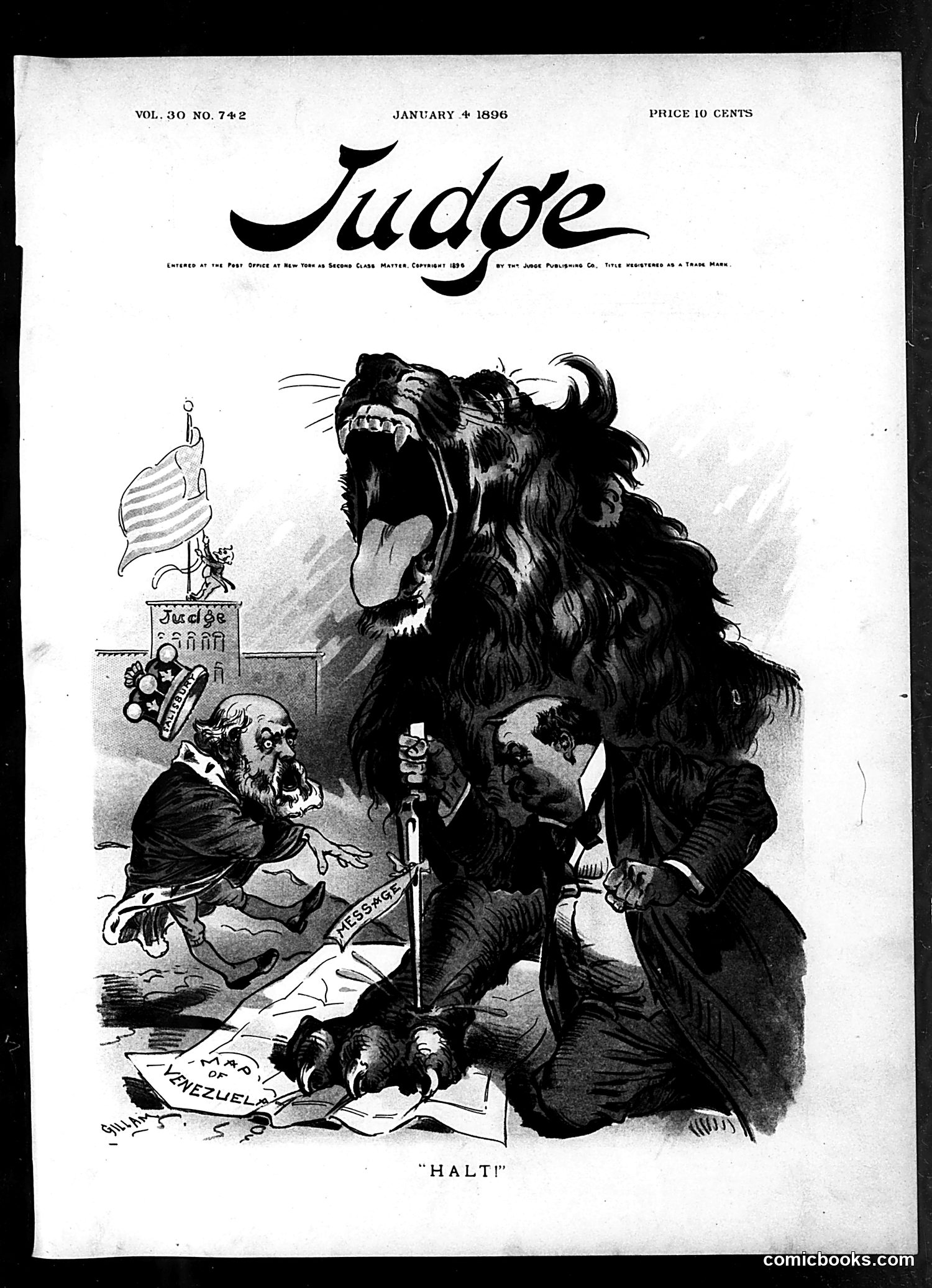
This political cartoon titled "HALT!" depicts a giant bear—representing Russia—roaring menacingly over three smaller figures in formal dress who appear frightened or pleading. Documents labeled "Partition of Venezuela" lie scattered below, suggesting diplomatic negotiations. The cartoon likely references tensions over Venezuela, possibly the boundary dispute between Venezuela and British Guiana that escalated in late 1895. The Russian bear represents imperial Russian expansion or interference in hemispheric affairs. The three smaller figures appear to represent European or American diplomats attempting to control or negotiate with Russian ambitions. The "HALT" caption suggests the cartoon warns against allowing Russian imperial expansion into Western Hemisphere affairs during the height of European imperial competition.
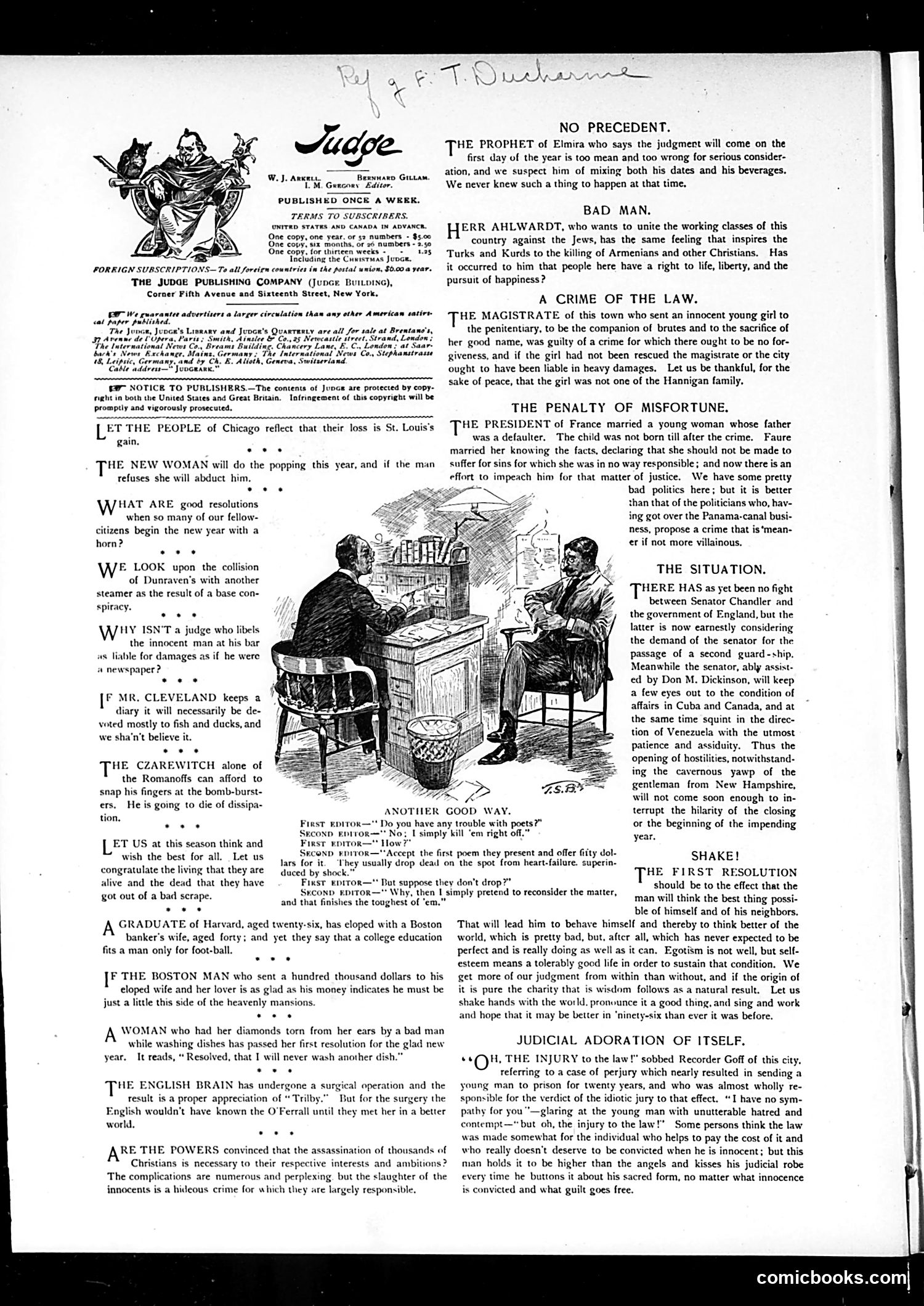
The central cartoon depicts two editors at a desk, with the caption "Do you have any trouble with poets?" / "No; I simply kill 'em right off." This is satirizing editorial practices—specifically the rejection and dismissal of submitted poetry. The humor targets both struggling poets seeking publication and editors' harsh treatment of amateur verse submissions. The surrounding editorial column "NO PRECEDENT" critiques various social and political issues: judicial corruption, Herr Ahlwardt's anti-working-class rhetoric, and French President's marriage scandal. The "SHAKE!" section advocates for New Year's resolutions promoting self-improvement and charitable thinking. Overall, this page mixes humor about literary gatekeeping with serious commentary on political hypocrisy and moral reform—typical of Judge's satirical approach.
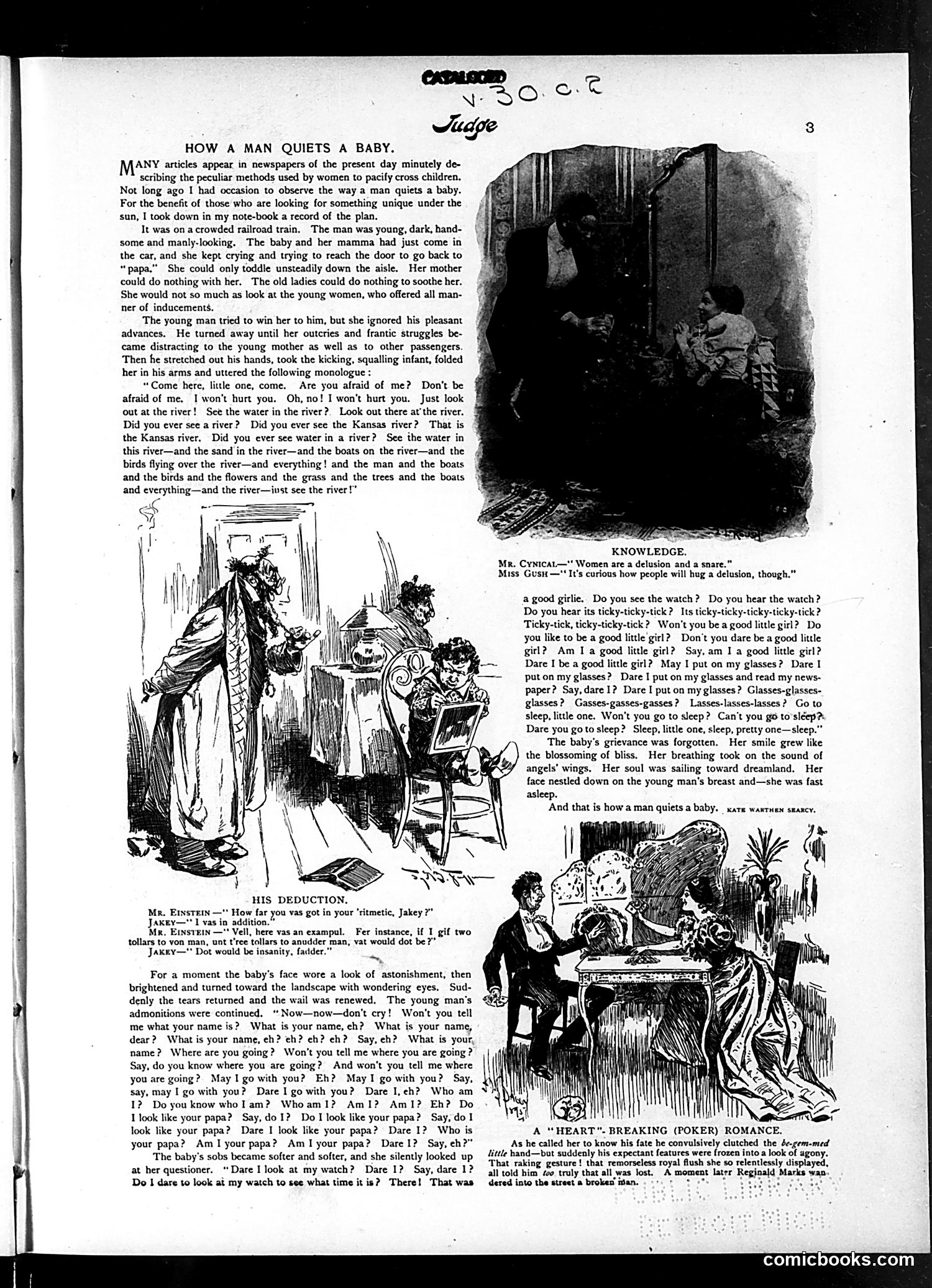
This page contains three humorous pieces satirizing social behavior and gender dynamics of the era. **"How a Man Quiets a Baby"** mocks sentimental masculinity—a young man distracts a crying infant with elaborate, poetic descriptions of rivers and nature rather than practical parenting. **"Knowledge"** features Ms. Cynical and Miss Gush debating whether women are "delusion and snare." The dialogue satirizes women's supposed intellectual limitations through rapid-fire questions about watches and glasses. **"His Deduction"** appears to mock male romantic presumption—a man interprets a woman's glance as romantic interest, exemplifying foolish male ego. The cartoons collectively ridicule both excessive male sentimentality and female intellectual stereotypes, reflecting Judge's satirical commentary on gender relations and social pretension of the period.
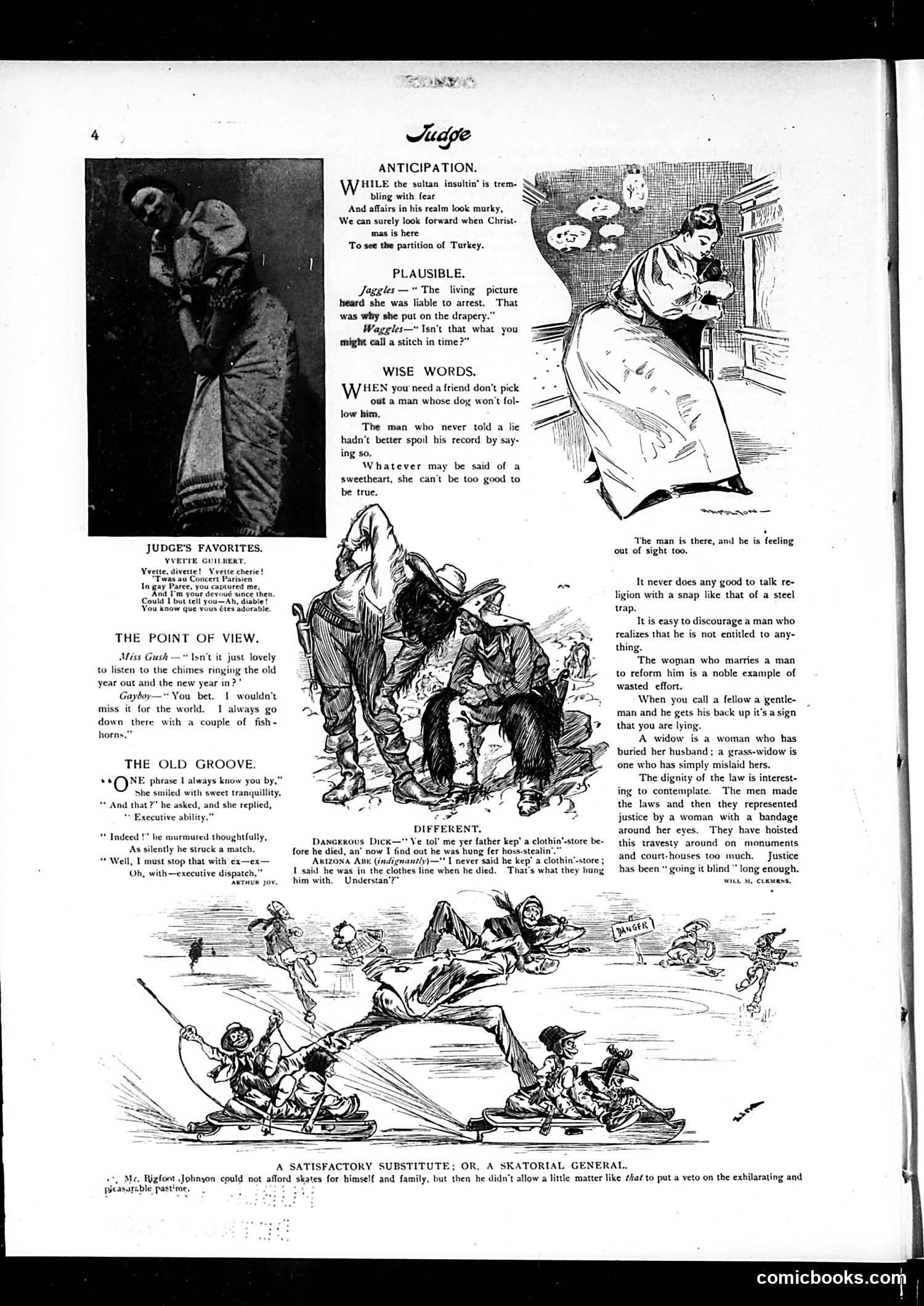
This page from the satirical magazine *Judge* contains several short humor pieces and cartoons typical of late 19th/early 20th-century American comedy journalism. **Key content includes:** - **"Anticipation"**: Political satire referencing Ottoman instability and European imperial ambitions regarding Turkey's partition—a real geopolitical concern of the era. - **Short jokes** on various topics: romantic relationships, character assessment, widow definitions, and legal system critique (the "blind justice" reference mocks Lady Justice imagery). - **"A Satisfactory Substitute"**: The bottom cartoon satirizes poverty—a man cannot afford ice skates for his family, so he improvises with makeshift alternatives, commenting on class disparities. - **Social commentary**: Multiple pieces critique hypocrisy, false morality, and human nature with cynical humor typical of *Judge*'s tone. The page reflects *Judge*'s mission: mixing topical political commentary with genteel social satire aimed at educated, middle-class readers amused by wordplay and observational humor about courtship, character, and contemporary affairs.
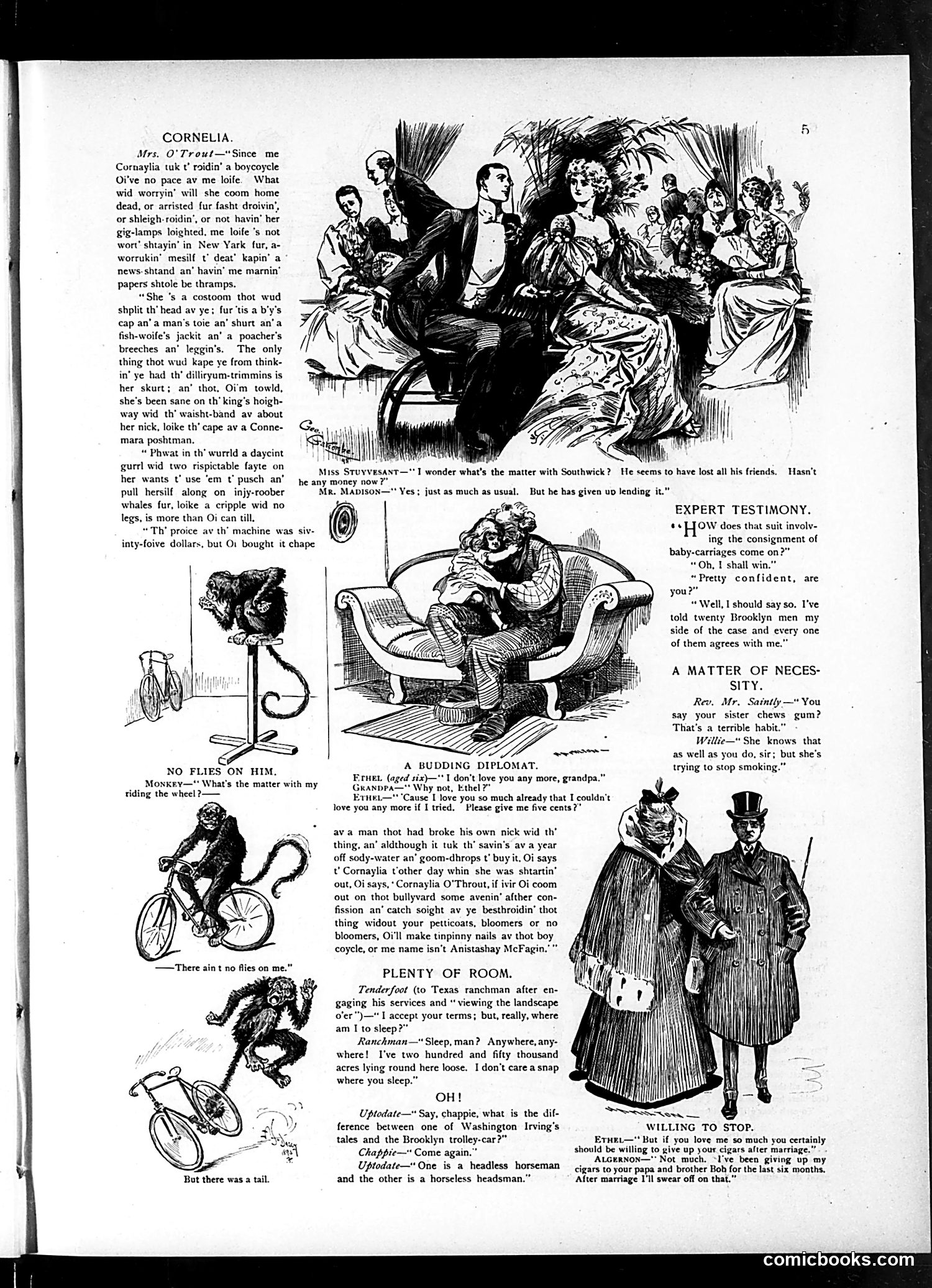
This page from Judge contains multiple short humor pieces satirizing late-19th/early-20th century American life: **"Cornelia"** ridicules the "New Woman" trend—specifically women cycling. An Irish immigrant mother despairs over her daughter's bicycle riding, fearing injury or arrest for "fast driving." The satire mocks both the mother's thick dialect and anxieties about female independence, while the elaborate costume description (mixing masculine and feminine elements) suggests contemporary concerns that cycling required immodest dress. **Other pieces** lampoon: - Wealth and social climbing ("Expert Testimony" joke about Brooklyn jurors agreeing with a wealthy man) - Child behavior and parenting - Marriage negotiations around male habits (cigars) - Texas frontier life stereotypes The cartoons are primarily social satire targeting class anxieties, gender role changes, and American regionalism rather than explicit political commentary. The humor assumes readers' familiarity with bicycle-craze debates and immigrant Irish caricatures.
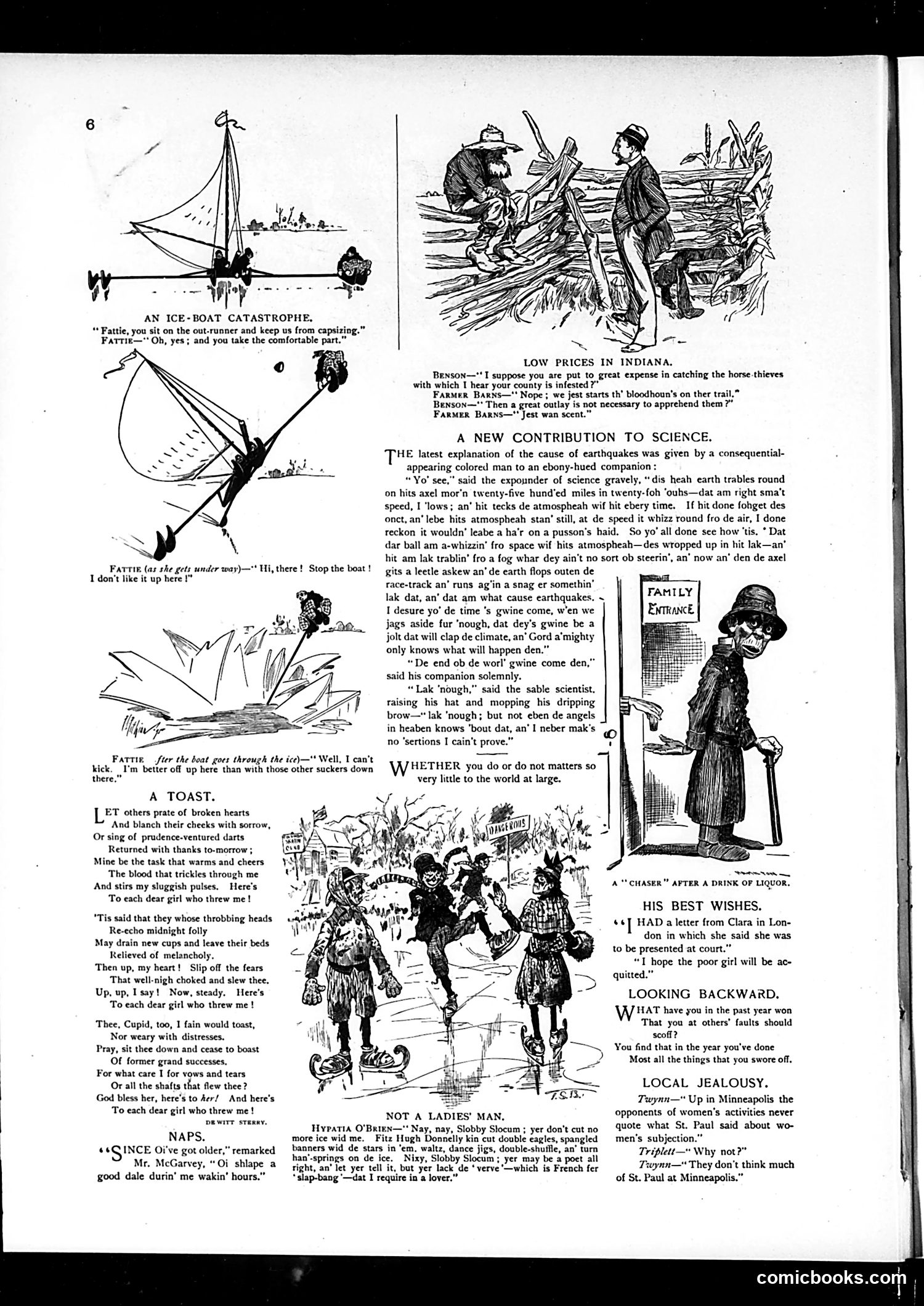
This page contains multiple satirical pieces typical of late 19th-century American humor: **Ice-Boat Catastrophe & Low Prices in Indiana**: Light comedic sketches about mishaps and rural life. The Indiana piece plays on the stereotype of horse theft in frontier areas, with a farmer making a pun about catching thieves being inexpensive (requiring only "one scent" from bloodhounds). **"A New Contribution to Science"**: A racial caricature mocking African American dialect and pseudo-scientific reasoning. Two Black men discuss earthquakes, with one offering a deliberately absurd explanation involving the Earth's rotation and "axel" (axis). The satire targets both pseudo-intellectual pretension and, unfortunately, relies on racist stereotyping common to the era. **Other Content**: Poetry about romantic disappointment, social commentary on women's activities in Minneapolis, and various short humorous pieces. The page reflects Judge's typical formula: lightweight humor, social observation, and unfortunately, the casual racism standard in American satirical magazines of this period.
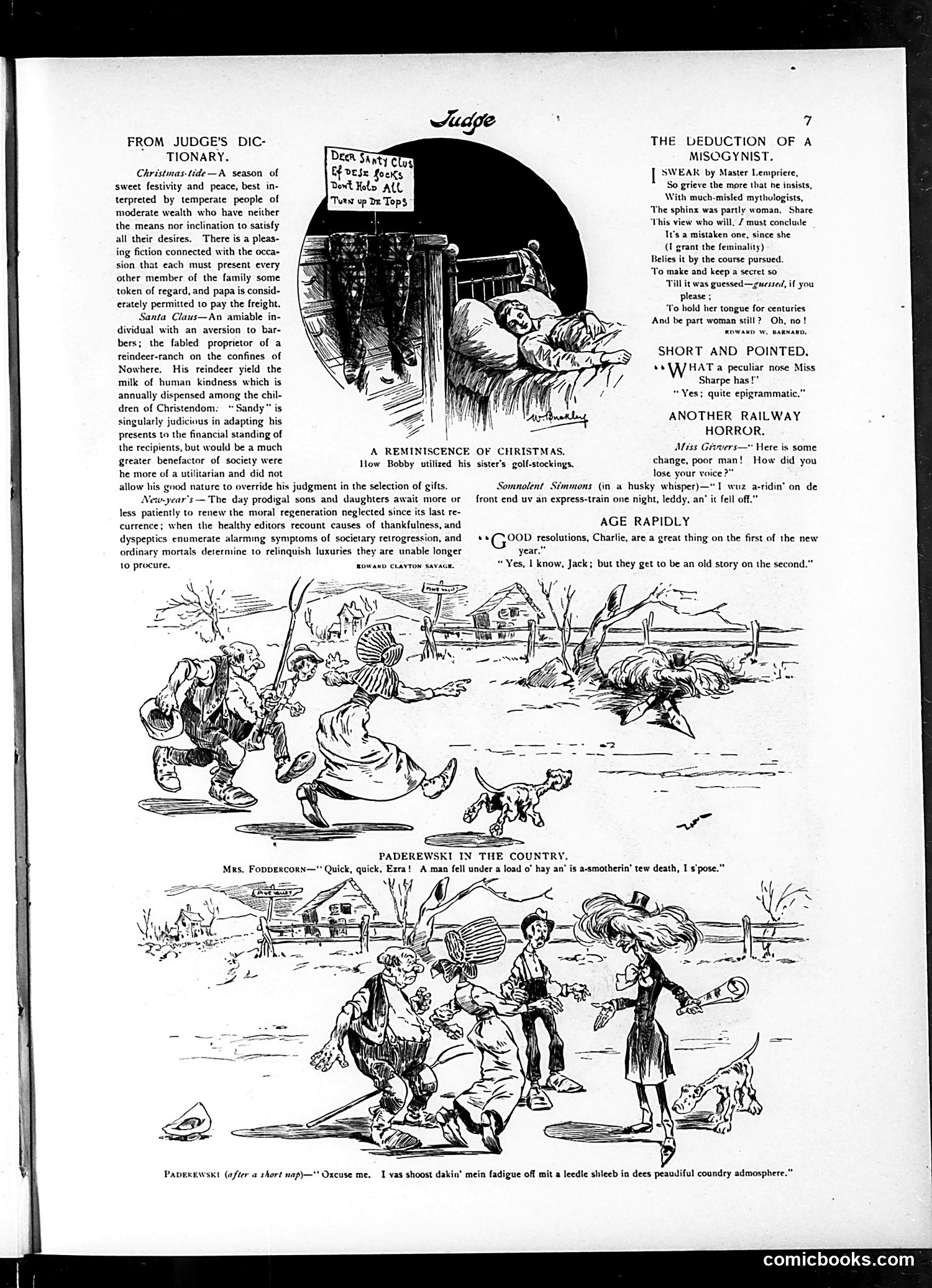
This page from the satirical magazine **Judge** contains multiple short humor pieces mocking contemporary American society and notable figures. **"Paderewski in the Country"** caricatures the famous Polish pianist **Ignacy Jan Paderewski** through exaggerated accent and stereotype—portraying him as self-absorbed and indifferent to a man dying under a hayload, caring only for his own rest. The humor relies on ethnic caricature common to the era. **"The Deduction of a Misogynist"** sarcastically "proves" women cannot keep secrets by referencing the mythological Sphinx, arguing that if she were female, she'd have revealed her riddle centuries ago. It's crude anti-woman satire. **Other items** include dictionary definitions mocking Christmas commercialism and New Year's hypocrisy, a railway conductor joke, and a child using golf stockings for play—all gentle social commentary on American consumer culture and family life. The page exemplifies Judge's formula: combining ethnic caricature, misogyny, and middle-class social satire into brief, punchy jokes for educated readers.
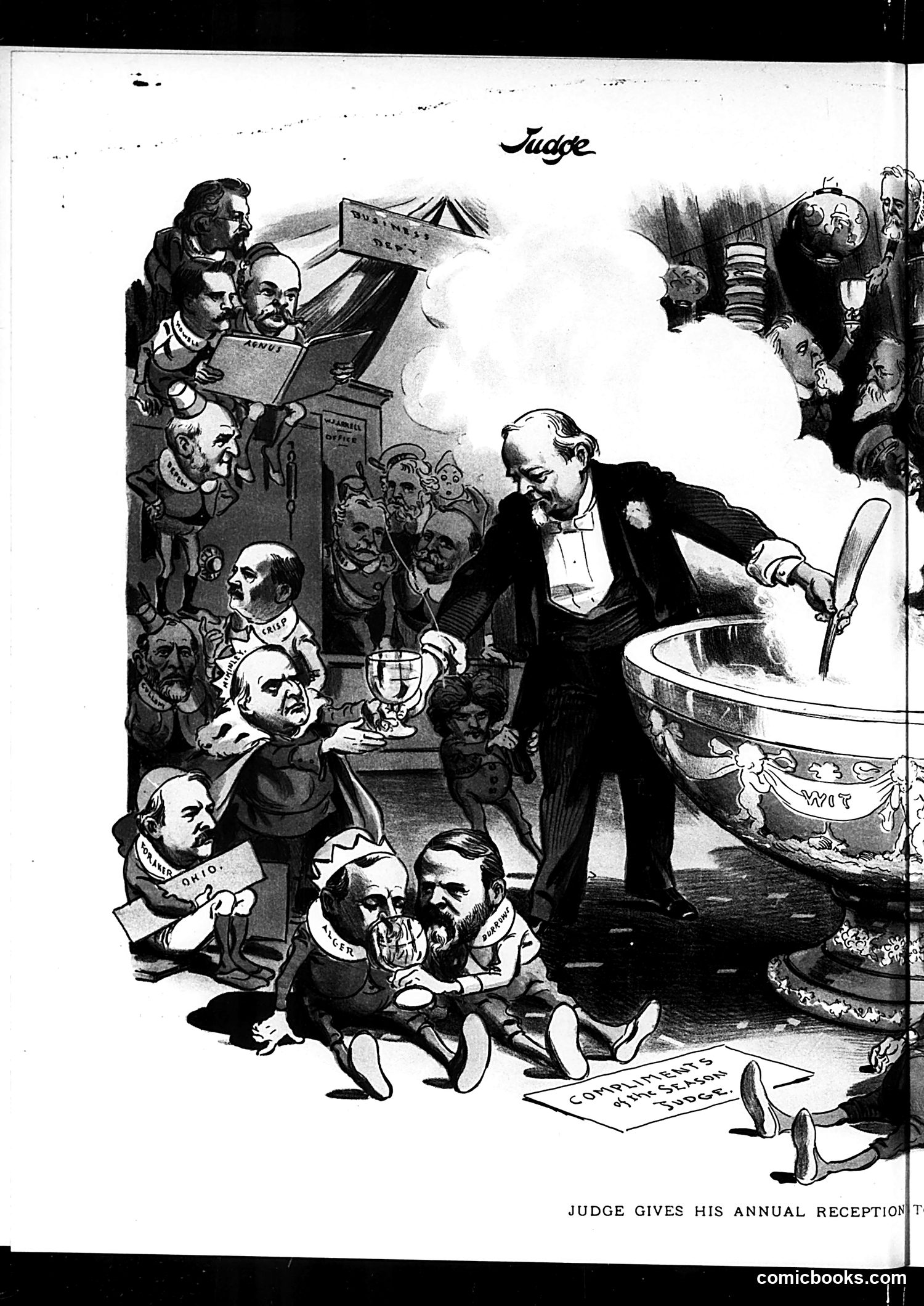
This cartoon satirizes corruption in the judicial system. A well-dressed judge presides over a large cauldron labeled "CORRUPTION" and "LITIGATION," stirring its contents. Below, several grotesque figures depicted as small, childlike creatures—labeled with names including "OHIO"—appear to be receiving favors or being served from the judge's pot. The scene mocks the notion that judges host "receptions" where they distribute judicial favors to politicians and special interests in exchange for corrupt payments or influence. The cauldron represents the mixing together of legal cases, bribery, and political manipulation. The exaggerated caricatures of the supplicants suggest they represent various state politicians or interest groups seeking judicial favoritism. The overall message criticizes how the American legal system had become compromised by political patronage and corruption during the Gilded Age.
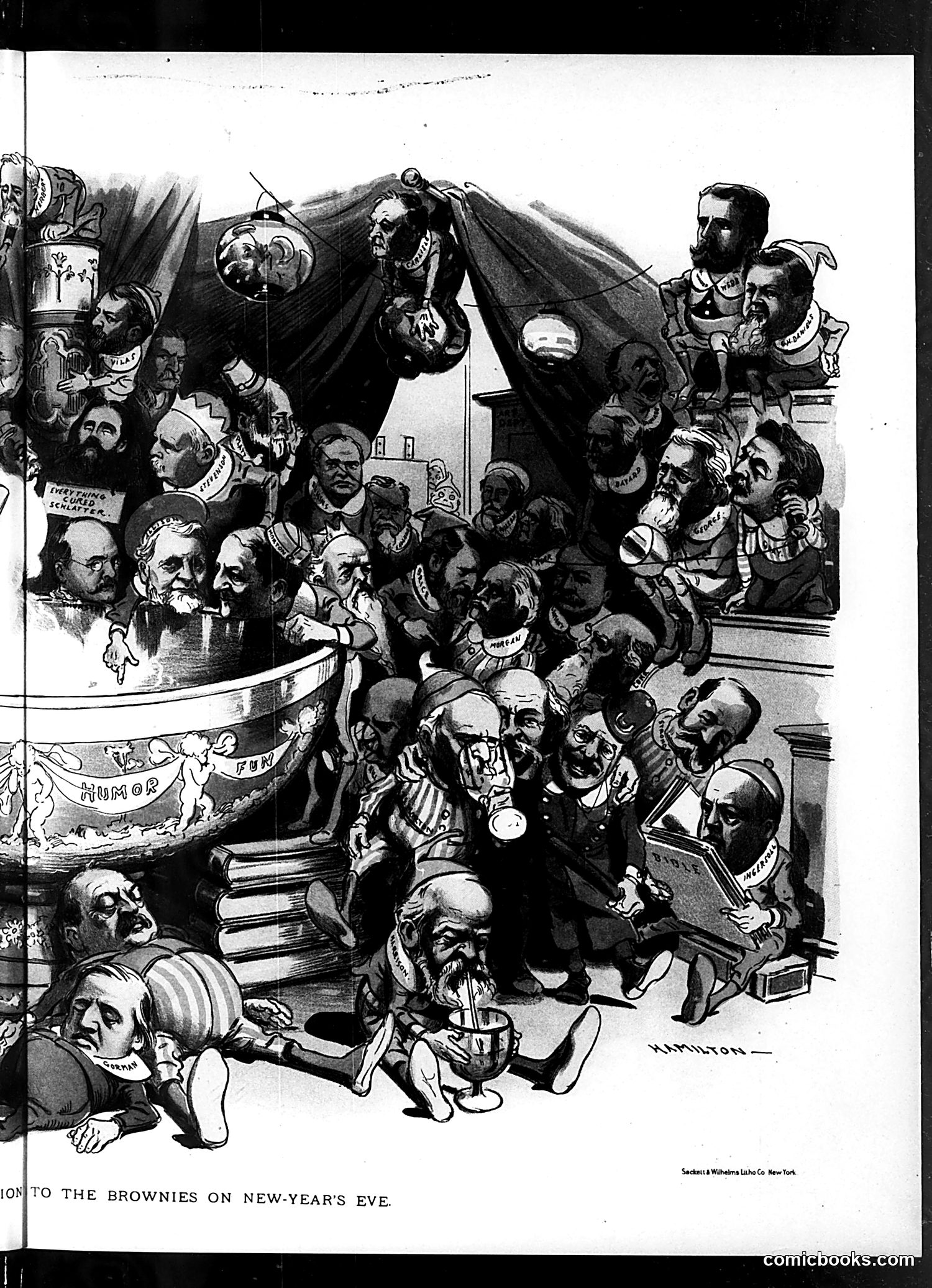
This political cartoon depicts numerous caricatured figures in what appears to be a chaotic New Year's Eve celebration. The title references "Brownies," likely meaning the British soldiers (Tommies) or possibly political figures of the era. The crowded composition shows multiple bearded men in military dress and period clothing arranged in tiers, some appearing intoxicated or rowdy, suggesting satirical commentary on military conduct or political leadership during revelry. Without clearer identification of specific figures or the magazine's publication date, the exact political targets remain unclear. The artist Hamilton's style suggests this is from the late 19th or early 20th century. The satire appears to mock either military excess, foreign policy figures, or domestic political leaders during celebrations, but the specific historical context needed for precise interpretation isn't evident from the visible elements.
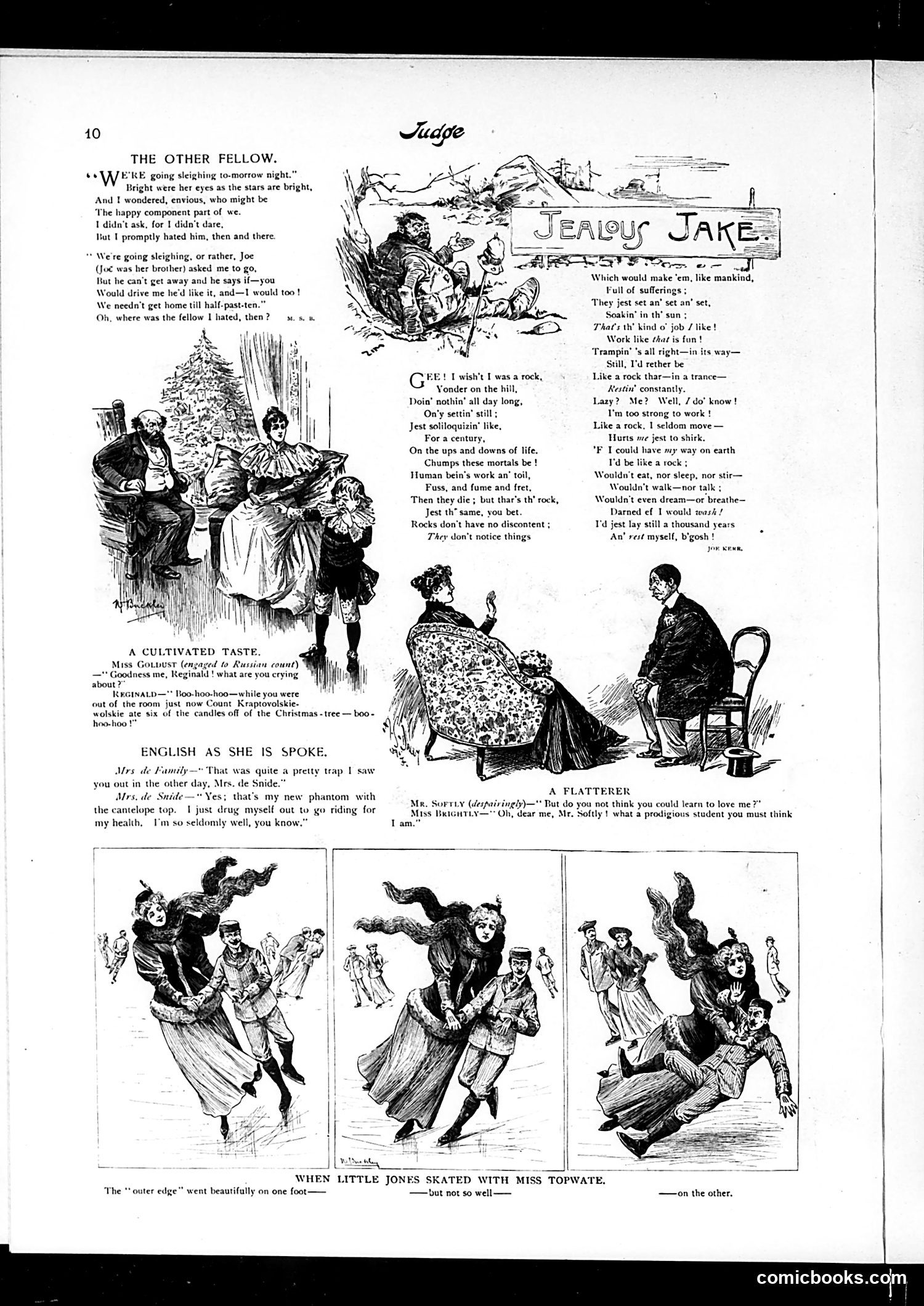
This page from *Judge* contains several distinct satirical pieces typical of the magazine's humor: **"The Other Fellow"** (top): A short narrative poem about romantic jealousy. A man learns his beloved is going sleighing with "Joe"—only to discover Joe is her brother. The joke mocks male insecurity and the narrator's baseless hatred of an innocent rival. **"A Cultivated Taste"**: Mocks pretension. A man named Reginald cries over Russian aristocrats eating candles from a Christmas tree, suggesting either absurd snobbery or that Russian nobility had bizarre eating habits—likely satirizing both excessive Anglophilia and ethnic stereotypes. **"English As She Is Spoke"**: Ridicules malapropisms and affected speech among the social-climbing wealthy (Mrs. de Family/de Snide), who mispronounce words while discussing their carriages. **"Jeasy Jake"**: A dialect poem about a rock's contentment versus human suffering—philosophical humor about working-class resignation. **"A Flatterer"**: Brief scene mocking courtship where Mr. Softly attempts romance with dubious success. **"When Little Jones Skated"**: Visual gag showing a skating mishap with Miss Topwate. Overall: light domestic and social satire aimed at middle-class readers.
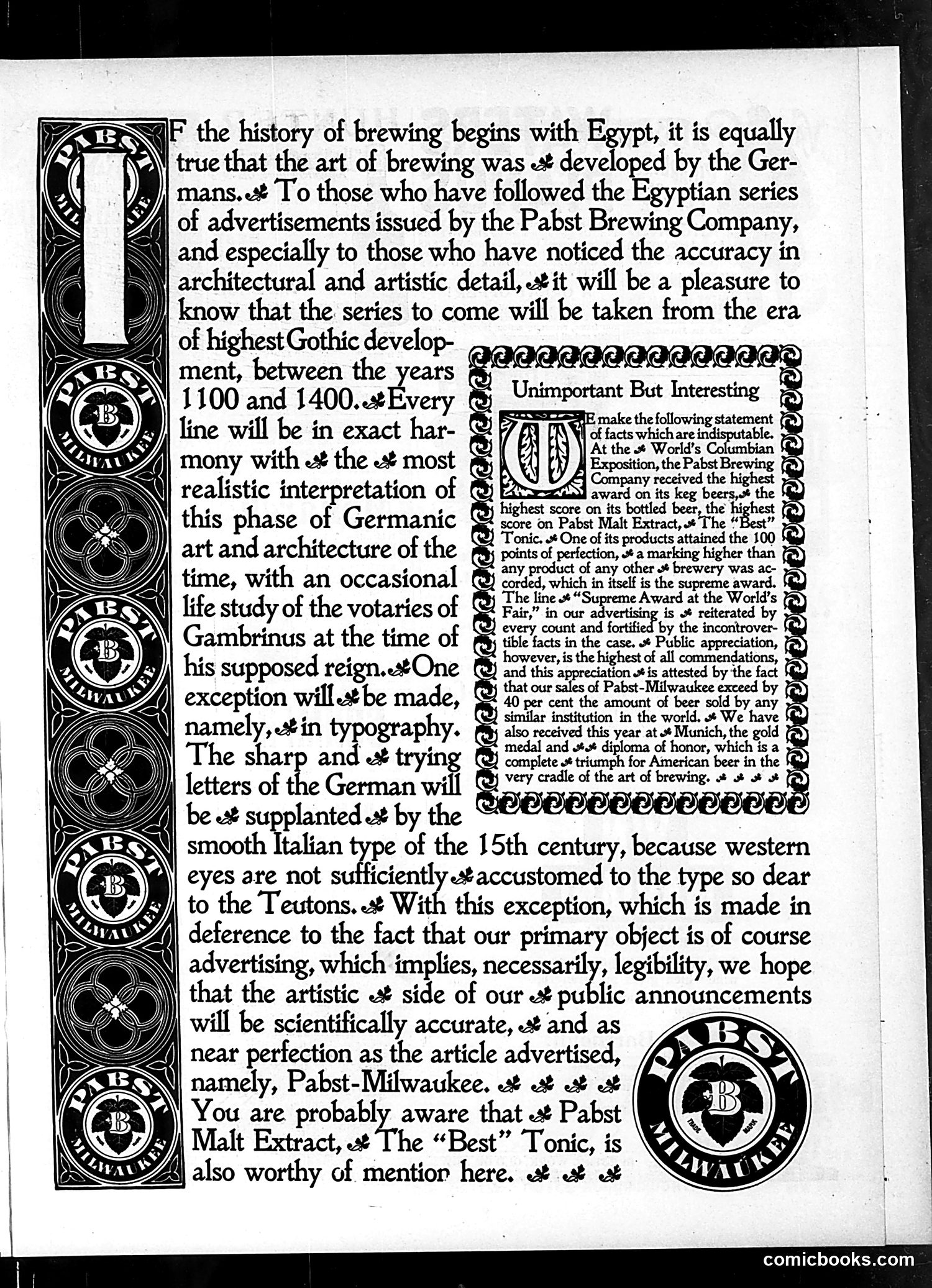
This is primarily a **Pabst Brewing Company advertisement**, not a political cartoon. The page announces an upcoming advertising series themed around Gothic art and architecture (1100-1400), following a previous Egyptian-themed campaign. The text explains that Pabst will use historically accurate Gothic design and imagery, with one exception: they'll replace authentic German typefaces with smoother Italian 15th-century fonts for readability, since American audiences aren't accustomed to traditional German lettering. The "Unimportant But Interesting" sidebar boasts of Pabst's awards at the World's Columbian Exposition and Munich competition, claiming superiority over competitors. This reflects the era's trend of using elaborate historical and artistic theming in advertisements, and Pabst's marketing strategy emphasizing both cultural sophistication and German heritage—appealing to significant German-American populations of the time.
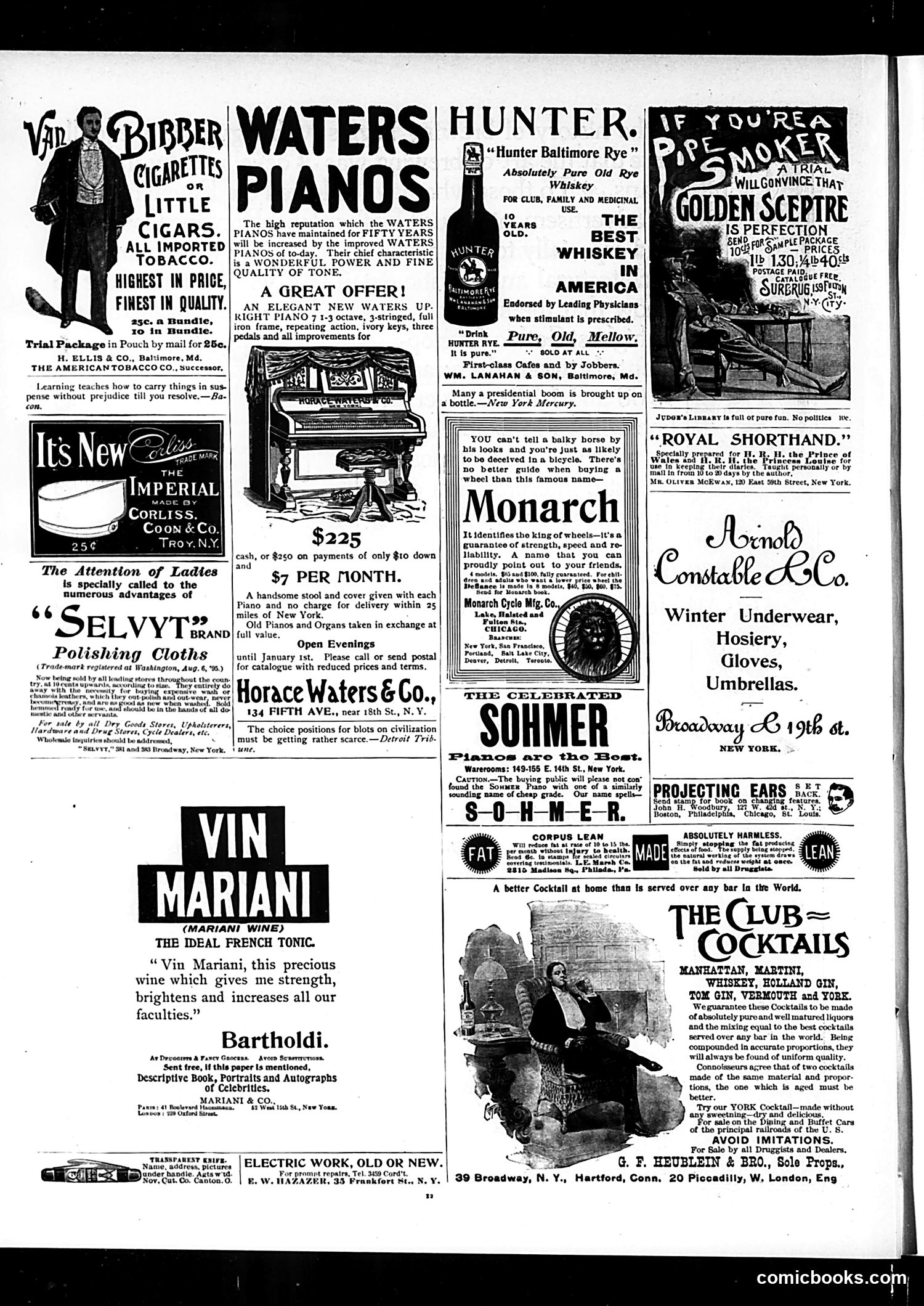
This page is primarily **advertising**, not political satire. It contains roughly a dozen ads for consumer products and services typical of the late 19th/early 20th century. The ads include: - **Tobacco products** (Bibber Cigarettes, cigars) - **Pianos** (Waters and Sohmer brands) - **Whiskey** (Hunter Baltimore Rye, promoted as medicinal) - **Patent medicines/tonics** (Vin Mariani wine tonic) - **Bicycles** (Monarch brand) - **Clothing** (Arnold Constable, Selvyt polishing cloths) - **Shorthand instruction** (Royal Shorthand) - **Cocktail guides** (The Club Cocktails) The only satirical element appears to be small editorial fragments between ads—brief witticisms like "You can't tell a balky horse by his looks and you're just as likely to be deceived in a bicycle" and "The choice positions for blots on civilization must be getting rather scarce." Otherwise, this is a revenue-generating advertising page offering no particular political commentary or historical significance beyond reflecting contemporary consumer culture and marketing practices.
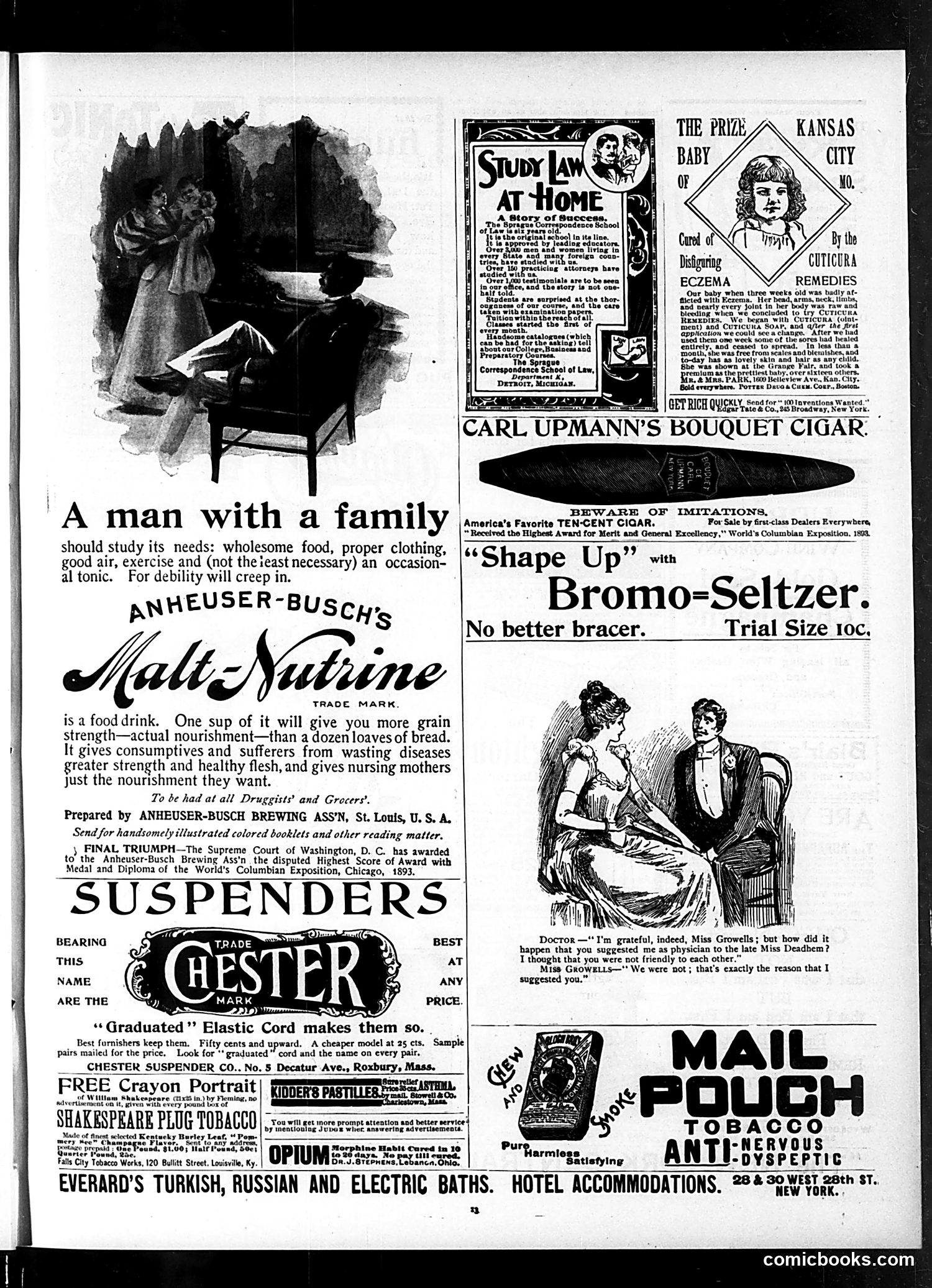
This page is primarily **advertising**, not political satire. It contains multiple late-19th-century product advertisements with minimal comic content. The main illustrated cartoon appears in the **Bromo-Seltzer ad**: a doctor and woman in conversation. The joke is straightforward—Miss Growells recommended her former enemy as the late Miss Deadhem's physician specifically *because* they weren't friendly, implying she wanted poor medical care for the rival. It's dark humor about female rivalry. The page's other content includes ads for Anheuser-Busch's "Malt Nutrine" (a nutritional drink), Chester Suspenders, Shakespeare Plug Tobacco, Cuticura Remedies, Carl Upmann's cigars, and Bromo-Seltzer. These ads rely on period medical/nutritional claims now recognized as dubious—malt beverages as health tonics, various remedies for skin conditions, etc. There is **no significant political content** on this page. It represents typical Judge magazine advertising space from the 1890s.
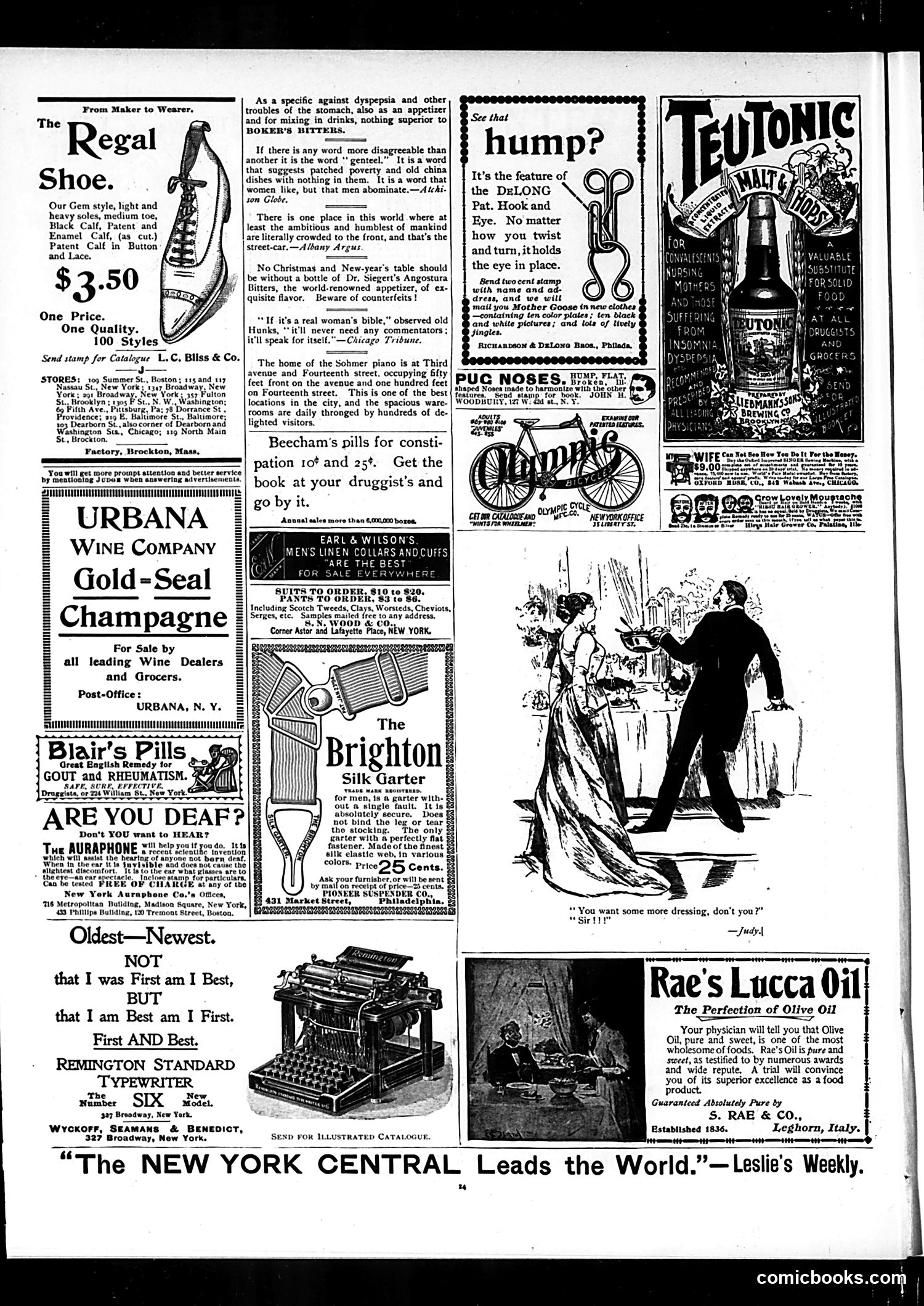
This page is primarily **advertising**, typical of early 20th-century magazines. The only cartoon is a small illustration at bottom-right showing a man and woman at a dining table, with the caption: *"You want some more dressing, don't you?" / "Sir! I!"* This is a mild domestic humor joke about marital propriety—the woman interprets the man's innocent question about salad dressing as an impertinent comment, responding with mock offense ("Sir!"). The rest of the page contains product advertisements for shoes, champagne, pills, hearing devices, typewriters, and other goods—all typical commercial copy of the era. There is no significant political or social satire on this particular page. The quoted excerpts scattered throughout the ads are generic observations about poverty, street-cars, and femininity, but lack specific satirical targets or commentary.
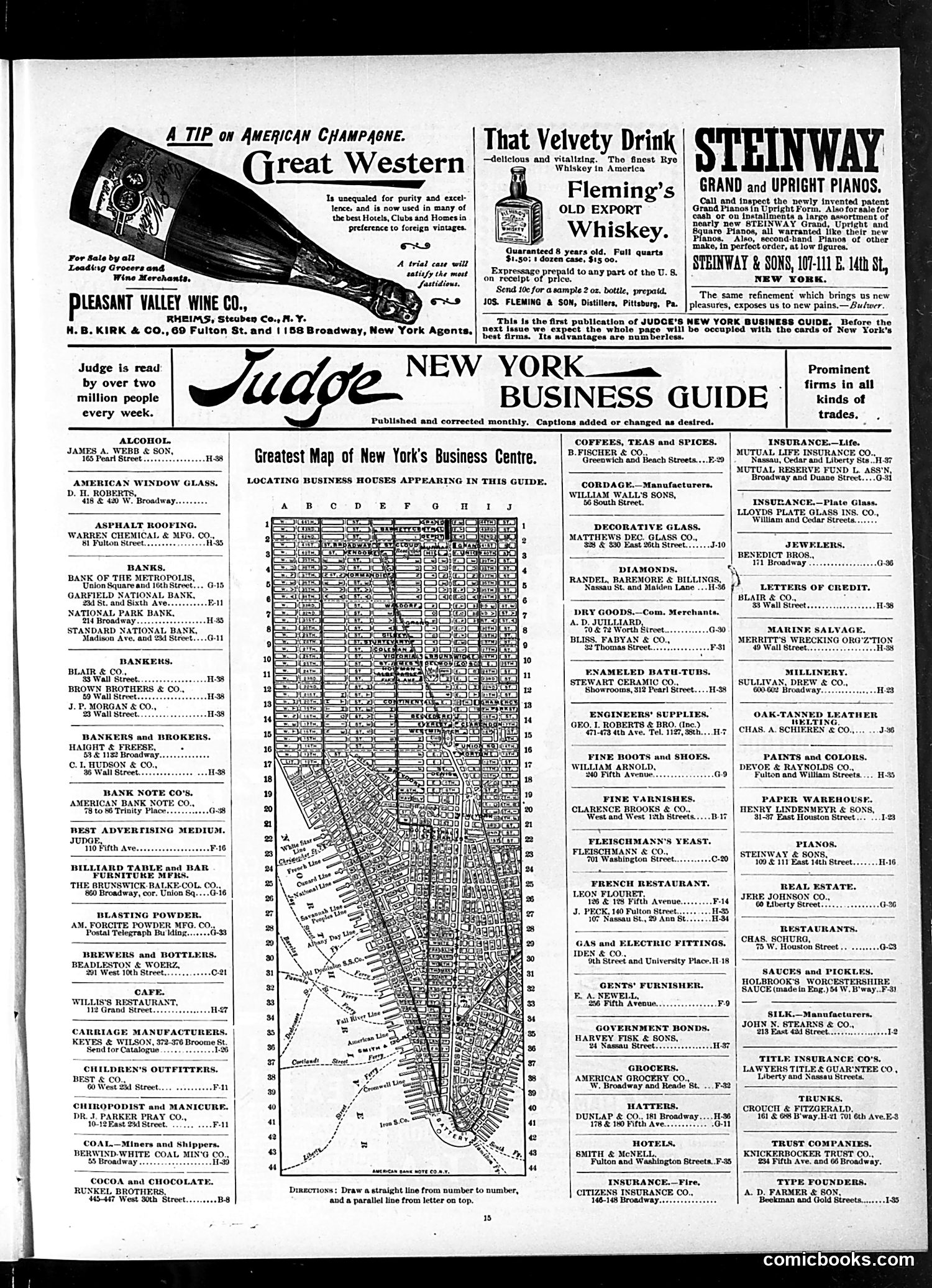
This page is primarily a **business directory and advertising supplement**, not a political cartoon. It comprises: 1. **Commercial advertisements** for liquor (Great Western Champagne, Fleming's Old Export Whiskey), pianos (Steinway), and wine at the top 2. **A detailed street map** of lower Manhattan's business district with a grid system for locating commercial establishments 3. **An alphabetical business directory** listing New York firms by category (banks, insurance companies, jewelers, etc.) with their addresses The only editorial content is a brief note stating this is "the first publication of JUDGE'S NEW YORK BUSINESS GUIDE," promoting the directory as a resource for merchants. **For modern readers:** This represents 19th-century *Judge* magazine functioning as both satirical publication and practical business publication—using advertising revenue to subsidize content while providing commercial services to readers and advertisers.
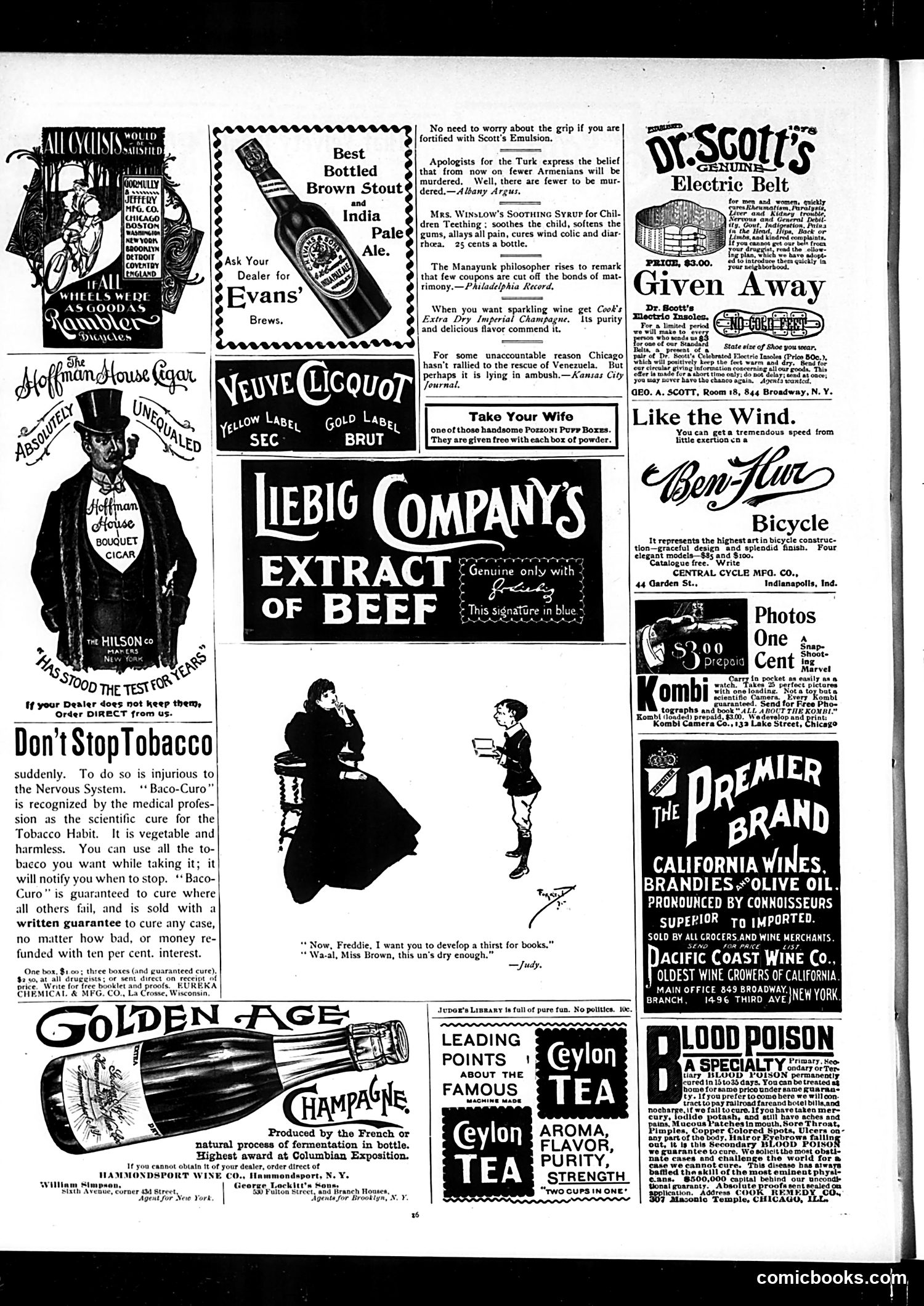
This is primarily an **advertising page** from Judge magazine, a satirical publication. However, it contains one notable political cartoon and one joke worth explaining: ## The Cartoon The small illustration captioned *"Now, Freddie, I want you to develop a thirst for books"* depicts a schoolteacher speaking to a boy who responds: *"Wa-al, Miss Brown, this un's dry enough."* This is a schoolroom joke playing on the double meaning of "thirst"—the teacher wants him interested in reading, but the boy interprets it literally as actual thirst, commenting that he's already parched. ## Political Content A brief text joke references the **Armenian massacre** by the Ottoman Turk, noting darkly that fewer Armenians will be murdered going forward because fewer remain alive—a grim commentary on recent historical atrocities. This appears as filler between advertisements. The rest of the page consists entirely of **period product advertisements** (beer, champagne, tobacco cessation aids, bicycles, cameras), representing typical Judge magazine revenue sources from this era.
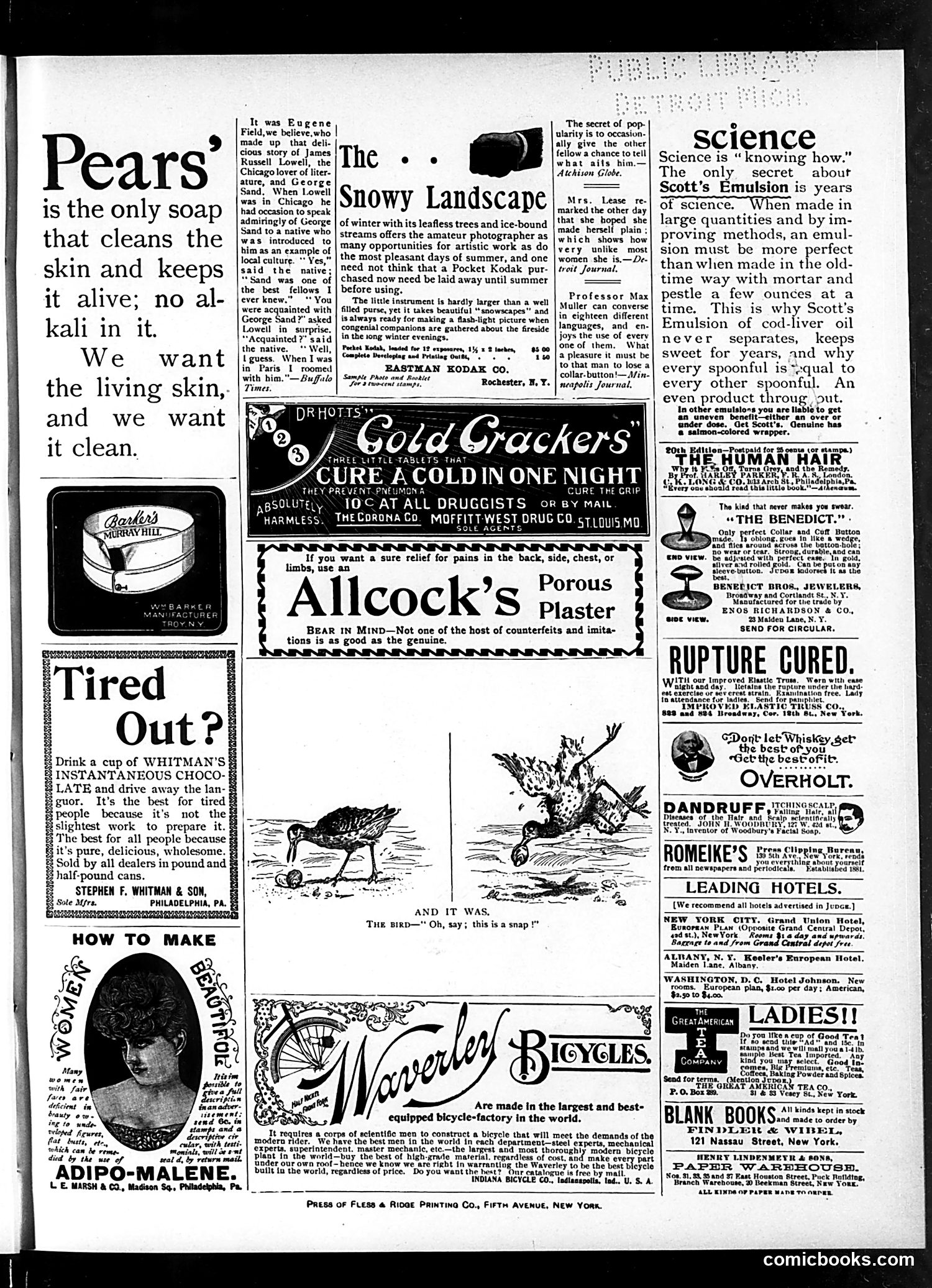
This page is primarily **advertising**, with one small cartoon. The advertisements are typical turn-of-the-century products (Pears' soap, Whitman's chocolate, Kodak cameras, cold remedies). The one cartoon shows **a bird in snowy landscape** with the caption "And it was the bird—'Oh, say; this is a snap!'" This appears to be a visual pun playing on photography terminology: the bird is literally being "snapped" (photographed) while also punning on "snap" as everyday speech. It accompanies an advertisement for Eastman Kodak cameras, illustrating how the Pocket Kodak can capture winter scenes. The page also includes humorous quotes and observations—likely from the magazine's regular "department" features—about various figures (Eugene Field, George Sand, Mrs. Lease, Professor Max Müller) though without sufficient context to explain their specific satirical points. The overall effect is light, aphoristic humor typical of Judge's editorial approach.
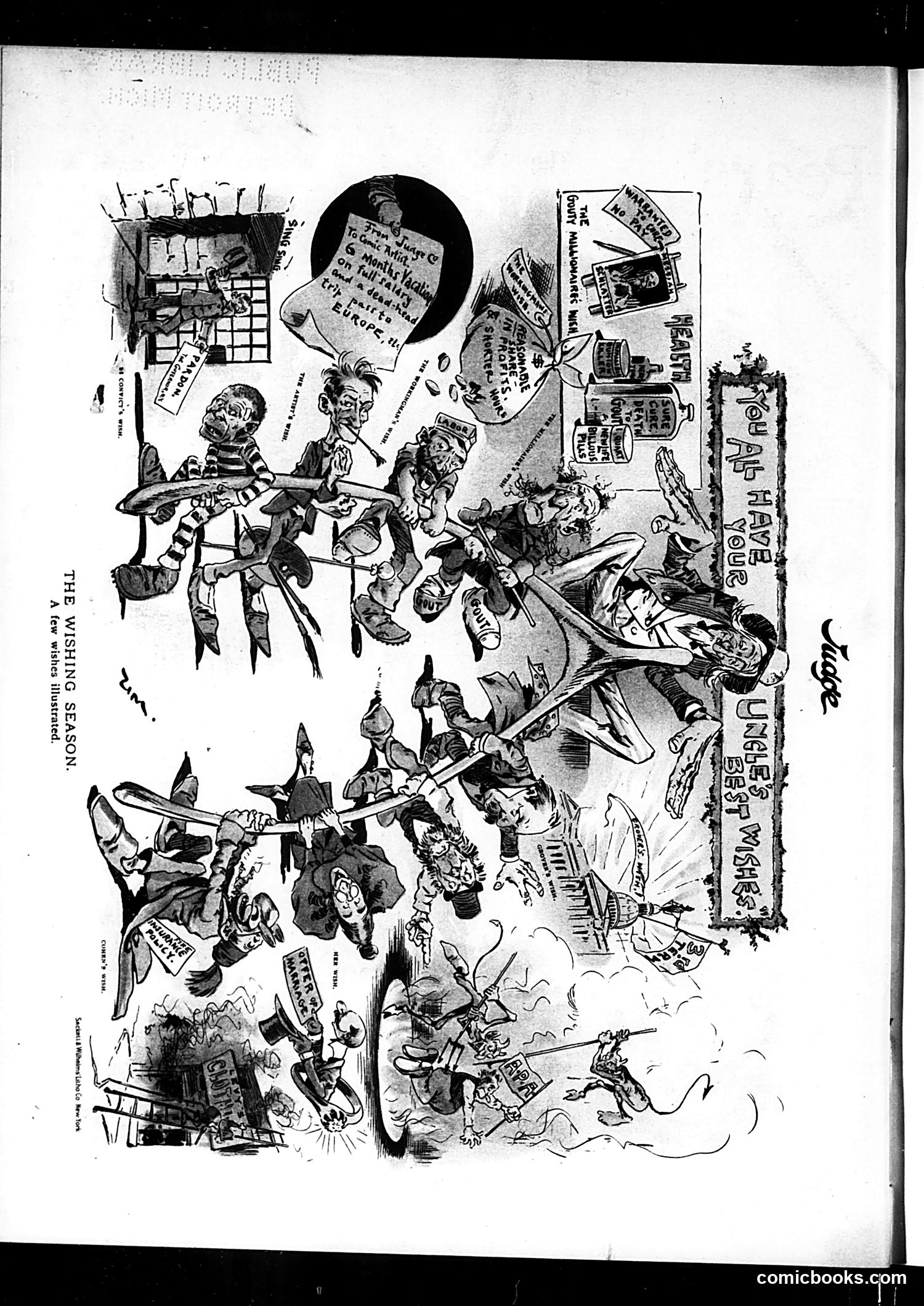
The OCR text is severely corrupted and essentially unreadable, making it impossible to identify the specific political or social references with confidence. From the **image alone**, I can see this is a satirical cartoon featuring multiple caricatured figures in exaggerated poses, some holding weapons or tools, with various speech bubbles and text boxes scattered throughout. The style is consistent with early 20th-century American political cartooning. However, without legible text identifying the figures or their context, I cannot accurately determine: - Which political figures or groups are being satirized - What specific event or issue is being commented on - The intended message or joke To provide accurate historical analysis, a clearer version of the OCR text or clearer image would be needed.