
A complete issue · 16 pages · 1895
Judge — August 31, 1895
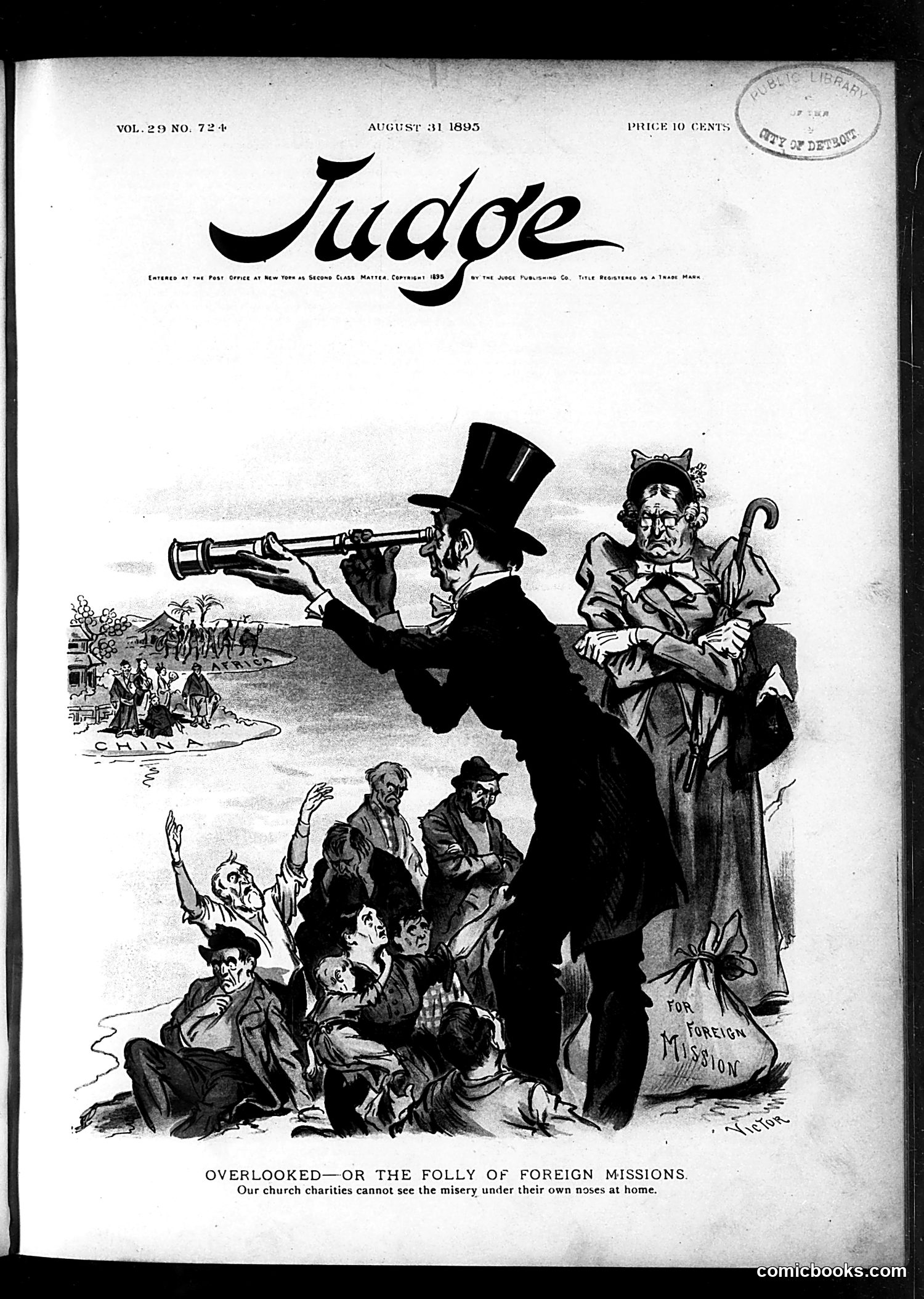
This satirical cartoon critiques American churches for funding foreign missionary work while ignoring domestic poverty. The central figure—a wealthy gentleman with a telescope—represents church leadership focused on distant "foreign missions" (labeled on the sack). Below him, impoverished people with raised hands appeal for help, symbolizing overlooked American poor. The subtitle states the cartoon's message directly: "Our church charities cannot see the misery under their own noses at home." This reflects late-19th-century debate about charitable priorities. Rather than aid struggling Americans—depicted as ragged and desperate—churches directed resources toward converting distant populations. The gentleman's telescope suggests selective vision: churches could "see" far away but remained willfully blind to nearby suffering. The satire attacks perceived hypocrisy in Christian charitable practices.
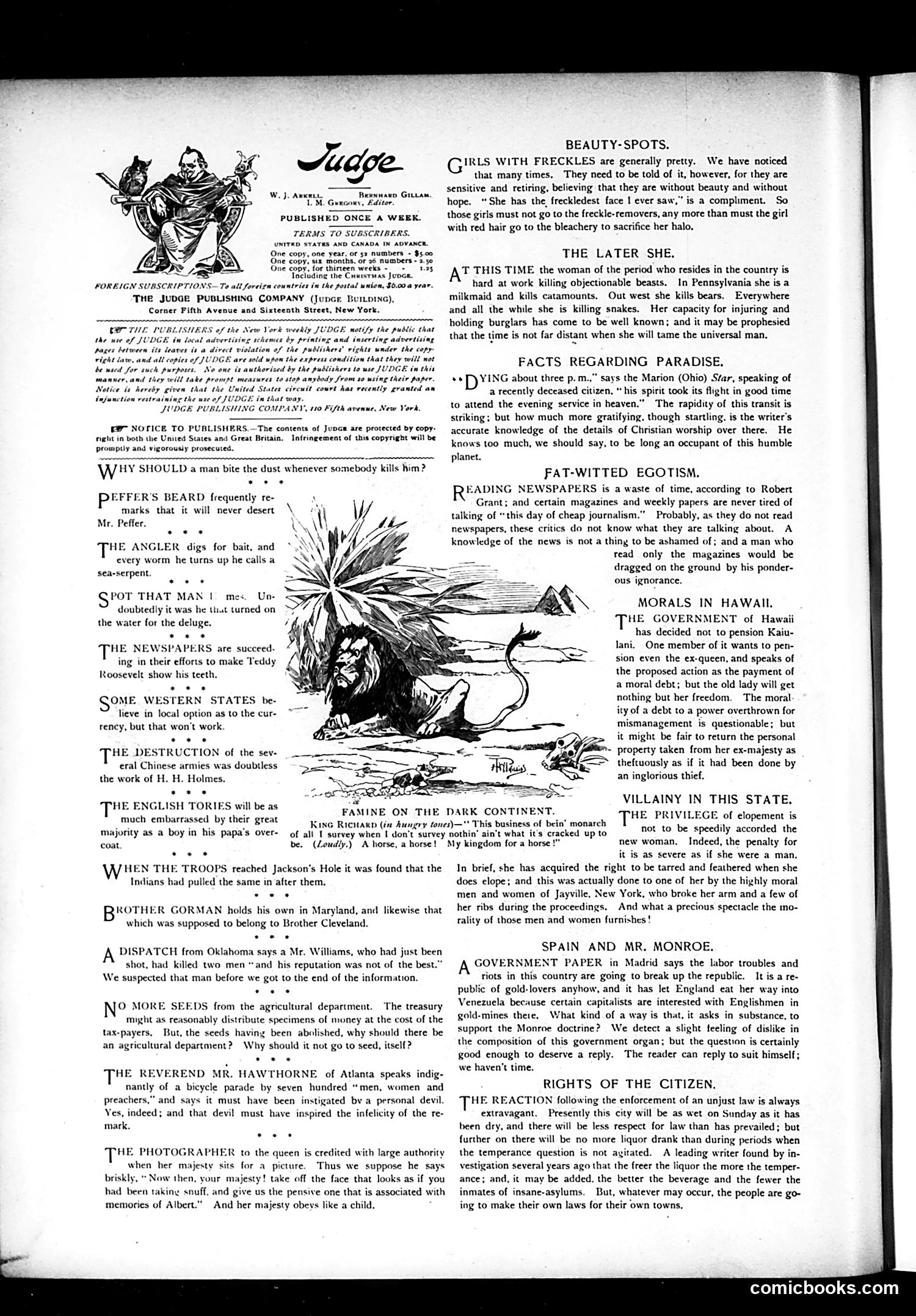
The visible cartoon depicts a fisherman in distress, apparently struggling with his catch. The accompanying text snippets are brief satirical observations rather than connected editorial commentary. The page's humor relies on wordplay and social commentary typical of Judge magazine: - "Why should a man bite the dust whenever somebody tells him?" — a joke about nagging - Observations about newspapers, beards, and Western states appear to be disconnected satirical jabs - References to political figures (Roosevelt, Theodore) and current events (Hawaii, labor troubles in Spain) Without clear date markers or attribution to specific cartoonists visible, the exact political targets remain somewhat opaque. The overall tone mocks contemporary politics, journalism, and social pretension—characteristic of Judge's approach as an American satirical weekly. The artwork style and typeface suggest late 19th or early 20th century publication.
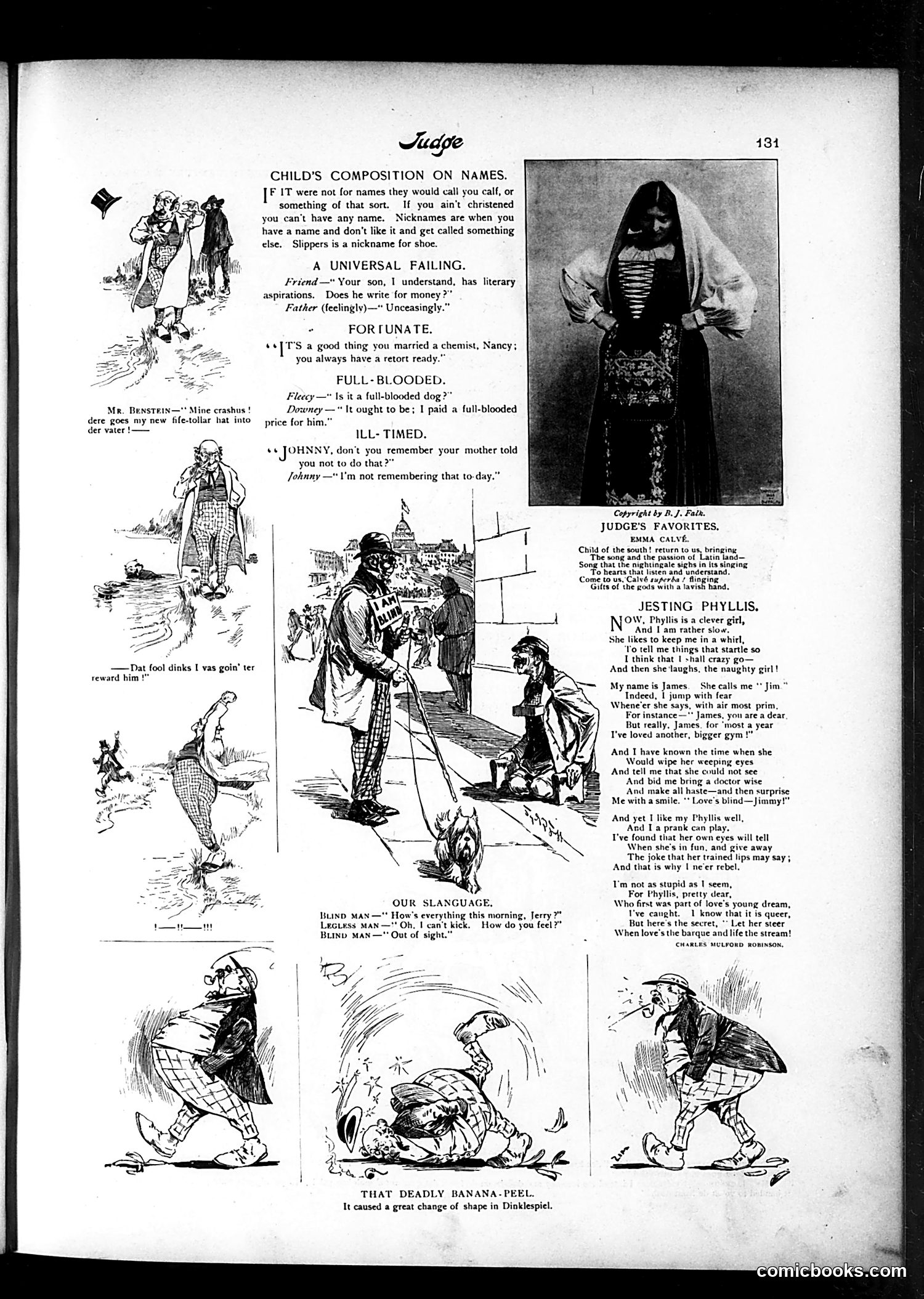
This page contains satirical humor columns and illustrations typical of Judge magazine's format. The text sections include: **"Child's Composition on Names"** - light satire on children's literal interpretations of language and nicknames. **"A Universal Failing"** - joke about a son with literary aspirations but no output. **"Full-Blooded"** - pun-based humor about dog breeding. **"Ill-Timed"** - brief joke about selective memory. The center features a large illustration of "Our Slanguage" - appears to be dock workers or laborers using working-class vernacular, with a blind man and legless man having difficulty understanding their speech patterns. **"Jesting Phyllis"** is a poem about a clever girl named Phyllis. The bottom cartoons show slapstick humor involving a banana peel causing mishaps - classic physical comedy of the era. The page is primarily entertainment-focused rather than political commentary.
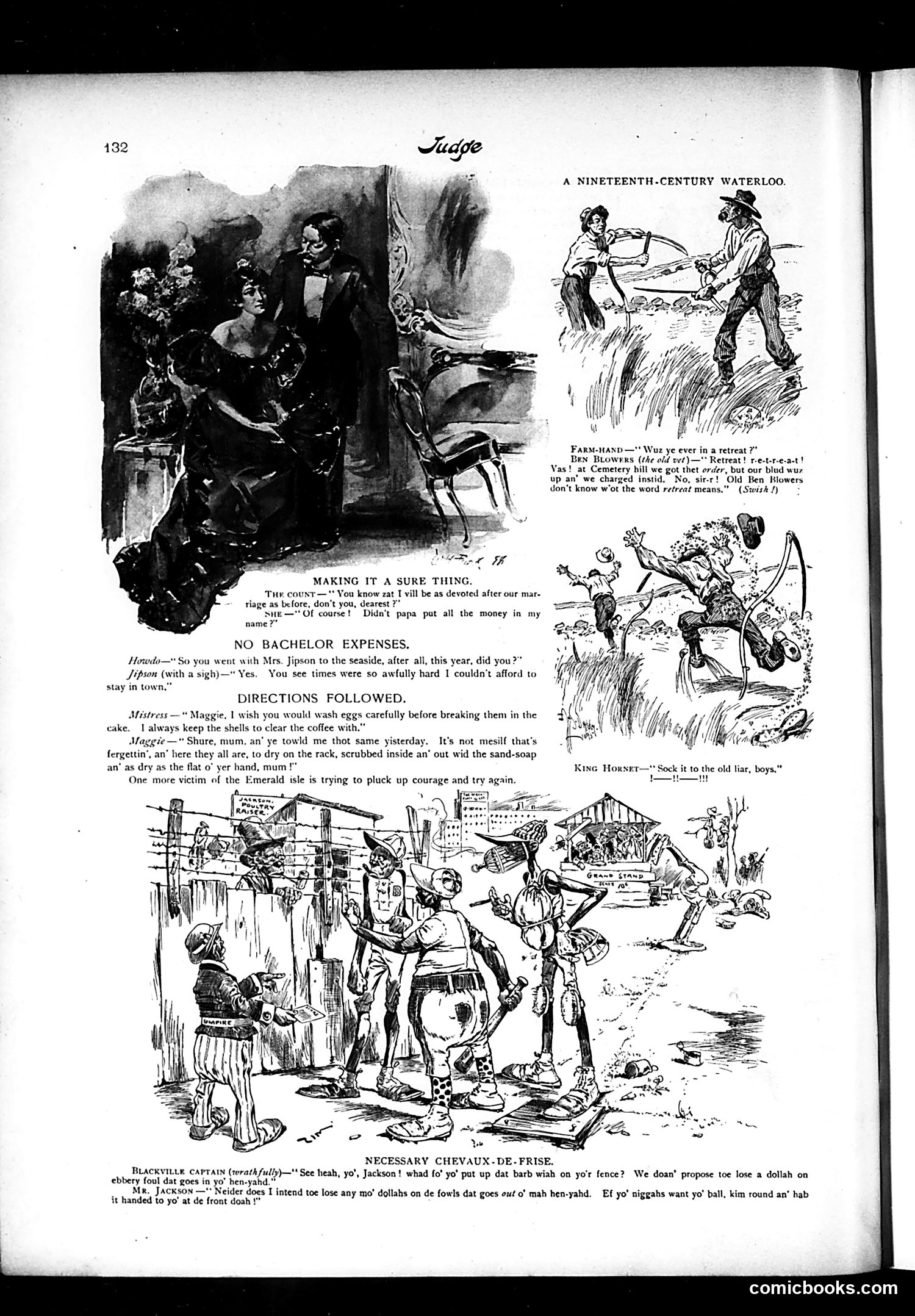
This page contains several satirical sketches typical of late 19th-century American humor: **"A Nineteenth-Century Waterloo"** mocks an elderly Civil War veteran ("Old Ben Blowers") bragging that he never retreated at Cemetery Hill, presenting false bravado about wartime courage. **"Making It a Sure Thing"** satirizes a groom reassuring his bride of devotion—the joke being her cynical confidence stems solely from her father placing money in her name, reducing marital devotion to financial security. **"No Bachelor Expenses"** jokes about a man forced to vacation with his wife at the seaside rather than afford staying in town alone, inverting typical expectations about marriage expenses. **"Directions Followed"** presents Irish domestic humor: a maid meticulously follows her mistress's literal instructions to scrub eggshells with sand-soap, highlighting immigrant servants' supposed literal-mindedness. **"Necessary Chevaux-de-Frise"** uses dialect humor between Black characters debating barbed wire on a fence to keep out livestock and people, relying on period racial caricature stereotypes.
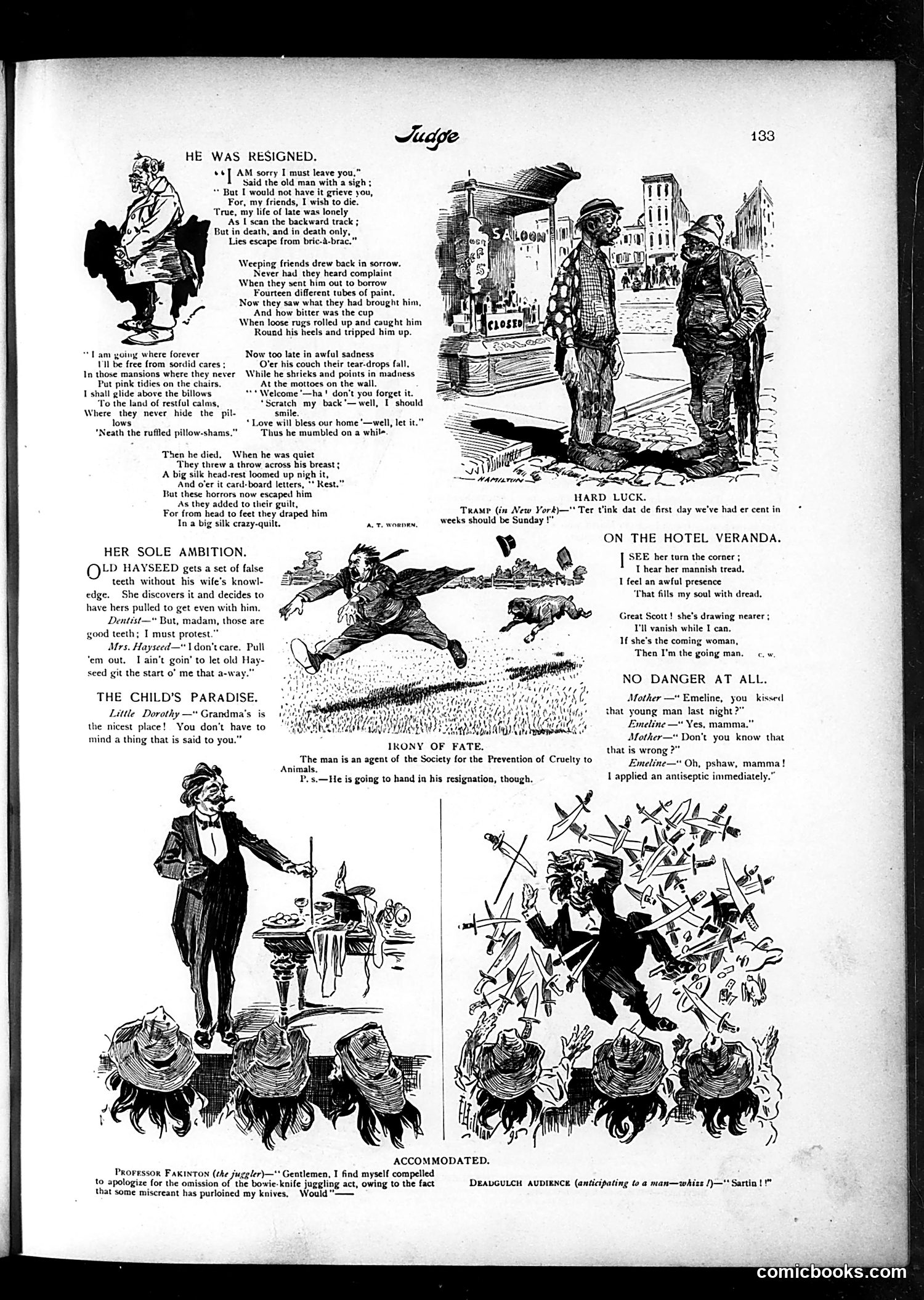
This page contains multiple satirical sketches typical of late-19th/early-20th-century American humor: **"He Was Resigned"**: A darkly comic poem about an elderly man driven to wish for death—not by hardship, but by his household's excessive decorative clutter (doilies, throw rugs, pillows, mottos). The satire targets Victorian domestic excess and the way well-meaning family members burden elderly relatives with "improvements." **"Her Sole Ambition"**: Rural humor about a farmer's wife ("Old Hayseed") who extracts her own good teeth simply to match her husband's false teeth, illustrating petty domestic one-upmanship. **"Irony of Fate"**: A brief joke: an animal-cruelty-prevention activist is resigning—the irony being his profession contradicts his actual nature. **"The Coming Woman"**: References the contemporary "New Woman" movement, with a man fleeing from an independent, assertive woman ("mannish tread"), mocking male anxiety about changing gender roles. Other sketches satirize dentistry, rural manners, and vaudeville acts. The humor relies on period-specific social anxieties and class commentary.
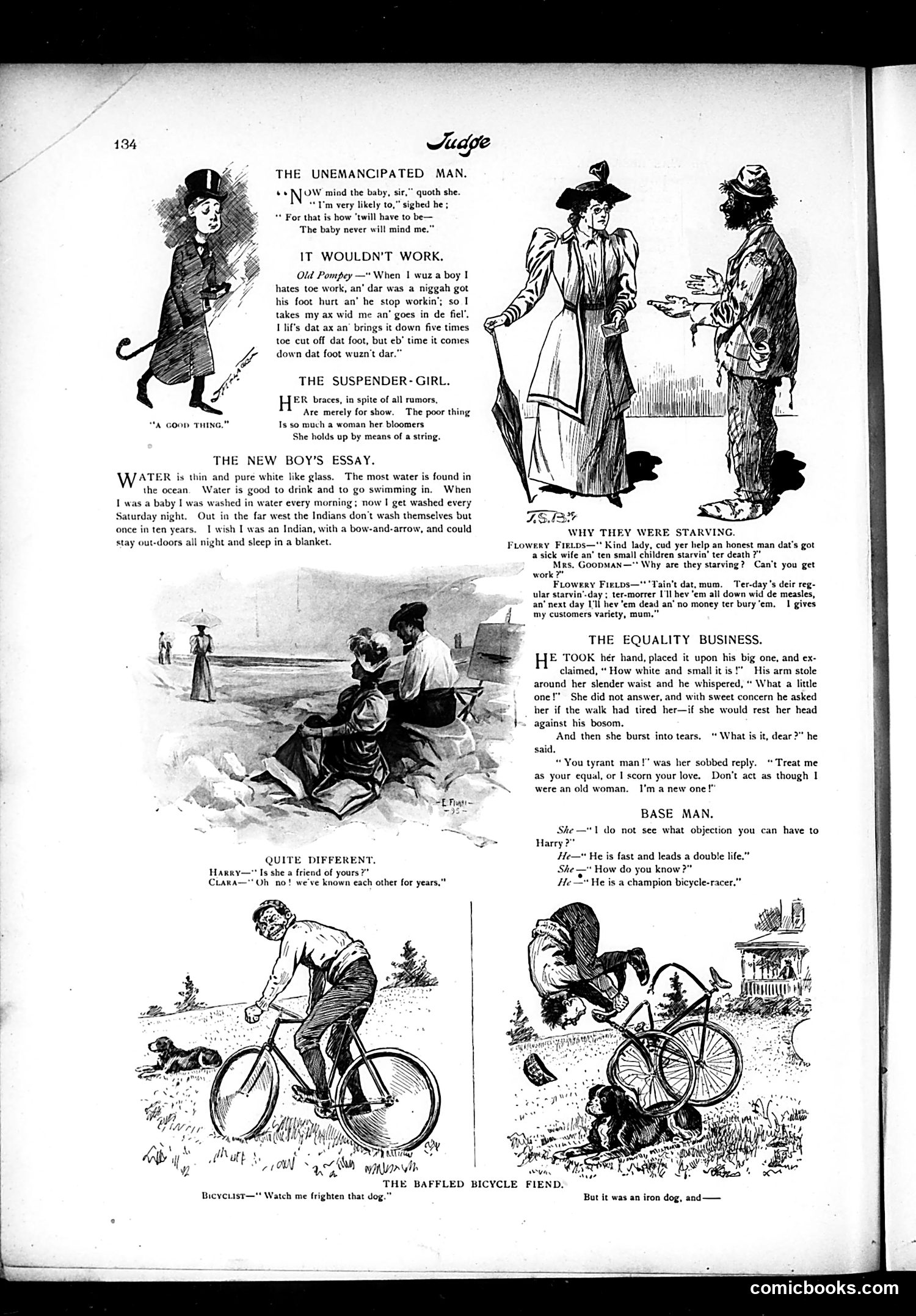
This page contains multiple short satirical pieces typical of late 19th-century American humor: **"The Unemancipated Man"** mocks male domestic helplessness—a husband reluctantly accepting childcare, suggesting men of this era were culturally unprepared for household responsibilities. **"It Wouldn't Work"** uses offensive period dialect to satirize a folk tale about an enslaved person's injury, reflecting Judge's often crude racial humor. **"The Suspender-Girl"** jokes about women's fashion and bloomers (reform clothing), mocking the contradiction between practical dress and Victorian modesty. **"Why They Were Starving"** satirizes professional beggars who manipulate charitable donors with excuses and planned miseries—social criticism wrapped in class mockery. **"The Equality Business"** critiques the "New Woman" movement: a man treats his companion with gentlemanly deference (small hands, delicate), but she demands genuine equality rather than patronizing chivalry—satirizing both progressive women and confused men navigating changing gender roles. **"The Baffled Bicycle Fiend"** appears a simple joke about an unsuccessful dog-scaring attempt. Overall: social satire targeting changing gender dynamics, class pretense, and contemporary anxieties about modernization.
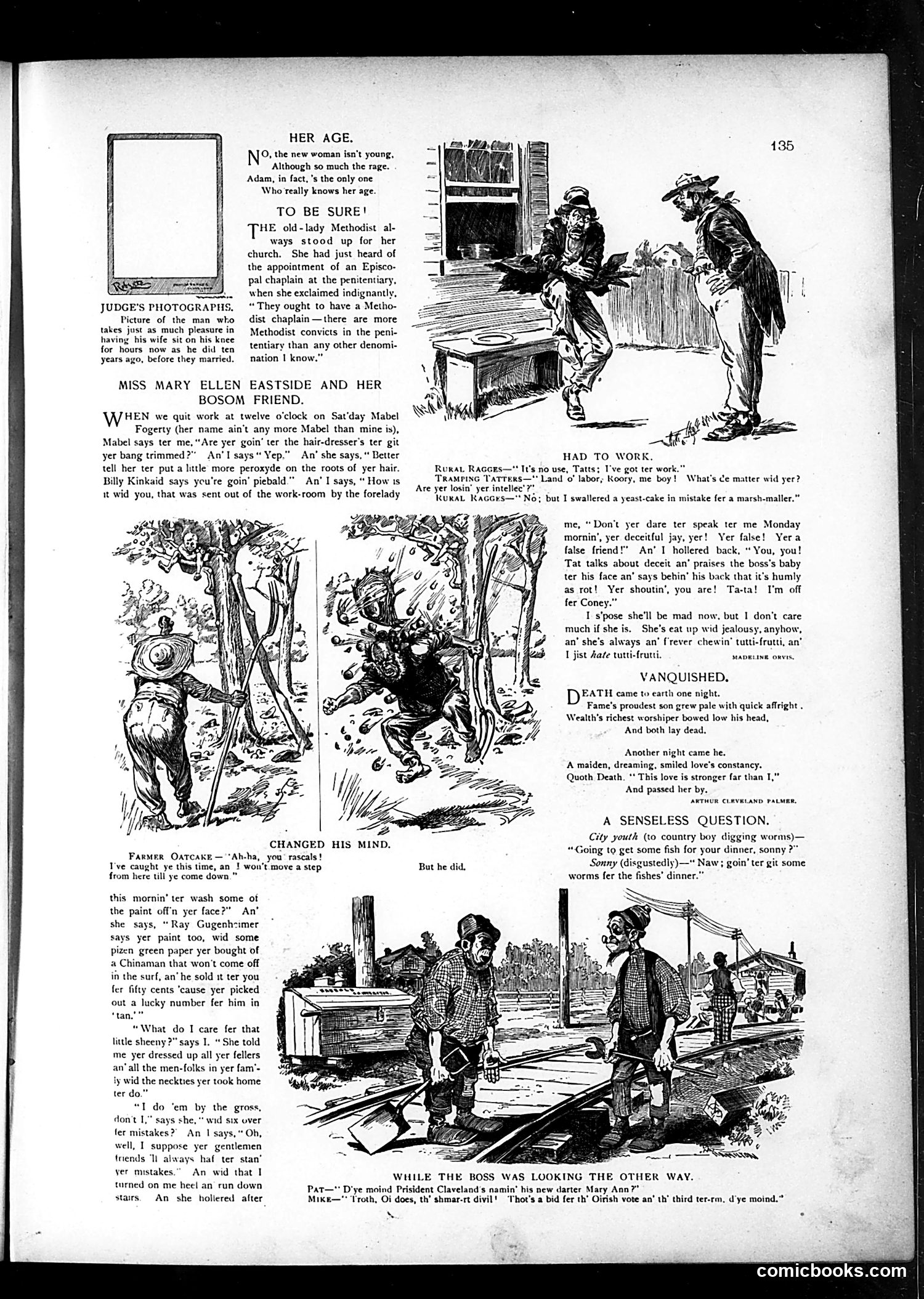
This page collects multiple short humor pieces satirizing early 1900s American society: **"Her Age"** mocks the "New Woman" movement—young women rejecting traditional roles—by suggesting only Adam knows women's true ages. **"Miss Mary Ellen Eastside"** depicts working-class women's petty jealousies and gossip, with dialogue capturing urban immigrant dialect ("yer," "Coney"). The humor targets female cattiness and workplace drama. **"Vanquished"** is sentimental verse about Death being powerless against romantic love—romantic rather than satirical. **"A Senseless Question"** plays on urban/rural cultural gaps: a city youth assumes country children fish for dinner; the child plans to feed caught fish to other fish—inverting expectations. **"Changed His Mind"** shows a farmer threatening trespassers but backing down when confronted. **"While the Boss Was Looking"** depicts Irish immigrant workers (indicated by brogue dialect and references to "President Cleveland's name" and "the Oirish vote") engaging in casual political manipulation. The page reflects period anxieties about women's independence, class tensions, and immigrant political participation.
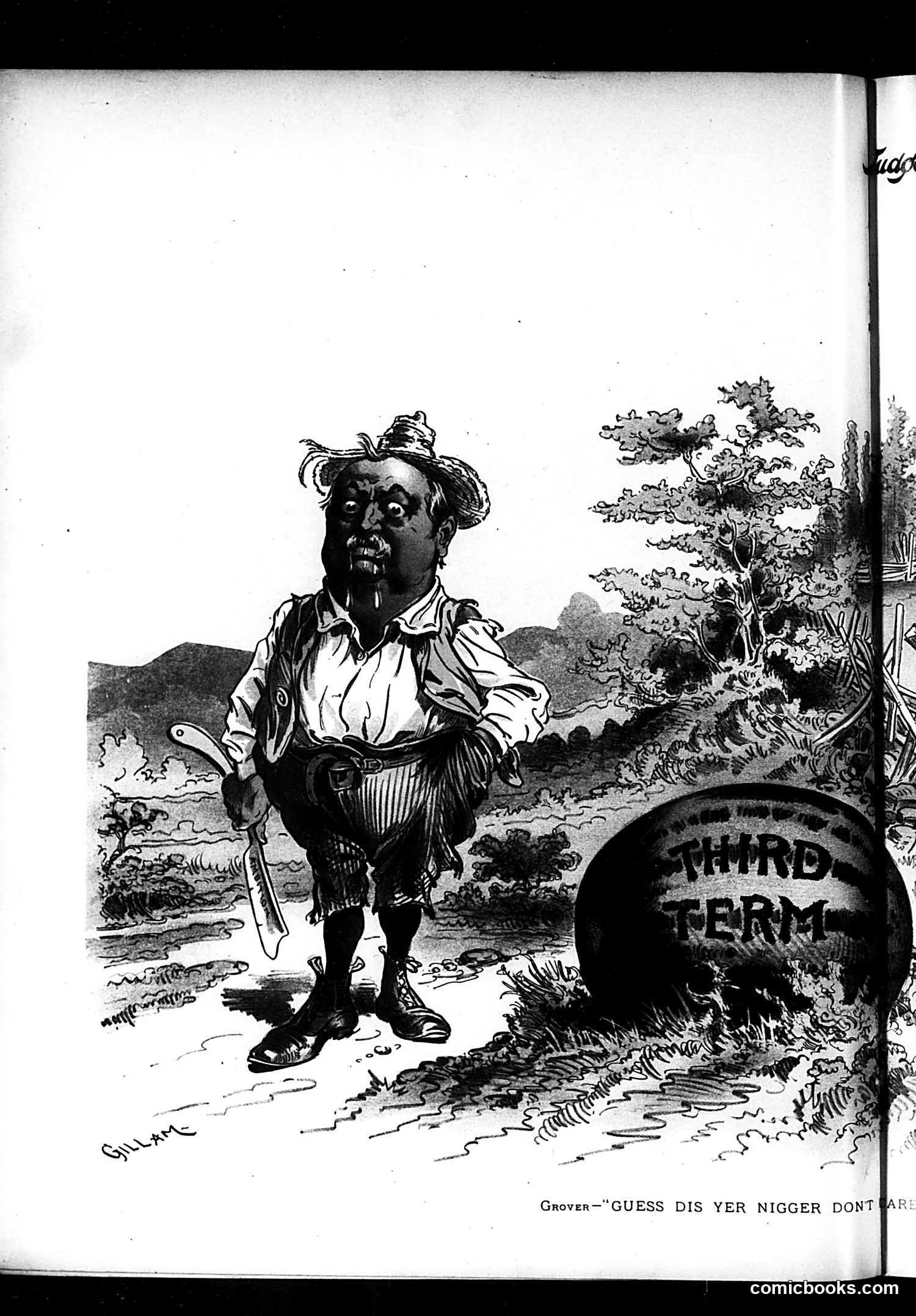
I can see this is a historical political cartoon from *Judge* magazine featuring a caricatured figure labeled "Grover" with a racist caption using a slur. The cartoon depicts a man in 19th-century clothing standing near a large spherical object labeled "THIRD TERM." This appears to reference Grover Cleveland and the political controversy surrounding whether a president could serve non-consecutive terms. The dehumanizing caricature and offensive language reflect the deeply racist editorial practices of the era. Without additional context about the specific date and political circumstances, I cannot definitively explain the intended satirical point, but it clearly combines racial mockery with commentary on Cleveland's political ambitions—representing a shameful example of how political magazines of that period deployed racist imagery.
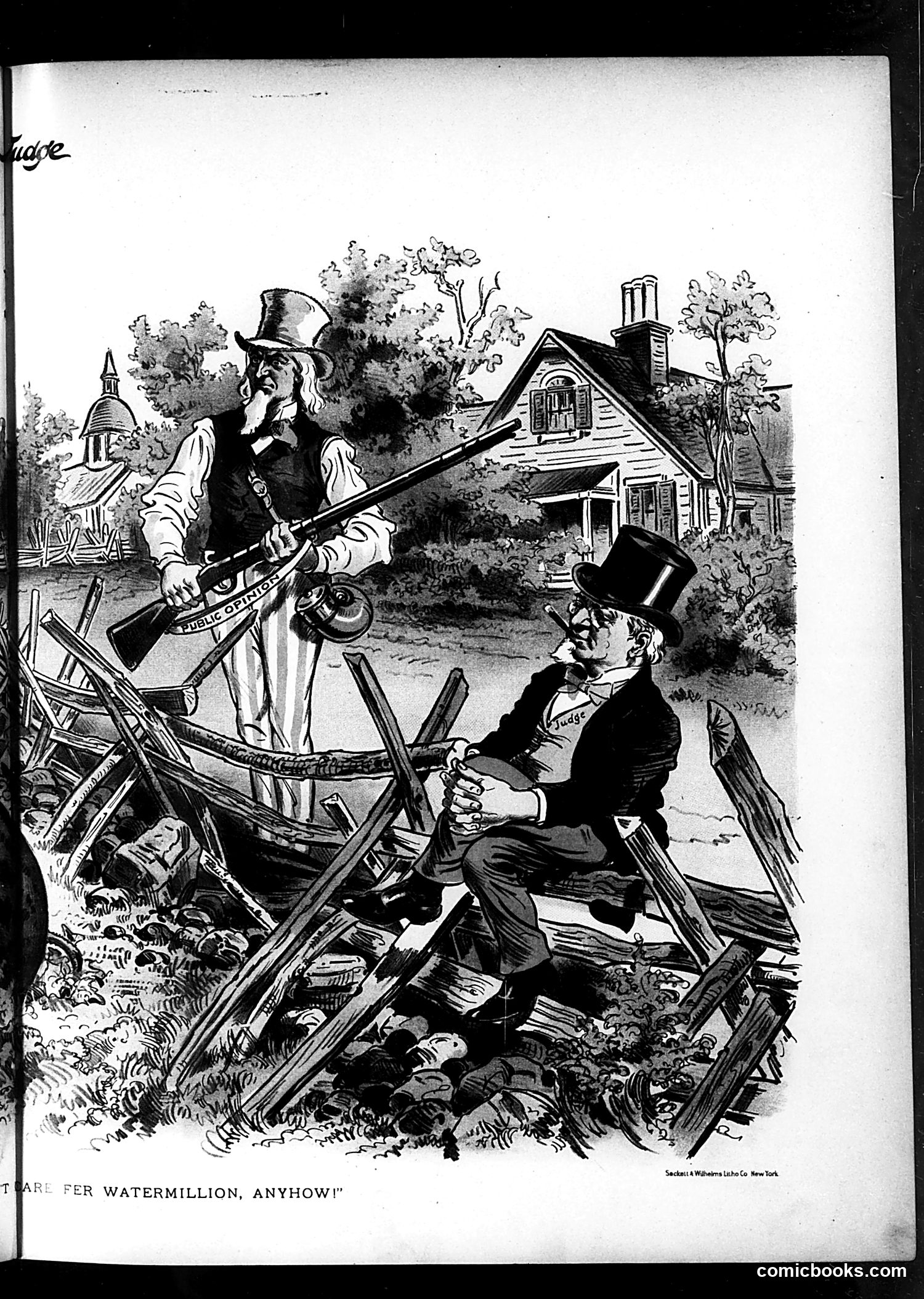
This Judge magazine cartoon depicts two figures amid rural destruction—broken fences and debris surround a cottage and church. The standing figure wears a top hat and holds a rifle labeled "PUBLIC CREDIT," while a seated figure in formal dress looks up at him. The caption reads "FER WATERMILLION, ANYHOW!"—a colloquial phrase suggesting something was done "for watermelon anyway," invoking a racist stereotype about African Americans. This appears to be Reconstruction-era satire (likely 1870s-80s) criticizing the use of federal authority ("Public Credit") to enforce political or economic policies in the South. The cartoon likely mocks Reconstruction efforts as destructive and absurd, using racial caricature to demean the context. The specific historical reference remains unclear without additional context.
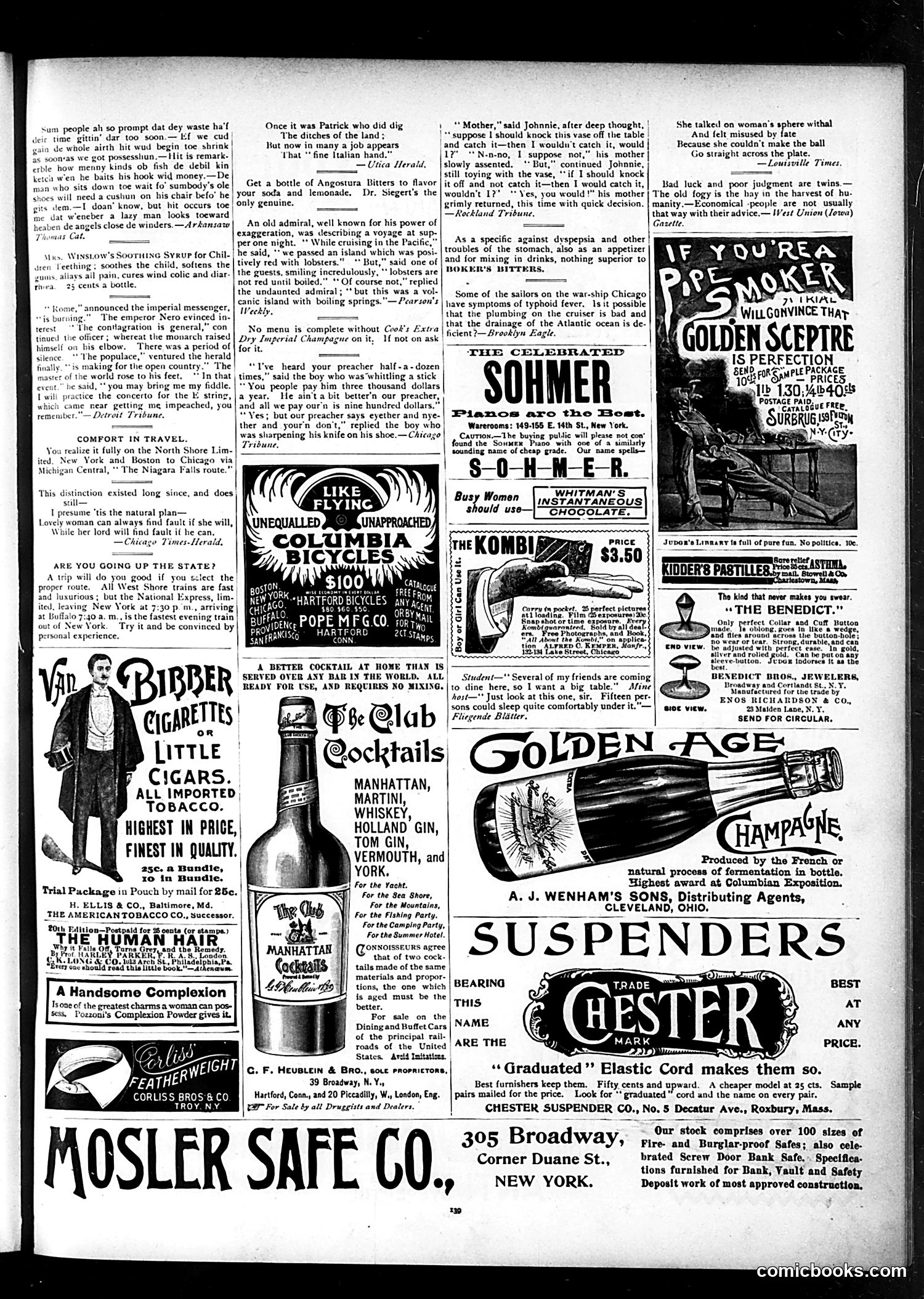
This page from *Judge* magazine is primarily **advertising**, with brief humorous anecdotes scattered between ads. The cartoon content is minimal—mostly vintage product advertisements for cigars, champagne, suspenders, and patent medicines. The few satirical pieces are short, dialect-heavy jokes targeting Irish immigrants ("Sam"), lazy people, and religious hypocrisy. One anecdote mocks an exaggerating admiral's tall tales; another jokes about a boy's logic regarding catching a falling vase. There's mild social commentary comparing preachers' salaries. The page reflects early 20th-century *Judge* humor: lighthearted, class-conscious, relying on ethnic stereotypes and domestic situations rather than sharp political satire. The advertisements (Sohmer pianos, Wenham's champagne, Chester suspenders) suggest the magazine's affluent readership. No specific political figures or events are caricatured here.
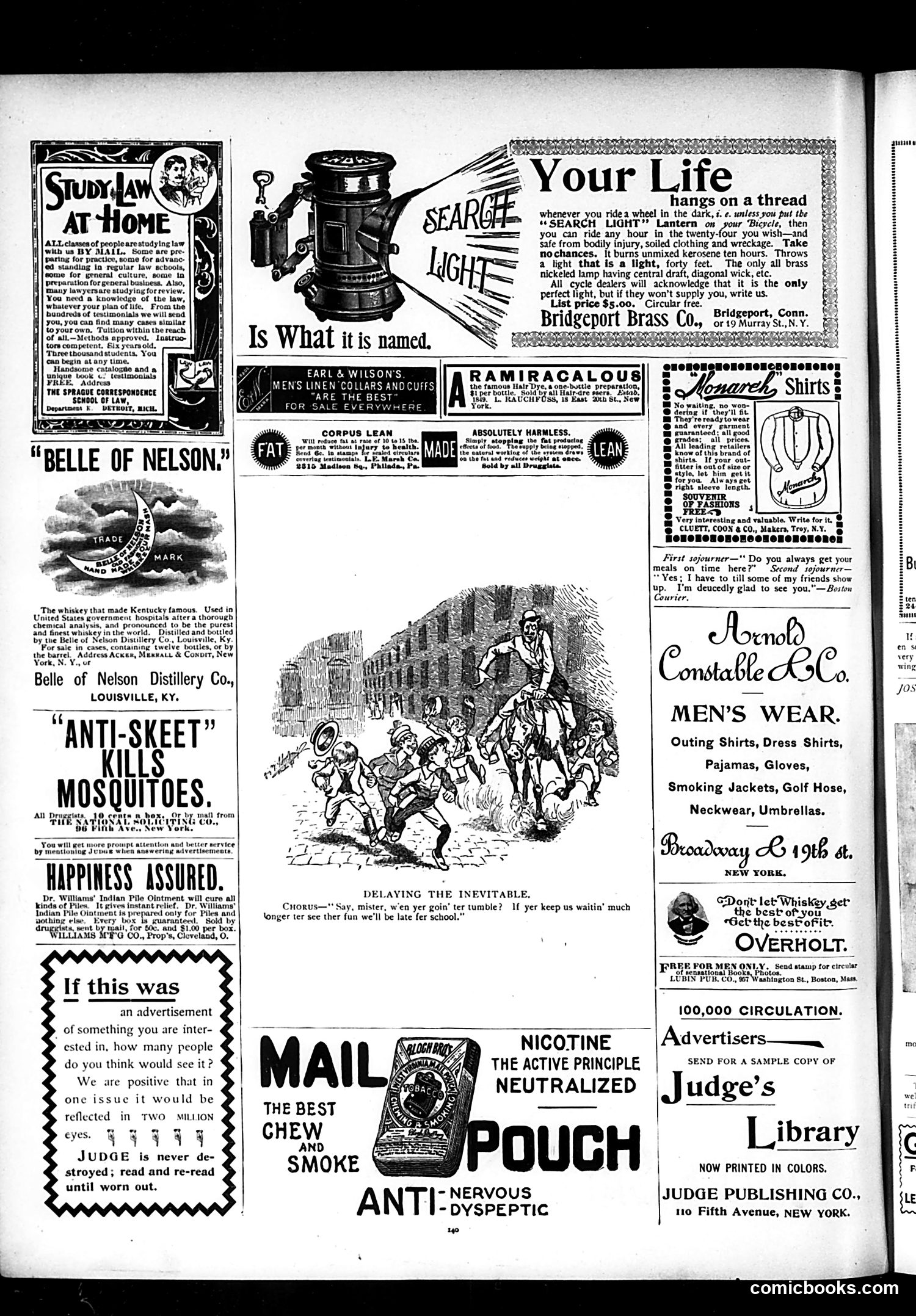
This page is primarily **advertising**, typical of early 20th-century magazines. Notable content includes: **Main Cartoon:** "Delaying the Inevitable" depicts street urchins (labeled "Chorus") pressuring a man to fall over, threatening to be late for school if he delays. It's a dark-humor joke about poverty and children's casual cruelty—the boys are waiting to rob or mock a drunk man. **Advertisements reflect period concerns:** Anti-mosquito products ("Anti-Skeet"), bicycle safety lamps, men's formal wear, and notably, whiskey and tobacco products sold without restriction. The "Mail Pouch" chewing tobacco ad emphasizes it's "anti-nervous" and "anti-dyspeptic"—common health claims of the era before modern advertising regulations. **Belle of Nelson Whiskey** advertisement explicitly states it was "used in United States government hospitals," reflecting pre-Prohibition attitudes toward alcohol as medicine. The page illustrates early 1900s consumer culture, marketing tactics, and social attitudes now considered shocking (child poverty humor, unregulated drug/alcohol claims).
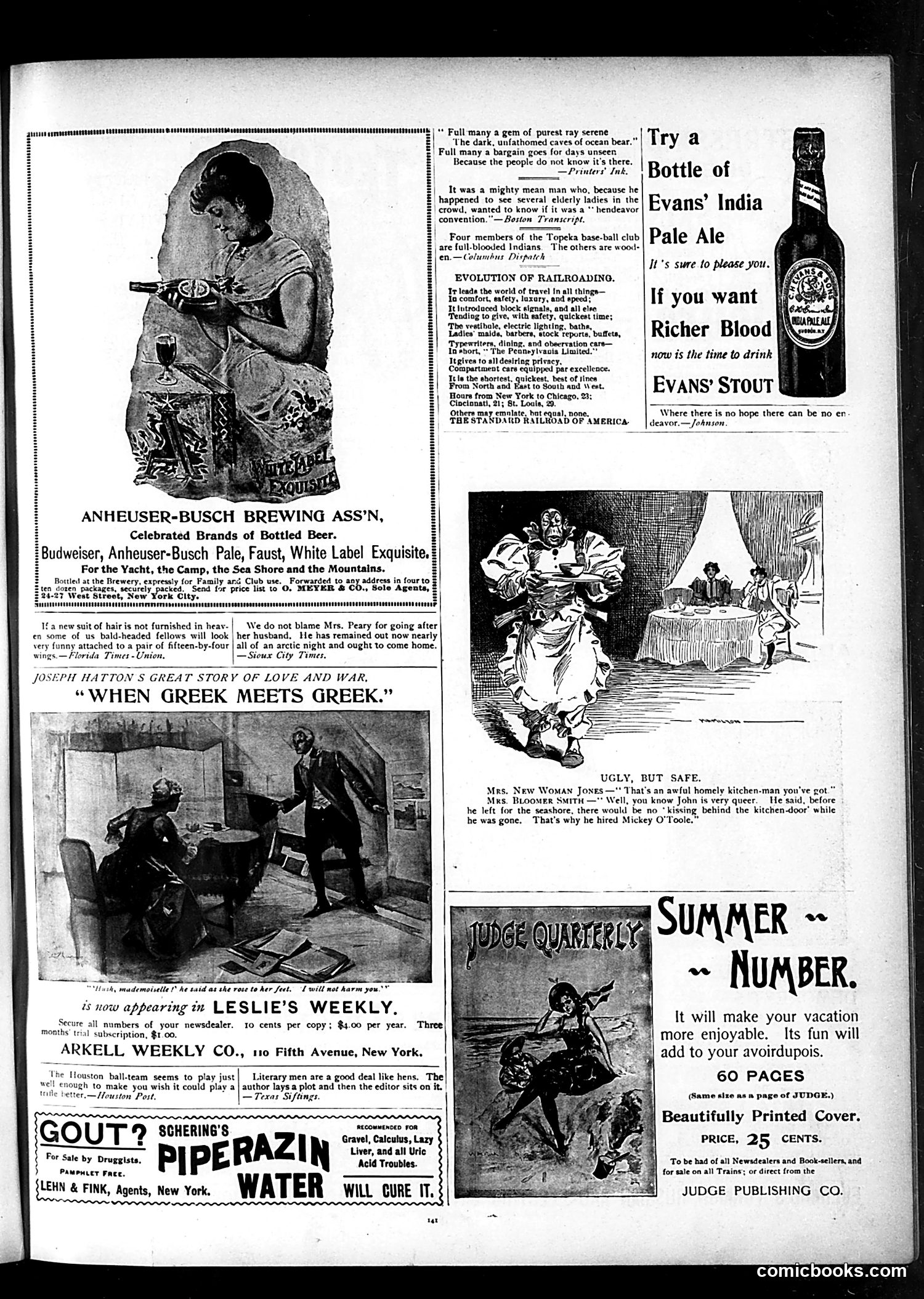
This page is primarily **advertising and promotional content** for Judge magazine's summer issue, with minimal political satire. The main cartoon—"When Greek Meets Greek"—appears to be a romantic or dramatic scene from a serialized story running in Leslie's Weekly, depicting two figures in what seems to be a tense domestic moment. The caption suggests a flirtation or confrontation, though the specific political/social reference is unclear from the image alone. The page is dominated by **period advertisements**: Anheuser-Busch beer, Piperazin water (a patent medicine for gout and kidney troubles), and Evans' ale and stout. These reflect typical early-1900s commercial appeals. The scattered jokes and quotes are mild social humor: references to bald men in heaven, Mrs. Peary's Arctic explorer husband, the Houston baseball team's poor performance, and a "New Woman" joke mocking progressive women's independence. The summer issue promotion emphasizes vacation appeal and "fun" content rather than satirical commentary. This appears to be a filler/revenue page rather than substantive political satire.
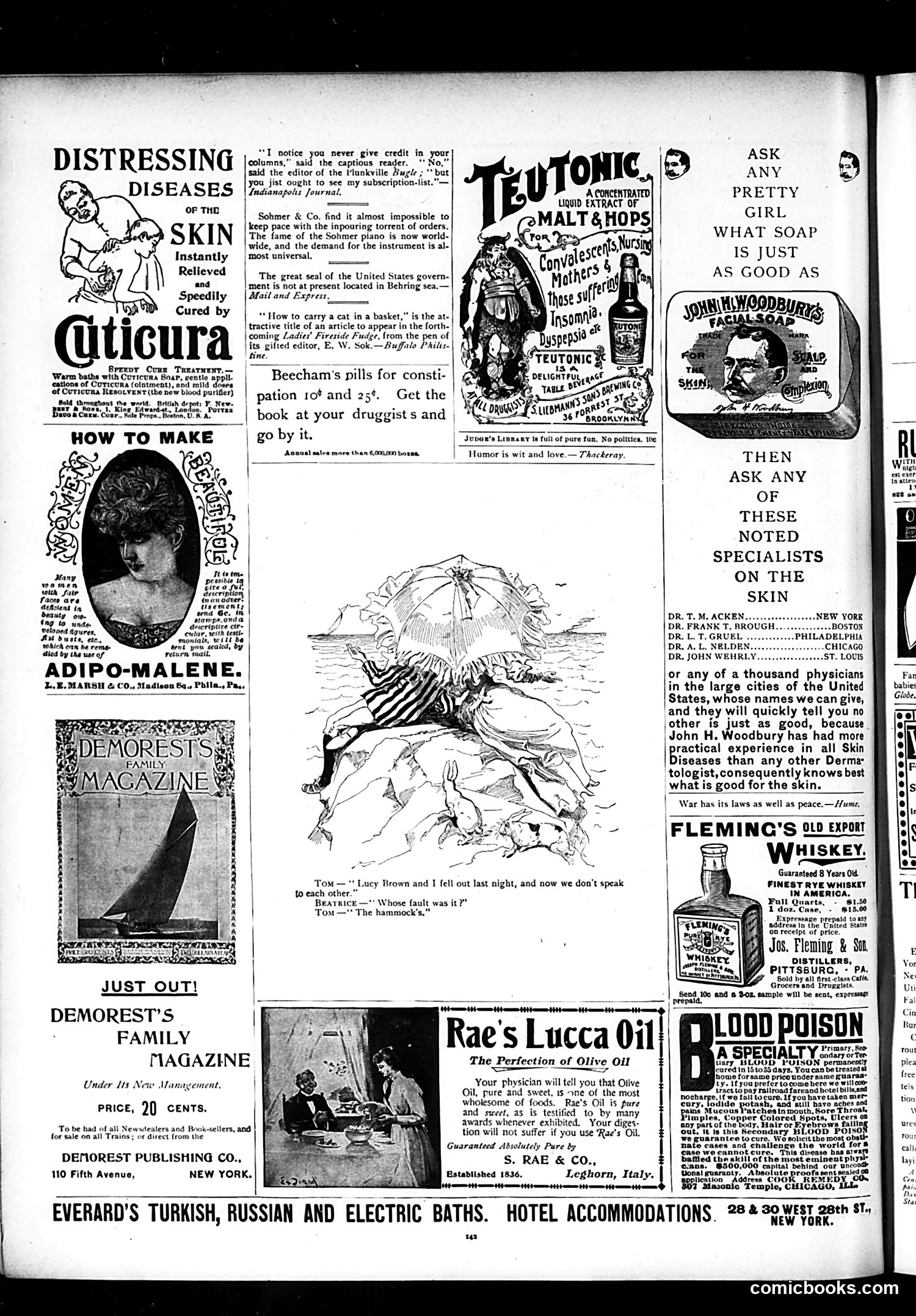
This page is primarily **advertising**, with minimal editorial content. The few small satirical items include: **Brief Jokes/Satire:** - A quip about an editor never crediting sources but having an impressive subscription list—mocking journalistic ethics - A comment that the U.S. government's seal isn't located in Behring Sea—likely referencing a contemporary territorial or political dispute - A domestic spat joke where Tom and Beatrice discuss Tom's argument with Lucy Brown **Dominant Content:** The page is overwhelmingly filled with **patent medicine and beauty product advertisements** (Cuticura, Adipo-Malene, Teutonic, Rae's Lucca Oil, Fleming's Whiskey, Blood Poison treatments). Notably, an ad for John H. Woodbury soap lists "noted specialists on the skin"—a common marketing tactic of the era, lending false medical credibility to consumer products. The page reflects **early 20th-century advertising practices** where dubious health claims and celebrity endorsements were unregulated, and magazines subsidized editorial content through such ads.
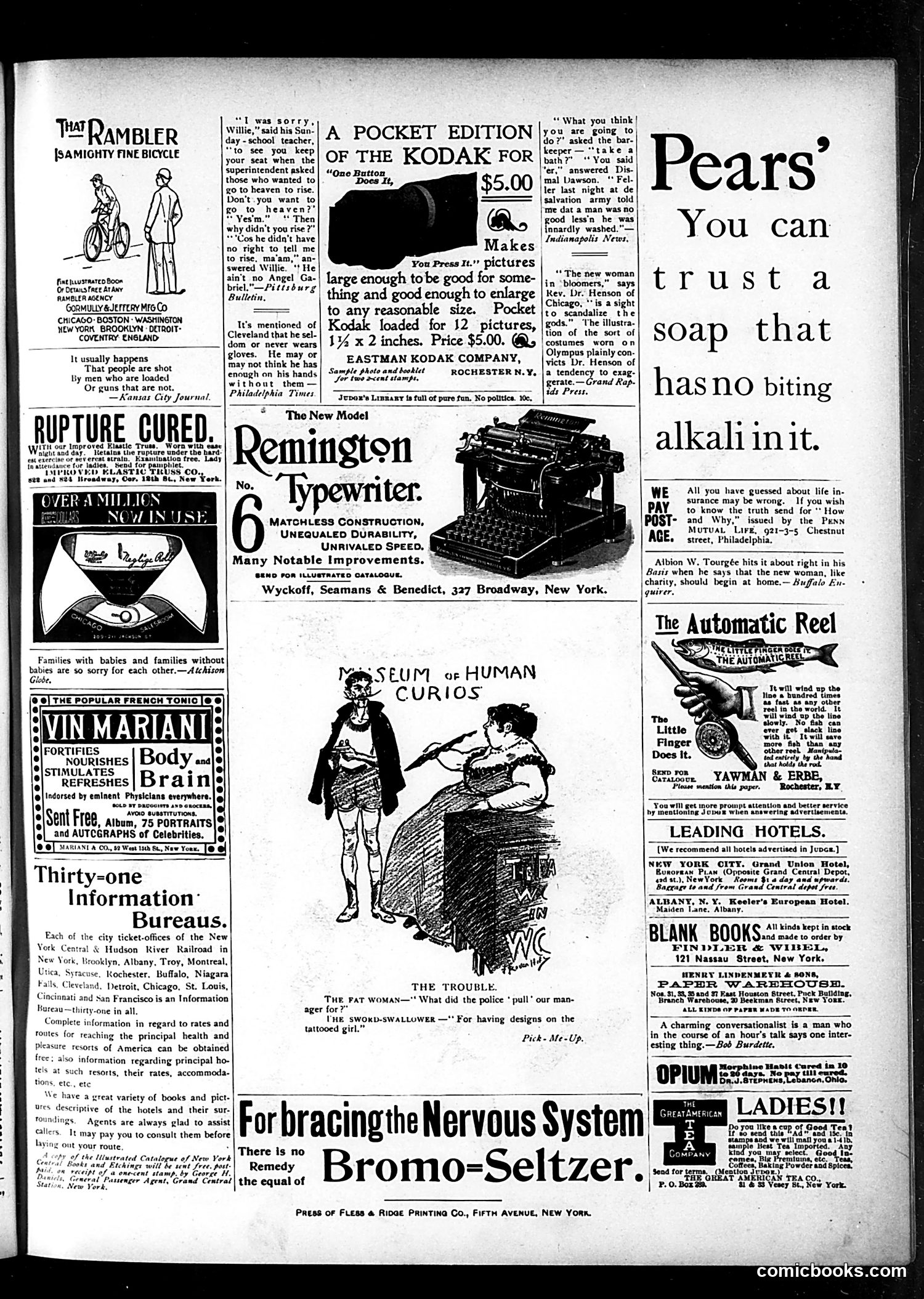
This is primarily an **advertising page** from Judge magazine, with minimal political satire. The page contains various product advertisements (Kodak cameras, Remington typewriters, Bromo-Seltzer) and notices. The only clear **cartoon content** appears to be two small illustrations labeled "THE TROUBLE": 1. **"The Fat Woman"** — depicts a woman asking what the police arrested her manager for 2. **"The Sword-Swallower"** — shows a performer, with the punchline referencing "designs on the tattooed girl" These are mild vaudeville/circus humor jokes, not political satire. The first jokes about police authority; the second about romantic rivalry among performers. The page also includes a bicycle advertisement featuring a dialogue about religious salvation, and various service announcements (Information Bureaus, hotels). **Bottom line**: This is a commercial/service page with filler humor rather than substantive satirical commentary on current events or politics.
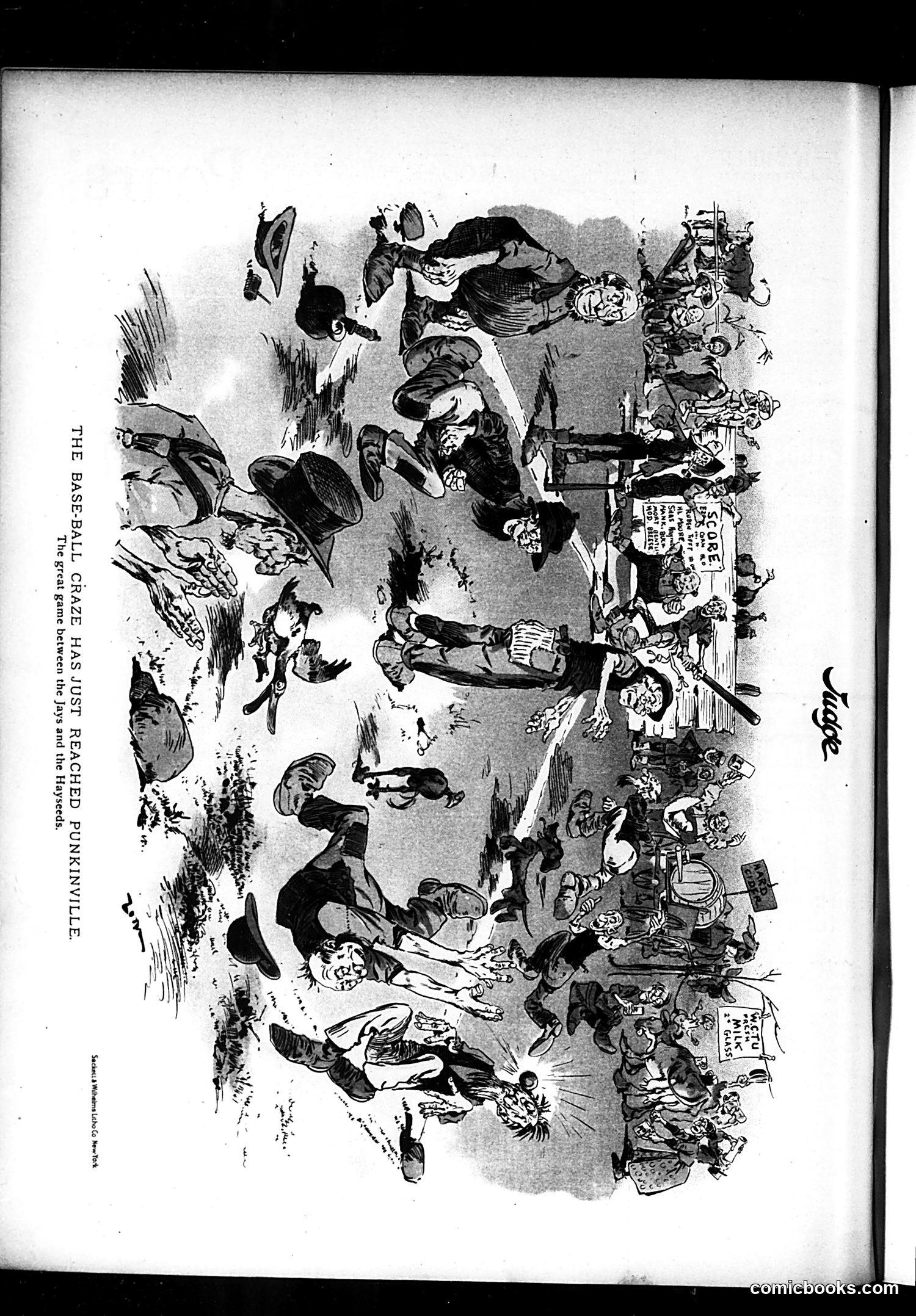
This satirical cartoon depicts baseball's arrival in a rural area ("Punkinville"), contrasting sophisticated urban players with unsophisticated country folk. The cartoon mocks rural Americans as backwards "Hayseeds" confronting modern urban entertainment through an absurd, chaotic game between "the Jays" (likely city slickers) and country players. The humor relies on depicting rural people as ignorant of baseball's proper rules and decorum—showing comic confusion and mayhem rather than organized sport. This reflects late-19th/early-20th-century urban attitudes toward rural Americans as quaint, inferior, and out-of-step with modern civilization. The title suggests amusement at baseball "craze" spreading to supposedly backward areas, reinforcing class and regional prejudices common in Judge magazine's satirical commentary.